EP0518246A2 - Procédé de fabrication de poutre creuse en bois et les structures de cette poutre obtenues par ce procédé - Google Patents
Procédé de fabrication de poutre creuse en bois et les structures de cette poutre obtenues par ce procédé Download PDFInfo
- Publication number
- EP0518246A2 EP0518246A2 EP92109618A EP92109618A EP0518246A2 EP 0518246 A2 EP0518246 A2 EP 0518246A2 EP 92109618 A EP92109618 A EP 92109618A EP 92109618 A EP92109618 A EP 92109618A EP 0518246 A2 EP0518246 A2 EP 0518246A2
- Authority
- EP
- European Patent Office
- Prior art keywords
- hollow wooden
- hollow
- beams
- individual elements
- tree
- Prior art date
- Legal status (The legal status is an assumption and is not a legal conclusion. Google has not performed a legal analysis and makes no representation as to the accuracy of the status listed.)
- Granted
Links
- 238000000034 method Methods 0.000 title claims abstract description 87
- 238000004519 manufacturing process Methods 0.000 title claims abstract description 15
- 239000000463 material Substances 0.000 claims abstract description 40
- 239000002023 wood Substances 0.000 claims abstract description 28
- 238000012545 processing Methods 0.000 claims abstract description 23
- 238000000926 separation method Methods 0.000 claims abstract description 22
- 238000001035 drying Methods 0.000 claims abstract description 20
- 230000015572 biosynthetic process Effects 0.000 claims abstract description 15
- 239000002131 composite material Substances 0.000 claims abstract description 13
- 238000005304 joining Methods 0.000 claims description 37
- 238000003754 machining Methods 0.000 claims description 14
- 239000003292 glue Substances 0.000 claims description 9
- 238000003825 pressing Methods 0.000 claims description 9
- 238000005520 cutting process Methods 0.000 claims description 7
- 239000000835 fiber Substances 0.000 claims description 6
- 238000004026 adhesive bonding Methods 0.000 claims description 5
- 239000007858 starting material Substances 0.000 claims description 5
- 230000000087 stabilizing effect Effects 0.000 claims description 4
- 238000005259 measurement Methods 0.000 claims description 2
- 238000007781 pre-processing Methods 0.000 claims description 2
- 210000001520 comb Anatomy 0.000 claims 1
- 230000000295 complement effect Effects 0.000 claims 1
- 238000007688 edging Methods 0.000 claims 1
- 238000003672 processing method Methods 0.000 claims 1
- 238000004381 surface treatment Methods 0.000 claims 1
- 239000002994 raw material Substances 0.000 abstract description 11
- 241000283690 Bos taurus Species 0.000 abstract description 4
- 239000007787 solid Substances 0.000 abstract description 4
- 238000005755 formation reaction Methods 0.000 description 12
- 238000009792 diffusion process Methods 0.000 description 3
- 206010042674 Swelling Diseases 0.000 description 2
- 238000010276 construction Methods 0.000 description 2
- 238000013461 design Methods 0.000 description 2
- 238000010586 diagram Methods 0.000 description 2
- 210000003128 head Anatomy 0.000 description 2
- 230000008961 swelling Effects 0.000 description 2
- 240000008669 Hedera helix Species 0.000 description 1
- 241000158927 Scolochloa Species 0.000 description 1
- 230000006978 adaptation Effects 0.000 description 1
- 238000004140 cleaning Methods 0.000 description 1
- 238000009826 distribution Methods 0.000 description 1
- 230000000694 effects Effects 0.000 description 1
- 210000000887 face Anatomy 0.000 description 1
- 210000001061 forehead Anatomy 0.000 description 1
- 238000010348 incorporation Methods 0.000 description 1
- 238000009776 industrial production Methods 0.000 description 1
- 238000009434 installation Methods 0.000 description 1
- 238000012432 intermediate storage Methods 0.000 description 1
- 238000003801 milling Methods 0.000 description 1
- 238000005192 partition Methods 0.000 description 1
- 238000002360 preparation method Methods 0.000 description 1
- 230000002787 reinforcement Effects 0.000 description 1
- 239000012779 reinforcing material Substances 0.000 description 1
- 238000010008 shearing Methods 0.000 description 1
- 238000011144 upstream manufacturing Methods 0.000 description 1
- 230000003313 weakening effect Effects 0.000 description 1
Images





Classifications
-
- E—FIXED CONSTRUCTIONS
- E04—BUILDING
- E04C—STRUCTURAL ELEMENTS; BUILDING MATERIALS
- E04C3/00—Structural elongated elements designed for load-supporting
- E04C3/02—Joists; Girders, trusses, or trusslike structures, e.g. prefabricated; Lintels; Transoms; Braces
- E04C3/12—Joists; Girders, trusses, or trusslike structures, e.g. prefabricated; Lintels; Transoms; Braces of wood, e.g. with reinforcements, with tensioning members
- E04C3/14—Joists; Girders, trusses, or trusslike structures, e.g. prefabricated; Lintels; Transoms; Braces of wood, e.g. with reinforcements, with tensioning members with substantially solid, i.e. unapertured, web
-
- B—PERFORMING OPERATIONS; TRANSPORTING
- B27—WORKING OR PRESERVING WOOD OR SIMILAR MATERIAL; NAILING OR STAPLING MACHINES IN GENERAL
- B27B—SAWS FOR WOOD OR SIMILAR MATERIAL; COMPONENTS OR ACCESSORIES THEREFOR
- B27B1/00—Methods for subdividing trunks or logs essentially involving sawing
-
- B—PERFORMING OPERATIONS; TRANSPORTING
- B27—WORKING OR PRESERVING WOOD OR SIMILAR MATERIAL; NAILING OR STAPLING MACHINES IN GENERAL
- B27M—WORKING OF WOOD NOT PROVIDED FOR IN SUBCLASSES B27B - B27L; MANUFACTURE OF SPECIFIC WOODEN ARTICLES
- B27M3/00—Manufacture or reconditioning of specific semi-finished or finished articles
- B27M3/0013—Manufacture or reconditioning of specific semi-finished or finished articles of composite or compound articles
- B27M3/0026—Manufacture or reconditioning of specific semi-finished or finished articles of composite or compound articles characterised by oblong elements connected laterally
- B27M3/0053—Manufacture or reconditioning of specific semi-finished or finished articles of composite or compound articles characterised by oblong elements connected laterally using glue
Definitions
- the inventions relate to processes for the production of hollow wooden beams, as well as hollow wooden beam shapes.
- Round timber outer parts / rinds made of medium-strong and strong round timber diameters, as well as segments / half-timber from the field of small timber serve as starting products.
- the semi-wood-like raw materials / primary materials are preferably conically profiled on three sides in the wet state and slotted against stress / drying cracks. After drying, the multi-sided finished profiling takes place, and the separation into individual elements, the inversions of which lead to a wooden beam with an external solid wood character and an inner hole (wooden hollow beam), or the separation takes place during or after layer formation.
- GM 89095758 describes rind uses in which the joining surface profiling processes are to be carried out as soon as the rind is cut off - ie directly when cutting round logs; a method that cannot be exploited (and poor in terms of rejects).
- Hollow wooden beams - in principle with the character of a Solid wood - with an inner hole arising from the tree curves / tree edge areas, have become known through a study by the CTB, Paris from 1976.
- the method described only provides for the use of shorter log sections of poorer quality (with parallel joining surface profiling), the 4 individual elements a round is formed into a square bar, the length of which should also be achieved in conjunction with boards.
- the inventions are based on the tasks of creating processes for the production of hollow wooden beams, and hollow wooden beams of advantageous shapes, in which the best yield - with the least rejection - is achieved, in which the QUALITIES and definable / catalogable shapes (cm3 / cm4 / red. B / cleaned and processed tree edge parts) are in the foreground, in which all standard dimensions (without dependencies on the different types of raw wood) are FLEXIBLE to manufacture; and where - due to the tree ring structures and core-free beam corners - the products offer high load capacities and remain "crack-free" despite considerable fluctuations in wood moisture; So they are also ideal and preferably suitable for external installation (weathering).
- the object is achieved in that in the so-called sawmill area (FIG. I), the core areas (4) are first removed by parallel cuts (p) on the logs (1) and models (2) coming to the incision, but in this context in principle, no decisions for later uses - that is, no specific requirements for the primary material forms (outer segments) (5) - have to be included, that the usage pattern (31) will only be determined later by the actual primary material forms, and also - depending on the required Quality or tree ring structure - in the case of primary materials, a middle section (26) is rejected by a double cut (26).
- This sequence makes it possible to create the tree ring structures necessary for corner stability and freedom from cracks in the finished wooden hollow beams (50) (no leakage of both tree rings on only one surface).
- the sawn-out middle pieces (4) are used in conventional ways (not for hollow wooden beams).
- the first prerequisite for gauge block profiling (19/10/11 - Fig. VII) is a workpiece that is guided exactly without amplitude. According to the invention, this object is achieved in that - after dressing the lower segment surface (15/19 - Fig. VII) which is distorted during drying - a slitting (20) takes place by means of a circular saw blade, which lies in the plane of the subsequent separation (18), and whereby the workpiece is firmly and tightly guided past the processing stations (FIGS. XIII + XIV) in connection with an attached guide ruler.
- the glue or joint surfaces in the horizontal position not only have to be available, but also as wide as possible - and the hole as small as possible.
- the task of optimal structural design or optimized formation type is achieved in that preferably the vertical glue surfaces are reduced by minimal and the surface moments (cm3 / cm4) negligible joint surface gradations (30 - Fig. XI), whereby the enlargement of the hole edge surfaces the processes from swelling / Control shrinkage / diffusion / tension.
- the advantages of fiber-parallel sawing are inevitably associated with wedge-like middle pieces (Fig. I and III), whose core-free separations lead to half-wood-like, but still wedge-like pieces (5a).
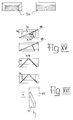
- the task of using these wedge-like, core-free pieces (5a) for hollow wooden beam production is achieved in that the core-free pieces or parts - with optional plane placements (Fig. XV + XVI) - are separated diagonally into triangular-like elements (39), of which the right-angled legs form the corners of the hollow wooden beam, or the triangles obtained can be separated again into two triangles (K 39) with a right angle each, and the triangles are profiled using the usual methods (41).
- the triangles made of wedge-like middle pieces are preferably dried out before gluing (low wood moisture Hu), and the wooden hollow beams made from them are preferred only installed indoors.
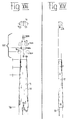
- the method is solved in that the workpieces - (as already mentioned in a previous section) - are slotted (20) and guided through a ruler in front of the processing stations (Fig. XIII) and that the adjustment times and adjustment paths of the processing units (35 ) are derived from the feed element (37) pushing the workpiece (36) at the end.
- the 90 ° ratios of the individual element joining surfaces (10/21) must be created with absolute accuracy, otherwise the individual elements (21) do not require exact dimensional accuracy, since the finished wooden hollow beam is planed again on all sides - including the bevel.
- raw materials (5) segments (15) of the same shape or the same size are used holistically - to glue 2 segments in series (Fig. XIX) in order to then separate the double halves and to carry out the joint surface processing. and press again in rows.
- the inventions are based on stabilizing the wooden hollow beam cross sections by introducing suitable materials, preferably at the beam ends in h0.5 (shear stress zones), and in the area of longitudinal beam connections, but also elements for achieving prestressing.
- the wooden hollow beam (Fig. XXIV) - however formed in cross-section - brings excellent values with regard to deflections (f) because of the almost “standing tree rings” and the fiber-parallel joint surface profiles; through the hole (insignificant for cm3 and cm4) there is a weakening of the cross-section strip in h0.5 - the "b-width" can only be rated with "b-remainder” in the G-module.
- nailed / screwed / combed / glued / pressed / dowelled / - etc. materials are used to prevent shearing at high shear stresses.
- Such composite components are introduced in the longitudinal area - also in connection with longitudinal connections.
- the introduction of the composite materials is preferably preceded by processing of the primary materials (5/15) or individual elements (21), and the composite materials are added during the formation / gluing.
- the addition of composite materials for longitudinal connections is integrated in the process of cross-sectional surface processing (Fig. XXIV), and the introduction of prestressing elements takes place on or in the finished delivery lengths.
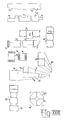
- Fig. I shows the incision of log sections (1) and models (pre-cut logs 2), or the production of the preliminary material (5) for the hollow wooden beams (50).
- the left top view with the end views sketched above illustrates the core-parallel removal (p) of the round timber parts required for the hollow wooden beams
- the second top view from the left with the front view above demonstrates the fiber-parallel (k) separation, the same is illustrated in the middle image, Dar fiber parallel (k)
- the outer materials can also be cut in connection with the core-parallel (p) incision.
- the top view with front view shows a preliminary material production that is common in small wood, namely core-parallel (p) separation of the round wood parts when a core board is set; or again (right sketch) fiber-parallel separation (k).
- Fig. II demonstrates the most varied shapes resulting from the roundwood or model cut of the roundwood parts serving as the preliminary material (5) for the production of hollow wooden beams.
- Fig. III illustrates in the two left sketches how the wedge-like central pieces (3) resulting from the fiber-parallel (k) round wood incision (Fig. I) can be separated further, and how by cutting out a core board (4) primary materials (5a) are created again with one or three conical surfaces (e, 2 front view sketches on the right).
- Fig. IV shows cylindrical (1a + 2a) or conical (1b + 2b) profiled log sections, and shows by the dashed lines in the front views that cylindrical and conical logs can be used analogously to the logs Fig. I.
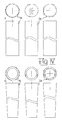
- Fig. V illustrates the most varied of pre-material shapes that can arise from the cuts.
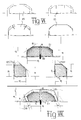
- the top right front view shows how wet pre-material (before drying) can be separated in the middle or off-center (16), and how a triangular-like (17) single part results from it; and the sketch below shows how the joining surfaces (10) are conical or parallel (p + k) on the single piece (17) - and the tree edge areas (13 + 14) are processed in between.
- the middle, right-hand cross-sectional sketch shows how a pre-material (5) separated in the incision area (Fig. I) in the wet state is pre-processed to a segment (15) with a three-surface conical shape (k), while maintaining a certain joining surface width (11) (10) - And is provided with relaxation slots (12).
- the vertical dashing indicates that the annual ring ends (9) always run out on 2 surfaces during a later cut.
- the two lower sketches basically show the same (15), they only refer to the tree edge area machining (13 + 14) and a different type of relaxation slits, and the sketches indicate that the pre-processing does not have three faces in every skin. is conical, but only twice or once (p).
- VI shows the variety of primary material forms in the two rows on the left.
- cross sections 21 show how the throughput accuracy in the final dimension profiling (19) is fixed by a slot milling cutter (20), the slot width of which is covered by the subsequent separation (18).
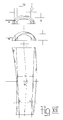
- Fig. VII shows how the pre-processed segments (15) "warp” due to the tree ring structure in the drying process.
- the middle cross-sectional sketch - and the two outer cross-sectional sketches (quarter pieces) show the gauge block profiling (19) including the tree edge area machining (13/14), the joint surface widths (11), the slot cutter / ruler guide (20), and the separation (18), as well the tree ring exits (9) on 2 surfaces.
- Fig. VIII demonstrates again the single element production (21) with the processing stages 19/11/20/13/14 with 3-surface conical (k), but with the difference compared to the types described above, that the joining surfaces are not perpendicular to the cross-sectional shape, but oblique (22/23).
- Fig. IX shows in the left row end views of individual elements (21a) resulting in different sizes due to different Ronholz diameters (24).
- the bars (50) with a hole (51) sketched to the right always show the same cross-sectional size (24a) by combining individual elements (21a) of different sizes.
- Fig. X illustrates that - depending on the shapes and combinations of 21a and their joining surfaces (10/11), the weld areas (13) cover the center of the cross-section of the beam, and therefore have to be processed at an angle (14).
- Fig. XII demonstrates in the forehead and top view the geometric distortions in bent woods, and in what way the axis curvatures (32) via the taper (K) leads to the grid (31).
- the path-time ratio for the precise, conical adjustments (k) of the stations in the machining center (35) is derived from the feed element (37) inserting the workpiece (36) at the end of the passage (33).
- XIV demonstrates, analogously to FIG. XIII, the processing in the pass (34) not on workpieces similar to semi-wood, but on quarter pieces (17).
- XV shows at the top in two end views the wedge-like (3) pre-materials (5a) that result from the parallel splitting of the wood sections, which (left sketch) can be conical on three sides or only conical on one side.
- the 4 front views below show how the geometries of the primary materials (5a) shift to the diagonal cut separation process (38), and how right angles (40) are formed again on individual elements (39), or how smaller individual elements result from further separations Have (K 39) made with a right angle (40).
- XVI indicates how the joining surfaces of the individual elements (39 / K 39) are conically profiled (k) and how a bar (65) is to be formed from the triangles (41).
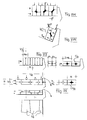
- Fig. XVII Fig. XVIII illustrates in the front view (42) how 4 individual elements (E 1 7) can be glued by pressing (F1 ...); and the upper sketch (Fig. XVII) indicates that multi-layer pressing of differently sized individual elements with thickness tolerances (x) is not possible.
- Fig. XIX shows a procedure in which the beam halves (43) are pressed in series in order to then separate the glued 2 Balkan halves (44) (H1 / H2), and after aligning the joining surfaces again by row pressing the beam height (50 / H 1 / 2 ) to form.
- Fig. XX illustrates a pressing "in the carpet” (46), wherein the 2-layer formation (45) gives the bar width (B). The beam heights (50 / H) are separated from this "carpet" (46).
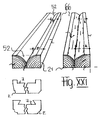
- Fig. XXI shows a perspective view of the beams (66) formed from only 2 individual parts (21) with conical (k) or parallel (p) joining surfaces with an open cavity (52), as well as two cross-sectional sketches with the information, as on this beam Corners (E) and interior areas (I) are to be machined.
- Fig. XXII shows the wooden hollow beam (50) in the top right in 2 perspective views, with references to the hole (51), the hole sizes (53), their edges (57), and the tree rings (55) in the corner area (54 ), as well as tree ring end exits (9) on two surfaces, as well as a cross-sectional diagram to the left of the perspective sketch to clarify the tree ring structures after core area removal (4) and smooth double cut (26) to reach the individual elements (21), and how they are place the tree rings (9).
- the 11 cross-section diagrams outlined below show the types of beams.
- Eg - 1. beams (57) with sloping Machining (14) between the joining surfaces - 2.) beams (56) with relaxation slots (12) - 3.) again (57) oblique processing (14) - 4.) beams (58) with stepped joining surfaces (10/30) - 5 .) Beams (59) with different sized and “combined" individual elements (21 / 21a) - 6.) dto.
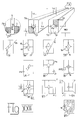
- Fig. XXIII shows in two side views beams (50) with processing (73) in the form of what ABBUND means. These include cross-sectional and longitudinal shapes such as head pieces (71) and incorporations (I 72). (e.g. beamed ceilings and wooden house walls). In the middle of Fig. XXIII layers (69) of hollow wooden beams (50), as well as elements and shapes (70) for longitudinal connections, and finally in the lower part of the figure, such as hollow wooden beams (50) by machining to polygons (67) or wholly or partially circular columns (68) are to be machined.
- cross-sectional and longitudinal shapes such as head pieces (71) and incorporations (I 72). (e.g. beamed ceilings and wooden house walls).
- layers (69) of hollow wooden beams (50) as well as elements and shapes (70) for longitudinal connections, and finally in the lower part of the figure, such as hollow wooden beams (50) by machining to polygons (67) or wholly or partially circular columns (68) are to
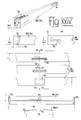
- XXIV demonstrates possibilities for the introduction of composite materials, e.g. indicated in the top perspective view (80/50) by reinforcing materials (74) in the shear stress range (h 0.5), and below in 2 side views (80/50) again in the shear stress range (h 0.5) e.g. through dowels (75) or cranked (76) shapes.
- the lower side view (80/50) shows possibilities of how fixed lengths (81) of the wooden hollow beam (50) can be pre-tensioned (Vf) by inserting head pieces (82) and tension elements (83) that take account of the elongation.
Landscapes
- Engineering & Computer Science (AREA)
- Life Sciences & Earth Sciences (AREA)
- Wood Science & Technology (AREA)
- Architecture (AREA)
- Forests & Forestry (AREA)
- Civil Engineering (AREA)
- Structural Engineering (AREA)
- Mechanical Engineering (AREA)
- Manufacturing & Machinery (AREA)
- Rod-Shaped Construction Members (AREA)
- Artificial Filaments (AREA)
Applications Claiming Priority (6)
| Application Number | Priority Date | Filing Date | Title |
|---|---|---|---|
| DE9107371U | 1991-06-14 | ||
| DE9107371U DE9107371U1 (de) | 1991-06-14 | 1991-06-14 | Holzbalken |
| DE9107760U DE9107760U1 (de) | 1991-06-24 | 1991-06-24 | Deckenbalken und Fachwerk |
| DE9107760U | 1991-06-24 | ||
| DE4204616 | 1992-02-15 | ||
| DE4204616 | 1992-02-15 |
Publications (3)
| Publication Number | Publication Date |
|---|---|
| EP0518246A2 true EP0518246A2 (fr) | 1992-12-16 |
| EP0518246A3 EP0518246A3 (en) | 1993-05-19 |
| EP0518246B1 EP0518246B1 (fr) | 1999-03-17 |
Family
ID=27203418
Family Applications (1)
| Application Number | Title | Priority Date | Filing Date |
|---|---|---|---|
| EP92109618A Expired - Lifetime EP0518246B1 (fr) | 1991-06-14 | 1992-06-06 | Procédé de fabrication de poutre creuse en bois et les structures de cette poutre obtenues par ce procédé |
Country Status (3)
| Country | Link |
|---|---|
| EP (1) | EP0518246B1 (fr) |
| AT (1) | ATE177672T1 (fr) |
| DE (1) | DE59209652D1 (fr) |
Cited By (16)
| Publication number | Priority date | Publication date | Assignee | Title |
|---|---|---|---|---|
| EP0549744A4 (en) * | 1991-07-03 | 1993-12-29 | Peter Sing | Method of converting logs and resultant product |
| WO1998025740A1 (fr) * | 1996-12-13 | 1998-06-18 | Primwood Ab | Procede de decoupe de troncs |
| AT2296U1 (de) * | 1997-06-13 | 1998-08-25 | Felbermayr Herbert | Verfahren zum herstellen von profilholz |
| USRE36153E (en) * | 1992-09-24 | 1999-03-23 | Sing; Peter | Converted log structural products and method |
| WO1999062679A1 (fr) * | 1998-05-29 | 1999-12-09 | Hammarstroem Lars | Procede permettant de diviser un rondin et unite de bois |
| EP0995852A1 (fr) * | 1998-10-23 | 2000-04-26 | Konstruktion-Holz-Werk Seubert KHW GmbH & Co. KG | Poutre en bois et procédé de fabrication d'une poutre |
| EP0933175A3 (fr) * | 1998-01-20 | 2000-10-04 | Fries, Petra | Procédé de fabrication de pièces individuelles et de poutre en bois composées de ces pièces individuelles et chaíne de production d'usinage mécanique |
| EP0915213A3 (fr) * | 1997-11-04 | 2000-10-18 | Konstruktion-Holz-Werk Seubert KHW GmbH & Co. KG | Elément de construction en bois et son procédé de fabrication |
| WO2002010531A1 (fr) * | 2000-07-27 | 2002-02-07 | Karlstroem Johan Tore | Systeme de barres de renforcement et procede associe |
| WO2011051794A3 (fr) * | 2009-10-30 | 2011-07-14 | Nikolay Skuratov | Plaque de bois semi-massif composée de profilés de bois collés les uns aux autres |
| RU2478466C1 (ru) * | 2011-10-04 | 2013-04-10 | Федеральное государственное бюджетное образовательное учреждение высшего профессионального образования Марийский государственный университет | Способ раскроя круглых лесоматериалов, имеющих кольцевые поражения |
| AT515171A1 (de) * | 2013-12-10 | 2015-06-15 | Hans-Peter Ing Leitinger | Schnittholzplatte aus Seitenbrettware sowie Verfahren zu deren Herstellung |
| EP3127669A1 (fr) * | 2015-08-04 | 2017-02-08 | Binderholz International AG | Procede de fabrication de composants en bois |
| EP3429811B1 (fr) * | 2016-03-18 | 2021-02-17 | Weinig Dimter GmbH & Co. KG | Procede de production de blocs formes d'assemblage de pieces de bois collees, et dispositif de mise en oeuvre du procede. |
| CN112606151A (zh) * | 2020-12-16 | 2021-04-06 | 南京林业大学 | 一种利用小径木制作空心圆木柱的方法 |
| CN116872310A (zh) * | 2023-07-12 | 2023-10-13 | 德华兔宝宝装饰新材股份有限公司 | 一种重组板芯生产方法 |
Family Cites Families (8)
| Publication number | Priority date | Publication date | Assignee | Title |
|---|---|---|---|---|
| DE855900C (de) * | 1950-08-18 | 1952-11-17 | Hans Vollmar | Holzbauglied, z. B. Traeger, Stuetze, Fachwerkstab od. dgl. |
| CH284016A (de) * | 1950-08-22 | 1952-07-15 | Emil Dr Staudacher | Konstruktionselement aus Holz. |
| DE1434785A1 (de) * | 1964-03-02 | 1968-11-28 | Fritz Reinke | Aus Fertigteilen zusammengesetzter Hohlkoerper |
| DE1509026A1 (de) * | 1964-03-21 | 1969-01-09 | Timber Engineering Company | Balkenkonstruktion fuer Holzbauten |
| DE3130445C2 (de) * | 1981-07-23 | 1984-09-06 | Gerhard Dipl.-Ing. 5461 Ockenfels Meickl | Beschlag zum querkraftbelastbaren Anschluß an die Stirnseite von Holzbalken |
| FR2606057B1 (fr) * | 1986-11-04 | 1990-10-12 | Wolf Philippe | Renforcement d'elements de charpente par insertion de plaques a haute resistance |
| EP0388507B1 (fr) * | 1989-03-23 | 1995-06-28 | Berthold Fries | Poutre en bois et procédé pour sa fabrication |
| DE8909575U1 (de) * | 1989-08-10 | 1989-12-07 | Gebr. Kühne GmbH & Co. Sägewerk und Holzhandel, 3404 Adelebsen | Verbundbalken aus Seitenware erzeugt |
-
1992
- 1992-06-06 EP EP92109618A patent/EP0518246B1/fr not_active Expired - Lifetime
- 1992-06-06 DE DE59209652T patent/DE59209652D1/de not_active Expired - Fee Related
- 1992-06-06 AT AT92109618T patent/ATE177672T1/de active
Cited By (22)
| Publication number | Priority date | Publication date | Assignee | Title |
|---|---|---|---|---|
| USRE35327E (en) * | 1991-07-03 | 1996-09-10 | Sing; Peter | Method of converting logs and resultant product |
| EP0549744A4 (en) * | 1991-07-03 | 1993-12-29 | Peter Sing | Method of converting logs and resultant product |
| USRE36153E (en) * | 1992-09-24 | 1999-03-23 | Sing; Peter | Converted log structural products and method |
| US6374881B1 (en) | 1996-12-13 | 2002-04-23 | Primwood Ab | Method for cutting up logs |
| WO1998025740A1 (fr) * | 1996-12-13 | 1998-06-18 | Primwood Ab | Procede de decoupe de troncs |
| RU2182862C2 (ru) * | 1996-12-13 | 2002-05-27 | Примвуд Аб | Способ распиловки бревен |
| AT2296U1 (de) * | 1997-06-13 | 1998-08-25 | Felbermayr Herbert | Verfahren zum herstellen von profilholz |
| EP0915213A3 (fr) * | 1997-11-04 | 2000-10-18 | Konstruktion-Holz-Werk Seubert KHW GmbH & Co. KG | Elément de construction en bois et son procédé de fabrication |
| EP0933175A3 (fr) * | 1998-01-20 | 2000-10-04 | Fries, Petra | Procédé de fabrication de pièces individuelles et de poutre en bois composées de ces pièces individuelles et chaíne de production d'usinage mécanique |
| WO1999062679A1 (fr) * | 1998-05-29 | 1999-12-09 | Hammarstroem Lars | Procede permettant de diviser un rondin et unite de bois |
| EP0995852A1 (fr) * | 1998-10-23 | 2000-04-26 | Konstruktion-Holz-Werk Seubert KHW GmbH & Co. KG | Poutre en bois et procédé de fabrication d'une poutre |
| WO2002010531A1 (fr) * | 2000-07-27 | 2002-02-07 | Karlstroem Johan Tore | Systeme de barres de renforcement et procede associe |
| US7225594B2 (en) | 2000-07-27 | 2007-06-05 | Karlstroem Johan Tore | Stud system and methods related thereto |
| WO2011051794A3 (fr) * | 2009-10-30 | 2011-07-14 | Nikolay Skuratov | Plaque de bois semi-massif composée de profilés de bois collés les uns aux autres |
| RU2478466C1 (ru) * | 2011-10-04 | 2013-04-10 | Федеральное государственное бюджетное образовательное учреждение высшего профессионального образования Марийский государственный университет | Способ раскроя круглых лесоматериалов, имеющих кольцевые поражения |
| AT515171A1 (de) * | 2013-12-10 | 2015-06-15 | Hans-Peter Ing Leitinger | Schnittholzplatte aus Seitenbrettware sowie Verfahren zu deren Herstellung |
| AT515171B1 (de) * | 2013-12-10 | 2016-02-15 | Hans-Peter Ing Leitinger | Schnittholzplatte aus Seitenbrettware sowie Verfahren zu deren Herstellung |
| EP3127669A1 (fr) * | 2015-08-04 | 2017-02-08 | Binderholz International AG | Procede de fabrication de composants en bois |
| EP3429811B1 (fr) * | 2016-03-18 | 2021-02-17 | Weinig Dimter GmbH & Co. KG | Procede de production de blocs formes d'assemblage de pieces de bois collees, et dispositif de mise en oeuvre du procede. |
| CN112606151A (zh) * | 2020-12-16 | 2021-04-06 | 南京林业大学 | 一种利用小径木制作空心圆木柱的方法 |
| CN112606151B (zh) * | 2020-12-16 | 2023-07-18 | 南京林业大学 | 一种利用小径木制作空心圆木柱的方法 |
| CN116872310A (zh) * | 2023-07-12 | 2023-10-13 | 德华兔宝宝装饰新材股份有限公司 | 一种重组板芯生产方法 |
Also Published As
| Publication number | Publication date |
|---|---|
| EP0518246B1 (fr) | 1999-03-17 |
| DE59209652D1 (de) | 1999-04-22 |
| ATE177672T1 (de) | 1999-04-15 |
| EP0518246A3 (en) | 1993-05-19 |
Similar Documents
| Publication | Publication Date | Title |
|---|---|---|
| EP0518246A2 (fr) | Procédé de fabrication de poutre creuse en bois et les structures de cette poutre obtenues par ce procédé | |
| DE69624497T2 (de) | Stapelleiste für gestapeltes schnittholz | |
| EP0107690B1 (fr) | Procede et dispositif pour transformer des billes de bois en bois de construction | |
| EP0388507B1 (fr) | Poutre en bois et procédé pour sa fabrication | |
| EP0864020B1 (fr) | Procede de fabrication d'elements constitutifs contenant du bambou, notamment des plaques en bambou collees pouvant etre utilisees pour des meubles et l'amenagement interieur, et elements constitutifs en bambou | |
| DE69223596T2 (de) | Verbundstoff mit diagonaler Holzmaserung | |
| DE69517046T2 (de) | Verbindungskonstruktion für holzelemente | |
| DE2159337A1 (de) | Verfahren und vorrichtung zur herstellung von schnittholz | |
| DE857139C (de) | Gittertraeger aus Holzgurten und Metallstreben sowie Verfahren zu seiner Herstellung | |
| DE3623235C2 (fr) | ||
| EP0862976B1 (fr) | Procédé pour la fabrication de baguettes couvre-joint | |
| EP0663272B1 (fr) | Procédé pour subdiviser des troncs d'arbre en pièces travaillées tout les cÔtés | |
| DE1225843B (de) | Verfahren zur Herstellung von Gegenstaenden aus Holz | |
| DE69513122T2 (de) | Vorgefertigte Verbindungsanordnung für einen Holzbalken | |
| EP1721714B1 (fr) | Poutre composite en bois | |
| DE821416C (de) | Verfahren zur Herstellung von gesperrten Fussbodenbrettern | |
| DE2902222C2 (de) | Verfahren zur Herstellung von Vollholzprofilen | |
| DE2424517A1 (de) | Aus einem runden holzquerschnitt zu gewinnender, reihenweise dicht zusammensetzbarer querschnitt | |
| DE9107371U1 (de) | Holzbalken | |
| WO1988004531A1 (fr) | Procede pour fabriquer des panneaux d'epaisseur differente en bois ou en materiaux de substitution du bois | |
| DE19700015C1 (de) | Verfahren zur Herstellung von Verleimprofilen an Hölzern | |
| DE102011054165B4 (de) | Verfahren zur Herstellung von Keilbohlen | |
| WO1996014971A1 (fr) | Procede pour la fabrication d'elements de panneaux revetus | |
| DE69929884T2 (de) | Verfahren zum aufteilen eines baumstammes und holzeinheit | |
| DE3913160A1 (de) | Verfahren zum herstellen einer fertigplatte aus holz oder holzmaterial sowie eine nach diesem verfahren hergestellte fertigplatte |
Legal Events
| Date | Code | Title | Description |
|---|---|---|---|
| PUAI | Public reference made under article 153(3) epc to a published international application that has entered the european phase |
Free format text: ORIGINAL CODE: 0009012 |
|
| AK | Designated contracting states |
Kind code of ref document: A2 Designated state(s): AT BE CH DE DK ES FR GB GR IT LI LU MC NL PT SE |
|
| PUAL | Search report despatched |
Free format text: ORIGINAL CODE: 0009013 |
|
| AK | Designated contracting states |
Kind code of ref document: A3 Designated state(s): AT BE CH DE DK ES FR GB GR IT LI LU MC NL PT SE |
|
| 17P | Request for examination filed |
Effective date: 19930826 |
|
| 17Q | First examination report despatched |
Effective date: 19940728 |
|
| GRAG | Despatch of communication of intention to grant |
Free format text: ORIGINAL CODE: EPIDOS AGRA |
|
| GRAG | Despatch of communication of intention to grant |
Free format text: ORIGINAL CODE: EPIDOS AGRA |
|
| GRAG | Despatch of communication of intention to grant |
Free format text: ORIGINAL CODE: EPIDOS AGRA |
|
| GRAH | Despatch of communication of intention to grant a patent |
Free format text: ORIGINAL CODE: EPIDOS IGRA |
|
| GRAH | Despatch of communication of intention to grant a patent |
Free format text: ORIGINAL CODE: EPIDOS IGRA |
|
| GRAA | (expected) grant |
Free format text: ORIGINAL CODE: 0009210 |
|
| AK | Designated contracting states |
Kind code of ref document: B1 Designated state(s): AT BE CH DE DK ES FR GB GR IT LI LU MC NL PT SE |
|
| PG25 | Lapsed in a contracting state [announced via postgrant information from national office to epo] |
Ref country code: IT Free format text: LAPSE BECAUSE OF FAILURE TO SUBMIT A TRANSLATION OF THE DESCRIPTION OR TO PAY THE FEE WITHIN THE PRE;WARNING: LAPSES OF ITALIAN PATENTS WITH EFFECTIVE DATE BEFORE 2007 MAY HAVE OCCURRED AT ANY TIME BEFORE 2007. THE CORRECT EFFECTIVE DATE MAY BE DIFFERENT FROM THE ONE RECORDED.SCRIBED TIME-LIMIT Effective date: 19990317 Ref country code: SE Free format text: THE PATENT HAS BEEN ANNULLED BY A DECISION OF A NATIONAL AUTHORITY Effective date: 19990317 Ref country code: NL Free format text: LAPSE BECAUSE OF FAILURE TO SUBMIT A TRANSLATION OF THE DESCRIPTION OR TO PAY THE FEE WITHIN THE PRESCRIBED TIME-LIMIT Effective date: 19990317 Ref country code: GB Free format text: LAPSE BECAUSE OF NON-PAYMENT OF DUE FEES Effective date: 19990317 Ref country code: GR Free format text: LAPSE BECAUSE OF NON-PAYMENT OF DUE FEES Effective date: 19990317 Ref country code: FR Free format text: LAPSE BECAUSE OF FAILURE TO SUBMIT A TRANSLATION OF THE DESCRIPTION OR TO PAY THE FEE WITHIN THE PRESCRIBED TIME-LIMIT Effective date: 19990317 Ref country code: ES Free format text: THE PATENT HAS BEEN ANNULLED BY A DECISION OF A NATIONAL AUTHORITY Effective date: 19990317 |
|
| REF | Corresponds to: |
Ref document number: 177672 Country of ref document: AT Date of ref document: 19990415 Kind code of ref document: T |
|
| REG | Reference to a national code |
Ref country code: CH Ref legal event code: EP |
|
| REF | Corresponds to: |
Ref document number: 59209652 Country of ref document: DE Date of ref document: 19990422 |
|
| PG25 | Lapsed in a contracting state [announced via postgrant information from national office to epo] |
Ref country code: LU Free format text: LAPSE BECAUSE OF NON-PAYMENT OF DUE FEES Effective date: 19990606 Ref country code: AT Free format text: LAPSE BECAUSE OF NON-PAYMENT OF DUE FEES Effective date: 19990606 |
|
| PG25 | Lapsed in a contracting state [announced via postgrant information from national office to epo] |
Ref country code: PT Free format text: LAPSE BECAUSE OF FAILURE TO SUBMIT A TRANSLATION OF THE DESCRIPTION OR TO PAY THE FEE WITHIN THE PRESCRIBED TIME-LIMIT Effective date: 19990617 Ref country code: DK Free format text: LAPSE BECAUSE OF FAILURE TO SUBMIT A TRANSLATION OF THE DESCRIPTION OR TO PAY THE FEE WITHIN THE PRESCRIBED TIME-LIMIT Effective date: 19990617 |
|
| PG25 | Lapsed in a contracting state [announced via postgrant information from national office to epo] |
Ref country code: LI Free format text: LAPSE BECAUSE OF NON-PAYMENT OF DUE FEES Effective date: 19990630 Ref country code: CH Free format text: LAPSE BECAUSE OF NON-PAYMENT OF DUE FEES Effective date: 19990630 Ref country code: BE Free format text: LAPSE BECAUSE OF NON-PAYMENT OF DUE FEES Effective date: 19990630 |
|
| NLV1 | Nl: lapsed or annulled due to failure to fulfill the requirements of art. 29p and 29m of the patents act | ||
| EN | Fr: translation not filed | ||
| GBV | Gb: ep patent (uk) treated as always having been void in accordance with gb section 77(7)/1977 [no translation filed] |
Effective date: 19990317 |
|
| BERE | Be: lapsed |
Owner name: FRIES BERTHOLD Effective date: 19990630 |
|
| PG25 | Lapsed in a contracting state [announced via postgrant information from national office to epo] |
Ref country code: MC Free format text: LAPSE BECAUSE OF NON-PAYMENT OF DUE FEES Effective date: 19991231 |
|
| PLBE | No opposition filed within time limit |
Free format text: ORIGINAL CODE: 0009261 |
|
| STAA | Information on the status of an ep patent application or granted ep patent |
Free format text: STATUS: NO OPPOSITION FILED WITHIN TIME LIMIT |
|
| REG | Reference to a national code |
Ref country code: CH Ref legal event code: PL |
|
| 26N | No opposition filed | ||
| PGFP | Annual fee paid to national office [announced via postgrant information from national office to epo] |
Ref country code: DE Payment date: 20000823 Year of fee payment: 9 |
|
| PG25 | Lapsed in a contracting state [announced via postgrant information from national office to epo] |
Ref country code: DE Free format text: LAPSE BECAUSE OF NON-PAYMENT OF DUE FEES Effective date: 20020403 |