EP0518432A2 - Circuit de ligne d'abonneé pour raccorder un abonné ISDN du côté de jonction d'une centrale nummérique - Google Patents
Circuit de ligne d'abonneé pour raccorder un abonné ISDN du côté de jonction d'une centrale nummérique Download PDFInfo
- Publication number
- EP0518432A2 EP0518432A2 EP92201663A EP92201663A EP0518432A2 EP 0518432 A2 EP0518432 A2 EP 0518432A2 EP 92201663 A EP92201663 A EP 92201663A EP 92201663 A EP92201663 A EP 92201663A EP 0518432 A2 EP0518432 A2 EP 0518432A2
- Authority
- EP
- European Patent Office
- Prior art keywords
- slip
- data
- transfer
- sld
- incoming
- Prior art date
- Legal status (The legal status is an assumption and is not a legal conclusion. Google has not performed a legal analysis and makes no representation as to the accuracy of the status listed.)
- Withdrawn
Links
- 238000001514 detection method Methods 0.000 claims abstract description 46
- 230000000903 blocking effect Effects 0.000 claims description 6
- 230000005540 biological transmission Effects 0.000 description 6
- 230000001174 ascending effect Effects 0.000 description 1
- 238000010586 diagram Methods 0.000 description 1
- 230000000717 retained effect Effects 0.000 description 1
Images

Classifications
-
- H—ELECTRICITY
- H04—ELECTRIC COMMUNICATION TECHNIQUE
- H04Q—SELECTING
- H04Q11/00—Selecting arrangements for multiplex systems
- H04Q11/04—Selecting arrangements for multiplex systems for time-division multiplexing
- H04Q11/0428—Integrated services digital network, i.e. systems for transmission of different types of digitised signals, e.g. speech, data, telecentral, television signals
- H04Q11/0435—Details
- H04Q11/0442—Exchange access circuits
-
- H—ELECTRICITY
- H04—ELECTRIC COMMUNICATION TECHNIQUE
- H04J—MULTIPLEX COMMUNICATION
- H04J3/00—Time-division multiplex systems
- H04J3/02—Details
- H04J3/06—Synchronising arrangements
- H04J3/062—Synchronisation of signals having the same nominal but fluctuating bit rates, e.g. using buffers
- H04J3/0626—Synchronisation of signals having the same nominal but fluctuating bit rates, e.g. using buffers plesiochronous multiplexing systems, e.g. plesiochronous digital hierarchy [PDH], jitter attenuators
- H04J3/0629—Synchronisation of signals having the same nominal but fluctuating bit rates, e.g. using buffers plesiochronous multiplexing systems, e.g. plesiochronous digital hierarchy [PDH], jitter attenuators in a network, e.g. in combination with switching or multiplexing, slip buffers
Definitions
- the invention relates to a digital subscriber line circuit for connecting an ISDN subscriber to the trunk side of a digital exchange, comprising an SLD interface operating according to the SLD system and a transfer arrangement for exchanging, during a transfer time window, data signals between incoming and outgoing time slots of a SL line of the SLD interface and time slots assigned thereto of outgoing or incoming trunks (highways) of the digital exchange.
- the generally known standard SLD interface has thusfar been used on the extension side of a digital exchange and operates in the so-called "master" mode. In this mode the internal SCL clock signal of the SLD interface controls the timing when SLD data signals are transmitted.
- the subscriber line circuit comprises a slip detection means for detecting a slip of a time slot of the incoming or outgoing trunk out of the transfer time window and includes a slip correction means controlled by the slip detection means, which correction means controls the transfer arrangement in response to the detection of a slip, so that data are skipped in one data transfer direction and data are repeated in the other data transfer direction.
- the lower boundary of the transfer time window corresponds to the end of the last data channel in the incoming time slot and the upper boundary thereof corresponds to the beginning of the first data channel in the outgoing time slot of the SL line.
- the slip detection reference corresponds to the lower or upper boundary of the transfer time window, the slip detection means producing an output signal when the slip detection reference coincides with the time slot of the trunks, and a slip detection reference switch circuit being available switching, in response to said output signal, the current reference to the other one of the two detection references mentioned above.
- the slip correction means comprises a blocking means blocking the data skipping and data repetition by the transfer arrangement in response to the output signal of the slip detection means in the case where, with a faster system clock signal than the SLD clock signal, the current slip detection reference corresponds to the upper boundary of the transfer time window, or, with a slower system clock signal than the SLD clock signal, the current slip detection reference corresponds to the lower boundary of the transfer time window.
- the transfer arrangement comprises an SLD register extended to the SLD interface, the register input being supplied with the data signals in the incoming time slots of the SL line and the data signals for the outgoing time slots of the SL line being tapped from its output, and includes a system register extended to the digital exchange, to the output of which system register the outgoing trunk of the digital exchange is connected, the registers being interconnected by two sets of transfer lines, the input of the system register being connected to the output of a switch circuit controlled by the slip correction means, the output of the system register being connected to an input of the switch circuit and the incoming trunk of the digital exchange being connected to another input of the switch circuit.
- a simple embodiment of the slip detection and slip correction means are constituted by a first counter which is supplied with the signal available on the SDx line and the SLD interface clock signal derived from that signal, a second counter which is supplied with the clock signal as well as the frame synchronizing signal of the trunks and, connected to the outputs of the counters, by a generator for generating control signals for the shift registers and the switch circuit and in that the generator comprises a comparing circuit for comparing the counts of the counters and includes a circuit for generating the control signals in response to the result of the comparison.
- SLD interfaces For the connection of Integrated Services Digital Network ISDN subscribers to a digital exchange, digital subscriber line circuits are used which generally comprise SLD interfaces.
- the standard SLD interface provides half duplex communication of 512 kbit/s with other arrangements which also comprise SLD interfaces. 128 kbit/s of the 256 kbit/s are assigned to speech/data channels also referred to as B channels. The remaining bandwidth is usually used for data in a so-called D channel and various transmissions of control signals and status signals.
- the SLD interface comprises three lines i.e.
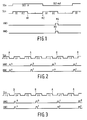
- Fig. 1 the signals on the SLx and SDx lines are represented at the top.
- the signal on the SDx line defines the period of incoming data SLD in and the period of outgoing data SLD out.
- On the top-but-one line of Fig. 1 the incoming and outgoing B channels B1 and B2 are shown.
- the space between the incoming and outgoing B channels is taken up by the D channel and by synchronizing, control and status signals.
- the subscriber line circuit has been used on the extension side and operates as it were in the master mode.
- the SCL and SDx signals are generated in the subscriber line circuit. If the SDx signal has a low level, the SLx output circuit is released and data are produced.
- the 2.048 MHz CL clock signal is used as the main clock signal. All the time duration signals in the trunk interface are derived from said clock signal.
- the FSS signal is used for purposes of timing, that is to say, for denoting the start of a PCM frame.
- the B channels of the SLD interfaces are to be multiplexed on the 2 Mbit/s trunks for which a number of time slots are used corresponding to the number of available B channels.
- slip may develop, however. This slip is caused by the asynchronism between the SCL clock signal, the internal clock signal of the SLD interface derived from the SDx signal and which controls the data transmission on the SLD interface, and the system clock signal which controls the trunk interface of the subscriber line circuit.
- SCL clock signal the internal clock signal of the SLD interface derived from the SDx signal and which controls the data transmission on the SLD interface
- system clock signal which controls the trunk interface of the subscriber line circuit.
- slip there is data loss or data repetition. It is evident that slip is to be handled correctly.
- the slip is controlled simultaneously both in send and receive directions. If slip occurs, data are skipped in one direction and repeated in another direction. It is evident that no slip occurs when the SLD interface is used in the master mode.
- Fig. 1 illustrates a possible slip situation.
- Figs. 2 and 3 show the transfer mechanism between the SLD system and the digital exchange for the case where the trunk system is faster than the SLD system. This means that the trunk needs more data than the SLD interface can produce.
- the first line of the Figs. 2 and 3 shows the data on the SLx line.
- Reference character i denotes that the data a, b, c or d are incoming data, whereas the reference character o denotes that the data r, s or u are outgoing data.
- the lines 2 and 3 of the Figs. 2 and 3 show the data signals on the trunks HWO and HWI respectively.
- the transfer time window is selected to be the space between the incoming and outgoing data of the SLx line, that is to say, the lower boundary of the transfer time window corresponds to the end (M2 of Fig. 1) of the last data channel B2 in the incoming time slot, and its upper boundary to the beginning (M2 in Fig. 1) of the first data channel B1 in the outgoing time slot of the SLx line.
- the subscriber line circuit For correctly handling a case of slip, the subscriber line circuit comprises a slip detection and slip correction means which will be discussed hereinafter. "Slipping" out of the transfer time window by one of the allocated time slots of the trunks is used as a criterion for slip. When a slip is detected in the slip detection and slip correction means, it is corrected in that data are skipped in one data transfer direction, whereas in the other direction data are repeated. Consequently, the data transmission Sequence is not disturbed.
- the slip detection reference is situated near the lower boundary of the transfer time window.
- the data i:a of the SLx line is multiplexed as data a on the HWO trunk.
- the data s on the HWI trunk is taken over in the time slot o:s.
- the trunks are faster than the SLDx line, so that as it were the time slots of the trunks shift to the left relative to those of the SLx lines. At a specific instant the time slots of the trunks will thus slip out of the time window as it were. With the second slip detection reference A on the SLx line there is a threat that this happens. When the time slots of the trunks are too close to the detection reference, a slip is detected. In response to this detection the data b from the time slot i:b of the SLx line is repeated on the trunk HWO, which is denoted by the second reference character b on the trunk HWO. Simultaneously, the data t on the trunk HWI is skipped.
- the slip correction means preferably comprises a blocking means blocking the skipping of data by the transfer arrangement.
- Figs. 4 and 5 show the situations in which the trunks are slower than the SLx line.
- the time slots of the trunks slip as it were to the right out of the transfer time window.
- the data i:c is skipped, whereas the data o:s is repeated.
- Fig. 5 which as it were is an extension to Fig. 4, no data are skipped or repeated.
- the reference characters of Figs. 4 and 5 corresponding to those of the Figs. 2 and 3 show data between the SLx line and the trunks being transferred or exchanged as well as the change-over of the slip detection reference and the consequent data skipping and data repetition.
- Fig. 6 shows an embodiment of the invention of a circuit by means of which slip is correctly combatted. This circuit will be called slip buffer hereinafter.
- the slip buffer comprises a transfer arrangement constituted by an SLD register 1 extended to the SLD interface.
- the data signals are applied to the input of this shift register in the incoming time slots of the SLx line, whereas the data signals for the outgoing time slots of the SLx line can be tapped from the output of said register 1.
- the digital exchange is extended by the system register 2 arranged as a shift register, the output of the system register being connected to the outgoing trunk of the digital exchange.
- the two registers are interconnected by two sets of transfer lines L1 and L2.
- the input of the system register 2 is connected to the output of a switch circuit 4 controlled by the slip detection and slip correction means 3.
- One input of the switch circuit 4 is connected to the output of the system register 2, whereas the other input of said switch circuit is connected to the incoming trunk of the digital exchange.
- the switch circuit 4 may have the form of a multiplexer.
- the slip detection and slip correction means 3 are supplied with the FSS signal, the CL clock signal and the SDx signal.
- the slip detection reference is derived from these signals and relative to this reference value there is detected whether slip occurs.
- the clock signals hcl and scl and load signals hl and sl for the registers 2 and 1 respectively, are generated.
- the incoming data coming in on the line SLx and the incoming data coming in on the trunk HWI are stored in the shift registers 1 and 2 respectively, and subsequently transferred via the transfer lines L1 and L2 respectively. However, if slip is detected, data are skipped in one direction, whereas in the other direction data are repeated by means of the feedback from the trunk HWO through the switch circuit 4. This switch circuit is controlled by the slip detection and slip correction means 3.
- FIG. 7 A simple embodiment of the slip detection and slip correction means is shown in Fig. 7.
- This circuit comprises a first counter T1 to which the clock signal scl is applied which is derived from the signal occurring on the line SDx. Then this counter T1 is supplied with the signal sdx occurring on the line SDx, while the counter is preset by the ascending edge of this signal sdx. Furthermore, a second counter T2 is present, which is supplied with the clock signal cl of the incoming and outgoing trunks. This counter is preset by the frame synchronizing signal of the trunks HWI and HWO.
- the outputs of the counters T1 and T2 are fed to a comparing circuit for comparing the counts of said counters.
- This comparing circuit is included in the generator G for generating control signals for the shift registers 1 and 2 and the switch circuit 4. By means of the comparing circuit there is established whether there is a threat of slip occurring or not.
- the control signals sl, scl, hcl and hl for the registers 1 and 2 as well as the control signal mux for the circuit 4 are derived.
Landscapes
- Engineering & Computer Science (AREA)
- Computer Networks & Wireless Communication (AREA)
- Computer Hardware Design (AREA)
- Signal Processing (AREA)
- Interface Circuits In Exchanges (AREA)
- Synchronisation In Digital Transmission Systems (AREA)
Applications Claiming Priority (2)
| Application Number | Priority Date | Filing Date | Title |
|---|---|---|---|
| EP91201478 | 1991-06-14 | ||
| EP91201478 | 1991-06-14 |
Publications (2)
| Publication Number | Publication Date |
|---|---|
| EP0518432A2 true EP0518432A2 (fr) | 1992-12-16 |
| EP0518432A3 EP0518432A3 (en) | 1993-11-18 |
Family
ID=8207718
Family Applications (1)
| Application Number | Title | Priority Date | Filing Date |
|---|---|---|---|
| EP19920201663 Withdrawn EP0518432A3 (en) | 1991-06-14 | 1992-06-09 | Digital subscriber line circuit for connecting an isdn subscriber to the trunk side of a digital exchange |
Country Status (3)
| Country | Link |
|---|---|
| US (1) | US5297145A (fr) |
| EP (1) | EP0518432A3 (fr) |
| JP (1) | JPH05176355A (fr) |
Families Citing this family (4)
| Publication number | Priority date | Publication date | Assignee | Title |
|---|---|---|---|---|
| US5440557A (en) * | 1993-12-21 | 1995-08-08 | National Semiconductor Corporation | Apparatus and methods for providing an interface between FDDI-II rings |
| US5583894A (en) * | 1995-03-20 | 1996-12-10 | Vlsi Technology, Inc. | Slip buffer for synchronizing data transfer between two devices |
| US6101216A (en) * | 1997-10-03 | 2000-08-08 | Rockwell International Corporation | Splitterless digital subscriber line communication system |
| US6445733B1 (en) | 1997-10-03 | 2002-09-03 | Conexant Systems, Inc. | Method of and apparatus for performing line characterization in a non-idle mode in a subscriber line communication system |
Family Cites Families (5)
| Publication number | Priority date | Publication date | Assignee | Title |
|---|---|---|---|---|
| US4833675A (en) * | 1987-06-02 | 1989-05-23 | Hekimian Laboratories, Inc. | PCM frame slip detection in a channel |
| US4965794A (en) * | 1987-10-05 | 1990-10-23 | Dallas Semiconductor Corporation | Telecommunications FIFO |
| US4839893A (en) * | 1987-10-05 | 1989-06-13 | Dallas Semiconductor Corporation | Telecommunications FIFO |
| US4860285A (en) * | 1987-10-21 | 1989-08-22 | Advanced Micro Devices, Inc. | Master/slave synchronizer |
| EP0333942A1 (fr) * | 1988-03-22 | 1989-09-27 | Hewlett-Packard Limited | Contrôle des systèmes de communication numériques |
-
1992
- 1992-06-09 US US07/896,070 patent/US5297145A/en not_active Expired - Fee Related
- 1992-06-09 EP EP19920201663 patent/EP0518432A3/en not_active Withdrawn
- 1992-06-11 JP JP4152089A patent/JPH05176355A/ja active Pending
Also Published As
| Publication number | Publication date |
|---|---|
| EP0518432A3 (en) | 1993-11-18 |
| US5297145A (en) | 1994-03-22 |
| JPH05176355A (ja) | 1993-07-13 |
Similar Documents
| Publication | Publication Date | Title |
|---|---|---|
| US4860285A (en) | Master/slave synchronizer | |
| US4413337A (en) | Time division switching system for circuit mode and packet mode lines | |
| US4704716A (en) | Method and apparatus for establishing a wideband communication facility through a communication network having narrow bandwidth channels | |
| EP0259119B1 (fr) | Dispositif de communication d'informations de commande pour un système de commutation à commande distribuée | |
| EP0125605B1 (fr) | Sélection de canal dans un système de commutation comprenant des modules de commutation distants interconnectés | |
| EP0148175B1 (fr) | Agencement de communication d'informations de commande pour un systeme de commutation a partage dans le temps | |
| US4639910A (en) | Apparatus for establishing communication paths | |
| EP0190198B1 (fr) | Procede et agencement de commande de systemes de commutation par repartition dans le temps | |
| GB2130847A (en) | The timing of reception and transmission channels in communications systems | |
| IE53245B1 (en) | Loop communication system | |
| JPH03234137A (ja) | シグナリングセルスイッチング方法及びシグナリングセルスイッチング方式 | |
| GB2162022A (en) | Data transmission system | |
| GB2118400A (en) | Switching digital data signals | |
| US4296492A (en) | Continuity verification arrangement | |
| US4500985A (en) | Communication path continuity verification arrangement | |
| EP0116558B1 (fr) | Agencement de communication d'informations de commande pour un systeme de commutation a division temporelle | |
| EP0255290A2 (fr) | Multiplexeur à assignation de créneaux temporels | |
| EP0595911B1 (fr) | Interface pour circuits de tarif de base | |
| CA1210841A (fr) | Reseau de commutation temps-espace-temps utilisant une liaison en boucle fermee | |
| EP0532914B1 (fr) | Système de correction de délai dans un système de commutation MIC à multiples canaux | |
| US5297145A (en) | Digital subscriber line circuit for connecting an ISDN subscriber to the trunk side of a digital exchange | |
| US4847833A (en) | System for the simultaneous operation of a plurality of terminal equipment at a network terminating unit of a broadband network | |
| JPS63290431A (ja) | 非同期時分割通信システム | |
| EP0033337B1 (fr) | Circuit digital de synchronisation de boucle | |
| US5144624A (en) | Direct digital access telecommunication system with signaling bit detection |
Legal Events
| Date | Code | Title | Description |
|---|---|---|---|
| PUAI | Public reference made under article 153(3) epc to a published international application that has entered the european phase |
Free format text: ORIGINAL CODE: 0009012 |
|
| AK | Designated contracting states |
Kind code of ref document: A2 Designated state(s): DE FR GB |
|
| PUAL | Search report despatched |
Free format text: ORIGINAL CODE: 0009013 |
|
| AK | Designated contracting states |
Kind code of ref document: A3 Designated state(s): DE FR GB |
|
| 17P | Request for examination filed |
Effective date: 19940509 |
|
| GRAG | Despatch of communication of intention to grant |
Free format text: ORIGINAL CODE: EPIDOS AGRA |
|
| 17Q | First examination report despatched |
Effective date: 19961210 |
|
| GRAH | Despatch of communication of intention to grant a patent |
Free format text: ORIGINAL CODE: EPIDOS IGRA |
|
| STAA | Information on the status of an ep patent application or granted ep patent |
Free format text: STATUS: THE APPLICATION IS DEEMED TO BE WITHDRAWN |
|
| 18D | Application deemed to be withdrawn |
Effective date: 19970729 |