EP0520230A1 - Procédé d'opération pour un discriminateur électronique de pièces de monnaie - Google Patents
Procédé d'opération pour un discriminateur électronique de pièces de monnaie Download PDFInfo
- Publication number
- EP0520230A1 EP0520230A1 EP92109636A EP92109636A EP0520230A1 EP 0520230 A1 EP0520230 A1 EP 0520230A1 EP 92109636 A EP92109636 A EP 92109636A EP 92109636 A EP92109636 A EP 92109636A EP 0520230 A1 EP0520230 A1 EP 0520230A1
- Authority
- EP
- European Patent Office
- Prior art keywords
- acceptance band
- coin
- measurement signal
- acceptance
- real
- Prior art date
- Legal status (The legal status is an assumption and is not a legal conclusion. Google has not performed a legal analysis and makes no representation as to the accuracy of the status listed.)
- Granted
Links
Images


Classifications
-
- G—PHYSICS
- G07—CHECKING-DEVICES
- G07D—HANDLING OF COINS OR VALUABLE PAPERS, e.g. TESTING, SORTING BY DENOMINATIONS, COUNTING, DISPENSING, CHANGING OR DEPOSITING
- G07D5/00—Testing specially adapted to determine the identity or genuineness of coins, e.g. for segregating coins which are unacceptable or alien to a currency
Definitions
- the invention relates to a method for operating an electronic coin validator according to the preamble of patent claim 1.
- Electronic coin validators contain at least one test probe, which determines a physical property of the coin to be tested, for example the material. Inductive probes are often used, the damping of which is characteristic of a coin.
- the analog measurement signal is digitized and compared with a reference signal in order to generate a real signal in the case of a real coin and a bad signal in the case of a false or foreign coin.
- the digital measurement signal is usually processed in a microprocessor, which also controls the coin acceptance and sorting.
- the reference value is stored in the microprocessor's memory.
- the reference values can be determined, for example, with the help of test coins or an arbitrary selection of real coins. From DE-OS 31 03 371 it has also become known to enter a learning program for the microprocessor, which itself determines the reference values when it is put into operation by inserting real coins. Since the electronic and electrical components of the coin validator can change their properties after a long period of operation and due to environmental influences (drift) and also the real coins change their properties over the years, the reference values have become known from the cited document and from EP 0 155 126 to be modified continuously or from time to time depending on the area in which the measurement signals are determined. The coin validator adapts itself to the changed conditions, so to speak, so that readjustment can be omitted.
- the statistical distribution of the measurement signals generated by real coins corresponds to the Gaussian curve, ie the maximum of the measurement signals lies in the middle between the limit values, while only a few measurement signals appear near the limit values.
- Counterfeit or foreign coins are naturally so produced or selected that they come as close as possible to the properties of the real coins to be tested.
- the statistical distribution of the measurement signals of many such coins also corresponds to a Gaussian bell curve.
- the invention is therefore based on the object of specifying a method which ensures the highest possible acceptance rate for real coins and the lowest possible acceptance rate for counterfeit coins.
- the measurement signal is compared with a second acceptance band that is narrower than the first acceptance band.
- the upper limit or reference value can be chosen smaller for the second acceptance band.
- the second acceptance band is used for coin testing, even if the measurement signal lies within the first acceptance band. If, on the other hand, the measurement signal of at least one coin lies within the second acceptance band, the first acceptance band is used.
- the method according to the invention is based on the following considerations. As already mentioned, some of the measurement signals from counterfeit coins fall into the acceptance band for real coins if this is specified so broadly that almost all real coins are accepted. If a measurement signal from the coin validator falls close to the limit value above which the measurement signals of the counterfeit coins overlap the acceptance band, the probability is relatively high that the counterfeit coin is involved. At least the probability is greater that a real coin has been inserted. In order to ensure a safe elimination of counterfeit money, the coin validator is switched over to the second, narrower acceptance band in the method according to the invention. This ensures that the subsequent coin is eliminated if its measurement signal lies outside the second acceptance band. Here can happen that a real coin is eliminated. However, the probability is relatively low.
- the method according to the invention cannot necessarily prevent the acceptance of a single counterfeit coin, but by shifting the limit values of the acceptance band, all subsequent counterfeit coins are eliminated. Only when a measurement signal lies within the narrower acceptance band is there a high probability that the next following coins are real coins, so that a switch back to the wider first acceptance band can take place.
- the acceptance rate for counterfeit coins can be significantly reduced by a corresponding choice of the switching limit between the first and second acceptance band without the acceptance rate for real money being significantly reduced.
- the switchover limit from the first to the second acceptance band and vice versa can be formed from the reduced reference value of the second acceptance band.
- a criterion for the switchover it was stated that at least one coin should have a measured value above the critical value so that a switchover to the narrower acceptance band takes place.
- the processing of the measurement signals in the coin validator according to the invention is expediently carried out in a microprocessor which is programmed in such a way that it forms two measurement channels, the changeover from one to the other measurement channel being carried out by the program of the microprocessor and not requiring special circuit components.
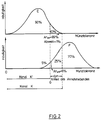
- Curve E represents the distribution curve for the measurement signals of a real coin. It is, for example, the curve for a 1 DM coin from which a certain physical property is measured with the aid of a test probe, for example the material composition.
- the initially analog measuring signal of the test probe is digitized so that qualitative statements can also be made.
- most of the measurement signals lie in a middle range between the limit or reference values of curve E, which are marked with Ru or Ro.
- the coin validator is to accept all genuine 1 DM coins, the position of the lower and upper reference value must be selected so that they coincide with the limit values Ru and Ro.
- This so-called acceptance band is indicated in FIG. 1 with channel K.
- the curve F represents the distribution of the measurement signals, which are present during the insertion of 20 sloty coins. 20 sloti coins, the value of which is only a fraction of a 1 DM coin, are often used for fraudulent purposes. As can be seen, curves E and F overlap. The area of overlap is indicated by the dashed line passing through the limit value Ro. All counterfeit coins whose measured value falls within the overlap area will be accepted if the coin validator works with the acceptance band channel K. Quantitatively, for example, 30% counterfeit coins can therefore be accepted with 100% acceptance of the real coins.
- the overlap area is reduced and the acceptance rate for counterfeit money is significantly lower, e.g. Only 5%.
- the acceptance rate for real money is also reduced.
- a query routine is now carried out in the microprocessor, for example for every coin inserted. If the measurement signal of the inserted coin is in the acceptance band channel K ', the acceptance band channel K is switched. If the measurement signal lies outside the acceptance band channel K ', the narrow acceptance band channel K' is switched to.
- the limit value G for the curves E and F so that - statistically - 10% of all genuine coins are eliminated when the coin validator works with the acceptance band channel K '. At the same time, 5% counterfeit coins are accepted. In the further channel K 100% of all real coins and 30% of all counterfeit coins are accepted.
- the acceptance rates of the coins are no longer simply comparable to the rates of a fixed setting, but are composed of a fixed component and a dynamic component.
- the fixed portion is the amount of coins that can be read directly by setting the acceptance band.
- the dynamic component results from the computational probability with which channel K is activated in relation to channel K '.
- the electronic coin validator accepts the latter amount regardless of which active channel is switched on. The minimum assumption is therefore 100% x M '(90%). This corresponds to the fixed part of the acceptance rate.
- the dynamic part results from the following consideration: Whenever a coin is within the acceptance band K ' lies, the coin validator switches to acceptance band K. The probability that this will occur is as great as shown by the distribution curve, namely 90%. That means nine times more likely to get K than K '. The difference MM 'occurs M times.
- the general procedure is as follows: n coins less than critical value > Switching to channel K acceptance band n coins larger than critical value > Switchover to acceptance band channel K '.
Landscapes
- Physics & Mathematics (AREA)
- General Physics & Mathematics (AREA)
- Testing Of Coins (AREA)
Applications Claiming Priority (2)
| Application Number | Priority Date | Filing Date | Title |
|---|---|---|---|
| DE4121034A DE4121034C1 (fr) | 1991-06-26 | 1991-06-26 | |
| DE4121034 | 1991-06-26 |
Publications (2)
| Publication Number | Publication Date |
|---|---|
| EP0520230A1 true EP0520230A1 (fr) | 1992-12-30 |
| EP0520230B1 EP0520230B1 (fr) | 1996-09-18 |
Family
ID=6434744
Family Applications (1)
| Application Number | Title | Priority Date | Filing Date |
|---|---|---|---|
| EP92109636A Expired - Lifetime EP0520230B1 (fr) | 1991-06-26 | 1992-06-09 | Procédé d'opération pour un discriminateur électronique de pièces de monnaie |
Country Status (4)
| Country | Link |
|---|---|
| US (1) | US5355989A (fr) |
| EP (1) | EP0520230B1 (fr) |
| DE (2) | DE4121034C1 (fr) |
| ES (1) | ES2093141T3 (fr) |
Cited By (2)
| Publication number | Priority date | Publication date | Assignee | Title |
|---|---|---|---|---|
| US5615760A (en) * | 1991-04-18 | 1997-04-01 | Mars Incorporated | Method and apparatus for validating money |
| US5931277A (en) * | 1995-05-09 | 1999-08-03 | Mars, Incorporated | Money validation system using acceptance criteria |
Families Citing this family (7)
| Publication number | Priority date | Publication date | Assignee | Title |
|---|---|---|---|---|
| GB2331828B (en) * | 1997-11-28 | 2001-08-08 | Mars Inc | Currency validation apparatus and method |
| GB9903024D0 (en) * | 1999-02-10 | 1999-03-31 | Coin Controls | Money item acceptor |
| GB0300633D0 (en) * | 2003-01-10 | 2003-02-12 | Money Controls Ltd | Money item acceptor with enhanced security |
| GB2397158A (en) * | 2003-01-08 | 2004-07-14 | Money Controls Ltd | Money item acceptor |
| CN1795470A (zh) * | 2003-05-22 | 2006-06-28 | 日本功勒克斯股份有限公司 | 货币金属处理装置及其控制方法 |
| JP5341453B2 (ja) * | 2008-09-30 | 2013-11-13 | サンデン株式会社 | 貨幣識別装置 |
| US10896566B2 (en) * | 2017-09-04 | 2021-01-19 | Asahi Seiko Co., Ltd. | Coin recycle device |
Citations (9)
| Publication number | Priority date | Publication date | Assignee | Title |
|---|---|---|---|---|
| DE2023076A1 (de) * | 1970-05-12 | 1971-11-25 | Lochstampfer Horst Dipl Ing | Muenzmessstelle |
| EP0043189A1 (fr) * | 1980-06-20 | 1982-01-06 | Plessey Overseas Limited | Méthode et dispositif pour la vérification de pièces de monnaie |
| DE3103371A1 (de) * | 1981-01-27 | 1982-08-05 | Günter Wulff-Apparatebau GmbH, 1000 Berlin | Verfahren zur festlegung der grenzwerte der gut-/schlecht-kennung von muenzen |
| EP0086648A2 (fr) * | 1982-02-12 | 1983-08-24 | Mars Incorporated | Dispositif pour examiner des pièces de monnaie |
| EP0155126A2 (fr) * | 1984-03-01 | 1985-09-18 | Mars Incorporated | Système à auto-accordement pour la reconnaissance de pièces de monnaie |
| EP0367921A2 (fr) * | 1988-11-07 | 1990-05-16 | Ascom Autelca Ag | Dispositif de contrôle de pièces de monnaie |
| US4951799A (en) * | 1988-02-10 | 1990-08-28 | Tamura Electric Works, Ltd. | Method of correcting coin data and apparatus for inspecting coins |
| EP0384375A1 (fr) * | 1989-02-23 | 1990-08-29 | URMET S.p.A. Costruzioni Elettro-Telefoniche | Trieur de pièces |
| EP0480736A2 (fr) * | 1990-10-10 | 1992-04-15 | Mars Incorporated | Dispositif et méthode pour l'acceptation de pièces de monnaie, billets et autres valeurs et pour le refus d'objets étrangers ou contrefaçons perfectionnés |
Family Cites Families (3)
| Publication number | Priority date | Publication date | Assignee | Title |
|---|---|---|---|---|
| US4538719A (en) * | 1983-07-01 | 1985-09-03 | Hilgraeve, Incorporated | Electronic coin acceptor |
| US5067604A (en) * | 1988-11-14 | 1991-11-26 | Bally Manufacturing Corporation | Self teaching coin discriminator |
| GB9010766D0 (en) * | 1990-05-14 | 1990-07-04 | Coin Controls | Coin discrimination apparatus |
-
1991
- 1991-06-26 DE DE4121034A patent/DE4121034C1/de not_active Expired - Fee Related
-
1992
- 1992-06-09 EP EP92109636A patent/EP0520230B1/fr not_active Expired - Lifetime
- 1992-06-09 ES ES92109636T patent/ES2093141T3/es not_active Expired - Lifetime
- 1992-06-09 DE DE59207161T patent/DE59207161D1/de not_active Expired - Fee Related
- 1992-06-25 US US07/903,857 patent/US5355989A/en not_active Expired - Fee Related
Patent Citations (9)
| Publication number | Priority date | Publication date | Assignee | Title |
|---|---|---|---|---|
| DE2023076A1 (de) * | 1970-05-12 | 1971-11-25 | Lochstampfer Horst Dipl Ing | Muenzmessstelle |
| EP0043189A1 (fr) * | 1980-06-20 | 1982-01-06 | Plessey Overseas Limited | Méthode et dispositif pour la vérification de pièces de monnaie |
| DE3103371A1 (de) * | 1981-01-27 | 1982-08-05 | Günter Wulff-Apparatebau GmbH, 1000 Berlin | Verfahren zur festlegung der grenzwerte der gut-/schlecht-kennung von muenzen |
| EP0086648A2 (fr) * | 1982-02-12 | 1983-08-24 | Mars Incorporated | Dispositif pour examiner des pièces de monnaie |
| EP0155126A2 (fr) * | 1984-03-01 | 1985-09-18 | Mars Incorporated | Système à auto-accordement pour la reconnaissance de pièces de monnaie |
| US4951799A (en) * | 1988-02-10 | 1990-08-28 | Tamura Electric Works, Ltd. | Method of correcting coin data and apparatus for inspecting coins |
| EP0367921A2 (fr) * | 1988-11-07 | 1990-05-16 | Ascom Autelca Ag | Dispositif de contrôle de pièces de monnaie |
| EP0384375A1 (fr) * | 1989-02-23 | 1990-08-29 | URMET S.p.A. Costruzioni Elettro-Telefoniche | Trieur de pièces |
| EP0480736A2 (fr) * | 1990-10-10 | 1992-04-15 | Mars Incorporated | Dispositif et méthode pour l'acceptation de pièces de monnaie, billets et autres valeurs et pour le refus d'objets étrangers ou contrefaçons perfectionnés |
Cited By (3)
| Publication number | Priority date | Publication date | Assignee | Title |
|---|---|---|---|---|
| US5615760A (en) * | 1991-04-18 | 1997-04-01 | Mars Incorporated | Method and apparatus for validating money |
| US5624019A (en) * | 1991-04-18 | 1997-04-29 | Mars Incorporated | Method and apparatus for validating money |
| US5931277A (en) * | 1995-05-09 | 1999-08-03 | Mars, Incorporated | Money validation system using acceptance criteria |
Also Published As
| Publication number | Publication date |
|---|---|
| EP0520230B1 (fr) | 1996-09-18 |
| DE4121034C1 (fr) | 1992-09-10 |
| ES2093141T3 (es) | 1996-12-16 |
| US5355989A (en) | 1994-10-18 |
| DE59207161D1 (de) | 1996-10-24 |
Similar Documents
| Publication | Publication Date | Title |
|---|---|---|
| DE69133116T2 (de) | Vorrichtung und Verfahren zur verbesserten Annahme von Münzen, Geldscheinen oder anderen Zahlungsmitteln und Zurückweisung von Falschgeld oder anderen gefälschten Zahlungsmitteln | |
| DE69034216T2 (de) | Verfahren und Vorrichtung zur Echtheitsprüfung von Geld | |
| DE2935539C2 (fr) | ||
| DE69109287T2 (de) | Vorrichtung zum unterscheiden von münzen. | |
| DE2455112C2 (de) | Münzprüfer | |
| DE2654472A1 (de) | Muenzpruefgeraet | |
| DE1474735A1 (de) | Verfahren und Vorrichtung zur Auswahl von Muenzen | |
| WO1987000662A1 (fr) | Dispositif de controle de pieces de monnaie | |
| DE69637234T2 (de) | Verfahren zur Echtheitsprüfung von Münzen | |
| EP0520230B1 (fr) | Procédé d'opération pour un discriminateur électronique de pièces de monnaie | |
| EP0622763B2 (fr) | Appareil pour trier des pièces de monnaie | |
| DE2705244A1 (de) | Muenzpruefvorrichtung | |
| CH676162A5 (fr) | ||
| DE68915363T2 (de) | Vorrichtung und Verfahren zum Einstellen der Klassifikationsgenauigkeit eines Münzprüfers. | |
| DE3231116A1 (de) | Verfahren und vorrichtung zur pruefung von muenzen mit der phasenverschiebung niedriger frequenzen | |
| EP2040227B1 (fr) | Procédé de vérification de pièces de monnaie | |
| DE69828437T2 (de) | Münzprüfvorrichtung | |
| DE19724711B4 (de) | Verfahren und Vorrichtung zum Erkennen und Lesen eines an einem Objekt vorgesehenen Strichcodes | |
| DE19726449A1 (de) | Verfahren und Schaltungsanordnung zur Prüfung von Münzen | |
| DE4339543C2 (de) | Verfahren zur Prüfung von Münzen | |
| DE69503383T3 (de) | Vorrichtung zum prüfen von wertgegenständen und verfahren zum kalibrieren einer solchen vorrichtung | |
| EP0660132A1 (fr) | Procédé numérique de détection d'une impulsion courte en temps et dispositif pour sa mise en oeuvre | |
| DE10140225C2 (de) | Verfahren und Vorrichtung zur Messung des Durchmessers von Münzen | |
| EP1589493B1 (fr) | Procédé pour contrôler des pièces de monnaie | |
| DE19548233C2 (de) | Elektronischer Münzprüfer |
Legal Events
| Date | Code | Title | Description |
|---|---|---|---|
| PUAI | Public reference made under article 153(3) epc to a published international application that has entered the european phase |
Free format text: ORIGINAL CODE: 0009012 |
|
| AK | Designated contracting states |
Kind code of ref document: A1 Designated state(s): CH DE ES FR GB IT LI NL SE |
|
| 17P | Request for examination filed |
Effective date: 19930628 |
|
| 17Q | First examination report despatched |
Effective date: 19950126 |
|
| GRAG | Despatch of communication of intention to grant |
Free format text: ORIGINAL CODE: EPIDOS AGRA |
|
| GRAH | Despatch of communication of intention to grant a patent |
Free format text: ORIGINAL CODE: EPIDOS IGRA |
|
| GRAH | Despatch of communication of intention to grant a patent |
Free format text: ORIGINAL CODE: EPIDOS IGRA |
|
| GRAA | (expected) grant |
Free format text: ORIGINAL CODE: 0009210 |
|
| AK | Designated contracting states |
Kind code of ref document: B1 Designated state(s): CH DE ES FR GB IT LI NL SE |
|
| PG25 | Lapsed in a contracting state [announced via postgrant information from national office to epo] |
Ref country code: NL Free format text: LAPSE BECAUSE OF FAILURE TO SUBMIT A TRANSLATION OF THE DESCRIPTION OR TO PAY THE FEE WITHIN THE PRESCRIBED TIME-LIMIT Effective date: 19960918 |
|
| GBT | Gb: translation of ep patent filed (gb section 77(6)(a)/1977) |
Effective date: 19960919 |
|
| REF | Corresponds to: |
Ref document number: 59207161 Country of ref document: DE Date of ref document: 19961024 |
|
| ITF | It: translation for a ep patent filed | ||
| REG | Reference to a national code |
Ref country code: ES Ref legal event code: FG2A Ref document number: 2093141 Country of ref document: ES Kind code of ref document: T3 |
|
| PG25 | Lapsed in a contracting state [announced via postgrant information from national office to epo] |
Ref country code: SE Effective date: 19961218 |
|
| ET | Fr: translation filed | ||
| NLV1 | Nl: lapsed or annulled due to failure to fulfill the requirements of art. 29p and 29m of the patents act | ||
| PG25 | Lapsed in a contracting state [announced via postgrant information from national office to epo] |
Ref country code: CH Free format text: LAPSE BECAUSE OF NON-PAYMENT OF DUE FEES Effective date: 19970630 Ref country code: LI Free format text: LAPSE BECAUSE OF NON-PAYMENT OF DUE FEES Effective date: 19970630 |
|
| PLBE | No opposition filed within time limit |
Free format text: ORIGINAL CODE: 0009261 |
|
| STAA | Information on the status of an ep patent application or granted ep patent |
Free format text: STATUS: NO OPPOSITION FILED WITHIN TIME LIMIT |
|
| 26N | No opposition filed | ||
| REG | Reference to a national code |
Ref country code: CH Ref legal event code: PL |
|
| REG | Reference to a national code |
Ref country code: GB Ref legal event code: IF02 |
|
| PGFP | Annual fee paid to national office [announced via postgrant information from national office to epo] |
Ref country code: FR Payment date: 20040528 Year of fee payment: 13 |
|
| PGFP | Annual fee paid to national office [announced via postgrant information from national office to epo] |
Ref country code: ES Payment date: 20050415 Year of fee payment: 14 |
|
| PGFP | Annual fee paid to national office [announced via postgrant information from national office to epo] |
Ref country code: GB Payment date: 20050608 Year of fee payment: 14 |
|
| PG25 | Lapsed in a contracting state [announced via postgrant information from national office to epo] |
Ref country code: FR Free format text: LAPSE BECAUSE OF NON-PAYMENT OF DUE FEES Effective date: 20060228 |
|
| REG | Reference to a national code |
Ref country code: FR Ref legal event code: ST Effective date: 20060228 |
|
| PG25 | Lapsed in a contracting state [announced via postgrant information from national office to epo] |
Ref country code: GB Free format text: LAPSE BECAUSE OF NON-PAYMENT OF DUE FEES Effective date: 20060609 |
|
| PG25 | Lapsed in a contracting state [announced via postgrant information from national office to epo] |
Ref country code: ES Free format text: LAPSE BECAUSE OF NON-PAYMENT OF DUE FEES Effective date: 20060610 |
|
| PGFP | Annual fee paid to national office [announced via postgrant information from national office to epo] |
Ref country code: IT Payment date: 20060630 Year of fee payment: 15 |
|
| GBPC | Gb: european patent ceased through non-payment of renewal fee |
Effective date: 20060609 |
|
| REG | Reference to a national code |
Ref country code: ES Ref legal event code: FD2A Effective date: 20060610 |
|
| PGFP | Annual fee paid to national office [announced via postgrant information from national office to epo] |
Ref country code: DE Payment date: 20080808 Year of fee payment: 17 |
|
| PG25 | Lapsed in a contracting state [announced via postgrant information from national office to epo] |
Ref country code: IT Free format text: LAPSE BECAUSE OF NON-PAYMENT OF DUE FEES Effective date: 20070609 |
|
| PG25 | Lapsed in a contracting state [announced via postgrant information from national office to epo] |
Ref country code: DE Free format text: LAPSE BECAUSE OF NON-PAYMENT OF DUE FEES Effective date: 20100101 |