EP0520724B1 - Antagonistes d'angiotensine II - Google Patents
Antagonistes d'angiotensine II Download PDFInfo
- Publication number
- EP0520724B1 EP0520724B1 EP92305705A EP92305705A EP0520724B1 EP 0520724 B1 EP0520724 B1 EP 0520724B1 EP 92305705 A EP92305705 A EP 92305705A EP 92305705 A EP92305705 A EP 92305705A EP 0520724 B1 EP0520724 B1 EP 0520724B1
- Authority
- EP
- European Patent Office
- Prior art keywords
- alkyl
- formula
- methyl
- group
- compound
- Prior art date
- Legal status (The legal status is an assumption and is not a legal conclusion. Google has not performed a legal analysis and makes no representation as to the accuracy of the status listed.)
- Expired - Lifetime
Links
Classifications
-
- C—CHEMISTRY; METALLURGY
- C07—ORGANIC CHEMISTRY
- C07D—HETEROCYCLIC COMPOUNDS
- C07D401/00—Heterocyclic compounds containing two or more hetero rings, having nitrogen atoms as the only ring hetero atoms, at least one ring being a six-membered ring with only one nitrogen atom
- C07D401/14—Heterocyclic compounds containing two or more hetero rings, having nitrogen atoms as the only ring hetero atoms, at least one ring being a six-membered ring with only one nitrogen atom containing three or more hetero rings
-
- A—HUMAN NECESSITIES
- A61—MEDICAL OR VETERINARY SCIENCE; HYGIENE
- A61P—SPECIFIC THERAPEUTIC ACTIVITY OF CHEMICAL COMPOUNDS OR MEDICINAL PREPARATIONS
- A61P43/00—Drugs for specific purposes, not provided for in groups A61P1/00-A61P41/00
-
- A—HUMAN NECESSITIES
- A61—MEDICAL OR VETERINARY SCIENCE; HYGIENE
- A61P—SPECIFIC THERAPEUTIC ACTIVITY OF CHEMICAL COMPOUNDS OR MEDICINAL PREPARATIONS
- A61P9/00—Drugs for disorders of the cardiovascular system
-
- A—HUMAN NECESSITIES
- A61—MEDICAL OR VETERINARY SCIENCE; HYGIENE
- A61P—SPECIFIC THERAPEUTIC ACTIVITY OF CHEMICAL COMPOUNDS OR MEDICINAL PREPARATIONS
- A61P9/00—Drugs for disorders of the cardiovascular system
- A61P9/12—Antihypertensives
-
- C—CHEMISTRY; METALLURGY
- C07—ORGANIC CHEMISTRY
- C07D—HETEROCYCLIC COMPOUNDS
- C07D405/00—Heterocyclic compounds containing both one or more hetero rings having oxygen atoms as the only ring hetero atoms, and one or more rings having nitrogen as the only ring hetero atom
- C07D405/14—Heterocyclic compounds containing both one or more hetero rings having oxygen atoms as the only ring hetero atoms, and one or more rings having nitrogen as the only ring hetero atom containing three or more hetero rings
-
- C—CHEMISTRY; METALLURGY
- C07—ORGANIC CHEMISTRY
- C07D—HETEROCYCLIC COMPOUNDS
- C07D471/00—Heterocyclic compounds containing nitrogen atoms as the only ring hetero atoms in the condensed system, at least one ring being a six-membered ring with one nitrogen atom, not provided for by groups C07D451/00 - C07D463/00
- C07D471/02—Heterocyclic compounds containing nitrogen atoms as the only ring hetero atoms in the condensed system, at least one ring being a six-membered ring with one nitrogen atom, not provided for by groups C07D451/00 - C07D463/00 in which the condensed system contains two hetero rings
- C07D471/04—Ortho-condensed systems
Definitions
- This invention concerns novel heterocyclic compounds and, more particularly, novel heterocyclic compounds which possess pharmacologically useful properties in antagonising at least in part one or more of the actions of the substances known as angiotensins, and in particular of that known as angiotensin II (hereinafter referred to as "AII").
- the invention also concerns pharmaceutical compositions of the novel compounds for use in treating diseases or medical conditions such as hypertension, congestive heart failure and/or hyperaldosteronism in warm-blooded animals (including man), as well as in other diseases or medical conditions in which the renin-angiotensin-aldosterone system plays a significant causative role.
- the invention also includes processes for the manufacture of the novel compounds and their use in treating one of the afore-mentioned diseases or medical conditions and for the production of novel pharmaceuticals for use in such medical treatments.
- the angiotensins are key mediators of the renin-angiotensinaldosterone system, which is involved in the control of homeostasis and fluid/electrolyte balance in many warm-blooded animals, including man.
- the angiotensin known as AII is produced by the action of angiotensin converting enzyme (ACE) on angiotensin I, itself produced by the action of the enzyme renin on the blood plasma protein angiotensinogen.
- ACE angiotensin converting enzyme
- AII is a potent spasmogen especially in the vasculature and is known to increase vascular resistance and blood pressure.
- the angiotensins are known to stimulate the release of aldosterone and hence result in vascular congestion and hypertension via sodium and fluid retention mechanisms.
- European Patent Application No. 400974 discloses imidazo-fused 6-membered heterocycles as AII antagonists and European Patent Application No. 429257 discloses indole derivatives used in the treatment or prophylaxis of hypertension.
- T1 is independently selected from (1-8C)alkyl, (3-8C)cycloalkyl, (3-8C)cycloalkyl-(1-4C)alkyl, phenyl, phenyl(1-4C)alkyl or substituted (1-4C)alkyl, the latter containing one or more fluoro substituents or bearing an (1-4C)alkoxy substituent;
- T2 is independently selected from hydrogen, (1-8C)alkyl, (3-8C)cycloalkyl, (3-8C)cycloalkyl-(1-4C)alkyl, carboxy, (1-4C)alkoxycarbonyl, (3-6C)alkenyloxycarbonyl, cyano, nitro, phenyl or phenyl(1-4C)alkyl;
- T3 is selected from
- alkyl include both straight and branched chain variants when the carbon numbers permit.
- branched chain variants such as “isopropyl” being specifically named where intended. The same convention applies to other radicals.
- T1 or T2 include, by way of example, for alkyl: methyl, ethyl, propyl, butyl, isobutyl, sec -butyl, pentyl and hexyl; for cycloalkyl: cyclopropyl, cyclopentyl and cyclohexyl; for alkyl containing one or more fluoro substituents: fluoromethyl, trifluoromethyl, 2,2,2-trifluoroethyl and pentafluoroethyl; for alkyl bearing an (1-4C)alkoxy substituent: 2-methoxyethyl and 2-ethoxyethyl; for cycloalkyl-alkyl: cyclopropylmethyl, cyclopentylmethyl, cyclohexylmethyl and 2-cyclopentyl-ethyl; for phenylalkyl: benzyl, 1-phenylethyl and 2-phenyleth
- a particular value for A1 when it is alkylene is, for example, methylene, ethylene or propylene.
- an optional substituent on B1 when it is phenyl bearing one or two substituents include, by way of example, for alkyl: methyl and ethyl; for alkoxy: methoxy and ethoxy; for halogeno: chloro, bromo and iodo; for alkanoylamino: formamido, acetamido and propanamido; for alkanoyl: formyl, acetyl and butyryl; for fluoroalkoxy: trifluoromethoxy, 2-fluoroethoxy, 2,2,2-trifluoroethoxy and 3,3,3-trifluoropropoxy; for hydroxyalkyl: hydroxymethyl, 1-hydroxyethyl and 2-hydroxyethyl; for alkoxyalkyl: 2-methoxyethyl and 2-ethoxyethyl; for N -alkylcarbamoyl: N -methyl and N -ethylcarbamo
- a particular value for B1 when it is a 5 or 6-membered saturated or unsaturated heterocyclic ring containing a single hetero atom selected from oxygen, sulphur or nitrogen includes, for example, a thienyl, furyl, pyrrolyl, pyrrolidinyl, pyridyl and piperidyl ring.
- a particular value for B1 when it is a 5 or 6-membered saturated or unsaturated heterocyclic ring containing two heteroatoms one of which is nitrogen and the other is oxygen, sulphur or nitrogen includes, for example, an imidazolyl, imidazolidinyl, pyrazolyl, pyrazolinyl, thiazolyl, thiazolinyl, oxazolyl, oxazolidinyl, pyrimidinyl, pyrazinyl, pyridazinyl, piperazinyl, morpholinyl and thiomorpholinyl ring.
- a particular value for an alkyl group which may be present on B1 when it is a saturated or unsaturated heterocyclic ring is, for example, methyl or ethyl.
- a particular value for T3 and T4 when together they form (3-6C)alkylene is, for example, trimethylene, tetramethylene or pentamethylene; when together they form (3-6C)alkenylene is, for example, 1-propenylene, 2-propenylene, 1-butenylene, 2-butenylene or 3-butenylene; and when together they form (3-6C)alkylene wherein one of the methylene groups is replaced by a carbonyl group is, for example, 1-oxopropylidene, 3-oxopropylidene, 1-oxobutylidene or 4-oxobutylidene.
- Rb when it is alkyl is, for example, methyl or ethyl; and when it is alkanoyl is, for example, formyl, acetyl or propanoyl.
- a particular value for E1, E2 or E3 when it is alkyl is, for example, methyl, ethyl, propyl, butyl, isobutyl, sec -butyl, pentyl or hexyl.
- a particular value for E2 or E3 when it is halogeno is, for example, fluoro, chloro, bromo or iodo; and when it is alkoxy is, for example, methoxy, ethoxy or propoxy.
- a particular value for E2 when it is alkoxycarbonyl is, for example, methoxycarbonyl, ethoxycarbonyl or propoxycarbonyl; when it is alkenyloxycarbonyl is, for example, allyloxycarbonyl, 2-methyl-2-propenyloxycarbonyl or 3-methyl-3-butenyloxycarbonyl; when it is alkanoyl is, for example, formyl, acetyl or butyryl; when it is alkylthio is, for example, methylthio or ethylthio; when it is alkylsulphinyl is, for example, methylsulphinyl or ethylsulphinyl; and when it is alkylsulphonyl is, for example, methylsulphonyl or ethylsulphonyl.
- E4 or E5 include, by way of example, for alkyl: methyl and ethyl; for alkyl containing one or more fluoro substituents: fluoromethyl, trifluoromethyl, 2,2,2-trifluoroethyl and pentafluoroethyl; for alkoxy: methoxy and ethoxy; for halogeno: chloro, bromo and iodo; for alkoxycarbonyl: methoxycarbonyl, ethoxycarbonyl and propoxycarbonyl; for alkenyloxycarbonyl: allyloxycarbonyl, 2-methyl-2-propenyloxycarbonyl and 3-methyl-3-butenyloxycarbonyl; and for alkanoyl: formyl, acetyl or butyryl; for N -alkylcarbamoyl: N -methylcarbamoyl and N -ethylcarbamoyl; for di-( N -alkyl
- Rc when it is alkyl is, for example, methyl or ethyl.
- a particular value for G1 includes, by way of example, for alkyl: methyl, ethyl and propyl; for alkyl bearing one or more fluoro substituents: fluoromethyl, trifluoromethyl, 2,2,2-trifluoroethyl or pentafluoroethyl; for halogeno: chloro, bromo and iodo; for alkoxycarbonyl: methoxycarbonyl and ethoxycarbonyl; for alkanoyl: formyl, acetyl or butyryl; for alkylcarbamoyl: N -methylcarbamoyl and N -ethylcarbamoyl; and for dialkylcarbamoyl: N , N -dimethylcarbamoyl or N , N -diethylcarbamoyl.
- a particular value for Ra or for an optional substituent which may be present on a phenyl moiety of T1, T2, T3 or E2 include, by way of example, for alkyl: methyl and ethyl; for alkoxy: methoxy and ethoxy; and for halogeno: chloro, bromo and iodo.
- a value for T1 or T3 of particular interest is, for example, methyl, ethyl or propyl.
- a value for T2 of particular interest is, for example, hydrogen, alkoxycarbonyl or,when T3 and T4 form alkylene is, for example, halogeno.
- a value for T4 of particular interest is, for example, alkoxycarbonyl or halogeno.
- a value of particular interest for T3 and T4 when together they form alkylene is, for example, trimethylene or tetramethylene.
- a value for Y of particular interest is, for example, oxygen or a group of the formula -NRb- in which Rb is hydrogen.
- a value of particular interest for E1 is, for example, methyl, ethyl or propyl; for E2 is, for example, hydrogen; for E3 is, for example, methyl, ethyl or halogeno; for E4 or E5 is, for example, hydrogen, alkyl (such as methyl or ethyl), halogeno, phenyl, pyridyl, alkoxycarbonyl, carbamoyl, N , N -dialkylcarbamoyl, cyano, hydroxy, phenylthio, or phenylsulphinyl.
- a value of particular interest for Q is, for example, 2-(1-4C)alkyl-5,6,7,8-tetrahydroquinolin-4-yloxy (such as 2-methyl-5,6,7,8-tetrahydroquinolin-4-yloxy or 2-ethyl-5,6,7,8-tetrahydroquinolin-4yloxy), 2,6-di-(1-4C)alkyl-3-halogenopyrid-4-ylamino (such as 2,6-dimethyl-3-chloropyrid-4-ylamino, 2,6-dimethyl-3-iodopyrid-4-ylamino, 2,6-diethyl-3-chloropyrid-4-ylamino or 2,6-diethyl-3-iodopyrid-4-ylamino), 2,6-di-(1-4C)alkyl-4-halogeno-1 H -pyrrolo[3,2- c ]pyrid-1-yl (such as 2,6-
- a preferred value for G1 is, for example, hydrogen or halogeno, especially bromo.
- a preferred value for X is, for example, oxygen or a group of the formula NRc in which Rc is hydrogen, of which oxygen is particularly preferred.
- a preferred value for Ra is, for example, hydrogen.
- a preferred value for Z is, for example, 1 H -tetrazol-5-yl.
- a combination of values of special interest is, for example, when T1 and T3 are both alkyl; when T1 is alkyl and T3 together with T4 form alkylene; or when E4 and E5 are both hydrogen.
- a particular group of compounds of the formula I which are of interest comprises compounds of the formula I as defined above but excluding those compounds wherein one or both of E4 and E5 is selected from phenyl, pyridyl, carbamoyl, N -alkylcarbamoyl and di-( N -alkyl)carbamoyl of up to 7 carbon atoms, (1-4C)alkylthio, (1-4C)alkylsulphinyl, (1-4C)alkylsulphonyl, phenylthio, phenylsulphinyl and phenylsulphonyl; or a non-toxic salt thereof.
- Particular groups of compounds of the invention comprise those compounds of the formula I in which Q constitutes:-
- Sub-groups of compounds of the invention of special interest from within the groups of compounds of particular interest (1) and (2) above comprise those compounds of the formula I in which Q constitutes:-
- Preferred compounds of the formula I from within those contained in groups (1) or (2) or within sub-groups (a), (b), (c) or (d) above are those wherein the group Q-CH2- is attached at the 5-position of the ring.
- those compounds in which X is oxygen or a group of the formula -NRc wherein Rc is hydrogen or (1-4C)alkyl are particularly preferred, and especially those compounds in which X is -NH- or oxygen, particularly the latter.
- the formula I compounds can form salts with suitable acids or bases.
- suitable non-toxic salts for such compounds include, for example, salts with bases affording physiologically acceptable cations, for example, alkali metal (such as sodium and potassium), alkaline earth metal (such as magnesium and calcium), aluminium and ammonium salts, as well as salts with suitable organic bases, such as with ethanolamine, methylamine, diethylamine or triethylamine, as well as salts with acids forming physiologically acceptable anions, such as salts with mineral acids, for example with hydrogen halides (such as hydrogen chloride and hydrogen bromide), sulphuric and phosphoric acid, and with strong organic acids, for example with p -toluenesulphonic and methanesulphonic acids.
- bases affording physiologically acceptable cations for example, alkali metal (such as sodium and potassium), alkaline earth metal (such as magnesium and calcium), aluminium and ammonium salts, as well as salts with suitable organic bases, such as with
- the compounds of formula I may be obtained by standard procedures of organic chemistry well known in the art for the production of structurally analogous compounds. Such procedures are provided as a further feature of the invention and include, by way of example, the following procedures in which the generic radicals have any of the values given above, unless stated otherwise:
- the reaction is preferably carried out in the presence of a base, such as triethylamine, and conveniently in a suitable solvent or diluent, for example dichloromethane, and at a temperature in the range of -78°C to ambient temperature.
- a base such as triethylamine
- a suitable solvent or diluent for example dichloromethane
- the compounds of the formula VII may be obtained by alkylation of a compound of formula Q.H with a compound of the formula VIII (itself obtained using analogous procedures to those described in EPA 429257 and 430709) using similar conditions to those of process (c) above, followed by reduction of the nitro group in the intermediate obtained, for example by conventional catalytic hydrogenation.
- those compounds of formula I wherein Z is 1 H -tetrazol-5-yl may be obtained by stepwise conversion of a compound of the formula I wherein Z is a carboxy group, or a compound of the formula III, into the corresponding nitrile under standard conditions, followed by reaction of the nitrile with an azide such as an alkali metal azide, preferably in the presence of an ammonium halide, and preferably in the presence of a suitable polar solvent such as N,N-dimethylformamide and at a temperature in the range, for example, 50 to 160°C.
- an azide such as an alkali metal azide
- an ammonium halide preferably in the presence of an ammonium halide
- a suitable polar solvent such as N,N-dimethylformamide
- a non-toxic salt of a compound of formula I when required, it may be obtained, for example, by reaction with the appropriate base affording a physiologically acceptable cation, or with the appropriate acid affording a physiologically acceptable anion, or by any other conventional salt formation procedure.
- an optically active form of a compound of formula I when required, one of the aforesaid processes may be carried out using an optically active starting material.
- the racemic form of a compound of formula I in which Z is an acidic group may be resolved, for example by reaction with an optically active form of a suitable organic base, for example, ephedrine, N,N,N-trimethyl-(1-phenylethyl)ammonium hydroxide or 1-phenylethylamine, followed by conventional separation of the diastereoisomeric mixture of salts thus obtained, for example by fractional crystallisation from a suitable solvent, for example a (1-4C)alkanol, whereafter the optically active form of said compound of formula I may be liberated by treatment with acid using a conventional procedure, for example using an aqueous mineral acid such as dilute hydrochloric acid.
- a suitable organic base for example, ephedrine, N,N,N-trimethyl-(1-phenylethyl)
- the compounds of formula I will have beneficial pharmacological effects in warm-blooded animals (including man) in diseases and medical conditions where amelioration of the vasoconstrictor and fluid retaining properties of the reninangiotensin-aldosterone system is desirable, at least in part by antagonism of one or more of the physiological actions of AII.
- the compounds of the invention will thus be useful in the treatment of diseases or medical conditions such as hypertension, congestive heart failure and/or hyperaldosteronism in warm-blooded animals (including man), as well as in other diseases or medical conditions in which the renin-angiotensin-aldosterone system plays a significant causative role.
- the compounds of the invention may also be useful for the treatment of ocular hypertension, glaucoma, cognitive disorders (such as Alzheimer's disease, amnesia, senile dementia and learning disorders), as well as other diseases such as renal failure, cardiac insufficiency, post-myocardial infarction, cerebrovascular disorders, anxiety, depression and certain mental illnesses such as schizophrenia.
- cognitive disorders such as Alzheimer's disease, amnesia, senile dementia and learning disorders
- other diseases such as renal failure, cardiac insufficiency, post-myocardial infarction, cerebrovascular disorders, anxiety, depression and certain mental illnesses such as schizophrenia.
- antagonism of one or more of the physiological actions of AII and, in particular, the antagonism of the interaction of AII with the receptors which mediate its effects on a target tissue may be assessed using one or more of the following, routine laboratory procedures:
- the compound of Example 5 gave the following results in tests A and C described above:-In test A: an IC50 of 3x10 ⁇ 8M; In test C: an ED50 of 8.2mg/kg (i.v. administration).
- compositions comprising a compound of formula I, or a salt thereof, as defined above, together with a pharmaceutically acceptable diluent or carrier.
- Such compositions will conveniently be in a form suitable for oral administration (e.g. as a tablet, capsule, solution, suspension or emulsion) or parenteral administration (e.g. as an injectable aqueous or oily solution, or injectable emulsion).
- the compounds of formula I may also be advantageously administered for therapeutic or prophylactic purposes together with another pharmacological agent known in the general art to be of value in treating one or more of the diseases or medical conditions referred to hereinabove, such as a beta-adrenergic blocker (for example atenolol), a calcium channel blocker (for example nifedipine), an angiotensin converting enzyme (ACE) inhibitor (for example lisinopril) or a diuretic (for example furosemide or hydrochlorothiazide).
- ACE angiotensin converting enzyme
- a combination therapy constitutes a futher aspect of the invention.
- a compound of formula I (or a pharmaceutically acceptable salt thereof as appropriate) will generally be administered to man so that, for example, a daily oral dose of up to 50 mg/kg body weight (and preferably of up to 10 mg/kg) or a daily parenteral dose of up to 5 mg/kg body weight (and preferably of up to 1 mg/kg) is received, given in divided doses as necessary, the precise amount of compound (or salt) administered and the route and form of administration depending on size, age and sex of the person being treated and on the particular disease or medical condition being treated according to principles well known in the medical arts.
- the compounds of formula I are also useful in the veterinary treatment of similar conditions affecting commercially valuable warm-blooded animals, such as dogs, cats, horses and cattle. In general for such treatment, the compounds of the formula I will generally be administered in an analogous amount and manner to those described above for administration to humans.
- the compounds of formula I are also of value as pharmacological tools in the development and standardisation of test systems for the evaluation of the effects of AII in laboratory animals such as cats, dogs, rabbits, monkeys, rats and mice, as part of the continuing search for new and improved therapeutic agents.
- the starting material A may be obtained as follows:-
- Example 2 3-bromo-5-[[2,6-diethyl-3-iodopyrid-4-ylamino]methyl]-2-[2-(1 H -tetrazol-5-yl)phenyl]-1 H -indole, starting from 4-amino-2,6-diethyl-3-iodopyridine, itself obtained as follows:-
- the starting material (A) was obtained as a foam in 51% yield using an analogous procedure to that described in Example 1, part (i), but starting from 5-[2-(3-bromo-5-(bromomethyl)-benzofuran-2-yl)phenyl]-triphenylmethyl-2 H -tetrazole (obtained as described in European Patent Application, Publication No.
- the starting material A was obtained as follows:-
- the starting material A may be obtained using an analogous procedure to that described in Example 6, part (iii), but starting from 5,7-diethyl-1,2,3,4-tetrahydro-1,6-naphthyridin-2-one, itself obtained as follows:-
- the compounds of the invention may be administered for therapeutic or prophylactic use to warm-blooded animals such as man in the form of conventional pharmaceutical compositions, typical examples of which include the following:- a) Capsule (for oral administration) Active ingredient * 20 Lactose powder 578.5 Magnesium stearate 1.5 b) Tablet (for oral administration) Active ingredient * 50 Microcrystalline cellulose 400 Starch (pregelatinised) 47.5 Magnesium stearate 2.5 c) Injectable Solution (for intravenous administration) Active ingredient * 0.05 - 1.0 Propylene glycol 5.0 Polyethylene glycol (300) 3.0 - 5.0 Purified water to 100% d) Injectable Suspension (for intramuscular administration) Active ingredient * 0.05 - 1.0 Methylcellulose 0.5 Tween 80 0.05 Benzyl alcohol 0.9 Benzalkonium chloride 0.1 Purified water to 100% Note : the active ingredient * may typically be an Example described hereinbefore and will conveniently be present as a pharmaceutical compositions, typical examples of which include
Landscapes
- Chemical & Material Sciences (AREA)
- Organic Chemistry (AREA)
- Health & Medical Sciences (AREA)
- Life Sciences & Earth Sciences (AREA)
- General Health & Medical Sciences (AREA)
- General Chemical & Material Sciences (AREA)
- Medicinal Chemistry (AREA)
- Nuclear Medicine, Radiotherapy & Molecular Imaging (AREA)
- Bioinformatics & Cheminformatics (AREA)
- Pharmacology & Pharmacy (AREA)
- Engineering & Computer Science (AREA)
- Animal Behavior & Ethology (AREA)
- Chemical Kinetics & Catalysis (AREA)
- Public Health (AREA)
- Veterinary Medicine (AREA)
- Cardiology (AREA)
- Heart & Thoracic Surgery (AREA)
- Pharmaceuticals Containing Other Organic And Inorganic Compounds (AREA)
- Nitrogen Condensed Heterocyclic Rings (AREA)
- Plural Heterocyclic Compounds (AREA)
Claims (11)
- Composé hétérocyclique de formule I


T¹ est choisi indépendamment pour représenter un groupe alkyle en C₁ à C₈, cycloalkyle en C₃ à C₈, (cycloalkyle en C₃ à C₈)-(alkyle en C₁ à C₄), phényle, phényl-(alkyle en C₁ à C₄) ou alkyle en C₁ à C₄ substitué, ce dernier portant un ou plusieurs substituants fluoro ou portant un substituant alkoxy en C₁ à C₄ ;
T² est choisi indépendamment pour représenter de l'hydrogène, un groupe alkyle en C₁ à C₈, cycloalkyle en C₃ à C₈, (cycloalkyle en C₃ à c₈)-(alkyle en C₁ à C₄), carboxy, (alkoxy en C₁ à C₄)carbonyle, (alcényloxy en C₃ à C₆)carbonyle, cyano, nitro, phényle ou phényl-(alkyle en C₁ à C₄) ;
T³ est choisi entre un radical halogéno, alkoxy en C₁ à C₄, amino, alkylamino et dialkylamino ayant jusqu'à 6 atomes de carbone et toutes les valeurs définies pour T¹ ;
T⁴ est choisi entre l'hydrogène, un groupe alkyle en C₁ à C₄, alkoxy en C₁ à C₄, alkyle en C₁ à C₄ contenant un ou plusieurs substituants fluoro, carboxy, (alkoxy en C₁ à C₄)carbonyle, (alcényloxy en C₃ à C₆)carbonyle, halogéno, cyano, nitro, carbamoyle, (alcanoyle en C₁ à C₄), N-alkylcarbamoyle et di-(N-alkyl)carbamoyle ayant jusqu'à 7 atomes de carbone, amino, alkylamino et dialkylamino ayant jusqu'à 6 atomes de carbone et un groupe de formule -A¹.B¹ dans laquelle A¹ est un groupe alkylène en C₁ à C₆, un groupe carbonyle ou une liaison directe et B¹ représente(1) un groupe phényle non substitué ou phényle portant un ou deux substituants choisis indépendamment entre alkyle en C₁ à C₄, alkoxy en C₁ à C₄, halogéno, cyano, trifluorométhyle, nitro, hydroxy, carboxy, alcanoylamino en C₁ à C₄, alcanoyle en C₁ à C₄, fluoralkoxy en C₁ à C₄, hydroxyalkyle en C₁ à C₄, (alkoxy en C₁ à C₄)-(alkyle en C₁ à C₄), carbamoyle, N-alkyle ou di-(N-alkyl)carbamoyle ayant jusqu'à 7 atomes de carbone, sulfamoyle, N-alkyle ou di-(N-alkyl)sulfamoyle ayant jusqu'à 6 atomes de carbone, (alkoxy en C₁ à C₄)carbonyle, alcanesulfonamido en C₁ à C₄, (alkyle en C₁ à C₄).S(O)n- [où n a la valeur zéro, 1 ou 2] et 1H-tétrazol-5-yle ; ou bien B¹ représente(2) un noyau hétérocyclique pentagonal ou hexagonal saturé ou non saturé portant facultativement un groupe alkyle en C₁ à C₄ et contenant un seul hétéroatome choisi entre oxygène, soufre et azote et contenant deux hétéroatomes dont l'un est l'azote et l'autre est l'oxygène, le soufre ou l'azote ;
ou bien T³ et T⁴ forment ensemble un groupe alcénylène en C₃ à C₆, un groupe alkylène en C₃ à C₆ ou un groupe alkylène en C₃ à C₆ dont le radical méthylène est remplacé par un groupe carbonyle, sous réserve que lorsque T³ et T⁴ forment ensemble l'un de ces trois derniers groupes, T² soit alors choisi en outre parmi toutes les valeurs précédentes données pour T⁴ ;
Y est l'oxygène ou un groupe de formule -NRb-dans laquelle Rb est de l'hydrogène, un groupe alkyle en C₁ à C₄, alcanoyle en C₁ à C₄ ou benzoyle ;
le groupe de jonction A de formule IIc est choisi entre -CH=CH-, -CH=CH-CO-, -CO-CH=CH-, -CO-CH₂-CH₂-, -CH₂-CH₂-CO, -CH₂-CO et -CO-CH₂- ;
E¹ est de l'hydrogène, un groupe alkyle en C₁ à C₈ ou trifluorométhyle ;
E² est de l'hydrogène, un groupe alkyle en C₁ à C₈, halogéno, alkoxy en C₁ à C₄, trifluorométhyle, carboxy, (alkoxy en C₁ à C₄)carbonyle, (alcényloxy en C₃ à C₆)carbonyle, cyano, nitro, alcanoyle en C₁ à C₄, (alkyle en C₁ à C₄).S(O)m- [où m a la valeur zéro, 1 ou 2] ou phénylsulfonyle ;
E³ est de l'hydrogène, un groupe alkyle en C₁ à C₈, alkoxy en C₁ à C₄, halogéno ou trifluorométhyle ;
E⁴ et E⁵ sont des substituants facultatifs du groupe de jonction A choisis indépendamment entre alkyle en C₁ à C₄, alkyle en C₁ à C₄ substitué portant un ou plusieurs substituants fluoro, phényle, pyridyle, alkoxy, halogéno, cyano, nitro, carboxy, (alkoxy en C₁ à C₄)carbonyle, (alcényloxy en C₃ à C₆)carbonyle, carbamoyle, N-alkylcarbamoyle et di(N-alkyl)carbamoyle ayant jusqu'à 7 atomes de carbone, alkylthio en C₁ à C₄, alkylsulfinyle en C₁ à C₄, alkylsulfonyle en C₁ à C₄, phénylthio, phénylsulfinyle, phénylsulfonyle et alcanoyle en C₁ à C₄ ;
G¹ est choisi entre l'hydrogène, un groupe alkyle en C₁ à C₄ portant facultativement un ou plusieurs substituants fluoro, halogéno, cyano, (alkoxy en C₁ à C₄)carbonyle, alcanoyle en C₁ à C₄, carbamoyle et N-alkylcarbamoyle et di-(N-alkyl)carbamoyle ayant jusqu'à 7 atomes de carbone ;
X est l'oxygène, le soufre ou un groupe de formule -NRc dans laquelle Rc est de l'hydrogène ou un groupe alkyle en C₁ à C₄ ;
Ra est choisi entre l'hydrogène, un groupe alkyle en C₁ à C₄, alkoxy en C₁ à C₄, halogéno, trifluorométhyle, cyano et nitro ;
Z est un groupe 1H-tétrazol-5-yle, carboxy ou un groupe de formule Cf₃SO₂NH- ; et l'un quelconque des fragments phényle de T¹, T², T³ ou E² peut être non substitué ou peut porter un ou deux substituants choisis indépendamment entre alkyle en C₁ à C₄, alkoxy en C₁ à C₄, halogéno, cyano et trifluorométhyle ; ou un sel non toxique de ce composé. - Composé suivant la revendication 1, dans lequel T¹ est choisi indépendamment entre les groupes méthyle, éthyle, propyle, butyle, isobutyle, sec.-butyle, pentyle, hexyle, cyclopropyle, cyclopentyle, cyclohexyle, cyclopropylméthyle, cyclopentylméthyle, cyclohexylméthyle, 2-cyclopentyléthyle, phényle, benzyle, 1-phényléthyle, 2-phényléthyle, fluorométhyle, trifluorométhyle, 2,2,2-trifluoréthyle, pentafluoréthyle, 2-méthoxyéthyle et 2-éthoxyéthyle ;
T² est choisi indépendamment entre l'hydrogène, les groupes méthyle, éthyle, propyle, butyle, isobutyle, sec.-butyle, pentyle, hexyle, cyclopropyle, cyclopentyle, cyclohexyle, cyclopropylméthyle, cyclopentylméthyle, cyclohexylméthyle, 2-cyclopentyléthyle, carboxy, méthoxycarbonyle, éthoxycarbonyle, propoxycarbonyle, allyloxycarbonyle, 2-méthyl-2-propényloxycarbonyle, 3-méthyl-3-butényloxycarbonyle, cyano, nitro, phényle, benzyle, 1-phényléthyle et 2-phényléthyle ;
T³ est choisi entre les groupes méthyle, éthyle, propyle, butyle, isobutyle, sec.-butyle, pentyle, hexyle, cyclopropyle, cyclopentyle, cyclohexyle, cyclopropylméthyle, cyclopentylméthyle, cyclohexylméthyle, 2-cyclopentyléthyle, phényle, benzyle, 1-phényléthyle, 2-phényléthyle, fluorométhyle, trifluorométhyle, 2,2,2-trifluoréthyle, pentafluoréthyle, 2-méthoxyéthyle, 2-éthoxyéthyle, fluoro, chloro, bromo, iodo, méthoxy, éthoxy, propoxy, amino, méthylamino, éthylamino, butylamino, diméthylamino, diéthylamino et dipropylamino ;
T⁴ est choisi entre l'hydrogène, les groupes méthyle, éthyle, propyle, méthoxy, éthoxy, propoxy, fluorométhyle, trifluorométhyle, 2,2,2-trifluoréthyle, pentafluoréthyle, carboxy, méthoxycarbonyle, éthoxycarbonyle, propoxycarbonyle, allyloxycarbonyle, 2-méthyl-2-propényloxycarbonyle, 3-méthyl-3-butényloxycarbonyle, fluoro, chloro, bromo, iodo, cyano, nitro, carbamoyle, formyle, acétyle, butyryle, N-méthylcarbamoyle, N-éthylcarbamoyle, N,N-diméthylcarbamoyle, N,N-diéthylcarbamoyle, amino, méthylamino, éthylamino, butylamino, diméthylamino, diéthylamino, dipropylamino et un groupe de formule -A¹.B¹ dans laquelle A¹ est un groupe méthylène, éthylène, propylène, un groupe carbonyle ou une liaison directe et B¹ représente(1) un groupe phényle non substitué ou phényle portant un ou deux substituants choisis indépendamment entre des substituants méthyle, éthyle, méthoxy, éthoxy, chloro, bromo, iodo, cyano, trifluorométhyle, nitro, hydroxy, carboxy, formamido, acétamido, propanamido, formyle, acétyle, butyryle, trifluorométhoxy, 2-fluoréthoxy, 2,2,2-trifluoréthoxy, 3,3,3-trifluoropropoxy, hydroxyméthyle, 1-hydroxyéthyle, 2-hydroxyéthyle, 2-méthoxyéthyle, 2-éthoxyéthyle, carbamoyle, N-méthylcarbamoyle et N-éthylcarbamoyle, N,N-diméthylcarbamoyle, N,N-diéthylcarbamoyle, sulfamoyle, N-méthylsulfamoyle, N-éthylsulfamoyle, N,N-diméthylsulfamoyle, N,N-diéthylsulfamoyle, méthoxycarbonyle, éthoxycarbonyle, propoxycarbonyle, méthanesulfonamido, éthanesulfonamido, méthylthio, éthylthio, méthylsulfinyle, éthylsulfinyle, méthylsulfonyle, éthylsulfonyle et 1H-tétrazol-5-yle ou bien B¹ représente(2) un noyau hétérocyclique choisi entre thiényle, furyle, pyrrolyle, pyrrolidinyle, pyridyle, pipéridyle, imidazolyle, imidazolidinyle, pyrazolyle, pyrazolinyle, thiazolyle, thiazolinyle, oxazolyle, oxazolidinyle, pyrimidinyle, pyrazinyle, pyridazinyle, pipérazinyle, morpholinyle et thiomorpholinyle, ce noyau portant facultativement un groupe méthyle ou éthyle ;
ou bien T³ et T⁴ forment ensemble un groupe triméthylène, tétraméthylène, pentaméthylène, 1-propénylène, 2-propénylène, 1-buténylène, 2-buténylène, 3-buténylène, 1-oxopropylidène, 3-oxopropylidène, 1-oxobutylidène ou 4-oxobutylidène, sous réserve que lorsque T³ et T⁴ forment ensemble l'un de ces douze derniers groupes, T² soit en outre choisi parmi toutes les valeurs précédemment données pour T⁴ ;
Y est l'oxygène ou un groupe de formule -NRb-dans lequel Rb est l'hydrogène, un groupe méthyle, éthyle, formyle, acétyle, propanoyle ou benzoyle ;
E¹ est l'hydrogène, un groupe méthyle, éthyle, propyle, butyle, isobutyle, sec.-butyle, pentyle, hexyle ou trifluorométhyle ;
E² est l'hydrogène, un groupe méthyle, éthyle, propyle, butyle, isobutyle, sec.-butyle, pentyle, hexyle, fluoro, chloro, bromo, iodo, méthoxy, éthoxy, propoxy, trifluorométhyle, carboxy, méthoxycarbonyle, éthoxycarbonyle, propoxycarbonyle, allyloxycarbonyle, 2-méthyl-2-propényloxycarbonyle, 3-méthyl-3-butényloxycarbonyle, cyano, nitro, formyle, acétyle, butyryle, méthylthio, éthylthio, méthylsulfinyle, éthylsulfinyle, méthylsulfonyle, éthylsulfonyle ou phénylsulfonyle ;
E³ est l'hydrogène, un groupe méthyle, éthyle, propyle, butyle, isobutyle, sec.-butyle, pentyle, hexyle, fluoro, chloro, bromo, iodo, méthoxy, éthoxy, propoxy ou trifluorométhyle ;
E⁴ et E⁵ sont des substituants facultatifs du groupe de jonction A choisis indépendamment entre méthyle, éthyle, fluorométhyle, trifluorométhyle, 2,2,2-trifluoréthyle, pentafluoréthyle, phényle, pyridyle, méthoxy, éthoxy, chloro, bromo, iodo, cyano, nitro, carboxy, méthoxycarbonyle, éthoxycarbonyle, propoxycarbonyle, allyloxycarbonyle, 2-méthyl-2-propényloxycarbonyle, 3-méthyl-3-butényloxycarbonyle, carbamoyle, N-méthylcarbamoyle, N-éthylcarbamoyle, N,N-diméthylcarbamoyle, N,N-diéthylcarbamoyle, méthylthio, éthylthio, méthylsulfinyle, éthylsulfinyle, méthylsulfonyle, éthylsulfonyle, phénylthio, phénylsulfinyle, phénylsulfonyle, formyle, acétyle et butyryle ;
G¹ est choisi entre l'hydrogène, les groupes méthyle, éthyle, propyle, fluorométhyle, trifluorométhyle, 2,2,2-trifluoréthyle, pentafluoréthyle, chloro, bromo, iodo, cyano, méthoxycarbonyle, éthoxycarbonyle, formyle, acétyle, butyryle, carbamoyle, N-méthylcarbamoyle, N-éthylcarbamoyle, N,N-diméthylcarbamoyle et N,N-diéthylcarbamoyle ;
X est l'oxygène, le soufre ou un groupe de formule -NRc dans laquelle Rc est l'hydrogène, un groupe méthyle ou éthyle ;
Ra est choisi entre l'hydrogène, un groupe méthyle, éthyle, méthoxy, éthoxy, chloro, bromo, iodo, trifluorométhyle, cyano et nitro ; et l'un quelconque des fragments phényle de T¹, T², T³ ou E² peut ne pas être substitué ou peut porter un ou deux substituants choisis indépendamment entre méthyle, éthyle, méthoxy, éthoxy, chloro, bromo, iodo, cyano et trifluorométhyle ; ou un sel non toxique de ce composé. - Composé suivant la revendication 1 ou 2, mais à l'exclusion de ceux dans lesquels l'un de E⁴ et E⁵ ou les deux sont choisis entre des groupes phényle, pyridyle, carbamoyle, N-alkylcarbamoyle et di-(N-alkyl)carbamoyle ayant jusqu'à 7 atomes de carbone, alkylthio en C₁ à C₄, alkylsulfinyle en C₁ à C₄, alkylsulfonyle en C₁ à C₄, phénylthio, phénylsulfinyle et phénylsulfonyle ; ou un sel non toxique de ce composé.
- Composé de formule I suivant la revendication 1, 2 ou 3, dans lequel Q est un groupe de formule structurale partielle IIb.
- Composé de formule I suivant la revendication 1, 2 ou 3, dans lequel Q est un groupe de formule structurale partielle IIc.
- Composé de formule I suivant la revendication 1, 2 ou 3, dans lequel Q est choisi entre des groupes
2-(alkyle en C₁ à C₄)-5,6,7,8-tétrahydroquinoline-4-yloxy,
2-6-di(alkyle en C₁ à C₄)-3-halogénopyrid-4-ylamino,
2,6-di-(alkyle en C₁ à C₄)-4-halogéno-1H-pyrrolo[3,2-c]pyrid-1-yle,
5,7-di-(alkyle en C₁ à C₄)-2-oxo-dihydro-1,6-naphtyridine-1-yle et
5,7-di-(alkyle en C₁ à C₄)-2-oxo-1,2,3,4-tétrahydro-1,6-naphtyridine-1-yle. - Composé de formule I suivant l'une quelconque des revendications précédentes, dans lequel X est l'oxygène.
- Composé de formule I, choisi entre :
la 4-[(3-bromo-2-(2-(1H-tétrazol-5-yl)phényl)benzofuranne-5-yl)méthoxy]-2-éthyl-5,6,7,8-tétrahydroquinoline et la 1-[(3-bromo-2-(2-(1H-tétrazol-5-yl)phényl)benzofuranne-5-yl)méthyl]-5,7-diéthyl-1,6-naphtyridine-2(1H)-one ; ou un sel non toxique de ce composé. - Sel suivant l'une quelconque des revendications précédentes, qui est choisi parmi des sels d'acides formant des anions acceptables du point de vue physiologique et des sels de bases formant des cations acceptables du point de vue physiologique.
- Procédé de production d'un composé de formule I ou d'un sel non toxique de ce composé suivant la revendication 1, qui est caractérisée en ce que :(a) Pour les composés dans lesquels Z est un groupe carboxy, un dérivé d'acide carboxylique de formule III
 (b) pour les composés de formule I dans laquelle Z est un groupe tétrazolyle, un composé de formule IV
 (c) Un composé de formule Q.H est alkylé avec un composé de formule V
 (d) Pour les composés de formule I dans laquelle Z est un groupe de formule CF₃SO₂NH-, un composé de formule VII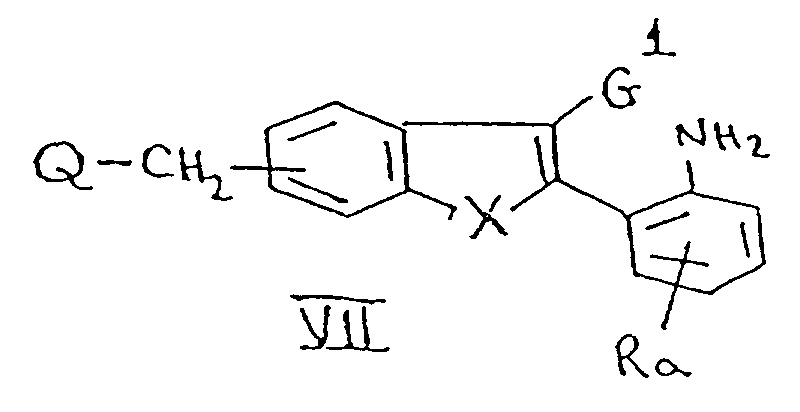
après quoi lorsqu'on désire un composé de formule I dans laquelle Z est un groupe 1H-tétrazol-5-yle, on convertit un composé de formule I dans laquelle Z est un groupe carboxy en le nitrile correspondant dans des conditions normales, en faisant ensuite réagir le nitrile avec un azide ;
puis, si nécessaire, on élimine tout groupe protecteur présent ; après quoi, lorsqu'on désire un sel non toxique d'un composé de formule I, on l'obtient par réaction avec l'acide ou la base appropriée apportant un ion physiologiquement acceptable, ou par toute autre opération de formation d'un sel ; et
lorsqu'on désire obtenir une forme optiquement active d'un composé de formule I, on met en oeuvre l'un des procédés (a) à (d) ci-dessus en utilisant une matière de départ optiquement active, ou bien on dédouble la forme racémique d'un composé de formule I par réaction avec une forme optiquement active d'une base organique convenable puis on sépare de façon classique le mélange diastéréoisomérique des sels ainsi obtenus, et on libère la forme optiquement active désirée du composé de formule I par un traitement classique avec un acide ;
Q, X, G¹, Z et Ra ayant l'une quelconque des définitions données dans l'une quelconque des revendications 1 à 7, sauf spécification contraire. - Composition pharmaceutique, qui comprend un composé de formule I, ou un sel non toxique de ce composé suivant l'une quelconque des revendications 1 à 9 en association avec un diluant ou support acceptable du point de vue pharmaceutique.
Applications Claiming Priority (2)
| Application Number | Priority Date | Filing Date | Title |
|---|---|---|---|
| GB9113626 | 1991-06-25 | ||
| GB919113626A GB9113626D0 (en) | 1991-06-25 | 1991-06-25 | Heterocyclic compounds |
Publications (2)
| Publication Number | Publication Date |
|---|---|
| EP0520724A1 EP0520724A1 (fr) | 1992-12-30 |
| EP0520724B1 true EP0520724B1 (fr) | 1995-09-20 |
Family
ID=10697239
Family Applications (1)
| Application Number | Title | Priority Date | Filing Date |
|---|---|---|---|
| EP92305705A Expired - Lifetime EP0520724B1 (fr) | 1991-06-25 | 1992-06-22 | Antagonistes d'angiotensine II |
Country Status (6)
| Country | Link |
|---|---|
| US (1) | US5281613A (fr) |
| EP (1) | EP0520724B1 (fr) |
| JP (1) | JPH05186462A (fr) |
| CA (1) | CA2071086A1 (fr) |
| DE (1) | DE69204920T2 (fr) |
| GB (1) | GB9113626D0 (fr) |
Families Citing this family (13)
| Publication number | Priority date | Publication date | Assignee | Title |
|---|---|---|---|---|
| AP9400651A0 (en) * | 1993-07-15 | 1995-12-30 | Pfizer | Azacyclic-heterocyclic compounds as angiotensin II receptor antagonists. |
| SE9903028D0 (sv) | 1999-08-27 | 1999-08-27 | Astra Ab | New use |
| DE60122939T2 (de) * | 2000-12-21 | 2007-01-11 | Nitromed, Inc., Bedford | Substituierte arylverbindungen als neue, cyclooxygenase-2-selektive inhibitoren, zusammensetzungen und verwendungsverfahren |
| EP1724271A4 (fr) * | 2004-02-26 | 2013-01-23 | Kyowa Hakko Kirin Co Ltd | Agent preventif et/ou therapeutique pour une maladie inflammatoire neutrophile |
| US8969514B2 (en) | 2007-06-04 | 2015-03-03 | Synergy Pharmaceuticals, Inc. | Agonists of guanylate cyclase useful for the treatment of hypercholesterolemia, atherosclerosis, coronary heart disease, gallstone, obesity and other cardiovascular diseases |
| MX2009013293A (es) | 2007-06-04 | 2010-02-15 | Synergy Pharmaceuticals Inc | Agonistas de guanilato ciclasa útiles para el tratamiento de trastornos gastrointestinales, inflamación, cáncer y otros trastornos. |
| EP2810951B1 (fr) | 2008-06-04 | 2017-03-15 | Synergy Pharmaceuticals Inc. | Agonistes de guanylate cyclase utile dans le traitement de troubles gastro-intestinaux, d'une inflammation, d'un cancer et d'autres troubles |
| CA2730603C (fr) | 2008-07-16 | 2019-09-24 | Synergy Pharmaceuticals Inc. | Agonistes de la guanylate cyclase utiles dans le traitement des affections gastro-intestinales, de l'inflammation gastro-intestinale, du cancer gastro-intestinal et d'autres affections |
| US9616097B2 (en) | 2010-09-15 | 2017-04-11 | Synergy Pharmaceuticals, Inc. | Formulations of guanylate cyclase C agonists and methods of use |
| JP2016514670A (ja) | 2013-03-15 | 2016-05-23 | シナジー ファーマシューティカルズ インコーポレイテッド | 他の薬物と組み合わせたグアニル酸シクラーゼ受容体アゴニスト |
| JP2016514671A (ja) | 2013-03-15 | 2016-05-23 | シナジー ファーマシューティカルズ インコーポレイテッド | グアニル酸シクラーゼのアゴニストおよびその使用 |
| EA201592263A1 (ru) | 2013-06-05 | 2016-05-31 | Синерджи Фармасьютикалз, Инк. | Ультрачистые агонисты гуанилатциклазы c, способ их получения и использования |
| DK4426434T3 (da) | 2021-11-02 | 2025-11-10 | Flare Therapeutics Inc | Pparg inverse agonists and uses thereof |
Family Cites Families (18)
| Publication number | Priority date | Publication date | Assignee | Title |
|---|---|---|---|---|
| US4920130A (en) * | 1987-11-02 | 1990-04-24 | Rorer Pharamceutical Corp. | Quinoline derivatives and use thereof as antagonists of leukotriene D4 |
| US4920132A (en) * | 1987-11-03 | 1990-04-24 | Rorer Pharmaceutical Corp. | Quinoline derivatives and use thereof as antagonists of leukotriene D4 |
| US4920131A (en) * | 1987-11-03 | 1990-04-24 | Rorer Pharmaceutical Corp. | Quinoline derivatives and use thereof as antagonists of leukotriene D4 |
| GT198900008A (es) * | 1988-01-29 | 1990-07-17 | Derivados de quinolina, quinazolina y cinolina. | |
| IL89029A (en) * | 1988-01-29 | 1993-01-31 | Lilly Co Eli | Fungicidal quinoline and cinnoline derivatives, compositions containing them, and fungicidal methods of using them |
| IE64514B1 (en) * | 1989-05-23 | 1995-08-09 | Zeneca Ltd | Azaindenes |
| IL94390A (en) * | 1989-05-30 | 1996-03-31 | Merck & Co Inc | The 6-membered trans-nitrogen-containing heterocycles are compressed with imidazo and pharmaceutical preparations containing them |
| CA2020073A1 (fr) * | 1989-07-03 | 1991-01-04 | Eric E. Allen | Quinazolinones substitues comme antagonistes de l'angiotensine ii |
| DE69016125T2 (de) * | 1989-08-11 | 1995-06-01 | Zeneca Ltd | Chinolin-Derivate, Verfahren zu ihrer Herstellung und ihre Anwendung als Arzneimittel. |
| PT95899A (pt) * | 1989-11-17 | 1991-09-13 | Glaxo Group Ltd | Processo para a preparacao de derivados indole |
| IE903911A1 (en) * | 1989-11-20 | 1991-05-22 | Ici Plc | Diazine derivatives |
| GB8927277D0 (en) * | 1989-12-01 | 1990-01-31 | Glaxo Group Ltd | Chemical compounds |
| EP0430709A3 (en) * | 1989-12-01 | 1992-02-12 | Glaxo Group Limited | Benzthiophen derivatives |
| CA2037630C (fr) * | 1990-03-07 | 2001-07-03 | Akira Morimoto | Composes heterocycliques renfermant de l'azote, methode de production et applications correspondantes |
| EP0453210A3 (en) * | 1990-04-19 | 1993-01-13 | Imperial Chemical Industries Plc | Pyridine derivatives |
| AU653734B2 (en) * | 1990-06-19 | 1994-10-13 | Meiji Seika Kabushiki Kaisha | Substituted 4-biphenylmethoxypyridine derivatives |
| IE912956A1 (en) * | 1990-09-10 | 1992-03-11 | Abbott Lab | Angiotensin ii receptor antagonists |
| PH31175A (en) * | 1990-10-31 | 1998-03-20 | Squibb & Sons Inc | Indole and benzimi-dazole-substituted imidazole and benzimidazole derivatives. |
-
1991
- 1991-06-25 GB GB919113626A patent/GB9113626D0/en active Pending
-
1992
- 1992-06-11 CA CA002071086A patent/CA2071086A1/fr not_active Abandoned
- 1992-06-22 DE DE69204920T patent/DE69204920T2/de not_active Expired - Fee Related
- 1992-06-22 EP EP92305705A patent/EP0520724B1/fr not_active Expired - Lifetime
- 1992-06-25 US US07/904,225 patent/US5281613A/en not_active Expired - Fee Related
- 1992-06-25 JP JP4167414A patent/JPH05186462A/ja active Pending
Also Published As
| Publication number | Publication date |
|---|---|
| DE69204920T2 (de) | 1996-03-28 |
| EP0520724A1 (fr) | 1992-12-30 |
| CA2071086A1 (fr) | 1992-12-26 |
| US5281613A (en) | 1994-01-25 |
| GB9113626D0 (en) | 1991-08-14 |
| DE69204920D1 (de) | 1995-10-26 |
| JPH05186462A (ja) | 1993-07-27 |
Similar Documents
| Publication | Publication Date | Title |
|---|---|---|
| EP0520723B1 (fr) | Antagonistes d'angiotensine II | |
| EP0516392B1 (fr) | Dérivés de la naphthyridine comme inhibiteurs de l'angiotensine II | |
| EP0454831B1 (fr) | Dérivés de diazine comme antagonistes des recepteurs à l'angiotensine II | |
| EP0412848B1 (fr) | Dérivés de quinoléine, procédés pour leur préparation et leur utilisation comme médicaments | |
| US5338740A (en) | Angiotensin II receptor antagonists | |
| EP0453210A2 (fr) | Derivés de pyridine | |
| US5236937A (en) | Pyridinyl compounds which are useful as angiotensin ii antagonists | |
| EP0399731A1 (fr) | Azaindènes | |
| US5281613A (en) | Heterocyclic compounds | |
| US5380730A (en) | Pyridine compounds which have useful pharmaceutical utility | |
| US5373015A (en) | Fused pyridine derivatives useful as angiotensin II antagonists | |
| IE921093A1 (en) | Nitrogen derivatives | |
| US5198434A (en) | Angiotensin ii antagonizing fused pyridinyloxy containing derivatives | |
| WO1994000450A1 (fr) | Derives de chromane utilises comme antagonistes d'angiotensine ii | |
| WO1994011379A1 (fr) | Composes heterocycliques utilises comme antagonistes d'angiotensine | |
| WO1993024487A1 (fr) | Composes heterocycliques contenant de l'azote utiles comme antagonistes de l'angiotensine ii | |
| WO1993024501A1 (fr) | Composes heterocycliques contenant du phosphore, utilises comme antagonistes d'angiotensines | |
| WO1994003453A1 (fr) | Derives de pyrazolopyridine utiles comme antagonistes de l'angiotensine ii |
Legal Events
| Date | Code | Title | Description |
|---|---|---|---|
| PUAI | Public reference made under article 153(3) epc to a published international application that has entered the european phase |
Free format text: ORIGINAL CODE: 0009012 |
|
| AK | Designated contracting states |
Kind code of ref document: A1 Designated state(s): AT BE CH DE DK ES FR GB GR IT LI LU MC NL PT SE |
|
| 17P | Request for examination filed |
Effective date: 19930526 |
|
| 17Q | First examination report despatched |
Effective date: 19930720 |
|
| RBV | Designated contracting states (corrected) |
Designated state(s): DE FR GB IT |
|
| RAP1 | Party data changed (applicant data changed or rights of an application transferred) |
Owner name: ZENECA LIMITED |
|
| GRAA | (expected) grant |
Free format text: ORIGINAL CODE: 0009210 |
|
| AK | Designated contracting states |
Kind code of ref document: B1 Designated state(s): DE FR GB IT |
|
| REF | Corresponds to: |
Ref document number: 69204920 Country of ref document: DE Date of ref document: 19951026 |
|
| ITF | It: translation for a ep patent filed | ||
| ET | Fr: translation filed | ||
| PG25 | Lapsed in a contracting state [announced via postgrant information from national office to epo] |
Ref country code: GB Effective date: 19960622 |
|
| PLBE | No opposition filed within time limit |
Free format text: ORIGINAL CODE: 0009261 |
|
| STAA | Information on the status of an ep patent application or granted ep patent |
Free format text: STATUS: NO OPPOSITION FILED WITHIN TIME LIMIT |
|
| 26N | No opposition filed | ||
| GBPC | Gb: european patent ceased through non-payment of renewal fee |
Effective date: 19960622 |
|
| PG25 | Lapsed in a contracting state [announced via postgrant information from national office to epo] |
Ref country code: FR Effective date: 19970228 |
|
| PG25 | Lapsed in a contracting state [announced via postgrant information from national office to epo] |
Ref country code: DE Effective date: 19970301 |
|
| REG | Reference to a national code |
Ref country code: FR Ref legal event code: ST |
|
| PG25 | Lapsed in a contracting state [announced via postgrant information from national office to epo] |
Ref country code: IT Free format text: LAPSE BECAUSE OF NON-PAYMENT OF DUE FEES;WARNING: LAPSES OF ITALIAN PATENTS WITH EFFECTIVE DATE BEFORE 2007 MAY HAVE OCCURRED AT ANY TIME BEFORE 2007. THE CORRECT EFFECTIVE DATE MAY BE DIFFERENT FROM THE ONE RECORDED. Effective date: 20050622 |