EP0454831B1 - Dérivés de diazine comme antagonistes des recepteurs à l'angiotensine II - Google Patents
Dérivés de diazine comme antagonistes des recepteurs à l'angiotensine II Download PDFInfo
- Publication number
- EP0454831B1 EP0454831B1 EP91900302A EP91900302A EP0454831B1 EP 0454831 B1 EP0454831 B1 EP 0454831B1 EP 91900302 A EP91900302 A EP 91900302A EP 91900302 A EP91900302 A EP 91900302A EP 0454831 B1 EP0454831 B1 EP 0454831B1
- Authority
- EP
- European Patent Office
- Prior art keywords
- formula
- compound
- ethyl
- alkyl
- hydrogen
- Prior art date
- Legal status (The legal status is an assumption and is not a legal conclusion. Google has not performed a legal analysis and makes no representation as to the accuracy of the status listed.)
- Expired - Lifetime
Links
- 0 C*C=CC=C(C)C1=CC=C(C*)CC1C Chemical compound C*C=CC=C(C)C1=CC=C(C*)CC1C 0.000 description 6
Classifications
-
- C—CHEMISTRY; METALLURGY
- C07—ORGANIC CHEMISTRY
- C07D—HETEROCYCLIC COMPOUNDS
- C07D471/00—Heterocyclic compounds containing nitrogen atoms as the only ring hetero atoms in the condensed system, at least one ring being a six-membered ring with one nitrogen atom, not provided for by groups C07D451/00 - C07D463/00
- C07D471/02—Heterocyclic compounds containing nitrogen atoms as the only ring hetero atoms in the condensed system, at least one ring being a six-membered ring with one nitrogen atom, not provided for by groups C07D451/00 - C07D463/00 in which the condensed system contains two hetero rings
- C07D471/04—Ortho-condensed systems
-
- A—HUMAN NECESSITIES
- A61—MEDICAL OR VETERINARY SCIENCE; HYGIENE
- A61P—SPECIFIC THERAPEUTIC ACTIVITY OF CHEMICAL COMPOUNDS OR MEDICINAL PREPARATIONS
- A61P43/00—Drugs for specific purposes, not provided for in groups A61P1/00-A61P41/00
-
- A—HUMAN NECESSITIES
- A61—MEDICAL OR VETERINARY SCIENCE; HYGIENE
- A61P—SPECIFIC THERAPEUTIC ACTIVITY OF CHEMICAL COMPOUNDS OR MEDICINAL PREPARATIONS
- A61P9/00—Drugs for disorders of the cardiovascular system
-
- A—HUMAN NECESSITIES
- A61—MEDICAL OR VETERINARY SCIENCE; HYGIENE
- A61P—SPECIFIC THERAPEUTIC ACTIVITY OF CHEMICAL COMPOUNDS OR MEDICINAL PREPARATIONS
- A61P9/00—Drugs for disorders of the cardiovascular system
- A61P9/12—Antihypertensives
Definitions
- This invention concerns novel diazine derivatives and, more particularly, novel azaquinoline derivatives which possess pharmacologically useful properties in antagonising, at least in part, one or more of the actions of the substances known as angiotensins, and in particular of that known as angiotensin II (hereafter referred to as AII).
- AII angiotensin II
- the invention also concerns pharmaceutical compositions of the novel compounds for use in treating diseases or medical conditions such as hypertension, congestive heart failure and/or hyperaldosteronism in warm-blooded animals (including man), as well as in other diseases or medical conditions in which the renin-angiotensin-aldosterone system plays a significant causative role.
- the invention also includes processes for the manufacture of the novel compounds and their use in treating one of the afore-mentioned diseases or medical conditions and for the production of novel pharmaceuticals for use in such medical treatments.
- the angiotensins are key mediators of the renin-angiotensin-aldosterone system, which is involved in the control of homeostasis and fluid/electrolyte balance in many warm-blooded animals, including man.
- the angiotensin known as AII is produced by the action of angiotensin converting enzyme (ACE) on angiotensin I, itself produced by the action of the enzyme renin on the blood plasma protein angiotensinogen.
- ACE angiotensin converting enzyme
- AII is a potent spasmogen especially in the vasculature and is known to increase vascular resistance and blood pressure.
- the angiotensins are known to stimulate the release of aldosterone and hence result in vascular congestion and hypertension via sodium and fluid retention mechanisms.
- ring B is a pyridine, pyridazine, pyrimidine or pyrazine moiety
- R1 is hydrogen, (1-8C)alkyl, (3-8C)cycloalkyl, (3-8C)cycloalkyl-(1-4C)alkyl, phenyl, phenyl(1-4C)alkyl or (1-4C)alkyl bearing one or more fluoro substituents
- R2 is hydrogen, (1-8C)alkyl, (3-8C)cycloalkyl, (3-8C)cycloalkyl-(1-4C)alkyl, carboxy, (1-4C)alkoxycarbonyl, cyano, nitro, phenyl or phenyl(1-4C)alkyl
- R3 and R4 are independently selected from hydrogen, (1-4C)alkyl, (1-4C)alkoxy, fluoridine or pyrazine moiety
- R1 is hydrogen, (1-8C)alkyl, (3-8C)cycloalkyl, (3-8
- a further aspect of the invention comprises a compound of the formula I as defined above wherein R1 is hydrogen, (1-8C)alkyl, trifluoromethyl, (3-8C)cycloalkyl, (3-8C)cycloalkyl(1-4C)alkyl, phenyl, or phenyl(1-4C)alkyl; and R3, R4 and R5 are independently selected from hydrogen, (1-4C)alkyl, (1-4C)alkoxy, halogeno, trifluoromethyl, cyano and nitro; or when ring B is a pyridine moiety, R3 and R4 may optionally together form a (1-4C)alkylenedioxy group.
- alkyl include both straight and branched chain variants when the carbon numbers permit.
- branched chain variants such as “isopropyl” being specifically named where intended. The same convention applies to other radicals.
- R1 or R2 when it is alkyl is, for example, methyl, ethyl, propyl, butyl, isobutyl, sec -butyl, pentyl or hexyl; when it is cycloalkyl is, for example, cyclopropyl, cyclopentyl or cyclohexyl; when it is cycloalkyl-alkyl is, for example, cyclopropylmethyl, cyclopentylmethyl, cyclohexylmethyl or 2-cyclopentyl-ethyl; when it is phenylalkyl is, for example, benzyl, 1-phenylethyl or 2-phenylethyl.
- R1 when it is alkyl bearing one or more fluoro substituents is, for example, fluoromethyl, trifluoromethyl, 2,2,2-trifluoroethyl or pentafluoroethyl; and for R2 when it is alkoxycarbonyl is, for example, methoxycarbonyl, ethoxycarbonyl or propoxycarbonyl.
- R3, R4, R5 or for an optional substituent which may be present when X is phenylene include, by way of example:- for alkyl, methyl and ethyl; for alkoxy, methoxy, ethoxy and isopropoxy; for fluoroalkoxy: trifluoromethoxy, 2-fluoroethoxy, 2,2,2-trifluoroethoxy and 3,3,3-trifluoropropoxy; for halogeno, fluoro, chloro, bromo and iodo; for alkylamino: methylamino, ethylamino and butylamino; for dialkylamino: dimethylamino, diethylamino and dipropylamino; for N -alkylcarbamoyl: N -methyl and N -ethylcarbamoyl; for di( N -alkyl)carbamoyl: N , N -dimethylcarbamoyl: N
- a particular value for R6 when it is a non-toxic, biodegradable residue of a physiologically acceptable alcohol or phenol is, for example, a residue derived from a (1-6C)alkanol such as methanol or ethanol, or phenol, glycerol or the like.
- R7 when it is alkyl is, for example, methyl, ethyl, propyl, isopropyl, butyl or pentyl; and when it is cycloalkyl is, for example, cyclobutyl, cyclopentyl or cyclohexyl.
- phenyl moieties include, by way of example, for halogeno, fluoro, chloro and bromo; for alkyl, methyl or ethyl; and for alkoxy, methoxy and ethoxy.
- a specific value for X which is of particular interest is, for example, p -phenylene.
- R6 or R5 is, for example, hydrogen and for R1 is, for example, methyl, ethyl or propyl.
- R3 or R4 is, for example, hydrogen, methyl, methoxy, ethoxy or isopropoxy.
- a preferred value for R2 is, for example, hydrogen.
- a preferred value for Z is, for example, carboxy or 1 H -tetrazol-5-yl, which latter is especially preferred and, in particular, when it is attached ortho to the group X.
- formula I compounds can readily be sub-divided, for example, into individual groups of compounds in which the pyridine moiety fused to ring B constitutes a pyrido-pyridine (that is a naphthyridine), pyrido-pyridazine, pyrido-pyrazine or pyrido-pyrimidine selected from those shown in the partial structural formulae IIa - IIj hereinafter, each of which constitutes a specific group of compounds of the invention.
- a pyrido-pyridine that is a naphthyridine
- pyrido-pyridazine pyrido-pyrazine
- pyrido-pyrimidine selected from those shown in the partial structural formulae IIa - IIj hereinafter, each of which constitutes a specific group of compounds of the invention.
- a group of compounds of the invention which is of special interest comprises those compounds of the formula III wherein R1, R2, R3, R4, R5, X and Z have any of the meanings defined above, and the physiologically acceptable salts thereof.
- X is, for example, p -phenylene and Z is, for example, 1 H -tetrazol-5-yl, and particularly when the groups X and Z are situated ortho to each other.
- R3 and R4 is selected from hydrogen, (1-4C)alkyl, (1-4C)alkoxy and fluoro(1-4C)alkoxy and is attached at the 6-position of the naphthyridine ring; and the other of R3 and R4 is hydrogen.
- Particularly suitable salts for such compounds therefore include, for example, salts with bases affording physiologically acceptable cations, for example, alkali metal (such as sodium and potassium), alkaline earth metal (such as magnesium and calcium), aluminium and ammonium salts, as well as salts with suitable organic bases, such as with ethanolamine, methylamine, diethylamine or triethylamine, as well as salts with acids forming physiologically acceptable anions, such as salts with mineral acids, for example with hydrogen halides (such as hydrogen chloride and hydrogen bromide), sulphuric and phosphoric acid, and with organic acids, for example with p -toluenesulphonic, methanesulphonic, citric, tartaric and oxalic acids.
- bases affording physiologically acceptable cations for example, alkali metal (such as sodium and potassium), alkaline earth metal (such as magnesium and calcium), aluminium and ammonium salts, as well as salts with suitable organic bases, such as with ethanolamine,
- the compounds of formula I may be obtained by standard procedures of organic chemistry well known in the art for the production of structurally analogous compounds. Such procedures are provided as a further feature of the invention and include, by way of example, the following procedures in which the generic radicals have any of the values given above, unless stated otherwise:
- the compounds of formula I will have beneficial pharmacological effects in warm-blooded animals (including man) in diseases and medical conditions where amelioration of the vasoconstrictor and fluid retaining properties of the reninangiotensin-aldosterone system is desirable, at least in part by antagonism of one or more of the physiological actions of AII.
- the compounds of the invention will thus be useful in the treatment of diseases or medical conditions such as hypertension, congestive heart failure and/or hyperaldosteronism in warm-blooded animals (including man), as well as in other diseases or medical conditions in which the renin-angiotensin-aldosterone system plays a significant causative role.
- Test A This in vitro procedure involves the incubation of the test compound initially at a concentration of 100 micromolar (or less) in a buffered mixture containing fixed concentrations of radiolabelled AII and a cell surface membrane fraction prepared from a suitable angiotensin target tissue.
- the source of cell surface membranes is the guinea pig adrenal gland which is well known to respond to AII.
- concentrations of the test compound are ordinarily chosen to allow testing over at least four orders of magnitude centred about the predicted approximate IC50, which latter is subsequently determined from a plot of percentage displacement against concentration of the test compound.
- Test B This in vitro test involves the measurement of the antagonistic effects of the test compound against AII-induced contractions of isolated rabbit aorta, maintained in a physiological salt solution at 37°C. In order to ensure that the effect of the compound is specific to antagonism of AII, the effect of the test compound on noradrenaline-induced contractions may also be determined in the same preparation.
- Test C This in vivo test involves using terminally-anaesthetised or conscious rats in which an arterial catheter has been implanted under anaesthesia for the measurement of changes in blood pressure.
- the AII antagonistic effects of the test compound following oral or parenteral administration, are assessed against pressor responses induced by AII. To ensure that the effect is specific the effect of the test compound on vasopressin-induced pressor responses may also be determined in the same preparation.
- Test C The compounds of formula I generally show specific AII-antagonist properties in Test C at a dose of 50 mg/kg body weight or much less, without any overt toxicological or other untoward pharmacological effect.
- Test D This in vivo test involves the stimulation of endogenous AII biosynthesis in a variety of species including rat, marmoset and dog by introducing a diet of low sodium content and giving appropriate daily doses of a saluretic known as frusemide. The test compound is then administered orally or parenterally to the animal in which an arterial catheter has been implanted under anaesthesia for the measurement of changes in blood pressure.
- the compound of Example 4 gave the following results in tests A and C described above:- In test A: an IC50 of 2x10 ⁇ 8M; In Test C: an ED50 of 0.6 mg/kg (i.v. administration).
- compositions comprising a compound of formula I or a salt thereof as defined above, together with a pharmaceutically acceptable diluent or carrier.
- Such compositions will conveniently be in a form suitable for oral administration (e.g. as a tablet, capsule, solution, suspension or emulsion) or parenteral administration (e.g. as an injectable aqueous or oily solution, or injectable emulsion).
- the compounds of formula I may also be advantageously administered for therapeutic or prophylactic purposes together with another pharmacological agent known in the general art to be of value in treating one or more of the diseases or medical conditions referred to hereinabove.
- a compound of formula I (or a pharmaceutically acceptable salt thereof as appropriate) will generally be administered to man so that, for example, a daily oral dose of up to 50 mg/kg body weight (and preferably of up to 10 mg/kg) or a daily parenteral dose of up to 5 mg/kg body weight (and preferably of up to 1 mg/kg) is received, given in divided doses as necessary, the precise amount of compound (or salt) administered and the route and form of administration depending on size, age and sex of the person being treated and on the particular disease or medical condition being treated according to principles well known in the medical arts.
- the compounds of formula I are also useful in the veterinary treatment of similar conditions affecting commercially valuable warm-blooded animals, such as dogs, cats, horses and cattle. In general for such treatment, the compounds of the formula I will generally be administered in an analogous amount and manner to those described above for administration to humans.
- the compounds of formula I are also of value as pharmacological tools in the development and standardisation of test systems for the evaluation of the effects of AII in laboratory animals such as cats, dogs, rabbits, monkeys, rats and mice, as part of the continuing search for new and improved therapeutic agents.
- the starting material A2 was obtained as follows:- Sodium hydride (60% dispersion in mineral oil; 250 mg) was added to a stirred suspension of 2-methyl-1,5-naphthyridin-4(1 H )-one (1.0 g) in DMF (30 ml). The mixture was stirred until evolution of hydrogen had ceased and then a solution of 5-[2-(4'-bromomethyl-biphenylyl]-2-triphenylmethyl-2 H -tetrazole (3.83 g) (obtained as described in European patent application, publication number 291969) in DMF (10 ml) was added. Stirring was continued for 72 hours and then water (200 ml) was added.
- the starting material (A3) was obtained as follows:-
- the starting material (A4) was obtained as follows:-
- Example 5 6-Ethoxy-2-ethyl-4-[(2'-(1 H -tetrazol-5-yl)biphenyl-4-yl)methoxy]-1,5-naphthyridine hydrochloride , m.p.
- the 3-aminopyridines used in Examples 8, 9 and 10 were obtained as follows: 5-amino-2-methylpyridine was obtained as described in Chem. Pharm. Bull. Japan , 1987, 35 (10), 4101-9; 3-amino-4-methylpyridine was obtained as described in Roczniki Chem ., 1956, 30 , 475, 479 ( Chemical Abstracts , 1957, 14722); 5-amino-2-dimethylaminopyridine was obtained as described in Chem Ber .,1928, 61 , 427. 2-(2,2,2-trifluoroethoxy)-5-aminopyridine used in Example 7 was obtained as described in U.K. Patent Application No. 2029411.
- the 3-aminopyridines used in Examples 5 and 6 were made by an analogous process using the appropriate alkali metal alkoxide, and were used without purification or characterisation.
- the starting material (A12) was obtained as follows:-
- the starting material (A13) was obtained as follows:-
- the starting material (A14) was obtained as follows:-
- Pharmaceutical dosage forms suitable for presenting the compounds of the invention for therapeutic or prophylactic use, include conventional tablet, capsule, injection and aerosol formulations.
- the following illustrative formulations may be obtained by conventional procedures well known in the art of pharmacy and are suitable for therapeutic or prophylactic use in humans:- Tablet I mg/tablet Compound Z* 5.0 Lactose Ph. Eur. 89.25 Croscarmellose sodium 4.0 Maize starch paste (5% w/v aqueous paste) 0.75 Magnesium stearate 1.0 Note : compound Z* may be a compound of formula I such as one of the previosly described specific examples herein or a physiologically acceptable salt thereof. Tablet II mg/tablet Compound Z* 50 Lactose Ph.
- compound Z* may be a compound of formula I such as one of the previosly described specific examples herein or a physiologically acceptable salt thereof .
- Tablet III mg/tablet Compound Z* 100 Lactose Ph.
- Maize starch paste (5% w/v aqueous paste) 2.25 Magnesium stearate 3.0
- compound Z* may be a compound of formula I such as one of the previosly described specific examples herein or a physiologically acceptable salt thereof.
- compound Z* 10 Lactose Ph.Eur. 488.5 Magnesium stearate 1.5 Note : compound Z* may be a compound of formula I such as one of the previosly described specific examples herein or a physiologically acceptable salt thereof.
Landscapes
- Chemical & Material Sciences (AREA)
- Organic Chemistry (AREA)
- Health & Medical Sciences (AREA)
- Life Sciences & Earth Sciences (AREA)
- General Health & Medical Sciences (AREA)
- General Chemical & Material Sciences (AREA)
- Medicinal Chemistry (AREA)
- Nuclear Medicine, Radiotherapy & Molecular Imaging (AREA)
- Bioinformatics & Cheminformatics (AREA)
- Pharmacology & Pharmacy (AREA)
- Engineering & Computer Science (AREA)
- Animal Behavior & Ethology (AREA)
- Chemical Kinetics & Catalysis (AREA)
- Public Health (AREA)
- Veterinary Medicine (AREA)
- Cardiology (AREA)
- Heart & Thoracic Surgery (AREA)
- Pharmaceuticals Containing Other Organic And Inorganic Compounds (AREA)
- Nitrogen Condensed Heterocyclic Rings (AREA)
- Plural Heterocyclic Compounds (AREA)
- Diaphragms For Electromechanical Transducers (AREA)
- Organic Insulating Materials (AREA)
- Vibration Prevention Devices (AREA)
Claims (11)
- Dérivé d'azaquinoléine de formule I

- Composé suivant la revendication 1, dans lequel R¹ représente de l'hydrogène, un groupe méthyle, éthyle, propyle, butyle, isobutyle, sec.butyle, pentyle, hexyle, cyclopropyle, cyclopentyle, cyclohexyle, cyclopropylméthyle, cyclopentylméthyle, cyclohexylméthyle, 2-cyclopentyléthyle, phényle, benzyle, 1-phényléthyle, 2-phényléthyle, fluorométhyle, trifluorométhyle, 2,2,2-trifluoréthyle ou pentafluoréthyle ; R² est de l'hydrogène, un groupe méthyle, éthyle, propyle, butyle, isobutyle, sec.butyle, pentyle, hexyle, cyclopropyle, cyclopentyle, cyclohexyle, cyclopropylméthyle, cyclopentylméthyle, cyclohexylméthyle, 2-cyclopentyléthyle, carboxy, méthoxycarbonyle, éthoxycarbonyle, propoxycarbonyle, cyano, nitro, phényle, benzyle, 1-phényléthyle ou 2-phényléthyle ; R³ et R⁴ sont choisis indépendamment entre l'hydrogène, des groupes méthyle, éthyle, méthoxy, éthoxy, isopropoxy, trifluorométhoxy, 2-fluoréthoxy, 2,2,2-trifluoréthoxy, 3,3,3-trifluoropropoxy, fluoro, chloro, bromo, iodo, trifluorométhyle, cyano, nitro, hydroxy, amino, méthylamino, éthylamino, butylamino, diméthylamino, diéthylamino, dipropylamino, carboxy, méthoxycarbonyle, éthoxycarbonyle, propoxycarbonyle, carbamoyle, N-méthylcarbamoyle, N-éthylcarbamoyle, N,N-diméthylcarbamoyle, N,N-diéthylcarbamoyle ; ou bien lorsque le noyau B est un noyau de pyridine, R³ et R⁴ peuvent facultativement former ensemble un groupe méthylènedioxy ou éthylènedioxy ; R⁵ est de l'hydrogène, un groupe méthyle, éthyle, méthoxy, éthoxy, isopropoxy, fluoro, chloro, bromo, iodo, trifluorométhyle, cyano ou nitro ; X est un groupe phénylène portant facultativement un substituant choisi entre méthyle, éthyle, méthoxy, éthoxy, isopropoxy, fluoro, chloro, bromo, iodo, trifluorométhyle, cyano et nitro, ou bien X est une liaison directe entre les groupes phényle et méthylène adjacents ; R⁶ est un atome d'hydrogène ou un résidu dérivé d'un alcanol en C₁ à C₆ ou du phénol ou du glycérol ; et R⁷ est un groupe méthyle, éthyle, propyle, isopropyle, butyle, pentyle, cyclobutyle, cyclopentyle, cyclohexyle ou phényle ; et l'un quelconque desdits groupes phényle peut ne pas être substitué ou peut porter un ou deux substituants choisis indépendamment entre des substituants méthyle, éthyle, méthoxy, éthoxy, fluoro, chloro, bromo, cyano et trifluorométhyle.
- Composé suivant la revendication 1, dans lequel R¹ est l'hydrogène, un groupe alkyle en C₁ à C₈, trifluorométhyle, cycloalkyle en C₃ à C₈, (cycloalkyle en C₃ à C₈)-(alkyle en C₁ à C₄), phényle ou phényl-(alkyle en C₁ à C₄) ; et R³, R⁴ et R⁵ sont choisis indépendamment entre l'hydrogène, des groupes alkyle en C₁ à C₄, alkoxy en C₁ à C₄, halogéno, trifluorométhyle, cyano et nitro ; ou bien lorsque le noyau B est un noyau de pyridine, R³ et R⁴ peuvent former ensemble facultativement un groupe alkylidènedioxy en C₁ à C₄.
- Naphtyridine de formule III

- Naphtyridine suivant la revendication 4, dans laquelle l'un de R³ et R⁴ est choisi entre l'hydrogène, des groupes alkyle en C₁ à C₄, alkoxy en C₁ à C₄ et fluoralkoxy en C₁ à C₄ et est attaché dans la position 6 du noyau de naphtyridine ; et l'autre, de R³ et R⁴, est l'hydrogène.
- Composé suivant l'une quelconque des revendications 1 à 5, dans lequel X est un groupe p-phénylène et Z est un groupe 1H-tétrazole-5-yle attaché en ortho par rapport au groupe X.
- Composé de formule I, choisi entre :
la2-éthyl-4-[(2'-(1H-tétrazole-5-yl)biphényl-4-yl)méthoxy]-1,5-naphtyridine ;
la 2-éthyl-6-méthoxy-4-[(2'-(1H-tétrazole-5-yl)biphényl-4-yl)méthoxy]-1,5-naphtyridine ;
la 6-éthoxy-2-éthyl-4-[(2'-(1H-tétrazole-5-yl)biphényl-4-yl)méthoxy]-1,5-naphtyridine ;
la 2-éthyl-6-isopropoxy-4-[(2'-(1H-tétrazole-5-yl)biphényl-4-yl)méthoxy]-1,5-naphtyridine ;
la2-éthyl-6-(2,2,2-trifluoroéthoxy)-4-[(2'-(1H-tétrazole-5-yl)biphényl-4-yl)méthoxy]-1,5-naphtyridine ; et
la 2-éthyl-6-méthyl-4-[(2'-(1H-tétrazole-5-yl)biphényl-4-yl)méthoxy]-1,5-naphtyridine ;
et leurs sels physiologiquement acceptables. - Sel suivant l'une quelconque des revendications précédentes, qui est choisi entre des sels formés avec des acides apportant des anions physiologiquement acceptables et, pour les composés de formule I qui sont acides, sels de métaux alcalins, de métaux alcalino-terreux, d'aluminium et d'ammonium, et sels formés avec des bases organiques apportant des cations physiologiquement acceptables.
- Procédé de production d'un composé de formule I ou III ou d'un sel physiologiquement acceptable de ce composé suivant la revendication 1, 4 ou 7, qui est caractérisé en ce que :(a) pour des composés dans lesquels Z est un groupe carboxy, un dérivé d'acide carboxylique de formule IV
 (b) pour des composés de formule I dans laquelle Z est un groupe tétrazolyle, un composé de formule V
 (c) une azoquinolone de formule VI
 (d) un composé de formule IX
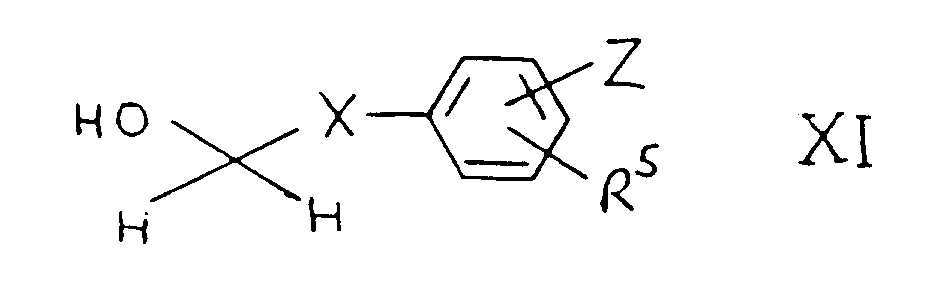
lorsqu'on désire un composé de formule I dans laquelle Z est un groupe de formule -CO.NH.SO₂R⁷ ou un groupe de formule -CO.OR⁶ dans laquelle R⁶ représente autre chose que l'hydrogène, on fait réagir un acide carboxylique de formule I dans laquelle Z est un groupe carboxy (ou un dérivé réactif de cet acide) avec un sulfonamide de formule NH₂.SO₂R⁷ ou un composé hydroxylé de formule HO.R⁶ ou avec un sel de ce composé ;
lorsqu'on désire obtenir un sel physiologiquement acceptable d'un composé de formule I, on l'obtient par réaction avec l'acide approprié ou la base appropriée apportant un ion physiologiquement acceptable, ou par toute autre opération classique de formation d'un sel ; et
lorsqu'on désire une forme optiquement active d'un composé de formule I, on met en oeuvre l'un des procédés (a)-(d) ci-dessus en utilisant une matière de départ optiquement active, ou bien on dédouble la forme racémique d'un composé de formule I dans laquelle Z est un groupe acide par réaction avec une forme optiquement active d'une base organique convenable, puis on sépare de façon classique le mélange diastéréoisomérique de sels ainsi obtenu et on libère la forme optiquement active désiré dudit composé de formule I par un traitement classique avec un acide ;
le noyau B, R¹, R², R³, R⁴, R⁵, R⁶, R⁷, X et Z ayant l'une quelconque des définitions données dans l'une quelconque des revendications 1 à 6, sauf spécification contraire. - Composition pharmaceutique, qui comprend un composé de formule I ou III ou un sel physiologiquement acceptable de ce composé suivant l'une quelconque des revendications 1 à 8, en association avec un diluant ou support acceptable du point de vue pharmaceutique.
- Composé de formule V, dans la formule duquel le noyau B, R¹, R², R³, R⁴, R⁵ et X ont l'une quelconque des définitions données dans l'une quelconque des revendications 1 à 6 et L est un groupe protecteur.
Applications Claiming Priority (5)
| Application Number | Priority Date | Filing Date | Title |
|---|---|---|---|
| GB898926211A GB8926211D0 (en) | 1989-11-20 | 1989-11-20 | Diazine derivatives |
| GB8926211 | 1989-11-20 | ||
| GB909011348A GB9011348D0 (en) | 1990-05-21 | 1990-05-21 | Nitrogen heterocycles |
| GB9011348 | 1990-05-21 | ||
| PCT/GB1990/001776 WO1991007404A1 (fr) | 1989-11-20 | 1990-11-19 | Derives de diazine |
Publications (2)
| Publication Number | Publication Date |
|---|---|
| EP0454831A1 EP0454831A1 (fr) | 1991-11-06 |
| EP0454831B1 true EP0454831B1 (fr) | 1994-08-03 |
Family
ID=26296233
Family Applications (1)
| Application Number | Title | Priority Date | Filing Date |
|---|---|---|---|
| EP91900302A Expired - Lifetime EP0454831B1 (fr) | 1989-11-20 | 1990-11-19 | Dérivés de diazine comme antagonistes des recepteurs à l'angiotensine II |
Country Status (17)
| Country | Link |
|---|---|
| US (1) | US5126344A (fr) |
| EP (1) | EP0454831B1 (fr) |
| JP (1) | JPH04505161A (fr) |
| KR (1) | KR920701206A (fr) |
| AT (1) | ATE109481T1 (fr) |
| AU (1) | AU6733690A (fr) |
| BG (1) | BG60068B2 (fr) |
| CA (1) | CA2030240A1 (fr) |
| DE (1) | DE69011318T2 (fr) |
| FI (1) | FI913478A7 (fr) |
| GB (1) | GB9024730D0 (fr) |
| HU (1) | HUT58334A (fr) |
| IE (1) | IE903911A1 (fr) |
| IL (1) | IL96407A0 (fr) |
| NZ (1) | NZ236127A (fr) |
| PT (1) | PT95929A (fr) |
| WO (1) | WO1991007404A1 (fr) |
Families Citing this family (34)
| Publication number | Priority date | Publication date | Assignee | Title |
|---|---|---|---|---|
| DE122007000050I1 (de) * | 1990-02-19 | 2007-11-08 | Novartis Ag | Acylverbindungen |
| GB9010394D0 (en) * | 1990-05-09 | 1990-06-27 | Ici Plc | Heterocyclic compounds |
| GB9025123D0 (en) * | 1990-11-19 | 1991-01-02 | Ici Plc | Nitrogen compounds |
| GB9102804D0 (en) * | 1991-02-11 | 1991-03-27 | Ici Plc | Heterocyclic derivatives |
| IL101860A0 (en) * | 1991-05-31 | 1992-12-30 | Ici Plc | Heterocyclic derivatives |
| JPH05213884A (ja) * | 1991-06-14 | 1993-08-24 | Upjohn Co:The | 新規な4−アミノキノリン類およびこれを有効成分とする高血圧・鬱血性心不全の予防・治療剤 |
| GB9113628D0 (en) * | 1991-06-25 | 1991-08-14 | Ici Plc | Heterocyclic derivatives |
| GB9113626D0 (en) * | 1991-06-25 | 1991-08-14 | Ici Plc | Heterocyclic compounds |
| US5246944A (en) * | 1991-08-13 | 1993-09-21 | Merck & Co., Inc. | Quinoline angiotensin ii antagonists incorporating a substituted benzyl element |
| GB9121727D0 (en) * | 1991-10-14 | 1991-11-27 | Ici Plc | Heterocyclic compounds |
| GB9202633D0 (en) * | 1992-02-07 | 1992-03-25 | Fujisawa Pharmaceutical Co | Heterocyclic derivatives |
| TW297025B (fr) * | 1992-02-14 | 1997-02-01 | Squibb & Sons Inc | |
| WO1993017682A1 (fr) * | 1992-03-04 | 1993-09-16 | Abbott Laboratories | Antagonistes des recepteurs de l'angiotensine ii |
| GB2264710A (en) * | 1992-03-04 | 1993-09-08 | Merck & Co Inc | Quinoline and azaquinoline angiotensin ii antagonists incorporating a substituted biphenyl element |
| GB9211270D0 (en) * | 1992-05-28 | 1992-07-15 | Ici Plc | Nitrogen compounds |
| SE9903028D0 (sv) | 1999-08-27 | 1999-08-27 | Astra Ab | New use |
| JP4303109B2 (ja) * | 2001-10-04 | 2009-07-29 | メルク エンド カムパニー インコーポレーテッド | 代謝共役型グルタミン酸受容体−5のヘテロアリール置換テトラゾール調節剤 |
| AR037517A1 (es) * | 2001-11-05 | 2004-11-17 | Novartis Ag | Derivados de naftiridinas, un proceso para su preparacion, composicion farmaceutica y el uso de los mismos para la preparacion de un medicamento para el tratamiento de una enfermedad inflamatoria |
| US8969514B2 (en) | 2007-06-04 | 2015-03-03 | Synergy Pharmaceuticals, Inc. | Agonists of guanylate cyclase useful for the treatment of hypercholesterolemia, atherosclerosis, coronary heart disease, gallstone, obesity and other cardiovascular diseases |
| MX354786B (es) | 2007-06-04 | 2018-03-21 | Synergy Pharmaceuticals Inc | Agonistas de guanilato ciclasa utiles para el tratamiento de trastornos gastrointestinales, inflamacion, cancer y otros trastornos. |
| ES2522968T3 (es) | 2008-06-04 | 2014-11-19 | Synergy Pharmaceuticals Inc. | Agonistas de guanilato ciclasa útiles para el tratamiento de trastornos gastrointestinales, inflamación, cáncer y otros trastornos |
| AU2009270833B2 (en) | 2008-07-16 | 2015-02-19 | Bausch Health Ireland Limited | Agonists of guanylate cyclase useful for the treatment of gastrointestinal, inflammation, cancer and other disorders |
| US9616097B2 (en) | 2010-09-15 | 2017-04-11 | Synergy Pharmaceuticals, Inc. | Formulations of guanylate cyclase C agonists and methods of use |
| AR089929A1 (es) | 2012-02-10 | 2014-10-01 | Actelion Pharmaceuticals Ltd | Proceso para manufacturar un derivado de naftiridina |
| AU2014235215A1 (en) | 2013-03-15 | 2015-10-01 | Synergy Pharmaceuticals Inc. | Agonists of guanylate cyclase and their uses |
| AU2014235209B2 (en) | 2013-03-15 | 2018-06-14 | Bausch Health Ireland Limited | Guanylate cyclase receptor agonists combined with other drugs |
| BR112015030326A2 (pt) | 2013-06-05 | 2017-08-29 | Synergy Pharmaceuticals Inc | Agonistas ultrapuros de guanilato ciclase c, método de fabricar e usar os mesmos |
| AU2016296905B2 (en) | 2015-07-23 | 2018-07-05 | Centre National De La Recherche Scientifique | Use of a combination of Dbait molecule and parp inhibitors to treat cancer |
| GB201519573D0 (en) | 2015-11-05 | 2015-12-23 | King S College London | Combination |
| WO2018162439A1 (fr) | 2017-03-08 | 2018-09-13 | Onxeo | Nouveau biomarqueur prédictif de la sensibilité à un traitement du cancer avec une molécule dbait |
| CA3092779A1 (fr) | 2018-03-13 | 2019-09-19 | Onxeo | Molecule dbait contre la resistance acquise dans le traitement du cancer |
| WO2021148581A1 (fr) | 2020-01-22 | 2021-07-29 | Onxeo | Nouvelle molécule dbait et son utilisation |
| PT4426434T (pt) | 2021-11-02 | 2025-11-24 | Flare Therapeutics Inc | Agonistas inversos de pparg e suas utilizações |
| CN121398822A (zh) | 2023-06-21 | 2026-01-23 | 四方生物科学有限公司 | 用于在治疗hr功能正常的癌症的方法中的用途的包含脱氧胞苷衍生物和parp抑制剂的组合 |
Family Cites Families (6)
| Publication number | Priority date | Publication date | Assignee | Title |
|---|---|---|---|---|
| CA1334092C (fr) * | 1986-07-11 | 1995-01-24 | David John Carini | Imidazoles bloquant les recepteurs de l'angiotensine ii |
| US4820843A (en) * | 1987-05-22 | 1989-04-11 | E. I. Du Pont De Nemours And Company | Tetrazole intermediates to antihypertensive compounds |
| US5015651A (en) * | 1988-01-07 | 1991-05-14 | E. I. Du Pont De Nemours And Company | Treatment of hypertension with 1,2,4-angiotensin II antagonists |
| US4880804A (en) * | 1988-01-07 | 1989-11-14 | E. I. Du Pont De Nemours And Company | Angiotensin II receptor blocking benzimidazoles |
| DE3907937A1 (de) * | 1989-03-11 | 1990-09-13 | Basf Ag | Substituierte 1,8-naphthylridine, verfahren zu ihrer herstellung und ihre verwendung als antidots |
| AU634561B2 (en) * | 1989-07-27 | 1993-02-25 | Eli Lilly And Company | Naphthyridine derivatives |
-
1990
- 1990-10-30 IE IE391190A patent/IE903911A1/en unknown
- 1990-11-14 GB GB909024730A patent/GB9024730D0/en active Pending
- 1990-11-19 IL IL96407A patent/IL96407A0/xx unknown
- 1990-11-19 FI FI913478A patent/FI913478A7/fi unknown
- 1990-11-19 WO PCT/GB1990/001776 patent/WO1991007404A1/fr not_active Ceased
- 1990-11-19 AU AU67336/90A patent/AU6733690A/en not_active Abandoned
- 1990-11-19 NZ NZ236127A patent/NZ236127A/en unknown
- 1990-11-19 DE DE69011318T patent/DE69011318T2/de not_active Expired - Fee Related
- 1990-11-19 JP JP2515806A patent/JPH04505161A/ja active Pending
- 1990-11-19 CA CA002030240A patent/CA2030240A1/fr not_active Abandoned
- 1990-11-19 EP EP91900302A patent/EP0454831B1/fr not_active Expired - Lifetime
- 1990-11-19 AT AT91900302T patent/ATE109481T1/de not_active IP Right Cessation
- 1990-11-19 HU HU912485A patent/HUT58334A/hu unknown
- 1990-11-19 US US07/615,753 patent/US5126344A/en not_active Expired - Fee Related
- 1990-11-19 KR KR1019910700759A patent/KR920701206A/ko not_active Withdrawn
- 1990-11-20 PT PT95929A patent/PT95929A/pt not_active Application Discontinuation
-
1991
- 1991-07-19 BG BG094862A patent/BG60068B2/bg unknown
Also Published As
| Publication number | Publication date |
|---|---|
| GB9024730D0 (en) | 1991-01-02 |
| DE69011318T2 (de) | 1994-12-01 |
| WO1991007404A1 (fr) | 1991-05-30 |
| CA2030240A1 (fr) | 1991-05-21 |
| HUT58334A (en) | 1992-02-28 |
| JPH04505161A (ja) | 1992-09-10 |
| IL96407A0 (en) | 1991-08-16 |
| EP0454831A1 (fr) | 1991-11-06 |
| PT95929A (pt) | 1991-09-13 |
| BG60068B2 (bg) | 1993-09-30 |
| FI913478A0 (fi) | 1991-07-18 |
| IE903911A1 (en) | 1991-05-22 |
| KR920701206A (ko) | 1992-08-11 |
| HU912485D0 (en) | 1991-12-30 |
| US5126344A (en) | 1992-06-30 |
| FI913478A7 (fi) | 1991-07-18 |
| NZ236127A (en) | 1993-08-26 |
| ATE109481T1 (de) | 1994-08-15 |
| AU6733690A (en) | 1991-06-13 |
| DE69011318D1 (de) | 1994-09-08 |
Similar Documents
| Publication | Publication Date | Title |
|---|---|---|
| EP0454831B1 (fr) | Dérivés de diazine comme antagonistes des recepteurs à l'angiotensine II | |
| EP0412848B1 (fr) | Dérivés de quinoléine, procédés pour leur préparation et leur utilisation comme médicaments | |
| CA2017066C (fr) | Azaindenes | |
| EP0516392B1 (fr) | Dérivés de la naphthyridine comme inhibiteurs de l'angiotensine II | |
| EP0520723B1 (fr) | Antagonistes d'angiotensine II | |
| EP0453210A2 (fr) | Derivés de pyridine | |
| EP0399732A1 (fr) | Dérivés benzimidazoles | |
| EP0499415A1 (fr) | Dérivés de pyridine et quinoléine, procédés pour leur fabrication et leur utilisation comme antagonistes de l'angiotensine II | |
| US5369114A (en) | Biphenylene branched alkyleneoxy quinolines | |
| EP0520724B1 (fr) | Antagonistes d'angiotensine II | |
| EP0511791A2 (fr) | Dérivés de pyrrolopyridine comme inhibiteurs de l'angiotensine | |
| US5373015A (en) | Fused pyridine derivatives useful as angiotensin II antagonists | |
| EP0499414A2 (fr) | Dérivés de pyridine comme antagonistes d'angiotensine II, procédés pour leur préparation et compositions pharmaceutiques les contenant | |
| US5219863A (en) | Angiotensin ii antagonizing compounds containing a 1,5-naphthyridine or a quinoline moiety | |
| WO1994000450A1 (fr) | Derives de chromane utilises comme antagonistes d'angiotensine ii | |
| WO1994011379A1 (fr) | Composes heterocycliques utilises comme antagonistes d'angiotensine | |
| WO1994003453A1 (fr) | Derives de pyrazolopyridine utiles comme antagonistes de l'angiotensine ii | |
| WO1993024487A1 (fr) | Composes heterocycliques contenant de l'azote utiles comme antagonistes de l'angiotensine ii |
Legal Events
| Date | Code | Title | Description |
|---|---|---|---|
| PUAI | Public reference made under article 153(3) epc to a published international application that has entered the european phase |
Free format text: ORIGINAL CODE: 0009012 |
|
| 17P | Request for examination filed |
Effective date: 19910705 |
|
| AK | Designated contracting states |
Kind code of ref document: A1 Designated state(s): AT BE CH DE DK ES FR GB GR IT LI LU NL SE |
|
| 17Q | First examination report despatched |
Effective date: 19920507 |
|
| GRAA | (expected) grant |
Free format text: ORIGINAL CODE: 0009210 |
|
| AK | Designated contracting states |
Kind code of ref document: B1 Designated state(s): AT BE CH DE DK ES FR GB GR IT LI LU NL SE |
|
| PG25 | Lapsed in a contracting state [announced via postgrant information from national office to epo] |
Ref country code: NL Effective date: 19940803 Ref country code: LI Effective date: 19940803 Ref country code: GR Free format text: LAPSE BECAUSE OF FAILURE TO SUBMIT A TRANSLATION OF THE DESCRIPTION OR TO PAY THE FEE WITHIN THE PRESCRIBED TIME-LIMIT Effective date: 19940803 Ref country code: ES Free format text: THE PATENT HAS BEEN ANNULLED BY A DECISION OF A NATIONAL AUTHORITY Effective date: 19940803 Ref country code: DK Effective date: 19940803 Ref country code: CH Effective date: 19940803 Ref country code: BE Effective date: 19940803 Ref country code: AT Effective date: 19940803 |
|
| REF | Corresponds to: |
Ref document number: 109481 Country of ref document: AT Date of ref document: 19940815 Kind code of ref document: T |
|
| REF | Corresponds to: |
Ref document number: 69011318 Country of ref document: DE Date of ref document: 19940908 |
|
| ITF | It: translation for a ep patent filed | ||
| ET | Fr: translation filed | ||
| PG25 | Lapsed in a contracting state [announced via postgrant information from national office to epo] |
Ref country code: SE Effective date: 19941103 |
|
| REG | Reference to a national code |
Ref country code: CH Ref legal event code: PL |
|
| PG25 | Lapsed in a contracting state [announced via postgrant information from national office to epo] |
Ref country code: LU Free format text: LAPSE BECAUSE OF NON-PAYMENT OF DUE FEES Effective date: 19941130 |
|
| NLV1 | Nl: lapsed or annulled due to failure to fulfill the requirements of art. 29p and 29m of the patents act | ||
| PLBE | No opposition filed within time limit |
Free format text: ORIGINAL CODE: 0009261 |
|
| STAA | Information on the status of an ep patent application or granted ep patent |
Free format text: STATUS: NO OPPOSITION FILED WITHIN TIME LIMIT |
|
| 26N | No opposition filed | ||
| PGFP | Annual fee paid to national office [announced via postgrant information from national office to epo] |
Ref country code: GB Payment date: 19971110 Year of fee payment: 8 |
|
| PGFP | Annual fee paid to national office [announced via postgrant information from national office to epo] |
Ref country code: FR Payment date: 19971112 Year of fee payment: 8 |
|
| PGFP | Annual fee paid to national office [announced via postgrant information from national office to epo] |
Ref country code: DE Payment date: 19971201 Year of fee payment: 8 |
|
| PG25 | Lapsed in a contracting state [announced via postgrant information from national office to epo] |
Ref country code: GB Free format text: LAPSE BECAUSE OF NON-PAYMENT OF DUE FEES Effective date: 19981119 |
|
| GBPC | Gb: european patent ceased through non-payment of renewal fee |
Effective date: 19981119 |
|
| PG25 | Lapsed in a contracting state [announced via postgrant information from national office to epo] |
Ref country code: FR Free format text: LAPSE BECAUSE OF NON-PAYMENT OF DUE FEES Effective date: 19990730 |
|
| REG | Reference to a national code |
Ref country code: FR Ref legal event code: ST |
|
| PG25 | Lapsed in a contracting state [announced via postgrant information from national office to epo] |
Ref country code: DE Free format text: LAPSE BECAUSE OF NON-PAYMENT OF DUE FEES Effective date: 19990901 |
|
| PG25 | Lapsed in a contracting state [announced via postgrant information from national office to epo] |
Ref country code: IT Free format text: LAPSE BECAUSE OF NON-PAYMENT OF DUE FEES;WARNING: LAPSES OF ITALIAN PATENTS WITH EFFECTIVE DATE BEFORE 2007 MAY HAVE OCCURRED AT ANY TIME BEFORE 2007. THE CORRECT EFFECTIVE DATE MAY BE DIFFERENT FROM THE ONE RECORDED. Effective date: 20051119 |