EP0520873A1 - Composés alkylthiopoly(éthylimidazolium), procédé de préparation et leur utilisation comme agents biocides - Google Patents
Composés alkylthiopoly(éthylimidazolium), procédé de préparation et leur utilisation comme agents biocides Download PDFInfo
- Publication number
- EP0520873A1 EP0520873A1 EP92401747A EP92401747A EP0520873A1 EP 0520873 A1 EP0520873 A1 EP 0520873A1 EP 92401747 A EP92401747 A EP 92401747A EP 92401747 A EP92401747 A EP 92401747A EP 0520873 A1 EP0520873 A1 EP 0520873A1
- Authority
- EP
- European Patent Office
- Prior art keywords
- formula
- compound
- compounds
- denotes
- hair
- Prior art date
- Legal status (The legal status is an assumption and is not a legal conclusion. Google has not performed a legal analysis and makes no representation as to the accuracy of the status listed.)
- Granted
Links
- GBFJOSJSYFLVCC-SREVYHEPSA-N CN(C)/C=C\[N](=C)(=C)=C Chemical compound CN(C)/C=C\[N](=C)(=C)=C GBFJOSJSYFLVCC-SREVYHEPSA-N 0.000 description 1
Classifications
-
- C—CHEMISTRY; METALLURGY
- C07—ORGANIC CHEMISTRY
- C07D—HETEROCYCLIC COMPOUNDS
- C07D249/00—Heterocyclic compounds containing five-membered rings having three nitrogen atoms as the only ring hetero atoms
- C07D249/02—Heterocyclic compounds containing five-membered rings having three nitrogen atoms as the only ring hetero atoms not condensed with other rings
- C07D249/08—1,2,4-Triazoles; Hydrogenated 1,2,4-triazoles
-
- A—HUMAN NECESSITIES
- A01—AGRICULTURE; FORESTRY; ANIMAL HUSBANDRY; HUNTING; TRAPPING; FISHING
- A01N—PRESERVATION OF BODIES OF HUMANS OR ANIMALS OR PLANTS OR PARTS THEREOF; BIOCIDES, e.g. AS DISINFECTANTS, AS PESTICIDES OR AS HERBICIDES; PEST REPELLANTS OR ATTRACTANTS; PLANT GROWTH REGULATORS
- A01N43/00—Biocides, pest repellants or attractants, or plant growth regulators containing heterocyclic compounds
- A01N43/48—Biocides, pest repellants or attractants, or plant growth regulators containing heterocyclic compounds having rings with two nitrogen atoms as the only ring hetero atoms
- A01N43/50—1,3-Diazoles; Hydrogenated 1,3-diazoles
-
- A—HUMAN NECESSITIES
- A61—MEDICAL OR VETERINARY SCIENCE; HYGIENE
- A61K—PREPARATIONS FOR MEDICAL, DENTAL OR TOILETRY PURPOSES
- A61K8/00—Cosmetics or similar toiletry preparations
- A61K8/18—Cosmetics or similar toiletry preparations characterised by the composition
- A61K8/30—Cosmetics or similar toiletry preparations characterised by the composition containing organic compounds
- A61K8/49—Cosmetics or similar toiletry preparations characterised by the composition containing organic compounds containing heterocyclic compounds
- A61K8/494—Cosmetics or similar toiletry preparations characterised by the composition containing organic compounds containing heterocyclic compounds with more than one nitrogen as the only hetero atom
- A61K8/4946—Imidazoles or their condensed derivatives, e.g. benzimidazoles
-
- A—HUMAN NECESSITIES
- A61—MEDICAL OR VETERINARY SCIENCE; HYGIENE
- A61P—SPECIFIC THERAPEUTIC ACTIVITY OF CHEMICAL COMPOUNDS OR MEDICINAL PREPARATIONS
- A61P17/00—Drugs for dermatological disorders
-
- A—HUMAN NECESSITIES
- A61—MEDICAL OR VETERINARY SCIENCE; HYGIENE
- A61Q—SPECIFIC USE OF COSMETICS OR SIMILAR TOILETRY PREPARATIONS
- A61Q17/00—Barrier preparations; Preparations brought into direct contact with the skin for affording protection against external influences, e.g. sunlight, X-rays or other harmful rays, corrosive materials, bacteria or insect stings
- A61Q17/005—Antimicrobial preparations
-
- A—HUMAN NECESSITIES
- A61—MEDICAL OR VETERINARY SCIENCE; HYGIENE
- A61Q—SPECIFIC USE OF COSMETICS OR SIMILAR TOILETRY PREPARATIONS
- A61Q5/00—Preparations for care of the hair
- A61Q5/12—Preparations containing hair conditioners
-
- C—CHEMISTRY; METALLURGY
- C07—ORGANIC CHEMISTRY
- C07D—HETEROCYCLIC COMPOUNDS
- C07D231/00—Heterocyclic compounds containing 1,2-diazole or hydrogenated 1,2-diazole rings
- C07D231/02—Heterocyclic compounds containing 1,2-diazole or hydrogenated 1,2-diazole rings not condensed with other rings
- C07D231/10—Heterocyclic compounds containing 1,2-diazole or hydrogenated 1,2-diazole rings not condensed with other rings having two or three double bonds between ring members or between ring members and non-ring members
- C07D231/12—Heterocyclic compounds containing 1,2-diazole or hydrogenated 1,2-diazole rings not condensed with other rings having two or three double bonds between ring members or between ring members and non-ring members with only hydrogen atoms, hydrocarbon or substituted hydrocarbon radicals, directly attached to ring carbon atoms
-
- C—CHEMISTRY; METALLURGY
- C07—ORGANIC CHEMISTRY
- C07D—HETEROCYCLIC COMPOUNDS
- C07D233/00—Heterocyclic compounds containing 1,3-diazole or hydrogenated 1,3-diazole rings, not condensed with other rings
- C07D233/54—Heterocyclic compounds containing 1,3-diazole or hydrogenated 1,3-diazole rings, not condensed with other rings having two double bonds between ring members or between ring members and non-ring members
- C07D233/56—Heterocyclic compounds containing 1,3-diazole or hydrogenated 1,3-diazole rings, not condensed with other rings having two double bonds between ring members or between ring members and non-ring members with only hydrogen atoms or radicals containing only hydrogen and carbon atoms, attached to ring carbon atoms
-
- A—HUMAN NECESSITIES
- A61—MEDICAL OR VETERINARY SCIENCE; HYGIENE
- A61Q—SPECIFIC USE OF COSMETICS OR SIMILAR TOILETRY PREPARATIONS
- A61Q5/00—Preparations for care of the hair
-
- A—HUMAN NECESSITIES
- A61—MEDICAL OR VETERINARY SCIENCE; HYGIENE
- A61Q—SPECIFIC USE OF COSMETICS OR SIMILAR TOILETRY PREPARATIONS
- A61Q5/00—Preparations for care of the hair
- A61Q5/02—Preparations for cleaning the hair
-
- Y—GENERAL TAGGING OF NEW TECHNOLOGICAL DEVELOPMENTS; GENERAL TAGGING OF CROSS-SECTIONAL TECHNOLOGIES SPANNING OVER SEVERAL SECTIONS OF THE IPC; TECHNICAL SUBJECTS COVERED BY FORMER USPC CROSS-REFERENCE ART COLLECTIONS [XRACs] AND DIGESTS
- Y10—TECHNICAL SUBJECTS COVERED BY FORMER USPC
- Y10S—TECHNICAL SUBJECTS COVERED BY FORMER USPC CROSS-REFERENCE ART COLLECTIONS [XRACs] AND DIGESTS
- Y10S424/00—Drug, bio-affecting and body treating compositions
- Y10S424/01—Aerosol hair preparation
-
- Y—GENERAL TAGGING OF NEW TECHNOLOGICAL DEVELOPMENTS; GENERAL TAGGING OF CROSS-SECTIONAL TECHNOLOGIES SPANNING OVER SEVERAL SECTIONS OF THE IPC; TECHNICAL SUBJECTS COVERED BY FORMER USPC CROSS-REFERENCE ART COLLECTIONS [XRACs] AND DIGESTS
- Y10—TECHNICAL SUBJECTS COVERED BY FORMER USPC
- Y10S—TECHNICAL SUBJECTS COVERED BY FORMER USPC CROSS-REFERENCE ART COLLECTIONS [XRACs] AND DIGESTS
- Y10S424/00—Drug, bio-affecting and body treating compositions
- Y10S424/05—Stick
Definitions
- the present invention relates to new compounds of the alkylthiopoly (ethylimidazolium) type, their preparation process and their use as biocidal agents in various technical fields such as cosmetics, human and veterinary pharmacy, agriculture, paints and varnishes, stationery.
- Cosmetic products are sought with bactericidal and / or fungicidal properties and good tolerance vis-à-vis the skin and hair, especially in anti-dandruff products, in skin cleansing products.
- bactericidal and / or fungicidal products are also of great interest, in particular in the treatment of diseases affecting the stratum corneum of the epidermis of humans or animals, such as acne or in the treatment of yeast infections or in the treatment of diseases affecting the mucous membranes.
- Cationic compounds of the quaternary ammonium type are commonly used as bactericidal agents in cosmetics or pharmacy. These compounds however present tolerance problems.
- cetyltrimethylammonium bromide better known under the name of "CETAVLON”.
- the Applicant has discovered new compounds derived from imidazole, exhibiting good biocidal activity, as well as reduced toxicity compared with known compounds. They also have good cosmetic properties with respect to the hair, the skin and the nails.
- the present invention relates to new cationic compounds of the imidazolium type.
- Another subject of the invention consists in a process for the preparation of these compounds.
- the invention also relates to the use of these compounds as biocidal agents in many fields of the chemical industry, and more particularly in cosmetics and dermopharmacy.
- R1 denotes a linear or branched alkyl radical having 12 to 18 carbon atoms
- R denotes a methyl, ethyl, hydroxyethyl, benzyl radical
- X ⁇ denotes a mineral or organic anion
- n is an integer or decimal number between 2 and 15
- w is 0, 1 or 2;
- the X ⁇ anions are chosen in particular from halides, alkylsulfates, alkylsulfonates, arylsulfonates.
- the anion X ⁇ preferably denotes Cl ⁇ , Br ⁇ , l ⁇ , CH3SO3 ⁇ , CH3OSO3 ⁇ , C2H5OSO3 ⁇ or
- R denotes a methyl radical and X ⁇ the CH3OSO3 ⁇ anion
- R denotes a benzyl radical and X ⁇ the Cl ⁇ anion.
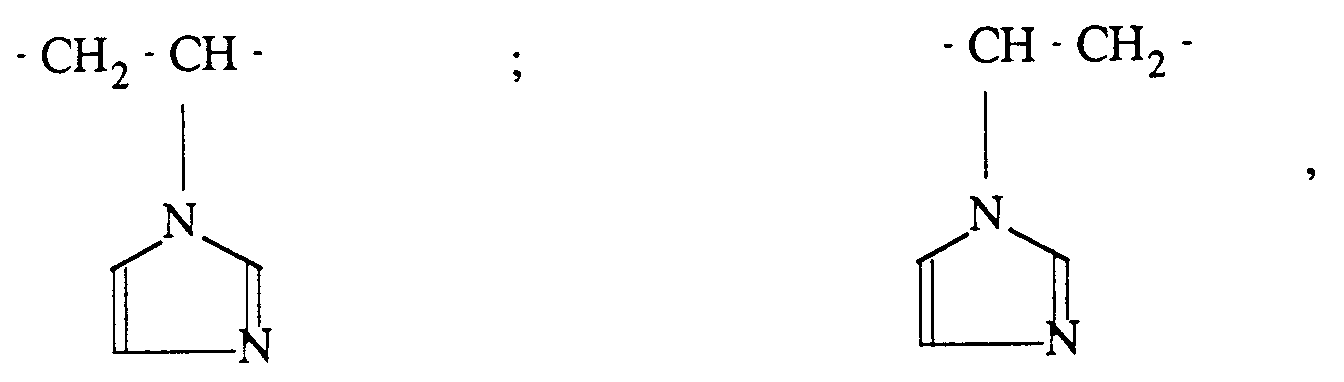
- the compounds according to the invention can be prepared by radical addition of an alkylthio group to one or more molecules of 1-vinylimidazole, in order to obtain an alkylthiopoly (ethylimidazole) surfactant of formula (II): in which R1 has the same meaning indicated above, the group C5H6N2 signifying the following structures taken as a mixture or separately:
- alkylthiopoly (ethylimidazole) compound thus obtained is then quaternized by alkylation with a compound of formula RX, in which R and X have the meanings indicated above.
- the products thus obtained are oxidized with hydrogen peroxide, according to a known process, at a temperature between 20 ° and 50 ° C.
- the radical reaction takes place in a solvent medium in the presence of a free radical initiator.
- hydroperoxides such as tert-butyl hydroperoxide, peroxides such as dibenzoyl peroxide, peresters such as tert-butyl peroxybenzoate or azo derivatives and in particular azobisisobutyronitrile.
- the solvents which can be used must be inert with respect to the reactants and can be chosen from C1-C4 alcohols such as methanol, isopropanol, alkyl ethers, glycol ethers, cyclic ethers such as tetrahydrofuran, C6-C8 aliphatic or aromatic hydrocarbons such as toluene.
- C1-C4 alcohols such as methanol, isopropanol, alkyl ethers, glycol ethers, cyclic ethers such as tetrahydrofuran, C6-C8 aliphatic or aromatic hydrocarbons such as toluene.
- the mercaptan of formula R1SH is dissolved in the solvent in the presence of 1-vinylimidazole, then the radical initiator is added, the reaction being carried out under an inert atmosphere.
- the compounds of formula (II) thus obtained are then alkylated with an alkylating agent RX in the presence of an inert solvent such as those mentioned. previously.
- RX alkylating agents used in accordance with the invention are chosen, for example, from methyl, ethyl or hydroxyethyl halides, methyl or ethyl sulfates, methyl sulfonate or methyl paratoluenesulfonate.
- alkylthiopoly (ethylimidazolium) compounds of formula (I) of the invention have good biocidal properties.
- the low toxicity of the compounds of the invention has been observed by hemolysis of red blood cells from blood samples.
- the compounds in accordance with the present invention can be used as biocidal agents or as preservatives in the chemical industry, in particular in cosmetic products and the pharmaceutical industry for human or veterinary use, agricultural products, paints and varnish, stationery.
- the compounds of formula (I) as defined above have the particularity of being fixed on keratin materials such as the skin, the hair and the nails.
- the compounds of the invention can be used as surfactants.
- the compounds of the invention are particularly advantageous for the cosmetic care of keratin materials. They are also particularly useful for the treatment of skin conditions of bacterial, mycobacterial or due to the implantation of pathogenic yeasts. They can in particular be used in pharmaceutical compositions which can be applied topically to the mucous membranes or to the skin for the treatment of acne or mycoses or in cosmetic compositions, in particular body deodorants or mouthwashes.
- Another subject of the invention therefore consists of pharmaceutical or cosmetic compositions for the treatment or care of human keratin materials, containing, in a physiologically acceptable medium, an effective amount of compounds of formula (I) as defined above.
- the compounds of formula (I) are present in concentrations preferably between 0.1 and 10% by weight relative to the total weight of the composition and preferably between 0.2 and 5% by weight.
- compositions can be aqueous, alcoholic or hydro-alcoholic solutions, emulsions in the form of milk or cream, foam, gel, paste, stick or even in the form of spray.
- compositions can be pressurized in aerosol devices, in the presence of a propellant, optionally in the presence of foam generators or emulsifying agents.
- freon type agents C3-C5 alkanes
- chlorinated solvents such as methylene chloride or ethers such as dimethyl ether.
- compositions can also be in the form of a vesicular dispersion based on ionic lipids (liposomes) or nonionic.
- compositions can contain water, a physiologically acceptable solvent or a mixture of water and this solvent, the solvent being chosen from lower C1-C4 alcohols such as ethanol, isopropanol, propanol or polyalcohols such as propylene glycol or glycerin; these solvents being present in proportions between 0 and 50%.
- solvent being chosen from lower C1-C4 alcohols such as ethanol, isopropanol, propanol or polyalcohols such as propylene glycol or glycerin; these solvents being present in proportions between 0 and 50%.
- compositions according to the invention may also contain oils, natural or synthetic waxes, foaming, emulsifying, dispersing, nonionic, cationic, weakly anionic, amphoteric or zwitterionic surfactants, fatty alcohols, silicones, polymers of natural origin such as cellulose, guar, chitosan derivatives, peptides, synthetic polymers, conditioners, foam stabilizers, thickeners, nacrants, sterols, salts, sunscreens, perfumes, dyes, moisturizers, preservatives other than those of formula (I), in particular those of the family of isothiazolones such as 2-methylisothiazolone, 2-octylisothiazolone, 5-chloro 2-methylisothiazolone, benzo-isothiazolone, or those described in patent FR-2,492,376.
- isothiazolones such as 2-methylisothiazolone, 2-octylisothiazolone
- a preferred form of cosmetic use consists of shampoos or anti-dandruff lotions.
- Another object of the invention consists of a cosmetic treatment process for the hair or scalp, characterized in that a hair composition is applied as defined above and optionally followed by rinsing with water.
- the applications more particularly targeted by the invention are shampoos, hair and scalp treatments for the elimination of dandruff, the treatment of the skin against acne and mycosis.
- the present invention also relates to the use of the compounds of formula (I) for the preparation of a medicament intended for the treatment of diseases of bacterial, mycobacterial origin or due to implantations of pathogenic yeasts.
- Heating is then started.
- a solution of 1.13 g of azobisisobutyronitrile in 40 ml of isopropanol is added dropwise over 45 minutes, while continuing the gradual rise in temperature.
- reaction medium is maintained at a temperature of 70 ° C for 16 hours.
- the product is in the form of a beige paste.
- the mixture is then stirred for 14 h at 25 ° C.
- This compound is prepared according to the procedure of Example 2 (1 st step).
- the crude product obtained is a mixture of compounds for which n represents an average statistical value of 3.
- the crude product obtained is in the form of a beige paste, the basicity index of which is 6.31 meq / g (theoretical: 8.75 meq / g).
- the mixture is then heated for 24 hours at 80 ° C. and then brought back to 25 ° C.
- the product is precipitated with stirring in 850 ml of tetrahydrofuran.
- the precipitate is filtered, rinsed with twice 300 ml of tetrahydrofuran and dried.
- the precipitate which is hygroscopic, is taken up in 600 ml of water, the last traces of tetrahydrofuran eliminated on a rotary evaporator.
- the fatty substances and the emulsifiers are heated to 80-85 ° C. Furthermore, the water containing the compound of Example 3 is heated to 80-85 ° C. and the fatty phase is added to the aqueous phase. After 10 minutes of vigorous stirring, it is allowed to cool with moderate stirring, then the perfume and the preservatives are added.
- This emulsion is prepared as in Example 2.
- the fatty substances and the emulsifiers are heated to 80-85 ° C. Furthermore, the water containing the compound of Example 9 is heated to 80-85 ° C. and the fatty phase is added to the aqueous phase. After 10 minutes of vigorous stirring, it is allowed to cool with moderate stirring, then the perfume and the preservatives are added.
- the temperature of the molten mixture is brought back to 90 ° C.
- a mixture consisting of 60.6 g of water, 3 g of glycerol and 1 g of the compound of Example 3 is gradually added at a temperature of 70 ° C.
- the mixture is homogenized using a VIRTIS ultra-disperser for 6 minutes at a speed of 40,000 rpm.
- a dispersion of lipid vesicles is thus obtained, the average size of which is 230 nm.
- 1 g of water is then added containing 0.15 g of diazolidinylurea sold under the name GERMAL II by the company SUTTON and 0.05 g of dipotassium salt of ethylene diamino tetracetic acid.
- the whole is subjected to the action of the VIRTIS disperser for 4 minutes at 40,000 rpm.
Landscapes
- Organic Chemistry (AREA)
- Chemical & Material Sciences (AREA)
- Health & Medical Sciences (AREA)
- Life Sciences & Earth Sciences (AREA)
- General Health & Medical Sciences (AREA)
- Veterinary Medicine (AREA)
- Public Health (AREA)
- Animal Behavior & Ethology (AREA)
- Dermatology (AREA)
- Engineering & Computer Science (AREA)
- Epidemiology (AREA)
- Environmental Sciences (AREA)
- Zoology (AREA)
- Wood Science & Technology (AREA)
- Plant Pathology (AREA)
- Pest Control & Pesticides (AREA)
- Agronomy & Crop Science (AREA)
- Birds (AREA)
- Dentistry (AREA)
- General Chemical & Material Sciences (AREA)
- Chemical Kinetics & Catalysis (AREA)
- Bioinformatics & Cheminformatics (AREA)
- Medicinal Chemistry (AREA)
- Nuclear Medicine, Radiotherapy & Molecular Imaging (AREA)
- Pharmacology & Pharmacy (AREA)
- Cosmetics (AREA)
- Pharmaceuticals Containing Other Organic And Inorganic Compounds (AREA)
- Agricultural Chemicals And Associated Chemicals (AREA)
- Nitrogen And Oxygen Or Sulfur-Condensed Heterocyclic Ring Systems (AREA)
- Organic Low-Molecular-Weight Compounds And Preparation Thereof (AREA)
- Addition Polymer Or Copolymer, Post-Treatments, Or Chemical Modifications (AREA)
Abstract

dans laquelle :
R₁ désigne un radical alkyle en C₁₂C₁₈;
R désigne méthyle, éthyle, hydroxyéthyle, benzyle;
R désigne méthyle, éthyle, hydroxyéthyle, benzyle;
X⁻ désigne un anion minéral ou organique;
n est compris entre 2 et 15;
w vaut 0, 1 ou 2;
le groupenent [C₅H₆N₂R⁺] représentant les structures suivantes prises en mélange ou séparément :
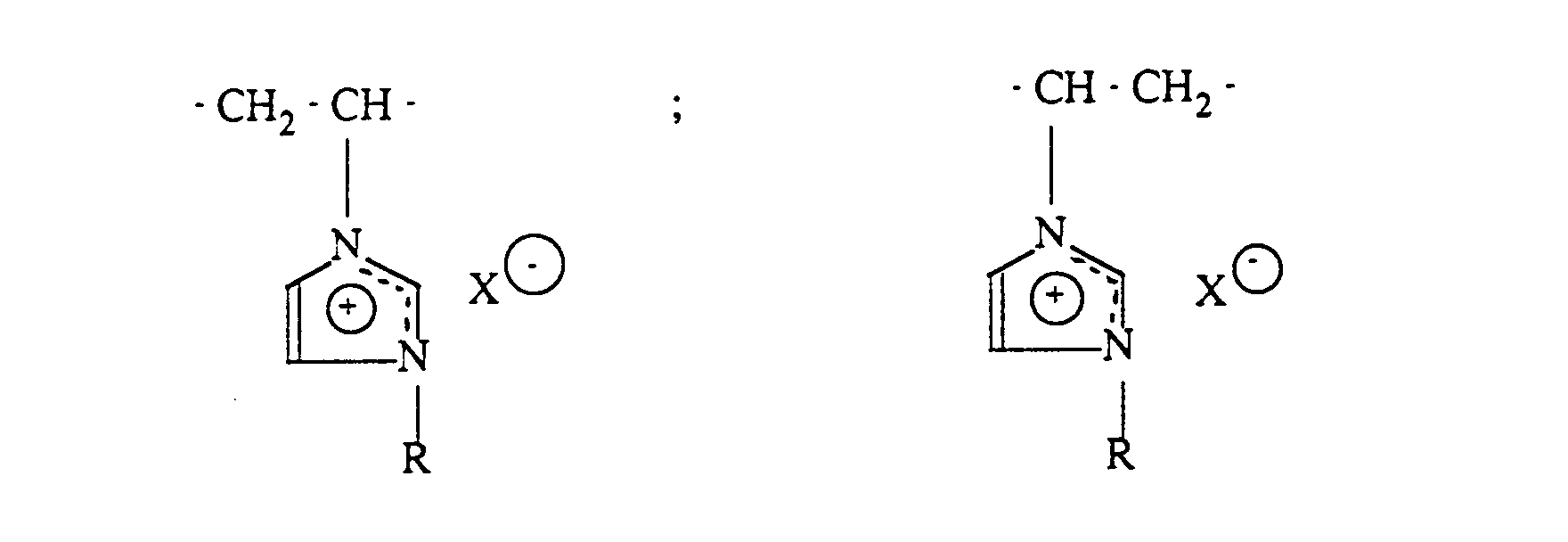
ainsi que leur utilisation comme biocides.
Description
- La présente invention concerne de nouveaux composés du type alkylthiopoly(éthylimidazolium), leur procédé de préparation et leur utilisation comme agents biocides dans divers domaines techniques comme la cosmétique, la pharmacie humaine et vétérinaire, l'agriculture, les peintures et vernis, la papeterie.
- On recherche en cosmétique des produits ayant des propriétés bactéricides et/ou fongicides et une bonne tolérance vis-à-vis de la peau et des cheveux, notamment dans les produits anti-pelliculaires, dans les produits de nettoyage de la peau.
- En dermopharmacie, l'utilisation des produits bactéricides et/ou fongicides présente également un grand intérêt, notamment dans le traitement des maladies affectant la couche cornée de l'épiderme de l'homme ou de l'animal, tel que l'acné ou dans le traitement des mycoses ou encore dans le traitement des maladies affectant les muqueuses.
- Les composés cationiques du type ammonium quaternaire sont couramment utilisés comme agents bactéricides en cosmétique ou pharmacie. Ces composés présentent cependant des problèmes de tolérance.
- On connaît, dans l'état de la technique, le bromure de cétyltriméthylammonium plus connu sous le nom de "CETAVLON".
- La demanderesse a découvert de nouveaux composés dérivés de l'imidazole, présentant une bonne activité biocide, ainsi qu'une toxicité amoindrie par rapport aux composés connus. Ils présentent de plus, de bonnes propriétés cosmétiques vis-à-vis des cheveux, de la peau et des ongles.
- Ces composés possèdent par ailleurs des propriétés tensio-actives intéressantes.
- La présente invention a pour objet de nouveaux composés cationiques du type imidazolium.
- Un autre objet de l'invention consiste en un procédé de préparation de ces composés.
- L'invention concerne également l'utilisation de ces composés comme agents biocides dans de nombreux domaines de l'industrie chimique, et plus particulièrement la cosmétique et la dermopharmacie.
- D'autres objets apparaîtront à la lumière de la description et des exemples qui suivent.
- Les composés conformes à la présente invention répondent à la formule suivante (I) :

dans laquelle
R₁ désigne un radical alkyle linéaire ou ramifié, ayant 12 à 18 atomes de carbone;
R désigne un radical méthyle, éthyle, hydroxyéthyle, benzyle;
X⁻ désigne un anion minéral ou organique;
n est un nombre entier ou décimal compris entre 2 et 15;
w vaut 0, 1 ou 2; - le groupement [C₅H₆N₂R⁺] représentant les structures suivantes prises en mélange ou séparément :
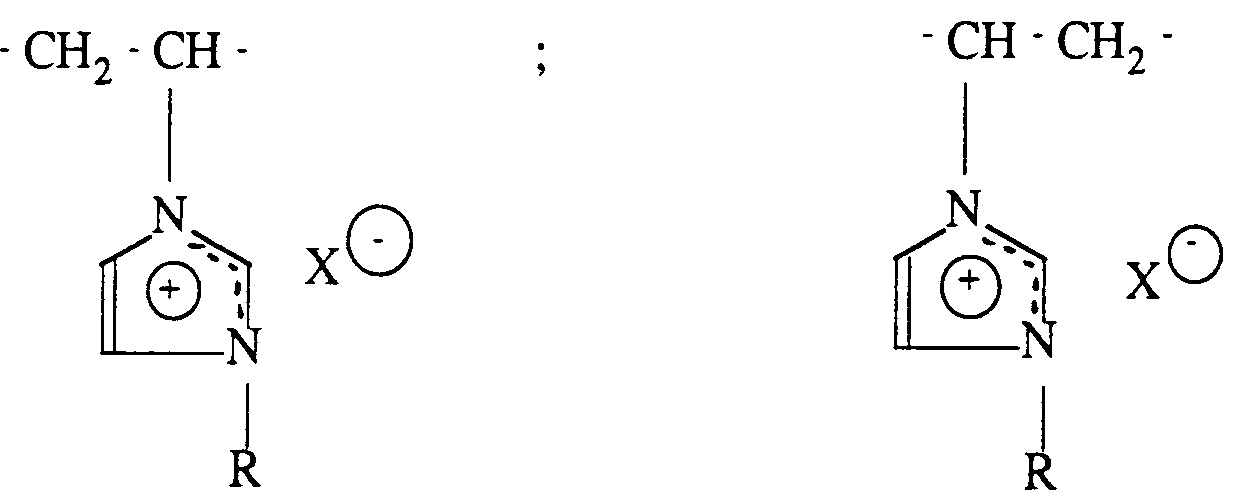
- Les anions X⁻ sont choisis notamment parmi les halogénures, les alkylsulfates, les alkylsulfonates, les arylsulfonates.
- L'anion X⁻ désigne de préférence Cl⁻ , Br⁻ , l⁻ , CH₃SO₃⁻, CH₃OSO₃⁻, C₂H₅OSO₃⁻ ou

- Les composéspréférentiels selon la présente invention sont choisis parmi ceux de formule (I), dans laquelle R désigne un radical méthyle et X⁻ l'anion CH₃OSO₃⁻ , et R désigne un radical benzyle et X⁻ l'anion Cl⊖.
- Les composés selon l'invention peuvent être préparés par addition radicalaire d'un groupe alkylthio sur une ou plusieurs molécules de 1-vinylimidazole, pour obtenir un tensio-actif alkylthiopoly(éthylimidazole) de formule (II) :

dans laquelle R₁ a la même signification indiquée ci-dessus, le groupement C₅H₆N₂ signifiant les structures suivantes prises en mélange ou séparément :
- Le composé alkylthiopoly(éthylimidazole) ainsi obtenu est ensuite quaternisé par alcoylation avec un composé de formule RX, dans laquelle R et X ont les significations indiquées ci-dessus.
- Dans le cas où w est égal à 1 ou 2, les produits ainsi obtenus sont oxydés à l'eau oxygénée, selon un procédé connu, à une température comprise entre 20° et 50°C.
- Le procédé de préparation des composés de l'invention peut être représenté par le schéma réactionnel suivant :

- La réaction radicalaire a lieu en milieu solvant en présence d'un initiateur de radicaux libres.
- Comme initiateurs de radicaux libres, on peut citer les hydroperoxydes tels que l'hydroperoxyde de tertiobutyle, les peroxydes tels que le peroxyde de dibenzoyle, les peresters tels que le peroxybenzoate de tertiobutyle ou les dérivés azoïques et en particulier l'azobisisobutyronitrile.
- Les solvants utilisables doivent être inertes vis-à-vis des réactifs et peuvent être choisis parmi les alcools en C₁-C₄ tels que le méthanol, l'isopropanol, les alkyléthers, les éthers de glycol, les éthers cycliques tels que le tétrahydrofurane, les hydrocarbures aliphatiques ou aromatiques en C₆-C₈ comme le toluène.
- Le mercaptan de formule R₁SH est dissous dans le solvant en présence du 1-vinylimidazole, puis l'initiateur de radicaux est additionné, la réaction étant effectuée sous atmosphère inerte. Les composés de formule (II) ainsi obtenus sont ensuite alcoylés avec un alcoylant RX en présence d'un solvant inerte tel que ceux cités précédemment.
- Les alcoylants RX utilisés conformément à l'invention sont choisis par exemple parmi les halogénures de méthyle, d'éthyle ou d'hydroxyéthyle, les sulfates de méthyle ou d'éthyle, le sulfonate de méthyle ou le paratoluènesulfonate de méthyle.
- Les composés de formule (II) sont nouveaux et constituent un autre objet de l'invention.
- Les composés alkylthiopoly(éthylimidazolium) de formule (I) de l'invention possèdent de bonnes propriétés biocides.
- Une bonne activité biocide a été observée selon les méthodes classiques sur les souches suivantes : Pseudomonas aeruginosa, Staphylococcus aureus, Candida albicans. Ces souches peuvent être considérées comme représentatives des principales bactéries et fongi responsables des affections cutanées d'origine bactérienne, mycobactérienne ou dues à l'implantation de levures pathogènes.
- La faible toxicité des composés de l'invention a été observée par hémolyse des hématies d'échantillons de sang.
- Les composés conformes à la présente invention peuvent être utilisés comme agents biocides ou comme agents conservateurs dans le domaine de l'industrie chimique, notamment dans les produits cosmétiques et l'industrie pharmaceutique à usage humain ou vétérinaire, les produits agricoles, les peintures et les vernis, la papeterie.
- Les composés de formule (I) tels que définis précédemment, ont la particularité de se fixer sur les matières kératiniques telles que la peau, les cheveux et les ongles.
- Les composés de l'invention peuvent être utilisés comme tensio-actifs.
- Leur caractère amphiphile cationique leur confère en plus des propriétés de conditionnement telles que de démêlage, de douceur, de brillance et de souplesse vis-à-vis des cheveux et des propriétés de douceur vis-à-vis de la peau.
- Les composés de l'invention sont particulièrement intéressants pour les soins cosmétiques des matières kératiniques. Ils sont également particulièrement intéressants pour le traitement des affections cutanées d'origine bactérienne, mycobactérienne ou dues à l'implantation de levures pathogènes. Ils peuvent notamment être utilisés dans les compositions pharmaceutiques pouvant être appliquées par voie topique sur les muqueuses ou sur la peau pour le traitement de l'acné ou des mycoses ou dans des compositions cosmétiques, notamment des déodorants corporels ou des bains de bouche.
- Ils sont également utilisés dans les compositions capillaires pour l'élimination des pellicules.
- Un autre objet de l'invention consiste donc en des compositions pharmaceutiques ou cosmétiques pour le traitement ou le soin des matières kératiniques humaines, contenant dans un milieu physiologiquement acceptable, une quantité efficace de composés de formule (I) telle que définie précédemment.
- Les composés de formule (I) sont présents dans des concentrations comprises de préférence entre 0,1 et 10% en poids par rapport au poids total de la composition et de préférence entre 0,2 et 5% en poids.
- Ces compositions peuvent être des solutions aqueuses, alcooliques ou hydro-alcooliques, des émulsions se présentant sous forme de lait ou de crème, de mousse, de gel, de pâte, de stick ou encore sous forme de spray.
- Ces compositions peuvent être pressurisées dans des dispositifs aérosols, en présence d'un agent propulseur, éventuellement en présence de générateurs de mousse ou d'agents émulsionnants.
- Comme agents propulseurs, on peut citer les agents de type fréons, les alcanes en C₃-C₅, des solvants chlorés tels que le chlorure de méthylène ou les éthers comme le diméthyléther.
- Les compositions peuvent également se présenter sous forme de dispersion vésiculaire à base de lipides ioniques (liposomes) ou nonioniques.
- Ces compositions peuvent contenir de l'eau, un solvant physiologiquement acceptable ou un mélange d'eau et de ce solvant, le solvant étant choisi parmi les alcools inférieurs en C₁-C₄ tels que l'éthanol, l'isopropanol, le propanol ou les polyalcools tels que le propylèneglycol ou la glycérine; ces solvants étant présents dans des proportions comprises entre 0 et 50%.
- Les compositions selon l'invention peuvent contenir également des huiles, des cires naturelles ou synthétiques, des produits tensio-actifs moussants, émulsionnants, dispersants, non-ioniques, cationiques, faiblement anioniques, amphotères ou zwittérioniques, des alcools gras, des silicones, des polymères d'origine naturelle comme les dérivés de cellulose, de guar, de chitosane, des peptides, des polymères de synthèse, des conditionneurs, des stabilisants de mousse, des épaississants, des nacrants, des stérols, des sels, des filtres solaires, des parfums, des colorants, des hydratants, des conservateurs autres que ceux de formule (I), notamment ceux de la famille des isothiazolones tels que la 2-méthylisothiazolone, 2-octylisothiazolone, 5-chloro 2-méthylisothiazolone, benzo-isothiazolone, ou celles décrites dans le brevet FR-2.492.376.
- Une forme d'utilisation cosmétique préférentielle est constituée par des shampooings ou des lotions anti-pelliculaires.
- Un autre objet de l'invention consiste en un procédé de traitement cosmétique des cheveux ou du cuir chevelu, caractérisé par le fait qu'on applique une composition capillaire telle que définie précédemment et éventuellement à faire suivre d'un rinçage à l'eau.
- On observe que les cheveux ainsi traités sont plus souples, plus brillants, plus lisses et facilement démêlables.
- Les applications plus particulièrement visées par l'invention sont les shampooings, les traitements des cheveux et du cuir chevelu pour l'élimination des pellicules, le traitement de la peau contre l'acné et les mycoses.
- La présente invention a également pour objet l'utilisation des composés de formule (I) pour la préparation d'un médicament destiné au traitement des maladies d'origine bactérienne, mycobactérienne ou dues à des implantations de levures pathogènes.
- Les exemples qui suivent servent à illustrer la présente invention sans toutefois présenter un caractère limitatif.
- Préparation d'un composé de formule (I) pour lequel
R₁=C₁₂H₂₅
- Préparation d'un composé de formule (II) pour lequel
R₁=C₁₂H₂₅
- Dans un réacteur de 500 ml, on dissout à 25°C, 20,24 g (0,1 mole) de dodécanethiol dans 20 ml d'isopropanol.
- La solution est placée sous courant d'azote puis 28,2 g de 1-vinylimidazole (0,3 mole) sont ajoutés en 5 minutes.
- Le chauffage est alors amorcé. Lorsque la température atteint 50°C, on additionne goutte à goutte une solution de 1,13 g d'azobisisobutyronitrile dans 40 ml d'isopropanol en 45 minutes, tout en poursuivant la montée progressive en température.
- Lorsque l'addition est terminée, le milieu réactionnel est maintenu à une température de 70°C pendant 16 heures.
- Le solvant est alors évaporé sous pression réduite. 48,5 g d'un produit brut sont alors obtenus.
- Le terme

- 6 g du produit de dicondensation sont ainsi obtenus. Le produit se présente sous la forme d'une pâte beige.
- Indice de basicité = 5,10 meq/g (Théorique: 5,12 meq/g).
-

- 5,31 g du composé de l'étape 1 sont solubilisés à 25°C dans 2,5 ml de méthanol.
- Lorsque la solution est homogène, on ajoute goutte à goutte, en 45 minutes, 3,41 g de sulfate de diméthyle en évitant que la température ne dépasse 50°C.
- Le mélange est alors agité 14 h à 25°C.
- Le solvant est alors évaporé sous pression réduite. On obtient un produit amorphe de couleur orangée qui est soluble dans l'eau.
-

- Préparation d'un composé de formule (I) pour lequel
R₁=C₁₂H₂₅
- Préparation d'un composé de formule (II) pour lequel
R₁=C₁₂H₂₅
- Ce composé est préparé selon le mode opératoire de l'exemple 2 (1 ère étape).
- Le produit brut obtenu est un mélange de composés pour lequel n représente une valeur statistique moyenne de 3.
- Indice de basicité = 5,74 meq/g (Théorique : 6,21 meq/g)
- Le mode opératoire est analogue à celui de l'exemple 1 (étape 2) utilisant :
- 10 g du composé obtenu à la 1ère étape de l'exemple 3 solubilisés dans 30 ml de méthanol
- 7,24 g de sulfate de diméthyle
- On obtient 17,2 g d'un produit orangé amorphe soluble dans l'eau.
-

- Préparation d'un composé de formule (I) pour lequel
R₁=C₁₈H₃₇
- Préparation d'un composé de formule (II) pour lequel
R₁=C₁₈H₃₇
- Le mode opératoire est analogue à celui de l'exemple 2 (Etape 1 ) en utilisant :
- 28,66 g d'octadécanethiol (0,1 mole) dissous dans 50 ml d'isopropanol
- 28,23 g (0,3 mole) de 1-vinylimidazole
- 1,13 g d'azobisisobutyronitrile dans 40 ml d'isopropanol.
- On obtient 56,9 g d'une pâte beige dont l'indice de basicité est de 4,20 meq/g.
- Le mode opératoire est analogue à celui de l'exemple 2 (Etape 2) en utilisant :
- 20 g du composé de l'étape 1 dissous dans 100 ml de méthanol
- 10,58 g de sulfate de diméthyle.
- On obtient 30,60 g d'un solide orangé dont le point de fusion est de 230°C avec décomposition.
-

- Préparation d'un composé de formule (I) pour lequel
R₁ = C₁₂H₂₅
- Préparation d'un composé de formule (II) pour lequel R₁ = C₁₂H₂₅ et

- Le mode opératoire est analogue à celui de l'exemple 2 (Etape 1) en utilisant :
- 20,25 g de dodécanethiol (0,1 mole) dissous dans 20 ml d'isopropanol
- 47 g de 1-vinylimidazole (0,5 mole)
- 1,88 g d'azobisisobutyronitrile dans 100 ml d'isopropanol.
- On obtient 65 g d'une pâte beige dont l'indice de basicité est 6,21 meq/g (théorique : 7,44 meq/g).
- Dodécanethiol thioéthérifié par cinq motifs méthylsulfate de 1-éthyl 3-méthylimidazolium (statistique)
- Le mode opératoire est identique à celui de l'exemple 2 (Etape 2) en utilisant :
- 20 g du composé de l'étape 1 dissous dans 100 ml de méthanol
- 15,62 g de sulfate de diméthyle.
- On obtient 34 g d'un solide orangé.
Tf = 230°C (décomposition). - Préparation d'un composé de formule (I) pour lequel
R₁ = C₁₂H₂₅
- Préparation d'un composé de formule (II) pour lequel R₁ = C₁₂H₂₅

- Le mode opératoire est analogue à celui de l'exemple 2 (Etape 1) en utilisant :
- 10,2 g de dodécanetliol (0,05 mole) dissous dans 10 ml d'isopropanol
- 47 g de 1-vinylimidazole (0,5 mole)
- 1,88 g d'azobisisobutyronitrile dans 100 ml d'isopropanol.
- Le produit brut obtenu se présente sous la forme d'une pâte beige dont l'indice de basicité est 6,31 meq/g (théorique : 8,75 meq/g).
- Dodécanethiol thioéthérifié par dix motifs méthylsulfate de 1-éthyl 3-méthylimidazolium (statistique)
- Le mode opératoire est identique à celui de l'exemple 2 (Etape 2) en utilisant :
- 20,6 g du composé de l'étape 1 dissous dans 100 ml de méthanol
- 16,38 g de sulfate de diméthyle.
- On obtient 35 g d'un solide orangé.
Tf = 240° C (décomposition). -

- Préparation d'un composé de formule (I) pour lequel
R₁ = C₁₈H₃₇
- Préparation d'un composé de formule (II) pour lequel R₁ = C₁₈H₃₇ et

- Dans un réacteur de 500 ml, on dissout, à 70°C et sous courant d'azote, 14,34 g d'octadécanethiol dans 100 ml d'isopropanol. On amène la température à 40°C et on additionne 37,6 g de 1-vinylinidazole (0,4 mole) goutte-à-goutte en 10 minutes. Lorsque l'addition est terminée, le chauffage est repris. Quand la température dans le réacteur atteint 50°C, on additionne une solution de 1,50 g d'azobisisobutyronitrile dans 50 ml de méthanol en 45 minutes tout en poursuivant la montée progressive en température. Lorsque l'addition est terminée, le milieu réactionnel est maintenu à une température de 70°C pendant 16 heures. Les solvants sont ensuite chassés sous pression réduite et on obtient 52 g d'un solide jaune pâle.
- Indice de basicité : 6,82 meq/g (théorique : 7,70 meq/g)
-

- Octadécanethiol thioéthérifié par huit motifs méthylsulfate de 1-éthyl 3-méthylimidazolium (statistique)
- Le mode opératoire est identique à celui de l'exemple 2 (Etape 2) en utilisant :
- 20 g du composé de l'étape 1 dissous dans 100 ml de méthanol
- 17,19 g de sulfate de diméthyle.
- On obtient 36,5 g d'un solide orangé.
-

- Préparation d'un composé de formule (I) pour lequel
R₁ = C₁₈H₃₇
- Préparation d'un composé de formule (II) pour lequel R₁ = C₁₈H₃₇

- Le mode opératoire est analogue à celui de l'exemple 6 (Etape 1) en utilisant :
- 14,37 g d'octadécanethiol (0,05 mole) dissous dans 100 ml d'isopropanol
- 47 g de 1-vinylimidazole (0,5 mole)
- 1,88 g d'azobisisobutyronitrile dans 50 ml de méthanol.
- On obtient 61 g d'un solide jaune pâle dont la basicité est 6,98 meq/g (théorique : 8, 15 meq/g).
-

- Octadécanethiol thioéthérifié par dix motifs méthylsulfate de 1-éthyl 3-méthylimidazolium (statistique)
- Le mode opératoire est identique à celui de l'exemple 2 (Etape 2) en utilisant :
- 20 g du composé issu de l'étape 1 dissous dans 100 ml de méthanol
- 17,39 g de sulfate de diméthyle.
- On obtient 36,5 g d'un solide orangé.
- Préparation d'un composé de formule (I) pour lequel
R₁ = C₁₈H₃₇
- Préparation d'un composé de formule (II) pour lequel R₁ = C₁₈H₃₇ et

- Le mode opératoire est analogue à celui de l'exemple 6(Etape 1) en utilisant :
- 14,37 g d'octadécanethiol (0,05 mole) dissous dans 100 ml d'isopropanol
- 56,4 g de 1-vinylimidazole (0,6 mole)
- 2,16 g d'azobisisobutyronitrile dans 60 ml de méthanol.
- On obtient 70 g d'un solide jaune dont la basicité est de 7,35 meq/g (théorique : 8,48 meq/g).
-

- Octadécanethiol thioéthérifié par douze motifs méthylsulfate de 1-éthyl 3-méthylimidazolium (statistique)
- Le mode opératoire est identique à celui de l'exemple 2 (Etape 2) en utilisant :
- 20 g du composé issu de l'étape 1 dissous dans 100 ml de méthanol
- 18,2 g de sulfate de diméthyle.
- On obtient 36,1 g d'un solide orangé.
-

- Préparation d'un composé de formule (I) pour lequel
R₁ = C₁₂H₂₅
- On solubilise 29 g de composé obtenu à l'étape 1 de l'exemple 7 dans 100 ml de diméthylacétamide à 80°C. On ajoute, à 80°C, 63,85 g de chlorure de benzyle (0,50 mole) en 15 minutes.
- Le mélange est alors chauffé 24 heures à 80°C puis ramené à 25°C. Le produit est précipité sous agitation dans 850 ml de tétrahydrofuranne.
- Le précipité est filtré, rincé par deux fois 300 ml de tétrahydrofuranne et séché. Le précipité, qui est hygroscopique, est repris par 600 ml d'eau, les dernières traces de tétrahydrofuranne éliminées à l'évaporateur rotatif.
- La solution, glacée dans un bain d'éthanol et de carboglace, est ensuite lyophilisée. On obtient 29 g d'une poudre beige ayant une teneur en eau d'environ 9%.
-

-

- On chauffe les corps gras et les émulsionnants vers 80-85°C. Par ailleurs, on chauffe à 80-85°C l'eau contenant le composé de l'exemple 3 et on ajoute la phase grasse à la phase aqueuse. Après 10 minutes d'agitation vive, on laisse refroidir sous agitation modérée, puis on ajoute le parfum et les conservateurs.
-


- Cette émulsion est préparée comme dans l'exemple 2.
-

-

-

- On chauffe les corps gras et les émulsionnants vers 80-85°C. Par ailleurs, on chauffe à 80-85°C l'eau contenant le composé de l'exemple 9 et on ajoute la phase grasse à la phase aqueuse. Après 10 minutes d'agitation vive, on laisse refroidir sous agitation modérée, puis on ajoute le parfum et les conservateurs.
- On réalise par fusion, à la température de 110°C, le mélange des produits suivants :

- Puis on ramène la température du mélange fondu à 90°C. On ajoute progressivement un mélange constitué de 60,6 g d'eau, 3 g de glycérol et 1 g du composé de l'exemple 3 à température de 70°C. On homogénéise le mélange à l'aide d'un ultra-disperseur VIRTIS pendant 6 minutes à la vitesse de 40.000 t/minute. On obtient ainsi une dispersion de vésicules lipides dont la taille moyenne est de 230 nm. On ajoute alors 1 g d'eau contenant 0,15 g de diazolidinylurée vendu sous la dénomination GERMAL II par la Société SUTTON et 0,05 g de sel dipotassique de l'acide éthylène diamino tétracétique.
- On ajoute alors :
- 10 g de décaméthyl cyclo pentasiloxane vendue sous la dénomination SILBIONE Huile 700 45 V5 par la Société RHONE POULENC.
- 0,8 g de diméthicone vendue sous la dénomination SILBIONE 747 V 300 par la Société RHONE POULENC
- 0,01 g de paraoxybenzoate de propyle.
- On soumet le tout à l'action du disperseur VIRTIS pendant 4 minutes à 40.000 t/minute.
- On ajoute :
- 0,42 g d'acide polyacrylique réticulé vendu sous la dénomination CARBOPOL 940 par la Société GOODRICH
- 0,2 g de paraoxybenzoate de méthyle
- 14 g d'eau
- 0,7 g de triéthanolamine.
- On obtient ainsi une crème blanche épaisse.
Claims (16)
- Composé de formule (I) :

R₁ désigne un radical alkyle linéaire ou ramifié, ayant 12 à 18 atomes de carbone;
R désigne un radical méthyle, éthyle, hydroxyéthyle, benzyle;
X⁻ désigne un anion minéral ou organique;
n est un nombre entier ou décimal compris entre 2 et 15;
w vaut 0, 1 ou 2;
le groupement [C₅H₆N₂R⁺] représentant les structures suivantes prises en mélange ou séparément :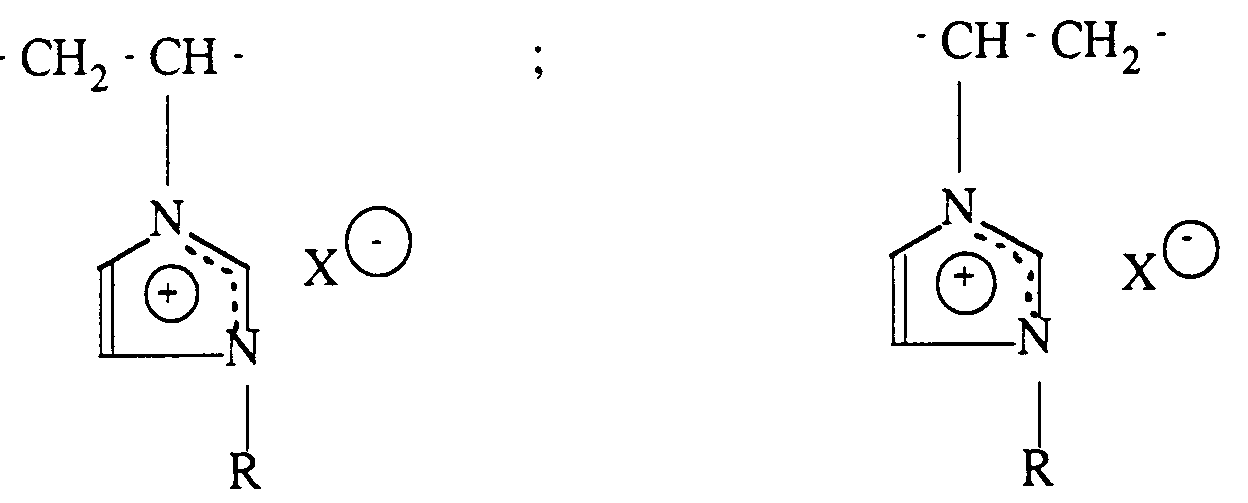
- Composé selon la revendication 1, caractérisé par le fait que X⁻ est choisi parmi Cl⁻, Br⁻, l⁻, CH₃ OSO₃⁻, C₂H₅OSO₃⁻, CH₃ SO₃⁻,

- Composé selon la revendication 1 ou 2, caractérisé par le fait que le radical R désigne méthyle et X⁻ représente l'anion CH₃ OSO₃⁻ ou R désigne benzyle et X désigne Cl⁻.
- Procédé de préparation des composés de formule (I) selon l'une quelconque des revendications 1 à 3, caractérisé par le fait qu'il consiste à effectuer, sous atmosphère inerte, en milieu solvant inerte, une réaction d'addition radicalaire en présence d'un initiateur de radicaux libres, d'un mercaptan de formule R₁SH, dans laquelle R₁ a la même signification indiquée dans la revendication 1, sur une ou plusieurs molécules de 1-vinylimidazole, pour obtenir un composé de formule (II) suivante :

- Composé répondant à la formule (II) :

R₁ désigne un radical alkyle linéaire ou ramifié, ayant 12 à 18 atomes de carbone;
n est compris entre 2 et 15 ou représente une valeur statistique comprise entre 2 et 15;
C₅H₆N₂ signifiant les structures suivantes prises en mélange ou séparément :
- Utilisation des composés de formule (I) selon l'une quelconque des revendications 1 à 3, comme agents biocides ou agents conservateurs, dans des applications non-thérapeutiques.
- Composition pour le soin ou le traitement des matières kératiniques humaines, en particulier des cheveux, de la peau, des ongles ou des muqueuses, caractérisée par le fait qu'elle contient dans un milieu physiologiquement acceptable, au moins un composé de formule (I) selon l'une quelconque des revendications 1 à 3.
- Composition selon la revendication 7, caractérisée par le fait qu'elle contient le composé de formule (I) dans des concentrations comprises entre 0,1 et 10% en poids par rapport au poids total de la composition.
- Composition selon la revendication 7 ou 8, caractérisée par le fait qu'elle se présente sous forme de solutions aqueuses, hydroalcooliques, ou alcooliques; d'émulsions se présentant sous forme de lait ou de crème; de mousse; de gel; de pâte; de stick; de spray; de dispersion vésiculaire ou conditionnée en aérosol.
- Composition selon l'une quelconque des revendications 7 à 9, caractérisée par le fait qu'elle contient de l'eau, un mélange d'eau et de solvant(s) ou bien un solvant, le solvant étant choisi parmi les monoalcools en C₁-C₄ ou les polyalcools, et présent dans des proportions comprises entre 0 et 50%.
- Composition selon l'une quelconque des revendications 7 à 10, caractérisée par le fait qu'elle contient en plus des huiles, des cires naturelles ou synthétiques, des alcools gras, des silicones, des tensio-actifs non ioniques, cationiques, faiblement anioniques, amphotères ou zwittérioniques, des polymères d'origine naturelle, ou synthétiques, des conditionneurs, des stabilisants de mousse, des épaississants, des nacrants, des stérols, des sels, des filtres solaires, des conservateurs autres que ceux de formule (I), notamment ceux de la famille des isothiazolones, des parfums, des colorants, des hydratants.
- Composition pharmaceutique destinée à être appliquée par voie topique sur la peau pour le traitement des maladies cutanées d'origine bactérienne, mycobactérienne ou dues à des implantations de levures pathogènes, caractérisée par le fait qu'elle est constituée d'une composition telle que définie selon l'une quelconque des revendications 7 à 11.
- Procédé de traitement cosmétique des cheveux et du cuir chevelu, caractérisé par le fait qu'on applique sur les cheveux ou le cuir chevelu, au moins une composition capillaire selon l'une quelconque des revendications 7 à 11, suivie éventuellement d'un rinçage à l'eau .
- Utilisation des composés de formule (I) selon l'une quelconque des revendications 1 à 3 pour la préparation d'un médicament destiné au traitement des maladies d'origine bactérienne, mycobactérienne ou dues à des implantations de levures pathogènes.
- Utilisation des composés de formule (I) selon l'une quelconque des revendications 1 à 3, comme agent tensio-actif.
- Utilisation des composés de formule (I) selon l'une quelconque des revendications 1 à 3, comme agent de conditionnement des cheveux ou de la peau.
Applications Claiming Priority (2)
| Application Number | Priority Date | Filing Date | Title |
|---|---|---|---|
| FR9107735A FR2677983B1 (fr) | 1991-06-24 | 1991-06-24 | Composes alkylthiopoly(ethylimidazolium), procede de preparation et leur utilisation comme agents biocides. |
| FR9107735 | 1991-06-24 |
Publications (2)
| Publication Number | Publication Date |
|---|---|
| EP0520873A1 true EP0520873A1 (fr) | 1992-12-30 |
| EP0520873B1 EP0520873B1 (fr) | 1996-03-20 |
Family
ID=9414194
Family Applications (1)
| Application Number | Title | Priority Date | Filing Date |
|---|---|---|---|
| EP92401747A Expired - Lifetime EP0520873B1 (fr) | 1991-06-24 | 1992-06-23 | Composés alkylthiopoly(éthylimidazolium), procédé de préparation et leur utilisation comme agents biocides |
Country Status (8)
| Country | Link |
|---|---|
| US (1) | US5364625A (fr) |
| EP (1) | EP0520873B1 (fr) |
| JP (1) | JPH05230030A (fr) |
| AT (1) | ATE135694T1 (fr) |
| CA (1) | CA2072293A1 (fr) |
| DE (1) | DE69209164T2 (fr) |
| ES (1) | ES2084957T3 (fr) |
| FR (1) | FR2677983B1 (fr) |
Cited By (2)
| Publication number | Priority date | Publication date | Assignee | Title |
|---|---|---|---|---|
| US5659047A (en) * | 1991-06-24 | 1997-08-19 | L'oreal | Polyfluoroalkylthiopoly (ethylimidazolium) compounds, preparation process and their use as biocidal agents |
| WO2004028502A1 (fr) * | 2002-09-27 | 2004-04-08 | Mochida Pharmaceutical Co., Ltd. | Composition nettoyante contenant un agent antifongique et un agent antibacterien |
Families Citing this family (7)
| Publication number | Priority date | Publication date | Assignee | Title |
|---|---|---|---|---|
| US5585092A (en) * | 1995-04-13 | 1996-12-17 | The Procter & Gamble Company | Gel deodorant compositions |
| DE60034144T2 (de) * | 1999-12-17 | 2008-01-03 | Pfizer Science And Technology Ireland Ltd. | Verfahren zur entfernung von spurlösungsmittel von einem hygroskopischen material |
| DE10050452A1 (de) * | 2000-10-12 | 2002-04-25 | Goldwell Gmbh | Haarbehandlungsmittel |
| US6383505B1 (en) * | 2000-11-09 | 2002-05-07 | Steris Inc | Fast-acting antimicrobial lotion with enhanced efficacy |
| FR2839644B1 (fr) * | 2002-05-14 | 2005-09-09 | Oreal | Utilisation d'un sel organique particulier et composition le comprenant pour le lavage et/ou le conditionnement des matieres keratiniques. |
| EP1557375A1 (fr) * | 2004-01-23 | 2005-07-27 | Neubourg Skin Care GmbH & Co. KG | Bombe aérosol pour teinture des ongles |
| JP4827433B2 (ja) * | 2005-04-21 | 2011-11-30 | 株式会社 資生堂 | 水中油型乳化皮膚化粧料 |
Citations (6)
| Publication number | Priority date | Publication date | Assignee | Title |
|---|---|---|---|---|
| FR2010024A1 (fr) * | 1968-06-01 | 1970-02-13 | Basf Ag | Sels d'ammonium sulfures substitues et agents biocides les contenant |
| US3882136A (en) * | 1973-11-16 | 1975-05-06 | Searle & Co | S-{8 omega-(1-imidazolyl) alkyl{9 hydrogen monothiosulfates and salts thereof |
| FR2324721A1 (fr) * | 1975-09-22 | 1977-04-15 | Interx Research Corp | Agents quaternaires doux et leur application comme agents antibacteriens |
| EP0000752B1 (fr) * | 1977-08-05 | 1981-01-14 | BASF Aktiengesellschaft | Alpha-azolylsulfides, -sulfoxydes et -sulfones, leurs sels et complexes métalliques, procédé pour leur préparation ainsi que fongicides les contenant |
| EP0331230A1 (fr) * | 1988-02-26 | 1989-09-06 | The Procter & Gamble Company | Composés d'imidazole et compositions pour traitement de textiles les contenant |
| WO1990004918A2 (fr) * | 1988-10-25 | 1990-05-17 | Wake Forest University | Derives lipidiques d'ether ou d'ester contenant une amine quaternaire, et compositions therapeutiques |
-
1991
- 1991-06-24 FR FR9107735A patent/FR2677983B1/fr not_active Expired - Fee Related
-
1992
- 1992-06-23 JP JP4164656A patent/JPH05230030A/ja active Pending
- 1992-06-23 EP EP92401747A patent/EP0520873B1/fr not_active Expired - Lifetime
- 1992-06-23 AT AT92401747T patent/ATE135694T1/de not_active IP Right Cessation
- 1992-06-23 DE DE69209164T patent/DE69209164T2/de not_active Expired - Fee Related
- 1992-06-23 US US07/902,729 patent/US5364625A/en not_active Expired - Fee Related
- 1992-06-23 ES ES92401747T patent/ES2084957T3/es not_active Expired - Lifetime
- 1992-06-25 CA CA002072293A patent/CA2072293A1/fr not_active Abandoned
Patent Citations (6)
| Publication number | Priority date | Publication date | Assignee | Title |
|---|---|---|---|---|
| FR2010024A1 (fr) * | 1968-06-01 | 1970-02-13 | Basf Ag | Sels d'ammonium sulfures substitues et agents biocides les contenant |
| US3882136A (en) * | 1973-11-16 | 1975-05-06 | Searle & Co | S-{8 omega-(1-imidazolyl) alkyl{9 hydrogen monothiosulfates and salts thereof |
| FR2324721A1 (fr) * | 1975-09-22 | 1977-04-15 | Interx Research Corp | Agents quaternaires doux et leur application comme agents antibacteriens |
| EP0000752B1 (fr) * | 1977-08-05 | 1981-01-14 | BASF Aktiengesellschaft | Alpha-azolylsulfides, -sulfoxydes et -sulfones, leurs sels et complexes métalliques, procédé pour leur préparation ainsi que fongicides les contenant |
| EP0331230A1 (fr) * | 1988-02-26 | 1989-09-06 | The Procter & Gamble Company | Composés d'imidazole et compositions pour traitement de textiles les contenant |
| WO1990004918A2 (fr) * | 1988-10-25 | 1990-05-17 | Wake Forest University | Derives lipidiques d'ether ou d'ester contenant une amine quaternaire, et compositions therapeutiques |
Cited By (2)
| Publication number | Priority date | Publication date | Assignee | Title |
|---|---|---|---|---|
| US5659047A (en) * | 1991-06-24 | 1997-08-19 | L'oreal | Polyfluoroalkylthiopoly (ethylimidazolium) compounds, preparation process and their use as biocidal agents |
| WO2004028502A1 (fr) * | 2002-09-27 | 2004-04-08 | Mochida Pharmaceutical Co., Ltd. | Composition nettoyante contenant un agent antifongique et un agent antibacterien |
Also Published As
| Publication number | Publication date |
|---|---|
| DE69209164D1 (de) | 1996-04-25 |
| DE69209164T2 (de) | 1996-08-01 |
| US5364625A (en) | 1994-11-15 |
| ES2084957T3 (es) | 1996-05-16 |
| FR2677983A1 (fr) | 1992-12-24 |
| JPH05230030A (ja) | 1993-09-07 |
| EP0520873B1 (fr) | 1996-03-20 |
| ATE135694T1 (de) | 1996-04-15 |
| FR2677983B1 (fr) | 1995-03-03 |
| CA2072293A1 (fr) | 1992-12-25 |
Similar Documents
| Publication | Publication Date | Title |
|---|---|---|
| EP0526267B1 (fr) | Composés polyfluoroalkylthiopoly(éthylimidazolium), procédé de préparation et leur utilisation comme agents biocides | |
| EP1123653B1 (fr) | Utilisation de dérivés de polyaminoacides comme agents conservateurs | |
| EP0408448B1 (fr) | Nouveaux dérivés d'uréthanne, leur préparation et leur application notamment comme agents hydratants dans des compositions cosmétiques ou pharmaceutiques destinées au traitement des peaux sèches | |
| EP0815829A1 (fr) | Utilisation de dérivés amino-alcools à fonction urée dans des compositions cosmétiques ou dermatologiques | |
| EP0520873B1 (fr) | Composés alkylthiopoly(éthylimidazolium), procédé de préparation et leur utilisation comme agents biocides | |
| WO2009101322A2 (fr) | Composition cosmétique comprenant un composé cationique tensioactif, nouveaux composés, utilisation comme conditionneur et procédé de traitement cosmétique | |
| EP0875495A1 (fr) | Nouveaux dérivés de l'acide salicylique et leur utilisation dans une composition cosmétique et/ou dermatologique | |
| EP0968221B1 (fr) | Nouveaux derives de l'acide salicylique et leur utilisation dans les compositions cosmetiques ou dermatologiques | |
| EP0290020A1 (fr) | Nouveaux rétinoates d'ammonium quaternaires, leur utilisation en cosmétique et en dermopharmacie | |
| FR2665157A1 (fr) | Composes solubilisants et/ou dispersants du type tensio-actif quaternaire, procede de preparation, utilisation comme additif dans des compositions et compositions cosmetiques ou dermopharmaceutiques en comportant. | |
| EP0666251A1 (fr) | Nouveaux N-(hydroxyalkyl) carbamates d'alkyle et leurs applications en cosmétique, plus particulièrement dans des compositions capillaires | |
| FR2756565A1 (fr) | Nouveaux derives d'histidine et leur utilisation en cosmetique ou en pharmacie | |
| EP0304649B1 (fr) | Sels du piperidino-6, diamino-2,4 pyrimidine oxyde-3 et de dérivés de l'acide thiamorpholinone-3 carboxylique-5, leur utilisation en cosmétique et pharmacie | |
| FR2778917A1 (fr) | Nouveaux derives d'histidine, procede de preparation et utilisations | |
| EP0824097B1 (fr) | Dérivés n-(alkyloxycarbonyl)-N-(2-hydroxy 3-alkyloxypropyl)-éthanolamine et leur utilisation dans et pour la préparation de compositions cosmétiques ou dermatologiques | |
| FR2909378A1 (fr) | Ceramides ou pseudo-ceramides quaternises et les compositions cosmetiques en contenant | |
| WO1999046280A1 (fr) | Composes lipidiques derives des bases sphingoïdes, leur procede de preparation et leurs utilisations en cosmetique et en dermopharmacie | |
| EP0380411B1 (fr) | Procédé de préparation de tensio-actifs non-ioniques à partir de l'isopropylidène-1,2 époxypropyl-3 glycérol et d'un acide carboxylique, nouveaux tensio-actifs non-ioniques et leur utilisation | |
| EP0498729B1 (fr) | Dérivés de dipeptides à groupement uréthanne, leur préparation et leur application, notamment comme agents hydratants et comme agents tensioactifs dans des compositions cosmétiques, pharmaceutiques ou alimentaires | |
| EP0760236A1 (fr) | Mousse déformable à base d'huile, contenant un tensioactif fluoré | |
| FR2982485A1 (fr) | Composition cosmetique comprenant des derives de lysine, procede de traitement cosmetique et composes nouveaux | |
| WO2009007636A2 (fr) | Nouveaux tensioactifs cationiques, compositions les comprenant, utilisation comme conditionneur, et procédé de traitement cosmétique | |
| EP0380410A1 (fr) | Procédé de préparation de tensio-actifs non-ioniques à partir de l'isopropylidène-1,2 époxypropyl-3 glycérol et d'un mercaptan, nouveaux produits tensio-actifs et leur utilisation |
Legal Events
| Date | Code | Title | Description |
|---|---|---|---|
| PUAI | Public reference made under article 153(3) epc to a published international application that has entered the european phase |
Free format text: ORIGINAL CODE: 0009012 |
|
| AK | Designated contracting states |
Kind code of ref document: A1 Designated state(s): AT BE CH DE DK ES FR GB GR IT LI NL PT SE |
|
| 17P | Request for examination filed |
Effective date: 19930601 |
|
| 17Q | First examination report despatched |
Effective date: 19950705 |
|
| GRAA | (expected) grant |
Free format text: ORIGINAL CODE: 0009210 |
|
| AK | Designated contracting states |
Kind code of ref document: B1 Designated state(s): AT BE CH DE DK ES FR GB GR IT LI NL PT SE |
|
| PG25 | Lapsed in a contracting state [announced via postgrant information from national office to epo] |
Ref country code: NL Free format text: LAPSE BECAUSE OF FAILURE TO SUBMIT A TRANSLATION OF THE DESCRIPTION OR TO PAY THE FEE WITHIN THE PRESCRIBED TIME-LIMIT Effective date: 19960320 Ref country code: GR Free format text: LAPSE BECAUSE OF FAILURE TO SUBMIT A TRANSLATION OF THE DESCRIPTION OR TO PAY THE FEE WITHIN THE PRESCRIBED TIME-LIMIT Effective date: 19960320 Ref country code: DK Effective date: 19960320 Ref country code: AT Effective date: 19960320 |
|
| REF | Corresponds to: |
Ref document number: 135694 Country of ref document: AT Date of ref document: 19960415 Kind code of ref document: T |
|
| ITF | It: translation for a ep patent filed | ||
| REF | Corresponds to: |
Ref document number: 69209164 Country of ref document: DE Date of ref document: 19960425 |
|
| REG | Reference to a national code |
Ref country code: ES Ref legal event code: FG2A Ref document number: 2084957 Country of ref document: ES Kind code of ref document: T3 |
|
| GBT | Gb: translation of ep patent filed (gb section 77(6)(a)/1977) |
Effective date: 19960430 |
|
| PG25 | Lapsed in a contracting state [announced via postgrant information from national office to epo] |
Ref country code: SE Effective date: 19960620 Ref country code: PT Effective date: 19960620 |
|
| PGFP | Annual fee paid to national office [announced via postgrant information from national office to epo] |
Ref country code: ES Payment date: 19960627 Year of fee payment: 5 |
|
| PG25 | Lapsed in a contracting state [announced via postgrant information from national office to epo] |
Ref country code: LI Effective date: 19960630 Ref country code: CH Effective date: 19960630 Ref country code: BE Effective date: 19960630 |
|
| NLV1 | Nl: lapsed or annulled due to failure to fulfill the requirements of art. 29p and 29m of the patents act | ||
| BERE | Be: lapsed |
Owner name: L' OREAL Effective date: 19960630 |
|
| PLBE | No opposition filed within time limit |
Free format text: ORIGINAL CODE: 0009261 |
|
| STAA | Information on the status of an ep patent application or granted ep patent |
Free format text: STATUS: NO OPPOSITION FILED WITHIN TIME LIMIT |
|
| REG | Reference to a national code |
Ref country code: CH Ref legal event code: PL |
|
| 26N | No opposition filed | ||
| PG25 | Lapsed in a contracting state [announced via postgrant information from national office to epo] |
Ref country code: ES Free format text: LAPSE BECAUSE OF EXPIRATION OF PROTECTION Effective date: 19970624 |
|
| REG | Reference to a national code |
Ref country code: ES Ref legal event code: FD2A Effective date: 20000201 |
|
| REG | Reference to a national code |
Ref country code: GB Ref legal event code: IF02 |
|
| PGFP | Annual fee paid to national office [announced via postgrant information from national office to epo] |
Ref country code: FR Payment date: 20020610 Year of fee payment: 11 |
|
| PGFP | Annual fee paid to national office [announced via postgrant information from national office to epo] |
Ref country code: GB Payment date: 20020619 Year of fee payment: 11 |
|
| PGFP | Annual fee paid to national office [announced via postgrant information from national office to epo] |
Ref country code: DE Payment date: 20020626 Year of fee payment: 11 |
|
| PG25 | Lapsed in a contracting state [announced via postgrant information from national office to epo] |
Ref country code: GB Free format text: LAPSE BECAUSE OF NON-PAYMENT OF DUE FEES Effective date: 20030623 |
|
| PG25 | Lapsed in a contracting state [announced via postgrant information from national office to epo] |
Ref country code: DE Free format text: LAPSE BECAUSE OF NON-PAYMENT OF DUE FEES Effective date: 20040101 |
|
| GBPC | Gb: european patent ceased through non-payment of renewal fee |
Effective date: 20030623 |
|
| PG25 | Lapsed in a contracting state [announced via postgrant information from national office to epo] |
Ref country code: FR Free format text: LAPSE BECAUSE OF NON-PAYMENT OF DUE FEES Effective date: 20040227 |
|
| REG | Reference to a national code |
Ref country code: FR Ref legal event code: ST |
|
| PG25 | Lapsed in a contracting state [announced via postgrant information from national office to epo] |
Ref country code: IT Free format text: LAPSE BECAUSE OF NON-PAYMENT OF DUE FEES Effective date: 20050623 |