EP0520879A2 - Nouveaux stéroides 16-méthyl substitués dérivés de la pregna 1,4-diène 3,20-dione, leur préparation, leur application à la préparation de steroides 16-méthylène et nouveaux intermédiaires - Google Patents
Nouveaux stéroides 16-méthyl substitués dérivés de la pregna 1,4-diène 3,20-dione, leur préparation, leur application à la préparation de steroides 16-méthylène et nouveaux intermédiaires Download PDFInfo
- Publication number
- EP0520879A2 EP0520879A2 EP92401764A EP92401764A EP0520879A2 EP 0520879 A2 EP0520879 A2 EP 0520879A2 EP 92401764 A EP92401764 A EP 92401764A EP 92401764 A EP92401764 A EP 92401764A EP 0520879 A2 EP0520879 A2 EP 0520879A2
- Authority
- EP
- European Patent Office
- Prior art keywords
- formula
- compound
- compounds
- radical
- action
- Prior art date
- Legal status (The legal status is an assumption and is not a legal conclusion. Google has not performed a legal analysis and makes no representation as to the accuracy of the status listed.)
- Granted
Links
- 0 CCC(*[C@](*)(C(CC1)C2CC3CS)C4(CC4)CC2(C)C3C(*)=O)([C@@](C)CC2)C1=CC2=O Chemical compound CCC(*[C@](*)(C(CC1)C2CC3CS)C4(CC4)CC2(C)C3C(*)=O)([C@@](C)CC2)C1=CC2=O 0.000 description 1
Classifications
-
- C—CHEMISTRY; METALLURGY
- C07—ORGANIC CHEMISTRY
- C07J—STEROIDS
- C07J5/00—Normal steroids containing carbon, hydrogen, halogen or oxygen, substituted in position 17 beta by a chain of two carbon atoms, e.g. pregnane and substituted in position 21 by only one singly bound oxygen atom, i.e. only one oxygen bound to position 21 by a single bond
- C07J5/0046—Normal steroids containing carbon, hydrogen, halogen or oxygen, substituted in position 17 beta by a chain of two carbon atoms, e.g. pregnane and substituted in position 21 by only one singly bound oxygen atom, i.e. only one oxygen bound to position 21 by a single bond substituted in position 17 alfa
- C07J5/0061—Normal steroids containing carbon, hydrogen, halogen or oxygen, substituted in position 17 beta by a chain of two carbon atoms, e.g. pregnane and substituted in position 21 by only one singly bound oxygen atom, i.e. only one oxygen bound to position 21 by a single bond substituted in position 17 alfa substituted in position 16
- C07J5/0069—Normal steroids containing carbon, hydrogen, halogen or oxygen, substituted in position 17 beta by a chain of two carbon atoms, e.g. pregnane and substituted in position 21 by only one singly bound oxygen atom, i.e. only one oxygen bound to position 21 by a single bond substituted in position 17 alfa substituted in position 16 by a saturated or unsaturated hydrocarbon group
- C07J5/0084—Normal steroids containing carbon, hydrogen, halogen or oxygen, substituted in position 17 beta by a chain of two carbon atoms, e.g. pregnane and substituted in position 21 by only one singly bound oxygen atom, i.e. only one oxygen bound to position 21 by a single bond substituted in position 17 alfa substituted in position 16 by a saturated or unsaturated hydrocarbon group by an alkylene group
-
- C—CHEMISTRY; METALLURGY
- C07—ORGANIC CHEMISTRY
- C07J—STEROIDS
- C07J5/00—Normal steroids containing carbon, hydrogen, halogen or oxygen, substituted in position 17 beta by a chain of two carbon atoms, e.g. pregnane and substituted in position 21 by only one singly bound oxygen atom, i.e. only one oxygen bound to position 21 by a single bond
-
- C—CHEMISTRY; METALLURGY
- C07—ORGANIC CHEMISTRY
- C07J—STEROIDS
- C07J31/00—Normal steroids containing one or more sulfur atoms not belonging to a hetero ring
- C07J31/006—Normal steroids containing one or more sulfur atoms not belonging to a hetero ring not covered by C07J31/003
-
- C—CHEMISTRY; METALLURGY
- C07—ORGANIC CHEMISTRY
- C07J—STEROIDS
- C07J41/00—Normal steroids containing one or more nitrogen atoms not belonging to a hetero ring
- C07J41/0033—Normal steroids containing one or more nitrogen atoms not belonging to a hetero ring not covered by C07J41/0005
- C07J41/005—Normal steroids containing one or more nitrogen atoms not belonging to a hetero ring not covered by C07J41/0005 the 17-beta position being substituted by an uninterrupted chain of only two carbon atoms, e.g. pregnane derivatives
-
- C—CHEMISTRY; METALLURGY
- C07—ORGANIC CHEMISTRY
- C07J—STEROIDS
- C07J7/00—Normal steroids containing carbon, hydrogen, halogen or oxygen substituted in position 17 beta by a chain of two carbon atoms
- C07J7/0005—Normal steroids containing carbon, hydrogen, halogen or oxygen substituted in position 17 beta by a chain of two carbon atoms not substituted in position 21
- C07J7/001—Normal steroids containing carbon, hydrogen, halogen or oxygen substituted in position 17 beta by a chain of two carbon atoms not substituted in position 21 substituted in position 20 by a keto group
- C07J7/004—Normal steroids containing carbon, hydrogen, halogen or oxygen substituted in position 17 beta by a chain of two carbon atoms not substituted in position 21 substituted in position 20 by a keto group substituted in position 17 alfa
- C07J7/005—Normal steroids containing carbon, hydrogen, halogen or oxygen substituted in position 17 beta by a chain of two carbon atoms not substituted in position 21 substituted in position 20 by a keto group substituted in position 17 alfa substituted in position 16
- C07J7/0055—Normal steroids containing carbon, hydrogen, halogen or oxygen substituted in position 17 beta by a chain of two carbon atoms not substituted in position 21 substituted in position 20 by a keto group substituted in position 17 alfa substituted in position 16 by a saturated or unsaturated hydrocarbon group
Definitions
- the present invention relates to new 16-methyl substituted steroids derived from pregna 1,4-diene-3,20-dione, their preparation, their application to the preparation of 16-methylene steroids and new intermediates.
- a subject of the invention is therefore the compounds of formula (1): in which represents either a 3-keto ⁇ 4 system or a 3-keto ⁇ 1.4 system or a 3-OR 4 ⁇ 5 system in which R 4 represents a hydrogen atom or a protecting group for the hydroxy radical, R represents a methyl radical, a radical -CH 2 0H or a radical -CH 2 -OR ', in which R' represents a protecting group for the hydroxy radical, R 1 and R ' 1 , identical or different, represent a methyl radical, a branched alkyl radical not having hydrogen atom in beta position, containing 5 to 8 carbon atoms, an aryl radical containing up to 10 carbon atoms, a heteroaryl radical containing up to 10 carbon atoms and one or more heteroatoms chosen from l nitrogen, sulfur and oxygen, or a benzyl radical, n and m, identical or different, represent the numbers 0 or 1, R 2 and R 3 represent a hydrogen atom or R 2 represents a fluor
- R ′ may in particular represent an alkyl radical containing from 1 to 6 carbon atoms and more particularly a methyl, ethyl, linear or branched propyl or linear or branched butyl radical.
- R ′ may also in particular represent an acyl radical containing from 1 to 6 carbon atoms and more particularly a formyl, acetyl, propionyl, butyryl or pivaloyl radical.
- R ′ may also in particular represent an aralkyl radical, in particular benzyl, a tetrahydropyrannyl radical, an alkyl, aryl or arylalkyl silyl radical, in particular trimethyl silyl, tert-butyl dimethyl silyl, triphenyl silyl or diphenyl tert-butyl silyl.
- an aralkyl radical in particular benzyl, a tetrahydropyrannyl radical
- an alkyl, aryl or arylalkyl silyl radical in particular trimethyl silyl, tert-butyl dimethyl silyl, triphenyl silyl or diphenyl tert-butyl silyl.
- R ′ is not limiting, any protective group for the hydroxy radical known to a person skilled in the art compatible with the operating conditions of the process defined below may be suitable.
- R 1 and R ' 1 represent an alkyl radical containing from 5 to 8 carbon atoms, it is a neopentyl radical or a higher homolog having no hydrogen atom in beta position.
- R 1 and R ′ 1 represent an aryl radical, it is in particular a phenyl radical, a phenyl radical substituted by one or two methyl radicals or a naphthyl radical.
- R 1 and R ′ 1 represent a heteroaryl radical, it is in particular a pyridyl, thiazolyl or benzothiazolyl radical.
- R 4 represents a group protecting from the hydroxy radical, it is in particular one of the groups mentioned above for R ′.
- a more particular subject of the invention is the compounds of formula (1), as defined above, in which R represents a methyl radical, a -CH 2 OH radical or a -CH 2 O
- a base which may in particular be an amine base, for example a secondary or tertiary amine such as diethylamine or triethylamine, diazabicycloundecene ( DBU), diazabicyclononene (DBN), an acetate, a carbonate, a hydride, a hydroxide or an alkali metal alkoxide, the strong bases being preferably used in a catalytic amount.
- a base which may in particular be an amine base, for example a secondary or tertiary amine such as diethylamine or triethylamine, diazabicycloundecene ( DBU), diazabicyclononene (DBN), an acetate, a carbonate, a hydride, a hydroxide or an alkali metal alkoxide, the strong bases being preferably used in a catalytic amount.
- DBU diazabicycloundecene
- DBN diazabi
- an organic solvent which may for example be an ether such as tetrahydrofuran or dioxane, an alcohol such as methanol or ethanol, an aromatic solvent such as benzene or toluene, or alternatively dimethylformamide , dimethyl sulfoxide or methylene chloride.
- thiol or thiophenol is catalyzed by a preferably weak acid, which can in particular be a carboxylic acid, such as formic, acetic or propionic acid, a Lewis acid such as zinc chloride or chloride d aluminum, or phosphoric acid. Said acid can also, if necessary, play the role of solvent.
- the solvent can also be an aromatic solvent such as benzene or toluene.
- the oxidizing agent used to transform the compound of formula (I A ) into monosulfoxide or into disulfoxide can be a peracid such as m-chloro perbenzoic acid, perbenzoic acid, perphthalic acid, the magnesium salt of l monoperphthalic acid, or alternatively hydrogen peroxide in the presence of a carboxylic acid such as acetic acid, or alternatively a periodate, a perborate or a persulfate, in particular of sodium or potassium.
- a peracid such as m-chloro perbenzoic acid, perbenzoic acid, perphthalic acid, the magnesium salt of l monoperphthalic acid, or alternatively hydrogen peroxide in the presence of a carboxylic acid such as acetic acid, or alternatively a periodate, a perborate or a persulfate, in particular of sodium or potassium.
- the subject of the invention is also, as new industrial compounds, and in particular as intermediates useful in the preparation of the compounds of formula (I), the compounds of formula (III), as defined above.
- the oxidizing agent used in the application according to the invention to transform the compound of formula (I A ) into a compound of formula (I c ), or to transform the compound of formula (IV) into a compound of formula (V ) is one of those mentioned above.
- the thiophilic agent can be, for example, triphenylphosphine, trimethyl or triethylphosphine, triphenyl, trimethyl or triethylphosphite, dimethyl or diethylphosphite, a secondary amine, for example diethylamine, phosphorous acid, a thiol such as thiophenol or methyl mercaptan, or alternatively a thiosulfate, or a bisulfite, for example sodium. Triphenylphosphine is particularly preferred.
- the operation is carried out in an organic solvent or a mixture of organic solvents, preferably at reflux.
- organic solvents such as benzene, toluene, xylene, or alternatively cyclohexane, tetrahydrofuran, dioxane, dimethoxyethane, monoglyme or diglyme, if appropriate as a mixture with a protic solvent, in particular an alcohol such as methanol, ethanol or isopropanol.
- the operation is carried out in the presence of an alkali carbonate such as sodium carbonate or calcium carbonate.
- the invention particularly relates to an application as defined above, characterized in that one subjects a compound of formula (I A ) as defined above, to the action of at least two equivalents of an oxidizing agent, to obtain a compound of formula (I c ) as defined above, that the hot, subjected to the action of a thiophilic agent, to obtain the expected compound of formula (A).
- Another subject of the invention is also, in particular, an application as defined above, characterized in that a compound of formula (I c ) as defined above is subjected, when hot, to the action of an agent thiophile, to obtain the expected compound of formula (A).
- the subject of the invention is finally, as new industrial compounds and in particular as intermediates useful in the application according to the invention, the compounds of formula (IV), as defined above, as well as the compounds of formula (V b ): corresponding to the compounds of formula (V), as defined above, in which the dotted line in position 16 (17) and 16 (16 ') represents a second bond only in position 16 (16') and the compounds of formula ( V e ): R corresponding to the compounds of formula (V), as defined above, in which the dotted line in position 16 (17) and (16 (16 ') represents a second bond only in position 16 (17), with the exception of those in which R represents a methyl radical, R 2 and R 3 represent a hydrogen atom and a double bond is present in 9 (11).
- the compounds of formula (A) are useful as intermediates in the synthesis of therapeutically active compounds.
- Example 1 21-acetoxy 16alpha- [bis (phenylthio) methyl] -pregna-1,4,9 (11) triene-3,20-dione.
- Stage A 21-acetoxy-16alpha - [(phenylthio) -nitro-methyl] -1,4,9 (11) -pregnatriene 3,20-dione.
- Stage B 21-acetoxy-16alpha- [bis (phenylthio) -methyl] -1,4,9 (11) -pregnatriene 3,20-dione.
- Example 2 21-acetoxy-16alpha - [(phenylthio) (phenylsulfinyl) -methyl] -1,4,9 (11) -pregnatriene 3,20-dione.
- Example 2 60 mg of disulfide obtained in Example 1 are dissolved in 1 ml of dichloromethane and the mixture is cooled to -60 ° C. 26 mg of meta-chloroperbenzoic acid are added. After one hour, 5 mg of metachloroperbenzoic acid are added. The reaction mixture is left still at -60 ° C for 1 hour. 2 ml of a saturated sodium hydrogen carbonate solution are added; brings the mixture to room temperature and extracted with dichloromethane (2x1.5 ml). The organic phase is then washed with water (3 ⁇ 2 ml), then dried and the solvent is evaporated under reduced pressure. 56 mg of expected crude monosulfoxide are obtained.
- This derivative is unstable and is stored in the refrigerator.
- Example 3 21-acetoxy-16alpha- [bis (phenylsulfinyl) -methyl] -1,4,9 (11) -pregnatriene-3,20-dione.
- Example 3 21-acetoxy 16alpha - [(phenylthio) (phenylsulfinyl)] and 16alpha- [bis (phenylsulfinyl) -methyl] -1,4,9 (11) -pregnatriene-3,20-diones.
- Example 2 0.206 g of disulfide obtained in Example 1 is diluted in 2 ml of acetic acid, under argon. Cooled to 0 ° C by an ice bath. 5 drops of 30% hydrogen peroxide are added to the mixture. Add a few drops of dichloromethane, let the temperature rise. After 21 hours at ambient temperature, the monosulfoxide identified is mainly obtained compared to the product of Example 2. The reaction is continued for approximately 50 hours under an inert atmosphere and at ambient temperature, then stopped by adding water.
- Example 4 21-acetoxy 16-methylene 17alpha-hydroxy pregna 1,4,9 (11) triene-3,20-dione.
- Stage A 21-acetoxy 16alpha - [(phenylthio) methyl] 1,4,9 (11) 16-pregnatetraene 3,20-dione and corresponding 16alpha - [(phenylthio) methylene] derivative.
- the monosulfoxide obtained is taken up as in Example 2, from 204 mg of disulfide, in 3 ml of dry toluene. 101 mg of triphenylphosphine are added and the solution is heated to reflux under argon for 15 hours. After 6 hours of heating, 55 mg of triphenylphosphine are added. The toluene is then evaporated and the product is purified by chromatography on silica (eluent: cyclohexane / ethyl acetate 9/1 then 3/1).
- m / z 490, 489, 488 (M +), 448, 447, 446 (M + -COCH 3 ), 430, 415, 387, 319, 207.
- Stage B 21-acetoxy 16alpha - [(phenylsulfinyl) methyl] 1,4,9 (11) 16-pregnatetraene-3,20-dione and derivative 16alpha - [(phenylsulfinyl) methylene] corresponding.
- Stage c 21-acetoxy 16-methylene 17alpha-hydroxy pregna 1,4,9 (11) -triene-3,20-dione.
- the product obtained in the preceding stage is dissolved in a mixture of 50 cm 3 of toluene and 50 cm 3 of methanol and 2.68 g of triphenylphosphine are added. It is heated to 85-90 ° C for 20 hours, then cooled and the solvent evaporated.
- Example 5 21-acetoxy 16-methylene 17alpha-hydroxy pregna 1,4,9 (11) -triene-3,20-dione.
- Example 6 21-acetoxy 16-methylene 17alpha-hydroxy pregna 1,4,9 (11) -triene-3,20-dione.
- Example 6 21-acetoxy 16-methylene 17alpha-hydroxy pregna 1,4,9 (11) -triene-3,20-dione.
- Example 7 21-acetoxy 16-methylene 17alpha-hydroxy pregna 1,4,9 (11) triene-3,20-dione.
- Example 1 702 mg of product obtained in Example 1 is dissolved, under nitrogen, in 10.5 cm 3 of dichloromethane and the solution is cooled to -60 ° C. 319 mg of 80% meta-chloroperbenzoic acid are added. After 30 min, 243.6 mg of meta-chloroperbenzoic acid are added and the reaction is left between -60 ° C and -40 ° C for 5 hours. 942 mg of triphenylphosphine are then added, the dichloromethane is evaporated under reduced pressure and replaced with 11 cm 3 of dry toluene. The solution obtained is brought to reflux for 7 hours.
- Example 8 16-methylene 17alpha-hydroxy 4-pregnèn-3,20-dione.
- Stage A 16alpha - [(phenylthio) -nitro methyl] 4-pregnèn- 3,20-dione.
- Stage B 16-methylene 17alpha-hydroxy 4-pregnen-3,20-dione.
- Example 3 By operating as indicated in Example 3 from the product obtained in Stage A above, the corresponding disulfoxide is obtained which is transformed as indicated in Example 6 to obtain 16-methylene 17alpha-hydroxy 4-pregnèn -3,20-dione expected (obtained as indicated in US Patent 3,354,184).
- Example 9 3beta-acetoxy 16-methylene 17alpha-hydroxy 5-pregnèn-3,20-dione.
- Stage A 3beta-acetoxy-16alpha - [(phenylthio) nitro-methyl] 5-pregnen-20-one.
- Stage B 3beta-acetoxy 16-methylene 17alpha-hydroxy 5-pregnèn-3,20-dione.
- Example 3 By operating as indicated in Example 3 from the product obtained in Stage A above, the corresponding disulfoxide is obtained which is transformed as indicated in Example 6 to obtain the 3beta-acetoxy 16-methylene 17alpha-hydroxy 5-pregnèn-20-one (described in US Patent 3,519,619).
- Example 10 16-methylene 17alpha-hydroxy 4-pregna 4.9 (11) dien-3.20-dione.
- Stage A 16alpha - [(phenylthio) nitromethyl] 4.9 (11) - pregnadièn-3,20-dione.
- Stage B 16-methylene 17alpha-hydroxy pregna 4.9 (11) dien-3.20-dione.
- Example 3 By operating as indicated in Example 3 from the product obtained in Stage A above, the corresponding disulfoxide is obtained which is transformed as indicated in Example 6 to obtain 16-methylene 17alpha-hydroxy pregna 4, 9 (11) -dien-3,20-dione expected (described in US Patent 3,359,287).
Landscapes
- Chemical & Material Sciences (AREA)
- Organic Chemistry (AREA)
- Health & Medical Sciences (AREA)
- General Health & Medical Sciences (AREA)
- Steroid Compounds (AREA)
- Pharmaceuticals Containing Other Organic And Inorganic Compounds (AREA)
- Organic Low-Molecular-Weight Compounds And Preparation Thereof (AREA)
- Compositions Of Macromolecular Compounds (AREA)
- Agricultural Chemicals And Associated Chemicals (AREA)
Abstract
où R est méthyle ou -CH2OH libre ou protégé, R1 et R'1 sont méthyle ; alkyle ramifié (5 à 8 atomes de carbone), aryle (jusqu'à 10 atomes de carbone), hétéroaryle ou benzyle, n et m sont 0 ou 1, R2 et R3 sont hydrogène ou R2 est fluor et R3 est formyloxy ou acétyloxy et les traits pointillés symbolisent une éventuelle liaison, leur préparation au départ d'un composé delta-16(17), leur application à la préparation des dérivés 16-méthylène et des nouveaux intermédiaires.
Description
- La présente invention a pour objet des nouveaux stéroides 16-méthyl substitués dérivés de la pregna 1,4- diène-3,20-dione, leur préparation, leurapplication à la préparation de stéroides 16-méthylène et des nouveaux intermédiaires.
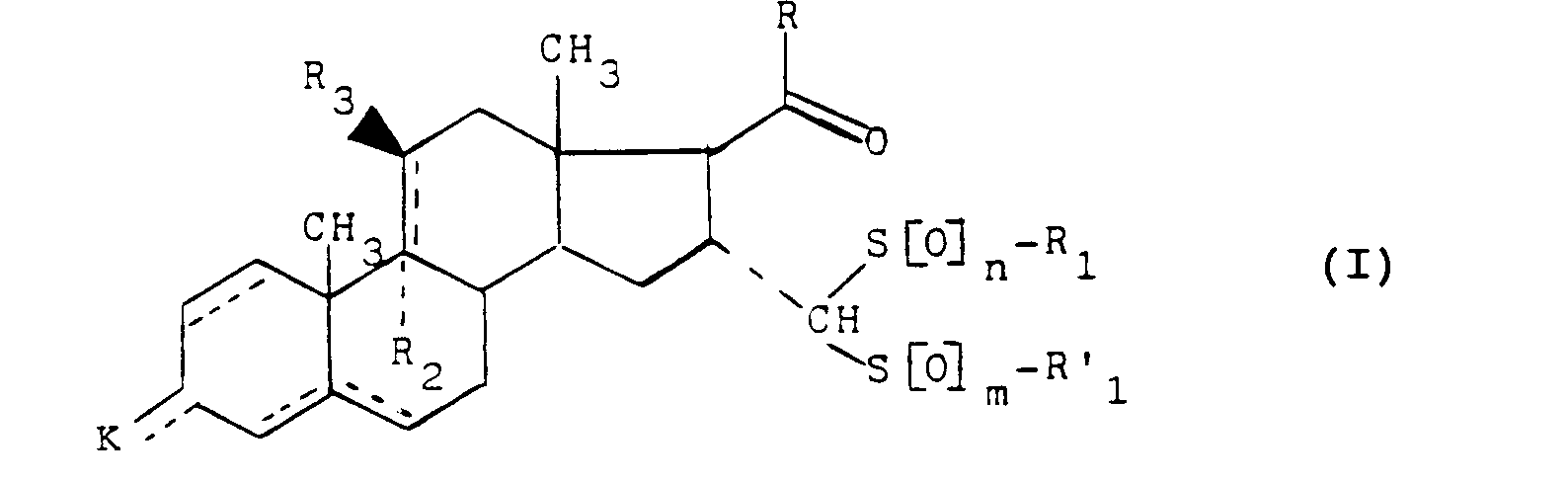
- L'invention a ainsi pour objet les composés de formule (1) :

dans laquelle
représente soit un système 3-céto Δ4 soit un système 3-céto Δ1,4 soit un système 3-OR4 Δ5 dans lequel R4 représente un atome d'hydrogène ou un groupement protecteur du radical hydroxy, R représente un radical méthyle, un radical -CH20H ou un radical -CH2-OR', dans lequel R' représente un groupement protecteur du radical hydroxy, R1 et R'1, identiques ou différents, représentent un radical méthyle, un radical alkyle ramifié ne possédant pas d'atome d'hydrogène en position béta, renfermant de 5 à 8 atomes de carbone, un radical aryle renfermant jusqu'à 10 atomes de carbone, un radical hétéroaryle renfermant jusqu'à 10 atomes de carbone et un ou plusieurs hétéroatomes choisis parmi l'azote, le soufre et l'oxygène, ou un radical benzyle, n et m, identiques ou différents, représentent les nombres 0 ou 1, R2 et R3 représentent un atome d'hydrogène ou R2 représente un atome de fluor et R3 représente un radical formyloxy ou acétyloxy et les traits pointillés en position 9(11) symbolisent la présence éventuelle d'une seconde liaison. - R' peut notamment représenter un radical alkyle renfermant de 1 à 6 atomes de carbone et plus particulièrement un radical méthyle, éthyle, propyle linéaire ou ramifié ou butyle linéaire ou ramifié.
- R' peut encore notamment représenter un radical acyle renfermant de 1 à 6 atomes de carbone et plus particulièrement un radical formyle, acétyle, propionyle, butyryle ou pivaloyle.
- R' peut encore notamment représenter un radical aralkyle notamment benzyle, un radical tétrahydropy- rannyle, un radical alkyl, aryl ou arylalkyl silyle, notamment triméthyl silyle, tert-butyl diméthyl silyle, triphényl silyle ou diphényl tert-butyl silyle.
- La liste des valeurs ci-dessus pour R' ne présente pas un caractère limitatif, tout groupement protecteur du radical hydroxy connu de l'homme du métier compatible avec les conditions opératoires du procédé défini ci-après peut convenir.
- Lorsque R1 et R'1 représentent un radical alkyle renfermant de 5 à 8 atomes de carbone, il s'agit d'un radical néopentyle ou d'un homologue supérieur ne possédant pas d'atome d'hydrogène en position béta.
- Lorsque R1 et R'1 représentent un radical aryle, il s'agit notamment d'un radical phényle, d'un radical phényle substitué par un ou deux radicaux méthyles ou d'un radical naphtyle.
- Lorsque R1 et R'1 représentent un radical hétéroaryl, il s'agit notamment d'un radical pyridyle, thiazolyle ou benzothiazolyle.
- Lorsque R4 représente un groupement protecteur du radical hydroxy, il s'agit notamment de l'un des groupements cités ci-dessus pour R'.
- Parmi les produits de formule (I), on peut citer les produits de formule (1') :

dans laquelle R, R1, R'1, R2, R3, m et n ont la signification indiquée ci-dessus et les traits pointillés en 1(2) et 9(11) symbolisent la présence éventuelle d'une seconde liaison. - L'invention a plus particulièrement pour objet les composés de formule (1), telle que définie précédemment, dans laquelle R représente un radical méthyle, un radical -CH2OH ou un radical -CH20R" dans lequel R" représente un radical alkyle renfermant de 1 à 4 atomes de carbone, un radical acyle renfermant de 1 à 5 atomes de carbone ou un radical benzyle, R1 et R'1, identiques ou différents, représentent un radical méthyle, phényle, tolyle ou benzyle, n, m, R2, R3 et les traits pointillés étant définis comme ci-dessus.
- Parmi les composés de formule (I) tels que définis précédemment, l'invention a ainsi pour objet :
- - les composés de formule (I), tels que définis précédemment, répondant à la formule (IA) :

dans laquelle K, R, R1, R'1, R2, R3 et les traits pointillés sont définis comme précédemment, - - les composés de formule (I), tels que définis précédemment, répondant à la formule (IB) :
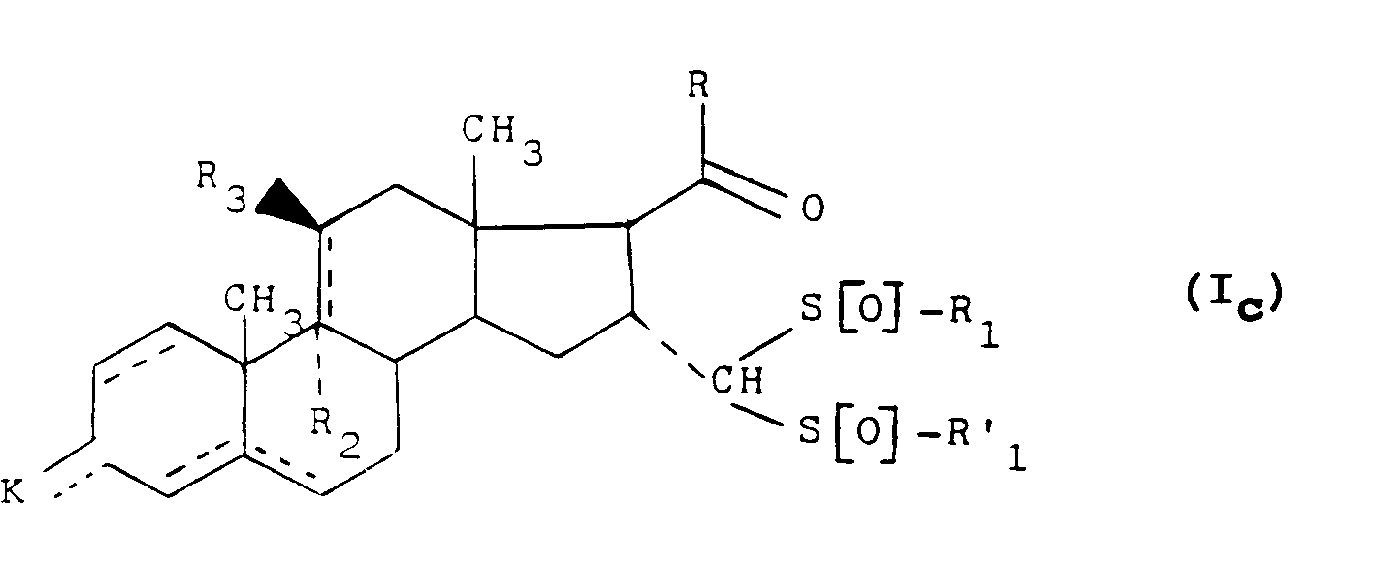
dans laquelle K, R, R1, R'1, R2, R3 et les traits pointillés sont définis comme précédemment ; - - les composés de formule (I), tels que définis précédemment, répondant à la formule (Ic) :

- Parmi les composés de formule (I), objet de l'invention, on peut citer également ceux caractérisés en ce que

représente un système 3-céto Δ1,4 et R représente un radical -CH2-OR", R" étant défini comme précédemment, R2 et R3 représentent un atome d'hydrogène et les traits pointillés en position 9(11), représentent une seconde liaison. - Parmi les composés de formule (I), l'invention a tout particulièrement pour objet :
- - la 21-acétoxy 16alpha-[bis(phénylthio)-méthyl] pregna-1,4,9(11)triène-3,20-dione ;
- - la 21-acétoxy 16alpha-[(phénylthio) (phénylsulfinyl)-méthyl] pregna-1,4,9(11)-triène-3,20-dione ;
- - la 21-acétoxy 16alpha-[bis(phénylsulfinyl)-méthyl] pregna-1,4,9(11)-triène-3,20-dione.
- L'invention a également pour objet un procédé de préparation des composés de formule (I), telle que définie plus haut, caractérisé en ce que l'on soumet un composé de formule (II) :

- dans laquelle K, R, R2, R3 et les traits pointillés ont la signification indiquée plus haut, en milieu basique, à l'action d'un réactif de formule (P) :

- dans laquelle R1 a la signification indiquée plus haut, pour obtenir un composé de formule (III) :

- dans laquelle K, R, R1, R2, R3 et les traits pointillés ont la signification indiquée plus haut, que l'on soumet, en présence d'un acide, à l'action d'un thiol ou d'un thiophénol de formule :
HS-R'1 - dans laquelle R'1 a la signification précitée, pour obtenir un composé de formule (IA) :
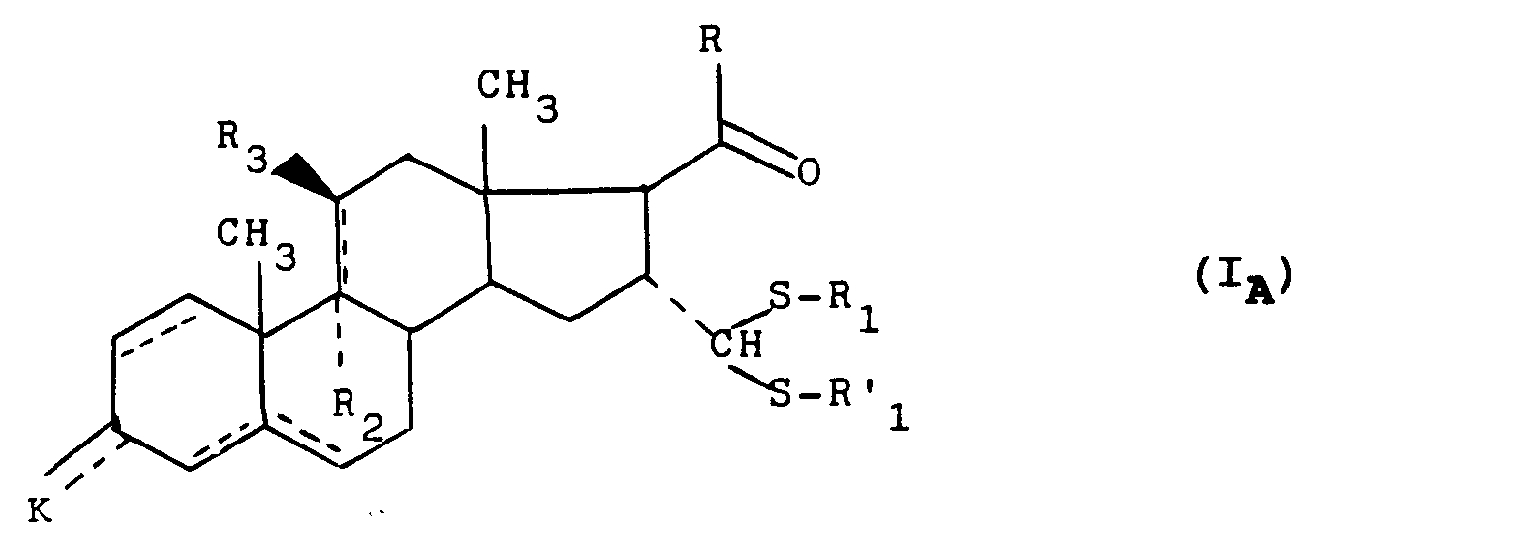
- dans laquelle K, R, R1, R'1, R2, R3 et les traits pointillés ont la signification précitée, correspondant à un composé de formule (I) dans laquelle m et n sont égaux à 0, composé de formule (IA) que, le cas échéant, l'on soumet soit à l'action d'un équivalent d'un agent oxydant, pour obtenir un composé de formule (IB) :
-

-

- L'invention a notamment pour objet un procédé selon ce qui précède, caractérisé en ce que l'on soumet un composé de formule (II) :
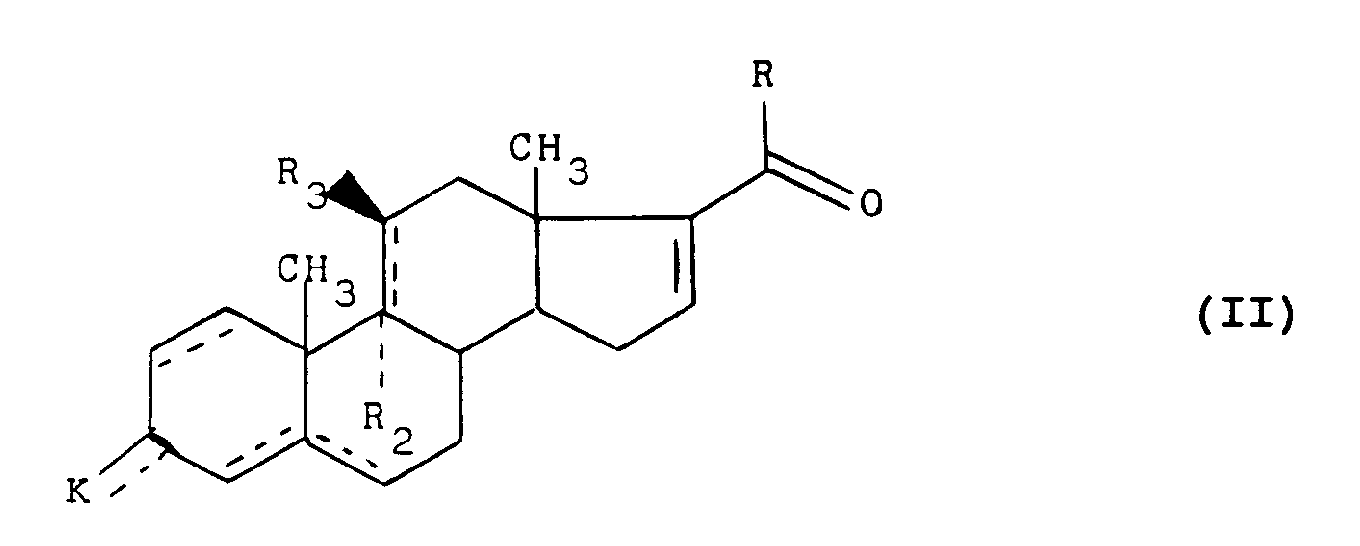
- dans laquelle K, R, R2, R3 et les traits pointillés ont la signification indiquée plus haut, en milieu basique, à l'action d'un réactif de formule (P) :
-

-

-

-


- dans laquelle K, R, R1, R'1, R2, R3 et les traits pointillés ont la signification précitée, correspondant à un composé de formule (I) dans laquelle m et n sont égaux à 1.
- L'action du réactif de formule P sur le composé de formule (II) est effectuée en présence d'une base qui peut être notamment une base aminée, par exemple une amine secondaire ou tertiaire telle que la diéthylamine ou la triéthylamine, le diazabicycloundécène (DBU), le diazabicyclononène (DBN), un acétate, un carbonate, un hydrure, un hydroxyde ou un alcoxyde alcalin, les bases fortes étant utilisées de préférence en quantité catalytique.
- On opère au sein d'un solvant organique qui peut être par exemple un éther tel que le tétrahydrofuranne ou le dioxanne, un alcool tel que le méthanol ou l'éthanol, un solvant aromatique tel que le benzène ou le toluène, ou encore le diméthylformamide, le diméthylsulfoxyde ou le chlorure de méthylène.
- L'action du thiol ou du thiophénol est catalysée par un acide de préférence faible, lequel peut notamment être un acide carboxylique, tel que l'acide formique, acétique ou propionique, un acide de Lewis tel que le chlorure de zinc ou le chlorure d'aluminium, ou encore l'acide phosphorique. Le dit acide peut aussi, le cas échéant, jouer le rôle de solvant. Le solvant peut encore être un solvant aromatique tel que le benzène ou le toluène. Il va de soi que les conditions de la réaction sont choisies le cas échéant de manière telle, qu'elles soient compatibles avec le groupement protecteur du radical hydroxy que le composé (II) peut porter et, plus généralement, avec la structure de la molécule, que l'on souhaite préserver. Ceci est connu de l'homme du métier.
- L'agent oxydant utilisé pour transformer le composé de formule (lA) en monosulfoxyde ou en disulfoxyde peut être un peracide tel que l'acide m-chloro perbenzoïque, l'acide perbenzoïque, l'acide perphtalique, le sel de magnésium de l'acide monoperphtalique, ou encore l'eau oxygénée en présence d'un acide carboxylique tel que l'acide acétique, ou encore un périodate, un perborate ou un persulfate, notamment de sodium ou de potassium.
- L'invention a aussi pour objet, à titre de composés industriels nouveaux, et notamment à titre d'intermédiaires utiles dans la préparation des composés de formule (I), les composés de formule (III), telle que définie plus haut.
- L'invention a également pour objet l'application des composés de formule (I), telle que définie plus haut, à la préparation des composés de formule (A) :

dans laquelle K, R, R2, R3 et les traits pointillés ont la signification indiquée plus haut, caractérisée en ce que : - - ou bien l'on soumet un composé de formule (IA) telle que définie plus haut, à l'action d'au moins deux équivalents d'un agent oxydant, pour obtenir un composé de formule (Ic) telle que définie plus haut, que l'on soumet, à chaud, à l'action d'un agent thiophile, pour obtenir le composé de formule (A) attendu ;
- - ou bien l'on soumet un composé de formule (Ic) telle que définie plus haut, à chaud, à l'action d'un agent thiophile, pour obtenir le composé de formule (A) attendu ;
- - ou bien l'on chauffe un composé de formule (IB) telle que définie plus haut, le cas échéant en présence d'un agent thiophile, pour obtenir un composé de formule (IV) :

- dans laquelle K, R, R'1, R2, R3 et les traits pointillés ont la signification indiquée plus haut, le trait pointillé en 16(17) et 16(16') symbolise l'existence d'un mélange de sulfure vinylique et allylique et le trait ondulé symbolise l'existence d'un mélange d'isomères, composé de formule (IV) que l'on soumet à l'action d'au moins un équivalent d'un agent oxydant, pour obtenir un composé de formule (V) :

- dans laquelle K, R, R'1, R2, R3 les traits pointillés et le trait ondulé ont la signification indiquée ci-dessus, que l'on soumet, à chaud, à l'action d'un agent thiophile, pour obtenir le composé de formule (A) attendu.
- Dans l'application selon l'invention, on peut :
- - isoler ou ne pas isoler le disulfoxyde de formule (Ic) ;
- - éliminer d'abord, par chauffage seulement, un premier groupement-S[O]R1 sur le disulfoxyde de formule (Ic), pour obtenir le composé monosulfoxyde de formule (V) telle que définie plus haut, puis éliminer le second groupement -S[O]R1, via la forme sulfénate intermédiaire décrite plus loin, par action, à chaud, d'un agent thiophile ;
- - isoler ou ne pas isoler le monosulfoxyde de formule (V) ainsi obtenu ;
- - éliminer par chauffage seulement le groupement -S[O]R1 sur le composé de formule (IB) ;
- - isoler ou ne pas isoler le monosulfoxyde de formule (V) obtenu par oxydation du composé de formule (IV).
- L'agent oxydant utilisé dans l'application selon l'invention pour transformer le composé de formule (IA) en un composé de formule (Ic), ou pour transformer le composé de formule (IV) en un composé de formule (V) est l'un de ceux qui ont été cités plus haut.
- L'agent thiophile peut être par exemple la triphénylphosphine, la triméthyl ou triéthylphosphine, le triphényl, triméthyl ou triéthylphosphite, le diméthyl ou diéthylphosphite, une amine secondaire, par exemple la diéthylamine, l'acide phosphoreux, un thiol tel que le thiophénol ou le méthyl mercaptan, ou encore un thiosulfate, ou un bisulfite, par exemple de sodium. La triphénylphosphine est particulièrement préférée.
- On opère au sein d'un solvant organique ou d'un mélange de solvants organiques, de préférence au reflux. On peut citer notamment les solvants aromatiques tels que benzène, toluène, xylène, ou encore le cyclohexane, le tétrahydrofuranne, le dioxanne, le diméthoxyéthane, le monoglyme ou le diglyme, le cas échéant en mélange avec un solvant protique, notamment un alcool tel que le méthanol, l'éthanol ou l'isopropanol.
- On opère le cas échéant en présence d'un carbonate alcalin tel que le carbonate de sodium ou le carbonate de calcium.
- Atitre purement indicatif, on peut ajouter que dans l'application selon l'invention, il est vraisemblable qu'au cours du procédé, la forme allylique du sulfoxyde de formule (V) se trouve en équilibre avec la forme sulfénate (Va) :

laquelle subit une réduction pour conduire au composé (A) désiré. - L'invention a notamment pour objet une application telle que définie plus haut, caractérisée en ce que l'on soumet un composé de formule (IA) telle que définie plus haut, à l'action d'au moins deux équivalents d'un agent oxydant, pour obtenir un composé de formule (Ic) telle que définie plus haut, que l'on soumet, à chaud, à l'action d'un agent thiophile, pour obtenir le composé de formule (A) attendu.
- L'invention a aussi notamment pour objet, une application telle que définie plus haut, caractérisée en ce que l'on soumet un composé de formule (Ic) telle que définie plus haut, à chaud, à l'action d'un agent thiophile, pour obtenir le composé de formule (A) attendu.
- Il est bien entendu possible de déprotéger les produits obtenus comportant un ou deux radicaux hydroxy protégés en utilisant les méthodes connues de l'homme du métier.
- L'invention a enfin pour objet, à titre de composés industriels nouveaux et notamment à titre d'intermédiaires utiles dans l'application selon l'invention, les composés de formule (IV), telle que définie plus haut, ainsi que les composés de formule (Vb) :

correspondant aux composés de formule (V), telle que définie plus haut, dans laquelle le trait pointillé en position 16(17) et 16(16') représente une seconde liaison uniquement en position 16(16') et les composés de formule (Ve) : R
correspondant aux composés de formule (V), telle que définie plus haut, dans laquelle le trait pointillé en position 16(17) et (16(16') représente une seconde liaison uniquement en position 16(17), à l'exception de ceux dans lesquels R représente un radical méthyle, R2 et R3 représentent un atome d'hydrogène et une double liaison est présente en 9(11). - Les composés de formule (A) dans laquelle R représente un radical méthyle sont décrits notamment dans les brevets américains 3354184, 3178462, 3312692, 3359287, 3064015, 3519619 ou peuvent être obtenus au départ des composés décrits dans ces brevets, par des procédés connus de l'homme du métier. Ceux dans laquelle R représente un radical -CH20H libre ou protégé sont quant à eux décrits par exemple dans les brevets allemands 1263765, 1263766, les brevets américains 3350394, 4567001, 3354184, le brevet français 1285336 ou encore les brevets européens 104054 ou 174496, ou peuvent être obtenus par des procédés connus de l'homme du métier au départ des composés décrits dans ces brevets ou encore dans les brevets américains 3309272 ou 3178462.
- Les composés de formule (A) sont utiles comme intermédiaires dans la synthèse de composés thérapeu- tiquement actifs.
- Les composés de formule (II) dans laquelle R représente un radical méthyle sont décrits notamment dans les brevets américains 2705719, 2817671, le brevet français 1058850, le brevet belge 711016 ou les brevets anglais 881501, 2199325 ou peuvent être obtenus au départ des composés décrits dans ces brevets, ainsi que dans les brevets allemands 2207420 ou américains 4113722 et 3976638, par des procédés connus de l'homme du métier. Les composés de formule (II) dans laquelle R représente un radical -CH2OH libre ou protégé sont décrits par exemple dans les brevets américains 2802839, 2745852, 2773058, 2864834, les brevets belges 540478 ou 789387, le brevet allemand 2207420, néerlandais 6902507 ou soviétique 819119, ou peuvent être obtenus au départ des composés décrits dans ces brevets, ainsi que dans les brevets américains 3976638 ou 2966504, européen 123736 ou canadien 760431, par des procédés connus de l'homme du métier.
- Les réactifs de formule (P) dans laquelle R1 représente un radical méthyle et phényle sont décrits dans J. Chem. Soc. Chem. Comm. 1983, 835, 1978, 362 ou encore J. Org. Chem. 1978, 43, 3101. Les autres réactifs de formule (P) peuvent être préparés par des méthodes analogues à celles décrites dans les références ci-dessus.
- Les exemples suivants illustrent l'invention sans toutefois la limiter.
- 2,01 g de 21-acétoxy-1,4,9(11),16-pregnatétraèn-3,20-dione et 1,1 g de (phénylthio)-nitro-méthane sont dissous, sous atmosphère inerte et à l'abri de la lumière, dans un mélange de THF sec (20 ml) et de tertiobutanol (20 ml). On ajoute 0,8 ml de DBU (1,8-diazabicyclo[5,4,0]undec-7-ène) et le mélange réactionnel est agité à température ambiante pendant 8 h. Une solution de 2 g d'acide citrique dans 50 ml d'eau est alors ajoutée. Après extraction au dichlorométhane, 5 filtration sur silice, séchage sur sulfate de sodium, filtration et évaporation du solvant à pression réduite, on obtient 3,73 g de produit brut. L'excès de (phénylthio)-nitro-méthane est éliminé en reprenant le brut de réaction dans un mélange pentane (75 ml)-éther (30 ml). On obtient 2,79 g de 21-acétoxy-16alpha[(phénylthio)-nitro-méthyl]-1,4,9(11)-pregnatrièn-3,20-dione. F=92-100°C.
-
- 1740(s) ; 1720(s) ; 1655(s) ; 1615(w) ; 1595(w) ; 1540(s) (N02) ; 885 (w) (C-SPh)
- 2 isomères visibles : 0,72 et 0,73 (3H,s,Me-18) ; 1,41 (3H,s,Me-19) ; 2,17 et 2,20 (3H,s,COCH3) ; 2,67 et 2,97 (1H,d,J=9,2Hz,C17-H) ; 3,60 (1H,m,W½=35Hz, C16-H) ; 4,43 et 4,75 (2H,système AB,J=16,9Hz) et 4,58 et 4,88 (2H,système AB,J=17,0 Hz) ; 5,38 (1 H,d,J=8,14 Hz,C16'-H) et 5,43 (1 H,d,J=5,9 Hz,C16'-H) ; 5,55 (1 H,massif, W½-10 HZ,C11-H) ; 6,08 (1H,massif,W1/2=10 Hz, C4-H) ; 6,30 (1H,d-d,J=10,2 Hz, J=1,7 Hz, C2-H) ; 7,17 (1H,d,J=10,2 Hz, C1-H), 7,34-7,48 (5H,massif).
- 30 carbones, 2 isomères :
- pairs : 29,87 et 30,65(s) ; 32,00(s) ; 34,60(s) ; 44,38 et 44,60(q) ; 45,91 (q) ; 69,01 (s) ; 130,58(q) ; 130,98(q) ; 143,21 et 143,34(q) ; 166,03(q) ; 170,40(q) ; 186,24(q) ; 201,40 et 201,65(q).
- impairs : 13,64(p, 18-Me) ; 20,52(p,COCH3) ; 26,61 (p, 19-Me) ; 36,29(t) ; 40,05 et 40,17(t) ; 40,97(t) ; 52,21 et 52,62(t) ; 61,95(t) ; 98,03 et 98,54(t) ; 119,65(t) ; 124,18(t) ; 127,62(t) ; 129,71(t) ; 129,87(t) ; 132,94(t) ; 133,23(t) ; 154,17(t).
- m/z=512(M+) ; 483; 391 ; 314; 213.
- 2 ml de thiophénol (5 ml) et d'acide acétique sont mélangés et portés à ébullition sous azote. 2,51 g de 21-acétoxy-16alpha-[(phénylthio)-nitro-méthyl]-1,4,9(11)-pregnatrièn-3,20-dione sont additionnés et le mélange est laissé à reflux pendant 4 h 30 mn. Une fois le mélange refroidi, de l'éther est ajouté (25 ml). Après neutralisation de l'acide acétique par une solution saturée d'hydrogénocarbonate de sodium, on ajoute 25 ml d'éther. La phase organique est récupérée, lavée à l'eau, puis séchée et concentrée. On obtient 4 g d'une huile marron. L'élimination du thiophénol en excès se fait en reprenant le brut de réaction dans un mélange éther (25 ml)-pentane (100 ml). On obtient 1,70 g du dérivé disulfure attendu, F=98-100°C après purification parchro- matographie sur silice (éluant : éther-dichlorométhane 9-1). [alpha]D= -13,4° (C=12,7 mg/ml ; chloroforme).
- 1750(s) ; 1720(s) ; 1665(s) ; 1630(m) ; 1610(w) ; 1585(w) ; 1550(w) ; 1480(w) ; 1440(w) ; 1410(w) ; 1370(w) ; 1270(m) ; 1120(w) ; 1155(w) ; 1070(m) ; 1050(m) ; 1025(m) ; 890(m).
- 0,61(3H,s,Me-18) ; 1,37(3H,s,Me-19) ; 2,10(3H,s,COCH3) ; 2,87(1H,d,J=9,2Hz,C17-H) ; 3,31(1H,m,W½=19 Hz,C16-H) ; 4,25 et 4,68(2H,système AB,J=16,9 Hz) ; 4,33(1 H,d,J=4,8 Hz,C16 -H) ; 5,47(1 H,massif,W½=9 Hz,C11-H) ; 6,03(1H,massif,W½=5 Hz,C4-H) ; 6,23(1H,d-d,J=10,1 Hz,J=1,7 Hz,C2-H) ; 7,10(1H,d,J=10,2 Hz,C1-H), 7,18-7,41 (10H,massif).
- pairs : 30,86(s) ; 32,14(s) ; 34,64(s) ; 40,23(s) ; 44,54(q) ; 134,40(q) ; 143,38(q) ; 154,45(q) ; 166,50(q) ; 170,32(q) ; 186,31 (q) ;202,50(q).
- impairs : 13,81(p) ; 20,53(p) ; 26,61 (p) ; 36,50(t) ; 43,52(t) ; 45,98(t) ; 52,75(t) ; 62,47(t) ; 64,64(t) ; 69,09(t) ; 119,89(t) ; 124,03(t) ; 127,49(t) ; 127,88(t) ; 127,97(t) ; 129,16(t) ; 132,27(t) ; 132,57(t).
- m/z=489(M+ - Sph).
- On dissout 60 mg de disulfure obtenu à l'exemple 1 dans 1 ml de dichlorométhane et on refroidit à -60°C. On ajoute 26 mg d'acide méta-chloroperbenzoïque. Après une heure, on rajoute 5 mg d'acide métachloroperbenzoïque. Le mélange réactionnel est laissé encore à -60°C pendant 1 heure. On ajoute 2 ml d'une solution saturée d'hydrogénocarbonate de sodium ; ramène le mélange à température ambiante et extrait au dichlorométhane (2x1,5 ml). La phase organique est ensuite lavée à l'eau (3x2 ml), puis séchée et le solvant est évaporé sous pression réduite. On obtient 56 mg de monosulfoxyde brut attendu.
- Ce dérivé est instable et est conservé au réfrigérateur.
- On dissout 1,09 g de produit obtenu à l'exemple 1 dans 10 ml de dichlorométhane et refroidit à -78°C. On ajoute 796 mg d'acide méta-chloroperbenzoïque à 80 % et maintient le mélange réactionnel à -78°C pendant 3 heures. On ajoute 15 ml d'une solution saturée d'hydrogénocarbonate de sodium ; le mélange est ramené aussitôt à température ambiante et extrait au dichlorométhane. La phase organique est ensuite lavée à l'eau, puis séchée et le solvant est évaporé sous pression réduite. Le disulfoxyde obtenu est purifié par chromatographie sur silice (éluant : cyclohexane : acétate d'éthyle 1/1) ; on obtient 649 mg du composé attendu.
- 3050, 2960, 2920, 1745(s), 1720(s), 1660(s), 1625, 1615(m), 1580, 1450(m), 1375, 1320, 1270, 1240(s), 1150(m), 1090(m), 1050(m), 890.
- 1er isomère : 0,62(3H,s,Me-18) ; 1,40(3H,s,Me-19) ; 2,18(3H,s,COCH3) ; 3,43-3,54(3H,16-H,16'-H et 17-H) ; 4,29 et 4,59(2H,système AB,J=16,6 Hz) ; 5,51 (1H,massif,W½=10 Hz,C11-H) ; 6,08(1H,massif,W½=5 Hz,C4-H) ; 6,28(1H,d-d,J=10,2 Hz,J=1,7 Hz,C2-H) ; 7,15(1H,d,J=10,1 Hz,C1-H), 7,31-7,66(10H,massif).
- 2ème isomère : 0,68(3H,s,Me-18) ; 1,40(3H,s,Me-19) ; 2,13(3H,s,COCH3) ; 3,54-3,62(3H,16H,16'-H et 17-H) ; 4,44 et 4,79 (2H,système AB,J=16,5 Hz) ; 5,58(1 H,massif,W½=10 Hz,C11-H) ; 6,08(1 H,massif,W1/2=5 Hz,C4-H) ; 6,28(1H,dd,J=10,2 Hz,J=1,7 Hz,C2-H) ; 7,18(1H,d,J=10,1 Hz,C1-H), 7,31-7,66(10H,massif).
- 0,206 g de disulfure obtenu à l'exemple 1 est dilué dans 2 ml d'acide acétique, sous argon. On refroidit à 0°C par un bain de glace. On ajoute au mélange 5 gouttes d'eau oxygénée 30 %. On additionne quelques gouttes de dichlorométhane, laisse remonter la température. Après 21 heures à température ambiante, on obtient majoritairement le monosulfoxyde identifié comparativement au produit de l'exemple 2. On poursuit la réaction pendant 50 heures environ sous atmosphère inerte et à température ambiante, puis l'arrête par addition d'eau.
- On obtient, après traitement comme à l'exemple 3, le disulfoxyde attendu, identique à celui obtenu à l'exemple 3.
- On reprend le monosulfoxyde obtenu comme à l'exemple 2, à partir de 204 mg de disulfure, dans 3 ml de toluène sec. On ajoute 101 mg de triphénylphosphine et la solution est chauffée à reflux sous argon pendant 15 heures. Après 6 heures de chauffage, on ajoute 55 mg de triphénylphosphine. Le toluène est ensuite évaporé et le produit est purifié par chromatographie sur silice (éluant : cyclohexane/acétate d'éthyle 9/1 puis 3/1).
- On obtient 143 mg d'un mélange de deux isomères de position pour la double liaison en position 16 (delta16-16' ou delta16-17).
- 3020, 2910, 2820, 1750(s), 1720(m), 1660(s), 1620(m), 1580, 1550, 1430, 1370, 1260, 1040, 880. Spectre RMN 1H :
- 0,80(3H,s,Me-18) ; 1,41 et 1,42(3H,s,Me-19) ; 2,18 et 2,19(3H,s,COCH3) ; 3,38(1 H,m,W½=10 Hz,C17-H) ; 3,72 et 4,09(2H,système AB,J=13,6 Hz,C16'-H) ; 4,44 et 4,67(2H,système AB,J=16,6 Hz) et 4,71 et4,90(2H,système AB,J=17 Hz) ; 5,50 et 5,59(1H,massif,W½=12,5 Hz,C11-H) ; 6,09(1H,massif,W½=5 Hz,C4-H) ; 6,30(1H,d-d,J=10,2 Hz,J=1,7 Hz,C2-H) ; 6,31 et 6,27(1H,d,J=1,9 Hz,C16'-H), 7,16-7,52(6H,massif).
- pairs : 32,03 ; 34,27 ; 34,66 ; 36,66 ; 37,12 ; 37,77 ; 40,41 ; 44,05 ; 45,97 ; 47,09 ; 68,08 ; 69,01 ; 134,58 ; 136,18 ; 143,06 ; 143,79 ; 144,11 ; 145,90 ; 151,58 ; 166,37 ; 170,29 ; 186,34 ; 193,57 ; 200,77.
- impairs : 14,16 ; 16,02 ; 20,53 ; 26,54 ; 28,72 ; 35,73 ; 51,19 ; 63,20 ; 117,37 ; 119,84 ; 120,23 ; 123,97 ; 126,43 ; 127,43 ; 128,54 ; 129,02 ; 129,09 ; 131,72 ; 154,47.
- m/z=490, 489, 488(M+), 448, 447, 446(M+-COCH3), 430, 415, 387, 319, 207.
- On dissout 6,42 g du mélange d'isomères obtenu comme décrit au stade précédent, dans 100 cm3 de dichlorométhane et refroidit à -78°C sous azote. On ajoute 2,92 g d'acide métachloroperbenzoïque à 80 % et maintient sous agitation pendant 2 heures environ.
- On traite à basse température par une solution saturée de bicarbonate de sodium puis à l'eau, sèche et évapore à sec. On obtient après chromatographie sur silice (élution : acétate d'éthyle puis acétate d'éthyle/mé- thanol 9/1) : 3,44 g du mélange de sulfoxydes désiré.
- On dissout le produit obtenu au stade précédent dans un mélange de 50 cm3 de toluène et 50 cm3 de méthanol et ajoute 2,68 g de triphénylphosphine. On chauffe à 85-90°C pendant 20 heures, puis refroidit et évapore le solvant.
- On obtient après chromatographie sur silice (élution : éther/dichlorométhane/éther de pétrole 4/1/5), 1,97 g de produit attendu. F=213°-215°C (dec) après cristallisation dans le méthanol.
- [alpha]D= -32,8° (C=10,5 mg/ml ; chloroforme).
- 3200 ; 2900 ; 2850 ; 2250 ; 1750(s) ; 1730(s) ; 1675(s) ; 1625 ; 1605 ; 1440 ; 1410 ; 1370 ; 1235(s) ; 1075 ; 915(s).
- 0,70(3H,s,Me-18) ; 1,41(3H,s,Me-19) ; 2,17(3H,s,COCH3) ; 4,93 et 5,07(2H,système AB,J=17,6 Hz) ; 5,02(1H,s,c=CH2) ; 5,15(1H,s,c=CH2) ; 5,60(1H,massif,W½=12 Hz,C11-H) ; 6,07(1H,massif,W½=5 Hz,C4-H) ; 6,29(1 H,d-d,J=10,2 Hz,J=1,4 Hz,C2-H) ; 7,20(1 H,d,J=10,2 Hz,C1-H).
- pairs : 31,96(s) ; 32,25(s) ; 33,36(s) ; 35,05(s) ; 46,04(q) ; 45,45(q) ; 68,65(s) ; 89,65(q) ; 114,45(s) ; 142,28(q) ; 152,64(q) ; 166,49(q) ; 170,64(q) ; 186,37(q) ; 204,00(q).
- impairs : 14,18(p) ; 20,60(p) ; 26,81 (p) ; 36,38(t) ; 46,31 (t) ; 120,83(t) ; 124,05(t) ; 127,50(t) ; 154,51 (t).
- On dissout 205 mg du mélange obtenu comme décrit au stade A de l'exemple 4 dans 3 ml de dichlorométhane et refroidit à -78°C sous azote. On ajoute 91 mg d'acide méta-chloroperbenzoïque à 80 %. Après 2 heures de réaction, le produit de départ a complètement disparu. On ajoute 221 mg de triphényl phosphine à basse température, puis on évapore le dichlorométhane sous pression réduite et le remplace par 3 ml de toluène sec. Après 2 h 30 mn de chauffage à reflux, on évapore à sec et obtient ainsi après purification par chromatographie sur silice éluant : cyclohexane/éther, 4/1 à 0/1), 113 mg de l'alcool attendu, identique à celui obtenu à l'exemple 4 F=213-215°C.
- On dissout 648 mg de disulfoxyde obtenu à l'exemple 3 sous argon, dans 10 cm3 de toluène et la solution est refroidie à -60°C. On ajoute 500 mg de carbonate de calcium et le mélange réactionnel est chauffé à 80°C pendant 2 heures. On ajoute ensuite 540 mg de triphénylphosphine ainsi que 10 cm3 de méthanol. La solution obtenue est portée à reflux, à 80°C pendant 11 heures, puis refroidie et amenée à sec. Après chromatographie sur silice éluant cyclohexane/acétate d'éthyle; 7/3 puis 1/1), on récupère 217 mg de l'alcool attendu, identique à celui obtenu à l'exemple 4 F=213-215°C.
- On dissout 287 mg de disulfoxyde obtenu à l'exemple 3 ou 3' dans 5 ml de toluène sec et on ajoute 250 mg de carbonate de calcium. La solution est chauffée à reflux pendant 75 mn. On ajoute 5 gouttes (1 équivalent) de triméthylphosphite et 5 ml de méthanol, puis 8 gouttes de triméthylphosphine après 8 heures et après 24 heures. Après 34 heures de chauffage à reflux, on observe en chromatographie sur couche mince que la réaction est complète. On laisse refroidir la solution et on additionne alors 15 ml de dichlorométhane et 15 ml d'eau. Le mélange obtenu est filtré et les phases organique et aqueuse sont séparées. La phase organique obtenue est lavée par une solution saturée de bicarbonate et une solution saturée de chlorure de sodium. Après séchage et élimination du solvant, on obtient 256 mg de produit attendu brut que l'on chromatographie sur silice (élution : éther de pétrole/acétate d'éthyle 7/3 puis 1/1). On obtient 64 mg soit 36 % de produit attendu pur identique à celui obtenu à l'exemple 4. F=213-215°C.
- On dissout 702 mg de produit obtenu à l'exemple 1, sous azote, dans 10,5 cm3 de dichlorométhane et la solution est refroidie à -60°C. On ajoute 319 mg d'acide méta-chloroperbenzoïque à 80 %. Après 30 mn, on rajoute 243,6 mg d'acide méta-chloroperbenzoïque et la réaction est laissée entre -60°C et -40°C pendant 5 heures. On ajoute alors 942 mg de triphénylphosphine, évapore le dichlorométhane sous pression réduite et le remplace par 11 cm3 de toluène sec. La solution obtenue est portée à reflux pendant 7 heures. On refroidit, évapore le solvant et chromatographie le résidu sur colonne de silice éluant cyclohexane/acétate d'éthyle; 1/0 à 1/1. On récupère 115 mg d'alcool attendu, identique à celui obtenu à l'exemple 4. F=213-215°C.
- 138 mg de 4,16-pregnadièn-3,20-dione et 110 mg de (phénylthio)-nitro-méthane sont dissous, sous atmosphère inerte et à l'abri de la lumière, dans 2 ml d'un mélange (1-1) de tétrahydrofuranne et de tertiobutanol puis on ajoute 0,1 ml de DBU (1,8-diazabicyclo[5,4,0]undec-7-ène) et le mélange réactionnel est agité à température ambiante pendant 48 h. Une solution de 0,5 g d'acide citrique dans 5 ml d'eau est alors ajoutée. Après extraction au dichlorométhane, séchage sur sulfate de sodium, filtration et évaporation du solvant sous pression réduite, on chromatographie le résidu sur silice en éluant à l'éther et obtient 48,3 mg de produit attendu sous forme d'un mélange 2-1 d'épimères. F = 166-172°C.
- 1702, 1660, 1551 cm-1
- 1H : 7,4 (5H,m) ; 5,7 (1H,s) ; 5,4 (1H,2d) ; 3,55 (1H,m) ; 2,87 (1/3H,d, J=8,8Hz) ; 2,64 (2/3H,d, J=8,8Hz) ; 2,23 (2/3 3H,s) ; 2,16 (1/3 3H,s) ; 1,18 (3H,s) ; 0,71 (3H,s).
- 13C (ppm) :
- 14,38 ; 17,47 ; 21,04 ; 28,72 ; 29,23 ; 31,58 ; 31,76 ; 32,64; 34,00 ; 35,39 ; 35,83 ; 38,66 ; 38,76 ; 40,67 ; 45,23 ; 53,50; 54,75 ; 55,24 ; 66,86 ; 98,66 ; 98,99 ; 124,26 ; 129,53 ; 129,80 ; 131,45 ; 132,94 ; 170,18 ; 199,19 ; 206,37.
- En opérant comme indiqué à l'exemple 3 à partir du produit obtenu au stade A ci-dessus, on obtient le disulfoxyde correspondant que l'on transforme comme indiqué à l'exemple 6 pour obtenir la 16-méthylène 17alpha-hydroxy 4-pregnèn-3,20-dione attendue (obtenue comme indiqué dans le brevet US 3,354,184).
- 124,3 g de 3bêta-acétoxy 5,16-pregnadièn-20-one et 89,7 mg de (phénylthio)-nitro-méthane sont dissous, sous atmosphère inerte et à l'abri de la lumière, dans 2 ml d'un mélange (1-1) de tétrahydrofuranne et de tertiobutanol puis on ajoute 0,05 ml de DBU (1,8-diazabicyclo[5,4,0]undec-7-ène) et le mélange réactionnel est agité à température ambiante pendant 48 h. Une solution de 0,5 g d'acide citrique dans 5 ml d'eau est alors ajoutée. Après extraction au dichlorométhane, séchage sur sulfate de sodium, filtration et évaporation du solvant sous pression réduite, on chromatographie le résidu sur silice en éluant avec un mélange éther-éther de pétrole (1-3) et obtient 66 mg de produit attendu sous forme d'un mélange 2-1 d'épimères. F = 135-159°C.
- 1720, 1702, 1551 cm-1
- 1H : (Δ) 7,4 (5H,m) ; 5,35 (1 H,2d) ; 4,6 (1H,m) ; 3,55 (1 H,m); 2,85 (1/3H,d, J=8,8Hz) ; 2,64 (2/3H,d, J=8,8Hz) ; 2,23 (2/3 3H,s) ; 2,16 (1/3 3H,s) ; 2,04 (3H,s) ; 1,02 (3H,s) ; 0,66 (3H,s).
- 13C (ppm) :
- 14,19 ; 19,32 ; 20,88 ; 21,46 ; 27,72 ; 29,36 ; 31,53 ; 36,58; 36,96 ; 38,04 ; 38,72 ; 40,46 ; 45,19 ; 49,64 ; 55,34 ; 55,83 ; 66,90 ; 73,74 ; 98,73 ; 99,06 ; 121,06 ; 129,43 ; 129,71 ; 132,88 ; 139,72 ; 170,56 ; 206,64.
- En opérant comme indiqué à l'exemple 3 à partir du produit obtenu au stade A ci-dessus, on obtient le disulfoxyde correspondant que l'on transforme comme indiqué à l'exemple 6 pour obtenir la 3bêta-acétoxy 16-méthylène 17alpha-hydroxy 5-pregnèn-20-one (décrit dans le brevet US 3,519,619).
- 100 mg de pregna 4,9(11),16-trièn-3,20-dione et 100 mg de (phénylthio)-nitro-méthane sont dissous, sous atmosphère inerte et à l'abri de la lumière, dans 1 ml d'un mélange (1-1) de tétrahydrofuranne et de tertiobutanol puis on ajoute 30 mg de DBU (1,8-diazabicyclo[5,4,0]undec-7-ène) et le mélange réactionnel est agité à température ambiante pendant 16 h. Une solution de 0,5 g d'acide citrique dans 5 ml d'eau est alors ajoutée. Après extraction au dichlorométhane, séchage sur sulfate de sodium, filtration et évaporation du solvant sous pression réduite, on chromatographie le résidu sur silice en éluant avec un mélange éther de pétrole-acétate d'éthyle (2-1) et obtient 129 mg de produit attendu sous forme d'un mélange 2-1 d'épimères. F = 198-200°C (déc.) après recristallisation dans un mélange chloroforme-méthanol.
- 1707, 1665, 1614, 1552 cm-1
- 1H : (Δ) 7,4 (5H,m) ; 5,75 (1H,s) ; 5,55 (1H,m) ; 5,4 (1H,2d); 3,6 (1H,m); 2,95 (1/3H,d, J=9Hz) ; 2,75 (2/3H,d, J=9Hz) ; 2,24 (2/3 3H,s) ; 2,17 (1/3 3H,s) ; 1,34 (3H,s) ; 0,65 (3H,s).
- 13C (ppm) :
- 13,96 ; 26,16 ; 29,50 ; 30,08 ; 31,28 ; 31,98 ; 32,60 ; 33,90; 34,25 ; 36,94 ; 40,70 ; 41,07 ; 43,30 ; 43,47 ; 51,58 ; 52,09; 66,50 ; 66,68 ; 98,46 ; 98,81 ; 117,84 ; 124,26 ; 129,41 ; 129,70 ; 132,81 ; 145,10 ; 198,70 ; 206,03.
- En opérant comme indiqué à l'exemple 3 à partir du produit obtenu au stade A ci-dessus, on obtient le disulfoxyde correspondant que l'on transforme comme indiqué à l'exemple 6 pour obtenir la 16-méthylène 17alpha-hydroxy pregna 4,9(11)-dièn-3,20-dione attendue (décrite dans le brevet US 3,359,287).
dans laquelle K, R, R1, R'1, R2, R3 et les traits pointillés sont définis comme précédemment.
Claims (20)

dans laquelle

représente soit un système 3-céto Δ4 soit un système 3-céto Δ1,4 soit un système 3-OR4 Δ5 dans lequel R4 représente un atome d'hydrogène ou un groupement protecteur du radical hydroxy, R représente un radical méthyle, un radical -CH2OH ou un radical -CH2-OR', dans lequel R' représente un groupement protecteur du radical hydroxy, R1 et R'1, identiques ou différents, représentent un radical méthyle, un radical alkyle ramifié ne possédant pas d'atome d'hydrogène en position béta, renfermant de 5 à 8 atomes de carbone, un radical aryle renfermant jusqu'à 10 atomes de carbone, un radical hétéroaryle renfermant jusqu'à 10 atomes de carbone et un ou plusieurs hétéroatomes choisis parmi l'azote, le soufre et l'oxygène, ou un radical benzyle, n et m, identiques ou différents, représentent les nombres 0 ou 1, R2 et R3 représentent un atome d'hydrogène ou R2 représente un atome de fluor et R3 représente un radical formyloxy ou acétyloxy et les traits pointillés en position 9(11) symbolisent la présence éventuelle d'une seconde liaison.

dans laquelle K, R, R1, R'1, R2, R3 et les traits pointillés sont définis comme précédemment,

dans laquelle K, R, R1, R'1, R2, R3 et les traits pointillés sont définis comme précédemment ;

dans laquelle K, R, R1, R'1, R2, R3 et les traits pointillés sont définis comme à la revendication 1 ou 2.

représente un système 3-céto Δ1,4 et R représente un radical -CH2-OR", R" étant défini comme à la revendication 2, R2 et R3 représentent un atome d'hydrogène et les traits pointillés en position 9(11), représentent une seconde liaison.

dans laquelle K, R, R2, R3 et les traits pointillés ont la signification indiquée plus haut, en milieu basique, à l'action d'un réactif de formule (P) :
R1S-CH2-NO2 (P)



dans laquelle K, R, R2, R3 et les traits pointillés ont la signification indiquée à la revendication 1, caractérisée en ce que :


correspondant aux composés de formule (V), telle que définie à la revendication 14, dans laquelle le trait pointillé en position 16(17) et 16(16') représente une seconde liaison uniquement en position 16(16') ;

correspondant aux composés de formule (V), telle que définie à la revendication 14, dans laquelle le trait pointillé en position 16(17) et 16(16') représente une seconde liaison uniquement en position 16(17), à l'exception de ceux dans lesquels R représente un radical méthyle, R2 et R3 représentent un atome d'hydrogène et une double liaison est présente en 9(11).
Applications Claiming Priority (3)
| Application Number | Priority Date | Filing Date | Title |
|---|---|---|---|
| FR9107784A FR2678275B1 (fr) | 1991-06-25 | 1991-06-25 | Nouveaux sterouides 16-methyl substitue derives de la pregna 1,4-diene 3,20-dione leur preparation, leur application a la preparation de sterouides 16-methylene et nouveaux intermediaires. |
| FR9107784 | 1991-06-25 | ||
| CN92105005A CN1035948C (zh) | 1991-06-25 | 1992-06-25 | 孕甾-1,4-二烯-3,20-二酮衍生物的制备方法 |
Publications (3)
| Publication Number | Publication Date |
|---|---|
| EP0520879A2 true EP0520879A2 (fr) | 1992-12-30 |
| EP0520879A3 EP0520879A3 (fr) | 1995-04-12 |
| EP0520879B1 EP0520879B1 (fr) | 1997-04-23 |
Family
ID=36781528
Family Applications (1)
| Application Number | Title | Priority Date | Filing Date |
|---|---|---|---|
| EP92401764A Expired - Lifetime EP0520879B1 (fr) | 1991-06-25 | 1992-06-24 | Nouveaux stéroides 16-méthyl substitués dérivés de la pregna 1,4-diène 3,20-dione, leur préparation, leur application à la préparation de steroides 16-méthylène et nouveaux intermédiaires |
Country Status (17)
| Country | Link |
|---|---|
| US (1) | US5248773A (fr) |
| EP (1) | EP0520879B1 (fr) |
| JP (1) | JP3037508B2 (fr) |
| KR (1) | KR100220540B1 (fr) |
| CN (1) | CN1035948C (fr) |
| AT (1) | ATE152119T1 (fr) |
| AU (1) | AU646342B2 (fr) |
| CA (1) | CA2072053C (fr) |
| DE (1) | DE69219217T2 (fr) |
| DK (1) | DK0520879T3 (fr) |
| ES (1) | ES2100315T3 (fr) |
| FR (1) | FR2678275B1 (fr) |
| GR (1) | GR3023294T3 (fr) |
| HU (1) | HU213674B (fr) |
| MX (1) | MX9202972A (fr) |
| RU (1) | RU2099346C1 (fr) |
| ZA (1) | ZA924665B (fr) |
Families Citing this family (7)
| Publication number | Priority date | Publication date | Assignee | Title |
|---|---|---|---|---|
| HU226413B1 (en) * | 1991-06-25 | 2008-11-28 | Aventis Pharma Sa | Novel 16-(nitro-substituted methyl)pregna-1,4-dien-3,20-dion derivatives and process for producing them |
| FR2692266B1 (fr) * | 1992-06-11 | 1994-08-05 | Roussel Uclaf | Nouveau procede de preparation de sterouides 16 alpha-methyles. |
| CN1061984C (zh) * | 1996-04-18 | 2001-02-14 | 上海华联制药有限公司 | 甾体激素化合物中引入9-11双键的一种方法 |
| DK2444092T3 (en) | 2008-05-28 | 2015-09-28 | Reveragen Biopharma Inc | Non-hormonal steroidmodulatorer of NF-? B for the treatment of disease |
| EP2556083A4 (fr) | 2010-04-05 | 2013-12-04 | Validus Biopharma Inc | Modulateurs stéroïdes non hormonaux de nf- kappa b pour le traitement de maladies |
| WO2017004205A1 (fr) | 2015-06-29 | 2017-01-05 | Reveragen Biopharma, Inc. | Modulateurs stéroïdiens non hormonaux de nf-κb pour le traitement de maladies |
| US11382922B2 (en) | 2019-03-07 | 2022-07-12 | Reveragen Biopharma, Inc. | Aqueous oral pharmaceutical suspension compositions |
Family Cites Families (2)
| Publication number | Priority date | Publication date | Assignee | Title |
|---|---|---|---|---|
| EP0104054A3 (fr) * | 1982-09-20 | 1985-10-09 | The Upjohn Company | 16-Méthylène stéroides et leur préparation |
| DE3486450T2 (de) * | 1984-01-05 | 1997-11-06 | Pharmacia & Upjohn Co., Kalamazoo, Mich. | 17-Alpha-Ethynyl Steroide |
-
1991
- 1991-06-25 FR FR9107784A patent/FR2678275B1/fr not_active Expired - Fee Related
-
1992
- 1992-06-18 MX MX9202972A patent/MX9202972A/es unknown
- 1992-06-23 CA CA002072053A patent/CA2072053C/fr not_active Expired - Lifetime
- 1992-06-24 EP EP92401764A patent/EP0520879B1/fr not_active Expired - Lifetime
- 1992-06-24 HU HU9202100A patent/HU213674B/hu unknown
- 1992-06-24 DK DK92401764.3T patent/DK0520879T3/da active
- 1992-06-24 ZA ZA924665A patent/ZA924665B/xx unknown
- 1992-06-24 ES ES92401764T patent/ES2100315T3/es not_active Expired - Lifetime
- 1992-06-24 RU SU925011969A patent/RU2099346C1/ru active
- 1992-06-24 AU AU18478/92A patent/AU646342B2/en not_active Ceased
- 1992-06-24 KR KR1019920010983A patent/KR100220540B1/ko not_active Expired - Lifetime
- 1992-06-24 DE DE69219217T patent/DE69219217T2/de not_active Expired - Lifetime
- 1992-06-24 JP JP4188932A patent/JP3037508B2/ja not_active Expired - Lifetime
- 1992-06-24 AT AT92401764T patent/ATE152119T1/de active
- 1992-06-25 CN CN92105005A patent/CN1035948C/zh not_active Expired - Fee Related
- 1992-06-25 US US07/903,886 patent/US5248773A/en not_active Expired - Lifetime
-
1997
- 1997-04-30 GR GR960402901T patent/GR3023294T3/el unknown
Also Published As
| Publication number | Publication date |
|---|---|
| HU213674B (en) | 1997-09-29 |
| JPH05186496A (ja) | 1993-07-27 |
| ATE152119T1 (de) | 1997-05-15 |
| AU1847892A (en) | 1993-01-07 |
| JP3037508B2 (ja) | 2000-04-24 |
| KR100220540B1 (ko) | 1999-10-01 |
| RU2099346C1 (ru) | 1997-12-20 |
| FR2678275B1 (fr) | 1995-06-23 |
| AU646342B2 (en) | 1994-02-17 |
| GR3023294T3 (en) | 1997-07-30 |
| CA2072053C (fr) | 2003-10-21 |
| EP0520879B1 (fr) | 1997-04-23 |
| ZA924665B (en) | 1993-06-24 |
| DE69219217D1 (de) | 1997-05-28 |
| US5248773A (en) | 1993-09-28 |
| CN1035948C (zh) | 1997-09-24 |
| HUT61569A (en) | 1993-01-28 |
| HU9202100D0 (en) | 1992-10-28 |
| DK0520879T3 (da) | 1997-10-20 |
| CA2072053A1 (fr) | 1992-12-26 |
| MX9202972A (es) | 1993-04-01 |
| DE69219217T2 (de) | 1997-11-13 |
| ES2100315T3 (es) | 1997-06-16 |
| FR2678275A1 (fr) | 1992-12-31 |
| KR930000534A (ko) | 1993-01-15 |
| EP0520879A3 (fr) | 1995-04-12 |
| CN1068120A (zh) | 1993-01-20 |
Similar Documents
| Publication | Publication Date | Title |
|---|---|---|
| EP0610138B1 (fr) | Nouveau procédé de préparation de stéroides 6alpha,9alpha-difluorés et nouveaux intermédiaires obtenus | |
| EP0520879B1 (fr) | Nouveaux stéroides 16-méthyl substitués dérivés de la pregna 1,4-diène 3,20-dione, leur préparation, leur application à la préparation de steroides 16-méthylène et nouveaux intermédiaires | |
| EP0023856B1 (fr) | Dérivés 17-((hydroxyméthyl)(formamido) méthylène) stéroides, leur préparation, leur application à l'introduction de la chaîne latérale hydroxyacétyle | |
| EP0313960B1 (fr) | Nouveaux stéroides substitués en position 10 par un radical comportant une double ou triple liaison et leur procédé de préparation | |
| EP0471612A2 (fr) | Nouveaux 19-Nor stéroides ayant en position 11béta une chaîne carbonée comportant une fonction amide, leur préparation, leur application comme médicaments et les compositions pharmaceutiques les renfermant | |
| CH652726A5 (fr) | Derives steroides 17-oxazolines, leur procede de preparation et leur utilisation a la preparation de corticosteroides. | |
| FR2530641A1 (fr) | Procede d'introduction d'un atome de fluor dans un steroide et produit obtenu | |
| US5412091A (en) | 16-methyl-Δ1,4-pregnadiene-3,20-dione | |
| EP0087359B1 (fr) | Nouveau réactif de nitrométhylation, son application à la préparation de composés nitrométhylénés et de certains de leurs dérivés et les composés nouveaux obtenus | |
| EP0058097B1 (fr) | Nouveau procédé de préparation de 17alpha-hydroxy 17bêta-hydroxyacétyl stéroides et produits intermédiaires correspondants obtenus | |
| IE922042A1 (en) | New substituted 16-methyl steroid derivatives of¹pregna-1,4-diene-3,20-dione, their preparation, their use in¹the preparation of 16-methylene steroids and new¹intermediates | |
| EP0275728B1 (fr) | Nouveaux produits stéroîdes comportant, en position 23, un radical sulfinyle, leur procédé de préparation, leur application à la préparation de produits de la série des 20-cétoprégnanes et des intermédiaires de cette application | |
| CH665423A5 (fr) | Steroides, leur procede de preparation, leur utilisation et intermediaires de cette utilisation. | |
| LU81497A1 (fr) | Nouveaux derives acetyleniques de l'androst-4-ene,leur procede de preparation,leur application comme medicament et les compositions pharmaceutiques les renfermant | |
| FR2516519A1 (fr) | Procede de preparation d'un corticoide a partir d'un steroide insature en position 20 | |
| EP0608178A1 (fr) | Nouveau procédé de préparation de stéroides 16alpha-méthylés | |
| CA1146531A (fr) | Procede de preparation de nouveaux derives 2,2- dimethyl 19-nor steroides | |
| FR2558470A1 (fr) | Steroides du type (16, 17-a) cyclopentanopregnenes et leurs utilisations therapeutiques, notamment en tant qu'agents anti-inflammatoires | |
| EP0546875B1 (fr) | Nouveau procédé de préparation de dérivés 20-oxo 17alpha,21-dihydroxylés du pregnane et nouveaux intermédiaires | |
| EP0237397B1 (fr) | Nouveaux stéroîdes 9(11) saturés substitués en position 10 par un radical comportant une triple liaison, leur procédé de préparation, leur application comme médicaments, les compositions pharmaceutiques les renfermant | |
| CH627193A5 (fr) | ||
| EP0275729B1 (fr) | Nouveaux produits stéroides comportant, en position 23, un radical cétonique, leur procédé de préparation, leur application à la préparation de produits de la série des 20-cétoprégnanes et des intermédiaires de cette application | |
| FR2477156A1 (fr) | Carbothioates d'androstanes, leur procede de preparation, composes pour leur preparation et leur application en therapeutique | |
| BE560670A (fr) | ||
| FR2570076A1 (fr) | Nouveaux steroides et leur procede de preparation |
Legal Events
| Date | Code | Title | Description |
|---|---|---|---|
| PUAI | Public reference made under article 153(3) epc to a published international application that has entered the european phase |
Free format text: ORIGINAL CODE: 0009012 |
|
| AK | Designated contracting states |
Kind code of ref document: A2 Designated state(s): AT BE CH DE DK ES FR GB GR IT LI LU NL PT SE |
|
| PUAL | Search report despatched |
Free format text: ORIGINAL CODE: 0009013 |
|
| AK | Designated contracting states |
Kind code of ref document: A3 Designated state(s): AT BE CH DE DK ES FR GB GR IT LI LU NL PT SE |
|
| RAP1 | Party data changed (applicant data changed or rights of an application transferred) |
Owner name: ROUSSEL UCLAF |
|
| 17P | Request for examination filed |
Effective date: 19951012 |
|
| 17Q | First examination report despatched |
Effective date: 19951205 |
|
| GRAG | Despatch of communication of intention to grant |
Free format text: ORIGINAL CODE: EPIDOS AGRA |
|
| GRAH | Despatch of communication of intention to grant a patent |
Free format text: ORIGINAL CODE: EPIDOS IGRA |
|
| GRAH | Despatch of communication of intention to grant a patent |
Free format text: ORIGINAL CODE: EPIDOS IGRA |
|
| ITF | It: translation for a ep patent filed | ||
| GRAA | (expected) grant |
Free format text: ORIGINAL CODE: 0009210 |
|
| AK | Designated contracting states |
Kind code of ref document: B1 Designated state(s): AT BE CH DE DK ES FR GB GR IT LI LU NL PT SE |
|
| REF | Corresponds to: |
Ref document number: 152119 Country of ref document: AT Date of ref document: 19970515 Kind code of ref document: T |
|
| REG | Reference to a national code |
Ref country code: CH Ref legal event code: EP |
|
| REG | Reference to a national code |
Ref country code: CH Ref legal event code: NV Representative=s name: A. BRAUN, BRAUN, HERITIER, ESCHMANN AG PATENTANWAE |
|
| GBT | Gb: translation of ep patent filed (gb section 77(6)(a)/1977) |
Effective date: 19970424 |
|
| REF | Corresponds to: |
Ref document number: 69219217 Country of ref document: DE Date of ref document: 19970528 |
|
| REG | Reference to a national code |
Ref country code: ES Ref legal event code: FG2A Ref document number: 2100315 Country of ref document: ES Kind code of ref document: T3 |
|
| REG | Reference to a national code |
Ref country code: GR Ref legal event code: FG4A Free format text: 3023294 |
|
| REG | Reference to a national code |
Ref country code: DK Ref legal event code: T3 |
|
| PLBE | No opposition filed within time limit |
Free format text: ORIGINAL CODE: 0009261 |
|
| STAA | Information on the status of an ep patent application or granted ep patent |
Free format text: STATUS: NO OPPOSITION FILED WITHIN TIME LIMIT |
|
| REG | Reference to a national code |
Ref country code: FR Ref legal event code: TP |
|
| 26N | No opposition filed | ||
| REG | Reference to a national code |
Ref country code: CH Ref legal event code: PFA Free format text: ROUSSEL UCLAF TRANSFER- HOECHST MARION ROUSSEL |
|
| REG | Reference to a national code |
Ref country code: GB Ref legal event code: 732E |
|
| NLS | Nl: assignments of ep-patents |
Owner name: HOECHST MARION ROUSSEL |
|
| REG | Reference to a national code |
Ref country code: PT Ref legal event code: PC4A Free format text: HOECHST MARION ROUSSEL FR Effective date: 19991118 |
|
| REG | Reference to a national code |
Ref country code: FR Ref legal event code: TP |
|
| REG | Reference to a national code |
Ref country code: GB Ref legal event code: IF02 |
|
| REG | Reference to a national code |
Ref country code: CH Ref legal event code: PFA Free format text: HOECHST MARION ROUSSEL TRANSFER- AVENTIS PHARMA S.A. |
|
| NLS | Nl: assignments of ep-patents |
Owner name: AVENTIS PHARMA S.A. |
|
| BECA | Be: change of holder's address |
Owner name: S.A. *AVENTIS PHARMA20 AVENUE RAYMOND ARON, F-9216 Effective date: 20030311 |
|
| BECH | Be: change of holder |
Owner name: S.A. *AVENTIS PHARMA Effective date: 20030311 |
|
| REG | Reference to a national code |
Ref country code: PT Ref legal event code: PC4A Free format text: AVENTIS PHARMA, S.A. FR Effective date: 20030110 |
|
| REG | Reference to a national code |
Ref country code: ES Ref legal event code: PC2A |
|
| REG | Reference to a national code |
Ref country code: CH Ref legal event code: PFA Owner name: AVENTIS PHARMA S.A. Free format text: AVENTIS PHARMA S.A.#20, AVENUE RAYMOND ARON#92160 ANTONY (FR) -TRANSFER TO- AVENTIS PHARMA S.A.#20, AVENUE RAYMOND ARON#92160 ANTONY (FR) |
|
| PGFP | Annual fee paid to national office [announced via postgrant information from national office to epo] |
Ref country code: FR Payment date: 20110621 Year of fee payment: 20 Ref country code: PT Payment date: 20110624 Year of fee payment: 20 Ref country code: GR Payment date: 20110511 Year of fee payment: 20 Ref country code: SE Payment date: 20110613 Year of fee payment: 20 Ref country code: LU Payment date: 20110621 Year of fee payment: 20 Ref country code: CH Payment date: 20110614 Year of fee payment: 20 |
|
| PGFP | Annual fee paid to national office [announced via postgrant information from national office to epo] |
Ref country code: NL Payment date: 20110621 Year of fee payment: 20 Ref country code: GB Payment date: 20110622 Year of fee payment: 20 Ref country code: DK Payment date: 20110610 Year of fee payment: 20 Ref country code: AT Payment date: 20110526 Year of fee payment: 20 |
|
| PGFP | Annual fee paid to national office [announced via postgrant information from national office to epo] |
Ref country code: IT Payment date: 20110621 Year of fee payment: 20 Ref country code: BE Payment date: 20110614 Year of fee payment: 20 |
|
| PGFP | Annual fee paid to national office [announced via postgrant information from national office to epo] |
Ref country code: ES Payment date: 20110715 Year of fee payment: 20 Ref country code: DE Payment date: 20110622 Year of fee payment: 20 |
|
| REG | Reference to a national code |
Ref country code: DE Ref legal event code: R071 Ref document number: 69219217 Country of ref document: DE |
|
| REG | Reference to a national code |
Ref country code: DE Ref legal event code: R071 Ref document number: 69219217 Country of ref document: DE |
|
| REG | Reference to a national code |
Ref country code: CH Ref legal event code: PL |
|
| BE20 | Be: patent expired |
Owner name: S.A. *AVENTIS PHARMA Effective date: 20120624 |
|
| REG | Reference to a national code |
Ref country code: PT Ref legal event code: MM4A Free format text: MAXIMUM VALIDITY LIMIT REACHED Effective date: 20120624 |
|
| REG | Reference to a national code |
Ref country code: NL Ref legal event code: V4 Effective date: 20120624 |
|
| REG | Reference to a national code |
Ref country code: DK Ref legal event code: EUP |
|
| REG | Reference to a national code |
Ref country code: GB Ref legal event code: PE20 Expiry date: 20120623 |
|
| PG25 | Lapsed in a contracting state [announced via postgrant information from national office to epo] |
Ref country code: DE Free format text: LAPSE BECAUSE OF EXPIRATION OF PROTECTION Effective date: 20120626 |
|
| REG | Reference to a national code |
Ref country code: SE Ref legal event code: EUG |
|
| PG25 | Lapsed in a contracting state [announced via postgrant information from national office to epo] |
Ref country code: GB Free format text: LAPSE BECAUSE OF EXPIRATION OF PROTECTION Effective date: 20120623 |
|
| REG | Reference to a national code |
Ref country code: GR Ref legal event code: MA Ref document number: 960402901 Country of ref document: GR Effective date: 20120625 |
|
| REG | Reference to a national code |
Ref country code: AT Ref legal event code: MK07 Ref document number: 152119 Country of ref document: AT Kind code of ref document: T Effective date: 20120624 |
|
| PG25 | Lapsed in a contracting state [announced via postgrant information from national office to epo] |
Ref country code: PT Free format text: LAPSE BECAUSE OF EXPIRATION OF PROTECTION Effective date: 20120703 |
|
| REG | Reference to a national code |
Ref country code: ES Ref legal event code: FD2A Effective date: 20130718 |
|
| PG25 | Lapsed in a contracting state [announced via postgrant information from national office to epo] |
Ref country code: ES Free format text: LAPSE BECAUSE OF EXPIRATION OF PROTECTION Effective date: 20120625 |