EP0520990B1 - Cathode en bioxyde de manganese pour piles rechargeables et piles contenant cette cathode - Google Patents
Cathode en bioxyde de manganese pour piles rechargeables et piles contenant cette cathode Download PDFInfo
- Publication number
- EP0520990B1 EP0520990B1 EP90916008A EP90916008A EP0520990B1 EP 0520990 B1 EP0520990 B1 EP 0520990B1 EP 90916008 A EP90916008 A EP 90916008A EP 90916008 A EP90916008 A EP 90916008A EP 0520990 B1 EP0520990 B1 EP 0520990B1
- Authority
- EP
- European Patent Office
- Prior art keywords
- cathode
- cell
- anode
- cells
- container
- Prior art date
- Legal status (The legal status is an assumption and is not a legal conclusion. Google has not performed a legal analysis and makes no representation as to the accuracy of the status listed.)
- Expired - Lifetime
Links
Images
Classifications
-
- H—ELECTRICITY
- H01—ELECTRIC ELEMENTS
- H01M—PROCESSES OR MEANS, e.g. BATTERIES, FOR THE DIRECT CONVERSION OF CHEMICAL ENERGY INTO ELECTRICAL ENERGY
- H01M10/00—Secondary cells; Manufacture thereof
- H01M10/05—Accumulators with non-aqueous electrolyte
- H01M10/052—Li-accumulators
-
- H—ELECTRICITY
- H01—ELECTRIC ELEMENTS
- H01M—PROCESSES OR MEANS, e.g. BATTERIES, FOR THE DIRECT CONVERSION OF CHEMICAL ENERGY INTO ELECTRICAL ENERGY
- H01M10/00—Secondary cells; Manufacture thereof
- H01M10/24—Alkaline accumulators
- H01M10/28—Construction or manufacture
- H01M10/283—Cells or batteries with two cup-shaped or cylindrical collectors
-
- H—ELECTRICITY
- H01—ELECTRIC ELEMENTS
- H01M—PROCESSES OR MEANS, e.g. BATTERIES, FOR THE DIRECT CONVERSION OF CHEMICAL ENERGY INTO ELECTRICAL ENERGY
- H01M4/00—Electrodes
- H01M4/02—Electrodes composed of, or comprising, active material
- H01M4/36—Selection of substances as active materials, active masses, active liquids
- H01M4/48—Selection of substances as active materials, active masses, active liquids of inorganic oxides or hydroxides
- H01M4/50—Selection of substances as active materials, active masses, active liquids of inorganic oxides or hydroxides of manganese
-
- H—ELECTRICITY
- H01—ELECTRIC ELEMENTS
- H01M—PROCESSES OR MEANS, e.g. BATTERIES, FOR THE DIRECT CONVERSION OF CHEMICAL ENERGY INTO ELECTRICAL ENERGY
- H01M4/00—Electrodes
- H01M4/02—Electrodes composed of, or comprising, active material
- H01M4/62—Selection of inactive substances as ingredients for active masses, e.g. binders, fillers
-
- Y—GENERAL TAGGING OF NEW TECHNOLOGICAL DEVELOPMENTS; GENERAL TAGGING OF CROSS-SECTIONAL TECHNOLOGIES SPANNING OVER SEVERAL SECTIONS OF THE IPC; TECHNICAL SUBJECTS COVERED BY FORMER USPC CROSS-REFERENCE ART COLLECTIONS [XRACs] AND DIGESTS
- Y02—TECHNOLOGIES OR APPLICATIONS FOR MITIGATION OR ADAPTATION AGAINST CLIMATE CHANGE
- Y02E—REDUCTION OF GREENHOUSE GAS [GHG] EMISSIONS, RELATED TO ENERGY GENERATION, TRANSMISSION OR DISTRIBUTION
- Y02E60/00—Enabling technologies; Technologies with a potential or indirect contribution to GHG emissions mitigation
- Y02E60/10—Energy storage using batteries
-
- Y—GENERAL TAGGING OF NEW TECHNOLOGICAL DEVELOPMENTS; GENERAL TAGGING OF CROSS-SECTIONAL TECHNOLOGIES SPANNING OVER SEVERAL SECTIONS OF THE IPC; TECHNICAL SUBJECTS COVERED BY FORMER USPC CROSS-REFERENCE ART COLLECTIONS [XRACs] AND DIGESTS
- Y02—TECHNOLOGIES OR APPLICATIONS FOR MITIGATION OR ADAPTATION AGAINST CLIMATE CHANGE
- Y02P—CLIMATE CHANGE MITIGATION TECHNOLOGIES IN THE PRODUCTION OR PROCESSING OF GOODS
- Y02P70/00—Climate change mitigation technologies in the production process for final industrial or consumer products
- Y02P70/50—Manufacturing or production processes characterised by the final manufactured product
Definitions
- This invention relates to rechargeable alkaline electro chemical cells having manganese dioxide cathodes.
- the cells in keeping with the invention, and for which specific examples are given are alkaline manganese dioxide-zinc cells; however, other cell systems are contemplated which are cells having alkaline electrolytes and manganese dioxide cathodes, and having anodes such as hydrogen, iron, cadmium, or lead.
- the present invention also is relevant to cells having lithium anodes, manganese dioxide cathodes, and a non-aqueous electrolyte.
- unconstrained it is meant that unlike many prior art patents, there is no additional wire screen or “cage” which is provided to specifically mechanically constrain the cathode from growing due to the tendency of manganese dioxide cathodes to swell during a discharge cycle.
- the cells in keeping with the present invention may exhibit high drain rate capabilities, as well long cycle life.
- any cell in keeping with the present invention whether a bobbin cell, or a coin or button cell -- is subjected to discharge when it is first put into use, and because manganese dioxide cathodes (especially in the presence of an alkaline electrolyte) have a tendency to swell during discharge, care must be taken to ensure that the cathode maintains its integrity and does not disintegrate or substantially swell in such a manner as to disturb the internal structure of the cell, thereby rendering it ineffective for further use. That, of course, is what happens or may happen generally if primary alkaline manganese dioxide-zinc cells are subjected to a charge cycle following discharge.
- Kordesch et al also demonstrated that if a similar electrode was confined by a perforated disc, the confined electrode continued its cycling life well beyond the fourth cycle; and that the change in dimension between the charged and the discharged electrode was only about half of that which occurred in the unconfined electrode. It was demonstrated that a mounting pressure of about 250-750 N/cm 2 was required to increase the cycle life from less than about 5 cycles -- shown, above, to be because of poor conductivity and mechanical disintegration -- and to achieve at least a cycle life of 75 cycles. A peak of 92 cycles was found at 500 N/cm 2 . However, it was also found that at higher mounting pressures the cycle life would drop because of the loss of pore volume within the manganese dioxide cathode, thereby creating problems with respect to electrolyte penetration within the cathode.
- the tendency of the cathode to swell creates internal pressure within itself, which acts against the metal cage and between the cage and the can, thereby counteracting the tendency to swell; and by maintaining the cathode under pressure, it maintains a substantially constant volume during discharge as well as charge.
- the use of the mechanical cage or screen adjacent to the separator of the cell may significantly affect the capability of the cell to operate in a high drain condition. Any mechanical means which restricts the electrode interface between the cathode and the anode will act to limit the current density achievable within the cell.
- a rechargeable electrochemical cell having a container, internal components comprising an anode, an ion permeable separator, at least one unconstrained manganese dioxide cathode pellet which has no additional wire screen or cage or binder specifically to constrain the cathode mechanically from growing due to the tendency of manganese dioxide cathodes to swell during a discharge cycle, an ion conductive electrolyte, and a closure member, the said closure member being placed over the anode, separator, cathode and electrolyte, within the container, so as to seal the internal components within the container, and the cathode pellet or pellets being restricted from significantly changing its dimensions during charging and discharging cycles by interference at its or their outer periphery and its or their bottom with the container, and otherwise by interference with the separator and/or with the closure member, and having been formed at a pressure of from about 1,000 to about 20,000 N/cm 2 .
- the present invention achieves its purpose of providing an unconstrained cathode by restricting the cathode from significantly changing its dimensions during discharge by, essentially, filling the entire volume within the cell intended for the cathode and thereby leaving essentially no void above the cathode between the top of the cathode and the closure of the cell.
- the cathode may have additionally admixed thereto a small amount of a metal-based additive which, surprisingly, may be zinc, zinc oxide, or zinc stearate.
- the present invention has shown that, although there may be changes in the dimensions of the cathode during cycling -- expansion during discharge, contraction during charge, as noted above -- and that while the overall size of the cathode may slowly increase as the number of cycles which the cell has been subjected increases, the present invention does provide a cathode for use in cell which exhibits at least equivalent operating characteristics, or better operating characteristics, than any of the prior art cells which employ hinder materials or mechanical components as noted above.
- the cathode structure may be subjected to a variety of forces as the cell is being cycled. Particularly during discharge, the tendency of the cathode to swell is inhibited by the metal can or container within which the cell is assembled. It appears that the tendency for the cathode of a bobbin cell to expand inwardly towards the anode is significantly reduced, which may in part be due to the sleeve geometry and due to the presence of the separator and the cylindrical anode within it.
- the tendency for the cathode to expand upwardly towards the anode appears likewise to be reduced.
- the tendency for the manganese dioxide cathode to swell may be substantially linear in all directions; and since the cathode is significantly longer in length or higher than its thickness or the width of its annulus, the expansion of the cathode during discharge will for the most part be longitudinal -- that is the height of the cathode will increase significantly more than the width or thickness of the annulus, and the amount of that increase is in some way related to although it may he greater than the ratio of the initial condition height and width of the cathode.
- the cathode is restricted from significantly changing its dimensions during discharge by interference at its outer periphery, and at its bottom, with the cell can or container; and by interference at its inner periphery with the separator of the cell; and by interference at its top with the closure member for the cell.
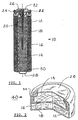
- Each cell includes a container or can 12, which may be nickel plated steel or any other convenient can of the sort generally used for the manufacture of primary or secondary cells.
- a container or can 12 which may be nickel plated steel or any other convenient can of the sort generally used for the manufacture of primary or secondary cells.
- anode 14 Within the can 12 there is an anode 14, a separator 16, and a cathode 18.
- the separator may be a single layer of a cellulosic, non-woven material or it may he a dual layer having a separate fibre reinforcement and an ion permeable layer.
- the nail or current collector 20 In the bobbin cell, there is extending downwardly into the anode 14 a nail or current collector 20, which pierces and extends through the cell closure 22, by which the cell is sealed as by crimping such as at 24.
- the nail or current collector is made of brass or bronze.
- Each cell has a negative cap 26 associated with and in the electrical conductivity with anode 14, either directly or, in the case of the bobbin cell 10, through the nail or current collector 20.
- the positive terminal is formed such as by a pip 28 formed in the can 12; an insulative washer or cup 30 is placed below the anode 14; and in the embodiment shown, the separator 16 extends down into the insulative cup 30, which protects the anode from coming into contact with the can 12.
- the separator 16 extends up to contact and interfere with the bottom surface of the closure member 22.
- a relief membrane 32 is shown moulded into the closure member 22, and it is intended to burst at a pre-determined pressure in the event of a significant build up of internal gas pressure within the cell.
- the coin or button cell 40 uses the can 12 as its positive terminal; and it is crimped over the grommet 34 so as to insulate the positive and negative terminals of the cell from each other.
- What the present invention provides, therefore, is a rechargeable electrochemical cell having a container 12, an anode 14, a separator 16, and a manganese dioxide cathode 18.
- a container 12 an anode 14, a separator 16, and a manganese dioxide cathode 18.
- an ion conductive electrolyte present within the cell, providing the ion transfer medium for current to flow between the cathode and the anode, and a closure member 22 or grommet 34 which is also a closure member.
- all of the internal components are sealed within the container.
- aqueous alkaline electrolyte As discussed, the usual embodiments of the present invention contemplate the use of aqueous alkaline electrolyte. However, non-aqueous, non-alkaline electrolytes may be used in some circumstances, but within the ambit of and otherwise in keeping with the teachings of the present invention -- for example, lithium cells.
- the cathode cf a nobbin cell is restricted from significantly changing its dimensions during discharge by interference at its outer periphery and its bottom with the internal surfaces of the container 12, at its inner periphery by interference with the separator 16, and at its top by interference with the underside of the closure member 22.
- the cathode of a coin or button cell is likewise restricted by the container 12 and separator 16.
- the anode may be zinc; but it may in certain circumstances be chosen from any one of the group consisting of zinc, hydrogen, iron, cadmium, and lead,
- bobbin cells according to the present invention are cylindrical, having the cathode in the form of an annulus or a series of rings or pellets, and a cylindrical anode axially placed within the cathode.
- Coin or button cells have both the cathode and anode in the form of a disc or wafer.
- the cathode may have certain additives admixed to its formulation.
- the alkaline electrolyte generally 6N KOH to 12N KOH.
- the cathode will contain a small amount of graphite -- usually in the amount of from about 5% to about 15% by weight of the cathode -- to increase the electrical conductivity characteristics thereof.
- the cathode may contain a small quantity of conductive carbon such as carbon black or other equivalent conductive carbon materials, generally in the range of from about 0.1% to about 10% or as much as 15% by weight of the cathode.
- conductive carbon such as carbon black or other equivalent conductive carbon materials
- the cathode mix for preparing the cathode will generally comprise manganese dioxide, together with from about 4% to about 8% by weight tnereof of the alkaline electrolyte -- usually 6N to 12 N KOH; and optionally from about 5% to about 15% by weight thereof of graphite; and optionally from about 0.1% to about 10.0% by weight thereof of conductive carbon; and optionally from about 0.1% to about 5.0% by weight thereof of conductive fibres which may be chosen from the group consisting of carbon fibres, graphite fibres, carbon fibres plated with nickel or silver, graphite fibres, plated with nickel or silver, or copper fibres plated with nickel or silver; and optionally from about 1.0% to about 5.0% by weight of the cathode of a metal-based additive which may be chosen from the group consisting of zinc, zinc oxide, and zinc stearate.
- the cathode used in a cell according to the present invention can be prepared by :
- step g of forming the cathode pellets or annular sleeves is carried out at pressures ranging from about 1,000 Newtons per square centimeter (N/cm 2 ) to about 20,000 (N/cm 2 ).
- the method of the present invention may optionally be followed by a further step of recompacting the cathode pellet(s), after it (they) has (have) been placed in the cell container.
- the recompaction is generally carried out at the same pressure or within the same pressure range noted above.
- One or several pellets may be used in a cathode for a bobbin cell; Figure 1 suggests that three pellets may be used in the cell that is illustrated.
- the anode composition was as follows: Zinc 60.0% [6% Hg amalgamated] ZnO 5.0% Gelling Agent 1.0% Anolyte 33.5% [9N KOH with 5% ZnO dissolved in it]
- the cathode had no fibre or other additives but was constructed in a manner so as to substantially fill all of the space allotted to it within the container, with substantially no void space above the cathode beneath the cell closure.
- the cathode formulation was as follows: MnO 2 81.5% Graphite 12.00% Electrolyte 6.50% [9N KOH]
- the cells were cycled at 420 mAh per day into 24 ohms, and were calculated to have a 45% depth of discharge of the cathode, and a 50% depth of discharge of the anode.
- the cells were cycled for 400 cycles, and there was an apparent imminent cathode failure when the tests were terminated.
- test cells Two sets of control cells were made, one having copper cages, the other having the same copper cages coated with graphite.
- the test cells were in keeping with the present invention, and had unconstrained cathodes -- i.e., no cages.
- the cells were subjected to 75 deep discharge cycles (or as noted), being discharged in each instance to 0.9V into 3.9 Ohms.
- the cage cells exhibited identical electrical performance, and the gassing performance of all cells was observed.
- the in-cell gassing was observed, and was noted to be the lowest in the test cells in keeping with this invention; with the cage cells having coated cages being higher, and the cage cells having uncoated cages showing the highest gassing activity.
Landscapes
- Chemical & Material Sciences (AREA)
- Chemical Kinetics & Catalysis (AREA)
- Electrochemistry (AREA)
- General Chemical & Material Sciences (AREA)
- Engineering & Computer Science (AREA)
- Manufacturing & Machinery (AREA)
- Inorganic Chemistry (AREA)
- Battery Electrode And Active Subsutance (AREA)
- Primary Cells (AREA)
- Secondary Cells (AREA)
Abstract
Claims (8)
- Pile électrochimique rechargeable ayant un récipient, des composants internes comprenant une anode, un séparateur perméable aux ions, au moins une pastille de cathode en dioxyde de manganèse, non contrainte, qui ne présente aucun tamis en fil métallique supplémentaire, ni cage, ni liant, pour empêcher spécifiquement, mécaniquement la cathode de croître en raison de la tendance des cathodes en dioxyde de manganèse à gonfler durant un cycle de décharge, un électrolyte conducteur d'ions, et un organe de fermeture, ledit organe de fermeture étant placé sur l'anode, le séparateur, la cathode et l'électrolyte, dans le récipient, de manière à isoler hermétiquement les composants internes dans le récipient et la ou les pastilles de cathode étant empêchées de changer significativement de dimension durant des cycles de charge et de décharge, par une interférence au niveau de sa ou de leur périphérie extérieure et de son ou de leur fond avec le récipient, et autrement par une interférence avec le séparateur et/ou avec l'organe de fermeture, et ayant été formés à une pression comprise dans la plage allant d'à peu près 1000 à à peu près 20000 N/cm2.
- Pile électrochimique rechargeable selon la revendication 1, dans laquelle l'anode est du zinc, de l'hydrogène, du fer, du cadmium ou du plomb.
- Pile électrochimique rechargeable selon la revendication 2, dans laquelle l'anode est du zinc et l'électrolyte est de l'hydroxyde de potassium, de manière que la pile soit une pile alcaline rechargeable.
- Pile électrochimique rechargeable selon l'une quelconque des revendications précédentes, dans laquelle la pastille de cathode contient en outre une faible quantité d'électrolyte à base d'hydroxyde de potassium, en une quantité comprise dans la plage allant d'à peu près 4 % à à peu près 8 % en poids de ce dernier, et contient en outre une faible quantité de graphite et, en option, une faible quantité de carbone conducteur, de manière à augmenter ses caractéristiques de conductivité électrique.
- Pile électrochimique rechargeable selon l'une quelconque des revendications précédentes, dans laquelle, après que la ou les pastilles de cathode aient été placées dans le récipient, elle ou elles ont été recompactées à une pression d'à peu près 1000 à 20000 N/cm2.
- Pile électrochimique rechargeable selon l'une quelconque des revendications précédentes, dans laquelle la pile est une pile de type à bobine cylindrique, la pastille d'anode et de cathode sont chacune de forme cylindrique, et l'anode est placée axialement dans la cathode, là où les pastilles de cathode sont empêchées de changer significativement de dimension durant des cycles de charge ou de décharge, par une interférence au niveau de sa ou de leur périphérie extérieure et de son ou de leur fond avec le récipient, ou niveau de sa ou de leur périphérie intérieure par une interférence avec le séparateur, et au niveau de leur sommet par une interférence avec l'organe de fermeture.
- Pile électrochimique rechargeable selon l'une quelconque des revendications 1 à 5, dans laquelle la pile est une pile bouton et la ou les pastilles d'anode et de cathode se présentent chacune sous la forme d'un disque, la ou les pastilles de cathode sont placées au fond du récipient, et ladite anode se situe au-dessus de la ou des pastilles de cathode, avec le séparateur entre elles, la ou les pastilles de cathode étant empêchées de changer significativement de dimension durant des cycles de charge et de décharge, par une interférence au niveau de sa ou de leur périphérie extérieure et de son ou de leur fond avec le récipient, et de son ou de leur sommet par une interférence avec le séparateur.
- Pile électrochimique rechargeable selon l'une quelconque des revendications précédentes, dans laquelle l'électrolyte alcalin est de l'hydroxyde de potassium ayant une normalité d'à peu près 6 à à peu près 12.
Applications Claiming Priority (4)
| Application Number | Priority Date | Filing Date | Title |
|---|---|---|---|
| CA10142 | 1990-02-15 | ||
| CA002010142A CA2010142C (fr) | 1990-02-15 | 1990-02-15 | Cathode en dioxyde de manganese pour une pile alcaline rechargeable et pile renfermant cette cathode |
| US07/497,908 US5108852A (en) | 1990-03-23 | 1990-03-23 | Manganese dioxide cathode for a rechargeable alkaline cell, and cell containing the same |
| PCT/CA1990/000379 WO1991012635A2 (fr) | 1990-02-15 | 1990-11-02 | Cathode en bioxyde de manganese pour piles rechargeables et piles contenant cette cathode |
Publications (2)
| Publication Number | Publication Date |
|---|---|
| EP0520990A1 EP0520990A1 (fr) | 1993-01-07 |
| EP0520990B1 true EP0520990B1 (fr) | 1997-01-29 |
Family
ID=25673954
Family Applications (1)
| Application Number | Title | Priority Date | Filing Date |
|---|---|---|---|
| EP90916008A Expired - Lifetime EP0520990B1 (fr) | 1990-02-15 | 1990-11-02 | Cathode en bioxyde de manganese pour piles rechargeables et piles contenant cette cathode |
Country Status (6)
| Country | Link |
|---|---|
| EP (1) | EP0520990B1 (fr) |
| AU (2) | AU640707B2 (fr) |
| DE (1) | DE520990T1 (fr) |
| ES (1) | ES2055676T3 (fr) |
| SG (1) | SG47732A1 (fr) |
| WO (1) | WO1991012635A2 (fr) |
Cited By (1)
| Publication number | Priority date | Publication date | Assignee | Title |
|---|---|---|---|---|
| WO2017062435A1 (fr) * | 2015-10-05 | 2017-04-13 | Research Foundation Of The City University Of New York | Batterie alcaline rechargeable comprenant un séparateur en hydroxyde de métal |
Families Citing this family (2)
| Publication number | Priority date | Publication date | Assignee | Title |
|---|---|---|---|---|
| US5300371A (en) * | 1990-03-23 | 1994-04-05 | Battery Technologies Inc. | Manganese dioxide positive electrode for rechargeable cells, and cells containing the same |
| DE19620735A1 (de) * | 1996-05-23 | 1997-11-27 | Varta Batterie | Verfahren zur Herstellung einer galvanischen Zelle |
Citations (1)
| Publication number | Priority date | Publication date | Assignee | Title |
|---|---|---|---|---|
| WO1990002423A1 (fr) * | 1988-08-31 | 1990-03-08 | Battery Technologies Inc. | Pile alcaline rechargeable au dioxyde de manganese-zinc presentant une capacite d'accumulation amelioree |
Family Cites Families (9)
| Publication number | Priority date | Publication date | Assignee | Title |
|---|---|---|---|---|
| BE571909A (fr) * | 1957-10-09 | |||
| US2977401A (en) * | 1957-10-09 | 1961-03-28 | Union Carbide Corp | Cathodes |
| US3192071A (en) * | 1960-12-27 | 1965-06-29 | Union Carbide Corp | Dry cell electrodes containing fibrous graphite and process of making same |
| US3530496A (en) * | 1967-06-26 | 1970-09-22 | Matsushita Electric Industrial Co Ltd | Rechargeable alkaline manganese cell |
| DE1771604C3 (de) * | 1968-06-14 | 1973-10-31 | Varta Batterie Ag, 3000 Hannover | Wiederaufladbares Braunstein/Zink Element mit alkalischem Elektrolyten, bei dem die Kapazität der Zinkelektrode weniger als 40% der tatsachlichen Kapa zitat der Braunsteinelektrode betragt |
| US4011103A (en) * | 1976-03-29 | 1977-03-08 | Union Carbide Corporation | Cathode contact member for alkaline round cells |
| US4091178A (en) * | 1977-09-01 | 1978-05-23 | Union Carbide Corporation | Rechargeable alkaline MnO2 -zinc cell |
| JPH0746608B2 (ja) * | 1986-10-30 | 1995-05-17 | 三洋電機株式会社 | 非水系二次電池 |
| CH669479A5 (en) * | 1986-12-09 | 1989-03-15 | Leclanche Sa | Chargeable manganese di:oxide-zinc battery - with hot melt adhesive sealing separate membrane |
-
1990
- 1990-11-02 WO PCT/CA1990/000379 patent/WO1991012635A2/fr not_active Ceased
- 1990-11-02 AU AU66325/90A patent/AU640707B2/en not_active Ceased
- 1990-11-02 SG SG1996004100A patent/SG47732A1/en unknown
- 1990-11-02 EP EP90916008A patent/EP0520990B1/fr not_active Expired - Lifetime
- 1990-11-02 DE DE0520990T patent/DE520990T1/de active Pending
- 1990-11-02 ES ES90916008T patent/ES2055676T3/es not_active Expired - Lifetime
-
1993
- 1993-08-17 AU AU44692/93A patent/AU656481B2/en not_active Ceased
Patent Citations (1)
| Publication number | Priority date | Publication date | Assignee | Title |
|---|---|---|---|---|
| WO1990002423A1 (fr) * | 1988-08-31 | 1990-03-08 | Battery Technologies Inc. | Pile alcaline rechargeable au dioxyde de manganese-zinc presentant une capacite d'accumulation amelioree |
Cited By (2)
| Publication number | Priority date | Publication date | Assignee | Title |
|---|---|---|---|---|
| WO2017062435A1 (fr) * | 2015-10-05 | 2017-04-13 | Research Foundation Of The City University Of New York | Batterie alcaline rechargeable comprenant un séparateur en hydroxyde de métal |
| US12482807B2 (en) | 2015-10-05 | 2025-11-25 | Research Foundation Of The City University Of New York | Rechargeable alkaline battery comprising metal hydroxide separator |
Also Published As
| Publication number | Publication date |
|---|---|
| DE520990T1 (de) | 1995-03-16 |
| WO1991012635A2 (fr) | 1991-08-22 |
| SG47732A1 (en) | 1998-04-17 |
| AU4469293A (en) | 1993-10-21 |
| AU640707B2 (en) | 1993-09-02 |
| WO1991012635A3 (fr) | 1992-04-16 |
| AU656481B2 (en) | 1995-02-02 |
| ES2055676T3 (es) | 1997-05-16 |
| AU6632590A (en) | 1991-09-03 |
| ES2055676T1 (es) | 1994-09-01 |
| EP0520990A1 (fr) | 1993-01-07 |
Similar Documents
| Publication | Publication Date | Title |
|---|---|---|
| US5346783A (en) | Manganese dioxide cathode for a rechargeable alkaline cell, and cell containing the same | |
| AU676276B2 (en) | Manganese dioxide positive electrode for rechargeable cells,and cells containing the same | |
| CA1099334A (fr) | Pile alcaline rechargeable, au zinc - mn0.sub.2 | |
| US3060254A (en) | Bonded electrodes | |
| US5011752A (en) | Rechargeable alkaline manganese dioxide-zinc cell having improved cumulative capacity | |
| EP0617845B1 (fr) | Cathodes destinees aux cellules dioxyde de manganese-zinc comportant des additifs a base de barium | |
| EP1958278B1 (fr) | Pile au manganèse alcaline rechargeable présentant une diminution de capacité réduite et une durée de vie cyclique améliorée | |
| EP0301647B1 (fr) | Cellule électrochimique | |
| US3671319A (en) | Battery electrode and battery embodying same | |
| EP0520990B1 (fr) | Cathode en bioxyde de manganese pour piles rechargeables et piles contenant cette cathode | |
| US3332802A (en) | Electric current producing cell | |
| CA2010142C (fr) | Cathode en dioxyde de manganese pour une pile alcaline rechargeable et pile renfermant cette cathode | |
| EP0800221B1 (fr) | Accumulateur alcalin et méthode de fabrication de plaque d'électrode positive de cet accumulateur | |
| US6596436B1 (en) | Nickel positive electrode plate for alkaline storage batteries and method for producing the same | |
| US3347707A (en) | Charged secondary cell | |
| CA1058698A (fr) | Pile au zinc-oxyde d'argent bivalent a niveau de decharge unipotentiel |
Legal Events
| Date | Code | Title | Description |
|---|---|---|---|
| PUAI | Public reference made under article 153(3) epc to a published international application that has entered the european phase |
Free format text: ORIGINAL CODE: 0009012 |
|
| 17P | Request for examination filed |
Effective date: 19920915 |
|
| AK | Designated contracting states |
Kind code of ref document: A1 Designated state(s): BE CH DE ES FR GB IT LI NL |
|
| ITCL | It: translation for ep claims filed |
Representative=s name: JACOBACCI CASETTA & PERANI S.P.A. |
|
| REG | Reference to a national code |
Ref country code: ES Ref legal event code: BA2A Ref document number: 2055676 Country of ref document: ES Kind code of ref document: T1 |
|
| TCNL | Nl: translation of patent claims filed | ||
| EL | Fr: translation of claims filed | ||
| 17Q | First examination report despatched |
Effective date: 19941228 |
|
| DET | De: translation of patent claims | ||
| GRAG | Despatch of communication of intention to grant |
Free format text: ORIGINAL CODE: EPIDOS AGRA |
|
| GRAH | Despatch of communication of intention to grant a patent |
Free format text: ORIGINAL CODE: EPIDOS IGRA |
|
| GRAH | Despatch of communication of intention to grant a patent |
Free format text: ORIGINAL CODE: EPIDOS IGRA |
|
| GRAH | Despatch of communication of intention to grant a patent |
Free format text: ORIGINAL CODE: EPIDOS IGRA |
|
| GRAA | (expected) grant |
Free format text: ORIGINAL CODE: 0009210 |
|
| AK | Designated contracting states |
Kind code of ref document: B1 Designated state(s): BE CH DE ES FR GB IT LI NL |
|
| ITF | It: translation for a ep patent filed | ||
| REG | Reference to a national code |
Ref country code: CH Ref legal event code: NV Representative=s name: TROESCH SCHEIDEGGER WERNER AG Ref country code: CH Ref legal event code: EP |
|
| REF | Corresponds to: |
Ref document number: 69029866 Country of ref document: DE Date of ref document: 19970313 |
|
| ET | Fr: translation filed | ||
| ET | Fr: translation filed |
Free format text: CORRECTIONS |
|
| REG | Reference to a national code |
Ref country code: ES Ref legal event code: FG2A Ref document number: 2055676 Country of ref document: ES Kind code of ref document: T3 |
|
| PLBE | No opposition filed within time limit |
Free format text: ORIGINAL CODE: 0009261 |
|
| STAA | Information on the status of an ep patent application or granted ep patent |
Free format text: STATUS: NO OPPOSITION FILED WITHIN TIME LIMIT |
|
| 26N | No opposition filed | ||
| PGFP | Annual fee paid to national office [announced via postgrant information from national office to epo] |
Ref country code: GB Payment date: 19981106 Year of fee payment: 9 |
|
| PGFP | Annual fee paid to national office [announced via postgrant information from national office to epo] |
Ref country code: FR Payment date: 19981110 Year of fee payment: 9 |
|
| PGFP | Annual fee paid to national office [announced via postgrant information from national office to epo] |
Ref country code: CH Payment date: 19981120 Year of fee payment: 9 |
|
| PGFP | Annual fee paid to national office [announced via postgrant information from national office to epo] |
Ref country code: NL Payment date: 19981126 Year of fee payment: 9 |
|
| PGFP | Annual fee paid to national office [announced via postgrant information from national office to epo] |
Ref country code: ES Payment date: 19981127 Year of fee payment: 9 |
|
| PGFP | Annual fee paid to national office [announced via postgrant information from national office to epo] |
Ref country code: BE Payment date: 19990119 Year of fee payment: 9 |
|
| PG25 | Lapsed in a contracting state [announced via postgrant information from national office to epo] |
Ref country code: GB Free format text: LAPSE BECAUSE OF NON-PAYMENT OF DUE FEES Effective date: 19991102 |
|
| PG25 | Lapsed in a contracting state [announced via postgrant information from national office to epo] |
Ref country code: ES Free format text: LAPSE BECAUSE OF NON-PAYMENT OF DUE FEES Effective date: 19991103 |
|
| PG25 | Lapsed in a contracting state [announced via postgrant information from national office to epo] |
Ref country code: LI Free format text: LAPSE BECAUSE OF NON-PAYMENT OF DUE FEES Effective date: 19991130 Ref country code: CH Free format text: LAPSE BECAUSE OF NON-PAYMENT OF DUE FEES Effective date: 19991130 Ref country code: BE Free format text: LAPSE BECAUSE OF NON-PAYMENT OF DUE FEES Effective date: 19991130 |
|
| BERE | Be: lapsed |
Owner name: BATTERY TECHNOLOGIES INC. Effective date: 19991130 |
|
| PG25 | Lapsed in a contracting state [announced via postgrant information from national office to epo] |
Ref country code: NL Free format text: LAPSE BECAUSE OF NON-PAYMENT OF DUE FEES Effective date: 20000601 |
|
| GBPC | Gb: european patent ceased through non-payment of renewal fee |
Effective date: 19991102 |
|
| REG | Reference to a national code |
Ref country code: CH Ref legal event code: PL |
|
| PG25 | Lapsed in a contracting state [announced via postgrant information from national office to epo] |
Ref country code: FR Free format text: LAPSE BECAUSE OF NON-PAYMENT OF DUE FEES Effective date: 20000731 |
|
| NLV4 | Nl: lapsed or anulled due to non-payment of the annual fee |
Effective date: 20000601 |
|
| REG | Reference to a national code |
Ref country code: FR Ref legal event code: ST |
|
| PGFP | Annual fee paid to national office [announced via postgrant information from national office to epo] |
Ref country code: DE Payment date: 20011119 Year of fee payment: 12 |
|
| PG25 | Lapsed in a contracting state [announced via postgrant information from national office to epo] |
Ref country code: DE Free format text: LAPSE BECAUSE OF NON-PAYMENT OF DUE FEES Effective date: 20030603 |
|
| REG | Reference to a national code |
Ref country code: ES Ref legal event code: FD2A Effective date: 20001214 |
|
| PG25 | Lapsed in a contracting state [announced via postgrant information from national office to epo] |
Ref country code: IT Free format text: LAPSE BECAUSE OF NON-PAYMENT OF DUE FEES;WARNING: LAPSES OF ITALIAN PATENTS WITH EFFECTIVE DATE BEFORE 2007 MAY HAVE OCCURRED AT ANY TIME BEFORE 2007. THE CORRECT EFFECTIVE DATE MAY BE DIFFERENT FROM THE ONE RECORDED. Effective date: 20051102 |