EP0522251A2 - Teilkristalliner Film auf der Basis von Polyester und dessen Verwendung für Klebematerialien - Google Patents
Teilkristalliner Film auf der Basis von Polyester und dessen Verwendung für Klebematerialien Download PDFInfo
- Publication number
- EP0522251A2 EP0522251A2 EP92107257A EP92107257A EP0522251A2 EP 0522251 A2 EP0522251 A2 EP 0522251A2 EP 92107257 A EP92107257 A EP 92107257A EP 92107257 A EP92107257 A EP 92107257A EP 0522251 A2 EP0522251 A2 EP 0522251A2
- Authority
- EP
- European Patent Office
- Prior art keywords
- adhesive
- carrier web
- film
- partially crystalline
- polyesters
- Prior art date
- Legal status (The legal status is an assumption and is not a legal conclusion. Google has not performed a legal analysis and makes no representation as to the accuracy of the status listed.)
- Withdrawn
Links
- 229920000728 polyester Polymers 0.000 title claims abstract description 31
- 239000000853 adhesive Substances 0.000 title abstract description 4
- 239000000463 material Substances 0.000 title abstract description 3
- 230000001070 adhesive effect Effects 0.000 title 1
- 125000002887 hydroxy group Chemical group [H]O* 0.000 claims abstract description 15
- 238000004132 cross linking Methods 0.000 claims abstract description 10
- NIXOWILDQLNWCW-UHFFFAOYSA-N acrylic acid group Chemical group C(C=C)(=O)O NIXOWILDQLNWCW-UHFFFAOYSA-N 0.000 claims abstract description 9
- 230000009477 glass transition Effects 0.000 claims abstract description 7
- 239000002390 adhesive tape Substances 0.000 claims abstract description 5
- 238000002844 melting Methods 0.000 claims abstract description 5
- 230000008018 melting Effects 0.000 claims abstract description 5
- 239000007787 solid Substances 0.000 claims abstract description 4
- 238000000034 method Methods 0.000 claims description 12
- 229920001634 Copolyester Polymers 0.000 claims description 11
- 239000012790 adhesive layer Substances 0.000 claims description 6
- 238000004519 manufacturing process Methods 0.000 claims description 5
- 239000010410 layer Substances 0.000 claims description 4
- 230000004927 fusion Effects 0.000 claims description 3
- 125000005395 methacrylic acid group Chemical group 0.000 claims description 3
- 230000005855 radiation Effects 0.000 claims description 3
- 239000004820 Pressure-sensitive adhesive Substances 0.000 claims description 2
- 150000001252 acrylic acid derivatives Chemical class 0.000 claims 2
- 239000000203 mixture Substances 0.000 claims 1
- 238000003892 spreading Methods 0.000 claims 1
- 239000002313 adhesive film Substances 0.000 abstract description 4
- ZWEHNKRNPOVVGH-UHFFFAOYSA-N 2-Butanone Chemical compound CCC(C)=O ZWEHNKRNPOVVGH-UHFFFAOYSA-N 0.000 description 9
- 238000006243 chemical reaction Methods 0.000 description 7
- -1 polyethylene Polymers 0.000 description 6
- 150000002009 diols Chemical class 0.000 description 5
- OMIGHNLMNHATMP-UHFFFAOYSA-N 2-hydroxyethyl prop-2-enoate Chemical compound OCCOC(=O)C=C OMIGHNLMNHATMP-UHFFFAOYSA-N 0.000 description 4
- NIXOWILDQLNWCW-UHFFFAOYSA-M acrylate group Chemical group C(C=C)(=O)[O-] NIXOWILDQLNWCW-UHFFFAOYSA-M 0.000 description 4
- 229920000642 polymer Polymers 0.000 description 4
- 238000006116 polymerization reaction Methods 0.000 description 4
- 238000012545 processing Methods 0.000 description 4
- OFOBLEOULBTSOW-UHFFFAOYSA-N Malonic acid Chemical compound OC(=O)CC(O)=O OFOBLEOULBTSOW-UHFFFAOYSA-N 0.000 description 3
- 125000001931 aliphatic group Chemical group 0.000 description 3
- 238000000576 coating method Methods 0.000 description 3
- 238000000113 differential scanning calorimetry Methods 0.000 description 3
- 239000002904 solvent Substances 0.000 description 3
- 229920001169 thermoplastic Polymers 0.000 description 3
- 239000012876 carrier material Substances 0.000 description 2
- 239000011248 coating agent Substances 0.000 description 2
- 239000000470 constituent Substances 0.000 description 2
- 150000001991 dicarboxylic acids Chemical class 0.000 description 2
- 125000002768 hydroxyalkyl group Chemical group 0.000 description 2
- NIMLQBUJDJZYEJ-UHFFFAOYSA-N isophorone diisocyanate Chemical compound CC1(C)CC(N=C=O)CC(C)(CN=C=O)C1 NIMLQBUJDJZYEJ-UHFFFAOYSA-N 0.000 description 2
- 229920000139 polyethylene terephthalate Polymers 0.000 description 2
- 239000005020 polyethylene terephthalate Substances 0.000 description 2
- 239000000758 substrate Substances 0.000 description 2
- 239000004416 thermosoftening plastic Substances 0.000 description 2
- 239000005058 Isophorone diisocyanate Substances 0.000 description 1
- 239000004698 Polyethylene Substances 0.000 description 1
- 239000004743 Polypropylene Substances 0.000 description 1
- 239000004793 Polystyrene Substances 0.000 description 1
- 239000000654 additive Substances 0.000 description 1
- 229920006125 amorphous polymer Polymers 0.000 description 1
- 238000004873 anchoring Methods 0.000 description 1
- 125000003118 aryl group Chemical group 0.000 description 1
- 230000001588 bifunctional effect Effects 0.000 description 1
- 125000003178 carboxy group Chemical group [H]OC(*)=O 0.000 description 1
- 239000003054 catalyst Substances 0.000 description 1
- 150000001875 compounds Chemical class 0.000 description 1
- 229920006037 cross link polymer Polymers 0.000 description 1
- 230000007423 decrease Effects 0.000 description 1
- 238000013461 design Methods 0.000 description 1
- 125000005442 diisocyanate group Chemical group 0.000 description 1
- 238000010894 electron beam technology Methods 0.000 description 1
- RTZKZFJDLAIYFH-UHFFFAOYSA-N ether Substances CCOCC RTZKZFJDLAIYFH-UHFFFAOYSA-N 0.000 description 1
- 125000000524 functional group Chemical group 0.000 description 1
- 239000003292 glue Substances 0.000 description 1
- 239000008187 granular material Substances 0.000 description 1
- 238000011065 in-situ storage Methods 0.000 description 1
- 239000007788 liquid Substances 0.000 description 1
- 238000005259 measurement Methods 0.000 description 1
- 238000012986 modification Methods 0.000 description 1
- 230000004048 modification Effects 0.000 description 1
- 239000000049 pigment Substances 0.000 description 1
- 238000006068 polycondensation reaction Methods 0.000 description 1
- 229920000573 polyethylene Polymers 0.000 description 1
- 229920001721 polyimide Polymers 0.000 description 1
- 230000000379 polymerizing effect Effects 0.000 description 1
- 229920001155 polypropylene Polymers 0.000 description 1
- 229920001296 polysiloxane Polymers 0.000 description 1
- 229920002223 polystyrene Polymers 0.000 description 1
- 239000004814 polyurethane Substances 0.000 description 1
- 229920002635 polyurethane Polymers 0.000 description 1
- 229920000915 polyvinyl chloride Polymers 0.000 description 1
- 239000004800 polyvinyl chloride Substances 0.000 description 1
- 238000002360 preparation method Methods 0.000 description 1
- 230000035484 reaction time Effects 0.000 description 1
- 229920013730 reactive polymer Polymers 0.000 description 1
- 238000007670 refining Methods 0.000 description 1
- 230000000717 retained effect Effects 0.000 description 1
- 229920006395 saturated elastomer Polymers 0.000 description 1
- 239000003381 stabilizer Substances 0.000 description 1
- 239000000126 substance Substances 0.000 description 1
- 238000012360 testing method Methods 0.000 description 1
- 238000009736 wetting Methods 0.000 description 1
Classifications
-
- C—CHEMISTRY; METALLURGY
- C08—ORGANIC MACROMOLECULAR COMPOUNDS; THEIR PREPARATION OR CHEMICAL WORKING-UP; COMPOSITIONS BASED THEREON
- C08J—WORKING-UP; GENERAL PROCESSES OF COMPOUNDING; AFTER-TREATMENT NOT COVERED BY SUBCLASSES C08B, C08C, C08F, C08G or C08H
- C08J5/00—Manufacture of articles or shaped materials containing macromolecular substances
- C08J5/18—Manufacture of films or sheets
-
- C—CHEMISTRY; METALLURGY
- C08—ORGANIC MACROMOLECULAR COMPOUNDS; THEIR PREPARATION OR CHEMICAL WORKING-UP; COMPOSITIONS BASED THEREON
- C08L—COMPOSITIONS OF MACROMOLECULAR COMPOUNDS
- C08L67/00—Compositions of polyesters obtained by reactions forming a carboxylic ester link in the main chain; Compositions of derivatives of such polymers
- C08L67/06—Unsaturated polyesters
- C08L67/07—Unsaturated polyesters having terminal carbon-to-carbon unsaturated bonds
-
- C—CHEMISTRY; METALLURGY
- C09—DYES; PAINTS; POLISHES; NATURAL RESINS; ADHESIVES; COMPOSITIONS NOT OTHERWISE PROVIDED FOR; APPLICATIONS OF MATERIALS NOT OTHERWISE PROVIDED FOR
- C09J—ADHESIVES; NON-MECHANICAL ASPECTS OF ADHESIVE PROCESSES IN GENERAL; ADHESIVE PROCESSES NOT PROVIDED FOR ELSEWHERE; USE OF MATERIALS AS ADHESIVES
- C09J7/00—Adhesives in the form of films or foils
- C09J7/20—Adhesives in the form of films or foils characterised by their carriers
- C09J7/22—Plastics; Metallised plastics
- C09J7/25—Plastics; Metallised plastics based on macromolecular compounds obtained otherwise than by reactions involving only carbon-to-carbon unsaturated bonds
- C09J7/255—Polyesters
-
- C—CHEMISTRY; METALLURGY
- C08—ORGANIC MACROMOLECULAR COMPOUNDS; THEIR PREPARATION OR CHEMICAL WORKING-UP; COMPOSITIONS BASED THEREON
- C08J—WORKING-UP; GENERAL PROCESSES OF COMPOUNDING; AFTER-TREATMENT NOT COVERED BY SUBCLASSES C08B, C08C, C08F, C08G or C08H
- C08J2367/00—Characterised by the use of polyesters obtained by reactions forming a carboxylic ester link in the main chain; Derivatives of such polymers
- C08J2367/06—Unsaturated polyesters
- C08J2367/07—Unsaturated polyesters having terminal carbon-to-carbon unsaturated bonds
Definitions
- thermoplastic polymers are usually used as carrier materials for self-adhesive film labels, adhesive tapes and adhesive films.
- examples of such polymers are polyethylene, polypropylene, polyvinyl chloride, polystyrene, polyurethanes, polyethylene terephthalate and the like. Because of their thermoplastic behavior, these films generally do not have good temperature resistance. Polyimide films and possibly still polyethylene terephthalate films can be regarded as exceptions, which, however, lack the elasticity required for many applications. In addition, such films are often difficult to process, i.e. difficult to print, coat or glue. A general disadvantage of prefabricated films is the insufficient freedom for the manufacturer to apply self-adhesive articles in the individual design of his products.
- crosslinked film webs described in DE-OS 39 31 890 based on branched and amorphous copolyesters containing acrylic groups lead to transparent, flexible and temperature-resistant films, but are limited in their elasticity and stretchability due to their branching and high glass transition temperature and are not due to their amorphous character sufficient in the important resistance to strong solvents.
- polyesters or copolyesters which are solid at room temperature and have glass transition temperatures of below -20 ° C. and heat of fusion of over 20 J / g, preferably over 40 J / g, of which the hydroxyl groups originally present have been converted to 50% to 90% to (meth) acrylic groups.
- the polyesters or copolyesters are very preferably saturated, but in the limit case they can contain up to 10% by weight of unsaturated constituents.
- the copolyesters are linear, ie they have predominantly unbranched chains due to the exclusive structure of bifunctional polyester constituents, ie diols and dicarboxylic acids.
- Linear copolyesters have a minimum of terminal OH groups, based on the respective molecular weight.
- Trifunctional polyester building blocks are possible up to 3 mol%.
- the hydroxyl number is 10 to 100, preferably 20 to 50. Since these OH groups are only replaced by acrylic groups or methacrylic groups to 50 to 90%, preferably 60 to 80%, the number of (meth) acrylic groups is limited. On the other hand, some of the OH groups are retained.
- the glass transition temperatures Tg of the polyester must be below -20 ° C, preferably between -40 ° C and -90 ° C.
- Semi-crystalline polyesters or copolyesters with a low Tg are preferably made from only one or more than 50 mol% of an aliphatic dicarboxylic acid, possibly only one or a portion of an aromatic dicarboxylic acid and preferably only one alkanediol, ie with a simple structure which is as uniform as possible Polyester chain.
- the polyesters are very preferably composed of only a single aliphatic dicarboxylic acid, ie one with C3 to C12, and only one diol, ie one with C2 to C10. Ether diols can also be used.
- the melting points of the partially crystalline polyesters are above 40 ° C., preferably above 60 ° C. in the range from 40 to 120, preferably from 60 to 110 ° C.
- the conversion of the hydroxyl groups to (meth) acrylate groups takes place according to known ones Processes, for example in the ways described in EP-OS 02 07 257.
- the polyester is reacted with a limited amount of acrylate or the adduct mentioned below, calculated from the OH number of the polyester and the intended degree of acrylation A, with a necessary small excess.
- the hydroxy copolyesters are preferably acrylated with an aliphatic or optionally aromatic diisocyanate and a hydroxyalkyl (meth) acrylate, aliphatic diisocyanates and hydroxyalkyl (meth) acrylate, particularly hydroxyethyl acrylate, being preferred. Both substances are first reacted with one another to form an adduct in a molar ratio of diisocyanate to hydroxyalkyl acrylate of 1: 0.6 to 1: 1.3. The reaction with the copolyester then takes place. The substoichiometric conversion leads to hydroxyl groups remaining on the polyester and to acrylic groups or methacrylic groups to the extent of the degree of acrylation mentioned. This contributes to a high surface tension of the cross-linked film of over 40 mN / m and leads to films that can be easily printed, glued and coated.
- the unreacted hydroxyl groups can be used for further reactions.
- a conversion into non-functional or other functional groups is possible, carboxyl groups being preferred, for example.
- polyesters Because of their partially crystalline character, these polyesters are solid at room temperature compared to those described in DE-OS 39 31 890 and can therefore be processed as granules, which considerably simplifies processing.
- polyesters Even when they have a high elongation at break and a low glass transition temperature, these polyesters have the stiffness necessary for application after crosslinking, which is not possible with amorphous polyesters.
- polyesters described here are linear, their melt viscosity falls above the melting point more than that of branched polyesters, which in turn can lead to a lower processing temperature and better coating quality.
- the viscosities of these polyesters are between 1 and 50 Pa.s, usually below 20 Pa.s., at the usual processing temperature of 100 ° C.
- Modification of the (meth) acrylic group-containing polyesters by adding additives such as stabilizers, catalysts, pigments, etc. is possible.
- the macromers described in EP-OS 0 201 257 are recommended for coating with pressure-sensitive adhesives.
- the partially crystalline films described here can preferably be used for the production of adhesive tapes, film labels, adhesive films or other self-adhesive articles.
- In-situ polymerization of the acrylated polyesters into films on a substrate, which leads to permanent anchoring on the substrate, can also be carried out.
- polyesters are prepared according to the processes described in the literature from the diols and dicarboxylic acids listed in Table 1 by polycondensation with excess diol, the excess diol being removed during the reaction. Such processes are described e.g. in EP-OS 0 201 257 or DE-OS 39 31 890.
- IPDI isophorone diisocyanate
- HEA 2-hydroxyethyl acrylate
- the polyester (PES 1 PES A to 6A) are melted and applied at 100 o C by means of a slit die onto a silicone paper web, wherein the layer thickness of 50 .mu.m corresponds. It is cross-linked by means of electron radiation with a dose of 60 KGray. Table 3 shows the properties of these semi-crystalline films, which emphasize their value as a high-quality carrier web for films, labels and adhesive tapes.
- the measurement of the glass transition temperature Tg and the crystallite melting point T m is determined by means of DSC (Differential Scanning Calorimetry).
- the pour point Fp of the acrylated polyester is measured by the ring and ball method (Iso 4625).
- the heats of fusion ⁇ H m are determined from the DSC analysis.
- the MEK test characterizes the solvent resistance and is carried out by double strokes (DH) of a bale of material moistened with methyl ethyl ketone (MEK). Good values are over 30, very good values over 50 double strokes.
- the surface tension (measured by wetting with liquids of known surface tension) should be at least 40 mN / m if good printability is to be achieved.
Landscapes
- Chemical & Material Sciences (AREA)
- Organic Chemistry (AREA)
- Chemical Kinetics & Catalysis (AREA)
- Manufacturing & Machinery (AREA)
- Engineering & Computer Science (AREA)
- Health & Medical Sciences (AREA)
- Medicinal Chemistry (AREA)
- Polymers & Plastics (AREA)
- Materials Engineering (AREA)
- Adhesives Or Adhesive Processes (AREA)
- Laminated Bodies (AREA)
- Polyesters Or Polycarbonates (AREA)
- Adhesive Tapes (AREA)
Abstract
Description
- Als Trägermaterialien für selbstklebende Filmetiketten, Klebebänder und Klebefolien werden üblicherweise Filme aus hochmolekularen, thermoplastischen Polymeren eingesetzt. Beispiele für solche Polymere sind Polyethylen, Polypropylen, Polyvinylchlorid, Polystyrol, Polyurethane, Polyethylenterephthalat u.ä. Aufgrund ihres thermoplastischen Verhaltens besitzen diese Filme allgemein keine gute Temperaturbeständigkeit. Als Ausnahmen können hierbei Polyimidfilme und eventuell noch Polyethylenterephthalatfilme angesehen werden, welche jedoch die für viele Anwendungen geforderte Elastizität vermissen lassen. Zudem sind solche Filme häufig schwer zu verarbeiten, d.h. schlecht zu bedrucken, zu beschichten oder zu verkleben. Von generellem Nachteil bei vorgefertigten Filmen ist der ungenügende Freiraum für den Hersteller sebstklebender Artikel bei der individuellen Gestaltung seiner Produkte.
- In den letzten Jahren sind die Anforderungen an die Temperaturbeständigkeit von Trägermaterialien für Kleberschichten, aber auch von Filmen für andere Verwendungen, stetig gestiegen, so daß viele der thermoplastischen Filme den Ansprüchen nicht mehr genügen. Als Alternative zu solchen Filmen bietet sich daher die Vernetzung von reaktiven Polymeren an. Wesentlich einfacher als dies an vorgefertigten Filmen durchzuführen, ist die Methode, niedermolekulare Polymere auf eine Trägerbahn aufzubringen und anschließend entweder vor oder nach weiteren Veredlungsschritten zu hochmolekularen Filmen zu polymerisieren. Aufgrund ihrer kurzen Reaktionszeit bietet sich hierfür die Polymerisation(meth)acrylgruppenhaltiger Polymeren durch aktinische Bestrahlung an. Zur Initiierung der Polymerisation bzw. Vernetzung kann dabei die Bestrahlung mit kurzwelligem Licht (UV) oder der Beschuß mit schnellen Elektronen (EB) herangezogen werden.
- An Versuchen, solche Filme aus polymerisationsfähigen Verbindungen herzustellen, hat es daher in der Vergangenheit nicht gefehlt. So führen z.B. die in den US-Patenten 4,008,115 und 4,022,926 beschriebenen Wege zwar zu hochvernetzten Polymeren mit guter Temperaturbeständigkeit. Diese sind jedoch aufgrund ihres hohen Vernetzungsgrades zu spröde, führen während der Polymerisation zu starker Schrumpfung und sind überdies schlecht zu beschichten und zu bedrucken.
- Die in der DE-OS 39 31 890 beschriebenen vernetzten Folienbahnen auf Basis von verzweigten und amorphen, acrylgruppenhaltigen Copolyestern führen zu transparenten, flexiblen und temperaturbeständigen Filmen, sind jedoch aufgrund ihrer Verzweigung und hohen Glasübergangstemperatur in ihrer Elastizität und Dehnbarkeit beschränkt und aufgrund ihres amorphen Charakters nicht ausreichend in der wichtigen Beständigkeit gegenüber starken Lösungsmitteln.
- Nachteilig wirkt sich zudem aus, daß bei zunehmender Elastizität amorpher Filme deren Steifigkeit abnimmt, was zu Problemen bei der Applikation von Etiketten führt. Der vor der Vernetzung amorpher Polymere bei Raumtemperatur vorhandene kalte Fluß erschwert zudem die Verarbeitung.
- Es bestand daher die Aufgabe, polymerisationsfähige Polymere herzustellen, die leichter zu verarbeiten sind und nach erfolgter Vernetzung flexible Filme bilden, die gleichzeitig eine Bruchdehnung von mindestens 100% bei guter Steifheit und hoher Reißfestigkeit und bessere Lösungsmittelbeständigkeit aufweisen.
- Gelöst wurde diese Aufgabe gemäß der Erfindung durch Verwendung von teilkristallinen, bei Raumtemperatur festen, im wesentlichen linearen Polyestern bzw. Copolyestern mit Glasübergangstemperaturen von unter -20°C und Schmelzwärmen von über 20 J/g, bevorzugt über 40 J/g, deren ursprünglich vorhandene Hydroxylgruppen zu 50% bis 90% zu (Meth)acrylgruppen umgesetzt worden sind. Die Polyester bzw. Copolyester sind sehr bevorzugt gesättigt, können im Grenzfall aber bis zu 10 Gew.-% ungesättigte Bestandteile enthalten.
- Die Copolyester sind linear, d.h. sie besitzen überwiegend unverzweigte Ketten durch ausschließlichen Aufbau aus bifunktionellen Polyesterbestandteilen, d.h. Diolen und Dicarbonsäuren. Lineare Copolyester haben, bezogen auf die jeweilige Molmasse, ein Minimum von endständigen OH-Gruppen. Trifunktionelle Polyesterbausteine sind bis zu 3 Mol-% möglich. Die Hydroxylzahl beträgt 10 bis 100, vorzugsweise 20 bis 50. Da diese OH-Gruppen durch Acrylgruppen bzw. Methacrylgruppen nur zu 50 bis 90%, vorzugsweise zu 60 bis 80% ersetzt wird, ist die Zahl der (Meth)acrylgruppen limitiert. Zum anderen bleibt ein Teil der OH-Gruppen erhalten. Wir haben festgestellt, daß die Glasübergangstemperaturen Tg der Polyester unter -20°C, vorzugsweise zwischen -40°C und -90°C liegen müssen.
Teilkristalline Polyester bzw. Copolyester mit niedrigem Tg werden vorzugsweise aus nur einer bzw. mehr als 50 Mol-% einer aliphatischen Dicarbonsäure, ggf. nur einer oder einem Anteil einer aromatischen Dicarbonsäure sowie bevorzugt nur einem Alkandiol, d.h. mit einem einfachen, möglichst gleichmäßigen Aufbau der Polyesterkette, hergestellt. Sehr bevorzugt sind die Polyester aus nur einer einzigen aliphatischen Dicarbonsäure, d.h. einer mit C₃ bis C₁₂, und nur einem einzigen Diol, d.h. einem mit C₂ bis C₁₀ aufgebaut. Ätherdiole können mitverwendet werden. - Die Schmelzpunkte der teilkristallinen Polyester liegen über 40°C, bevorzugt über 60°C im Bereich 40 bis 120, vorzugsweise 60 bis 110°C. Die Umsetzung der Hydroxylgruppen zu (Meth-)acrylatgruppen erfolgt nach bekannten Verfahren, z.B. auf den in EP-OS 02 07 257 beschriebenen Wegen. Dabei erfolgt die Umsetzung der Polyester mit einer aus der OH-Zahl der Polyester und dem beabsichtigten Acrylierungsgrad A berechneten limitierten Menge Acrylat bzw. dem unten genannten Addukt mit einem notwendigen kleinen Überschuß. Bevorzugt erfolgt die Acrylierung der Hydroxy-Copolyester mit einem aliphatischen oder ggf. aromatischen Diisocyanat und einem Hydroxyalkyl(meth)acrylat, wobei aliphatische Diisocyanate und Hydroxyalkyl(meth)acrylat, besonders Hydroxyethylacrylat bevorzugt sind. Beide Stoffe werden zunächst zu einem Addukt im Molverhältnis Diisocyanat zu Hydroxyalkylacrylat von 1:0,6 bis 1:1,3 miteinander umgesetzt. Danach erfolgt die Umsetzung mit dem Copolyester. Die unterstöchiometrische Umsetzung führt zu am Polyester verbleibenden Hydroxylgruppen und zu Acrylgruppen bzw. Methacrylgruppen im Maße des genannten Acrylierungsgrades. Das trägt zu einer hohen Oberflächenspannung des vernetzten Films von über 40 mN/m bei und führt zu gut bedruckbaren, verklebbaren und beschichtbaren Filmen.
- Die nicht umgesetzten Hydroxylgruppen können zu weiteren Umsetzungen herangezogen werden. Eine Überführung in nichtfunktionelle oder andere funktionelle Gruppen ist möglich, wobei beispielsweise Carboxylgruppen bevorzugt werden.
- Aufgrund ihres teilkristallinen Charakters sind diese Polyester gegenüber den in DE-OS 39 31 890 beschriebenen bei Raumtemperatur fest and daher als Granulat verarbeitbar, was eine wesentliche Vereinfachung bei der Verarbeitung bringt.
- Auch bei hoher Bruchdehnung und tiefer Glasübergangstemperatur besitzen diese Polyester nach ihrer Vernetzung die für die Applikation notwendige Steifigkeit, was mit amorphen Polyestern nicht möglich ist.
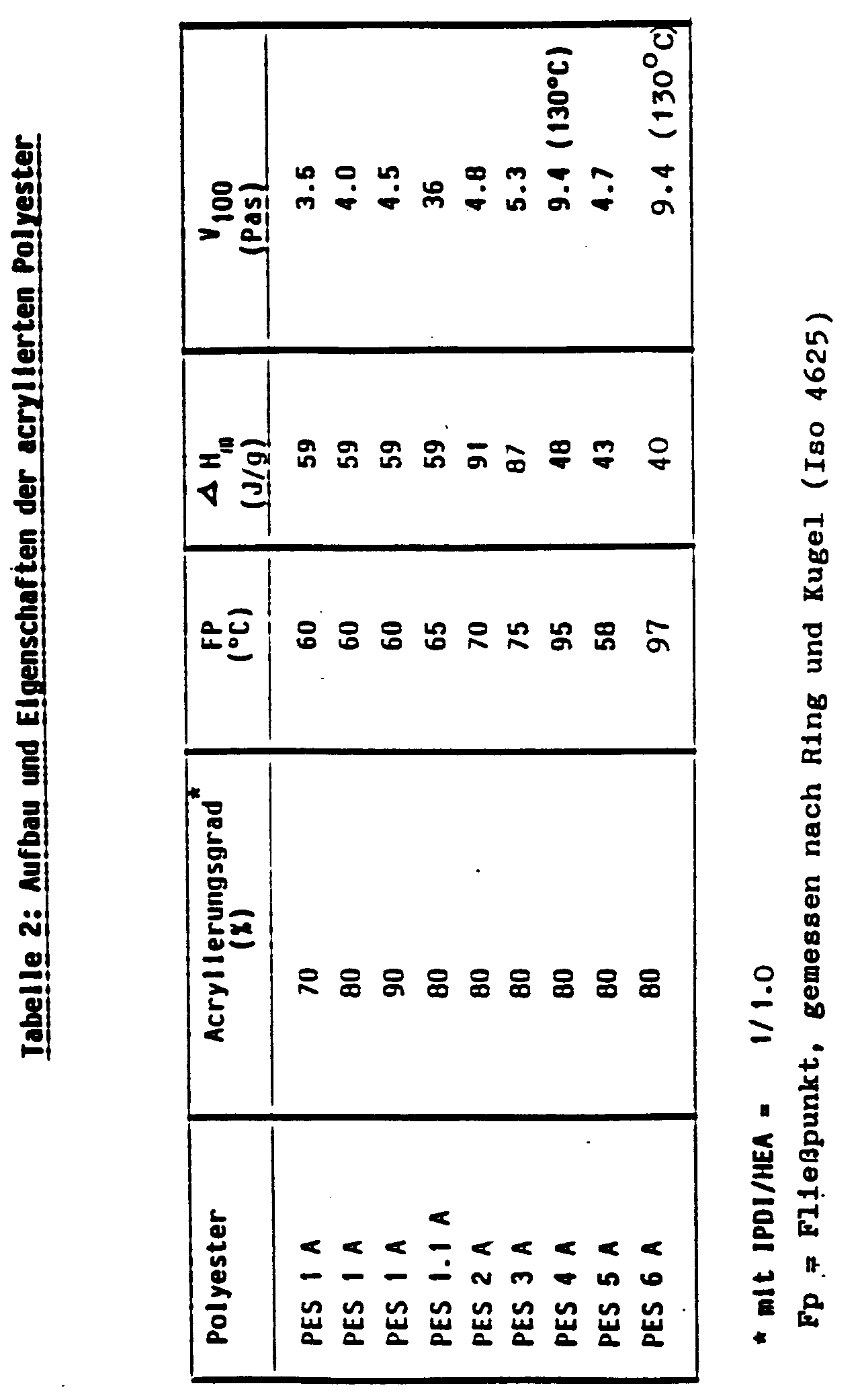
- Da es sich bei den hier beschriebenen Polyestern um lineare handelt, fällt deren Schmelzviskosität oberhalb des Schmelzpunktes stärker als bei verzweigten Polyestern, was wiederum zu einer tieferen Verarbeitungstemperatur und besserer Beschichtungsqualität führen kann. Die Viskositäten dieser Polyester liegen bei der üblichen Verarbeitungstemperatur von 100°C zwischen 1 und 50 Pa.s, üblicherweise unter 20 Pa.s.
- Eine Modifizierung der (meth)acrylgruppenhaltigen Polyester durch Zusatz von Additiven wie Stabilisatoren, Katalysatoren, Pigmenten, u.a. ist möglich. Die Herstellung des teilkristallinen Films erfolgt bei Temperaturen von 60-150oC, bevorzugt zwischen 80oC und 120oC mit Hilfe von üblichen Auftragsverfahren, z.B. durch Walzenauftrag oder aus einer Schlitzdüse, auf eine Trägerbahn, die nach erfolgter Vernetzung mittels Elektronenbestrahlung oder UV-Licht wieder entfernt werden kann. Ein Aufbringen weiterer inerter oder polymerisationsfähiger Beschichtungen kann vor oder nach der Bestrahlung erfolgen. Zur Beschichtung mit Haftklebstoffen werden die in EP-OS 0 201 257 beschriebenen Makromere empfohlen.
- Verwendet werden können die hier beschriebenen teilkristallinen Filme vorzugsweise zur Herstellung von Klebebändern, Filmetiketten, Klebefolien oder sonstiger selbstklebender Artikel. Eine in-situ Polymerisation der acrylierten Polyester zu Filmen auf einem Substrat, die zu einer permanenten Verankerung auf dem Substrat führt, ist ebenfalls ausführbar.
- Die Polyester werden entsprechend der in der Literatur beschriebenen Verfahren aus den in Tabelle 1 aufgeführten Diolen und Dicarbonsäuren durch Polykondensation unter Diolüberschuß hergestellt, wobei der Diolüberschuß während der Reaktion entfernt wird. Beschrieben sind solche Verfahren z.B. in EP-OS 0 201 257 oder DE-OS 39 31 890.
- Acrylierung der Hydroxylpolyester PES 1 A bis PES 6A: Die Hydroxylpolyester PES 1 bis PES 6 werden entsprechend den in DE-OS 39 31 890 beschriebenen Verfahren mit Addukten aus Isophorondiisocyanat (IPDI) und 2-Hydroxyethylacrylat (HEA) (IPDI/HEA = 1/1,0) vermischt und bei Temperaturen von 100-120oC umgesetzt. Bei Vernetzung mittels UV-Licht werden nach erfolgter Umsetzung 1-2 Gew.-% Photoinitiator zugesetzt.
Der Acrylierungsgrad der dann als PES A bezeichneten umgesetzten Polyester ist in Tabelle 2 aufgeführt. - Die Polyester (PES 1 A bis PES 6A) werden aufgeschmolzen und bei 100oC mittels einer Schlitzdüse auf eine Siliconpapierbahn aufgebracht, wobei die Schichtdicke 50µm entspricht. Vernetzt wird mittels Elektronenbestrahlung mit einer Dosis von 60 KGray.
Tabelle 3 zeigt die Eigenschaften dieser teilkristallinen Filme, die deren Wert als hochwertige Trägerbahn für Folien, Etiketten und Klebebänder herausstellen. - Die Messung der Glasübergangstemperatur Tg und der Kristallitschmelzpunkt Tm wird mittels DSC (Differential Scanning Calorimetry) bestimmt.
- Die Messung des Fließpunktes Fp der acrylierten Polyester erfolgt durch die Ring- und Kugel-Methode (Iso 4625). Die Schmelzwärmen Δ Hm werden aus der DSC-Analyse ermittelt.
- Der MEK-Test kennzeichnet die Lösungsmittelbeständigkeit und wird durch Doppelhübe (DH) eines Stoffballens, der mit Methylethylketon (MEK) befeuchtet ist, ausgeführt. Gute Werte liegen über 30, sehr gute Werte über 50 Doppelhüben.
- Die Oberflächenspannung (gemessen durch Benetzung mit Flüssigkeiten von bekannter Oberflächenspannung) soll wenigsten 40 mN/m betragen, wenn eine gute Bedruckbarkeit erzielt werden soll.


Claims (8)
- Teilkristalliner Film, hergestellt durch Strahlenvernetzung von bei Raumtemperatur festen, teilkristallinen Copolyestern mit Glasübergangstemperaturen unter -20°C, Molmassen von 1.000 bis 10.000 und Schmelzwärmen von über 20 J/g, deren ursprünglich vorhandenen Hydroxylgruppen zu 50% bis 90% in Acrylgruppen bzw. Methacrylgruppen überführt worden sind.
- Film nach Anspruch 1, dadurch gekennzeichnet, daß die Schmelzpunkte der Polyester über 40°C, bevorzugt über 60°C im Bereich von 40 bis 120°C, liegen.
- Film nach Anspruch 1 oder 2, dadurch gekennzeichnet, daß in den Polyestern die Menge der Hydroxylgruppen den Hydroxylzahlen 10 bis 100, vorzugsweise 20 bis 50, entspricht.
- Film nach einem der vorangehenden Ansprüche für die Verwendung als Trägerbahn für einseitige oder beidseitige Kleberschichten.
- Film nach Anspruch 4 als Trägerbahn für Schichten aus einem Haftklebstoff für die Herstellung von Etiketten.
- Verwendung der Folienbahn nach einem oder mehreren der Ansprüche 1 bis 5 als Trägerbahn für einseitige oder beidseitig Kleberschichten von Klebebändern.
- Verfahren zur Herstellung einer Folienbahn als Trägerbahn mit Klebstoffschicht gemäß mindestens einem der vorangehenden Ansprüche durch flächiges Ausbringen der mit (Meth)acrylatverbindungen umgesetzten Copolyester oder deren Mischungen bei erhöhter Temperatur mit derselben Technik wie das Aufbringen von Klebstoffschichten.
- Verfahren zur Herstellung einer Trägerbahn, dadurch gekennzeichnet, daß das flächige Ausbringen der mit (Meth)acrylatverbindungen umgesetzten Copolyester zur Trägerschicht und anschließend das Aufbringen einer Kleberschicht auf die verfestigte Trägerbahn und darauf das gemeinsame Härten beider Schichten durch Bestrahlung erfolgt.
Applications Claiming Priority (2)
| Application Number | Priority Date | Filing Date | Title |
|---|---|---|---|
| DE4121702A DE4121702A1 (de) | 1991-07-01 | 1991-07-01 | Teilkristalliner film und dessen verwendung |
| DE4121702 | 1991-07-01 |
Publications (2)
| Publication Number | Publication Date |
|---|---|
| EP0522251A2 true EP0522251A2 (de) | 1993-01-13 |
| EP0522251A3 EP0522251A3 (en) | 1993-03-10 |
Family
ID=6435145
Family Applications (1)
| Application Number | Title | Priority Date | Filing Date |
|---|---|---|---|
| EP19920107257 Withdrawn EP0522251A3 (en) | 1991-07-01 | 1992-04-29 | Polyester based partially crystalline film and its use for adhesive materials |
Country Status (3)
| Country | Link |
|---|---|
| EP (1) | EP0522251A3 (de) |
| JP (1) | JPH05202178A (de) |
| DE (1) | DE4121702A1 (de) |
Cited By (2)
| Publication number | Priority date | Publication date | Assignee | Title |
|---|---|---|---|---|
| EP0798355A3 (de) * | 1996-03-15 | 1998-09-09 | LINTEC Corporation | Basismaterial für Klebeband |
| WO2003101729A3 (en) * | 2002-05-29 | 2005-09-01 | Gary Blake | Laminated product and method for its preparation |
Family Cites Families (1)
| Publication number | Priority date | Publication date | Assignee | Title |
|---|---|---|---|---|
| DE3931890C2 (de) * | 1989-09-24 | 1998-11-05 | Huels Chemische Werke Ag | Strahlenvernetzte Folienbahn und deren Verwendung |
-
1991
- 1991-07-01 DE DE4121702A patent/DE4121702A1/de not_active Withdrawn
-
1992
- 1992-04-29 EP EP19920107257 patent/EP0522251A3/de not_active Withdrawn
- 1992-06-30 JP JP4172212A patent/JPH05202178A/ja active Pending
Cited By (3)
| Publication number | Priority date | Publication date | Assignee | Title |
|---|---|---|---|---|
| EP0798355A3 (de) * | 1996-03-15 | 1998-09-09 | LINTEC Corporation | Basismaterial für Klebeband |
| US6139953A (en) * | 1996-03-15 | 2000-10-31 | Lintec Corporation | Adhesive tape, base material for adhesive tape and their manufacturing methods |
| WO2003101729A3 (en) * | 2002-05-29 | 2005-09-01 | Gary Blake | Laminated product and method for its preparation |
Also Published As
| Publication number | Publication date |
|---|---|
| DE4121702A1 (de) | 1993-01-07 |
| EP0522251A3 (en) | 1993-03-10 |
| JPH05202178A (ja) | 1993-08-10 |
Similar Documents
| Publication | Publication Date | Title |
|---|---|---|
| DE69703153T2 (de) | Anpassungsfähiges, prägbares retroreflekierendes Bahnenmaterial | |
| DE2259360C2 (de) | Verfahren zur Herstellung von dünnen Schichten auf Basis von Polyurethan-Elastomeren | |
| DE69227848T2 (de) | Herstellungsverfahren für retroreflektierende folie | |
| DE3015463C2 (de) | Verfahren zur Herstellung von Haftschmelzkleberbeschichtungen auf Substraten | |
| DE19535934C2 (de) | Haftfähiger Lackfilm | |
| DE69937686T2 (de) | Transfermaterial, die oberfläche schützende folie und verfahren zur herstellung von gegossenen gegenständen mit dieser | |
| DE69728467T2 (de) | Druckempfindliche Klebstoffzusammensetzung und druckempfindliche Klebfolien | |
| DE3922462C2 (de) | Klebstoff | |
| EP0522321A1 (de) | Schmelzkleber | |
| DE10041388A1 (de) | Durch aktive Energiestrahlung härtbare Klebstoffzusammensetzung | |
| EP0737132A1 (de) | Polymerbeschichtetes mehrschichtmaterial und verfahren zu seiner herstellung | |
| EP0283944B1 (de) | Strahlungshärtbare Haftkleber auf Basis von Polyurethanacrylaten | |
| DE69800648T2 (de) | Bedruckbare Klebeschicht und Etikett | |
| DE2741349A1 (de) | Heiss aufgeschmolzene haftkleber | |
| DE2715043A1 (de) | Strahlungshaertbare, druckempfindliche klebstoffzusammensetzung | |
| DE69217251T2 (de) | Ein halogenfreies acryl-urethan-folienmaterial | |
| DE2913676A1 (de) | Verfahren zur herstellung von verbundfolien mittels loesungsmittelfreier klebstoffe | |
| DE3931890C2 (de) | Strahlenvernetzte Folienbahn und deren Verwendung | |
| DE4121702A1 (de) | Teilkristalliner film und dessen verwendung | |
| EP1347026B1 (de) | Haftklebeband und Verfahren zur Herstellung | |
| DE68905827T2 (de) | Trennmittel und verbundwerkstoff mit vulkanisierter trennmittelschicht. | |
| DE60305820T2 (de) | Hochleistungshaftmittel | |
| DE2704328C2 (de) | ||
| DE69635799T2 (de) | Druckempfindliche klebstoffzusammensetzung und daraus hergestellte druckempfindliche klebefolien und dichtungsmasse, versträrkungsfolien und druckempfindliche klebefolien zum drucken | |
| DE4121716C2 (de) | Schmelzkleber und dessen Verwendung |
Legal Events
| Date | Code | Title | Description |
|---|---|---|---|
| PUAI | Public reference made under article 153(3) epc to a published international application that has entered the european phase |
Free format text: ORIGINAL CODE: 0009012 |
|
| AK | Designated contracting states |
Kind code of ref document: A2 Designated state(s): BE CH DE ES FR GB IT LI NL SE |
|
| PUAL | Search report despatched |
Free format text: ORIGINAL CODE: 0009013 |
|
| AK | Designated contracting states |
Kind code of ref document: A3 Designated state(s): BE CH DE ES FR GB IT LI NL SE |
|
| 17P | Request for examination filed |
Effective date: 19930814 |
|
| 17Q | First examination report despatched |
Effective date: 19950419 |
|
| STAA | Information on the status of an ep patent application or granted ep patent |
Free format text: STATUS: THE APPLICATION HAS BEEN WITHDRAWN |
|
| 18W | Application withdrawn |
Withdrawal date: 19951111 |