EP0524103A2 - Steuerungssystem für Metapherumgebung - Google Patents
Steuerungssystem für Metapherumgebung Download PDFInfo
- Publication number
- EP0524103A2 EP0524103A2 EP92402065A EP92402065A EP0524103A2 EP 0524103 A2 EP0524103 A2 EP 0524103A2 EP 92402065 A EP92402065 A EP 92402065A EP 92402065 A EP92402065 A EP 92402065A EP 0524103 A2 EP0524103 A2 EP 0524103A2
- Authority
- EP
- European Patent Office
- Prior art keywords
- user
- model
- metaphor
- rules
- task
- Prior art date
- Legal status (The legal status is an assumption and is not a legal conclusion. Google has not performed a legal analysis and makes no representation as to the accuracy of the status listed.)
- Granted
Links
Images



Classifications
-
- G—PHYSICS
- G06—COMPUTING OR CALCULATING; COUNTING
- G06N—COMPUTING ARRANGEMENTS BASED ON SPECIFIC COMPUTATIONAL MODELS
- G06N5/00—Computing arrangements using knowledge-based models
- G06N5/04—Inference or reasoning models
-
- G—PHYSICS
- G06—COMPUTING OR CALCULATING; COUNTING
- G06F—ELECTRIC DIGITAL DATA PROCESSING
- G06F3/00—Input arrangements for transferring data to be processed into a form capable of being handled by the computer; Output arrangements for transferring data from processing unit to output unit, e.g. interface arrangements
- G06F3/01—Input arrangements or combined input and output arrangements for interaction between user and computer
- G06F3/048—Interaction techniques based on graphical user interfaces [GUI]
- G06F3/0484—Interaction techniques based on graphical user interfaces [GUI] for the control of specific functions or operations, e.g. selecting or manipulating an object, an image or a displayed text element, setting a parameter value or selecting a range
- G06F3/0485—Scrolling or panning
-
- G—PHYSICS
- G06—COMPUTING OR CALCULATING; COUNTING
- G06F—ELECTRIC DIGITAL DATA PROCESSING
- G06F9/00—Arrangements for program control, e.g. control units
- G06F9/06—Arrangements for program control, e.g. control units using stored programs, i.e. using an internal store of processing equipment to receive or retain programs
- G06F9/44—Arrangements for executing specific programs
- G06F9/451—Execution arrangements for user interfaces
Definitions
- the present invention relates generally to human interfaces of any application program for computers and more particularly to a metaphor environment control system which displays a plurality of metaphors representative of various functions of the application program and presents relevant functions according to a user's operations.
- this partial mapping takes place between a task domain provided by an application and an object represented as a metaphor interface.
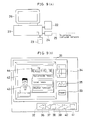
- An information-presenting system incorporating the TV metaphor environment is built up of a computer 21 (e.g., Personal Computer PC9801RX made by NEC), an electronic voice utterance device 22, a mouse 23, a modem 24 and a telephone line 25 as hardware and a script interpreter operating on, e.g., MS-DOS and a script description file giving commands to this, as illustrated in Fig. 1A.
- a computer 21 e.g., Personal Computer PC9801RX made by NEC
- an electronic voice utterance device 22 e.g., a mouse 23, a modem 24 and a telephone line 25 as hardware and a script interpreter operating on, e.g., MS-DOS and a script description file giving commands to this, as illustrated in Fig. 1A.
- This system achieves an environment allowing a user to see news programs by operating the TV metaphor through the electronic voice utterance device 22 and display 26.
- Data available to this end include not only "Mainichi Sinbun On-Line News Flashes", “Mainichi Sinbun On-Line Local News”, “The National Weather Forecast”, all served by NIFTY-Serve, and data acceptable from other personal computer networks, but general-purpose data as well.
- An example of information presentation on the screen is illustrated in Fig. 1B.
- the television metaphor environment is made up of four metaphors: the TV set, VTR controller, news program and program guidance, which are specified by independent scripts.
- the states in the TV set and the program should change when those metaphors are operated. For instance, state changes that occur when the user presses the power switch, volume or channel button is described.
- the news program script the flow of a news program and its rules are described regarding how the data of a personal computer network, e.g., NIFTY-Serve, is constructed and presented as a news program, for instance, how the input data is processed and presented, and in the program guidance script, the structure and rules of program guidance are described.
- the scripts of these metaphors are stored in a script file, which is read and operated by the script interpreter.
- the communication functionality is specified by a script describing how the communication functions of the script interpreter (that are able to handle selected data input from RS232C as an event and transmit the data) communicate with the personal computer network, e.g., NIFTY-Serve.
- the TV set 31 and the VTR controller 32 are always displayed on the display screen, as illustrated in Fig. 1B. And, with some exceptions, the power switch 33, channel button 34 and volume button 35 of the TV set 31 and the respective buttons (36-41) of the VTR controller 32 are operable on every scene, and operations on these are called the basic operations. In addition, some metaphors appearing on a CRT 42 can be operated on particular scenes.
- the television metaphor environment mentioned above may be designed to present information in newspaper format suitable for browsing or, in the alternative, in TV program format suitable for grazing.
- the rules for interpreting the user's operation are left to the designer, but in consideration of plural users and a variety of applications, it is difficult to set down those interpretive rules unequivocally.
- the operation that the user presses the fast-forward button of the VTR may be taken as an action of turning the pages of a newspaper in the context that representation is in newspaper format and as an action of fast picture search in the context that representation is in television program format.
- the operation that the user presses the play button of the VTR may be interpreted as a request for still pictures to be moved in the context that the user sets an eye on a photograph in a certain news item.
- a metaphor of a clock may be used for fast picture search as well.
- the VTR's fast-forward button corresponds to plural meanings of "turning the pages" and “fast picture search”, and so this is called a “equivocal metahor”.
- Fast picture search corresponds to the metaphor of the fast-forward button of the VTR and the metaphor of the watch, and so these are called “synonymic metapors". Ambiguities inherent in the equivocal and synonymic metaphors must be resolved so as to follow the user's context, knowledge, intention and preferences.
- Applicant has also come up with a metaphor environment control mechanism which enables adaptive actions for an individual user to be implemented from the same condition and event (Japanese Patent Application No. Hei. 2-154260).
- rule bases 51-1 ... 51-n set down rules regarding status transition for each metaphor, and a working memory 54 stores information about relations among the metaphors as well as status transitions and other states of the metaphors.
- An input/output control means 53 controls inputs and outputs between a display, a mouse and a voice utterance device, and a function call means 55 calls a certain function of the application.
- a rule base control means 52 is operable to rewrite the information stored in the working memory 54 with reference to the rule bases 51-1, ... 51-n, place the function call means 55 under control and control the input/output control means 53, thereby implementing status transitions of the metaphors.
- one metaphor is constructed as one production system having several states, and the rules of the production system are such that states and events are defined as the left side and actions as the right side.
- the events include the user's operations, messages from other metaphors, timer events, etc.
- the actions have three kinds of control:status control, picture control and function call. Said status control gives rise to a change in a metaphor itself, said picture control triggers a change in metaphor representation and said function call calls a certain function of the application.
- Each metaphor has its own collective hierarchy, whose parent is called the master and whose children are called the slaves.
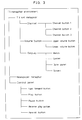
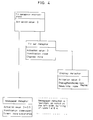
- the television metaphor environment built as shown in Fig. 3, by way of example, is made up of a TV set metaphor, a newspaper metaphor, a VTR controller metaphor, etc., and objects presented to the user includes a TV set, a caster, VTR controller panel, a newspaper, a clock, and so on. These are constructed in the form of a collective hierarchy of objects as shown in Fig. 4. Not only can these objects be recombined depending upon the user's preferences, but what operations are done on the objects can also be interpreted in the user's context, enabling function call to be carried out flexibly.
- TV set metaphor can be in either an icon state or an open- state, said open state being further broken down into on and off states.
- the on-state includes a multi-dimensional condition expressed by the program being represented, the channel number and the sound volume level.
- the operation the user conducts on the metaphor environment may be interpreted as having several meanings. For instance, now let us consider the case where the user is opening the iconified newspaper metaphor by the mouse cursor in the television metaphor environment as mentioned above. Then, there are some possibilities, mentioned just below, about the user's task intention, i.e., what the user intends to do by opening the newspaper metaphor with the mouse cursor.
- information regarding the activation value is set in the television metaphor environment; information regarding the activation value, iconization and channel in the TV set metaphor; information regarding the activation value, representation/non-representation and news titles in the display metaphor; and information regarding the activation value and iconization in the newspaper metaphor.
- the prior invention is designed to allow a redundancy of rules firing with respect to the same condition and event existing in the rule category of common knowledge written in one metaphor of the rule bases 51-1, ... 51-n.
- the newspaper metaphor for instance, all politics, economics, living and television program columns it has as slaves may be candidates for space to be filled when it is opened up.
- the CF value is set for each rule to incorporate therein a mechanism enabling it to change in conformity to the individual users, so that the action of each metaphor can accommodate to the individual's preferences.
- Such personal adaptation which holds for the priority order of the rules firing in one metaphor, is considered to make positive use of semantic relations among the metaphors, when the user performs her or his task on the metaphor environment. For instance, the space to be filled when the newspaper metaphor is opened is affected by what state the TV set metaphor on the same metaphor environment is in.
- Such influences resulting from what kind of relations exist among the metaphors can be implemented by incorporating the activation value in each metaphor and letting the activation value of a certain metaphor have an influence on resolution of conflict with the rule of other metaphor.
- the activation value of the TV set metaphor be so increased that the information of that activation value can accelerate selection of the rule triggering the representation of the television column.
- the metaphor environment control mechanism is designed to write the rule of each metaphor in the rule base and store status control information about the status of each metaphor in the working memory to place the status transitions of the metaphors under control, so that the CF value and the activation value of each metaphor, that are able to be set depending upon an individual user's preferences, can be incorporated in the rules and working memory, thereby implementing actions lending themselves well fit for the user's preferences.
- An object of this invention is, therefore, to provide a metaphor environment control system which enables a user to do manual operations without recourse to the designer's subjective point-of-view and enables the operational grammar to be automatically customized from those operations depending upon each user.
- the present invention provides a metaphor environment control system of human interfaces of any application program for computers, which represents a plurality of metaphors that express various functions of the application program and presents a user with a pertinent function according the user's operations, characterized by including: an operational model for storing a user's operational information, a world model for storing the internal states of a plurality of metaphors to be manipulated, a display model for storing what states said plurality of metaphors are displayed in, an operation/display control block for rewriting said operational model depending upon the user's operation and changing the representations of said metaphors pertinently depending upon a change in said display model, an operational model/world model conversion rule for rewriting pertinent portions of said world and display models, taking a chance of a change in said operation/display control block for said operational model, a plurality of casual rules for rewriting other portion of said world model and a pertinent portion of said display model, taking a chance of rewriting said world model, and allowing one world model to
- the ambiguity resolution block includes a task intention hierarchy in which task names are arranged in the form of a hierarchy structure, said task intention hierarchy being additionally provided with task transition-limiting information for limiting the transitions of tasks expressed by task names, so that the task currently done by the user can always be identified according to the user's operations and the previous task.
- the ambiguity resolution block is operable to resolve ambiguity when that one of said plurality of casual rules requested to be launched by the user's operation can be judged with some certainty from the user's task and transition-limiting information on the current task intention hierarchy, and is operable such that if not so, it inquires of the user about ambiguity resolution.
- said ambiguity resolution block allows the user to give a redo command by a particular operation and when the redo command is given, said ambiguity resolution block reverts the current state back to the state where said casual rules are in conflict with each other, inquiring of the user about ambiguity resolution.
- the system further includes a personality adaptation block for creating or changing said task transition-limiting information added to said task intention hierarchy according to the result of the user's response to said inquiry about ambiguity resolution, making the ambiguity resolution done by said ambiguity resolution block slowly adaptative to the person.
- a personality adaptation block for creating or changing said task transition-limiting information added to said task intention hierarchy according to the result of the user's response to said inquiry about ambiguity resolution, making the ambiguity resolution done by said ambiguity resolution block slowly adaptative to the person.
- the system of this invention which, as mentioned above, includes an operational model for storing a user's operational information, a world model for storing the internal states of a plurality of metaphors to be manipulated, a display model for storing what states said plurality of metaphors are displayed in, an operation/display control block for rewriting said operational model depending upon the user's operation and changing the representations of said metaphors pertinently depending upon a change in said display model, an operational model/world model conversion rule for rewriting pertinent portions of said world and display models, taking a chance of a change in said operation/display control block for said operational model, a plurality of casual rules for rewriting other portion of said world model and a pertinent portion of said display model, taking a chance of rewriting said world model, and allowing one world model to request to launch a plurality of rules, and an ambiguity resolution block for selecting any one of said plurality of casual rules, when they are launched, ambiguity resolution is achieved on the basis of the task context by allowing the casual rule to describe
- a graphic manager 1 and a macrointerpreter 2 are a module adapted to handle portions of metaphors concerning "pictorial figures".
- the pictures of the individual metaphors are depicted by a graphic library, e.g., GMR-3D, and the actions of these as pictures take place through unique commands for graphic control (G command/event: GC/GE and macrocommand/event: MGC/MGE).
- a main routine 3 for instance, is a process for accessing the next part, in which receiving the macro G event (MGE) from the macrointerpreter 2 and transferring control to the next part occur repeatedly.
- MGE macro G event
- the next part object module is modeled by a user's operations on the metaphors and the resulting actions, using objects and rules.
- a mouse 4 is an operational model object for storing the information of the macro G event from the macrointerpreter 2. For instance, the mouse is described as follows:
- a world model object 7 is an object modelling the status of each metaphor regarding, e.g., a newspaper, a news program, a television set and a control panel, designing the individual metaphors separately and making them cooperative with each other.
- Each metaphor incorporates the child objects of the part-of hierarchy as subobjects.
- the television set metaphor is described as follows:
- a display model object 9 is an object for storing information about the objects on display, and the information stored there is the argument of the macro G command created by a macro G command generator 10. For instance, the television set is described as follows:
- O.M. to W.M. rules 5 are to reflect the contents of the operational model object (mouse) 4 on the world model objects 7, and are transmitted from the operational model object 4 to the world model objects 7 by letting a two- or three-stage rules fire forward. Some parts of the action on the right side serve to change the contents of the property of the display model object as well.
- the first stage plays a role in allocating the events on the operational model to each metaphor, and uses the information of the OM mouse._ob name slot of the operational model object to judge which metaphor has that event.
- the slot contents of the world model object and some display model objects are rewritten in correspondence to the contents of the events on the operational model object. Since these rules are again and repeatedly used by the next user's operation, they are required to have got a hypothesis reset. Unless these were reset, then the next part would not fire any pertinent rule, because they keep intact the hypothetical true-value state determined by the former user's operation.
- W.M. to F.M. rules 6 are provided to call the function modules from the contents of the world model object 7. Here metaphor/function separation is implemented.
- Cause-and-effect or casual rules 8 are provided to describe the sequence of cause and effect of the properties of the world model objects 7. Some parts of the actions on the right side serve to change the contents of the properties of display model object 9 as well. And a plurality of sequences of cause and effect to be fired by a user's single operation are provided, whereby a metaphorical action might have multiple meanings and the ambiguities are resolved in a conflict or ambiguity resolution block 11.
- the ambiguity resolution block 11 When the casual rules 8 have a plurality of subrules capable of firing, the ambiguity resolution block 11 performs the following operations.
- the casual rules 7 allow the action that metaphor induces by a single event to be described in plural ways. Then, ambiguity is resolved on the basis of the task context by letting the ambiguity resolution block 11 select the desired one from a plurality of casual rules based on the identification of the user's intention.
- a function module is a group of functions capable of doing actual tasks for retrieving information from an on-line data base and storing the retrieved data as a local file.
- function modules as an article selector 14, an article collector 15, an article storer/retriever 16 and a mapper 13.
- the article selector 14 is provided to create and transmit a query sentence for applying inquiry to the on-line data base in launching a news program and calling a newspaper and receive an answer thereto.
- the article collector 15 is used to manage an article retrieved by the article selector 14 on a memory in some format. It may also be used to store the articles presented to the user in the past and collect the differential alone.
- the article storer/retriever 16 serves to store the contents of the articles collected in the article collector 14 in a local file and remove them out of it.
- the mapper 13 functions to allocate the articles collected by the article collector 14 onto metaphors.
- the casual rules describe actions occurring in association with the rewriting of slots of the world model objects. Included in these actions are changing other slots of the world mode object and slots of the display model object, accessing the function modules, and so on.
- the O.M. to W.M. rule involves at its terminal launching operation for rewriting the slots of the objects by RHS and a selecting operation for leaving "HYPO: Select objectname" intact.
- "HYPO: IC_object_slot” is first hit in the "If Change metaslot” of the object slots. This is because it is required to have got “Conditional IC” set, where the rules are fired depending upon how the slot is rewritten. Then, the "HYPO: IC_object_slot” rule accesses the ambiguity resolution block as using the "HYPO: CR_conflictrules” as an argument, followed by firing the "HYPO: CR conflictrules”. The ambiguity resolution block retrieves the "HYPO: CR_conflictrules” given as the argument. If there is one rule, then retrieval is completed. If not so, then information "COMMENTS" is elicited to present the user with a menu. Or the ambiguity resolution block itself resolves ambiguity. Other CR_conflictrules which are not selected are set at - 20000 or less in terms of category atom.
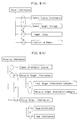
- the task intention hierarchy is expressed as such a tree structure as shown in Fig. 7, in which the nodes are task names and the links are the relations between goals and subgoals.
- the nodes are task names and the links are the relations between goals and subgoals.
- the links are the relations between goals and subgoals.
- five kinds of subgoals underlie a certain goal, and there are the following five relations among the subgoals:
- Step 1 "Sequential Goals" are found out as Step 1.
- the rule written in the knowledge and beginning with CR there is provided such a table as shown in Fig. 8 in the ambiguity resolution block, so that the number of times and probability in and at which the CR rule is used continuously can be totalized. And if the number of times exceeds the predetermined minimum effective cycle and the probability exceeds the predetermined minimum probability, then that pair is regarded as "Sequential Goals".
- Step 2 "Repetitive Goals” and “Conditional Goals” are found out as Step 2. While both are common to each other in that a plurality of goals are repeated, the former is designed such that "if one goal is achieved, then the next is executed” and the latter such that "if goals fail, then execution is continued but if one goal is achieved, then execution is brought to an end". Note, however, that both cannot simply be distinguished from each other. Nor, in many cases, can achievement and failure of goals be objectively determined unlike programs, because this is often subject to the user's own judgement.
- Step 3 "Choice” is found out as Step 3.
- one CR e.g., CR-i
- CR-m CR-m and CR-n
- CR-1, CR-m, CR-n, etc. may possibly be either "Choice” or "Independent”.
- a difference between "Choice” and “Independent” may result from whether probability frequencies are high enough or low enough, as expressed by: CR-1 ⁇ CR-m, CR-m ⁇ CR-1 CR-1 ⁇ CR-m, CR-m ⁇ CR-1 CR-m ⁇ CR-n, CR-m ⁇ CR-m. High and low probability frequencies may be considered as “Independent” and "Choice”, respectively. If there are goal sets that may be regarded as “Independent” and "Choice”, then they are grouped as a super goal. At this time, the CRs being elements of the goal sets are all substituted by the super goal in the table shown in Table 8, as is the case with Step 2.
- initialization is done.
- processings (1)-(6) are performed.
- Step S9 For each CR of the ambiguity set, the following steps S2-S7 are done one after another. If achieved, then Step S9 is performed. If they fail, then the user is presented with a menu for selecting the desired one from the ambiguity set, followed by carrying out Step S9.
- Step S2 If there is a CR in which CR_PREV linked to the "Sequential" link, then it is executed (Step S2).
- Step S3 If there is a CR next to CR_PREV in the CR_PREV containing "Cyclic" set, then it is executed (Step S3).
- Step S4 If there is a CR contained in the CR_PREV containing "Independent” set, then it is executed (Step S4).
- Step S5 If there is a CR in which the super goal of the CR PREV containing "Cyclic”, “Independent” and “Choice” sets is linked to the "Sequential” link, then it is executed (Step S5).
- Step S6 If there is a CR next to the super goal in the "Cyclic” set containing the super goal of the CR PREV containing "Cyclic”, “Independent” and “Choice” sets, then it is executed (Step S6).
- Step S6 If there is a CR contained in the "Independent” set containing the super goal of the CR PREV containing "Cyclic”, “Independent” and “Choice” sets, then it is executed (Step S6).
- Step S9 If the CR is contained in any one of all the "Cyclic”, “Independent” and “Choice” sets, then its own ID is substituted by its super goal, and if its own ID is already found in NEXT_CR of CR_TABLE[ID_of_CR_PREV] in CR_TABLE, then TIMES and PROBABILITY are rewritten by calculation. If there is still nothing, registration is newly made (Step S9).
- the "Sequential" pair makes registration as to PROBABILITY more than SEQ_MIN according to Step S1.
- the "Cyclic” set is extracted from the “Sequential” pair according to Step S2, and the “Choice” and “Independent” sets are extracted according to Step S3. Then, their respective super goals are set with a certain unique ID to rewrite the table.
- ambiguity is resolved by allowing the casual rules to describe the action the metaphor induces by a single event in plural ways and letting the ambiguity resolution block select the desired one from a plurality of casual rules based on the identification of the user's intention.
- one user has different operational intentions with respect to the same metaphor.
- the flow of the user's task context can be expressed as a trace of the task intention hierarchy expressed in the goal/subgoal format and the flow of the task context of tasks done by a particular user has a certain predetermined pattern.
- a standard task intention hierarchy is first provided, and the task intention underlying the user's operations is then identified. Finally, additional information is added to the first standard task intention hierarchy to make it well fit for the person.
- the present invention has a number of effects. Among them:
- This invention can be implemented on an Apollo 4500 machine, provided with Apollo/Domain OS (version SR10.2), together with Nexpert Object (version 1.1.1), and software modules as defined in source code by the Appendix to this description.
- Such software modules are adequate for compilation by C Compilation System (Issue 4.0 (11.0) 1/3/86 : Version 1.8.2.1 : 11/19/85).
- the Appendix in which two pages are reduced to one, comprises the following modules:
- the header files comprise ambi.h(.jis) and metaware.h(.jis), as defined, and other usual files like Math.h and stdio.h.
- the library comprises libnxp.a (Nexpert Object), and libm.a.
Landscapes
- Engineering & Computer Science (AREA)
- Theoretical Computer Science (AREA)
- General Engineering & Computer Science (AREA)
- Software Systems (AREA)
- Physics & Mathematics (AREA)
- General Physics & Mathematics (AREA)
- Human Computer Interaction (AREA)
- Artificial Intelligence (AREA)
- Computational Linguistics (AREA)
- Data Mining & Analysis (AREA)
- Evolutionary Computation (AREA)
- Computing Systems (AREA)
- Mathematical Physics (AREA)
- Digital Computer Display Output (AREA)
- Stored Programmes (AREA)
Applications Claiming Priority (3)
| Application Number | Priority Date | Filing Date | Title |
|---|---|---|---|
| JP3176536A JPH07113881B2 (ja) | 1991-07-17 | 1991-07-17 | メタファ環境制御方式 |
| JP17653691 | 1991-07-17 | ||
| JP176536/91 | 1991-07-17 |
Publications (3)
| Publication Number | Publication Date |
|---|---|
| EP0524103A2 true EP0524103A2 (de) | 1993-01-20 |
| EP0524103A3 EP0524103A3 (en) | 1993-07-28 |
| EP0524103B1 EP0524103B1 (de) | 2001-10-10 |
Family
ID=16015320
Family Applications (1)
| Application Number | Title | Priority Date | Filing Date |
|---|---|---|---|
| EP92402065A Expired - Lifetime EP0524103B1 (de) | 1991-07-17 | 1992-07-17 | Steuerungssystem für Metapherumgebung |
Country Status (3)
| Country | Link |
|---|---|
| EP (1) | EP0524103B1 (de) |
| JP (1) | JPH07113881B2 (de) |
| DE (1) | DE69232107T2 (de) |
Cited By (1)
| Publication number | Priority date | Publication date | Assignee | Title |
|---|---|---|---|---|
| EP0626635A3 (de) * | 1993-05-24 | 1997-02-12 | Firstperson Inc | Graphische Benutzerschnittstelle mit Verfahren und Vorrichtung zur Schnittstellebildung mit fernsteuernden Einrichtungen. |
Families Citing this family (2)
| Publication number | Priority date | Publication date | Assignee | Title |
|---|---|---|---|---|
| JPH07219741A (ja) * | 1994-02-03 | 1995-08-18 | Nec Corp | メタファインタフェース装置 |
| JPH08147243A (ja) * | 1994-11-21 | 1996-06-07 | Nec Corp | マルチメディアデータ通信方式 |
Family Cites Families (3)
| Publication number | Priority date | Publication date | Assignee | Title |
|---|---|---|---|---|
| JPS6349827A (ja) * | 1986-08-19 | 1988-03-02 | Nec Corp | メニユ−画面制御方式 |
| JPH02236608A (ja) * | 1989-03-10 | 1990-09-19 | Hitachi Ltd | 操作支援方式 |
| FR2649508B1 (fr) * | 1989-07-07 | 1994-07-08 | Bull Sa | Procede d'assistance pour l'utilisateur d'un systeme informatique et dispositif pour la mise en oeuvre dudit procede |
-
1991
- 1991-07-17 JP JP3176536A patent/JPH07113881B2/ja not_active Expired - Fee Related
-
1992
- 1992-07-17 EP EP92402065A patent/EP0524103B1/de not_active Expired - Lifetime
- 1992-07-17 DE DE69232107T patent/DE69232107T2/de not_active Expired - Fee Related
Cited By (5)
| Publication number | Priority date | Publication date | Assignee | Title |
|---|---|---|---|---|
| EP0626635A3 (de) * | 1993-05-24 | 1997-02-12 | Firstperson Inc | Graphische Benutzerschnittstelle mit Verfahren und Vorrichtung zur Schnittstellebildung mit fernsteuernden Einrichtungen. |
| US5886697A (en) * | 1993-05-24 | 1999-03-23 | Sun Microsystems, Inc. | Method and apparatus for improved graphical user interface having anthropomorphic characters |
| US5995106A (en) * | 1993-05-24 | 1999-11-30 | Sun Microsystems, Inc. | Graphical user interface for displaying and navigating in a directed graph structure |
| US6154209A (en) | 1993-05-24 | 2000-11-28 | Sun Microsystems, Inc. | Graphical user interface with method and apparatus for interfacing to remote devices |
| US6160551A (en) * | 1993-05-24 | 2000-12-12 | Sun Microsystems, Inc. | Graphical user interface for displaying and manipulating objects |
Also Published As
| Publication number | Publication date |
|---|---|
| EP0524103B1 (de) | 2001-10-10 |
| EP0524103A3 (en) | 1993-07-28 |
| JPH0520002A (ja) | 1993-01-29 |
| JPH07113881B2 (ja) | 1995-12-06 |
| DE69232107D1 (de) | 2001-11-15 |
| DE69232107T2 (de) | 2002-07-18 |
Similar Documents
| Publication | Publication Date | Title |
|---|---|---|
| US5404440A (en) | Metaphor environment control system | |
| US5606702A (en) | Method for specifying user interfaces and programming system running a multiple user interface computer | |
| US5560011A (en) | Computer system for monitoring a user's utilization pattern to determine useful tasks | |
| Hayes et al. | Design alternatives for user interface management sytems based on experience with cousin | |
| US5220675A (en) | Method and system for customizing a user interface in an integrated environment | |
| EP0541712B1 (de) | Intelligentes hilfssystem | |
| US6121968A (en) | Adaptive menus | |
| US5287514A (en) | Method and system for customizing a user interface in a computer system | |
| EP0453152A2 (de) | Spezifikationssystem für Rechnerprogramm | |
| US7987446B2 (en) | Method for automating variables in end-user programming system | |
| WO2003038584A1 (en) | Object oriented explorer type environment | |
| USRE37431E1 (en) | Intelligent help system | |
| KR20060111240A (ko) | 검색가능 태스크 기반 인터페이스의 일부분을 사용자가네비게이트할 수 있게 하는 컴퓨터 구현 방법 | |
| US5781900A (en) | Flexible hyperlink association system | |
| Howes et al. | Predicting the learnability of task-action mappings | |
| EP0578634B1 (de) | Verfahren zur bestimmung von benutzerschnittstellen und programmiersystem fur einen rechner mit mehreren benutzerschnittstellen | |
| WO1990010913A1 (en) | Method for building a hypermedia information management tool | |
| EP0524103B1 (de) | Steuerungssystem für Metapherumgebung | |
| JPH08101766A (ja) | 計算機の操作方法および操作装置 | |
| Alty et al. | Microtechnology and user friendly systems—the CONNECT dialogue executor | |
| Rudraraju | A tool for configuring mappings for musical systems using wireless sensor networks | |
| Wood | Desktop Agents | |
| Libes | Automation and Testing of Character‐graphic Programs | |
| Hassell et al. | Generalisation and the adaptive interface | |
| WO2003052530A2 (en) | Control system and method |
Legal Events
| Date | Code | Title | Description |
|---|---|---|---|
| PUAI | Public reference made under article 153(3) epc to a published international application that has entered the european phase |
Free format text: ORIGINAL CODE: 0009012 |
|
| AK | Designated contracting states |
Kind code of ref document: A2 Designated state(s): DE FR GB |
|
| PUAL | Search report despatched |
Free format text: ORIGINAL CODE: 0009013 |
|
| AK | Designated contracting states |
Kind code of ref document: A3 Designated state(s): DE FR GB |
|
| 17P | Request for examination filed |
Effective date: 19931223 |
|
| RAP1 | Party data changed (applicant data changed or rights of an application transferred) |
Owner name: NEW MEDIA DEVELOPMENT ASSOCIATION |
|
| 17Q | First examination report despatched |
Effective date: 19970605 |
|
| GRAG | Despatch of communication of intention to grant |
Free format text: ORIGINAL CODE: EPIDOS AGRA |
|
| GRAG | Despatch of communication of intention to grant |
Free format text: ORIGINAL CODE: EPIDOS AGRA |
|
| GRAH | Despatch of communication of intention to grant a patent |
Free format text: ORIGINAL CODE: EPIDOS IGRA |
|
| RAP1 | Party data changed (applicant data changed or rights of an application transferred) |
Owner name: MITSUBISHI DENKI KABUSHIKI KAISHA |
|
| GRAH | Despatch of communication of intention to grant a patent |
Free format text: ORIGINAL CODE: EPIDOS IGRA |
|
| GRAA | (expected) grant |
Free format text: ORIGINAL CODE: 0009210 |
|
| AK | Designated contracting states |
Kind code of ref document: B1 Designated state(s): DE FR GB |
|
| REF | Corresponds to: |
Ref document number: 69232107 Country of ref document: DE Date of ref document: 20011115 |
|
| REG | Reference to a national code |
Ref country code: GB Ref legal event code: IF02 |
|
| ET | Fr: translation filed | ||
| PGFP | Annual fee paid to national office [announced via postgrant information from national office to epo] |
Ref country code: FR Payment date: 20020627 Year of fee payment: 11 |
|
| PGFP | Annual fee paid to national office [announced via postgrant information from national office to epo] |
Ref country code: GB Payment date: 20020717 Year of fee payment: 11 |
|
| PLBE | No opposition filed within time limit |
Free format text: ORIGINAL CODE: 0009261 |
|
| STAA | Information on the status of an ep patent application or granted ep patent |
Free format text: STATUS: NO OPPOSITION FILED WITHIN TIME LIMIT |
|
| PGFP | Annual fee paid to national office [announced via postgrant information from national office to epo] |
Ref country code: DE Payment date: 20020927 Year of fee payment: 11 |
|
| 26N | No opposition filed | ||
| PG25 | Lapsed in a contracting state [announced via postgrant information from national office to epo] |
Ref country code: GB Free format text: LAPSE BECAUSE OF NON-PAYMENT OF DUE FEES Effective date: 20030717 |
|
| PG25 | Lapsed in a contracting state [announced via postgrant information from national office to epo] |
Ref country code: DE Free format text: LAPSE BECAUSE OF NON-PAYMENT OF DUE FEES Effective date: 20040203 |
|
| GBPC | Gb: european patent ceased through non-payment of renewal fee |
Effective date: 20030717 |
|
| PG25 | Lapsed in a contracting state [announced via postgrant information from national office to epo] |
Ref country code: FR Free format text: LAPSE BECAUSE OF NON-PAYMENT OF DUE FEES Effective date: 20040331 |
|
| REG | Reference to a national code |
Ref country code: FR Ref legal event code: ST |