EP0524655A2 - Wiederaufbereitung eines flüssigkristallinen Verbundharzes - Google Patents
Wiederaufbereitung eines flüssigkristallinen Verbundharzes Download PDFInfo
- Publication number
- EP0524655A2 EP0524655A2 EP92112801A EP92112801A EP0524655A2 EP 0524655 A2 EP0524655 A2 EP 0524655A2 EP 92112801 A EP92112801 A EP 92112801A EP 92112801 A EP92112801 A EP 92112801A EP 0524655 A2 EP0524655 A2 EP 0524655A2
- Authority
- EP
- European Patent Office
- Prior art keywords
- liquid crystal
- crystal polymer
- resin
- composite resin
- transition temperature
- Prior art date
- Legal status (The legal status is an assumption and is not a legal conclusion. Google has not performed a legal analysis and makes no representation as to the accuracy of the status listed.)
- Granted
Links
Images





Classifications
-
- B—PERFORMING OPERATIONS; TRANSPORTING
- B29—WORKING OF PLASTICS; WORKING OF SUBSTANCES IN A PLASTIC STATE IN GENERAL
- B29B—PREPARATION OR PRETREATMENT OF THE MATERIAL TO BE SHAPED; MAKING GRANULES OR PREFORMS; RECOVERY OF PLASTICS OR OTHER CONSTITUENTS OF WASTE MATERIAL CONTAINING PLASTICS
- B29B17/00—Recovery of plastics or other constituents of waste material containing plastics
- B29B17/04—Disintegrating plastics, e.g. by milling
- B29B17/0412—Disintegrating plastics, e.g. by milling to large particles, e.g. beads, granules, flakes, slices
-
- B—PERFORMING OPERATIONS; TRANSPORTING
- B29—WORKING OF PLASTICS; WORKING OF SUBSTANCES IN A PLASTIC STATE IN GENERAL
- B29B—PREPARATION OR PRETREATMENT OF THE MATERIAL TO BE SHAPED; MAKING GRANULES OR PREFORMS; RECOVERY OF PLASTICS OR OTHER CONSTITUENTS OF WASTE MATERIAL CONTAINING PLASTICS
- B29B13/00—Conditioning or physical treatment of the material to be shaped
- B29B13/02—Conditioning or physical treatment of the material to be shaped by heating
- B29B13/022—Melting the material to be shaped
-
- B—PERFORMING OPERATIONS; TRANSPORTING
- B29—WORKING OF PLASTICS; WORKING OF SUBSTANCES IN A PLASTIC STATE IN GENERAL
- B29B—PREPARATION OR PRETREATMENT OF THE MATERIAL TO BE SHAPED; MAKING GRANULES OR PREFORMS; RECOVERY OF PLASTICS OR OTHER CONSTITUENTS OF WASTE MATERIAL CONTAINING PLASTICS
- B29B13/00—Conditioning or physical treatment of the material to be shaped
- B29B13/02—Conditioning or physical treatment of the material to be shaped by heating
- B29B13/023—Half-products, e.g. films, plates
-
- B—PERFORMING OPERATIONS; TRANSPORTING
- B29—WORKING OF PLASTICS; WORKING OF SUBSTANCES IN A PLASTIC STATE IN GENERAL
- B29B—PREPARATION OR PRETREATMENT OF THE MATERIAL TO BE SHAPED; MAKING GRANULES OR PREFORMS; RECOVERY OF PLASTICS OR OTHER CONSTITUENTS OF WASTE MATERIAL CONTAINING PLASTICS
- B29B13/00—Conditioning or physical treatment of the material to be shaped
- B29B13/10—Conditioning or physical treatment of the material to be shaped by grinding, e.g. by triturating; by sieving; by filtering
-
- B—PERFORMING OPERATIONS; TRANSPORTING
- B29—WORKING OF PLASTICS; WORKING OF SUBSTANCES IN A PLASTIC STATE IN GENERAL
- B29B—PREPARATION OR PRETREATMENT OF THE MATERIAL TO BE SHAPED; MAKING GRANULES OR PREFORMS; RECOVERY OF PLASTICS OR OTHER CONSTITUENTS OF WASTE MATERIAL CONTAINING PLASTICS
- B29B17/00—Recovery of plastics or other constituents of waste material containing plastics
- B29B17/0026—Recovery of plastics or other constituents of waste material containing plastics by agglomeration or compacting
-
- B—PERFORMING OPERATIONS; TRANSPORTING
- B29—WORKING OF PLASTICS; WORKING OF SUBSTANCES IN A PLASTIC STATE IN GENERAL
- B29C—SHAPING OR JOINING OF PLASTICS; SHAPING OF MATERIAL IN A PLASTIC STATE, NOT OTHERWISE PROVIDED FOR; AFTER-TREATMENT OF THE SHAPED PRODUCTS, e.g. REPAIRING
- B29C39/00—Shaping by casting, i.e. introducing the moulding material into a mould or between confining surfaces without significant moulding pressure; Apparatus therefor
- B29C39/02—Shaping by casting, i.e. introducing the moulding material into a mould or between confining surfaces without significant moulding pressure; Apparatus therefor for making articles of definite length, i.e. discrete articles
-
- B—PERFORMING OPERATIONS; TRANSPORTING
- B29—WORKING OF PLASTICS; WORKING OF SUBSTANCES IN A PLASTIC STATE IN GENERAL
- B29C—SHAPING OR JOINING OF PLASTICS; SHAPING OF MATERIAL IN A PLASTIC STATE, NOT OTHERWISE PROVIDED FOR; AFTER-TREATMENT OF THE SHAPED PRODUCTS, e.g. REPAIRING
- B29C48/00—Extrusion moulding, i.e. expressing the moulding material through a die or nozzle which imparts the desired form; Apparatus therefor
- B29C48/022—Extrusion moulding, i.e. expressing the moulding material through a die or nozzle which imparts the desired form; Apparatus therefor characterised by the choice of material
-
- B—PERFORMING OPERATIONS; TRANSPORTING
- B29—WORKING OF PLASTICS; WORKING OF SUBSTANCES IN A PLASTIC STATE IN GENERAL
- B29C—SHAPING OR JOINING OF PLASTICS; SHAPING OF MATERIAL IN A PLASTIC STATE, NOT OTHERWISE PROVIDED FOR; AFTER-TREATMENT OF THE SHAPED PRODUCTS, e.g. REPAIRING
- B29C70/00—Shaping composites, i.e. plastics material comprising reinforcements, fillers or preformed parts, e.g. inserts
- B29C70/04—Shaping composites, i.e. plastics material comprising reinforcements, fillers or preformed parts, e.g. inserts comprising reinforcements only, e.g. self-reinforcing plastics
- B29C70/06—Fibrous reinforcements only
-
- C—CHEMISTRY; METALLURGY
- C08—ORGANIC MACROMOLECULAR COMPOUNDS; THEIR PREPARATION OR CHEMICAL WORKING-UP; COMPOSITIONS BASED THEREON
- C08L—COMPOSITIONS OF MACROMOLECULAR COMPOUNDS
- C08L77/00—Compositions of polyamides obtained by reactions forming a carboxylic amide link in the main chain; Compositions of derivatives of such polymers
-
- C—CHEMISTRY; METALLURGY
- C08—ORGANIC MACROMOLECULAR COMPOUNDS; THEIR PREPARATION OR CHEMICAL WORKING-UP; COMPOSITIONS BASED THEREON
- C08L—COMPOSITIONS OF MACROMOLECULAR COMPOUNDS
- C08L77/00—Compositions of polyamides obtained by reactions forming a carboxylic amide link in the main chain; Compositions of derivatives of such polymers
- C08L77/02—Polyamides derived from omega-amino carboxylic acids or from lactams thereof
-
- C—CHEMISTRY; METALLURGY
- C08—ORGANIC MACROMOLECULAR COMPOUNDS; THEIR PREPARATION OR CHEMICAL WORKING-UP; COMPOSITIONS BASED THEREON
- C08L—COMPOSITIONS OF MACROMOLECULAR COMPOUNDS
- C08L77/00—Compositions of polyamides obtained by reactions forming a carboxylic amide link in the main chain; Compositions of derivatives of such polymers
- C08L77/06—Polyamides derived from polyamines and polycarboxylic acids
-
- B—PERFORMING OPERATIONS; TRANSPORTING
- B29—WORKING OF PLASTICS; WORKING OF SUBSTANCES IN A PLASTIC STATE IN GENERAL
- B29C—SHAPING OR JOINING OF PLASTICS; SHAPING OF MATERIAL IN A PLASTIC STATE, NOT OTHERWISE PROVIDED FOR; AFTER-TREATMENT OF THE SHAPED PRODUCTS, e.g. REPAIRING
- B29C2793/00—Shaping techniques involving a cutting or machining operation
- B29C2793/009—Shaping techniques involving a cutting or machining operation after shaping
-
- B—PERFORMING OPERATIONS; TRANSPORTING
- B29—WORKING OF PLASTICS; WORKING OF SUBSTANCES IN A PLASTIC STATE IN GENERAL
- B29C—SHAPING OR JOINING OF PLASTICS; SHAPING OF MATERIAL IN A PLASTIC STATE, NOT OTHERWISE PROVIDED FOR; AFTER-TREATMENT OF THE SHAPED PRODUCTS, e.g. REPAIRING
- B29C48/00—Extrusion moulding, i.e. expressing the moulding material through a die or nozzle which imparts the desired form; Apparatus therefor
-
- B—PERFORMING OPERATIONS; TRANSPORTING
- B29—WORKING OF PLASTICS; WORKING OF SUBSTANCES IN A PLASTIC STATE IN GENERAL
- B29C—SHAPING OR JOINING OF PLASTICS; SHAPING OF MATERIAL IN A PLASTIC STATE, NOT OTHERWISE PROVIDED FOR; AFTER-TREATMENT OF THE SHAPED PRODUCTS, e.g. REPAIRING
- B29C48/00—Extrusion moulding, i.e. expressing the moulding material through a die or nozzle which imparts the desired form; Apparatus therefor
- B29C48/03—Extrusion moulding, i.e. expressing the moulding material through a die or nozzle which imparts the desired form; Apparatus therefor characterised by the shape of the extruded material at extrusion
- B29C48/07—Flat, e.g. panels
-
- B—PERFORMING OPERATIONS; TRANSPORTING
- B29—WORKING OF PLASTICS; WORKING OF SUBSTANCES IN A PLASTIC STATE IN GENERAL
- B29K—INDEXING SCHEME ASSOCIATED WITH SUBCLASSES B29B, B29C OR B29D, RELATING TO MOULDING MATERIALS OR TO MATERIALS FOR MOULDS, REINFORCEMENTS, FILLERS OR PREFORMED PARTS, e.g. INSERTS
- B29K2105/00—Condition, form or state of moulded material or of the material to be shaped
- B29K2105/0079—Liquid crystals
-
- B—PERFORMING OPERATIONS; TRANSPORTING
- B29—WORKING OF PLASTICS; WORKING OF SUBSTANCES IN A PLASTIC STATE IN GENERAL
- B29K—INDEXING SCHEME ASSOCIATED WITH SUBCLASSES B29B, B29C OR B29D, RELATING TO MOULDING MATERIALS OR TO MATERIALS FOR MOULDS, REINFORCEMENTS, FILLERS OR PREFORMED PARTS, e.g. INSERTS
- B29K2105/00—Condition, form or state of moulded material or of the material to be shaped
- B29K2105/0088—Blends of polymers
-
- B—PERFORMING OPERATIONS; TRANSPORTING
- B29—WORKING OF PLASTICS; WORKING OF SUBSTANCES IN A PLASTIC STATE IN GENERAL
- B29K—INDEXING SCHEME ASSOCIATED WITH SUBCLASSES B29B, B29C OR B29D, RELATING TO MOULDING MATERIALS OR TO MATERIALS FOR MOULDS, REINFORCEMENTS, FILLERS OR PREFORMED PARTS, e.g. INSERTS
- B29K2105/00—Condition, form or state of moulded material or of the material to be shaped
- B29K2105/06—Condition, form or state of moulded material or of the material to be shaped containing reinforcements, fillers or inserts
-
- B—PERFORMING OPERATIONS; TRANSPORTING
- B29—WORKING OF PLASTICS; WORKING OF SUBSTANCES IN A PLASTIC STATE IN GENERAL
- B29K—INDEXING SCHEME ASSOCIATED WITH SUBCLASSES B29B, B29C OR B29D, RELATING TO MOULDING MATERIALS OR TO MATERIALS FOR MOULDS, REINFORCEMENTS, FILLERS OR PREFORMED PARTS, e.g. INSERTS
- B29K2105/00—Condition, form or state of moulded material or of the material to be shaped
- B29K2105/25—Solid
- B29K2105/253—Preform
- B29K2105/255—Blocks or tablets
-
- B—PERFORMING OPERATIONS; TRANSPORTING
- B29—WORKING OF PLASTICS; WORKING OF SUBSTANCES IN A PLASTIC STATE IN GENERAL
- B29K—INDEXING SCHEME ASSOCIATED WITH SUBCLASSES B29B, B29C OR B29D, RELATING TO MOULDING MATERIALS OR TO MATERIALS FOR MOULDS, REINFORCEMENTS, FILLERS OR PREFORMED PARTS, e.g. INSERTS
- B29K2995/00—Properties of moulding materials, reinforcements, fillers, preformed parts or moulds
- B29K2995/0037—Other properties
- B29K2995/005—Oriented
-
- B—PERFORMING OPERATIONS; TRANSPORTING
- B29—WORKING OF PLASTICS; WORKING OF SUBSTANCES IN A PLASTIC STATE IN GENERAL
- B29K—INDEXING SCHEME ASSOCIATED WITH SUBCLASSES B29B, B29C OR B29D, RELATING TO MOULDING MATERIALS OR TO MATERIALS FOR MOULDS, REINFORCEMENTS, FILLERS OR PREFORMED PARTS, e.g. INSERTS
- B29K2995/00—Properties of moulding materials, reinforcements, fillers, preformed parts or moulds
- B29K2995/0037—Other properties
- B29K2995/0077—Yield strength; Tensile strength
-
- Y—GENERAL TAGGING OF NEW TECHNOLOGICAL DEVELOPMENTS; GENERAL TAGGING OF CROSS-SECTIONAL TECHNOLOGIES SPANNING OVER SEVERAL SECTIONS OF THE IPC; TECHNICAL SUBJECTS COVERED BY FORMER USPC CROSS-REFERENCE ART COLLECTIONS [XRACs] AND DIGESTS
- Y02—TECHNOLOGIES OR APPLICATIONS FOR MITIGATION OR ADAPTATION AGAINST CLIMATE CHANGE
- Y02W—CLIMATE CHANGE MITIGATION TECHNOLOGIES RELATED TO WASTEWATER TREATMENT OR WASTE MANAGEMENT
- Y02W30/00—Technologies for solid waste management
- Y02W30/50—Reuse, recycling or recovery technologies
- Y02W30/62—Plastics recycling; Rubber recycling
Definitions
- the present invention relates to a method for reforming a liquid crystal resin composite.
- a conventional synthetic resin product provided with a high tensile strength and a high rigidity which comprises a composite resin of a thermal setting resin such as SMC (sheet mold compound) and RIM mixed with glass fiber or a thermal setting resin called stan bubble sheet mixed with a long glass fiber and molded into a given shape. Further, there has been also known a synthetic resin mixed with carbon fiber in the place of the above glass fiber.
- a thermal setting resin such as SMC (sheet mold compound) and RIM mixed with glass fiber or a thermal setting resin called stan bubble sheet mixed with a long glass fiber and molded into a given shape.
- a composite resin comprising a thermoplastic resin and a liquid crystal resin, which has no glass fiber or carbon fiber mixed therein and which has a high tensile strength and a high rigidity.
- This composite resin can be prepared by extruding a mixture of thermal plastic resin and liquid crystal polymer (liquid crystal resin) at a temperature higher than a transition temperature of the liquid crystal polymer under being extended to obtain strand materials, cutting the strand materials into a small piece of 1 to 40mm, subjecting the small pieces to an extrusion molding at a temperature lower than the transition temperature of the liquid crystal polymer.
- an object of the present invention is to provide a method for reforming the synthesized resin having a high tensile strength and a high rigidity into a molding product having the same tensile strength and rigidity as those of the original molding product.
- a reformed liquid crystal composite is provided with substantially the same physical properties as that of the original liquid crystal composite when the composite product may be reformed by the method comprising steps of; crushing a product, which is preferably a used product of a composite resin of thermoplastic resin as a matrix material and liquid crystal polymer, as a reinforcing material, having a crystal transition temperature higher than a minimum moldable temperature of the thermoplastic resin into particles or pieces; extruding said crushed particles or pieces at a temperature higher than the transition temperature to obtain a raw moldable material; and forming the moldable material into a molding product in a given shape at a temperature lower than the transition temperature.
- the present invention is to provide a method for reforming a composite resin of liquid crystal polymer and thermoplastic resin comprising steps of: providing a product, which is preferably a used product of a composite resin of thermoplastic resin and liquid crystal polymer having a crystal transition temperature higher than a minimum moldable temperature of the thermoplastic resin; crushing said composite resin into particles or pieces; heating said particles or pieces at a temperature higher than the transition temperature of said liquid crystal polymer to obtain a molten composite resin; extruding said molten composite resin at a temperature higher than the transition temperature to obtain raw moldable materials; and forming the moldable material into a molding product in a given shape at a temperature lower than the transition temperature of the liquid crystal polymer.
- the present invention is to provide a method for reforming a composite resin of liquid crystal polymer and thermoplastic resin comprising steps of: providing a product, which may be a used product of a composite resin of thermoplastic resin and liquid crystal polymer having a crystal transition temperature higher than a minimum moldable temperature of the thermoplastic resin; crushing said composite resin into particles or pieces; heating said particles or pieces at a temperature higher than the transition temperature of said liquid crystal polymer to obtain a molten composite resin of the thermoplastic resin and the liquid crystal polymer; extruding said molten composite resin at a temperature higher than the transition temperature of the liquid crystal polymer to obtain a molding product of a given shape.
- the present invention is also to provide a method for reforming a used composite resin of thermoplastic resin and liquid crystal polymer having a crystal transition point (temperature) higher than a minimum moldable temperature of the thermoplastic resin, wherein the liquid crystal polymer can be of a fiber form present in the thermoplastic resin.
- the present invention is to provide a method for reforming a composite resin of thermoplastic resin and liquid crystal polymer having a crystal transition point higher than a minimum moldable temperature of the thermoplastic resin, wherein the step of obtaining a raw moldable composite material by extruding the molten composite resin at a temperature higher than the transition temperature of the liquid crystal polymer is directed to a step of obtaining a raw molding material by extruding the molten composite resin at a temperature higher than the transition temperature of the liquid crystal polymer under being extended.
- the present invention is to provide a method for reforming a composite resin of thermoplastic resin and liquid crystal polymer having a crystal transition point higher than a minimum moldable temperature of the thermoplastic resin, wherein the step of forming the molten composite resin into a molding product at a temperature higher than the transition temperature of the liquid crystal polymer is directed to a step of extrusion-forming the molten composite resin into a molding product of a given shape at a temperature higher than the transition temperature of the liquid crystal polymer under being extended.
- the present invention in order to obtain a moldable composite material of a strand form, also is to provide a method for reforming a composite resin of thermoplastic resin and liquid crystal polymer having a crystal transition point higher than a minimum moldable temperature of the thermoplastic resin, wherein the step of obtaining a raw moldable material by extruding the molten composite resin at a temperature higher than the transition temperature of the liquid crystal polymer or the step of obtaining a raw moldable material by extruding the molten composite resin at a temperature higher than the transition temperature of the liquid crystal polymer under being extended is directed to a step of forming the raw molding material of a strand form.
- the present invention in order to obtain a raw moldable material of a sheet form, is to provide a method for reforming a composite resin of thermoplastic resin and liquid crystal polymer having a crystal transition point higher than a minimum moldable temperature of the thermoplastic resin , wherein the step of obtaining the moldable composite material by extruding the molten composite resin at a temperature higher than the transition temperature of the liquid crystal polymer or the step of obtaining a raw molding material by extruding the molten composite resin at a temperature higher than the transition temperature of the liquid crystal polymer under being extended is directed to a step of forming the moldable composite material of a sheet form.
- the first step is to crush a molding product, which is preferably a used product made from a composite resin of a thermoplastic resin and a liquid crystal polymer having a crystal transition temperature higher than that of the thermoplastic resin.
- a molding product which is preferably a used product made from a composite resin of a thermoplastic resin and a liquid crystal polymer having a crystal transition temperature higher than that of the thermoplastic resin.
- the molten composite resin is extruded at a temperature higher than the transition temperature of the liquid crystal polymer to obtain a raw moldable composite material.
- the crushing process makes the liquid crystal polymer to be cut into crushed particles or pieces of a small size
- the next melting process causes the crushed particles to be combined with each other. Therefore, the liquid crystal polymer in the combined a particles or pieces is solidified in a manner to have an orientation structure wherein molecules are oriented in one direction. Accordingly, the raw moldable composite material thus obtained results in a tensile strength and a rigidity the same as those of the original composite resin.
- the raw moldable composite material is formed into a molding product of a given shape at a temperature lower than the transition temperature of the liquid crystal. Therefore, the reformed molding product has the liquid crystal polymer of a molecular orientation structure kept therein.
- the first step is to crush a product, which is preferably a used product made from a composite resin of a thermoplastic resin and a liquid crystal polymer having a crystal transition temperature higher than a minimum moldable temperature of the thermoplastic resin.
- a product which is preferably a used product made from a composite resin of a thermoplastic resin and a liquid crystal polymer having a crystal transition temperature higher than a minimum moldable temperature of the thermoplastic resin.
- the molten composite resin is extruded at a temperature higher than the transition temperature of the liquid crystal polymer to obtain a molding product of a given shape.
- the crushing process makes the liquid crystal polymer to be cut into crushed particles of a small size in a similar way to the above method, the melting process causes the crushed particles or pieces to be combined with each other.
- the liquid crystal polymer in the combined crushed particles or pieces is solidified in a manner to have an orientation structure wherein molecules are oriented in a one direction. Accordingly, the molding product thus obtained results in an tensile strength and a rigidity the same as those of the original composite resin.
- the liquid crystal polymer of a fiber form is included in the composite resin before the crushing and is cut into crushed particles or pieces of a small size.
- the melting process causes the crushed particles or pieces to be combined with each other, so that the liquid crystal polymer in the combined particles or pieces is solidified in a manner to have an orientation structure.
- the raw moldable material thus obtained includes a liquid crystal polymer of a fiber form having a same length as that of the original liquid crystal polymer and results in a tensile strength and a rigidity the same as those of the original composite resin.
- the composite resin is extruded at a temperature higher than the transition temperature of the liquid crystal under being extended to obtain a raw moldable material.
- the liquid crystal polymer in the raw moldable material is oriented sufficiently to an extrusion direction.
- the composite resin is extruded at a temperature higher than the transition temperature of the liquid crystal under being extended to obtain a molding product of a given shape.
- the liquid crystal polymer in the raw moldable product is oriented sufficiently to an extrusion direction.
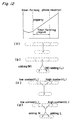
- the used product to be reformed which is preferably a used product may contain various contents of liquid crystal polymer. Therefore, when two or more kinds of the product and/or the used product are provided in order to reform a product containing a desired content of the liquid crystal polymer, there may be added thereto a new thermoplastic resin compatible to the matrix thermoplastic resin and/or a new liquid crystal polymer. That is, in the case of Fig. 12(a) wherein molding is carried out only by use of the used products, a reformed product comes to have almost the same properties as that of the original product.
- a middle property between that of a high content product and that of a low content product may be provided with a reformed product by using a mixture of crushed powders having a low content of the liquid crystal polymer (L) and having a high content of L.
- an additional new thermoplastic resin and/or new liquid crystal resin may be added to the above mixture to obtain a desired composition ratio of the thermoplastic resin (M) and the liquid crystal resin (L) as shown in Fig.12(d).
- the present invention is to provide a method for reforming a composite resin according to the present invention, wherein in the step of heating the crushed particles or pieces into a molten composite material, the crushed particles or pieces comprise a mixture of used composite resins having different contents of the liquid crystal resin or a mixture of a used composite resin and a liquid crystal resin and/or a thermoplastic resin.
- a first step is to provide a molding product such as an automobile bonnet made of composite resin 10 comprising a thermoplastic resin and a liquid crystal polymer having a melting point higher than that of the thermoplastic resin.
- the composite resin 10 is crushed by a crusher 12 into particles or pieces 14.
- the crushed particles or pieces 14 are supplied to a molten resin extrusion apparatus 20 and are heated in the molten resin extrusion apparatus 20 at a temperature higher than the transition temperature of the liquid crystal into a molten resin 22 comprising a thermoplastic resin and a liquid crystal polymer.
- the molten resin 22 is extruded at a temperature higher than the transition temperature of the liquid crystal under being extended and formed into a molding material 24 of a sheet form as shown in Fig. 1c or into a molding material 26 of a strand form as shown in Fig. 1d.
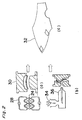
- the molding material 24 of a sheet form is heated at a temperature lower than the transition temperature of the liquid crystal in a preheating apparatus 28 as shown in Fig. 2a and then is pressed into a given shape by a pressing apparatus 30 to obtain reformed molding product 32 such as an automobile bonnet as shown in Fig. 2c.
- a pressing apparatus 30 to obtain reformed molding product 32 such as an automobile bonnet as shown in Fig. 2c.
- the reformed molding product 32 is prepared by using only the crushed particles or pieces 14. However, it is possible to use the crushed particles or pieces 14 having new thermoplastic resin and new liquid crystal polymer added thereto.
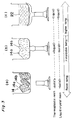
- Fig. 3 is a schematic view illustrating the reforming process in which the thermoplastic resin and the liquid crystal polymer change in the state with the working steps.
- Fig. 3a shows a state of the crushed particles or pieces 14 in advance to the heating.
- Reference numerals 14a and 14b indicate the thermoplastic resin and the liquid crystal polymer of a solid state, respectively, as constituents of the crushed particles or pieces 14.
- Fig. 3c shows a state of a molten composite resin 22 which is obtained by heating the crushed particles or pieces 14 at a temperature higher than the transition temperature of the liquid crystal polymer 14b.
- the thermoplastic resin 14a and the liquid crystal polymer 14b as constituents of the crushed particles or pieces 14 are of a molten state (liquid state).
- thermoplastic resin 14a is of a liquid state (molten state) but the liquid crystal polymer 14b is in a solid state. Accordingly, it is necessary to reform the crushed particles or pieces 14 of a state shown in Fig. 3b into a reformed molding product of a given shape by a pressing apparatus or an injection forming apparatus.
- a liquid crystal polymer as a starting material comprises VECTRA A950 ( poly esther of aromatic group, the liquid crystal transition temperature is about 280 o C) made by POLYPLASTIC CO., LTD. and a thermoplastic resin as a starting material comprises TECHNIACE-T105 made by SUMITOMO DOW LTD..
- a composite resin is prepared by mixing the two materials mentioned above in a given mixing ratio.
- an extruding apparatus is a twin screw extruder (screw diameter of 36 mm) made by RESEARCH LABORATORY OF PLASTIC TECHNOLOGY; a resin temperature is 290°C; a screw rotation is 100 rpm; die diameter is 2 mm; shear rate is 1700sec ⁇ 1 and a tensile ratio is 2 times.
- the composite resin is extruded into a first molding material of a strand form in a diameter of 1. 4mm.
- the first molding material is cut into a first pellet material of a 3 mm length.
- the first pellet material is formed into a composite resin by an injection method.
- the injecting formation is carried out in the following conditions: The used injecting formation apparatus 220 Toh made by TOSHIBA MACHINE CO., LTD.; a die is of a test piece type; the resin temperature is 250°C.
- the flowing ability is tested by using the injecting formation apparatus mentioned above and a die of a spiral flow type (diameter of 6mm of a half circle form) at the resin temperature of 250°C at an injecting pressure of 1000Kg/cm2.
- the injected composite resin is crushed into pellets having a length of 3 to 4 mm by using a crusher V-360 made by HORAI IRON WORKS CO., LTD..
- the pellets are extruded into reformation molding material of a strand form of 1. 4mm diameter.
- the reformation molding material of a strand form is cut into recycle used pellets of a length of 3 mm.
- the injection working condition is the same as that of the first extrusion formation.
- the first raw moldable material of a strand form and the recycle used pellets are subjected to a tensile test.
- the test is carried out by using a universal testing machine (AUTOGRAPh) made by SHIMADZU Co. at a tensile rate of 20 mm/min.
- AUTOGRAPh universal testing machine
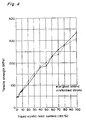
- Figs. 4 and 5 are graphs showing the relation between a tensile strength and a content of the liquid crystal polymer contained in the first molding material and recycle used moldable material, respectively.
- the liquid crystal polymer starts to be formed into a fiber form at a range higher than 2 to 4 % of the liquid crystal amount. It is found that the first moldable material and recycle used molding material show the tensile strength the same as each other at the all range of the liquid crystal polymer content. This indicates clearly that the recycle used moldable material is not impaired in the tensile strength of the reformed moldable product compared with the case using the original molding material.
- Fig. 6 is a graph showing a relation between a flow length ratio and the content amount of liquid crystal polymer. It is clear from Fig. 6 that a flowing ability is greatly decreased at a liquid crystal polymer content higher than 60 %. It is difficult to achieve a reformed molding product by using the molding material having a content of liquid crystal polymer higher than 60%. In connection with a case using PC/ABS as a thermoplastic resin, the content of liquid crystal polymer preferably ranges from 2 to 60 %.
- a liquid crystal polymer as a starting material comprises VECTRA A950 (poly esther of aromatic group, the liquid crystal transition temperature is about 280°C) made by POLYPLASTIC CO. LTD. and a thermoplastic resin PC/PBT as a starting material comprises XENOY 1101 made by GE PLASTIC JAPAN LTD..
- a composite resin is prepared by mixing the two reagents mentioned above in a given mixing ratio.
- the composite resin is subjected to a first extrusion formation in a condition the same as that of the PC/ABS and is formed into a first moldable material of a strand form.
- the first moldable material is cut into pellets of a length 3 mm into first pellets.
- the flowing test is carried out in a way similar to that of the PC/ABS case.
- the first pellets are subjected to a injecting formation in a way similar to that of PC/ABS case to obtain a composite resin.
- a part of the composite resin is formed into a recycle used moldable material of a strand form as a testing piece in a way similar to that of PC/ABS case.
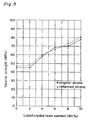
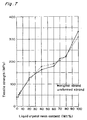
- Figs. 7 and 8 are graphs showing the relation between an tensile strength and a content of the liquid crystal polymer contained in the first moldable material and recycle used moldable material, respectively.
- the liquid crystal polymer starts to be formed into a fiber form at a range higher than 2 to 4 % of the liquid crystal amount. It is found that the first moldable material and recycle used moldable material show the tensile strength the same as each other at the all range of the liquid crystal polymer content.
- Fig. 9 is a graph showing a relation between a flow length ratio and the content amount of liquid crystal polymer. It is clear from Fig. 9 that a flowing ability is greatly decreased at a liquid crystal polymer content higher than 60 %. It is difficult to achieve a reformed molding product by using the moldable material having a content of liquid crystal polymer higher than 60%. In connection with a case using PC/PBT as a thermoplastic resin, the content of liquid crystal polymer preferably ranges from 2 to 60 %.
- a liquid crystal polymer as a starting material comprises VECTRA A950 ( poly esther of aromatic group, the liquid crystal transition temperature is about 280°C) made by POLYPLASTIC CO.LTD. and a thermoplastic resin PPO as a starting material comprises NORYL PX2623 made by NIPPON GE PLASTIC Co..
- a composite resin is prepared by mixing the two reagents mentioned above in a given mixing ratio.
- the composite resin is subjected to a first extrusion formation in a condition the same as that of the PC/ABS and is formed into a first molding material of a strand form.
- the first molding material is cut into pellets of a length 3 mm into first pellets.
- the first pellets are subjected to an injecting formation in a way similar to that of PC/ABS case to obtain a composite resin.
- a part of the composite resin is formed into a recycle used moldable material of a strand form as a testing piece in a way similar to that of PC/ABS case.
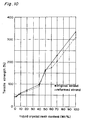
- Figs. 10 and 11 are graphs showing the relation between a tensile strength and a content of the liquid crystal polymer contained in the first molding material and recycle used molding material, respectively.
- the liquid crystal polymer starts to be formed into a fiber form at a range higher than 3 % of the liquid crystal amount. It is found that the first moldable material and recycle used moldable material show the tensile strength the same as each other at the all range of the liquid crystal polymer content.
- the content of liquid crystal polymer is preferably higher than 3 %.
- a method for reforming a composite resin of- the present invention comprises the steps of; crushing a molding product of a composite resin of thermoplastic resin and liquid crystal polymer having a transition temperature of the liquid crystal resin higher than a minimum moldable temperature of the thermoplastic resin to obtain crushed particles or pieces; heating said particles or pieces at a temperature higher than the transition temperature of said liquid crystal polymer to obtain molten composite resin of thermoplastic resin and the liquid crystal polymer; extruding said molten composite resin at a temperature higher than the transition temperature of the liquid crystal polymer to obtain raw moldable material.
- liquid crystal polymer Since liquid crystal polymer is cut into a small size by crushing, it is caused to be combined with each other by the melting process and the combined particles or pieces of liquid crystal polymer come to be of an orientation structure and are solidified as it is. Accordingly, the raw moldable material so obtained has a tensile strength and a rigidity the same as those of the original composite resin. Further, the raw moldable material so obtained is formed into a molding product at a temperature lower than the transition temperature of the liquid crystal polymer. Hence, the molding product has the liquid crystal polymer keeping an orientation structure and has a tensile strength and a rigidity the same as those of the original composite resin.
- a method comprising the steps of: crushing a molding product of a composite resin of thermoplastic resin and liquid crystal polymer having a transition point of the liquid crystal resin higher than a minimum moldable temperature of the thermoplastic resin to obtain crushed particles or pieces; heating said particles or pieces at a temperature higher than the transition temperature of said liquid crystal polymer to obtain molten composite resin of thermoplastic resin and the liquid crystal polymer; and extruding said molten composite resin at a temperature higher than the transition temperature of the liquid crystal polymer to obtain a molding product in a given shape.
- the liquid crystal polymer Since the liquid crystal polymer is cut into a small size by crushing, it is caused to be combined with each other by the melting process and the combined crushed particles or pieces of liquid crystal polymer come to be of an orientation structure and are solidified as it is. Accordingly, the molding product so obtained has a tensile strength and a rigidity the same as those of the original composite resin.
- the crushed particles or pieces of liquid crystal polymer are combined to each other during a formation process at a temperature higher than the transition temperature of the liquid crystal polymer, so that the liquid crystal polymer can keep a fiber structure having a length the same as that of the liquid crystal polymer contained in the original composite resin.
- the resultant raw moldable material or the resultant molding product has a tensile strength and rigidity the same as those of the original composite resin.
- a raw moldable materials is obtained by extruding the molten composite resin at a temperature higher than the transition temperature of the liquid crystal polymer under being extended. Accordingly,the liquid crystal polymer in the raw moldable material is of an orientation structure aligned to the extrusion direction. This results in an improvement in the tensile strength and rigidity of the raw moldable material and the resultant molding product.
- a molding product is obtained by extruding the molten composite resin at a temperature higher than the transition temperature of the liquid crystal polymer under being extended. Accordingly, this results in an improvement in the tensile strength and rigidity of the resultant molding product.
- a raw moldable material of a strand form Accordingly, it is easy to carry out the reformation of the raw molding material of a strand form by an injection method by cutting the raw moldable material.
- a raw moldable material of a sheet form Accordingly, it is easy to carry out the reformation of the raw moldable material of a sheet form by a pressing formation or vacuum formation method.
Landscapes
- Engineering & Computer Science (AREA)
- Chemical & Material Sciences (AREA)
- Mechanical Engineering (AREA)
- Medicinal Chemistry (AREA)
- Polymers & Plastics (AREA)
- Organic Chemistry (AREA)
- Health & Medical Sciences (AREA)
- Chemical Kinetics & Catalysis (AREA)
- Physics & Mathematics (AREA)
- Thermal Sciences (AREA)
- Environmental & Geological Engineering (AREA)
- Composite Materials (AREA)
- Processes Of Treating Macromolecular Substances (AREA)
- Processing And Handling Of Plastics And Other Materials For Molding In General (AREA)
Applications Claiming Priority (6)
| Application Number | Priority Date | Filing Date | Title |
|---|---|---|---|
| JP187914/91 | 1991-07-26 | ||
| JP18791491 | 1991-07-26 | ||
| JP18791491 | 1991-07-26 | ||
| JP252211/91 | 1991-09-30 | ||
| JP25221191 | 1991-09-30 | ||
| JP25221191A JP3241404B2 (ja) | 1991-09-30 | 1991-09-30 | 成形用樹脂組成物とその樹脂成形品の製造方法 |
Publications (3)
| Publication Number | Publication Date |
|---|---|
| EP0524655A2 true EP0524655A2 (de) | 1993-01-27 |
| EP0524655A3 EP0524655A3 (en) | 1993-07-14 |
| EP0524655B1 EP0524655B1 (de) | 1999-10-27 |
Family
ID=26504638
Family Applications (1)
| Application Number | Title | Priority Date | Filing Date |
|---|---|---|---|
| EP19920112801 Expired - Lifetime EP0524655B1 (de) | 1991-07-26 | 1992-07-27 | Wiederaufbereitung eines flüssigkristallinen Verbundharzes |
Country Status (4)
| Country | Link |
|---|---|
| US (1) | US5632945A (de) |
| EP (1) | EP0524655B1 (de) |
| KR (1) | KR960005588B1 (de) |
| DE (1) | DE69230201T2 (de) |
Cited By (1)
| Publication number | Priority date | Publication date | Assignee | Title |
|---|---|---|---|---|
| EP0535650A3 (en) * | 1991-09-30 | 1993-06-30 | Mazda Motor Corporation | Molding resin composition |
Families Citing this family (2)
| Publication number | Priority date | Publication date | Assignee | Title |
|---|---|---|---|---|
| TWI233444B (en) * | 1998-10-30 | 2005-06-01 | Toray Industries | Thermoplastic resin composition, production thereof, and molded article thereof |
| JP7119583B2 (ja) * | 2018-05-29 | 2022-08-17 | Tdk株式会社 | プリント配線板およびその製造方法 |
Family Cites Families (9)
| Publication number | Priority date | Publication date | Assignee | Title |
|---|---|---|---|---|
| US4250129A (en) * | 1978-03-13 | 1981-02-10 | Maryland Cup Corporation | Method for the continuous formation of biaxially oriented thermoplastic materials and forming articles therefrom in a continuous process |
| US4467969A (en) * | 1979-05-23 | 1984-08-28 | Standard Oil Company | On-line reclaim system |
| US4340347A (en) * | 1980-12-01 | 1982-07-20 | Robertson Joseph D | Scrap recovery system |
| US4433118A (en) * | 1981-09-11 | 1984-02-21 | Standard Oil Company (Indiana) | Poly (p- and m-methylenebenzoate) blends with polyarylates |
| US4728698A (en) * | 1985-09-06 | 1988-03-01 | University Of Akron | Liquid crystal fiber-reinforced polymer composite and process for preparing same |
| JPH01207358A (ja) * | 1987-10-07 | 1989-08-21 | Toray Ind Inc | 高強度樹脂複合体およびその製法 |
| DE3734645C1 (de) * | 1987-10-13 | 1988-12-15 | Inventa Ag | Formkoerper |
| JPH0729355B2 (ja) * | 1988-06-22 | 1995-04-05 | 積水化学工業株式会社 | 成形品の製造方法 |
| JPH032261A (ja) * | 1989-05-31 | 1991-01-08 | Toray Ind Inc | 液晶ポリエステル樹脂組成物 |
-
1992
- 1992-07-27 EP EP19920112801 patent/EP0524655B1/de not_active Expired - Lifetime
- 1992-07-27 DE DE69230201T patent/DE69230201T2/de not_active Expired - Fee Related
- 1992-07-27 KR KR92013396A patent/KR960005588B1/ko not_active Expired - Fee Related
-
1995
- 1995-03-03 US US08/400,386 patent/US5632945A/en not_active Expired - Lifetime
Cited By (1)
| Publication number | Priority date | Publication date | Assignee | Title |
|---|---|---|---|---|
| EP0535650A3 (en) * | 1991-09-30 | 1993-06-30 | Mazda Motor Corporation | Molding resin composition |
Also Published As
| Publication number | Publication date |
|---|---|
| KR960005588B1 (en) | 1996-04-26 |
| EP0524655A3 (en) | 1993-07-14 |
| DE69230201D1 (de) | 1999-12-02 |
| US5632945A (en) | 1997-05-27 |
| DE69230201T2 (de) | 2000-07-13 |
| EP0524655B1 (de) | 1999-10-27 |
Similar Documents
| Publication | Publication Date | Title |
|---|---|---|
| US5073320A (en) | Preparation of thermoplastics containing ceramic powders as fillers | |
| JP2838406B2 (ja) | 自己補強性重合体複合物及びその製法 | |
| US4927579A (en) | Method for making fiber-reinforced plastics | |
| US5569713A (en) | Blend composition containing recycled polycarbonate and recycled polymethylmethacrylate | |
| EP0566149B1 (de) | Verbundmaterial und Verfahren zu dessen Herstellung | |
| EP0524655B1 (de) | Wiederaufbereitung eines flüssigkristallinen Verbundharzes | |
| US5861462A (en) | Method for forming a liquid crystal resin composite | |
| JP2020176261A (ja) | 複合プラスチック材料の製造方法及び複合プラスチック材料 | |
| KR960006785B1 (ko) | 성형용 수지조성물 | |
| JP3176131B2 (ja) | 液晶樹脂複合体の再成形方法 | |
| JP3119508B2 (ja) | 液晶ポリマーを含有する再成形品の製造方法 | |
| JP3217091B2 (ja) | 液晶ポリマーを含有する再成形品 | |
| JP3224137B2 (ja) | 液晶性ポリマーを含有する再成形品の製造方法 | |
| JP3159741B2 (ja) | 液晶性ポリマーを含有する再成形品の製造方法 | |
| JP3162124B2 (ja) | 液晶性ポリマーを含有する再成形品の製造方法 | |
| JPH08290428A (ja) | ガラス繊維配合熱可塑性樹脂回収材を用いる成形方法 | |
| JP3224136B2 (ja) | 液晶性ポリマーを含有する再成形品の製造方法 | |
| KR102945424B1 (ko) | 분쇄된 탄소섬유/재활용 초고분자량 폴리에틸렌 복합재료 및 이의 제조방법 | |
| JP3217092B2 (ja) | 液晶ポリマーを含有する再成形品 | |
| JP3241404B2 (ja) | 成形用樹脂組成物とその樹脂成形品の製造方法 | |
| JP3115655B2 (ja) | 液晶性ポリマーを含有する再成形品の製造方法 | |
| JP3124587B2 (ja) | 液晶性ポリマーを含有する再成形品の製造方法 | |
| CN119592036A (zh) | 一种双组分相容剂增容的pc/abs合金及其制备方法 | |
| JP3332258B2 (ja) | 液晶樹脂複合体の成形用素材および成形方法 | |
| JP2004143278A (ja) | プラスチック廃棄物を利用した混合材料及びその製造装置並びにその製造方法 |
Legal Events
| Date | Code | Title | Description |
|---|---|---|---|
| PUAI | Public reference made under article 153(3) epc to a published international application that has entered the european phase |
Free format text: ORIGINAL CODE: 0009012 |
|
| AK | Designated contracting states |
Kind code of ref document: A2 Designated state(s): DE FR GB |
|
| PUAL | Search report despatched |
Free format text: ORIGINAL CODE: 0009013 |
|
| AK | Designated contracting states |
Kind code of ref document: A3 Designated state(s): DE FR GB |
|
| 17P | Request for examination filed |
Effective date: 19931126 |
|
| 17Q | First examination report despatched |
Effective date: 19951127 |
|
| GRAG | Despatch of communication of intention to grant |
Free format text: ORIGINAL CODE: EPIDOS AGRA |
|
| GRAG | Despatch of communication of intention to grant |
Free format text: ORIGINAL CODE: EPIDOS AGRA |
|
| GRAH | Despatch of communication of intention to grant a patent |
Free format text: ORIGINAL CODE: EPIDOS IGRA |
|
| GRAH | Despatch of communication of intention to grant a patent |
Free format text: ORIGINAL CODE: EPIDOS IGRA |
|
| GRAA | (expected) grant |
Free format text: ORIGINAL CODE: 0009210 |
|
| AK | Designated contracting states |
Kind code of ref document: B1 Designated state(s): DE FR GB |
|
| REF | Corresponds to: |
Ref document number: 69230201 Country of ref document: DE Date of ref document: 19991202 |
|
| ET | Fr: translation filed | ||
| PLBE | No opposition filed within time limit |
Free format text: ORIGINAL CODE: 0009261 |
|
| STAA | Information on the status of an ep patent application or granted ep patent |
Free format text: STATUS: NO OPPOSITION FILED WITHIN TIME LIMIT |
|
| 26N | No opposition filed | ||
| REG | Reference to a national code |
Ref country code: GB Ref legal event code: IF02 |
|
| PGFP | Annual fee paid to national office [announced via postgrant information from national office to epo] |
Ref country code: FR Payment date: 20060719 Year of fee payment: 15 |
|
| PGFP | Annual fee paid to national office [announced via postgrant information from national office to epo] |
Ref country code: GB Payment date: 20060726 Year of fee payment: 15 |
|
| GBPC | Gb: european patent ceased through non-payment of renewal fee |
Effective date: 20070727 |
|
| PG25 | Lapsed in a contracting state [announced via postgrant information from national office to epo] |
Ref country code: GB Free format text: LAPSE BECAUSE OF NON-PAYMENT OF DUE FEES Effective date: 20070727 |
|
| REG | Reference to a national code |
Ref country code: FR Ref legal event code: ST Effective date: 20080331 |
|
| PG25 | Lapsed in a contracting state [announced via postgrant information from national office to epo] |
Ref country code: FR Free format text: LAPSE BECAUSE OF NON-PAYMENT OF DUE FEES Effective date: 20070731 |
|
| PGFP | Annual fee paid to national office [announced via postgrant information from national office to epo] |
Ref country code: DE Payment date: 20080807 Year of fee payment: 17 |
|
| PG25 | Lapsed in a contracting state [announced via postgrant information from national office to epo] |
Ref country code: DE Free format text: LAPSE BECAUSE OF NON-PAYMENT OF DUE FEES Effective date: 20100202 |