EP0525593A1 - Sensorschlauch zur Überwachung eines Mediums - Google Patents
Sensorschlauch zur Überwachung eines Mediums Download PDFInfo
- Publication number
- EP0525593A1 EP0525593A1 EP92112462A EP92112462A EP0525593A1 EP 0525593 A1 EP0525593 A1 EP 0525593A1 EP 92112462 A EP92112462 A EP 92112462A EP 92112462 A EP92112462 A EP 92112462A EP 0525593 A1 EP0525593 A1 EP 0525593A1
- Authority
- EP
- European Patent Office
- Prior art keywords
- sensor tube
- medium
- sensor
- tube according
- substance
- Prior art date
- Legal status (The legal status is an assumption and is not a legal conclusion. Google has not performed a legal analysis and makes no representation as to the accuracy of the status listed.)
- Granted
Links
- 238000012544 monitoring process Methods 0.000 title description 11
- 239000000126 substance Substances 0.000 claims abstract description 28
- 239000000463 material Substances 0.000 claims abstract description 23
- 239000002253 acid Substances 0.000 claims description 7
- 239000007789 gas Substances 0.000 claims description 7
- 239000001257 hydrogen Substances 0.000 claims description 6
- 229910052739 hydrogen Inorganic materials 0.000 claims description 6
- UFHFLCQGNIYNRP-UHFFFAOYSA-N Hydrogen Chemical compound [H][H] UFHFLCQGNIYNRP-UHFFFAOYSA-N 0.000 claims description 5
- 239000002184 metal Substances 0.000 claims description 5
- 229910052751 metal Inorganic materials 0.000 claims description 5
- 239000003513 alkali Substances 0.000 claims description 3
- HCHKCACWOHOZIP-UHFFFAOYSA-N Zinc Chemical compound [Zn] HCHKCACWOHOZIP-UHFFFAOYSA-N 0.000 claims description 2
- 229910052725 zinc Inorganic materials 0.000 claims description 2
- 239000011701 zinc Substances 0.000 claims description 2
- 239000002609 medium Substances 0.000 description 11
- 238000007789 sealing Methods 0.000 description 6
- 238000001514 detection method Methods 0.000 description 5
- 239000006163 transport media Substances 0.000 description 5
- 239000002699 waste material Substances 0.000 description 4
- XLYOFNOQVPJJNP-UHFFFAOYSA-N water Substances O XLYOFNOQVPJJNP-UHFFFAOYSA-N 0.000 description 4
- 238000009792 diffusion process Methods 0.000 description 3
- 239000003344 environmental pollutant Substances 0.000 description 3
- 231100000719 pollutant Toxicity 0.000 description 3
- 230000004888 barrier function Effects 0.000 description 2
- 239000012528 membrane Substances 0.000 description 2
- 238000000034 method Methods 0.000 description 2
- 150000007513 acids Chemical class 0.000 description 1
- 230000009471 action Effects 0.000 description 1
- 230000008901 benefit Effects 0.000 description 1
- 230000000694 effects Effects 0.000 description 1
- 238000000855 fermentation Methods 0.000 description 1
- 230000004151 fermentation Effects 0.000 description 1
- 239000003673 groundwater Substances 0.000 description 1
- 238000010438 heat treatment Methods 0.000 description 1
- 150000002431 hydrogen Chemical class 0.000 description 1
- 239000007788 liquid Substances 0.000 description 1
- 230000007774 longterm Effects 0.000 description 1
- 238000005259 measurement Methods 0.000 description 1
- 238000012806 monitoring device Methods 0.000 description 1
- 230000008569 process Effects 0.000 description 1
- 238000005086 pumping Methods 0.000 description 1
- 230000004044 response Effects 0.000 description 1
- 230000000630 rising effect Effects 0.000 description 1
- 239000002689 soil Substances 0.000 description 1
- 238000005406 washing Methods 0.000 description 1
Images
Classifications
-
- F—MECHANICAL ENGINEERING; LIGHTING; HEATING; WEAPONS; BLASTING
- F17—STORING OR DISTRIBUTING GASES OR LIQUIDS
- F17D—PIPE-LINE SYSTEMS; PIPE-LINES
- F17D5/00—Protection or supervision of installations
- F17D5/02—Preventing, monitoring, or locating loss
-
- G—PHYSICS
- G01—MEASURING; TESTING
- G01M—TESTING STATIC OR DYNAMIC BALANCE OF MACHINES OR STRUCTURES; TESTING OF STRUCTURES OR APPARATUS, NOT OTHERWISE PROVIDED FOR
- G01M3/00—Investigating fluid-tightness of structures
- G01M3/02—Investigating fluid-tightness of structures by using fluid or vacuum
- G01M3/04—Investigating fluid-tightness of structures by using fluid or vacuum by detecting the presence of fluid at the leakage point
- G01M3/042—Investigating fluid-tightness of structures by using fluid or vacuum by detecting the presence of fluid at the leakage point by using materials which expand, contract, disintegrate, or decompose in contact with a fluid
-
- G—PHYSICS
- G01—MEASURING; TESTING
- G01M—TESTING STATIC OR DYNAMIC BALANCE OF MACHINES OR STRUCTURES; TESTING OF STRUCTURES OR APPARATUS, NOT OTHERWISE PROVIDED FOR
- G01M3/00—Investigating fluid-tightness of structures
- G01M3/02—Investigating fluid-tightness of structures by using fluid or vacuum
- G01M3/04—Investigating fluid-tightness of structures by using fluid or vacuum by detecting the presence of fluid at the leakage point
- G01M3/20—Investigating fluid-tightness of structures by using fluid or vacuum by detecting the presence of fluid at the leakage point using special tracer materials, e.g. dye, fluorescent material, radioactive material
- G01M3/22—Investigating fluid-tightness of structures by using fluid or vacuum by detecting the presence of fluid at the leakage point using special tracer materials, e.g. dye, fluorescent material, radioactive material for pipes, cables or tubes; for pipe joints or seals; for valves; for welds; for containers, e.g. radiators
-
- Y—GENERAL TAGGING OF NEW TECHNOLOGICAL DEVELOPMENTS; GENERAL TAGGING OF CROSS-SECTIONAL TECHNOLOGIES SPANNING OVER SEVERAL SECTIONS OF THE IPC; TECHNICAL SUBJECTS COVERED BY FORMER USPC CROSS-REFERENCE ART COLLECTIONS [XRACs] AND DIGESTS
- Y02—TECHNOLOGIES OR APPLICATIONS FOR MITIGATION OR ADAPTATION AGAINST CLIMATE CHANGE
- Y02E—REDUCTION OF GREENHOUSE GAS [GHG] EMISSIONS, RELATED TO ENERGY GENERATION, TRANSMISSION OR DISTRIBUTION
- Y02E60/00—Enabling technologies; Technologies with a potential or indirect contribution to GHG emissions mitigation
- Y02E60/30—Hydrogen technology
- Y02E60/34—Hydrogen distribution
-
- Y—GENERAL TAGGING OF NEW TECHNOLOGICAL DEVELOPMENTS; GENERAL TAGGING OF CROSS-SECTIONAL TECHNOLOGIES SPANNING OVER SEVERAL SECTIONS OF THE IPC; TECHNICAL SUBJECTS COVERED BY FORMER USPC CROSS-REFERENCE ART COLLECTIONS [XRACs] AND DIGESTS
- Y10—TECHNICAL SUBJECTS COVERED BY FORMER USPC
- Y10T—TECHNICAL SUBJECTS COVERED BY FORMER US CLASSIFICATION
- Y10T436/00—Chemistry: analytical and immunological testing
- Y10T436/22—Hydrogen, per se
Definitions
- the invention relates to a sensor hose which can be laid on a medium to be monitored.
- the invention finds its main application in the pipeline monitoring of chemical plants.
- LEOS stands for "leakage detection and location system”.
- the LEOS hoses which are laid in a meandering shape, filled with air and the walls of which are permeable to various substances in the landfill, are connected to a central monitoring system. If the seal is placed underneath the waste body, a damaged area is located in it by detecting substances dissolved in the leachate. And if the seal is placed above the garbage body, a damaged area is located in it by the detection of rising fermentation gases.
- a LEOS hose and a device that serves for its operation are known from DE-PS 24 31 907. It is a hose that is permeable to certain substances.
- a pump is located at one end of the hose. With this pump, individual volumes of a transport medium, for example individual gas or especially air volumes, are conveyed through the hose in succession at intervals. In this way, the hose is flowed through for a time at regular time intervals, that is to say at a constant frequency.
- sensors that are sensitive to the substances to be detected, for example pollutants. If such a substance gets into the vicinity of the hose, this substance penetrates into the hose; it is brought to the sensors with the next pumping of the transport medium. Since the medium flows at a known speed, the difference between the switch-on time of the pump and the response time of the sensors can be used to determine exactly the location at which the substance got into the hose between two flow processes. In addition, the amount of substance can be determined.
- an element for sealing and monitoring a body, in particular a landfill is disclosed by means of a control room.
- This element is based on the knowledge that it makes sense to create increased protection through a double barrier. This is useful both for the basic sealing and for the surface sealing of a landfill.
- the element is further based on the consideration that it also makes sense to design it in such a way that it can be measured by measurement whether one or the other barrier has a leak and where this leak is located.
- the element comprises two seals which are arranged at a distance from one another by supporting elements. At least one channel is formed between the seals and the support elements, which has an inlet opening and an outlet opening for a medium, such as air.
- This channel is designed as a permeable LEOS tube or it contains such a LEOS tube.
- At least one sensor for example a sensor for liquid vapor and additionally a sensor for gas, can be connected to the outlet opening.
- the two seals are sealed together at their edges, leaving the inlet and outlet openings of the channel free, so that a control room is formed.
- the support elements consist of a flow-permeable, but flow-restricting (largely homogeneous) material.
- the LEOS measuring method requires that the substance to be detected in the detector (sensor) can diffuse into the sensor tube in sufficient concentration and that it is displayed by the detector (sensor) of the measuring system after being transported through the transport medium. This is not the case with a material with little diffusion. This is also not the case with an aqueous substance, for example when monitoring alkalis, acids, water in district heating pipes or in similar water networks in which only water vapor diffuses into the permeable hose. In the latter case, because of the normal soil moisture, there is an uncontrollable subsurface effect, so that there is insufficient detection reliability in the event of a leak.
- the invention has for its object to design a sensor tube type mentioned so that it works with increased diffusion can.
- the invention is based on the consideration that a new diffusible substance can be generated by suitable measures with the aid of the medium to be monitored that leaks, which penetrates into the sensor tube and is carried along by the transport medium to the detector or sensor responsive to it.
- a sensor tube which is characterized in that at least in its vicinity a material is arranged which reacts in contact with the medium to be monitored and thereby produces a substance which is diffusible and detectable. capable and detectable by the sensor.
- This diffusible and detectable substance can in particular be a gas, such as hydrogen. Suitable detectors are available to detect this substance. Hydrogen also penetrates the known sensor tubes relatively easily.
- Hydrogen or another gas can be generated, for example, by the action of an acid.
- the material can in particular be a metal which is in the form of a wire. It can be installed next to or on the sensor hose.
- the invention can be used with particular advantage when monitoring pipelines in chemical plants, in particular for monitoring acid or alkali-bearing pipes. But it can also be used in the field of landfill monitoring. With suitable materials it is also possible to detect water in a control room, which is located between two of the sealing membranes mentioned at the beginning.
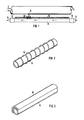
- a medium 2 to be monitored for example an acid
- the device shown here is used to monitor whether the pipeline 4 may have a leak 6 from which the medium 2 escapes into the environment.
- the monitoring device shown essentially comprises a sensor hose 8 laid parallel to the pipeline 4, a pump 10 at one end of this sensor hose 8 and a detector or sensor 12 for a substance to be detected at the other end.
- a transport medium 14 such as cleaned air, is pumped through the sensor tube 8 for a certain time.
- a material 16 is arranged in the vicinity of the sensor tube 8, which reacts in the event of a leak with the medium 2 emerging from the leak 6. It creates a substance 18 which is diffusible with respect to the sensor tube 8 and which can be detected by means of the detector 12.
- the substance 18 can in particular be a gas such as hydrogen.
- the medium 2 to be monitored can in particular be an acid or alkali.
- reaction material 16 can be a coiled wire which is laid parallel to the sensor tube 8.
- the material 16 can in particular be a metal.
- zinc is particularly considered when monitoring an acid pipeline 4.
- the material 16 is preferably in the space between the sensor tube 8 and the pipeline 4 to be monitored.
- the sensor tube 8 can be designed in a known manner as a LEOS tube. It can therefore comprise a wire mesh, for example. Depending on the number of substances or substances to be detected, one or more detectors 12 will be provided.
- FIG. 2 shows an embodiment in which the material 16 is wound on the sensor tube 8 in the form of a wire.
- the wire can be applied in a spiral or helical shape.
- spaced apart metal rings can also be used; the distance of such rings, however, somewhat influences the spatial resolution when the leak 6 is determined.
- an elongated wire can also be laid and fixed parallel to the longitudinal axis of the sensor tube 8.
- FIG. 3 shows an embodiment in which the material 16 is applied to the sensor tube 8 in the form of a film.
- This film 16 has the shape of a half cylinder. It can be seen that a small distance can be provided between the sensor tube 8 and the film 16.
- the produced substance 18 have a particularly good diffusion behavior, so that even small leaks 6 can be detected with sufficient signal security.
Landscapes
- Physics & Mathematics (AREA)
- General Physics & Mathematics (AREA)
- Engineering & Computer Science (AREA)
- Mechanical Engineering (AREA)
- General Engineering & Computer Science (AREA)
- Examining Or Testing Airtightness (AREA)
- Rigid Pipes And Flexible Pipes (AREA)
- Indicating And Signalling Devices For Elevators (AREA)
- Automatic Disk Changers (AREA)
- Devices For Checking Fares Or Tickets At Control Points (AREA)
- Investigating Or Analyzing Materials By The Use Of Magnetic Means (AREA)
Abstract
Description
- Die Erfindung betrifft einen Sensorschlauch, der an einem zu überwachenden Medium verlegbar ist. Die Erfindung findet ihre Hauptanwendung bei der Rohrleitungsüberwachung von Chemieanlagen.
- Aus dem Siemens-Prospekt "Deponie-Langzeitüberwachung mit LEOS", Bestell-Nr. A 19100-U653-A222, Juli 1990, ist eine Einrichtung zum Abdichten einer Mülldeponie sowie zur Leckage-Erkennung und -Ortung bekannt. Dabei ist vorgesehen, daß die Mülldeponie mit einer wasserdichten Folie, Dichtungsbahn oder "Abdichtung" (insbesondere aus Kunststoff) versehen ist. Diese Abdichtung kann unterhalb des Müllkörpers angeordnet sein (Basisabdichtung), damit keine Schadstoffe in das Grundwasser gelangen können. Die Abdichtung kann aber auch oberhalb des Müllkörpers verlegt sein (oberflächenabdichtung), um das Eintreten von Regenwasser und damit das Auswaschen von Schadstoffen aus dem Müll zu verhindern. Um ein Leck, das heißt eine Schadstelle, in dieser Abdichtung frühzeitig zu erkennen, ist bei der bekannten Einrichtung die Verlegung von sogenannten Sensor- oder LEOS-Schläuchen vorgesehen, und zwar auf der vom Müllkörper abgewandten Seite der Abdichtung. LEOS steht hierbei für "Leckage-Erkennungs- und Ortungs-System". Die LEOS-Schläuche, die mäanderförmig verlegt, mit Luft gefüllt und deren Wandung für verschiedene, in der Deponie vorhandene Stoffe durchlässig sind, sind an ein zentrales Überwachungssystem angeschlossen. Bei einer Plazierung der Abdichtung unterhalb des Müllkörpers wird eine Schadstelle darin durch Detektion von im Sickerwasser gelösten Stoffen lokalisiert. Und bei einer Plazierung der Abdichtung oberhalb des Müllkörpers wird eine Schadstelle darin durch Detektion von aufsteigenden Faulgasen lokalisiert.
- Ein LEOS-Schlauch sowie eine Einrichtung, die zu seinem Betrieb dient, sind aus der DE-PS 24 31 907 bekannt. Es handelt sich dabei um einen Schlauch, der für gewisse Stoffe durchlässig ist. Am einen Ende des Schlauches ist eine Pumpe angeordnet. Mit dieser Pumpe werden einzelne Volumina eines Transportmediums, zum Beispiel einzelne Gas- oder speziell Luftvolumina, in zeitlichen Abständen nacheinander durch den Schlauch hindurch befördert. Der Schlauch wird auf diese Weise in regelmäßigen zeitlichen Abständen, das heißt mit gleichbleibender Frequenz, jeweils für eine Zeit lang durchströmt. Am anderen Ende des Schlauches befinden sich für die zu detektierenden Stoffe, beispielsweise Schadstoffe, empfindliche Sensoren. Falls in die Umgebung des Schlauches ein solcher Stoff gelangt, dringt dieser Stoff in den Schlauch ein; er wird mit dem nächsten Pumpvorgang des Transportmediums zu den Sensoren gebracht. Da das Medium dabei mit einer bekannten Geschwindigkeit strömt, läßt sich aus der Differenz zwischen dem Einschaltzeitpunkt der Pumpe und dem Ansprechzeitpunkt der Sensoren genau der Ort bestimmen, an dem zwischen zwei Durchströmungsvorgängen der Stoff in den Schlauch gelangt ist. Außerdem läßt sich die Stoffmenge bestimmen.
- In der nicht-vorveröffentlichten deutschen Patentanmeldung P 41 09 520.0 (Anmeldetag: 30.03.1991) wird ein Element zum Abdichten und Überwachen eines Körpers, insbesondere einer Abfalldeponie, mittels eines Kontrollraums offenbart. Diesem Element liegt die Erkenntnis zugrunde, daß es sinnvoll ist, einen verstärkten Schutz durch eine Doppelbarriere zu schaffen. Dies ist sowohl bei der Basisabdichtung als auch bei der Oberflächenabdichtung einer Deponie zweckmäßig. Das Element beruht weiter auf der Überlegung, daß es auch sinnvoll ist, die Ausgestaltung so vorzunehmen, daß meßtechnisch zu erfassen ist, ob die eine oder andere Barriere ein Leck aufweist und wo dieses Leck gelegen ist. Das Element umfaßt dazu zwei Abdichtungen, die durch Stützelemente voneinander beabstandet angeordnet sind. Dabei ist mindestens ein Kanal zwischen den Abdichtungen und den Stützelementen gebildet, der eine Eintrittsöffnung und eine Austrittsöffnung für ein Medium, wie zum Beispiel Luft, aufweist. Dieser Kanal ist dabei als permeabler LEOS-Schlauch ausgebildet, oder er beinhaltet einen solchen LEOS-Schlauch. An die Austrittsöffnung ist mindestens ein Sensor, zum Beispiel ein Sensor für Flüssigkeitsdampf und zusätzlich ein Sensor für Gas, anschließbar. Die beiden Abdichtungen sind unter Freilassung der Eintritts- und Austrittsöffnung des Kanals an ihren Rändern dicht miteinander verbunden, so daß ein Kontrollraum gebildet ist. Und die Stützelemente bestehen aus einem strömungsdurchlässigen, aber strömungsbehindernden (weitgehend homogenen) Material.
- Das LEOS-Meßverfahren setzt voraus, daß der im Detektor (Sensor) zu detektierende Stoff in ausreichender Konzentration in den Sensorschlauch eindiffundieren kann, und daß er nach dem Transport durch das Transportmedium vom Detektor (Sensor) des Meßsystems angezeigt wird. Dies ist nicht gegeben bei einem Stoff mit kleiner Diffusion. Dies ist auch nicht gegeben bei einer wäßrigen Substanz, also beispielsweise bei der Uberwachung von Laugen, Säuren, Wasser in Fernwärmeleitungen oder in ähnlichen Wassernetzen, bei denen ausschließlich Wasserdampf in den permeablen Schlauch eindiffundiert. Im letzteren Fall ist wegen der normalen Bodenfeuchte ein nicht kontrollierbarer Untergrundeffekt vorhanden, so daß keine ausreichende Nachweissicherheit im Leckage-Fall gegeben ist.
- Der Erfindung liegt die Aufgabe zugrunde, einen Sensorschlauch eingangs genannten Art so auszugestalten, daß er mit erhöhter Diffusion arbeiten kann.
- Die Erfindung beruht auf der Überlegung, daß durch geeignete Maßnahmen mit Hilfe des bei einer Leckage austretenden, zu überwachenden Mediums ein neuer diffusionsfähiger Stoff erzeugt werden kann, der in den Sensorschlauch eindringt und vom Transportmedium zum darauf ansprechenden Detektor oder Sensor mitgenommen wird.
- Die genannte Aufgabe wird demgemäß erfindungsgemäß durch einen Sensorschlauch gelöst, der dadurch gekennzeichnet ist, daß zumindest in seiner Nähe ein Material angeordnet ist, das in Kontakt mit dem zu überwachenden Medium reagiert und dabei einen Stoff erzeugt, der diffusionsfähig und detektierbar ist. fähig und vom Sensor detektierbar ist.
- Dieser diffusionsfähige und detektierbare Stoff kann insbesondere ein Gas, wie beispielsweise Wasserstoff, sein. Zum Nachweis dieses Stoffes stehen geeignete Detektoren zur Verfügung. Wasserstoff dringt auch relativ einfach in die bekannten Sensorschläuche ein.
- Wasserstoff oder ein anderes Gas kann beispielsweise durch Einwirken einer Säure erzeugt werden. Bei dem Material kann es sich insbesondere um ein Metall handeln, das in Form eines Drahtes vorliegt. Es kann neben oder auf dem Sensorschlauch verlegt sein.
- Die Erfindung läßt sich mit besonderem Vorteil bei der Überwachung von Rohrleitungen in Chemieanlagen, insbesondere zur Überwachung von säure- oder laugenführenden Rohren, einsetzen. Sie läßt sich aber auch auf dem Gebiet der Uberwachung von Mülldeponien verwenden. Mit geeigneten Materialien ist nämlich der Nachweis von Wasser in einem Kontrollraum, der sich zwischen zwei der eingangs erwähnten Dichtungsbahnen befindet, auch möglich.
- Weitere vorteilhafte Ausgestaltungen der Erfindung sind in den Unteransprüchen gekennzeichnet.
- Ausführungsbeispiele der Erfindung werden im folgenden anhand von drei Figuren näher erläutert. Es zeigen:
- FIG 1 eine Einrichtung zur Überwachung eines Mediums, bei dem ein Sensorschlauch verwendet wird, für den im Leckagefall ein diffusionsfähiger und detektierbarer Stoff erzeugt wird;
- FIG 2 einen Sensorschlauch mit einem Reaktionsmaterial in Form eines aufgewickelten Metalldrahtes; und
- FIG 3 einen Sensorschlauch mit einem aufgebrachten Reaktionsmaterial in Form einer Folie.
- Nach Figur 1 wird ein zu überwachendes Medium 2, beispielsweise eine Säure, in einer Rohrleitung 4 geführt. Mittels der dargestellten Einrichtung wird hierbei überwacht, ob die Rohrleitung 4 möglicherweise ein Leck 6 aufweist, aus dem das Medium 2 in die Umgebung austritt. Die dargestellte Überwachungseinrichtung umfaßt im wesentlichen einen parallel zur Rohrleitung 4 verlegten Sensorschlauch 8, eine Pumpe 10 an einem Ende dieses Sensorschlauches 8 und einen Detektor oder Sensor 12 für einen nachzuweisenden Stoff am anderen Ende. Mit Hilfe der Pumpe 10 wird ein Transportmedium 14, wie beispielsweise gereinigte Luft, jeweils für eine gewisse Zeit durch den Sensorschlauch 8 gepumpt.
- Wichtig ist nun, daß in der Nähe des Sensorschlauches 8 ein Material 16 angeordnet ist, das bei einer Leckage mit dem aus dem Leck 6 austretenden Medium 2 reagiert. Es erzeugt dabei einen Stoff 18, der bezüglich des Sensorschlauches 8 diffusionsfähig ist und der mittels des Detektors 12 detektierbar ist.
- Bei dem Stoff 18 kann es sich insbesondere um ein Gas wie Wasserstoff handeln. Und das zu überwachende Medium 2 kann insbesondere eine Säure oder Lauge sein.
- In Figur 1 ist gezeigt, daß das Reaktionsmaterial 16 ein gewendelter Draht sein kann, der parallel zum Sensorschlauch 8 verlegt ist. Bei dem Material 16 kann es sich insbesondere um ein Metall handeln. In Verbindung mit der Erzeugung von Wasserstoff kommt bei der Überwachung einer Säure-Rohrleitung 4 insbesondere Zink in Betracht.
- Aus Figur 1 ist auch ersichtlich, daß sich das Material 16 bevorzugt im Raum zwischen dem Sensorschlauch 8 und der zu überwachenden Rohrleitung 4 befindet.
- Der Sensorschlauch 8 kann in bekannter Weise als LEOS-Schlauch ausgebildet sein. Er kann also beispielsweise ein Drahtgeflecht umfassen. Je nach Anzahl der nachzuweisenden Substanzen oder Stoffe wird man einen oder mehrere Detektoren 12 vorsehen.
- Aus Figur 2 ist eine Ausführung ersichtlich, bei der auf dem Sensorschlauch 8 das Material 16 in Form eines Drahtes aufgewickelt ist. Insbesondere kann der Draht spiral- oder wendelförmig aufgebracht sein. Natürlich können auch voneinander beabstandete Metallringe verwendet werden; der Abstand solcher Ringe beeinflußt jedoch etwas die Ortsauflösung bei der Feststellung der Leckstelle 6. Prinzipiell kann auch ein langgestreckter Draht parallel zur Längsachse des Sensorschlauches 8 verlegt und fixiert sein.
- In Figur 3 ist eine Ausführungsform gezeigt, bei der das Material 16 auf dem Sensorschlauch 8 in Form einer Folie aufgebracht ist. Diese Folie 16 hat dabei die Gestalt eines Halbzylinders. Es ist ersichtlich, daß zwischen dem Sensorschlauch 8 und der Folie 16 ein geringer Abstand vorgesehen sein kann.
- Je nach Medium 2 und Material 16 kann der erzeugte Stoff 18 ein besonders gutes Diffusionsverhalten aufweisen, so daß bereits kleine Leckstellen 6 mit ausreichender Signalsicherheit nachgewiesen werden können.
Claims (13)
Applications Claiming Priority (2)
| Application Number | Priority Date | Filing Date | Title |
|---|---|---|---|
| DE4125373 | 1991-07-31 | ||
| DE4125373A DE4125373A1 (de) | 1991-07-31 | 1991-07-31 | Sensorschlauch zur ueberwachung eines mediums |
Publications (2)
| Publication Number | Publication Date |
|---|---|
| EP0525593A1 true EP0525593A1 (de) | 1993-02-03 |
| EP0525593B1 EP0525593B1 (de) | 1995-09-20 |
Family
ID=6437420
Family Applications (1)
| Application Number | Title | Priority Date | Filing Date |
|---|---|---|---|
| EP92112462A Expired - Lifetime EP0525593B1 (de) | 1991-07-31 | 1992-07-21 | Sensorschlauch zur Überwachung eines Mediums |
Country Status (6)
| Country | Link |
|---|---|
| US (1) | US5271901A (de) |
| EP (1) | EP0525593B1 (de) |
| AT (1) | ATE128228T1 (de) |
| DE (2) | DE4125373A1 (de) |
| DK (1) | DK0525593T3 (de) |
| ES (1) | ES2077942T3 (de) |
Cited By (8)
| Publication number | Priority date | Publication date | Assignee | Title |
|---|---|---|---|---|
| WO1997036159A1 (de) * | 1996-03-26 | 1997-10-02 | Siemens Aktiengesellschaft | Einrichtung und verfahren zur leckageerkennung |
| DE10315925A1 (de) * | 2003-04-08 | 2004-10-21 | Ust Umweltsensortechnik Gmbh | Verfahren und Anordnung zur Erkennung von Leckagen an einem gastgefüllten System |
| EP1342998A3 (de) * | 2002-03-08 | 2006-01-18 | UST Umweltsensortechnik GmbH | Verfahren und Anordnung zur Erkennung von Leckagen an einem gasgefüllten System |
| WO2010089605A1 (en) | 2009-02-06 | 2010-08-12 | Reneuron Limited | Treatment of limb ischemia |
| CN103675946A (zh) * | 2013-12-27 | 2014-03-26 | 青岛厚科化学有限公司 | 一种落管式地下埋设物标识系统 |
| CN103712068A (zh) * | 2013-12-27 | 2014-04-09 | 青岛厚科化学有限公司 | 一种套管式地下埋设物无线传输自动预警系统 |
| CN111189592A (zh) * | 2019-11-08 | 2020-05-22 | 江苏法尔胜光电科技有限公司 | 酸性介质输送管道泄漏分布式光纤检测系统及其检测方法 |
| EP3686901A1 (de) | 2009-05-26 | 2020-07-29 | Rapiscan Systems, Inc. | Röntgentomographieprüfverfahren |
Families Citing this family (11)
| Publication number | Priority date | Publication date | Assignee | Title |
|---|---|---|---|---|
| US5573934A (en) * | 1992-04-20 | 1996-11-12 | Board Of Regents, The University Of Texas System | Gels for encapsulation of biological materials |
| US5531357A (en) * | 1994-10-20 | 1996-07-02 | Foamseal, Inc. | Hose containment system |
| DE19536472A1 (de) * | 1995-09-29 | 1997-04-03 | Siemens Ag | Vorrichtung zur Bestimmung von Konzentrationsprovilen flüssiger oder gasförmiger Stoffe längs einer Strecke |
| US5731523A (en) * | 1996-03-22 | 1998-03-24 | Aeroquip Corporation | Hose fatigue indicator |
| DE19612947C1 (de) * | 1996-04-01 | 1997-09-11 | Siemens Ag | Einrichtung und Verfahren zur Leckageerkennung |
| DE10060976B4 (de) | 2000-12-06 | 2005-06-23 | Framatome Anp Gmbh | Vorrichtung zur Leckageerkennung und Leckageortung |
| DE102010005494A1 (de) * | 2009-11-27 | 2011-06-01 | Inficon Gmbh | Verfahren zur Dichtheisprüfung von wasserführenden Komponenten in einem Gehäuse |
| CA3007129C (en) * | 2015-12-04 | 2024-02-27 | Instrumar Limited | Apparatus and method of detecting breaches in pipelines |
| US9823184B1 (en) | 2016-05-13 | 2017-11-21 | General Electric Company | Distributed gas detection system and method |
| US11435252B2 (en) * | 2018-05-01 | 2022-09-06 | Baker Hughes, A Ge Company, Llc | Gas sensor system |
| KR102170028B1 (ko) * | 2018-11-27 | 2020-10-26 | 한국원자력연구원 | 습도센서 센서튜브 및 이를 이용한 습도센서 어셈블리 |
Citations (5)
| Publication number | Priority date | Publication date | Assignee | Title |
|---|---|---|---|---|
| GB1148868A (en) * | 1965-05-25 | 1969-04-16 | Cossonay Cableries Trefileries | Fluid hydrocarbon detecting element |
| US3995472A (en) * | 1975-06-26 | 1976-12-07 | Murgor Electric Company, Inc. | Detector system |
| DE2431907C3 (de) * | 1974-07-03 | 1978-03-09 | Wolfgang Dipl.-Phys. Dr.- Ing. 7500 Karlsruhe Issel | Verfahren und Vorrichtung zur Bestimmung von Konzentrationsprofilen flüssiger oder gasförmiger Stoffe längs einer Strecke |
| DE3321256A1 (de) * | 1983-06-11 | 1984-12-13 | Hochtemperatur-Reaktorbau GmbH, 4600 Dortmund | Leckdetektionseinrichtung fuer den beton-druckbehaelter eines gasgekuehlten kernreaktors |
| DE3736177C1 (de) * | 1987-10-26 | 1988-09-01 | Dietzel Karl | Auf Fluessigkeiten reagierende Leckueberwachungs- und Pruefeinrichtung |
Family Cites Families (7)
| Publication number | Priority date | Publication date | Assignee | Title |
|---|---|---|---|---|
| US3959764A (en) * | 1974-10-09 | 1976-05-25 | Dictaphone Corporation | Gas analyzing element |
| JPS5236290A (en) * | 1975-09-18 | 1977-03-19 | Power Reactor & Nuclear Fuel Dev Corp | Liquid sodium leakage detector |
| DE2952828A1 (de) * | 1978-03-08 | 1980-07-31 | British Gas Corp | Gasspuerelement und verfahren zu seiner herstellung |
| US4709577A (en) * | 1983-11-29 | 1987-12-01 | Tracer Research Corporation | System for continuously monitoring for leaks in underground storage tanks |
| JPS6221034A (ja) * | 1985-07-19 | 1987-01-29 | Junkosha Co Ltd | 漏液検知センサ |
| DE3706869A1 (de) * | 1987-03-04 | 1988-09-15 | Heers & Brockstedt Gmbh | Verfahren zum ueberwachen und gegebenenfalls reparieren von leckagen bei deponien |
| US5046353A (en) * | 1989-01-26 | 1991-09-10 | Tracer Research Corporation | Underground pipe leak detection system |
-
1991
- 1991-07-31 DE DE4125373A patent/DE4125373A1/de not_active Withdrawn
-
1992
- 1992-07-21 EP EP92112462A patent/EP0525593B1/de not_active Expired - Lifetime
- 1992-07-21 AT AT92112462T patent/ATE128228T1/de not_active IP Right Cessation
- 1992-07-21 DK DK92112462.4T patent/DK0525593T3/da active
- 1992-07-21 DE DE59203734T patent/DE59203734D1/de not_active Expired - Fee Related
- 1992-07-21 ES ES92112462T patent/ES2077942T3/es not_active Expired - Lifetime
- 1992-07-29 US US07/921,840 patent/US5271901A/en not_active Expired - Fee Related
Patent Citations (5)
| Publication number | Priority date | Publication date | Assignee | Title |
|---|---|---|---|---|
| GB1148868A (en) * | 1965-05-25 | 1969-04-16 | Cossonay Cableries Trefileries | Fluid hydrocarbon detecting element |
| DE2431907C3 (de) * | 1974-07-03 | 1978-03-09 | Wolfgang Dipl.-Phys. Dr.- Ing. 7500 Karlsruhe Issel | Verfahren und Vorrichtung zur Bestimmung von Konzentrationsprofilen flüssiger oder gasförmiger Stoffe längs einer Strecke |
| US3995472A (en) * | 1975-06-26 | 1976-12-07 | Murgor Electric Company, Inc. | Detector system |
| DE3321256A1 (de) * | 1983-06-11 | 1984-12-13 | Hochtemperatur-Reaktorbau GmbH, 4600 Dortmund | Leckdetektionseinrichtung fuer den beton-druckbehaelter eines gasgekuehlten kernreaktors |
| DE3736177C1 (de) * | 1987-10-26 | 1988-09-01 | Dietzel Karl | Auf Fluessigkeiten reagierende Leckueberwachungs- und Pruefeinrichtung |
Cited By (11)
| Publication number | Priority date | Publication date | Assignee | Title |
|---|---|---|---|---|
| WO1997036159A1 (de) * | 1996-03-26 | 1997-10-02 | Siemens Aktiengesellschaft | Einrichtung und verfahren zur leckageerkennung |
| EP1342998A3 (de) * | 2002-03-08 | 2006-01-18 | UST Umweltsensortechnik GmbH | Verfahren und Anordnung zur Erkennung von Leckagen an einem gasgefüllten System |
| DE10315925A1 (de) * | 2003-04-08 | 2004-10-21 | Ust Umweltsensortechnik Gmbh | Verfahren und Anordnung zur Erkennung von Leckagen an einem gastgefüllten System |
| DE10315925B4 (de) * | 2003-04-08 | 2012-01-05 | Ust Umweltsensortechnik Gmbh | Verfahren und Anordnung zur Erkennung von Leckagen an einem gasgefüllten System |
| WO2010089605A1 (en) | 2009-02-06 | 2010-08-12 | Reneuron Limited | Treatment of limb ischemia |
| EP3686901A1 (de) | 2009-05-26 | 2020-07-29 | Rapiscan Systems, Inc. | Röntgentomographieprüfverfahren |
| CN103675946A (zh) * | 2013-12-27 | 2014-03-26 | 青岛厚科化学有限公司 | 一种落管式地下埋设物标识系统 |
| CN103712068A (zh) * | 2013-12-27 | 2014-04-09 | 青岛厚科化学有限公司 | 一种套管式地下埋设物无线传输自动预警系统 |
| CN103675946B (zh) * | 2013-12-27 | 2017-01-04 | 青岛厚科化学有限公司 | 一种落管式地下埋设物标识系统 |
| CN103712068B (zh) * | 2013-12-27 | 2017-01-04 | 青岛厚科化学有限公司 | 一种套管式地下埋设物无线传输自动预警系统 |
| CN111189592A (zh) * | 2019-11-08 | 2020-05-22 | 江苏法尔胜光电科技有限公司 | 酸性介质输送管道泄漏分布式光纤检测系统及其检测方法 |
Also Published As
| Publication number | Publication date |
|---|---|
| ATE128228T1 (de) | 1995-10-15 |
| ES2077942T3 (es) | 1995-12-01 |
| DE59203734D1 (de) | 1995-10-26 |
| DK0525593T3 (da) | 1996-02-12 |
| US5271901A (en) | 1993-12-21 |
| DE4125373A1 (de) | 1993-02-04 |
| EP0525593B1 (de) | 1995-09-20 |
Similar Documents
| Publication | Publication Date | Title |
|---|---|---|
| EP0525593B1 (de) | Sensorschlauch zur Überwachung eines Mediums | |
| DE2431907B2 (de) | Verfahren und vorrichtung zur bestimmung von konzentrationsprofilen fluessiger oder gasfoermiger stoffe laengs einer strecke | |
| EP0890088B1 (de) | Einrichtung und verfahren zur leckageerkennung | |
| WO1997037205A1 (de) | Einrichtung und verfahren zur leckageerkennung | |
| EP1784602B1 (de) | Sammelleitung zur leckageüberwachung und leckageortung | |
| DE4213585A1 (de) | Überwachungseinrichtung für eine Mülldeponie und Verfahren zur Leckageortung | |
| DE4015190A1 (de) | Flachbodentank und verfahren zur leckueberwachung von flachbodentanks | |
| DE202018101539U1 (de) | Vorrichtung zur Ortung einer Leckage an einem fluidführenden Abschnitt | |
| EP0633460B1 (de) | Einrichtung zur Langzeit-Lecküberwachung an doppelwandigen Gefässsystemen, insbesondere doppelwandigen Tankböden | |
| EP0525594B1 (de) | Verfahren und Einrichtung zur Überwachung eines Mediums mittels eines Sensorschlauches | |
| EP0575441B1 (de) | Element zum abdichten und überwachen eines körpers, insbesondere einer abfalldeponie | |
| WO2002048603A1 (de) | Vorrichtung zur leckageerkennung und leckageortung | |
| WO1997026478A1 (de) | Beton-, steinzeug- oder gussrohr | |
| WO2001053796A1 (de) | Verfahren zur messung der konzentration oder des partialdruckes von gasen, insbesondere sauerstoff, in fluiden und gassensor | |
| DE3417332A1 (de) | Einrichtung zum erkennen von undichtigkeiten insbesondere an rohrleitungen und behaeltnissen | |
| EP0676043A1 (de) | Sensorschläuche | |
| DE19638734A1 (de) | Vorrichtung zur selektiven Detektion und zur Ortung von Leckageflüssigkeiten an Abdichtungssystemen | |
| DE9108467U1 (de) | Element zum gas- und flüssigkeitsdichten Sichern und Überwachen eines Körpers, insbesondere einer Abfalldeponie | |
| DE4123728A1 (de) | Einrichtung zum gas- und fluessigkeitsdichten sichern und ueberwachen eines koerpers, insbesondere einer abfalldeponie, sowie verfahren zum betrieb derselben | |
| DE19610475C1 (de) | Vorrichtung zur Auffindung von Leckagen in Rohren, insbesondere Kanalisationsrohren | |
| DE4134380A1 (de) | Einrichtung zum gas- und fluessigkeitsdichten sichern und ueberwachen eines koerpers, insbesondere einer abfalldeponie | |
| DE19643637A1 (de) | Einrichtung und Verfahren zur Leckageerkennung | |
| WO1983000226A1 (en) | Method and device for continuously monitoring an installation containing a fluid | |
| DE4131085A1 (de) | Einrichtung zum gas- und fluessigkeitsdichten sichern und ueberwachen eines koerpers, insbesondere einer abfalldeponie, sowie verfahren zum betrieb derselben | |
| DE3904577C2 (de) | Fehlerortungsvorrichtung an ummantelten Rohren |
Legal Events
| Date | Code | Title | Description |
|---|---|---|---|
| PUAI | Public reference made under article 153(3) epc to a published international application that has entered the european phase |
Free format text: ORIGINAL CODE: 0009012 |
|
| AK | Designated contracting states |
Kind code of ref document: A1 Designated state(s): AT BE CH DE DK ES FR GB IT LI NL |
|
| 17P | Request for examination filed |
Effective date: 19930308 |
|
| 17Q | First examination report despatched |
Effective date: 19940519 |
|
| GRAA | (expected) grant |
Free format text: ORIGINAL CODE: 0009210 |
|
| AK | Designated contracting states |
Kind code of ref document: B1 Designated state(s): AT BE CH DE DK ES FR GB IT LI NL |
|
| REF | Corresponds to: |
Ref document number: 128228 Country of ref document: AT Date of ref document: 19951015 Kind code of ref document: T |
|
| REF | Corresponds to: |
Ref document number: 59203734 Country of ref document: DE Date of ref document: 19951026 |
|
| REG | Reference to a national code |
Ref country code: ES Ref legal event code: FG2A Ref document number: 2077942 Country of ref document: ES Kind code of ref document: T3 |
|
| ITF | It: translation for a ep patent filed | ||
| ET | Fr: translation filed | ||
| GBT | Gb: translation of ep patent filed (gb section 77(6)(a)/1977) |
Effective date: 19951113 |
|
| REG | Reference to a national code |
Ref country code: DK Ref legal event code: T3 |
|
| PLBE | No opposition filed within time limit |
Free format text: ORIGINAL CODE: 0009261 |
|
| STAA | Information on the status of an ep patent application or granted ep patent |
Free format text: STATUS: NO OPPOSITION FILED WITHIN TIME LIMIT |
|
| 26N | No opposition filed | ||
| PGFP | Annual fee paid to national office [announced via postgrant information from national office to epo] |
Ref country code: GB Payment date: 19970620 Year of fee payment: 6 Ref country code: AT Payment date: 19970620 Year of fee payment: 6 |
|
| PGFP | Annual fee paid to national office [announced via postgrant information from national office to epo] |
Ref country code: ES Payment date: 19970710 Year of fee payment: 6 Ref country code: BE Payment date: 19970710 Year of fee payment: 6 |
|
| PGFP | Annual fee paid to national office [announced via postgrant information from national office to epo] |
Ref country code: NL Payment date: 19970714 Year of fee payment: 6 |
|
| PGFP | Annual fee paid to national office [announced via postgrant information from national office to epo] |
Ref country code: DK Payment date: 19970715 Year of fee payment: 6 |
|
| PGFP | Annual fee paid to national office [announced via postgrant information from national office to epo] |
Ref country code: FR Payment date: 19970718 Year of fee payment: 6 |
|
| PGFP | Annual fee paid to national office [announced via postgrant information from national office to epo] |
Ref country code: DE Payment date: 19970918 Year of fee payment: 6 |
|
| PGFP | Annual fee paid to national office [announced via postgrant information from national office to epo] |
Ref country code: CH Payment date: 19971028 Year of fee payment: 6 |
|
| PG25 | Lapsed in a contracting state [announced via postgrant information from national office to epo] |
Ref country code: GB Free format text: LAPSE BECAUSE OF NON-PAYMENT OF DUE FEES Effective date: 19980721 Ref country code: AT Free format text: LAPSE BECAUSE OF NON-PAYMENT OF DUE FEES Effective date: 19980721 |
|
| PG25 | Lapsed in a contracting state [announced via postgrant information from national office to epo] |
Ref country code: ES Free format text: LAPSE BECAUSE OF THE APPLICANT RENOUNCES Effective date: 19980722 |
|
| PG25 | Lapsed in a contracting state [announced via postgrant information from national office to epo] |
Ref country code: LI Free format text: LAPSE BECAUSE OF NON-PAYMENT OF DUE FEES Effective date: 19980731 Ref country code: DK Free format text: LAPSE BECAUSE OF NON-PAYMENT OF DUE FEES Effective date: 19980731 Ref country code: CH Free format text: LAPSE BECAUSE OF NON-PAYMENT OF DUE FEES Effective date: 19980731 Ref country code: BE Free format text: LAPSE BECAUSE OF NON-PAYMENT OF DUE FEES Effective date: 19980731 |
|
| BERE | Be: lapsed |
Owner name: SIEMENS A.G. Effective date: 19980731 |
|
| PG25 | Lapsed in a contracting state [announced via postgrant information from national office to epo] |
Ref country code: NL Free format text: LAPSE BECAUSE OF NON-PAYMENT OF DUE FEES Effective date: 19990201 |
|
| GBPC | Gb: european patent ceased through non-payment of renewal fee |
Effective date: 19980721 |
|
| REG | Reference to a national code |
Ref country code: CH Ref legal event code: PL |
|
| PG25 | Lapsed in a contracting state [announced via postgrant information from national office to epo] |
Ref country code: FR Free format text: LAPSE BECAUSE OF NON-PAYMENT OF DUE FEES Effective date: 19990331 |
|
| NLV4 | Nl: lapsed or anulled due to non-payment of the annual fee |
Effective date: 19990201 |
|
| PG25 | Lapsed in a contracting state [announced via postgrant information from national office to epo] |
Ref country code: DE Free format text: LAPSE BECAUSE OF NON-PAYMENT OF DUE FEES Effective date: 19990501 |
|
| REG | Reference to a national code |
Ref country code: FR Ref legal event code: ST |
|
| REG | Reference to a national code |
Ref country code: DK Ref legal event code: EBP |
|
| REG | Reference to a national code |
Ref country code: ES Ref legal event code: FD2A Effective date: 20001009 |
|
| PG25 | Lapsed in a contracting state [announced via postgrant information from national office to epo] |
Ref country code: IT Free format text: LAPSE BECAUSE OF NON-PAYMENT OF DUE FEES;WARNING: LAPSES OF ITALIAN PATENTS WITH EFFECTIVE DATE BEFORE 2007 MAY HAVE OCCURRED AT ANY TIME BEFORE 2007. THE CORRECT EFFECTIVE DATE MAY BE DIFFERENT FROM THE ONE RECORDED. Effective date: 20050721 |