EP0528030B1 - Be-13793c-derivat mit antitumorwirkung - Google Patents
Be-13793c-derivat mit antitumorwirkung Download PDFInfo
- Publication number
- EP0528030B1 EP0528030B1 EP91904336A EP91904336A EP0528030B1 EP 0528030 B1 EP0528030 B1 EP 0528030B1 EP 91904336 A EP91904336 A EP 91904336A EP 91904336 A EP91904336 A EP 91904336A EP 0528030 B1 EP0528030 B1 EP 0528030B1
- Authority
- EP
- European Patent Office
- Prior art keywords
- group
- compound
- pharmaceutically acceptable
- iii
- indolo
- Prior art date
- Legal status (The legal status is an assumption and is not a legal conclusion. Google has not performed a legal analysis and makes no representation as to the accuracy of the status listed.)
- Expired - Lifetime
Links
- 0 CC(C(C(C(CCC1)C(CC2NC)C1O)C2C1C2c3cccc(O)c3N(*)CC1)C2C(C)=O)=O Chemical compound CC(C(C(C(CCC1)C(CC2NC)C1O)C2C1C2c3cccc(O)c3N(*)CC1)C2C(C)=O)=O 0.000 description 3
- HGCIXCUEYOPUTN-UHFFFAOYSA-N C1CC=CCC1 Chemical compound C1CC=CCC1 HGCIXCUEYOPUTN-UHFFFAOYSA-N 0.000 description 1
Classifications
-
- C—CHEMISTRY; METALLURGY
- C07—ORGANIC CHEMISTRY
- C07H—SUGARS; DERIVATIVES THEREOF; NUCLEOSIDES; NUCLEOTIDES; NUCLEIC ACIDS
- C07H19/00—Compounds containing a hetero ring sharing one ring hetero atom with a saccharide radical; Nucleosides; Mononucleotides; Anhydro-derivatives thereof
- C07H19/02—Compounds containing a hetero ring sharing one ring hetero atom with a saccharide radical; Nucleosides; Mononucleotides; Anhydro-derivatives thereof sharing nitrogen
- C07H19/04—Heterocyclic radicals containing only nitrogen atoms as ring hetero atom
- C07H19/044—Pyrrole radicals
-
- A—HUMAN NECESSITIES
- A61—MEDICAL OR VETERINARY SCIENCE; HYGIENE
- A61P—SPECIFIC THERAPEUTIC ACTIVITY OF CHEMICAL COMPOUNDS OR MEDICINAL PREPARATIONS
- A61P35/00—Antineoplastic agents
-
- C—CHEMISTRY; METALLURGY
- C07—ORGANIC CHEMISTRY
- C07H—SUGARS; DERIVATIVES THEREOF; NUCLEOSIDES; NUCLEOTIDES; NUCLEIC ACIDS
- C07H19/00—Compounds containing a hetero ring sharing one ring hetero atom with a saccharide radical; Nucleosides; Mononucleotides; Anhydro-derivatives thereof
- C07H19/02—Compounds containing a hetero ring sharing one ring hetero atom with a saccharide radical; Nucleosides; Mononucleotides; Anhydro-derivatives thereof sharing nitrogen
- C07H19/04—Heterocyclic radicals containing only nitrogen atoms as ring hetero atom
- C07H19/23—Heterocyclic radicals containing two or more heterocyclic rings condensed among themselves or condensed with a common carbocyclic ring system, not provided for in groups C07H19/14 - C07H19/22
Definitions
- This invention is useful in the field of medicine, and relates more detailedly to novel BE-13793C (12,13-dihydro-1,11-dihydroxy-5H-indolo[2,3-a]pyrrolo[3,4-c]carbazole-5,7(6H)-dione) derivatives inhibiting proliferation of tumor cells and exerting an antitumor effect, a method for preparation thereof and their use.
- the present inventors widely screened microbial metabolic products, as a result, found a novel antitumor activity-possessing compound BE-13793C (12,13-dihydro-1,11-dihydroxy-5H-indolo[2,3-a]pyrrolo[3,4-c]carbazole-5,7(6H)dione), and disclosed it in the preceding patent application (Japanese Patent Application No. 71149/1989).
- This invention relates to 12,13-dihydro-6H-indolo[2,3-a]pyrrolo[3,4-c]carbazole-5,7(6H)-dione derivatives represented by the following general formula, pharmaceutically acceptable salts thereof, a method for preparation thereof and a use thereof: [wherein R 1 denotes a monosaccharide group having 5 to 7 carbon atoms, and the hydroxyl groups of this monosaccharide group can be replaced by the same or different 1 to 3 groups selected from the group consisting of a hydrogen atom, a lower alkyl group, lower alkylcarbonyloxy group and lower alkoxy group.]
- the monosaccharide group having 5 to 7 carbon atoms means a group obtained by removing an anomeric hydroxyl group from the cyclic form of a saccharide having 5 carbon atoms such as, for example, ribose, arabinose, xylose or lyxose, a saccharide having 6 carbon atoms such as, for example, allose, altrose, glucose, mannose, gulose, idose, galactose or talose, or a saccharide having 7 carbon atoms such as a heptose such as, for example, 7-sedoheptulose.
- a saccharide having 5 carbon atoms such as, for example, ribose, arabinose, xylose or lyxose
- a saccharide having 6 carbon atoms such as, for example, allose, altrose, glucose, mannose, gulose, idose, galactose or talose
- lower means that the carbon number of the group or compound to which this term is attached is 5 or less. Therefore, a lower alkyl group means an alkyl group having 1 to 5 carbon atoms such as, for example, a methyl group, ethyl group, propyl group, isopropyl group, butyl group, isobutyl group, pentyl group or isopentyl group.
- a lower alkylcarbonyloxy group means an alkylcarbonyloxy group having 1 to 5 carbon atoms such as an acetyloxy group, propionyloxy group, isopropionyloxy group, butanoyloxy group, isobutanoyloxy group, pentanoyloxy group or isopentanoyloxy group.
- a lower alkoxy group means an alkoxy group having 1 to 5 carbon atoms such as, for example, a methoxy group, ethoxy group, propoxy group, isopropoxy group, butoxy group, isobutoxy group, pentyloxy group or isopentyloxy group, and a leaving group means a halogen atom such as a chlorine atom, bromine atom or iodine atom, or an alkylsulfonyloxy group or arylsulfonyloxy group such as a methanesulfonyloxy group or toluenesulfonyloxy group.
- a method for preparation of compounds of the present invention is described below.
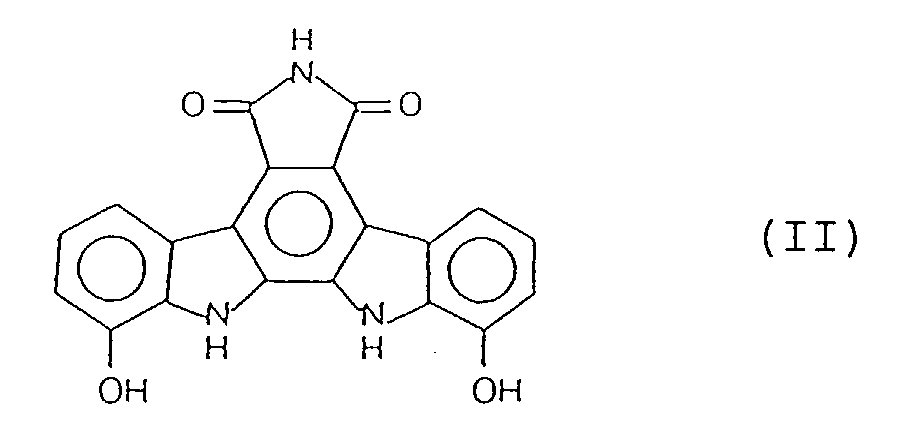
- a compound of this invention is prepared using as a starting raw material substance a novel antitumor substance BE-13793C [12,13-dihydro-1,11-dihydroxy-5H-indolo[2,3-a]pyrrolo[3,4-c]carbazole-5,7(6H)-dione; refer to Japanese Patent Application No. 71543/1990] represented by the following formula and disclosed in the preceding patent application: Namely, a compound of this invention is prepared by carrying out one or more of the following steps:
- the reaction of compound (II) or B-(II) with compound (III) or B-(III) is usually carried out in a solvent which has no bad influence on the reaction, using a suitable base.
- a solvent includes an alcohol such as, for example, methanol, ethanol, propanol or isopropanol, ketones such as, for example, acetone or methyl isobutyl ketone, ethers such as, for example, tetrahydrofuran or dioxane, or an aprotic polar solvent such as, for example, N,N-dimethylformamide, acetonitrile or dimethyl sulfoxide, or a mixed solvent thereof, or a mixed solvent thereof with water.
- a usable suitable base includes an alkali metal carbonate salt such as sodium bicarbonate, potassium bicarbonate, sodium carbonate or potassium carbonate, an alkali metal hydroxide such as sodium hydroxide or potassium hydroxide, an alkali metal hydride such as sodium hydride or lithium hydride, or the like.
- the use amount of the base is equimolar or excessive amount per the raw material compound, and usually 1 to 4 moles.
- the reaction temperature is in the range of 0°C to the boiling point of the solvent, preferably 0°C to 100°C, and the reaction time is not particularly limited, but usually 0.5 to 24 hours.
- an alkanoyl group such as an acetyl group, a methoxymethyl group, a benzyl group or the like is used as a protective group, and particularly, a benzyl group is preferably used.
- a protective group can readily be made by reacting a corresponding halide with compound (II) in the presence of a base, and elimination of such a protective group can readily be made by acid or alkali hydrolysis or ammonolysis on an alkanoyl group and by hydrolysis with an acid catalyst, or the like on a methoxymethyl group, and can readily be made on a benzyl group, for example, by hydrogenation reaction using palladium-carbon as a catalyst.
- a benzyloxymethyl group or the like is preferably used, introduction of this protective group can readily be made by reacting a compound wherein the hydroxyl groups of compound (II) are protected, with a benzyloxymethyl halide in the presence of a base, an elimination of this protective group can readily be made, for example, by carrying out catalytic hydrogenation reaction using palladium-carbon as a catalyst and treating the formed hydroxymethyl compound with concentrated ammonia water.
- an acetyl group is, for example, preferably used, this acetyl compound can readily be obtained by reacting the corresponding saccharide with an acid anhydride such as acetic anhydride in the presence of a base such as, for example, pyridine, and deacetylation can readily be made by reaction with a base such as sodium hydroxide or concentrated ammonia water.
- a base such as sodium hydroxide or concentrated ammonia water.
- a triphenylmethyl group or the like is also preferably used as for a primary hydroxyl group.
- triphenylmethyl group can be made by a usual method well known in this field (refer to the afore-mentioned T. W. Greene, Protective Groups in Organic Chemistry, John Wiley & Sons page 34 to 35).
- Compound (II) a raw material for preparation of compounds of this invention, can be prepared by the process (refer to Reference example) disclosed in the preceding Japanese Patent Application No. 71543/1990, and a compound represented by the general formula (III) or if necessary, compound B-(III) wherein the hydroxyl groups thereof are protected, which is another raw material, can be prepared by converting the anomeric hydroxyl group of a naturally occurred saccharide into a leaving group such as a halogen atom, or by converting a naturally occurred saccharide into a dehydroxyl compound, alkoxy compound, alkanoyl compound or alkyl compound by a well-known chemical process and then converting the anomeric hydroxyl group thereof into a leaving group such as a halogen atom [refer to J. W. Gillard et al., Tetrahedron Letters, 22 , 513-616 (1981)].
- Isolation and purification of the product of the above condensation reaction can be carried out by a method known in this field, for example, by solvent extraction, recrystallization or chromatography.
- step to convert a compound obtained in the above step into a pharmaceutically acceptable salt can be carried out, for example, by applying a technique conventionally used in this field to the free compound prepared by the above preparation process.
- these pharmaceutically acceptable salts are, for example, alkali metal salts such as a sodium salt and a potassium salt, alkaline earth metal salts such as a calcium salt, etc.
- Compounds of this invention represented by the general formula (I) are useful compounds which exhibit an excellent proliferation inhibition activity against various cancer cells and are expected to be used as antitumor agents.
- test compound (20 mg) was dissolved in dimethyl sulfoxide (1 ml) and successively diluted into test solutions.
- DMEM medium containing 10% fetal bovine serum was used for a human gastric cancer cell MKN45 and a human colon cancer cell LS180, and RPMI-160 medium containing 10% fetal bovine serum was used for human lung cancer PC13.
- the compounds of this invention remarkably inhibit proliferation of human gastric cancer cells, colon cancer cells and lung cancer cells, and thus are expected to be clinically usable as antitumor agents.
- oral agents such as, for example, tablets, capsuls, powders, granules or liquids, or sterilized liquid parenteral agents such as, for example, solutions or suspensions.
- Solid preparations can be prepared, as they are, as forms of tablets, capsuls, granules or powders, or can also be prepared using suitable additives.
- additives may be additives usually used, and include saccharides such as, for example, lactose and glucose; starches such as, for example, corn, wheat and rice; fatty acids such as, for example, stearic acid; inorganic salts such as, for example, aluminium magnesium metasilicate and anhydrous calcium phosphate; synthesized polymers such as, for example, polyvinylpyrrolidone and polyalkylene glycol; fatty acid salts such as, for example, calcium stearate and magnesium stearate; alcohols such as, for example, stearyl alcohol and benzyl alcohol; synthesized cellulose derivatives such as, for example, methylcellulose, carboxymethylcellulose, ethylcellulose and hydroxypropylmethylcellulose; and further, water, gelatin, talc, vegetable oils, gum arabic, etc.
- Solid preparations such as these tablets, capsuls, granules and powders contain an effective ingredient generally at 0.1-100 weight %, preferably at 5-100 weight %.
- Liquid preparations are prepared in forms such as suspensions, syrups or injections using suitable additives usually used in liquid preparations such as water, alcohols or oils originated in vegetables such as, for example, soybean oil, peanut oil and sesame oil.
- solvents suitable in case of parenteral administration by intramuscular injection, intravenous injection or subcutaneous injection includes, for example, distilled water for injection, aqueous lidocaine hydrochloride solutions (for intramuscular injection), physiological saline, aqueous glucose solutions, ethanol, liquids for intravenous injection (e.g. aqueous solutions of citric acid and sodium citrate, etc.), electrolyte solutions (for intravenous drip and intravenous injection), etc., and their mixed solvents.
- injections can take such forms that powder itself or to which suitable additives were added is dissolved at the time of use, besides such forms that ingredients are dissolved in advance.
- Such an injection contains usually 0.1-10 weight %, preferably 1-5 weight % of the effective ingredient.
- a liquid agent of a suspension, syrup or the like for oral administration contains 0.5-10 weight % of the effective ingredient.
- the actually preferred dose of the compounds of this invention changes according to the kind of a compound to be used, the kind and application frequency of the compounded composition, the specified site to be treated, hosts and tumors.
- the dose per day and per one adult is 10 to 500 mg in case of oral administration, and 10 to 100 mg per day in case of parenteral administration, preferably intravenous injection.
- the administration frequency varies depending on administration methods and symptoms, but is 1 to 5 times.
- BE-13793C represented by the formula (II), a raw material compound of compounds of this invention, so long as it is capable of producing an antitumor substance BE-13793C, and for example there can be mentioned BA-13793 strain [Fermentation Research Institute, Agency of Industrial Science and Technology, the Ministry of International Trade and Industry (Bikoken); Accession No.: FERM P-10489); This strain was transferred to international deposition and its accession number is FERM BP-2785)].
- a process of preparation of BE-13793C using this strain is, for example, as follows.
- BA-13793 strain cultured on a slant agar medium was inoculated into 100 ml of a medium (pH 6.7) comprising 0.1% glucose, 2.0% dextrin, 1.0% corn gluten meal, 0.5% fish meal, 0.1% yeast extract, 0.1% sodium chloride, 0.05% magnesium sulfate, 0.05% calcium chloride, 0.0002% ferrous sulfate, 0.00004% cupric chloride, 0.00004% manganese chloride, 0.00004% cobalt chloride, 0.00008% zinc sulfate, 0.00008% sodium borate, 0.00024% ammonium molybdate and 0.5% 3-(N-morpholino)propanesulfonic acid in each of four 500-ml culturing Erlenmeyer flasks, and cultured at 28°C for 72 hours on a rotary shaker (180 r.p.m.).
- a medium pH 6.7
- a medium comprising 0.1% glucose, 2.0% dextrin, 1.0%
- 1 ml of the resulted culture broth was inoculated into 100 ml of the above-described medium in each of fifty 500-ml culturing Erlenmeyer flasks, and cultured at 28°C for 120 hours on a rotary shaker (180 r.p.m.).
- the culture broth (about 5 1) was filtered by filtration, the resultant cells were washed with 500 ml of deionized water, and then 2.5 1 of methanol was added to the cells and the mixture was stirred at room temperature for 1 hour. Then methanol extract was obtained by filtration. Methanol extraction was carried out one more time, and the combined methanol extract (about 5 l) was concentrated up to about 800 ml under reduced pressure.
- the resultant concentrate was extracted with 3 1 of ethyl acetate, the ethyl acetate extract was concentrated under reduced pressure, and the resultant residue was washed with 500 ml of chloroform added to give 720 mg of a BE-13793C-containing crude substance.
- This crude substance was dissolved in 2 1 of methanol, the solution was concentrated under reduced pressure to form an orange precipitate, and this was taken to give 546 mg of a BE-13793C-containing substance.
- This invention is useful in the filed of medicine, and more detailedly, relates to novel BE-13793C (12,13-dihydro-1,11-dihydroxy-5H-indolo[2,3-a]pyrrolo[3,4-c]carbazole-5,7(6H)-dione) derivatives which inhibit proliferation of tumor cells and exert an antitumor effect, a process for preparation thereof and a use thereof.
Landscapes
- Chemical & Material Sciences (AREA)
- Organic Chemistry (AREA)
- Health & Medical Sciences (AREA)
- General Health & Medical Sciences (AREA)
- Life Sciences & Earth Sciences (AREA)
- Molecular Biology (AREA)
- Genetics & Genomics (AREA)
- Biotechnology (AREA)
- Biochemistry (AREA)
- Engineering & Computer Science (AREA)
- Veterinary Medicine (AREA)
- Chemical Kinetics & Catalysis (AREA)
- Animal Behavior & Ethology (AREA)
- Pharmacology & Pharmacy (AREA)
- Nuclear Medicine, Radiotherapy & Molecular Imaging (AREA)
- Medicinal Chemistry (AREA)
- General Chemical & Material Sciences (AREA)
- Public Health (AREA)
- Pharmaceuticals Containing Other Organic And Inorganic Compounds (AREA)
- Lubricants (AREA)
- Fats And Perfumes (AREA)
- Transplanting Machines (AREA)
- Nitrogen Condensed Heterocyclic Rings (AREA)
- Heterocyclic Carbon Compounds Containing A Hetero Ring Having Oxygen Or Sulfur (AREA)
Claims (5)
- BE-13793C-Derivate, dargestellt durch die folgende allgemeine Formel oder Salze davon:

- Verfahren zur Herstellung eines BE-13793C-Derivats nach Anspruch 1, dargestellt durch die allgemeine Formel (I) oder eines Salzes davon, umfassend das Durchführen einer oder mehrerer der folgenden Stufen:1) Stufe zur Umsetzung, in Gegenwart einer Base, der Verbindung (BE-13793C), dargestellt durch die allgemeine Formel
R1-Z (III)
in der Z für eine Austrittsgruppe steht und R1 die gleiche Bedeutung wie in Anspruch 1 definiert besitzt, oder einer Verbindung B-(III), wobei eine geeignete Schutzgruppe in R1 der Verbindung (III) eingeführt wurde, und2) Stufe zur Entfernung der Schutzgruppe/der Schutzgruppen und, falls notwendig, Umwandlung der entstehenden Verbindung in ein Salz. - Antitumormittel, enthaltend ein BE-13793C-Derivat nach Anspruch 1 oder ein Salz davon.
- Verfahren zur Herstellung von BE-13793C-Derivaten, dargestellt durch die folgende allgemeine Formel oder eines pharmazeutisch annehmbaren Salzes davon:

umfassend das Durchführen einer oder mehrerer der folgenden Stufen:1) Stufe zur Umsetzung, in Gegenwart einer Base, der Verbindung (BE-13793C), dargestellt durch die allgemeine Formel
R1-Z (III)
in der Z für eine Austrittsgruppe steht und R1 die gleiche Bedeutung wie oben definiert besitzt, oder einer Verbindung B-(III), wobei eine geeignete Schutzgruppe in R1 der Verbindung (III) eingeführt wurde, und2) Stufe zur Entfernung der Schutzgruppe/der Schutzgruppen und, falls notwendig, Umwandlung der entstandenen Verbindung in ein pharmazeutisch annehmbares Salz. - Verfahren zur Herstellung eines Antitumormittels, umfassend das Mischen des BE-13793C-Derivats nach Anspruch 1 oder eines pharmazeutisch annehmbaren Salzes davon mit einem pharmazeutisch annehmbaren Träger und/oder Verdünnungsmittel.
Applications Claiming Priority (3)
| Application Number | Priority Date | Filing Date | Title |
|---|---|---|---|
| JP12229190 | 1990-05-11 | ||
| JP122291/90 | 1990-05-11 | ||
| PCT/JP1991/000214 WO1991018003A1 (fr) | 1990-05-11 | 1991-02-20 | Derive antitumoral de be-13793c |
Publications (3)
| Publication Number | Publication Date |
|---|---|
| EP0528030A1 EP0528030A1 (de) | 1993-02-24 |
| EP0528030A4 EP0528030A4 (en) | 1993-03-24 |
| EP0528030B1 true EP0528030B1 (de) | 1997-09-17 |
Family
ID=14832324
Family Applications (1)
| Application Number | Title | Priority Date | Filing Date |
|---|---|---|---|
| EP91904336A Expired - Lifetime EP0528030B1 (de) | 1990-05-11 | 1991-02-20 | Be-13793c-derivat mit antitumorwirkung |
Country Status (6)
| Country | Link |
|---|---|
| EP (1) | EP0528030B1 (de) |
| JP (1) | JP3064416B2 (de) |
| AT (1) | ATE158298T1 (de) |
| CA (1) | CA2082528C (de) |
| DE (1) | DE69127691T2 (de) |
| WO (1) | WO1991018003A1 (de) |
Families Citing this family (15)
| Publication number | Priority date | Publication date | Assignee | Title |
|---|---|---|---|---|
| US5668271A (en) * | 1991-11-29 | 1997-09-16 | Banyu Pharmaceutical Co., Ltd. | Indolopyrrolocarbazole derivatives |
| US5437996A (en) * | 1992-11-24 | 1995-08-01 | Banyu Pharmaceutical Co., Ltd. | Microtetraspora strain for preparation of indolopyrrolocarbazole derivatives |
| US5591842A (en) * | 1991-11-29 | 1997-01-07 | Banyu Pharmaceutical Co., Ltd. | Indolopyrrolocarbazole derivatives |
| CN1035878C (zh) * | 1992-02-18 | 1997-09-17 | 万有制药株式会社 | 吲哚并吡咯并咔唑衍生物 |
| CA2130836A1 (en) * | 1992-03-20 | 1993-09-30 | Martin J. Slater | Further indole derivatives with antiviral activity |
| DE4217964A1 (de) * | 1992-05-30 | 1993-12-02 | Goedecke Ag | Indolocarbazol-Imide und deren Verwendung |
| US5804564A (en) * | 1994-05-09 | 1998-09-08 | Banyu Pharmaceutical Co., Ltd. | Antitumor indolopyrrolocarbazole derivatives |
| EP0760375B1 (de) | 1994-05-09 | 2003-11-26 | Banyu Pharmaceutical Co., Ltd. | Antitumor-indolopyrolocarbazolderivat |
| WO1995030682A1 (en) * | 1994-05-09 | 1995-11-16 | Banyu Pharmaceutical Co., Ltd. | Antitumor indolopyprolocarbazole derivative |
| US5922860A (en) * | 1994-05-09 | 1999-07-13 | Banyu Pharmaceutical Co., Ltd. | Antitumor indolopyrrolocarbazole derivatives |
| JP3707075B2 (ja) * | 1994-06-13 | 2005-10-19 | 萬有製薬株式会社 | グリコシルトランスフェラーゼをコードする遺伝子及びその用途 |
| JP3536574B2 (ja) | 1997-02-28 | 2004-06-14 | 萬有製薬株式会社 | 抗腫瘍性インドロピロロカルバゾール誘導体 |
| GB9811624D0 (en) * | 1998-05-29 | 1998-07-29 | Merck Sharp & Dohme | Therapeutic use |
| US6703373B1 (en) | 1999-09-10 | 2004-03-09 | Banyu Pharmaceutical Co., Ltd. | Indolopyrrolocarbazole derivatives and antitumor agents |
| EP1666485A1 (de) * | 2003-09-16 | 2006-06-07 | Banyu Pharmaceutical Co., Ltd. | Neues indolopyrrolocarbazolderivat mit antitumorwirkung |
Family Cites Families (2)
| Publication number | Priority date | Publication date | Assignee | Title |
|---|---|---|---|---|
| US4785085A (en) * | 1986-11-21 | 1988-11-15 | Bristol-Myers Company | Rebeccamycin analogs |
| JP3010675B2 (ja) * | 1989-03-23 | 2000-02-21 | 萬有製薬株式会社 | 抗腫瘍性物質be―13793c |
-
1991
- 1991-02-20 EP EP91904336A patent/EP0528030B1/de not_active Expired - Lifetime
- 1991-02-20 AT AT91904336T patent/ATE158298T1/de not_active IP Right Cessation
- 1991-02-20 WO PCT/JP1991/000214 patent/WO1991018003A1/ja not_active Ceased
- 1991-02-20 JP JP3504280A patent/JP3064416B2/ja not_active Expired - Fee Related
- 1991-02-20 DE DE69127691T patent/DE69127691T2/de not_active Expired - Fee Related
- 1991-02-20 CA CA002082528A patent/CA2082528C/en not_active Expired - Fee Related
Non-Patent Citations (1)
| Title |
|---|
| JOURNAL OF ORGANIC CHEMISTRY, vol. 54, no. 4, 1989; pp. 824-828 * |
Also Published As
| Publication number | Publication date |
|---|---|
| EP0528030A4 (en) | 1993-03-24 |
| DE69127691T2 (de) | 1998-01-15 |
| ATE158298T1 (de) | 1997-10-15 |
| DE69127691D1 (de) | 1997-10-23 |
| CA2082528C (en) | 2001-03-13 |
| WO1991018003A1 (fr) | 1991-11-28 |
| JP3064416B2 (ja) | 2000-07-12 |
| CA2082528A1 (en) | 1991-11-12 |
| EP0528030A1 (de) | 1993-02-24 |
Similar Documents
| Publication | Publication Date | Title |
|---|---|---|
| CA2082528C (en) | Antitumor substance be-13793c derivatives | |
| JPWO1991018003A1 (ja) | 抗腫瘍性物質be―13793c誘導体 | |
| US5536827A (en) | Method for preparing antitumor substance BE-13793C derivatives | |
| EP0089812B1 (de) | N-Substituierte Pseudo-aminozucker, ihre Herstellung und Verwendung | |
| EP0602597B1 (de) | Verfahren zur Herstellung von Indolopyrrolocarbazolderivaten | |
| EP0339681B1 (de) | Antibiotische Substanz mit Antitumorwirkung | |
| US5643760A (en) | Microbial process for preparation of indolopyrrolocarbazole derivatives | |
| US4826964A (en) | Bridged oxygen analogs of daunorubcin and doxorubicin | |
| US4303785A (en) | Antitumor anthracycline antibiotics | |
| EP0045474B1 (de) | Anthracyclin-Derivate | |
| CA1185967A (en) | Anthracycline derivatives | |
| US5374711A (en) | Chemical modification of 2"-amino group in elsamicin a | |
| Baker et al. | An evaluation of certain chain-extended analogs of 9-. beta.-D-arabinofuranosyladenine for antiviral and cardiovascular activity | |
| EP0760375B1 (de) | Antitumor-indolopyrolocarbazolderivat | |
| CA2533384A1 (en) | Indolopyrrolocarbazole derivative and antitumor agent | |
| CN112920242B (zh) | 一种苯并咪唑衍生物bi292及其制备方法和应用 | |
| HU210499B (en) | Process for preparing 6-o-alkylelsamicin a deriv.s and pharmaceutical compn.s contg. them | |
| US5237055A (en) | Chemical modification of 2"-amino group in elsamicin A | |
| JPH05271271A (ja) | シアル酸結合5−デアザフラビン系化合物 | |
| JPH05163292A (ja) | 3’及び/又は4’位の水酸基を化学修飾したエルサマイシンa誘導体の製造法 | |
| WO1998022612A1 (en) | Novel antitumor compounds and use thereof | |
| HU196964B (en) | Process for producing amino-nitro-pyridine derivatives | |
| JP2701069B2 (ja) | 抗腫瘍性アントラサイクリン系化合物 | |
| JPS61143394A (ja) | 新マクロライド誘導体 | |
| Seela et al. | DIDEOXY-D-GLYCERO-PENTOFURANOSYL CHLORIDE |
Legal Events
| Date | Code | Title | Description |
|---|---|---|---|
| PUAI | Public reference made under article 153(3) epc to a published international application that has entered the european phase |
Free format text: ORIGINAL CODE: 0009012 |
|
| 17P | Request for examination filed |
Effective date: 19921111 |
|
| AK | Designated contracting states |
Kind code of ref document: A1 Designated state(s): AT BE CH DE DK ES FR GB GR IT LI LU NL SE |
|
| A4 | Supplementary search report drawn up and despatched |
Effective date: 19930203 |
|
| AK | Designated contracting states |
Kind code of ref document: A4 Designated state(s): AT BE CH DE DK ES FR GB GR IT LI LU NL SE |
|
| 17Q | First examination report despatched |
Effective date: 19950714 |
|
| GRAG | Despatch of communication of intention to grant |
Free format text: ORIGINAL CODE: EPIDOS AGRA |
|
| GRAH | Despatch of communication of intention to grant a patent |
Free format text: ORIGINAL CODE: EPIDOS IGRA |
|
| GRAH | Despatch of communication of intention to grant a patent |
Free format text: ORIGINAL CODE: EPIDOS IGRA |
|
| GRAA | (expected) grant |
Free format text: ORIGINAL CODE: 0009210 |
|
| AK | Designated contracting states |
Kind code of ref document: B1 Designated state(s): AT BE CH DE DK ES FR GB GR IT LI LU NL SE |
|
| PG25 | Lapsed in a contracting state [announced via postgrant information from national office to epo] |
Ref country code: CH Effective date: 19970917 Ref country code: LI Effective date: 19970917 Ref country code: GR Free format text: LAPSE BECAUSE OF FAILURE TO SUBMIT A TRANSLATION OF THE DESCRIPTION OR TO PAY THE FEE WITHIN THE PRESCRIBED TIME-LIMIT Effective date: 19970917 Ref country code: AT Effective date: 19970917 Ref country code: ES Free format text: THE PATENT HAS BEEN ANNULLED BY A DECISION OF A NATIONAL AUTHORITY Effective date: 19970917 Ref country code: DK Free format text: LAPSE BECAUSE OF NON-PAYMENT OF DUE FEES Effective date: 19970917 Ref country code: BE Effective date: 19970917 Ref country code: NL Free format text: LAPSE BECAUSE OF FAILURE TO SUBMIT A TRANSLATION OF THE DESCRIPTION OR TO PAY THE FEE WITHIN THE PRESCRIBED TIME-LIMIT Effective date: 19970917 |
|
| REF | Corresponds to: |
Ref document number: 158298 Country of ref document: AT Date of ref document: 19971015 Kind code of ref document: T |
|
| REG | Reference to a national code |
Ref country code: CH Ref legal event code: EP |
|
| ITF | It: translation for a ep patent filed | ||
| REF | Corresponds to: |
Ref document number: 69127691 Country of ref document: DE Date of ref document: 19971023 |
|
| PG25 | Lapsed in a contracting state [announced via postgrant information from national office to epo] |
Ref country code: SE Effective date: 19971217 |
|
| ET | Fr: translation filed | ||
| PG25 | Lapsed in a contracting state [announced via postgrant information from national office to epo] |
Ref country code: LU Free format text: LAPSE BECAUSE OF NON-PAYMENT OF DUE FEES Effective date: 19980220 |
|
| NLV1 | Nl: lapsed or annulled due to failure to fulfill the requirements of art. 29p and 29m of the patents act | ||
| REG | Reference to a national code |
Ref country code: CH Ref legal event code: PL |
|
| PLBE | No opposition filed within time limit |
Free format text: ORIGINAL CODE: 0009261 |
|
| STAA | Information on the status of an ep patent application or granted ep patent |
Free format text: STATUS: NO OPPOSITION FILED WITHIN TIME LIMIT |
|
| 26N | No opposition filed | ||
| REG | Reference to a national code |
Ref country code: GB Ref legal event code: IF02 |
|
| PG25 | Lapsed in a contracting state [announced via postgrant information from national office to epo] |
Ref country code: IT Free format text: LAPSE BECAUSE OF NON-PAYMENT OF DUE FEES;WARNING: LAPSES OF ITALIAN PATENTS WITH EFFECTIVE DATE BEFORE 2007 MAY HAVE OCCURRED AT ANY TIME BEFORE 2007. THE CORRECT EFFECTIVE DATE MAY BE DIFFERENT FROM THE ONE RECORDED. Effective date: 20050220 |
|
| PGFP | Annual fee paid to national office [announced via postgrant information from national office to epo] |
Ref country code: GB Payment date: 20070214 Year of fee payment: 17 |
|
| PGFP | Annual fee paid to national office [announced via postgrant information from national office to epo] |
Ref country code: DE Payment date: 20070215 Year of fee payment: 17 |
|
| PGFP | Annual fee paid to national office [announced via postgrant information from national office to epo] |
Ref country code: FR Payment date: 20070228 Year of fee payment: 17 Ref country code: IT Payment date: 20070424 Year of fee payment: 17 |
|
| PGRI | Patent reinstated in contracting state [announced from national office to epo] |
Ref country code: IT Effective date: 20080301 |
|
| GBPC | Gb: european patent ceased through non-payment of renewal fee |
Effective date: 20080220 |
|
| REG | Reference to a national code |
Ref country code: FR Ref legal event code: ST Effective date: 20081031 |
|
| PG25 | Lapsed in a contracting state [announced via postgrant information from national office to epo] |
Ref country code: DE Free format text: LAPSE BECAUSE OF NON-PAYMENT OF DUE FEES Effective date: 20080902 |
|
| PG25 | Lapsed in a contracting state [announced via postgrant information from national office to epo] |
Ref country code: FR Free format text: LAPSE BECAUSE OF NON-PAYMENT OF DUE FEES Effective date: 20080229 |
|
| PG25 | Lapsed in a contracting state [announced via postgrant information from national office to epo] |
Ref country code: GB Free format text: LAPSE BECAUSE OF NON-PAYMENT OF DUE FEES Effective date: 20080220 |
|
| PGRI | Patent reinstated in contracting state [announced from national office to epo] |
Ref country code: IT Effective date: 20080301 |