EP0528443A2 - Dispositif pour la réception dans des véhicules d'ondes radio du domaine VHF - Google Patents
Dispositif pour la réception dans des véhicules d'ondes radio du domaine VHF Download PDFInfo
- Publication number
- EP0528443A2 EP0528443A2 EP92115650A EP92115650A EP0528443A2 EP 0528443 A2 EP0528443 A2 EP 0528443A2 EP 92115650 A EP92115650 A EP 92115650A EP 92115650 A EP92115650 A EP 92115650A EP 0528443 A2 EP0528443 A2 EP 0528443A2
- Authority
- EP
- European Patent Office
- Prior art keywords
- phase
- signal
- circuit
- output
- signals
- Prior art date
- Legal status (The legal status is an assumption and is not a legal conclusion. Google has not performed a legal analysis and makes no representation as to the accuracy of the status listed.)
- Granted
Links
Images


Classifications
-
- H—ELECTRICITY
- H04—ELECTRIC COMMUNICATION TECHNIQUE
- H04B—TRANSMISSION
- H04B7/00—Radio transmission systems, i.e. using radiation field
- H04B7/02—Diversity systems; Multi-antenna system, i.e. transmission or reception using multiple antennas
- H04B7/04—Diversity systems; Multi-antenna system, i.e. transmission or reception using multiple antennas using two or more spaced independent antennas
- H04B7/08—Diversity systems; Multi-antenna system, i.e. transmission or reception using multiple antennas using two or more spaced independent antennas at the receiving station
- H04B7/0837—Diversity systems; Multi-antenna system, i.e. transmission or reception using multiple antennas using two or more spaced independent antennas at the receiving station using pre-detection combining
- H04B7/084—Equal gain combining, only phase adjustments
-
- H—ELECTRICITY
- H04—ELECTRIC COMMUNICATION TECHNIQUE
- H04B—TRANSMISSION
- H04B7/00—Radio transmission systems, i.e. using radiation field
- H04B7/02—Diversity systems; Multi-antenna system, i.e. transmission or reception using multiple antennas
- H04B7/04—Diversity systems; Multi-antenna system, i.e. transmission or reception using multiple antennas using two or more spaced independent antennas
- H04B7/08—Diversity systems; Multi-antenna system, i.e. transmission or reception using multiple antennas using two or more spaced independent antennas at the receiving station
- H04B7/0837—Diversity systems; Multi-antenna system, i.e. transmission or reception using multiple antennas using two or more spaced independent antennas at the receiving station using pre-detection combining
- H04B7/0842—Weighted combining
- H04B7/0848—Joint weighting
- H04B7/0851—Joint weighting using training sequences or error signal
-
- H—ELECTRICITY
- H04—ELECTRIC COMMUNICATION TECHNIQUE
- H04B—TRANSMISSION
- H04B7/00—Radio transmission systems, i.e. using radiation field
- H04B7/02—Diversity systems; Multi-antenna system, i.e. transmission or reception using multiple antennas
- H04B7/04—Diversity systems; Multi-antenna system, i.e. transmission or reception using multiple antennas using two or more spaced independent antennas
- H04B7/08—Diversity systems; Multi-antenna system, i.e. transmission or reception using multiple antennas using two or more spaced independent antennas at the receiving station
- H04B7/0837—Diversity systems; Multi-antenna system, i.e. transmission or reception using multiple antennas using two or more spaced independent antennas at the receiving station using pre-detection combining
- H04B7/0842—Weighted combining
- H04B7/0848—Joint weighting
- H04B7/0857—Joint weighting using maximum ratio combining techniques, e.g. signal-to- interference ratio [SIR], received signal strenght indication [RSS]
Definitions
- the property right is a new circuit arrangement according to the type of the main claim.
- the object of the present invention is to further improve the reception of radio signals in VHF ranges in vehicles.
- the use of two directional antennas has also been known for many years as space diversity reception from radio transmission in the GHz range.
- the two parabolic antennas are arranged stationary at a certain distance from each other and aligned to the same transmitter (EP 01 28 812 AZ).
- Directional antennas according to the previously known constructions are obviously not suitable as antennas for motor vehicles and therefore come for the solution of the above. Task out of the question.
- signals received by antennas 1 and 2 pass through pre-circuits 3 and 4 to mixers 5 and 6, where they are mixed with a carrier generated by oscillator 7.
- a carrier generated by oscillator 7. information and parts which relate to the signal from the antennas 1 are provided with the index A, while the index B indicates the signal from the antenna 2.
- the oscillator 7 and the pre-circuits 3 and 4 are tuned in a manner known per se with the aid of the PLL circuit 8, which in turn is controlled by a microcomputer 9 which is connected to control elements 10 and displays 11.
- the output signals of mixers 5 and 6 (hereinafter referred to as mixed signals) are each fed via a controllable phase shifter 12 and 13 to an adder 14, which vectorially adds the mixed signals and forwards the sum signal to the IF amplifier.
- the output signal of the IF amplifier 15 is then demodulated in a manner known per se by means of an FM demodulator 16 and fed to a stereo demodulator 17.
- the LF signal can then be taken from node 23 for further amplification and reproduction.
- a limited IF signal is fed to the FM demodulator and an unlimited IF signal to an AM demodulator 18 for carrying out the method according to the invention.
- the AM demodulator 18 is used to measure the amplitude of the IF signal and thus indirectly to measure the field strength, which is the basis of the antenna signal received in each case.
- the circuits 5, 6 and 12 to 14 are shown in more detail. Since the mixers 5 and 6 are known per se, only the push-pull output transformers 25, 26, two resistors 27, 28 for the primary-side voltage supply and a filter capacitor 29 were shown in more detail.
- a transistor 30, 31 is used as an impedance converter, each with a load resistor 32, 33.
- a voltage divider from the resistors 34, 35 is used, which between the positive operating voltage and ground potential supplied at 36 is switched. Furthermore, a positive operating voltage supplied at 37 is blocked by a capacitor 38.
- the phase shifters 12 and 13 are supplied with digital control signals via the inputs 41 to 48.
- the phase rotation is brought about by controllable delay lines, each of which has a signal transit time of 4 to approx. 52 ns.
- the phase of the mixed signals can be adjusted in stages by selecting the binary default value.
- the phase-shifted mixed signals are then available at the outputs 49 and 50 of the phase shifters 12 and 13. The amount of the vectorial difference of these signals is then amplified in the operational amplifier 51.
- Digitally controllable delay lines available on the market such as those sold by Data Delay Devices Inc, USA, under the name PDU-1316, can be used as phase rotators 12, 13.
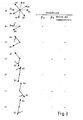
- the IF components A and B of the mixed signals are each shown in four different phase positions, which are achieved by correspondingly controlling the phase rotating elements 12 and 13.
- the representation presupposes in-phase antenna signals, so that the signals A and B are phase-shifted by 180 degrees with the same setting of the phase rotating elements 12 and 13. It is assumed that the signals A2 and B4 are forwarded to the adder 14 at the moment shown. The other signals are therefore shown in dashed lines.
- the microcomputer 9 (FIG. 1) checks whether a better reception can be achieved with a different setting.
- the phase shifter 12 is influenced, as shown in line b). Instead of signal A2, signal A1 is passed to adder 14. The phase of signal A is thus rotated in the positive direction. As can be seen from the arrowheads moving closer together, the magnitude of the sum vector and thus the amplitude of the IF signal become smaller. This is communicated to the computer via the AM demodulator 18, the sample and hold circuit 19 and the analog-to-digital converter 21 (FIG. 1). Then he changes the direction of the switching of the phase rotator 12, so that the conditions shown in line c) result. The amount of the sum vector has risen again.
- the microcomputer 9 checks from time to time whether this setting still leads to an optimal reception result. If the signals received by the antennas 1 and 2 then have a different delay time difference, the phase rotators 12 and 13 are automatically set differently. In order to avoid incorrect control, several "field strength" measurements lead to phase switching.
- phase shifters which permit a continuous change in the transit time - that is, the phase relationship of the mixed signals with one another. This change must not take place too quickly, otherwise interference in the LF signal will occur.
- the microprocessor 9 controls the transit time of one of the mixed signals or both mixed signals in a similar manner as was explained in connection with FIG. 3.
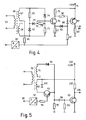
- phase rotators examples are shown in FIGS. 4 and 5.
- the signal to be rotated in phase is fed to the circuit arrangement according to FIG. 4 via the input 65 and an input transformer 66 which has two bifilar secondary windings 67, 68.
- 3 RC elements are used for phase rotation, each consisting of a resistor 69, 70 and 71 and a capacitance variation diode 72, 73 and 74.
- the signal which is rotated in phase or changed in its transit time is taken from the connection point 75 between the resistor 70 and the capacitance variation diode 73 and fed to a field effect transistor 76.
- Both the sources and the drain electrode of the field effect transistor are connected to ground potential or the positive pole 79 of the operating voltage source via load resistors 77, 78.
- the antiphase signals thus generated are fed via a further RC element consisting of the resistor 80 and the capacitance variation diode 81 to the transistor 82 serving as an output stage, the emitter of which is connected to the positive pole 79 of the operating voltage source and the collector of which is connected to ground potential via a load resistor 83 .
- the collector of transistor 82 serves as output 84 of the circuit according to FIG. 4.
- the voltage for controlling the running time is followed by the microprocessor 9 (FIG. 1) via a D / A converter 85 and via the two resistors 86 and 87 of the circuit Fig. 4 supplied.
- the resistors 86 and 87 are dimensioned so large (for example 100 kOhm) that an all too sudden change in the running time of the circuit arrangement according to FIG. 4 is prevented.
- a coupling capacitor 88 is connected between the capacitance variation diode 81 and the base of the transistor 82.
- a phase shift of 180 degrees can be achieved with the circuit arrangement according to FIG.
- the mixed signal is also supplied via an input transformer 90 with a bifilar secondary winding 91, 92.
- a transistor 93 serves simultaneously as a variable resistor and to control the capacitance variation diode 94.
- the resistor 95 serves as a load resistor.
- the base of the transistor 93 is supplied with the control voltage output by the D / A converter 97 via a further resistor 96.
- the D / A converter 97 receives corresponding digital signals via the input 98 from the microprocessor 9.
- the control electrode of a field effect transistor 99 which together with the load resistor 100 serves as an output stage, is connected via a coupling capacitor 98.
- a resistor 101 connects the control electrode of the field effect transistor 99 to ground potential.
- the operating voltage is supplied at node 102 and blocked by a capacitor 103.
- the drain electrode of the field effect transistor 99 forms the output 104 of the circuit according to FIG. 6.
- any phase difference between the two antenna signals can be compensated for. This corresponds to a total phase rotation of 360 degrees, with each of the two controllable phase rotators 12, 13 having a range of 180 degrees in FIG. 1.
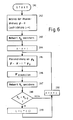
- FIG. 6 shows a flow chart for a program according to which the microcomputer 9 makes the settings described.
- the amount of phase rotation is set to 0 degrees and the direction of travel - that is, the sign of the next change to be made to the phase rotation - is specified.
- the measurement value M n supplied to the microcomputer by the A / D converter 21 (FIG. 1) is stored (program part 143).
- the index n is then increased by 1 at 144.
- the phase rotation is then increased in the program part 145 by an incremental amount PHI R.
- the size of this angle depends on the required resolution of the phase shift.
- a value of 5.6 degrees has proven itself in practice, for which purpose a bit width of 4 is required for the value to be output by the microcomputer 9 to the D / A converter 132. This setting is effected by outputting the corresponding binary number to the D / A converter (146).
- a new measured value M n is then recorded and compared with the previous measured value M n - 1 . If the new measured value is smaller, the direction of travel is changed at 149 and the process is continued via 150. However, if the new measured value is larger, the program continues from branch 148 without change or direction of travel.
Landscapes
- Engineering & Computer Science (AREA)
- Computer Networks & Wireless Communication (AREA)
- Signal Processing (AREA)
- Variable-Direction Aerials And Aerial Arrays (AREA)
- Circuits Of Receivers In General (AREA)
- Input Circuits Of Receivers And Coupling Of Receivers And Audio Equipment (AREA)
- Burglar Alarm Systems (AREA)
Applications Claiming Priority (3)
| Application Number | Priority Date | Filing Date | Title |
|---|---|---|---|
| DE3510580 | 1985-03-23 | ||
| DE19853510580 DE3510580A1 (de) | 1985-03-23 | 1985-03-23 | Verfahren und schaltungsanordnung zur verbesserung des empfangs von radiowellen |
| EP86103325A EP0199058B1 (fr) | 1985-03-23 | 1986-03-12 | Procédé et montage pour l'amélioration de la réception d'ondes radio |
Related Parent Applications (1)
| Application Number | Title | Priority Date | Filing Date |
|---|---|---|---|
| EP86103325.6 Division | 1986-03-12 |
Publications (3)
| Publication Number | Publication Date |
|---|---|
| EP0528443A2 true EP0528443A2 (fr) | 1993-02-24 |
| EP0528443A3 EP0528443A3 (en) | 1993-05-05 |
| EP0528443B1 EP0528443B1 (fr) | 1996-01-17 |
Family
ID=6266123
Family Applications (2)
| Application Number | Title | Priority Date | Filing Date |
|---|---|---|---|
| EP86103325A Expired - Lifetime EP0199058B1 (fr) | 1985-03-23 | 1986-03-12 | Procédé et montage pour l'amélioration de la réception d'ondes radio |
| EP92115650A Expired - Lifetime EP0528443B1 (fr) | 1985-03-23 | 1986-03-12 | Dispositif pour la réception dans des véhicules d'ondes radio du domaine VHF |
Family Applications Before (1)
| Application Number | Title | Priority Date | Filing Date |
|---|---|---|---|
| EP86103325A Expired - Lifetime EP0199058B1 (fr) | 1985-03-23 | 1986-03-12 | Procédé et montage pour l'amélioration de la réception d'ondes radio |
Country Status (3)
| Country | Link |
|---|---|
| EP (2) | EP0199058B1 (fr) |
| AT (2) | ATE91054T1 (fr) |
| DE (3) | DE3510580A1 (fr) |
Families Citing this family (19)
| Publication number | Priority date | Publication date | Assignee | Title |
|---|---|---|---|---|
| JPS62143527A (ja) * | 1985-12-18 | 1987-06-26 | Nec Corp | 同相合成方式 |
| DE3634439A1 (de) * | 1986-10-09 | 1988-04-14 | Blaupunkt Werke Gmbh | Verfahren und schaltungsanordnung zum empfang von radiowellen |
| DE3644087A1 (de) * | 1986-12-23 | 1988-07-07 | Sennheiser Electronic | Antennendiversity-verfahren |
| DE3836046A1 (de) | 1987-10-31 | 1989-05-11 | Hirschmann Radiotechnik | Empfangsverfahren und empfangs-antennensystem zur durchfuehrung des verfahrens |
| DE3741698A1 (de) * | 1987-12-09 | 1989-06-29 | Blaupunkt Werke Gmbh | Empfaenger fuer radiowellen mit mehreren antennen |
| DE3814900A1 (de) * | 1988-05-03 | 1989-11-23 | Hirschmann Richard Gmbh Co | Empfangsverfahren und empfangs-antennensystem fuer mobilen empfang |
| DE3821714A1 (de) * | 1988-06-28 | 1990-01-04 | Telefunken Electronic Gmbh | Fernsehtuner |
| DE3825265A1 (de) * | 1988-07-26 | 1990-02-01 | Deutsche Bundespost | Verfahren zum erlangen von netzkenntnissen eines digitalen uebertragungsnetzes |
| DE3926336C2 (de) * | 1989-08-09 | 2001-03-29 | Heinz Lindenmeier | Antennendiversity-Empfangsanlage zur Elimination von Empfangsstörungen beim mobilen Empfang von Fernsehsignalen |
| JP2728547B2 (ja) * | 1990-06-13 | 1998-03-18 | 株式会社日立製作所 | ダイバシティ受信装置 |
| DE4105599C1 (en) * | 1991-02-22 | 1992-09-17 | Blaupunkt-Werke Gmbh, 3200 Hildesheim, De | Diversity device for VHF car radio having several antennae - synchronises oscillator to antenna noise signals in mixer using automatic search stage and converts output of adder to carry frequency |
| DE4129830A1 (de) * | 1991-09-07 | 1993-03-25 | Blaupunkt Werke Gmbh | Ukw-empfaenger mit mehreren antennen |
| DE4130784A1 (de) * | 1991-09-16 | 1993-03-25 | Hirschmann Richard Gmbh Co | Eichverfahren zum automatischen abgleich von diversity-systemen |
| US5321850A (en) * | 1991-10-09 | 1994-06-14 | Telefonaktiebolaget L M Ericsson | Diversity radio receiver automatic frequency control |
| DE19831928A1 (de) * | 1998-07-16 | 2000-02-03 | Grundig Ag | Einrichtung zum Empfang mehrerer Rundfunksignale |
| DE19925868B4 (de) * | 1999-06-07 | 2004-10-21 | Microtune Gmbh & Co. Kg | Diversity-TV-Empfangssystem |
| DE102004002481A1 (de) | 2004-01-17 | 2005-08-11 | Robert Bosch Gmbh | Funkempfangssystem mit zwei Empfangsantennen und zwei daran angeschlossenen Empfängern |
| DE102004045109A1 (de) * | 2004-09-17 | 2006-03-23 | Robert Bosch Gmbh | Verfahren zum mobilen Empfangen eines, insbesondere frequenzmodulierten, Funksignals und Funkempfänger-Schaltung hierfür |
| DE102007039914A1 (de) * | 2007-08-01 | 2009-02-05 | Lindenmeier, Heinz, Prof. Dr. Ing. | Antennendiversityanlage mit zwei Antennen für den Funkempfang in Fahrzeugen |
Family Cites Families (3)
| Publication number | Priority date | Publication date | Assignee | Title |
|---|---|---|---|---|
| DE3205014A1 (de) * | 1982-02-12 | 1983-09-01 | AEG-Telefunken Nachrichtentechnik GmbH, 7150 Backnang | Phasenkorrekturschaltung in einer diversity-empfangsanlage |
| JPS5913442A (ja) * | 1982-07-14 | 1984-01-24 | Nec Corp | 信号分散最小型スペ−ス・ダイバ−シテイ−装置 |
| JPS59230334A (ja) * | 1983-06-13 | 1984-12-24 | Fujitsu Ltd | 空間ダイバ−シチ受信方式 |
-
1985
- 1985-03-23 DE DE19853510580 patent/DE3510580A1/de not_active Ceased
-
1986
- 1986-03-12 AT AT86103325T patent/ATE91054T1/de not_active IP Right Cessation
- 1986-03-12 DE DE3650475T patent/DE3650475D1/de not_active Expired - Fee Related
- 1986-03-12 AT AT92115650T patent/ATE133303T1/de not_active IP Right Cessation
- 1986-03-12 EP EP86103325A patent/EP0199058B1/fr not_active Expired - Lifetime
- 1986-03-12 EP EP92115650A patent/EP0528443B1/fr not_active Expired - Lifetime
- 1986-03-12 DE DE8686103325T patent/DE3688601D1/de not_active Expired - Lifetime
Also Published As
| Publication number | Publication date |
|---|---|
| DE3650475D1 (de) | 1996-02-29 |
| DE3688601D1 (de) | 1993-07-29 |
| EP0199058A2 (fr) | 1986-10-29 |
| EP0528443B1 (fr) | 1996-01-17 |
| ATE133303T1 (de) | 1996-02-15 |
| DE3510580A1 (de) | 1986-09-25 |
| EP0199058A3 (en) | 1988-08-10 |
| EP0199058B1 (fr) | 1993-06-23 |
| EP0528443A3 (en) | 1993-05-05 |
| ATE91054T1 (de) | 1993-07-15 |
Similar Documents
| Publication | Publication Date | Title |
|---|---|---|
| EP0528443B1 (fr) | Dispositif pour la réception dans des véhicules d'ondes radio du domaine VHF | |
| DE4129830C2 (fr) | ||
| EP0263357B1 (fr) | Procédé et montage de réception d'ondes radio | |
| DE3108029C2 (de) | FM-Empfänger für ein Kraftfahrzeug | |
| DE3131292C2 (fr) | ||
| DE2929901C2 (de) | Elektronischer Kanalwähler | |
| DE2165911A1 (de) | Schaltung fuer den empfang amplitudenmodulierter oder frequenzmodulierter signale | |
| WO1989004092A1 (fr) | Procede de reception et systeme d'antennes receptrices pour la mise en oeuvre du procede | |
| DE10115235A1 (de) | Bildunterdrückungsmischstufe | |
| DE2142660A1 (de) | Abstimm- und Empfangsfeldstärke-Anzeigeschaltung | |
| DE2442985A1 (de) | Rundfunkempfaenger | |
| DE3412191C2 (fr) | ||
| DE1919625B2 (de) | Empfaenger-eingangsschaltung, insbesondere fuer mittelwelle | |
| DE4313211C2 (de) | Schaltungsanordnung zum Dämpfen eines Empfangssignals | |
| DE4017418A1 (de) | Empfaenger | |
| WO1995003650A1 (fr) | Systeme de filtrage fi pour signaux de reception fm | |
| DE2830668C2 (fr) | ||
| EP0241793A2 (fr) | Procédé et circuit de réception d'ondes radio-électriques utilisant plusieurs antennes | |
| DE3016071A1 (de) | Rundfunkempfaenger mit automatischer abstimmschaltung | |
| DE2902616A1 (de) | Ukw-empfaenger, insbesondere autoempfaenger | |
| EP0344833A1 (fr) | Méthode de réception et système d'antenne réceptrice pour réception mobile | |
| DE69015578T2 (de) | AM-Funkempfänger. | |
| EP1469614B1 (fr) | Récepteur radio avec diversité d'antennes et procédé utilisant ledit récepteur | |
| DE3639057C1 (en) | Two-channel radio direction finder | |
| DE3115683A1 (de) | Schaltungsanordnung zur steuerung der verstaerkung einer zf-stufe |
Legal Events
| Date | Code | Title | Description |
|---|---|---|---|
| PUAI | Public reference made under article 153(3) epc to a published international application that has entered the european phase |
Free format text: ORIGINAL CODE: 0009012 |
|
| AC | Divisional application: reference to earlier application |
Ref document number: 199058 Country of ref document: EP |
|
| AK | Designated contracting states |
Kind code of ref document: A2 Designated state(s): AT CH DE FR GB IT LI |
|
| PUAL | Search report despatched |
Free format text: ORIGINAL CODE: 0009013 |
|
| AK | Designated contracting states |
Kind code of ref document: A3 Designated state(s): AT CH DE FR GB IT LI |
|
| 17P | Request for examination filed |
Effective date: 19930521 |
|
| 17Q | First examination report despatched |
Effective date: 19950224 |
|
| GRAA | (expected) grant |
Free format text: ORIGINAL CODE: 0009210 |
|
| AC | Divisional application: reference to earlier application |
Ref document number: 199058 Country of ref document: EP |
|
| AK | Designated contracting states |
Kind code of ref document: B1 Designated state(s): AT CH DE FR GB IT LI |
|
| REF | Corresponds to: |
Ref document number: 133303 Country of ref document: AT Date of ref document: 19960215 Kind code of ref document: T |
|
| ET | Fr: translation filed | ||
| REF | Corresponds to: |
Ref document number: 3650475 Country of ref document: DE Date of ref document: 19960229 |
|
| REG | Reference to a national code |
Ref country code: CH Ref legal event code: NV Representative=s name: SCINTILLA AG, DIREKTION |
|
| ITF | It: translation for a ep patent filed | ||
| GBT | Gb: translation of ep patent filed (gb section 77(6)(a)/1977) |
Effective date: 19960322 |
|
| PLBE | No opposition filed within time limit |
Free format text: ORIGINAL CODE: 0009261 |
|
| 26N | No opposition filed | ||
| REG | Reference to a national code |
Ref country code: GB Ref legal event code: IF02 |
|
| PGFP | Annual fee paid to national office [announced via postgrant information from national office to epo] |
Ref country code: GB Payment date: 20040305 Year of fee payment: 19 |
|
| PGFP | Annual fee paid to national office [announced via postgrant information from national office to epo] |
Ref country code: FR Payment date: 20040318 Year of fee payment: 19 |
|
| PGFP | Annual fee paid to national office [announced via postgrant information from national office to epo] |
Ref country code: CH Payment date: 20040319 Year of fee payment: 19 Ref country code: AT Payment date: 20040319 Year of fee payment: 19 |
|
| PGFP | Annual fee paid to national office [announced via postgrant information from national office to epo] |
Ref country code: DE Payment date: 20040517 Year of fee payment: 19 |
|
| PG25 | Lapsed in a contracting state [announced via postgrant information from national office to epo] |
Ref country code: IT Free format text: LAPSE BECAUSE OF NON-PAYMENT OF DUE FEES;WARNING: LAPSES OF ITALIAN PATENTS WITH EFFECTIVE DATE BEFORE 2007 MAY HAVE OCCURRED AT ANY TIME BEFORE 2007. THE CORRECT EFFECTIVE DATE MAY BE DIFFERENT FROM THE ONE RECORDED. Effective date: 20050312 Ref country code: GB Free format text: LAPSE BECAUSE OF NON-PAYMENT OF DUE FEES Effective date: 20050312 Ref country code: AT Free format text: LAPSE BECAUSE OF NON-PAYMENT OF DUE FEES Effective date: 20050312 |
|
| PG25 | Lapsed in a contracting state [announced via postgrant information from national office to epo] |
Ref country code: LI Free format text: LAPSE BECAUSE OF NON-PAYMENT OF DUE FEES Effective date: 20050331 Ref country code: CH Free format text: LAPSE BECAUSE OF NON-PAYMENT OF DUE FEES Effective date: 20050331 |
|
| PG25 | Lapsed in a contracting state [announced via postgrant information from national office to epo] |
Ref country code: DE Free format text: LAPSE BECAUSE OF NON-PAYMENT OF DUE FEES Effective date: 20051001 |
|
| REG | Reference to a national code |
Ref country code: CH Ref legal event code: PL |
|
| GBPC | Gb: european patent ceased through non-payment of renewal fee |
Effective date: 20050312 |
|
| PG25 | Lapsed in a contracting state [announced via postgrant information from national office to epo] |
Ref country code: FR Free format text: LAPSE BECAUSE OF NON-PAYMENT OF DUE FEES Effective date: 20051130 |
|
| REG | Reference to a national code |
Ref country code: FR Ref legal event code: ST Effective date: 20051130 |