EP0528599A2 - Conduite de processus et interfaces opérateur-machine - Google Patents
Conduite de processus et interfaces opérateur-machine Download PDFInfo
- Publication number
- EP0528599A2 EP0528599A2 EP92307213A EP92307213A EP0528599A2 EP 0528599 A2 EP0528599 A2 EP 0528599A2 EP 92307213 A EP92307213 A EP 92307213A EP 92307213 A EP92307213 A EP 92307213A EP 0528599 A2 EP0528599 A2 EP 0528599A2
- Authority
- EP
- European Patent Office
- Prior art keywords
- attributes
- user
- value
- scale
- operator
- Prior art date
- Legal status (The legal status is an assumption and is not a legal conclusion. Google has not performed a legal analysis and makes no representation as to the accuracy of the status listed.)
- Withdrawn
Links
Images





Classifications
-
- G—PHYSICS
- G06—COMPUTING OR CALCULATING; COUNTING
- G06T—IMAGE DATA PROCESSING OR GENERATION, IN GENERAL
- G06T11/00—Two-dimensional [2D] image generation
- G06T11/60—Creating or editing images; Combining images with text
-
- G—PHYSICS
- G06—COMPUTING OR CALCULATING; COUNTING
- G06F—ELECTRIC DIGITAL DATA PROCESSING
- G06F40/00—Handling natural language data
- G06F40/10—Text processing
- G06F40/103—Formatting, i.e. changing of presentation of documents
- G06F40/109—Font handling; Temporal or kinetic typography
Definitions
- This invention relates in one aspect to process control and in another to operator-machine interfaces for use in determining computer-aided design or process control parameters.
- control processes involve the selection of a variety of process control parameters to achieve the desired final product, this often requiring significant expertise. This can occur, in one example, in the creation of digital images, e.g. in CAD/CAM and in the design of products such as publishing material in the form of slides, printed pages and the like. In principle, such selection can occur in many other control processes, such as air-conditioning of buildings and the control of utilities such as power stations. The situation can perhaps most simply be explained in terms of printing processes.
- a page layout program can be used to control the overall look of a document.
- the page layout program permits a user to place and arrange blocks of text, graphics, borders, titles, backgrounds, etc., on a page or document.
- the presentation of text in a document can be customized by selecting different "fonts" for the text, a font being a collection of character representations that are of a specific typeface (such as courier, times, palatino, helvetica, etc.), combined with a specific typestyle (bold, italic, bold and italic, outline, shadow, etc.).
- Graphics and paint programs allow a computer user to "draw” or “paint” using the display of a computer to create digital graphic images or designs. These graphic images can then be incorporated into digital images for the production of presentation documents. Also available are libraries of "clip art,” preexisting images the user may copy and paste into a presentation document.
- the user may desire to display data in the form of a chart or graph.
- charts and graph programs There are a number of dedicated charting and graph programs, as well as charting and graphing tools implemented in a spread sheet and/or database programs.
- one aspect of the invention concerns a system for controlling a process by means of a computer, the system comprising: computer memory means storing a plurality of alternative models for use in carrying out the process and, for each model, a plurality of predetermined attributes defining filter criteria for the associated model; input means for the input of data defining a value for each of the attributes of the filter criteria; means for filtering coupled to the input means to receive said data and arranged to determine from said models a model the filter criteria of which match the input data according to a predetermined matching function; and means for effecting the process in dependence upon the determined model.
- Each model or solution may comprise a set of control parameters which may be described as objective, i.e. parameters which directly determine the process whatever it may be, such as parameters defining set-points, a function of temperature and humidity and so on in an air-conditioning system or such as font, colour and layout attributes in a printing or design system.
- control parameters which may be described as objective, i.e. parameters which directly determine the process whatever it may be, such as parameters defining set-points, a function of temperature and humidity and so on in an air-conditioning system or such as font, colour and layout attributes in a printing or design system.
- filter criteria may include values of comfort or complexity.
- a publishing system which suggests and provides digital image design selections based on a user's subjective concept of a desired result
- the system providing an operator-machine interface which presents to the user a plurality of semantic scales to define the characteristics or subjective attributes of a document.
- Each scale permits a user to assign values on a spectrum defined by polar word pairs (e.g., informal ⁇ formal, simple ⁇ fancy, traditional ⁇ modern, etc.).
- the user assigns these values to define a desired look of the document.
- the system utilizes these scale values to select a number of models or solutions from an existing database of possible models or solutions.
- the "fit" of each database solution to the user criteria is determined via a filter employing an "intelligent search".
- rejection constraints may be binary constraints and may be the result of output device limitation (printer vs. slide), intended audience (business vs. sales), environment of use, availability of color, etc.
- the elimination of solutions that do not meet the rejection constraints reduces the population of possible solutions, simplifying further research and analysis.
- the rejection constraints may be tri-state selections, scalar selections or multiple integer selections.
- Each model or solution in the database is also described by a set of stored semantic scale values corresponding to the same semantic scales selected by the user.
- the user-selected scale value is compared to the scale value of each remaining solution. If the scale value of the solution is greater than or less than the user-selected value by more than a predefined amount, those solutions are also eliminated.
- the remaining solutions in the database are then represented as N dimensional vectors. These vectors are compared to the multidimensional vector (referred to as an eigen vector) generated by the user selected scale values to determine the closeness of fit of the remaining solutions to the user-determined criteria. This comparison is used to generate an "eigen value" that represents the degree of fit of the existing solution to the user-defined parameters.
- the solutions with the closest fit are provided as choices to the user. Representations of the choices may be provided on a computer display or the user may be referred to specific pages of hard copy representations of the solutions.
- the control parameters of that solution are those used by the system to implement the required process.
- Another application of the invention is the production of multimedia material.
- one may be producing a video presentation displaying a text sequence and/or having a spoken commentary.
- the final material is to include background audio, e.g. music, and background visual material on which the commentary is to be overlayed by the equipment.
- the audio and visual material is to be selected from thousands of segments stored on disc, the selected segments being merged with the main commentary to manufacture a marketable video presentation.
- This example of the invention includes in the video production equipment an interface providing user operable scales as already described, each scale representing a range of values of an attribute stored with the various segments.
- the attributes would include attributes represented by polar pairs such as classical ⁇ modern and romantic ⁇ martial, and for the visual segments the attributes would correspond to polar pairs such as urban ⁇ rural and static ⁇ fast.
- the relevant segments or models would thus be processed to arrive at a very small (one to five) subset of segments for final selection before the equipment merges these with the commentary.
- a diagnostic solution model In a diagnostic solution model, the goal is to traverse a decision tree and arrive at a single, unique, solution for a given set of input parameters.
- the knowledge representation technique traditionally used in a diagnostic solution-based decision system is a rules-parsing technique known as "backward chaining".
- Backward chaining assumes that there is a single end state from which to work backwards to identify a specific diagnosis (solution).
- Such backward chaining systems have limited application in areas such as design.
- a design problem may have several equally valid solutions that satisfy the user input parameters. Therefore, backward chaining diagnostic-based solutions that force the system to provide a single response to a single set of input parameters are not desired.
- assertions that match the antecedents become sub-goals. Proving of all these sub-goals completes the proof of the original goal.
- Diagnostic solution-based systems may also use "forward chaining".
- forward chaining a set of “first principles” is defined. These first principles are then codified as “if... then" rules.
- antecedents are defined that lead to consequents. When an assertion matches an antecedent, that link in the forward chain is traversed. When this happens, the datem (instance) corresponding to the consequent is added to the global database.
- a disadvantage of forward chaining is that it is difficult to establish a clearly defined set of rules for many design problems, and it is impossible to know all valid end states. There could be literally millions of valid end states. Therefore, forward chaining is a limited solution at best and is not effective at implementing a computer-aided design system.
- preferred embodiments of the invention provide an operator-machine interface which is able to present more than one solution to the user for his final selection of how the process concerned should operate and without the need for the user to have individually selected the various control parameters required by the process.
- the present invention has application to any process control environment where solutions and user parameters can be described in terms of scale values and/or rejection constraints.
- the present invention may be used to provide a CAD/CAM system for the design of digital images and is further applicable to a computer-aided design system for, say, architectural plans, movies, art, clothing, interior design, etc.
- the present invention has particular application in control or design environments where more than one solution is valid for a given set of input parameters and constraints.
- the embodiment to be described does not rely on forward chaining or backward chaining search schemes. Instead of generating a range of solutions for sets of input parameters, the embodiment provides a finite set of pre-encoded descriptors (solutions) and matches them against a set of constraints defined by the user. A "fit" of a given design from the finite set of pre-encoded descriptors to a set of constraints is determined. Thus, the system uses an "intelligent search" for acceptable solutions.
- the search technique does not require the definition of formal rules. Rather, the search technique requires only a definition of constraints. Any set of constraints can be described as a multi-dimensional vector problem in linear algebra. The appropriateness of fit between any set of descriptors and constraints may be made by a group of expert designers or by a group of typical end users. The constraints can be changed without changing the model to account for cultural differences in graphic visual perceptions.
- the search of the present embodiment is an intelligent search that has rejection constraints (which are binary and must be met) and so called “fuzzy" constraints (which are statistical in nature and can be described as the distance between points in a multi-dimensional space).
- rejection constraints which are binary and must be met
- fuzzy constraints which are statistical in nature and can be described as the distance between points in a multi-dimensional space.
- each solution is first checked against the rejection criteria via a simple pattern match algorithm. This reduces the set of acceptable solutions. Those solutions which pass the first rejection criteria are further analyzed to determine those that lie closest to a hypothetical vector (describing the user input) in the multi-dimensional space.
- Rejection constraints may be binary and are the result of, for example, output device limitation, intended audience, or environment of use. For example, if the user does not have access to a color printer, only those solutions suitable for black and white format are acceptable. Each solution can have an associated single bit that indicates suitability for color or black and white display. The user indicates the type of output device available or desired, and a simple bit matching algorithm is executed to eliminate those solutions that do not match the rejection criteria. The solution population is then reduced so that the ease and speed of searching for acceptable solutions to the remaining criteria is improved. In the preferred embodiment of the present invention, these criteria are based on expert knowledge.
- This step of the solution process treats each descriptor as a univariant problem and rejects a possible solution if any single solution descriptor value exceeds a user selected descriptor value by a predetermined amount stored in memory.
- the system checks the remaining population of possible solutions that remains for those solutions that lie within an acceptable range of "fit" of a hypothetical vector that describes the user's input in a multi-dimensional space.
- the vector is generated by the user's scaled weighting of a plurality of factors describing the desired output. For example, in the case of a publishing or printing process the following factors may be considered and weighted by a user: formal ⁇ informal conservative ⁇ liberal dark room ⁇ light room large group ⁇ small group
- a user selects an appropriate value on a scale for each set of factors.
- the formal to informal factor can be scaled from one to seven, for example, where one is the most formal and seven is the most informal. Similar scales can be provided for the remaining factors.
- the user selects a value of three on the formal/informal scale, a value of four on the conservative/liberal scale, a value of five in the dark room/light room scale and a value of six in the large group/small group.
- the values for these readings can be said to constitute a vector [C] equal to [3, 4, 5, 6] that lies in multi-dimensional space. Such a vector is described in linear algebra as an "eigen vector".
- Each possible solution to the user input includes a value for each scale representing the particular value of that solution on that scale.
- These values can be representing by a two dimensional vector set [T].
- [T] is an n x m matrix where n is equal to the number of attributes (scale factors) and m is equal to the number of possible solutions in the set.
- the set of eigen values [E] is calculated that result by taking the root means square (or absolute value) of each row in [T nm ] with [C n ]. Then the vector [E] that contains the eigen values is sorted. The solution whose eigen values are the lowest is "closest" matched to the input vector [C].
- the matrix of eigen values contains a set of scalar integers and is of the size [E m ].
- [C] is an eigen vector of size n defining the hypothetical user input (that is, the attributes of the desired solution).
- [T] is an n X m matrix containing the eigen vectors which represent the attributes of the existing solutions.
- [E] is an array of eigen values, one per solutions, that shows the closeness of fit of that solution to the user request.
- suitable dot product and cross product operations may also be used to generate eigen values.
- the number of rejection constraints and fuzzy constraints can be as large or small as needed without changing the algorithm for determining the closest match.
- semantic scales are a scale whose opposite ends are defined by mutually exclusive terms.
- An example of such a scale is a scale from "formal” to "informal.”
- a user can make a relativistic selection on a semantic scale by selecting a point of the scale representing the degree of formally (or conversely, the degree of informality) desired.
- the intended usage is taken into consideration when implementing rankings for the various semantic scales. If the intended users are in the United States, different rankings may be generated from those intended for users in other countries. What may be "traditional" in one country may be considered modern in another. Therefore, different solution databases are generated for each culture/language required.
- Each characteristic of a solution may be described by one or more weighted scale factors.
- a user may assign weighted values to the same factors to generate a user selection vector. This vector is then compared to the vectors of the population of solutions and suitable solutions to the user requests are determined.
- the relevant descriptors for the solutions define a multi-dimensional space.
- the average value of each descriptor of each solution is used to generate as an eigen vector for that solution.
- These eigen vector values are stored in a table associated with each of the solutions in the solution database.
- the number of dimensions of the vector is equal to the number of scales.
- the descriptors can be determined by polling a representative group of people. Typical solutions are shown in pairs. The solution are ranked and compared, two at a time, by using polar adjectives. In this manner, it is possible to determine which adjective pairs are actually meaningful as well as where each solution is ranked on the scale by averaging the selection of typical users. Alternatively, a group of "experts", such a graphic designers, can be polled to determine the average value to be assigned to each weighted descriptor of a selected set of possible solutions.
- Any number of polar adjective pairs can be utilized by test subjects in weighting the solutions of the solution database. By analyzing the results of this weighting procedure, the most meaningful and useful adjective pairs can be determined.
- the present example provides a means for a user to establish desired parameters for the creation of a presentation document. In the preferred embodiment, this is accomplished by prompting a user to assign weighted values to a plurality of descriptors using a selection interface.
- the descriptors are the same descriptors determined to be the most meaningful in generating the solution database.
- a flow diagram illustrating the interaction of the user with the selection interfaces is illustrated in Figure 7.
- a step 701 the user initiates the search process by making a menu selection, such as with a pull-down menu, key command or other means.
- the user selects "advisor modules", which are represented by user interfaces.
- the appropriate user interface is presented to the user.
- the user selects semantic scale values using the selection switches in the appropriate user interface.
- the user selects rejection constraints, also referred to as "filter criteria.”
- the user indicates that he has finished making his selections and activates the search function.
- the search function is performed. This search function is described in detail in connection with the flow chart of Figure 8 and is not described in detail here.
- solutions that are in the acceptable range of the user-determined criteria are displayed for the user. Alternatively, a list of identification numbers is presented so that the user can look up hard copies of the solutions.
- the user has two options.
- the user can exit the program at step 709.
- the user can select one of the suggested solutions at step 710.
- the scale and filter values are illustrated for that solution.
- the scale indicates how close the match is to the user-determined constraints.
- the user may choose to refine his original request at step 711 and return to step 704 to select semantic scale values.
- the user may wish to use the selected solution and "apply" the solution at step 712. In that case, the recommended solution is applied as a solution to the appropriate process control environment.
- the user interface dialog box is closed.
- an intelligent search is executed to identify those solutions in the pre-existing database which most closely match the user parameters.
- the intelligent search is described in the flow diagram of Figure 8.
- step 801 general rejection constraint criteria that has been defined by the user is compared to the database of solutions, and those solutions that do not satisfy the general rejection constraints are eliminated.
- step 802 special caser rejection constraints (if any) are compared to the remaining solutions in the database, and those remaining solutions that do not satisfy the special case rejection criteria are rejected.
- step 803 the individual differences between semantic scale values requested by the user and remaining objects in the solution database are calculated.
- a threshold value is compared to the calculated value for each solution, and any solutions that are not within the acceptable range are eliminated.
- the semantic scales have values from 1 to 7.
- the threshold value in this embodiment has a value of 3.8.
- Other threshold values can be set and stored as may be desired.
- other threshold values are used when different magnitude semantic scales are utilized.
- the N-dimensional eigen value for each remaining value in the solution database is calculated based on a vector representing the user's request criteria.
- these objects are sorted in a list from closest match down and provided to a user interface.
- the system is used to identify solutions for master page layouts, fonts, colors, chart layout, etc. and thus a user makes decisions concerning: (1) page layout; (2) fonts; (3) color (if necessary); and (4) chart-type (if necessary). Therefore, this example may provide separate solution databases for each of the user-determined parameters.
- the master page layout refers to the overall look of a document. For example, the placement of text in certain regions on a sheet of paper, the user of colors, use of borders and/or associated graphics, and the font and size of typefaces are all elements of a master page layout. Font refers to the particular typeface selected for the text portion of a document. Color includes background colors, the color in which the text is printed, and any graphics associated with the document. The chart layout describes the particular type of chart used to graphically represent sampled data.
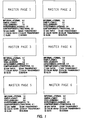
- FIGs 1 and 2 Examples of solutions for master page layouts and fonts are illustrated in Figures 1 and 2, respectively. Referring first to Figure 1, examples of six solutions (master page 1 through master page 6), are illustrated. In this example of the present invention, each master page solution is associated with five associated semantic scales as follows: Informal ⁇ formal Simple ⁇ fancy Vivid ⁇ subdued Entertaining ⁇ serious Contemporary ⁇ traditional
- each semantic scale For each master page, each semantic scale has an associated weighted value that represents the ranking of that page layout on the semantic scale.
- each semantic scale of each solution database may be based on any suitable range or on a percentage basis, as well.
- the solution has a ranking of 6.2 on the informal ⁇ formal scale. This means that the solution is more formal than informal, but is not the most formal solution (which would have a ranking of 7).
- the simple ⁇ fancy semantic scale is ranked as a 5.1 for master page 1, meaning that it is more fancy than simple.
- master page 1 On the vivid ⁇ subdued scale, master page 1 has a ranking of 7, meaning it is considered to be the most subdued.
- master page 1 On the entertaining ⁇ serious scale, master page 1 has a ranking of 4.8, meaning it is more serious than entertaining, and a ranking of 5.5 on the contemporary ⁇ traditional scale, meaning that it is more in the traditional style.
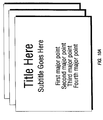
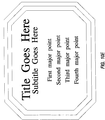
- An example of a master page layout that can be described by these scale values is illustrated in Figure 10A.
- the corresponding solution is a set of parameters (mainly different from those given by the associated scales) which operate on an image to create the layout concerned.
- Master page 2 has a ranking of 1.8 on the informal ⁇ formal scale, meaning that it is informal. Master page 2 is fancy, with a ranking of 6.2 on the simple ⁇ fancy scale. Master page 2 is also vivid and entertaining with rankings of 1.2 and 1.6 on the vivid ⁇ subdued scale and entertaining ⁇ serious scale, respectively. On the contemporary ⁇ traditional scale, master page 2 has received a contemporary ranking of 1.6.
- An example of a master page layout that can be described by the scale values of master page 2 is illustrated in Figure 10B.
- Master page 3 is formal and simple with rankings of 6.7 on the informal ⁇ formal scale and 1.8 on the simple ⁇ fancy scale. Master page 3 is slightly subdued with a ranking of 4.9 on the vivid ⁇ subdued scale. Master page 3 is slightly entertaining with a ranking of 3.1 on the entertaining ⁇ serious scale, and has a ranking of 4, midway between contemporary and traditional on that scale.
- Figure 10C is an example of a master page layout described by the scale values of master page 3.
- Master page 4 is substantially informal and simple with rankings of 3.3 and 2.2 on the informal ⁇ formal and simple ⁇ fancy scales, respectively. Master page 4 is midway between vivid and subdued, with a ranking of 4, but is entertaining contemporary with rankings of 2.3 and 2.4 on the entertaining ⁇ serious scale and the contemporary ⁇ traditional scale. An example of such a master page layout is illustrated in Figure 10D.
- Master page 5 has a ranking of 1.9 on the informal ⁇ formal scale, and a ranking of 3.5 on the simple ⁇ fancy scale. Master page 5 is very subdued with a ranking of 6.4 on the vivid ⁇ subdued scale and has the most serious ranking on the entertaining ⁇ serious scale with a ranking of 7. Master page 5 is also very traditional with a ranking of 6.1 on the contemporary ⁇ traditional scale. These scale values describe, for example, the page layout of Figure 10E.
- Master page 6 is formal, with a ranking of 5.5 on the informal ⁇ formal scale and fancy with a ranking of 4.5 on the simple ⁇ fancy scale. Master page 6 is slightly subdued with a ranking of 4.3 on the vivid ⁇ subdued scale. Master page 6 is serious with a ranking of 4.9 on the entertaining ⁇ serious scale, and is slightly contemporary with a ranking of 3.3 on the contemporary ⁇ traditional scale.
- Figure 10F is an example of a master page layout described by the these scale values.
- rejection constraints are binary constraints that may be the result of output device limitation or other factors. Still referring to Figure 1, each of the master page solutions have associated rejection constraint selectors as follows: black and white paper black and white transparency color paper color transparency slide screen show
- Master page which is a formal and serious page layout, is suitable for black and white paper and black and white transparencies, but not suitable for colored paper, color transparencies, slide or screen presentations.
- Master page 2 and 5 which are both informal, are suitable for all presentation methods.
- Master page 3 is suitable for black and white paper and black and white transparencies, as well as slide and screen presentation, but not for color paper or color transparency.
- Master page 4 is suitable for color paper and color transparency as well as slide and screen, but not black and white presentation.
- Master page 6 is suitable for black and white paper and color paper, but not for black and white or color transparencies, slide or screen presentation.
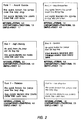
- the master page layouts typically include suggested fonts for text areas. However, these fonts can be overridden or fine tuned by the user. In addition, the user may selects fonts when designing a page layout from scratch. Examples of fonts used as solutions in the present example are illustrated in Figure 2. Figure 2 includes six font solutions, font 1 through font 6. These fonts are by way of example only and other fonts can be provided as solutions. In this example of the present invention, the following categories were chosen as being most appropriate for selecting fonts, namely: Informal ⁇ formal Contemporary ⁇ traditional Simple ⁇ fancy
- Font 1 referred to as "Avant Garde” has a ranking of 5.3 on the informal ⁇ formal scale. This means that it is ranked near the formal end of the semantic scale. Font 1 has a ranking of 1.9 on the contemporary ⁇ traditional scale, meaning that it is very contemporay. Font 1 has a ranking of 1.7 on the simple ⁇ fancy scale, meaning that it is a simple font.
- Font 2 referred to as "San Francisco,” is an informal and modern font with a ranking of 1 on the informal ⁇ formal scale and a ranking of 2.5 on the contemporay ⁇ traditional scale. Font 2 is also slightly fancy, with a ranking of 4.6 on the simple ⁇ fancy scale.
- Font 3 "Zapf Chancery” is a fancy font, with a ranking of 6.1 on the simple ⁇ fancy scale. Font 3 is also informal, with a ranking of 3.3 on the informal ⁇ formal scale and slightly traditional with a ranking of 4.8 on the contemporary ⁇ traditional scale.
- Font 4 known as "London,” is very formal with a ranking of 6.4 on the informal ⁇ formal scale as well as being very traditional and fancy with rankings of 7.0 on the contemporary ⁇ traditional scale and simple ⁇ fancy scales, respectively.
- Font 5 "Palatino,” is a formal font, suitable for business, with a ranking of 6.1 on the informal ⁇ formal scale. Font 5 is ranked midway between contemporary and traditional, with a rating of 4.0. Font 5 is also ranked near the middle of the simple ⁇ fancy scale, with a ranking of 3.7.
- Font 6 "Los Angeles,” is very informal and modern, with a ranking of 1.8 on the informal ⁇ formal scale and a ranking of 2.5 on the contemporary ⁇ traditional scale. Font 6 is a simple font with a ranking of 1.3 on the simple ⁇ fancy scale.
- the ranking above are for purposes of example only.
- the present example is not limited to fonts utilizing these particular valued rankings.
- Figures 3-6 Examples of the user interfaces of the graphic design system of this example are illustrated in Figures 3-6. Referring first to Figure 3, an interface for master page layout is illustrated.
- each of the scales is a slide scale, with a selector that can be positioned any where between the terminal ends of the scale.
- the example provides a scale having a low value of one and a high value of seven. The use selects the desired value on the scale by positioning the scale selector at the appropriate region of the, e.g. by use of a mouse.
- the example utilizes an analog scale from one to seven.
- a switch may be utilized that limits the selection to integer values between and including one and seven.
- Other ranges of values can be used with either a sliding or integer scale.
- the scale may represent a percentage value from 0-100 percent, with a sliding or integer scale.
- the master page interface also includes means for selecting rejection constraint criteria.
- Region 302 includes a check box located next to each of the rejection constraints stored in the solution database, namely black and white paper, black and white transparency, color paper, color transparency, slide, and screen show. The user selects those rejection constraints that describe the desired output.
- Mutually exclusive rejection constraints such as light room/dark room, can be selected in region 303. In this region, only one of the selections may be made since they are mutually exclusive.
- the selection of a country or region of interest can be made. For example, USA is selected in Figure 3. The selection of a country or region recalibrates the solution database to provide appropriate solutions to user selected criteria.
- the user After the user has selected rejection constraints and made selections on the semantic scales, the user initiates the search by activating the "advise" button 305. At that time, an intelligent search is performed and suitable solutions are presented as suggested master pages to the user.
- a number of solutions that provide the closest fit to the user constraints are displayed in region 304 of Figure 3, (e.g. "Master page 1, Master page 2, and Master page 3"). These solutions may include an identification number as well as the scale values for that solution. Values referred to as "eigen values" that represent the closeness of fit of the suggested solutions to the user parameters may also be provided. The generation of these eigen values is described in detail below.
- the user can act on the possible solutions by activating the buttons in region 306.
- the user can request views of additional or prior groups of solutions by selecting the "Next" and "Previous” buttons, (for example, in Figure 3, three possible solutions are shown at a time).
- the user can select one of the solutions by activating the "Apply” button.
- "Reset” and “Cancel” buttons are also provided for the user.
- the Reset button restores the settings of the scales and rejection criteria to match the users original input.
- the Cancel button the interface is closed without changing the state of the presentation document.
- identification numbers of suitable solutions can be provided to the user and the user can refer to a hard copy compilation of the solutions to view the suggested solutions.
- the interface for font selection is illustrated in Figure 4.
- Three semantic scales 401A, 401B, and 401C correspond to the informal ⁇ formal, contemporary ⁇ traditional and simple ⁇ fancy scales used to describe the font solutions.
- Rejection constraints used with font selection are illustrated in region 402. These rejection constraints describe the intended use for the selected fonts, such as headline, body of text, and footnote.
- the user After making selections on the scales 401A-401C, the user activates the "advise" button 405 to initiate the search of the present example. After the search is completed, the names of fonts that are potential solutions are identified in region 403. An example of text using the font of the suggested solution may be displayed for the user in region 404. In an alternate embodiment, the user is directed to hard copy examples of font solutions by index numbers.
- the user may select a suggested font solution by activating the "Apply” button in region 406.
- the user may also activate the "Reset” or “Cancel” buttons from that region.
- FIG. 5 An interface used for selecting color schemes is illustrated in Figure 5. Rejection constraints are provided by selecting a primary color scheme.
- the color solutions may include more than one color, but with one primary color scheme dominating. By selecting the desired primary color scheme, solutions in the database that do not contain that primary color scheme can be quickly eliminated in the intelligent search of the present example.
- the following primary color schemes are selectable by a user, blue, cyan, green, yellow, orange, red, magenta, violet, brown, grey, black, and white. Of course other primary color schemes can be used.
- Semantic scale 501A is a warm ⁇ cool scale.
- Scale 501B is a bright ⁇ soft scale and scale 501C is a loud ⁇ quiet scale.
- suitable solutions are provided in area 503. These solutions may be provided to a display for viewing by the user.
- the user can select a solution by activating the "Apply” button.
- the user can also activate the "Reset” or “Cancel” buttons as desired.
- the user may be referred to a hard copy example of the color scheme for review and selection.
- Figure 6 is an interface used in selecting numeric charts and scales.
- the interface of Figure 6 includes three scales, 601A-601C.
- Scale 601A is an individual ⁇ cumulative scale.
- Scale 601B is a differences ⁇ trends scale and scale 601C is a simple ⁇ fancy scale.
- Region 602 is provided to identify the number of variables and the number of observations to be charted. In this example of the present invention, this data is filled in automatically. However, a user can override the selections if desired. After the user makes selections and initiates a search by activating advise button 605, sample charts are provided in region 603 (e.g. Template 1, Template 2, and Template 3). The user can activate the "Apply” button or the "Next", “Previous”, “Reset", or “Cancel” buttons of region 604. In an alternate embodiments, indexes to hard copies of sample charts are provided to the user.
- a user preparing a document selects the master page layout user interface and selects rejection constraint criteria.
- the user wishes to create a color document to be printed on paper. Therefore, the user selects the "color paper" option.
- the user then proceeds to select values on the semantic scales.
- the user first selects a value of 4 on the informal ⁇ formal scale using selector 301A.
- a value of 4 is midway between informal and formal in the preferred embodiment of the present invention.
- the simple ⁇ fancy scale the user selects a value of 5, desiring a slightly fancy presentation.
- the vivid ⁇ subdued scale the user selects a value of 1, one of the most vivid presentations for its color presentation document.
- the entertaining ⁇ serious scale the user selects a value of 3 for a slightly entertaining look.
- the contemporary ⁇ traditional scale the user selects a 4, desiring a more traditional presentation.
- the user selected value on each semantic scale is compared to the semantic scale values of the remaining solutions in the database. Any solutions with a semantic scale value outside a predetermined range when compared to the user selected range values is eliminated.
- a range of 3.8 is acceptable when a position scale is utilized.
- the informal ⁇ formal scale value of 4 selected by the user all remaining solutions are within a value of plus or minus 3.8, so all remain as possible solutions.
- the simple ⁇ fancy scale the user has selected a value of 5. Therefore, all values greater than 1.2 are acceptable.
- all remaining solutions have a simple ⁇ fancy scale value of 2 or greater.
- the user has selected a vivid ⁇ subdued value of 1.
- any solution with a value of 4.8 or greater will be eliminated.
- master page 5 with a vivid ⁇ subdued scale value of 6.4 is eliminated.
- the entertaining ⁇ serious scale has a user value of 3. All of the remaining solutions are within the acceptable range of that value.
- the contemporary ⁇ traditional scale has a user value of 4 and all remaining solutions are within the predetermined range of 3.8 of that value.
- master page 2 At the end of this step of the search, master page 2, master page 4 and master page 6 remain as possible solutions.
- the "closeness of fit" of the remaining solutions to the user-selected parameters is determined by generating the n-dimensional eigen vector based on the user parameters and calculating the distance from it to the eigen vector calculated for the remaining solutions.
- the generate the eigen values two matrixes are generated.
- the first matrix, T nm is an n x m matrix, where n is equal to the number of attributes (scale factors) and m is equal to the number of possible solutions in the set. In the present example, there are five scale factors and three possible solutions so that the matrix T nm appears as follows:
- the solution database consists of master page 2, master page 4 and master page 6.
- the scale values for the semantic scales for each of the master pages are entered in the matrix t nm .
- vector C is generated which is of size n and consists of the user-generated scale factors.
- the vector C appears as follows:
- Vector W n provides a set of weightings to be applied to each scale factor, if desired.
- Vector W n appears as follows in this example:
- vector W n is a unit scaling vector with a value of 1. If desired, the relative weights of each semantic scale can be controlled by changing the values in the vector W n .
- a threshold filter can be applied so that any solutions with an eigen value above a certain amount are eliminated. If no solutions have eigen values below the threshold level, the user is prompted to change the selected parameter. It has been found in this example of the present invention that a threshold value of 12 is useful for master page layout selection and a threshold value of 5 is used for fonts. Of course, other threshold values can be user. Alternatively, the user can elect to override the eigen value filtering and accept the closest fit of the calculated solutions.
- the user After selecting the master page layout based on the intelligent search of the present example, the user proceeds to select appropriate fonts for the text on the presentation document. Referring to Figure 4, the user selects a value of 4 on the informal ⁇ formal scale to match the selection on the master page layout. It is not required that the user have the same value on the informal ⁇ formal scale in one interface as another. On the contemporary ⁇ traditional scale, the user selects a value of 5, desiring a slightly traditional font. On the simple ⁇ fancy scale, the user selects a value of 2 so that the font will be relatively simple.
- the intelligent search function is initiated. Initially, the user-selected value for each semantic scale is compared to the semantic scale value of the solutions in the font database. Any solution with a semantic scale value outside of the predetermined range of 3.8 in this example of the present invention is eliminated as a potential solution. Using this comparison on the solutions of Figure 2, none of the solutions have values that are outside the acceptable range on the informal ⁇ formal scale. Similarly, all of the contemporary ⁇ traditional scale values are within the acceptable range, as well. However, on the simple ⁇ fancy scale, font numbers 3 and 4 are outside the range and are, therefore, eliminated, leaving fonts 1, 2, 5 and 6 as possible solutions.
- the closeness of fit of the remaining font solutions to the user-selected parameters can be determined by calculating the distance between the vector gerenated by the user parameters and the solution style sheets.
- the vector W n remains a unit scaling vector with a value of 1.
- the array of eigen values, one for each remaining solution in the solution database is then generated as before, resulting in an array of eigen values, as follows:
- font 5 Palatino, with an eigen value of 3.4, is the font which most closely matches the user parameters.
- the next closest match is font 1, Avant Garde, with an eigen value of 4.7.
- Font 6 and font 2 are the poorest fitting solutions with eigen values of 5.4 and 8.1, respectively.
- the system is implemented on a personal computer.
- the personal computer may be a DOS-based computer with a microprocessor such as the Intel 80x86 microprocessor.
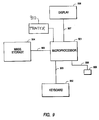
- a block diagram of a computer system for implementing the present example is illustrated of Figure 9.
- the computer system includes a microprocessor 901 coupled to an input/output device, such as keyboard 902 on line 903.
- the computer system also has associated mass storage 904 coupled to the microprocessor on line 905.
- a display 906 is coupled to the microprocessor through line 907.
- a position translating device, such as mouse 908, is coupled to the processor on line 909 and is used to move a position indicator, such as a cursor, on the display 906.
- a laser printer 910 is also coupled to the microprocessor to reproduce the final digital image.
- Rejection constraint values and scales values for each solution in the solution database are stored in mass storage 904.
- the method of the present example can be implemented as a series of instructions and steps to be executed by the processing means 901. Examples of program code suitable for implementing the master page layout interface, font interface and numeric chart interface in the present example are illustrated below.
- scaled data is encoded as integers from 1-7 inclusive. Referring briefly to Figure 3, the scales have a value of 1 on the left-hand side, increasing in integer steps to a maximum of 7 on the right-hand side for purposes of the code described below.
- the filter numbers are as follows: (1) black and white paper; (2) color paper; (3) 35 mm slide; (4) screen show; (5) B&W transparency; (6) color transparency; (7) light room; and (8) dark room.
- the user interface When the user interface has received all the data which it needs to compute a solution, it calls the handler "suggestMP". This procedure calculates the solution and displays it in the form of a list. In this example, all of the data and computation is done within the ToolBook environment.
- the database/knowledge base is stored on a set of ToolBook pages (e.g., cards) one master page per card.
- the program is the script for the page which contains the advisor user interface.
Landscapes
- Engineering & Computer Science (AREA)
- Theoretical Computer Science (AREA)
- Physics & Mathematics (AREA)
- General Physics & Mathematics (AREA)
- Audiology, Speech & Language Pathology (AREA)
- Computational Linguistics (AREA)
- General Health & Medical Sciences (AREA)
- Health & Medical Sciences (AREA)
- General Engineering & Computer Science (AREA)
- Artificial Intelligence (AREA)
- User Interface Of Digital Computer (AREA)
- Processing Or Creating Images (AREA)
- Information Transfer Between Computers (AREA)
- Document Processing Apparatus (AREA)
Applications Claiming Priority (2)
| Application Number | Priority Date | Filing Date | Title |
|---|---|---|---|
| US746733 | 1985-06-20 | ||
| US07/746,733 US5634021A (en) | 1991-08-15 | 1991-08-15 | System and methods for generation of design images based on user design inputs |
Publications (2)
| Publication Number | Publication Date |
|---|---|
| EP0528599A2 true EP0528599A2 (fr) | 1993-02-24 |
| EP0528599A3 EP0528599A3 (en) | 1993-10-20 |
Family
ID=25002105
Family Applications (1)
| Application Number | Title | Priority Date | Filing Date |
|---|---|---|---|
| EP19920307213 Withdrawn EP0528599A3 (en) | 1991-08-15 | 1992-08-06 | Process control and operator-machine interfaces |
Country Status (4)
| Country | Link |
|---|---|
| US (2) | US5634021A (fr) |
| EP (1) | EP0528599A3 (fr) |
| JP (1) | JPH06195332A (fr) |
| CA (1) | CA2074680A1 (fr) |
Cited By (3)
| Publication number | Priority date | Publication date | Assignee | Title |
|---|---|---|---|---|
| EP0680018A3 (fr) * | 1994-04-25 | 1996-06-12 | Canon Information Syst Inc | Sélection de couleurs assistée par ordinateur et système de coloration. |
| EP0684584A3 (fr) * | 1994-04-25 | 1996-06-12 | Canon Information Syst Inc | Système de sélection de couleurs à base d'objective. |
| EP0740270A3 (fr) * | 1995-04-28 | 1997-06-11 | Sharp Kk | Dispositif de sortie d'images |
Families Citing this family (117)
| Publication number | Priority date | Publication date | Assignee | Title |
|---|---|---|---|---|
| US5519606A (en) * | 1992-01-21 | 1996-05-21 | Starfish Software, Inc. | System and methods for appointment reconciliation |
| JP2776295B2 (ja) * | 1994-10-27 | 1998-07-16 | 日本電気株式会社 | 画像インデックス生成方法及び画像インデックス生成装置 |
| US5717913A (en) * | 1995-01-03 | 1998-02-10 | University Of Central Florida | Method for detecting and extracting text data using database schemas |
| US5669006A (en) * | 1995-02-23 | 1997-09-16 | International Business Machines Corporation | Method for automatically obtaining spatial layout for multimedia presentations |
| US5875110A (en) | 1995-06-07 | 1999-02-23 | American Greetings Corporation | Method and system for vending products |
| US5794237A (en) * | 1995-11-13 | 1998-08-11 | International Business Machines Corporation | System and method for improving problem source identification in computer systems employing relevance feedback and statistical source ranking |
| US5740078A (en) * | 1995-12-18 | 1998-04-14 | General Electric Company | Method and system for determining optimum colorant loading using merit functions |
| JPH09212493A (ja) * | 1996-01-31 | 1997-08-15 | Fuji Xerox Co Ltd | 文書処理装置 |
| US5903905A (en) * | 1996-04-30 | 1999-05-11 | Microsoft Corporation | Method for simultaneously constructing and displaying a dynamic preview of a document that provides an accurate customized document |
| US5784487A (en) * | 1996-05-23 | 1998-07-21 | Xerox Corporation | System for document layout analysis |
| US6085165A (en) * | 1996-09-20 | 2000-07-04 | Ulwick; Anthony W. | Process and system for outcome based mass customization |
| US20100153183A1 (en) * | 1996-09-20 | 2010-06-17 | Strategyn, Inc. | Product design |
| US5963910A (en) * | 1996-09-20 | 1999-10-05 | Ulwick; Anthony W. | Computer based process for strategy evaluation and optimization based on customer desired outcomes and predictive metrics |
| US6278462B1 (en) * | 1997-02-28 | 2001-08-21 | Microsoft Corporation | Flexible schemes for applying properties to information in a medium |
| DE29710403U1 (de) | 1997-06-14 | 1997-08-21 | Ante, Bruno, Dr., 61350 Bad Homburg | Vorrichtung zur Erfassung der Kundenzufriedenheit |
| US6353840B2 (en) * | 1997-08-15 | 2002-03-05 | Ricoh Company, Ltd. | User-defined search template for extracting information from documents |
| US5953007A (en) * | 1997-09-15 | 1999-09-14 | International Business Machines Corporation | System, method, and program for using animations to show page layout combinations in a user interface for submitting print jobs |
| US5974430A (en) * | 1997-09-30 | 1999-10-26 | Unisys Corp. | Method for dynamically embedding objects stored in a web server within HTML for display by a web browser |
| US6128617A (en) * | 1997-11-24 | 2000-10-03 | Lowry Software, Incorporated | Data display software with actions and links integrated with information |
| GB2332348A (en) * | 1997-12-09 | 1999-06-16 | Zyris Plc | Graphic image design |
| US6377704B1 (en) | 1998-04-30 | 2002-04-23 | Xerox Corporation | Method for inset detection in document layout analysis |
| US6377937B1 (en) | 1998-05-28 | 2002-04-23 | Paskowitz Associates | Method and system for more effective communication of characteristics data for products and services |
| AUPQ589300A0 (en) * | 2000-02-28 | 2000-03-23 | Canon Kabushiki Kaisha | Automatically selecting fonts |
| US6615198B1 (en) | 2000-04-10 | 2003-09-02 | Sprint Communications Company, L.P. | System and method for creating performance solution tools and performance solutions |
| US6572377B2 (en) * | 2000-06-09 | 2003-06-03 | Cynthia H. Masters | Computerized interior design expert system |
| US7568155B1 (en) * | 2000-08-10 | 2009-07-28 | Oracle International Corporation | Visual configurator |
| JP2002083148A (ja) * | 2000-09-06 | 2002-03-22 | Seiko Epson Corp | 閲覧情報作成システム及びディジタルコンテンツ配信システム |
| US7689621B1 (en) * | 2000-11-06 | 2010-03-30 | Navteq North America, Llc | Multi-dimensional spatial index for a geographic database |
| JP2002169834A (ja) * | 2000-11-20 | 2002-06-14 | Hewlett Packard Co <Hp> | 文書のベクトル解析を行うコンピュータおよび方法 |
| DE10063934A1 (de) * | 2000-12-20 | 2002-06-27 | Bosch Gmbh Robert | Verfahren und Vorrichtung zur Überwachung und Abschaltung von Steuereinheiten in einem Netzwerk und Netzwerk |
| US20020111784A1 (en) * | 2001-02-12 | 2002-08-15 | Keller S. Brandon | Method of suggesting configuration commands based on E-CAD tool output |
| US6823342B2 (en) | 2001-05-15 | 2004-11-23 | Vykor, Inc. | Method and system for capturing, managing, and disseminating manufacturing knowledge |
| US7962482B2 (en) * | 2001-05-16 | 2011-06-14 | Pandora Media, Inc. | Methods and systems for utilizing contextual feedback to generate and modify playlists |
| US7003515B1 (en) * | 2001-05-16 | 2006-02-21 | Pandora Media, Inc. | Consumer item matching method and system |
| US20060206478A1 (en) * | 2001-05-16 | 2006-09-14 | Pandora Media, Inc. | Playlist generating methods |
| US20060212442A1 (en) * | 2001-05-16 | 2006-09-21 | Pandora Media, Inc. | Methods of Presenting and Providing Content to a User |
| EP1397252A4 (fr) * | 2001-05-25 | 2005-12-21 | Manyworlds Inc | Procede et systeme de publication et de gestion de medias imprimes personnalises |
| US20020188960A1 (en) * | 2001-06-12 | 2002-12-12 | Rodriguez Arturo A. | Multiple information levels in media services menus |
| US6714934B1 (en) | 2001-07-31 | 2004-03-30 | Logika Corporation | Method and system for creating vertical search engines |
| US6952691B2 (en) * | 2002-02-01 | 2005-10-04 | International Business Machines Corporation | Method and system for searching a multi-lingual database |
| US20030179232A1 (en) * | 2002-03-25 | 2003-09-25 | Fousek Daniel P. | Custom drawing symbols |
| US20040034613A1 (en) * | 2002-07-23 | 2004-02-19 | Xerox Corporation | System and method for dynamically generating a style sheet |
| US7487445B2 (en) * | 2002-07-23 | 2009-02-03 | Xerox Corporation | Constraint-optimization system and method for document component layout generation |
| US7010746B2 (en) * | 2002-07-23 | 2006-03-07 | Xerox Corporation | System and method for constraint-based document generation |
| US6886009B2 (en) * | 2002-07-31 | 2005-04-26 | International Business Machines Corporation | Query routing based on feature learning of data sources |
| US7340673B2 (en) * | 2002-08-29 | 2008-03-04 | Vistaprint Technologies Limited | System and method for browser document editing |
| US8428934B2 (en) * | 2010-01-25 | 2013-04-23 | Holovisions LLC | Prose style morphing |
| US7854009B2 (en) * | 2003-06-12 | 2010-12-14 | International Business Machines Corporation | Method of securing access to IP LANs |
| GB2404270A (en) * | 2003-07-24 | 2005-01-26 | Hewlett Packard Development Co | Document composition |
| US7171618B2 (en) * | 2003-07-30 | 2007-01-30 | Xerox Corporation | Multi-versioned documents and method for creation and use thereof |
| US7391885B2 (en) * | 2003-07-30 | 2008-06-24 | Xerox Corporation | Method for determining overall effectiveness of a document |
| US8014997B2 (en) * | 2003-09-20 | 2011-09-06 | International Business Machines Corporation | Method of search content enhancement |
| US20050065774A1 (en) * | 2003-09-20 | 2005-03-24 | International Business Machines Corporation | Method of self enhancement of search results through analysis of system logs |
| US7743322B2 (en) * | 2003-09-30 | 2010-06-22 | Hewlett-Packard Development Company, L.P. | Automatic photo album page layout |
| US7555730B2 (en) * | 2005-05-12 | 2009-06-30 | Hewlett-Packard Development Company, L.P. | Method for arranging graphic assemblies |
| US8065627B2 (en) * | 2003-09-30 | 2011-11-22 | Hewlett-Packard Development Company, L.P. | Single pass automatic photo album page layout |
| US8056013B2 (en) | 2005-05-13 | 2011-11-08 | Hewlett-Packard Development Company, L.P. | Method for arranging graphic assemblies |
| US7375838B2 (en) * | 2003-11-17 | 2008-05-20 | Manyworlds Inc. | Method and system for customized print publication and management |
| US7606772B2 (en) | 2003-11-28 | 2009-10-20 | Manyworlds, Inc. | Adaptive social computing methods |
| US12093983B2 (en) | 2003-11-28 | 2024-09-17 | World Assets Consulting Ag, Llc | Adaptive and recursive system and method |
| US7526459B2 (en) | 2003-11-28 | 2009-04-28 | Manyworlds, Inc. | Adaptive social and process network systems |
| US8566263B2 (en) * | 2003-11-28 | 2013-10-22 | World Assets Consulting Ag, Llc | Adaptive computer-based personalities |
| US8600920B2 (en) * | 2003-11-28 | 2013-12-03 | World Assets Consulting Ag, Llc | Affinity propagation in adaptive network-based systems |
| US20090018918A1 (en) * | 2004-11-04 | 2009-01-15 | Manyworlds Inc. | Influence-based Social Network Advertising |
| US7526458B2 (en) | 2003-11-28 | 2009-04-28 | Manyworlds, Inc. | Adaptive recommendations systems |
| USRE45770E1 (en) | 2003-11-28 | 2015-10-20 | World Assets Consulting Ag, Llc | Adaptive recommendation explanations |
| US7539652B2 (en) | 2003-11-28 | 2009-05-26 | Manyworlds, Inc. | Adaptive self-modifying and recombinant systems |
| US7526464B2 (en) * | 2003-11-28 | 2009-04-28 | Manyworlds, Inc. | Adaptive fuzzy network system and method |
| JP4438401B2 (ja) * | 2003-12-22 | 2010-03-24 | 富士ゼロックス株式会社 | 画像処理装置及びプログラム |
| US7395257B2 (en) * | 2004-06-14 | 2008-07-01 | Ebay Inc. | Automated method and system to calculate the surface distance between two geographical locations, and to filter a data set based on the calculation |
| GB2416615A (en) * | 2004-07-27 | 2006-02-01 | Hewlett Packard Development Co | Document layout system |
| US20060048063A1 (en) * | 2004-08-24 | 2006-03-02 | Sbc Knowledge Ventures, L.P. | Design request form |
| JP4197313B2 (ja) | 2004-10-15 | 2008-12-17 | インターナショナル・ビジネス・マシーンズ・コーポレーション | 文章編集方法、文章編集方法を実行するプログラム、及び文章編集システム |
| US7656543B2 (en) * | 2004-11-12 | 2010-02-02 | Hewlett-Packard Development Company, L.P. | Albuming images |
| US7760372B2 (en) * | 2005-01-11 | 2010-07-20 | Xerox Corporation | Method for automated document selection |
| TWI259972B (en) * | 2005-02-05 | 2006-08-11 | Via Tech Inc | Apparatus capable of improving the quality of scrolling image with scaling and method of the same |
| US8161377B2 (en) * | 2005-03-01 | 2012-04-17 | Hewlett-Packard Development Company, L.P. | Arranging images on pages of an album |
| US7395254B2 (en) * | 2005-04-21 | 2008-07-01 | Xerox Corporation | Method for dynamic knowledge capturing in production printing workflow domain |
| US7760956B2 (en) | 2005-05-12 | 2010-07-20 | Hewlett-Packard Development Company, L.P. | System and method for producing a page using frames of a video stream |
| US7644356B2 (en) * | 2005-06-10 | 2010-01-05 | Hewlett-Packard Development Company, L.P. | Constraint-based albuming of graphic elements |
| US7577905B2 (en) * | 2005-06-13 | 2009-08-18 | Microsoft Corporation | Applying a design to a slide using equivalent layouts |
| US8279464B2 (en) * | 2007-04-18 | 2012-10-02 | Xerox Corporation | Method and system for classifying a job in a production environment |
| US7757126B2 (en) * | 2007-04-20 | 2010-07-13 | Sap Ag | System and method for supporting software |
| US20080294448A1 (en) * | 2007-05-23 | 2008-11-27 | At&T Knowledge Ventures, Lp | Methods and systems associated with telephone directory advertisements |
| US8934717B2 (en) * | 2007-06-05 | 2015-01-13 | Intellectual Ventures Fund 83 Llc | Automatic story creation using semantic classifiers for digital assets and associated metadata |
| US8214244B2 (en) | 2008-05-30 | 2012-07-03 | Strategyn, Inc. | Commercial investment analysis |
| US8086481B2 (en) * | 2007-11-30 | 2011-12-27 | Caterpillar Inc. | Method for performing a market analysis |
| US8494894B2 (en) * | 2008-09-19 | 2013-07-23 | Strategyn Holdings, Llc | Universal customer based information and ontology platform for business information and innovation management |
| US8412749B2 (en) | 2009-01-16 | 2013-04-02 | Google Inc. | Populating a structured presentation with new values |
| US8977645B2 (en) | 2009-01-16 | 2015-03-10 | Google Inc. | Accessing a search interface in a structured presentation |
| US8452791B2 (en) * | 2009-01-16 | 2013-05-28 | Google Inc. | Adding new instances to a structured presentation |
| US8615707B2 (en) * | 2009-01-16 | 2013-12-24 | Google Inc. | Adding new attributes to a structured presentation |
| US9152292B2 (en) * | 2009-02-05 | 2015-10-06 | Hewlett-Packard Development Company, L.P. | Image collage authoring |
| US8161384B2 (en) * | 2009-04-23 | 2012-04-17 | Hewlett-Packard Development Company, L.P. | Arranging graphic objects on a page with text |
| US8291314B2 (en) * | 2009-04-23 | 2012-10-16 | Hewlett-Packard Development Company, L.P. | Arranging graphic objects on a page |
| US8666977B2 (en) | 2009-05-18 | 2014-03-04 | Strategyn Holdings, Llc | Needs-based mapping and processing engine |
| US20100306223A1 (en) * | 2009-06-01 | 2010-12-02 | Google Inc. | Rankings in Search Results with User Corrections |
| US20110106819A1 (en) * | 2009-10-29 | 2011-05-05 | Google Inc. | Identifying a group of related instances |
| US8983969B2 (en) * | 2009-07-16 | 2015-03-17 | International Business Machines Corporation | Dynamically compiling a list of solution documents for information technology queries |
| US9367523B2 (en) | 2009-09-25 | 2016-06-14 | Adobe Systems Incorporated | System and method for using design features to search for page layout designs |
| US8583469B2 (en) * | 2010-03-03 | 2013-11-12 | Strategyn Holdings, Llc | Facilitating growth investment decisions |
| US20110280476A1 (en) * | 2010-05-13 | 2011-11-17 | Kelly Berger | System and method for automatically laying out photos and coloring design elements within a photo story |
| US9483167B2 (en) | 2010-09-29 | 2016-11-01 | Adobe Systems Incorporated | User interface for a touch enabled device |
| US9229636B2 (en) | 2010-10-22 | 2016-01-05 | Adobe Systems Incorporated | Drawing support tool |
| US20130132907A1 (en) * | 2011-03-02 | 2013-05-23 | Adobe Systems Incorporated | Shape pixel rendering |
| US8842120B2 (en) | 2011-03-02 | 2014-09-23 | Adobe Systems Incorporated | Physics rules based animation engine |
| US8898562B2 (en) * | 2011-03-04 | 2014-11-25 | Dan Tocchini | System and method for harmonious tiling search and publishing |
| US8463765B2 (en) | 2011-04-29 | 2013-06-11 | Zachary C. LESAVICH | Method and system for creating vertical search engines with cloud computing networks |
| US10031641B2 (en) | 2011-09-27 | 2018-07-24 | Adobe Systems Incorporated | Ordering of objects displayed by a computing device |
| US8645820B2 (en) * | 2012-03-02 | 2014-02-04 | Adobe Systems Incorporated | Method and apparatus for providing comb text field inputs on a mobile device |
| US10304122B2 (en) | 2013-05-30 | 2019-05-28 | Ebay Inc. | Time- and geolocation-limited marketplace |
| US10282075B2 (en) | 2013-06-24 | 2019-05-07 | Microsoft Technology Licensing, Llc | Automatic presentation of slide design suggestions |
| US9430853B2 (en) * | 2015-01-09 | 2016-08-30 | Lawrance Joseph L'Heureux | Methods for reifying images to convey non-textual information to viewers |
| US10528547B2 (en) | 2015-11-13 | 2020-01-07 | Microsoft Technology Licensing, Llc | Transferring files |
| US9824291B2 (en) | 2015-11-13 | 2017-11-21 | Microsoft Technology Licensing, Llc | Image analysis based color suggestions |
| US10534748B2 (en) | 2015-11-13 | 2020-01-14 | Microsoft Technology Licensing, Llc | Content file suggestions |
| AU2023210538A1 (en) | 2023-07-31 | 2025-02-20 | Canva Pty Ltd | Systems and methods for processing designs |
Family Cites Families (16)
| Publication number | Priority date | Publication date | Assignee | Title |
|---|---|---|---|---|
| US4791561A (en) * | 1987-04-17 | 1988-12-13 | Wang Laboratories, Inc. | Interactive construction of means for database maintenance |
| US5148370A (en) * | 1987-06-17 | 1992-09-15 | The Standard Oil Company | Expert system and method for batch production scheduling and planning |
| US4965743A (en) * | 1988-07-14 | 1990-10-23 | The United States Of America As Represented By The Administrator Of The National Aeronautics And Space Administration | Discrete event simulation tool for analysis of qualitative models of continuous processing system |
| US5016204A (en) * | 1989-02-28 | 1991-05-14 | Digital Equipment Corporation | Expert system for performing diagnostic and redesign operations incorporating multiple levels of simulation detail |
| US5197005A (en) * | 1989-05-01 | 1993-03-23 | Intelligent Business Systems | Database retrieval system having a natural language interface |
| US5182793A (en) * | 1989-06-30 | 1993-01-26 | Texas Instruments Incorporated | Computer-aided decision making with a symbolic spreadsheet |
| US5123057A (en) * | 1989-07-28 | 1992-06-16 | Massachusetts Institute Of Technology | Model based pattern recognition |
| JPH0385601A (ja) * | 1989-08-30 | 1991-04-10 | Matsushita Electric Ind Co Ltd | ファジィ同定器 |
| US5218555A (en) * | 1989-11-27 | 1993-06-08 | Toyo Boseki Kabushiki Kaisha | Method for judging a color difference using rules fuzzy inference and apparatus therefor |
| JPH03177964A (ja) * | 1989-12-07 | 1991-08-01 | Toshiba Corp | 文書整形装置 |
| US5201047A (en) * | 1989-12-21 | 1993-04-06 | International Business Machines Corporation | Attribute-based classification and retrieval system |
| JPH03201022A (ja) * | 1989-12-28 | 1991-09-02 | Toshiba Corp | 情報入力装置 |
| US5195172A (en) * | 1990-07-02 | 1993-03-16 | Quantum Development Corporation | System and method for representing and solving numeric and symbolic problems |
| US5276775A (en) * | 1990-12-07 | 1994-01-04 | Texas Instruments Inc. | System and method for building knowledge-based applications |
| US5265173A (en) * | 1991-03-20 | 1993-11-23 | Hughes Aircraft Company | Rectilinear object image matcher |
| US5222155A (en) * | 1991-03-26 | 1993-06-22 | Massachusetts Institute Of Technology | Computer apparatus and method for fuzzy template shape matching using a scoring function |
-
1991
- 1991-08-15 US US07/746,733 patent/US5634021A/en not_active Expired - Lifetime
-
1992
- 1992-07-27 CA CA002074680A patent/CA2074680A1/fr not_active Abandoned
- 1992-08-06 EP EP19920307213 patent/EP0528599A3/en not_active Withdrawn
- 1992-08-12 JP JP4214863A patent/JPH06195332A/ja active Pending
-
1994
- 1994-08-15 US US08/290,403 patent/US5499366A/en not_active Expired - Lifetime
Cited By (6)
| Publication number | Priority date | Publication date | Assignee | Title |
|---|---|---|---|---|
| EP0680018A3 (fr) * | 1994-04-25 | 1996-06-12 | Canon Information Syst Inc | Sélection de couleurs assistée par ordinateur et système de coloration. |
| EP0684584A3 (fr) * | 1994-04-25 | 1996-06-12 | Canon Information Syst Inc | Système de sélection de couleurs à base d'objective. |
| US5615320A (en) * | 1994-04-25 | 1997-03-25 | Canon Information Systems, Inc. | Computer-aided color selection and colorizing system using objective-based coloring criteria |
| EP1178437A3 (fr) * | 1994-04-25 | 2006-09-13 | Canon Kabushiki Kaisha | Sélection de couleurs assistée par ordinateur et système de coloration |
| EP0740270A3 (fr) * | 1995-04-28 | 1997-06-11 | Sharp Kk | Dispositif de sortie d'images |
| US5893130A (en) * | 1995-04-28 | 1999-04-06 | Sharp Kabushiki Kaisha | Image output device |
Also Published As
| Publication number | Publication date |
|---|---|
| US5634021A (en) | 1997-05-27 |
| EP0528599A3 (en) | 1993-10-20 |
| US5499366A (en) | 1996-03-12 |
| JPH06195332A (ja) | 1994-07-15 |
| CA2074680A1 (fr) | 1993-02-16 |
Similar Documents
| Publication | Publication Date | Title |
|---|---|---|
| EP0528599A2 (fr) | Conduite de processus et interfaces opérateur-machine | |
| US5874955A (en) | Interactive rule based system with selection feedback that parameterizes rules to constrain choices for multiple operations | |
| Ives | Graphical user interfaces for business information systems | |
| Senay et al. | A knowledge-based system for visualization design | |
| Cook et al. | An introduction to regression graphics | |
| US7343307B1 (en) | Dynamic help method and system for an insurance claims processing system | |
| JP3063073B2 (ja) | 画像解析表現付加装置 | |
| US7095426B1 (en) | Graphical user interface with a hide/show feature for a reference system in an insurance claims processing system | |
| US5832494A (en) | Method and apparatus for indexing, searching and displaying data | |
| US5864844A (en) | System and method for enhancing a user interface with a computer based training tool | |
| EP0615201A2 (fr) | Système pour la détection de documents qui utilise une présentation de résultats pour faciliter la compréhension de l'utilisateur | |
| Kurita et al. | Learning of personal visual impression for image database systems | |
| CA2271204A1 (fr) | Systeme informatise pour visualiser et analyser un systeme objet d'ingenierie et indiquer des valeurs pour les modifications specifiques de la conception | |
| Hong et al. | CBCRS: An open case-based color recommendation system | |
| US7440931B1 (en) | Method and apparatus for analyzing thought system | |
| CN118296033A (zh) | 一种基于npl语义解析的统计场景下多维度统计图绘制系统 | |
| AU2007279140A1 (en) | Method and system of production and/or automatic conversion from heterogeneous content of at least one page make-up for achieving the fastest read with maximum retention | |
| JPH10188023A (ja) | 画像デザイン支援装置 | |
| McDonald et al. | Evaluating a method for structuring the user-system interface | |
| Barth et al. | How applicable are attribute-based approaches for human-centered ranking creation? | |
| ISHIBASHI et al. | Statistics-based interactive evolutionary computation for color scheme search | |
| Johnson et al. | Package ‘rockchalk’ | |
| Lu et al. | Appearance Evaluation of Toaster with Kansei Engineering | |
| Tymchenko et al. | Using Fuzzy Logic in the Research of the Data Visualization Process in Infographics. | |
| Morita et al. | Affective Color Palette Recommendations with Non-negative Tensor Factorization |
Legal Events
| Date | Code | Title | Description |
|---|---|---|---|
| PUAI | Public reference made under article 153(3) epc to a published international application that has entered the european phase |
Free format text: ORIGINAL CODE: 0009012 |
|
| AK | Designated contracting states |
Kind code of ref document: A2 Designated state(s): AT BE CH DE DK ES FR GB GR IE IT LI LU MC NL PT SE |
|
| PUAL | Search report despatched |
Free format text: ORIGINAL CODE: 0009013 |
|
| AK | Designated contracting states |
Kind code of ref document: A3 Designated state(s): AT BE CH DE DK ES FR GB GR IE IT LI LU MC NL PT SE |
|
| 17P | Request for examination filed |
Effective date: 19940414 |
|
| 17Q | First examination report despatched |
Effective date: 19950818 |
|
| STAA | Information on the status of an ep patent application or granted ep patent |
Free format text: STATUS: THE APPLICATION IS DEEMED TO BE WITHDRAWN |
|
| 18D | Application deemed to be withdrawn |
Effective date: 19980303 |