EP0528741B1 - Unité dissociable de transport ferroviaire porteuse d'un chargement, notamment d'une unité routière - Google Patents
Unité dissociable de transport ferroviaire porteuse d'un chargement, notamment d'une unité routière Download PDFInfo
- Publication number
- EP0528741B1 EP0528741B1 EP92440097A EP92440097A EP0528741B1 EP 0528741 B1 EP0528741 B1 EP 0528741B1 EP 92440097 A EP92440097 A EP 92440097A EP 92440097 A EP92440097 A EP 92440097A EP 0528741 B1 EP0528741 B1 EP 0528741B1
- Authority
- EP
- European Patent Office
- Prior art keywords
- bogie
- transport unit
- unit according
- load
- loading
- Prior art date
- Legal status (The legal status is an assumption and is not a legal conclusion. Google has not performed a legal analysis and makes no representation as to the accuracy of the status listed.)
- Expired - Lifetime
Links
Images






Classifications
-
- B—PERFORMING OPERATIONS; TRANSPORTING
- B61—RAILWAYS
- B61D—BODY DETAILS OR KINDS OF RAILWAY VEHICLES
- B61D3/00—Wagons or vans
- B61D3/16—Wagons or vans adapted for carrying special loads
-
- B—PERFORMING OPERATIONS; TRANSPORTING
- B61—RAILWAYS
- B61D—BODY DETAILS OR KINDS OF RAILWAY VEHICLES
- B61D47/00—Loading or unloading devices combined with vehicles, e.g. loading platforms, doors convertible into loading and unloading ramps
Definitions
- the present invention relates to a unit of dissociable rail transport carrying a road loading consisting in particular of a unit road wholly or partially incorporated.
- This rail transport unit includes a load-bearing structure called a wagon structure resting on removably by either or both of its ends on two axle blocks (x) or bogies through interfaces.
- transverse receiving structures carry the undercarriage at the rear, while the pivot hitch is held in front by a support analog or constituting an equivalent of the support articulation classically called harness in articulated tractor-trailer combinations.
- the loading plan is specially raised to come to the level of the platform.
- the achievements according to this invention have the disadvantage of requiring a structure complex wagon, specially adapted for transhipment.
- Another disadvantage is the height of the loading plan whose access is not necessarily compatible with the level of the platform car.
- the object of the present invention is to alleviate the above disadvantages by proposing a structure carrier rail easy to manufacture, allowing fast loading / unloading operations and easy.
- the rail transport unit comprises a supporting structure connecting two axle blocks (x) or bogie (s) for the transport of a load or type load road, in particular a road unit totally or partially incorporated, and is particular in that the supporting structure is mounted on each of the blocks axle (s) or bogie (s) via a composite interface transmitting the forces of traction and shock, and in that at least one end of the supporting structure is open for delimit an access passage, said supporting structure being mounted directly or indirectly separable as a whole the interface of at least one block axle (s) or bogie (s) in order to fully release the passage of the load or the road loading for its access to or in the supporting structure through the opening access.
- axle block (s) or bogie (s) must be considered in the following as a rolling support any railroad, i.e. a set running on a railway track formed by at least one axle and a minimum load-bearing mechanical structure including the bearings. In the case of a two-axle unit, this structure includes the mechanical chassis connecting both axles.
- bogie The concept of bogie must be understood in this which follows as a rail rolling unit plus complete. It consists of an axle block (x) and various intermediate mechanical means ensuring the connection between the chassis of the wagon and said block axle (x).
- the intermediate mechanical means are called "interface”.
- the rail transport unit consists of a supporting structure of link 1 having two longitudinal ends front 2 and rear 3, by which it is located directly or indirectly mounted on two railway axle blocks (s) respectively before 4 and back 5 through an interface composite adapted before 6 and rear 7.
- the supporting structure 1 has at least two pieces of parallel sides 8 and 9 ending along the front 2 and rear longitudinal ends 3 separate or joined together.
- the interface composite 6 or 7 is integral with the axle block (x) corresponding 4 or 5.
- each axle block (x) 4 or 5 must be between each axle block (x) 4 or 5 and the corresponding ends of the supporting structure for connecting at least one articulation driving 10.
- Composite end interfaces 6 or 7 individually or simultaneously, with one of their ends, pads such as 11 and a hook hitch 12 for shock absorption and transmission of tensile force to the block axle (s) or bogie (s).
- the supporting structure 1 is free at least at one of its longitudinal ends, for example rear 3, according to a partial access opening 13 or total but sufficient for the passage of the load or of road loading in the case of loading by longitudinal or oblique penetration.
- Such coupling-locking means can exist on the other front composite interface 7.
- At least one of the composite interfaces of preferably the composite interface before 7, will present a loading / unloading pivot joint 14 allowing it to rotate in its together.
- the two pivot joints, on the one hand of rolling 10, and on the other hand loading / unloading 14, are juxtaposed or combined, or distinct, but with axes confused.
- the present invention covers two single joints than a double joint of pivoting along a common axis.
- the load-bearing connecting structure can be separated from the two composite interfaces.
- the loading-pivoting articulation 14, possibly confused with the rolling joint 10 from one end of the connecting support structure 1, is common or has a common axis 15 with the load-pivot joint at the end of the connecting support structure 1 immediately next.
- the integrated lifting means 16 of one or on the other end, or both create sufficient vertical release movement to realize the dissociation of one or the other end, or both, of the adjacent axle block (s), or its associated composite interface structure.
- Lateral displacement means for example of transverse running 17 on the ground, associated or not to the integrated lifting means 16, are intended to allow, in association with the lifting means, the dislocation of the load-bearing connecting structure by a vertical then lateral movement in order to decentralize the transverse access opening 13 and release it totally from the corresponding composite interface ( Figures 8 and 12).
- the loading / unloading modes in oblique and online are facilitated by aforementioned characteristics, concerning the opening transverse access 13 present at one of ends, for example rear, pivoting overall, but also the presence of structures linear carriers which will be discussed below.
- the supporting link structure 1 is intended to carry various loads, in particular road loads fully or partially incorporated.
- an articulated road assembly 18 vehicle carriers carrying cars such as 19 or a semi-trailer 20, or even one or more two standardized containers or swap bodies 21 and 22 ISO, fixed on their road base or supported by different ways, for example in terms of their classic corner pieces.
- the road load is carried by different means.
- linear internal carriers 23 and 24 present on along the side pieces 8 and 9 which hold the loading support plan at a level said lowered, i.e. below the upper level axle block (s) or bogie (s).
- these structures lower carriers are produced in the form of means of movement along paths 25 and 26 of bearing, sliding or guide, for wheels or additional rolling elements to the wheels (figure 10), or for mobile structures transverse movable carriers accommodating the wheels or the road load wheel trains at carry. It can be, for example, in this last case, trolleys or cradles movable along of the above paths (not shown).
- the structure link carrier has a bottom 27, for example flat, in the form of a plate 28 bringing together the lower edges of each of the flank pieces 8 and 9, to form an access ramp and a supporting plane for the road load (figure 11).
- the bottom 27 also constituting the access ramp is the plan load carrier and is located at a level said lowered.
- the rail transport unit can be opened or covered, and in this last case, present a fixed or removable cover.
- the two flank pieces 8 and 9 of the supporting structure of link 1 extend longitudinally beyond each of their ends by extensions arm-shaped parallels such as 33 and 34, by straight example, coming in support relation with the corresponding composite interface mounted on its axle block (s) or bogie (s) ( Figures 12 to 28).
- the ends of the front and rear flank pieces are, for example, interconnected by a front link cross member and rear such as 35 and 36 ( Figures 12 to 28).
- the side pieces 8 and 9 can be fitted each along their face internal of a raceway, sliding or guide, intended to serve as a movement support for wheels of a vehicle, to an extension of the hub or to a carriage carrying a support accommodating the wheels of the road unit to be transported.
- the front end further comprises at the level rear ends of the flank pieces, the means integrated lifting gear 16 in the form of crutches extensible 37.38 with support sole ( Figures 8 and 12).
- the rolling means consist of lower rollers 39 and 40 shown schematically in Figure 12.
- the rail transport unit according to the invention can be mounted at each of its ends on a bogie 41 of the universal type, conventionally comprising a running gear, a carrying frame and a crapaudine 42 in which will come s' rotationally engaging a pivoting support 43 common to each of the connecting crosspieces 35 and 36 or two independent pivoting supports, crosspieces each carrying, at each of their ends, immobilization latch coupling means in two or three directions cooperating with suitable means.
- These crosspieces, pivoting link are each provided to connect and support the ends of each of the arms bordering the front end as shown in Figures 13 to 28.
- a single pivot can be used to on the one hand, the rolling pivoting and plus the swivel function of loading / unloading of the load-bearing structure immediately neighboring link in the case articulations with a common axis with that of the pivot of bogie.
- the wagon structure is a load-bearing structure meeting railway standards. It is intended for come to mate in a dissociable way by one or the other of its ends on a bogie interface common to two successive adjacent structures and identical for all the bogies of the same convoy.
- Bogie interface is the same for everyone the bogies of the same rail convoy.
- the invention aims, but not limiting, the use of classic bogies and universal.
- the bogie universal 41 traditionally consists of two axles 45 and 46 which, if applicable, have brake discs, e.g. 47, 48, 49 and 50.
- This chassis supports at least one articulation patella conventionally called crapaudine 57.
- This ball joint commonly receives pivoting the lower end structure of the supported car by the bogie.
- This common bogie interface adaptable to all common railway rolling bases called bogies allows to articulate and connect simultaneously the front and rear ends of two successive wagon structures according to the invention on and by the same bogie.
- This bogie interface is intended for serve as a common connecting piece for two structures successive wagons 60 and 61 of the same type in accordance with present invention ( Figures 36 to 38), for example removable and removable, comprising one end open rear 62 used for loading access autonomous, for example the road unit.
- This end rear is bordered by two arms 63 and 64 similar to arms 33 and 34 each terminated by a joining means 65, 66.
- the wagon structure also includes a front end 67 shaped like a "V" with two branches 68 and 69 converging along a point 70 which serves as pivot center 71.
- the bogie interface in question is present in the form of an interface crosspiece pivoting 72 mounted on the bogie 41 comprising a articulated central unit 73 common to the two structures successive wagons 60 and 61.
- This crosspiece 72 comprises at each of its ends a receiving support, for example centering pins 74 and 75 or erasable means or retractable, for example retractable fingers, it will be discussed later, for example of form conical, intended to receive in a dissociable way each of arms 63 and 64 of the open rear end 62 of one of the wagon structures supported by the bogie common.
- These receiving supports are aligned with the center of the sleeper. Next to these pawns or associates or integrated into them are provided locks additional to ensure coupling safety (not shown).
- reception supports constitute means of joining with complementary shapes provided at the ends 63 and 64 of the arms of the end open rear 62 of the wagon structure.
- the interface crosspiece 72 presented by elsewhere, on the underside, symmetrically in part and on either side of its articulated central assembly 73, a support area for example in the form of inserts 76, 77 opposite each of the reader 58 and 59, these plates serving as surface support and contact at the crosspiece 72.
- the interface cross member 72 can present on its upper side on either side of its central part two friction-bearing plates 78 and 79 for two pads opposite 80 and 81 mounted on springs 82 and 83 intended to make the contact support during roll movements and thereby even provide roll stability.
- the interface cross member 72 rests on the bogie, on the one hand, in its center in an articulated way, and on the other hand, laterally by its support surfaces on each of the sideboards thus offering the deflections according to the three degrees of freedom required between a wagon structure and a bogie.
- the articulated central assembly 73 turns out complex.
- the articulated central assembly 73 comprises also an upper articulation 86 resting or mounted on a mechanical element or structure 87 secured to the interface cross member 72.
- This upper articulation 86 is coaxial at the lower joint 84. These two joints therefore have the same geometric axis 88.
- the upper articulation 86 receives so separable or not the pivot center 71 of the front end at point 70 of the wagon structure constituting with it a means of articulation.
- the upper articulation 86 allows at least the pivoting movements in a horizontal plane referred to in the mode of loading / unloading using lateral offset in oblique.
- this ball joint function additional to the swivel function, can be filled simultaneously at the joint upper 86 as in the upper joint mixed described below.
- upper joint 86 is a spherical bearing 89 mounted on a pivot cylinder 90 secured to the central part of the cross member and coaxial with the axis vertical pivot of the basket.
- This spherical bearing develops around the pivot cylinder 90 and inside a cage 91 cylindrical with conical outer side surface 92 integral with or detachable from the front end 67 in tip of the wagon structure.
- the point 70 in "V" of the front end of the wagon structure is presented as a simple through bore, either cylindrical, either conical, coming to fit on the outer wall of the cage 91 of the spherical bearing.
- the front end 67 of the wagon structure is mounted directly on the when the interface cross member 72 is articulated above on an extension, an axis crossing end 67 or in any other way.
- Flank pieces 96 and 97 extend backward to a higher level by both arms parallel 63 and 64, like a stretcher delimiting with the adjacent edges flank pieces and the transverse end of the bottom the access opening 62 for the charge.
- the general conformation of the extremity rear 62 visible in the figures is such that the opening plan 101 thereof is located largely in withdrawal from the ends of arms 63 and 64.
- Flank pieces 96 and 97 extend forward by the two converging branches 68 and 69 arranged at approximately the same upper level as the arms 63 and 64 of the rear end 62. They have a general "V" shape whose tip is directed forward in a determined median zone by the general median vertical plane of the structure wagon and an upper horizontal plane which can be the one bounded by the two upper parallel edges flank pieces 96 and 97.
- the point 70 constituting the union of the two converging branches 68 and 69 is shaped so as to present an opening for example a bore end 102 intended to allow it to come mount in a dissociable way or not, but preferably not dissociable, on the upper part of the double joint 73.
- the rear end arms 63 and 64 62 are terminated by technical forms adapted to the end structures of the pivoting cross member bogie interface to form the joining means 65 and 66.
- the wagon structure When the end cones are fitted and locked, the wagon structure has a connection rigid transverse mechanical end incorporated by the bogie interface cross member.
- the 105,106 retractable fingers present at the two ends of the bogie interface are arranged in alignment with the central joint.
- end cones 103 and 104 each preceded, according to this variant, by a inclined ramp 111 and 112 on two successive slopes of penetration at the entrance of an opening 113 and 114 for backward erasure and upward release during the longitudinal movements of engagement and clearance of the ends of the arms 63 and 64.
- This coupling link can be blocked by additional end locks (not represented).
- the wagon structure has so optional near its ends of the means individual lifting possibly with rolling integrated or not, preferably autonomous, for example a crutch 115,116 similar to crutches 37 and 38 to each of the ends of each flank piece 96 and 97 (figure 35) and this at one end of the wagon structure or at both ends at the same time.
- a crutch 115,116 similar to crutches 37 and 38 to each of the ends of each flank piece 96 and 97 (figure 35) and this at one end of the wagon structure or at both ends at the same time.
- crutches targeted is that of a retractable and extendable stand for example telescopic, manual or hydraulic.
- each stand 115 and 116 of rolling means such as 117 and 118 with directional or fixed axis.
- Means can also be provided for bearings separated from the stands.
- means are provided for initial guidance over the side pieces 96 and 97, at the arms of the rear end.
- rollers such as 119 and 120 with vertical axis intended to ensure the centering then guiding the load along its flanks, for example along the lower edges 121,122 of the body of a 123 semi-trailer ( Figure 39).
- integrated means are provided load securing: semi-trailer, container, swap body etc ..., for example in the form of support on the upper or lateral arms or edges of flank pieces.
- the fixing is done by means conventional, for example twistlocks standardized or not.
- association and dissociation of successive wagon structures with the unique interface of bogie are carried out by nesting or dislocation of connecting means at the rear and possibly articulation means at the front.
- tapered bores 103 and 104 that have the ends of arms 63 and 64 of the rear end 62 of the wagon structure come fit onto the end centering pins of the crosspiece 72 interface with lock closure additional or get rid of them by simple vertical movements or without requiring the slightest lifting in the case of retractable fingers.
- the front end of the structure wagon carrying the spherical bearing is mounted on the pivot cylinder 90 or disengage from it in the case of a detachable variant according to which the conical central opening at the front end or bore can just as easily be mounted on the conical bearing head or extract from it by simple vertical movements.
- This overall lifting allows to extract in its whole and with its loading the unit of rail transport of the convoy, drop it off somewhere else pending, or insert it with its load in a another rail convoy.
- Figures 13 to 16 show the structure loaded by a semi-trailer separated from the convoy by lifting using a crane or gantry.
- the second mode concerns loading / unloading in line or longitudinal ( Figures 17 to 22). The movements are indicated by arrows.
- This loading / unloading mode requires a loading area called rails integrated in the ground.
- the transport unit rail is joined or separated by a vertical lifting or traveling movement or two handsets from its open cross end, solidarity-decoupling movement brought by the integrated lifting means, for example the extendable crutches for support and / or by means exteriors.
- the separation makes it possible to free the axle block (s) or bogie on whose interface the ends of the flank pieces were fitted.
- the road unit is loaded or unloaded, either directly along the load-bearing linear structures of displacement integrated into the Wagon, either indirectly, through one or more structure (s) transverse carrier (s) mobile (s) along the wagon structure on which or on which rests the undercarriage of the road unit.
- This road unit is coupled or secured or vice versa to a motor assembly 44, in view of its supply or evacuation in line on the quay, following the general direction of the convoy rail.
- a rear end having a deep and remote opening allows the whole engine 44 to stay on the ground during supply maneuvers or recovery of the semi-trailer.
- Loading / unloading takes place in bringing the front end oblique after detachment from the axle block (s) or bogie before by any means, for example by crutches, then offset obliquely by rolling on the quay loading, operation during which the structure carrier as a whole pivots around its rear end by pivoting support on the axle block (s) or rear bogie.
- the running gear of the unit road to be loaded is carried by the structures linear internal carriers 23 and 24 or mounted on transverse load-bearing structures, cradles or carts. Moving along the flank pieces 8 and 9 or 96 and 97, to or from its position of transport, is provided by integrated motor means or preferably by the road motor vehicle.
- the supporting structure is then moved laterally towards the axle block (x) or bogie by a overall pivoting movement in the same way as previously, but in reverse order.
- Lifting means for example integrated in the form of crutches, raise the front ends flank pieces, and come to place them opposite securing-locking means provided on the interface of the axle block (x) or bogie.
- the supporting structure After coupling and locking, the supporting structure is ready in the convoy with its re-loading for rail transport.
- Means for lifting the rear end integrated into the wagon or exterior structure will allow, after opening additional locks, to separate the joining means and obtain the dissociation of the wagon structure from the interface of bogie.
- a rotational movement around the end front will ensure the clearance of the rear end by an oblique offset.
- Lifting means at both ends allow the removal of the wagon structure by transverse or longitudinal shift.
- the means described above will provide the possibility to choose and carry out the loading / unloading best suited to the load (container, road unit or other) and at the configuration of the station handling area, train and constraints and peculiarities of the sorting operation.
Landscapes
- Engineering & Computer Science (AREA)
- Transportation (AREA)
- Mechanical Engineering (AREA)
- Handcart (AREA)
- Loading Or Unloading Of Vehicles (AREA)
- Chain Conveyers (AREA)
- Body Structure For Vehicles (AREA)
Description
- possibilité de déchargement même sur des quais ne comportant pas d'installation de manutention ;
- possibilité de chargement/déchargement quel que soit le niveau du quai ;
- rapidité des opérations de mise en oeuvre et de chargement/déchargement ;
- aptitude à recevoir tous types de chargement.
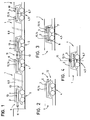
- la figure 1 est une vue schématique de profil d'une succession composite de plusieurs unités de transport ferroviaire ;
- les figures 2, 3 et 4 sont des vues schématiques de
profil montrant trois types d'extrémités de l'unité
routière selon l'invention, respectivement :
- avec tampon et crochet d'attelage sur l'interface,
- avec bloc d'essieu(x) ou bogie commun à deux extrémités,
- avec bloc d'essieu(x) ou bogie commun, interface commune et axe de pivotement commun ;
- les figures 5, 6 et 7 sont des vues de profil illustrant des exemples d'applications respectivement aux structures routières porte-voitures, à une remorque semi-portée et à des conteneurs ;
- la figure 8 est une vue en coupe transversale illustrant un des moyens de levage intégré sous la forme de béquilles avec représentation du gabarit en traits mixtes ;
- la figure 9 est une vue en coupe transversale montrant des structures de soutien d'un ou de plusieurs conteneurs avec représentation du gabarit en traits mixtes ;
- la figure 10 est une vue en coupe transversale illustrant les moyens de déplacement-soutien longitudinaux avec représentation du gabarit en traits mixtes ;
- la figure 11 est une vue en coupe transversale illustrant un exemple de réalisation à fond plat ;
- la figure 12 est une vue schématique en perspective de la structure porteuse vue d'une de ses extrémités dans sa version à fond plat ;
- les figures 13 à 16 sont des vues successives de profil, puis en plan, montrant le chargement/déchargement par levage ;
- les figures 17 à 22 sont des vues schématiques de profil illustrant une séquence de déchargement selon le mode en ligne ;
- les figures 23 à 28 sont des vues de profil puis en plan montrant les différentes phases d'une séquence de chargement selon le mode en oblique.
- la figure 29 est une vue générale en perspective de l'ensemble de la structure wagon selon l'invention ;
- la figure 30 est une vue en perspective de l'extrémité avant et de l'interface de bogie sur laquelle elle est montée ;
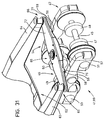
- la figure 31 est une vue en perspective de l'extrémité avant et de l'interface de bogie sur laquelle elle est destinée à être montée ;
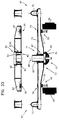
- les figures 32 et 33 sont des vues en coupe longitudinale de la traverse avant et après dissociation ;
- la figure 34 est une vue en perspective de l'extrémité d'un des bras arrière coopérant avec un doigt rétractable ;
- la figure 35 est une vue simplifiée en perspective de la structure wagon montrant des moyens de levage vertical et de roulage latéral intégrés ;
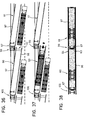
- les figures 36, 37 et 38 sont des vues schématiques en plan illustrant un chargement en épi dans le cas d'une application à une unité routière du type semi-remorque ;
- la figure 39 est une vue simplifiée en élévation de l'arrière de la structure wagon chargée par une semi-remorque.
l'extrémité avant comme représenté sur les figures de 13 à 28.
- mode en oblique dit "en épi" par déverrouillage puis désaccouplement de l'extrémité arrière et pivotement en oblique autour de l'extrémité avant ;
- mode vertical par déverrouillage puis mouvements verticaux de désaccouplement simultané des deux extrémités à l'aide d'un engin de levage extérieur ou intégré et dépose par levage d'ensemble ;
- mode horizontal par déverrouillage puis
désaccouplement de l'une ou l'autre des deux
extrémités avant et arrière, et l'une ou l'autre des
phases de décalage suivantes :
- décalage latéral par les deux extrémités et avec des moyens extérieurs,
- décalage longitudinal par dissociation de l'extrémité arrière et avec l'aide de moyens intégrés.
Claims (40)
- Unité de transport ferroviaire, reliant deux blocs d'essieu(x) ou deux bogie(s) comprenant une structure wagon ouverte à l'une de ses extrémités, formée de deux pièces de flancs et d'un fond surbaissé, les pièces de flancs se terminant à l'une de leurs extrémités à la manière d'un brancard et délimitant avec le fond une ouverture d'accès en retrait pour la charge ou un chargement de type routier, notamment une unité routière totalement ou partiellement constituée, caractérisée en ce que la structure wagon est montée sur chacun des blocs d'essieu(x) ou bogie(s) par l'intermédiaire d'une interface composite transmettant les efforts de traction et les chocs, par l'extrémité desquels s'effectue son accouplement sur l'interface composite de bogie et en ce que ladite structure porteuse est montée dissociable de l'interface composite d'au moins un bloc d'essieu(x) ou d'un bogie correspondant par au moins son extrémité comportant l'ouverture d'accès en vue de dégager totalement le passage de la charge ou du chargement routier pour son accès sur ou dans la structure porteuse par l'ouverture d'accès et sa sortie et en ce qu'elle est déposable à même le sol par au moins l'extrémité d'accès pour l'accès direct de la charge à partir du sol.
- Unité de transport selon la revendication 1, caractérisée en ce que l'interface composite est solidaire du bloc d'essieu(x) ou bogie(s).
- Unité de transport selon les revendications 1 ou 2, caractérisée en ce que les deux pièces de flanc se terminant d'un côté par deux extrémités distinctes se terminent du côté opposé par deux extrémités confondues.
- Unité de transport selon l'une quelconque des revendications précédentes, caractérisée en ce que chaque interface composite comprend au moins, un moyen de pivotement de roulage, des moyens d'accouplement-verrouillage avec les extrémités de la structure wagon, des moyens de transmission de l'effort de traction et des moyens d'amortissement des chocs.
- Unité de transport selon l'une quelconque des revendications précédentes, caractérisée en ce que le moyen de transmission de l'effort de traction est la structure mécanique de l'interface.
- Unité de transport selon l'une quelconque des revendications précédentes, caractérisée en ce qu'au moins une interface comporte des tampons et un crochet d'attelage.
- Unité de transport selon l'une quelconque des revendications précédentes, caractérisée en ce qu'elle présente en regard le long de chaque face interne de chaque pièce de flanc, des moyens de déplacement-soutien utilisés pour le soutien, la mise en place ou la sortie du chargement routier.
- Unité de transport selon la revendication 7, caractérisée en ce que les moyens de déplacement routier sont des chemins de roulement, de glissement ou de guidage pour les roues, ou des éléments de roulement additionnels aux roues, ou des structures transversales porteuses des roues, ou des trains de roues de l'unité routière à transporter, structures transversales mobiles longitudinalement le long des pièces de flanc.
- Unité de transport selon les revendications 7 et 8, caractérisée en ce que le plan-support de chargement formé par les moyens de déplacement-soutien est surbaissé.
- Unité de transport selon l'une quelconque des revendications précédentes, caractérisée en ce qu'au moins une des interfaces composite comprend une articulation de pivotement double formée d'une articulation de roulage et d'une articulation de chargement/déchargement.
- Unité de transport selon les revendications 1 et 10, caractérisée en ce que l'articulation double de pivotement est commune à deux structures wagon successives sur un même bloc d'essieu(x) ou de bogie.
- Unité de transport selon l'une quelconque des revendications précédentes, caractérisée en ce que l'extrémité de la structure wagon reliée à l'interface composite possédant l'articulation double de pivotement est dissociable de ladite interface composite.
- Unité de transport selon l'une quelconque des revendications précédentes, caractérisée en ce que la structure wagon possède à son extrémité opposée à l'extrémité ouverte des moyens de pivotement par rapport à l'interface permettant de la faire pivoter dans son ensemble en vue des opérations de chargement/déchargement.
- Unité de transport selon l'une quelconque des revendications précédentes, caractérisée en ce que la structure wagon présente des moyens permettant sa préhension verticale.
- Unité de transport selon l'une quelconque des revendications précédentes, caractérisée en ce que la structure wagon comporte, sur chacune de ses pièces de flanc, des moyens de soutien d'au moins une caisse mobile ou d'un conteneur ou d'une carrosserie routière.
- Unité de transport selon les revendications 1 à 5, caractérisée en ce que la structure wagon est dissociable de l'interface composite du bloc d'essieu(x) ou bogie(s) adjacent de l'extrémité arrière ouverte par pivotement ou par soulèvement puis pivotement de son extrémité correspondante en vue du déboítement latéral relatif au chargement/déchargement en oblique.
- Unité de transport selon l'une quelconque des revendications précédentes, caractérisée en ce que la structure wagon comporte, au voisinage de son extrémité arrière ouverte, des moyens intégrés de levage et/ou des moyens de roulement sur le sol pour son mouvement de pivotement d'ensemble en vue du déboítement latéral lors du chargement/déchargement en oblique.
- Unité de transport selon les revendication 1 ou 11, caractérisée en ce que le fond est utilisé comme rampe d'accès à partir du sol.
- Unité de transport comportant une structure wagon de liaison reposant sur deux blocs d'essieu(x) ou bogie(s) pour le chargement/déchargement et le transport par voie ferroviaire d'une charge ou d'une unité routière partiellement ou totalement constituée, caractérisée en ce que les deux pièces de flanc longitudinales sont prolongées dans leur partie supérieure d'une part à l'arrière de la structure wagon par deux branches réunies entre elles en extrémité par une jonction d'appui-pivotement sur une structure porteuse de bloc d'essieu(x) ou bogie(s), et d'autre part à l'avant par deux bras parallèles dont les extrémités sont distinctes et portent de façon dissociable sur les extrémités d'un support transversal porteur de blocs d'essieu(x) ou bogie(s), et en ce que lesdites pièces de flanc sont réunies en partie basse par une structure transversale porteuse du train roulant d'un ensemble routier, en ce que des moyens de levage verticaux montés sur des moyens de roulage transversaux équipent au moins l'extrémité avant en vue d'un abaissement de l'ouverture d'accès jusqu'au sol puis de son relevage, et en ce que les pièces de flanc comportent le long de chacune de leur face en regard des supports de soutien d'un conteneur de transport routier ou d'une carrosserie routière.
- Unité de transport selon la revendication 19, caractérisée en ce que les deux pièces de flanc parallèles prolongées longitudinalement par les bras parallèles délimitent vers le bas un fond ouvert, et en bout une extrémité avant totalement ouverte prolongée longitudinalement par une extension avant formée par les deux bras parallèles et une extrémité arrière prolongée longitudinalement par une extension arrière de support-pivotement, chaque extension étant montée désolidarisable d'un support porteur pivotant que possède chaque bloc d'essieu(x) ou bogie(s).
- Unité de transport selon les revendications 19 ou 20, caractérisée en ce que les moyens de levage sont des béquilles extensibles équipant chacune la base de l'extrémité avant de chacune des pièces de flanc.
- Unité de transport selon la revendication 21, caractérisée en ce que les béquilles sont jumelées par une rampe d'accès amovible.
- Unité de transport selon les revendications 18 ou 20, caractérisée en ce que les moyens de roulement sont des rouleaux équipant chacune des bases inférieures des extrémités avant des pièces de flanc.
- Unité de transport selon les revendications 19 ou 20, caractérisée en ce que la traverse porteuse pivotante de bloc d'essieu(x) ou bogie(s) porte le pivot d'articulation de l'extension arrière.
- Unité de transport selon la revendication 24 , caractérisée en ce que la traverse pivotante est une pièce pivotante unique commune à deux structures successives.
- Unité de transport selon les revendications 19 à 23, caractérisée en ce que le pivotement du support de bloc d'essieu(x) ou bogie(s) par rapport au bloc d'essieu(x) ou bogie(s) est indépendant du pivotement de la structure-wagon par rapport au bloc d'essieu(x) ou bogie(s).
- Unité de transport selon la revendication 24, caractérisée en ce que la traverse pivotante montée sur chaque bloc d'essieu(x) ou bogie(s) est un ensemble à plots et verrous.
- Unité de transport selon les revendications 23 ou 25, caractérisée en ce que la traverse pivotante du bloc d'essieu(x) ou du bogie est symétrique de part et d'autre d'un point central de pivotement.
- Unité de transport selon les revendications 26 à 28, caractérisée en ce que le support pivotant de chaque bloc d'essieu(x) ou bogie(s) est une traverse pivotante montée sur la crapaudine du bloc d'essieu(x) ou bogie(s).
- Unité de transport selon la revendication 29, caractérisé en ce que la traverse pivotante d'interface et la pointe de l'extrémité avant d'une structure wagon sont reliées à la crapaudine du bogie par un ensemble commun articulé de pivotement et en ce que la pointe de l'extrémité avant conformée en "V" de la structure wagon est dissociable de l'ensemble commun articulé par des mouvements verticaux et l'extrémité opposée de la structure wagon suivante est dissociable des extrémités de la traverse pivotante par des mouvements verticaux et/ou horizontaux.
- Procédé de chargement/déchargement et de constitution d'un tronçon de convoi ferroviaire à l'aide de l'unité de transport ferroviaire selon l'une quelconque des revendications précédentes en vue du transport par rail de charges, d'unités routières partiellement ou totalement constituées, ou de convois routiers eux-mêmes chargés, selon lequel on dissocie la structure porteuse par l'une de ses extrémités et on la fait pivoter par cette extrémité pour l'écarter transversalement de l'alignement du convoi ferroviaire caractérisé en ce que l'on utilise l'unité de transport ferroviaire selon l'une quelconque des revendications précédentes montée qu'on la dissocie par l'une ou l'autre de ses extrémités de l'un ou l'autre des deux blocs d'essieu(x) ou bogie(s), que l'on abaisse cette structure porteuse par ladite extrémité utilisée pour réaliser le pivotement jusqu'à contact avec le sol alors que l'autre extrémité reste attachée au bloc d'essieu(x) ou bogie(s) opposé après avoir pivoté sur celui-ci, que l'on fait accéder le véhicule dans l'espace intérieur entre les pièces de flanc par l'ouverture d'accès, que l'on fait monter l'unité routière par son train roulant sur les structures linéaires porteuses de déplacement ou sur les structures transversales porteuses, que le camion relié à l'unité routière abandonne l'unité portée et/ou tractée, carrosserie déposable, semi-remorque ou autre, que l'on reconstitue l'unité ferroviaire en levant ou soulevant à nouveau l'extrémité libre, puis qu'en la faisant pivoter, on la rapproche du bloc d'essieu(x) ou bogie(s) pour la replacer sur puis la solidariser à l'interface du bloc d'essieu(x) ou bogie(s).
- Procédé de chargement/déchargement et de constitution d'un convoi ferroviaire selon la revendication précédente, caractérisé en ce que l'on fait accéder les roues de l'unité routière à transporter dans des structures transversales porteuses mobiles par poussée ou traction, le long des structures linéaires porteuses de déplacement jusqu'à la position de transport.
- Procédé de chargement/déchargement et de constitution d'une unité ferroviaire à l'aide de l'unité de transport selon l'une quelconque des revendications de 1 à 30, en vue du transport par rail de véhicules ou de convois routiers eux-mêmes chargés, caractérisé en ce que l'on utilise la structure ferroviaire montée désolidarisable, que l'on lève ou soulève ou on translate la structure ferroviaire par son extrémité ouverte jusqu'à sa désolidarisation d'avec le bloc d'essieu(x) ou bogie(s), que l'on abaisse la structure wagon au sol, que l'on déplace l'unité routière pour lui permettre d'accéder par l'extrémité ouverte et de venir se placer par son train roulant sur les structures transversales porteuses pour sa mise en place définitive sur la structure porteuse, que le camion abandonne l'unité portée et/ou tractée, carrosserie déposable, semi-remorque ou autre, que l'on reconstitue l'unité ferroviaire en levant ou en soulevant à nouveau ou en translatant en sens inverse l'extrémité libre, puis qu'on la replace sur, et qu'on la solidarise au bloc d'essieu(x) ou bogie(s).
- Procédé de chargement/déchargement et de constitution d'une unité de transport ferroviaire selon l'une quelconque des revendications de 1 à 33, caractérisé en ce que la structure wagon est levée dans son ensemble, est désolidarisée simultanément de l'un et l'autre bloc d'essieu(x) ou bogie(s), est déplacée latéralement dans son ensemble pour être posée sur le sol ou sur un quai de chargement par un engin de levage puis est chargée ou déchargée et replacée dans l'ordre inverse des opérations.
- Procédé de chargement/déchargement selon la revendication 34, caractérisé en ce que la structure wagon est levée dans son ensemble, est désolidarisée simultanément de l'un et de l'autre bloc d'essieu(x) ou bogie(s) et est déplacée dans son ensemble pour être insérée dans un autre convoi ferroviaire.
- Procédé de chargement/déchargement et de constitution d'une unité de transport ferroviaire à l'aide de l'unité de transport selon l'une quelconque des revendications de 1 à 35, caractérisé en ce que la structure porteuse est solidarisée sur une interface composite d'un bloc d'essieu(x) ou bogie(s) commun à deux structures porteuses successives permettant leur accouplement-désaccouplement respectif de façon indépendante.
- Procédé de chargement/déchargement selon les revendications de 34 à 36, caractérisé en ce que l'interface d'un même bloc d'essieu(x) ou bogie(s) est adaptée à une seule structure porteuse et porte des tampons.
- Procédé de chargement/déchargement selon l'une quelconque des revendications de 34 à 47, caractérisé en ce que la charge routière est supportée par la structure wagon et se déplace le long de celle-ci sur des structures linéaires en forme de chemins de roulement ou de glissement intégrés à la structure porteuse.
- Procédé de chargement/déchargement selon la revendication 38, caractérisé en ce que la charge routière est supportée par la structure wagon et se déplace le long de celle-ci sur des structures transversales porteuses amovibles le long de la structure wagon
- Application du procédé de chargement/déchargement et de constitution d'une unité de transport ferroviaire selon l'une quelconque des revendications de 1 à 39, en vue du transport par rail de véhicules et de convois routiers eux-mêmes chargés.
Applications Claiming Priority (6)
| Application Number | Priority Date | Filing Date | Title |
|---|---|---|---|
| FR9110590A FR2680492B1 (fr) | 1991-08-21 | 1991-08-21 | Unite de transport ferroviaire porteuse d'une charge routiere. |
| FR9110590 | 1991-08-21 | ||
| FR9202764A FR2688179B1 (fr) | 1992-03-04 | 1992-03-04 | Structure wagon deposable articulee a une interface de bogie commune a deux structures adjacentes. |
| FR9202764 | 1992-03-04 | ||
| FR9202763 | 1992-03-04 | ||
| FR9202763A FR2688180B1 (fr) | 1992-03-04 | 1992-03-04 | Interface pivotante unique entre un bogie commun et deux structures wagon adjacentes. |
Publications (2)
| Publication Number | Publication Date |
|---|---|
| EP0528741A1 EP0528741A1 (fr) | 1993-02-24 |
| EP0528741B1 true EP0528741B1 (fr) | 1998-07-08 |
Family
ID=27252502
Family Applications (1)
| Application Number | Title | Priority Date | Filing Date |
|---|---|---|---|
| EP92440097A Expired - Lifetime EP0528741B1 (fr) | 1991-08-21 | 1992-08-21 | Unité dissociable de transport ferroviaire porteuse d'un chargement, notamment d'une unité routière |
Country Status (7)
| Country | Link |
|---|---|
| US (1) | US6095055A (fr) |
| EP (1) | EP0528741B1 (fr) |
| AT (1) | ATE168083T1 (fr) |
| AU (1) | AU670756B2 (fr) |
| CA (1) | CA2116006A1 (fr) |
| DE (1) | DE69226138T2 (fr) |
| WO (1) | WO1993003945A1 (fr) |
Families Citing this family (18)
| Publication number | Priority date | Publication date | Assignee | Title |
|---|---|---|---|---|
| SE9403544D0 (sv) * | 1994-10-18 | 1994-10-18 | Lars Berglund | Sätt och anordning för lastning och lossning av godståg |
| SE503925C2 (sv) * | 1995-05-26 | 1996-09-30 | Jan Eriksson | Järnvägsvagn |
| DE19546300C1 (de) * | 1995-10-04 | 1997-04-30 | Matthias Gradenwitz | Cargosystem mit Rotationsbrücken zum Be- und Entladen von Kraftfahrzeugen auf Eisenbahnzügen |
| AU740384B2 (en) * | 1997-11-05 | 2001-11-01 | Daimlerchrysler Ag | Rail vehicle system |
| DE10104005A1 (de) * | 2001-01-31 | 2002-08-01 | Werner Haag | Verfahren und Niederflurfahrzeug zum Transport von Strassenfahrzeugen auf der Schiene |
| US6546878B1 (en) | 2001-10-12 | 2003-04-15 | Gunderson, Inc. | Multi-unit railroad freight car for carrying cargo containers |
| US6510800B1 (en) | 2001-10-12 | 2003-01-28 | Gunderson, Inc. | Multi-unit railroad freight car for carrying cargo containers between container well units |
| US7607396B2 (en) | 2007-11-14 | 2009-10-27 | Gunderson Llc | Container car side sills |
| US20090151596A1 (en) * | 2007-12-12 | 2009-06-18 | William Harvey Sproat | Fastload rail carrier for motor vehicles, freight and passengers |
| US7757610B2 (en) | 2008-07-30 | 2010-07-20 | Gunderson Llc | Shortened container well |
| KR101757893B1 (ko) | 2009-04-16 | 2017-07-14 | 헬롬 리미티드 | 철도 왜건 및 그 선적 방법 |
| US8616564B2 (en) * | 2009-12-07 | 2013-12-31 | Paceco Corp. | Cargo container handling cart and system using same |
| US8291592B2 (en) * | 2010-03-17 | 2012-10-23 | Gunderson Llc | Method of lengthening a container well of a railcar |
| US8177461B2 (en) | 2010-04-09 | 2012-05-15 | Gunderson Llc | Transport and storage of wheelsets |
| CN104494612A (zh) * | 2015-01-05 | 2015-04-08 | 齐齐哈尔轨道交通装备有限责任公司 | 铁路货车 |
| PL237854B1 (pl) * | 2018-03-15 | 2021-06-14 | Inst Pojazdow Szynowych Tabor | Wagon, zwłaszcza do transportu kombinowanego kolejowego- -drogowego |
| CN115897307B (zh) * | 2023-02-20 | 2025-11-11 | 中车沈阳机车车辆有限公司 | 双侧操作间隔铁装置 |
| WO2024228836A1 (fr) * | 2023-05-01 | 2024-11-07 | Amsted Rail Company, Inc. | Systèmes de véhicule ferroviaire autonome et procédés |
Family Cites Families (10)
| Publication number | Priority date | Publication date | Assignee | Title |
|---|---|---|---|---|
| US2246543A (en) * | 1938-11-28 | 1941-06-24 | Jay C Smith | Railroad car for transporting vehicles |
| DE3234374C2 (de) * | 1982-09-16 | 1985-04-25 | Waggonfabrik Talbot, 5100 Aachen | Eisenbahn-Güterwagen zum Transport von Straßenfahrzeugen |
| US4653966A (en) * | 1986-01-08 | 1987-03-31 | Trailer Rail Partners | Drop-deck intermodal bogie |
| EP0293359B1 (fr) * | 1987-05-14 | 1990-07-18 | Austria Metall Aktiengesellschaft | Wagon surbaissé à hauteur réglable pour trafic intermodal rail-route |
| US4961676A (en) * | 1987-12-11 | 1990-10-09 | Intermotra | Goods transport systems which are transformable into rail vehicles, and rail bogies for use therewith |
| NL8901499A (nl) * | 1989-06-13 | 1991-01-02 | Alpha Engineering Ingenieurs E | Spoorwegsysteem en draaistel, eindwagen, voertuigfreem, draagorgaan en oplegger daarvoor. |
| FR2663896B1 (fr) * | 1990-06-29 | 1993-07-02 | Sambre & Meuse Usines | Systeme de transport rail-route pour remorques ou conteneurs. |
| US5216956A (en) * | 1990-10-12 | 1993-06-08 | Adams Jr George W | Truck train system having a removable first truck and a second truck with a load platform and an extendable center sill |
| US5222443A (en) * | 1992-05-13 | 1993-06-29 | Knorr Brake Holding Corporation | Railway ramp car |
| FR2694913B1 (fr) * | 1992-08-20 | 1994-09-23 | Lohr Ind | Ensemble d'accouplement entre deux structures wagon successives et un bogie commun. |
-
1992
- 1992-08-21 US US08/193,203 patent/US6095055A/en not_active Expired - Fee Related
- 1992-08-21 AT AT92440097T patent/ATE168083T1/de not_active IP Right Cessation
- 1992-08-21 CA CA002116006A patent/CA2116006A1/fr not_active Abandoned
- 1992-08-21 DE DE69226138T patent/DE69226138T2/de not_active Expired - Lifetime
- 1992-08-21 WO PCT/FR1992/000816 patent/WO1993003945A1/fr not_active Ceased
- 1992-08-21 EP EP92440097A patent/EP0528741B1/fr not_active Expired - Lifetime
- 1992-08-21 AU AU25043/92A patent/AU670756B2/en not_active Ceased
Also Published As
| Publication number | Publication date |
|---|---|
| DE69226138T2 (de) | 1999-02-18 |
| EP0528741A1 (fr) | 1993-02-24 |
| DE69226138D1 (de) | 1998-08-13 |
| CA2116006A1 (fr) | 1993-03-04 |
| ATE168083T1 (de) | 1998-07-15 |
| AU2504392A (en) | 1993-03-16 |
| US6095055A (en) | 2000-08-01 |
| AU670756B2 (en) | 1996-08-01 |
| WO1993003945A1 (fr) | 1993-03-04 |
Similar Documents
| Publication | Publication Date | Title |
|---|---|---|
| EP0320420B1 (fr) | Véhicules et dispositifs de transport transformables en wagons et boggies ferroviaires pour cet usage | |
| EP2598392B1 (fr) | Système universel de chargement / déchargement et de transport ferroviaire de semi-remorques routières | |
| EP0584026B1 (fr) | Ensemble d'accouplement entre deux structures wagon successives et un bogie commun | |
| EP1292476B1 (fr) | Systeme de transport et de chargement/dechargement des wagons en oblique dans une gare ferroviaire de transport combine rail/route et son procede de mise en oeuvre | |
| EP0528741A1 (fr) | Unité dissociable de transport ferroviaire porteuse d'un chargement, notamment d'une unité routière | |
| EA036512B1 (ru) | Способ погрузки (выгрузки) автомобильного полуприцепа на вагон-кенгуру и вагон-кенгуру, подходящий для этого способа | |
| EP1349763A1 (fr) | Unite ferroviaire a structure porteuse pivotante pour le transport combine rail/route soit d'une semi-remorque soit de deux vehicules a moteur | |
| HU221835B1 (hu) | Vasúti kocsi | |
| EP0672566B1 (fr) | Procédé et système de chargement et déchargement de wagons pour le transport de véhicules routiers et wagons adaptés | |
| EP0112778B1 (fr) | Plateau porteur destiné à recevoir un fourgon ou conteneur de marchandises, muni de moyens d'adaptation au transport par route, rail et mer | |
| EP1874584B1 (fr) | Wagon pour le transport de vehicules routiers a plans porteurs mobiles entre une position de transport et une position de circulation inter-wagon et train constitue de tels wagons | |
| EP0426589A1 (fr) | Remorque routière porte-engins convertible en wagon | |
| EP0032471B1 (fr) | Wagon démontable pour la coordination technique du transport rail-route | |
| FR2624445A1 (fr) | Vehicules de transport mixte rail-route | |
| FR2680492A1 (fr) | Unite de transport ferroviaire porteuse d'une charge routiere. | |
| EP0265398B1 (fr) | Semi-remorque pouvant circuler sur rails et route | |
| FR2666767A1 (fr) | Structure transversale d'extremite permettant la transformation rail-route d'une unite routiere. | |
| FR2534870A1 (fr) | Semi-remorque pour la coordination technique rail-route et wagon charge de cette semi-remorque | |
| FR2482031A2 (fr) | Wagon demontable pour la coordination technique du transport rail-route | |
| FR2688179A1 (fr) | Structure wagon deposable articulee a une interface de bogie commune a deux structures adjacentes. | |
| FR2516029A1 (fr) | Dispositif pour le transport routier de wagons ferroviaires | |
| FR2743537A1 (fr) | Systeme de transbordement pour le transport combine | |
| FR2688180A1 (fr) | Interface pivotante unique entre un bogie commun et deux structures wagon adjacentes. | |
| BE538724A (fr) | ||
| FR2638414A1 (fr) | Vehicules et dispositifs de transport transformables en wagons |
Legal Events
| Date | Code | Title | Description |
|---|---|---|---|
| PUAI | Public reference made under article 153(3) epc to a published international application that has entered the european phase |
Free format text: ORIGINAL CODE: 0009012 |
|
| AK | Designated contracting states |
Kind code of ref document: A1 Designated state(s): AT BE CH DE DK ES GB GR IT LI LU MC NL PT SE |
|
| 17P | Request for examination filed |
Effective date: 19930724 |
|
| R17P | Request for examination filed (corrected) |
Effective date: 19930816 |
|
| 17Q | First examination report despatched |
Effective date: 19950220 |
|
| GRAG | Despatch of communication of intention to grant |
Free format text: ORIGINAL CODE: EPIDOS AGRA |
|
| GRAG | Despatch of communication of intention to grant |
Free format text: ORIGINAL CODE: EPIDOS AGRA |
|
| GRAH | Despatch of communication of intention to grant a patent |
Free format text: ORIGINAL CODE: EPIDOS IGRA |
|
| GRAH | Despatch of communication of intention to grant a patent |
Free format text: ORIGINAL CODE: EPIDOS IGRA |
|
| GRAA | (expected) grant |
Free format text: ORIGINAL CODE: 0009210 |
|
| AK | Designated contracting states |
Kind code of ref document: B1 Designated state(s): AT BE CH DE DK ES GB GR IT LI LU MC NL PT SE |
|
| PG25 | Lapsed in a contracting state [announced via postgrant information from national office to epo] |
Ref country code: GR Free format text: LAPSE BECAUSE OF FAILURE TO SUBMIT A TRANSLATION OF THE DESCRIPTION OR TO PAY THE FEE WITHIN THE PRESCRIBED TIME-LIMIT Effective date: 19980708 Ref country code: ES Free format text: THE PATENT HAS BEEN ANNULLED BY A DECISION OF A NATIONAL AUTHORITY Effective date: 19980708 |
|
| REF | Corresponds to: |
Ref document number: 168083 Country of ref document: AT Date of ref document: 19980715 Kind code of ref document: T |
|
| REG | Reference to a national code |
Ref country code: CH Ref legal event code: EP |
|
| REF | Corresponds to: |
Ref document number: 69226138 Country of ref document: DE Date of ref document: 19980813 |
|
| PG25 | Lapsed in a contracting state [announced via postgrant information from national office to epo] |
Ref country code: PT Free format text: LAPSE BECAUSE OF FAILURE TO SUBMIT A TRANSLATION OF THE DESCRIPTION OR TO PAY THE FEE WITHIN THE PRESCRIBED TIME-LIMIT Effective date: 19981008 Ref country code: DK Free format text: LAPSE BECAUSE OF FAILURE TO SUBMIT A TRANSLATION OF THE DESCRIPTION OR TO PAY THE FEE WITHIN THE PRESCRIBED TIME-LIMIT Effective date: 19981008 |
|
| GBT | Gb: translation of ep patent filed (gb section 77(6)(a)/1977) |
Effective date: 19981008 |
|
| PG25 | Lapsed in a contracting state [announced via postgrant information from national office to epo] |
Ref country code: MC Free format text: LAPSE BECAUSE OF NON-PAYMENT OF DUE FEES Effective date: 19990228 |
|
| PLBE | No opposition filed within time limit |
Free format text: ORIGINAL CODE: 0009261 |
|
| 26N | No opposition filed | ||
| PGFP | Annual fee paid to national office [announced via postgrant information from national office to epo] |
Ref country code: GB Payment date: 20010713 Year of fee payment: 10 |
|
| PGFP | Annual fee paid to national office [announced via postgrant information from national office to epo] |
Ref country code: BE Payment date: 20010717 Year of fee payment: 10 |
|
| PGFP | Annual fee paid to national office [announced via postgrant information from national office to epo] |
Ref country code: LU Payment date: 20010725 Year of fee payment: 10 |
|
| PGFP | Annual fee paid to national office [announced via postgrant information from national office to epo] |
Ref country code: SE Payment date: 20010823 Year of fee payment: 10 |
|
| PGFP | Annual fee paid to national office [announced via postgrant information from national office to epo] |
Ref country code: AT Payment date: 20010829 Year of fee payment: 10 |
|
| REG | Reference to a national code |
Ref country code: GB Ref legal event code: IF02 |
|
| PG25 | Lapsed in a contracting state [announced via postgrant information from national office to epo] |
Ref country code: LU Free format text: LAPSE BECAUSE OF NON-PAYMENT OF DUE FEES Effective date: 20020821 Ref country code: GB Free format text: LAPSE BECAUSE OF NON-PAYMENT OF DUE FEES Effective date: 20020821 Ref country code: AT Free format text: LAPSE BECAUSE OF NON-PAYMENT OF DUE FEES Effective date: 20020821 |
|
| PG25 | Lapsed in a contracting state [announced via postgrant information from national office to epo] |
Ref country code: SE Free format text: LAPSE BECAUSE OF NON-PAYMENT OF DUE FEES Effective date: 20020822 |
|
| PGFP | Annual fee paid to national office [announced via postgrant information from national office to epo] |
Ref country code: NL Payment date: 20020830 Year of fee payment: 11 |
|
| PG25 | Lapsed in a contracting state [announced via postgrant information from national office to epo] |
Ref country code: BE Free format text: LAPSE BECAUSE OF NON-PAYMENT OF DUE FEES Effective date: 20020831 |
|
| BERE | Be: lapsed |
Owner name: *LOHR INDUSTRIE Effective date: 20020831 |
|
| EUG | Se: european patent has lapsed | ||
| GBPC | Gb: european patent ceased through non-payment of renewal fee |
Effective date: 20020821 |
|
| PG25 | Lapsed in a contracting state [announced via postgrant information from national office to epo] |
Ref country code: NL Free format text: LAPSE BECAUSE OF NON-PAYMENT OF DUE FEES Effective date: 20040301 |
|
| NLV4 | Nl: lapsed or anulled due to non-payment of the annual fee |
Effective date: 20040301 |
|
| PGFP | Annual fee paid to national office [announced via postgrant information from national office to epo] |
Ref country code: CH Payment date: 20110711 Year of fee payment: 20 |
|
| PGFP | Annual fee paid to national office [announced via postgrant information from national office to epo] |
Ref country code: DE Payment date: 20110827 Year of fee payment: 20 |
|
| PGFP | Annual fee paid to national office [announced via postgrant information from national office to epo] |
Ref country code: IT Payment date: 20110825 Year of fee payment: 20 |
|
| REG | Reference to a national code |
Ref country code: DE Ref legal event code: R071 Ref document number: 69226138 Country of ref document: DE |
|
| REG | Reference to a national code |
Ref country code: DE Ref legal event code: R071 Ref document number: 69226138 Country of ref document: DE |
|
| REG | Reference to a national code |
Ref country code: CH Ref legal event code: PL |
|
| PG25 | Lapsed in a contracting state [announced via postgrant information from national office to epo] |
Ref country code: DE Free format text: LAPSE BECAUSE OF EXPIRATION OF PROTECTION Effective date: 20120822 |