EP0529190A1 - Procédé pour la fabrication de silice fondue dopée au titane - Google Patents
Procédé pour la fabrication de silice fondue dopée au titane Download PDFInfo
- Publication number
- EP0529190A1 EP0529190A1 EP92104490A EP92104490A EP0529190A1 EP 0529190 A1 EP0529190 A1 EP 0529190A1 EP 92104490 A EP92104490 A EP 92104490A EP 92104490 A EP92104490 A EP 92104490A EP 0529190 A1 EP0529190 A1 EP 0529190A1
- Authority
- EP
- European Patent Office
- Prior art keywords
- titanium
- containing compound
- titania
- halide
- amorphous particles
- Prior art date
- Legal status (The legal status is an assumption and is not a legal conclusion. Google has not performed a legal analysis and makes no representation as to the accuracy of the status listed.)
- Granted
Links
Images


Classifications
-
- C—CHEMISTRY; METALLURGY
- C03—GLASS; MINERAL OR SLAG WOOL
- C03B—MANUFACTURE, SHAPING, OR SUPPLEMENTARY PROCESSES
- C03B37/00—Manufacture or treatment of flakes, fibres, or filaments from softened glass, minerals, or slags
- C03B37/01—Manufacture of glass fibres or filaments
- C03B37/012—Manufacture of preforms for drawing fibres or filaments
- C03B37/014—Manufacture of preforms for drawing fibres or filaments made entirely or partially by chemical means, e.g. vapour phase deposition of bulk porous glass either by outside vapour deposition [OVD], or by outside vapour phase oxidation [OVPO] or by vapour axial deposition [VAD]
- C03B37/01413—Reactant delivery systems
-
- C—CHEMISTRY; METALLURGY
- C03—GLASS; MINERAL OR SLAG WOOL
- C03C—CHEMICAL COMPOSITION OF GLASSES, GLAZES OR VITREOUS ENAMELS; SURFACE TREATMENT OF GLASS; SURFACE TREATMENT OF FIBRES OR FILAMENTS MADE FROM GLASS, MINERALS OR SLAGS; JOINING GLASS TO GLASS OR OTHER MATERIALS
- C03C1/00—Ingredients generally applicable to manufacture of glasses, glazes, or vitreous enamels
-
- C—CHEMISTRY; METALLURGY
- C03—GLASS; MINERAL OR SLAG WOOL
- C03C—CHEMICAL COMPOSITION OF GLASSES, GLAZES OR VITREOUS ENAMELS; SURFACE TREATMENT OF GLASS; SURFACE TREATMENT OF FIBRES OR FILAMENTS MADE FROM GLASS, MINERALS OR SLAGS; JOINING GLASS TO GLASS OR OTHER MATERIALS
- C03C3/00—Glass compositions
- C03C3/04—Glass compositions containing silica
- C03C3/06—Glass compositions containing silica with more than 90% silica by weight, e.g. quartz
-
- C—CHEMISTRY; METALLURGY
- C03—GLASS; MINERAL OR SLAG WOOL
- C03B—MANUFACTURE, SHAPING, OR SUPPLEMENTARY PROCESSES
- C03B2201/00—Type of glass produced
- C03B2201/06—Doped silica-based glasses
- C03B2201/30—Doped silica-based glasses doped with metals, e.g. Ga, Sn, Sb, Pb or Bi
- C03B2201/40—Doped silica-based glasses doped with metals, e.g. Ga, Sn, Sb, Pb or Bi doped with transition metals other than rare earth metals, e.g. Zr, Nb, Ta or Zn
- C03B2201/42—Doped silica-based glasses doped with metals, e.g. Ga, Sn, Sb, Pb or Bi doped with transition metals other than rare earth metals, e.g. Zr, Nb, Ta or Zn doped with titanium
-
- C—CHEMISTRY; METALLURGY
- C03—GLASS; MINERAL OR SLAG WOOL
- C03B—MANUFACTURE, SHAPING, OR SUPPLEMENTARY PROCESSES
- C03B2207/00—Glass deposition burners
- C03B2207/30—For glass precursor of non-standard type, e.g. solid SiH3F
- C03B2207/32—Non-halide
-
- C—CHEMISTRY; METALLURGY
- C03—GLASS; MINERAL OR SLAG WOOL
- C03B—MANUFACTURE, SHAPING, OR SUPPLEMENTARY PROCESSES
- C03B2207/00—Glass deposition burners
- C03B2207/80—Feeding the burner or the burner-heated deposition site
- C03B2207/81—Constructional details of the feed line, e.g. heating, insulation, material, manifolds, filters
-
- C—CHEMISTRY; METALLURGY
- C03—GLASS; MINERAL OR SLAG WOOL
- C03B—MANUFACTURE, SHAPING, OR SUPPLEMENTARY PROCESSES
- C03B2207/00—Glass deposition burners
- C03B2207/80—Feeding the burner or the burner-heated deposition site
- C03B2207/85—Feeding the burner or the burner-heated deposition site with vapour generated from liquid glass precursors, e.g. directly by heating the liquid
- C03B2207/87—Controlling the temperature
-
- C—CHEMISTRY; METALLURGY
- C03—GLASS; MINERAL OR SLAG WOOL
- C03C—CHEMICAL COMPOSITION OF GLASSES, GLAZES OR VITREOUS ENAMELS; SURFACE TREATMENT OF GLASS; SURFACE TREATMENT OF FIBRES OR FILAMENTS MADE FROM GLASS, MINERALS OR SLAGS; JOINING GLASS TO GLASS OR OTHER MATERIALS
- C03C2201/00—Glass compositions
- C03C2201/06—Doped silica-based glasses
- C03C2201/30—Doped silica-based glasses containing metals
- C03C2201/40—Doped silica-based glasses containing metals containing transition metals other than rare earth metals, e.g. Zr, Nb, Ta or Zn
- C03C2201/42—Doped silica-based glasses containing metals containing transition metals other than rare earth metals, e.g. Zr, Nb, Ta or Zn containing titanium
-
- C—CHEMISTRY; METALLURGY
- C03—GLASS; MINERAL OR SLAG WOOL
- C03C—CHEMICAL COMPOSITION OF GLASSES, GLAZES OR VITREOUS ENAMELS; SURFACE TREATMENT OF GLASS; SURFACE TREATMENT OF FIBRES OR FILAMENTS MADE FROM GLASS, MINERALS OR SLAGS; JOINING GLASS TO GLASS OR OTHER MATERIALS
- C03C2203/00—Production processes
- C03C2203/40—Gas-phase processes
-
- Y—GENERAL TAGGING OF NEW TECHNOLOGICAL DEVELOPMENTS; GENERAL TAGGING OF CROSS-SECTIONAL TECHNOLOGIES SPANNING OVER SEVERAL SECTIONS OF THE IPC; TECHNICAL SUBJECTS COVERED BY FORMER USPC CROSS-REFERENCE ART COLLECTIONS [XRACs] AND DIGESTS
- Y02—TECHNOLOGIES OR APPLICATIONS FOR MITIGATION OR ADAPTATION AGAINST CLIMATE CHANGE
- Y02P—CLIMATE CHANGE MITIGATION TECHNOLOGIES IN THE PRODUCTION OR PROCESSING OF GOODS
- Y02P40/00—Technologies relating to the processing of minerals
- Y02P40/50—Glass production, e.g. reusing waste heat during processing or shaping
- Y02P40/57—Improving the yield, e-g- reduction of reject rates
-
- Y—GENERAL TAGGING OF NEW TECHNOLOGICAL DEVELOPMENTS; GENERAL TAGGING OF CROSS-SECTIONAL TECHNOLOGIES SPANNING OVER SEVERAL SECTIONS OF THE IPC; TECHNICAL SUBJECTS COVERED BY FORMER USPC CROSS-REFERENCE ART COLLECTIONS [XRACs] AND DIGESTS
- Y10—TECHNICAL SUBJECTS COVERED BY FORMER USPC
- Y10S—TECHNICAL SUBJECTS COVERED BY FORMER USPC CROSS-REFERENCE ART COLLECTIONS [XRACs] AND DIGESTS
- Y10S65/00—Glass manufacturing
- Y10S65/901—Liquid phase reaction process
Definitions
- a halide-free, silicon-containing compound is selected from the group consisting of an organosilicon-oxygen compound, an organosilicon-nitrogen compound, a siloxasilane, and a mixture thereof.
- Silicon, germanium, zirconium, and titanium are metals often used in chloride form as vaporous reactants for forming high purity metal oxide glasses.
- a pernicious by-product of such reactants is hydrochloric acid (HCl).
- HCl hydrochloric acid
- the corrosive nature of HCl necessitates periodic replacement of the equipment having had prolonged contact with the acid.
- the enhanced global sensitivity to environmental protection has led to more strict government regulation of point source emissions; thus it is no longer acceptable to release environmentally pernicious gases, such as HCl, into the atmosphere without abatement.
- vaporous exhausts such as HCl
- cleansing systems that remove particulate matter from exhaust gases before they are released into the atmosphere.
- periodic maintenance of equipment necessitated by the corrosive nature of HCl utilizes thousands of man-hours, as well as the consequential loss of manufacturing productivity.
- halide-free feedstocks preferably a polymethylcyclosiloxane, and most preferably octamethylcyclotetrasiloxane (OMCTS), in these processes for producing metal oxides, thus eliminating the production of HCl as a by-product.
- OCTS octamethylcyclotetrasiloxane
- the advantages of operating under a chloride-free system include: reduced pollution abatement requirements; reduced equipment losses and maintenance due to the corrosive nature of HCl; and increased manufacturing productivity.
- the instant invention is directed toward the doping of metal oxide glasses, particularly glasses used in the fabrication of optical fiber, by oxidation or flame hydrolysis of a halide-free, organometallic compound in vapor form.
- metal oxide glasses may be doped in the manner described by Dobbins et al., while still catering to the environmental concerns addressed therein. Therefore, it is an object of the instant invention to provide a chloride-free, organometallic compound that is suitable for doping metal oxide glasses.
- Optical fiber having one or more outer layers doped with titania has been shown to exhibit superior strength, as compared to homogeneous silica clad fibers. Superior strength is desirable in optical fiber as it reduces the potential for rupture and consequential replacement. It is a further object of the instant invention to provide a method of making doped optical fiber with superior strength as compared to standard silica clad optical waveguides.
- an optical fiber having a core, an inner cladding, and two outer claddings, one nominally about 8% by weight TiO2 and a bump layer, with said bump layer comprising a TiO2 concentration greater that 10.5 per cent by weight.
- the sole purpose of the bump layer is to control the loss of titania during consolidation.
- the present inventive technique eliminates the need for the bump layer without compromising the strength of the fiber. Said technique may also result in improved select rates of drawn optical fiber.
- the teachings of the instant invention are easily adapted to known methods of producing high purity fused silica by flame pyrolysis or hydrolysis, such as those disclosed in the early patents by Nordberg (U.S. Patent 2,239,551) in 1941 and Hyde (U.S Patent 2,272,342) in 1942. It is anticipated that this process alteration may be adapted to a variety of deposition/collection techniques as well.
- the instant invention is directed toward the doping of metal oxide glasses with titania being extracted from an organometallic compound in vapor form selected from the group consisting of titanium isopropoxide, Ti(OC3H7)4, titanium ethoxide, Ti(OC2H5)4, titanium-2-ethylhexyloxide, Ti[OCH2(C2H5)CHCH4H9]4, titanium cyclopentyloxide, Ti(OC3H9)4, and the titanium amides, Ti(NR2)4, or a combination thereof.
- an organometallic compound in vapor form selected from the group consisting of titanium isopropoxide, Ti(OC3H7)4, titanium ethoxide, Ti(OC2H5)4, titanium-2-ethylhexyloxide, Ti[OCH2(C2H5)CHCH4H9]4, titanium cyclopentyloxide, Ti(OC3H9)4, and the titanium amides, Ti(NR2)4, or a combination thereof.
- Embodied herein is a method
- Said organometallic compounds may be easily incorporated into any system suitable for oxidation of metal oxides by pyrolysis or hydrolysis.
- titania-doped metal oxide glasses may be produced without producing environmentally pernicious by-products.
- 3,486,913 Zirngibl and 2,269,059 (McLachlan) teach of oxidation of halides: inorganic halide components in vapor form such as TiCl4, CrCl3, CrO2Cl2, SiCl4, AlCl3, ZrCl4, FeCl2, FeCl3, ZnCl2, or SnCl4 oxidized with air, steam, or oxygen are employed in '913; while silicon halides and AlCl3, TiCl4, and ZrCl4 are employed in '059.
- inorganic halide components in vapor form such as TiCl4, CrCl3, CrO2Cl2, SiCl4, AlCl3, ZrCl4, FeCl2, FeCl3, ZnCl2, or SnCl4 oxidized with air, steam, or oxygen are employed in '913; while silicon halides and AlCl3, TiCl4, and ZrCl4 are employed in '059.
- U.S. Patent No. 2,326,059 (Nordberg) details a technique for making silica-rich, ultra-low expansion glass by vaporizing tetrachlorides of Si and Ti into the gas stream of an oxy-gas burner, depositing the resultant mixture to make a preform, vitrifying the preform at 1500°C to make an opal glass, and firing the opal preform at a higher temperature to cause it to become transparent.
- the stated reference does not employ the use of halide-free, titanium-containing source compounds.
- U.S. Patent No. 4,501,602 (Miller et al.) describes the production of glass and glass/ceramic articles via a vapor phase oxidation process wherein ⁇ -diketonate complexes of metals selected from Groups IA, IB, IIA, IIB, IIIA, IIIB, IVA, IVB, and the rare earth series of the Periodic Table are vaporized, the vapor is transported to an oxidation site, such as a burner or a hot plasma zone which is adjacent to a deposition substrate or within a deposition tube, and oxidized in the vapor phase to form particulate metal oxide soot.
- an oxidation site such as a burner or a hot plasma zone which is adjacent to a deposition substrate or within a deposition tube
- ⁇ -diketonate complexes are also available of metals in Group VA of the Periodic Table, notably tantalum and vanadium. Miller et al. did not refer to the halide-free, titanium-containing source compounds employed in the present invention.
- Japanese Patent Application No. 90838-1985 entitled MANUFACTURING METHOD OF QUARTZ GLASS PREFORM FOR OPTICAL TRANSMISSION, (Okamoto et al.) discloses a method of doping quartz glass by utilizing an ester silane expressed by the general formula R1nSi(OR2) 4-n and one or more dopants defined by the formulas Ge(OR3)3, B(OR3)3, and PH3, where R1 is a hydrogen atom, methyl or ethyl group; R2 is a methyl or ethyl group; R3 is an univalent hydrocarbon group; and n is an integer ranging between 0 and 4.
- organometallic compounds including methlytrimethoxysilane, dimethyldimethoxysilane, trimethylmethoxysilane, tetramethoxysilane, methyltriethoxysilane, and tetraethoxysilane, though none of the halide-free titania-containing source compounds of the instant invention are mentioned.
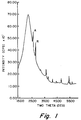
- FIGURE 1 is an x-ray diffraction pattern of the surface layer of a silica blank or preform doped with titania, from which the intensity peaks of the rutile and anatase crystalline phases of titania are evident.
- FIGURE 2 is a microprobe analysis of the surface layer of a silica blank or preform doped with titania. This analysis demonstrates the minute amount of depletion at the surface.
- FIGURE 3 is a photomicrograph of the surface and interior layers of a silica blank or preform doped with titania. The high concentration of TiO2 crystals (virtual non-depletion) at the surface is demonstrated.
- titanium isopropoxide, Ti(OC3H7)4, titanium ethoxide, Ti(OC2H5)4, or a combination thereof is used to dope metal oxide glasses.
- titanium isopropoxide, titanium ethoxide, or a combination thereof is used to produce the titania-doped silica out cladding layer or layers found in optical fiber with superior fatigue resistance performance as compared to standard silica clad optical waveguides.
- the application of the titanium-based, organometallic compounds of the instant invention as dopants to conventional methods of making optical fiber is easy and inexpensive to implement.
- each of the component liquids is heated to a constant temperature at which enough vapor pressure is generated to produce a reasonable rate of deposition.
- the individual vapors are entrained in a carrier gas stream, mixed together prior to combustion to ensure homogeneous output, and then passed through a burner flame, usually a natural gas/oxygen mixture which frequently contains excess oxygen.
- the vapors in the mixture are converted to their respective oxides upon exiting the burner orifice to form a stream of volatile gases and finely-divided, amorphous, spherical aggregates, called soot.
- the soot is collected on a support, for example, on a mandrel (called outside vapor deposition), or on the surface of a bait tube (called axial vapor deposition), and deposited in thin layers.
- a support for example, on a mandrel (called outside vapor deposition), or on the surface of a bait tube (called axial vapor deposition), and deposited in thin layers.
- the final product of soot collection, the porous preform is then subjected to high temperature in which the preform consolidates to a non-porous monolithic glassy body.
- the optical waveguide process is a three-step process.
- oxygen the carrier gas
- the resulting vaporous reactant is transported to a reaction site, such as a burner, via a carrier gas, wherein the vaporous gas streams are combusted in a burner flame fueled with natural gas and oxygen.
- the presence of oxygen serves to convert the vaporous reactants to their respective oxides upon exiting the burner orifice to form a stream of volatile gases and finely-divided, spherical particles of soot that are deposited onto a substrate, forming a porous blank or preform of opaque, white silica soot. Water, HCl, and carbon dioxide are emitted as byproducts of this reaction.
- the blank or preform is subsequently heat treated in a helium/chlorine atmosphere to full consolidation.
- conventional fiber-draw technology is utilized in pulling optical waveguide fiber from the preform.
- titanium isopropoxide as well as the other organometallic compounds of the instant invention, into such a system only requires an additional means of transporting a vaporous reactant to the burner site. Such a system modification can be met with minimal resources and/or expense.
- An added advantage of using titanium isopropoxide in producing titanium-doped optical fiber is that the titania layer produced exhibits minimal depletion.
- Depletion i.e., the migration and loss of titanium ions during consolidation, is an area of concern when producing fiber with good fatigue resistance.
- Previous methods of minimizing depletion have employed the bump layer wherein 4-8% depletion of titania has been observed in blanks after being consolidated in a 99:1 helium:chlorine environment. Less than 1% depletion has been observed in blanks doped with titanium isopropoxide that are consolidated in the same environment.
- titania-doped fiber made from titanium isopropoxide may be explained by the flame chemistry and crystalline phases of titania.
- anatase a low temperature polymorph of titania in the form of submicroscopic crystals
- titania made by oxidizing TiCl4.
- rutile a high temperature phase of titania, at around 1600-1650°C, after which rutile does not reconvert to anatase.
- Rutile is known to have a much smaller surface area as determined by surface area analysis.
- Both of these tetragonal crystals are usually produced during the flame hydrolysis of TiCl4 with anatase being the dominant phase, however. Because of its smaller surface area, it is expected that rutile would be less reactive to chlorine than anatase during the consolidation of a blank.
- the fiber in usual practice of preparing optical fiber, the fiber is quenched during the draw process, thus eliminating the existence of anatase and/or rutile TiO2 crystals, leaving fiber in the glassy state.
- the present inventive technology can be applied by utilizing various systems of oxidation through hydrolysis and/or pyrolysis, such as the bubbler, the preferred method for use in the large scale commercial production of optical fiber involves a flash vaporizer for generating soot. This practice is depicted in the Example below.
- Titanium isopropoxide was used to fabricate the outer layer of silica fibers. Titanium isopropoxide has a boiling point of 232°C and is stored under nitrogen because it reacts readily with water.
- the flash vaporizer was heated and controlled at 175°C, the boiling point of octamethylcyclotetrasiloxane (OMCTS).
- OMCTS is the organometallic used to generate silica.
- the flash vaporizer has two separate channels: titanium isopropoxide is flashed off one to yield TiO2; and OMCTS is flashed off the other to yield SiO2. All fume lines are heated to 175°C.
- the bypass nitrogen carries the product through the vaporizer into the fume line and then on to the burner.
- Oxygen is added to the fume line.
- the burner premix is methane/oxygen.
- the delivery rate for OMCTS was 7.5 gm per minute and the delivery rate for the titanium isopropoxide was 2.8 gm per minute. This combination yielded a blank containing an average of 12 wt% titania.
- the titania/silica blank was dried in a consolidation furnace in the presence of 1% chlorine and 99% helium. Afterwards, the blank was drawn into fiber.
- X-ray diffraction analyses of the surface layer have indicated that more rutile than anatase is present during laydown.
- microprobe analyses have demonstrated that the surface is depleted only 0.8% from an average value of 12.3% to 11.5% titania.
- An illustration of the crystal structure of the titania layers is shown in the photo-micrograph displayed in Figure 3.
- the white dots in the photomicrograph are submicroscopic crystals of rutile. (The white bar at the base of Figure 3 represents 10 microns.)
- titania-amides of the instant invention resemble those of the alkoxides, e.g. they are hydrolyzed rapidly by water and are sensitive to oxygen. It follows that they may serve as replacements for titanium isopropoxide and titanium ethoxide in synthesizing the titania-doped metal oxide glasses of the instant invention.
- the ultimate test of the fiber is determined by characterizing the resultant fatigue resistance.
- the fatigue resistance mechanism is known to the art, and is characterized by the fatigue constant, n.
- a fatigue constant of 33.3 was measured, which compares favorably with the fatigue constant of ⁇ 31.5 typically observed in commercially available titanium-doped silica fiber.
- OMCTS relative to SiCl4
- the cost of OMCTS relative to SiCl4 is approximately the same, based on the amount of silica deposited.
- Maximum soot collection efficiencies observed for SiCl4 are typically on the order of 50-60 per cent or higher; the maximum deposition efficiency for an OMCTS-based process is hypothesized to be in the same range. Therefore, the same cost effectiveness is expected when titania-doped glass based on OMCTS is produced.
- the cost of the halide-free, titanium-containing compounds of the instant invention are minimal when compared to standard processing techniques whereby doping is achieved by using TiCl4.
- deposition efficiency tends to increase with blank size. Once deposition begins collection efficiencies for SiCl4 can be less than 10%, while OMCTS can yield initial deposition efficiencies up to 25%. This factor of 2.5 or greater in deposition efficiency gives a corresponding increase in preform growth rate for equivalent rates of silica deposited at the burner, and a 20% or so reduction, by weight, in soot that has to be cleaned from the exhaust gases. These benefits are also possible when titania-doped glass based on OMCTS is produced.
Landscapes
- Chemical & Material Sciences (AREA)
- Engineering & Computer Science (AREA)
- Materials Engineering (AREA)
- Chemical Kinetics & Catalysis (AREA)
- General Chemical & Material Sciences (AREA)
- Geochemistry & Mineralogy (AREA)
- Life Sciences & Earth Sciences (AREA)
- Organic Chemistry (AREA)
- General Life Sciences & Earth Sciences (AREA)
- Manufacturing & Machinery (AREA)
- Glass Compositions (AREA)
- Manufacture, Treatment Of Glass Fibers (AREA)
- Glass Melting And Manufacturing (AREA)
Applications Claiming Priority (2)
| Application Number | Priority Date | Filing Date | Title |
|---|---|---|---|
| US750616 | 1991-08-26 | ||
| US07/750,616 US5154744A (en) | 1991-08-26 | 1991-08-26 | Method of making titania-doped fused silica |
Publications (2)
| Publication Number | Publication Date |
|---|---|
| EP0529190A1 true EP0529190A1 (fr) | 1993-03-03 |
| EP0529190B1 EP0529190B1 (fr) | 1996-08-28 |
Family
ID=25018574
Family Applications (1)
| Application Number | Title | Priority Date | Filing Date |
|---|---|---|---|
| EP92104490A Expired - Lifetime EP0529190B1 (fr) | 1991-08-26 | 1992-03-16 | Procédé pour la fabrication de silice fondue dopée au titane |
Country Status (7)
| Country | Link |
|---|---|
| US (1) | US5154744A (fr) |
| EP (1) | EP0529190B1 (fr) |
| JP (1) | JP3220253B2 (fr) |
| AU (1) | AU647955B2 (fr) |
| CA (1) | CA2062872A1 (fr) |
| DE (1) | DE69213139T2 (fr) |
| ES (1) | ES2090388T3 (fr) |
Cited By (3)
| Publication number | Priority date | Publication date | Assignee | Title |
|---|---|---|---|---|
| WO2001079571A3 (fr) * | 2000-04-18 | 2002-04-04 | Millennium Inorganic Chem | Composes de tio2 obtenus a partir d'un minerai a teneur elevee en silicate |
| EP1218796A4 (fr) * | 1999-07-22 | 2006-08-23 | Corning Inc | Procede lithographique de projection de rayons x mous a ultraviolets extremes et masques correspondant |
| EP1214718A4 (fr) * | 1999-07-22 | 2006-08-23 | Corning Inc | Procede et systeme de gravure par projection aux rayons x mous dans l'ultraviolet extreme et elements de gravure |
Families Citing this family (46)
| Publication number | Priority date | Publication date | Assignee | Title |
|---|---|---|---|---|
| US5755850A (en) * | 1992-09-24 | 1998-05-26 | Iowa State University Research Foundation | Method of making a surgical laser fiber from a monolithic silica titania glass rod |
| DE69432175T2 (de) * | 1993-03-24 | 2004-03-04 | Georgia Tech Research Corp. | Verfahren und vorrichtung zur verbrennungs cvd von filmen und beschichtungen |
| GB9312634D0 (en) * | 1993-06-18 | 1993-08-04 | Tsl Group Plc | Improvements in vitreous silica manufacture |
| DE69601749T3 (de) * | 1995-06-07 | 2004-04-29 | Corning Inc. | Verfahren zur thermischen Behandlung und zum Konsolidieren von Vorformen aus Siliciumdioxid zur Verminderung von durch Laser hervorgerufenen optischen Defekten |
| US5868734A (en) * | 1995-11-29 | 1999-02-09 | Iowa State University Research Foundation, Inc. | Methods of using silica-titania clad fibers |
| FR2759465B1 (fr) * | 1996-04-30 | 1999-04-30 | Corning Inc | Procede de formation d'un circuit optique |
| EP0960073A4 (fr) * | 1996-06-17 | 2004-04-07 | Corning Inc | Procede de formation de preformes contenant de l'oxyde de titane et d'ebauches de verre de silice |
| US6309991B1 (en) | 1996-08-29 | 2001-10-30 | Corning Incorporated | Silica with low compaction under high energy irradiation |
| CN1211264A (zh) | 1996-12-16 | 1999-03-17 | 康宁股份有限公司 | 制造锗掺杂的二氧化硅用的原料及制造方法 |
| WO1998027018A1 (fr) * | 1996-12-16 | 1998-06-25 | Corning Incorporated | Composes organometalliques pour des applications de circuits optiques a onde lumineuse |
| US6487879B1 (en) | 1997-03-07 | 2002-12-03 | Corning Incorporated | Method of making titania-doped fused silica |
| KR100574123B1 (ko) * | 1997-09-24 | 2006-04-25 | 코닝 인코포레이티드 | 용융 실리카-티타니아 유리의 제조방법 |
| EP1094990A1 (fr) * | 1998-04-22 | 2001-05-02 | Corning Incorporated | Procedes de fabrication de verres en silice-anhydride titanique a expansion ultra faible |
| US6214473B1 (en) * | 1998-05-13 | 2001-04-10 | Andrew Tye Hunt | Corrosion-resistant multilayer coatings |
| EP0978487A3 (fr) | 1998-08-07 | 2001-02-21 | Corning Incorporated | Bruleur à bec étanche et sans premelange pour le dépot de verre de silice |
| US5970751A (en) * | 1998-09-22 | 1999-10-26 | Corning Incorporated | Fused SiO2 -TiO2 glass method |
| US6207522B1 (en) * | 1998-11-23 | 2001-03-27 | Microcoating Technologies | Formation of thin film capacitors |
| US6368942B1 (en) * | 2000-03-31 | 2002-04-09 | Euv Llc | Method for fabricating an ultra-low expansion mask blank having a crystalline silicon layer |
| AU2001245816A1 (en) * | 2000-05-25 | 2001-12-11 | Corning Incorporated | Method of making a titania-doped fused silica preform |
| US6387511B1 (en) * | 2000-07-27 | 2002-05-14 | Corning Incorporated | Light weight porous structure |
| US6988378B1 (en) | 2000-07-27 | 2006-01-24 | Corning Incorporated | Light weight porous structure |
| EP1195360A1 (fr) * | 2000-09-01 | 2002-04-10 | Degussa AG | Méthode de fabrication de verres SiO2-TiO2 avec un coefficient d'expansion faible |
| US6776006B2 (en) | 2000-10-13 | 2004-08-17 | Corning Incorporated | Method to avoid striae in EUV lithography mirrors |
| US20030104209A1 (en) * | 2001-11-30 | 2003-06-05 | Bellman Robert A. | Precursor and method of growing doped glass films |
| US6832493B2 (en) * | 2002-02-27 | 2004-12-21 | Corning Incorporated | High purity glass bodies formed by zero shrinkage casting |
| US6829908B2 (en) * | 2002-02-27 | 2004-12-14 | Corning Incorporated | Fabrication of inclusion free homogeneous glasses |
| US20030159466A1 (en) * | 2002-02-27 | 2003-08-28 | Bowden Bradley F. | Dry pressing of spray dried soot to make EUV components |
| US20030226377A1 (en) * | 2002-03-05 | 2003-12-11 | Barrett W. Tim | Method of making silica-titania extreme ultraviolet elements |
| US7053017B2 (en) * | 2002-03-05 | 2006-05-30 | Corning Incorporated | Reduced striae extreme ultraviolet elements |
| US20040025542A1 (en) * | 2002-06-07 | 2004-02-12 | Ball Laura J. | Method of making extreme ultraviolet lithography glass substrates |
| JP2004131373A (ja) * | 2002-09-09 | 2004-04-30 | Corning Inc | シリカ・チタニア極端紫外線光学素子の製造方法 |
| EP1471038A3 (fr) | 2003-04-26 | 2005-11-23 | Schott Ag | Procédé de fabrication de corps vitreux en verre de silice dopée |
| US7155936B2 (en) * | 2003-08-08 | 2007-01-02 | Corning Incorporated | Doped silica glass articles and methods of forming doped silica glass boules and articles |
| US20060179879A1 (en) * | 2004-12-29 | 2006-08-17 | Ellison Adam J G | Adjusting expansivity in doped silica glasses |
| US20080050076A1 (en) * | 2006-08-23 | 2008-02-28 | Ming-Jun Li | Low loss photonic waveguide having high index contrast glass layers |
| US7799711B2 (en) * | 2007-08-31 | 2010-09-21 | Corning Incorporated | Photomachinable glass compositions having tunable photosensitivity |
| US20120026473A1 (en) | 2010-07-29 | 2012-02-02 | Michael Lucien Genier | Highly reflective, hardened silica titania article and method of making |
| DE102011119373A1 (de) | 2011-11-25 | 2013-05-29 | Heraeus Quarzglas Gmbh & Co. Kg | Verfahren zur Herstellung von synthetischem Quarzglas |
| DE102011119339A1 (de) | 2011-11-25 | 2013-05-29 | Heraeus Quarzglas Gmbh & Co. Kg | Zerstäubungsverfahren zur Herstellung von synthetischem Quarzglas |
| DE102011119374A1 (de) | 2011-11-25 | 2013-05-29 | Heraeus Quarzglas Gmbh & Co. Kg | Verfahren zur Herstellung von synthetischem Quarzglas |
| DE102011119341A1 (de) | 2011-11-25 | 2013-05-29 | Heraeus Quarzglas Gmbh & Co. Kg | Verfahren zur Herstellung von synthetischem Quarzglas nach der Sootmethode |
| JP5520346B2 (ja) * | 2012-07-24 | 2014-06-11 | 信越石英株式会社 | 繊維状光触媒体の製造方法 |
| JP5596807B2 (ja) * | 2013-01-28 | 2014-09-24 | 信越石英株式会社 | 可視光応答型繊維状光触媒体の製造方法 |
| US9382151B2 (en) | 2014-01-31 | 2016-07-05 | Corning Incorporated | Low expansion silica-titania articles with a Tzc gradient by compositional variation |
| JP6748644B2 (ja) | 2014-11-26 | 2020-09-02 | コーニング インコーポレイテッド | ハロゲンをドープした光学要素を製造する方法 |
| KR102504285B1 (ko) * | 2022-10-28 | 2023-02-24 | 소중원 | 차량 도장면 초미립입자 분사 유리막 코팅 장치 |
Citations (3)
| Publication number | Priority date | Publication date | Assignee | Title |
|---|---|---|---|---|
| EP0103448A2 (fr) * | 1982-09-15 | 1984-03-21 | Corning Glass Works | Production de verres et céramiques frittés |
| EP0146659B1 (fr) * | 1983-12-22 | 1988-03-30 | Shin-Etsu Chemical Co., Ltd. | Méthode de préparation de verre de silice synthétique convenant comme matériau pour fibres optiques |
| EP0471139A2 (fr) * | 1990-08-16 | 1992-02-19 | Corning Incorporated | Procédé de fabrication des corps de verre quartzeux non poreux à haute pureté |
Family Cites Families (9)
| Publication number | Priority date | Publication date | Assignee | Title |
|---|---|---|---|---|
| US3933162A (en) * | 1973-05-17 | 1976-01-20 | Automatic Revenue Controls (Europa) Ltd. | Coin feeding devices |
| JPS56114904A (en) * | 1980-02-18 | 1981-09-09 | Nippon Telegr & Teleph Corp <Ntt> | Manufacture of light directing film |
| JPS56164023A (en) * | 1980-05-19 | 1981-12-16 | Nippon Telegr & Teleph Corp <Ntt> | Quartz-glass lens |
| JPS6090838A (ja) * | 1983-10-25 | 1985-05-22 | Shin Etsu Chem Co Ltd | 光伝送用石英ガラス母材の製造方法 |
| JPS60155551A (ja) * | 1984-01-24 | 1985-08-15 | Toshiba Corp | 光フアイバ用被覆ガラス |
| US4877306A (en) * | 1987-09-30 | 1989-10-31 | Corning Glass Works | Coated optical waveguide fibers |
| US4915988A (en) * | 1988-06-22 | 1990-04-10 | Georgia Tech Research Corporation | Chemical vapor deposition of group IIA metals and precursors therefor |
| GB8905966D0 (en) | 1989-03-15 | 1989-04-26 | Tsl Group Plc | Improved vitreous silica products |
| US5067975A (en) * | 1989-12-22 | 1991-11-26 | Corning Incorporated | Method of manufacturing optical waveguide fiber with titania-silica outer cladding |
-
1991
- 1991-08-26 US US07/750,616 patent/US5154744A/en not_active Expired - Lifetime
-
1992
- 1992-03-12 CA CA002062872A patent/CA2062872A1/fr not_active Abandoned
- 1992-03-16 ES ES92104490T patent/ES2090388T3/es not_active Expired - Lifetime
- 1992-03-16 EP EP92104490A patent/EP0529190B1/fr not_active Expired - Lifetime
- 1992-03-16 DE DE69213139T patent/DE69213139T2/de not_active Expired - Fee Related
- 1992-08-24 AU AU21261/92A patent/AU647955B2/en not_active Ceased
- 1992-08-25 JP JP24709092A patent/JP3220253B2/ja not_active Expired - Lifetime
Patent Citations (3)
| Publication number | Priority date | Publication date | Assignee | Title |
|---|---|---|---|---|
| EP0103448A2 (fr) * | 1982-09-15 | 1984-03-21 | Corning Glass Works | Production de verres et céramiques frittés |
| EP0146659B1 (fr) * | 1983-12-22 | 1988-03-30 | Shin-Etsu Chemical Co., Ltd. | Méthode de préparation de verre de silice synthétique convenant comme matériau pour fibres optiques |
| EP0471139A2 (fr) * | 1990-08-16 | 1992-02-19 | Corning Incorporated | Procédé de fabrication des corps de verre quartzeux non poreux à haute pureté |
Non-Patent Citations (2)
| Title |
|---|
| DATABASE WPIL Section Ch, Week 27, Derwent Publications Ltd., London, GB; Class L01, AN 85-161549 & JP-A-60 090 838 (SHINETSU CHEM. IND. KK) 22 May 1985 * |
| PATENT ABSTRACTS OF JAPAN vol. 13, no. 556 (C-664)(3904) 11 December 1989 & JP-A-01 230 444 ( SUMITOMO ELECTRIC IND.LTD. ) 13 September 1989 * |
Cited By (4)
| Publication number | Priority date | Publication date | Assignee | Title |
|---|---|---|---|---|
| EP1218796A4 (fr) * | 1999-07-22 | 2006-08-23 | Corning Inc | Procede lithographique de projection de rayons x mous a ultraviolets extremes et masques correspondant |
| EP1214718A4 (fr) * | 1999-07-22 | 2006-08-23 | Corning Inc | Procede et systeme de gravure par projection aux rayons x mous dans l'ultraviolet extreme et elements de gravure |
| WO2001079571A3 (fr) * | 2000-04-18 | 2002-04-04 | Millennium Inorganic Chem | Composes de tio2 obtenus a partir d'un minerai a teneur elevee en silicate |
| US6713038B2 (en) | 2000-04-18 | 2004-03-30 | Millenium Inorganic Chemicals, Inc. | TiO2 compounds obtained from a high silica content ore |
Also Published As
| Publication number | Publication date |
|---|---|
| EP0529190B1 (fr) | 1996-08-28 |
| JPH05246736A (ja) | 1993-09-24 |
| DE69213139T2 (de) | 1997-02-06 |
| ES2090388T3 (es) | 1996-10-16 |
| AU647955B2 (en) | 1994-03-31 |
| JP3220253B2 (ja) | 2001-10-22 |
| CA2062872A1 (fr) | 1993-02-27 |
| DE69213139D1 (de) | 1996-10-02 |
| AU2126192A (en) | 1993-03-04 |
| US5154744A (en) | 1992-10-13 |
Similar Documents
| Publication | Publication Date | Title |
|---|---|---|
| US5154744A (en) | Method of making titania-doped fused silica | |
| US5152819A (en) | Method of making fused silica | |
| CA2037102C (fr) | Mode de production de silice fondue | |
| EP0463045B1 (fr) | Produits ameliores de silice vitreuse | |
| US6487879B1 (en) | Method of making titania-doped fused silica | |
| US6312656B1 (en) | Method for forming silica by combustion of liquid reactants using oxygen | |
| EP0868401B1 (fr) | Procede et dispositif servant a obtenir du verre de silice par combustion de reactifs liquides | |
| US5703191A (en) | Method for purifying polyalkylsiloxanes and the resulting products | |
| US5879649A (en) | Method for purifying polyalkylsiloxanes and the resulting products | |
| CN1211264A (zh) | 制造锗掺杂的二氧化硅用的原料及制造方法 | |
| EP1030822B1 (fr) | PROCEDE DE PRODUCTION DE VERRE DE SiO2-TiO2 FONDUE | |
| US4564378A (en) | Method for producing a preform for light waveguides | |
| AU638702C (en) | Vitreous silica products |
Legal Events
| Date | Code | Title | Description |
|---|---|---|---|
| PUAI | Public reference made under article 153(3) epc to a published international application that has entered the european phase |
Free format text: ORIGINAL CODE: 0009012 |
|
| AK | Designated contracting states |
Kind code of ref document: A1 Designated state(s): DE ES FR GB IT NL |
|
| 17P | Request for examination filed |
Effective date: 19930812 |
|
| 17Q | First examination report despatched |
Effective date: 19950308 |
|
| GRAH | Despatch of communication of intention to grant a patent |
Free format text: ORIGINAL CODE: EPIDOS IGRA |
|
| GRAH | Despatch of communication of intention to grant a patent |
Free format text: ORIGINAL CODE: EPIDOS IGRA |
|
| GRAA | (expected) grant |
Free format text: ORIGINAL CODE: 0009210 |
|
| AK | Designated contracting states |
Kind code of ref document: B1 Designated state(s): DE ES FR GB IT NL |
|
| ITF | It: translation for a ep patent filed | ||
| REF | Corresponds to: |
Ref document number: 69213139 Country of ref document: DE Date of ref document: 19961002 |
|
| REG | Reference to a national code |
Ref country code: ES Ref legal event code: FG2A Ref document number: 2090388 Country of ref document: ES Kind code of ref document: T3 |
|
| REG | Reference to a national code |
Ref country code: ES Ref legal event code: FG2A Ref document number: 2090388 Country of ref document: ES Kind code of ref document: T3 |
|
| ET | Fr: translation filed | ||
| PLBE | No opposition filed within time limit |
Free format text: ORIGINAL CODE: 0009261 |
|
| STAA | Information on the status of an ep patent application or granted ep patent |
Free format text: STATUS: NO OPPOSITION FILED WITHIN TIME LIMIT |
|
| 26N | No opposition filed | ||
| PGFP | Annual fee paid to national office [announced via postgrant information from national office to epo] |
Ref country code: ES Payment date: 19980323 Year of fee payment: 7 |
|
| PG25 | Lapsed in a contracting state [announced via postgrant information from national office to epo] |
Ref country code: ES Free format text: LAPSE BECAUSE OF NON-PAYMENT OF DUE FEES Effective date: 19990317 |
|
| REG | Reference to a national code |
Ref country code: ES Ref legal event code: FD2A Effective date: 20010503 |
|
| REG | Reference to a national code |
Ref country code: GB Ref legal event code: IF02 |
|
| PGFP | Annual fee paid to national office [announced via postgrant information from national office to epo] |
Ref country code: DE Payment date: 20020327 Year of fee payment: 11 |
|
| PGFP | Annual fee paid to national office [announced via postgrant information from national office to epo] |
Ref country code: GB Payment date: 20030204 Year of fee payment: 12 |
|
| PGFP | Annual fee paid to national office [announced via postgrant information from national office to epo] |
Ref country code: NL Payment date: 20030206 Year of fee payment: 12 |
|
| PGFP | Annual fee paid to national office [announced via postgrant information from national office to epo] |
Ref country code: FR Payment date: 20030303 Year of fee payment: 12 |
|
| PG25 | Lapsed in a contracting state [announced via postgrant information from national office to epo] |
Ref country code: DE Free format text: LAPSE BECAUSE OF NON-PAYMENT OF DUE FEES Effective date: 20031001 |
|
| PG25 | Lapsed in a contracting state [announced via postgrant information from national office to epo] |
Ref country code: GB Free format text: LAPSE BECAUSE OF NON-PAYMENT OF DUE FEES Effective date: 20040316 |
|
| PG25 | Lapsed in a contracting state [announced via postgrant information from national office to epo] |
Ref country code: NL Free format text: LAPSE BECAUSE OF NON-PAYMENT OF DUE FEES Effective date: 20041001 |
|
| GBPC | Gb: european patent ceased through non-payment of renewal fee |
Effective date: 20040316 |
|
| PG25 | Lapsed in a contracting state [announced via postgrant information from national office to epo] |
Ref country code: FR Free format text: LAPSE BECAUSE OF NON-PAYMENT OF DUE FEES Effective date: 20041130 |
|
| NLV4 | Nl: lapsed or anulled due to non-payment of the annual fee |
Effective date: 20041001 |
|
| REG | Reference to a national code |
Ref country code: FR Ref legal event code: ST |
|
| PG25 | Lapsed in a contracting state [announced via postgrant information from national office to epo] |
Ref country code: IT Free format text: LAPSE BECAUSE OF NON-PAYMENT OF DUE FEES Effective date: 20050316 |