EP0529514A2 - Adressendrucksystem auf Briefumschlägen - Google Patents
Adressendrucksystem auf Briefumschlägen Download PDFInfo
- Publication number
- EP0529514A2 EP0529514A2 EP92114224A EP92114224A EP0529514A2 EP 0529514 A2 EP0529514 A2 EP 0529514A2 EP 92114224 A EP92114224 A EP 92114224A EP 92114224 A EP92114224 A EP 92114224A EP 0529514 A2 EP0529514 A2 EP 0529514A2
- Authority
- EP
- European Patent Office
- Prior art keywords
- envelopes
- groups
- printing
- sequence
- subsequences
- Prior art date
- Legal status (The legal status is an assumption and is not a legal conclusion. Google has not performed a legal analysis and makes no representation as to the accuracy of the status listed.)
- Withdrawn
Links
Images


Classifications
-
- B—PERFORMING OPERATIONS; TRANSPORTING
- B07—SEPARATING SOLIDS FROM SOLIDS; SORTING
- B07C—POSTAL SORTING; SORTING INDIVIDUAL ARTICLES, OR BULK MATERIAL FIT TO BE SORTED PIECE-MEAL, e.g. BY PICKING
- B07C3/00—Sorting according to destination
- B07C3/18—Devices or arrangements for indicating destination, e.g. by code marks
Definitions
- the subject invention relates to a system for addressing envelopes. More particularly it relates to a system including a laser printer or the like operating under control of a micro-computer or the like to print envelopes with addresses.
- envelopes are printed "two-up" or, more generally, as a succession of pluralities of envelopes, there is a problem in printing a sequence of M addresses and restoring the printed envelopes to the same sequence. This is desirable because the Postal Service allows substantial postage discounts for pre-sorted mail and because it is frequently necessary to match particular contents with corresponding pre-addressed envelopes. If envelopes are printed "two-up" in the most natural way, with one stream consisting of envelopes printed with the even numbered addresses in the sequence and the other printed with the odd numbered sequence of addresses, the envelope steams will have to be merged envelope by envelope to restore the sequence for the printed envelopes.
- the output of such a printer will generally be to an output stacker having a limited capacity 2N (two stacks of N envelopes, still considering "two-up” printing) where 2N is generally less than M.
- 2N is generally less than M.
- the system must suborder the printed envelopes into groups of N envelopes.
- an envelope printing system which includes a printer having the capability to print two or more envelopes simultaneously, and controller for controlling the printer to print a sequence of consecutive addresses on the envelopes.
- sequence of consecutive addresses means a list of addresses, including return addresses, zip codes, bar codes, etc., which is ordered in accordance with a predetermined rule for determining the position of each address within the list.
- the controller further controls the printer to suborder the sequence into two or more subsequences of consecutive addresses and to concurrently print the subsequences on the envelopes to form two or more groups of envelopes printed with consecutive addresses, wherein the size of the groups is determined by the output (or input) capacity of the printer.
- the subsequences are selected from the sequence so that adjacent groups may be concatenated to form larger groups printed with successive addresses.
- adjacent groups are either successively printed groups in the same paper feed path or concurrently printed groups in physically adjacent feed paths.
- the groups may be readily combined to conform to the sequence of addresses.
- the printer may have multiple sensors for detecting movement of envelopes along the two or more parallel paper paths provided through the printer so that printing stops when there is a jam, or failure to feed in any path.
- the printer may have multiple sensors for detecting movement of envelopes along the two or more parallel paper paths provided through the printer so that printing stops when there is a jam, or failure to feed in any path.
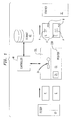
- Figure 1 shows a schematic block diagram of a system in accordance with the subject invention.
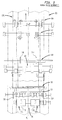
- Figure 2 shows a semi-schematic unfolded plan view, partially broken away, of the paper path through a laser printer, as modified in accordance with the subject invention.
- Figure 3 shows a flow chart of the operation of one embodiment of the subject invention.
- Figure 4 shows a flow chart of the operation of a second embodiment of the subject invention.
- FIG. 1 shows a block diagram of a system in accordance with the subject invention, where a substantially conventional envelope feeder 10 is provided to feed envelopes two at a time to a laser printer 20.
- Feeders for feeding envelopes two at a time are known in the art and are described in above referenced US Patent No. 4,603,846. Applicant notes, however, that where the addresses to be printed include bar code information current Postal Service requirements place tight tolerances on the position of the bar code and modifications may be required to a feeder to meet these tolerance requirements.
- Such a feeder is described in commonly assigned, Co-pending Application Serial No. 07/643,616 which describes a feeder for feeding single envelopes.
- the envelopes are then printed by laser printer 20, with each envelope being printed with a distinct address selected from an ordered list of address, as will be described further below.
- One envelope moves along the first, or left, path 22L while the second moves along the second, or right, path 22R.
- the envelopes are simultaneously printed by a conventional laser print engine in a manner well understood by those skilled in the art, which need not be discussed further here for an understanding of the subject invention.
- Each envelope is typically printed with a return address R, a destination address A, and the destination zip code in bar code format B, and output to stacker 30.
- Laser printer 20 is substantially a conventional laser printer, such as a Model No. W100 marketed by Mita Copystar, Inc. under an OEM agreement with the assignee of the present application Modifications to provide two parallel envelope path together with a capability to transport a single sheet or envelope along the center line, will be described more fully below.
- Stacker 30 is substantially conventional and is designed to hold two stacks of N envelopes each, for a total capacity of 2N.
- 2N will be substantially less than the total number of addresses to be printed, M, so that as stacker 30 fills it will be necessary for an operator to transfer the output stack to a mail tray, or similar container.
- these groups of N envelopes be printed in a manner which will allow the operator to readily restore the groups of envelopes to correspond to the original sequence of addresses. (It will clear to those skilled in the art that, for other printer designs, the capacity of the input envelope feeder may be controlling.)
- Controller 40 which is typically a microcomputer such as an IBM PC. Controller 40 maintains an address list which is typically stored in a disc storage unit 42, or other equivalent storage medium, and generates an ordered sequence of addresses to be printed in a conventional manner. Software for the maintenance of such address databases and the generation of such ordered address lists is well known and need not be discussed further here for an understanding of the subject invention. One example of such software is marketed by the assignee of the subject application under the trademark "Microfinalist".
- controller 40 formats pairs of addresses into a single page and controls printer 20 to print that page in a conventional manner so that one address is printed on the envelope moving along path 22L and the other is printed on the envelope and moving along path 22R, as is shown in Figure 1.
- controller 40 selects these pairs of addresses to form two subsequences and prints corresponding groups of envelopes, one from path 22L and the other from path 22R which may be easily concatenated to form larger groups of sequentially addressed envelopes, which correspond to the original address sequence.
- FIG. 2 shows a schematic representation of the paper paths 22L and 22R through laser printer 20.
- Pick up rollers 52L and 52R pick up the top envelope from each of two stacks of envelopes in a feeder (not shown) and transfer these envelopes to separator assembly 56 which is provided to assure that only a single envelope is feed along each of paths 22L and 22R.
- the envelopes are then transferred past guide rollers 58 to registration assembly 60.
- Assembly 60 also provides a second separating action to further assure that only single envelopes are feed along each path.
- the envelopes are then transferred to registration assembly 61 which is provided to assure that each of the two envelopes is properly lead edge registered before printing. After registration each envelope is simultaneously printed by print engine 24 (shown in Figure 1) and then transferred for output by feed roller assemblies 62 and 64.
- the paper paths through printer 20 also include out of paper sensors 70L and 70R and sensors 72L and 72R, and 74L and 74R to monitor the passing of envelopes along paper paths 22L and 22R, respectively, to detect jams.
- One of sensors 74L or 74R is also used to initiate the operation of print engine 24 in synchronism with the movement of the envelopes.
- Each of these pairs of sensors is logically "anded” so that if either sensor in a pair is not activated, i.e., either stack is out of envelopes or there is a jam along either paper path, printer 20 senses an error condition, pauses, and waits for operator intervention. Spacing between each pair of sensors is chosen so that both are activated if a single envelope of at least a predetermined width is transported along the center line.
- printer 20 Functions of printer 20 (e.g. print operation, transport, etc.) are locally controlled by controller 21, responsive to sensors 70L and 70R, and 74L and 74R .
- Paper Paths 22L and 22R are similar to conventional paper paths through conventional laser printers intended for sheet printing and differ-substantially only by the addition of additional lateral drive points along each drive shaft to assure good drive for both pairs of envelopes and single sheets or envelopes along the center line: and the replacement of single sensors with pairs of logically "anded" sensors, as described above. Accordingly a further description of the movement of envelopes through printer 20 is not believed necessary for an understanding of the subject invention.
- Figure 3 shows a flow chart of the operation of controller 40 in forming subsequences of addresses and controlling printer 20 to print corresponding groups of envelopes.
- controller 40 tests if the number of addresses M to be printed is odd. If it is, a blank address it is added to the list and N is set equal to M+1, at 102, and controller 40 continues to decision block 104. If N is even controller 40 goes directly to 104. There the system tests to determine if M is less than or equal to 2Ni, where i is an index representing the number of pairs of subsequences which have been formed and corresponding groups which have been printed. If M is less than or equal to 2Ni then all addresses have been printed and the system exits.
- system 40 executes the routine shown in block 110 to form a first string of groups from path 22L having the form: [1,...,N], [2N+1,...,3N], ...; and a second string of groups having the form: [N+1,...,2N], [3N+1,...,4N], ...; (As used herein to described the form of strings of blocks of envelopes the numbers 1-M represent the positions of corresponding addresses in the sequence so that, for example, "1-N" describes a block of N envelopes printed with the first N addresses, in sequence.)
- controller 40 follows the routine shown in block 112 to divide the remaining addresses between the last group of each string as shown above.
- each pair of groups is printed the operator need only first take the left group from paper path 22L, place it in a mail tray or similar container, and then concatenate the second group from 22R with the first group in the mail tray. Repeating this process with all groups produced will restore the printed envelopes to correspond the original sequence of addresses.
- controller 40 increments small i by one and returns to decision block 104.
- Figure 4 shows a flow chart of the operation of the system of the subject invention in accordance with a second embodiment.
- controller 40 from blocks 200 through 208 is identical to the operation shown in Figure 3 for blocks 100 through 108 and repetition of the description provided above is not believed necessary for understanding of the subject invention.
- controller 40 executes the routine shown to divide the remaining addresses between the last groups in the first and second strings, as shown above. Then at 216 controller 40 increments i by one and returns 204.
- a system operator concatenates successive groups from paper path 22L and successive groups from paper path 22R to form two larger groups corresponding to the first and second halves of the original string. These two larger groups may then be in turn concatenated to restore the original sequence.
Landscapes
- Accessory Devices And Overall Control Thereof (AREA)
- Sheets, Magazines, And Separation Thereof (AREA)
Applications Claiming Priority (2)
| Application Number | Priority Date | Filing Date | Title |
|---|---|---|---|
| US747581 | 1991-08-20 | ||
| US07/747,581 US5343556A (en) | 1991-08-20 | 1991-08-20 | System for addressing envelopes |
Publications (2)
| Publication Number | Publication Date |
|---|---|
| EP0529514A2 true EP0529514A2 (de) | 1993-03-03 |
| EP0529514A3 EP0529514A3 (en) | 1993-05-12 |
Family
ID=25005718
Family Applications (1)
| Application Number | Title | Priority Date | Filing Date |
|---|---|---|---|
| EP19920114224 Withdrawn EP0529514A3 (en) | 1991-08-20 | 1992-08-20 | System for addressing envelopes |
Country Status (3)
| Country | Link |
|---|---|
| US (1) | US5343556A (de) |
| EP (1) | EP0529514A3 (de) |
| CA (1) | CA2076095A1 (de) |
Families Citing this family (9)
| Publication number | Priority date | Publication date | Assignee | Title |
|---|---|---|---|---|
| DE4224955C2 (de) * | 1992-07-24 | 1998-11-26 | Francotyp Postalia Gmbh | Anordnung und Verfahren für einen internen Kostenstellendruck |
| FR2701778B1 (fr) * | 1993-02-17 | 1995-03-31 | Neopost Ind | Inverseur électronique de pages pour un système de traitement de courrier et plieuse-inséreuse comportant un tel inverseur. |
| US5818724A (en) * | 1996-03-20 | 1998-10-06 | Pitney Bowes Inc. | Method of in-line addressing for modular folder inserters |
| US5912695A (en) * | 1997-12-12 | 1999-06-15 | Pitney Bowes Inc. | System for printing pairs of envelopes or the like |
| US7113959B1 (en) | 2000-01-10 | 2006-09-26 | Imagex, Inc. | System and method of using human resources data to generate printed products |
| US7818285B1 (en) | 2000-01-10 | 2010-10-19 | Fedex Office And Print Services, Inc. | System and method of using a sales management system to generate printed products |
| US6415277B1 (en) * | 2000-01-10 | 2002-07-02 | Imagex, Inc. | Method of generating print production tasks using information extracted from enterprise databases |
| US6639918B1 (en) * | 2000-01-18 | 2003-10-28 | Apple Computer, Inc. | Method and apparatus for border node behavior on a full-duplex bus |
| AU2006249239B2 (en) * | 2006-12-07 | 2010-02-18 | Canon Kabushiki Kaisha | A method of ordering and presenting images with smooth metadata transitions |
Family Cites Families (6)
| Publication number | Priority date | Publication date | Assignee | Title |
|---|---|---|---|---|
| JPS58207982A (ja) * | 1982-05-29 | 1983-12-03 | 株式会社東芝 | 紙札類発行装置 |
| AT380498B (de) * | 1983-10-12 | 1986-05-26 | Plasser Bahnbaumasch Franz | Fahrbare gleisstopfmaschine, insbesondere gleis- stopf-, nivellier- und richtmaschine |
| US4524691A (en) * | 1984-01-11 | 1985-06-25 | Graphic Arts Technical Innovators, Inc. | Envelope feeder for printing press with timing circuit for suction cups, feed roller and flywheel |
| US4603846A (en) * | 1984-10-03 | 1986-08-05 | Micheal Miles | Dual-stream envelope feeder |
| US4731741A (en) * | 1985-10-25 | 1988-03-15 | Allen Paul M | Bulk mail label printing |
| US4807805A (en) * | 1987-01-20 | 1989-02-28 | Avery International Corporation | Dual envelope sheet-fed assembly |
-
1991
- 1991-08-20 US US07/747,581 patent/US5343556A/en not_active Expired - Lifetime
-
1992
- 1992-08-13 CA CA002076095A patent/CA2076095A1/en not_active Abandoned
- 1992-08-20 EP EP19920114224 patent/EP0529514A3/en not_active Withdrawn
Also Published As
| Publication number | Publication date |
|---|---|
| US5343556A (en) | 1994-08-30 |
| CA2076095A1 (en) | 1993-02-21 |
| EP0529514A3 (en) | 1993-05-12 |
Similar Documents
| Publication | Publication Date | Title |
|---|---|---|
| JP3068595B2 (ja) | 両面記録の方法 | |
| CN1326758C (zh) | 纸张叠放装置 | |
| US5726897A (en) | Mail assembly system and method | |
| US5343556A (en) | System for addressing envelopes | |
| CN101008800A (zh) | 具有用于装订打印物的带订书机的整理器的图像形成系统 | |
| JPS58162372A (ja) | 封筒宛名印刷装置及び方法 | |
| EP0706096A1 (de) | Zwei-Wege Blattzuführvorrichtung | |
| GB2160063A (en) | Printing system for page printer | |
| WO1996018954A9 (en) | Improved printing system | |
| CA2174046C (en) | Method for generating a mailpiece | |
| US6470156B1 (en) | Method of printing variable image requirements | |
| US5039077A (en) | Multibin feeder | |
| US5206684A (en) | Recording apparatus including a memory into which information is written in a particular order and from which memory information is read in the reverse order | |
| EP0899619A2 (de) | Verfahren zu unprogrammierten Ausgabe von Blattsätzen in einer Endverarbeitungsvorrichtung | |
| CA2175773C (en) | Method for maintaining mailpiece integrity | |
| JP2002103758A (ja) | 印刷装置およびそのエラー通知方法 | |
| US5257040A (en) | System for printing asymmetrically positioned pairs of envelopes | |
| US5912695A (en) | System for printing pairs of envelopes or the like | |
| JP5747452B2 (ja) | 画像形成システム | |
| JPH0234860B2 (de) | ||
| JPH1035997A (ja) | 印刷用紙区分装置 | |
| JP2684724B2 (ja) | 記録装置 | |
| JPH10101260A (ja) | 印刷用紙区分装置 | |
| JPH021044B2 (de) | ||
| JPH0653422B2 (ja) | 両面記録ページプリンタ |
Legal Events
| Date | Code | Title | Description |
|---|---|---|---|
| PUAI | Public reference made under article 153(3) epc to a published international application that has entered the european phase |
Free format text: ORIGINAL CODE: 0009012 |
|
| AK | Designated contracting states |
Kind code of ref document: A2 Designated state(s): DE FR GB |
|
| PUAL | Search report despatched |
Free format text: ORIGINAL CODE: 0009013 |
|
| AK | Designated contracting states |
Kind code of ref document: A3 Designated state(s): DE FR GB |
|
| 18W | Application withdrawn |
Withdrawal date: 19930810 |