EP0529520A1 - Procédé pour la préparation de poudres d'alliages composites à matrice en aluminium - Google Patents
Procédé pour la préparation de poudres d'alliages composites à matrice en aluminium Download PDFInfo
- Publication number
- EP0529520A1 EP0529520A1 EP92114255A EP92114255A EP0529520A1 EP 0529520 A1 EP0529520 A1 EP 0529520A1 EP 92114255 A EP92114255 A EP 92114255A EP 92114255 A EP92114255 A EP 92114255A EP 0529520 A1 EP0529520 A1 EP 0529520A1
- Authority
- EP
- European Patent Office
- Prior art keywords
- powder
- preparing
- percent
- ceramic particles
- alloy
- Prior art date
- Legal status (The legal status is an assumption and is not a legal conclusion. Google has not performed a legal analysis and makes no representation as to the accuracy of the status listed.)
- Granted
Links
Images
Classifications
-
- C—CHEMISTRY; METALLURGY
- C22—METALLURGY; FERROUS OR NON-FERROUS ALLOYS; TREATMENT OF ALLOYS OR NON-FERROUS METALS
- C22C—ALLOYS
- C22C1/00—Making non-ferrous alloys
- C22C1/10—Alloys containing non-metals
- C22C1/1036—Alloys containing non-metals starting from a melt
- C22C1/1042—Alloys containing non-metals starting from a melt by atomising
Definitions
- the present invention relates to a method of preparing an MMC (metal matrix composite material), and more particularly, to a method of preparing an aluminum matrix particle composite alloy containing ceramic particles by powder forging.
- An MMC which has mechanical strength and physical characteristics (Young's modulus etc.) equivalent to those of iron, titanium etc. and is lightweight, can usefully be substituted for iron or titanium as a component material for household electric apparatus, business machines, robots etc.
- MMCs can be prepared by two methods, i.e., casting and powder metallurgy.
- Casting includes long fiber reinforcing, short fiber reinforcing and particle reinforcing methods.
- powder metallurgy includes only short fiber reinforcing and particle reinforcing.
- powder metallurgy it is possible to obtain a matrix alloy with a higher degree of freedom.
- the alloy has a higher strength compared to the casting method, thereby obtaining a highly reliable component without the mold cavity casting defects.
- powder metallurgy has the disadvantage that mixed reinforcing particles segregate in old powder boundaries and the particles themselves are large even if no segregation takes place. Casting also has problems of gravity segregation in solidification and the size of particles.
- the particles are generally added by a mixing method, which is economical, easy and effective in improving physical characteristic values. Using this method, however, it is difficult to attain sufficient dispersion/reinforcement in the case of simple mixed powder since the dispersed particles are present in the old powder boundaries, while the particles are inhibited from bonding when fine particles are dispersed. Also in casting, particles are heterogeneously dispersed since the dispersed particles move to slowly solidified portions due to gravity segregation in solidification and the slow solidification rate.
- none of the conventional methods can provide an MMC which has sufficiently high characteristics and is economical to produce, and hence no MMC has been put into practical use. It is most important for an MMC to obtain extra-fine reinforcing particles while homogeneously distributing them without no segregation.
- an MMC is generally inferior in machinability due to the dispersion of hard particles.
- the present invention's object is to provide a method of preparing an aluminum matrix particle composite alloy, which can homogeneously distribute reinforcing particles without segregation.
- Another object of the present invention is to obtain an aluminum matrix particle composite alloy which has excellent mechanical strength and physical characteristics of powder forging.
- Ceramic particles When ceramic particles are already contained in a raw material powder, the particles are dispersed with a high uniformity coefficient, causing no flocculation or segregation.
- Such ceramic particles may be contained in a raw material powder by disintegrating the molten metal, in which the ceramic particles are dispersed, by atomization.
- the atomization can be carried out by gas atomization, using air or an inert gas such as helium or nitrogen as an atomization medium, or rotary disc atomization. However, air atomization is generally employed.
- Such composite atomized powder can be prepared by the well-known technique disclosed in the Japanese Patent Publication No. 63-12927 (1988).
- Ceramic particles may be homogeneously contained in a molten metal to prevent segregation by fusing an ingot which is reinforced by dispersed coarse particles by the fusion casting method of DURALCAN (trade name), or by stirring a molten metal by induction fusion etc.
- the particles which have been contained/dispersed in the molten metal are homogeneously dispersed in the asobtained powder, which can then be molded/solidified to prepare an aluminum matrix particle composite sintered alloy in which fine reinforcing particles are homogeneously distributed without segregation.
- the present invention provides a method of preparing an aluminum matrix particle composite alloy comprising the steps of disintegrating an aluminum alloy molten metal containing dispersed particles by atomization and thereafter warm-forming/solidifying the as-obtained powder, containing the dispersed particles (less than 20 ⁇ m in mean particle diameter) by powder forging.
- the aluminum alloy molten metal simultaneously contains 4.0 to 40.0 percent of Si by weight and 0.2 to 4.0 percent of Mg, as well as less than 10 percent of at least one component selected from Cu, Zn, Mn, Fe, Ni, Cr and Zr as needed, and a residue substantially composed of aluminum.
- the composite powder volume should be composed of 2 to 40 percent of particles of at least one element selected from intermetallic compounds, carbides, oxides, nitrides, borides and silicides.
- the powder forging step in the present invention is carried out by annealing the aluminum alloy powder in a temperature range of 200 to 450°C, thereafter compression-molding the annealed powder by cold forming to a density ratio of at least 70 percent, and molding/solidifying the compact to a true density ratio of at least 99 percent in a temperature range of 400 to 550°C.
- the alloy components of the molten metal Si is added to effectively reduce the thermal expansion coefficient and improve Young's modulus, the hardness, strength and wear resistance.
- the lowest limit of Si content is set at 4.0 percent by weight since the effects cannot be sufficiently attained if the Si content is less than this value.
- the upper limit of the Si content is set at 40 percent by weight, since the primary crystals of Si are produced to form coarse particles in sintering and deteriorate the toughness if it exceeds 40 percent of the eutectic composition.
- Mg is partially combined with oxygen on the powder surface to form an oxide film thereby promoting parting of the surface oxide film in solidification, this can also improve mechanical properties through solution heat treatment/aging treatment, due to coexistence with Si. These effects are insufficient if the Mg content is not more than 0.2 percent by weight, while the strength of the powder-forged body deteriorates if the Mg content exceeds 4.0 percent.
- the dispersed particles may be properly selected so far as they can improve the thermal expansion coefficient, rigidity, strength, wear resistance and the like upon composition, while they must not be dispersed, diffused or condensed/grown by heating. Therefore, the particles are selected from intermetallic compounds (transition metal aluminide and transition intermetallic compounds), carbides (aluminum carbide, silicon carbide, titanium carbide, boron carbide and the like), oxides (alumina, silica, mullite, zinc oxide, yttria and the like), nitrides (aluminum nitride, silicon nitride and titanium nitride), a boride (titanium boride), a silicide (molybdenum silicide) etc.
- intermetallic compounds transition metal aluminide and transition intermetallic compounds
- carbides aluminum carbide, silicon carbide, titanium carbide, boron carbide and the like
- oxides alumina, silica,
- the diameters of the particles are preferably about 0.1 to 1 ⁇ m for the purpose of dispersion/reinforcement, about 1 to 10 ⁇ m to attain composite effects, and about 5 to 20 ⁇ m for improving wear resistance.
- the particles are preferably not more than 20 ⁇ m in mean particle diameter since the ceramic particles may crack, forming defects from pressure applied in molding/solidification or they may serve as defects when stress is applied to the solidified body, reducing toughness and ductility if the mean particle diameter exceeds 20 ⁇ m.
- the content of such particles is set at 2 to 40 percent by volume since an effect cannot be attained if the content is less than 2 percent by volume, while compressibility as well as machinability and toughness deteriorate if the content exceeds 40 percent.
- the optimum grain size distribution of the powder which depends on flowability, compactibility, the degree of sintering etc., is preferably not more than 300 ⁇ m in general, and more preferably not more than 150 ⁇ m.
- the powder is annealed at a temperature of 200 to 450°C, to improve compactibility and compressibility.
- the annealing temperature is set in the range of 200 to 450°C as no remarkable improvement is attained if the annealing temperature is lower than 200°C, while the powder may be disadvantageously oxidized if the annealing temperature exceeds 450°C. While particular retention time is not required for such annealing and sufficient effects can be attained when a target temperature is reached, the powder may be heated for 30 to 60 minutes in order to ensure homogeneity of the treatment.
- the powder is cold-formed into a powder compact in a density ratio of at least 70 percent, since the strength of the compact is reduced if the molding density ratio is less than 70 percent.
- the powder is generally cold-formed, while it can alternatively be warm-formed.
- the compact is then heated to a solidification temperature.
- the heating atmosphere it is necessary to sinter the compact in a non-oxidizing atmosphere of N2 gas, Ar gas or a vacuum under low steam partial pressure with a dew point of less than 0°C, preferably not more than -30°C, in order to sufficiently remove absorbed moisture from the powder surface and suppress the growth of an oxide film which hinders sintering in the temperature-up process.
- the heating temperature is selected in a range of 400 to 550°C since the powder exhibits such remarkable flow stress that a high solidification pressure is required to increase the equipment load and sufficient solid phase diffusion is not attained if the heating temperature is not more than 400°C.
- the structure is brought into a coarse state and the mechanical properties deteriorate if the heating temperature exceeds 550°C.
- the powder solidified body is heat treated, to ensure tensile strength of at least 35 kg/mm2, fracture elongation of at least 1 percent, and an impact value of at least 0.4 kg ⁇ m/cm2.
- a molten metal mainly composed of aluminum, containing ceramic particles is disintegrated by atomization, to prepare the atomized powder.
- the atomized powder is mechanically ground and reflocculated to prepare a mechanically ground/reflocculated powder, containing the ceramic particles, of not more than 8 ⁇ m in maximum particle diameter and not more than 3 ⁇ m in mean particle diameter.
- the mechanically ground/reflocculated powder is then warm-formed/solidified.
- the powder to be subjected to mechanical grinding/reflocculation already contains ceramic particles, it is possible to reduce the amount of energy for homogeneously dispersing the ceramic particles by mechanical grinding/reflocculation, as well as to obtain powder which is in a dispersed state with a high uniformity coefficient without flocculation and segregation of the dispersed particles.
- the ceramic particles to be added to the molten metal are preferably coarse so as to be dispersed in the molten metal more effectively, as flocculation may result from the addition of a large amount of fine particles.
- the ceramic particles are refined as the treatment time for mechanical grinding/reflocculation is increased. Even if coarse ceramic particles exceeding 10 ⁇ m in diameter are added to a molten metal, it is possible to work them into the desired diameters by increasing the treatment time of mechanical grinding/reflocculation.
- the ceramic particles added to the molten metal are ideally smaller in size as the treatment time should be lower in consideration of the influence of oxygen etc. contained in the mechanical grinding/reflocculation atmosphere as well as the cost for the treatment.
- the as-obtained atomized powder is mechanically ground/reflocculated with a ball mill or an attoritor.
- a dry type method called mechanical alloying (MA) is carried out in place of a conventional wet type method such as ball mill grinding or mixing.
- MA mechanical alloying
- PCA process control agent
- addition of such a liquid is not necessarily required if the treatment temperature conditions etc. are controlled.
- the attoritor is suitable for high-speed treatment, but unsuitable for mass treatment.
- the ball mill is the most economical provided that the applied energy is properly designed, although it does require lengthy treatment.
- the ceramic particles are repeatedly ground and refined so that the matrix is bonded/granulated, incorporating the ground/refined ceramic particles, to provide a mechanically ground/reflocculated powder (hereinafter referred to as the "MG-treated powder") with certain particle size distribution.
- the maximum diameter of the ceramic particles which are contained in the MG-treated powder must be not more than 8 ⁇ m, since the ceramic particles may crack forming defects under molding/solidification pressure or they may serve as defects when stress is applied to the solidified body reducing toughness or ductility if the maximum diameter exceeds 8 ⁇ m.
- the maximum diameter of the ceramic particles is not more than 5 ⁇ m.
- the mean particle diameter of the ceramic particles contained in the MG-treated powder must be not more than 3 ⁇ m, since sufficient particle dispersion/reinforcement cannot be attained and hence toughness and ductility are reduced, if the mean particle diameter exceeds 3 ⁇ m. If the content of ceramic particles which are added to the molten metal is not more than 30 percent by volume, the mean particle diameter of the ceramic particles contained in the MG-treated powder is preferably not more than 1 ⁇ m. When a large amount of ceramic particles are added, however, the mean particle diameter thereof may be about 1 to 2 ⁇ m, in order to maintain a mean free path to some extent and prevent reduction of fracture toughness.
- the ceramic particles are finely ground and homogeneously dispersed.
- the MG-treated powder is heated in a necessary temperature condition range, and solidified in the form of a powder or as a powder compact, and thereafter pressure-solidified to provide an aluminum matrix particle composite alloy.
- the heating conditions which vary with matrix alloy compositions, a temperature of at least 300°C is generally selected so that the powder materials are sufficiently diffusion-bonded in the process of solidification.
- the upper temperature limit exists on the solidus line of the matrix metal since the ceramic particles are also not brought into coarse states in a high temperature region.
- a temperature of not more than about 550°C is preferable in order to solidify the powder without damaging the quench effect of the atomized powder and the intermetallic compound formed by mechanical alloying.
- an aluminum matrix particle composite alloy in which ceramic particles are homogeneously distributed without segregation.
- mechanical strength and physical characteristics are improved.
- a particle composite alloy of an aluminum matrix which has excellent mechanical strength and physical characteristics according to the present invention.
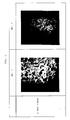
- Fig. 1 shows the structures of the composite materials of aluminum alloy samples Nos. (1) and (7) according to Example 1 of the present invention.
- Particles having mean diameters shown in Table 2 were dispersed in three types of molten metals A, B and C with alloy compositions (wt.%) shown in Table 1.
- each of these powder materials was molded into a cylindrical tablet of ⁇ 120 to ⁇ 60 by 50 mm under a surface pressure of 4 t/cm2 so as to prepare a compact with a density ratio of 75 percent, which in turn was heated in N2 gas with a dew point of -10°C under a furnace temperature of 480°C and thereafter powder-forged under a surface pressure of 6 t/cm2 to be solidified.
- Fig. 1 shows the composite material structures of samples Nos. (1) and (7) in 500 magnifications.
- comparative samples were prepared using composite materials and forged composite materials according to a conventional mixing method.
- Table 2 shows the solidification characteristics of the inventive and comparative samples.
- Table 1 No. Si Cu Mg Mn Fe Ni Cr Zr A 7 0.2 0.9 0.2 0.2 Tr. Tr. Tr. B 12 3.3 1.1 0.6 1.8 1.6 Tr. Tr. C 25 2.1 0.7 1.0 3.2 Tr. 0.4 0.7
- Ceramic-dispersed JIS nominal 2024 alloys each containing 20 percent by volume of Al2O3 or SiC ceramic particles with a mean particle diameter of 1 to 2 ⁇ m, were prepared using three methods including (1) a fusion casting method, (2) a method of adding ceramic particles in an MG treatment and solidifying the as-obtained MG-treated powder by powder forging, and (3) a method of MG-treating on atomized powder containing ceramic particles and solidifying the MG-treated powder by powder forging.
- 2024 alloy powder materials of -42 meshes were MG-treated with ball mills for 20 hours, heated to 490°C and thereafter molded/solidified by forging, to be subjected to measurement of transverse rupture strength values.
- Molten metals of JIS nominal 2024, 6061 and 7075 alloys and an Al - 20 wt.% Si - 3 wt.% Cu - 1 wt.% Mg alloy, each containing 0 to 40 percent by volume of ceramic particles of Al2O3, Si3N4, SiC or ZrO2 of 1 to 20 ⁇ m in mean particle diameter as shown in Table 4, were worked into powder materials of -42 meshes by gas atomization, and thereafter treated with ball mills for 4 to 60 hours or with attoritors for 4 to 30 hours, to prepare aluminum alloy powder materials in which ceramic particles were dispersed. These powder materials were heated to 350 to 550°C, and then molded/solidified by extrusion or forging, to be subjected to measurement of Young's moduli and transverse rupture strength values. Table 4 shows the results.
- a composite alloy preferably has a small Young's modulus, which is related to ductility and toughness, and high transverse rupture strength, which is related to mechanical strength. According to the present invention, it is possible to prepare an aluminum matrix particle composite alloy with excellent solidified body properties, as understood from Table 4.
Landscapes
- Chemical & Material Sciences (AREA)
- Engineering & Computer Science (AREA)
- Materials Engineering (AREA)
- Mechanical Engineering (AREA)
- Metallurgy (AREA)
- Organic Chemistry (AREA)
- Powder Metallurgy (AREA)
- Manufacture Of Alloys Or Alloy Compounds (AREA)
Applications Claiming Priority (4)
| Application Number | Priority Date | Filing Date | Title |
|---|---|---|---|
| JP21071291A JP3363459B2 (ja) | 1991-08-22 | 1991-08-22 | アルミニウム基粒子複合合金の製造方法 |
| JP210712/91 | 1991-08-22 | ||
| JP3270109A JPH0578708A (ja) | 1991-09-20 | 1991-09-20 | アルミニウム基粒子複合合金の製造方法 |
| JP270109/91 | 1991-09-20 |
Publications (2)
| Publication Number | Publication Date |
|---|---|
| EP0529520A1 true EP0529520A1 (fr) | 1993-03-03 |
| EP0529520B1 EP0529520B1 (fr) | 1997-11-19 |
Family
ID=26518230
Family Applications (1)
| Application Number | Title | Priority Date | Filing Date |
|---|---|---|---|
| EP92114255A Expired - Lifetime EP0529520B1 (fr) | 1991-08-22 | 1992-08-20 | Procédé pour la préparation de poudres d'alliages composites à matrice en aluminium |
Country Status (3)
| Country | Link |
|---|---|
| US (1) | US5372775A (fr) |
| EP (1) | EP0529520B1 (fr) |
| DE (1) | DE69223194T2 (fr) |
Cited By (9)
| Publication number | Priority date | Publication date | Assignee | Title |
|---|---|---|---|---|
| EP0657553A1 (fr) * | 1993-11-10 | 1995-06-14 | Sumitomo Electric Industries, Ltd. | Alliage de métallurgie des poudres d'aluminium-silicium azoté |
| DE19532244A1 (de) * | 1995-09-01 | 1997-03-06 | Peak Werkstoff Gmbh | Verfahren zur Herstellung von dünnen Rohren (I) |
| DE19532253A1 (de) * | 1995-09-01 | 1997-03-06 | Peak Werkstoff Gmbh | Verfahren zur Herstellung von dünnen Rohren (II) |
| EP0844311A1 (fr) * | 1996-11-21 | 1998-05-27 | SEILSTORFER GMBH & CO. METALLURGISCHE VERFAHRENSTECHNIK KG | Matériau d'aluminium résistant à la chaleur en particulier pour la fabrication de pistons |
| WO1999011834A1 (fr) * | 1997-08-30 | 1999-03-11 | Honsel Ag | Alliage et procede de production d'objets a partir de cet alliage |
| DE19532252C2 (de) * | 1995-09-01 | 1999-12-02 | Erbsloeh Ag | Verfahren zur Herstellung von Laufbuchsen |
| US6051045A (en) * | 1996-01-16 | 2000-04-18 | Ford Global Technologies, Inc. | Metal-matrix composites |
| WO2008109898A1 (fr) * | 2007-03-09 | 2008-09-18 | Capital Technology Beteiligungs Gmbh | Pièce de véhicule automobile |
| EP2881480A1 (fr) * | 2013-12-06 | 2015-06-10 | Airbus Defence and Space GmbH | Piston intégré pour moteurs à pistons rotatifs |
Families Citing this family (30)
| Publication number | Priority date | Publication date | Assignee | Title |
|---|---|---|---|---|
| US5577546A (en) * | 1992-09-11 | 1996-11-26 | Comalco Aluminium Limited | Particulate feedstock for metal injection molding |
| US5669059A (en) * | 1994-01-19 | 1997-09-16 | Alyn Corporation | Metal matrix compositions and method of manufacturing thereof |
| US5980602A (en) * | 1994-01-19 | 1999-11-09 | Alyn Corporation | Metal matrix composite |
| US5722033A (en) * | 1994-01-19 | 1998-02-24 | Alyn Corporation | Fabrication methods for metal matrix composites |
| JP2785910B2 (ja) * | 1994-08-25 | 1998-08-13 | 本田技研工業株式会社 | 耐熱・耐摩耗性アルミニウム合金、アルミニウム合金製リテーナ及びアルミニウム合金製バルブリフタ |
| DE19614147B4 (de) * | 1996-04-10 | 2005-01-20 | Robert Bosch Gmbh | Verfahren zum bahnförmigen Aufbringen von Material auf einen keramischen Träger, insbesondere zur Herstellung von Elektroden von Abgassensoren, und Verwendung des Verfahrens, insbesondere zur Herstellung einer Lambdasonde |
| DE19739595C1 (de) * | 1997-09-10 | 1999-02-04 | Daimler Benz Ag | Profil für einen Kipperboden |
| JPH11343525A (ja) * | 1998-05-29 | 1999-12-14 | Toyo Alum Kk | 粉末冶金用原料およびその製造方法 |
| JP3765477B2 (ja) * | 1999-11-04 | 2006-04-12 | トヨタ自動車株式会社 | 表面ピットの形成方法と表面ピットをもつ部材 |
| US6843105B1 (en) * | 2003-06-30 | 2005-01-18 | Robert Bosch Corporation | Contact pin for exhaust gas sensor |
| US7404883B2 (en) * | 2004-04-12 | 2008-07-29 | Robert Bosch Gmbh | Insulation bushing assembly for an exhaust gas sensor |
| JP4294011B2 (ja) * | 2004-07-21 | 2009-07-08 | 日信工業株式会社 | 炭素系材料及びその製造方法、複合材料の製造方法 |
| US20060016521A1 (en) * | 2004-07-22 | 2006-01-26 | Hanusiak William M | Method for manufacturing titanium alloy wire with enhanced properties |
| JP4279220B2 (ja) * | 2004-09-09 | 2009-06-17 | 日信工業株式会社 | 複合材料及びその製造方法、複合金属材料及びその製造方法 |
| US20060228495A1 (en) * | 2005-04-12 | 2006-10-12 | Robert Bosch Gmbh | Method of manufacturing an exhaust gas sensor |
| WO2012082877A1 (fr) * | 2010-12-15 | 2012-06-21 | Gkn Sinter Metals, Llc | Métal pulvérulent d'alliage d'aluminium amélioré pourvu d' éléments de transition |
| DE102011012142B3 (de) * | 2011-02-24 | 2012-01-26 | Daimler Ag | Aluminium-Matrixverbundwerkstoff, Halbzeug aus dem Aluminium-Matrixverbundwerkstoff und Verfahren zu dessen Herstellung |
| DE102011120988A1 (de) | 2011-12-13 | 2013-06-13 | Daimler Ag | Flächiges Halbzeug aus einer Aluminiummatrixverbundlegierung mit Borcarbid-Partikeln zur Herstellung einer mit Borcarbid-Partikeln angereicherten Platte und Herstellungsverfahren |
| JP5772731B2 (ja) * | 2012-06-08 | 2015-09-02 | 株式会社豊田中央研究所 | アルミニウム合金粉末成形方法およびアルミニウム合金部材 |
| US9993996B2 (en) * | 2015-06-17 | 2018-06-12 | Deborah Duen Ling Chung | Thixotropic liquid-metal-based fluid and its use in making metal-based structures with or without a mold |
| US10030288B2 (en) * | 2015-07-16 | 2018-07-24 | Hamilton Sundstrand Corporation | Method of manufacturing aluminum alloy articles |
| DE102017108459A1 (de) * | 2017-04-20 | 2018-10-25 | Benteler Automobiltechnik Gmbh | Fahrzeugbauteil aus einem partikelverstärkten Metallwerkstoff |
| DE102017111846A1 (de) | 2017-05-30 | 2018-12-06 | Otto-Von-Guericke-Universität Magdeburg | Verfahren zur Herstellung von lokal modifizierten Gussformteilen |
| DE102019134748A1 (de) * | 2019-12-17 | 2021-06-17 | Getek GmbH | Verfahren zur Herstellung eines Bauteils aus einem Aluminiummaterial sowie Pulver für diese Herstellung |
| CN113549789A (zh) * | 2020-04-23 | 2021-10-26 | 萍乡学院 | 一种氧化铝-铝金属陶瓷及其制备方法 |
| CN114045417A (zh) * | 2021-11-16 | 2022-02-15 | 玉林师范学院 | 一种轻量化铝合金复合材料、压缩机滚子及其制备方法 |
| TW202321475A (zh) * | 2021-11-16 | 2023-06-01 | 財團法人工業技術研究院 | 用於雷射積層製造的鋁合金粉末與鋁合金燒熔體 |
| CN117344172B (zh) * | 2023-09-08 | 2026-07-17 | 阿尔泰新材料(香河)有限公司 | 一种提高粉末冶金铝合金烧结密度和性能的方法 |
| CN119287195B (zh) * | 2024-10-10 | 2025-09-09 | 天津大学 | 一种多组元协同强化的铝基复合材料及其制备方法 |
| CN121649396B (zh) * | 2025-11-24 | 2026-08-04 | 中国科学院金属研究所 | 一种铝基复合材料粉末模锻制备方法 |
Citations (3)
| Publication number | Priority date | Publication date | Assignee | Title |
|---|---|---|---|---|
| US2967351A (en) * | 1956-12-14 | 1961-01-10 | Kaiser Aluminium Chem Corp | Method of making an aluminum base alloy article |
| WO1986006013A1 (fr) * | 1985-04-16 | 1986-10-23 | Battelle Memorial Institute | Procede de fabrication de poudres metalliques |
| EP0262869A1 (fr) * | 1986-09-24 | 1988-04-06 | Alcan International Limited | Poudre composite en alliage d'aluminium |
Family Cites Families (8)
| Publication number | Priority date | Publication date | Assignee | Title |
|---|---|---|---|---|
| CH624147A5 (fr) * | 1976-12-24 | 1981-07-15 | Alusuisse | |
| US4690796A (en) * | 1986-03-13 | 1987-09-01 | Gte Products Corporation | Process for producing aluminum-titanium diboride composites |
| US4755221A (en) * | 1986-03-24 | 1988-07-05 | Gte Products Corporation | Aluminum based composite powders and process for producing same |
| JPH0711446B2 (ja) * | 1986-07-04 | 1995-02-08 | ソニー株式会社 | 加速度センサ |
| US4812289A (en) * | 1986-09-02 | 1989-03-14 | Technical Research Assoc., Inc. | Oxide dispersion hardened aluminum composition |
| GB8713449D0 (en) * | 1987-06-09 | 1987-07-15 | Alcan Int Ltd | Aluminium alloy composites |
| US4959195A (en) * | 1988-05-12 | 1990-09-25 | Sumitomo Electric Industries, Ltd. | Method of forming large-sized aluminum alloy product |
| FR2636974B1 (fr) * | 1988-09-26 | 1992-07-24 | Pechiney Rhenalu | Pieces en alliage d'aluminium gardant une bonne resistance a la fatigue apres un maintien prolonge a chaud et procede de fabrication desdites pieces |
-
1992
- 1992-08-17 US US07/930,187 patent/US5372775A/en not_active Expired - Fee Related
- 1992-08-20 EP EP92114255A patent/EP0529520B1/fr not_active Expired - Lifetime
- 1992-08-20 DE DE69223194T patent/DE69223194T2/de not_active Expired - Fee Related
Patent Citations (3)
| Publication number | Priority date | Publication date | Assignee | Title |
|---|---|---|---|---|
| US2967351A (en) * | 1956-12-14 | 1961-01-10 | Kaiser Aluminium Chem Corp | Method of making an aluminum base alloy article |
| WO1986006013A1 (fr) * | 1985-04-16 | 1986-10-23 | Battelle Memorial Institute | Procede de fabrication de poudres metalliques |
| EP0262869A1 (fr) * | 1986-09-24 | 1988-04-06 | Alcan International Limited | Poudre composite en alliage d'aluminium |
Non-Patent Citations (1)
| Title |
|---|
| PATENT ABSTRACTS OF JAPAN vol. 13, no. 559 (M-905)12 December 1989 & JP-A-01 230 705 ( SUMITOMO ELECTRIC IND ) 14 September 1989 * |
Cited By (16)
| Publication number | Priority date | Publication date | Assignee | Title |
|---|---|---|---|---|
| US5605558A (en) * | 1993-11-10 | 1997-02-25 | Sumitomo Electric Industries, Ltd. | Nitrogenous aluminum-silicon powder metallurgical alloy |
| EP0657553A1 (fr) * | 1993-11-10 | 1995-06-14 | Sumitomo Electric Industries, Ltd. | Alliage de métallurgie des poudres d'aluminium-silicium azoté |
| DE19532244A1 (de) * | 1995-09-01 | 1997-03-06 | Peak Werkstoff Gmbh | Verfahren zur Herstellung von dünnen Rohren (I) |
| DE19532253A1 (de) * | 1995-09-01 | 1997-03-06 | Peak Werkstoff Gmbh | Verfahren zur Herstellung von dünnen Rohren (II) |
| US6136106A (en) * | 1995-09-01 | 2000-10-24 | Erbsloh Aktiengesellschaft | Process for manufacturing thin pipes |
| DE19532244C2 (de) * | 1995-09-01 | 1998-07-02 | Peak Werkstoff Gmbh | Verfahren zur Herstellung von dünnwandigen Rohren (I) |
| DE19532253C2 (de) * | 1995-09-01 | 1998-07-02 | Peak Werkstoff Gmbh | Verfahren zur Herstellung von dünnwandigen Rohren (II) |
| US6086819A (en) * | 1995-09-01 | 2000-07-11 | Erbsloh Aktiengesellschaft | Process for manufacturing thin-walled pipes |
| DE19532252C2 (de) * | 1995-09-01 | 1999-12-02 | Erbsloeh Ag | Verfahren zur Herstellung von Laufbuchsen |
| US6051045A (en) * | 1996-01-16 | 2000-04-18 | Ford Global Technologies, Inc. | Metal-matrix composites |
| EP0844311A1 (fr) * | 1996-11-21 | 1998-05-27 | SEILSTORFER GMBH & CO. METALLURGISCHE VERFAHRENSTECHNIK KG | Matériau d'aluminium résistant à la chaleur en particulier pour la fabrication de pistons |
| WO1998022633A1 (fr) * | 1996-11-21 | 1998-05-28 | Seilstorfer Gmbh & Co. Metallurgische Verfahrenstechnik Kg | Materiau d'aluminium a haute resistance a chaud, notamment pour la production de pistons |
| WO1999011834A1 (fr) * | 1997-08-30 | 1999-03-11 | Honsel Ag | Alliage et procede de production d'objets a partir de cet alliage |
| US6531089B1 (en) | 1997-08-30 | 2003-03-11 | Honsel Gmbh & Co. Kg | Alloy and method for producing objects therefrom |
| WO2008109898A1 (fr) * | 2007-03-09 | 2008-09-18 | Capital Technology Beteiligungs Gmbh | Pièce de véhicule automobile |
| EP2881480A1 (fr) * | 2013-12-06 | 2015-06-10 | Airbus Defence and Space GmbH | Piston intégré pour moteurs à pistons rotatifs |
Also Published As
| Publication number | Publication date |
|---|---|
| EP0529520B1 (fr) | 1997-11-19 |
| DE69223194T2 (de) | 1998-06-18 |
| US5372775A (en) | 1994-12-13 |
| DE69223194D1 (de) | 1998-01-02 |
Similar Documents
| Publication | Publication Date | Title |
|---|---|---|
| EP0529520B1 (fr) | Procédé pour la préparation de poudres d'alliages composites à matrice en aluminium | |
| US4946500A (en) | Aluminum based metal matrix composites | |
| US4923532A (en) | Heat treatment for aluminum-lithium based metal matrix composites | |
| US5143795A (en) | High strength, high stiffness rapidly solidified magnesium base metal alloy composites | |
| EP0484931A1 (fr) | Alliage de titane préparé par frittage de poudres et procédé pour leur fabrication | |
| EP0529993B1 (fr) | Préparation de Poudre composite à matrice en aluminium | |
| JP3306822B2 (ja) | 焼結Ti合金材料およびその製造方法 | |
| EP0340788A1 (fr) | Alliage d'aluminium à module d'élasticité élevé | |
| US5466277A (en) | Starting powder for producing sintered-aluminum alloy, method for producing sintered parts, and sintered aluminum alloy | |
| EP0577436B1 (fr) | Alliages d'aluminium frittés et comprimés en azote et procédé de fabrication | |
| US5045278A (en) | Dual processing of aluminum base metal matrix composites | |
| EP0600474B1 (fr) | Alliage d'aliminium résistant à la chaleur et à l'abrasion | |
| JP2546660B2 (ja) | セラミックス分散強化型アルミニウム合金の製造方法 | |
| JP3095026B2 (ja) | アルミニウム焼結合金の製造方法 | |
| US20190118255A1 (en) | Aluminum Alloy Powder Metal With Transition Elements | |
| JPH0625386B2 (ja) | アルミニウム合金粉末及びその焼結体の製造方法 | |
| US5149496A (en) | Method of making high strength, high stiffness, magnesium base metal alloy composites | |
| JPH0578708A (ja) | アルミニウム基粒子複合合金の製造方法 | |
| JP4008597B2 (ja) | アルミニウム基複合材およびその製造方法 | |
| JP2509052B2 (ja) | 窒素化合アルミニウム焼結合金及びその製造方法 | |
| JPH01201450A (ja) | 耐摩耗性アルミニウム合金の加工方法 | |
| JPH04308050A (ja) | 分散強化アルミニウム焼結合金の製造方法 | |
| JP3628748B2 (ja) | 炭化物分散焼結合金の製造方法 | |
| JPH04308002A (ja) | 分散強化アルミニウム焼結合金及び常圧焼結性複合アルミニウム合金粉末の製造方法 | |
| JPH0551663A (ja) | アルミニウム基粒子複合合金の製造方法 |
Legal Events
| Date | Code | Title | Description |
|---|---|---|---|
| PUAI | Public reference made under article 153(3) epc to a published international application that has entered the european phase |
Free format text: ORIGINAL CODE: 0009012 |
|
| AK | Designated contracting states |
Kind code of ref document: A1 Designated state(s): DE FR |
|
| 17P | Request for examination filed |
Effective date: 19930422 |
|
| 17Q | First examination report despatched |
Effective date: 19950317 |
|
| GRAG | Despatch of communication of intention to grant |
Free format text: ORIGINAL CODE: EPIDOS AGRA |
|
| GRAH | Despatch of communication of intention to grant a patent |
Free format text: ORIGINAL CODE: EPIDOS IGRA |
|
| GRAH | Despatch of communication of intention to grant a patent |
Free format text: ORIGINAL CODE: EPIDOS IGRA |
|
| GRAA | (expected) grant |
Free format text: ORIGINAL CODE: 0009210 |
|
| AK | Designated contracting states |
Kind code of ref document: B1 Designated state(s): DE FR |
|
| REF | Corresponds to: |
Ref document number: 69223194 Country of ref document: DE Date of ref document: 19980102 |
|
| ET | Fr: translation filed | ||
| PLBE | No opposition filed within time limit |
Free format text: ORIGINAL CODE: 0009261 |
|
| 26N | No opposition filed | ||
| REG | Reference to a national code |
Ref country code: FR Ref legal event code: D6 |
|
| PGFP | Annual fee paid to national office [announced via postgrant information from national office to epo] |
Ref country code: FR Payment date: 20020808 Year of fee payment: 11 |
|
| PGFP | Annual fee paid to national office [announced via postgrant information from national office to epo] |
Ref country code: DE Payment date: 20020829 Year of fee payment: 11 |
|
| PG25 | Lapsed in a contracting state [announced via postgrant information from national office to epo] |
Ref country code: DE Free format text: LAPSE BECAUSE OF NON-PAYMENT OF DUE FEES Effective date: 20040302 |
|
| PG25 | Lapsed in a contracting state [announced via postgrant information from national office to epo] |
Ref country code: FR Free format text: LAPSE BECAUSE OF NON-PAYMENT OF DUE FEES Effective date: 20040430 |
|
| REG | Reference to a national code |
Ref country code: FR Ref legal event code: ST |