EP0529532A2 - Méthode et appareil pour étalonner une imprimante à canaux multiples - Google Patents
Méthode et appareil pour étalonner une imprimante à canaux multiples Download PDFInfo
- Publication number
- EP0529532A2 EP0529532A2 EP92114316A EP92114316A EP0529532A2 EP 0529532 A2 EP0529532 A2 EP 0529532A2 EP 92114316 A EP92114316 A EP 92114316A EP 92114316 A EP92114316 A EP 92114316A EP 0529532 A2 EP0529532 A2 EP 0529532A2
- Authority
- EP
- European Patent Office
- Prior art keywords
- printer
- receiving medium
- radiation
- light sources
- test
- Prior art date
- Legal status (The legal status is an assumption and is not a legal conclusion. Google has not performed a legal analysis and makes no representation as to the accuracy of the status listed.)
- Granted
Links
Images

Classifications
-
- G—PHYSICS
- G06—COMPUTING OR CALCULATING; COUNTING
- G06K—GRAPHICAL DATA READING; PRESENTATION OF DATA; RECORD CARRIERS; HANDLING RECORD CARRIERS
- G06K15/00—Arrangements for producing a permanent visual presentation of the output data, e.g. computer output printers
- G06K15/02—Arrangements for producing a permanent visual presentation of the output data, e.g. computer output printers using printers
- G06K15/12—Arrangements for producing a permanent visual presentation of the output data, e.g. computer output printers using printers by photographic printing, e.g. by laser printers
-
- G—PHYSICS
- G06—COMPUTING OR CALCULATING; COUNTING
- G06K—GRAPHICAL DATA READING; PRESENTATION OF DATA; RECORD CARRIERS; HANDLING RECORD CARRIERS
- G06K15/00—Arrangements for producing a permanent visual presentation of the output data, e.g. computer output printers
- G06K15/02—Arrangements for producing a permanent visual presentation of the output data, e.g. computer output printers using printers
- G06K15/027—Test patterns and calibration
Definitions
- the present invention relates to the calibration of a multichannel printer, and more particularly, to the calibration of such a printer in order to eliminate artifacts in an image produced thereby.
- a photosensitive material is supported on a rotatable drum, and a print head carrying a light source is advanced relative to the photosensitive material by means of a lead screw.
- the light source is modulated in accordance with an information signal to form an image on the photosensitive material.
- multiple light sources are mounted in the print head so that a plurality of print lines can be formed in a single pass.
- any difference of densities among the lines can create very severe artifacts in the image. These artifacts can appear as repetitive patterns known as "banding.”
- the problem of banding can be particularly troublesome in half-tone printing where, for example, 12 mini-pixels are used to write a half-tone dot.
- Visible lines in the image caused by unevenness in the densities of the lines, can come at a different section of each successive half-tone dot, and thus, cycle across the image.
- the visible lines can be due, for example, to a variation in the intensity of the light sources.
- the frequency of the visible lines in the image beats with the half-tone dot frequency.
- the resulting macro density variation can have a spatial frequency in the image which, unfortunately, matches the frequency at which the eye is most sensitive, that is, at about 0.5 cycle/mm. At this frequency range, the typical human eye can see a variation of density of around 0.2%. This small level of unevenness in density is very hard to control in a printer using a multiline print head.
- Multiple writing beams can be formed from a single light single source by using beam splitter optics. Such a system will typically write six lines at a time. In these systems, the problem of balancing each writing line may be less severe, since the same light source is used for all of the lines; however, the intensity of light provided to each line is necessarily considerably reduced. None of the known prior-art solutions to the problem of artifacts in images produced by multiline printers is totally satisfactory, however, particularly when the writing is being done on mediums such as a thermal print medium.
- a method of calibrating a multichannel printer the printer having a plurality of light sources which are projected onto a receiving medium responsive to radiation, the method comprising the steps of: sequentially directing radiation from each of the light sources onto a receiving medium to form a test pattern thereon, the test pattern including a plurality of test patches, each of the test patches being formed by radiation from one of the light sources produced by a known input; measuring the density of each of the test patches and correlating the input of each of the light sources with the measured density of the respective test patch; and determining the inputs for each of the sources to obtain desired densities on said receiving medium.
- apparatus for calibrating a multichannel printer having a print head which includes a plurality of light sources
- the apparatus comprising: means for directing radiation from the print head onto a receiving medium responsive to radiation in order to form a plurality of lines thereon; and means for controlling the directing means to form a plurality of test patches on the receiving medium, each of the test patches being formed by radiation from one of the light sources.
- the present invention can be used in a printer which is adapted to form an image on a thermal print medium.
- the printer includes a rotatable drum for supporting the print medium, and a print head which is moved relative to the print medium by means of a lead screw.
- the print head includes an array of optical fibers and a lens for focussing the ends of the fibers onto the medium.
- Each of the fibers is connected to a diode laser which is modulated in accordance with an information signal.
- the power output from each of the lasers is measured, and the power measurements are correlated with the power inputs to the lasers. Test patterns are then formed on the receiving medium with each of the lasers using known power inputs.
- the density of each of the test patterns is measured, and the density values obtained are correlated with the input levels for each of the lasers.
- the measurement of single laser densities is facilitated by slowing the print head down by a factor of the number of lines normally printed and writing with one line source at a time.
- a principal advantage of the present invention is that apparatus calibrated in accordance with the invention can produce an image free of artifacts in both half-tone and continuous-tone printing.
- a further advantage is that increased resolution can be obtained in both modes of operation.
- a still further advantage of the present invention is that an image free of artifacts can be produced without the need to modify the printer apparatus.
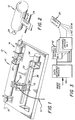
- the present invention can be used in a multichannel printer such as laser thermal printer 10 shown in FIG. 1.
- Printer 10 comprises a drum 12 which is mounted for rotation about an axis 15 and is driven by a motor 14.
- Drum 12 is adapted to support a thermal print medium, not shown, of a type in which a dye is transferred by sublimation from a donor to a receiver as a result of heating the dye in the donor.
- a thermal print medium for use with the printer 10 can be, for example, a medium disclosed in U.S. Patent No. 4,772,582, entitled "Spacer Bead Layer for Dye-Donor Element Used in Laser Induced Thermal Dye Transfer", granted September 20, 1988. This patent is assigned to the assignee of the present invention.
- a print head 20 is movably supported adjacent drum 12.
- Print head 20 is supported for slidable movement on a rail 22, and the print head 20 is driven by means of a motor 24 which rotates a lead screw 26.
- Print head 20 comprises an array of optical fibers 31 which are connected to a plurality of light sources such as diode lasers (not shown).
- the diode lasers can be individually modulated in a well-known manner to selectively direct light from the optical fibers onto the thermal print medium.
- any difference in the density of the print lines creates a very severe artifact known as banding.
- This artifact can be due, for example, to unbalanced laser power, and the artifact is particularly troublesome in half-tone printers.
- half-tone printers it takes, for example, 12 mini-pixels to write a half-tone dot.
- the printing swath may sometimes be less than 12 mini-pixels, and as a result, a darker line (or several darker lines) comes at a different section of each sequential half-tone dot; these darker lines cycle across the image.
- the frequency of the lines of uneven density beats with the half-tone dot frequency and is visually observed in the image as banding.
- the resulting macro density variation can have a spatial frequency in the image which matches with the greatest contrast sensitivity of the eye.
- the light source in each of the channels is precisely calibrated in order to overcome the problem of banding.
- a target image is formed with each light source independently. Density or transmittance measurements on the target images are used to balance each laser. Power measurements can be made periodically during the operation of the instrument to track the performance of each light source.
- single-line print densities are facilitated by slowing the lead screw down by a factor of the number of lines normally printed, and writing with one line source at a time. This produces an image made using a single channel at the normal line-to-line spacing.
- the print density is measured with a conventional densitometer.
- Single line densities are referred to herein as single laser densities or (SLD's).
- SLD's single laser densities
- a single writing channel or single line is referred to as a single laser.
- Measuring print densities on a line-by-line basis provides a means to account for differences in the output of the individual lasers. This method of balancing does not require that all of the individual factors affecting laser output be measured or even that all of the significant contributors be known. Once the lasers have been balanced, routine power measurements can be made to track the performance of the writing engine over the lifetime of the machine. This is a simpler and less time consuming method than repeatably printing single line densities to track each laser over time.
- the following steps are performed:(1) single laser density (SLD) target images are printed on a receiving medium using known inputs (DAC values) for each laser; (2) the target images are then measured with a densitometer, and the measured SLD's are correlated with the DAC values for each source;(3) DAC values needed to obtain a given single laser density are then computed, using the SLD versus DAC value relationship calculated in step 2; (4) solid area densities (SAD's) are printed using all of the lasers in the print head 20 to print selected sets of SLD's.
- SLD single laser density
- each laser would be set to the DAC value which has been found to produce that SLD; and (5) a regression is calculated between the SAD values and SLD values.
- a given SAD can be produced by using the corresponding SLD found in step 3.
- the above steps can be repeated as needed to maintain the balance among the separate channels in printer 10. However, it is preferable to perform power measurements in order to maintain balance, once the relationship between SLD and DAC values is defined for each channel.
- the following six steps are performed: (1) the power for each laser versus the input (DAC value) is measured; (2) single laser density (SLD) target images are printed using known power levels for each laser; (3) the target images are then measured with a densitometer and the density values obtained are correlated with the input values for each source; (4) the power of each laser is remeasured when rebalance of the system is found to be necessary; (5) DAC Values to obtain a given SLD are readjusted using the latest power data measured in step 4, and the original single laser density versus power relationship calculated in step 3; and (6) solid area densities (SAD's) are printed using all of the lasers in print head 20 to print selected sets of single laser densities. A regression is then calculated between SAD values and S
- the single laser power at the revolving drum 12 is proportional to the DAC value for that laser.
- the print head 20 is moved to a calibration station 34, shown in FIG. 2.
- the analog output of a calibration sensor (not shown) at calibration station 34 is fed into an analog-to-digital converter (not shown).
- the calibration sensor can be, for example, a SD 444-4141-261 sensor, obtainable from Silicon Detector Corp.
- Analog-to-digital converter counts (ADC values) are proportional to the power detected by the calibration sensor, and ADC values for a set of DAC values are measured for each laser.
- a linear regression is performed on the data for each channel to model the power (ADC Value) as a function of DAC value. Equation 1, shown below, is the model used.
- (ADC Value) m1 * (DAC Value)+b1 (1)
- (DAC Value) [(ADC Value)-b1]/m1 (2) where m1 is the slope and b1 is the intercept.
- step 2 a set of ADC values are selected which will produce workable single laser densities (SLD's).
- the DAC values required to obtain this set of ADC values are calculated using Equation 2.
- Single laser densities are printed by turning on one channel at a time and slowing the speed of lead screw 26 down to one line width per revolution of the drum 12.
- the resulting test image when printed using a single laser source will have the same line spacing as a normal image formed with a print head having ten lasers.
- step 3 the single laser densities are measured using an ordinary densitometer, for example, a X-Rite 408G densitometer. The resulting single laser densities are plotted against the known ADC values.
- Step 4 the print head is again moved to the calibration station 34.
- ADC counts for a set of DAC values ate remeasured for each laser.
- a linear regression is performed on the data for each laser channel to model the power (ADC Value) as a function of DAC value. Equation 4, shown below, is the model used. Step 4 is repeated as needed to track the performance of each laser over the life of printer 12.
- Step 5 the slopes and intercepts calculated in the previous steps are used to calculate the DAC Value that will result in a required single laser density.
- the following equation is used to calculate the required DAC value to obtain a requested SLD.
- DAC Value Required ⁇ m1 * [(SLD-b2)/m2]+b1-b3 ⁇ /m3 (5)
- the final step, Step 6, is directed to printing solid area densities (SAD's) using all of the lasers to print selected sets of balanced single laser densities (SLD's).
- SAD m4*SLD + b4 (6) Equation 7, shown below, is used to calculate the required single laser density when it is desired to produce a print at a particular solid area density. Equation 5 is then used to determine the DAC value to be used for each laser channel.
- SLD (SAD - b4)/m4 (7)
- individual laser channels can be balanced without measuring or knowing all of the factors which cause the densities produced by the different channels in the printer to be different. Some of the factors which may contribute to differences in density are: the spot size of each channel, the wavelength of each laser source, and the modes that each source emits through the print head.
- the densities produced by the lasers can be different even when the power output from the lasers is the same.
- the correlation of the SLD's with the measured power outputs of the lasers is an important feature of the invention
- the ability to eliminate artifacts by precisely balancing each channel permits an increase in the number of lines printed at one time, thereby decreasing the total time required to make a print.
- measurement of the single laser densities only needs to be done once.
- complex microdensitometry is not required in the calibration process.
- a test pattern is created which includes a plurality of test patches formed during the revolution of the drum 12. Each test patch is created using a different laser. This method makes it possible to print all n lasers during the same amount of time that the method described above prints one laser. Another method uses each laser to print test patches while the drum rotates, each test patch being exposed at a different power level.
- print head 20 containing n channels, is moved relative to revolving drum 12 which supports a thermal print medium (not shown).
- the print head 20 moves a distance equal to n lines for each revolution of drum 12.
- Modulated data is sent to each of the n channels to expose the media in accordance with an information signal in order to create an image on the medium.
- the power level of each channel is adjusted to produce a desired density.
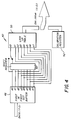
- a data interface module 40 presorts the Image Data and sends it to the appropriate channel driver 42. For example, if the image data is sent one line at a time, the data interface module 40 will transfer the first line to channel 1, the second line to channel 2, the n th line to channel n, and the n th +1 line to channel 1.
- the channel drivers 42 buffer and deliver the data to each channel in the print head 20 at the correct time.
- the channel drivers 42 also convert the data from an on or off signal to optical on and off power levels.
- the data interface module 40 loads 8 bits of data at a time into channel driver 42. In a half-tone printing mode, this data represents 8 bits each of which is either on or off.
- the 8 bits are stored in a first-in-first-out (FIFO) buffer 46 until all the channels are ready and the drum 12 is up to speed.
- the 8 bits are then loaded into a shift register 48 and shifted out 1 bit at a time to the lowest address line, (a0), of a look up table 50.
- the look up table 50 is loaded such that when a0 is a logic low the 12 bit output value is set to the off power level and when a0 is a logic high the 12 bit output value is set to the on power level.
- the 12 bit DAC Value out of the look up table drives a digital-to-analog converter (not shown).
- the analog output is fed into a current amplifier (not shown) which drives the laser of one channel.
- the channel driver 42 can, alternatively, be configured for continuous-tone printing instead of half-tone printing.
- continuous-tone printing each byte, 8 bits, of data sent from the DIM 40 is used to select one of 256 power levels.
- the shift register 48 is not used, and the data out of FIFO buffer 46 is fed directly into the look up table 50.
- the look up table 50 is loaded with values which convert the 8 bit input value into 12 bit power levels which result in equal increments in print density.
- the channel driver 42 may also be configured to use the calibration path instead of the normal print path.
- the DAC Value into the digital-to-analog convertor is driven by the calibration register 52 instead of the look up table 50.
- the drive motor 14 for lead screw 26 is driven at 1/n times normal speed.
- the print head 20 moves exactly one line width for each revolution of the drum 12.
- the channel drivers 42 are configured for half-tone printing.
- a Constant solid image is fed into the DIM 40. Only one channel driver 42 out of n is turned on at a time. Data sent from the DIM 40 to the unused channels is ignored. The resulting image contains lines at the correct line spacing which were exposed using only one channel.
- Single laser tests using this method may also be created by: (1) turning the drum 12 at the normal speed; (2) turning the lead screw at 1/n times the normal speed; and (3) turning on one laser at the desired power level, setting its DAC Value by means of the calibration register 52.
- a more efficient method of generating single laser densities is to print a test pattern 60 as shown in FIG. 5.
- the test pattern 60 repeats after n lines. Lines 1 through n contain x pixels to be printed in a sequence such that if the lines were placed on top of each other their exposed areas would not overlap.
- the resulting image will contain n patches 62. Each patch 62 will have been exposed by a separate channel.
- the test pattern 60 can be generated using an internal pattern generator (not shown), or the necessary instructions can exist as a special line work image file.
- FIG. 5 there is shown a test pattern 60 generated by a print head having 9 channels. Each channel forms one line 64 so n is 9, and each line contains 10 pixels so x is 10. The first line has 10 pixels on, and all other pixels off,. No other line in the pattern is on at the same time as line 1. Line n+1 is the same as line 1. Therefore; channel 1 will print during lines 1, n+1, 2n+1, etc. and none of the other channels will be active at the same time. The first 10 pixels in the resultant image will be exposed only by channel 1. The second 10 pixels are exposed only by channel 2, and the last 10 pixels are exposed by channel 9.
- the test pattern 60 can be generated by a pattern generator (not shown) internal to the data interface module 40.
- the pattern generator can contain up to 2047 words in the pattern. For a system with 18 writing channels, for example, the pattern repeats every 18 lines. Each line is 1800 pixels or 225 bytes long. Each line contains 100 pixels that are exposed. The first line contains 100 pixels on, and 1700 pixels off. The second line has 100 pixels off, 100 pixels on, and 1600 pixels off. This sequence continues until the 18th line which contains 1700 pixels off and 100 pixels on. The total pattern length is 2025 words. At a resolution of 1800 pixels per inch the pattern generated would be only 1 inch long. Each patch 64 would be only 0.056 inches long making it difficult to measure with a densitometer. By changing the resolution in the pixel direction to 300 dots per inch, the test pattern 60 is stretched to 6 inches long. Each patch becomes 0.33 inches long, and such a patch can be measured by a densitometer using, for example, a 0.25 inch diameter aperture.
- the continuous-tone data path can also be used to create test patches.
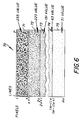
- a continuous-tone pattern 70 which includes test patches 71-75 made at different exposure levels. Patches 71-75 were made at exposure levels of 255, 223, 191, 63, and 31 look up table power levels, respectively.
- the look up table 50 is loaded with a linear table so that input power level 255 results in output DAC value 4095 and input power level 0 results in an output DAC value 0.
- Each of the patches 71-75 was printed with one light source and with the lead screw 26 running at 1/n times the normal rate.
- each pixel in the image is sent by the data interface module 40 to the channel drivers 41.
- the channel drivers 42 pass the 8 bits of pixel data directly to the look up table 50 which sets the DAC Value, thereby controlling the exposure level of each patch.
- the data sent from the DIM 40 to the unused channels is ignored.
- the resulting image will contain test patches formed in the direction of the movement of drum 12.
- test patterns can be created for any multichannel printer, and more than one source can be measured during a single revolution of the drum.
- a single channel can be used to form multiple patches of different exposures during one revolution of the drum.
- Test patterns can be created to efficiently test exposure from a multiple number of individual sources.
- the test pattern in FIG. 5 could, for example, be modified to change the order in which each source is printed.
- Other test patterns can be created which allow for exposure as a function of a multiple number of channels.
- a test pattern 80 shown in FIG. 7, was produced by running the lead screw speed at 2/n times the normal speed.
- Each test patch 82 in the test pattern 80 is the result of exposure from two adjacent channels simultaneously.
- Such a test pattern can be used to provide information on channel interaction.
Landscapes
- Engineering & Computer Science (AREA)
- Physics & Mathematics (AREA)
- General Engineering & Computer Science (AREA)
- General Physics & Mathematics (AREA)
- Theoretical Computer Science (AREA)
- Optics & Photonics (AREA)
- Electronic Switches (AREA)
- Accessory Devices And Overall Control Thereof (AREA)
- Dot-Matrix Printers And Others (AREA)
Applications Claiming Priority (2)
| Application Number | Priority Date | Filing Date | Title |
|---|---|---|---|
| US749056 | 1991-08-23 | ||
| US07/749,056 US5291221A (en) | 1991-08-23 | 1991-08-23 | Method and apparatus for the calibration of a multichannel printer |
Publications (3)
| Publication Number | Publication Date |
|---|---|
| EP0529532A2 true EP0529532A2 (fr) | 1993-03-03 |
| EP0529532A3 EP0529532A3 (en) | 1993-09-01 |
| EP0529532B1 EP0529532B1 (fr) | 1998-05-13 |
Family
ID=25012049
Family Applications (1)
| Application Number | Title | Priority Date | Filing Date |
|---|---|---|---|
| EP92114316A Expired - Lifetime EP0529532B1 (fr) | 1991-08-23 | 1992-08-21 | Méthode et appareil pour étalonner une imprimante à canaux multiples |
Country Status (5)
| Country | Link |
|---|---|
| US (1) | US5291221A (fr) |
| EP (1) | EP0529532B1 (fr) |
| JP (1) | JPH05201050A (fr) |
| DE (1) | DE69225443T2 (fr) |
| DK (1) | DK0529532T3 (fr) |
Cited By (5)
| Publication number | Priority date | Publication date | Assignee | Title |
|---|---|---|---|---|
| WO1995018423A1 (fr) * | 1993-12-29 | 1995-07-06 | Schoonscan, Inc. | Stabilisation spatiale pour dispositif de formation d'images en bandes |
| US5565906A (en) * | 1994-01-13 | 1996-10-15 | Schoonscan, Inc. | Clocking means for bandwise imaging device |
| US5684620A (en) * | 1996-01-30 | 1997-11-04 | Schoonscan, Inc. | High resolution imaging system and method of imaging using the same |
| US6148134A (en) * | 1999-03-25 | 2000-11-14 | Schoonscan, Inc. | Fiber mounts for fiber optic harness in a fiber optic-based imaging system |
| EP1027997A3 (fr) * | 1999-02-10 | 2000-11-29 | Noritsu Koki Co., Ltd. | Procédé pour tester l'état d'émission de lumière d'une tête d'exposition et motif à points à utiliser dans ce procédé |
Families Citing this family (8)
| Publication number | Priority date | Publication date | Assignee | Title |
|---|---|---|---|---|
| KR0133020B1 (ko) * | 1993-12-29 | 1998-04-15 | 김주용 | 레이저프린터의 테스트 패턴 생성회로 |
| US5815187A (en) * | 1996-01-11 | 1998-09-29 | Xante Corporation | Method for improving the dimensional accuracy of laser printers |
| US6603498B1 (en) | 2000-11-28 | 2003-08-05 | Coherent, Inc. | Printer head with linear array of individually addressable diode-lasers |
| US6590600B2 (en) | 2001-03-16 | 2003-07-08 | Eastman Kodak Company | Method and apparatus for controlling exposure amplitude and printed track width by pulse width modulation |
| US7027185B2 (en) * | 2001-07-30 | 2006-04-11 | Hewlett-Packard Development Company, L.P. | Linearization of an incremental printer by measurements referred to a media-independent sensor calibration |
| US6842188B2 (en) * | 2003-05-16 | 2005-01-11 | Eastman Kodak Company | Method for setting focus of a multichannel printhead |
| US8259354B2 (en) * | 2009-05-07 | 2012-09-04 | Eastman Kodak Company | Calibration of a recording apparatus |
| CN104764675A (zh) * | 2015-04-08 | 2015-07-08 | 张宏松 | 一种印刷样品检测台 |
Family Cites Families (16)
| Publication number | Priority date | Publication date | Assignee | Title |
|---|---|---|---|---|
| DE2445543A1 (de) * | 1974-09-24 | 1976-04-01 | Agfa Gevaert Ag | Verfahren und vorrichtung zur herstellung von kopien |
| US4074318A (en) * | 1976-12-13 | 1978-02-14 | Bell Telephone Laboratories, Incorporated | Led array imaging system-serial approach |
| US4455562A (en) * | 1981-08-14 | 1984-06-19 | Pitney Bowes Inc. | Control of a light emitting diode array |
| JPS5784674A (en) * | 1980-11-14 | 1982-05-27 | Konishiroku Photo Ind Co Ltd | Recorder |
| US4751377A (en) * | 1985-12-27 | 1988-06-14 | Fuji Photo Film Co., Ltd. | Light beam scanning recording apparatus and method of correcting intensity of image to be recorded thereby |
| EP0264886B1 (fr) * | 1986-10-20 | 1994-06-08 | Fuji Photo Film Co., Ltd. | Procédé et appareil d'analyse à faisceau laser |
| US4897672A (en) * | 1987-07-02 | 1990-01-30 | Fujitsu Limited | Method and apparatus for detecting and compensating light emission from an LED array |
| NL8702166A (nl) * | 1987-09-11 | 1989-04-03 | Oce Nederland Bv | Belichtingsinrichting met een verouderings correctiesysteem voor een led printer. |
| GB8722944D0 (en) * | 1987-09-30 | 1987-11-04 | Plessey Co Plc | Calibration system for led array |
| JP2690777B2 (ja) * | 1989-04-20 | 1997-12-17 | 富士写真フイルム株式会社 | 画像記録装置 |
| US4999673A (en) * | 1989-05-10 | 1991-03-12 | Xerox Corporation | Process control by creating and sensing half-tone test patches |
| US4998118A (en) * | 1989-07-03 | 1991-03-05 | Eastman Kodak Company | LED printhead with post lens optical feedback and method of controlling same |
| DE69024796T2 (de) * | 1990-02-06 | 1996-05-30 | Bell Helicopter Textron Inc | Struktur für elektromagnetische wellenverminderung und enteisung |
| US5146241A (en) * | 1991-03-15 | 1992-09-08 | Eastman Kodak Company | Automatic cut-out for auto-focus device |
| US5146242A (en) * | 1991-03-15 | 1992-09-08 | Eastman Kodak Company | Writing beam angular alignment device |
| US5220348A (en) * | 1991-08-23 | 1993-06-15 | Eastman Kodak Company | Electronic drive circuit for multi-laser thermal printer |
-
1991
- 1991-08-23 US US07/749,056 patent/US5291221A/en not_active Expired - Fee Related
-
1992
- 1992-08-13 JP JP21603292A patent/JPH05201050A/ja not_active Ceased
- 1992-08-21 DK DK92114316T patent/DK0529532T3/da active
- 1992-08-21 EP EP92114316A patent/EP0529532B1/fr not_active Expired - Lifetime
- 1992-08-21 DE DE69225443T patent/DE69225443T2/de not_active Expired - Fee Related
Cited By (6)
| Publication number | Priority date | Publication date | Assignee | Title |
|---|---|---|---|---|
| WO1995018423A1 (fr) * | 1993-12-29 | 1995-07-06 | Schoonscan, Inc. | Stabilisation spatiale pour dispositif de formation d'images en bandes |
| US5565906A (en) * | 1994-01-13 | 1996-10-15 | Schoonscan, Inc. | Clocking means for bandwise imaging device |
| US5684620A (en) * | 1996-01-30 | 1997-11-04 | Schoonscan, Inc. | High resolution imaging system and method of imaging using the same |
| EP1027997A3 (fr) * | 1999-02-10 | 2000-11-29 | Noritsu Koki Co., Ltd. | Procédé pour tester l'état d'émission de lumière d'une tête d'exposition et motif à points à utiliser dans ce procédé |
| US6373514B1 (en) | 1999-02-10 | 2002-04-16 | Noritsu Koki Co., Ltd. | Method of testing light emission condition of exposing head and dot pattern for use in the method |
| US6148134A (en) * | 1999-03-25 | 2000-11-14 | Schoonscan, Inc. | Fiber mounts for fiber optic harness in a fiber optic-based imaging system |
Also Published As
| Publication number | Publication date |
|---|---|
| US5291221A (en) | 1994-03-01 |
| EP0529532A3 (en) | 1993-09-01 |
| DE69225443T2 (de) | 1998-12-17 |
| EP0529532B1 (fr) | 1998-05-13 |
| DK0529532T3 (da) | 1998-10-12 |
| JPH05201050A (ja) | 1993-08-10 |
| DE69225443D1 (de) | 1998-06-18 |
Similar Documents
| Publication | Publication Date | Title |
|---|---|---|
| US5323179A (en) | Method of calibrating a multichannel printer | |
| US5291221A (en) | Method and apparatus for the calibration of a multichannel printer | |
| JP3293665B2 (ja) | マルチ−レーザ熱転写プリンタ用電子ドライブ回路 | |
| US7006119B2 (en) | Image forming apparatus with photoconductive body, and computer-readable storage medium | |
| WO1991008904A1 (fr) | Imprimante thermique | |
| EP0460158A1 (fr) | Imprimante thermique. | |
| JPH0920023A (ja) | 多重照射源プリントヘッドの個々のパスに離間した複数の色材転写トラックを有したインターリーブ熱式印刷 | |
| US4998118A (en) | LED printhead with post lens optical feedback and method of controlling same | |
| EP1033030B1 (fr) | Procede et dispositif pour l'etalonnage d'un appareil d'imagerie | |
| JPH0924632A (ja) | インターリーブ走査ラインのための可逆アドレスを有したデータチャンネル | |
| EP0529539B1 (fr) | Imprimante thermique à haute résolution | |
| JPH01257868A (ja) | 情報印刷装置 | |
| US5661544A (en) | Exposure correcting method for a photographic printer and photographic printing apparatus | |
| US7289137B2 (en) | Method and test form for equalizing the exposure heads in an exposer for printing originals | |
| US5378563A (en) | Method for correcting image density in thermo-optic recording | |
| EP0713328B1 (fr) | Enregistrement d'images pour matériau photographique à halogénure d'argent, avec correction de non-uniformité entre les éléments d'exposition | |
| JP3486796B2 (ja) | 画像形成方法及び画像形成装置 | |
| US5706075A (en) | Exposure apparatus for controlling the duration of exposure operations according to compensated exposure data | |
| JP3556747B2 (ja) | 画像形成方法及び装置 | |
| KR100472261B1 (ko) | 최적화 영상 처리를 위한 방법 및 장치 | |
| JP3521370B2 (ja) | 画像形成方法 | |
| USRE30911E (en) | Optical scanning and encoding device | |
| EP0525382A2 (fr) | Méthode et appareil de balayage d'un support de réception | |
| JP4582977B2 (ja) | 最適化されたイメージ処理の方法及び装置 | |
| JP3542533B2 (ja) | プリンターヘッドの光量ムラを測定する測定装置及びそれを用いた画像形成装置 |
Legal Events
| Date | Code | Title | Description |
|---|---|---|---|
| PUAI | Public reference made under article 153(3) epc to a published international application that has entered the european phase |
Free format text: ORIGINAL CODE: 0009012 |
|
| AK | Designated contracting states |
Kind code of ref document: A2 Designated state(s): DE DK FR GB NL |
|
| PUAL | Search report despatched |
Free format text: ORIGINAL CODE: 0009013 |
|
| AK | Designated contracting states |
Kind code of ref document: A3 Designated state(s): DE DK FR GB NL |
|
| 17P | Request for examination filed |
Effective date: 19931229 |
|
| 17Q | First examination report despatched |
Effective date: 19951228 |
|
| GRAG | Despatch of communication of intention to grant |
Free format text: ORIGINAL CODE: EPIDOS AGRA |
|
| GRAG | Despatch of communication of intention to grant |
Free format text: ORIGINAL CODE: EPIDOS AGRA |
|
| GRAH | Despatch of communication of intention to grant a patent |
Free format text: ORIGINAL CODE: EPIDOS IGRA |
|
| GRAH | Despatch of communication of intention to grant a patent |
Free format text: ORIGINAL CODE: EPIDOS IGRA |
|
| GRAA | (expected) grant |
Free format text: ORIGINAL CODE: 0009210 |
|
| AK | Designated contracting states |
Kind code of ref document: B1 Designated state(s): DE DK FR GB NL |
|
| REF | Corresponds to: |
Ref document number: 69225443 Country of ref document: DE Date of ref document: 19980618 |
|
| ET | Fr: translation filed | ||
| REG | Reference to a national code |
Ref country code: DK Ref legal event code: T3 |
|
| PLBE | No opposition filed within time limit |
Free format text: ORIGINAL CODE: 0009261 |
|
| 26N | No opposition filed | ||
| PGFP | Annual fee paid to national office [announced via postgrant information from national office to epo] |
Ref country code: DK Payment date: 20000614 Year of fee payment: 9 |
|
| PGFP | Annual fee paid to national office [announced via postgrant information from national office to epo] |
Ref country code: NL Payment date: 20000620 Year of fee payment: 9 |
|
| PGFP | Annual fee paid to national office [announced via postgrant information from national office to epo] |
Ref country code: GB Payment date: 20000703 Year of fee payment: 9 |
|
| PGFP | Annual fee paid to national office [announced via postgrant information from national office to epo] |
Ref country code: FR Payment date: 20000803 Year of fee payment: 9 |
|
| PGFP | Annual fee paid to national office [announced via postgrant information from national office to epo] |
Ref country code: DE Payment date: 20000830 Year of fee payment: 9 |
|
| PG25 | Lapsed in a contracting state [announced via postgrant information from national office to epo] |
Ref country code: GB Free format text: LAPSE BECAUSE OF NON-PAYMENT OF DUE FEES Effective date: 20010821 Ref country code: DK Free format text: LAPSE BECAUSE OF NON-PAYMENT OF DUE FEES Effective date: 20010821 |
|
| PG25 | Lapsed in a contracting state [announced via postgrant information from national office to epo] |
Ref country code: NL Free format text: LAPSE BECAUSE OF NON-PAYMENT OF DUE FEES Effective date: 20020301 |
|
| GBPC | Gb: european patent ceased through non-payment of renewal fee |
Effective date: 20010821 |
|
| REG | Reference to a national code |
Ref country code: DK Ref legal event code: EBP |
|
| PG25 | Lapsed in a contracting state [announced via postgrant information from national office to epo] |
Ref country code: FR Free format text: LAPSE BECAUSE OF NON-PAYMENT OF DUE FEES Effective date: 20020430 |
|
| NLV4 | Nl: lapsed or anulled due to non-payment of the annual fee |
Effective date: 20020301 |
|
| PG25 | Lapsed in a contracting state [announced via postgrant information from national office to epo] |
Ref country code: DE Free format text: LAPSE BECAUSE OF NON-PAYMENT OF DUE FEES Effective date: 20020501 |
|
| REG | Reference to a national code |
Ref country code: FR Ref legal event code: ST |