EP0529546A1 - Ruban adhésif sensible à la pression à base de silicone durcissable - Google Patents
Ruban adhésif sensible à la pression à base de silicone durcissable Download PDFInfo
- Publication number
- EP0529546A1 EP0529546A1 EP92114348A EP92114348A EP0529546A1 EP 0529546 A1 EP0529546 A1 EP 0529546A1 EP 92114348 A EP92114348 A EP 92114348A EP 92114348 A EP92114348 A EP 92114348A EP 0529546 A1 EP0529546 A1 EP 0529546A1
- Authority
- EP
- European Patent Office
- Prior art keywords
- pressure sensitive
- sensitive adhesive
- tape
- adhesive
- silicone pressure
- Prior art date
- Legal status (The legal status is an assumption and is not a legal conclusion. Google has not performed a legal analysis and makes no representation as to the accuracy of the status listed.)
- Granted
Links
Images

Classifications
-
- E—FIXED CONSTRUCTIONS
- E06—DOORS, WINDOWS, SHUTTERS, OR ROLLER BLINDS IN GENERAL; LADDERS
- E06B—FIXED OR MOVABLE CLOSURES FOR OPENINGS IN BUILDINGS, VEHICLES, FENCES OR LIKE ENCLOSURES IN GENERAL, e.g. DOORS, WINDOWS, BLINDS, GATES
- E06B3/00—Window sashes, door leaves, or like elements for closing wall or like openings; Layout of fixed or moving closures, e.g. windows in wall or like openings; Features of rigidly-mounted outer frames relating to the mounting of wing frames
- E06B3/54—Fixing of glass panes or like plates
- E06B3/58—Fixing of glass panes or like plates by means of borders, cleats, or the like
- E06B3/62—Fixing of glass panes or like plates by means of borders, cleats, or the like of rubber-like elastic cleats
- E06B3/6202—Fixing of glass panes or like plates by means of borders, cleats, or the like of rubber-like elastic cleats positioned between adjoining panes without separate glazing bar
-
- C—CHEMISTRY; METALLURGY
- C09—DYES; PAINTS; POLISHES; NATURAL RESINS; ADHESIVES; COMPOSITIONS NOT OTHERWISE PROVIDED FOR; APPLICATIONS OF MATERIALS NOT OTHERWISE PROVIDED FOR
- C09J—ADHESIVES; NON-MECHANICAL ASPECTS OF ADHESIVE PROCESSES IN GENERAL; ADHESIVE PROCESSES NOT PROVIDED FOR ELSEWHERE; USE OF MATERIALS AS ADHESIVES
- C09J183/00—Adhesives based on macromolecular compounds obtained by reactions forming in the main chain of the macromolecule a linkage containing silicon, with or without sulfur, nitrogen, oxygen, or carbon only; Adhesives based on derivatives of such polymers
- C09J183/04—Polysiloxanes
-
- C—CHEMISTRY; METALLURGY
- C09—DYES; PAINTS; POLISHES; NATURAL RESINS; ADHESIVES; COMPOSITIONS NOT OTHERWISE PROVIDED FOR; APPLICATIONS OF MATERIALS NOT OTHERWISE PROVIDED FOR
- C09J—ADHESIVES; NON-MECHANICAL ASPECTS OF ADHESIVE PROCESSES IN GENERAL; ADHESIVE PROCESSES NOT PROVIDED FOR ELSEWHERE; USE OF MATERIALS AS ADHESIVES
- C09J183/00—Adhesives based on macromolecular compounds obtained by reactions forming in the main chain of the macromolecule a linkage containing silicon, with or without sulfur, nitrogen, oxygen, or carbon only; Adhesives based on derivatives of such polymers
- C09J183/14—Adhesives based on macromolecular compounds obtained by reactions forming in the main chain of the macromolecule a linkage containing silicon, with or without sulfur, nitrogen, oxygen, or carbon only; Adhesives based on derivatives of such polymers in which at least two but not all the silicon atoms are connected by linkages other than oxygen atoms
-
- C—CHEMISTRY; METALLURGY
- C09—DYES; PAINTS; POLISHES; NATURAL RESINS; ADHESIVES; COMPOSITIONS NOT OTHERWISE PROVIDED FOR; APPLICATIONS OF MATERIALS NOT OTHERWISE PROVIDED FOR
- C09J—ADHESIVES; NON-MECHANICAL ASPECTS OF ADHESIVE PROCESSES IN GENERAL; ADHESIVE PROCESSES NOT PROVIDED FOR ELSEWHERE; USE OF MATERIALS AS ADHESIVES
- C09J7/00—Adhesives in the form of films or foils
- C09J7/20—Adhesives in the form of films or foils characterised by their carriers
- C09J7/22—Plastics; Metallised plastics
- C09J7/25—Plastics; Metallised plastics based on macromolecular compounds obtained otherwise than by reactions involving only carbon-to-carbon unsaturated bonds
-
- C—CHEMISTRY; METALLURGY
- C09—DYES; PAINTS; POLISHES; NATURAL RESINS; ADHESIVES; COMPOSITIONS NOT OTHERWISE PROVIDED FOR; APPLICATIONS OF MATERIALS NOT OTHERWISE PROVIDED FOR
- C09J—ADHESIVES; NON-MECHANICAL ASPECTS OF ADHESIVE PROCESSES IN GENERAL; ADHESIVE PROCESSES NOT PROVIDED FOR ELSEWHERE; USE OF MATERIALS AS ADHESIVES
- C09J7/00—Adhesives in the form of films or foils
- C09J7/30—Adhesives in the form of films or foils characterised by the adhesive composition
- C09J7/38—Pressure-sensitive adhesives [PSA]
-
- E—FIXED CONSTRUCTIONS
- E06—DOORS, WINDOWS, SHUTTERS, OR ROLLER BLINDS IN GENERAL; LADDERS
- E06B—FIXED OR MOVABLE CLOSURES FOR OPENINGS IN BUILDINGS, VEHICLES, FENCES OR LIKE ENCLOSURES IN GENERAL, e.g. DOORS, WINDOWS, BLINDS, GATES
- E06B3/00—Window sashes, door leaves, or like elements for closing wall or like openings; Layout of fixed or moving closures, e.g. windows in wall or like openings; Features of rigidly-mounted outer frames relating to the mounting of wing frames
- E06B3/54—Fixing of glass panes or like plates
- E06B3/5427—Fixing of glass panes or like plates the panes mounted flush with the surrounding frame or with the surrounding panes
-
- C—CHEMISTRY; METALLURGY
- C08—ORGANIC MACROMOLECULAR COMPOUNDS; THEIR PREPARATION OR CHEMICAL WORKING-UP; COMPOSITIONS BASED THEREON
- C08L—COMPOSITIONS OF MACROMOLECULAR COMPOUNDS
- C08L2666/00—Composition of polymers characterized by a further compound in the blend, being organic macromolecular compounds, natural resins, waxes or and bituminous materials, non-macromolecular organic substances, inorganic substances or characterized by their function in the composition
- C08L2666/28—Non-macromolecular organic substances
- C08L2666/44—Silicon-containing compounds
-
- C—CHEMISTRY; METALLURGY
- C09—DYES; PAINTS; POLISHES; NATURAL RESINS; ADHESIVES; COMPOSITIONS NOT OTHERWISE PROVIDED FOR; APPLICATIONS OF MATERIALS NOT OTHERWISE PROVIDED FOR
- C09J—ADHESIVES; NON-MECHANICAL ASPECTS OF ADHESIVE PROCESSES IN GENERAL; ADHESIVE PROCESSES NOT PROVIDED FOR ELSEWHERE; USE OF MATERIALS AS ADHESIVES
- C09J2433/00—Presence of (meth)acrylic polymer
-
- C—CHEMISTRY; METALLURGY
- C09—DYES; PAINTS; POLISHES; NATURAL RESINS; ADHESIVES; COMPOSITIONS NOT OTHERWISE PROVIDED FOR; APPLICATIONS OF MATERIALS NOT OTHERWISE PROVIDED FOR
- C09J—ADHESIVES; NON-MECHANICAL ASPECTS OF ADHESIVE PROCESSES IN GENERAL; ADHESIVE PROCESSES NOT PROVIDED FOR ELSEWHERE; USE OF MATERIALS AS ADHESIVES
- C09J2483/00—Presence of polysiloxane
- C09J2483/006—Presence of polysiloxane in the substrate
-
- E—FIXED CONSTRUCTIONS
- E06—DOORS, WINDOWS, SHUTTERS, OR ROLLER BLINDS IN GENERAL; LADDERS
- E06B—FIXED OR MOVABLE CLOSURES FOR OPENINGS IN BUILDINGS, VEHICLES, FENCES OR LIKE ENCLOSURES IN GENERAL, e.g. DOORS, WINDOWS, BLINDS, GATES
- E06B3/00—Window sashes, door leaves, or like elements for closing wall or like openings; Layout of fixed or moving closures, e.g. windows in wall or like openings; Features of rigidly-mounted outer frames relating to the mounting of wing frames
- E06B3/54—Fixing of glass panes or like plates
- E06B3/56—Fixing of glass panes or like plates by means of putty, cement, or adhesives only
-
- Y—GENERAL TAGGING OF NEW TECHNOLOGICAL DEVELOPMENTS; GENERAL TAGGING OF CROSS-SECTIONAL TECHNOLOGIES SPANNING OVER SEVERAL SECTIONS OF THE IPC; TECHNICAL SUBJECTS COVERED BY FORMER USPC CROSS-REFERENCE ART COLLECTIONS [XRACs] AND DIGESTS
- Y10—TECHNICAL SUBJECTS COVERED BY FORMER USPC
- Y10T—TECHNICAL SUBJECTS COVERED BY FORMER US CLASSIFICATION
- Y10T428/00—Stock material or miscellaneous articles
- Y10T428/14—Layer or component removable to expose adhesive
- Y10T428/1452—Polymer derived only from ethylenically unsaturated monomer
-
- Y—GENERAL TAGGING OF NEW TECHNOLOGICAL DEVELOPMENTS; GENERAL TAGGING OF CROSS-SECTIONAL TECHNOLOGIES SPANNING OVER SEVERAL SECTIONS OF THE IPC; TECHNICAL SUBJECTS COVERED BY FORMER USPC CROSS-REFERENCE ART COLLECTIONS [XRACs] AND DIGESTS
- Y10—TECHNICAL SUBJECTS COVERED BY FORMER USPC
- Y10T—TECHNICAL SUBJECTS COVERED BY FORMER US CLASSIFICATION
- Y10T428/00—Stock material or miscellaneous articles
- Y10T428/28—Web or sheet containing structurally defined element or component and having an adhesive outermost layer
- Y10T428/2852—Adhesive compositions
Definitions
- This invention relates to curable silicone pressure sensitive adhesive tape useful for bonding in structural applications.
- Adhesives have been used in the manufacture and attachment of exterior panels in curtain walls such as in structural glazing systems.
- the backing material used to form the joint between metal frame and glass curtain in a factory during construction of the assembly is a urethane foam tape.
- This foam tape has a pressure sensitive adhesive on two sides. The tape is applied to the frame as a gasket, then the glass placed over it. The adhesive holds the glass in place while a silicone sealant is installed between the frame and glass and allowed to cure, to permanently bond the two pieces together.
- a glazed impervious sheet assembly and method of glazing are described in U.S. Patent No. 3,881,290, issued May 6, 1975.
- the method makes use of a pressure sensitive resilient tape to seal between an exterior stop and the impervious sheet.
- Shown is a suitable polyvinyl chloride foam ribbon and silicone pressure sensitive adhesive useful in the method.
- None of the above described systems can be used to bond two surfaces together through the use of a pressure sensitive adhesive with sufficient long term integrity so that support brackets are not necessary either during assembly or during use.
- a method of permanently bonding two surfaces together comprises placing the surfaces in proximity, then placing in contact with both surfaces a curable pressure sensitive adhesive tape so that each of the two surfaces is in contact with at least a portion of the silicone pressure sensitive adhesive, then curing the adhesive.
- the pressure sensitive adhesive tape comprises a tape substrate having one or more sides coated with a curable silicone pressure sensitive adhesive, the pressure sensitive adhesive being curable to a permanent adhesive.
- a preferred curable silicone pressure sensitive adhesive is one which is moisture-curable.
- siloxane pressure sensitive adhesive an adhesive comprising one or more siloxane components and possessing sufficient tack and and cohesive strength so that it can be adhered with mild pressure to a clean stainless steel substrate and then removed therefrom and adhered to the same or another clean substrate.
- permanent adhesive it is meant an adhesive that bonds to a clean substrate and cannot be so removed and thereafter readhered.
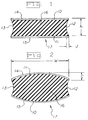
- Figure 1 is a cross section of pressure sensitive adhesive tape having curable silicone pressure sensitive adhesive on the bearing surfaces.
- Figure 2 is a cross section of an alternate design of tape.
- Figure 3 is a partial cross section of a curtain wall construction.
- This invention relates to a pressure sensitive adhesive tape comprising a tape substrate having at least a portion of one or more sides coated with a curable silicone pressure sensitive adhesive, the pressure sensitive adhesive being one which can be rebonded to a surface after being removed from a surface, the silicone pressure sensitive adhesive being curable to a permanent adhesive, the permanent adhesive being an adhesive which can not be rebonded to the surface after being removed.
- the pressure sensitive adhesive tape is used in a method of permanently bonding two surfaces together comprising placing the surfaces in proximity, then placing in contact with both surfaces a pressure sensitive adhesive tape comprising a tape substrate having at least a portion of one or more sides coated with a silicone pressure sensitive adhesive, which is curable to a permanent adhesive, so that each of the two surfaces is in contact with at least a portion of the curable silicone pressure sensitive adhesive, then curing the silicone pressure sensitive adhesive to bond the two surfaces together in a permanent manner.
- Figure 1 shows a cross section of a preferred tape having an elongated member 16 having a rectangular shape.
- the two opposing bonding surfaces 10 and 11 are shown as flat and parallel in this figure.
- the two opposing non-bonding surfaces 12 and 13 are flat or concave.
- the non-bearing surfaces are preferably concave as this shape has been found to reduce the peel stress on the corners of the tape when assembled into a curtain wall construction.
- Elongated member 16 is preferably constructed of a silicone elastomer having the physical properties desired for the tape in order for it to function properly in the particular application.
- Elongated member 16 can be constructed of any material which is appropriate for the application being considered.
- the bonding surfaces 10 and 11 are coated with a layer of curable pressure sensitive silicone adhesive 14 and 15.
- the outer surfaces of curable pressure sensitive silicone adhesives 14 and 15 are covered by a release liner or sheet, not shown, while the tape is in storage.
- This adhesive is a pressure sensitive adhesive so that the tape can be applied to a surface to be bonded to by merely removing the tape from the storage container and pressing into place on the first surface to be bonded to.
- a protective release liner not shown in figure 1, is removed and a second surface to be bonded to is placed over the adhesive surface of the tape and forced against the adhesive 14. Because of the pressure sensitive nature of the adhesive 14, the second surface is immediately held in place without any further need of additional mechanical fasteners to provide temporary support while the adhesive cures.
- the adhesive 14 and 15 on the tape 16 is cured.
- the cured adhesive bonds the two surfaces together, through the tape 16, with a permanent, structurally sufficient strength to hold the construction in place.
- FIG. 2 shows optional features which may be used in the construction of the tape.
- Bearing surfaces 10 and 11 may be convex, with the maximum height c of the convex surface less than 1.2 percent of the width w of the surface.
- the convex surface is useful in obtaining a uniform, bubble free joined surface between the adhesive 14 and an overlaying panel in the finished construction. As the panel is placed over the tape and pressed into place, the higher portion of the tape at the center causes air present between the adhesive surface and the panel surface to be forced out. The height of the convex surface is held to a maximum since too great a height would cause a concentration of forces at the center of the tape from the compression of the tape as the overlaying panel is forced down into contact with the tape. When the applying force is removed, the compressive forces at the center of the tape will tend to force the panel away from the tape, possibly causing failure of the bond at the edges of the tape.
- the preferred adhesive used in constructing the tape is a moisture-curable pressure sensitive silicone adhesive. This adhesive is preferred because it gives the immediate structural performance necessary to allow two surfaces to be bonded together due to the pressure sensitive nature of the adhesive. After the surfaces are bonded together, the adhesive cures to produce a permanent adhesive which securely bonds the surfaces together through the tape.
- the tape substrate and the adhesive both have the long life required in practical applications.
- FIG. 3 A use of the pressure sensitive adhesive tape of figure 1 is illustrated in Figure 3, showing construction of a curtain wall.
- the frame member 31 is a structural part of the building curtain wall.
- the curtain wall panels 32 and 33 are attached to the frame member 31 by use or the pressure sensitive adhesive tape 17.
- the adhesive layers 14 and 15 on the bearing surfaces of the tape 17 bond the panels 32 and 33 to the frame 31.
- an elastomeric backer rod 34 is placed between the panels 32 and 33 and a weather sealant 35 is extruded into place to seal the space between the panels 32 and 33.
- the elongated member 16 can be composed of any material that possesses the required rheological properties needed for performance in the structural application.
- the preferred material for curtainwall applications is a silicone rubber with a Shore A durometer of about 30 and 70.
- An elastomeric material such as this allows a tape to be made which can be formed and stored in roll form.
- the elongated member could be a rigid material, which means it would have to be handled from a practical point of view as a series of pieces which would be put in place, but the idea of a method of permanently bonding two surfaces together through the use of a curable pressure sensitive adhesive tape is still present.
- the silicone pressure sensitive composition curable to a permanent adhesive in the presence of moisture (SPSA) comprises a silicone pressure sensitive adhesive component bearing curing radicals having the formula R b (OR') 3-b SiZ- wherein Z denotes a divalent radical linking the silicon atom of the curing radical to a silicon atom of the silicone pressure sensitive adhesive component, R denotes a monovalent hydrocarbon radical, R' denotes an alkyl or alkoxyalkyl radical and the subscript b has a value of 0 or 1; all other silicon-bonded radicals of the silicone pressure sensitive adhesive component being selected from the group consisting of divalent oxygen atoms linking silicon atoms, hydroxyl radicals, hydrogen atoms and monovalent hydrocarbon radicals; and an effective amount of a catalyst component to accelerate the reaction of the curing radicals with moisture to form siloxane bonds.
- R b (OR') 3-b SiZ- wherein Z denotes a divalent radical linking the silicon atom of the curing radical to a silicon atom of the silicone
- the SPSA component bearing curing radicals consists essentially of a SPSA composition which has been modified so that it bears one or more silicon-bonded radicals of the formula R b (OR') 3-b SiZ-.
- R can be any monovalent hydrocarbon radical having, for example, from 1 to 10, preferably 1 to 6, carbon atoms such as lower alkyl radicals exemplified by methyl, ethyl, propyl and isopropyl; alkenyl such as vinyl; and aryl such as phenyl.
- the value of b in the curing radical formula is zero.
- b is 1 R is preferably the methyl radical.
- R' denotes any alkyl or alkoxyalkyl radical, preferably having less than 5 carbon atoms such as methyl, ethyl, iopropyl, methoxyethyl or ethoxyethyl. R' is preferably methyl.
- Z denotes a divalent radical which durably links the silicon atom of the curing radical to a silicon atom of the silicone pressure sensitive adhesive.
- Z is to be linked to the silicon atom of the curing radical and to the silicon atom of the pressure sensitive adhesive so that the curing radical is not removed from the SPSA component during moisture curing of the SPSA.
- Z has no other known requirements.
- Z is typically selected from the types of divalent radicals that are used to link silicon atoms in a hydrolytically stable manner and include, for example, oxygen; hydrocarbon such as alkylene, exemplified by ethylene, propylene and isobutylene and phenylene; hydrocarbon containing one or more hetero atoms selected from oxygen, nitrogen and sulfur such as ether-, thioether-, ester- or amide-containing hydrocarbon siloxane such as polydimethylsiloxane; and combinations thereof.
- oxygen such as alkylene, exemplified by ethylene, propylene and isobutylene and phenylene
- hydrocarbon containing one or more hetero atoms selected from oxygen, nitrogen and sulfur such as ether-, thioether-, ester- or amide-containing hydrocarbon siloxane such as polydimethylsiloxane
- hydrocarbon such as alkylene, exemplified by ethylene, propylene and isobutylene and phenylene
- Z is selected from the group of radicals having the formula -(C2H4SiMe2) x (OSiMe2) y D-.
- Me denotes methyl and D denotes oxygen or C2H4.
- the value of the subscript x can range from 0 to 2, preferably 1, and the subscript y can range from 0 to 6, preferably 0 or 1, each both inclusive, and the sum of x + y is zero or more.
- Preferred Z includes silhydrocarbonsiloxane linkages such as -(OSiMe2)CH2CH2-. -(CH2CH2SiMe2)(OSiMe2)CH2CH2-. -(CH2CH2SiMe2)O- and -(CH2CH2SiMe2)(OSiMe2)O-; silhydrocarbon linkages such as -(CH2CH2SiMe2)CH2CH2- and -CH2CH2-; and siloxane linkages such as -(OSiMe2)O- and -O-.
- suitable curing radicals include, but are not limited to (MeO)3SiCH2CH2-.
- (MeO)3SiO- Me(MeO)2SiO-, (MeO)3SiCH2CH2SiMe2CH2CH2SiMe2O-, (MeO)3SiCH2CH2SiMe2O-, (MeO)3SiCH2CH2SiMe2OSiMe2O- and (MeO)3SiCH2CH2SiMe2OSiMe2CH2CH2-.
- ethylene radical is sometimes written as C2H4 to indicate the isomeric mixture of CH2CH2 and CH3CH linkages that are obtained when an hydrosilylation reaction between a silicon-bonded vinyl radical and a silicon-bonded hydrogen atom occurs.
- the formula (MeO)3SiC2H4SiMe2O- is to be construed as encompassing (MeO)3SiCH2CH2SiMe2O- and/or (MeO)3SiCH(CH3)SiMe2O-.
- Silicon-bonded radicals of the silicone pressure sensitive adhesive component which are not curing radicals having the formula indicated are selected from divalent oxygen atoms linking silicon atoms and monovalent radicals selected from hydroxyl radicals, hydrogen atoms and the hydrocarbon radicals noted above for R.
- the SPSA component of the compositions of this invention bearing curing radicals can be prepared by introducing the required curing radicals, in any desired sequence, into a preformed SPSA and/or into one or more of the siloxane components of the SPSA, by way of reactive sites such as silicon-bonded hydroxyl or vinyl radicals, therein.
- the weight ratio of resin (1) to gum (2) in the SPSAs ranges from 5/95 to 70/30, preferably 40/60 to 60/40.
- the silicon-bonded radicals of these SPSAs are selected from the group consisting of divalent oxygen atoms linking silicon atoms, hydroxyl radicals and monovalent hydrocarbon radicals such as alkyl, aryl, alkenyl, cycloalkyl, cycloalkenyl, aralkyl and alkaryl; and hydrogen atoms.
- the organopolysiloxane resin (1) consists essentially of R13SiO 1/2 siloxane units and SiO 4/2 siloxane units and can be dissolved, substantially completely, in either a hydrocarbon liquid such as benzene, toluene, xylene, heptane and the like or in a silicone liquid such as a low viscosity cyclic or linear polydiorganosiloxanes.
- R1 denotes a monovalent hydrocarbon radical preferably having less than 20 carbon atoms and, most preferably, having from 1 to 10 carbon atoms, a hydroxyl radical or a hydrogen atom.
- suitable hydrocarbon R1 radicals include alkyl radicals such as methyl, ethyl, propyl, pentyl, octyl, undecyl and octadecyl; alkenyl radicals such as vinyl, allyl and 5-hexenyl; cycloalphatic radicals such as cyclohexyl and cyclohexenylethyl; and aryl radicals such as phenyl, tolyl, xylyl, benzyl and 2-phenylethyl.
- alkyl radicals such as methyl, ethyl, propyl, pentyl, octyl, undecyl and octadecyl
- alkenyl radicals such as vinyl, allyl and 5-hexenyl
- cycloalphatic radicals such as cyclohexyl and cyclohexenylethyl
- aryl radicals such as phen
- At least one-third and, more preferably, substantially all R1 radical, in the formula for component (1) are methyl radicals.
- R13SiO 1/2 siloxane units include HMe2SiO 1/2 , Me3SiO 1/2 , PhMe2SiO 1/2 and Me2ViSiO 1/2 where Me, Ph and Vi denote methyl, phenyl and vinyl.
- the mol ratio of the R13SiO 1/2 siloxane units to SiO 4/2 siloxane units of component (1) has a value of from 0.5/1 to 1.5/1, preferably from 0.6/1 to 0.9/1. These mol ratios are easily measured by Si29 n.m.r. spectroscopy.
- Component (1) consisting essentially of R13SiO 1/2 siloxane units and SiO 4/2 siloxane units can be prepared by any suitable method. That is to say it is believed that the organopolysiloxane resin (1) can be prepared by, for example, silane co-hydrolysis methods or silica hydrosol capping methods known in the art. Component (1) is preferably prepared by the silica hydrosol capping processes of Daudt et al., U.S. Patent No. 2,676,182; of Rivers-Farrell et al., U.S. Patent No. 4,611,042; and of Butler, U.S. Patent No. 4,774,310; each teach how to prepare organopolysiloxane resins which can be reacted to contain curing radicals or which can be used to make SPSAs which can be reacted to contain curing radicals.
- Component (2) of the SPSA component to be converted to contain curing radicals is a polydiorganosiloxane gum having the general formula R3R22SiO(R22SiO) n SiR22R3.
- each R2 denotes a hydrogen atom or a monovalent hydrocarbon radical
- each R3 denotes a radical selected from the group consisting of R2 radicals and OH radicals.
- R2 radicals include the hydrocarbon radicals delineated above for R1, including preferred species.
- At least 50% and, preferably, at least 90%, of the R2 radicals of Component (2) are methyl radicals.
- the methyl radicals can be distributed in any preferred manner in the polydiorganosiloxane.
- General examples of polydiorganosiloxanes which are suitable for use as component (2) in the compositions of this invention include hydroxyl-, hydrogen-and hydrocarbon- terminated polydiorganosiloxanes.
- polydiorganosiloxane examples include, but are not limited to, the polydiorganosiloxanes in the examples disclosed below and ViMe2SiO(Me2SiO) n SiMe2Vi, ViMe2SiO(Me2SiO) 0.98n (MeViSiO) 0.02n SiMe2Vi, Me3SiO(Me2SiO) 0.9n (MeViSiO) 0.1n SiMe3, HMe2SiO(Me2SiO) n SiMe2H, Me3SiO(Me2SiO) 0.9n (MeHSiO) 0.1n SiMe3, HOMe2SiO(Me2SiO) n SiMe2OH and HOR22SiO(Me2SiO) 0.95n (MeViSiO) 0.05n SiR22OH, wherein Me, Vi and Ph denote methyl, vinyl,
- the average values of the subscript n in the above formulae are such that the organopolysiloxane component (2) has a viscosity at 25°C. of from 100,000 centipoise (100 pascal-seconds) to 100,000,000 centipoise (100 kilopascal-seconds) and more.
- the exact value of the subscript n needed to provide a viscosity value falling within said limits depends upon the identity of the R2 radicals; however, for hydroxyl-terminated and/or R2-terminated polydiorganosiloxanes containing at least 90% methyl radicals n will have a value of from about 1 to several thousand. From a consideration of maximum adhesive properties, component (2) is preferably a gum having a viscosity of at least 1,000,000 centipoise at 25°C.
- Component (2) can comprise trace amounts of siloxane branching sites such as R2SiO 3/2 units and SiO 4/2 units and can be comprised of a single polydiorganosiloxane or a mixture of two or more different polydiorganosiloxanes, if desired.
- Polydiorganosiloxanes are well known in the organo-silicone art and their synthesis needs no extensive delineation herein. Many are commerically available from major silicone manufacturers.
- SPSAs having sites of the formula ⁇ SiOH, herein also denoted as a silanol-functionl SPSA can be any of those known in the art.
- the disclosures of U.S. Patent Nos. 2,736,721; 2,814,601; 2,857,356; 3,527,842; 3,528,940; 3,839,075; 3,929,704; 3,983,298; 4,309,520; 4,584,355; 4,591,622; and 4,774,297 illustrate silanol-functional SPSAs that can be used to prepare the moisture-curable SPSA component of the compositions of this invention.
- SPSAs having sites of the formula ⁇ Si-alkenyl herein also denoted as an alkenyl-functional SPSA
- an alkenyl-functional SPSA can be prepared, for example, by replacing one or more of the silanol-functional components normally used to prepare a silanol-functional SPSA compositions known in the art with an alkenyl-functional component.
- SPSAs having sites of the formula ⁇ SiH herein also denoted as an hydrogen-functional SPSA
- a preferred SPSA composition to be used to prepare the SPSA component of the compositions of this invention is a bodied SPSA composition.
- a bodied SPSA composition can be prepared by heating a solution of a silanol-functional SPSA in a solvent such as a water-azeotroping hydrocarbon, at reflux until its silanol content has been reduced, preferably to a value of less than one weight percent.
- the SPSA component of this invention bearing curing radicals can be prepared by a method wherein an ⁇ SiX-functional SPSA is reacted with a compound that will convert one or more ⁇ SiX groups in the SPSA to a curing radical having the formula noted above.
- the curing radicals can be introduced into the organopolysiloxane resin portion, into the polydiorganosiloxane gum portion, into the SPSA after it has been prepared or into any combination of said portions and SPSA.
- the polydiorganosiloxane gum or the organopolysiloxane resinous portion or the SPSA composition made therefrom must contain a sufficient number of ⁇ SiX reactive site to accomodate the introduction of the needed curing radicals.
- the present invention relates to a method comprising: reacting (i) a silicone pressure sensitive adhesive composition having reactive sites of the formula ⁇ SIX with (ii) a moisture-reactive compound having the formula R b (OR') 3-b SiY wherein Y denotes a radical which is reactive with ⁇ SiX, whereby the Y-substituted silicon atom is linked with the X-substituted silicon atom by a divalent Z radical, R denotes a monovalent hydrocarbon radical, R' denotes an alkyl or alkoxyalkyl radical and the subscript b has a value of 0 or 1; all other silicon-bonded radicals in (i) being selected from the group consisting of divalent oxygen atoms linking silicon atoms, hydrogen atoms, hydroxyl radicals and monovalent hydrocarbon radicals.
- the SPSA component bearing curing radicals having the formula R b (OR') 3-b SiZ- can be prepared by any method wherein the Y radical of R b (OR') 3-b SiY reacts with an X radical of an X-substituted SPSA to form a Z radical, as noted above.
- the method for forming a Z radical can encompass the reactions of silicon chemistry such as the reaction of silanols or of silicon hydrides; or of organic chemistry such as the reaction of an alcohol with a carboxylic acid to form an ester linkage.
- silicon chemistry such as the reaction of silanols or of silicon hydrides
- organic chemistry such as the reaction of an alcohol with a carboxylic acid to form an ester linkage.
- 3,122,522; 3,161,614 (Re 29,760); 3,175,993; 3,334,067; 4,100,129; 4,395,526; 4,599,394; 4,772,675; 4,847,400; and 4,962,174 show the preparation of moisture-curable compositions which comprise silicon-bonded alkoxy groups and a catalyst.
- the SPSA component bearing curing radicals can be prepared by the application of any of the above-noted processes to SPSA compositions and/or to one or more of their several components. Briefly, these methods comprise hydrosilylation reactions and silanol-converting reactions; the latter comprising the reaction of a silanol group with a silicon-bonded hydrolyzable radical such as amine, silylamine, alkoxy, halogen or acyloxy; or with a silicon-bonded hydrogen atom.
- hydrosilylation reactions and silanol-converting reactions comprising the reaction of a silanol group with a silicon-bonded hydrolyzable radical such as amine, silylamine, alkoxy, halogen or acyloxy; or with a silicon-bonded hydrogen atom.
- (MeO)3SiCH2CH2 radicals and (MeO)3SiCH2CH2SiMe2OSiMe2CH2CH2- radicals can be introduced into a vinyl radical-containing SPSA component with compounds having the formula (MeO)3SiH and (MeO)3SiCH2CH2SiMe2OSiMe2H, respectively.
- Radicals having the formulae (MeO)3SiO- and Me(MeO)2SiO- can be introduced into a silanol-functional SPSA component with compounds having the formulae (MeO)4Si and Me(MeO)3Si, respectively.
- (MeO)3SiCH2CH2SiMe2O-, (MeO)3SiCH2CH2SiMe2OSiMe2O-and (MeO)3SiCH2CH2SiMe2CH2CH2SiMe2O- radicals can be introduced into a silanol-functional SPSA component by the use of compounds such as (MeO)3SiCH2CH2SiMe2OSiMe2H, (MeO)3SiCH2CH2SiMe2CH2CH2SiMe2H and (MeO)3SiCH2CH2SiMe2H.
- the SPSA component bearing curing radicals having the formula R b (OR') 3-b SiZ- is prepared by reacting a silanol-containing SPSA with a moisture-reactive compound having the formula R b (OR') 3-b SiY wherein Y bears a silicon-bonded hydrolyzable radical such as halogen, acyloxy, amino, amido, etc.
- Y preferably bears an amino nitrogen which provides an ammonia by-product.
- Silazanes and disilazanes are preferred compounds for introducing the curing radicals into a silanol-functional SPSA, in view of the type of by-products that will produced during the reaction.
- Examples of silazanes and disilazanes include (MeO)3Si(CH2CH2SiMe2) x (OSiMe2) y NH2 and ⁇ (MeO)3Si(CH2CH2SiMe2) x (OSiMe2) y ⁇ 2NH such as ⁇ (MeO)3SiCH2CH2SiMe2 ⁇ 2NH.
- An highly preferrred curing radical for the composition of this invention is (MeO)3SiC2H4SiMe2O-because it can be readily introduced into the SPSA composition by way of its disilazane.
- the SPSA component bearing silicon-bonded curing radicals having the formula R b (OR') 3-b SiZ- can bear any number of curing radicals; the rate and extent of cure of the SPSA composition, when exposed to moisture, being dependent on the concentration of curing radicals.
- the SPSA component should contain an average of at least 1 millimol, preferably at least 2 millimols, of curing radicals per 100 parts by weight of SPSA component to obtain a desirable rate of cure.
- the SPSA component should contain no more that 100, preferably no more than 50, millimols of curing radicals per 100 parts of SPSA component to achieve a desirable adhesive strength.
- mols and parts are to be expressed in comparable terms. For example, 5 millimols and 100 parts can be expressed as 5 milligram-mols and 100 gram parts or as 5 millipound-mols and 100 pound parts.
- a suitable catalyst should be used when introducing curing radicals into the SPSA component.
- a silicon hydride to introduce curing radicals it is desirable to use a platinum group metal catalyst such as platinum or rhodium and its compounds and complexes to accelerate the hydrosilylation reaction.
- a silazane to introduce curing radicals it is desirable to use a strong acid catalyst such as trifluoroacetic acid.
- a titanate catalyst such as tetrabutyl titanate.
- the compositions of this invention preferably further comprise an effective amount of a catalyst component to accelerate the reaction of the curing radicals with moisture to form siloxane bonds.
- Catalysts for accelerating the reaction of the OR' radicals with moisture to form siloxane bonds are well known in the silicone elastomer art and need no detailed delineation herein.
- said catalysts include, but are not limited to, metal salts of monocarboxylic acids such as stannous octoate, dibutyltin dilaurate and dibutyltin diacetate; titanium esters such as tetrabutyl titanate, tetraethylhexyl titanate and tetraphenyltitanate; siloxytitanates such as tetrakis(trimethylsiloxy)titanium and bis(trimethylsiloxy)-bis(isopropoxy)titanium; and beta-dicarbonyltitanium compounds such as bis(acetylacetonyl)-diisopropyl titanate; amines such as hexylamine; and their acetate and quat salts.
- Preferred catalyst are bis(acetylacetonyl)diisopropyl titanate and certain orthotitanates such as tetrabutyl titanate and their partial hydrolyzates.
- the amount of titanium-containing catalysts typically ranges from 0.1 to 27%, based on the weight of the SPSA component.
- compositions of this invention can be prepared by introducing curing radicals of the formula noted above into a SPSA, preferably dissolved in a solvent, and, if desired, thereafter admixing a suitable amount of the catalyst component.
- the solvent component can be any liquid that will dissolve the SPSA and the curing radical-containing SPSA component without adversely reacting therewith in the absence of moisture.
- suitable solvents include aromatic hydrocarbons such as benzene, toluene and xylene; aliphatic hydrocarbons such as hexane, heptane and cyclohexane; halogenated hydrocarbons such as chlorocarbons; oxygenated solvents such as esters, ketones and lower alcohols; and volatile siloxanes such as hexamethyldisiloxane and cyclopolydimethylsiloxanes.
- aromatic hydrocarbons such as benzene, toluene and xylene
- aliphatic hydrocarbons such as hexane, heptane and cyclohexane
- halogenated hydrocarbons such as chlorocarbons
- oxygenated solvents such as esters, ketones and lower alcohols
- volatile siloxanes such as hexamethyldisiloxane and cyclopolydimethylsiloxanes.
- compositions of this invention typically, but not necessarily, further comprise an appropriate quantity of a solvent to provide for a lower viscosity and hence an easier application of, the SPSA composition to various substrates.
- a solvent to provide for a lower viscosity and hence an easier application of, the SPSA composition to various substrates.
- Concrete examples of this component are the same as those delineated above for use during the preparation of the SPSA component and mixtures thereof.
- the amount of solvent is not critical; however, only a sufficient amount to facilitate the preparation, handling and applying of the composition is recommended.
- the solvent when used, is preferably a non-reactive hydrocarbon solvent or siloxane solvent and is preferably used in an amount sufficient to provide a viscosity of from 10,000 to 100,000 centipoise at 25°C. for the composition.
- the SPSA component in a solvent that can be allowed to remain in the final composition.
- the solvent when used, is preferably a non-reactive hydrocarbon solvent or siloxane solvent. It has been found convenient, but not necessary, to prepare the SPSA component in a solvent that can be allowed to remain in the final composition as a viscosity-adjusting solvent.
- compositions of this invention can be used in all of the applications to which the SPSA compositions of the art are directed since they possess adhesive properties in their uncured state, one or more of which will improve upon exposure to ambient moisture. Additionally, the compositions of this invention can be used in all of the applications to which the permanent adhesive compositions of the art are directed since certain embodiments thereof will cure to the permanent adhesive state upon exposure to ambient moisture. It is expected that the compositions of this invention will satisfy other adhesive needs in view of their moisture-activated curing capability.
- the use of the compositions of this invention comprises applying a composition of this invention to a substrate; removing substantially all of the solvent from the applied composition to provide at adhesive-bearing substrate; and adhering the adhesive-bearing substrate to a surface.
- a composition of this invention is applied to the substrate and devolatilized before any substantial gelling of the composition occurs.
- compositions of this invention comprising a catalyst component it is recommended that the composition be prepared within a day or two of being applied to the substrate and devolatilized. Thereafter it is preferred to apply the adhesive-bearing substrate to the surface before the adhesive has experienced a complete loss of tack. It is recommended that the adhesive-bearing substrate be applied to the surface within a few days to a few weeks after being prepared. If there is any delay in applying the adhesive-bearing substrate to the surface it is recommended to maintain the adhesive under substantially anhydrous conditions.
- the SPSA component bearing silicon-bonded curing radicals having the formula R b (OR') 3-b SiZ- must bear an average of at least one, preferably at least two and, most preferably, 3 to 5, silicon-bonded curing radical per molecule of SPSA. Any remaining silanol radicals in the SPSA are preferably, but not necessarily, capped with non-reactive silyl groups such as R3SiO 1/2 groups. Silanol-capping to provide said non-reactive silyl groups can be done with a silanol-capping compound having the formula R3SiY wherein Y has the same meaning as noted above. Examples of silanol-capping compounds which provide non-reactive silyl groups and an ammonia by-product include silazanes such as R3SiNH2 and disilazanes such as R3SiNHSiR3.
- the SPSA component bearing silicon-bonded curing radicals having the formula R b (OR') 3-b SiZ- is prepared by capping a silanol-radical containing SPSA of the art with an appropriate amount of an alkoxysilylalkylene radical-substituted silazane or disilazane and an appropriate amount of a trialkylsilyl-substituted silazane or disilazane to provide a silanol-free silicone pressure sensitive adhesive.
- the SPSA component bearing silicon-bonded curing radicals having the formula R b (OR') 3-b SiZ- by an alternative silanol-capping process, using any of the silanol-capping compounds delineated above, by capping the organopolysiloxane resin portion or the polydiorganosiloxane fluid or gum portion before preparing the SPSA therefrom.
- the SPSA component bearing silicon-bonded curing radicals having the formula R b (OR') 3-b SiZ- is obtained when the SPSA is prepared, by way of well-known methods, except using one or more components comprising one or more, preferably two or more and most preferably 3 to 5, curing radicals.
- compositions of this invention preferably further comprise an effective amount of a catalyst component to accelerate the reaction of the hydrolyzable radicals with moisture to form siloxane bonds.
- the reactivity of silicon-bonded hydrolyzable radicals in the radicals having the formula R b (OR') 3-b SiZ- is expected to vary with the identities of R, R' and Z and the value of the subscript b.
- Catalysts for accelerating the reaction of the OR' radicals with moisture to form siloxane bonds are well known in the silicone elastomer art and need no detailed delineation herein.
- said catalysts include, but are not limited to, metal salts of monocarboxylic acids such as stannous octoate, dibutyltin dilaurate and dibutyltin diacetate; titanium esters such as tetrabutyl titanate, tetraethylhexyl titanate and tetraphenyltitanate; siloxytitanates such as tetrakis(trimethylsiloxy)titanium and bis(trimethylsiloxy)-bis(isopropoxy)titanium; and beta-dicarbonyltitanium compounds such as bis(acetylacetonyl)di-isopropyl titanate; amines such as hexylamine; and their acetate and quat salts.
- Preferred catalyst are bis(acetylacetonyl)di-isopropyl titanate, stannous carboxylates and certain orthotitanates and their partial hydrolyzates.
- the amount of titanium-containing catalysts typically ranges from 0.1 to 2%, based on the weight of siloxane.
- a preferred SPSA is a composition
- compositions of this preferred SPSA further comprise (C) an effective amount a silicon compound bearing a plurality of silicon-bonded alkoxy radicals to improve the shelf life of the composition.
- Component (C) in the compositions of this preferred composition can be any compound bearing two or more, preferably three or more, silicon-bonded alkoxy radicals. Any other silicon-bonded radicals in component (C) are to be selected from the group consisting of divalent oxygen atoms linking silicon atoms, divalent hydrocarbon atoms linking silicon atoms, hydrogen atoms and monovalent hydrocarbon radicals.
- the component (C) can be a silane or a partial hydrolyzates and/or condensates thereof.
- silanes examples include di-, tri- and tetra-alkoxy silanes wherein the alkoxy radicals are, for example, methoxy, ethoxy, n-propoxy, i-propoxy and butoxy, each used singularly or in mixtures and the other silicon-bonded radicals, if present, include hydrogen; monovalent hydrocarbon such as alkyl such as methyl, ethyl, propyl; aryl such as phenyl and benzyl; and olefinic such as vinyl and allyl; and polyvalent hydrocarbon such as ethylene and phenylene.
- alkoxy radicals are, for example, methoxy, ethoxy, n-propoxy, i-propoxy and butoxy, each used singularly or in mixtures and the other silicon-bonded radicals, if present, include hydrogen; monovalent hydrocarbon such as alkyl such as methyl, ethyl, propyl; aryl such as phenyl and benzyl; and ole
- orthosilicates such as ethyl orthosilicate and n-propyl orthosilicate
- alkyltrialkoxy silanes such as methyltrimethoxy silane
- alkylene-bis-trialkoxysilanes such as bis-trimethoxysilylethane
- polysilicates such as ethyl polysilicate.
- compositions can be prepared by introducing curing and capping radicals of the formulae noted above into a SPSA composition, preferably in solution, to form the SPSA component and thereafter admixing a suitable amount of the silicon component (C) hearing a plurality of silicon-bonded alkoxy radicals and a suitable amount of the catalyst component (B).
- the solvent component can be any liquid that will dissolve the SPSA and the curing radical-containing component without adversley reacting therewith in the absence of moisture.
- suitable solvents include aromatic hydrocarbons such as benzene, toluene and xylene; aliphatic hydrocarbons such as hexane, heptane and cyclohexane; halogenated hydrocarbons such as chlorocarbons; oxygenated solvents such as esters, ketones and lower alcohols; and volatile siloxanes such as hexamethyldisiloxane and cyclopolydimethylsiloxanes.
- the silicone pressure sensitive adhesive described above can be applied to the tape substrate by any suitable method.
- the composition can be sprayed, painted or roller coated onto the surface of the substrate.
- the solvent is then removed by air drying or heating to a suitable temperature to give a coating of the adhesive on the substrate surface. If the opposite side of the substrate is to be coated, a release film can be placed over the adhesive, the assembly turned over and adhesive applied to the second side in a similar manner.
- a second method of making the pressure sensitive tape is through the use of a release liner.
- the silicone pressure sensitive adhesive composition is applied to a release liner by spraying, roller coating, drawdown bar or other suitable means.
- the coating is then dried to give a film of pressure sensitive adhesive on the release liner.
- This construction is known as a transfer tape.
- This transfer tape is then used to make the pressure sensitive tape by applying the exposed adhesive to the surface of the tape substrate, giving an adhesive attached to the tape substrate and covered with a release film.
- a preferred release liner comprises a plastic film such as polyester or polyethylene coated on one or both sides with a silicone release agent.
- a preferred silicone release agent is one in which a fluorosilicone polymer such as is described in U.S. Patent No. 4,736,048, issued April 5, 1988, is used. Further description of release liner and moisture-curable silicone pressure sensitive adhesive is found in co-pending U.S. Patent Application Serial No. 748,581, titled, "LAMINATE ARTICLE COMPRISING MOISTURE-CURABLE SILICONE PRESSURE SENSITIVE ADHESIVE AND RELEASE LINER", filed on August 22, 1991.
- a preferred method of manufacturing a silicone elastomeric structural glazing tape comprises (A) applying to a tape substrate, which is a silicone elastomer having a rectangular shape in which two opposing bonding surfaces are flat or convex with the maximum height of the convex surface less than 1.2 percent of the width of the convex surface and in which two opposing non-bonding surfaces are flat or concave, a transfer tape comprising a release sheet film having a softening point of greater than 50°C.
- the preferred tape substrate is a silicone rubber extrusion having a Shore A durometer of from about 30 to 70.
- the tape has a rectangular shape in which the two opposing bonding surfaces are flat or convex, with the maximum height of the convex surface less than 1.2 percent of the width of the convex surface This shape has been found to provide the best air-free contact between the silicone pressure sensitive adhesive on the surface and the surface to be bonded to.
- the tape substrate is generally on the order of 1/2 inch in width with a thickness of 1/4 inch to 1/2 inch, but can be made any desired size.
- the preferred method of applying the silicone pressure sensitive adhesive to the bonding surface or surfaces of the tape substrate is through the use of the transfer tape discussed above wherein a releasable release sheet film is coated with the silicone pressure sensitive adhesive composition described above.
- This transfer tape is then adhered to the tape substrate by applying an exposed surface of the silicone pressure sensitive adhesive to the cleaned bonding surface of the tape substrate. This can be done by hand methods or through the use of machinery as preferred. A description of both methods is found in the examples.
- the polyester release films from both sides of the construction and replace them with one releasable film of polyethylene. This is done by removing one of the original polyester release films from the construction and replacing it with a polyethylene release film which has been coated on both sides with a release coating, preferably the fluorosilicone release coating discussed above.
- a release coating preferably the fluorosilicone release coating discussed above.
- the tape substrate with the adhesive on both sides and the releasable polyethylene film on one side of the adhesive may be formed into a roll by winding the construction around a circular core and upon the preceding layer of itself.
- polyester release film on the second adhesive layer is removed as this is done so that the second adhesive layer is placed against the second release coated surface of the polyethylene film which had been previously applied to the first adhesive surface.
- This process results in a roll of tape substrate having a layer of silicone pressure sensitive adhesive on both bonding surfaces wound in layers with a releasable film of polyethylene between the layers of adhesive coated tape substrate. It is preferred that this entire process be carried out in an atmosphere with a minimum of moisture present since the preferred adhesive cures upon exposure to moisture.
- the roll of tape is stored for use when desired by packaging the roll of tape in a moisture impermeable container.
- the preferred container is an aluminum foil plastic laminate pouch which can be heat sealed.
- the roll of pressure sensitive adhesive tape is placed in the pouch, with a desiccant such as silica gel present if desired, the air in the pouch is removed and the pouch is heat sealed. The silicone pressure sensitive adhesive is thus prevented from curing.
- the roll is removed from the container and the tape is unrolled.
- the tape will have one adhesive surface exposed and the other adhesive surface covered with the releasable polyethylene film.
- the exposed adhesive surface is applied to the surface to be adhered to and the tape forced into intimate contact with the underlaying surface.
- the releasable polyethylene film on the upper adhesive surface is then removed and the second substrate to be adhered to is applied over the exposed adhesive and forced into intimate contact with the adhesive. Because the adhesive is a pressure sensitive adhesive, it will hold the two substrates together. Now that the adhesive on the tape is exposed to moisture, the adhesive will gradually cure to permanently bond the two substrates together.
- a silicone pressure sensitive adhesive composition was prepared by mixing 40 parts of solid, benzene soluble resin copolymer consisting essentially of R3SiO1/2 units and SiO4/2 units where R is a monovalent hydrocarbon radical containing no more than 6 carbon atoms, there being from 0.6 to 0.9 inclusive R3SiO1/2 units for every SiO4/2 unit, at least 95 percent of all radicals in the copolymer being methyl and the total number of R radicals in the copolymer that have olefinic unsaturation being no more than 0.5 percent, with 29 parts of xylene. This was then blended with 23 parts of hydroxyl endblocked polydimethylsiloxane gum having a Williams Plasticity of about 63 and the mixture was heated to 140°C.
- the mixture was heated to 100°C. and reacted, then cooled to 70°C. and 0.5 part of hexamethyldisilazane was added, the mixture was heated to 100°C. to react and the mixture was cooled to room temperature to give the silicone pressure sensitive adhesive composition.
- the substrate was then dunked into a bath containing a 50/50 by weight mixture of toluene and iso-propyl alcohol and then rinsed with clean toluene.
- the substrate was then scrubbed with a piece of cheese cloth which was soaked with clean toluene to remove any dirt or grime.
- the substrate stock was then allowed to air dry for 3 to 4 hours.
- the coated cores were then removed from the oven and allowed to cool approximately 10 min. at laboratory conditions.
- a release liner of polyester film approx. 3 mil thick and coated on one side with a dimethyl,methylperfluorobutylethyl, methylvinylsiloxane copolymer (Dow Corning (R) Q2-7785 Release Coating) was placed over the adhesive film surface.
- the release liner was then trimmed to the width of the substrate with a razor blade. This gave a pressure sensitive adhesive tape having adhesive on one side, covered with a release liner.
- This pressure sensitive adhesive tape was then placed back into the coating fixture with the covered side down. A piece of 6 mil shim stock was placed on top of the other shims to compensate for the release linear and the adhesive film on the other side of the core. This provided a 10 mil gap for the second wet coat of SPSA. The coating procedure with the oven dry cycle was repeated. After cooling the second time, a second piece of release liner was placed over the adhesive film and cut to size as described above. This gave a pressure sensitive adhesive tape having two opposing surfaces coated with SPSA which was protected by release liners.
- Tensile adhesion joints were prepared, using the following procedure, to test the ability of the above pressure sensitive adhesive tape to hold two surfaces together.
- Each 13 inch piece of tape was cut into two inch lengths, six per tape.
- Cleaned glass coupons 1 inch wide by 3 inches long and 1/4 inch thick ) were used to prepare the samples.
- the release liner was removed from one side of the tape and the glass coupon was pressed on to the edge of the tape and rolled across the adhesive film surface. This technique was used to minimize trapping air between the adhesive film surface and the glass surface.
- Another piece of glass was then placed at the edge of the tape and rolled onto the surface of the adhesive film. A sandwich was thus formed with the double sided tape adhered to two pieces of glass. This sample preparation was repeated until a total of 12 tensile adhesion joints were built. Each sample had one square inch of tape surface area attached to the glass.
- test samples were then evaluated for percent glass contact and when the values were recorded, the test joints were submitted for testing.
- the tensile and elongation values were measured for each sample.
- Three test joints were measured at the following test times, 0, 3, 7 and 14 days. Samples were aged at ambient lab conditions (25°C. and 50% relative humidity). These tests were a modification of ASTM 1135-90 Test Method for Determining Tensile Adhesion Properties of Structural Sealants. The results obtained were as follows.
- a pressure sensitive tape was prepared in the laboratory through the use of a transfer film.
- Silicone pressure sensitive adhesive composition was prepared in the same manner as in Example 1.
- a sheet of 3 mil thick polyester backing coated with the fluorosilicone release described in Example 1 ( 12 inches wide by 14 inches long ) was placed and taped to a piece of white freezer wrap paper with the release coated side up.
- a 3" multiple film applicator (Pacific Scientific Cat. No. AR-5340), commonly refered to as a bird box, was placed near one edge of the release liner, with the 10 mil gap on the liner.
- the SPSA was then carefully poured into the bird box (approx. 7 to 10 grams) to avoid air bubbles.
- the bird box was then pull down the length of the release liner leaving a 10 mil wet coat of SPSA on the release liner surface.
- the film of adhesive was about three inches wide. The casting procedure was repeated until three films were made on the sheet of release liner.
- the liner was then removed from the kraft paper and placed onto an oven tray. The liner was held in place by four clamps. The tray was then placed into an air circulating oven controlled at 70°C. (158°F.) and oven dried for 5 minutes. The oven tray was removed and placed on a lab bench to cool (approx. 10 min.). The three films were then separated by cutting with a razor blade.
- Strips of tape substrate were cleaned in the manner described in Example 1.
- a piece of cleaned tape substrate was placed on a sheet of clean white kraft paper, polyethylene side up.
- a sheet of the above described transfer film ( 3 inches wide ) was turned adhesive film side down and applied to the surface of the tape substrate; starting from left to right.
- the film was positioned using the index finger to apply pressure to remove any trapped air bubbles. Once the film was completely positioned down the length of the substrate, the excess film was trimmed away.
- a ten pound steel roller was then moved over the release liner, to assure transfer of the adhesive film from the release liner to silicone rubber tape substrate. This process was repeated on the opposite side of the substrate, yielding a piece of double sided pressure sensitive adhesive tape. Two 13 inch pieces of tape were prepared by this technique.
- Example 2 The film transfer technique of Example 2, using a different silicone pressure sensitive adhesive composition, was repeated.
- the silicone pressure sensitive adhesive composition was 60.03 g of the composition described in Example 1, 2.19 g of normal orthopropyl silicate, 0.12 of titanium-di-isopropoxy-di-ethylacetoacetate and 6.68 g of xylene.
- the ingredients were weighed out into a 2 oz. wide mouth squat jar. These were then hand mixed with a 3 inch stainless steel spatula. After mixing the jar was sealed and placed into the centrifuge and deaired for about 2 minutes at 3/4 speed. The 6 grams of xylene was added to the formulation to adjust the viscosity of the composition to approximately 60,000 cp., which was the preferred working viscosity for film production
- the adhesive was used to prepare transfer films as described in Example 2, except that the wet film thickness was 0.020 inches and five sample films were prepared.
- the tape substrate used was a silicone rubber extrusion having a 70 durometer in the shape of a rectangle having a width of 1/2 inch and a height of 3/8 inch. There were two holes through the extrusion of a rectangular shape with a width of about 1/8 inch and a height of about 1/4 inch. The 1/2 inch surfaces which subsequently had adhesive applied to them were flat, while the 3/8 inch surfaces were concave.
- the tape substrate was cleaned as described in Example 1.
- the pressure sensitive adhesive tape was prepared from the tape substrate and transfer film described above in the manner described in Example 1. Four pieces of tape 13 inches long were prepared. From these, 24 tensile adhesion samples were prepared and tested as described above. The test results are shown in Table III.
- Table III Tensile Adhesion Sample Test Time Days %Glass SideA Contact SideB Tensile Strength psi Elongation percent 1 0 90 90 97 40 2 0 97 98 104.5 35 3 0 99 97 107 35 average 0 102.8 36.7 4 3 90 100 147.5 60 5 3 95 97 150 60 6 3 95 99 148 65 average 3 148.5 61.7 7 14 95 97 168 65 8 14 92 97 170 65 9 14 96 98 172 75 average 14 170 68.3 10 30 96 98 192.5 80 11 30 97 98 200 85 12 30 96 97 197.5 95 average 30 196.7 86.7 13 90 97 97 255 115 14 90 96 97 256 115 15 90 97 98 255 120 average
- a silicone pressure sensitive adhesive was prepared by mixing a solution of 27 parts of xylene, 38 parts of a xylene solution containing 70 percent of a soluble organopolysiloxane consisting of (CH3)3SiO 1/2 units and SiO 4/2 units in a mol ratio of 0.8/1 and having a hydroxyl content of 3.45 percent and M n of 1,963, M w /M n of 2.57 as measured by gel-permeation chromatography using Varian TSK 4000+2500 columns at 35°C., a chloroform mobile phase (flow rate) at 1 microL/m and an IR detector set at 8.5 microns to detect SiO2 and 23 parts of a hydroxyl-terminated polydimethylsiloxane gum having a plasticity number of 137-152, as measured by ASTM 926-67 and a viscosity of at least 10,000,000 centipoise at 25°C.
- the reaction mixture was cooled to 70°C. and 3.4 parts of hexamethyldisilazane was added and the mixture was again heated to 10°C. for one hour. After cooling to room temperature, 3.5 parts of normal-propyltetrasilicate was added and the solution was filtered. The resulting silicone pressure sensitive adhesive base was a 40 percent solids solution.
- the coating was heated for 24
- Strips of tape substrate of 30 durometer silicone rubber extrusion 1/2 inch wide and 1/4 inch thick in 13 inch lengths were cleaned by scrubbing with a toluene soaked piece of cheese cloth and then air drying for 2 to 3 hours.
- the above described transfer film was then used to apply adhesive to the opposing 1/2 inch surfaces of the tape substrate by first cutting the transfer film into 9/16 inch wide strips, 13 inches long.
- the second release liner was removed from the surface of the adhesive for about two inches to expose the adhesive film surface.
- This tab of adhesive film surface was then attached to the end of the piece of cleaned tape substrate, using finger pressure to secure the starting point of the transfer film.
- the bottom piece of release liner was slowly pulled away from the transfer film while the adhesive film was being positioned and secured to the tape substrate with finger pressure.
- Example 4 The silicone pressure sensitive adhesive of Example 4 was used to make a roll of transfer film in the same manner as described in Example 4. The roll of transfer film was then slit into rolls of 1/2 inch width which were stored in the absence of moisture.
- a tape substrate was prepared by extruding and curing a silicone rubber which had a durometer of about 40.
- the tape substrate was 1/2 inch in width and 1/4 inch in thickness with flat surfaces. The surfaces of the extrusion were cleaned with toluene impregnated cheese cloth as the extrusion was removed from the storage reel and allowed to air dry until used.
- a 6 foot long strip of the tape substrate was placed against a straightedge on a table and the transfer film was applied to the upper 1/2 inch surface of the tape substrate in the same manner as described in Example 4. The opposite 1/2 inch surface was then treated in the same manner to give a 6 foot long strip of double sided pressure sensitive adhesive tape. Samples were prepared in the same manner which were 12 feet and 18 feet long.
- the adhesive tape was then formed into a roll by winding around a 3 inch diameter plastic spool with 1/2 inch width.
- the second polyester release film was removed from the adhesive surface on the second side of the double sided tape. This surface then was wrapped onto the top side of the polyethylene release liner on the first adhesive surface of the adhesive tape.
- the roll was held in place by wrapping a length of polyester tape around the radius.
- a small package of silica gel desiccant was placed into the center of the roll of tape and the entire roll was wrapped in a sheet of polyester release liner with the release coating against the edge of the tape roll.
- the covered tape roll was then placed into an aluminum foil laminated plastic bag and the air within the bag was evacuated and the bag heat sealed to give a package which was dry and moisture impermeable in order to store the roll of pressure sensitive adhesive tape which was made with a pressure sensitive adhesive which was further curable upon exposure to moisture.
Landscapes
- Chemical & Material Sciences (AREA)
- Organic Chemistry (AREA)
- Chemical Kinetics & Catalysis (AREA)
- Engineering & Computer Science (AREA)
- Civil Engineering (AREA)
- Structural Engineering (AREA)
- Adhesives Or Adhesive Processes (AREA)
- Adhesive Tapes (AREA)
Applications Claiming Priority (2)
| Application Number | Priority Date | Filing Date | Title |
|---|---|---|---|
| US74858491A | 1991-08-22 | 1991-08-22 | |
| US748584 | 1991-08-22 |
Publications (2)
| Publication Number | Publication Date |
|---|---|
| EP0529546A1 true EP0529546A1 (fr) | 1993-03-03 |
| EP0529546B1 EP0529546B1 (fr) | 1995-08-23 |
Family
ID=25010067
Family Applications (1)
| Application Number | Title | Priority Date | Filing Date |
|---|---|---|---|
| EP92114348A Expired - Lifetime EP0529546B1 (fr) | 1991-08-22 | 1992-08-21 | Ruban adhésif sensible à la pression à base de silicone durcissable |
Country Status (5)
| Country | Link |
|---|---|
| US (1) | US5300171A (fr) |
| EP (1) | EP0529546B1 (fr) |
| JP (1) | JPH05194917A (fr) |
| CA (1) | CA2076278A1 (fr) |
| DE (1) | DE69204240T2 (fr) |
Cited By (12)
| Publication number | Priority date | Publication date | Assignee | Title |
|---|---|---|---|---|
| EP0614929A1 (fr) * | 1993-03-12 | 1994-09-14 | General Electric Company | Méthode pour préparer de poudre de résine de silicone substantiellement exempt de silanol |
| FR2731923A1 (fr) * | 1995-03-20 | 1996-09-27 | Spi Bio | Procede de collage et adhesif pour la mise en oeuvre dudit procede |
| EP0850996A3 (fr) * | 1996-12-24 | 2001-03-14 | Dow Corning Corporation | Compositions durcissables par polyaddition ayant la capacité d'auto-adhésion sur des substrats |
| FR2820750A1 (fr) * | 2001-02-09 | 2002-08-16 | Michel Ozanne | Bande destinee a servir a la protection de certaines zones predeterminees de pieces pendant leur traitement |
| WO2007011540A1 (fr) * | 2005-07-19 | 2007-01-25 | Dow Corning Corporation | Moyen de fixation de structures |
| WO2010100037A1 (fr) * | 2009-03-04 | 2010-09-10 | Tesa Se | Bande adhésive, en particulier pour le collage de stratifiés photovoltaïques |
| WO2012088541A3 (fr) * | 2010-12-23 | 2012-12-06 | Saint-Gobain Performance Plastics Corporation | Espaceur de vitrage structurel |
| RU2481826C2 (ru) * | 2008-05-30 | 2013-05-20 | Нитто Денко Корпорейшн | Содержащий донепезил адгезивный препарат и упаковка для него |
| US9085121B2 (en) | 1999-05-13 | 2015-07-21 | 3M Innovative Properties Company | Adhesive-backed articles |
| WO2016127056A1 (fr) * | 2015-02-05 | 2016-08-11 | Avery Dennison Corporation | Ensembles étiquettes pour environnements hostiles |
| US9708509B2 (en) | 2012-10-09 | 2017-07-18 | Avery Dennison Corporation | Adhesives and related methods |
| US10526511B2 (en) | 2016-12-22 | 2020-01-07 | Avery Dennison Corporation | Convertible pressure sensitive adhesives comprising urethane (meth)acrylate oligomers |
Families Citing this family (55)
| Publication number | Priority date | Publication date | Assignee | Title |
|---|---|---|---|---|
| US6955915B2 (en) * | 1989-06-07 | 2005-10-18 | Affymetrix, Inc. | Apparatus comprising polymers |
| US5286815A (en) * | 1992-02-07 | 1994-02-15 | Minnesota Mining And Manufacturing Company | Moisture curable polysiloxane release coating compositions |
| US5389170A (en) * | 1993-06-11 | 1995-02-14 | Dow Corning Corporation | Method for bonding substrates using molten moisture reactive organosiloxane compositions |
| JPH09100461A (ja) * | 1995-10-03 | 1997-04-15 | Shin Etsu Polymer Co Ltd | シリコーンゴム系目地部材 |
| JP2000119627A (ja) * | 1998-10-12 | 2000-04-25 | Dow Corning Toray Silicone Co Ltd | 接着性硬化シリコーンシートの保存方法 |
| US6348044B1 (en) * | 1999-10-12 | 2002-02-19 | George D. N. Coletti | Method and apparatus for recapping single-use hypodermic needles |
| US6403189B1 (en) * | 2000-02-07 | 2002-06-11 | P. R. Donahue Incorporated | Unitary stack of repositional paper sheets |
| US6578332B2 (en) * | 2000-12-14 | 2003-06-17 | Todd E. Bushberger | Foundation seal |
| US6698068B2 (en) * | 2001-03-29 | 2004-03-02 | Christopher S. Autterson | Quick release wire strap, and methods of making and using same |
| US20040037989A1 (en) * | 2002-08-22 | 2004-02-26 | Eastman Kodak Company | Photo and album system |
| WO2004050343A1 (fr) | 2002-12-03 | 2004-06-17 | Antonini Fred A | Enveloppes et prises renforcees pour dispositifs portatifs |
| US8268426B2 (en) * | 2003-09-04 | 2012-09-18 | Antonini Fred A | Silicone-elastomer film |
| US8119213B2 (en) | 2005-02-08 | 2012-02-21 | Antonini Fred A | Elastomeric film |
| US20050112292A1 (en) * | 2003-11-25 | 2005-05-26 | Parker Russell A. | Methods for treating at least one member of a microarray structure and methods of using the same |
| DE102004001875B4 (de) * | 2004-01-14 | 2023-03-30 | Thomas Hake | Modulares Dachsystem |
| US6997640B1 (en) * | 2005-04-21 | 2006-02-14 | Hohmann & Barnard, Inc. | Backer rod for expansion joints |
| WO2007011538A2 (fr) * | 2005-07-19 | 2007-01-25 | Dow Corning Corporation | Adhesifs par pression et procedes d'elaboration |
| US20100183814A1 (en) * | 2005-08-02 | 2010-07-22 | Victor Rios | Silicone compositions, methods of manufacture, and articles formed therefrom |
| US20090162596A1 (en) * | 2005-08-02 | 2009-06-25 | World Properties, Inc. | Silicone compositions, methods of manufacture, and articles formed therefrom |
| CN101278011B (zh) * | 2005-08-02 | 2012-10-24 | 环球产权公司 | 有机硅组合物、其制造方法及其形成的物品 |
| US20090162651A1 (en) * | 2005-08-02 | 2009-06-25 | World Properties, Inc. | Silicone compositions, methods of manufacture, and articles formed therefrom |
| US7415807B2 (en) * | 2005-08-05 | 2008-08-26 | Owens Corning Intellectual Capital Llc | Structured adhesive system |
| US7721441B2 (en) * | 2006-03-03 | 2010-05-25 | Silverbrook Research Pty Ltd | Method of fabricating a printhead integrated circuit attachment film |
| US7837297B2 (en) | 2006-03-03 | 2010-11-23 | Silverbrook Research Pty Ltd | Printhead with non-priming cavities for pulse damping |
| US7879269B1 (en) | 2006-09-13 | 2011-02-01 | Rf Micro Devices, Inc. | Ferrite powder optimized for fabrication of ferrite features and related methods |
| US20100178496A1 (en) * | 2007-11-16 | 2010-07-15 | Taica Corporation | Transparent pressure-sensitive adhesive product for optical use, transparent pressure-sensitive adhesive laminate for optical use and manufacturing method thereof |
| DE102008038595A1 (de) * | 2008-08-21 | 2010-02-25 | Tesa Se | Verfahren zur Herstellung von bandförmigen Laminaten |
| US8038770B2 (en) * | 2008-12-01 | 2011-10-18 | Eaton Corporation | Separator for degassing fluid |
| US8490356B2 (en) * | 2009-03-09 | 2013-07-23 | Custom Building Products, Inc. | Mortarless tile installation system and method for installing tiles |
| US8302366B2 (en) * | 2009-03-09 | 2012-11-06 | Custom Building Products, Inc. | Mortarless tile installation system and method for installing tiles |
| US8973329B2 (en) * | 2009-08-20 | 2015-03-10 | James Hardie Technology Limited | Building system with multi-function insulation barrier |
| US8611781B2 (en) * | 2010-02-10 | 2013-12-17 | Static Control Components, Inc. | Method and device of joining multiple parts of a toner cartridge |
| GB201019475D0 (en) * | 2010-11-18 | 2010-12-29 | Lizzanno Partitions Uk Ltd | Panel-to-panel joint |
| JP5717258B2 (ja) | 2010-12-28 | 2015-05-13 | 光雄 月野 | 歯ブラシ兼用電動歯間ブラシ |
| JP2012149240A (ja) | 2010-12-31 | 2012-08-09 | Dow Corning Toray Co Ltd | シリコーン粘着剤用プライマー組成物、積層体およびシリコーン粘着テープ |
| CA2827489C (fr) | 2011-03-04 | 2018-11-20 | Surface Medical Inc. | Piece adhesive et procede d'utilisation de celui-ci |
| US10563015B2 (en) | 2015-01-28 | 2020-02-18 | Dow Silicones Corporation | Elastomeric compositions and their applications |
| US12534576B2 (en) | 2015-01-28 | 2026-01-27 | Dow Silicones Corporation | Elastomeric compositions and their applications |
| US10562274B1 (en) | 2016-02-22 | 2020-02-18 | Apple Inc. | Glass fastening and sealing systems |
| GB201703484D0 (en) | 2016-05-06 | 2017-04-19 | Dow Corning | Adhesive compositions and their applications |
| GB201613412D0 (en) | 2016-08-03 | 2016-09-14 | Dow Corning | Elastomeric compositions and their applications |
| GB201613414D0 (en) * | 2016-08-03 | 2016-09-14 | Dow Corning | Elastomeric compositions and their applications |
| GB201613397D0 (en) | 2016-08-03 | 2016-09-14 | Dow Corning | Cosmetic composition comprising silicone materials |
| GB201613399D0 (en) | 2016-08-03 | 2016-09-14 | Dow Corning | Cosmetic composition comprising silicone materials |
| US9797131B1 (en) | 2016-09-14 | 2017-10-24 | Stc Architectural Products, Llc | Mullion seal |
| CN110268128A (zh) * | 2017-01-18 | 2019-09-20 | 特里姆科有限公司 | 结构粘接复合材料 |
| US10400445B2 (en) * | 2017-02-02 | 2019-09-03 | Stc Architectural Products, Llc | Mullion seal |
| FR3064546B1 (fr) * | 2017-03-30 | 2019-04-05 | Saint-Gobain Glass France | Vitrage comprenant un seul cordon profile pour la liaison entre deux vitres. |
| FR3064545B1 (fr) * | 2017-03-30 | 2019-04-05 | Saint-Gobain Glass France | Vitrage comprenant au moins un cordon profile pour la liaison entre deux vitres. |
| GB201707439D0 (en) | 2017-05-09 | 2017-06-21 | Dow Corning | Lamination Process |
| GB201707437D0 (en) | 2017-05-09 | 2017-06-21 | Dow Corning | Lamination adhesive compositions and their applications |
| CN108441134A (zh) * | 2018-06-12 | 2018-08-24 | 深圳日高胶带新材料有限公司 | 一种吸湿固化双面胶带 |
| JP2023131510A (ja) * | 2022-03-09 | 2023-09-22 | リンテック株式会社 | ワーク加工用粘着シートの製造方法 |
| CN116476557B (zh) * | 2023-02-16 | 2024-10-25 | 惠州市柯梦科技有限公司 | 烫金转印组件的使用方法及烫金转印组件 |
| US20250001850A1 (en) * | 2023-06-28 | 2025-01-02 | Arnold Jäger Holding GmbH | Elongate seal for slide out rooms |
Citations (4)
| Publication number | Priority date | Publication date | Assignee | Title |
|---|---|---|---|---|
| EP0173303A2 (fr) * | 1984-08-31 | 1986-03-05 | Kanegafuchi Kagaku Kogyo Kabushiki Kaisha | Composition d'adhésifs sensibles à la pression |
| EP0236042A2 (fr) * | 1986-03-03 | 1987-09-09 | Dow Corning Corporation | Joint élastomère silicone à conservation améliorée |
| EP0262968A2 (fr) * | 1986-10-01 | 1988-04-06 | Dow Corning Corporation | Procédé d'exécution de joints résistant aux intempéries |
| EP0370689A2 (fr) * | 1988-11-23 | 1990-05-30 | Dow Corning Corporation | Stratifié ayant une couche d'adhésif sensible à la pression et un revêtement de détachement |
Family Cites Families (15)
| Publication number | Priority date | Publication date | Assignee | Title |
|---|---|---|---|---|
| US2541498A (en) * | 1948-01-29 | 1951-02-13 | Goodrich Co B F | Polyethylene as a liner for tacky rubber |
| US2882183A (en) * | 1956-05-21 | 1959-04-14 | Minnesota Mining & Mfg | Silicone pressure-sensitive adhesive tape |
| NL239469A (fr) * | 1958-05-27 | |||
| BE665729A (fr) * | 1964-07-01 | 1900-01-01 | ||
| US3409198A (en) * | 1965-04-30 | 1968-11-05 | Texas Instruments Inc | Bonding apparatus which assures bondability |
| US3881290A (en) * | 1974-04-15 | 1975-05-06 | Gen Electric | Glazed impervious sheet assembly and method of glazing |
| US4257932A (en) * | 1978-06-27 | 1981-03-24 | General Electric Company | Curable compositions and process |
| US4396675A (en) * | 1982-09-22 | 1983-08-02 | Minnesota Mining And Manufacturing Company | Storable, crosslinkable pressure-sensitive adhesive tape |
| US4613534A (en) * | 1983-07-13 | 1986-09-23 | Dow Corning Corporation | Bonding surfaces with permanent-bond adhesive |
| US4584355A (en) * | 1984-10-29 | 1986-04-22 | Dow Corning Corporation | Silicone pressure-sensitive adhesive process and product with improved lap-shear stability-I |
| US4842902A (en) * | 1986-06-04 | 1989-06-27 | Dow Corning Corporation | Pressure sensitive adhesive release liner |
| US4736048A (en) * | 1986-06-04 | 1988-04-05 | Dow Corning Corporation | Pressure sensitive adhesive release liner and fluorosilicone compounds, compositions and method therefor |
| US4889753A (en) * | 1986-06-04 | 1989-12-26 | Dow Corning Corporation | Pressure sensitive adhesive release liner and fluorosilicone compounds, compositions and method therefor |
| US4912898A (en) * | 1987-12-31 | 1990-04-03 | Holmes Thomas G | Glass butt joints for curtain wall construction |
| US4980440A (en) * | 1989-01-12 | 1990-12-25 | Dow Corning Corporation | Fluorosilicone compounds and compositions for adhesive release liners |
-
1992
- 1992-08-17 CA CA002076278A patent/CA2076278A1/fr not_active Abandoned
- 1992-08-21 JP JP4222420A patent/JPH05194917A/ja active Pending
- 1992-08-21 DE DE69204240T patent/DE69204240T2/de not_active Expired - Fee Related
- 1992-08-21 EP EP92114348A patent/EP0529546B1/fr not_active Expired - Lifetime
-
1993
- 1993-02-16 US US08/026,221 patent/US5300171A/en not_active Expired - Lifetime
Patent Citations (4)
| Publication number | Priority date | Publication date | Assignee | Title |
|---|---|---|---|---|
| EP0173303A2 (fr) * | 1984-08-31 | 1986-03-05 | Kanegafuchi Kagaku Kogyo Kabushiki Kaisha | Composition d'adhésifs sensibles à la pression |
| EP0236042A2 (fr) * | 1986-03-03 | 1987-09-09 | Dow Corning Corporation | Joint élastomère silicone à conservation améliorée |
| EP0262968A2 (fr) * | 1986-10-01 | 1988-04-06 | Dow Corning Corporation | Procédé d'exécution de joints résistant aux intempéries |
| EP0370689A2 (fr) * | 1988-11-23 | 1990-05-30 | Dow Corning Corporation | Stratifié ayant une couche d'adhésif sensible à la pression et un revêtement de détachement |
Cited By (34)
| Publication number | Priority date | Publication date | Assignee | Title |
|---|---|---|---|---|
| EP0614929A1 (fr) * | 1993-03-12 | 1994-09-14 | General Electric Company | Méthode pour préparer de poudre de résine de silicone substantiellement exempt de silanol |
| FR2731923A1 (fr) * | 1995-03-20 | 1996-09-27 | Spi Bio | Procede de collage et adhesif pour la mise en oeuvre dudit procede |
| EP0850996A3 (fr) * | 1996-12-24 | 2001-03-14 | Dow Corning Corporation | Compositions durcissables par polyaddition ayant la capacité d'auto-adhésion sur des substrats |
| US9085121B2 (en) | 1999-05-13 | 2015-07-21 | 3M Innovative Properties Company | Adhesive-backed articles |
| FR2820750A1 (fr) * | 2001-02-09 | 2002-08-16 | Michel Ozanne | Bande destinee a servir a la protection de certaines zones predeterminees de pieces pendant leur traitement |
| US8141324B2 (en) | 2005-07-19 | 2012-03-27 | Dow Corning Corporation | Structural attachment media |
| JP2009503292A (ja) * | 2005-07-19 | 2009-01-29 | ダウ・コーニング・コーポレイション | 構造体取り付け媒体 |
| CN101228333B (zh) * | 2005-07-19 | 2012-11-14 | 陶氏康宁公司 | 结构固定介质 |
| WO2007011540A1 (fr) * | 2005-07-19 | 2007-01-25 | Dow Corning Corporation | Moyen de fixation de structures |
| RU2481826C2 (ru) * | 2008-05-30 | 2013-05-20 | Нитто Денко Корпорейшн | Содержащий донепезил адгезивный препарат и упаковка для него |
| WO2010100037A1 (fr) * | 2009-03-04 | 2010-09-10 | Tesa Se | Bande adhésive, en particulier pour le collage de stratifiés photovoltaïques |
| CN102341469A (zh) * | 2009-03-04 | 2012-02-01 | 德莎欧洲公司 | 胶带、特别是粘合光伏层合体的胶带 |
| WO2012088541A3 (fr) * | 2010-12-23 | 2012-12-06 | Saint-Gobain Performance Plastics Corporation | Espaceur de vitrage structurel |
| US8826611B2 (en) | 2010-12-23 | 2014-09-09 | Saint-Gobain Performance Plastics Corporation | Structural glazing spacer |
| KR101524507B1 (ko) * | 2010-12-23 | 2015-06-01 | 생-고뱅 퍼포먼스 플라스틱스 코포레이션 | 구조적 글레이징 스페이서 |
| US9272499B2 (en) | 2010-12-23 | 2016-03-01 | Saint-Gobain Performance Plastics Corporation | Structural glazing spacer |
| US10040973B2 (en) | 2012-10-09 | 2018-08-07 | Avery Dennison Corporation | Adhesives and related methods |
| US10597560B2 (en) | 2012-10-09 | 2020-03-24 | Avery Dennison Corporation | Adhesives and related methods |
| US9714365B2 (en) | 2012-10-09 | 2017-07-25 | Avery Dennison Corporation | Adhesives and related methods |
| US9725623B2 (en) | 2012-10-09 | 2017-08-08 | Avery Dennison Corporation | Adhesives and related methods |
| US9738817B2 (en) | 2012-10-09 | 2017-08-22 | Avery Dennison Corporation | Adhesives and related methods |
| US10035930B2 (en) | 2012-10-09 | 2018-07-31 | Avery Dennison Corporation | Adhesives and related methods |
| US10040978B2 (en) | 2012-10-09 | 2018-08-07 | Avery Dennison Corporation | Adhesives and related methods |
| US10040974B2 (en) | 2012-10-09 | 2018-08-07 | Avery Dennison Corporation | Adhesives and related methods |
| US11685841B2 (en) | 2012-10-09 | 2023-06-27 | Avery Dennison Corporation | Adhesives and related methods |
| US11292942B2 (en) | 2012-10-09 | 2022-04-05 | Avery Dennison Corporation | Adhesives and related methods |
| US10457838B2 (en) | 2012-10-09 | 2019-10-29 | Avery Dennison Corporation | Adhesives and related methods |
| US11008483B2 (en) | 2012-10-09 | 2021-05-18 | Avery Dennison Corporation | Adhesives and related methods |
| US10533117B2 (en) | 2012-10-09 | 2020-01-14 | Avery Dennison Corporation | Adhesives and related methods |
| US9708509B2 (en) | 2012-10-09 | 2017-07-18 | Avery Dennison Corporation | Adhesives and related methods |
| US11049421B2 (en) | 2015-02-05 | 2021-06-29 | Avery Dennison Corporation | Label assemblies for adverse environments |
| RU2677155C1 (ru) * | 2015-02-05 | 2019-01-15 | Авери Деннисон Корпорейшн | Этикеточные узлы для неблагоприятной окружающей среды |
| WO2016127056A1 (fr) * | 2015-02-05 | 2016-08-11 | Avery Dennison Corporation | Ensembles étiquettes pour environnements hostiles |
| US10526511B2 (en) | 2016-12-22 | 2020-01-07 | Avery Dennison Corporation | Convertible pressure sensitive adhesives comprising urethane (meth)acrylate oligomers |
Also Published As
| Publication number | Publication date |
|---|---|
| JPH05194917A (ja) | 1993-08-03 |
| CA2076278A1 (fr) | 1993-02-23 |
| US5300171A (en) | 1994-04-05 |
| DE69204240D1 (de) | 1995-09-28 |
| EP0529546B1 (fr) | 1995-08-23 |
| DE69204240T2 (de) | 1996-02-22 |
Similar Documents
| Publication | Publication Date | Title |
|---|---|---|
| EP0529546B1 (fr) | Ruban adhésif sensible à la pression à base de silicone durcissable | |
| EP1904597B1 (fr) | Adhesifs par pression et procedes d'elaboration | |
| US5281455A (en) | Laminate article comprising moisture-curable silicone pressure sensitive adhesive and release liner | |
| US6238755B1 (en) | Insulating glass units | |
| US8580073B2 (en) | Hot melt adhesive compositions and methods for their preparation and use | |
| EP2057240B1 (fr) | Laminés utilisant une composition auto-adhésive et des revêtements siliconés conventionnels | |
| US8141324B2 (en) | Structural attachment media | |
| JPH0336063B2 (fr) | ||
| JP6820433B2 (ja) | 透明ユニット | |
| JPS6039485A (ja) | シリコーン樹脂被覆織物 | |
| JP2009503292A5 (fr) | ||
| US5208300A (en) | Solution-stable, moisture-curable silicone pressure sensitive adhesives | |
| US5210156A (en) | Stable, moisture-curable silicone pressure sensitive adhesives | |
| EP0529841B1 (fr) | Adhésifs sensibles à la pression à base de siloxane durcissable par l'humidité | |
| JPH11107387A (ja) | 反応接着型シリコーンゴム系目地部材及びこれを用いたシール方法 | |
| JPH03169958A (ja) | 無機質壁面板体の支持構造 | |
| EP0838490A2 (fr) | Procédé pour lier un élastomère de silicone sur un substrat |
Legal Events
| Date | Code | Title | Description |
|---|---|---|---|
| PUAI | Public reference made under article 153(3) epc to a published international application that has entered the european phase |
Free format text: ORIGINAL CODE: 0009012 |
|
| AK | Designated contracting states |
Kind code of ref document: A1 Designated state(s): DE FR GB |
|
| 17P | Request for examination filed |
Effective date: 19930504 |
|
| 17Q | First examination report despatched |
Effective date: 19940311 |
|
| GRAA | (expected) grant |
Free format text: ORIGINAL CODE: 0009210 |
|
| AK | Designated contracting states |
Kind code of ref document: B1 Designated state(s): DE FR GB |
|
| REF | Corresponds to: |
Ref document number: 69204240 Country of ref document: DE Date of ref document: 19950928 |
|
| ET | Fr: translation filed | ||
| PLBE | No opposition filed within time limit |
Free format text: ORIGINAL CODE: 0009261 |
|
| 26N | No opposition filed | ||
| PGFP | Annual fee paid to national office [announced via postgrant information from national office to epo] |
Ref country code: DE Payment date: 19980626 Year of fee payment: 7 |
|
| PGFP | Annual fee paid to national office [announced via postgrant information from national office to epo] |
Ref country code: FR Payment date: 19980629 Year of fee payment: 7 |
|
| PGFP | Annual fee paid to national office [announced via postgrant information from national office to epo] |
Ref country code: GB Payment date: 19980720 Year of fee payment: 7 |
|
| PG25 | Lapsed in a contracting state [announced via postgrant information from national office to epo] |
Ref country code: GB Free format text: LAPSE BECAUSE OF NON-PAYMENT OF DUE FEES Effective date: 19990821 |
|
| GBPC | Gb: european patent ceased through non-payment of renewal fee |
Effective date: 19990821 |
|
| PG25 | Lapsed in a contracting state [announced via postgrant information from national office to epo] |
Ref country code: FR Free format text: LAPSE BECAUSE OF NON-PAYMENT OF DUE FEES Effective date: 20000428 |
|
| PG25 | Lapsed in a contracting state [announced via postgrant information from national office to epo] |
Ref country code: DE Free format text: LAPSE BECAUSE OF NON-PAYMENT OF DUE FEES Effective date: 20000601 |
|
| REG | Reference to a national code |
Ref country code: FR Ref legal event code: ST |