EP0531251A2 - Procédé et dispositif pour la fabrication d'un âme en nid d'abeilles à partir de feuilles en bandes, et utilisation de ladite âme comme âme pour des panneaus fabriqués en continu - Google Patents
Procédé et dispositif pour la fabrication d'un âme en nid d'abeilles à partir de feuilles en bandes, et utilisation de ladite âme comme âme pour des panneaus fabriqués en continu Download PDFInfo
- Publication number
- EP0531251A2 EP0531251A2 EP92810588A EP92810588A EP0531251A2 EP 0531251 A2 EP0531251 A2 EP 0531251A2 EP 92810588 A EP92810588 A EP 92810588A EP 92810588 A EP92810588 A EP 92810588A EP 0531251 A2 EP0531251 A2 EP 0531251A2
- Authority
- EP
- European Patent Office
- Prior art keywords
- strip
- strips
- adhesive
- unit
- honeycomb
- Prior art date
- Legal status (The legal status is an assumption and is not a legal conclusion. Google has not performed a legal analysis and makes no representation as to the accuracy of the status listed.)
- Granted
Links
Images





Classifications
-
- B—PERFORMING OPERATIONS; TRANSPORTING
- B29—WORKING OF PLASTICS; WORKING OF SUBSTANCES IN A PLASTIC STATE IN GENERAL
- B29D—PRODUCING PARTICULAR ARTICLES FROM PLASTICS OR FROM SUBSTANCES IN A PLASTIC STATE
- B29D99/00—Subject matter not provided for in other groups of this subclass
- B29D99/0089—Producing honeycomb structures
-
- B—PERFORMING OPERATIONS; TRANSPORTING
- B31—MAKING ARTICLES OF PAPER, CARDBOARD OR MATERIAL WORKED IN A MANNER ANALOGOUS TO PAPER; WORKING PAPER, CARDBOARD OR MATERIAL WORKED IN A MANNER ANALOGOUS TO PAPER
- B31D—MAKING ARTICLES OF PAPER, CARDBOARD OR MATERIAL WORKED IN A MANNER ANALOGOUS TO PAPER, NOT PROVIDED FOR IN SUBCLASSES B31B OR B31C
- B31D3/00—Making articles of cellular structure, e.g. insulating board
- B31D3/02—Making articles of cellular structure, e.g. insulating board honeycombed structures, i.e. the cells having an essentially hexagonal section
- B31D3/0223—Making honeycomb cores, e.g. by piling a plurality of web sections or sheets
-
- B—PERFORMING OPERATIONS; TRANSPORTING
- B31—MAKING ARTICLES OF PAPER, CARDBOARD OR MATERIAL WORKED IN A MANNER ANALOGOUS TO PAPER; WORKING PAPER, CARDBOARD OR MATERIAL WORKED IN A MANNER ANALOGOUS TO PAPER
- B31D—MAKING ARTICLES OF PAPER, CARDBOARD OR MATERIAL WORKED IN A MANNER ANALOGOUS TO PAPER, NOT PROVIDED FOR IN SUBCLASSES B31B OR B31C
- B31D3/00—Making articles of cellular structure, e.g. insulating board
- B31D3/02—Making articles of cellular structure, e.g. insulating board honeycombed structures, i.e. the cells having an essentially hexagonal section
- B31D3/0223—Making honeycomb cores, e.g. by piling a plurality of web sections or sheets
- B31D3/0276—Plane webs having essentially transverse adhesive strips being folded transversely into stacks or being cut transversely into sections which are piled
-
- B—PERFORMING OPERATIONS; TRANSPORTING
- B31—MAKING ARTICLES OF PAPER, CARDBOARD OR MATERIAL WORKED IN A MANNER ANALOGOUS TO PAPER; WORKING PAPER, CARDBOARD OR MATERIAL WORKED IN A MANNER ANALOGOUS TO PAPER
- B31D—MAKING ARTICLES OF PAPER, CARDBOARD OR MATERIAL WORKED IN A MANNER ANALOGOUS TO PAPER, NOT PROVIDED FOR IN SUBCLASSES B31B OR B31C
- B31D3/00—Making articles of cellular structure, e.g. insulating board
- B31D3/02—Making articles of cellular structure, e.g. insulating board honeycombed structures, i.e. the cells having an essentially hexagonal section
- B31D3/0284—Laminating honeycomb cores; applying cover sheets to core edges; working core edges
-
- B—PERFORMING OPERATIONS; TRANSPORTING
- B32—LAYERED PRODUCTS
- B32B—LAYERED PRODUCTS, i.e. PRODUCTS BUILT-UP OF STRATA OF FLAT OR NON-FLAT, e.g. CELLULAR OR HONEYCOMB, FORM
- B32B37/00—Methods or apparatus for laminating, e.g. by curing or by ultrasonic bonding
- B32B37/10—Methods or apparatus for laminating, e.g. by curing or by ultrasonic bonding characterised by the pressing technique, e.g. using action of vacuum or fluid pressure
- B32B37/1045—Intermittent pressing, e.g. by oscillating or reciprocating motion of the pressing means
-
- B—PERFORMING OPERATIONS; TRANSPORTING
- B32—LAYERED PRODUCTS
- B32B—LAYERED PRODUCTS, i.e. PRODUCTS BUILT-UP OF STRATA OF FLAT OR NON-FLAT, e.g. CELLULAR OR HONEYCOMB, FORM
- B32B38/00—Ancillary operations in connection with laminating processes
- B32B38/18—Handling of layers or the laminate
- B32B38/1825—Handling of layers or the laminate characterised by the control or constructional features of devices for tensioning, stretching or registration
- B32B38/1833—Positioning, e.g. registration or centering
- B32B38/1841—Positioning, e.g. registration or centering during laying up
- B32B38/185—Positioning, e.g. registration or centering during laying up combined with the cutting of one or more layers
-
- Y—GENERAL TAGGING OF NEW TECHNOLOGICAL DEVELOPMENTS; GENERAL TAGGING OF CROSS-SECTIONAL TECHNOLOGIES SPANNING OVER SEVERAL SECTIONS OF THE IPC; TECHNICAL SUBJECTS COVERED BY FORMER USPC CROSS-REFERENCE ART COLLECTIONS [XRACs] AND DIGESTS
- Y10—TECHNICAL SUBJECTS COVERED BY FORMER USPC
- Y10T—TECHNICAL SUBJECTS COVERED BY FORMER US CLASSIFICATION
- Y10T156/00—Adhesive bonding and miscellaneous chemical manufacture
- Y10T156/10—Methods of surface bonding and/or assembly therefor
- Y10T156/1002—Methods of surface bonding and/or assembly therefor with permanent bending or reshaping or surface deformation of self sustaining lamina
- Y10T156/1003—Methods of surface bonding and/or assembly therefor with permanent bending or reshaping or surface deformation of self sustaining lamina by separating laminae between spaced secured areas [e.g., honeycomb expanding]
-
- Y—GENERAL TAGGING OF NEW TECHNOLOGICAL DEVELOPMENTS; GENERAL TAGGING OF CROSS-SECTIONAL TECHNOLOGIES SPANNING OVER SEVERAL SECTIONS OF THE IPC; TECHNICAL SUBJECTS COVERED BY FORMER USPC CROSS-REFERENCE ART COLLECTIONS [XRACs] AND DIGESTS
- Y10—TECHNICAL SUBJECTS COVERED BY FORMER USPC
- Y10T—TECHNICAL SUBJECTS COVERED BY FORMER US CLASSIFICATION
- Y10T156/00—Adhesive bonding and miscellaneous chemical manufacture
- Y10T156/10—Methods of surface bonding and/or assembly therefor
- Y10T156/1002—Methods of surface bonding and/or assembly therefor with permanent bending or reshaping or surface deformation of self sustaining lamina
- Y10T156/1043—Subsequent to assembly
- Y10T156/1044—Subsequent to assembly of parallel stacked sheets only
-
- Y—GENERAL TAGGING OF NEW TECHNOLOGICAL DEVELOPMENTS; GENERAL TAGGING OF CROSS-SECTIONAL TECHNOLOGIES SPANNING OVER SEVERAL SECTIONS OF THE IPC; TECHNICAL SUBJECTS COVERED BY FORMER USPC CROSS-REFERENCE ART COLLECTIONS [XRACs] AND DIGESTS
- Y10—TECHNICAL SUBJECTS COVERED BY FORMER USPC
- Y10T—TECHNICAL SUBJECTS COVERED BY FORMER US CLASSIFICATION
- Y10T156/00—Adhesive bonding and miscellaneous chemical manufacture
- Y10T156/10—Methods of surface bonding and/or assembly therefor
- Y10T156/1052—Methods of surface bonding and/or assembly therefor with cutting, punching, tearing or severing
- Y10T156/1062—Prior to assembly
- Y10T156/1067—Continuous longitudinal slitting
- Y10T156/1069—Bonding face to face of laminae cut from single sheet
-
- Y—GENERAL TAGGING OF NEW TECHNOLOGICAL DEVELOPMENTS; GENERAL TAGGING OF CROSS-SECTIONAL TECHNOLOGIES SPANNING OVER SEVERAL SECTIONS OF THE IPC; TECHNICAL SUBJECTS COVERED BY FORMER USPC CROSS-REFERENCE ART COLLECTIONS [XRACs] AND DIGESTS
- Y10—TECHNICAL SUBJECTS COVERED BY FORMER USPC
- Y10T—TECHNICAL SUBJECTS COVERED BY FORMER US CLASSIFICATION
- Y10T156/00—Adhesive bonding and miscellaneous chemical manufacture
- Y10T156/10—Methods of surface bonding and/or assembly therefor
- Y10T156/1052—Methods of surface bonding and/or assembly therefor with cutting, punching, tearing or severing
- Y10T156/1084—Methods of surface bonding and/or assembly therefor with cutting, punching, tearing or severing of continuous or running length bonded web
- Y10T156/1085—One web only
-
- Y—GENERAL TAGGING OF NEW TECHNOLOGICAL DEVELOPMENTS; GENERAL TAGGING OF CROSS-SECTIONAL TECHNOLOGIES SPANNING OVER SEVERAL SECTIONS OF THE IPC; TECHNICAL SUBJECTS COVERED BY FORMER USPC CROSS-REFERENCE ART COLLECTIONS [XRACs] AND DIGESTS
- Y10—TECHNICAL SUBJECTS COVERED BY FORMER USPC
- Y10T—TECHNICAL SUBJECTS COVERED BY FORMER US CLASSIFICATION
- Y10T156/00—Adhesive bonding and miscellaneous chemical manufacture
- Y10T156/12—Surface bonding means and/or assembly means with cutting, punching, piercing, severing or tearing
- Y10T156/13—Severing followed by associating with part from same source
-
- Y—GENERAL TAGGING OF NEW TECHNOLOGICAL DEVELOPMENTS; GENERAL TAGGING OF CROSS-SECTIONAL TECHNOLOGIES SPANNING OVER SEVERAL SECTIONS OF THE IPC; TECHNICAL SUBJECTS COVERED BY FORMER USPC CROSS-REFERENCE ART COLLECTIONS [XRACs] AND DIGESTS
- Y10—TECHNICAL SUBJECTS COVERED BY FORMER USPC
- Y10T—TECHNICAL SUBJECTS COVERED BY FORMER US CLASSIFICATION
- Y10T156/00—Adhesive bonding and miscellaneous chemical manufacture
- Y10T156/12—Surface bonding means and/or assembly means with cutting, punching, piercing, severing or tearing
- Y10T156/1348—Work traversing type
-
- Y—GENERAL TAGGING OF NEW TECHNOLOGICAL DEVELOPMENTS; GENERAL TAGGING OF CROSS-SECTIONAL TECHNOLOGIES SPANNING OVER SEVERAL SECTIONS OF THE IPC; TECHNICAL SUBJECTS COVERED BY FORMER USPC CROSS-REFERENCE ART COLLECTIONS [XRACs] AND DIGESTS
- Y10—TECHNICAL SUBJECTS COVERED BY FORMER USPC
- Y10T—TECHNICAL SUBJECTS COVERED BY FORMER US CLASSIFICATION
- Y10T156/00—Adhesive bonding and miscellaneous chemical manufacture
- Y10T156/17—Surface bonding means and/or assemblymeans with work feeding or handling means
- Y10T156/1702—For plural parts or plural areas of single part
- Y10T156/1744—Means bringing discrete articles into assembled relationship
- Y10T156/1749—All articles from single source only
Definitions
- the invention relates to a method for producing an expanded honeycomb core from a tape-shaped film which is unwound from a tape roll, provided with adhesive strips at regular intervals and cut into strips in the direction of unwinding, the strips each offset with the adhesive strips and stacked on top of one another and under pressure with one another glued and then pulled apart.
- the invention further relates to an apparatus for performing the method and the use of the honeycomb core for the continuous production of a composite panel.
- the film is unwound in the longitudinal direction, i.e. in the unwinding direction of the film, equipped with adhesive strips. Then a second film of the same treatment is unwound from a second roll of tape and glued to the first film under pressure. Then strips of the same width are cut from the intermittently conveyed, now two-ply film strip transversely to the unwinding direction, the width corresponding to the desired honeycomb core height. The strips are stacked with the adhesive strips offset from one another and glued under pressure and then pulled apart.
- sheets are cut off from the film after unrolling from the tape roll by cuts transverse to the unwinding direction, which are stacked offset with one another with the adhesive strips applied in the unwinding direction and bonded to one another under pressure. From the stacks thus formed, strips of a width corresponding to the desired honeycomb core height are in turn cut in the direction transverse to the unwinding direction and then further processed in the same manner as in the aforementioned method.
- honeycomb cores which can be produced using these known methods have a honeycomb core width predetermined by the width of the film strips and a honeycomb core length limited to a limited number of strips or sheets to be stacked.
- the maximum bandwidth is about 180 cm, since wider foil tapes are not available, so that only honeycomb core widths below about 150 cm can be produced.
- the production is complex and uneconomical, in particular because of the need to ensure an exact measure of the honeycomb core height by means of a separate machining operation by milling or the like, because the above-mentioned separation of the strips is not accurate enough because at the places where the adhesive is located , the strip packs are always narrower in width than in the other places.
- honeycomb core production method of the generic type in which the film width is slightly more than twice the height of the later honeycomb core.
- the film is provided with adhesive strips on one side at equal distances across the longitudinal direction, the edge regions and the center of the film remaining free and the adhesive strips being arranged such that there are strips on one half of the entire film width and strips on the other half of the film width are located, but which are arranged offset from the other half.
- the edge parts and the middle part of the film are free of adhesive tape. On one edge of the film and near the center, but beyond this edge, perforations are made at precisely the same height in the unwinding direction. The film is then cut in the middle.
- the two strips are then guided through a roller arrangement in such a way that the two film strips come to lie one above the other with the adhesive strip arrangement oriented in the same way, ie the front side of one film strip lies against the back of the other film strip.
- the perforation is used to place the two strips so that the adhesive strips of one strip come to lie exactly on the center of the gaps in the other strip.
- the double strips are then stacked, glued under pressure and trimmed to remove the edges not provided with adhesive strips.
- honeycomb core with a precise final dimension in a form which enables continuous production of composite panels, which necessitates at least one one-piece honeycomb core of virtually any length.
- the invention is therefore based on the object of providing a method for producing a honeycomb core of the type described in the preamble of claim 1, which has a honeycomb core of practically any dimensions with a very precise honeycomb height with little effort and with the fullest possible utilization of the film material, ie practically waste-free, allowed to manufacture, and to propose a device for performing the method.
- the honeycomb core should also enable the continuous production of composite panels.
- the object is achieved by a method which is distinguished by the wording of claim 1.
- Advantageous further developments of the method according to the invention are characterized by the features of claims 2 to 10.
- the device according to the invention for carrying out the method according to the invention is characterized by the features of claim 11. Further advantageous embodiments of the device according to the invention result from the features of claims 12 to 22.
- the method according to the invention is used in the manner according to the invention for the continuous production of a composite panel, as characterized by claim 23.
- the further design of the use according to the invention characterize the Claims 24 to 28.
- the method according to the invention enables the film to be cut into strips without waste.
- the strips which can be cut to the desired honeycomb core height in a known manner without any special effort, are temporarily stored before further processing. This is expediently done by winding the strips into strip rolls and then, in accordance with the method for offset stacking and gluing under the action of elevated temperature and a pressing force, unrolling the strips and cutting them to the desired length transversely to the unwinding direction.
- Another advantage of the method according to the invention is that practically any honeycomb core widths can be obtained, because the strips can be rolled off the strip rolls and cut practically freely in the direction transverse to the unwinding direction, corresponding to the desired honeycomb core width.
- the stacked unit obtained can be stored temporarily in the compressed form, thereby minimizing the amount of storage space, or can be pulled apart immediately afterwards. It is thus possible according to the method according to the invention, optionally using the device according to the invention for carrying out the method according to the invention, to continuously manufacture honeycomb cores with practically any dimensions.
- Such a honeycomb core continuously manufactured in this way can advantageously be used for the continuous production of a composite panel with the expanded honeycomb core as the core and at least one cover layer.
- a metal foil 4 is unwound from a tape roll 2 in the direction of arrow F and is provided with adhesive strips 6 at regular intervals A in the transverse direction to the unwinding direction.
- the adhesive strips 6 are e.g. dried at a drying station 8. They adhere firmly to the film 4, but do not have any adhesive effect when they come into contact with another metal film.
- the film 4 is cut into strips 10 of the same width T at 11.
- the strips 10 are wound up into strip rolls 12 and stored temporarily. It is advantageous to choose the width of the band-shaped metal foil 4 or the width T of the strips 10 such that the metal foil 4 is cut into strips 10 without waste. It can be seen that strips 10 of any length can be cut and wound into strip rolls 12.
- a piece of the strip 10 is removed from the strip roll 12 unwound, positioned on the uppermost strip tape 10 'of a stack of strip tapes 10' in such a way that the adhesive strips 6 of the strip 10 and the top strip strip 10 'are offset from one another, preferably offset from one another such that the adhesive strips 6 of the strip 10 are in the middle the gaps-free gaps of the upper strip 10 'come to rest.
- the strip 10 is then cut to the desired length L u at 15.
- a stacking unit 40 with alternatingly arranged adhesive strips 6 of the strip strips 10 ' is created when the strip 10 or the individual strip strips 10' with the adjacent strip strips 10 'with the application of pressure and depending on the adhesive used and possibly increased Temperature are connected to each other by the adhesive strips 6.
- a hot melt adhesive is preferably used as the adhesive, which requires an elevated temperature for the adhesive bonding of the strip 10 and the strip strip 10 '. In the compressed state, the stacking unit 40 can be stored temporarily.
- Figure 3b shows a single hexagonal honeycomb 80.
- the honeycomb core length W depends on the stacked number of strip strips 10 'and can thus be freely selected will. This makes the continuous production of composite panels 90 with the honeycomb core 41 pulled apart and the cover layer 42 at least on one side possible, for example by the stack unit 40, which is still compressed, being fed to a continuous composite panel production, which is described in detail later with FIG. 8.
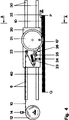
- a carriage 20 is movably arranged on guides 30. On the carriage 20 there are a position detection unit 24, a position drive 25, a cutting unit 26 and a liftable sealing roller 21 for gluing the strip 10 to the top strip strip 10 '.
- the mobility of the carriage 20 is such that the sealing roller 21 with its apex R a honeycomb collecting unit 60 arranged below it, in which the strip bands 10 'and the strip 10 are joined to form a stacking unit 40, at least over their entire width L u , ie at least to the endpoints P and Q.
- the sealing roller 21 can be raised vertically and is preferably heated. You can depending on the control while driving to the ends P and Q on the strip 10 and at least the top strip band 10 'with simultaneous heating, if necessary, exert the same pressure, the strip 10 being glued to the top strip band 10'. As previously mentioned, heating is necessary for adhesives which develop an adhesive effect after or at elevated temperature.
- a strip 10 is pulled off the strip roll 12 and the exact position of the adhesive strips 6 is recorded with the position detection unit 24.
- the adhesive strips 6 also serve as tax stamps for the offset positioning of the strip 10 relative to the top strip strip 10 'of the stacking unit 40.
- the position drive 25 now pushes the strip 10 so far under the clamping piece 32 that the adhesive strips 6 are offset by the exact dimension 2a the adhesive strips 6 of the underlying strip tape 10 'come to rest.
- the clamping piece 32 holds the strip 10 in this position. This position determines the position of the subsequent strip to be stacked.
- the carriage 20 moves in the direction of the end P until the apex R of the sealing roller 21 is above the end P, whereupon the sealing roller 21 lowers and onto the strip 10 or the stacking unit 40 may apply simultaneous heating of the same pressure.
- the carriage 20 moves in the direction of the other end Q until the apex R of the sealing roller 21 reaches the other end Q.
- the cutting unit 26 is used to cut the Strip 10 cut to the preselected length L u delimited by the ends P and Q, which depends on the desired width L of the honeycomb core 41 to be produced. By this pressing and heat transfer process, the strip 10 is glued to the top strip 10 '.
- the strip 10 is now part of the stacking unit 40 to the strip 10 '.
- the entire process is then repeated from the beginning, ie starting with the detection of the position of the adhesive strips 6 of the strip 10 on the strip roll 12 and feeding the same to the end P.
- the continuous repetition of these processes creates a continuously growing stacking unit 40 which becomes one exploded honeycomb core 41 of practically any length W and width L leads.
- FIG. 5 shows the section A-A of Figure 4 with further details.
- the honeycomb collection unit 60 and the sealing roller 21 are shown.
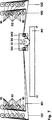
- the honeycomb collection unit 60 consists of a lowerable table 33 and clamping jaws 34.
- the sealing roller 21 presses with the help of the pressure cylinder 35 onto the stacking unit 40, which is supported on the lowerable table 33.
- the plane of the table 33 runs parallel to the direction of movement of the carriage 20 and is only necessary in the initial phase to carry out the method with the aid of the device.
- the pressure exerted by the pressure cylinders 35 is controlled and / or the stacking unit 40 is slightly lowered in a manner not shown by lowering when the clamping jaws 34 are released.
- the table 33 can also be used for lowering.
- the right-hand side r is used to feed the strip 10 *, which comes from the tape roll 12 *. Associated with this side r is the clamping piece 32 * at the end Q. If the carriage 20 moves in the manner described while exerting pressure and possibly at elevated temperature onto the stacking unit 40 or the deposited strip 10 from the end P to the end Q, the carriage takes the strip 10 * over the units arranged on the right-hand side r of the same and positions it at the end Q in a manner analogous to the previously positioned strip 10.
- the sealing roller 21 exerts such a high pressure on the stacking unit 40 or on the deposited strips 10 and, if appropriate, at the same time has a sufficiently high temperature that the strips 10 and the top strip strip 10 ' Stacking unit 40 are heated such that the strips 10 and the top strip strip 10 'of the stacking unit 40 are bonded together.
- an adjustment of the strips 10 to one another is necessary so that the adhesive strips 6 of the adjacent strips 10 are in a staggered arrangement.
- FIG. 7 Another arrangement, which is based on the principle of increasing the efficiency of the device, is shown in FIG. 7 in a highly simplified manner.
- a first number 101 of strips 10 with a staggered arrangement of the adhesive strips 6 are simultaneously guided, positioned and held in place by a position detection unit 241 during the movement of the slide 20 in the direction of the end P and back during the subsequent movement of the slide 20 in the direction of the other end Q, a second number 102 of strips 10 with a staggered arrangement of the adhesive strips 6 are simultaneously guided by a set of strip rolls 112 from a second position detection unit 242 to the end Q, positioned and held there.
- the sealing roller 21 With the exception of the short lifting of the sealing roller 21 for positioning and holding, the sealing roller 21 is constantly in the pressing position during the travel movement, so that both the number of 101 strips 10 and the number of 102 strips 10 with one another and with the uppermost strip band 10 ' Stacking unit 40 are glued. As can also be seen from FIG. 7, a further number 121, 122 strips 10 can be fed in an analog manner at each of the two ends P, Q.
- the sealing roll 21 must be designed accordingly so that it contains the number 101 and 121 or 102 and 122 strips 10 and at least that uppermost strip band 10 'of the stacking unit, if necessary, to heat it up sufficiently and additionally can apply the necessary pressure.
- FIG. 8 shows the use of the stacking unit 40 produced by the method according to the invention, preferably using the device according to the invention, for producing a composite panel 90 with an expanded honeycomb core 41 and cover layers 42.
- the meandering stacking unit 40 passes through an expansion device 48, which essentially consists of two there are rotatable rollers 50 arranged on both sides of the stacking unit 40, which are provided on the surface with brushes 49.
- the brushes act on the strip belts 10 'of the stacking unit 40 transversely to the stacking direction in that a drive, not shown, of the rollers 50 conveys the stacking unit 40 at a higher speed than it leaves the honeycomb collecting unit 60.
- the retaining unit 40 acts on a retaining force which brakes the tensile force exerted by the drive of the rollers 50.
- the retention force is brought about by a braking device 52 arranged on both sides of the stacking unit 40, in particular by brush strips arranged on both sides.
- the stacking unit 40 is pulled apart to form an expanded honeycomb core 41.
- This pulled-apart honeycomb core 41 is provided on both sides on the end edges 82 of the honeycomb cells 80 with adhesive, preferably in the form of foils 84, on which the cover layers 42 are placed.
- a continuous press 70 By coordinating the running speeds of the continuous press 70 and the drive of the rollers 50, continuous composite panel production is achieved.
- the pulling apart of the honeycomb core 41 can preferably be at least supported.
- the adhesive film 84 is placed on the pulled-apart honeycomb core 41 with a hot gaseous medium, especially hot air.
- the continuously produced composite panel 90 can be cut to the desired size in a manner known per se by a cutting device 72.
Landscapes
- Engineering & Computer Science (AREA)
- Mechanical Engineering (AREA)
- Physics & Mathematics (AREA)
- Fluid Mechanics (AREA)
- Laminated Bodies (AREA)
- Folding Of Thin Sheet-Like Materials, Special Discharging Devices, And Others (AREA)
- Micro-Organisms Or Cultivation Processes Thereof (AREA)
Applications Claiming Priority (2)
| Application Number | Priority Date | Filing Date | Title |
|---|---|---|---|
| CH2315/91A CH683829A5 (de) | 1991-08-05 | 1991-08-05 | Verfahren zum Herstellen eines Wabenkerns aus einer bandförmigen Folie, Vorrichtung zur Durchführung des Verfahrens und Verwendung des Wabenkerns für Verbundplatten. |
| CH2315/91 | 1991-08-05 |
Publications (3)
| Publication Number | Publication Date |
|---|---|
| EP0531251A2 true EP0531251A2 (fr) | 1993-03-10 |
| EP0531251A3 EP0531251A3 (en) | 1993-06-30 |
| EP0531251B1 EP0531251B1 (fr) | 1996-04-24 |
Family
ID=4230928
Family Applications (1)
| Application Number | Title | Priority Date | Filing Date |
|---|---|---|---|
| EP92810588A Expired - Lifetime EP0531251B1 (fr) | 1991-08-05 | 1992-08-03 | Procédé et dispositif pour la fabrication d'un âme en nid d'abeilles à partir de feuilles en bandes, et utilisation de ladite âme comme âme pour des panneaus fabriqués en continu |
Country Status (15)
| Country | Link |
|---|---|
| US (2) | US5277732A (fr) |
| EP (1) | EP0531251B1 (fr) |
| JP (1) | JP3197351B2 (fr) |
| AU (1) | AU646965B2 (fr) |
| CA (1) | CA2075142C (fr) |
| CH (1) | CH683829A5 (fr) |
| CZ (1) | CZ286345B6 (fr) |
| DE (1) | DE59206097D1 (fr) |
| FI (1) | FI105086B (fr) |
| HU (1) | HU213356B (fr) |
| IS (1) | IS3893A (fr) |
| NO (1) | NO179137C (fr) |
| SK (1) | SK278828B6 (fr) |
| TR (1) | TR26822A (fr) |
| ZA (1) | ZA925539B (fr) |
Cited By (9)
| Publication number | Priority date | Publication date | Assignee | Title |
|---|---|---|---|---|
| EP0574235A1 (fr) * | 1992-06-09 | 1993-12-15 | Oji Kenzai Kogyo Co., Ltd. | Procédé et dispositif pour la fabrication d'un stratifié pour une structure en nid d'abeilles |
| WO1994023948A1 (fr) * | 1993-04-09 | 1994-10-27 | Cedal Srl | Machine d'assemblage de piles de modules comprenant des strates de cuivre dans la production de stratifies en plastique a partir de bandes disposees en serpentin |
| EP0622174A1 (fr) * | 1993-04-29 | 1994-11-02 | Alois Dipl.-Ing. Öllinger | Procédé pour la production des âmes légères |
| CH688370A5 (de) * | 1995-01-30 | 1997-08-29 | Alusuisse Lonza Services Ag | Verfahren zur Herstellung einer zellenfoermigen Platte |
| DE19828265A1 (de) * | 1998-06-25 | 1999-12-30 | Nokia Deutschland Gmbh | Verfahren und Vorrichtung zur Herstellung von zusammenhängenden Zellen |
| WO2001051273A1 (fr) * | 2000-01-11 | 2001-07-19 | Versacore Industrial Corporation | Procede et dispositif permettant d'assembler des sections d'un materiau bande thermoplastique |
| DE19636259B4 (de) * | 1996-07-16 | 2006-06-01 | Teh Yor Co., Ltd. | Verfahren und Vorrichtung zur Herstellung von Schutz- bzw. Abdeckmaterial |
| CN101830081A (zh) * | 2010-05-31 | 2010-09-15 | 合肥得润电子器件有限公司 | 敞开式蜂窝纸板复合生产线 |
| CN110181844A (zh) * | 2019-05-10 | 2019-08-30 | 国家能源投资集团有限责任公司 | 热塑性复合芯材的生产方法和生产设备 |
Families Citing this family (15)
| Publication number | Priority date | Publication date | Assignee | Title |
|---|---|---|---|---|
| DE69109110T2 (de) * | 1991-02-06 | 1995-09-14 | Oji Kenzai Kogyo Kk | Verfahren zur herstellung eines mehrschichtigen gegenstandes für honigwabenstrukturen. |
| JP2547951B2 (ja) * | 1993-11-26 | 1996-10-30 | 静岡工機株式会社 | ハニカムボードの製造に使用するハニカムコアの展張機 |
| JPH08103978A (ja) * | 1994-10-04 | 1996-04-23 | Yokohama Rubber Co Ltd:The | ハニカムコアの製造方法及びその装置 |
| US5774859A (en) * | 1995-01-03 | 1998-06-30 | Scientific-Atlanta, Inc. | Information system having a speech interface |
| US5735986A (en) * | 1995-11-03 | 1998-04-07 | Fell; Barry Michael | Continuous process for the preparation of honeycomb structural material and apparatus suitable for use therein |
| US5937619A (en) * | 1996-12-04 | 1999-08-17 | Privatizer Systems Incorporated | Apparatus and method for sealing an envelope having a first lateral side and a second lateral side in a document security apparatus |
| US6823571B1 (en) * | 2000-01-24 | 2004-11-30 | Atd Corporation | Apparatus and method for manufacture of multilayer metal products |
| US6592963B1 (en) | 2000-06-16 | 2003-07-15 | E. I. Du Pont De Nemours And Company | Honeycomb structure |
| CA2584113C (fr) * | 2004-11-19 | 2013-02-12 | K.U.Leuven Research & Development | Structure alveolaire thermoplastique semi-fermee, son procede de fabrication et le materiel pour la produire |
| TWI277511B (en) * | 2005-08-17 | 2007-04-01 | Metal Ind Res & Dev Ct | Honeycomb insulating panel and method of making the same |
| CN102862325B (zh) * | 2012-09-28 | 2015-02-18 | 浙江美迅机械有限公司 | 一种单元蜂窝纸芯的连续生产方法 |
| US20240081567A1 (en) * | 2019-01-07 | 2024-03-14 | Destiny Padgett | Cooler With Handle Accommodating a Cylindrical Object |
| JP7561853B2 (ja) | 2019-12-23 | 2024-10-04 | スリーエム イノベイティブ プロパティズ カンパニー | マルチスリット張力作動式拡張シート |
| US12202226B2 (en) | 2019-12-23 | 2025-01-21 | 3M Innovative Properties Company | Tension-activated, expanding sheets |
| EP4124449B1 (fr) | 2021-07-28 | 2025-10-15 | S+P Samson GmbH | Étiquette, bande d'étiquettes et procédé de fabrication d'étiquettes |
Family Cites Families (13)
| Publication number | Priority date | Publication date | Assignee | Title |
|---|---|---|---|---|
| US2649131A (en) * | 1948-03-27 | 1953-08-18 | John D Lincoln | Machine and method for producing continuous honeycomb structures |
| GB717072A (en) * | 1952-05-28 | 1954-10-20 | California Reinforced Plastics | Improvements in or relating to method of and apparatus for making honeycomb materialfrom flexible sheet material |
| CH359533A (fr) * | 1958-08-28 | 1962-01-15 | Dufaylite Dev Ltd | Procédé de fabrication d'un matériau de structure cellulaire et appareil pour sa mise en oeuvre |
| US3637448A (en) * | 1968-02-12 | 1972-01-25 | Orbitex Inc | Laminating method for honeycomb |
| US3655475A (en) * | 1969-05-26 | 1972-04-11 | Orbitex Inc | Method of and apparatus for making honeycomb core |
| US4025681A (en) * | 1975-03-24 | 1977-05-24 | The Boeing Company | Environmentally durable metal honeycomb structure |
| US4229243A (en) * | 1979-03-15 | 1980-10-21 | Ellinor Daniel H | Resiliently stabilized web movement for honeycomb machine |
| US4500380A (en) * | 1983-12-19 | 1985-02-19 | Bova Joseph D | Method and apparatus for continuous production of expandable honeycomb |
| FR2617468B1 (fr) * | 1987-06-30 | 1989-12-15 | Coopelin | Procede et machine de formation d'un empilage a plat de feuilles de format predetermine |
| DE3810811A1 (de) * | 1988-03-30 | 1989-10-12 | Continental Ag | Einrichtung zum herstellen von mehrlagigen materialbahnen |
| US5015317A (en) * | 1988-12-22 | 1991-05-14 | Comfortex Corporation | Method and apparatus for making a multi-cellular collapsible shade |
| JPH0829571B2 (ja) * | 1989-08-07 | 1996-03-27 | 王子建材工業株式会社 | ハニカム構造体用積層体の製造法 |
| EP0507733A1 (fr) * | 1991-04-03 | 1992-10-07 | Ciba-Geigy Ag | Dispositif pour couper et empiler des feuilles |
-
1991
- 1991-08-05 CH CH2315/91A patent/CH683829A5/de not_active IP Right Cessation
-
1992
- 1992-07-22 AU AU20466/92A patent/AU646965B2/en not_active Ceased
- 1992-07-23 ZA ZA925539A patent/ZA925539B/xx unknown
- 1992-07-27 US US07/919,950 patent/US5277732A/en not_active Expired - Lifetime
- 1992-07-30 SK SK2383-92A patent/SK278828B6/sk not_active IP Right Cessation
- 1992-07-30 CZ CS19922383A patent/CZ286345B6/cs not_active IP Right Cessation
- 1992-07-31 CA CA002075142A patent/CA2075142C/fr not_active Expired - Lifetime
- 1992-07-31 IS IS3893A patent/IS3893A/is unknown
- 1992-08-03 DE DE59206097T patent/DE59206097D1/de not_active Expired - Lifetime
- 1992-08-03 EP EP92810588A patent/EP0531251B1/fr not_active Expired - Lifetime
- 1992-08-03 NO NO923050A patent/NO179137C/no not_active IP Right Cessation
- 1992-08-04 FI FI923513A patent/FI105086B/fi not_active IP Right Cessation
- 1992-08-04 HU HU9202529A patent/HU213356B/hu not_active IP Right Cessation
- 1992-08-04 TR TR00805/92A patent/TR26822A/xx unknown
- 1992-08-05 JP JP20903292A patent/JP3197351B2/ja not_active Expired - Fee Related
-
1993
- 1993-08-02 US US08/100,377 patent/US5334276A/en not_active Expired - Lifetime
Cited By (15)
| Publication number | Priority date | Publication date | Assignee | Title |
|---|---|---|---|---|
| US5395465A (en) * | 1992-06-09 | 1995-03-07 | Oji Kenzai Kogyo Co., Ltd. | Method for manufacturing laminate for honeycomb structure |
| US5545284A (en) * | 1992-06-09 | 1996-08-13 | Oji Kenzai Kogyo Co., Ltd. | Apparatus for manufacturing laminate for honeycomb structure |
| EP0574235A1 (fr) * | 1992-06-09 | 1993-12-15 | Oji Kenzai Kogyo Co., Ltd. | Procédé et dispositif pour la fabrication d'un stratifié pour une structure en nid d'abeilles |
| WO1994023948A1 (fr) * | 1993-04-09 | 1994-10-27 | Cedal Srl | Machine d'assemblage de piles de modules comprenant des strates de cuivre dans la production de stratifies en plastique a partir de bandes disposees en serpentin |
| CN1056559C (zh) * | 1993-04-09 | 2000-09-20 | 塞达尔公司 | 组合有金属薄层的塑性层叠片合板堆的自动机器和方法 |
| EP0622174A1 (fr) * | 1993-04-29 | 1994-11-02 | Alois Dipl.-Ing. Öllinger | Procédé pour la production des âmes légères |
| CH688370A5 (de) * | 1995-01-30 | 1997-08-29 | Alusuisse Lonza Services Ag | Verfahren zur Herstellung einer zellenfoermigen Platte |
| DE19636259B4 (de) * | 1996-07-16 | 2006-06-01 | Teh Yor Co., Ltd. | Verfahren und Vorrichtung zur Herstellung von Schutz- bzw. Abdeckmaterial |
| DE19828265A1 (de) * | 1998-06-25 | 1999-12-30 | Nokia Deutschland Gmbh | Verfahren und Vorrichtung zur Herstellung von zusammenhängenden Zellen |
| US6837962B2 (en) | 2000-01-11 | 2005-01-04 | Versacore Industrial Corp. | Methods and apparatus for joining pieces of thermoplastic material to form cellular blocks |
| US6907912B2 (en) | 2000-01-11 | 2005-06-21 | Versacure Industrial Corp. | Method and device for joining sections of thermoplastic continuous web material |
| WO2001051273A1 (fr) * | 2000-01-11 | 2001-07-19 | Versacore Industrial Corporation | Procede et dispositif permettant d'assembler des sections d'un materiau bande thermoplastique |
| US8075727B2 (en) | 2000-01-11 | 2011-12-13 | 3M Innovative Properties Company | Method for joining sections of thermoplastic continuous web material |
| CN101830081A (zh) * | 2010-05-31 | 2010-09-15 | 合肥得润电子器件有限公司 | 敞开式蜂窝纸板复合生产线 |
| CN110181844A (zh) * | 2019-05-10 | 2019-08-30 | 国家能源投资集团有限责任公司 | 热塑性复合芯材的生产方法和生产设备 |
Also Published As
| Publication number | Publication date |
|---|---|
| CZ238392A3 (en) | 1993-02-17 |
| NO923050D0 (no) | 1992-08-03 |
| HUT63985A (en) | 1993-11-29 |
| CA2075142A1 (fr) | 1993-02-06 |
| EP0531251A3 (en) | 1993-06-30 |
| NO179137C (no) | 1996-08-14 |
| NO179137B (no) | 1996-05-06 |
| SK278828B6 (sk) | 1998-03-04 |
| US5277732A (en) | 1994-01-11 |
| AU646965B2 (en) | 1994-03-10 |
| CA2075142C (fr) | 2004-09-28 |
| JPH05193029A (ja) | 1993-08-03 |
| ZA925539B (en) | 1993-03-19 |
| FI923513A0 (fi) | 1992-08-04 |
| CZ286345B6 (cs) | 2000-03-15 |
| JP3197351B2 (ja) | 2001-08-13 |
| FI105086B (fi) | 2000-06-15 |
| AU2046692A (en) | 1993-03-11 |
| HU213356B (en) | 1997-05-28 |
| US5334276A (en) | 1994-08-02 |
| FI923513A7 (fi) | 1993-02-06 |
| TR26822A (tr) | 1994-08-10 |
| EP0531251B1 (fr) | 1996-04-24 |
| NO923050L (no) | 1993-02-08 |
| SK238392A3 (en) | 1993-11-10 |
| IS3893A (is) | 1993-02-06 |
| CH683829A5 (de) | 1994-05-31 |
| DE59206097D1 (de) | 1996-05-30 |
Similar Documents
| Publication | Publication Date | Title |
|---|---|---|
| EP0531251B1 (fr) | Procédé et dispositif pour la fabrication d'un âme en nid d'abeilles à partir de feuilles en bandes, et utilisation de ladite âme comme âme pour des panneaus fabriqués en continu | |
| DE69101142T2 (de) | Verfahren und apparat für die herstellung von wabenmaterial. | |
| CH651505A5 (de) | Verfahren zum herstellen eines einbandes fuer ein buch, ein heft oder eine broschuere und vorrichtung zur durchfuehrung des verfahrens. | |
| EP0295383B1 (fr) | Procédé et dispositif pour réaliser une couverture ou analogue | |
| DE2746428B2 (de) | Verfahren und Vorrichtung zum spiralförmigen Aufwickeln der Elektrodenplatten und Separatoren für eine elektrochemische Zelle | |
| DE2256259B2 (de) | Vorrichtung zum Klebebinden von Blattstapeln | |
| DE3610551A1 (de) | Einrichtung zum herstellen von aus kunststoffolienbahnen gebildeten nutzen | |
| DE4141767A1 (de) | Verfahren und anordnung zum herstellen von buechern und broschueren | |
| EP3968427A2 (fr) | Procédé et dispositif de fabrication d'un empilement de cellules pour batterie | |
| EP3968425A2 (fr) | Procédé et dispositif de fabrication d'un empilement de cellules pour batterie | |
| EP0347729B1 (fr) | Procédé et dispositif pour fabriquer un ruban à alvéoles sans fin | |
| DE3334009A1 (de) | Vorrichtung zum auflaminieren eines folienstueckes auf einen plattenfoermigen gegenstand | |
| DE69405445T2 (de) | Verfahren und Vorrichtung zum Verkleben eines Kantenschutzklebebandes auf dem Rand einer mehrschichtigen Verbundplatte, wie eine Wärmeschutzplatte eines Raumfahrzeuges | |
| DE3707675C2 (fr) | ||
| EP3968426A2 (fr) | Procédé et dispositif de fabrication d'un empilement de cellules pour batterie | |
| DE3320078A1 (de) | Anordnung und verfahren zur herstellung von geschichteten einheiten | |
| EP0376007A1 (fr) | Machine de fabrication de sacs à porter à poignées incorporées et pièces de renforcements en matière thermoplastique soudés autour de celles-ci | |
| DE69227255T2 (de) | Vorrichtung und verfahren zur herstellung eines hexagonalzelligen wabenförmigen kerns, und der so hergestellte kern | |
| DE3503715C2 (fr) | ||
| DE69831280T2 (de) | Verfahren und Vorrichtung zum Anbringen einer Materialschicht auf eine zu beschichtende Platte, vorzugsweise auf eine Glasscheibe | |
| DE2940796A1 (de) | Maschine zum ueberziehen von schachteln mit einem karton- oder folienzuschnitt | |
| DE10153157C1 (de) | Verfahren zum Herstellen von Multilayern-Presspaketen | |
| DE2440963C3 (fr) | ||
| DE19535602A1 (de) | Verfahren und Vorrichtung zur Herstellung von Wabenmaterial | |
| DE3325237C2 (fr) |
Legal Events
| Date | Code | Title | Description |
|---|---|---|---|
| PUAI | Public reference made under article 153(3) epc to a published international application that has entered the european phase |
Free format text: ORIGINAL CODE: 0009012 |
|
| AK | Designated contracting states |
Kind code of ref document: A2 Designated state(s): AT BE CH DE DK ES FR GB GR IE IT LI LU MC NL PT SE |
|
| PUAL | Search report despatched |
Free format text: ORIGINAL CODE: 0009013 |
|
| AK | Designated contracting states |
Kind code of ref document: A3 Designated state(s): AT BE CH DE DK ES FR GB GR IE IT LI LU MC NL PT SE |
|
| 17P | Request for examination filed |
Effective date: 19931104 |
|
| 17Q | First examination report despatched |
Effective date: 19950308 |
|
| GRAH | Despatch of communication of intention to grant a patent |
Free format text: ORIGINAL CODE: EPIDOS IGRA |
|
| RBV | Designated contracting states (corrected) |
Designated state(s): BE CH DE FR GB IT LI LU |
|
| GRAA | (expected) grant |
Free format text: ORIGINAL CODE: 0009210 |
|
| ITF | It: translation for a ep patent filed | ||
| AK | Designated contracting states |
Kind code of ref document: B1 Designated state(s): BE CH DE FR GB IT LI LU |
|
| GBT | Gb: translation of ep patent filed (gb section 77(6)(a)/1977) |
Effective date: 19960429 |
|
| REF | Corresponds to: |
Ref document number: 59206097 Country of ref document: DE Date of ref document: 19960530 |
|
| ET | Fr: translation filed | ||
| PLBE | No opposition filed within time limit |
Free format text: ORIGINAL CODE: 0009261 |
|
| 26N | No opposition filed | ||
| REG | Reference to a national code |
Ref country code: GB Ref legal event code: IF02 |
|
| BECN | Be: change of holder's name |
Owner name: 3A TECHNOMOGY & MANAGEMENT LTD. Effective date: 20100602 |
|
| REG | Reference to a national code |
Ref country code: FR Ref legal event code: CD |
|
| PGFP | Annual fee paid to national office [announced via postgrant information from national office to epo] |
Ref country code: CH Payment date: 20100825 Year of fee payment: 19 |
|
| PGFP | Annual fee paid to national office [announced via postgrant information from national office to epo] |
Ref country code: LU Payment date: 20100831 Year of fee payment: 19 Ref country code: IT Payment date: 20100826 Year of fee payment: 19 Ref country code: FR Payment date: 20100831 Year of fee payment: 19 Ref country code: DE Payment date: 20100827 Year of fee payment: 19 |
|
| PGFP | Annual fee paid to national office [announced via postgrant information from national office to epo] |
Ref country code: GB Payment date: 20100825 Year of fee payment: 19 |
|
| PGFP | Annual fee paid to national office [announced via postgrant information from national office to epo] |
Ref country code: BE Payment date: 20100825 Year of fee payment: 19 |
|
| BERE | Be: lapsed |
Owner name: 3A TECHNOMOGY & MANAGEMENT LTD. Effective date: 20110831 |
|
| REG | Reference to a national code |
Ref country code: CH Ref legal event code: PL |
|
| GBPC | Gb: european patent ceased through non-payment of renewal fee |
Effective date: 20110803 |
|
| PG25 | Lapsed in a contracting state [announced via postgrant information from national office to epo] |
Ref country code: CH Free format text: LAPSE BECAUSE OF NON-PAYMENT OF DUE FEES Effective date: 20110831 Ref country code: LI Free format text: LAPSE BECAUSE OF NON-PAYMENT OF DUE FEES Effective date: 20110831 |
|
| REG | Reference to a national code |
Ref country code: FR Ref legal event code: ST Effective date: 20120430 |
|
| PG25 | Lapsed in a contracting state [announced via postgrant information from national office to epo] |
Ref country code: IT Free format text: LAPSE BECAUSE OF NON-PAYMENT OF DUE FEES Effective date: 20110803 Ref country code: BE Free format text: LAPSE BECAUSE OF NON-PAYMENT OF DUE FEES Effective date: 20110831 |
|
| REG | Reference to a national code |
Ref country code: DE Ref legal event code: R119 Ref document number: 59206097 Country of ref document: DE Effective date: 20120301 |
|
| PG25 | Lapsed in a contracting state [announced via postgrant information from national office to epo] |
Ref country code: FR Free format text: LAPSE BECAUSE OF NON-PAYMENT OF DUE FEES Effective date: 20110831 Ref country code: GB Free format text: LAPSE BECAUSE OF NON-PAYMENT OF DUE FEES Effective date: 20110803 |
|
| PG25 | Lapsed in a contracting state [announced via postgrant information from national office to epo] |
Ref country code: LU Free format text: LAPSE BECAUSE OF NON-PAYMENT OF DUE FEES Effective date: 20110803 |
|
| PG25 | Lapsed in a contracting state [announced via postgrant information from national office to epo] |
Ref country code: DE Free format text: LAPSE BECAUSE OF NON-PAYMENT OF DUE FEES Effective date: 20120301 |