EP0531258B1 - Matériau photographique contenant un absorbant UV - Google Patents
Matériau photographique contenant un absorbant UV Download PDFInfo
- Publication number
- EP0531258B1 EP0531258B1 EP92810658A EP92810658A EP0531258B1 EP 0531258 B1 EP0531258 B1 EP 0531258B1 EP 92810658 A EP92810658 A EP 92810658A EP 92810658 A EP92810658 A EP 92810658A EP 0531258 B1 EP0531258 B1 EP 0531258B1
- Authority
- EP
- European Patent Office
- Prior art keywords
- alkyl
- formula
- phenyl
- group
- independently
- Prior art date
- Legal status (The legal status is an assumption and is not a legal conclusion. Google has not performed a legal analysis and makes no representation as to the accuracy of the status listed.)
- Expired - Lifetime
Links
- 0 CCC*C1C2C1C*C(C)C2 Chemical compound CCC*C1C2C1C*C(C)C2 0.000 description 16
- RUADGOLRFXTMCY-UHFFFAOYSA-N CC(CCC1C)CC1O Chemical compound CC(CCC1C)CC1O RUADGOLRFXTMCY-UHFFFAOYSA-N 0.000 description 1
Classifications
-
- G—PHYSICS
- G03—PHOTOGRAPHY; CINEMATOGRAPHY; ANALOGOUS TECHNIQUES USING WAVES OTHER THAN OPTICAL WAVES; ELECTROGRAPHY; HOLOGRAPHY
- G03C—PHOTOSENSITIVE MATERIALS FOR PHOTOGRAPHIC PURPOSES; PHOTOGRAPHIC PROCESSES, e.g. CINE, X-RAY, COLOUR, STEREO-PHOTOGRAPHIC PROCESSES; AUXILIARY PROCESSES IN PHOTOGRAPHY
- G03C1/00—Photosensitive materials
- G03C1/76—Photosensitive materials characterised by the base or auxiliary layers
- G03C1/815—Photosensitive materials characterised by the base or auxiliary layers characterised by means for filtering or absorbing ultraviolet light, e.g. optical bleaching
- G03C1/8155—Organic compounds therefor
-
- C—CHEMISTRY; METALLURGY
- C07—ORGANIC CHEMISTRY
- C07F—ACYCLIC, CARBOCYCLIC OR HETEROCYCLIC COMPOUNDS CONTAINING ELEMENTS OTHER THAN CARBON, HYDROGEN, HALOGEN, OXYGEN, NITROGEN, SULFUR, SELENIUM OR TELLURIUM
- C07F7/00—Compounds containing elements of Groups 4 or 14 of the Periodic Table
- C07F7/02—Silicon compounds
- C07F7/08—Compounds having one or more C—Si linkages
- C07F7/0803—Compounds with Si-C or Si-Si linkages
- C07F7/081—Compounds with Si-C or Si-Si linkages comprising at least one atom selected from the elements N, O, halogen, S, Se or Te
- C07F7/0812—Compounds with Si-C or Si-Si linkages comprising at least one atom selected from the elements N, O, halogen, S, Se or Te comprising a heterocyclic ring
-
- C—CHEMISTRY; METALLURGY
- C07—ORGANIC CHEMISTRY
- C07F—ACYCLIC, CARBOCYCLIC OR HETEROCYCLIC COMPOUNDS CONTAINING ELEMENTS OTHER THAN CARBON, HYDROGEN, HALOGEN, OXYGEN, NITROGEN, SULFUR, SELENIUM OR TELLURIUM
- C07F7/00—Compounds containing elements of Groups 4 or 14 of the Periodic Table
- C07F7/02—Silicon compounds
- C07F7/08—Compounds having one or more C—Si linkages
- C07F7/18—Compounds having one or more C—Si linkages as well as one or more C—O—Si linkages
- C07F7/1804—Compounds having Si-O-C linkages
-
- Y—GENERAL TAGGING OF NEW TECHNOLOGICAL DEVELOPMENTS; GENERAL TAGGING OF CROSS-SECTIONAL TECHNOLOGIES SPANNING OVER SEVERAL SECTIONS OF THE IPC; TECHNICAL SUBJECTS COVERED BY FORMER USPC CROSS-REFERENCE ART COLLECTIONS [XRACs] AND DIGESTS
- Y10—TECHNICAL SUBJECTS COVERED BY FORMER USPC
- Y10S—TECHNICAL SUBJECTS COVERED BY FORMER USPC CROSS-REFERENCE ART COLLECTIONS [XRACs] AND DIGESTS
- Y10S430/00—Radiation imagery chemistry: process, composition, or product thereof
- Y10S430/132—Anti-ultraviolet fading
Definitions
- the present invention relates to new photographic material which contains UV absorbers, in particular of the tris-2-hydroxyphenyltriazinyl type.
- 2-hydroxyphenyl-1,3,5-triazines as a stabilizing agent against ultraviolet radiation in photographic materials is known, e.g. B. from DE-A-2 113 833.
- a group of triazine UV absorbers has now been found which, surprisingly, has proven to be largely free from such disadvantages. They show improved stability to natural light and have the property of better protecting image dyes and color couplers against exposure to light than was possible with the hydroxyphenylbenztriazoles and triazines conventionally used in photographic materials.
- This group of triazines is particularly suitable for increasing the stability of the magenta and cyan layers of photographic materials, for example by incorporating them in layers which are applied over the magenta or cyan layer or directly in the cyan layer.
- these triazines can advantageously be combined with UV absorbers of the hydroxyphenylbenztriazole type, in particular representatives thereof which are liquid at room temperature (cf. for example US Pat. Nos.
- Combinations of the triazines with other types of UV absorbers such as benzophenones, oxanilides, cyanoacrylates, salicylic acid esters, acrylonitriles or thiazolines are also suitable for use in photographic materials.
- substituents in the compounds of the formula (1) are alkyl having 1 to 18 carbon atoms, radicals such as methyl, ethyl, propyl, butyl, pentyl, hexyl, heptyl, octyl, nonyl, decyl, undecyl, dodecyl, tehadecyl, hexadecyl and Octadecyl and corresponding branched isomers in question.
- Examples are alkyl radicals with 3 to 50 carbon atoms which are interrupted by oxygen, sulfur or nitrogen and Alkenyl radicals with 2 to 18 carbon atoms can be one or, from 4 carbon atoms, polyunsaturated.
- Dialkylaminoalkyl radicals with a total of 4 to 16 carbon atoms can be represented, for example, by the formula are reproduced, the sum of n 1 , n 2 and n 3 giving 4 to 16.
- Alkylene residues with 2 to 10 carbon atoms can be derived from corresponding alkyl residues.
- Alkylene radicals with 4 to 50 carbon atoms interrupted by oxygen can, for example, of the formula correspond.
- the material according to the invention preferably contains between the silver halide emulsion layers Intermediate layers of gelatin.
- the material according to the invention contains a further layer with a UV absorber of the formula (1), which is arranged between the green and red-sensitive silver halide emulsion layer.
- UV absorber of the formula (1) is additionally contained in the red-sensitive silver halide emulsion layer.
- benzotriazole compounds can advantageously be used instead of the UV absorbers of the formula (1).
- benzotriazole compounds preferably correspond to the formula wherein T 1 , T 2 and T 3 are independently hydrogen, halogen, alkyl, alkyl substituted with a carboxylic acid ester group, alkoxy, aryloxy, hydroxyl or acyloxy, and T 4 is hydrogen, alkoxy, aryloxy or acyloxy.
- the present invention also relates to photographic material containing, on a support, a blue-sensitive, a green-sensitive and / or a red-sensitive silver halide emulsion layer and a protection layer, a layer with a UV absorber being arranged between the uppermost silver halide emulsion layer and the protection layer that (a) the UV absorber of the formula where T 1 , T 2 and T 3 are independently hydrogen, halogen, alkyl, alkyl substituted with a carboxylic acid ester group, alkoxy, aryloxy, hydroxyl or acyloxy and T 4 is hydrogen, alkoxy, aryloxy or acyloxy, and (b) that Material has at least one further layer which contains a UV absorber of the formula (1).
- the further layer is preferably arranged between the green and red-sensitive silver halide emulsion layer.
- the photographic material additionally contains a UV absorber of the formula (1) in the red-sensitive layer. It can also be advantageous if the UV absorber of the formula (1) is replaced by one of the formula (2) in the further layer or in the red-sensitive layer; but at least one layer should contain a UV absorber of the formula (1).
- Preferred photographic materials contain intermediate gelatin layers between the silver halide emulsion layers.
- the photographic material on a support contains at least 2 silver halide emulsion layers with a layer between these layers with a UV absorber, characterized in that the UV absorber corresponds to the formula (1).
- the two silver halide emulsion layers are preferably a green-sensitive and a red-sensitive silver halide emulsion layer.
- a corresponding material is preferred, in which the red-sensitive silver halide emulsion layer additionally contains a UV absorber of the formula (1) or (2).
- Another embodiment of the present invention relates to photographic material having a red sensitive silver halide emulsion layer on a support and optionally also contains a blue-sensitive and / or green-sensitive silver halide emulsion layer, characterized in that the red-sensitive silver halide emulsion layer contains a UV absorber of the formula (1). It preferably contains a layer with a UV absorber of the formula (2) between the red-sensitive silver halide emulsion layer and the support.
- the photographic materials according to the invention offer the advantage over materials with benzotriazole UV absorbers in that the UV absorbers of the formula (1) are required in a comparatively small amount in order to ensure adequate protection against UV radiation.
- the use of a comparable amount of UV absorber will result in even better protection.
- Yellow couplers which can be used in the material according to the invention are preferably compounds of the formula A. wherein R 1 is alkyl or aryl, R 2 is aryl and Q is hydrogen or a group that can be cleaved by reaction with the oxidized developer.
- a group of yellow couplers are those compounds of the formula A in which R 1 is t-butyl and R 2 is a group of the formula is where R 3 is hydrogen, halogen, alkyl or alkoxy and R 4 , R 5 and R 6 are hydrogen, halogen, alkyl, alkenyl, alkoxy, aryl, carboxy, alkoxycarbonyl, a carbamoyl group, a sulfone or sulfamoyl group, an alkylsulfonamino group, Acylamino group, ureido group or amino group.
- R 3 is preferably chlorine, R 4 and R 5 are hydrogen and R 6 is an acylamino group. This also includes the compounds of the formula where x is O-4, R 7 is hydrogen or alkyl and R 8 and R 9 are alkyl.
- R 10 is hydrogen, halogen or alkoxy
- R 11 , R 12 and R 13 are hydrogen, halogen, alkyl, alkenyl, alkoxy, aryl, carboxyl, alkoxycarbonyl, a carbamoyl group, a sulfone group, sulfamoyl group, sulfonamido group, acylamino group, ureido group or amino group and R 1 and Q have the meaning given above .
- R 1 is t-butyl
- R 10 is chlorine
- R 11 and R 13 are hydrogen
- R 12 is alkoxycarbonyl
- the leaving group Q can be hydrogen or it is a heterocyclic group wherein R 14 is an organic divalent group that complements the ring to a 4-7 membered ring, or Q is a group -OR 15 , wherein R 15 is alkyl, aryl, acyl or a heterocyclic radical.
- Typical examples of common yellow couplers are the compounds of the following formulas:
- the yellow couplers are usually used in an amount of 0.05-2 mol and preferably 0.1-1 mol per mol of silver halide.
- Typical and preferred yellow couplers correspond to the formulas:
- Magenta couplers can e.g. simple 1-aryl-5-pyrazolones or pyrazole derivatives condensed with 5-membered hetero rings, e.g. Imidazopyrazole, pyrazolopyrazole, pyrazolotriazole or pyrazolotetrazole.
- a group of magenta couplers are 5-pyrazolones of the formula C, as described in British Patent 2,003,473.
- R 16 is hydrogen, alkyl, aryl, alkenyl or a heterocyclic group.
- R 17 is hydrogen, alkyl aryl, a heterocyclic group, an ester group, alkoxy group, alkylthio group, carboxyl group, arylamino group, acylamino group, (thio) urea group, (thio) carbamoyl group, guanidino group or sulfonamido group.
- R 17 is preferably a group wherein R 18 is imino, acylamino or ureido, R 19 is hydrogen, halogen, alkyl or alkoxy, R 20 is hydrogen, alkyl, acylamino, carbamoyl, sulfamoyl, sulfonamido, alkoxycarbonyl, acyloxy or a urethane group.
- magenta coupler is tetra-equivalent to that Silver halide.
- Typical examples of this type of magenta coupler are compounds of the formula wherein R 20 has the meanings given above, and Q ', as described above, is a leaving group. These compounds are preferably present in the material according to the invention.
- Q 'in formula C is not hydrogen but a group that is eliminated in the reaction with the oxidized developer, then it is a equivalent magenta coupler.
- Q can e.g. Halogen or a group bonded to the pyrazole ring via O, S or N.
- Such equivalent couplers result in a higher color density and are more reactive towards the oxidized developer than the corresponding tetra-equivalent magenta couplers.
- Typical and preferred magenta couplers correspond to the formulas
- Two pyrazolone rings can be linked via a divalent Q 'and so-called bis couplers are then obtained.
- Such are e.g. described in US-A-2,632,702, US-A-2,618,864, GB-A-968,461, GB-A-786,859, JP-A-76/37646, 59/4086, 69/16110, 69/26589, 74/37854 and 74/29638.
- Y is preferably an O-alkoxyarylthio group.
- pyrazoles - so-called pyrazoloazoles - condensed with 5-membered heterocycles can also be used as magenta couplers.
- Their advantages over simple pyrazoles is that they have colors with greater formalin resistance and purer absorption spectra.
- Pyrazoloazole type magenta couplers which are also preferred, can be represented by the formulas in which R 1 is hydrogen or a substituent, Z represents the non-metallic atoms necessary to complete a 5-membered ring with 2 or 3 nitrogen atoms, which ring may be substituted, and Q is hydrogen or a leaving group.
- magenta couplers of the formulas are preferred.
- R 11 , R 12 and R 13 independently of one another are, for example, hydrogen, halogen, a group of the formula —CR 3 , in which the radicals R are independently of one another hydrogen or alkyl, aryl, heterocyclyl, cyano, hydroxy, nitro, carboxyl, amino, alkoxy , Aryloxy, acylamino, alkylamino, anilino, ureido, sulfamoylamino, alkylthio, arylthio, alkoxycarbonylamino, sulfonamido, carbamoyl, sulfamoyl, sulfonyl, alkoxycarbonyl, heterocyclyloxy, azo, acyloxy, carbamoyloxy, silylamino, imylyloxy, aryloxy, aryloxy, aryloxy, aryloxy, aryloxy, aryloxy, aryloxy, aryloxy,
- radicals R are independently hydrogen or alkyl, aralkyl, alkenyl, alkynyl, cycloalkyl or cycloalkenyl and particularly preferably methyl, ethyl, propyl, isopropyl, t-butyl , Tridecyl, 2-methanesulfonylethyl, 3- (3-pentadecylphenoxy) propyl, 3- (4- (2- (4- (4-hydroxyphenylsulfonyl) phenoxy) dodecanamido) phenyl) propyl, 2-ethoxytridecyl, trifluoromethyl, cyclopentyl, 3- (2,4-di-t-amylphenoxy) propyl); Aryl (e.g.
- phenyl 4-t-butylphenyl, 2,4-di-t-amylphenyl, 4-tetradecaneamidophenyl); Heterocyclyl (e.g. 2-furyl, 2-thienyl, 2-pyrimidinyl, 2-benzothiazolyl); Cyano; Hydroxy, nitro; Carboxy; Amino; Alkoxy (e.g. methoxy, ethoxy, 2-methoxyethoxy; 2-dodecylethoxy, 2-methanesulfonylethoxy); Aryloxy (e.g.
- phenoxy 2-methylphenoxy, 4-t-butylphenoxy, 3-nitrophenoxy, 3-t-butyloxycarbamoylphenoxy, 3-methoxycarbamoyl); Acylamino (e.g. acetoamido, benzamido, tetradecanamido, 2- (2,4-di-t-amylphenoxy) butanamido, 4- (3-t-butyl-4-hydroxyphenoxy) butanamido, 2- (4- (4-hydroxyphenylsulfonyl) phenoxy) decanamido); Methylbutylamino); Anilino (e.g.
- phenylamino 2-chloroanilino, 2-chloro-5-tetradecanaminoanilino, 2-chloro-5-dodecyloxycarbonylanilino, N-acetylanilino, 2-chloro-5- (alpha- (3-t-butyl-4-hydroxyphenoxy) dodecanamidoanilino ); Ureido (e.g. phenylureido, methylureido, N, N-dibutylureido); sulfamoylamino (e.g.
- phenylthio 2-butoxy-5-t-octylphenylthio, 3-pentadecylphenylthio, 2-carboxyphenylthio, 4-tetradecanamidophenylthio); Alkoxycarbonylamino (e.g. methoxycarbonylamino, tetradecyloxycarbonylamino); Sulfonamido (e.g.
- N-ethylsulfamoyl N, N-dipropylsulfamoyl, N-2 (-dodecyloxyethyl) sulfamoyl, N-ethyl-N-dodecylsulfamoyl, N, N-diethylsulfamoyl); Sulfonyl (e.g. methanesulfonyl, octanesulfonyl, benzenesulfonyl, toluenesulfonyl); Alkoxycarbonyl (e.g.
- Aryloxycarbonylamino e.g. phenoxycarbonylamino
- Imido e.g. N-succinimido, N-phthalimido, 3-octadecenylsuccinimido
- heterocyclic ring thio e.g. 2-benzothiazolylthio, 2,4-diphenyloxy-1,3,5-triazol-6-thio, 2-pyridylthio
- Sulfinyl e.g.
- Phosphonyl e.g. phenoxyphosphonyl, octyloxyphosphonyl, phenylphosphonyl
- Aryloxycarbonyl e.g. phenoxycarbonyl
- Acyl e.g. acetyl, 3-phenylpropan
- substituents are optionally further substituted, for example by halogen or by an organic radical bonded via a C, O, N or S atom.
- the preferred groups R 11 are alkyl, aryl, alkoxy, aryloxy, alkylthio, ureido, urethane and acylamino groups.
- R 12 can have the meaning of R 11 and is preferably hydrogen, alkyl, aryl, a heterocyclic ring, alkoxycarbonyl, carbamoyl, sulfamoyl, sulfinyl, acyl or cyano.
- R 13 can have the meaning of R 11 and is preferably hydrogen, alkyl, aryl, heterocyclic, alkoxy, aryloxy, alkylthio, arylthio, alkoxycarbonyl, carbamoyl or acyl, preferably alkyl, aryl, heterocyclic, alkylthio or arylthio.
- Q is hydrogen or a leaving group such as halogen, alkoxy, aryloxy, acyloxy, Alkyl- or arylsulfonyloxy, acylamino, alkyl- or aryl-sulfonamido, alkoxycarbonyloxy, aryloxycarbonyloxy, alkyl-, aryl- or heterocyclyl-S-carbamoylamino, a 5- or 6-membered nitrogen-containing heterocyclic radical, imido and arylazo. These groups are optionally further substituted as shown for R 11 .
- Q is halogen (e.g. fluorine, chlorine, bromine); Alkoxy (e.g. ethoxy, dodecyloxy, methoxyethylcarbamoylmethoxy, carboxypropyloxy, methylsulfonylethoxy, ethoxycarbonylmethoxy); Aryloxy (e.g. 4-methylphenoxy, 4-chlorophenoxy, 4-methoxyphenoxy, 4-carboxyphenoxy, 3-ethoxycarboxyphenoxy, 3-acetylaminophenoxy, 2-carboxyphenoxy); Acyloxy (e.g.
- acetoxy, tetradecanoyloxy, benzoyloxy Alkyl or aryl sulfonyloxy (e.g. methanesulfonyloxy, toluenesulfonyloxy); Acylamino (e.g. dichloroacetylamino, heptafluorobutyrylamino); Alkyl or arylsulfonamido (e.g. methanesulfonamido, trifluoromethanesulfonamido, p-toluenesulfonylamido); Alkoxycarbonyloxy (e.g.
- ethoxycarbonyloxy, benzyloxycarbonyloxy ethoxycarbonyloxy, benzyloxycarbonyloxy
- Aryloxycarbonyloxy e.g. phenoxycarbonyloxy
- Alkyl, aryl or heterocyclyl-S- e.g. dodecylthio, 1-carboxydodecylthio, phenylthio, 2-butoxy-5-t-octylphenylthio, tetrazolylthio
- Carbamoylamino e.g. N-methylcarbamoylamino, N-phenylcarbamoylamino
- 5- or 6-membered nitrogen-containing ring e.g.
- Q can also form corresponding bis-compounds by condensing 4 equivalent couplers with an aldehyde or ketone. Furthermore, Q can contain photographically active groups such as development inhibitors or development accelerators. Q is preferably halogen, alkoxy, aryloxy, alkyl, arylthio, or a 5- or 6-membered nitrogen-containing heterocyclic group which is bonded to the coupling site via a nitrogen atom.
- Pyrazolo-tetrazoles are described in JP-A-85/33552; Pyrazolo-pyrazole in JP-A-85 / 43,695; Pyrazolo-imidazoles in JP-A-85/35732, JP-A-86/18949 and US-A-4,500,630; Pyrazolo-triazoles in JP-A-85 / 186,567, JP-A-86/47957, JP-A-85 / 215,687, JP-A-85 / 197,688, JP-A-85 / 172,982, EP-A-119,860 , EP-A-173,256, EP-A-178,789, EP-A-178,788 and in Research Disclosure 84 / 24,624.
- JP-A-86 / 28,947 JP-A-85 / 140,241, JP-A-85 / 262,160, JP-A-85 / 213,937, JP-A-87 / 278,552, JP-A-87 / 279,340, JP-A-88 / 100,457, EP-A-177,765, EP-A-176,804, EP-A-170,164, EP-A-164,130, EP-A-178,794, DE-A- 3,516,996, DE-A-3,508,766 and Research Disclosure 81/20919, 84/24531 and 85/25758.
- Cyan couplers can be, for example, derivatives of phenol, 1-naphthol or pyrazolo-quinazolone. Structures of the formula E are preferred, wherein R 21 , R 22 , R 23 and R 24 are hydrogen, halogen, alkyl, carbamoyl, amino, sulfonamido, phosphoramido or ureido. R 21 is preferably H or Cl, R 22 is preferably an alkyl or amino group. R 23 is preferably an amino group and R 24 is preferably hydrogen. Q "is hydrogen or a leaving group which is split off on reaction with the oxidized developer. A detailed list of cyan couplers can be found in US Pat. No. 4,456,681.
- cyan couplers can be found in the following US-A-: 2,369,929, 2,423,730, 2,434,272, 2,474,293, 2,521,293, 2,521,908, 2,698,794, 2,706,684, 2,772,162, 2,801,171, 2,895,826, 2,908,573, 3,034,892, 3,046,129, 3,227,550, 3,253,294, 3,311,476, 3,386,301, 3,419,390, 3,458,315, 3,476,560, 3,476,563, 3,516,831, 3,560,212, 3,582,322, 3,583,971, 3,591,383, 3,619,196, 3,632,347, 3,652,286, 3,737,326, 3,758,308, 3,839,044, 3,880,661, 4,004,929, 4,124,396, 4,333,999, 4,463,086, 4,456,681, 4,873,183 and 4,923,791 and in EP-A-354,549 and EP-A-398,664.
- cyan couplers of the formula and / or or formula used in which Z 1 is alkyl, aryl, Z 2 alkyl, cycloalkyl, aryl, a heterocyclic group or a ballast group, Z 3 is hydrogen or halogen, Z 1 and Z 3 together can form a ring, and Z 4 is hydrogen or a leaving group, and Z 5 is a ballast group, Z 6 is hydrogen or a leaving group and Z 7 is alkyl.
- the color developers commonly used for color photographic materials are p-dialkylaminoanilines.
- Examples include 4-amino-N, N-diethylaniline, 3-methyl-4-amino-N, N-diethylaniline, 4-amino-N-ethyl-N- ⁇ -hydroxyethylaniline, 3-methyl-4-amino-N -ethyl-N- ⁇ -hydroxyethylaniline, 3-methyl-4-amino-N-ethyl-N- ⁇ -hydroxyethylaniline, 3-methyl-4-amino-N-ethyl-N- ⁇ -methanesulphonamidoethylaniline, 3-methyl -4-amino-N-ethyl-N- ⁇ -methoxyethyl-aniline, 3- ⁇ -methanesulphonamidoethyl-4-amino-N, N-diethylaniline, 3-methoxy-4-amino-N-ethyl
- the UV absorbers of the formulas (1) and (2) used according to the invention can be incorporated into the color photographic material alone or together with the color coupler and, if appropriate, further additives, by pre-dissolving them in high-boiling organic solvents.
- Solvents boiling above 160 ° C. are preferably used. Typical examples of such solvents are the esters of phthalic acid, phosphoric acid, citric acid, benzoic acid or of fatty acids, and also alkylamides and phenols.
- a low-boiling solvent is also used to make it easier to incorporate the additives into the color photographic material.
- solvents are esters such as e.g. Ethyl acetate, alcohols such as e.g. Butanol, ketones such as Methyl isobutyl ketone, chlorinated hydrocarbons such as e.g. Methylene chloride, or amides such as e.g. Dimethylformamide.
- the additives themselves are liquid, they can also be incorporated into the photo material without the use of solvents.
- UV absorbers according to the invention can optionally be dispersed without oil in the gelatin layer; Research Disclosure 88/296017 and 89/303070.
- the amount of high-boiling solvent is, for example, in the range from 50 mg to 2 g per m 2 of carrier, preferably from 200 mg to 1 g per m 2 .
- the photographic layers may also be so-called DIR couplers (DIR means D evelopment I nhibition R elease) contain give the colorless compounds with the oxidized developer. They are added to improve the sharpness and graininess of the color images.
- DIR means D evelopment I nhibition R elease
- the photographic layers in the material according to the invention can also contain further UV absorbers.
- UV absorbers are benzotriazoles, 2-hydroxybenzophenones, salicylic acid esters, acrylonitrile derivatives or thiazolines.
- Such UV absorbers are described in more detail, for example, in the following publications: US Pat. 4,749,643, GB-A-1,564,089, EP-A-190,003 and JP-A-71/2784, 81 / 111,826, 81 / 27,146, 88 / 53,543 and 88 / 55,542.
- Preferred UV absorbers are benzotriazoles, in particular 2- (2-hydroxyphenyl) benzotriazoles and preferably those of the formula (2) shown above.
- the photographic layers can also contain phenolic compounds which act as light stabilizers for the color image and as agents against color fog. They can be contained in a light-sensitive layer (color layer) or in an intermediate layer, alone or together with other additives. Such connections are e.g.
- the photographic layers can also contain certain phosphorus III compounds, especially phosphites and phosphonites. These act as light stabilizers for the color images and as a dark storage stabilizer for magenta couplers. They are preferably added to the high-boiling solvents together with the coupler.
- phosphorus III compounds are e.g. described in more detail in the following publications: US-A-4,407,935, US-A-4,436,811, US-A-4,956,406, EP-A-181,289, JP-A-73/32728, JP-A-76/1420 and JP-A -55/66741.
- the photographic layers can also contain organometallic complexes which are light stabilizers for the color images, in particular for the magenta dyes.
- organometallic complexes which are light stabilizers for the color images, in particular for the magenta dyes.
- Such compounds and their combination with other additives are e.g. described in more detail in the following publications: US Pat. JP-A-81 / 167,138, 81 / 168,652, 82/30834, 82 / 161,744; EP-A-137,271, 161,577, 185,506; DE-A-2,853,865.
- silver chloride, bromide or iodide emulsions can be used as silver halide emulsions or mixtures thereof such as silver chlorobromide and silver chloroiodide emulsions, in which the silver halides can have all known crystal forms.
- the use of silver chloride emulsions is of particular importance in the material according to the invention.
- the preparation of such emulsions and their sensitization are described in RESEARCH DISCLOSURE, November 1989, No. 307.105.
- This publication also mentions a number of binders for the emulsions mentioned, which can also be used in the materials according to the invention. The same applies to the carriers mentioned in the publication.
- the silver halide emulsion which can be used in the practice of this invention can be sensitized for all desired wavelengths by means of sensitizing pigments.
- sensitizing pigments cyanine pigments, merocyanine pigments, holopolar pigments, hemicyanine pigments, styryl pigments or hemioxanol pigments can be used.
- Water-soluble dyes can be contained in the photosensitive material, for example to improve clarity by preventing radiation damage.
- Oxonol dyes, hemioxonol dyes, styryl dyes, merocyanine dyes, cyanine dyes, anthraquinone dyes and azo dyes can be used for this.
- Example 1 A gelatin layer which contains silver bromide, a magenta coupler and a stabilizer is first applied to a carrier material coated with polyethylene, then a gelatin layer which contains the UV absorber of the formula (1) (top layer).
- 2,4-dichloro-6-hydroxytriazine is used as the hardener and the sodium salt of diisobutylnaphthalenesulfonic acid as the wetting agent.
- the amounts of magenta coupler and stabilizer are given in Table 2.
- a step wedge with a density difference of 0.15 logE per step is exposed on each of the samples thus obtained and then processed in accordance with the manufacturer's instructions in processing process E + 2 from Kodak for negative color papers.
- the reflectance density in green is measured for the magenta step with a density between 0.9 and 1.1 of the wedge. Then the wedge is exposed in a Atlas exposure device with a total of 45 kJ / cm 2 and the remission density is measured again.
- the dye loss (- ⁇ D) in% is given in Table 2.
- Example 2 If Example 1 is repeated, but 150 mg of UV absorber and 150 mg of hydroxybentriazole are used, the values for the loss of dye (- ⁇ D) given in Table 3 are obtained in%.
- Example 3 If Example 1 is repeated, but 150 mg of two UV absorbers are taken, the values for the color loss (- ⁇ D) in% given in Table 4 are obtained.
- Example 4 If example 1 is repeated, but take 100 mg of three UV absorbers each the values for the color loss (- ⁇ D) given in Table 5 are obtained in%.
- Example 5 The procedure is as in Example 1, but without a stabilizer and using a cyan coupler.
- a smaller decrease in the density of the cyan dye can be found in the samples which contain a UV absorber according to the invention.
- Example 6 A gelatin layer which contains silver brimide, a cyan coupler and a UV absorber of the formula (1) is applied to a carrier material coated with polyethylene.
- the gelatin layer contains the following components (each m 2 carrier material).
- Example 7 The procedure is as in Example 1, but without a stabilizer and using a yellow coupler.
- Example 8 The procedure is as in Example 1.
- magenta coupler and stabilizer are given in Table 9.
- Example 9 Repeating Example 8, but additionally adding a stabilizer of the following formula the values for the dye loss (- ⁇ D) given in Table 10 are obtained in%.
- Table 10 Sample No. Yellow coupler (mg) Stabilizer (mg) UV absorber no. - ⁇ D (%) 108 Y-8 (927) ST-Y1 (278) - 23 109 Y-8 (927) ST-Y1 (278) (3) 8th 110 Y-8 (927) ST-Y1 (278) (14) 8th 111 Y-8 (927) ST-Y1 (278) (15) 9
- Example 10 If Example 9 is repeated, but a UV absorber (150 mg) is used together with a hydroxybenzotriazole (150 mg), the dye loss values (- ⁇ D) given in Table 11 are obtained in%.
- Example 11 Repeating as in Example 9 but using two UV absorbers (each 150 mg), the values for the dye loss (- ⁇ D) given in Table 12 are obtained in%.
- Example 12 The amount of UV absorber listed in the table below is dissolved in 2 ml of ethyl acetate. 1 ml of this solution is mixed with 9 ml of an aqueous gelatin solution (which contains 27.6 g / l gelatin and 6.8 g / l of an 8% aqueous solution of 4,8-diisobutylnaphthalene-2-sulfonic acid (sodium salt) as a wetting agent ) mixed. This mixture is emulsified with ultrasound for 3 minutes.
- aqueous gelatin solution which contains 27.6 g / l gelatin and 6.8 g / l of an 8% aqueous solution of 4,8-diisobutylnaphthalene-2-sulfonic acid (sodium salt) as a wetting agent
- UV absorber (mg) UV absorber loss -DD (%) Atlas 60 kJ / cm 2 119 (3) (27) 1 120 (4) (33) 0 121 (5) (25) 1 122 (12) (25) 0 123 (7) (34) 4th 124 (6) (21) 2nd 125 (14) (21) 3rd 126 (15) (21) 3rd 127 (16) (21) 3rd 128 (17) (21) 3rd
- Example 13 A photographic material with the following layer structure is produced:
- the gelatin layers consist of the following components (each m 2 carrier material): Blue sensitive layer Yellow coupler Y-2 859 mg Tricresyl phosphate 286 mg gelatin 5.15 g Harder 300 mg Wetting agent 340 mg AgBr 520 mg First intermediate layer of gelatin gelatin 3.90 g Harder 230 mg Wetting agent 65 mg Green sensitive layer Magenta coupler M-5 306 mg Tricresyl phosphate 153 mg gelatin 5.15 g Harder 300 mg Wetting agent 85 mg AgBr 260 mg stabilizer 107 mg Second layer of gelatin gelatin 3.90 g Harder 230 mg Wetting agent 65 mg Red sensitive layer Cyan coupler E-6 331 mg Tricresyl phosphate 496 mg gelatin 5.15 g Harder 300 mg Wetting agent 170 mg AgBr 260 mg
- a protective layer is made with and without UV absorber with UV absorber without UV absorber gelatin 1.2 g 2.4 g UV absorber 300 mg --- Tricresyl phosphate 510 mg --- Hardening agent 40 mg 80 mg Wetting agent 100 mg 200 mg Sample No. UV absorber 85 - 86 (3) 87 (4)
- Example 1 The corresponding compounds according to Example 1 are used as hardeners and wetting agents.
- the reflectance densities are measured in red for the cyan level, in green for the magenta level and in blue for the yellow level at a density between 0.9 and 1.1 of the wedges. Then the wedges are exposed in an Atlas exposure device with a total of 15 kJ / cm 2 and the reflectance densities are measured again.
- the reflectance density is measured before and after the exposure in blue for yellowing.
- UV absorbers reduces the loss of dye density of the cyan, magenta and yellow image dye and yellowing.
- Example 14 A photographic material with the following layer structure is produced:
- gelatin layers consist of the following components (each m 2 carrier material):
- 2,4-dichloro-6-hydroxytriazine is used as the hardener and the sodium salt of diisobutylnaphthalenesulfonic acid as the wetting agent.
- the reflectance densities are measured in red for the cyan level, in green for the magenta level and in blue for the yellow level at a density between 0.9 and 1.1 of the wedges. Then the wedges are exposed in an Atlas exposure device with a total of 15 kJ / cm 2 and the reflectance densities are measured again.
- the reflectance density is measured before and after the exposure in blue for yellowing.
- UV absorbers reduces the loss of dye density of the cyan, magenta and yellow image dye.
- the main fraction, after drying, consists of 6.9 g (87.3% yield) of 2,4,6-tris- [2-hydroxy-4 (3'-n-butoxy-2'-valeroyloxypropoxy) - phenyl] -1,3,5-triazine in the form of a tough light yellow resin.
- Example 24 To a solution of 15.0 g of 2,4,6-tris- [2-hydroxy-4- (2'-hydroxy-3'-butoxypropyloxy) phenyl] -1,3,5-triazine and 8, 47 g of imidazole in 112 ml of N, N'-dimethylacetamide are added dropwise to 11.12 g of tert-hexyl-dimethylchlorosilane under a nitrogen atmosphere. After 20 hours at room temperature, the reaction mixture is evaporated (Rotavapor). The residue is filtered through a layer of silica gel (mobile phase: hexane / ethyl acetate 30: 1). 14.1 g of the compound of the formula are obtained as a yellow resin. Analysis: C 66 H 111 N 3 O 12 Si 3 Calc .: C 64.82 H 9.15 N 3.44% Found: C 65.00 H 9.38 N 3.05%
Landscapes
- Chemical & Material Sciences (AREA)
- Organic Chemistry (AREA)
- Engineering & Computer Science (AREA)
- Materials Engineering (AREA)
- Physics & Mathematics (AREA)
- General Physics & Mathematics (AREA)
- Silver Salt Photography Or Processing Solution Therefor (AREA)
Claims (12)
- Matériau photographique contenant sur un support une couche d'émulsion à l'halogénure d'argent sensible au bleu, une couche d'émulsion à l'halogénure d'argent sensible au vert et/ou une couche d'émulsion à l'halogénure d'argent sensible au rouge, et éventuellement une couche de protection, où une couche comportant un absorbant UV est disposée entre la couche d'émulsion à l'halogénure d'argent situé le plus haut et la couche de protection, ou encore au-dessus de la couche d'halogénure d'argent située le plus haut, caractérisé en ce que l'absorbant UV correspond à la formule :
 les radicaux R1 sont, indépendamment les uns des autres, chacun un groupe alkyle ayant de 1 à 18 atomes de carbone, substitué par des substituants hydroxyle, alcényloxy ayant de 2 à 18 atomes de carbone, -CO2H, -CO2R2, et/ou -O-COR3, alkyle ou hydroxyalkyle interrompu par des oxygènes, ou glycidyloxyalkyle ayant de 3 à 50 atomes de carbone, glycidyle, un groupe de formule :
 R2 est un groupe alkyle ayant de 1 à 18 atomes de carbone, ou un groupe alkyle ou hydroxyalkyle ayant de 3 à 30 atomes de carbone et interrompu par des oxygènes, des soufres ou des azotes, hydroxyalkyle ayant de 2 à 18 atomes de carbone, alcényle ayant de 3 à 18 atomes de carbone, glycidyle, cycloalkyle ayant de 5 à 8 atomes de carbone, benzyle, alkylphényle ayant de 1 à 12 atomes de carbone dans le fragment alkyle, phényle, furfuryle, ou un radical de formule -CH2CH(OH)R7,R3 est un groupe alkyle ayant de 1 à 18 atomes de carbone, alcényle ayant de 2 à 18 atomes de carbone ou le groupe phényle,R4 est un groupe alkylène ayant de 2 à 10 atomes de carbone, le groupe phénylène ou un groupe de formule :
 R7 est un groupe phénylalkyle ayant de 1 à 6 atomes de carbone dans le fragment alkyle ou un radical de formule -CH2OR8, oùX est -O-, -S-, -SO2-, -CH2- ou -C(CH3)2-, etR8 est le groupe cyclohexyle, benzyle, phényle ou tolyle ;ou encore les radicaux R1 représentent chacun indépendamment des autres un radical de formule :
-CH2-CH(ORx)Ry, -CH2CH(ORx)CH2ORz,
 Rx est H, -CORs, -COORw ou -SiRpRqRr,Ry est un groupe alkyle en C1-C18, ou phényl(alkyle en C1-C4),Rz est un groupe alkyle en C1-C18, alcényle en C2-C18, phényl(alkyle en C1-C4), -COR5, ou encore alkyle en C2-C24 ou hydroxyalkyle en C2-C24 interrompu par des oxygènes,Rs est un groupe alkyle en C1-C18, alcényle en C2-C18 ou le groupe phényle,Rw est un groupe alkyle en C1-C4, etRp, Rq et Rr représentent chacun indépendamment des autres un groupe alkyle en C1-C6, ou le groupe phényle ;ou bien les radicaux R1, indépendamment les uns des autres représentent des groupes G-II où II est un groupe de formule :
 G est une liaison directe ou un groupe divalent ayant l'une des formules suivantes :où :
-(CH2)q-, -(CH2)q-O-, -(CH2)q-O-R26-, -(CH2)q-CO-X-(CH2)r-, -(CH2)q-CO-X-(CH2)r-O-,

 q et r, indépendamment l'un de l'autre, valent de 1 à 4 et p vaut de 0 à 50,R26 est un groupe alkylène en C1-C12 ou le groupe cyclohexylène ou phénylène,R27 est un groupe alkyle en C1-C12, cycloalkyle en C5-C8, le groupe phényle, un groupe alcoxyméthyle en C2-C13, cycloalcoxyméthyle en C6-C9, ou le groupe phénoxyméthyle,R28 est un groupe de formule -G-II,R29 est un hydrogène ou le groupe méthyle,X est -O- ou -NR23-, où R23 est un hydrogène ou un groupe alkyle en C1-C12, ou encore un groupe -(CH2)3-G-II ou -(CH2)3-O-G-II,Y est -O- ou -NH-,R20, R21 et R22 sont chacun indépendamment des autres un groupe alkyle en C1-C18, le groupe cyclohexyle ou phényle, ou un groupe alcoxy en C1-C18.
 - Matériau photographique selon la revendication 1, caractérisé en ce que les radicaux R1 représentent chacun indépendamment des autres un radical de formule :
-CH2-CH(ORx)Ry, -CH2CH(ORx)CH2ORz,
 Rx est H, -CORs, -COORw ou -SiRpRqRr,Ry est un groupe alkyle en C1-C18, ou phényl(alkyle en C1-C4),Rz est un groupe alkyle en C1-C18, alcényle en C2-C18, phényl(alkyle en C1-C4), -COR5, ou encore alkyle en C2-C24 ou hydroxyalkyle en C2-C24 interrompu par des oxygènes,Rs est un groupe alkyle en C1-C18, alcényle en C2-C18 ou le groupe phényle,Rw est un groupe alkyle en C1-C4, etRp, Rq et Rr représentent chacun indépendamment des autres un groupe alkyle en C1-C6, ou le groupe phényle ;ou bien les radicaux R1, indépendamment les uns des autres représentent des groupes G-II où II est un groupe de formule :
 G est une liaison directe ou un groupe divalent ayant l'une des formules suivantes :où :
-(CH2)q-, -(CH2)q-O-, -(CH2)q-O-R26-, -(CH2)q-CO-X-(CH2)r-, -(CH2)q-CO-X-(CH2)r-O-,

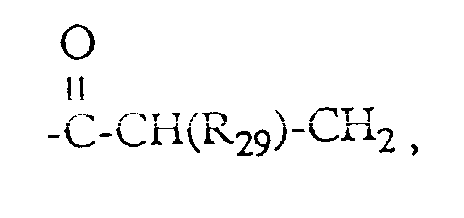 q et r, indépendamment l'un de l'autre, valent de 1 à 4 et p vaut de 0 à 50,R26 est un groupe alkylène en C1-C12 ou le groupe cyclohexylène ou phénylène,R27 est un groupe alkyle en C1-C12, cycloalkyle en C5-C8, le groupe phényle, un groupe alcoxyméthyle en C2-C13, cycloalcoxyméthyle en C6-C9, ou le groupe phénoxyméthyle,R28 est un groupe de formule -G-II,R29 est un hydrogène ou le groupe méthyle,X est -O- ou -NR23-, où R23 est un hydrogène ou un groupe alkyle en C1-C12, ou encore un groupe -(CH2)3-G-II ou -(CH2)3-O-G-II,Y est -O- ou -NH-,R20, R21 et R22 sont chacun indépendamment des autres un groupe alkyle en C1-C18, le groupe cyclohexyle ou phényle, ou un groupe alcoxy en C1-C18.
 - Matériau photographique selon la revendication 1, caractérisé en ce que les radicaux R1, indépendamment les uns des autres, sont des radicaux de formule -CH2-CH(ORx)Ry, -CH2CH(ORx)CH2ORz, -CH2CORy ou -CH2COCH2ORz, où :Rx est H, -CORs, -COORw ou -SiRpRqRr,Ry est un groupe alkyle en C1-C8,Rz est un groupe alkyle en C1-C18, alcényle en C2-C18, le groupe benzyle, -COR5 ou un groupe alkyle en C2-C24 ou hydroxyalkyle en C2-C24 interrompu par des oxygènes,Rs est un groupe alkyle en C1-C18, alcényle en C2-C18, ou le groupe phényle,Rw est un groupe alkyle en C1-C4, etRp, Rq et Rr sont chacun indépendamment des autres des groupes alkyle en C1-C6 ; ou encoreR1 est un groupe G-II, où II est un groupe de formule :
 G est une liaison directe ou un groupe divalent ayant l'une des formules suivantes :où :
-(CH2)q-, -(CH2)q-O-, -(CH2)q-CO-X-(CH2)r-,

 q et r, indépendamment l'un de l'autre, valent chacun 1, 2 ou 3, et p vaut de 0 à 50,R27 est le groupe méthyle, phényle, un groupe alcoxyméthyle en C3-C9, ou le groupe phénoxyméthyle,R28 est un groupe de formule G-II, etX et Y sont -O-,R20, R21 et R22, indépendamment les uns des autres, représentent chacun un groupe alkyle en C1-C8, phényle ou alcoxy en C1-C8.
 - Matériau photographique selon la revendication 1, caractérisé en ce que, dans les autres couches et/ou dans la couche d'émulsion à l'halogénure d'argent sensible au rouge, il contient au lieu de l'absorbant UV de formule (1) un absorbant UV du type benzotriazole, en particulier ayant la formule suivante :

- Matériau photographique contenant sur un support une couche d'émulsion à l'halogénure d'argent sensible au bleu, une telle couche sensible au vert et/ou une telle couche sensible au rouge, ainsi qu'une couche de protection, où une couche comportant un absorbant UV est disposée entre la couche supérieure d'émulsion à l'halogénure d'argent et la couche de protection, caractérisé en ce que (a) l'absorbant UV correspond à la formule suivante :
 T1, T2 et T3, indépendamment des autres, sont chacun un hydrogène ou un groupe halogéno, alkyle, alkyle substitué par un groupe carboxylate ou encore alcoxy, aryloxy, hydroxyle ou acyloxy, et T4 est un hydrogène ou un groupe alcoxy, aryloxy ou acyloxy, et(b) le matériau comporte au moins une couche supplémentaire, qui contient un absorbant UV de formule (1).
 - Matériau photographique contenant sur un support au moins deux couches d'émulsion à l'halogénure d'argent, avec une couche, disposée entre ces couches, comportant un absorbant UV, caractérisé en ce que l'absorbant UV correspond à la formule (1).
- Matériau photographique contenant sur un support une couche d'émulsion à l'halogénure d'argent sensible au rouge, et éventuellement une couche d'émulsion à l'halogénure d'argent sensible au bleu et/ou sensible au vert, caractérisé en ce que la couche d'émulsion à l'halogénure d'argent sensible au rouge contient un absorbant UV ayant la formule (1).
- Matériau photographique selon l'une des revendications 1 à 7, caractérisé en ce que l'on a dans les couches pouvant contenir un absorbant UV un mélange des absorbants UV ayant les formules (1) et (2).
- Matériau photographique selon la revendication 1, 5, 6 ou 7, caractérisé en ce que la couche d'émulsion à l'halogénure d'argent sensible au rouge contient un copulant cyan de formule :


Z1 est un groupe alkyle ou aryle, Z2 est un groupe alkyle, cycloalkyle, aryle, un groupe hétérocyclique ou un groupe ballast, Z3 est un hydrogène ou un halogène, Z1 et Z3 peuvent former ensemble un noyau, et Z4 est un hydrogène ou un groupe éliminable, et Z5 est un groupe ballast, Z6 est un hydrogène ou un groupe éliminable, et Z7 est un groupe alkyle. - Matériau photographique selon la revendication 1, 5, 6 ou 7, caractérisé en ce que la couche d'émulsion à l'halogénure d'argent sensible au vert contient un copulant magenta de formule :

R1 est un hydrogène ou un substituant, Z représente les atomes non métalliques nécessaires pour compléter un noyau à 5 chaînons avec 2 ou 3 atomes d'azote, ce noyau pouvant être substitué, et Q est un hydrogène ou un groupe éliminable. - Matériau photographique selon la revendication 1, 5, 6 ou 7, caractérisé en ce que la couche d'émulsion à l'halogénure d'argent sensible au vert contient un copulant magenta de formule :

R20 est un hydrogène ou un groupe alkyle, acylamino, carbamoyle, sulfamoyle, sulfonamido, alcoxycarbonyle, acyl-oxy, ou un groupe uréthanne, et Q' est un groupe éliminable. - Composés de formule :
 les radicaux R1, indépendamment des autres, représentent chacun un groupe de formule -CH2-CH(ORx)Ry ou -CH2CH(ORx)CH2ORz, oùRx est -CORs, -COORw ou -SiRpRqRr,Ry est un groupe alkyle en C1-C18, ou phényl(alkyle en C1-C4),Rz est un groupe alkyle en C1-C18, alcényle en C2-C18, phényl(alkyle en C1-C4), -CORs, ou encore alkyle en C1-C24, ou hydroxyalkyle en C2-C24, interrompu par des oxygènes,Rs est un groupe alkyle en C1-C18, alcényle en C2-C18 ou phényle,Rw est un groupe alkyle en C1-C4, etRp, Rq et Rr sont chacun indépendamment des autres un groupe alkyle en C1-C6 ou phényle ; ou encoreles radicaux R1, indépendamment les uns des autres, représentent chacun un groupe G-II, où II représente un groupe de formule :
 G est une liaison directe ou un groupe divalent ayant l'une des formules suivantes :où :
 q et r, indépendamment l'un de l'autre, valent chacun de 1 à 4, et p vaut de 0 à 50,R26 est un groupe alkylène en C1-C12, cyclohexylène ou phénylène,R27 est un groupe alkyle en C1-C12, cycloalkyle en C5-C8, phényle, alcoxyméthyle en C2-C13, cycloalcoxyméthyle en C6-C9, ou phénoxyméthyle,R28 est un groupe de formule G-II,R29 est un hydrogène ou un groupe méthyle,X est -O- ou -NR23-, où R23 est un hydrogène ou un groupe alkyle en C1-C12 ou -(CH2)3-G-II ou -(CH2)3-O-G-II,Y est -O- ou -NH-,R20, R21, R22, indépendamment les uns des autres, sont chacun un groupe alkyle en C1-C18, cyclohexyle, phényle ou alcoxy en C1-C18.
Applications Claiming Priority (2)
| Application Number | Priority Date | Filing Date | Title |
|---|---|---|---|
| CH260791 | 1991-09-05 | ||
| CH2607/91 | 1991-09-05 |
Publications (2)
| Publication Number | Publication Date |
|---|---|
| EP0531258A1 EP0531258A1 (fr) | 1993-03-10 |
| EP0531258B1 true EP0531258B1 (fr) | 1997-09-10 |
Family
ID=4237571
Family Applications (1)
| Application Number | Title | Priority Date | Filing Date |
|---|---|---|---|
| EP92810658A Expired - Lifetime EP0531258B1 (fr) | 1991-09-05 | 1992-08-27 | Matériau photographique contenant un absorbant UV |
Country Status (4)
| Country | Link |
|---|---|
| US (2) | US5300414A (fr) |
| EP (1) | EP0531258B1 (fr) |
| JP (1) | JP3220816B2 (fr) |
| DE (1) | DE59208885D1 (fr) |
Families Citing this family (63)
| Publication number | Priority date | Publication date | Assignee | Title |
|---|---|---|---|---|
| EP0520938B1 (fr) * | 1991-06-03 | 1997-09-24 | Ciba SC Holding AG | Matériau photographique contenant un absorbant UV |
| KR100316724B1 (ko) * | 1992-09-07 | 2002-02-28 | 에프. 아. 프라저, 에른스트 알테르 (에. 알테르), 한스 페터 비틀린 (하. 페. 비틀린), 피. 랍 보프, 브이. 스펜글러, 페. 아에글러 | 히드록시페닐-s-트리아진 |
| BE1006797A5 (fr) * | 1992-12-03 | 1994-12-13 | Ciba Geigy Ag | Absorbeurs d'uv. |
| US5489503A (en) * | 1992-12-03 | 1996-02-06 | Ciba-Geigy Corp. | UV absorbers |
| US6706215B1 (en) | 1993-05-17 | 2004-03-16 | Ciba Specialty Chemicals Corporation | Coating compositions stabilized against damage by light, heat and oxygen |
| GB2278115B (en) * | 1993-05-17 | 1997-08-06 | Ciba Geigy Ag | 2-(2-Hydroxyphenyl)-1,3-pyrimidine derivatives and their use as stabilizers for coating compositions |
| US5672704A (en) * | 1994-10-04 | 1997-09-30 | Ciba-Geigy Corporation | 2-Hydroxyphenyl-s-Triazines substituted with ethylenically unsaturated moieties |
| EP0706083A1 (fr) * | 1994-10-04 | 1996-04-10 | Ciba-Geigy Ag | Matériau photographique d'enregistrement comprenant un absorbeur UV |
| AU703967B2 (en) * | 1994-10-10 | 1999-04-01 | Ciba Specialty Chemicals Holding Inc. | Bisresorcinyltriazines |
| EP0711804A3 (fr) | 1994-11-14 | 1999-09-22 | Ciba SC Holding AG | Stabilisateurs à la lumière latents |
| TW325490B (en) * | 1995-06-23 | 1998-01-21 | Ciba Sc Holding Ag | Polysiloxane light stabilizers |
| DE19532889A1 (de) * | 1995-09-06 | 1997-03-13 | Agfa Gevaert Ag | Fotografisches Aufzeichnungsmaterial |
| US5585422A (en) * | 1995-09-20 | 1996-12-17 | Ciba-Geigy Corporation | Hybrid s-triazine light stabilizers substituted by benzotriazole or benzophenone moieties and compositions stabilized therewith |
| DE19543730A1 (de) * | 1995-11-23 | 1997-05-28 | Ciba Geigy Ag | Bis-Resorcinyl-Triazine |
| US5998116A (en) * | 1996-09-13 | 1999-12-07 | Ciba Specialty Chemicals Corporation | Color-photographic recording material |
| GB2319523B (en) | 1996-11-20 | 2000-11-08 | Ciba Sc Holding Ag | Hydroxyphenyltriazines |
| EP0878469B1 (fr) * | 1997-05-16 | 2004-10-27 | Ciba SC Holding AG | Resorcinyl-triazines |
| TW432055B (en) * | 1997-05-16 | 2001-05-01 | Ciba Sc Holding Ag | Resorcinyl-triazines, their preparation process and a cosmetic composition containing them |
| DE19735899A1 (de) * | 1997-08-19 | 1999-02-25 | Beiersdorf Ag | Wirkstoffkombinationen aus einer oder mehreren grenzflächenaktiven Substanzen und oligomeren oder polymeren UV-Filtersubstanzen mit periodisch sich wiederholenden Si-0-Gruppen |
| US6117997A (en) * | 1997-11-19 | 2000-09-12 | Ciba Specialty Chemicals Corporation | Hydroxyphenyltriazines |
| JP2000026435A (ja) * | 1998-05-07 | 2000-01-25 | Ciba Specialty Chem Holding Inc | トリスレゾリシニルトリアジン |
| AU4425599A (en) * | 1998-06-22 | 2000-01-10 | Ciba Specialty Chemicals Holding Inc. | Trisaryl-1,3,5-triazine ultraviolet light absorbers containing hindered phenols |
| JP2002518489A (ja) | 1998-06-22 | 2002-06-25 | チバ スペシャルティ ケミカルズ ホールディング インコーポレーテッド | ポリ(トリスアリール−1,3,5−トリアジン=カルバマート)紫外光吸収剤 |
| US6239276B1 (en) | 1998-06-22 | 2001-05-29 | Cytec Technology Corporation | Non-yellowing para-tertiary-alkyl phenyl substituted triazine and pyrimidine ultraviolet light absorbers |
| DE69927372T2 (de) | 1998-06-22 | 2006-07-13 | Cytec Technology Corp., Wilmington | In den roten Bereich verschobene Trisaryl-1,3,5-Triazin-Ultraviolettlicht-Absorptionsmittel |
| US6297377B1 (en) | 1998-06-22 | 2001-10-02 | Cytec Technology Corporation | Benzocycle-substituted triazine and pyrimidine ultraviolet light absorbers |
| WO2000014074A1 (fr) | 1998-09-04 | 2000-03-16 | Ciba Specialty Chemicals Holding Inc. | Procede de preparation de 1,3,5-triazine substituee par 2-hydroxy-4-alcoxyphenyle ou 2,4-dihydroxyphenyle s'utilisant comme absorbeurs de rayons ultraviolets |
| GB2343007B (en) | 1998-10-19 | 2001-11-07 | Ciba Sc Holding Ag | Colour photographic material |
| TWI259182B (en) | 1998-11-17 | 2006-08-01 | Cytec Tech Corp | Process for preparing triazines using a combination of Lewis acids with reaction promoters |
| DK1242391T3 (da) * | 1999-12-23 | 2006-04-24 | Ciba Sc Holding Ag | Stabilisatorblanding |
| US6867250B1 (en) | 2000-10-30 | 2005-03-15 | Cytec Technology Corp. | Non-yellowing ortho-dialkyl aryl substituted triazine ultraviolet light absorbers |
| JP4146105B2 (ja) * | 2001-05-30 | 2008-09-03 | 富士フイルム株式会社 | 紫外線吸収剤及びその製造方法、紫外線吸収剤を含有する組成物、ならびに画像形成方法 |
| GB0130416D0 (en) * | 2001-12-20 | 2002-02-06 | Eastman Kodak Co | Photographic elements containing a de-aggregating compound dye-forming coupler and stabilizer |
| JP2004160883A (ja) * | 2002-11-14 | 2004-06-10 | Asahi Denka Kogyo Kk | 光学記録材料 |
| MXPA05009108A (es) | 2003-02-26 | 2005-10-20 | Ciba Sc Holding Ag | Alcoxiaminas sustituidas con hidroxi estericamente impedidas compatibles con agua. |
| US20040176745A1 (en) * | 2003-03-07 | 2004-09-09 | Scott Ferguson | Wound drain with elongated intermediate section of enhanced radial strength |
| US7611829B2 (en) | 2004-01-30 | 2009-11-03 | Fujifilm Corporation | Silver halide color photographic light-sensitive material and color image-forming method |
| US7595011B2 (en) | 2004-07-12 | 2009-09-29 | Ciba Specialty Chemicals Corporation | Stabilized electrochromic media |
| EP2006324A4 (fr) | 2006-03-30 | 2010-11-24 | Adeka Corp | Composition de materiau polymere |
| EP2046094A4 (fr) | 2006-05-26 | 2011-12-07 | Fujifilm Corp | Élément électroluminescent à émission par la surface |
| EP1974948A3 (fr) | 2007-03-29 | 2012-02-08 | FUJIFILM Corporation | Procédé de formation d'images utilisant un système de transfert thermosensible |
| EP1980409A3 (fr) | 2007-03-29 | 2010-09-29 | FUJIFILM Corporation | Feuille de transfert thermosensible à utiliser dans un système de transfert thermosensible et procédé de formation d'image utilisant le système de transfert thermosensible |
| US8119562B2 (en) | 2007-03-29 | 2012-02-21 | Fujifilm Corporation | Heat-sensitive transfer sheet and image-forming method using heat-sensitive transfer system |
| JP2008273641A (ja) | 2007-04-25 | 2008-11-13 | Fujifilm Corp | 感熱転写受像シート用紙管、感熱転写受像シートのロール形態加工物、及び画像形成方法 |
| CN101688004B (zh) | 2007-06-29 | 2013-11-20 | 巴塞尔聚烯烃意大利有限责任公司 | 含非酚稳定剂的受辐射聚合物组合物 |
| DK2331625T3 (da) | 2008-09-05 | 2012-04-02 | Thor Gmbh | Flammebeskyttelsespræparat indeholdende et phosphonsyrederivat |
| WO2010072592A1 (fr) | 2008-12-22 | 2010-07-01 | Basf Se | Procédé d'amélioration de la résistance aux rayures, produits et utilisations associés |
| EP2387600B1 (fr) | 2009-01-19 | 2014-04-02 | Basf Se | Pigments noirs organiques et leur fabrication |
| JP2012516062A (ja) | 2009-01-22 | 2012-07-12 | イー・アイ・デュポン・ドウ・ヌムール・アンド・カンパニー | 不飽和複素環式化合物を含むポリ(ビニルブチラール)封止材を有する太陽電池モジュール |
| WO2011005631A2 (fr) | 2009-07-07 | 2011-01-13 | Basf Se | Particules de bronze de potassium-césium-tungstène |
| JP5625411B2 (ja) * | 2010-03-17 | 2014-11-19 | 富士ゼロックス株式会社 | 画像形成装置、及び、プロセスカートリッジ |
| JP5544239B2 (ja) | 2010-07-29 | 2014-07-09 | 富士フイルム株式会社 | 重合性組成物 |
| EP2801847A4 (fr) | 2012-01-06 | 2015-08-26 | Konica Minolta Inc | Miroir à film, procédé de fabrication de miroir à film, miroir à film pour génération d'énergie photovoltaïque et dispositif de réflexion pour génération d'énergie photovoltaïque |
| CN105051012B (zh) | 2012-10-23 | 2019-01-04 | 巴斯夫欧洲公司 | 含有聚合物稳定剂基团的烯属不饱和低聚物 |
| BR112016006528B1 (pt) | 2013-09-27 | 2021-07-27 | Basf Se | Artigo extrudado compreendendo uma composição de poliolefina |
| EP3071544B1 (fr) | 2013-11-22 | 2022-07-06 | Polnox Corporation | Antioxydants macromoléculaires basés sur deux types de fractions par molécule : structures, leurs procédés de fabrication et d'utilisation |
| TWI685524B (zh) | 2013-12-17 | 2020-02-21 | 美商畢克美國股份有限公司 | 預先脫層之層狀材料 |
| CN107849295B (zh) | 2015-07-20 | 2020-03-13 | 巴斯夫欧洲公司 | 聚烯烃阻燃物品 |
| US10574014B2 (en) | 2017-03-27 | 2020-02-25 | Aptiv Technologies Limited | Method for sealing electric terminal assembly |
| US10017659B1 (en) | 2017-10-09 | 2018-07-10 | Delphi Technologies, Inc | Robust sealed electric terminal assembly |
| EP3841166B2 (fr) | 2018-08-22 | 2025-05-07 | Basf Se | Polyoléfine rotomoulée stabilisée |
| CN113574094B (zh) | 2019-03-18 | 2023-07-21 | 巴斯夫欧洲公司 | 用于耐沾污性的uv可固化组合物 |
| US20220282064A1 (en) | 2019-07-30 | 2022-09-08 | Basf Se | Stabilizer composition |
Citations (1)
| Publication number | Priority date | Publication date | Assignee | Title |
|---|---|---|---|---|
| US4853471A (en) * | 1981-01-23 | 1989-08-01 | Ciba-Geigy Corporation | 2-(2-Hydroxyphenyl)-benztriazoles, their use as UV-absorbers and their preparation |
Family Cites Families (15)
| Publication number | Priority date | Publication date | Assignee | Title |
|---|---|---|---|---|
| US3118887A (en) * | 1961-03-06 | 1964-01-21 | American Cyanamid Co | O-hydroxy substituted tris aryl-s-triazines |
| CH484695A (de) * | 1962-10-30 | 1970-01-31 | Ciba Geigy | Verwendung von neuen Hydroxyphenyl-1,3,5-triazinen als Ultraviolettschutzmittel ausserhalb der Textilindustrie |
| NL130993C (fr) * | 1963-02-07 | |||
| CH469053A (de) * | 1963-07-26 | 1969-02-28 | Ciba Geigy | Verwendung von neuen Hydroxyphenyl-1,3,5-triazinen als Schutzmittel gegen Ultraviolettstrahlung für nichttextile organische Materialien |
| CH485484A (de) * | 1964-12-04 | 1970-02-15 | Ciba Geigy | Verwendung von neuen Hydroxyphenyl-1,3,5-triazinen als Schutzmittel gegen Ultraviollettstrahlung für organische Materialien ausserhalb der Textilindustrie |
| CH533853A (de) * | 1970-03-23 | 1973-02-15 | Ciba Geigy Ag | Verwendung von 2'-Hydroxyphenyl-1,3,5-triazinen als Stabilisierungsmittel gegen Ultraviolettstrahlung in photographischem Material |
| DE3264154D1 (en) * | 1981-01-23 | 1985-07-25 | Ciba Geigy Ag | 2-(2-hydroxyphenyl)-benzotriazoles, their use as ultraviolet stabilizers and their preparation |
| JPS58214152A (ja) * | 1982-06-05 | 1983-12-13 | Konishiroku Photo Ind Co Ltd | カラ−写真感光材料 |
| JPS59215378A (ja) * | 1983-05-21 | 1984-12-05 | Konishiroku Photo Ind Co Ltd | 乳化分散物 |
| JPS60250344A (ja) * | 1984-05-26 | 1985-12-11 | Fuji Photo Film Co Ltd | カラ−写真感光材料 |
| US4619956A (en) * | 1985-05-03 | 1986-10-28 | American Cyanamid Co. | Stabilization of high solids coatings with synergistic combinations |
| US4812498B1 (en) * | 1986-12-22 | 1995-04-11 | Adeka Argus Chemical Co Ltd | Polycarbonate resin compositions having improved resistance to deterioration when exposed to light and containing alkylidene bis(benzotriazolyl phenols). |
| ES2061729T3 (es) * | 1987-12-23 | 1994-12-16 | Ciba Geigy Ag | Procedimiento para la preparacion de mezcla liquidas de 2-(2-hidroxifenil)-benzotriazoles alquilados. |
| US4826978A (en) * | 1987-12-29 | 1989-05-02 | Milliken Research Corporation | Reactive, non-yellowing triazine compounds useful as UV screening agents for polymers |
| US4973701A (en) * | 1988-04-11 | 1990-11-27 | Ciba-Geigy Corporation | Liquid substituted 2H-benzotriazole mixtures, stabilized compositions and processes for preparing the liquid mixtures |
-
1992
- 1992-08-27 EP EP92810658A patent/EP0531258B1/fr not_active Expired - Lifetime
- 1992-08-27 DE DE59208885T patent/DE59208885D1/de not_active Expired - Fee Related
- 1992-09-01 US US07/939,507 patent/US5300414A/en not_active Expired - Lifetime
- 1992-09-07 JP JP26430892A patent/JP3220816B2/ja not_active Expired - Fee Related
-
1994
- 1994-01-21 US US08/185,665 patent/US5410048A/en not_active Expired - Lifetime
Patent Citations (1)
| Publication number | Priority date | Publication date | Assignee | Title |
|---|---|---|---|---|
| US4853471A (en) * | 1981-01-23 | 1989-08-01 | Ciba-Geigy Corporation | 2-(2-Hydroxyphenyl)-benztriazoles, their use as UV-absorbers and their preparation |
Also Published As
| Publication number | Publication date |
|---|---|
| US5410048A (en) | 1995-04-25 |
| DE59208885D1 (de) | 1997-10-16 |
| EP0531258A1 (fr) | 1993-03-10 |
| JPH05232630A (ja) | 1993-09-10 |
| US5300414A (en) | 1994-04-05 |
| JP3220816B2 (ja) | 2001-10-22 |
Similar Documents
| Publication | Publication Date | Title |
|---|---|---|
| EP0520938B1 (fr) | Matériau photographique contenant un absorbant UV | |
| US5300414A (en) | Photographic material containing UV absorber | |
| EP0530135A1 (fr) | Matériau photographique contenant un absorbant UV | |
| DE69124775T2 (de) | Cyanbilderzeugungsverfahren und Cyankuppler enthaltendes farbphotographisches Silberhalogenidmaterial | |
| NL194945C (nl) | UV-absorptiemiddelen. | |
| DE19537291B4 (de) | Bis-Resorcinyltriazine | |
| DE19739748A1 (de) | Farbfotografisches Aufzeichnungsmaterial | |
| DE69203576T2 (de) | Farbphotographisches Silberhalogenidmaterial. | |
| DE69401682T2 (de) | Farbphotographisches Silberhalogenidmaterial | |
| EP0586343B1 (fr) | Matériau d'enregistrement photographique couleur | |
| US5763144A (en) | Color-photographic recording material | |
| DE69231087T2 (de) | Farbphotographisches lichtempfindliches Silberhalogenidmaterial | |
| EP0457723B1 (fr) | Méthode pour la stabilisation de coupleurs magenta et des images de colorants résultantes dans des produits photographiques | |
| DE69223958T2 (de) | Farbphotographisches photoempfindliches silberhalogenidmaterial | |
| DE69228414T2 (de) | Farbphotographisches lichtempfindliches Silberhalogenidmaterial | |
| US5780625A (en) | 4-aminophenol derivatives | |
| DE69326634T2 (de) | Farbphotographisches lichtempfindliches Silberhalogenidmaterial | |
| DE69322126T2 (de) | Farbphotographisches Silberhalogenidmaterial | |
| US5274170A (en) | Substituted benzophenone stabilizers | |
| EP0544323A1 (fr) | Matériau photographique couleur à l'halogénure d'argent sensible à la lumière | |
| DE19745886A1 (de) | Farbfotografisches Silberhalogenidmaterial | |
| DE19745977A1 (de) | Farbfotografisches Silberhalogenidmaterial | |
| JP3269930B2 (ja) | ハロゲン化銀カラー感光材料 |
Legal Events
| Date | Code | Title | Description |
|---|---|---|---|
| PUAI | Public reference made under article 153(3) epc to a published international application that has entered the european phase |
Free format text: ORIGINAL CODE: 0009012 |
|
| AK | Designated contracting states |
Kind code of ref document: A1 Designated state(s): BE DE FR GB IT NL |
|
| 17P | Request for examination filed |
Effective date: 19930823 |
|
| 17Q | First examination report despatched |
Effective date: 19931102 |
|
| RAP1 | Party data changed (applicant data changed or rights of an application transferred) |
Owner name: CIBA SC HOLDING AG |
|
| GRAG | Despatch of communication of intention to grant |
Free format text: ORIGINAL CODE: EPIDOS AGRA |
|
| GRAH | Despatch of communication of intention to grant a patent |
Free format text: ORIGINAL CODE: EPIDOS IGRA |
|
| RAP3 | Party data changed (applicant data changed or rights of an application transferred) |
Owner name: CIBA SPECIALTY CHEMICALS HOLDING INC. |
|
| GRAH | Despatch of communication of intention to grant a patent |
Free format text: ORIGINAL CODE: EPIDOS IGRA |
|
| GRAA | (expected) grant |
Free format text: ORIGINAL CODE: 0009210 |
|
| AK | Designated contracting states |
Kind code of ref document: B1 Designated state(s): BE DE FR GB IT NL |
|
| REF | Corresponds to: |
Ref document number: 59208885 Country of ref document: DE Date of ref document: 19971016 |
|
| ITF | It: translation for a ep patent filed | ||
| GBT | Gb: translation of ep patent filed (gb section 77(6)(a)/1977) |
Effective date: 19971107 |
|
| ET | Fr: translation filed | ||
| PLBE | No opposition filed within time limit |
Free format text: ORIGINAL CODE: 0009261 |
|
| 26N | No opposition filed | ||
| REG | Reference to a national code |
Ref country code: GB Ref legal event code: IF02 |
|
| PGFP | Annual fee paid to national office [announced via postgrant information from national office to epo] |
Ref country code: FR Payment date: 20050719 Year of fee payment: 14 |
|
| PGFP | Annual fee paid to national office [announced via postgrant information from national office to epo] |
Ref country code: BE Payment date: 20050914 Year of fee payment: 14 |
|
| PGFP | Annual fee paid to national office [announced via postgrant information from national office to epo] |
Ref country code: DE Payment date: 20060720 Year of fee payment: 15 |
|
| PG25 | Lapsed in a contracting state [announced via postgrant information from national office to epo] |
Ref country code: BE Free format text: LAPSE BECAUSE OF NON-PAYMENT OF DUE FEES Effective date: 20060831 |
|
| REG | Reference to a national code |
Ref country code: FR Ref legal event code: ST Effective date: 20070430 |
|
| BERE | Be: lapsed |
Owner name: *CIBA SPECIALTY CHEMICALS HOLDING INC. Effective date: 20060831 |
|
| PG25 | Lapsed in a contracting state [announced via postgrant information from national office to epo] |
Ref country code: FR Free format text: LAPSE BECAUSE OF NON-PAYMENT OF DUE FEES Effective date: 20060831 |
|
| PG25 | Lapsed in a contracting state [announced via postgrant information from national office to epo] |
Ref country code: DE Free format text: LAPSE BECAUSE OF NON-PAYMENT OF DUE FEES Effective date: 20080301 |
|
| PGFP | Annual fee paid to national office [announced via postgrant information from national office to epo] |
Ref country code: NL Payment date: 20100825 Year of fee payment: 19 |
|
| PGFP | Annual fee paid to national office [announced via postgrant information from national office to epo] |
Ref country code: IT Payment date: 20100831 Year of fee payment: 19 |
|
| PGFP | Annual fee paid to national office [announced via postgrant information from national office to epo] |
Ref country code: GB Payment date: 20100831 Year of fee payment: 19 |
|
| REG | Reference to a national code |
Ref country code: NL Ref legal event code: V1 Effective date: 20120301 |
|
| GBPC | Gb: european patent ceased through non-payment of renewal fee |
Effective date: 20110827 |
|
| PG25 | Lapsed in a contracting state [announced via postgrant information from national office to epo] |
Ref country code: NL Free format text: LAPSE BECAUSE OF NON-PAYMENT OF DUE FEES Effective date: 20120301 Ref country code: IT Free format text: LAPSE BECAUSE OF NON-PAYMENT OF DUE FEES Effective date: 20110827 |
|
| PG25 | Lapsed in a contracting state [announced via postgrant information from national office to epo] |
Ref country code: GB Free format text: LAPSE BECAUSE OF NON-PAYMENT OF DUE FEES Effective date: 20110827 |