EP0531993B1 - Verfahren und Vorrichtung zur Erzeugung von Röntgencomputertomogrammen und zum Erzeugen von Schattenbildern mittels spiralförmiger Abtastung - Google Patents
Verfahren und Vorrichtung zur Erzeugung von Röntgencomputertomogrammen und zum Erzeugen von Schattenbildern mittels spiralförmiger Abtastung Download PDFInfo
- Publication number
- EP0531993B1 EP0531993B1 EP92115493A EP92115493A EP0531993B1 EP 0531993 B1 EP0531993 B1 EP 0531993B1 EP 92115493 A EP92115493 A EP 92115493A EP 92115493 A EP92115493 A EP 92115493A EP 0531993 B1 EP0531993 B1 EP 0531993B1
- Authority
- EP
- European Patent Office
- Prior art keywords
- ray
- image data
- biological body
- projection image
- ray projection
- Prior art date
- Legal status (The legal status is an assumption and is not a legal conclusion. Google has not performed a legal analysis and makes no representation as to the accuracy of the status listed.)
- Expired - Lifetime
Links
Images




Classifications
-
- A—HUMAN NECESSITIES
- A61—MEDICAL OR VETERINARY SCIENCE; HYGIENE
- A61B—DIAGNOSIS; SURGERY; IDENTIFICATION
- A61B6/00—Apparatus or devices for radiation diagnosis; Apparatus or devices for radiation diagnosis combined with radiation therapy equipment
- A61B6/02—Arrangements for diagnosis sequentially in different planes; Stereoscopic radiation diagnosis
- A61B6/03—Computed tomography [CT]
- A61B6/032—Transmission computed tomography [CT]
-
- A—HUMAN NECESSITIES
- A61—MEDICAL OR VETERINARY SCIENCE; HYGIENE
- A61B—DIAGNOSIS; SURGERY; IDENTIFICATION
- A61B6/00—Apparatus or devices for radiation diagnosis; Apparatus or devices for radiation diagnosis combined with radiation therapy equipment
- A61B6/02—Arrangements for diagnosis sequentially in different planes; Stereoscopic radiation diagnosis
- A61B6/027—Arrangements for diagnosis sequentially in different planes; Stereoscopic radiation diagnosis characterised by the use of a particular data acquisition trajectory, e.g. helical or spiral
Definitions
- the present invention generally relates to an X-ray CT (computerized tomographic) imaging method and an X-ray CT imaging system. More specifically, the present invention is directed to an X-ray CT imaging method and an imaging system capable of producing scano data from X-ray projection image data of a biological body acquired by helically scanning this biological body.
- X-ray CT computerized tomographic
- a scano image of this biological body is first obtained by projecting X-ray beams to the overall portion of the biological body, while maintaining the X-ray source and detector at a fixed position. Based upon the scano image, positioning operation of tomographic images is carried out to determine a desired diagnostic portion of the biological body. Thereafter, while the X-ray source is rotated together with the X-ray detector around the diagnostic portion, this diagnostic portion of the biological body is scanned by way of the X-ray pulses to acquire X-ray projection image data, and then, the X-ray projection image data are processed to finally obtain X-ray CT image data.
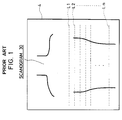
- the normal X-ray projection is performed without rotating the X-ray source around the biological body (namely, with fixed X-ray source). Accordingly, the X-ray projection data are obtained and processed to form a scanogram 30 as represented in Fig. 1.
- the conventional X-ray CT imaging system necessarily requires a lengthy examination time duration until the desirable CT images are obtained, since first the biological body is translated so as to obtain the scanogram 30, secondly this biological body is returned to the home position, and thirdly the biological body is again translated in order to obtain the X-ray CT image data.
- the biological body under medical examination such as a patient must endure such a lengthy and afflictive medical examination.
- the relative position between the X-ray source and the patient differs from each other during the scanogram data acquisition and the CT image data acquisition. Even if, for instance, the first CT imaging position "L 1 " is accurately determined on the scanogram 30, an actual CT imaging position on the patient may be positionally shifted.
- EP-A-0 383 232 discloses a X-ray CT imaging method and system in accordance with the preamble of the independent claims. There, a patient is helically scanned and projection image data are interpolated in order to reconstruct an image of a desired slice.
- DE-C-41 03 588 published on May 27, 1992, discloses a computer tomograph in which a patient is helically scanned. In order to derive an additional shadow image, image data of a predetermined projection angle are processed.
- the present invention has been made in an attempt to solve the above-described problems of the conventional X-ray CT imaging system, and therefore, has an object to provide such X-ray CT imaging method/system capable of producing a scanogram within a short examination time.
- Another object of the present invention is to provide an X-ray CT imaging method/system capable of obtaining a scanogram at high positional precision with respect to CT images of a biological body under medical examination.
- an X-ray CT (computerized tomographic) imaging method comprises the steps as defined in any of claims 1 to 6. portion of the biological body (20); and reconstructing an X-ray CT image (21) of said helically-scanned biological body (20) based upon said first X-ray projection image data, whereby both of said scanogram (22) and said X-ray CT image (21) are substantially simultaneously displayed.
- an X-ray CT (computerized tomographic) imaging system (100:400) comprises the features as defined in any of claims 7 to 12.
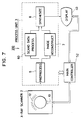
- FIG. 2 there is shown an arrangement of an X-ray CT (computerized tomographic) imaging system 100 according to a first preferred embodiment of the present invention.
- X-ray CT computerized tomographic
- the first X-ray CT imaging system 100 is mainly constructed of an X-ray scanner 2 for performing X-ray scanning operation with respect to a biological body under medical examination such as a patient 20 (shown in Fig. 3) to produce X-ray projection data; a data processing unit 3 for processing the X-ray projection data; a display unit 4 for displaying both of a scanogram and an X-ray CT image; and a main controller 50.
- the data processing unit 3 includes a preprocessing unit 5 for preprocessing the X-ray projection data derived from the X-ray scanner 2 to obtain preprocessed X-ray projection data; a scano data processing unit 6 for processing the preprocessed X-ray projection data to produce scano data; an image reconstructing unit 7 for reconstructing a desirable X-ray CT image from the preprocessed X-ray projection data; and a synthesizing unit 8 for synthesizing the above-described scano data and X-ray CT image data in such a manner that both of the scanogram and the CT image of the biological body are displayed on the same screen of the display unit 4 (will be discussed more in detail).
- a preprocessing unit 5 for preprocessing the X-ray projection data derived from the X-ray scanner 2 to obtain preprocessed X-ray projection data
- a scano data processing unit 6 for processing the preprocessed X-ray projection data to produce scano data
- an image reconstructing unit 7 for reconstructing
- the patient 20 is helically scanned only one time by the X-ray scanner 2 of the first X-ray CT imaging system 100 so as to obtain both of scano data and CT image data. That is to say, since the X-ray projection data are acquired during only one helical scanning operation and thereafter both of the scano data and the CT image data are produced from this series of X-ray projection data, the couch (not shown in detail) on which the patient 20 is laid is translated only one time along a longitudinal direction thereof.
- the helical scanning operation is performed by the X-ray scanner 2 with respect to the patient 20 in the first X-ray CT imaging system 100 of Fig. 2.
- an X-ray detector unit 12 is positioned opposite to an X-ray tube 10, this detector unit 12 is omitted from Fig. 3.
- the X-ray helical scanning operation per se is known from, for instance, U.S. patent No. 4,630,202 issued to Mori, entitled "COMPUTERIZED TOMOGRAPHIC APPARATUS UTILIZING A RADIATION SOURCE", patented on December 16, 1986.
- a series of X-ray projection data obtained by helically scanning the patient 20 is continuously acquired from the X-ray scanner 2 under control of the main controller 50.
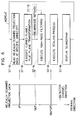
- a preselected projection angle for instance, 0° or 360° (corresponding to the positions 10A, 10B, ... 10N) are read out from the above-described series of helically-scanned X-ray projection data at a first step ST-10.
- the read projection data acquired at the specific projection angle of 0° (360° ) are processed by a curved plane/flat plane transformation, since the X-ray detector unit 12 (see Fig. 2) is constructed of a plurality of detector channels having curved surfaces.
- the plane-transformed projection data are further processed in a high-pass filter (not shown in detail) at a step ST-14.
- the filtered projection data are processed by a scaling process at a step ST-16.
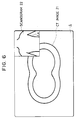
- the scaling-processed projection data (corresponding to the scano data) are displayed as a scanogram 22 (see Fig. 6) on the display unit 4 at a step ST-18. Then, this flow operation is repeated from the previous step ST-10.
- the scanogram 22 of the patient 20 can be obtained by processing only the helically-scanned X-ray projection data acquired at the specific projection angle (0° ) in the scano data processing unit 6 under control of the main controller 50.
- helically-scanned X-ray projection data acquired at another specific projection angle "180° " indicated by a dot line of Fig. 4 are also processed to obtain such a scano data
- the following additional process step is required in the process flow shown in Fig. 4. That is, after the helically-scanned projection data acquired at two specific projection angles of 0° and 180° are read out at the step ST-10 and processed by the curved plane/plane transformation at the step ST-12, only the processed projection data acquired at the specific projection angle 180° are rearranged at a step ST-13. This is because the positional relationship of the detector channel is completely opposite to each other with respect to the projection angles 0° and 180° .
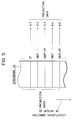
- Fig. 5 represents a so-called “sinogram” 25 constructed of a plurality of projection data "D1", “D2”, ... “D5".
- a desirable scanogram 22 is obtained by arranging these projection data "D1 (angle of 0° )", “D2 (angle of 180° )”, ... “D5 (angle of 360° )” along the longitudinal direction of the patient 20.
- the above-described series of helically-scanned X-ray projection data are preprocessed in the preprocessing unit 5, and thereafter are reconstructed in the image reconstructing unit 7 so as to produce desirable CT image data under control of the main controller.
- Both of this desirable CT image data and the above-mentioned scano data are synthesized in the synthesizing unit 8, so that both of a desirable CT image 21 and a desirable scanogram 22 are simultaneously displayed on the same screen of the display unit 4.
- a line "L x " indicates a position on the patient 20, where this CT image 21 has been obtained.
- this X-ray CT imaging system 100 since both of the scanogram 22 and the CT image 21 can be obtained at the same time by performing only a single helical scanning operation with respect to the patient 20, the entire medical examination time during which the patient 20 must endure can be considerably reduced, as compared with that of the conventional X-ray CT imaging system. Accordingly, since such a lengthy and afflictive medical examination can be mitigated, this X-ray CT imaging system 100 is suitable for a so-called "group diagnosis" in which X-ray imaging portions of patients are previuosly determined and a large number of medical examination processes must be carried out within a limited time period.
- the projection angles of the first X-ray CT imaging system 100 are selected to be 0° , 90° and 180° , any other projection angles such as 1° , 150° , 292° may be freely selected to obtain the scanograms.
- FIG. 7 an arrangement of an X-ray CT imaging system 200 according to a second preferred embodiment of the present invention will be described.
- a scano data process unit 60 is employed in the process unit 3 and a main controller 52 is employed. Under control of the main controller 52, a series of helically-scanned X-ray projection data are acquired by the X-ray scanner 2 at two specific projection angles of 0° and 90° . Then, one scanogram 26 is obtained as a top view (0° ) and the other scanogram 27 is obtained as a side view (90° ), as indicated in Fig. 10, which are produced in the scano data process unit 60 under control of the main controller 52.
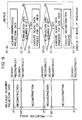
- FIG. 9 An overall operation of the second X-ray CT imaging system 200 will be described. Similarly, acquisition timings (projection angles) of the helically-scanned X-ray projection data and projection data process operations are represented at a lefthand portion of Fig. 9, whereas an operation flow of the second CT imaging system 200 is indicated at a righthand portion of Fig. 9.
- both of the scanogram production and the CT image reconstruction are simultaneously performed at the respective specific projection angles of 0° and 90° , whereas only the CT image reconstruction is carried out at any projection angles other than the specific projection angles.
- a series of helically-scanned X-ray projection data are acquired by the X-ray scanner 2 under control of the main controller 52, and then are preprocessed in the preprocess unit 5 under control of the main controller 52.
- a check is made as to whether or not the helically-scanned projection data has been acquired at the first specific projection angle of 0° . If YES, then the process operation is advanced to a step ST-22 at which the scano data process for the top view 26 (see Fig. 10) is performed in the scano data process unit 60 with respect to the helically-scanned projection data acquired at the angle of 0° .
- the process operation is jumped to a further step ST-23.
- step ST-23 another check is made as to whether or not this helically-scanned projection data has been acquired at the second specific projection angle of 90° . If YES, then the process operation is advanced to the next step ST-24 at which the scano data process for the side view 27 (see Fig. 10) is executed in the scano data process unit 60 under control of the main controller 52.
- the process operation is jumped to a further step ST-25.
- the CT image reconstruction process is carried out with respect to the projection data in the image reconstruction unit 7 under control of the main controller 52. Thereafter, the above-described process operation is repeated from the first step ST-20.
- the resultant CT image 23 produced at the step ST-25 may be displayed in combination with both of the top-viewed scanogram 26 and the side-viewed scanogram 27, as represented in Fig. 10, if required.
- FIG. 11 there is shown an arrangement of an X-ray CT imaging system 300 according to a third preferred embodiment of the present invention.
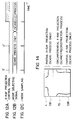
- a major feature of this third X-ray CT imaging system 300 is such that a scano data process unit 65 is employed in the process unit 3 and is operated in conjunction with a mode selector 80 under control of a main controller 54 to select the operation mode of the third X-ray CT imaging system 300. That is, a selection is made between only scano data process, and also a combination of the scano data process with the CT image reconstruction process via the mode selector 80 by an operator. As shown in Figs. 12A to 12C, the mode selector 80 issues a mode selecting signal of Fig. 12B to the main controller 54. Then, if only the scano data process (scanogram formation) is selected, an X-ray projection control signal shown in Fig.
- the X-ray tube 10 of Fig. 11 is energized in response to this X-ray projection control signal, so that X-ray beams are projected therefrom only at the preselected projection angle of 0° .
- a preselected projection angle e.g., 0°
- the X-ray tube 10 of Fig. 11 is energized in response to this X-ray projection control signal, so that X-ray beams are projected therefrom only at the preselected projection angle of 0° .
- the patient 20 receives only a limited quantity of X-ray dose during this operation mode.
- both of the X-ray tube 10 and the X-ray detector unit 12 are helically scanned around the patient 20, the X-ray beams are intermittently projected from the X-ray tube 10 during the helical scanning operation at the preselected projection angle, which does not correspond to the normal helical scanning operation (will be referred to a "partial X-ray projection").
- the mode selector 80 selects the combination process (namely, the scano data process and the CT image reconstruction process) by the mode selector 80, another mode selecting signal is issued from the main controller 54. Then, the above-described normal helical scanning operation is carried out (will be referred to a "circumferential X-ray projection"), so that while the scanogram data is produced in the scano data process unit 65, the X-ray CT image is reconstructed in the image reconstruction unit 7.
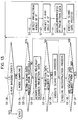
- Fig. 13 represents a flow chart of overall operation by the third X-ray CT imaging system 300 of Fig. 11.
- a check is done as to whether or not the X-ray imaging operation is completed. If NO, then the process operation is advanced to the next step ST-31 at which mode sampling is performed. Then, another check is made as to whether or not only the scano data process is selected. If NO, then the process operation is advanced to the subsequent step ST-33.
- the combination process of the scano data and the CT image reconstruction is selected by the operator via the mode selector 80, the above-described normal helically-scanned X-ray projection data are acquired by the X-ray scanner 2 and thereafter preprocessed in the preprocess unit 5 under control of the main controller 54.
- step ST-34 another check is made as to whether or not the helically-scanned projection data is acquired at the specific projection angle of 0° at a step ST-34. If YES, then the process operation is advanced to the next step ST-35 at which the scano data process is performed by the scano data process unit 65 under control of the main controller 54. To the contrary, if NO at the previous step ST-34, then the process operation is jumped to a step ST-36. Then, the X-ray CT image reconstruction process is performed for this helically-scanned projection data in the image reconstruction unit 7 under control of the main controller.
- step ST-36 After this image reconstruction process has been accomplished at the step ST-36, a further check is made as to whether or not the helically-scanned projection data have been acquired/processed from 0° to 360° (i.e., circumferential X-ray projection process). If NO, then the process operation is returned to the step ST-33, so that a series of projection data process operations is again carried out until the step ST-37. If YES, then the process operation is returned to the first step ST-30, because the combination process operation mode selected by the operator via the mode selector 80 has been completed. Thus, the circumferential X-ray projection (see Fig. 14) is achieved.
- the process operation is advanced to a new step ST-40.
- a predetermined projection angle for instance, 0° in the third X-ray CT imaging system 300 is detected under control of the main controller 54.
- the X-ray beam is projected from the X-ray tube 10 only at the projection angle of 0° at a step ST-42.
- a display region of a scanogram is relatively larger than that of a CT image on a display screen. Furthermore, since an operator observes a CT image with reference to a scanogram, it is suitable for easy observation to display the scanogram with a larger area than that of the CT image on a display screen. To this end, if X-ray beams are projected from the X-ray tube 10 to the patient 20 over the circumferential helical-direction, a total amount of X-ray dose is increased, as compared with that of the partial X-ray projection.
- the mode selector 80 manipulated by an operator is newly employed and can select such a partial X-ray projection in conjunction with the main controller 54 to obtain a scanogram under lower X-ray dose.
- an operator manipulates the mode selector 80 to change the partial X-ray projection mode into the circumferential X-ray projection mode.
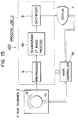
- Fig. 15 represents an arrangement of an X-ray CT imaging system 400 according to a fourth preferred embodiment of the present invention.
- a major feature of the fourth X-ray CT imaging system 400 is to employ a scanogram/CT image processing unit 90 in the process unit 3.
- This scanogram/CT image processing unit 90 is capable of performing a scano data process operation and a CT image reconstruction operation.
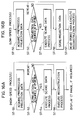
- the entire processing operation of the fourth X-ray CT imaging system 400 is executed in accordance with a flow chart shown in Fig. 16A.
- a first step ST-50 of this flow chart the helically-scanned X-ray projection data are acquired by the X-ray scanner 2 and thereafter are preprocessed by the preprocess unit 5 under control of the main controller 56. Subsequently, a check is done as to whether or not the preprocessed projection data have been acquired at the specific projection angle 0° or 180° at a step ST-52.
- the scano data process operation is carried out for these projection data acquired at the specific projection angle of 0° or 180° at a high speed at the next step ST-54. Then, the CT image reconstruction operation is performed based on these projection data at a step ST-56.
- a resultant CT image (not shown) reconstructed at this step ST-56 may be displayed on the display unit 4 in combination with a scanogram (not shown either) combined in the synthesizer unit 8. If NO at the step ST-52, then the process operation is jumped to the step ST-56 at which the above-described CT image reconstruction process is performed. Then, a series of the above-described highspeed process operation is repeatedly executed.
- the entire processing operation of the fourth X-ray CT imaging system 400 is executed in accordance with a flow chart shown in Fig. 16B. Since the process operations from the step ST-50 to the step ST-54 are identical to those of Fig. 16A, only different process operation will be explained. That is, after the scano data process is accomplished at the step ST-54, the preprocessed X-ray projection data are once stored into a memory (not shown in detail) at the next step ST-55. Thereafter, the stored projection data are read out from the memory and are processed to reconstruct a CT image at a step ST-57.
- the fourth X-ray CT imaging system 400 there are such particular advantages that the overall medical examination time for the patient can be considerably shortened even if both of the scanogram and the X-ray CT image thereof are produced, since only one helical scanning operation is required. Also, a total amount of X-ray dose given to the patient can be reduced, as compared with that of the conventional X-ray CT imaging system.
Landscapes
- Health & Medical Sciences (AREA)
- Life Sciences & Earth Sciences (AREA)
- Engineering & Computer Science (AREA)
- Medical Informatics (AREA)
- Optics & Photonics (AREA)
- Biomedical Technology (AREA)
- Biophysics (AREA)
- High Energy & Nuclear Physics (AREA)
- Veterinary Medicine (AREA)
- Nuclear Medicine, Radiotherapy & Molecular Imaging (AREA)
- Public Health (AREA)
- Pathology (AREA)
- Radiology & Medical Imaging (AREA)
- Physics & Mathematics (AREA)
- Heart & Thoracic Surgery (AREA)
- Molecular Biology (AREA)
- Surgery (AREA)
- Animal Behavior & Ethology (AREA)
- General Health & Medical Sciences (AREA)
- Pulmonology (AREA)
- Theoretical Computer Science (AREA)
- Apparatus For Radiation Diagnosis (AREA)
Claims (12)
- Computertomographisches Röntgenstrahl-Abbildungsverfahren, das die folgenden Schritte aufweist:Abtasten eines in medizinischer Untersuchung befindlichen biologischen Körpers (20) in einer Betriebsart mit schraubenlinienförmiger Abtastung, wobei eine Röntgenröhre (10) um den biologischen Körper (20), der entlang einer Längsachse des biologischen Körpers (20) verschoben wird, relativgedreht wird, um hierdurch Röntgenstrahl-Projektionsbilddaten bezüglich des schraubenlinienförmig abgetasteten biologischen Körpers (20) zu erzielen, undRekonstruieren eines computertomographischen Röntgenbilds (21) des schraubenlinienförmig abgetasteten biologischen Körpers (20) auf der Grundlage der gesamten Röntgenstrahl-Projektionsbilddaten,
gekennzeichnet durch die weiteren Schritte:Auswählen lediglich von solchen Röntgenstrahl-Projektionsbilddaten, die bei einem vorbestimmten Projektionswinkel erhalten wurden, aus den gesamten Röntgenstrahl-Projektionsbilddaten, die bei der schraubenlinienförmigen Abtastung erhalten wurden, undVerarbeiten der ausgewählten Röntgenstrahl-Projektionsbilddaten zur Erzeugung eines Scannogramms (Abtastbilds) (22) des schraubenlinienförmig abgetasteten biologischen Körpers (20),
wobei sowohl das Scannogramm (22) als auch das computertomographische Röntgenbild (21) im wesentlichen gleichzeitig angezeigt werden. - Computertomographisches Röntgenstrahl-Abbildungsverfahren, das die Schritte aufweist:Abtasten eines ersten Abschnitts eines in medizinischer Untersuchung befindlichen biologischen Körpers (20) in einer Betriebsart mit schraubenlinienförmiger Abtastung, wobei eine Röntgenröhre (10) um den biologischen Körper (20), der entlang einer Längsachse des biologischen Körpers (20) verschoben wird, relativgedreht wird, um hierdurch erste Röntgenstrahl-Projektionsbilddaten bezüglich des schraubenlinienförmig abgetasteten, ersten Abschnitts des biologischen Körpers (20) zu erhalten, undRekonstruieren eines computertomographischen Röntgenbilds (21) des schraubenlinienförmig abgetasteten ersten Abschnitts des biologischen Körpers (20) auf der Grundlage der ersten Röntgerstrahl-Projektionsbilddaten,
gekennzeichnet durch die weiteren Schritte:Erzeugen eines Scannogramms (Abtastbilds) des ersten Abschnitts des biologischen Körpers (20),teilweises Abtasten eines zweiten Abschnitts des in medizinischer Untersuchung befindlichen biologischen Körpers (20) durch intermittierendes Aussenden eines Röntgenstrahls von der Röntgenröhre (10) zu dem zweiten Abschnitt des Körpers (20), um hierdurch zweite Röntgenstrahl-Projektionsbilddaten bezuglich des schraubenlinienförmig abgetasteten zweiten Abschnitts des biologischen Körpers (20) zu gewinnen, undVerarbeiten der zweiten Röntgenstrahl-Projektionsbilddaten zur Erzeugung eines Scannogramms (Abtastbilds) (22) des teilweise abgetasteten zweiten Abschnitts des biologischen Körpers (20),
wobei sowohl das Scannogramm (22) als auch das computertomographische Röntgenbild (21) im wesentlichen gleichzeitig angezeigt werden. - Abbildungsverfahren nach Anspruch 1 oder 2, bei dem der vorbestimmte Projektionswinkel aus den Werten 0°, 90° und 180° mit Bezug zu einer Basislinie ausgewählt ist, die innerhalb einer Ebene liegt, die rechtwinklig zu der Längsachse des biologischen Körpers (20) verläuft.
- Abbildungsverfahren nach Anspruch 2, bei dem der vorbestimmte Projektionswinkel aus jeweils zwei kombinierten Winkeln mit den Werten 0°, 90° und 180° mit Bezug zu einer Basislinie ausgewählt ist, die in einer Ebene liegt, die rechtwinklig zu der Längsachse des biologischen Körpers (20) verläuft.
- Abbildungsverfahren nach einem der Ansprüche 1, 3 und 4, bei dem der Verarbeitungsschritt die Schritte enthält:Durchführen einer Transformation von gekrümmter Ebene zu flacher Ebene im Hinblick auf die ausgewählten Röntgenstrahl-Projektionsbilddaten, die bei dem vorbestimmten Projektionswinkel erhalten wurden, um hierdurch in eine Ebene transformierte Röntgenstrahl-Projektionsbilddaten zu gewinnen,Durchführen einer Hochpaßfilterung hinsichtlich der in die Ebene transformierten Röntgenstrahl-Projektionsbilddaten, um hierdurch gefilterte Röntgenstrahl-Projektionsbilddaten zu gewinnen, undDurchführen einer Dichteumwandlung im Hinblick auf die gefilterten Röntgenstrahl-Projektionsbilddaten, um hierdurch hinsichtlich ihrer Dichte umgewandelte Röntgenstrahl-Projektionsbilddaten zu gewinnen, wobei das Scannogramm (22) auf der Grundlage der hinsichtlich ihrer Dichte umgewandelten Röntgenstrahl-Projektionsbilddaten erzeugt wird.
- Abbildungsverfahren nach Anspruch 5, bei dem der Verarbeitungsschritt den weiteren Schritt enthält:Umordnen der in die Ebene transformierten Röntgenstrahl-Projektionsbilddaten, wenn diese bei einem zweiten Projektionswinkel, der entgegengesetzt zu dem vorbestimmten Projektionswinkel liegt, gewonnen wurden, derart, daß die umgeordneten Röntgenstrahl-Projektionsbilddaten, die bei dem zweiten Projektionswinkel gewonnen wurden, den in die Ebene transformierten Röntgenstrahl-Projektionsbilddaten entsprechen, die bei dem vorbestimmten Projektionswinkel gewonnen wurden.
- Computertomographisches Röntgenbildgabesystem (100, 400), miteiner Abtasteinrichtung (2), die eine Röntgenröhre (10) enthält und zum Abtasten eines in medizinischer Untersuchung befindlichen biologischen Körpers (20) in einer Betriebsart mit schraubenlinienförmiger Abtastung ausgelegt ist, wobei die Röntgenröhre (10) um den biologischen Körper (20), der entlang einer Längsachse des biologischen Körpers (20) verschoben wird, relativgedreht wird, um hierdurch Röntgenstrahl-Projektionsbilddaten bezüglich des schraubenlinienförmig abgetasteten, biologischen Körpers (20) zu erhalten,einer computertomographischen Bildrekonstruktionseinrichtung (7) zum Rekonstruieren eines computertomographischen Röntgenbilds (21) des schraubenlinienförmig abgetasteten biologischen Körpers (20) auf der Grundlage der gesamten Röntgenstrahl-Projektionsbilddaten, undeiner Anzeigeeinrichtung zum Anzeigen des computertomographischen Röntgenbilds (21),
gekennzeichnet durch die weiteren Merkmale:eine Abtastdatenverarbeitungseinrichtung (6, 90) zum Auswählen lediglich derjenigen Röntgenstrahl-Projektionsbilddaten, die bei einem vorbestimmten Projektionswinkel erhalten wurden, aus den gesamten Röntgenstrahl-Projektionsbilddaten, und zum Verarbeiten der ausgewählten Röntgenstrahl-Projektionsbilddaten zur Erzeugung eines Scannogramms (Abtastbilds) (22) des schraubenlinienförmig abgetasteten biologischen Körpers (20),
wobei die Anzeigeeinrichtung sowohl das Scannogramm (22) als auch das computertomographische Röntgenbild (21) im wesentlichen gleichzeitig anzeigt. - Computertomographisches Röntgenbildgabesystem (300) miteiner Abtasteinrichtung (2), die eine Röntgenröhre (10) enthält und zum Abtasten eines ersten Abschnitts eines in medizinischer Untersuchung befindlichen biologischen Körpers (20) in einer Betriebsart mit schraubenlinienförmiger Abtastung ausgelegt ist, wobei die Röntgenröhre (10) um den biologischen Körper (20), der entlang einer Längsachse des biologischen Körpers (20) verschoben wird, relativgedreht wird, um hierdurch erste Röntgenstrahl-Projektionsbilddaten bezüglich des schraubenlinienförmig abgetasteten ersten Abschnitts des biologischen Körpers (20) zu erhalten,einer computertomographischen Bildrekonstruktionseinrichtung (7) zum Rekonstruieren eines computertomographischen Röntgenbilds (21) des schraubenlinienförmig abgetasteten biologischen Körpers (20) auf der Grundlage der ersten Röntgenstrahl-Projektionsbilddaten, undeiner Anzeigeeinrichtung (4) zum Anzeigen des computertomographischen Röntgenbilds (21),
dadurch gekennzeichnet,daß die Abtasteinrichtung einen zweiten Abschnitt des biologischen Körpers (20) durch intermittierendes Aussenden eines Röntgenstrahls von der Röntgenröhre (10) zu dem zweiten Abschnitt des biologischen Körpers (20) teilweise abtastet, um hierdurch zweite Röntgenstrahl-Projektionsbilddaten bezüglich des teilweise abgetasteten zweiten Abschnitts des biologischen Körpers (20) zu gewinnen,daß das System weiterhin eine Abtastdatenverarbeitungseinrichtung (65) zum Verarbeiten der ersten und der zweiten Röntgenstrahl-Projektionsbilddaten zur Erzeugung eines Scannogramms (Abtastbilds) (22) des ersten Abschnitts und des teilweise abgetasteten zweiten Abschnitts des biologischen Körpers (20) aufweist,
wobei die Anzeigeeinrichtung (4) sowohl das Scannogramm (22) als auch das computertomographische Röntgenbild (21) im wesentlichen gleichzeitig anzeigt. - Bildgabesystem (100, 300, 400) nach Anspruch 7 oder 8, bei dem der vorbestimmte Projektionswinkel aus einem der Werte 0°, 90° und 180° mit Bezug zu einer Basislinie ausgewählt ist, die in einer Ebene liegt, die rechtwinklig zu der Längsachse des biologischen Körpers (20) verläuft.
- Bildgabesystem (100, 300, 400) nach Anspruch 7 oder 8, bei dem die Abtastdatenverarbeitungseinrichtung (6, 90) enthält:eine Einrichtung zum Durchführen einer Transformation von einer gekrümmten Ebene in eine flache Ebene im Hinblick auf die ausgewählten Röntgenstrahl-Projektionsbilddaten, die bei dem vorbestimmten Projektionswinkel gewonnen wurden, um hierdurch in die Ebene transformierte Röntgenstrahl-Projektionsbilddaten zu erzielen,eine Einrichtung zum Durchführen einer Hochpaßfilterung mit Bezug zu den in die Ebene transformierten Röntgenstrahl-Projektionsbilddaten, um hierdurch gefilterte Röntgenstrahl-Projektionsbilddaten zu gewinnen, undeine Einrichtung zum Ausführen einer Dichteumwandlung im Hinblick auf die gefilterten Röntgenstrahl-Projektionsbilddaten zur Gewinnung von hinsichtlich ihrer Dichte umgewandelten Röntgenstrahl-Projektionsbilddaten, wobei das Scannogramm (22) auf der Basis der hinsichtlich ihrer Dichte umgewandelten Röntgenstrahl-Projektionsbilddaten erzeugt wird.
- Bildgabesystem (100, 300, 400) nach Anspruch 10, bei dem die Abtastdatenverarbeitungseinrichtung (6, 64, 90) weiterhin enthält:eine Einrichtung zum Umordnen der in die Ebene transformierten Röntgenstrahl-Projektionsbilddaten, wenn diese bei einem zweiten Projektionswinkel, der entgegengesetzt zu dem vorbestimmten Projektionswinkel liegt, gewonnen wurden, derart, daß die umgewandelten Röntgenstrahl-Projektionsbilddaten, die bei dem zweiten Projektionswinkel gewonnen wurden, den in die Ebene transformierten Röntgenstrahl-Projektionsbilddaten entsprechen, die bei dem vorbestimmten Projektionswinkel gewonnen wurden.
- Bildgabesystem (100, 400) nach Anspruch 7 oder 8, miteiner Vorverarbeitungseinrichtung (5) zum Vorverarbeiten der Röntgenstrahl-Projektionsbilddaten, die von der Abtasteinrichtung (2) erhalten werden, um hierdurch vorverarbeitete Röntgenstrahl-Projektionsbilddaten zu erzeugen, die sowohl zu der Abtastdatenverarbeitungseinrichtung (6, 90) als auch zu der computertomographischen Bildrekonstruktionseinrichtung (7) zuzuführen sind, undeiner Synthetisiereinrichtung (8) zum Synthetisieren des Scannogramms (22) und des computertomographischen Röntgenbilds (22) derart, daß diese im wesentlichen gleichzeitig auf der Anzeigeeinrichtung (4, 40) angezeigt werden.
Applications Claiming Priority (2)
| Application Number | Priority Date | Filing Date | Title |
|---|---|---|---|
| JP23268891 | 1991-09-12 | ||
| JP232688/91 | 1991-09-12 |
Publications (2)
| Publication Number | Publication Date |
|---|---|
| EP0531993A1 EP0531993A1 (de) | 1993-03-17 |
| EP0531993B1 true EP0531993B1 (de) | 1998-01-07 |
Family
ID=16943232
Family Applications (1)
| Application Number | Title | Priority Date | Filing Date |
|---|---|---|---|
| EP92115493A Expired - Lifetime EP0531993B1 (de) | 1991-09-12 | 1992-09-10 | Verfahren und Vorrichtung zur Erzeugung von Röntgencomputertomogrammen und zum Erzeugen von Schattenbildern mittels spiralförmiger Abtastung |
Country Status (3)
| Country | Link |
|---|---|
| US (1) | US5412702A (de) |
| EP (1) | EP0531993B1 (de) |
| DE (1) | DE69223884T2 (de) |
Cited By (17)
| Publication number | Priority date | Publication date | Assignee | Title |
|---|---|---|---|---|
| WO2004066841A1 (de) | 2003-01-17 | 2004-08-12 | Siemens Aktiengesellschaft | Verfahren zum dauerbetrieb eines tomographie-geräts und tomographie-gerät |
| DE102005061559A1 (de) * | 2005-12-22 | 2007-07-05 | Siemens Ag | Verfahren zum Betreiben eines Röntgen-Computertomographen |
| DE102006003829A1 (de) * | 2006-01-26 | 2007-08-16 | Siemens Ag | Röntgen-Computertomograf und Verfahren zum Betreiben eines Röntgen-Computertomografen |
| US7684538B2 (en) | 2003-04-25 | 2010-03-23 | Rapiscan Systems, Inc. | X-ray scanning system |
| US7724868B2 (en) | 2003-04-25 | 2010-05-25 | Rapiscan Systems, Inc. | X-ray monitoring |
| US7949101B2 (en) | 2005-12-16 | 2011-05-24 | Rapiscan Systems, Inc. | X-ray scanners and X-ray sources therefor |
| US8135110B2 (en) | 2005-12-16 | 2012-03-13 | Rapiscan Systems, Inc. | X-ray tomography inspection systems |
| US8223919B2 (en) | 2003-04-25 | 2012-07-17 | Rapiscan Systems, Inc. | X-ray tomographic inspection systems for the identification of specific target items |
| US8243876B2 (en) | 2003-04-25 | 2012-08-14 | Rapiscan Systems, Inc. | X-ray scanners |
| US8451974B2 (en) | 2003-04-25 | 2013-05-28 | Rapiscan Systems, Inc. | X-ray tomographic inspection system for the identification of specific target items |
| US8804899B2 (en) | 2003-04-25 | 2014-08-12 | Rapiscan Systems, Inc. | Imaging, data acquisition, data transmission, and data distribution methods and systems for high data rate tomographic X-ray scanners |
| US8837669B2 (en) | 2003-04-25 | 2014-09-16 | Rapiscan Systems, Inc. | X-ray scanning system |
| US9001973B2 (en) | 2003-04-25 | 2015-04-07 | Rapiscan Systems, Inc. | X-ray sources |
| US9052403B2 (en) | 2002-07-23 | 2015-06-09 | Rapiscan Systems, Inc. | Compact mobile cargo scanning system |
| US9223052B2 (en) | 2008-02-28 | 2015-12-29 | Rapiscan Systems, Inc. | Scanning systems |
| US9285498B2 (en) | 2003-06-20 | 2016-03-15 | Rapiscan Systems, Inc. | Relocatable X-ray imaging system and method for inspecting commercial vehicles and cargo containers |
| US9429530B2 (en) | 2008-02-28 | 2016-08-30 | Rapiscan Systems, Inc. | Scanning systems |
Families Citing this family (39)
| Publication number | Priority date | Publication date | Assignee | Title |
|---|---|---|---|---|
| US5594772A (en) * | 1993-11-26 | 1997-01-14 | Kabushiki Kaisha Toshiba | Computer tomography apparatus |
| US5748696A (en) * | 1993-11-26 | 1998-05-05 | Kabushiki Kaisha Toshiba | Radiation computed tomography apparatus |
| DE19925395B4 (de) * | 1999-06-02 | 2004-11-25 | Siemens Ag | Verfahren zum Betrieb eines Computertomographie(CT)-Gerätes |
| DE10001492A1 (de) * | 2000-01-15 | 2001-07-19 | Philips Corp Intellectual Pty | Computertomographie-Verfahren zur Erzeugung eines Scannogramms |
| US6823203B2 (en) * | 2001-06-07 | 2004-11-23 | Koninklijke Philips Electronics N.V. | System and method for removing sensitive data from diagnostic images |
| US6914958B2 (en) * | 2001-07-06 | 2005-07-05 | Ge Medical Systems Global Technology Company, Llc | Multi-plane acquisition in digital x-ray radiography |
| US7963695B2 (en) | 2002-07-23 | 2011-06-21 | Rapiscan Systems, Inc. | Rotatable boom cargo scanning system |
| US20060140339A1 (en) * | 2003-02-05 | 2006-06-29 | Armin Marcovitch | Dual function ct scan |
| US9208988B2 (en) | 2005-10-25 | 2015-12-08 | Rapiscan Systems, Inc. | Graphite backscattered electron shield for use in an X-ray tube |
| US9113839B2 (en) | 2003-04-25 | 2015-08-25 | Rapiscon Systems, Inc. | X-ray inspection system and method |
| GB0309383D0 (en) | 2003-04-25 | 2003-06-04 | Cxr Ltd | X-ray tube electron sources |
| GB0309371D0 (en) | 2003-04-25 | 2003-06-04 | Cxr Ltd | X-Ray tubes |
| GB0812864D0 (en) | 2008-07-15 | 2008-08-20 | Cxr Ltd | Coolign anode |
| GB0309387D0 (en) | 2003-04-25 | 2003-06-04 | Cxr Ltd | X-Ray scanning |
| US10483077B2 (en) | 2003-04-25 | 2019-11-19 | Rapiscan Systems, Inc. | X-ray sources having reduced electron scattering |
| GB0309374D0 (en) | 2003-04-25 | 2003-06-04 | Cxr Ltd | X-ray sources |
| JP2007526782A (ja) * | 2003-06-30 | 2007-09-20 | コーニンクレッカ フィリップス エレクトロニクス エヌ ヴィ | パルスx線大面積ct検出器のための輪郭およびスカウトスキャン技術 |
| JP3909059B2 (ja) * | 2004-01-07 | 2007-04-25 | ジーイー・メディカル・システムズ・グローバル・テクノロジー・カンパニー・エルエルシー | 放射線断層撮像装置およびそれを用いた撮像方法 |
| US20060020200A1 (en) * | 2004-07-08 | 2006-01-26 | Medow Joshua E | Artifact-free CT angiogram |
| US7471764B2 (en) | 2005-04-15 | 2008-12-30 | Rapiscan Security Products, Inc. | X-ray imaging system having improved weather resistance |
| US7583781B2 (en) * | 2005-09-22 | 2009-09-01 | Kabushiki Kaisha Toshiba | X-Ray CT apparatus and method of controlling the same |
| US9046465B2 (en) | 2011-02-24 | 2015-06-02 | Rapiscan Systems, Inc. | Optimization of the source firing pattern for X-ray scanning systems |
| JP2008220653A (ja) * | 2007-03-13 | 2008-09-25 | Toshiba Corp | X線ct装置、被検体外形推定方法、画像再構成方法 |
| GB0809110D0 (en) | 2008-05-20 | 2008-06-25 | Rapiscan Security Products Inc | Gantry scanner systems |
| JP5608648B2 (ja) * | 2008-08-04 | 2014-10-15 | コーニンクレッカ フィリップス エヌ ヴェ | 介入撮像及びデータ処理 |
| GB0816823D0 (en) | 2008-09-13 | 2008-10-22 | Cxr Ltd | X-ray tubes |
| GB0901338D0 (en) | 2009-01-28 | 2009-03-11 | Cxr Ltd | X-Ray tube electron sources |
| WO2011011684A2 (en) * | 2009-07-24 | 2011-01-27 | The Research Foundation Of State University Of New York | Selection of optimal views for computed tomography reconstruction |
| US9218933B2 (en) | 2011-06-09 | 2015-12-22 | Rapidscan Systems, Inc. | Low-dose radiographic imaging system |
| DE102013200337B4 (de) * | 2013-01-11 | 2021-11-11 | Siemens Healthcare Gmbh | Verfahren, Computertomopraph und Computerprogrammprodukt zum Bestimmen von Intensitätswerten einer Röntgenstrahlung zur Dosismodulation |
| AU2014212158B2 (en) | 2013-01-31 | 2017-04-20 | Rapiscan Systems, Inc. | Portable security inspection system |
| US10585206B2 (en) | 2017-09-06 | 2020-03-10 | Rapiscan Systems, Inc. | Method and system for a multi-view scanner |
| CN110432920A (zh) * | 2019-07-09 | 2019-11-12 | 苏州雷泰智能科技有限公司 | 一种放射治疗cbct的成像方法及系统 |
| US12181422B2 (en) | 2019-09-16 | 2024-12-31 | Rapiscan Holdings, Inc. | Probabilistic image analysis |
| US11212902B2 (en) | 2020-02-25 | 2021-12-28 | Rapiscan Systems, Inc. | Multiplexed drive systems and methods for a multi-emitter X-ray source |
| US11551903B2 (en) | 2020-06-25 | 2023-01-10 | American Science And Engineering, Inc. | Devices and methods for dissipating heat from an anode of an x-ray tube assembly |
| CN114235854B (zh) * | 2021-11-02 | 2026-04-14 | 中北大学 | 一种变电压ct扫描的电压预测方法 |
| GB2638891A (en) | 2022-09-16 | 2025-09-03 | Rapiscan Holdings Inc | Systems and methods for generating high-energy three-dimensional computed tomography images of bulk materials |
| CN120022019A (zh) * | 2023-11-21 | 2025-05-23 | 上海联影医疗科技股份有限公司 | 一种长范围血管成像方法和系统 |
Family Cites Families (7)
| Publication number | Priority date | Publication date | Assignee | Title |
|---|---|---|---|---|
| DE2932182A1 (de) * | 1979-08-08 | 1981-02-26 | Siemens Ag | Schichtgeraet zur herstellung von transversalschichtbildern |
| JPS59111738A (ja) * | 1982-12-16 | 1984-06-28 | 株式会社東芝 | X線断層撮影装置 |
| US4789929A (en) * | 1987-05-14 | 1988-12-06 | Hitachi Medical Corporation | CT system for spirally scanning subject on a movable bed synchronized to X-ray tube revolution |
| JPH0810468B2 (ja) * | 1989-01-26 | 1996-01-31 | 株式会社東芝 | 画像表示装置 |
| JPH0728862B2 (ja) * | 1989-02-13 | 1995-04-05 | 株式会社東芝 | Ct装置 |
| JP2829122B2 (ja) * | 1990-11-14 | 1998-11-25 | 株式会社東芝 | 画像表示装置 |
| DE4103588C1 (de) * | 1991-02-06 | 1992-05-27 | Siemens Ag, 8000 Muenchen, De |
-
1992
- 1992-09-10 DE DE69223884T patent/DE69223884T2/de not_active Expired - Lifetime
- 1992-09-10 EP EP92115493A patent/EP0531993B1/de not_active Expired - Lifetime
- 1992-09-11 US US07/943,544 patent/US5412702A/en not_active Expired - Lifetime
Cited By (25)
| Publication number | Priority date | Publication date | Assignee | Title |
|---|---|---|---|---|
| US9052403B2 (en) | 2002-07-23 | 2015-06-09 | Rapiscan Systems, Inc. | Compact mobile cargo scanning system |
| US7283607B2 (en) | 2003-01-17 | 2007-10-16 | Siemens Aktiengesellschaft | Continuously operating tomography apparatus and method for the operation thereof |
| WO2004066841A1 (de) | 2003-01-17 | 2004-08-12 | Siemens Aktiengesellschaft | Verfahren zum dauerbetrieb eines tomographie-geräts und tomographie-gerät |
| US8223919B2 (en) | 2003-04-25 | 2012-07-17 | Rapiscan Systems, Inc. | X-ray tomographic inspection systems for the identification of specific target items |
| US9001973B2 (en) | 2003-04-25 | 2015-04-07 | Rapiscan Systems, Inc. | X-ray sources |
| US9020095B2 (en) | 2003-04-25 | 2015-04-28 | Rapiscan Systems, Inc. | X-ray scanners |
| US7684538B2 (en) | 2003-04-25 | 2010-03-23 | Rapiscan Systems, Inc. | X-ray scanning system |
| US7724868B2 (en) | 2003-04-25 | 2010-05-25 | Rapiscan Systems, Inc. | X-ray monitoring |
| US7929663B2 (en) | 2003-04-25 | 2011-04-19 | Rapiscan Systems, Inc. | X-ray monitoring |
| US8837669B2 (en) | 2003-04-25 | 2014-09-16 | Rapiscan Systems, Inc. | X-ray scanning system |
| CN101569531B (zh) * | 2003-04-25 | 2011-06-15 | Cxr有限公司 | X射线扫描系统 |
| US8804899B2 (en) | 2003-04-25 | 2014-08-12 | Rapiscan Systems, Inc. | Imaging, data acquisition, data transmission, and data distribution methods and systems for high data rate tomographic X-ray scanners |
| US8451974B2 (en) | 2003-04-25 | 2013-05-28 | Rapiscan Systems, Inc. | X-ray tomographic inspection system for the identification of specific target items |
| US8243876B2 (en) | 2003-04-25 | 2012-08-14 | Rapiscan Systems, Inc. | X-ray scanners |
| US9285498B2 (en) | 2003-06-20 | 2016-03-15 | Rapiscan Systems, Inc. | Relocatable X-ray imaging system and method for inspecting commercial vehicles and cargo containers |
| US8625735B2 (en) | 2005-12-16 | 2014-01-07 | Rapiscan Systems, Inc. | X-ray scanners and X-ray sources therefor |
| US8135110B2 (en) | 2005-12-16 | 2012-03-13 | Rapiscan Systems, Inc. | X-ray tomography inspection systems |
| US7949101B2 (en) | 2005-12-16 | 2011-05-24 | Rapiscan Systems, Inc. | X-ray scanners and X-ray sources therefor |
| US8958526B2 (en) | 2005-12-16 | 2015-02-17 | Rapiscan Systems, Inc. | Data collection, processing and storage systems for X-ray tomographic images |
| US7573980B2 (en) | 2005-12-22 | 2009-08-11 | Siemens Aktiengesellschaft | Method for operating an X-ray computer tomograph |
| DE102005061559A1 (de) * | 2005-12-22 | 2007-07-05 | Siemens Ag | Verfahren zum Betreiben eines Röntgen-Computertomographen |
| DE102006003829A1 (de) * | 2006-01-26 | 2007-08-16 | Siemens Ag | Röntgen-Computertomograf und Verfahren zum Betreiben eines Röntgen-Computertomografen |
| US7486763B2 (en) | 2006-01-26 | 2009-02-03 | Siemens Aktiengesellschaft | X ray computer tomograph and method for operating an X ray computer tomograph |
| US9223052B2 (en) | 2008-02-28 | 2015-12-29 | Rapiscan Systems, Inc. | Scanning systems |
| US9429530B2 (en) | 2008-02-28 | 2016-08-30 | Rapiscan Systems, Inc. | Scanning systems |
Also Published As
| Publication number | Publication date |
|---|---|
| DE69223884T2 (de) | 1998-08-27 |
| DE69223884D1 (de) | 1998-02-12 |
| EP0531993A1 (de) | 1993-03-17 |
| US5412702A (en) | 1995-05-02 |
Similar Documents
| Publication | Publication Date | Title |
|---|---|---|
| US5412702A (en) | X-ray computerized tomographic imaging method and imaging system capable of forming scanogram data from helically scanned data | |
| JP4497570B2 (ja) | 画像診断装置 | |
| EP1006878B1 (de) | Dynamische echtzeit-bildrekonstruktion | |
| EP0080717B1 (de) | Programmgesteuerte Röntgentomographie-Einrichtung | |
| JP4208985B2 (ja) | 計算機式断層写真法システムにおいて物体を走査する方法及び計算機式断層写真法システムのためのプロセッサ | |
| US4674046A (en) | Method and apparatus for obtaining three dimensional tomographic images by interpolation of a plurality of projection slice data bind for obtaining projection data for a chosen slice | |
| EP1324699B1 (de) | Spiralabtastrekonstruktion des herzens für tomograph mit zweidimensionaler detektoranordung | |
| US6196715B1 (en) | X-ray diagnostic system preferable to two dimensional x-ray detection | |
| JP3325301B2 (ja) | X線ct装置 | |
| KR20060135569A (ko) | X선 ct 촬영 방법 및 x선 ct 장치 | |
| JP5274757B2 (ja) | 撮影計画支援方法およびx線ct装置 | |
| JP2007000408A (ja) | X線ct装置 | |
| JP2000350725A (ja) | コンピュータトモグラフィ装置の作動方法 | |
| JPH07250832A (ja) | 断層写真像を作成する方法 | |
| US6944261B2 (en) | X-ray computed tomography apparatus | |
| JP4408976B2 (ja) | X線ct装置 | |
| JP4434351B2 (ja) | 放射線ct | |
| JPH09192126A (ja) | 画像再構成処理装置 | |
| JP3346441B2 (ja) | X線ct装置 | |
| JP5461803B2 (ja) | X線ct装置 | |
| JP2000254117A (ja) | システム軸に対して傾いた層を撮像するためのct装置 | |
| JP2003204960A (ja) | コンピュータ断層撮影装置 | |
| JP4406106B2 (ja) | X線ct装置 | |
| JP3688753B2 (ja) | コンピュータ断層撮影装置 | |
| JPH08187240A (ja) | コンピュータ断層撮影装置 |
Legal Events
| Date | Code | Title | Description |
|---|---|---|---|
| PUAI | Public reference made under article 153(3) epc to a published international application that has entered the european phase |
Free format text: ORIGINAL CODE: 0009012 |
|
| 17P | Request for examination filed |
Effective date: 19920910 |
|
| AK | Designated contracting states |
Kind code of ref document: A1 Designated state(s): DE NL |
|
| 17Q | First examination report despatched |
Effective date: 19950306 |
|
| GRAG | Despatch of communication of intention to grant |
Free format text: ORIGINAL CODE: EPIDOS AGRA |
|
| GRAG | Despatch of communication of intention to grant |
Free format text: ORIGINAL CODE: EPIDOS AGRA |
|
| GRAH | Despatch of communication of intention to grant a patent |
Free format text: ORIGINAL CODE: EPIDOS IGRA |
|
| RAP1 | Party data changed (applicant data changed or rights of an application transferred) |
Owner name: KABUSHIKI KAISHA TOSHIBA |
|
| GRAH | Despatch of communication of intention to grant a patent |
Free format text: ORIGINAL CODE: EPIDOS IGRA |
|
| GRAA | (expected) grant |
Free format text: ORIGINAL CODE: 0009210 |
|
| AK | Designated contracting states |
Kind code of ref document: B1 Designated state(s): DE NL |
|
| REF | Corresponds to: |
Ref document number: 69223884 Country of ref document: DE Date of ref document: 19980212 |
|
| PLBE | No opposition filed within time limit |
Free format text: ORIGINAL CODE: 0009261 |
|
| 26N | No opposition filed | ||
| PGFP | Annual fee paid to national office [announced via postgrant information from national office to epo] |
Ref country code: DE Payment date: 20110907 Year of fee payment: 20 |
|
| PGFP | Annual fee paid to national office [announced via postgrant information from national office to epo] |
Ref country code: NL Payment date: 20110922 Year of fee payment: 20 |
|
| REG | Reference to a national code |
Ref country code: DE Ref legal event code: R071 Ref document number: 69223884 Country of ref document: DE |
|
| REG | Reference to a national code |
Ref country code: DE Ref legal event code: R071 Ref document number: 69223884 Country of ref document: DE |
|
| REG | Reference to a national code |
Ref country code: NL Ref legal event code: V4 Effective date: 20120910 |
|
| PG25 | Lapsed in a contracting state [announced via postgrant information from national office to epo] |
Ref country code: DE Free format text: LAPSE BECAUSE OF EXPIRATION OF PROTECTION Effective date: 20120911 |