EP0533153A2 - Plasmides linéaires de Pichia pastoris et leurs fragments - Google Patents
Plasmides linéaires de Pichia pastoris et leurs fragments Download PDFInfo
- Publication number
- EP0533153A2 EP0533153A2 EP92115908A EP92115908A EP0533153A2 EP 0533153 A2 EP0533153 A2 EP 0533153A2 EP 92115908 A EP92115908 A EP 92115908A EP 92115908 A EP92115908 A EP 92115908A EP 0533153 A2 EP0533153 A2 EP 0533153A2
- Authority
- EP
- European Patent Office
- Prior art keywords
- dna
- linear
- plasmids
- pichia pastoris
- buffer
- Prior art date
- Legal status (The legal status is an assumption and is not a legal conclusion. Google has not performed a legal analysis and makes no representation as to the accuracy of the status listed.)
- Granted
Links
Images



Classifications
-
- C—CHEMISTRY; METALLURGY
- C12—BIOCHEMISTRY; BEER; SPIRITS; WINE; VINEGAR; MICROBIOLOGY; ENZYMOLOGY; MUTATION OR GENETIC ENGINEERING
- C12N—MICROORGANISMS OR ENZYMES; COMPOSITIONS THEREOF; PROPAGATING, PRESERVING, OR MAINTAINING MICROORGANISMS; MUTATION OR GENETIC ENGINEERING; CULTURE MEDIA
- C12N15/00—Mutation or genetic engineering; DNA or RNA concerning genetic engineering, vectors, e.g. plasmids, or their isolation, preparation or purification; Use of hosts therefor
- C12N15/09—Recombinant DNA-technology
- C12N15/63—Introduction of foreign genetic material using vectors; Vectors; Use of hosts therefor; Regulation of expression
- C12N15/79—Vectors or expression systems specially adapted for eukaryotic hosts
- C12N15/80—Vectors or expression systems specially adapted for eukaryotic hosts for fungi
- C12N15/81—Vectors or expression systems specially adapted for eukaryotic hosts for fungi for yeasts
- C12N15/815—Vectors or expression systems specially adapted for eukaryotic hosts for fungi for yeasts for yeasts other than Saccharomyces
-
- Y—GENERAL TAGGING OF NEW TECHNOLOGICAL DEVELOPMENTS; GENERAL TAGGING OF CROSS-SECTIONAL TECHNOLOGIES SPANNING OVER SEVERAL SECTIONS OF THE IPC; TECHNICAL SUBJECTS COVERED BY FORMER USPC CROSS-REFERENCE ART COLLECTIONS [XRACs] AND DIGESTS
- Y10—TECHNICAL SUBJECTS COVERED BY FORMER USPC
- Y10S—TECHNICAL SUBJECTS COVERED BY FORMER USPC CROSS-REFERENCE ART COLLECTIONS [XRACs] AND DIGESTS
- Y10S435/00—Chemistry: molecular biology and microbiology
- Y10S435/8215—Microorganisms
- Y10S435/911—Microorganisms using fungi
- Y10S435/938—Pichia
Definitions
- This invention relates to the field of recombinant DNA technology.
- a basic element employed in recombinant DNA technology is the plasmid, which is extrachromosomal, double-stranded DNA found in some microorganisms. Where plasmids have been found to naturally occur in microorganisms, they are often found to occur in multiple copies per cell. Most reported naturally occurring plasmids are of covalently closed circular DNA; however, linear plasmids have been found to exist in organisms such as Kluyveromyces lactis and Pichia aciae.
- isolated linear plasmids has traditionally revolved around their use as hybrid or shuttle vectors.
- These plasmids can be specifically cleaved by restriction endonucleases or other restriction enzymes, each of which recognizes a specific, unique site on the plasmid DNA.
- homologous genes as well as heterologous genes i.e., genes derived from organisms other than the host, or gene fragments, may be inserted into the plasmid by endwise joining of the cleaved plasmid and the desired genetic material at the cleavage site or at reconstructed ends adjacent to the cleavage site.
- the resulting recombined DNA material can be referred to as a hybrid or shuttle vector which is then able to be expressed in a host microorganism.
- linear plasmids are sources of autonomous replication sequences (ARS) which are required to produce the plasmid in daughter cells.
- ARS autonomous replication sequences
- linear plasmids are convenient vehicles for the modification of host cells.
- linear plasmids found in other microorganisms have demonstrated utility which extends beyond that of use as sources of ARS and subsequent shuttle vectors.
- a linear DNA can serve as a linear DNA vector and was found to be stably maintained in cytoplasm. These newly developed vectors are extremely stable and have high copy numbers.
- linear plasmids of have been found to code for a secreted killer toxin which is capable of killing a wide variety of sensitive yeast strains while immunizing the producing organism from the toxin. These linear plasmids are believed to be the source of a secretion signal which is useful in the secreted production of heterologous proteins.
- a killer system in which toxin production and immunity are both associated with linear double-stranded DNA was found to exist in Pichia aciae. The toxins produced might prove useful in the biotyping of pathogenic fungi as has been demonstrated for other Pichia toxins.
- linear plasmids are continuously being explored.
- they are potentially useful as recombinant linear plasmids which are highly stable and maintain heterologous DNA at a high copy number; sources of secretion signals; sources of promoters for the expression of proteins; as well as utilities yet to be discovered with continued experimentation.
- Another object of the present invention is to provide novel isolated DNA fragments of the linear plasmids which comprise the autonomous replicating sequence (ARS).
- ARS autonomous replicating sequence
- pPP1 and pPP2 two linear plasmids, pPP1 and pPP2 have been discovered and isolated from Pichia pastoris.
- pPP1 and pPP2 occurred when the total DNA of a Pichia pastoris cell, NRRL-11430, was isolated and examined using DNA agarose gel electrophoresis which is known to those skilled in the art and detailed in Isolation and Characterization of Linear Deoxyribonucleic Acid Plasmids from Kluyveromyces lactis and the Plasmid-Associated Killer Character, Vol. 145, No. 1, "Journal of Biotechnology", pp 382-390 (January 1981).
- the DNA concentration is determined using ultraviolet spectrophotometry.
- the resultant isolated DNA is a mixture of linear plasmids pPP1 and pPP2. Further details and conditions for each step are recounted in
- the DNA plasmids are cleaved into fragments via partial digestion of pPP1 and pPP2 by restriction endonucleases.
- Tables I through VI list those restriction endonucleases which work best as well as those which do not work at all; however, these tables merely provide the preferred endonucleases and are not intended to limit this invention in any way.
- the fragments are then able to be cloned for the autonomously replicating segments, (ARS), by:
- the buffer and media employed in the following examples have the composition given below.
- Pichia pastocis NRRL Y-11430 cells were divided into approximately 30 gram lots and placed in 500 ml bottles. These cells were washed one time with 500 ml of 0.1 M Tris(pH 8) end 1% ⁇ -mercaptoethanol. The cells were then centrifuged for about 5 minutes. The pellet (30g) was washed and then resuspended in about 180 ml of 0.6 M potassium chloride.
- the cells of the resuspension were subsequently centrifuged for 5 minutes at about 4000 g, and then resuspended in 250 ml of 0.6 M KCI and Zymolyase (Zymolase 60,000 manufactured by Miles Laboratories) was added to a concentration of about 500 ⁇ g per ml.
- the cells were then incubated with Zymolase (Miles Laboratories) for 40 minutes in a 37 °C water bath. After incubation, the incubation mixture was centrifuged at about 10,000 g and the supernatant treated with RNAase A added at a concentration of about 100 ⁇ g per ml at 37°C for 1 hour.
- the supernatant was then treated with a Proteinase K solution having a concentration of about 50 ⁇ g per ml et room temperature for 15 minutes. Sodium dodecyl sulfate was then added to achieve a concentration of 0.1% and the mixture was centrifuged for about 20 minutes at about 10,000 g. The supernatant was dialysed against about 8 liters of TE buffer overnight. During this dialysis process the TE buffer was changed two times with 8 liter changes. The DNA was precipitated from the supernatant by adding an equal volume of isopropanol and one tenth volume of 5 M NaCI, and centrifuging the mixture for about 1 hour in order to precipitate the DNA.
- the pellets resulting from the precipitation were resuspended in 70 ml of the TE buffer and dialyzed overnight against 8 liters of sucrose gradient buffer.
- the dialyzed DNA samples were added to centrifuge tubes for sucrose gradient centrifugation in the following order such that distinct layers were maintained: 5 ml of 40% sucrose cushion, 20 ml of 15%-30% linear gradient, and 5 ml sample of dialyzed DNA to a final concentration of 10% sucrose.
- the samples were then centrifuged at 130,000 g for about 18 hours. The gradients were fractionated and the fractions analyzed on 0.8% agarose gels.
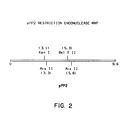
- Restriction maps of pPP1 and pPP2 are represented in Figures 1 and 2, respectively.
- the frequency of the occurrence of DNA cleavage sites with various restriction endonucleases are given in Tables I-III for pPP1 and Tables IV-VI for pPP2.
- Partial Taql digestion of pPP1 and pPP2 was performed in a final volume of 1,000 ⁇ .l comprising 100 ⁇ .l of DNA (from the pPP1 and pPP2 mixtures), with 100 ⁇ .l of a 10X low salt buffer, 50 ⁇ .l of a 2 mg/ml Bovine Serum Albumin (BSA) solution and approximately 750 ⁇ .l H 2 0. Approximately 30 units of Taql enzyme were added to the reaction mixture. The reaction was kept at 65 ° C for about 25 minutes to effectuate partial digestion and then placed on ice in order to curb any further enzymatic degradation.
- BSA Bovine Serum Albumin
- the DNA was precipitated with an equal volume of isopropanol, and a one tenth volume of 5 M NaCl end the mixture was centrifuged for about 1 hour at about 17,000 g. The pellet was resuspended in about 2 ml of TE buffer. Linear sucrose gradients (10%-30%) were prepared for size fractionation of DNA fragments. Gradients were centrifuged for 18 hours et 130,000 g. From these gradients 10 drop fractions were collected and every third fraction was analyzed on 0.8% agarose gels. Like fractions containing the 2-4 kb fragments were pooled and dialyzed for about 7 hours against the TE buffer with four 4 liter changes of buffer.
- 500 ⁇ .l of the pooled 2-4 kB DNA was digested with 10 ⁇ .l of Hhal in the presence of 60 ⁇ .l of 10x medium salts buffer end 30 ⁇ .l BSA (2 mg/ml). The sample was incubated at 37°C for 2 hours in order to digest chromosomal DNA to fragments less than 500 bp in length. (It should be noted that pPP1 and pPP2 DNAs were not cut by the Hhal). DNA was ethanol precipitated (as above) and the pellet vacuum dried and resuspended in TE buffer.
- ligase salts 10X 2.5 ⁇ .l of B SA (2 ⁇ .g/ ⁇ .l), 1 ⁇ .l of ATP (50 mM), and water to 45 ⁇ .l total volume.
- the ligation mixtures, containing either 1, 2, or 10 ⁇ .l of the 2-4 kb Taql fragments were heated to 42 ° C for 5 minutes, and cooled to room temperature.
- 5 ⁇ .l spermidine (40 mM) and 200 units T4 DNA ligase were added end the ligations were performed for 16 hours at 12.50 C in a circulating glycol bath.
- E. coli 848 was then transformed with each of the above three ligation mixtures containing the 2-4 kb fragments, the CaCI method known to those of skill in the art, and described in Maniatis. Transformants were selected on plates containing 40 ⁇ .g/ml of LB-ampicillin (LB-AMP). Selected transformants were transferred to master LB-AMP plates. Pooled colonies from these master plates were used to inoculate 700 ml of AB3-AMP (40 ⁇ .g/ml) (1 liter flask).
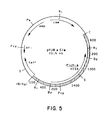
- pKP39 plasmids were isolated using the alkaline SDS isolation as described on page 368 of Maniatis and the plasmid pool of pKP39 DNA was purified on CsCI gradients.
- Pichia pastoris strain GS115 (his4) (NRRL-aY-15851) was transformed as described in Cregg, U.S. Patent No. 4,929,555 issued on May 29, 1990 and assigned to Phillips Petroleum Company, with these pKP39 pooled plasmids in order to select plasmids containing the Pichia linear ARS element. Transformants were selected on histidine deficient plates. Forty individual transformants, designated GS115 (pKP39-1) through GS115 (pKP39-40), were isolated and subsequently grown at 30°C for about 40 hours in 10 ml IM1 + 1% glucose + 1 ml 2X His assay medium. Total yeast DNA was isolated from 1 ml of each pKP39-N culture. Each pKP39-N DNA was subsequently transformed into E. coli for large scale isolation.
Landscapes
- Life Sciences & Earth Sciences (AREA)
- Health & Medical Sciences (AREA)
- Genetics & Genomics (AREA)
- Engineering & Computer Science (AREA)
- Zoology (AREA)
- Wood Science & Technology (AREA)
- Biomedical Technology (AREA)
- Organic Chemistry (AREA)
- Biotechnology (AREA)
- General Engineering & Computer Science (AREA)
- Chemical & Material Sciences (AREA)
- Mycology (AREA)
- Bioinformatics & Cheminformatics (AREA)
- Microbiology (AREA)
- Physics & Mathematics (AREA)
- Plant Pathology (AREA)
- Molecular Biology (AREA)
- Biochemistry (AREA)
- General Health & Medical Sciences (AREA)
- Biophysics (AREA)
- Micro-Organisms Or Cultivation Processes Thereof (AREA)
- Preparation Of Compounds By Using Micro-Organisms (AREA)
Applications Claiming Priority (2)
| Application Number | Priority Date | Filing Date | Title |
|---|---|---|---|
| US07/761,528 US5665600A (en) | 1991-09-18 | 1991-09-18 | Pichia pastoris linear plasmids and DNA fragments thereof |
| US761528 | 1991-09-18 |
Publications (3)
| Publication Number | Publication Date |
|---|---|
| EP0533153A2 true EP0533153A2 (fr) | 1993-03-24 |
| EP0533153A3 EP0533153A3 (en) | 1994-10-05 |
| EP0533153B1 EP0533153B1 (fr) | 1998-11-25 |
Family
ID=25062489
Family Applications (1)
| Application Number | Title | Priority Date | Filing Date |
|---|---|---|---|
| EP92115908A Expired - Lifetime EP0533153B1 (fr) | 1991-09-18 | 1992-09-17 | Plasmides linéaires de Pichia pastoris et leurs fragments |
Country Status (7)
| Country | Link |
|---|---|
| US (1) | US5665600A (fr) |
| EP (1) | EP0533153B1 (fr) |
| JP (1) | JP3238476B2 (fr) |
| AT (1) | ATE173764T1 (fr) |
| CA (1) | CA2078365C (fr) |
| DE (1) | DE69227661T2 (fr) |
| DK (1) | DK0533153T3 (fr) |
Cited By (1)
| Publication number | Priority date | Publication date | Assignee | Title |
|---|---|---|---|---|
| US10076564B2 (en) | 2013-04-26 | 2018-09-18 | Katholieke Universiteit Leuven | Bacterial artificial chromosomes |
Families Citing this family (5)
| Publication number | Priority date | Publication date | Assignee | Title |
|---|---|---|---|---|
| CA2374050A1 (fr) * | 1999-05-20 | 2000-11-30 | Scios Inc. | Dimeres, facteurs de croissance de l'endothelium vasculaire |
| JP2003507006A (ja) * | 1999-05-20 | 2003-02-25 | サイオス,インコーポレーテッド | 血管内皮増殖因子改変体 |
| US7009045B2 (en) * | 2000-07-14 | 2006-03-07 | Archer-Daniels-Midland Company | Transformation systems for flavinogenic yeast |
| SG188846A1 (en) * | 2008-03-03 | 2013-04-30 | Abbott Lab | Methods for transforming yeast |
| CN113481225A (zh) * | 2021-07-23 | 2021-10-08 | 武汉瀚海新酶生物科技有限公司 | 一种蛋白酶k高表达工程菌株的构建及应用 |
Family Cites Families (6)
| Publication number | Priority date | Publication date | Assignee | Title |
|---|---|---|---|---|
| US4477571A (en) * | 1981-02-09 | 1984-10-16 | Cetus Corporation | Chimeric plasmids that replicate in bacteria and yeast and microorganisms transformed therewith |
| JPS57146571A (en) * | 1981-03-09 | 1982-09-10 | Mitsubishi Chem Ind Ltd | Killer yeast |
| EP0105149B1 (fr) * | 1982-08-16 | 1990-05-16 | Science and Technology Agency, Minister's Secretariat, Director of Finance Division | Plasmide recombinant contenant le gène du virus de l'hépatite B, levure transformée avec ce plasmide recombinant et production de l'antigène de surface du virus de l'hépatite B |
| US4879231A (en) * | 1984-10-30 | 1989-11-07 | Phillips Petroleum Company | Transformation of yeasts of the genus pichia |
| US4837148A (en) * | 1984-10-30 | 1989-06-06 | Phillips Petroleum Company | Autonomous replication sequences for yeast strains of the genus pichia |
| US4882279A (en) * | 1985-10-25 | 1989-11-21 | Phillips Petroleum Company | Site selective genomic modification of yeast of the genus pichia |
-
1991
- 1991-09-18 US US07/761,528 patent/US5665600A/en not_active Expired - Fee Related
-
1992
- 1992-07-03 JP JP17707892A patent/JP3238476B2/ja not_active Expired - Fee Related
- 1992-09-16 CA CA002078365A patent/CA2078365C/fr not_active Expired - Fee Related
- 1992-09-17 AT AT92115908T patent/ATE173764T1/de not_active IP Right Cessation
- 1992-09-17 EP EP92115908A patent/EP0533153B1/fr not_active Expired - Lifetime
- 1992-09-17 DE DE69227661T patent/DE69227661T2/de not_active Expired - Fee Related
- 1992-09-17 DK DK92115908T patent/DK0533153T3/da active
Cited By (1)
| Publication number | Priority date | Publication date | Assignee | Title |
|---|---|---|---|---|
| US10076564B2 (en) | 2013-04-26 | 2018-09-18 | Katholieke Universiteit Leuven | Bacterial artificial chromosomes |
Also Published As
| Publication number | Publication date |
|---|---|
| JP3238476B2 (ja) | 2001-12-17 |
| US5665600A (en) | 1997-09-09 |
| CA2078365A1 (fr) | 1993-03-19 |
| JPH05260973A (ja) | 1993-10-12 |
| EP0533153A3 (en) | 1994-10-05 |
| ATE173764T1 (de) | 1998-12-15 |
| DK0533153T3 (da) | 1999-08-09 |
| EP0533153B1 (fr) | 1998-11-25 |
| DE69227661T2 (de) | 1999-04-29 |
| CA2078365C (fr) | 1996-06-11 |
| DE69227661D1 (de) | 1999-01-07 |
Similar Documents
| Publication | Publication Date | Title |
|---|---|---|
| CA1273882A (fr) | Sequences de replication autonome pour des souches de levure du genre pichia | |
| EP0183071B1 (fr) | Région de régulation pour l'expression de gène hétérologue dans de la levure | |
| US4977247A (en) | Immobilized protein G variants and the use thereof | |
| JP2710610B2 (ja) | 機能遺伝子を含むdna断片 | |
| Mobley et al. | Cloning and expression of R-factor mediated arsenate resistance in Escherichia coli | |
| JPS62104585A (ja) | ピチア属酵母の部位選択的ゲノム修飾 | |
| US4956296A (en) | Cloned streptococcal genes encoding protein G and their use to construct recombinant microorganisms to produce protein G | |
| CA2038706A1 (fr) | Vecteurs bacteriens | |
| US4954618A (en) | Cloned streptococcal genes encoding protein G and their use to construct recombinant microorganisms to produce protein G | |
| US5312901A (en) | Cloned streptococcal genes encoding protein G and their use to construct recombinant microorganisms to produce protein G | |
| US5082773A (en) | Cloned streptococcal genes encoding protein G and their use to construct recombinant microorganisms to produce protein G | |
| US5037744A (en) | Process for the microbiological preparation of human serum albumin | |
| EP0533153B1 (fr) | Plasmides linéaires de Pichia pastoris et leurs fragments | |
| WO1987005025A1 (fr) | Genes streptococcyques clones codant la proteine g et leur utilisation pour construire des micro-organismes recombinants produisant la proteine g | |
| US4477571A (en) | Chimeric plasmids that replicate in bacteria and yeast and microorganisms transformed therewith | |
| US5683893A (en) | Mutant AOX2 promoter, vector carrying same, transformant, and production of heterlogous protein | |
| US5702921A (en) | Expression of biologically active human C-reactive protein in escherichia coli | |
| US5229492A (en) | Cloned streptococcal genes encoding protein G and their use to construct recombinant microorganisms to produce protein G | |
| EP0248227A1 (fr) | Production de streptokinase à partir de cellules de levure | |
| US5707827A (en) | Mutant AOX2 promoter, vector carrying same, transformant and production of heterologous protein | |
| US4837147A (en) | PhO81 promotor of Saccharomyces cerevisiae and use thereof for heterologous gene expression | |
| JPH03262487A (ja) | ヒト血清アルブミンの安定な製造方法 | |
| JPS5936697A (ja) | プラスミドpSL1及びその含有菌株 | |
| GB2188050A (en) | pWS101 plasmid, method of obtaining same and use thereof | |
| JPS63237788A (ja) | 新規多コピ−性プラスミド |
Legal Events
| Date | Code | Title | Description |
|---|---|---|---|
| PUAI | Public reference made under article 153(3) epc to a published international application that has entered the european phase |
Free format text: ORIGINAL CODE: 0009012 |
|
| AK | Designated contracting states |
Kind code of ref document: A2 Designated state(s): AT BE CH DE DK FR GB GR IT LI NL SE |
|
| RAP1 | Party data changed (applicant data changed or rights of an application transferred) |
Owner name: RESEARCH CORPORATION TECHNOLOGIES, INC. |
|
| RHK1 | Main classification (correction) |
Ipc: C12N 15/81 |
|
| PUAL | Search report despatched |
Free format text: ORIGINAL CODE: 0009013 |
|
| AK | Designated contracting states |
Kind code of ref document: A3 Designated state(s): AT BE CH DE DK FR GB GR IT LI NL SE |
|
| 17P | Request for examination filed |
Effective date: 19941201 |
|
| 17Q | First examination report despatched |
Effective date: 19951026 |
|
| GRAG | Despatch of communication of intention to grant |
Free format text: ORIGINAL CODE: EPIDOS AGRA |
|
| GRAG | Despatch of communication of intention to grant |
Free format text: ORIGINAL CODE: EPIDOS AGRA |
|
| GRAG | Despatch of communication of intention to grant |
Free format text: ORIGINAL CODE: EPIDOS AGRA |
|
| GRAH | Despatch of communication of intention to grant a patent |
Free format text: ORIGINAL CODE: EPIDOS IGRA |
|
| GRAH | Despatch of communication of intention to grant a patent |
Free format text: ORIGINAL CODE: EPIDOS IGRA |
|
| GRAA | (expected) grant |
Free format text: ORIGINAL CODE: 0009210 |
|
| AK | Designated contracting states |
Kind code of ref document: B1 Designated state(s): AT BE CH DE DK FR GB GR IT LI NL SE |
|
| PG25 | Lapsed in a contracting state [announced via postgrant information from national office to epo] |
Ref country code: SE Free format text: THE PATENT HAS BEEN ANNULLED BY A DECISION OF A NATIONAL AUTHORITY Effective date: 19981125 Ref country code: GR Free format text: LAPSE BECAUSE OF NON-PAYMENT OF DUE FEES Effective date: 19981125 |
|
| REF | Corresponds to: |
Ref document number: 173764 Country of ref document: AT Date of ref document: 19981215 Kind code of ref document: T |
|
| REG | Reference to a national code |
Ref country code: CH Ref legal event code: NV Representative=s name: R. A. EGLI & CO. PATENTANWAELTE Ref country code: CH Ref legal event code: EP |
|
| REF | Corresponds to: |
Ref document number: 69227661 Country of ref document: DE Date of ref document: 19990107 |
|
| ET | Fr: translation filed | ||
| ITF | It: translation for a ep patent filed | ||
| REG | Reference to a national code |
Ref country code: DK Ref legal event code: T3 |
|
| PLBE | No opposition filed within time limit |
Free format text: ORIGINAL CODE: 0009261 |
|
| 26N | No opposition filed | ||
| REG | Reference to a national code |
Ref country code: GB Ref legal event code: IF02 |
|
| PGFP | Annual fee paid to national office [announced via postgrant information from national office to epo] |
Ref country code: NL Payment date: 20040809 Year of fee payment: 13 Ref country code: DK Payment date: 20040809 Year of fee payment: 13 Ref country code: AT Payment date: 20040809 Year of fee payment: 13 |
|
| PGFP | Annual fee paid to national office [announced via postgrant information from national office to epo] |
Ref country code: GB Payment date: 20040812 Year of fee payment: 13 |
|
| PGFP | Annual fee paid to national office [announced via postgrant information from national office to epo] |
Ref country code: FR Payment date: 20040902 Year of fee payment: 13 |
|
| PGFP | Annual fee paid to national office [announced via postgrant information from national office to epo] |
Ref country code: CH Payment date: 20040914 Year of fee payment: 13 |
|
| PGFP | Annual fee paid to national office [announced via postgrant information from national office to epo] |
Ref country code: BE Payment date: 20040928 Year of fee payment: 13 |
|
| PGFP | Annual fee paid to national office [announced via postgrant information from national office to epo] |
Ref country code: DE Payment date: 20040930 Year of fee payment: 13 |
|
| PG25 | Lapsed in a contracting state [announced via postgrant information from national office to epo] |
Ref country code: IT Free format text: LAPSE BECAUSE OF NON-PAYMENT OF DUE FEES Effective date: 20050917 Ref country code: AT Free format text: LAPSE BECAUSE OF NON-PAYMENT OF DUE FEES Effective date: 20050917 |
|
| PG25 | Lapsed in a contracting state [announced via postgrant information from national office to epo] |
Ref country code: LI Free format text: LAPSE BECAUSE OF NON-PAYMENT OF DUE FEES Effective date: 20050930 Ref country code: DK Free format text: LAPSE BECAUSE OF NON-PAYMENT OF DUE FEES Effective date: 20050930 Ref country code: CH Free format text: LAPSE BECAUSE OF NON-PAYMENT OF DUE FEES Effective date: 20050930 Ref country code: BE Free format text: LAPSE BECAUSE OF NON-PAYMENT OF DUE FEES Effective date: 20050930 |
|
| PG25 | Lapsed in a contracting state [announced via postgrant information from national office to epo] |
Ref country code: NL Free format text: LAPSE BECAUSE OF NON-PAYMENT OF DUE FEES Effective date: 20060401 Ref country code: DE Free format text: LAPSE BECAUSE OF NON-PAYMENT OF DUE FEES Effective date: 20060401 |
|
| REG | Reference to a national code |
Ref country code: DK Ref legal event code: EBP |
|
| REG | Reference to a national code |
Ref country code: CH Ref legal event code: PL |
|
| GBPC | Gb: european patent ceased through non-payment of renewal fee |
Effective date: 20050917 |
|
| PG25 | Lapsed in a contracting state [announced via postgrant information from national office to epo] |
Ref country code: FR Free format text: LAPSE BECAUSE OF NON-PAYMENT OF DUE FEES Effective date: 20060531 |
|
| NLV4 | Nl: lapsed or anulled due to non-payment of the annual fee |
Effective date: 20060401 |
|
| REG | Reference to a national code |
Ref country code: FR Ref legal event code: ST Effective date: 20060531 |
|
| BERE | Be: lapsed |
Owner name: *RESEARCH CORP. TECHNOLOGIES INC. Effective date: 20050930 |