EP0534015A1 - Copolymère greffé thermiquement réversible - Google Patents
Copolymère greffé thermiquement réversible Download PDFInfo
- Publication number
- EP0534015A1 EP0534015A1 EP91250260A EP91250260A EP0534015A1 EP 0534015 A1 EP0534015 A1 EP 0534015A1 EP 91250260 A EP91250260 A EP 91250260A EP 91250260 A EP91250260 A EP 91250260A EP 0534015 A1 EP0534015 A1 EP 0534015A1
- Authority
- EP
- European Patent Office
- Prior art keywords
- acrylamide
- methacrylamide
- graft copolymer
- polymer
- substituted
- Prior art date
- Legal status (The legal status is an assumption and is not a legal conclusion. Google has not performed a legal analysis and makes no representation as to the accuracy of the status listed.)
- Withdrawn
Links
- 229920000578 graft copolymer Polymers 0.000 title claims abstract description 33
- 230000002441 reversible effect Effects 0.000 title claims abstract description 19
- 229920000642 polymer Polymers 0.000 claims abstract description 24
- -1 N-substituted acrylamide Chemical class 0.000 claims abstract description 23
- FQPSGWSUVKBHSU-UHFFFAOYSA-N methacrylamide Chemical class CC(=C)C(N)=O FQPSGWSUVKBHSU-UHFFFAOYSA-N 0.000 claims abstract description 22
- 229920002554 vinyl polymer Polymers 0.000 claims abstract description 12
- 239000000178 monomer Substances 0.000 claims description 17
- BZHJMEDXRYGGRV-UHFFFAOYSA-N Vinyl chloride Chemical group ClC=C BZHJMEDXRYGGRV-UHFFFAOYSA-N 0.000 claims description 15
- SOGAXMICEFXMKE-UHFFFAOYSA-N Butylmethacrylate Chemical compound CCCCOC(=O)C(C)=C SOGAXMICEFXMKE-UHFFFAOYSA-N 0.000 claims description 10
- 238000000034 method Methods 0.000 claims description 10
- 229920001577 copolymer Polymers 0.000 claims description 9
- 230000002209 hydrophobic effect Effects 0.000 claims description 7
- HRPVXLWXLXDGHG-UHFFFAOYSA-N Acrylamide Chemical compound NC(=O)C=C HRPVXLWXLXDGHG-UHFFFAOYSA-N 0.000 claims description 6
- QNILTEGFHQSKFF-UHFFFAOYSA-N n-propan-2-ylprop-2-enamide Chemical compound CC(C)NC(=O)C=C QNILTEGFHQSKFF-UHFFFAOYSA-N 0.000 claims description 6
- RESPXSHDJQUNTN-UHFFFAOYSA-N 1-piperidin-1-ylprop-2-en-1-one Chemical compound C=CC(=O)N1CCCCC1 RESPXSHDJQUNTN-UHFFFAOYSA-N 0.000 claims description 3
- WLPAQAXAZQUXBG-UHFFFAOYSA-N 1-pyrrolidin-1-ylprop-2-en-1-one Chemical compound C=CC(=O)N1CCCC1 WLPAQAXAZQUXBG-UHFFFAOYSA-N 0.000 claims description 3
- YQIGLEFUZMIVHU-UHFFFAOYSA-N 2-methyl-n-propan-2-ylprop-2-enamide Chemical compound CC(C)NC(=O)C(C)=C YQIGLEFUZMIVHU-UHFFFAOYSA-N 0.000 claims description 3
- CCIDRBFZPRURMU-UHFFFAOYSA-N 2-methyl-n-propylprop-2-enamide Chemical compound CCCNC(=O)C(C)=C CCIDRBFZPRURMU-UHFFFAOYSA-N 0.000 claims description 3
- 229920001519 homopolymer Polymers 0.000 claims description 3
- OVHHHVAVHBHXAK-UHFFFAOYSA-N n,n-diethylprop-2-enamide Chemical compound CCN(CC)C(=O)C=C OVHHHVAVHBHXAK-UHFFFAOYSA-N 0.000 claims description 3
- FIBUWQFQYAAXHD-UHFFFAOYSA-N n-cyclopropyl-2-methylprop-2-enamide Chemical compound CC(=C)C(=O)NC1CC1 FIBUWQFQYAAXHD-UHFFFAOYSA-N 0.000 claims description 3
- LCXIFAOALNZGDO-UHFFFAOYSA-N n-cyclopropylprop-2-enamide Chemical compound C=CC(=O)NC1CC1 LCXIFAOALNZGDO-UHFFFAOYSA-N 0.000 claims description 3
- SWPMNMYLORDLJE-UHFFFAOYSA-N n-ethylprop-2-enamide Chemical compound CCNC(=O)C=C SWPMNMYLORDLJE-UHFFFAOYSA-N 0.000 claims description 3
- 150000003839 salts Chemical class 0.000 claims description 3
- 229920002818 (Hydroxyethyl)methacrylate Polymers 0.000 claims description 2
- SMZOUWXMTYCWNB-UHFFFAOYSA-N 2-(2-methoxy-5-methylphenyl)ethanamine Chemical compound COC1=CC=C(C)C=C1CCN SMZOUWXMTYCWNB-UHFFFAOYSA-N 0.000 claims description 2
- SJIXRGNQPBQWMK-UHFFFAOYSA-N 2-(diethylamino)ethyl 2-methylprop-2-enoate Chemical compound CCN(CC)CCOC(=O)C(C)=C SJIXRGNQPBQWMK-UHFFFAOYSA-N 0.000 claims description 2
- JKNCOURZONDCGV-UHFFFAOYSA-N 2-(dimethylamino)ethyl 2-methylprop-2-enoate Chemical compound CN(C)CCOC(=O)C(C)=C JKNCOURZONDCGV-UHFFFAOYSA-N 0.000 claims description 2
- NIXOWILDQLNWCW-UHFFFAOYSA-N 2-Propenoic acid Natural products OC(=O)C=C NIXOWILDQLNWCW-UHFFFAOYSA-N 0.000 claims description 2
- OMIGHNLMNHATMP-UHFFFAOYSA-N 2-hydroxyethyl prop-2-enoate Chemical compound OCCOC(=O)C=C OMIGHNLMNHATMP-UHFFFAOYSA-N 0.000 claims description 2
- AGBXYHCHUYARJY-UHFFFAOYSA-N 2-phenylethenesulfonic acid Chemical compound OS(=O)(=O)C=CC1=CC=CC=C1 AGBXYHCHUYARJY-UHFFFAOYSA-N 0.000 claims description 2
- KGIGUEBEKRSTEW-UHFFFAOYSA-N 2-vinylpyridine Chemical compound C=CC1=CC=CC=N1 KGIGUEBEKRSTEW-UHFFFAOYSA-N 0.000 claims description 2
- JIGUQPWFLRLWPJ-UHFFFAOYSA-N Ethyl acrylate Chemical compound CCOC(=O)C=C JIGUQPWFLRLWPJ-UHFFFAOYSA-N 0.000 claims description 2
- WOBHKFSMXKNTIM-UHFFFAOYSA-N Hydroxyethyl methacrylate Chemical compound CC(=C)C(=O)OCCO WOBHKFSMXKNTIM-UHFFFAOYSA-N 0.000 claims description 2
- CERQOIWHTDAKMF-UHFFFAOYSA-N Methacrylic acid Chemical compound CC(=C)C(O)=O CERQOIWHTDAKMF-UHFFFAOYSA-N 0.000 claims description 2
- VVQNEPGJFQJSBK-UHFFFAOYSA-N Methyl methacrylate Chemical compound COC(=O)C(C)=C VVQNEPGJFQJSBK-UHFFFAOYSA-N 0.000 claims description 2
- WHNWPMSKXPGLAX-UHFFFAOYSA-N N-Vinyl-2-pyrrolidone Chemical compound C=CN1CCCC1=O WHNWPMSKXPGLAX-UHFFFAOYSA-N 0.000 claims description 2
- VOZRXNHHFUQHIL-UHFFFAOYSA-N glycidyl methacrylate Chemical compound CC(=C)C(=O)OCC1CO1 VOZRXNHHFUQHIL-UHFFFAOYSA-N 0.000 claims description 2
- DFENKTCEEGOWLB-UHFFFAOYSA-N n,n-bis(methylamino)-2-methylidenepentanamide Chemical compound CCCC(=C)C(=O)N(NC)NC DFENKTCEEGOWLB-UHFFFAOYSA-N 0.000 claims description 2
- YPHQUSNPXDGUHL-UHFFFAOYSA-N n-methylprop-2-enamide Chemical compound CNC(=O)C=C YPHQUSNPXDGUHL-UHFFFAOYSA-N 0.000 claims description 2
- PNJWIWWMYCMZRO-UHFFFAOYSA-N pent‐4‐en‐2‐one Natural products CC(=O)CC=C PNJWIWWMYCMZRO-UHFFFAOYSA-N 0.000 claims description 2
- NLVXSWCKKBEXTG-UHFFFAOYSA-N vinylsulfonic acid Chemical compound OS(=O)(=O)C=C NLVXSWCKKBEXTG-UHFFFAOYSA-N 0.000 claims description 2
- 230000001747 exhibiting effect Effects 0.000 claims 1
- UACSZOWTRIJIFU-UHFFFAOYSA-N hydroxymethyl 2-methylprop-2-enoate Chemical compound CC(=C)C(=O)OCO UACSZOWTRIJIFU-UHFFFAOYSA-N 0.000 claims 1
- GJIDOLBZYSCZRX-UHFFFAOYSA-N hydroxymethyl prop-2-enoate Chemical compound OCOC(=O)C=C GJIDOLBZYSCZRX-UHFFFAOYSA-N 0.000 claims 1
- 229920003213 poly(N-isopropyl acrylamide) Polymers 0.000 description 18
- 229920000915 polyvinyl chloride Polymers 0.000 description 15
- 239000004800 polyvinyl chloride Substances 0.000 description 15
- XLYOFNOQVPJJNP-UHFFFAOYSA-N water Substances O XLYOFNOQVPJJNP-UHFFFAOYSA-N 0.000 description 15
- ZMXDDKWLCZADIW-UHFFFAOYSA-N N,N-Dimethylformamide Chemical compound CN(C)C=O ZMXDDKWLCZADIW-UHFFFAOYSA-N 0.000 description 11
- WYURNTSHIVDZCO-UHFFFAOYSA-N Tetrahydrofuran Chemical compound C1CCOC1 WYURNTSHIVDZCO-UHFFFAOYSA-N 0.000 description 10
- LMBWSYZSUOEYSN-UHFFFAOYSA-N diethyldithiocarbamic acid Chemical group CCN(CC)C(S)=S LMBWSYZSUOEYSN-UHFFFAOYSA-N 0.000 description 8
- OKKJLVBELUTLKV-UHFFFAOYSA-N Methanol Chemical compound OC OKKJLVBELUTLKV-UHFFFAOYSA-N 0.000 description 6
- 239000012528 membrane Substances 0.000 description 6
- 239000000243 solution Substances 0.000 description 6
- 238000006243 chemical reaction Methods 0.000 description 5
- JHIVVAPYMSGYDF-UHFFFAOYSA-N cyclohexanone Chemical compound O=C1CCCCC1 JHIVVAPYMSGYDF-UHFFFAOYSA-N 0.000 description 4
- 238000010559 graft polymerization reaction Methods 0.000 description 3
- 238000006116 polymerization reaction Methods 0.000 description 3
- CSCPPACGZOOCGX-UHFFFAOYSA-N Acetone Chemical compound CC(C)=O CSCPPACGZOOCGX-UHFFFAOYSA-N 0.000 description 2
- FAPWRFPIFSIZLT-UHFFFAOYSA-M Sodium chloride Chemical compound [Na+].[Cl-] FAPWRFPIFSIZLT-UHFFFAOYSA-M 0.000 description 2
- XTXRWKRVRITETP-UHFFFAOYSA-N Vinyl acetate Chemical compound CC(=O)OC=C XTXRWKRVRITETP-UHFFFAOYSA-N 0.000 description 2
- 230000015572 biosynthetic process Effects 0.000 description 2
- 238000000113 differential scanning calorimetry Methods 0.000 description 2
- 229950004394 ditiocarb Drugs 0.000 description 2
- QSHDDOUJBYECFT-UHFFFAOYSA-N mercury Chemical compound [Hg] QSHDDOUJBYECFT-UHFFFAOYSA-N 0.000 description 2
- 229910052753 mercury Inorganic materials 0.000 description 2
- 239000000203 mixture Substances 0.000 description 2
- 150000003254 radicals Chemical class 0.000 description 2
- 239000011734 sodium Substances 0.000 description 2
- 238000000807 solvent casting Methods 0.000 description 2
- YLQBMQCUIZJEEH-UHFFFAOYSA-N tetrahydrofuran Natural products C=1C=COC=1 YLQBMQCUIZJEEH-UHFFFAOYSA-N 0.000 description 2
- 239000004342 Benzoyl peroxide Substances 0.000 description 1
- OMPJBNCRMGITSC-UHFFFAOYSA-N Benzoylperoxide Chemical compound C=1C=CC=CC=1C(=O)OOC(=O)C1=CC=CC=C1 OMPJBNCRMGITSC-UHFFFAOYSA-N 0.000 description 1
- VGGSQFUCUMXWEO-UHFFFAOYSA-N Ethene Chemical compound C=C VGGSQFUCUMXWEO-UHFFFAOYSA-N 0.000 description 1
- 239000005977 Ethylene Substances 0.000 description 1
- VCUFZILGIRCDQQ-KRWDZBQOSA-N N-[[(5S)-2-oxo-3-(2-oxo-3H-1,3-benzoxazol-6-yl)-1,3-oxazolidin-5-yl]methyl]-2-[[3-(trifluoromethoxy)phenyl]methylamino]pyrimidine-5-carboxamide Chemical compound O=C1O[C@H](CN1C1=CC2=C(NC(O2)=O)C=C1)CNC(=O)C=1C=NC(=NC=1)NCC1=CC(=CC=C1)OC(F)(F)F VCUFZILGIRCDQQ-KRWDZBQOSA-N 0.000 description 1
- 150000001252 acrylic acid derivatives Chemical class 0.000 description 1
- 239000003463 adsorbent Substances 0.000 description 1
- 238000013019 agitation Methods 0.000 description 1
- 238000004458 analytical method Methods 0.000 description 1
- 239000007864 aqueous solution Substances 0.000 description 1
- 239000012298 atmosphere Substances 0.000 description 1
- 235000019400 benzoyl peroxide Nutrition 0.000 description 1
- 238000004113 cell culture Methods 0.000 description 1
- 239000011248 coating agent Substances 0.000 description 1
- 150000001875 compounds Chemical class 0.000 description 1
- 239000011557 critical solution Substances 0.000 description 1
- 238000004132 cross linking Methods 0.000 description 1
- 230000018044 dehydration Effects 0.000 description 1
- 238000006297 dehydration reaction Methods 0.000 description 1
- 239000008367 deionised water Substances 0.000 description 1
- 229910021641 deionized water Inorganic materials 0.000 description 1
- 238000004090 dissolution Methods 0.000 description 1
- 239000012153 distilled water Substances 0.000 description 1
- 230000000694 effects Effects 0.000 description 1
- 238000000921 elemental analysis Methods 0.000 description 1
- 235000013305 food Nutrition 0.000 description 1
- 239000011521 glass Substances 0.000 description 1
- 230000036571 hydration Effects 0.000 description 1
- 238000006703 hydration reaction Methods 0.000 description 1
- 239000011261 inert gas Substances 0.000 description 1
- 239000003999 initiator Substances 0.000 description 1
- 238000002347 injection Methods 0.000 description 1
- 239000007924 injection Substances 0.000 description 1
- 230000001678 irradiating effect Effects 0.000 description 1
- 239000000463 material Substances 0.000 description 1
- 239000012567 medical material Substances 0.000 description 1
- 150000002734 metacrylic acid derivatives Chemical class 0.000 description 1
- 239000003960 organic solvent Substances 0.000 description 1
- 238000004806 packaging method and process Methods 0.000 description 1
- 238000006303 photolysis reaction Methods 0.000 description 1
- 230000015843 photosynthesis, light reaction Effects 0.000 description 1
- 229920006267 polyester film Polymers 0.000 description 1
- 238000001556 precipitation Methods 0.000 description 1
- 230000005855 radiation Effects 0.000 description 1
- 229920005604 random copolymer Polymers 0.000 description 1
- 229920005989 resin Polymers 0.000 description 1
- 239000011347 resin Substances 0.000 description 1
- 238000000926 separation method Methods 0.000 description 1
- 238000002791 soaking Methods 0.000 description 1
- 239000011780 sodium chloride Substances 0.000 description 1
- 239000002904 solvent Substances 0.000 description 1
- 239000000126 substance Substances 0.000 description 1
- 239000000758 substrate Substances 0.000 description 1
- 229920000208 temperature-responsive polymer Polymers 0.000 description 1
- 238000012719 thermal polymerization Methods 0.000 description 1
- 230000007704 transition Effects 0.000 description 1
- 238000005406 washing Methods 0.000 description 1
- 229920003169 water-soluble polymer Polymers 0.000 description 1
Images
Classifications
-
- C—CHEMISTRY; METALLURGY
- C08—ORGANIC MACROMOLECULAR COMPOUNDS; THEIR PREPARATION OR CHEMICAL WORKING-UP; COMPOSITIONS BASED THEREON
- C08F—MACROMOLECULAR COMPOUNDS OBTAINED BY REACTIONS ONLY INVOLVING CARBON-TO-CARBON UNSATURATED BONDS
- C08F259/00—Macromolecular compounds obtained by polymerising monomers on to polymers of halogen containing monomers as defined in group C08F14/00
- C08F259/02—Macromolecular compounds obtained by polymerising monomers on to polymers of halogen containing monomers as defined in group C08F14/00 on to polymers containing chlorine
- C08F259/04—Macromolecular compounds obtained by polymerising monomers on to polymers of halogen containing monomers as defined in group C08F14/00 on to polymers containing chlorine on to polymers of vinyl chloride
Definitions
- This invention relates to a thermally reversible graft polymer. More specifically, it relates to a vinyl polymer comprising vinyl chloride units graft-polymerized with a polymer of N-substituted acrylamide or methacrylamide derivative alone or a copolymer of N-substituted acrylamide or methacrylamide derivative together with a monomer copolymerizable therewith.
- thermally reversible polymers those which, in a state of an aqueous solution, show a special reversible solubility behavior such as precipitation and formation of white turbidity at a temperature higher than the LCST (lower critical solution temperature which is the transition temperature for the hydration and dehydration of temperature-responsive polymer) and dissolution and becoming clear at the temperature lower than the LCST, are called thermally reversible polymers.
- Thermally reversible polymers are being applied in light-shielding members or adsorbents.
- the thermally reversible polymer itself can dissolve in water at low temperatures, it has to be insolubilized or immobilized by some method such as by formation of crosslinking or by grafting to a supporting member, in order to make it available for wider application.
- This invention provides a thermally reversible graft copolymer which avoids the problems of the conventional thermally reversible polymers by carrying out graft polymerization with polymers comprising vinyl chloride units (e.g., the general purpose polyvinyl chloride resins which are widely used in sheets, films, tubes, and injection molded articles, etc.).
- vinyl chloride units e.g., the general purpose polyvinyl chloride resins which are widely used in sheets, films, tubes, and injection molded articles, etc.
- a graft copolymer in accordance with the invention is prepared by grafting component A: a polymer of an N-substituted acrylamide or methacrylamide derivative or component A': a copolymer of N-substituted acrylamide or methacrylamide derivative and a monomer copolymerizable therewith onto component B a vinyl polymer comprising vinyl chloride units.
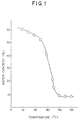
- Fig. 1 is a graph showing the relationship between the water content of a polyvinyl chloride graftpolymerized with poly(N-isopropyl acrylamide) and temperature.
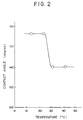
- Fig. 2 is a graph showing the relationship between the contact angle of polyvinyl chloride graftpolymerized with poly(N-isopropyl acrylamide) and temperature.
- Exemplary N-substituted acrylamide or methacrylamide derivatives forming the polymer component A which can be graftpolymerized on the vinyl polymer comprising vinyl chloride units in the present invention include N-acryloyl piperidine, N-n-propyl methacrylamide, N-isopropyl acrylamide, N,N-diethyl acrylamide, N-isopropyl methacrylamide, N-cyclopropyl acrylamide, N-acryloyl pyrrolidine, N,N-ethylmethyl acrylamide, N-cyclopropyl methacrylamide and N-ethyl acrylamide.
- any monomers which are copolymerizable with the above described N-substituted acrylamide or methacrylamide derivatives can be employed to form component A'.
- copolymerizable monomers which can be employed in the present invention include hydrophilic monomers such as N-vinyl pyrrolidone, vinyl pyridine, acrylamide, methacrylamide, N-methyl acrylamide, hydroxyethyl methacrylate, hydroxyethyl acrylate, acrylic acid and methacrylic acid and their salts, vinylsulfonic acid, styrenesulfonic acid; compounds having basic groups such as N,N-dimethylaminoethyl methacrylate, N,N-diethylaminoethyl methacrylate, N,N-dimethylaminopropyl acrylamide and their salts; and hydrophobic monomers such as acrylates or methacrylates including ethyl acrylate, methyl methacrylate, n-but
- the LCST of the graft copolymer can be easily controlled by properly selecting the copolymerizable monomer. If it is desired to obtain a graft copolymer having a relatively high LCST, a hydrophilic monomer is preferably copolymerized with the acrylamide or methacrylamide derivative. If it is desired to obtain a graft copolymer having a relatively low LCST, a hydrophobic monomer is preferably copolymerized.
- the LCST of the graft copolymer can be measured by the differential scanning calorimetry.
- any vinyl polymers comprising vinyl chloride units can be employed in the present invention as component B.
- exemplary vinyl polymers include vinyl chloride homopolymers, copolymers of vinyl chloride and vinyl acetate, and copolymers of vinyl chloride, vinyl acetate and ethylene.
- the copolymers it is preferred that the copolymers contain at least 10 weight % vinyl chloride units in order to use various characteristic features which polyvinyl chloride possesses.
- the graft copolymer can be obtained by thermal polymerization forming of component A or component A' in the presence of component B with the use of a hydrogen-abstracting type radical initiator, such as benzoyl peroxide, to run a chain transfer.
- the graft copolymer can be obtained by the so-called "photograft polymerization" i.e., a photo-functional group is incorporated in component B and component A or component A' is grafted to component B by using the radical formed by the photolysis of the photofunctional group.
- the photograft polymerization can control the amount of active sites.
- the structure and the position of grafting obtained with the photografting technique are more desirable because a polymer having a high grafting ratio and a better molecular design can be obtained.
- N,N-dialkyldithiocarbamate groups are preferred as such photo-functional groups, and diethyldithiocarbamate group (herein "DTC group") is particularly preferred because it is easier to incorporate and leads to a higher stability product.
- DTC group diethyldithiocarbamate group
- a vinyl polymer comprising vinyl chloride units is mixed with sodium diethyldithiocarbamate in N,N-dimethylformamide and then heated at 50 to 60°C to easily obtain a photofunctional stem polymer containing DTC group.
- This component B polymer can be easily photo-graft polymerized with component A or A' by dissolving the monomers of components A or A' in a solvent such as tetrahydrofuran, dimethylformamide and cyclohexanone and irradiating in an inert gas atmosphere with ultraviolet radiation by using, for example, a high pressure mercury lamp.
- a solvent such as tetrahydrofuran, dimethylformamide and cyclohexanone
- the ratio of component A or component A' to component B in the graft copolymer of the present invention can be arbitrarily varied. However, it is preferred that the amount of component A or component A' is higher than about 5 weight %, where the effect of the graft polymerization starts to appear, more preferably higher than 10 weight %.
- the graft copolymer of this invention thus obtained shows thermally reversible behavior like the thermally reversible homopolymer. Further, the graft copolymer of the present invention does not dissolve in water at low temperatures and excels also in moldability and mechanical properties.
- the graft copolymer of the present invention is soluble in a volatile organic solvent such as tetrahydrofuran, dimethylformaldehyde and cyclohexanone and accordingly can easily be fixed on the surfaces of various substrates such as sheets, plates, films, and filters by the so-called solvent casting.
- a volatile organic solvent such as tetrahydrofuran, dimethylformaldehyde and cyclohexanone
- various products or articles now exsisting can easily be imparted thermal reversibility with the graft copolymer of the present invention.
- the thermally reversible vinyl chloride graft polymers is useful as a medical material, as a coating agent for cell cultures, as a material for packaging foods, as a selective permeable membrane, as a separation membrane, as a light-shielding member for greenhouse, etc.
- polyvinyl chloride 100 g (herein "PVC", degree of polymerization: about 1100, a product of Wako Pure Chemical Industries, Ltd.) was dissolved in dimethylformamide (herein “DMF”) 2 liters, and then sodium diethyldithiocarbamate (herein “DTC-Na”) about 3 g was added to carry out the reaction at 60°C for 4 hours with agitation. After completion of the reaction, the polymer solution was added dropwise in a water/methanol (volume ratio: 1/1) mixed medium to precipitate the polymer.
- DMF dimethylformamide
- DTC-Na sodium diethyldithiocarbamate
- DTC-PVC DTC-modified polyvinyl chloride
- DTC group diethyldithiocarbamate group
- the DTC-PVC thus prepared 10 g and N-isopropyl acrylamide (herein "NIPAAm”) 50 g were dissolved in about one liter of THF, and photo-graft polymerized at 30°C for 12 hours by using a 100 W high pressure mercury lamp to irradiate from outside. During this process, the NIPAAm was polymerized to form "PNIPAAm” grafted to the PVC ("PVC-graft-PNIAAm"). The graft copolymer solution thus obtained was added dropwise to a water/methanol (volume ratio: 1/1) mixed medium to precipitate the copolymer which was then dried at room temperature in vacuum to obtain the PVC-graft-PNIPAAm.
- NIPAAm N-isopropyl acrylamide
- the PVC-graft-PNIPAAm thus obtained was washed with water at 10°C, and the weight before and after washing with water was measured. As a result, no change in weight was observed. This clearly indicates that the PNIPAAm in this graft copolymer is completely grafted to PVC.
- the amount of the grafted component in the PVC-graft-PNIPAAm was determined from the result of the elementary analysis of Cl, and it was 45 weight %.
- the PVC-graft-PNIPAAm 1.5 mg was added with distilled water 20 ⁇ l and the mixture was subjected to differential scanning calorimetry (herein "DSC") at a rate of raising temperature of 2°C per minute. As a result, an endothermic peak was observed at 32°C and this corresponds to the LCST of the grafted PNIPAAm.
- DSC differential scanning calorimetry
- the amount of the grafted component was 63 weight %.
- Example 1 The procedure of Example 1 was repeated except that the amount of DTC-Na employed was changed from about 3 g to 30 g. As a result, the amount of DTC in the DTC-PVC was 9.54 mol % and the amount of the grafted PNIPAAm in the PVC-graft-PNIPAAm was 75 weight %. Also, an endothermic peak by DSC was observed at 32°C and this corresponds to the LCST of the grafted PNIPAAm.
- the PVC-graft-PNIPAAm as prepared in Example 3 was dissolved in THF to prepare a 3 weight % solution.
- This polymer solution was coated on a glass plate and dried at room temperature in vacuum to prepare a membrane having a thickness of about 30 ⁇ m, and then the weight of the membrane was measured. After soaking the membrane in a water tank held at a specified temperature in the range of 10°C to 50°C, the weight of the wet membrane was measured. Water content represented by the following formula was calculated, and the relation between temperature and water content was graphed (Fig. 1).
- the water content of PVC-graft-PNIPAAm significantly changes near 30°C.
- the water content is high at a temperature lower than about 30°C, it abruptly declines when the temperature exceeds 30°C.
- This change in water content is thermally reversible and is due to the hydrophobic/hydrophilic interconversion which corresponds to the LCST of the grafted PNIPAAm.
- the PVC-graft-PNIPAAm as prepared in Example 3 was dissolved in THF to prepare a 5 weight % solution. Using this polymer solution, a PVC-graft-PNIPAAm coated layer having a thickness of about 5 ⁇ m was formed on an about 100 ⁇ m-thick polyester film by a solvent casting technique. Change in contact angle of water-air-surface tri-phase system of the coated film with temperature was measured and the results are as shown in Fig. 2.
- the contact angle of the coated surface is higher (hydrophilic) if the temperature is lower than about 30°C and it changes drastically near 30°C. At temperatures higher than 30°C, the contact angle becomes lower (hydrophobic). This change in contact angle is thermally reversible, and it is due to the hydrophilic/hydrophobic conversion which corresponds to the LCST of the grafted PNIPAAm.
Landscapes
- Chemical & Material Sciences (AREA)
- Health & Medical Sciences (AREA)
- Chemical Kinetics & Catalysis (AREA)
- Medicinal Chemistry (AREA)
- Polymers & Plastics (AREA)
- Organic Chemistry (AREA)
- Graft Or Block Polymers (AREA)
Applications Claiming Priority (1)
| Application Number | Priority Date | Filing Date | Title |
|---|---|---|---|
| JP8898790A JPH03285903A (ja) | 1990-04-03 | 1990-04-03 | グラフト共重合体 |
Publications (1)
| Publication Number | Publication Date |
|---|---|
| EP0534015A1 true EP0534015A1 (fr) | 1993-03-31 |
Family
ID=13958154
Family Applications (1)
| Application Number | Title | Priority Date | Filing Date |
|---|---|---|---|
| EP91250260A Withdrawn EP0534015A1 (fr) | 1990-04-03 | 1991-09-25 | Copolymère greffé thermiquement réversible |
Country Status (2)
| Country | Link |
|---|---|
| EP (1) | EP0534015A1 (fr) |
| JP (1) | JPH03285903A (fr) |
Cited By (4)
| Publication number | Priority date | Publication date | Assignee | Title |
|---|---|---|---|---|
| WO1998005706A1 (fr) * | 1996-08-02 | 1998-02-12 | Cryovac, Inc. | Film a amide gras greffe dans sa couche externe |
| WO1998055147A3 (fr) * | 1997-06-06 | 1999-03-04 | Battelle Memorial Institute | Copolymere a gelification reversible, et son procede d'obtention |
| US5997961A (en) * | 1998-03-06 | 1999-12-07 | Battelle Memorial Institute | Method of bonding functional surface materials to substrates and applications in microtechnology and antifouling |
| US9139740B2 (en) | 2009-03-03 | 2015-09-22 | Kansai Paint Co., Ltd. | Flow modifier for water-based coating material and water-based coating composition containing same |
Citations (1)
| Publication number | Priority date | Publication date | Assignee | Title |
|---|---|---|---|---|
| EP0161881A2 (fr) * | 1984-05-07 | 1985-11-21 | MITSUI TOATSU CHEMICALS, Inc. | Matériaux composites à haut poids moléculairepour le dégagement d'un composé organique soluble dans l'eau |
-
1990
- 1990-04-03 JP JP8898790A patent/JPH03285903A/ja active Pending
-
1991
- 1991-09-25 EP EP91250260A patent/EP0534015A1/fr not_active Withdrawn
Patent Citations (1)
| Publication number | Priority date | Publication date | Assignee | Title |
|---|---|---|---|---|
| EP0161881A2 (fr) * | 1984-05-07 | 1985-11-21 | MITSUI TOATSU CHEMICALS, Inc. | Matériaux composites à haut poids moléculairepour le dégagement d'un composé organique soluble dans l'eau |
Non-Patent Citations (4)
| Title |
|---|
| WORLD PATENTS INDEX LATEST Week 7419, Derwent Publications Ltd., London, GB; AN 74-35972V & SU-A-392 180 (BABKIN) 30 November 1973 * |
| WORLD PATENTS INDEX LATEST Week 7930, Derwent Publications Ltd., London, GB; AN 79-55326B & JP-A-54 074 871 (KANSAI PAINT KK.) 15 June 1979 * |
| WORLD PATENTS INDEX LATEST Week 8750, Derwent Publications Ltd., London, GB; AN 87-351373 & JP-A-62 253 638 (IDEMTSU KOSAN KK.) 5 November 1987 * |
| WORLD PATENTS INDEX LATEST Week 8851, Derwent Publications Ltd., London, GB; AN 88-364061 & JP-A-63 273 601 (MITSUBISHI RAYON) 10 November 1988 * |
Cited By (5)
| Publication number | Priority date | Publication date | Assignee | Title |
|---|---|---|---|---|
| WO1998005706A1 (fr) * | 1996-08-02 | 1998-02-12 | Cryovac, Inc. | Film a amide gras greffe dans sa couche externe |
| WO1998055147A3 (fr) * | 1997-06-06 | 1999-03-04 | Battelle Memorial Institute | Copolymere a gelification reversible, et son procede d'obtention |
| US6979464B2 (en) | 1997-06-06 | 2005-12-27 | Battelle Memorial Institute | Reversible geling co-polymer and method of making |
| US5997961A (en) * | 1998-03-06 | 1999-12-07 | Battelle Memorial Institute | Method of bonding functional surface materials to substrates and applications in microtechnology and antifouling |
| US9139740B2 (en) | 2009-03-03 | 2015-09-22 | Kansai Paint Co., Ltd. | Flow modifier for water-based coating material and water-based coating composition containing same |
Also Published As
| Publication number | Publication date |
|---|---|
| JPH03285903A (ja) | 1991-12-17 |
Similar Documents
| Publication | Publication Date | Title |
|---|---|---|
| JPH05331244A (ja) | 熱可逆性グラフト共重合体 | |
| US4279795A (en) | Hydrophilic-hydrophobic graft copolymers for self-reinforcing hydrogels | |
| US4424311A (en) | Antithrombogenic biomedical material | |
| JP4086961B2 (ja) | グラフトポリマー | |
| JPH01144409A (ja) | 弗化ビニリデンとn−アルキルアクリルアミドとの親水性序列コポリマー及びその製造方法 | |
| EP1095077B1 (fr) | Copolymeres greffes dispersables dans l'eau ou solubles dans l'eau | |
| US4098987A (en) | Non-ionic surfactants from water soluble copolymers of acrylamide with hydrophobic monomers | |
| JPH0674304B2 (ja) | ポリビニルアルコール系重合体を一成分とするブロツク共重合体の製法 | |
| GB2089354A (en) | Polymerization of methyl methacrylate | |
| US5426154A (en) | Thermally reversible graft copolymer | |
| US3236798A (en) | Film-forming acrylonitrile polyer latex and method for preparing same | |
| JPH03285903A (ja) | グラフト共重合体 | |
| JPH05117306A (ja) | 高重合度ポリアクリル酸の製造方法 | |
| JPH0414124B2 (fr) | ||
| JPS591744B2 (ja) | 自己補強性ヒドロゲル | |
| JP3094693B2 (ja) | 両性イオン型高分子ゲル、両性イオン型高分子ゲル膜及びその製造法 | |
| JPH06157689A (ja) | 熱応答性高分子ゲル、熱応答性高分子ゲル膜及びその製造法 | |
| JPH0569846B2 (fr) | ||
| JP3207925B2 (ja) | 感温性ハイドロゲル | |
| JPS59189111A (ja) | ブロツク共重合体の製法 | |
| US5290870A (en) | Grafted copolymers highly absorbent to aqueous electrolyte solutions | |
| JPH0320409B2 (fr) | ||
| US6166155A (en) | Process for preparing polymers of vinyl monomers with narrow molecular weight distribution by controlled free-radical polymerization | |
| JPH03221502A (ja) | シクロデキストリンポリマーの合成方法及びシクロデキストリン膜の製造方法 | |
| KR100467902B1 (ko) | 전기변색소자용 고분자 전해질 및 그 제조방법 |
Legal Events
| Date | Code | Title | Description |
|---|---|---|---|
| PUAI | Public reference made under article 153(3) epc to a published international application that has entered the european phase |
Free format text: ORIGINAL CODE: 0009012 |
|
| AK | Designated contracting states |
Kind code of ref document: A1 Designated state(s): DE FR GB IT |
|
| 17P | Request for examination filed |
Effective date: 19930803 |
|
| 17Q | First examination report despatched |
Effective date: 19930924 |
|
| STAA | Information on the status of an ep patent application or granted ep patent |
Free format text: STATUS: THE APPLICATION IS DEEMED TO BE WITHDRAWN |
|
| 18D | Application deemed to be withdrawn |
Effective date: 19940405 |