EP0534384A2 - Annuleur d'interférence de polarisation croisée - Google Patents
Annuleur d'interférence de polarisation croisée Download PDFInfo
- Publication number
- EP0534384A2 EP0534384A2 EP92116247A EP92116247A EP0534384A2 EP 0534384 A2 EP0534384 A2 EP 0534384A2 EP 92116247 A EP92116247 A EP 92116247A EP 92116247 A EP92116247 A EP 92116247A EP 0534384 A2 EP0534384 A2 EP 0534384A2
- Authority
- EP
- European Patent Office
- Prior art keywords
- output
- signal
- transversal filter
- polarized wave
- analog
- Prior art date
- Legal status (The legal status is an assumption and is not a legal conclusion. Google has not performed a legal analysis and makes no representation as to the accuracy of the status listed.)
- Granted
Links
Images



Classifications
-
- H—ELECTRICITY
- H04—ELECTRIC COMMUNICATION TECHNIQUE
- H04B—TRANSMISSION
- H04B7/00—Radio transmission systems, i.e. using radiation field
- H04B7/002—Reducing depolarization effects
Definitions
- the present invention relates generally to a cross-polarization canceller. More specifically, the invention relates to a cross-polarization canceller which employs a transversal filter for a multi-level quadrature amplitude modulation system or multi-phase modulation system digital radio communication system.
- a cross-polarization transmission system in which two orthogonally polarized waves, i.e., a horizontally polarized wave (H polarized wave) and a vertically polarized wave (V polarized wave), are used in order to transmit two independent signals at the same frequency so that an available frequency band can be effectively used.
- a cross-polarization interference canceller is employed at a receiver side in order to remove a cross-polarization interference due to degradation of cross-polarization discrimination (XPD).
- Fig. 6 is a block diagram showing one example of the conventional cross-polarization interference canceller.
- the shown cross-polarization interference canceller employs a three tap fractional interval type transversal filter for canceling cross-polarization interference by digital signal processing in a base band.
- the fractional interval type transversal filter is used for the advantage that a compensation characteristics will not be degraded even when a fluctuation of a relative delay time difference is present between the horizontally polarized wave and the vertically polarized wave.
- cross-polarization interference canceller has been disclosed in JP-A-300729/89.
- the primary polarized wave signal S1 and the different polarized wave signal S2 are respectively input to demodulators 11 and 12, respectively.
- the demodulators 11 and 12 are responsive to those input signals to output base band signals SB1 and SB2 to respective of analog-to-digital converters 15 and 16.
- the demodulator 11 reproduces a clock signal CLK1.
- the clock signal CLK1 is input to the analog-to-digital converter 15.
- the clock signal CLK1 is input to a doubler circuit 18.
- the doubler circuit 18 doubles the input clock signal CLK1 to output a doubled clock signal CLK2 to the analog-to-digital converter 16.
- the analog-to-digital converter 15 samples and quantizes the primary polarized wave side base band signal SB1 with the clock signal CLK2 to output a digital signal sequence D1 to a delay circuit 19.
- the analog-to-digital converter 16 samples and quantizes the different polarized wave side base band signal SB2 with the clock signal CLK2 to output a digital signal sequence D2 to a transversal filter 101.
- the transversal filter 101 outputs a compensation signal SX derived by controlling amplitude and phase of the signal from the analog-to-digital converter 16.
- the compensation signal SX is input to a subtracter 29.
- the subtracter 29 also receives the output D11 of a delay circuit 19.
- the subtracter 29 subtracts the output signal of the transversal filter 101 from the output D11 of the delay circuit so as to remove an interference component superimposed on the primary polarized wave signal.
- the primary polarized wave signal D12, from which the interference component is removed, is output to a terminal 3.
- an error signal E representative of an deviation of the received signal from a reference value
- the transversal filter control circuit 102 correlates the most significant bit D (data polarity signal) of the output D2 of the analog-to-digital converter 16 and the error signal E, and controls a weighting coefficient of each tap of the transversal filter 101 so as to minimize the error signal component.
- the control algorithm employed is generally called as MZF (Modified Zero Forcing) method. The detail of the MZF method has been discussed in "Digital Signal Processing", The Institute of Electronics, Information, Communication Engineers (IEICE), in Japan, 1975, Section 11.
- the error signal E is indicative of an offset amount of a received multi-level base band signal from the reference value.
- the (N + 1)th bit from the most significant bit becomes the error signal E which represents the polarity of the error.
- the error signal the (N + 1)th bit of the signal D12 after compensation of the interference is used to represent a polarity of a residual error component after compensation.
- the first bit of the input signal D2 of the transversal filter 101 is used in case of the MZF method.
- the data polarity signal D is inputted to a delay circuit 30 for compensation of delay in a multiplier 23 and an adder 28 in the transversal filter 101. After adjustment of the timing relative to the error signal E, the data polarity signal D is input to flip-flops 31 and 32 which are connected in series.
- the binary signal C0' is derived as a product of binary values of the error signal E and a signal D0 which is the T/2 sec. delayed output D-1 delayed by the delay circuit.
- the binary signal C0' is derived by an exclusive OR (EX-OR) circuit 34 to be input to an up/down counter 37.
- the up/down counter comprises a K stage shift register.
- the upper M bits of the K-stage shift register as the up/down counter 37 are input to the multiplier 23 as the tap coefficient C0.
- a tap coefficient C-1 for a -1 tap and a tap coefficient C+1 for a +1 tap are generated. These tap coefficients C-1 and C+1 are input to respective multipliers 22 and 24.
- a product D2' of D2 and C-1, a product D3' of D3 and C0, and a product D4' of D4 and C+1 are added in an adder 28 and then output to the subtracter 29 as the compensation signal SX.
- the tap coefficient C0 of the center tap can be expressed by: Therefore, correct tap coefficient cannot be obtained and rather cause extra interference.
- a cross-polarization interference canceller comprises: a first demodulator for demodulating a primary polarized wave signal among two orthogonally polarized signals; a second demodulator for demodulating a different polarized wave signal; a first analog-to-digital converter for sampling and quantizing an output base band signal of the first demodulator with a reproduction clock; a second analog-to-digital converter for sampling and quantizing an output base band of the second demodulator with the reproduction clock; a T/M interval all digital type transversal filter operating at a clock period of 1/M (M is natural value) of a period T of the reproduction clock with respect to an output digital signal sequence of the second analog-to-digital converter; a transversal filter control means for supplying tap coefficient for the transversal filter; a delay means connected to the output of the first analog-to-digital converter for providing a delay corresponding to a time delay by the transversal filter; a digital subtracter outputting a compensated primary
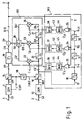
- Fig. 1 is a block diagram showing the first embodiment of a cross-polarization interference canceller according to the present invention, in which the common components to those illustrated in Fig. 6 will be represented by the same reference numerals.
- the shown first embodiment is directed to an embodiment, in which T/2 interval type three tap transversal filter including taps having intervals of one half of a reproduction clock period T.
- a modulation wave S1 of an intermediate frequency band of a primary polarized wave (H polarized wave or V polarized wave) side, which is interfered, is input to a terminal 1.
- a modulation wave S2 of an intermediate frequency band of a different polarized wave (V polarized wave or H polarized wave) side, which provides the interference, is input.
- the primary polarized wave signal S1 and the different polarized wave signal S2 are respectively input to demodulator 11 and 12.
- the demodulator 11 and 12 are responsive to those input signals to output base band signals SB1 and SB2 to respective of analog-to-digital converters 15 and 16.
- the demodulator 11 reproduces a clock signal CLK1.
- the clock signal CLK1 is input to the analog-to-digital converter 15.
- the clock signal CLK1 is input to a doubler circuit 18.
- the doubler circuit 18 doubles the input clock signal CLK1 to output a doubled clock signal CLK2 to the analog-to-digital converter 16.
- the analog-to-digital converter 15 samples and quantizes the primary polarized wave side base band signal SB1 with the clock signal CLK2 to output to a delay circuit 19 as a digital signal sequence D1.
- the analog-to-digital converter 16 samples and quantizes the different polarized wave side base band signal SB2 with the clock signal CLK2 to output to a transversal filter 101 as a digital signal sequence D2.
- the transversal filter 101 outputs a compensation signal SX derived by controlling amplitude and phase of the signal from the analog-to-digital converter 16.
- the compensation signal SX is input to a subtracter 29.
- the subtracter 29 also receives the output D11 of a delay circuit 19.
- the subtracter 29 subtracts the output signal of the transversal filter 101 from the output D11 of the delay circuit so as to remove an interference component superimposed on the primary polarized wave signal.
- the primary polarized wave signal D12, from which the interference component is removed, is output to a terminal 3.
- an error signal E representative of an deviation of the received signal from a reference value
- the transversal filter control circuit 103 correlates the most significant bit D (data polarity signal) of the output D2 of the analog-to-digital converter 16 and the error signal E, and controls a weighting coefficient of each tap of the transversal filter 101 so as to minimize the error signal component.
- the transversal filter 101 comprises shift registers 20 and 21 connected in series and adapted to delay the output D2 of the analog-to-digital converter 16 for T/2, respectively, a multiplier 22, to which the output D2 of the analog-to-digital converter 16 is input, a multiplier 23 connected to the shift register 20 as the delay element, a multiplier 24 connected to the shift register 21, and an adder 28 adding the outputs of the multipliers 22 - 24.
- Tap control signals C-1, C0 and C+1 from the transversal filter control circuit 103 are supplied to the multiplier 22, 23 and 24, respectively.
- a compensation signal SX which is a signal a substantially equal to the cross-polarization interference component superimposed to the primary polarized wave side.
- the operation of the cross-polarization interference canceller is similar to that illustrated with reference to Fig. 6, except for the transversal filter control circuit 103.
- the error signal E represents an offset amount of the received multi-level base band signal from a reference value.
- the (N + 1)th bit from the most significant bit becomes the error signal E which represents the polarity of the error.
- the error signal the (N + 1)th bit of the signal D12 after compensation of the interference is used to represent a polarity of a residual error component after compensation.
- the data polarity signal D the first bit of the input signal D2 of the transversal filter 101 is used in case of the MZF method.
- the data polarity signal D is input to a delay circuit 30 for compensation of delay in a multiplier 23 and an adder 28 in the transversal filter 101. After adjustment of the timing relative to the error signal E, the data polarity signal D is input to flip-flops 31 and 32 which are connected in series.
- the binary signal C0' is derived as a product of binary values of the error signal E and a signal D0 which is the T/2 sec delayed output D-1 delayed by the delay circuit.
- the binary signal C0' is derived by an exclusive OR (EX-OR) circuit 34 to be input to a moving average circuit 42.
- the running average circuit according to the present invention derives the tap coefficient with always using the most recent J bits of correlation results.
- the tap coefficient C0 can be expeessed by:
- the tap coefficient obtained through the foregoing equation (4) is smaller in three digit than that obtained through the equation (2). Therefore, the tap coefficient C0 can approach true zero.
- the operation for obtaining the moving average of the tap coefficient is equally applicable for deriving other tap coefficients C-1 and C+1.
- Moving average circuits 41, 42 and 43 may comprise moving average preliminary process circuits 44, 45 and 46 and up/down counters 36, 37 and 38 respectively connected to the corresponding running average preliminary process circuits.
- This process is done by the moving average preliminary process circuit 44 ⁇ 46 which will be discussed herebelow.
- the construction of the moving average preliminary process circuit 44 ⁇ 46 is illustrated in Fig. 2.
- the correlation output F1 from the EX-OR is input to a judgement circuit 52 and to a memory circuit 51 through a terminal 4. From the memory circuit 51, the correlation output F2 of J bit ahead is input to the judgement circuit 52.
- the memory circuit 51 can be easily realized by a shift register, RAM or so forth.
- the judgement circuit 52 can also be realized by a normal logic circuit element.
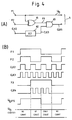
- Fig. 4(A) shows one concrete example of the judgement circuit 52.
- Two signals F1 and F2 are input to EX-OR circuit 61.
- the output F3 of the EX-OR circuit becomes one input of an AND circuit 63.
- the clock signal CLK2 is doubled in the frequency by a doubler 62 and input to another input of the AND circuit 63 as a clock signal CLK3.
- the output CLK4 of the AND circuit 63 serves as the clock pulse for the up/down counter.
- Fig. 4(B) is a timing chart showing waveforms of each portion of the judgement circuit of Fig. 4(A).
- the shown construction is substantially similar to those of the foregoing first embodiment except for neglecting of the doubler 18 and shorting the circuit, and setting of the delay amount of the shift registers 20, 21, 31 and 32 to T. Therefore, detailed discussed is neglected.
- the tap coefficient can be sufficiently close to a true value even when the random characteristics of the sign has certain magnitude of offset. Therefore, since the tap coefficient becomes sufficiently close to zero when the cross-polarization interference is not present so that interference noise in the canceller can be successfully avoided.
Landscapes
- Engineering & Computer Science (AREA)
- Computer Networks & Wireless Communication (AREA)
- Signal Processing (AREA)
- Filters That Use Time-Delay Elements (AREA)
- Noise Elimination (AREA)
- Cable Transmission Systems, Equalization Of Radio And Reduction Of Echo (AREA)
- Radio Transmission System (AREA)
Applications Claiming Priority (2)
| Application Number | Priority Date | Filing Date | Title |
|---|---|---|---|
| JP273086/91 | 1991-09-25 | ||
| JP27308691A JP3169646B2 (ja) | 1991-09-25 | 1991-09-25 | 交差偏波干渉補償器 |
Publications (3)
| Publication Number | Publication Date |
|---|---|
| EP0534384A2 true EP0534384A2 (fr) | 1993-03-31 |
| EP0534384A3 EP0534384A3 (en) | 1993-07-14 |
| EP0534384B1 EP0534384B1 (fr) | 1998-01-07 |
Family
ID=17522952
Family Applications (1)
| Application Number | Title | Priority Date | Filing Date |
|---|---|---|---|
| EP92116247A Expired - Lifetime EP0534384B1 (fr) | 1991-09-25 | 1992-09-23 | Annuleur d'interférence de polarisation croisée |
Country Status (5)
| Country | Link |
|---|---|
| US (1) | US5241320A (fr) |
| EP (1) | EP0534384B1 (fr) |
| JP (1) | JP3169646B2 (fr) |
| AU (1) | AU649202B2 (fr) |
| DE (1) | DE69223892T2 (fr) |
Families Citing this family (19)
| Publication number | Priority date | Publication date | Assignee | Title |
|---|---|---|---|---|
| US5517531A (en) * | 1991-05-29 | 1996-05-14 | The United States Of America As Represented By The Secretary Of The Navy | Kernel adaptive interference suppression system |
| CA2073082C (fr) * | 1991-07-08 | 1997-09-09 | Takanori Iwamatsu | Eliminateur de parasites a polarisation orthogonale |
| US5396655A (en) * | 1992-11-30 | 1995-03-07 | At&T Corp. | Adaptive canceler for contiguous band filtering |
| DE69533816T2 (de) * | 1994-03-28 | 2005-04-21 | Nec Corp | Verfahren und Vorrichtung zum Steuern der Filterkoeffizienten eines adaptiven signalangepassten Filters in einem automatischen Entzerrer |
| US5901343A (en) * | 1997-05-09 | 1999-05-04 | Lockheed Martin Corporation | Adaptive cross polarization Interference canceler for use at intermediate frequencies |
| US6449320B1 (en) | 1999-07-02 | 2002-09-10 | Telefonaktiebolaget Lm Ericsson (Publ) | Equalization with DC-offset compensation |
| JP3988526B2 (ja) | 2002-05-14 | 2007-10-10 | 三菱電機株式会社 | スタータ制御装置および制御装置付スタータ |
| US7613260B2 (en) * | 2005-11-21 | 2009-11-03 | Provigent Ltd | Modem control using cross-polarization interference estimation |
| US7796708B2 (en) * | 2006-03-29 | 2010-09-14 | Provigent Ltd. | Adaptive receiver loops with weighted decision-directed error |
| US7643512B2 (en) | 2006-06-29 | 2010-01-05 | Provigent Ltd. | Cascaded links with adaptive coding and modulation |
| US7839952B2 (en) | 2006-12-05 | 2010-11-23 | Provigent Ltd | Data rate coordination in protected variable-rate links |
| US7720136B2 (en) | 2006-12-26 | 2010-05-18 | Provigent Ltd | Adaptive coding and modulation based on link performance prediction |
| US8315574B2 (en) * | 2007-04-13 | 2012-11-20 | Broadcom Corporation | Management of variable-rate communication links |
| US7821938B2 (en) * | 2007-04-20 | 2010-10-26 | Provigent Ltd. | Adaptive coding and modulation for synchronous connections |
| US8001445B2 (en) * | 2007-08-13 | 2011-08-16 | Provigent Ltd. | Protected communication link with improved protection indication |
| US8040985B2 (en) * | 2007-10-09 | 2011-10-18 | Provigent Ltd | Decoding of forward error correction codes in the presence of phase noise |
| WO2010011500A1 (fr) * | 2008-07-25 | 2010-01-28 | Smith International, Inc. | Trépan pdc ayant des lames fendues |
| JP4746703B1 (ja) | 2010-03-29 | 2011-08-10 | 株式会社東芝 | 電子機器、ハードディスクドライブ |
| US10466338B2 (en) * | 2016-07-17 | 2019-11-05 | Commscope Technologies Llc | Detecting Federal Incumbent Radar (FIR) signal |
Family Cites Families (7)
| Publication number | Priority date | Publication date | Assignee | Title |
|---|---|---|---|---|
| US3633105A (en) * | 1970-04-01 | 1972-01-04 | Gte Automatic Electric Lab Inc | Digital adaptive equalizer system |
| CA1338153C (fr) * | 1987-11-10 | 1996-03-12 | Yoshihiro Nozue | Eliminateur de parasites |
| JPH0756970B2 (ja) * | 1988-05-30 | 1995-06-14 | 日本電信電話株式会社 | 交差偏波受信回路 |
| JPH07118629B2 (ja) * | 1988-11-21 | 1995-12-18 | 富士電機株式会社 | フィルタ時定数可変のアナログ入力装置 |
| JPH02298119A (ja) * | 1988-12-23 | 1990-12-10 | Nec Corp | アダプティブ・フィルタによるノイズ除去の方法及び装置 |
| CA2022050C (fr) * | 1989-07-27 | 1993-03-23 | Toru Matsuura | Systeme stable d'elimintation de signaux a polarisation orthogonale |
| JP2536207B2 (ja) * | 1990-01-23 | 1996-09-18 | 日本電気株式会社 | 干渉補償器 |
-
1991
- 1991-09-25 JP JP27308691A patent/JP3169646B2/ja not_active Expired - Fee Related
-
1992
- 1992-09-22 US US07/948,687 patent/US5241320A/en not_active Expired - Fee Related
- 1992-09-23 DE DE69223892T patent/DE69223892T2/de not_active Expired - Fee Related
- 1992-09-23 EP EP92116247A patent/EP0534384B1/fr not_active Expired - Lifetime
- 1992-09-25 AU AU25376/92A patent/AU649202B2/en not_active Ceased
Also Published As
| Publication number | Publication date |
|---|---|
| AU2537692A (en) | 1993-04-01 |
| AU649202B2 (en) | 1994-05-12 |
| EP0534384B1 (fr) | 1998-01-07 |
| EP0534384A3 (en) | 1993-07-14 |
| DE69223892D1 (de) | 1998-02-12 |
| DE69223892T2 (de) | 1998-04-30 |
| JPH0590983A (ja) | 1993-04-09 |
| JP3169646B2 (ja) | 2001-05-28 |
| US5241320A (en) | 1993-08-31 |
Similar Documents
| Publication | Publication Date | Title |
|---|---|---|
| US5241320A (en) | Cross-polarization interference canceller | |
| US4730343A (en) | Decision feedback equalizer with a pattern detector | |
| EP0228771B1 (fr) | Système de transmission de données | |
| US5541958A (en) | Clock recovery circuit of demodulator | |
| US6055284A (en) | Symbol timing recovery circuit in digital demodulator | |
| CA1226636A (fr) | Circuit de synchronisation de la trame et de la phase d'une horloge d'echantillonnage locale | |
| EP0544315A2 (fr) | Appareil d'estimation de séquence à vraisemblance maximale | |
| US7813702B1 (en) | Receiver with dual D.C. noise cancellation circuits | |
| KR100189371B1 (ko) | 디지털 복조기의 인터폴레이터 | |
| US6240132B1 (en) | Mechanism for interpolating among samples of received communication signal using asynchronous high speed clock which is a nominal multiple of recovered signalling baud rate | |
| US4769808A (en) | Method of cancelling echoes in full-duplex data transmission system | |
| US5524126A (en) | Symbol timing recovery using fir data interpolators | |
| EP0656713A1 (fr) | Estimation du décalage de phase pour récepteur MDP | |
| US7336747B2 (en) | Coding system for minimizing digital data bandwidth | |
| US11483125B2 (en) | Clock and data recovery circuit and receiver | |
| JP2518690B2 (ja) | トランスバ―サルフィルタ制御回路 | |
| US5333149A (en) | Process and a circuit for adapting coefficients in a modem equalizer | |
| KR100289404B1 (ko) | 국소대칭강제파형부를 이용한 패턴지터를 줄이는 장치 및 방법 | |
| US4586023A (en) | Means and method for data transmission on wired channels | |
| US5982826A (en) | Synchronous clock regeneration system for generating a clock waveform at a specified frequency | |
| EP0633669B1 (fr) | Procédé et dispositif pour la détection de données transmises dans un réseau d'alimentation en énergie électrique | |
| KR0136370Y1 (ko) | 결정귀환 등화기 | |
| JPH0421226A (ja) | 交差偏波干渉補償器 | |
| PL175643B1 (pl) | Sposób i odbiornik do transmisji sygnałów cyfrowych | |
| JPH0787405B2 (ja) | エコ−除去装置 |
Legal Events
| Date | Code | Title | Description |
|---|---|---|---|
| PUAI | Public reference made under article 153(3) epc to a published international application that has entered the european phase |
Free format text: ORIGINAL CODE: 0009012 |
|
| AK | Designated contracting states |
Kind code of ref document: A2 Designated state(s): BE DE FR GB IT NL |
|
| PUAL | Search report despatched |
Free format text: ORIGINAL CODE: 0009013 |
|
| AK | Designated contracting states |
Kind code of ref document: A3 Designated state(s): BE DE FR GB IT NL |
|
| 17P | Request for examination filed |
Effective date: 19930602 |
|
| 17Q | First examination report despatched |
Effective date: 19960610 |
|
| GRAG | Despatch of communication of intention to grant |
Free format text: ORIGINAL CODE: EPIDOS AGRA |
|
| GRAG | Despatch of communication of intention to grant |
Free format text: ORIGINAL CODE: EPIDOS AGRA |
|
| GRAG | Despatch of communication of intention to grant |
Free format text: ORIGINAL CODE: EPIDOS AGRA |
|
| GRAH | Despatch of communication of intention to grant a patent |
Free format text: ORIGINAL CODE: EPIDOS IGRA |
|
| GRAH | Despatch of communication of intention to grant a patent |
Free format text: ORIGINAL CODE: EPIDOS IGRA |
|
| GRAA | (expected) grant |
Free format text: ORIGINAL CODE: 0009210 |
|
| AK | Designated contracting states |
Kind code of ref document: B1 Designated state(s): BE DE FR GB IT NL |
|
| REF | Corresponds to: |
Ref document number: 69223892 Country of ref document: DE Date of ref document: 19980212 |
|
| ITF | It: translation for a ep patent filed | ||
| ET | Fr: translation filed | ||
| PLBE | No opposition filed within time limit |
Free format text: ORIGINAL CODE: 0009261 |
|
| 26N | No opposition filed | ||
| REG | Reference to a national code |
Ref country code: GB Ref legal event code: IF02 |
|
| PGFP | Annual fee paid to national office [announced via postgrant information from national office to epo] |
Ref country code: BE Payment date: 20020823 Year of fee payment: 11 |
|
| PGFP | Annual fee paid to national office [announced via postgrant information from national office to epo] |
Ref country code: FR Payment date: 20020910 Year of fee payment: 11 |
|
| PGFP | Annual fee paid to national office [announced via postgrant information from national office to epo] |
Ref country code: GB Payment date: 20020918 Year of fee payment: 11 |
|
| PGFP | Annual fee paid to national office [announced via postgrant information from national office to epo] |
Ref country code: NL Payment date: 20020930 Year of fee payment: 11 |
|
| PGFP | Annual fee paid to national office [announced via postgrant information from national office to epo] |
Ref country code: DE Payment date: 20021002 Year of fee payment: 11 |
|
| PG25 | Lapsed in a contracting state [announced via postgrant information from national office to epo] |
Ref country code: GB Free format text: LAPSE BECAUSE OF NON-PAYMENT OF DUE FEES Effective date: 20030923 |
|
| PG25 | Lapsed in a contracting state [announced via postgrant information from national office to epo] |
Ref country code: BE Free format text: LAPSE BECAUSE OF NON-PAYMENT OF DUE FEES Effective date: 20030930 |
|
| BERE | Be: lapsed |
Owner name: *NEC CORP. Effective date: 20030930 |
|
| PG25 | Lapsed in a contracting state [announced via postgrant information from national office to epo] |
Ref country code: NL Free format text: LAPSE BECAUSE OF NON-PAYMENT OF DUE FEES Effective date: 20040401 Ref country code: DE Free format text: LAPSE BECAUSE OF NON-PAYMENT OF DUE FEES Effective date: 20040401 |
|
| GBPC | Gb: european patent ceased through non-payment of renewal fee |
Effective date: 20030923 |
|
| PG25 | Lapsed in a contracting state [announced via postgrant information from national office to epo] |
Ref country code: FR Free format text: LAPSE BECAUSE OF NON-PAYMENT OF DUE FEES Effective date: 20040528 |
|
| NLV4 | Nl: lapsed or anulled due to non-payment of the annual fee |
Effective date: 20040401 |
|
| REG | Reference to a national code |
Ref country code: FR Ref legal event code: ST |
|
| PG25 | Lapsed in a contracting state [announced via postgrant information from national office to epo] |
Ref country code: IT Free format text: LAPSE BECAUSE OF NON-PAYMENT OF DUE FEES Effective date: 20050923 |