EP0534432A2 - Verfahren zur Herstellung von kornorientierten Elektrostahlblechen mit hervorragenden magnetischen Eigenschaften - Google Patents
Verfahren zur Herstellung von kornorientierten Elektrostahlblechen mit hervorragenden magnetischen Eigenschaften Download PDFInfo
- Publication number
- EP0534432A2 EP0534432A2 EP92116367A EP92116367A EP0534432A2 EP 0534432 A2 EP0534432 A2 EP 0534432A2 EP 92116367 A EP92116367 A EP 92116367A EP 92116367 A EP92116367 A EP 92116367A EP 0534432 A2 EP0534432 A2 EP 0534432A2
- Authority
- EP
- European Patent Office
- Prior art keywords
- steel sheet
- iron loss
- annealing
- sheet
- decarburization annealing
- Prior art date
- Legal status (The legal status is an assumption and is not a legal conclusion. Google has not performed a legal analysis and makes no representation as to the accuracy of the status listed.)
- Granted
Links
Images
Classifications
-
- C—CHEMISTRY; METALLURGY
- C21—METALLURGY OF IRON
- C21D—MODIFYING THE PHYSICAL STRUCTURE OF FERROUS METALS; GENERAL DEVICES FOR HEAT TREATMENT OF FERROUS OR NON-FERROUS METALS OR ALLOYS; MAKING METAL MALLEABLE, e.g. BY DECARBURISATION OR TEMPERING
- C21D8/00—Modifying the physical properties of ferrous metals or ferrous alloys by deformation combined with, or followed by, heat treatment
- C21D8/12—Modifying the physical properties of ferrous metals or ferrous alloys by deformation combined with, or followed by, heat treatment during manufacturing of articles with special electromagnetic properties
-
- C—CHEMISTRY; METALLURGY
- C21—METALLURGY OF IRON
- C21D—MODIFYING THE PHYSICAL STRUCTURE OF FERROUS METALS; GENERAL DEVICES FOR HEAT TREATMENT OF FERROUS OR NON-FERROUS METALS OR ALLOYS; MAKING METAL MALLEABLE, e.g. BY DECARBURISATION OR TEMPERING
- C21D8/00—Modifying the physical properties of ferrous metals or ferrous alloys by deformation combined with, or followed by, heat treatment
- C21D8/12—Modifying the physical properties of ferrous metals or ferrous alloys by deformation combined with, or followed by, heat treatment during manufacturing of articles with special electromagnetic properties
- C21D8/1244—Modifying the physical properties of ferrous metals or ferrous alloys by deformation combined with, or followed by, heat treatment during manufacturing of articles with special electromagnetic properties characterised by the heat treatment
- C21D8/1255—Modifying the physical properties of ferrous metals or ferrous alloys by deformation combined with, or followed by, heat treatment during manufacturing of articles with special electromagnetic properties characterised by the heat treatment with diffusion of elements, e.g. decarburising, nitriding
-
- C—CHEMISTRY; METALLURGY
- C21—METALLURGY OF IRON
- C21D—MODIFYING THE PHYSICAL STRUCTURE OF FERROUS METALS; GENERAL DEVICES FOR HEAT TREATMENT OF FERROUS OR NON-FERROUS METALS OR ALLOYS; MAKING METAL MALLEABLE, e.g. BY DECARBURISATION OR TEMPERING
- C21D11/00—Process control or regulation for heat treatments
-
- C—CHEMISTRY; METALLURGY
- C21—METALLURGY OF IRON
- C21D—MODIFYING THE PHYSICAL STRUCTURE OF FERROUS METALS; GENERAL DEVICES FOR HEAT TREATMENT OF FERROUS OR NON-FERROUS METALS OR ALLOYS; MAKING METAL MALLEABLE, e.g. BY DECARBURISATION OR TEMPERING
- C21D3/00—Diffusion processes for extraction of non-metals; Furnaces therefor
- C21D3/02—Extraction of non-metals
- C21D3/04—Decarburising
-
- C—CHEMISTRY; METALLURGY
- C23—COATING METALLIC MATERIAL; COATING MATERIAL WITH METALLIC MATERIAL; CHEMICAL SURFACE TREATMENT; DIFFUSION TREATMENT OF METALLIC MATERIAL; COATING BY VACUUM EVAPORATION, BY SPUTTERING, BY ION IMPLANTATION OR BY CHEMICAL VAPOUR DEPOSITION, IN GENERAL; INHIBITING CORROSION OF METALLIC MATERIAL OR INCRUSTATION IN GENERAL
- C23C—COATING METALLIC MATERIAL; COATING MATERIAL WITH METALLIC MATERIAL; SURFACE TREATMENT OF METALLIC MATERIAL BY DIFFUSION INTO THE SURFACE, BY CHEMICAL CONVERSION OR SUBSTITUTION; COATING BY VACUUM EVAPORATION, BY SPUTTERING, BY ION IMPLANTATION OR BY CHEMICAL VAPOUR DEPOSITION, IN GENERAL
- C23C8/00—Solid state diffusion of only non-metal elements into metallic material surfaces; Chemical surface treatment of metallic material by reaction of the surface with a reactive gas, leaving reaction products of surface material in the coating, e.g. conversion coatings, passivation of metals
- C23C8/80—After-treatment
Definitions
- the present invention relates to a process for production of an oriented electrical steel sheet, and more particularly to an oriented electrical steel sheet having a low iron loss particularly by using a technique for heating a slab at a low temperature.
- An oriented electrical steel sheet is used mainly as an iron core material for a transformer, a generator and other electrical equipment and should have excellent magnetic properties, particularly iron loss properties.
- An oriented electrical steel sheet is produced by developing a crystal grain having the so-called "Goss orientation", that is, having a (110) face on the rolled surface and an [001] axis in the rolling direction by utilizing a secondary recrystallization phenomenon.
- inhibitor As is well known in the art, secondary recrystallization occurs in finish annealing.
- the so-called “inhibitor” which is a fine precipitate of AlN, MnS, MnSe or the like for regulating the growth of a primary recrystallized grain until the temperature reaches a secondary recrystallization region, should be present.
- an electric steel slab is heated to a high temperature, for example, about 1350° to 1400°C so as to form an inhibitor, for example, AlN, MnS or MnSe, in a solid solution, and annealing is performed for finely precipitating the inhibitor when the material is in the form of a hot rolled sheet or an intermediate sheet before final cold rolling.
- a high temperature for example, about 1350° to 1400°C so as to form an inhibitor, for example, AlN, MnS or MnSe, in a solid solution
- annealing is performed for finely precipitating the inhibitor when the material is in the form of a hot rolled sheet or an intermediate sheet before final cold rolling.
- Such a treatment has enabled an oriented electrical steel sheet having a high magnetic flux density to be produced. Since, however, the electrical steel slab is heated at the above-described high temperature, there occurs a large amount of a molten scale, which hinders the operation of a heating furnace. Further, this process has problems in that it requires a high energy unit and it creates surface defects.
- Japanese Unexamined Patent Publication (Kokai) No. 55-24116 discloses a process wherein a slab is heated at 1100 to 1260°C through the incorporation of a nitride forming element, such as Zr, Ti, B, Ta, V, Cr or Mo, in addition to Al. Further, Japanese Unexamined Patent Publication (Kokai) No.
- 59-56522 proposes a process wherein an electrical steel slab having a Mn content of 0.08 to 0.45%, a S content of 0.007%, a lowered content of [Mn] ⁇ [S] and further comprising Al, P and N is used as the material.
- Japanese Unexamined Patent Publication (Kokai) No. 2-200732 the applicant for the present invention has proposed a process wherein when an oriented electrical steel sheet cold-rolled to a predetermined sheet thickness is passed in the form of a strip, through a decarburization annealing furnace, and the sheet is nitrided by using NH3 to form an inhibitor in situ.
- an oriented electrical steel sheet that comprises nitriding a steel sheet subjected to decarburization annealing by using a gas having a nitriding capability to strengthen the inhibitor, coating the nitrided sheet with an annealing separator composed mainly of MgO, taking up the coated sheet in coil form and subjecting the sheet to finish annealing; the development of the secondary recrystallization varies despite an identical degree of nitriding, which often gives rise to a variation in the magnetic flux density and iron loss or an inferior secondary recrystallized grain called "fine grain".
- An object of the present invention is to provide an oriented electrical steel sheet having a stably developed secondary recrystallized grain and excellent magnetic properties such as iron loss through an annealing method wherein decarburization is followed by nitriding of the steel sheet.
- the present inventors have conducted detailed studies on the relationship between the amount of nitrogen and the iron loss value and, as a result, have found that the average diameter of the primary recrystallized grain can be determined by measuring the amount of nitrogen and the iron loss value of a steel sheet subjected to decarburization annealing and nitriding, that the average diameter of the primary recrystallized grain has a great influence on the iron loss value of a product sheet and there is a clear correlation between the average diameter of the primary recrystallized grain and the iron loss value and that the average diameter of the primary recrystallized grain can be regulated by varying the heating temperature in the decarburization annealing thereby enabling the iron loss value of the product sheet to be regulated, which has led to the completion of the present invention.
- the present invention relates to a process for producing an oriented electrical steel sheet, comprising the steps of: heating a slab of an electrical steel sheet to a temperature of 1280°C or less, hot-rolling the slab, subjecting the hot-rolled sheet before or after annealing to cold rolling once or at least twice with intermediate annealing being performed between rollings, subjecting the cold-rolled sheet to decarburization annealing and nitriding treatment to form an inhibitor in said steel sheet, measuring the amount of nitrogen and the iron loss value of the steel sheet after said treatment to determine the average diameter of a primary recrystallized grain formed during the decarburization annealing, determining the primary recrystallized average grain-diameter corresponding to the iron loss value of a final product sheet with proper range from a relationship between the average diameter of the primary recrystallized grain and the iron loss value of the final product sheet, determining a proper decarburization annealing temperature from a relationship between the average diameter of the primary recrystallized grain and the de
- the steel sheet After the steel sheet is subjected to decarburization annealing at a temperature regulated in such a manner that the average diameter of the primary recrystallized grain becomes optimal to obtain a desired iron loss value of the final product sheet, it is coated with an annealing separator and then subjected to final annealing.
- the present inventors have conducted an examination on the cause of the variation in magnetic properties and, as a result, have found that the average diameter of the primary recrystallized grain varies from charge to charge.
- an oriented electrical steel sheet produced by heating an electrical steel slab at a high temperature, bringing an inhibitor forming ingredient to a solid solution state, and precipitating as an inhibitor MnS, MnSe or AlN + MnS when annealing a hot-rolled sheet or during the intermediate annealing before the final cold rolling, even when decarburization annealing conditions vary, the state of development of secondary recrystallization cannot vary because of the strong action of the inhibitor.
- the average diameter of the primary recrystallized grain is greatly influenced by the furnace temperature during decarburization annealing because the inhibitor is weak during the process in which primary recrystallization occurs.
- the present inventors have conducted studies on the influence of ingredients in the steel on the average diameter of the primary recrystallized grain and, as a result, have found that the average diameter of the primary recrystallized grain is influenced by the concentration of residual Al (AlR), which is not linked to nitrogen in the steel.
- AlR residual Al
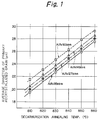
- the average diameter of the primary recrystallized grain increases with an increase in the decarburization annealing temperature.
- the present inventors conducted the following experiment for determining the relationship between the average diameter of primary recrystallized grain after decarburization annealing and the iron loss value.
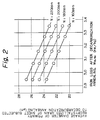
- Product sheets were produced by using a test material of a steel sheet comprising, in terms of % by weight, 0.057% of C, 3.22% of Si, 0.014% of Mn, 0.08% of S, 0.008% of Al (acid soluble Al), 0.0076% of N and further 0.01 to 0.07% of Sn with the decarburization annealing temperature being varied. Further, the NH3 concentration as well was varied in the nitriding treatment subsequent to the decarburization treatment so as to vary the amount of nitrogen of the steel sheet. The image of the primary recrystallized grain of the steel sheet was observed under a microscope, and the average diameter of the primary recrystallized grain was determined by image analysis or the like. Then, the iron value of the steel sheet was measured so as to determine the relationship between the iron loss value and the average diameter value of the primary recrystallized grain.
- Fig. 2 The results are shown in Fig. 2. As shown in Fig. 2, it was found that when the amount of nitrogen of the steel sheet is taken into consideration, the average diameter of the primary recrystallized grain after decarburization can be estimated by measuring the iron loss value. From this fact, it is apparent that the average grain-diameter, D ( ⁇ m), can be determined according to the following formula (1) by using the iron loss value after decarburization annealing, W (W/kg), and the amount of nitrogen of the steel sheet, N (ppm).
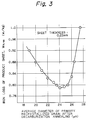
- Fig. 3 shows that an electrical steel sheet having an iron loss value of 0.82 or less and excellent magnetic properties in the final product sheet can be obtained by regulating the average grain-diameter so as to fall within the range of from 23.5 to 25.5 ⁇ m.
- the average diameter of the primary recrystallized grain can be regulated so as to fall within a proper range, it is possible to eliminate the problem of poor secondary recrystallization and the occurrence of a variation in magnetic properties such as iron loss, which enables an oriented electrical steel sheet having excellent magnetic properties to be produced on a commercial scale.
- An Al-containing electrical steel slab heated at a temperature of 1280°C or below is hot-rolled and then optionally annealed.
- the electrical steel slab is heated at a temperature of 1280°C or below in order to prevent the occurrence of molten scale and surface defects and to save energy.
- the sheet is then cold-rolled once or at least twice with intermediate annealing being conducted between the cold rollings to a desired sheet thickness and subjected to decarburization annealing.
- the above-described cold rolling including one wherein the sheet is heated to about 50 to 300°C between rolling.
- the decarburization annealing is conducted by holding the sheet in an atmosphere having a dew point of 60 to 75°C, a H2 content of 75% and a N2 content of 25% at a temperature in the range of from 800 to 880°C for 110 to 180 sec.
- the decarburization annealing reduces the carbon content of the steel sheet to, for example, 30 ppm or less and causes an oxide layer containing SiO2 to be formed on the surface of the steel sheet. In this case, the steel sheet is decarburized and, at the same time, gives rise to primary recrystallization.
- a nitriding treatment is performed in a nitriding chamber having a partition wall in a decarburization annealing furnace or a nitriding furnace.
- the nitriding treatment is conducted by introducing a very small amount of NH3 into an atmosphere having a dew point of -30 to +20°C, a H2 content of 75% and a N2 content of 25% and holding the steel sheet in this atmosphere at a temperature in the range of from 700 to 800°C for 15 to 40 sec.
- the amount of nitrogen of the steel sheet thus treated is determined by measuring the amount of nitrogen of a sample obtained after decarburization annealing, and the iron loss value of the steel sheet is determined by a known on-line iron loss measuring method.
- This iron loss measuring method comprises providing primary and secondary coils for an iron loss measurement either between the annealing furnace and the annealing separator coating device, or between the annealing separator coating device and the coiler for taking up the steel sheet in coil form, and passing the steel sheet through the primary and secondary coils to measure the iron loss.
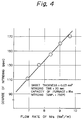
- the degree of nitriding of the steel sheet can be estimated from the flow rate of NH3 in the nitriding furnace.
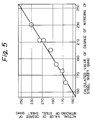
- the average diameter of the primary recrystallized grain is determined from the amount of nitrogen in the steel sheet determined by the above-described method and the iron loss value after decarburization annealing by using the equation (1), the iron loss value of the final product sheet derived from the average grain-diameter is determined from the relationship (Fig. 3) between the average grain-diameter and the iron loss value of the product sheet after finish annealing, and the heating temperature in the decarburization annealing is adjusted based on Fig. 1 so that the average grain-diameter becomes optimal to obtain a desired iron loss value of the final product sheet, e.g., 0.82 w/kg or less.
- the steel sheet is coated with an annealing separator composed mainly of MgO, and subjected to finish annealing at a temperature in the range of from 1150 to 1280°C for 15 to 30 hr.
- an annealing separator composed mainly of MgO
- a slab comprising ingredients specified in Table 1 was heated under conditions specified in Table 2 and hot-rolled to a thickness of 1.6 mm.
- the hot-rolled sheet was cold-rolled to a thickness of 0.23 mm.
- the cold-rolled steel sheet was decarburized by holding the sheet in an atmosphere having a dew point of 60°C, a H2 content of 75% and a N2 content of 25% at a temperature of 830°C for 155 sec.
- the decarburized steel sheet was nitrided by holding the sheet at 770°C for 30 sec in an atmosphere having a H2 content of 75% and a N2 content of 25% and a dew point of -20°C and containing a very small amount of NH3 introduced thereinto.
- the amount of nitrogen of the steel sheet and the iron loss value after decarburization annealing were measured to determine the average grain-diameter, and annealing was performed at a steel sheet temperature that varied according to the relationship (Fig. 3) between the average grain-diameter and the iron loss of the product sheet after finish annealing.
- the steel sheet was coated with an annealing separator composed mainly of MgO and subjected to finish annealing at 1200°C for 20 hr.
- the magnetic properties and the film property of the resultant oriented electrical steel sheet are given in Table 3.
- Table 1 Symbol Ingredient of steel (%) C Si Mn S Al N Sn 1 0.055 3.21 0.0132 0.007 0.0278 0.0071 0.021 2 0.063 3.28 0.0141 0.008 0.0265 0.0076 0.023 o 3 0.057 3.23 0.0137 0.006 0.0270 0.0074 0.019 o 4 0.053 3.20 0.0140 0.007 0.0274 0.0072 0.027 o 5 0.057 3.26 0.0135 0.008 0.0281 0.0071 0.022 o 6 0.061 3.22 0.0139 0.006 0.0264 0.0075 0.017 o 7 0.061 3.28 0.0133 0.007 0.0273 0.0073 0.025 Note) o represents the present invention.
- Table 2 Symbol Slab heating temp. (°C) Amount of nitrogen of steel sheet (ppm) Iron loss at the time of decarburization annealing W 13/50 (w/kg) Estimated average grain-diameter of primary recrystallized grain ( ⁇ m) Measured average grain-diameter of primary recrystallized grain ( ⁇ m) 1 1180 170 2.613 27.2 27.5 2 1210 190 3.698 18.5 18.7 o 3 1190 183 3.101 23.5 23.4 o 4 1150 195 3.094 24.2 24.0 o 5 1220 188 2.932 25.3 25.5 o 6 1150 179 3.033 23.9 23.7 o 7 1170 201 3.081 24.6 24.5 Note) o represents the present invention.
- symbols 1 and 2 represent examples wherein the process of the present invention has not been used.
- the estimated average grain-diameter of the primary recrystallized grain based on the amount of nitrogen of the steel sheet and the iron loss value at the time of decarburization annealing deviates significantly from the optimal average grain-diameter range, so that the iron loss value of the final product is large.
- Symbols 3 to 7 represent examples wherein the treatment according to the present invention has been used.
- the average diameter of the primary recrystallized grain was calculated from the iron loss value, that is, 3.25 w/kg measured after the decarburization annealing and the amount of nitrogen of the steel sheet, that is, 183 ppm, and found to be 22 ⁇ m (see Fig. 2), and next decarburization annealing was Performed at a decarburization annealing temperature of 833°C determined from the line shown by the symbol o in Fig.
- the iron loss value, W 13/50 at the time of decarburization annealing and the measured average diameter of the primary recrystallized grain were 3.101 w/kg and 23.4 ⁇ m, respectively, and the iron loss value, W 17/50, of the final product sheet was 0.80 w/kg, that is, a desired iron loss value (i.e., 0.82 w/kg or less) could be obtained.
- an oriented electrical steel sheet having excellent magnetic properties can be produced by determining the average diameter of a primary recrystallized grain using an online measurement and regulating this average grain-diameter so as to fall within a proper range.
Landscapes
- Chemical & Material Sciences (AREA)
- Engineering & Computer Science (AREA)
- Physics & Mathematics (AREA)
- Metallurgy (AREA)
- Organic Chemistry (AREA)
- Mechanical Engineering (AREA)
- Materials Engineering (AREA)
- Crystallography & Structural Chemistry (AREA)
- Thermal Sciences (AREA)
- Electromagnetism (AREA)
- Manufacturing & Machinery (AREA)
- Chemical Kinetics & Catalysis (AREA)
- Manufacturing Of Steel Electrode Plates (AREA)
- Soft Magnetic Materials (AREA)
- Heat Treatment Of Sheet Steel (AREA)
- Solid-Phase Diffusion Into Metallic Material Surfaces (AREA)
Applications Claiming Priority (2)
| Application Number | Priority Date | Filing Date | Title |
|---|---|---|---|
| JP3248091A JP2519615B2 (ja) | 1991-09-26 | 1991-09-26 | 磁気特性の優れた方向性電磁鋼板の製造方法 |
| JP248091/91 | 1991-09-26 |
Publications (3)
| Publication Number | Publication Date |
|---|---|
| EP0534432A2 true EP0534432A2 (de) | 1993-03-31 |
| EP0534432A3 EP0534432A3 (de) | 1994-02-23 |
| EP0534432B1 EP0534432B1 (de) | 1998-03-04 |
Family
ID=17173079
Family Applications (1)
| Application Number | Title | Priority Date | Filing Date |
|---|---|---|---|
| EP92116367A Expired - Lifetime EP0534432B1 (de) | 1991-09-26 | 1992-09-24 | Verfahren zur Herstellung von kornorientierten Elektrostahlblechen mit hervorragenden magnetischen Eigenschaften |
Country Status (5)
| Country | Link |
|---|---|
| US (1) | US5266129A (de) |
| EP (1) | EP0534432B1 (de) |
| JP (1) | JP2519615B2 (de) |
| KR (1) | KR950005792B1 (de) |
| DE (1) | DE69224575T2 (de) |
Cited By (3)
| Publication number | Priority date | Publication date | Assignee | Title |
|---|---|---|---|---|
| EP0648847A1 (de) * | 1993-10-19 | 1995-04-19 | Nippon Steel Corporation | Verfahren zum Herstellen von kornorientierten Elektroblechen mit hohen magnetischen Werten |
| EP0716151B1 (de) * | 1994-12-05 | 2002-07-31 | Kawasaki Steel Corporation | Kornorientiertes Elektrostahlblech mit hoher magnetischer Flussdichte und geringen Eisenverlusten und Herstellungsverfahren |
| EP2902507A4 (de) * | 2012-09-27 | 2016-06-01 | Baoshan Iron & Steel | Herstellungsverfahren eines gängigen kornorientierten siliciumstahls mit hoher magnetischer induktion |
Families Citing this family (10)
| Publication number | Priority date | Publication date | Assignee | Title |
|---|---|---|---|---|
| US5759293A (en) * | 1989-01-07 | 1998-06-02 | Nippon Steel Corporation | Decarburization-annealed steel strip as an intermediate material for grain-oriented electrical steel strip |
| IT1290171B1 (it) * | 1996-12-24 | 1998-10-19 | Acciai Speciali Terni Spa | Procedimento per il trattamento di acciaio al silicio, a grano orientato. |
| IT1290173B1 (it) * | 1996-12-24 | 1998-10-19 | Acciai Speciali Terni Spa | Procedimento per la produzione di lamierino di acciaio al silicio a grano orientato |
| IT1290978B1 (it) * | 1997-03-14 | 1998-12-14 | Acciai Speciali Terni Spa | Procedimento per il controllo dell'inibizione nella produzione di lamierino magnetico a grano orientato |
| IT1290977B1 (it) * | 1997-03-14 | 1998-12-14 | Acciai Speciali Terni Spa | Procedimento per il controllo dell'inibizione nella produzione di lamierino magnetico a grano orientato |
| KR100232138B1 (ko) * | 1997-04-16 | 1999-12-01 | 구자홍 | 칼라음극선관용 자기차폐체(inner shield)의 제조 방법 |
| KR100940720B1 (ko) * | 2002-12-27 | 2010-02-08 | 주식회사 포스코 | 자기특성이 우수한 방향성 전기강판의 제조방법 |
| JP5266695B2 (ja) * | 2007-09-19 | 2013-08-21 | Jfeスチール株式会社 | 方向性電磁鋼板の磁気特性変動部位の検出方法および装置 |
| JP5262436B2 (ja) * | 2008-08-27 | 2013-08-14 | Jfeスチール株式会社 | 磁気測定方法および装置 |
| EP2933350A1 (de) | 2014-04-14 | 2015-10-21 | Mikhail Borisovich Tsyrlin | Herstellungsverfahren für kornorientierten Elektrostrahl mit hoher Permeabilität |
Family Cites Families (9)
| Publication number | Priority date | Publication date | Assignee | Title |
|---|---|---|---|---|
| JPS5224116A (en) * | 1975-08-20 | 1977-02-23 | Nippon Steel Corp | Material of high magnetic flux density one directionally orientated el ectromagnetic steel and its treating method |
| JPS5956522A (ja) * | 1982-09-24 | 1984-04-02 | Nippon Steel Corp | 鉄損の良い一方向性電磁鋼板の製造方法 |
| JPH0684524B2 (ja) * | 1989-04-05 | 1994-10-26 | 新日本製鐵株式会社 | 方向性電磁鋼板の1次再結晶焼鈍方法 |
| DE69030771T2 (de) * | 1989-01-07 | 1997-09-11 | Nippon Steel Corp | Verfahren zum Herstellen eines kornorientierten Elektrostahlbandes |
| JPH0717953B2 (ja) * | 1989-01-31 | 1995-03-01 | 新日本製鐵株式会社 | 磁気特性の優れた方向性電磁鋼板の製造法 |
| EP0390142B2 (de) * | 1989-03-30 | 1999-04-28 | Nippon Steel Corporation | Verfahren zum Herstellen kornorientierter Elektrobleche mit hoher magnetischer Flussdichte |
| JPH0717960B2 (ja) * | 1989-03-31 | 1995-03-01 | 新日本製鐵株式会社 | 磁気特性の優れた一方向性電磁鋼板の製造方法 |
| EP0392534B1 (de) * | 1989-04-14 | 1998-07-08 | Nippon Steel Corporation | Verfahren zur Herstellung von kornorientierten Elektrostahlblechen mit hervorragenden magnetischen Eigenschaften |
| JP2782086B2 (ja) * | 1989-05-29 | 1998-07-30 | 新日本製鐵株式会社 | 磁気特性、皮膜特性ともに優れた一方向性電磁鋼板の製造方法 |
-
1991
- 1991-09-26 JP JP3248091A patent/JP2519615B2/ja not_active Expired - Lifetime
-
1992
- 1992-09-21 US US07/948,361 patent/US5266129A/en not_active Expired - Fee Related
- 1992-09-24 DE DE69224575T patent/DE69224575T2/de not_active Expired - Fee Related
- 1992-09-24 EP EP92116367A patent/EP0534432B1/de not_active Expired - Lifetime
- 1992-09-25 KR KR1019920017534A patent/KR950005792B1/ko not_active Expired - Fee Related
Cited By (4)
| Publication number | Priority date | Publication date | Assignee | Title |
|---|---|---|---|---|
| US5472521A (en) * | 1933-10-19 | 1995-12-05 | Nippon Steel Corporation | Production method of grain oriented electrical steel sheet having excellent magnetic characteristics |
| EP0648847A1 (de) * | 1993-10-19 | 1995-04-19 | Nippon Steel Corporation | Verfahren zum Herstellen von kornorientierten Elektroblechen mit hohen magnetischen Werten |
| EP0716151B1 (de) * | 1994-12-05 | 2002-07-31 | Kawasaki Steel Corporation | Kornorientiertes Elektrostahlblech mit hoher magnetischer Flussdichte und geringen Eisenverlusten und Herstellungsverfahren |
| EP2902507A4 (de) * | 2012-09-27 | 2016-06-01 | Baoshan Iron & Steel | Herstellungsverfahren eines gängigen kornorientierten siliciumstahls mit hoher magnetischer induktion |
Also Published As
| Publication number | Publication date |
|---|---|
| DE69224575D1 (de) | 1998-04-09 |
| KR950005792B1 (ko) | 1995-05-31 |
| DE69224575T2 (de) | 1998-10-15 |
| EP0534432B1 (de) | 1998-03-04 |
| JPH0578744A (ja) | 1993-03-30 |
| KR930006165A (ko) | 1993-04-20 |
| US5266129A (en) | 1993-11-30 |
| JP2519615B2 (ja) | 1996-07-31 |
| EP0534432A3 (de) | 1994-02-23 |
Similar Documents
| Publication | Publication Date | Title |
|---|---|---|
| EP0339474B1 (de) | Verfahren zur Herstellung von kornorientiertem Elektrostahlblech mit ausgezeichneten magnetischen Eigenschaften und Filmeigenschaften | |
| US4929286A (en) | Method for producing a grain-oriented electrical steel sheet | |
| EP2025767B2 (de) | Verfahren zur herstellung von kornorientiertem elektrischem stahlblech mit hoher magnetischer flussdichte | |
| US5082509A (en) | Method of producing oriented electrical steel sheet having superior magnetic properties | |
| EP1162280B1 (de) | Verfahren zur Herstellung eines kornorientierten Elektrobleches mit ausgezeichneten magnetischen Eigenschaften | |
| EP0534432A2 (de) | Verfahren zur Herstellung von kornorientierten Elektrostahlblechen mit hervorragenden magnetischen Eigenschaften | |
| KR0139247B1 (ko) | 자성이 우수한 일방향성 전기강판의 제조방법 | |
| EP0539858A1 (de) | Verfahren zur Herstellung kornorientierter elektrischer Stahlbänder mit magnetischer Permeabilität | |
| EP0378131B1 (de) | Verfahren zum Herstellen eines kornorientierten Elektrostahlbandes | |
| US4319936A (en) | Process for production of oriented silicon steel | |
| JPH08134551A (ja) | 鉄損及び磁歪特性の優れた一方向性電磁鋼板の製造方法 | |
| JP2826903B2 (ja) | グラス被膜の良好な高磁束密度方向性電磁鋼板の製造方法 | |
| JPH10219359A (ja) | 方向性電磁鋼板の脱炭焼鈍の管理方法 | |
| JP3072401B2 (ja) | 磁気特性、被膜特性の優れた方向性電磁鋼板の製造方法 | |
| JP4268277B2 (ja) | 一方向性電磁鋼板の製造方法 | |
| EP0585956B1 (de) | Dicke kornorientierte Elektrostahlbleche mit hervorragenden magnetischen Eigenschaften | |
| JP2562254B2 (ja) | 薄手高磁束密度一方向性電磁鋼板の製造方法 | |
| JPH04346622A (ja) | 磁気特性の優れた方向性電磁鋼板の製造方法 | |
| JPH05230534A (ja) | 磁気特性の優れた一方向性電磁鋼板の製造方法 | |
| JPH10273725A (ja) | 方向性電磁鋼板の製造方法 | |
| JPH0762439A (ja) | 方向性電磁鋼板の品質制御方法 | |
| JPH0762434A (ja) | 方向性電磁鋼板の一次再結晶粒径制御方法 | |
| JPH04337029A (ja) | 一方向性電磁鋼板の1次再結晶焼鈍方法 | |
| JP4021503B2 (ja) | 方向性電磁鋼板の1次再結晶粒径制御方法 | |
| JPH05179418A (ja) | 方向性電磁鋼板の窒化量制御方法 |
Legal Events
| Date | Code | Title | Description |
|---|---|---|---|
| PUAI | Public reference made under article 153(3) epc to a published international application that has entered the european phase |
Free format text: ORIGINAL CODE: 0009012 |
|
| 17P | Request for examination filed |
Effective date: 19921012 |
|
| AK | Designated contracting states |
Kind code of ref document: A2 Designated state(s): DE FR GB IT |
|
| PUAL | Search report despatched |
Free format text: ORIGINAL CODE: 0009013 |
|
| AK | Designated contracting states |
Kind code of ref document: A3 Designated state(s): DE FR GB IT |
|
| GRAG | Despatch of communication of intention to grant |
Free format text: ORIGINAL CODE: EPIDOS AGRA |
|
| 17Q | First examination report despatched |
Effective date: 19970318 |
|
| GRAG | Despatch of communication of intention to grant |
Free format text: ORIGINAL CODE: EPIDOS AGRA |
|
| GRAG | Despatch of communication of intention to grant |
Free format text: ORIGINAL CODE: EPIDOS AGRA |
|
| GRAH | Despatch of communication of intention to grant a patent |
Free format text: ORIGINAL CODE: EPIDOS IGRA |
|
| GRAH | Despatch of communication of intention to grant a patent |
Free format text: ORIGINAL CODE: EPIDOS IGRA |
|
| GRAA | (expected) grant |
Free format text: ORIGINAL CODE: 0009210 |
|
| AK | Designated contracting states |
Kind code of ref document: B1 Designated state(s): DE FR GB IT |
|
| REF | Corresponds to: |
Ref document number: 69224575 Country of ref document: DE Date of ref document: 19980409 |
|
| ITF | It: translation for a ep patent filed | ||
| ET | Fr: translation filed | ||
| PLBE | No opposition filed within time limit |
Free format text: ORIGINAL CODE: 0009261 |
|
| 26N | No opposition filed | ||
| PGFP | Annual fee paid to national office [announced via postgrant information from national office to epo] |
Ref country code: FR Payment date: 19990909 Year of fee payment: 8 |
|
| PGFP | Annual fee paid to national office [announced via postgrant information from national office to epo] |
Ref country code: GB Payment date: 19990922 Year of fee payment: 8 |
|
| PGFP | Annual fee paid to national office [announced via postgrant information from national office to epo] |
Ref country code: DE Payment date: 19990927 Year of fee payment: 8 |
|
| PG25 | Lapsed in a contracting state [announced via postgrant information from national office to epo] |
Ref country code: GB Free format text: LAPSE BECAUSE OF NON-PAYMENT OF DUE FEES Effective date: 20000924 |
|
| GBPC | Gb: european patent ceased through non-payment of renewal fee |
Effective date: 20000924 |
|
| PG25 | Lapsed in a contracting state [announced via postgrant information from national office to epo] |
Ref country code: FR Free format text: LAPSE BECAUSE OF NON-PAYMENT OF DUE FEES Effective date: 20010531 |
|
| PG25 | Lapsed in a contracting state [announced via postgrant information from national office to epo] |
Ref country code: DE Free format text: LAPSE BECAUSE OF NON-PAYMENT OF DUE FEES Effective date: 20010601 |
|
| REG | Reference to a national code |
Ref country code: FR Ref legal event code: ST |
|
| PG25 | Lapsed in a contracting state [announced via postgrant information from national office to epo] |
Ref country code: IT Free format text: LAPSE BECAUSE OF NON-PAYMENT OF DUE FEES Effective date: 20050924 |