EP0534738A2 - Verfahren und Gerät zur schnellen Bestimmung von Gewichten - Google Patents
Verfahren und Gerät zur schnellen Bestimmung von Gewichten Download PDFInfo
- Publication number
- EP0534738A2 EP0534738A2 EP92308674A EP92308674A EP0534738A2 EP 0534738 A2 EP0534738 A2 EP 0534738A2 EP 92308674 A EP92308674 A EP 92308674A EP 92308674 A EP92308674 A EP 92308674A EP 0534738 A2 EP0534738 A2 EP 0534738A2
- Authority
- EP
- European Patent Office
- Prior art keywords
- estimate
- mail piece
- signals
- transducer
- sequences
- Prior art date
- Legal status (The legal status is an assumption and is not a legal conclusion. Google has not performed a legal analysis and makes no representation as to the accuracy of the status listed.)
- Granted
Links
Images


Classifications
-
- G—PHYSICS
- G01—MEASURING; TESTING
- G01G—WEIGHING
- G01G19/00—Weighing apparatus or methods adapted for special purposes not provided for in the preceding groups
- G01G19/002—Weighing apparatus or methods adapted for special purposes not provided for in the preceding groups for postal parcels and letters
- G01G19/005—Weighing apparatus or methods adapted for special purposes not provided for in the preceding groups for postal parcels and letters with electric or electronic computing means
-
- G—PHYSICS
- G01—MEASURING; TESTING
- G01G—WEIGHING
- G01G19/00—Weighing apparatus or methods adapted for special purposes not provided for in the preceding groups
- G01G19/40—Weighing apparatus or methods adapted for special purposes not provided for in the preceding groups with provisions for indicating, recording, or computing price or other quantities dependent on the weight
- G01G19/413—Weighing apparatus or methods adapted for special purposes not provided for in the preceding groups with provisions for indicating, recording, or computing price or other quantities dependent on the weight using electromechanical or electronic computing means
- G01G19/414—Weighing apparatus or methods adapted for special purposes not provided for in the preceding groups with provisions for indicating, recording, or computing price or other quantities dependent on the weight using electromechanical or electronic computing means using electronic computing means only
- G01G19/4148—Weighing apparatus or methods adapted for special purposes not provided for in the preceding groups with provisions for indicating, recording, or computing price or other quantities dependent on the weight using electromechanical or electronic computing means using electronic computing means only for controlling postal rate in articles to be mailed
-
- G—PHYSICS
- G07—CHECKING-DEVICES
- G07B—TICKET-ISSUING APPARATUS; FARE-REGISTERING APPARATUS; FRANKING APPARATUS
- G07B17/00—Franking apparatus
- G07B17/00185—Details internally of apparatus in a franking system, e.g. franking machine at customer or apparatus at post office
- G07B17/00362—Calculation or computing within apparatus, e.g. calculation of postage value
-
- G—PHYSICS
- G07—CHECKING-DEVICES
- G07B—TICKET-ISSUING APPARATUS; FARE-REGISTERING APPARATUS; FRANKING APPARATUS
- G07B17/00—Franking apparatus
- G07B17/00459—Details relating to mailpieces in a franking system
- G07B17/00661—Sensing or measuring mailpieces
-
- G—PHYSICS
- G07—CHECKING-DEVICES
- G07B—TICKET-ISSUING APPARATUS; FARE-REGISTERING APPARATUS; FRANKING APPARATUS
- G07B17/00—Franking apparatus
- G07B17/00185—Details internally of apparatus in a franking system, e.g. franking machine at customer or apparatus at post office
- G07B17/00362—Calculation or computing within apparatus, e.g. calculation of postage value
- G07B2017/0037—Calculation of postage value
-
- G—PHYSICS
- G07—CHECKING-DEVICES
- G07B—TICKET-ISSUING APPARATUS; FARE-REGISTERING APPARATUS; FRANKING APPARATUS
- G07B17/00—Franking apparatus
- G07B17/00459—Details relating to mailpieces in a franking system
- G07B17/00661—Sensing or measuring mailpieces
- G07B2017/00701—Measuring the weight of mailpieces
Definitions
- the subject invention relates to scales and a method of operating such scales to rapidly determine weights. More particularly, the subject invention relates to postal scales and the like.
- Postal scales are well known. Such scales weigh a mail piece, and determine the appropriate postage for that mail piece as a function of the weight.
- U.S. Patent No. 4,787,048, issued November 22, 1988, to the inventors of the subject invention discloses one approach to decreasing the time required for a postal scale to determine the weight of a mail piece.
- the system disclosed in this patent takes advantage of the structure of postal rate charts, i.e., the function which relates the weight of a mail piece to the appropriate postage amount. As can be seen in Figure 1, such rate charts provide a constant postage value for all weights between pairs of predetermined breakpoints.
- the system of the ′048 patent takes advantage of this by use of an algorithm where a first estimate of the weight is made and used to determine the postage amount, unless the first estimate is within a predetermined distance of a breakpoint, in which case a second more accurate estimate is made.
- a postal scale for determining the postage amount for a mail piece as a function of the weight of said mail piece, said function having a constant value over at least one weight range between predetermined breakpoints, comprising:
- a method for determining the postage amount for a mail piece as a function of the weight of said mail piece, said function having a constant value over at least one weight range between predetermined breakpoints comprising:
- a mail piece is supported on a pan, which is in turn supported by a transducer for generating a series of signals representative of the instantaneous response of the pan when the mail piece is received.
- the transducer will include a load cell.
- a processor receives the output signals from the transducer and detects the presence of a mail piece on the pan.
- the processor examines all sequences of the transducer signals which are of a first length to determine the differences between the maximum and minimum values for each of these first length sequences. When the first of such first length sequences for which the difference is less than a first threshold is found, the processor determines a first estimate of the weight of the mail piece as a function of the first first length sequence.
- the system determines the postage amount using the first estimate for the weight. If the first estimate is within the predetermined distance the processor averages adjacent,non-intersecting sequences of a second length; and then examines all sequences of the averages having a third length to determine the difference between the minimum and minimum averages for each of the sequences. When the first of the sequences of averages for which the difference is less than a second threshold is found, the processor determines a second estimate as a function of the transducer output signals used to determine the averages, and uses the second estimate to determine the postage amount.
- the system computes estimates for the weight of the mail piece as functions of the transducer output signals which make up the sequences tested in the manner described above.
- the first of the signals is not evaluated in these functions, as the first of the signals may fall on the rapidly rising leading edge of the transient response, and be anomalous.
- the processor operates to determine weights for a representative series of mail pieces and the average time for determining such weights is approximately equal to a predetermined time.
- the pan and transducer are connected to form a structure, the stiffness of this structure being great enough with respect to the mass of the structure that the structure has no resonances below a predetermined frequency, where the period of the predetermined frequency is substantially less than the predetermined time.
- output signals from the transducer are processed by a low pass filter to filter frequencies above the above mentioned predetermined frequency.
- the filter when a mail piece is detected on the scale pan, the filter may be operated at a higher sampling rate for a temporary period to increase its cut-off frequency and allow the filtered output of the transducer to reach its stable state more quickly.
- the filter when a mail piece is detected on the scale pan the filter may be by-passed temporarily.
- this filter will be a digital filter.
- One preferred embodiment of the invention includes a transport for transporting the mail piece onto the scale pan in a controlled and repeatable manner.
- the invention advantageously achieves the above described objects in decreasing the time in which a postal scale can determine a postage amount for a mail piece.
- Figure 1 shows a typical postal rate chart.
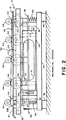
- Figure 2 shows a schematic side view of a scale pan and load cell transducer structure in accordance with the subject invention.
- Figure 3 shows a graphic representation of the instantaneous response of the scale pan to application of a mail piece and the corresponding transducer output.
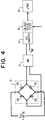
- Figure 4 shows the electronic circuitry of the load cell transducer of Figure 2.
- Figure 5 shows a flow chart representation of the operation of the scale system of the subject invention in determining a weight for a mail piece.
- FIG. 2 a schematic diagram shows a side view of a weighing module in accordance with one embodiment of the subject invention.
- a module can be used, for example, in a high speed mailing system, such as that described in commonly assigned, U.S. Patent Number 5,082,072, as a replacement for the vibrating tray scale system described in that patent.
- FIG. 2 a commercially available load cell supports a pan assembly 12 on scale base 14.
- Assembly 12 includes a pan 18 which is mounted on a stiffening structure 20, commonly referred to as a "spider”, by mounts 22.
- Load cell 10 is connected to base 14 in a cantilevered manner by bolt 26 and spacer 28. Assembly 12 is fastened in a similar manner to load cell 10 by bolt 30 and spacer 34. This manner of mounting a scale pan is conventional and results in load cell 10 acting as a four bar linkage which deflects vertically in response to loads on pan 18.
- the weighing module of Figure 2 also includes stops 36, which protect load cell 10 against excessive deflections.
- Base 14 is supported on mechanical ground by resilient supports 38.
- Preferably supports 38 are formed of a vibration damping material, as is taught in U.S. Patent Number 4,479,561; to Feinland et al.
- Scales and weighing modules comprising a pan supported on a base by a load cell mounted as a four bar linkage are well known in the art and, in general, a more detailed description of their construction is not believed necessary for an understanding of the subject invention.
- the weighing module also includes a transport mechanism 50 for transporting mail pieces onto pan 18 in a controlled and repeatable manner.
- Transport 50 includes belt 52 which is supported on and driven by rollers 54.
- Rollers 54 are in turn supported by structure 58, which is supported on base 14 by springs 60.
- Transport 50 projects above the surface of pan 18 through slots S1 and S2 provided in pan 18 and structure 20 respectively, so that a mail piece which is fed from a feed mechanism (not shown) is transported to a position above but not on pan 18 by transport 50.
- Transport 50 is driven by a conventional drive 62 and mail pieces are guided on belt 52 by rollers 64 in a conventional manner.
- Drive 62 also includes activator 68 for lowering support 58 and transport 50 against the resistance of springs 60, so that after a mail piece is stopped above pan 18 it is lowered onto pan 18 in a controlled and repeatable manner.
- a transport similar to that described above is included in the mailing system of the above mentioned U.S. Patent Number 5,082,072, and is described in that patent which is hereby incorporated by reference.
- a transport system may be mounted on the pan assembly of a weighing module so that the entire weight of the transport system forms part of the tare of the weighing module. Such a system is described, for example, in the above mentioned U.S. Patent No. 4,742,878; which is also hereby incorporated by reference.
- Figure 3 shows a graphic representation of the response of pan assembly 12 when a mail piece is applied.
- a signal is received indicating that a mail piece has been applied.
- this signal will be generated by the system when transport 50 is stopped and lowered to apply the mail piece.
- the response R rapidly raises from the zero value and then shows a damped oscillation which converges to a value W representative of the weight of the applied mail piece.
- digital signals d representative of response R are produced, as will be described further below.
- Strain gauge 70 comprises four strain sensors 70s which are physically fixed to load cell 10 in a conventional manner, and which are resistor elements whose resistance changes in response to strain in load cell 10. Sensors 70s are connected to form a bridge circuit which is excited with a dc voltage.
- the output of strain gage 70 is an analog electrical signal representative of the mechanical displacement of load cell 10 and, correspondingly, pan 18 in response to the application of a mail piece.
- This signal is amplified by amplifier 72, which is preferably an instrumentation amplifier, such as the Model AD624, available from Analog Devices Inc.
- A/D analog-to digital converter
- a low pass digital filter 76 Preferably such filter would be a six pole Bessel filter which may be implemented in a either a) known manner in any of a number of commercially available microprocessors especially adapted for digital signal processing; or b) within an AID of the sigma-delta type, which contains an integral six-pole Bessel filter; and whose digital output is already filtered.
- Preferred A/D's which include such filters based on digital signal processing techniques, and which have a conversion rate sufficiently high for fast weighing are Models 5501 and 5503 available from Crystal Semiconductor Corp. Filter 76 is helpful to minimize the affects of vibrations felt by load cell 10 which are above the cutoff frequency of filter 76.
- this cut off frequency is approximately five Hz. Because digital filtering is substantially an averaging process over at least one cycle of a frequency of interest it is not possible to filter lower frequencies within the desired time constraints of this embodiment of the subject invention.
- pan assembly 12 and load cell 10 should be constructed and connected to form a structure which is sufficiently stiff in relation to its mass that it will have no substantial resonances (i.e., frequencies at which the structure naturally tends to vibrate) below a selected frequency, where the period of this selected frequency is substantially less than the predetermined average time for determining the weight of a mail piece (and the periods of the cut-off frequency of the filter).
- Pan assembly 12 may be stiffened in various conventional manners known to those skilled in the art, such as addition of supporting ribs, or its mass may be reduced by selectively drilling holes, etc.
- Load cell 10 may be stiffened by providing a load cell whose capacity is substantially greater than that required for the application.
- load cell 10 is to be used in a mailing machine such as that described in the above mentioned U.S. Patent Number 5,082,072, where the maximum weight for a mail piece is expected to be on the order of 0.454kg. (a pound), a load cell capable of handling up to about 6.81kg. (15 lbs) may be used to provide the necessary stiffness.
- Signals d which are output by low pass filter 76 are received by microprocessor 78 and processed to determine the weight of the applied mail piece as will be described further below.
- Figure 5 shows a flow chart of the operation of micro processor 78 in determining the weight of the applied mail piece in response to the series of signals d received from low pass filter 76.
- microprocessor 78 waits for a signal from the system that a mail piece has been placed upon pan 18. Alternatively, as is known in the art microprocessor 78 may detect the rising edge of the transient response when a mail piece is applied. When a mail piece is applied, at 102 microprocessor 78 inputs the next sample (i.e., signal d), and at 104 tests to determine if it has accumulated three samples. If not it returns to 102 until three samples are accumulated.
- signal d the next sample
- microprocessor 78 determines the range (i.e., the difference between the maximum and minimum sample of the sequence) and tests if that range is less than a predetermined threshold T1.
- threshold T1 is approximately 2.65x10 ⁇ 3kg. (3/32 ounces). If the range of the samples is not within threshold T1 microprocessor 78 loops back through 102 to input the next sample and continues to loop through 108 until the last three samples tested do have a range less than threshold T1. Thus, all sequences of length three are tested until a first whose range is less than threshold T1 is found.
- microprocessor 78 computes an estimate for the weight of the mail piece, as will be described further below.
- microprocessor 78 tests to determine if the first estimate computed at 110 is within a predetermined distance of a breakpoint in a postal rate chart such as that shown in Figure 1. If the first estimate is not within the predetermined distance then the first estimate is used to compute the postage value in a conventional manner well known to those skilled in the art.
- microprocessor 78 tests to determine if 12 samples are available. If not, it loops through 118 until four samples are available, and then at 122 partitions the 12 most recent samples into 3 consecutive groups of 4 consecutive samples, and at 124 computes an average for each of the 3 groups. Then, at 130 microprocessor 78 tests to determine if the range of the averages is less then a second threshold T2. If not, at 132 the next sample is input and microprocessor 78 loops through 122.
- microprocessor 78 computes the second estimate for the weight and uses the second estimate to determine the postage amount for the mail piece.
- the first estimate is determined as a function of three or more, and preferable three, samples whose range is less than threshold T1.
- the first estimate is then computed as the average of all samples, except for the earliest sample. This computation allows use of a relatively wide threshold T1 so that the first estimate is determined quickly yet provides sufficient accuracy so that the first estimate may be used near to a breakpoint, so that a larger portion of weights can be determined using the first estimate.
- threshold T1 equal to 2.65x10 ⁇ 3kg (3/32 ounces) the first sequence which has a range less than threshold T1 frequently will include this first sample. Accordingly, Applicants have learned that a more accurate estimate is achieved by discarding the possibly anomalous first sample. Using this method of computing the first estimate Applicants have determined that the first estimate emay be accepted if it is no closer than approximately 1/16 ounces to a breakpoint.
- the sampling rate is temporarily increased so that the cut-off frequency of filter 76 is approximately doubled when a mail piece is detected allowing signals to respond more quickly to the rapidly rising edge shown in Figure 3.
- filter 76 may simply be by-passed temporarily when a mail piece is detected.
- an average time of approximately 250 milliseconds for determining the weight of a mail piece can be achieved with a second threshold T2 of approximately 8.85x10 ⁇ 4kg (1/32 ounces).
- T2 approximately 8.85x10 ⁇ 4kg (1/32 ounces).
- the second estimate is then computed as the average of all samples comprised in the sequence of three averages, again expecting the earliest sample, for the reasons described above. This second estimate is found to satisfy the accuracy specifications suitable for postal scales (i.e. ⁇ 1/32 ounces).
- the first estimate is computed as the average of the second and third samples of a sequence of three samples whose range is less than approximately 2.65x10 ⁇ 3kg. (3/32 ounces)
- the second estimate is computed as the average of all samples, except for the earliest, of a sequence of three groups of four samples whose averages have a range less than approximately 8.85x10 ⁇ 4kg.
- the samples are taken at approximately 20 millisecond intervals, and are processed by a digital filter having a cut off frequency of 5 Hz., the pan assembly and load cell structure has no resonances below approximately 5 Hz., and the mail piece is applied to the scale pan in a controlled and repeatable manner; an average time to determine the weight of representative series of mail pieces has been observed to be approximately 260 milliseconds (Note that in this observation, data samples were recorded and processed off-line to facilitate evaluation of the results).
Landscapes
- Physics & Mathematics (AREA)
- Mathematical Physics (AREA)
- Engineering & Computer Science (AREA)
- Theoretical Computer Science (AREA)
- General Physics & Mathematics (AREA)
- Sorting Of Articles (AREA)
- Devices For Checking Fares Or Tickets At Control Points (AREA)
Applications Claiming Priority (2)
| Application Number | Priority Date | Filing Date | Title |
|---|---|---|---|
| US768793 | 1991-09-27 | ||
| US07/768,793 US5226496A (en) | 1991-09-27 | 1991-09-27 | Method and apparatus for fast determination of weights |
Publications (3)
| Publication Number | Publication Date |
|---|---|
| EP0534738A2 true EP0534738A2 (de) | 1993-03-31 |
| EP0534738A3 EP0534738A3 (en) | 1993-05-12 |
| EP0534738B1 EP0534738B1 (de) | 1996-05-01 |
Family
ID=25083497
Family Applications (1)
| Application Number | Title | Priority Date | Filing Date |
|---|---|---|---|
| EP92308674A Expired - Lifetime EP0534738B1 (de) | 1991-09-27 | 1992-09-23 | Verfahren und Gerät zur schnellen Bestimmung von Gewichten |
Country Status (4)
| Country | Link |
|---|---|
| US (1) | US5226496A (de) |
| EP (1) | EP0534738B1 (de) |
| CA (1) | CA2078537C (de) |
| DE (1) | DE69210342T2 (de) |
Cited By (2)
| Publication number | Priority date | Publication date | Assignee | Title |
|---|---|---|---|---|
| FR2700042A1 (fr) * | 1992-12-29 | 1994-07-01 | Neopost Ind | Système de pesée dynamique optimisée pour machine de traitement du courrier. |
| US6713689B2 (en) * | 2002-07-09 | 2004-03-30 | Pitney Bowes Inc. | System and method for weighing items such as mailpieces with varying accuracy |
Families Citing this family (18)
| Publication number | Priority date | Publication date | Assignee | Title |
|---|---|---|---|---|
| US5424962A (en) * | 1993-12-29 | 1995-06-13 | Comsat | Method and system for projecting steady state conditions of a product from transient monotonic or cyclic data |
| DE19860296B4 (de) * | 1998-12-18 | 2007-10-11 | Francotyp-Postalia Gmbh | Verfahren und Anordnung zur Steuerung einer dynamischen Waage |
| DE19860295C2 (de) * | 1998-12-18 | 2003-04-24 | Francotyp Postalia Ag | Verfahren und Anordnung zur Steuerung einer dynamischen Waage |
| US7133715B1 (en) * | 2000-01-07 | 2006-11-07 | Natus Medical Inc. | Hearing evaluation device with noise detection and evaluation capability |
| US6901388B2 (en) | 2002-06-07 | 2005-05-31 | Pitney Bowes Inc. | Method and system for metering mixed weight mail pieces at an increased average rate |
| US7247801B2 (en) * | 2002-06-07 | 2007-07-24 | Pitney Bowes Inc. | System and method for fast weighing of items such as mailpieces |
| US6839694B2 (en) * | 2002-06-07 | 2005-01-04 | Pitney Bowes Inc. | System and method for weighing items such as mailpieces in the presence of external vibration |
| US6825423B2 (en) * | 2002-06-28 | 2004-11-30 | Pitney Bowes Inc. | Method and system for weighing items such as mail pieces |
| US6839697B2 (en) | 2002-06-28 | 2005-01-04 | Pitney Bowes Inc. | System and method for weighing items such as mailpieces in the presence of external vibration |
| US6797893B2 (en) * | 2002-06-28 | 2004-09-28 | Pitney Bowes Inc. | Method and scale system and transducer used in such scale system for rapidly determining weights of items such as mail pieces |
| US7693800B2 (en) * | 2002-07-09 | 2010-04-06 | Pitney Bowes Inc. | Method and system for metering mixed weight mail pieces at an increased average rate |
| ATE556302T1 (de) * | 2005-06-21 | 2012-05-15 | Mettler Toledo Ag | Verfahren zur verarbeitung des ausgangssignals eines messumformers sowie eine kraftmessvorrichtung zur durchführung des verfahrens. |
| US9440264B2 (en) * | 2007-04-13 | 2016-09-13 | Siemens Industry, Inc. | Method and system for weighing mail pieces |
| DE102007058919B4 (de) * | 2007-12-05 | 2010-07-22 | Sartorius Ag | Wägevorrichtung mit einer Mehrzahl digitaler Wägezellen, Wägezelle und Verfahren |
| US8527231B2 (en) * | 2010-09-15 | 2013-09-03 | Teradyne, Inc. | High throughput semiconductor device testing |
| CN102175296B (zh) * | 2011-02-24 | 2012-11-28 | 山东大学 | 一种应用于高精度数字称重传感器的快速两级滤波算法 |
| SE541453C2 (en) * | 2018-02-22 | 2019-10-08 | Motus Weighing Ab | A device for determining a weight of a vehicle and methods thereof |
| JP7374763B2 (ja) * | 2019-12-27 | 2023-11-07 | 株式会社小松製作所 | 作業機械、計量方法、および作業機械を含むシステム |
Family Cites Families (9)
| Publication number | Priority date | Publication date | Assignee | Title |
|---|---|---|---|---|
| US3725656A (en) * | 1970-02-23 | 1973-04-03 | Sharp Kk | Computing system for use in price indicating balance |
| US4091449A (en) * | 1976-01-27 | 1978-05-23 | Hobart Corporation | Computing scale system |
| DE2626023C3 (de) * | 1976-06-10 | 1980-04-17 | Maatschappij Van Berkel's, Patent N.V., Rotterdam (Niederlande) | Wiegevorrichtung |
| JPH0621814B2 (ja) * | 1986-05-29 | 1994-03-23 | 大和製衡株式会社 | 計重装置の計重信号の濾波方法及び装置 |
| US4742878A (en) * | 1986-09-19 | 1988-05-10 | Pitney Bowes Inc. | Weighing module |
| US4787048A (en) * | 1986-09-19 | 1988-11-22 | Pitney Bowes Inc. | Postal weighing apparatus and method |
| US4956782A (en) * | 1986-09-19 | 1990-09-11 | Pitney Bowes Inc. | Mailing system for mixed weight mail |
| US4864521A (en) * | 1987-12-30 | 1989-09-05 | Pitney Bowes Inc. | Multiranging scale with blanking of rate display |
| US4849918A (en) * | 1987-12-30 | 1989-07-18 | Pitney Bowes Inc. | Weighing instrument having adaptive breakpoints |
-
1991
- 1991-09-27 US US07/768,793 patent/US5226496A/en not_active Expired - Lifetime
-
1992
- 1992-09-17 CA CA002078537A patent/CA2078537C/en not_active Expired - Fee Related
- 1992-09-23 EP EP92308674A patent/EP0534738B1/de not_active Expired - Lifetime
- 1992-09-23 DE DE69210342T patent/DE69210342T2/de not_active Expired - Lifetime
Cited By (2)
| Publication number | Priority date | Publication date | Assignee | Title |
|---|---|---|---|---|
| FR2700042A1 (fr) * | 1992-12-29 | 1994-07-01 | Neopost Ind | Système de pesée dynamique optimisée pour machine de traitement du courrier. |
| US6713689B2 (en) * | 2002-07-09 | 2004-03-30 | Pitney Bowes Inc. | System and method for weighing items such as mailpieces with varying accuracy |
Also Published As
| Publication number | Publication date |
|---|---|
| US5226496A (en) | 1993-07-13 |
| EP0534738B1 (de) | 1996-05-01 |
| DE69210342D1 (de) | 1996-06-05 |
| DE69210342T2 (de) | 1996-09-19 |
| EP0534738A3 (en) | 1993-05-12 |
| CA2078537A1 (en) | 1993-03-28 |
| CA2078537C (en) | 1996-06-18 |
Similar Documents
| Publication | Publication Date | Title |
|---|---|---|
| EP0534738B1 (de) | Verfahren und Gerät zur schnellen Bestimmung von Gewichten | |
| EP0534736B1 (de) | Waage zur Schnellbestimmung von Gewichten | |
| CA2072696C (en) | Weighing scale with validating reference channel | |
| EP0534734B1 (de) | Modulare Frankiermaschine mit Wägezellenwaage | |
| US6265675B1 (en) | Apparatus for weighing moving postal matter | |
| US7297879B2 (en) | Method and apparatus for determining the mass of an article using a load cell | |
| US6759602B2 (en) | Apparatus and method for weighing mailpieces in motion | |
| US6839694B2 (en) | System and method for weighing items such as mailpieces in the presence of external vibration | |
| EP1535246B1 (de) | Wiegen von gegenständen wie zum beispiel poststücken bei anwesenheit externer vibration | |
| EP1532588B1 (de) | Schnelles wiegen von gegenständen wie zum beispiel poststücken | |
| JP3834141B2 (ja) | 物品の振動式搬送装置 | |
| JP2790646B2 (ja) | 振動トレイ式秤で得た重量の信憑性を決定する装置および方法 | |
| US6713689B2 (en) | System and method for weighing items such as mailpieces with varying accuracy | |
| US11274960B2 (en) | Calibration and support platform for calibration weights on a conveyor and metering device | |
| US20040000437A1 (en) | Method and scale system and transducer used in such scale system for rapidly determining weights of items such as mail pieces | |
| JP3642639B2 (ja) | 複数の荷重変換手段を備える計量装置 | |
| JP3600355B2 (ja) | 秤 | |
| JP3836969B2 (ja) | 物品の振動式搬送装置 | |
| JPH08110261A (ja) | 質量計量装置及び重量計量装置 | |
| JPH09113346A (ja) | 計量方法および装置 |
Legal Events
| Date | Code | Title | Description |
|---|---|---|---|
| PUAI | Public reference made under article 153(3) epc to a published international application that has entered the european phase |
Free format text: ORIGINAL CODE: 0009012 |
|
| PUAL | Search report despatched |
Free format text: ORIGINAL CODE: 0009013 |
|
| AK | Designated contracting states |
Kind code of ref document: A2 Designated state(s): CH DE FR GB LI |
|
| AK | Designated contracting states |
Kind code of ref document: A3 Designated state(s): CH DE FR GB LI |
|
| 17P | Request for examination filed |
Effective date: 19931102 |
|
| 17Q | First examination report despatched |
Effective date: 19950223 |
|
| GRAH | Despatch of communication of intention to grant a patent |
Free format text: ORIGINAL CODE: EPIDOS IGRA |
|
| GRAA | (expected) grant |
Free format text: ORIGINAL CODE: 0009210 |
|
| AK | Designated contracting states |
Kind code of ref document: B1 Designated state(s): CH DE FR GB LI |
|
| REG | Reference to a national code |
Ref country code: CH Ref legal event code: NV Representative=s name: E. BLUM & CO. PATENTANWAELTE |
|
| REF | Corresponds to: |
Ref document number: 69210342 Country of ref document: DE Date of ref document: 19960605 |
|
| ET | Fr: translation filed | ||
| PLBE | No opposition filed within time limit |
Free format text: ORIGINAL CODE: 0009261 |
|
| 26N | No opposition filed | ||
| REG | Reference to a national code |
Ref country code: GB Ref legal event code: IF02 |
|
| REG | Reference to a national code |
Ref country code: CH Ref legal event code: PFA Owner name: PITNEY BOWES INC. Free format text: PITNEY BOWES INC.#WORLD HEADQUARTERS ONE ELMCROFT#STAMFORD CONNECTICUT 06926-0700 (US) -TRANSFER TO- PITNEY BOWES INC.#WORLD HEADQUARTERS ONE ELMCROFT#STAMFORD CONNECTICUT 06926-0700 (US) |
|
| PGFP | Annual fee paid to national office [announced via postgrant information from national office to epo] |
Ref country code: GB Payment date: 20090929 Year of fee payment: 18 Ref country code: CH Payment date: 20090925 Year of fee payment: 18 |
|
| PGFP | Annual fee paid to national office [announced via postgrant information from national office to epo] |
Ref country code: DE Payment date: 20090929 Year of fee payment: 18 |
|
| REG | Reference to a national code |
Ref country code: CH Ref legal event code: PL |
|
| GBPC | Gb: european patent ceased through non-payment of renewal fee |
Effective date: 20100923 |
|
| REG | Reference to a national code |
Ref country code: FR Ref legal event code: ST Effective date: 20110531 |
|
| REG | Reference to a national code |
Ref country code: DE Ref legal event code: R119 Ref document number: 69210342 Country of ref document: DE Effective date: 20110401 |
|
| PG25 | Lapsed in a contracting state [announced via postgrant information from national office to epo] |
Ref country code: LI Free format text: LAPSE BECAUSE OF NON-PAYMENT OF DUE FEES Effective date: 20100930 Ref country code: CH Free format text: LAPSE BECAUSE OF NON-PAYMENT OF DUE FEES Effective date: 20100930 Ref country code: FR Free format text: LAPSE BECAUSE OF NON-PAYMENT OF DUE FEES Effective date: 20100930 Ref country code: DE Free format text: LAPSE BECAUSE OF NON-PAYMENT OF DUE FEES Effective date: 20110401 |
|
| PG25 | Lapsed in a contracting state [announced via postgrant information from national office to epo] |
Ref country code: GB Free format text: LAPSE BECAUSE OF NON-PAYMENT OF DUE FEES Effective date: 20100923 |
|
| PGFP | Annual fee paid to national office [announced via postgrant information from national office to epo] |
Ref country code: FR Payment date: 20091008 Year of fee payment: 18 |