EP0535128B1 - Verfahren zum formen und zum stabilisieren der dimension des geformten laminates - Google Patents
Verfahren zum formen und zum stabilisieren der dimension des geformten laminates Download PDFInfo
- Publication number
- EP0535128B1 EP0535128B1 EP91912199A EP91912199A EP0535128B1 EP 0535128 B1 EP0535128 B1 EP 0535128B1 EP 91912199 A EP91912199 A EP 91912199A EP 91912199 A EP91912199 A EP 91912199A EP 0535128 B1 EP0535128 B1 EP 0535128B1
- Authority
- EP
- European Patent Office
- Prior art keywords
- laminate
- layer
- shaped
- carrier layer
- temperature
- Prior art date
- Legal status (The legal status is an assumption and is not a legal conclusion. Google has not performed a legal analysis and makes no representation as to the accuracy of the status listed.)
- Expired - Lifetime
Links
Images
Classifications
-
- B—PERFORMING OPERATIONS; TRANSPORTING
- B60—VEHICLES IN GENERAL
- B60J—WINDOWS, WINDSCREENS, NON-FIXED ROOFS, DOORS, OR SIMILAR DEVICES FOR VEHICLES; REMOVABLE EXTERNAL PROTECTIVE COVERINGS SPECIALLY ADAPTED FOR VEHICLES
- B60J1/00—Windows; Windscreens; Accessories therefor
- B60J1/02—Windows; Windscreens; Accessories therefor arranged at the vehicle front, e.g. structure of the glazing, mounting of the glazing
-
- B—PERFORMING OPERATIONS; TRANSPORTING
- B29—WORKING OF PLASTICS; WORKING OF SUBSTANCES IN A PLASTIC STATE IN GENERAL
- B29C—SHAPING OR JOINING OF PLASTICS; SHAPING OF MATERIAL IN A PLASTIC STATE, NOT OTHERWISE PROVIDED FOR; AFTER-TREATMENT OF THE SHAPED PRODUCTS, e.g. REPAIRING
- B29C51/00—Shaping by thermoforming, i.e. shaping sheets or sheet like preforms after heating, e.g. shaping sheets in matched moulds or by deep-drawing; Apparatus therefor
- B29C51/26—Component parts, details or accessories; Auxiliary operations
- B29C51/30—Moulds
- B29C51/36—Moulds specially adapted for vacuum forming, Manufacture thereof
-
- B—PERFORMING OPERATIONS; TRANSPORTING
- B29—WORKING OF PLASTICS; WORKING OF SUBSTANCES IN A PLASTIC STATE IN GENERAL
- B29C—SHAPING OR JOINING OF PLASTICS; SHAPING OF MATERIAL IN A PLASTIC STATE, NOT OTHERWISE PROVIDED FOR; AFTER-TREATMENT OF THE SHAPED PRODUCTS, e.g. REPAIRING
- B29C55/00—Shaping by stretching, e.g. drawing through a die; Apparatus therefor
- B29C55/02—Shaping by stretching, e.g. drawing through a die; Apparatus therefor of plates or sheets
- B29C55/023—Shaping by stretching, e.g. drawing through a die; Apparatus therefor of plates or sheets using multilayered plates or sheets
-
- B—PERFORMING OPERATIONS; TRANSPORTING
- B29—WORKING OF PLASTICS; WORKING OF SUBSTANCES IN A PLASTIC STATE IN GENERAL
- B29C—SHAPING OR JOINING OF PLASTICS; SHAPING OF MATERIAL IN A PLASTIC STATE, NOT OTHERWISE PROVIDED FOR; AFTER-TREATMENT OF THE SHAPED PRODUCTS, e.g. REPAIRING
- B29C71/00—After-treatment of articles without altering their shape; Apparatus therefor
- B29C71/02—Thermal after-treatment
-
- B—PERFORMING OPERATIONS; TRANSPORTING
- B32—LAYERED PRODUCTS
- B32B—LAYERED PRODUCTS, i.e. PRODUCTS BUILT-UP OF STRATA OF FLAT OR NON-FLAT, e.g. CELLULAR OR HONEYCOMB, FORM
- B32B17/00—Layered products essentially comprising sheet glass, or glass, slag, or like fibres
- B32B17/06—Layered products essentially comprising sheet glass, or glass, slag, or like fibres comprising glass as the main or only constituent of a layer, next to another layer of a specific material
- B32B17/10—Layered products essentially comprising sheet glass, or glass, slag, or like fibres comprising glass as the main or only constituent of a layer, next to another layer of a specific material of synthetic resin
- B32B17/10005—Layered products essentially comprising sheet glass, or glass, slag, or like fibres comprising glass as the main or only constituent of a layer, next to another layer of a specific material of synthetic resin laminated safety glass or glazing
- B32B17/10009—Layered products essentially comprising sheet glass, or glass, slag, or like fibres comprising glass as the main or only constituent of a layer, next to another layer of a specific material of synthetic resin laminated safety glass or glazing characterized by the number, the constitution or treatment of glass sheets
- B32B17/10036—Layered products essentially comprising sheet glass, or glass, slag, or like fibres comprising glass as the main or only constituent of a layer, next to another layer of a specific material of synthetic resin laminated safety glass or glazing characterized by the number, the constitution or treatment of glass sheets comprising two outer glass sheets
-
- B—PERFORMING OPERATIONS; TRANSPORTING
- B32—LAYERED PRODUCTS
- B32B—LAYERED PRODUCTS, i.e. PRODUCTS BUILT-UP OF STRATA OF FLAT OR NON-FLAT, e.g. CELLULAR OR HONEYCOMB, FORM
- B32B17/00—Layered products essentially comprising sheet glass, or glass, slag, or like fibres
- B32B17/06—Layered products essentially comprising sheet glass, or glass, slag, or like fibres comprising glass as the main or only constituent of a layer, next to another layer of a specific material
- B32B17/10—Layered products essentially comprising sheet glass, or glass, slag, or like fibres comprising glass as the main or only constituent of a layer, next to another layer of a specific material of synthetic resin
- B32B17/10005—Layered products essentially comprising sheet glass, or glass, slag, or like fibres comprising glass as the main or only constituent of a layer, next to another layer of a specific material of synthetic resin laminated safety glass or glazing
- B32B17/1055—Layered products essentially comprising sheet glass, or glass, slag, or like fibres comprising glass as the main or only constituent of a layer, next to another layer of a specific material of synthetic resin laminated safety glass or glazing characterized by the resin layer, i.e. interlayer
- B32B17/10761—Layered products essentially comprising sheet glass, or glass, slag, or like fibres comprising glass as the main or only constituent of a layer, next to another layer of a specific material of synthetic resin laminated safety glass or glazing characterized by the resin layer, i.e. interlayer containing vinyl acetal
-
- B—PERFORMING OPERATIONS; TRANSPORTING
- B32—LAYERED PRODUCTS
- B32B—LAYERED PRODUCTS, i.e. PRODUCTS BUILT-UP OF STRATA OF FLAT OR NON-FLAT, e.g. CELLULAR OR HONEYCOMB, FORM
- B32B17/00—Layered products essentially comprising sheet glass, or glass, slag, or like fibres
- B32B17/06—Layered products essentially comprising sheet glass, or glass, slag, or like fibres comprising glass as the main or only constituent of a layer, next to another layer of a specific material
- B32B17/10—Layered products essentially comprising sheet glass, or glass, slag, or like fibres comprising glass as the main or only constituent of a layer, next to another layer of a specific material of synthetic resin
- B32B17/10005—Layered products essentially comprising sheet glass, or glass, slag, or like fibres comprising glass as the main or only constituent of a layer, next to another layer of a specific material of synthetic resin laminated safety glass or glazing
- B32B17/10807—Making laminated safety glass or glazing; Apparatus therefor
- B32B17/10816—Making laminated safety glass or glazing; Apparatus therefor by pressing
- B32B17/10871—Making laminated safety glass or glazing; Apparatus therefor by pressing in combination with particular heat treatment
-
- B—PERFORMING OPERATIONS; TRANSPORTING
- B32—LAYERED PRODUCTS
- B32B—LAYERED PRODUCTS, i.e. PRODUCTS BUILT-UP OF STRATA OF FLAT OR NON-FLAT, e.g. CELLULAR OR HONEYCOMB, FORM
- B32B17/00—Layered products essentially comprising sheet glass, or glass, slag, or like fibres
- B32B17/06—Layered products essentially comprising sheet glass, or glass, slag, or like fibres comprising glass as the main or only constituent of a layer, next to another layer of a specific material
- B32B17/10—Layered products essentially comprising sheet glass, or glass, slag, or like fibres comprising glass as the main or only constituent of a layer, next to another layer of a specific material of synthetic resin
- B32B17/10005—Layered products essentially comprising sheet glass, or glass, slag, or like fibres comprising glass as the main or only constituent of a layer, next to another layer of a specific material of synthetic resin laminated safety glass or glazing
- B32B17/10807—Making laminated safety glass or glazing; Apparatus therefor
- B32B17/10889—Making laminated safety glass or glazing; Apparatus therefor shaping the sheets, e.g. by using a mould
-
- B—PERFORMING OPERATIONS; TRANSPORTING
- B32—LAYERED PRODUCTS
- B32B—LAYERED PRODUCTS, i.e. PRODUCTS BUILT-UP OF STRATA OF FLAT OR NON-FLAT, e.g. CELLULAR OR HONEYCOMB, FORM
- B32B17/00—Layered products essentially comprising sheet glass, or glass, slag, or like fibres
- B32B17/06—Layered products essentially comprising sheet glass, or glass, slag, or like fibres comprising glass as the main or only constituent of a layer, next to another layer of a specific material
- B32B17/10—Layered products essentially comprising sheet glass, or glass, slag, or like fibres comprising glass as the main or only constituent of a layer, next to another layer of a specific material of synthetic resin
- B32B17/10005—Layered products essentially comprising sheet glass, or glass, slag, or like fibres comprising glass as the main or only constituent of a layer, next to another layer of a specific material of synthetic resin laminated safety glass or glazing
- B32B17/10807—Making laminated safety glass or glazing; Apparatus therefor
- B32B17/10981—Pre-treatment of the layers
-
- B—PERFORMING OPERATIONS; TRANSPORTING
- B32—LAYERED PRODUCTS
- B32B—LAYERED PRODUCTS, i.e. PRODUCTS BUILT-UP OF STRATA OF FLAT OR NON-FLAT, e.g. CELLULAR OR HONEYCOMB, FORM
- B32B27/00—Layered products comprising a layer of synthetic resin
- B32B27/36—Layered products comprising a layer of synthetic resin comprising polyesters
-
- B—PERFORMING OPERATIONS; TRANSPORTING
- B29—WORKING OF PLASTICS; WORKING OF SUBSTANCES IN A PLASTIC STATE IN GENERAL
- B29K—INDEXING SCHEME ASSOCIATED WITH SUBCLASSES B29B, B29C OR B29D, RELATING TO MOULDING MATERIALS OR TO MATERIALS FOR MOULDS, REINFORCEMENTS, FILLERS OR PREFORMED PARTS, e.g. INSERTS
- B29K2029/00—Use of polyvinylalcohols, polyvinylethers, polyvinylaldehydes, polyvinylketones or polyvinylketals or derivatives thereof as moulding material
-
- B—PERFORMING OPERATIONS; TRANSPORTING
- B29—WORKING OF PLASTICS; WORKING OF SUBSTANCES IN A PLASTIC STATE IN GENERAL
- B29K—INDEXING SCHEME ASSOCIATED WITH SUBCLASSES B29B, B29C OR B29D, RELATING TO MOULDING MATERIALS OR TO MATERIALS FOR MOULDS, REINFORCEMENTS, FILLERS OR PREFORMED PARTS, e.g. INSERTS
- B29K2067/00—Use of polyesters or derivatives thereof, as moulding material
Definitions
- This invention relates to dimensionally stabilizing a laminate for a safety glazing and more particularly to forming a shaped laminate having layer(s) which are stabilized against wrinkling during formation of such a glazing.
- thermoforming an energy absorbing interlayer of plasticized polyvinyl butyral (PVB) with one or more rigid layers such as glass in a safety glazing.
- PVB plasticized polyvinyl butyral
- Such a glazing is usually prepared by interposing the PVB layer between glass sheets while eliminating air from between the engaging surfaces and then subjecting the assembly to elevated temperature and pressure in an autoclave to fusion bond the PVB and glass and form an optically clear structure.
- These glazings are used in windows such as the front, side and rear windows in motor vehicles, particularly windshields, where the interlayer can absorb a blow from the head of an occupant without penetration of the windshield.
- performance layers are usually deposited on or adhered to a carrier layer which is different from the low modulus, elastomeric PVB which is unsuitable as a carrier.
- a carrier layer should have good clarity, be relatively uniform in thickness and strong having high modulus to facilitate ease of handling and processing during association with the performance layer(s).
- Freguently biaxially oriented polyethylene terephthalate is used as noted, for example, in U.S. No. 4,465,736.
- a principal object of this invention is to provide a process for forming a shaped laminate for use in forming a safety glazing having compound curvature such as a vehicle window displaying reduced or no edge wrinkling.
- Another object is to provide a method of minimizing or eliminating shrink-back formation of edge wrinkles in forming a safety glazing having compound curvature.
- Another object is to provide a process for forming such a laminate wherein the laminate can be used in a conventional autoclave laminating operation without requiring change.
- a further object is to impart wrinkle-resistance to a carrier layer during formation of a shaped, flexible plastic laminate which can then be used in forming a safety glazing having compound curvature with reduced or no wrinkling of the carrier layer.
- a specific object of this invention is to provide such a process which facilitates use of biaxially orientated polyethylene terephthalate as a carrier layer in a safety glazing having compound curvature.
- a further object is to eliminate edge wrinkles in a windshield which incorporates a solar radiation control stack on a carrier layer having substantially greater modulus than plasticized polyvinyl butyral.
- thermoplastic layer in a draw-formed laminate with plasticized polyvinyl butyral which comprises heat setting the thermoplastic layer.
- a more specific aspect is provision of a process for forming a shaped laminate for use in a safety glazing such as a vehicle window or the like which comprises lightly bonding at least one flexible, transparent, thermoplastic carrier layer having one or more adherent functional performance layers or coatings on its surface to at least one layer of plasticized polyvinyl butyral to form a premolding composite, stretching the composite to impart compound curvature thereto and form a shaped, shrinkable laminate, subjecting the shaped laminate to elevated temperature while constraining its edges to relieve stresses in the carrier layer, and cooling the shaped laminate while maintaining its edges constrained.
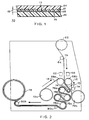
- Laminate 10 in Fig. 1 is usable with one or more rigid panels such as glass sheets, not shown, in a safety glazing.
- Laminate 10 comprises transparent, thermoplastic carrier layer or film 12 having a non-critical thickness of about 0.5 to 8 mils (0.013 to 0.20 mm), preferably 1 to 4 mils (0.025 to 0.1 mm) and most preferably 2 mils (0.05 mm), which is sufficiently stress-relieved and shrink-stable in a manner to be further described as to avoid substantial wrinkling during elevated temperature laminating formation of the safety glazing.
- Layer 12 in the embodiment shown is bonded on one side to at least one layer 14 and preferably as well on the other side (with 18 interposed therebetween) to layer 16 of plasticized polyvinyl butyral, typically about 5 to 30 mils (0.13 to 0.76 mm) in thickness.
- Layers 14, 16 may be of the same or different thickness and be textured or roughened on either or both unbonded outer surfaces by known techniques to facilitate deairing during formation of the safety glazing.
- Layer 12 on the carrier surface of one side 13 has one or more overlying adherent functional performance layers and/or coatings 18 between side 13 of layer 12 and side 15 of layer 16 (hereinafter called "performance layer") of the type previously described having properties enhancing performance of the safety glazing.
- carrier layer 12 and performance layer 18 is numbered 19 and hereinafter called "coated film".
- the preferred form of 18 is a multi-layer optically functional solar radiation control stack of one or more metal and two or more cooperating dielectric layers of which the metal layer(s) may optionally be electrically resistance heated for defrosting or defogging of associated glass layers in a vehicle window.
- layers 14, 16 and/or carrier layer 12 and/or performance layer 18 may be surface treated or coated to promote interfacial adhesion such as, for example, by flame or plasma exposure, sputter deposition of a metal oxide, application of an appropriate adhesive or the like.
- Carrier layer 12 has properties to maintain its integrity during handling and applying performance layer 18 to its surface as well as subsequent bonding, molding and laminating steps (to be further described herein) and as an integral part of the end use safety glazing product.
- carrier layer 12 is optically transparent (i.e. objects adjacent the layer on one side can be comfortably seen, without distortion, by the eye of a particular observer looking through the layer from the other side) and has a tensile modulus regardless of composition which will always be greater, preferably significantly greater, than that of plasticized polyvinyl butyral layers 14, 16.
- plastic materials having these physical properties and therefore suitable as carrier layer 12 are nylons, polyurethanes, acrylics, polycarbonates, polyolefins such as polypropylene, cellulose acetates and triacetates, vinyl chloride polymers and copolymers and the like.
- Preferred materials are pre-stretched thermoplastic films having the noted properties which include polyesters such as polyalkylene terephthalate.
- PET polyethylene terephthalate
- PET polyethylene terephthalate
- the tensile modulus (at 21-25°C) of polyethylene terephthalate is about 101°Pa as compared with about 107Pa for plasticized polyvinyl butyral of the type used in safety glazings.
- this tensile modulus property is desirable, it is also responsible for layer 12 resisting stretching which contributes to the wrinkle formation sought by the present invention to be avoided.
- more than one identical or different coated or uncoated carrier layer 12 may be used in laminate 10.
- Various coating and surface treatment techniques for PET carrier film are disclosed in published European Application No. 0157030, pages 4 and 5, incorporated herein by reference.
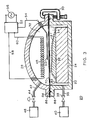
- Apparatus 20 comprises base 22 supporting bed 24 on which shaping mold 26 is mounted having a surface schematically shown as 27 possessing compound curvature.
- a surface with compound curvature requires some degree of stretching of a flat, planar thermoplastic layer in conforming such layer into perfect surface to surface contact with it.
- spherical curvature for example, is compound curvature.
- Mold surface 27 can be cooled (e.g. by circulating cooling water through channels, not shown, in mold 26) or coated with an appropriate anti-stick agent such as Teflon ⁇ to minimize unwanted sticking of plastic to surface 27 during the molding cycle to be shortly described.
- lower chamber 34 may be reduced in pressure through line 36 containing valve 38 communicating with negative pressure source 40.
- upper chamber 32 may be pressurized through line 42 containing control valve 44 communicating with source 46 of compressed air or nitrogen.
- Radiant heater 48 is positioned in upper chamber 32 to evenly heat unshaped premolding composite 70, to be further described.
- Thermocouple 50 between heater 48 and premolding composite 70 is preferably as close as possible to the upper surface of composite 70 without touching it.
- Line 54 delivers the signal from thermocouple 50 to temperature controller 52. Depending on temperature set point, controller 52 feeds appropriate electric power to heater 48 from power source 56 through leads 58, 60.
- Fig. 1 illustrates a nip roll press bonding system for encapsulating coated or layered carrier film 12 within PVB layers 14, 16.
- Carrier layer 12 as flexible, transparent biaxially oriented polyethylene terephthalate film carrying a solar radiation control metal/metal oxide stack (19 in Fig. 2,) is supplied from roll 62 and first passed over tension roll 64.
- Coated film 19 is subjected to moderate surface heating in stations 66 which are positioned to gently heat either coated film 19, plasticized PVB sheets 14, 16 or both. Heating is to a temperature sufficient to promote temporary fusion bonding in that the thermally softened surfaces of outer layers 14, 16 become tacky. Suitable temperatures for these preferred materials are in the range of 50 to 121°C, with the preferred surface temperature reaching about 65°C.
- Coated film 19 and plasticized PVB layers 14, 16 are fed into the laminating nip between oppositely rotating press rolls 68a, 68b where the three layers are merged together to expel air and encapsulate coated film 19 within PVB layers 14, 16 and form lightly bonded premolding composite 70.
- Layers 14, 16 are supplied from rolls 72a, 72b and a tension roll 74 can be included in the PVB layer supply line.
- press rolls 68a, 68b can be optionally heated to promote bonding.
- the bonding pressure exerted by press rolls 68a, 68b can be varied depending on the film materials chosen and bonding temperature employed but generally will range from about 0.7 to 5.3 kg/sq cm, preferably about 1.8 - 2.1 kg/sq cm.
- the tension of premolding composite 70 is controlled by passage over idler roll 74. Typical line speeds through the Fig. 2 assembly are from 5 to 30 ft/min (1.5 to 9.2 m/min).
- premolding composite 70 After bonding between press rolls 68a, 68b, premolding composite 70 passes over a series of cooling rolls 76a, 76b, 76c, 76d to insure that the composite accumulated on roll 78 is not tacky. Process water cooling is generally sufficient to achieve this objective. Tension in the roll system is further maintained by idler rolls 80a and 80b. The resulting premolding composite 70 has a bond strength between layers of about 0.4 - 0.9 kg per linear cm when tested according to a standard 180° peel test. This is considered sufficient strength to avoid delaminating during normal handling and further processing of the premolding composite.
- Heater 48 by signal from controller 52 then increases the temperature of shaped, shrinkable laminate 82 to a predetermined level which is above the initial shaping temperature and at least about equal to and preferably above the maximum use temperature subsequently encountered during autoclave laminating, while continuing constraint of the edges of margin 84.
- Shaped laminate 82 is held against mold surface 27 at such predetermined temperature as developed by heater 48 and controller 52 for a predetermined time sufficient to relieve stresses developed in laminate 82 during the prior stretching step and insure satisfactory heat setting of the carrier film component according to the invention.
- Time temperature conditions adequate to achieve heat setting according to the invention will vary but will generally be between 110 to 180°C for 30 sec to 100 min.
- shaped laminate 10 is associated with at least one and preferably two transparent rigid panels of matching shape and, by squeezing between rollers or drawing negative pressure on the assembly within a vacuum bag, air is withdrawn from the abutting interfaces of the rigid panels and matching laminate while heating commences to initially tack the PVB and glass surfaces together. Elevated temperature not significantly exceeding the temperature of the laminate during prior heat setting and elevated pressure is then developed in known manner to fusion bond the PVB and glass and form a delamination-resistant safety glazing having compound curvature and containing substantially wrinkle-free carrier layer 12.
- encapsulating layers 14, 16, of plasticized PVB of laminate 10 cooperate in reducing wrinkling by exerting a viscous drag effect on the carrier layer thereby retarding carrier layer shrinkage.
- a flexible, transparent, thermoplastic carrier layer having a multi-layer, solar radiation control stack adhered on one side was obtained from Southwall Technologies Inc. of Palo Alto, Calif. as Heat MirrorsTM -XIR-70-2.
- the carrier layer was 2 mil (0.051 mm) thick polyethylene terephthalate (PET) film obtained from Hoechst Celanese Corp. as Hostaphan® 4300-200 which had been biaxially oriented by stretching approximately equally in the longitudinal and transverse directions in the plane of the film and subsequently dimensionally stabilized by heating under tension to about 200-250°C for about 1 to 3 sec.
- PET polyethylene terephthalate
- Hostaphan® 4300-200 which had been biaxially oriented by stretching approximately equally in the longitudinal and transverse directions in the plane of the film and subsequently dimensionally stabilized by heating under tension to about 200-250°C for about 1 to 3 sec.
- PMMA polymethyl methacrylate
- the solar control stack was about 2000A thick and comprised five to seven successive sputter deposited alternate layers of silver metal and tin-indium oxide dielectric material, further details of which are described in U.S. No. 4,799,745.
- This initial heat setting of the biaxially oriented PET film according to known prior art teachings (see for example U.S. 4,469,743, col. 2, lines 54-59) minimizes or avoids dimensional changes in the film with temperature during treatment and deposition of the solar stack on the surface of the film and bonding to PVB sheet.
- the side of the PET film without the stack was plasma treated using oxygen to improve the adhesive strength of the PET film.
- the coated carrier film was encapsulated within and lightly bonded to two 15 mil (0.38 mm) thick layers of plasticized polyvinyl butyral available from Monsanto Co. as Saflex® TG sheet to form a premolding composite.
- Sixteen inch (40.6 cm) square sections of this composite were then prepared for processing in apparatus such as depicted in Fig. 3. Each section was peripherally clamped within a gripping assembly which circumscribed a 15 in. (38.1 cm) diameter circle.
- the region within the clamped periphery of the composite was heated in a sealed chamber to a shaping temperature of about 7982°C as measured by a thermocouple in close proximity to the surface of one of the outer PVB layers, using radiant heat from an infra-red heater mounted above the clamped composite.
- Negative pressure of 28 in. (71.1 cm) Hg was then developed on one side of the clamped composite to draw the heated region within the clamped periphery down over the surface of a metal-filled epoxy male or female mold of spherical shape generally in the form of a watchglass 12.5 in. (31.8 cm) diameter, 1.6 in. (4.1 cm) deep having a 13 in. (33.0 cm) radius of curvature.
- the glass/shaped laminate/glass assembly was placed in a rubberized fabric vacuum bag which in turn was placed in an autoclave chamber.
- a vacuum (71.1 cm Hg) was applied within the bag to remove air from between mating glass-plastic interfaces while the atmosphere within the chamber was gradually heated to 121°C.
- Pressure within the autoclave was increased to 180 psig (1224kPa) while maintaining 121°C and these autoclave laminating conditions were maintained for about 20 min. to establish the strong PVB-glass fusion bond of a safety glazing.
- the optically transparent safety glazing samples having compound curvature representative of that encountered in a modern vehicle window were then cooled to room temperature, removed from the vacuum bag and visually examined for the presence of edge wrinkles in the PET carrier layer. Results were as follows:
- Example 7 conditions (10 min @ 121°C) were insufficient to produce a wrinkle-resistant carrier layer during subsequent processing in that stresses imparted during shaping and remaining in the carrier layer due to insufficient heat setting relaxed causing shrinkage and visible wrinkling due to buckling of the carrier layer when the shaped laminate was exposed to 121°C during autoclaving.
- Example 4 is representative of the effect on carrier layer wrinkling of the relationship between downstream autoclave temperature and heat set conditions.
- 143°C autoclave temperature unrelaxed stresses introduced into the carrier film most likely during initial formation of the biaxially stretched PET film at about this 143°C temperature (vis-a-vis 121°C in Example 3) relaxed sufficiently to generate wrinkles in the shaped laminate with its unrestrained edges during deairing/autoclaving, the 10 min, 160°C heat setting conditions being too mild to relax such stresses and prevent wrinkling from occurring.
- stresses present in the PET film of Example 3 introduced at temperatures greater than 121°C were unrelieved at the 121°C autoclave temperature and therefore did not result in wrinkling.
Landscapes
- Engineering & Computer Science (AREA)
- Mechanical Engineering (AREA)
- Physics & Mathematics (AREA)
- Thermal Sciences (AREA)
- Manufacturing & Machinery (AREA)
- Laminated Bodies (AREA)
- Joining Of Glass To Other Materials (AREA)
- Diaphragms For Electromechanical Transducers (AREA)
- Shaping By String And By Release Of Stress In Plastics And The Like (AREA)
Claims (36)
- Verfahren zur Bildung eines Formlaminats zur Verwendung in einer Sicherheitsverglasung, wie einem Fahrzeugfenster oder dgl., welches umfaßt:a) leichtes Binden zumindest einer flexiblen, transparenten, thermoplastischen Trägerschicht, die eine oder mehrere haftende Schichten oder -beschichtungen mit funktioneller Leistung an ihrer Oberfläche aufweist, an zumindest eine Schicht aus plastifiziertem Polyvinylbutyral, um einen Vorformverbund zu bilden;b) Strecken des Verbundes, um diesem eine zusammengesetzte Krümmung zu verleihen und ein schrumpfbares Formlaminat zu bilden;c) Unterwerfen des Formlaminats einer erhöhten Temperatur, während seine Ränder eingespannt werden, um Spannungen in der Trägerschicht aufzuheben; undd) Abkühlen des Formlaminats, während seine Ränder eingespannt bleiben.
- Verfahren nach Anspruch 1, bei welchem das Strecken durch Drücken des Verbundes gegen die Fläche einer formgebenden Form erfolgt.
- Verfahren nach Anspruch 1, bei welchem vor Schritt b) der Vorformverbund auf Formtemperatur erhitzt wird.
- Verfahren nach Anspruch 1, bei welchem die eine oder mehreren haftenden Leistungsschichten oder -beschichtungen ein mehrschichtiges Sonnenstrahlungsschutz-Schichtpaket umfassen.
- Verfahren nach Anspruch 1, bei welchem die erhöhte Temperatur von Schritt c) 110 bis 180°C beträgt.
- Verfahren nach Anspruch 1, bei welchem die in Schritt c) aufgehobenen Spannungen in Schritt b) entwickelt werden.
- Verfahren nach Anspruch 1, 2, 3, 4, 5 oder 6, bei welchem die flexible, transparente, thermoplastische Trägerschicht in Schritt a) ein biaxial orientiertes Polyalkylenterephthalat ist.
- Verfahren nach Anspruch 7, bei welchem das Polyalkylen Polyethylen ist.
- Verfahren nach Anspruch 8, bei welchem das biaxial orientierte Polyalkylenterephthalat vor der Durchführung von Schritt a) heißfixiert wird.
- Verfahren zur Bildung eines Formlaminats zur Verwendung in einer Sicherheitsverglasung, wie einem Fahrzeugfenster oder dgl., welches umfaßt:a) Einkapseln einer flexiblen, transparenten Trägerschicht aus biaxial orientiertem Polyethylenterephthalat, die ein mehrschichtiges Sonnenstrahlungsschutz- oder ein elektrisch leitfähiges Schichtpaket an ihrer Oberfläche aufweist, in Schichten aus plastifiziertem Polyvinylbutyral, um einen Vorformverbund zu bilden;b) Erhitzen des Vorformverbunds auf Formtemperatur;c) Strecken des erhitzten Verbundes gegen die Oberfläche einer formgebenden Form, um diesem eine zusammengesetzte Krümmung zu verleihen und ein schrumpfbares Formlaminat zu bilden;d) Erhitzen des schrumpfbaren Formlaminats auf eine Temperatur über der Formtemperatur, während seine Ränder eingespannt werden, um die im Laminat während Schritt c) entwickelten Spannungen aufzuheben; unde) Kühlen des spannungsfreien Formlaminats, während seine Ränder eingespannt bleiben.
- Verfahren nach Anspruch 10, bei welchem die in Schritt d) erreichte Temperatur des schrumpfbaren Formlaminats die Temperatur des Laminats während der Bildung der Sicherheitsverglasung im Autoklaven ist.
- Herstellung einer Sicherheitsverglasung, wie einer Windschutzscheibe oder dgl., mit einer zusammengesetzten Krümmung unter Verwendung eines Laminats, das eine Trägerschicht enthält, die eine funktionelle Beschichtung mit die Leistung der Sicherheitsverglasung verbessernden Eigenschaften aufweist, unter Anwendung eines Verfahrens zur Verringerung einer Faltenbildung der Trägerschicht in der Sicherheitsverglasung, welches die Schritte umfaßt:a) leichtes Binden einer transparenten, thermoplastischen Trägerschicht, die eine oder mehrere haftende Schichten oder -beschichtungen mit funktioneller Leistung an ihrer Oberfläche aufweist, an zumindest eine Schicht aus plastifiziertem Polyvinylbutyral, um einen Vorformverbund zu bilden;b) Strecken des Verbundes, um diesem eine zusammengesetzte Krümmung zu verleihen und ein schrumpfbares Formlaminat zu bilden;c) Unterwerfen des Formlaminats einer erhöhten Temperatur, während seine Ränder eingespannt werden, um Spannungen in der Trägerschicht aufzuheben; undd) Abkühlen des Formlaminats, während seine Ränder eingespannt bleiben;e) Vereinigen des die spannungsfreie Trägerschicht enthaltenden Laminats mit zumindest einer transparenten, steifen Platte passender Form; und dannf) Unterwerfen des Formlaminats und der steifen Platte einer erhöhten Temperatur und einem Druck, um das Formlaminat stark an zumindest eine steife Platte zu binden und eine delaminierungsbeständige Sicherheitsverglasung zu bilden, die im wesentlichen frei von Falten in der Trägerschicht ist.
- Verfahren nach Anspruch 12, bei welchem Schritt e) das Aufbringen des Formlaminats gegen die Fläche der zumindest einen steifen Platte, während die Grenzfläche zwischen dem Formlaminat und der genannten steifen Platte entlüftet wird, enthält.
- Verfahren nach Anspruch 12 oder 13, bei welchem das Formlaminat in Schritt e) zwischen zwei steifen Platten angeordnet wird.
- Verfahren nach Anspruch 14, bei welchem die steifen Platten Glas sind.
- Verfahren nach Anspruch 15, bei welchem die Temperatur in Schritt f) die in Schritt c) erreichte Temperatur des Laminats nicht überschreitet.
- Verfahren zur Bildung eines Formlaminats zur Verwendung in einer Sicherheitsverglasung, wie einem Fahrzeugfenster oder dgl., welches umfaßt:a) Verbinden zumindest einer flexiblen, transparenten, thermoplastischen Trägerschicht, die eine oder mehrere haftende Schichten oder -beschichtungen mit funktioneller Leistung an ihrer Oberfläche aufweist, mit zumindest einer Schicht aus plastifiziertem Polyvinylbutyral, um einen Vorformverbund zu bilden;b) Positionieren eines ebenen Abschnitts des Vorformverbunds in Nachbarschaft einer in Betrieb befindlichen Heizvorrichtung, um die Temperatur zumindest der Trägerschicht auf Formtemperatur zu erhöhen;c) Ziehen des die erhitzte Trägerschicht enthaltenden Verbundes gegen die Oberfläche einer benachbarten Form mit einer zusammengesetzten Krümmung, um ein die Trägerschicht enthaltendes Formlaminat zu bilden, das eine passende zusammengesetzte Krümmung aufweist und durch während des genannten Ziehens entwickelte induzierte Spannungen schrumpfbar gemacht wurde;d) Halten des Formlaminats, das die schrumpfbare Trägerschicht enthält, gegen die Formoberfläche unter dem Einfluß der in Betrieb befindlichen Heizvorrichtung, um die Temperatur der schrumpfbaren Trägerschicht über die Formtemperatur zur Aufhebung der genannten Spannungen zu erhöhen; unde) Abkühlen des genannten Formlaminats, das die spannungsfrei gemachte Trägerschicht enthält, während das genannte Formlaminat mit der Formoberfläche in Oberflächenkontakt gehalten wird.
- Verfahren nach Anspruch 17, bei welchem die Trägerschicht in Schritt a) eine biaxial gestreckte Polyethylenterephthalat-Folie ist.
- Verfahren nach Anspruch 17 oder 18, bei welchem die eine oder mehreren haftenden Leistungsschichten oder -beschichtungen ein mehrschichtiges Sonnenstrahlungsschutz- oder elektrisch heizbares Schichtpaket umfassen.
- Verfahren zum Formstabilisieren einer transparenten, schrumpfbaren, thermoplastischen Schicht in einem durch Ziehen geformten Laminat, wobei die genannte thermoplastische Schicht eine oder mehrere Leistungsschichten oder -beschichtungen trägt und im Laminat mit Schichten aus plastifiziertem Polyvinylbutyral gebunden wird, welches Verfahren das Heißfixieren der thermoplastischen Schicht durch Erhitzen des Laminats während des Haltens des Laminats gegen die Oberfläche einer formgebenden Form umfaßt.
- Verfahren nach Anspruch 20, bei welchem die thermoplastische Schicht im Laminat an das plastifizierte Polyvinylbutyral gebunden wird.
- Verfahren nach Anspruch 21, bei welchem die thermoplastische Schicht im Laminat an jeder Seite an eine Schicht aus plastifiziertem Polyvinylbutyral gebunden wird.
- Verfahren nach Anspruch 20, 21 oder 22, bei welchem das Laminat ein mehrschichtiges Sonnenstrahlungsschutz-Schichtpaket an einer Seite der thermoplastischen Schicht enthält.
- Verfahren nach Anspruch 23, bei welchem die Oberfläche des Paketes oder die Seite der thermoplastischen Schicht ohne Paket behandelt oder beschichtet wurde, um eine Bindung an das plastifizierte Polyvinylbutyral zu fördern.
- Verfahren nach Anspruch 24, bei welchem die thermoplastische Schicht eine Polyesterfolie umfaßt.
- Verfahren nach Anspruch 25, bei welchem der Polyester Polyalkylenterephthalat ist.
- Verfahren nach Anspruch 26, bei welchem der Polyester Polyethylen ist.
- Verfahren nach Anspruch 27, bei welchem die thermoplastische Schicht biaxial orientiertes Polyethylenterephthalat ist.
- Verfahren nach Anspruch 28, bei welchem das Laminat 30 Sekunden bis 100 Minuten lang gegen die Fläche gehalten wird, während das Laminat auf 110 bis 180°C erhitzt wird.
- Verfahren nach Anspruch 29, bei welchem vor der Bildung des Laminats die biaxial orientierte Polyethylenterephthalat-Schicht bei 200 bis 250°C heißfixiert wird.
- Verfahren zum Formstabilisieren einer transparenten, schrumpfbaren Schicht aus Polyethylenterephthalat, die eine oder mehrere Leistungsschichten oder -beschichtungen an ihrer Oberfläche aufweist, wobei die genannte Schicht in einem durch Ziehen geformten Laminat an zumindest eine Schicht aus plastifiziertem Polyvinylbutyral gebunden wird, welches Verfahren den Schritt umfaßt, daß das Laminat, während es für einen ausreichenden Zeitraum, um die thermoplastische Polyethylenterephthalat-Schicht heißzufixieren, gegen die Oberfläche einer formgebenden Form für das Laminat gehalten wird, einer erhöhten Temperatur unterworfen wird.
- Verfahren nach Anspruch 31, bei welchem die erhöhte Temperatur zwischen 110 und 180°C liegt.
- Verfahren nach Anspruch 32, bei welchem der Zeitraum zwischen 30 Sekunden und 100 Minuten beträgt.
- Verfahren nach Anspruch 33, bei welchem die plastifizierte Polyvinylbutyral-Schicht an die Seite des Polyethylenterephthalats, die jener Seite gegenüberliegt, die die eine oder mehreren Leistungsschichten oder -beschichtungen trägt, schmelzgebunden wird.
- Verfahren nach Anspruch 33, bei welchem vor dem Binden die Polyethylenterephthalat-Schicht oder die Polyvinylbutyral-Schicht zur Verbesserung der Schichthaftung behandelt oder beschichtet wurde.
- Verfahren nach Anspruch 35, bei welchem die Polyethylenterephthalat-Schicht 0,051 bis 0,13 mm dick ist.
Applications Claiming Priority (4)
| Application Number | Priority Date | Filing Date | Title |
|---|---|---|---|
| US07/539,251 US5069734A (en) | 1990-06-18 | 1990-06-18 | Dimensional stabilizing process |
| US539256 | 1990-06-18 | ||
| US539251 | 1990-06-18 | ||
| US07/539,256 US5529654A (en) | 1990-06-18 | 1990-06-18 | Process forming a shaped laminate |
Publications (2)
| Publication Number | Publication Date |
|---|---|
| EP0535128A1 EP0535128A1 (de) | 1993-04-07 |
| EP0535128B1 true EP0535128B1 (de) | 1994-02-16 |
Family
ID=27066053
Family Applications (1)
| Application Number | Title | Priority Date | Filing Date |
|---|---|---|---|
| EP91912199A Expired - Lifetime EP0535128B1 (de) | 1990-06-18 | 1991-06-07 | Verfahren zum formen und zum stabilisieren der dimension des geformten laminates |
Country Status (12)
| Country | Link |
|---|---|
| EP (1) | EP0535128B1 (de) |
| JP (1) | JPH05507661A (de) |
| KR (1) | KR950012799B1 (de) |
| AT (1) | ATE101559T1 (de) |
| AU (1) | AU644191B2 (de) |
| BR (1) | BR9106568A (de) |
| CA (1) | CA2084662A1 (de) |
| DE (1) | DE69101221T2 (de) |
| DK (1) | DK0535128T3 (de) |
| ES (1) | ES2050056T3 (de) |
| MX (1) | MX171196B (de) |
| WO (1) | WO1991019586A1 (de) |
Cited By (3)
| Publication number | Priority date | Publication date | Assignee | Title |
|---|---|---|---|---|
| DE19902471A1 (de) * | 1999-01-22 | 2000-08-03 | Sekurit Saint Gobain Deutsch | Verbundscheibe |
| US7867605B2 (en) | 2000-09-28 | 2011-01-11 | Solutia Inc. | Intrusion resistant glass laminates |
| EP4545289A1 (de) * | 2023-10-25 | 2025-04-30 | Kuraray Europe GmbH | Verfahren zur herstellung von zwischenschichtfolien für windschutzscheiben mit gekrümmten verdunkelungsbändern |
Families Citing this family (10)
| Publication number | Priority date | Publication date | Assignee | Title |
|---|---|---|---|---|
| US5024895A (en) * | 1990-06-18 | 1991-06-18 | Monsanto Company | Laminate for a safety glazing |
| US5264058A (en) * | 1992-08-24 | 1993-11-23 | Monsanto | Forming a shaped prelaminate and bilayer glazing of glass and plastic |
| DE19632616B4 (de) * | 1996-08-13 | 2004-10-07 | Saint-Gobain Sekurit Deutschland Gmbh & Co. Kg | Seitenaufprallschutz für Fahrzeuginsassen |
| CA2309537A1 (en) * | 1997-12-19 | 1999-07-01 | E.I. Du Pont De Nemours And Company | Interlayer structure for laminated glass |
| US7189447B2 (en) * | 2002-01-04 | 2007-03-13 | 3M Innovative Properties Company | Laminates |
| DE602004032136D1 (de) * | 2003-06-12 | 2011-05-19 | Pilkington Italia Spa | Verfahren zur herstellung einer gebogenen laminierten glasscheibe |
| WO2009008857A1 (en) * | 2007-07-09 | 2009-01-15 | E. I. Du Pont De Nemours And Company | Decorative polyvinyl butyral solar control laminates |
| JP5417710B2 (ja) * | 2008-01-09 | 2014-02-19 | セントラル硝子株式会社 | プラスチックフィルム挿入合わせガラスの製造方法およびプラスチックフィルム挿入合わせガラス |
| CN106061915A (zh) * | 2014-02-25 | 2016-10-26 | 积水化学工业株式会社 | 夹层玻璃用中间膜、夹层玻璃用中间膜的制造方法及夹层玻璃 |
| DE102020212679A1 (de) | 2020-10-07 | 2022-04-07 | Volkswagen Aktiengesellschaft | Verfahren zur Herstellung eines geformten Glasverbundes mit mindestens einem optischen Funktionselement und Verwendung eines solchen |
Family Cites Families (4)
| Publication number | Priority date | Publication date | Assignee | Title |
|---|---|---|---|---|
| US4469743A (en) * | 1983-03-14 | 1984-09-04 | E. I. Du Pont De Nemours And Company | Polyvinyl butyral laminates |
| GB8619464D0 (en) * | 1986-08-09 | 1986-09-17 | Glaverbel | Bending thermoplastics sheets |
| US5024895A (en) * | 1990-06-18 | 1991-06-18 | Monsanto Company | Laminate for a safety glazing |
| US5091258A (en) * | 1990-08-20 | 1992-02-25 | Monsanto Company | Laminate for a safety glazing |
-
1991
- 1991-06-07 KR KR1019920703257A patent/KR950012799B1/ko not_active Expired - Lifetime
- 1991-06-07 CA CA002084662A patent/CA2084662A1/en not_active Abandoned
- 1991-06-07 AU AU80561/91A patent/AU644191B2/en not_active Ceased
- 1991-06-07 DE DE69101221T patent/DE69101221T2/de not_active Expired - Fee Related
- 1991-06-07 BR BR919106568A patent/BR9106568A/pt not_active Application Discontinuation
- 1991-06-07 DK DK91912199.6T patent/DK0535128T3/da active
- 1991-06-07 JP JP91511487A patent/JPH05507661A/ja active Pending
- 1991-06-07 WO PCT/US1991/004033 patent/WO1991019586A1/en not_active Ceased
- 1991-06-07 ES ES91912199T patent/ES2050056T3/es not_active Expired - Lifetime
- 1991-06-07 EP EP91912199A patent/EP0535128B1/de not_active Expired - Lifetime
- 1991-06-07 AT AT91912199T patent/ATE101559T1/de not_active IP Right Cessation
- 1991-06-17 MX MX026270A patent/MX171196B/es unknown
Cited By (4)
| Publication number | Priority date | Publication date | Assignee | Title |
|---|---|---|---|---|
| DE19902471A1 (de) * | 1999-01-22 | 2000-08-03 | Sekurit Saint Gobain Deutsch | Verbundscheibe |
| DE19902471C2 (de) * | 1999-01-22 | 2003-07-17 | Saint Gobain Sekurit D Gmbh | Verbundscheibe |
| US7867605B2 (en) | 2000-09-28 | 2011-01-11 | Solutia Inc. | Intrusion resistant glass laminates |
| EP4545289A1 (de) * | 2023-10-25 | 2025-04-30 | Kuraray Europe GmbH | Verfahren zur herstellung von zwischenschichtfolien für windschutzscheiben mit gekrümmten verdunkelungsbändern |
Also Published As
| Publication number | Publication date |
|---|---|
| AU8056191A (en) | 1992-01-07 |
| KR950012799B1 (ko) | 1995-10-21 |
| AU644191B2 (en) | 1993-12-02 |
| DE69101221T2 (de) | 1994-08-11 |
| EP0535128A1 (de) | 1993-04-07 |
| CA2084662A1 (en) | 1991-12-19 |
| WO1991019586A1 (en) | 1991-12-26 |
| KR930701289A (ko) | 1993-06-11 |
| DK0535128T3 (da) | 1994-05-09 |
| DE69101221D1 (de) | 1994-03-24 |
| BR9106568A (pt) | 1993-05-25 |
| ES2050056T3 (es) | 1994-05-01 |
| MX171196B (es) | 1993-10-06 |
| JPH05507661A (ja) | 1993-11-04 |
| ATE101559T1 (de) | 1994-03-15 |
Similar Documents
| Publication | Publication Date | Title |
|---|---|---|
| US5024895A (en) | Laminate for a safety glazing | |
| US5529654A (en) | Process forming a shaped laminate | |
| KR100433721B1 (ko) | 뒤틀림에의한광학적왜곡이없는적층안전유리판을제조하는방법과이적층안전유리판 | |
| US6261398B1 (en) | Process for producing a curved laminated safety glass sheet | |
| EP2216304B1 (de) | Verfahren zur herstellung von verbundglas mit eingesetztem kunststofffilm | |
| AU644191B2 (en) | Process forming and dimensionally stabilizing shaped laminate | |
| US5069734A (en) | Dimensional stabilizing process | |
| JP2726813B2 (ja) | ガラスとプラスチックとの積層体の形成法 | |
| EP0186787B1 (de) | Verfahren zur Herstellung eines Verbundglases | |
| US7503994B2 (en) | Process for the production of multilayer polymer films | |
| US4973364A (en) | Process for the manufacture of a substantially wrinkle-free non-planar laminate and pre-laminate | |
| EP0326015B1 (de) | Im wesentlichen faltenfreie, nicht flache Folie mit hohem Elastizitätsmodul und Verfahren zu ihrer Herstellung | |
| CN112004785A (zh) | 车辆用轻质夹层玻璃板的制造方法 | |
| JPS6371332A (ja) | 積層体の製造方法 | |
| JPS62297136A (ja) | 積層体の製造方法 |
Legal Events
| Date | Code | Title | Description |
|---|---|---|---|
| PUAI | Public reference made under article 153(3) epc to a published international application that has entered the european phase |
Free format text: ORIGINAL CODE: 0009012 |
|
| 17P | Request for examination filed |
Effective date: 19921126 |
|
| AK | Designated contracting states |
Kind code of ref document: A1 Designated state(s): AT BE CH DE DK ES FR GB GR IT LI LU NL SE |
|
| 17Q | First examination report despatched |
Effective date: 19930430 |
|
| GRAA | (expected) grant |
Free format text: ORIGINAL CODE: 0009210 |
|
| AK | Designated contracting states |
Kind code of ref document: B1 Designated state(s): AT BE CH DE DK ES FR GB GR IT LI LU NL SE |
|
| REF | Corresponds to: |
Ref document number: 101559 Country of ref document: AT Date of ref document: 19940315 Kind code of ref document: T |
|
| REF | Corresponds to: |
Ref document number: 69101221 Country of ref document: DE Date of ref document: 19940324 |
|
| ET | Fr: translation filed | ||
| REG | Reference to a national code |
Ref country code: ES Ref legal event code: FG2A Ref document number: 2050056 Country of ref document: ES Kind code of ref document: T3 |
|
| ITF | It: translation for a ep patent filed | ||
| REG | Reference to a national code |
Ref country code: DK Ref legal event code: T3 |
|
| REG | Reference to a national code |
Ref country code: GR Ref legal event code: FG4A Free format text: 3011212 |
|
| EPTA | Lu: last paid annual fee | ||
| PLBE | No opposition filed within time limit |
Free format text: ORIGINAL CODE: 0009261 |
|
| STAA | Information on the status of an ep patent application or granted ep patent |
Free format text: STATUS: NO OPPOSITION FILED WITHIN TIME LIMIT |
|
| EAL | Se: european patent in force in sweden |
Ref document number: 91912199.6 |
|
| 26N | No opposition filed | ||
| PGFP | Annual fee paid to national office [announced via postgrant information from national office to epo] |
Ref country code: LU Payment date: 19950501 Year of fee payment: 5 |
|
| PGFP | Annual fee paid to national office [announced via postgrant information from national office to epo] |
Ref country code: SE Payment date: 19950511 Year of fee payment: 5 Ref country code: CH Payment date: 19950511 Year of fee payment: 5 |
|
| PGFP | Annual fee paid to national office [announced via postgrant information from national office to epo] |
Ref country code: AT Payment date: 19950515 Year of fee payment: 5 |
|
| PGFP | Annual fee paid to national office [announced via postgrant information from national office to epo] |
Ref country code: DK Payment date: 19950517 Year of fee payment: 5 |
|
| PGFP | Annual fee paid to national office [announced via postgrant information from national office to epo] |
Ref country code: NL Payment date: 19950522 Year of fee payment: 5 |
|
| PGFP | Annual fee paid to national office [announced via postgrant information from national office to epo] |
Ref country code: FR Payment date: 19950526 Year of fee payment: 5 Ref country code: DE Payment date: 19950526 Year of fee payment: 5 |
|
| PGFP | Annual fee paid to national office [announced via postgrant information from national office to epo] |
Ref country code: BE Payment date: 19950529 Year of fee payment: 5 |
|
| PGFP | Annual fee paid to national office [announced via postgrant information from national office to epo] |
Ref country code: GR Payment date: 19950530 Year of fee payment: 5 Ref country code: GB Payment date: 19950530 Year of fee payment: 5 |
|
| PGFP | Annual fee paid to national office [announced via postgrant information from national office to epo] |
Ref country code: ES Payment date: 19950612 Year of fee payment: 5 |
|
| PG25 | Lapsed in a contracting state [announced via postgrant information from national office to epo] |
Ref country code: LU Free format text: LAPSE BECAUSE OF NON-PAYMENT OF DUE FEES Effective date: 19960607 Ref country code: GB Effective date: 19960607 Ref country code: DK Effective date: 19960607 Ref country code: AT Effective date: 19960607 |
|
| REG | Reference to a national code |
Ref country code: DK Ref legal event code: EBP |
|
| PG25 | Lapsed in a contracting state [announced via postgrant information from national office to epo] |
Ref country code: SE Effective date: 19960608 Ref country code: ES Free format text: LAPSE BECAUSE OF EXPIRATION OF PROTECTION Effective date: 19960608 |
|
| PG25 | Lapsed in a contracting state [announced via postgrant information from national office to epo] |
Ref country code: LI Effective date: 19960630 Ref country code: CH Effective date: 19960630 Ref country code: BE Effective date: 19960630 |
|
| BERE | Be: lapsed |
Owner name: MONSANTO CY Effective date: 19960630 |
|
| PG25 | Lapsed in a contracting state [announced via postgrant information from national office to epo] |
Ref country code: GR Free format text: THE PATENT HAS BEEN ANNULLED BY A DECISION OF A NATIONAL AUTHORITY Effective date: 19961231 |
|
| PG25 | Lapsed in a contracting state [announced via postgrant information from national office to epo] |
Ref country code: NL Effective date: 19970101 |
|
| GBPC | Gb: european patent ceased through non-payment of renewal fee |
Effective date: 19960607 |
|
| REG | Reference to a national code |
Ref country code: GR Ref legal event code: MM2A Free format text: 3011212 |
|
| REG | Reference to a national code |
Ref country code: CH Ref legal event code: PL |
|
| PG25 | Lapsed in a contracting state [announced via postgrant information from national office to epo] |
Ref country code: FR Effective date: 19970228 |
|
| PG25 | Lapsed in a contracting state [announced via postgrant information from national office to epo] |
Ref country code: DE Effective date: 19970301 |
|
| EUG | Se: european patent has lapsed |
Ref document number: 91912199.6 |
|
| NLV4 | Nl: lapsed or anulled due to non-payment of the annual fee |
Effective date: 19970101 |
|
| REG | Reference to a national code |
Ref country code: FR Ref legal event code: ST |
|
| REG | Reference to a national code |
Ref country code: ES Ref legal event code: FD2A Effective date: 20000601 |
|
| PG25 | Lapsed in a contracting state [announced via postgrant information from national office to epo] |
Ref country code: IT Free format text: LAPSE BECAUSE OF NON-PAYMENT OF DUE FEES;WARNING: LAPSES OF ITALIAN PATENTS WITH EFFECTIVE DATE BEFORE 2007 MAY HAVE OCCURRED AT ANY TIME BEFORE 2007. THE CORRECT EFFECTIVE DATE MAY BE DIFFERENT FROM THE ONE RECORDED. Effective date: 20050607 |