EP0535384B1 - Verfahren zur ununterbrochenen Herstellung von Mikrokapseln - Google Patents
Verfahren zur ununterbrochenen Herstellung von Mikrokapseln Download PDFInfo
- Publication number
- EP0535384B1 EP0535384B1 EP92114936A EP92114936A EP0535384B1 EP 0535384 B1 EP0535384 B1 EP 0535384B1 EP 92114936 A EP92114936 A EP 92114936A EP 92114936 A EP92114936 A EP 92114936A EP 0535384 B1 EP0535384 B1 EP 0535384B1
- Authority
- EP
- European Patent Office
- Prior art keywords
- liquid
- emulsion
- tank
- continuously
- polyamine
- Prior art date
- Legal status (The legal status is an assumption and is not a legal conclusion. Google has not performed a legal analysis and makes no representation as to the accuracy of the status listed.)
- Expired - Lifetime
Links
Images
Classifications
-
- B—PERFORMING OPERATIONS; TRANSPORTING
- B01—PHYSICAL OR CHEMICAL PROCESSES OR APPARATUS IN GENERAL
- B01J—CHEMICAL OR PHYSICAL PROCESSES, e.g. CATALYSIS OR COLLOID CHEMISTRY; THEIR RELEVANT APPARATUS
- B01J13/00—Colloid chemistry, e.g. the production of colloidal materials or their solutions, not otherwise provided for; Making microcapsules or microballoons
- B01J13/02—Making microcapsules or microballoons
- B01J13/06—Making microcapsules or microballoons by phase separation
- B01J13/14—Polymerisation; cross-linking
- B01J13/16—Interfacial polymerisation
-
- Y—GENERAL TAGGING OF NEW TECHNOLOGICAL DEVELOPMENTS; GENERAL TAGGING OF CROSS-SECTIONAL TECHNOLOGIES SPANNING OVER SEVERAL SECTIONS OF THE IPC; TECHNICAL SUBJECTS COVERED BY FORMER USPC CROSS-REFERENCE ART COLLECTIONS [XRACs] AND DIGESTS
- Y10—TECHNICAL SUBJECTS COVERED BY FORMER USPC
- Y10T—TECHNICAL SUBJECTS COVERED BY FORMER US CLASSIFICATION
- Y10T428/00—Stock material or miscellaneous articles
- Y10T428/29—Coated or structually defined flake, particle, cell, strand, strand portion, rod, filament, macroscopic fiber or mass thereof
- Y10T428/2982—Particulate matter [e.g., sphere, flake, etc.]
- Y10T428/2984—Microcapsule with fluid core [includes liposome]
- Y10T428/2985—Solid-walled microcapsule from synthetic polymer
Definitions
- the present invention relates to a method of producing microcapsules each having a wall of a polyurethane-urea resin film.
- microcapsules For producing microcapsules by adding a polyisocyanate to an oily liquid containing a capsule core substance, emulsifying and dispersing the oily liquid and an aqueous liquid containing an emulsifier to form an emulsion, and reacting a polyamine with the emulsion to form a synthetic polymer wall film at the liquid-drop interface to encapsulate the hydrophobic liquid surface; the following methods are known.
- the oily liquid and the aqueous liquid are prepared at a high temperature of 80°C or higher. However, where emulsification of them is effected at a low temperature, they are once cooled and then emulsified and thereafter are again heated for encapsulation reaction. The operation involves much energy loss. In addition, where the oily liquid contains a colorant or the like as the capsule core substance, the colorant would easily precipitate when it is cooled so that the concentration of the colorant in the liquid could not be made high defectively.
- the method still involves various problems that aggregated capsules are formed because of the insufficient stirring in the reactor, that a large-sized equipment is necessary for ensuring a determined retention time for encapsulation and that removal of the capsules as adhered to the wall in the reactor is difficult.
- the object of the present invention is to overcome the above-mentioned problems in the conventional methods and to provide a method of efficiently producing microcapsules having excellent characteristics, which method does not need much time for elevating the reaction temperature, which is free from deterioration of the heat resistance and solvent resistance of the microcapsules formed, which may use a colorant having a high concentration, which is free from adhesion of the formed capsules to the wall of a tank during encapsulation reaction, which does not need much time for cleaning the tank and which uses a small-sized equipment.
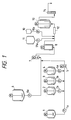
- Fig. 1 is a flow-sheet of a method of producing microcapsules of the present invention.
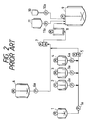
- Fig. 2 is a flow-sheet of a conventional method of producing microcapsules.
- the above-mentioned object of the present invention is attained by the method outlined in claim 1.
- the emulsion to which the polyamine and water have been continuously added is overflown with continuously feeding it from the bottom of an encapsulating device to the top thereof to continuously effect the wall filming treatment.
- Fig. 1 shows a flow-sheet of the method of producing microcapsules of the present invention.
- an oily liquid containing a colorant is stored in the container 1 at a temperature of 50°C or higher; and a polyisocyanate and a polyol to be used as wall forming agents are stored in the containers 2, 3 and 4.
- the liquids in 1, 2, 3 and 4 are continuously introduced into the in-line mixer at a desired ratio, after having metered by the metering pumps 1a, 2a, 3a and 4a, respectively.
- the metering pump to be used herein may be any one having a metering function, such as a gear pump, a plunger pump, a monopump or a diaphragm pump, which is not specifically defined with respect to the type.
- a metering function such as a gear pump, a plunger pump, a monopump or a diaphragm pump, which is not specifically defined with respect to the type.
- the in-line mixer usable are a static mixer and a high power shearing mixer. Anyhow, it is not specifically defined with respect to the type, provided that it may uniformly mix the above-mentioned liquids 1, 2, 3 and 4.
- An aqueous liquid is stored in the container 6 at a temperature of 50°C or higher, and it is introduced into the pre-emulsifier 7 at a desired ratio to the oily liquid in the in-line mixer 5, after having been metered by the metering pump 6a. After the oily liquid and the aqueous liquid are pre-emulsified therein at a temperature of 50°C or higher, the pre-emulsion is then fed to the emulsifier 8.
- the pre-emulsifier 7 may be a pipe line homomixer or a homomic line flow; and the emulsifier 8 may be any one capable of effecting continuous emulsification, such as a pipe line homomixer, a colloid mill or a double cylindrical emulsifier, and the type thereof is not specifically defined.
- a polyamine and a capsule concentration adjusting water of 50°C or higher from the containers 10 and 11, via the metering pumps 10a and 11a, respectively, and they are continuously mixed with the static mixer 12.
- the resulting mixture liquid is then injected into the encapsulation device 13 from the bottom thereof, in which encapsulation of the liquid is effected for a determined period of time. After encapsulation, the liquid is then taken out from the overflow outlet at the top of the device and is cooled in the heat exchanger.
- microcapsules to be produced by the method of the present invention are treated at a temperature of 50°C or higher from the emulsification step, formation of the capsule wall is extremely rapid and, therefore, the microcapsules formed have extremely excellent heat resistance and solvent resistance.
- the temperature of the oily liquid and the aqueous liquid is high, elevation of the temperature for encapsulation is unnecessary, or if necessary, it may be extremely small. Further, since the temperature of the oily liquid is high, the colorant hardly precipitates out in the oily liquid so that the concentration of the colorant in the oily liquid may be high. The high concentration of the colorant is effective, where the present invention is applied to a pressure-sensitive paper, since the color density to be obtained may be high.
- the equipment for the method of the present invention is simple and may have a sufficient retention time.
- Fig. 1 is referred to.
- colorants 10 parts by weight of crystal violet lactone, one part by weight of benzoyl leucomethylene blue and 4 parts by weight of 3-[4-(diethylamino)-2-ethoxyphenyl]-3-(2-methyl-1-ethyl-3-indolyl)-4-azaphthalide were dissolved in 200 parts by weight of diisopropylnaphthalene at 95°C and then cooled to 80°C to prepare an oily liquid, which was stored in the oily liquid tank 1.
- aqueous liquid 15 parts by weight of polyvinyl alcohol was dissolved in 135 parts by weight of water and dissolved at 95°C and then cooled to 80°C to prepare an aqueous liquid, which was stored in the aqueous liquid tank 6.
- Carbodiimide-modified diphenylmethane diisocyanate ( Millionate MTL, trade name by Nippon Polyurethane Co.), as a polyisocyanate, was stored in the container 2; biuret hexamethylene diisocyanate ( Sumidule N-3200, trade name by Sumitomo Bayer Urethane Co.) was in the container 3; and ethylenediamine-butylene oxide adduct (mols of butylene oxide added to ethylenediamine: 16.8 mols, molecular weight: 1,267), as an amine-alkylene oxide adduct, was in the container 4.
- Diethylenetriamine as a polyamine, was stored in the container 10; and a capsule concentration adjusting water of 80°C in the container 11.
- the aqueous liquid was fed from the aqueous liquid tank 6 via the gear pump 6a, at a flow rate of 1,000 g/min.
- the liquids from the oily liquid tank 1, the polyisocyanate tank 2, the isocyanate tank 3 and the polyol tank 4 were fed to the in-line mixer 5 (pipe line homomixer, manufactured by Tokushu Kika Kogyo K.K.) via the respective gear pumps 1a, 2a, 3a and 4a, at a flow rate of 850 g/min, 60 g/min, 60 g/min and 30 g/min, respectively, and mixed therein.
- the mixture liquid was mixed with the above-mentioned aqueous liquid in the pre-emulsifier 7 (homomic line flow, manufactured by Tokushu Kika Kogyo K.K.) to form a pre-emulsion.
- the emulsion thus pre-emulsified at a temperature of about 80°C was then fed into the emulsifier 8 (double cylindrical emulsifier), where the diameter of the oil drops formed was continuously adjusted to be 8 ⁇ m.
- the liquids of the polyamine tank 10 and the concentration adjusting water tank 11 were mixed with the emulsion, via the gear pumps 10a and 11a, respectively, at a flow rate of 8 g/min and 800 g/min, by the aid of the static mixer 12.
- the resulting mix was then fed into the encapsulation device 13.
- the mix was continuously flown as a liquid of a temperature of 80°C in the encapsulation device 13, from the bottom of the device 13 to the top thereof. After it was retained therein for 60 minutes on average, it was overflown to obtain a capsule liquid.
- the coating liquid was coated on a base paper (40 g/m2) in a dry weight of 4.0 g/m2, with an air knife coater, to obtain a microcapsule sheet.
- Example 2 The same process as in Example 1 was repeated, except that the temperature of the oily liquid and the aqueous liquid was varied to 60°C, the emulsification temperature was varied to 60°C, and the liquid mix to be encapsulated was treated in the encapsulation device at 70°C. Thus, a microcapsule sheet was obtained.
- the apparatus of Fig. 2 was used.
- the composition of the oily liquid used and that of the aqueous liquid used were same as those in Example 1.
- the temperature of the two liquids was 40°C.
- Emulsification in the emulsifier 8 was effected at 40°C.
- the resulting emulsion was filled in the encapsulating tank 9.
- the encapsulating tank was filled with the emulsion, 0.4 part by weight, to 100 parts by weight of the emulsion, of diethylenetriamine, as a polyamine, and 40 parts by weight, to 100 parts by weight of the emulsion, of concentration adjusting water of 20°C were added to the tank.
- the content in the tank was heated up to 80°C with a tank jacket and was kept at the temperature for 60 minutes to obtain a capsule liquid.
- the capsule liquid thus obtained is formed into a coating composition under the same condition as in Example 1, and the composition was coated and dried on a base paper to obtain a microcapsule sheet.
- Fig. 1 is referred to.
- As colorants 6 parts by weight of 2-anilino-3-methyl-6-N-ethyl-N-isopentylaminofluoran and one part by weight of 2-dibenzylamino-6-diethylaminofluoran were dissolved in 100 parts by weight of 1-phenyl-1-xylylethane at 95°C and then cooled to 80°C. The solution was stored in the oily liquid tank 1.
- a polyisocyanate carbodiimide-modified diphenylmethane diisocyanate ( Millionate MTL, trade name by Nippon Polyurethane Co.) was stored in the container 2; and biuret hexamethylene diisocyanate ( Sumidule N-3200, trade name by Sumitomo Bayer Urethane Co.) was in the container 3.
- a amine-alkylene oxide ethylenediamine-butylene oxide adduct (mols of butylene oxide added to ethylenediamine: 16.8 mols, molecular weight: 1,267) was stored in the container 4.
- tetraethylenepentamine was stored in the tank 10; and capsule concentration adjusting water of 80°C was stored in the tank 11.
- the aqueous liquid was fed from the aqueous liquid tank 6 via the plunger pump 6a at a flow rate of 1,000 g/min.
- the respective liquids were fed via the respective plunger pumps 1a, 2a, 3a and 4a, at a flow rate of 850 g/min, 60 g/min, 60 g/min and 30 g/min, respectively, into the in-line mixer 5 (static mixer) and mixed therein.
- the resulting mixture liquid was mixed with the aqueous liquid in the pre-emulsifier 7 (pipe line homomixer, manufactured by Tokushu Kika Kogyo K.K.) to form a pre-emulsion.
- the pre-emulsion thus formed at a temperature of about 80°C was then fed to the emulsifier 8 (colloid mill, manufactured by Nippon Seiki Seisakusho K.K.), where the diameter of oil drops therein was continuously adjusted to be 7 ⁇ m.
- the liquids from the polyamine tank 10 and the concentration adjusting water tank 11 were added to the emulsion via the plunger pumps 10a and 11a, respectively, at a flow rate of 8 g/min and 800 g/min, respectively, and mixed with the static mixer 12.
- the resulting mixture liquid was then fed to the encapsulation device 13.
- the liquid was continuously flown into the encapsulating device 13 at a temperature of 80°C, from the bottom to the top thereof. After the liquid was retained for 60 minutes on average, a capsule liquid was thus obtained by overflowing.
- the coating liquid was coated and dried on a base paper (40 g/m2) in a dry weight of 4.0 g/m2, with an air knife coater, to obtain a microcapsule sheet.
- the apparatus of Fig. 2 was used.
- the composition of the oily liquid used and that of the aqueous liquid used were same as those in Example 3.
- the temperature of the two liquids was 40°C.
- Emulsification in the emulsifier 8 was effected at 40°C.
- the resulting emulsion was filled in the encapsulating tank 9.
- the encapsulating tank was filled with the emulsion, 0.4 part by weight, to 100 parts by weight of the emulsion, of tetraethylenepentamine, as a polyamine, and 40 parts by weight, to 100 parts by weight of the emulsion, of concentration adjusting water of 20°C were added to the tank.
- the content in the tank was heated up to 80°C with a tank jacket and was kept at the temperature for 60 minutes to obtain a capsule liquid.
- the capsule liquid thus obtained is formed into a coating composition under the same condition as in Example 3, and the composition was coated and dried on a base paper to obtain a microcapsule sheet.
- Each microcapsule sheet was allowed to stand in an atmosphere of 120°C for 4 hours and then lapped over a developer sheet under a load of 300 kg/cm2 for coloration.
- a fresh sample not subjected to the above-mentioned heat treatment was also colored in the same manner as above.
- the density of each of the thus colored samples in the visible region was measured with Macbeth RD-918 Densitometer, and the ratio of the density of the heat-treated sample to that of the fresh sample was obtained.
- Each microcapsule sheet was dipped in ethyl acetate for about one second and dried spontaneously. The dried sheet was lapped over a developer sheet under a load of 300 kg/cm2 for coloration. A fresh sample not subjected to the above-mentioned solvent treatment was also colored in the same manner as above. The density of each of the thus colored samples in the visible region was measured with Macbeth RD-918 Densitometer, and the ratio of the density of the solvent-treated sample to that of the fresh sample was obtained. The test results are shown in Table 1 below.
- mixture and emulsification and dispersion of the encapsulation system are effected at a high temperature from the initial stage, and the concentration of a colorant of a capsule core substance in the system may be high.
- the time necessary for elevating the reaction temperature may be short, and adhesion of precipitates to the wall of the tank for encapsulation is little so that the time for cleaning the tank may noticeably be reduced.
- the reaction container for encapsulation may be small-sized.
- the microcapsules to be obtained by the method of the present invention has excellent heat resistance and solvent resistance, as demonstrated in the examples. The producibility of such high-quality microcapsules of the present invention is high.
Landscapes
- Chemical & Material Sciences (AREA)
- Organic Chemistry (AREA)
- Dispersion Chemistry (AREA)
- Chemical Kinetics & Catalysis (AREA)
- Manufacturing Of Micro-Capsules (AREA)
Claims (2)
- Verfahren zur kontinuierlichen Herstellung von Mikrokapseln, worin ein Polyisocyanat mit einer öligen Flüssigkeit vermischt wird, welche eine Substanz enthält, die im Kapselkern verbleibt, das erhaltene flüssige Gemisch wird bei einer Temperatur von mehr als 50°C kontinuierlich in einer wäßrigen Flüssigkeit emulgiert und dispergiert, welche einen Emulgator enthält, um eine Emulsion zu bilden, und die Emulsion wird mit einem Polyamin umgesetzt, indem kontinuierlich ein Polyamin und heißes Wasser mit einer Temperatur von mehr als 50°C zu der Emulsion gegeben werden, und danach wird die Emulsion einer Behandlung zur Bildung eines Wandfilms unterworfen, um Mikrokapseln zu bilden, wobei jede Mikrokapsel eine Wand aus einem Polyurethan-Harnstoff-Harz an der Grenzfläche zwischen der Flüssigkeit und dem Tröpfchen besitzt, dadurch gekennzeichnet, daß die Zugabe des Polyamins und des heißen Wassers durchgeführt wird, indem diese Bestandteile kontinuierlich in eine Rohrleitung eingespeist werden, welche die emulgierte Flüssigkeit enthält, und mit der emulgierten Flüssigkeit vermischt werden, und danach die Behandlung zur Bildung des Wandfilms durchgeführt wird.
- Verfahren nach Anspruch 1, worin die Emulsion, zu welcher das Polyamin und das heiße Wasser kontinuierlich zugegeben worden sind, kontinuierlich durch eine Vorrichtung zum Einkapseln geleitet wird, indem sie vom Boden dieser Vorrichtung bis zum oberen Ende davon geleitet wird, um die Behandlung zur Bildung des Wandfilms kontinuierlich durchzuführen.
Applications Claiming Priority (2)
| Application Number | Priority Date | Filing Date | Title |
|---|---|---|---|
| JP246475/91 | 1991-09-02 | ||
| JP3246475A JP2684473B2 (ja) | 1991-09-02 | 1991-09-02 | マイクロカプセルの連続的製造方法 |
Publications (2)
| Publication Number | Publication Date |
|---|---|
| EP0535384A1 EP0535384A1 (de) | 1993-04-07 |
| EP0535384B1 true EP0535384B1 (de) | 1996-05-15 |
Family
ID=17148956
Family Applications (1)
| Application Number | Title | Priority Date | Filing Date |
|---|---|---|---|
| EP92114936A Expired - Lifetime EP0535384B1 (de) | 1991-09-02 | 1992-09-01 | Verfahren zur ununterbrochenen Herstellung von Mikrokapseln |
Country Status (5)
| Country | Link |
|---|---|
| US (1) | US5401443A (de) |
| EP (1) | EP0535384B1 (de) |
| JP (1) | JP2684473B2 (de) |
| DE (1) | DE69210736T2 (de) |
| ES (1) | ES2090433T3 (de) |
Families Citing this family (25)
| Publication number | Priority date | Publication date | Assignee | Title |
|---|---|---|---|---|
| JP2729538B2 (ja) * | 1991-02-13 | 1998-03-18 | 富士写真フイルム株式会社 | マイクロカプセルの製造方法 |
| ATE212830T1 (de) * | 1993-11-19 | 2002-02-15 | Alkermes Inc | Herstellung biologisch abbaubarer, einen biologisch aktiven stoff enthaltender, mikropartikel |
| JP3765598B2 (ja) * | 1995-07-20 | 2006-04-12 | 富士写真フイルム株式会社 | 連続乳化槽及び連続乳化方法 |
| US6649587B1 (en) | 1999-04-30 | 2003-11-18 | Slil Biomedical Corporation | Polyamine analog conjugates and quinone conjugates as therapies for cancers and prostate diseases |
| WO2000066587A2 (en) * | 1999-04-30 | 2000-11-09 | Slil Biomedical Corporation | Polyamines and their use in therapy |
| MXPA01011008A (es) * | 1999-04-30 | 2003-06-30 | Slil Biomedical Corp | Conjugados analogos de poliamina y conjugados de quinona novedosos como terapia para canceres y enfermedades de la prostata. |
| US6482943B1 (en) | 1999-04-30 | 2002-11-19 | Slil Biomedical Corporation | Quinones as disease therapies |
| DE10051190A1 (de) | 2000-10-16 | 2002-04-25 | Bayer Ag | Mikrokapseln mit Wänden aus Polyharnstoff |
| DE10051194A1 (de) | 2000-10-16 | 2002-04-25 | Bayer Ag | Mikrokapseln mit Wänden aus Polyharnstoff |
| WO2002091989A2 (en) * | 2000-11-08 | 2002-11-21 | Slil Biomedical Corporation | Antiviral therapies using polyamine or polyamine analog-amino acid conjugates |
| ES2284789T3 (es) * | 2001-03-28 | 2007-11-16 | Fujifilm Corporation | Aparato de mezcla en-linea, proceso de mezcla de soluciones quimicas reactivas y proceso para producir microcapsulas. |
| DE10138996A1 (de) | 2001-08-15 | 2003-02-27 | Basf Ag | Mikrokapseldispersion |
| US6982351B2 (en) * | 2001-12-07 | 2006-01-03 | Cellgate, Inc. | Cycloalkyl substituted polyamines for cancer therapy and methods of synthesis therefor |
| EP1754012A1 (de) | 2004-05-24 | 2007-02-21 | Basf Aktiengesellschaft | Formkörper aus lignocellulosehaltigen materialien |
| US20090202891A1 (en) * | 2004-11-05 | 2009-08-13 | Mel Morganstein | Inertially activated battery |
| ES2373788T3 (es) | 2006-02-03 | 2012-02-08 | Basf Se | Método para tratar sustratos. |
| JP5262132B2 (ja) | 2008-01-24 | 2013-08-14 | 富士ゼロックス株式会社 | 液晶含有組成物、及びこれを用いた液晶表示素子 |
| US8491992B2 (en) | 2008-12-17 | 2013-07-23 | Basf Se | Laminar component made from composite material |
| AR079413A1 (es) | 2009-10-07 | 2012-01-25 | Basf Se | Uso de particulas polimericas que comprenden insecticida para mejorar la movilidad en el suelo de insecticidas, formulaciones insecticidas, particulas polimericas que comprenden insecticida, y metodos para controlar plagas |
| DE102011079299A1 (de) | 2010-07-20 | 2012-01-26 | Basf Se | Verbundmaterials enthaltend Latentwärmespeicher |
| CN103228710B (zh) | 2010-11-24 | 2016-08-10 | 巴斯夫欧洲公司 | 含微胶囊化的潜热蓄存体材料的热塑性模塑组合物 |
| EP3756462A1 (de) | 2013-03-26 | 2020-12-30 | Basf Se | Mikrokapseln mit anionischen pestiziden |
| AU2017267129A1 (en) | 2016-05-18 | 2018-11-22 | Basf Se | Capsules comprising benzylpropargylethers for use as nitrification inhibitors |
| WO2018072934A1 (de) | 2016-09-29 | 2018-04-26 | Basf Se | Verpackungsmaterial und verfahren zur dessen herstellung |
| EP4069412A1 (de) | 2019-12-05 | 2022-10-12 | Symrise AG | Verkapselte riechstoffe auf natürlicher aminosäurebasis |
Family Cites Families (11)
| Publication number | Priority date | Publication date | Assignee | Title |
|---|---|---|---|---|
| US3577515A (en) * | 1963-12-13 | 1971-05-04 | Pennwalt Corp | Encapsulation by interfacial polycondensation |
| US3464926A (en) * | 1965-04-26 | 1969-09-02 | Pennwalt Corp | Process for encapsulation |
| DE2311712B2 (de) * | 1973-03-09 | 1978-08-10 | Bayer Ag, 5090 Leverkusen | Verfahren zur Hersteilung von Mikrokapseln |
| GB1538075A (en) * | 1975-03-24 | 1979-01-10 | Champion Paper Co Ltd | Formation of microcapsules by interfacial cross-linking and microcapsules produced thereby |
| US4081384A (en) * | 1975-07-21 | 1978-03-28 | The Proctor & Gamble Company | Solvent-free capsules and fabric conditioning compositions containing same |
| DE2909906A1 (de) * | 1979-03-14 | 1980-10-02 | Bayer Ag | Verfahren zur kontinuierlichen herstellung von mikrokapseln |
| US4280833A (en) * | 1979-03-26 | 1981-07-28 | Monsanto Company | Encapsulation by interfacial polycondensation, and aqueous herbicidal composition containing microcapsules produced thereby |
| DE3020781C2 (de) * | 1980-05-31 | 1982-11-18 | Hoechst Ag, 6000 Frankfurt | Druckbeständige Mikrokapseln mit einer Polyamid-Außenhülle und einer durch Polyurethan-Polyharnstoff oder Polyharnstoff strukturierten Innenmasse und Verfahren zu ihrer Herstellung |
| DE3421865A1 (de) * | 1984-06-13 | 1985-12-19 | Bayer Ag, 5090 Leverkusen | Kontinuierliche herstellung von mikrokapseldispersionen |
| US4889877A (en) * | 1988-01-07 | 1989-12-26 | The Standard Register Company | High solids CB printing ink |
| JP2632004B2 (ja) * | 1988-06-15 | 1997-07-16 | 富士写真フイルム株式会社 | 感圧記録シート用マイクロカプセルの製造法 |
-
1991
- 1991-09-02 JP JP3246475A patent/JP2684473B2/ja not_active Expired - Fee Related
-
1992
- 1992-09-01 EP EP92114936A patent/EP0535384B1/de not_active Expired - Lifetime
- 1992-09-01 US US07/937,688 patent/US5401443A/en not_active Expired - Lifetime
- 1992-09-01 ES ES92114936T patent/ES2090433T3/es not_active Expired - Lifetime
- 1992-09-01 DE DE69210736T patent/DE69210736T2/de not_active Expired - Fee Related
Also Published As
| Publication number | Publication date |
|---|---|
| DE69210736D1 (de) | 1996-06-20 |
| DE69210736T2 (de) | 1996-10-02 |
| JPH0557178A (ja) | 1993-03-09 |
| EP0535384A1 (de) | 1993-04-07 |
| JP2684473B2 (ja) | 1997-12-03 |
| US5401443A (en) | 1995-03-28 |
| ES2090433T3 (es) | 1996-10-16 |
Similar Documents
| Publication | Publication Date | Title |
|---|---|---|
| US5401443A (en) | Method of continuous production of microcapsules | |
| US4668580A (en) | Continuous production of microcapsule dispersions | |
| US5643506A (en) | Continuous production of Emulsions and microcapsules of uniform particle size | |
| US5324584A (en) | Process for manufacturing polyurea microcapsules and product therefrom | |
| JP3266330B2 (ja) | ポリ酸化エチレンを含有する基を有するイソシアネートから製造したマイクロカプセル | |
| US4025455A (en) | Cross-linked hydroxypropylcellulose microcapsules and process for making | |
| US4876290A (en) | Microencapsulation by interfacial polyaddition | |
| US5164126A (en) | Process for microencapsulation | |
| EP0503291B1 (de) | Verfahren zur Herstellung von Mikrokapseln | |
| EP0327748A1 (de) | Polyharnstoff und Polyharnstoff-Epoxy-Mikrokapseln | |
| US4532183A (en) | Method for producing microcapsules by interfacial photopolymerization and microcapsules formed thereby | |
| US4439581A (en) | Method for the production of microcapsules | |
| US4120518A (en) | Carbonless copying papers | |
| EP0754490B1 (de) | Behälter zum kontinuierlichen Emulgieren und Verfahren | |
| JPS6137975B2 (de) | ||
| US5650102A (en) | Process for microencapsulation using oil-soluble emulsifiers | |
| JP2639495B2 (ja) | マイクロカプセルの製造方法 | |
| EP0571933A1 (de) | Verfahren zur Herstellung von Mikrokapseln | |
| JPH1190212A (ja) | マイクロカプセルの製造方法 | |
| JPS6236738B2 (de) | ||
| JP3417081B2 (ja) | マイクロカプセルの製造方法 | |
| JPH10137577A (ja) | マイクロカプセルの製造方法 | |
| JP3227708B2 (ja) | マイクロカプセルの製造方法 | |
| GB2029791A (en) | Method of making microcapsules | |
| JP2004009002A (ja) | マイクロカプセルの製造方法 |
Legal Events
| Date | Code | Title | Description |
|---|---|---|---|
| PUAI | Public reference made under article 153(3) epc to a published international application that has entered the european phase |
Free format text: ORIGINAL CODE: 0009012 |
|
| AK | Designated contracting states |
Kind code of ref document: A1 Designated state(s): DE ES FR |
|
| 17P | Request for examination filed |
Effective date: 19930722 |
|
| 17Q | First examination report despatched |
Effective date: 19940922 |
|
| GRAH | Despatch of communication of intention to grant a patent |
Free format text: ORIGINAL CODE: EPIDOS IGRA |
|
| GRAA | (expected) grant |
Free format text: ORIGINAL CODE: 0009210 |
|
| AK | Designated contracting states |
Kind code of ref document: B1 Designated state(s): DE ES FR |
|
| REF | Corresponds to: |
Ref document number: 69210736 Country of ref document: DE Date of ref document: 19960620 |
|
| ET | Fr: translation filed | ||
| REG | Reference to a national code |
Ref country code: ES Ref legal event code: FG2A Ref document number: 2090433 Country of ref document: ES Kind code of ref document: T3 |
|
| REG | Reference to a national code |
Ref country code: ES Ref legal event code: FG2A Ref document number: 2090433 Country of ref document: ES Kind code of ref document: T3 |
|
| PLBE | No opposition filed within time limit |
Free format text: ORIGINAL CODE: 0009261 |
|
| 26N | No opposition filed | ||
| PGFP | Annual fee paid to national office [announced via postgrant information from national office to epo] |
Ref country code: DE Payment date: 20040902 Year of fee payment: 13 |
|
| PGFP | Annual fee paid to national office [announced via postgrant information from national office to epo] |
Ref country code: FR Payment date: 20040908 Year of fee payment: 13 |
|
| PG25 | Lapsed in a contracting state [announced via postgrant information from national office to epo] |
Ref country code: DE Free format text: LAPSE BECAUSE OF NON-PAYMENT OF DUE FEES Effective date: 20060401 |
|
| PG25 | Lapsed in a contracting state [announced via postgrant information from national office to epo] |
Ref country code: FR Free format text: LAPSE BECAUSE OF NON-PAYMENT OF DUE FEES Effective date: 20060531 |
|
| REG | Reference to a national code |
Ref country code: FR Ref legal event code: ST Effective date: 20060531 |
|
| PGFP | Annual fee paid to national office [announced via postgrant information from national office to epo] |
Ref country code: ES Payment date: 20110921 Year of fee payment: 20 |
|
| REG | Reference to a national code |
Ref country code: ES Ref legal event code: FD2A Effective date: 20130718 |
|
| PG25 | Lapsed in a contracting state [announced via postgrant information from national office to epo] |
Ref country code: ES Free format text: LAPSE BECAUSE OF EXPIRATION OF PROTECTION Effective date: 20120902 |