EP0535992B1 - Verfahren und Vorrichtung zur Bildverbesserung - Google Patents
Verfahren und Vorrichtung zur Bildverbesserung Download PDFInfo
- Publication number
- EP0535992B1 EP0535992B1 EP92309035A EP92309035A EP0535992B1 EP 0535992 B1 EP0535992 B1 EP 0535992B1 EP 92309035 A EP92309035 A EP 92309035A EP 92309035 A EP92309035 A EP 92309035A EP 0535992 B1 EP0535992 B1 EP 0535992B1
- Authority
- EP
- European Patent Office
- Prior art keywords
- image data
- pixel
- data
- filter
- image
- Prior art date
- Legal status (The legal status is an assumption and is not a legal conclusion. Google has not performed a legal analysis and makes no representation as to the accuracy of the status listed.)
- Expired - Lifetime
Links
Images



Classifications
-
- G—PHYSICS
- G06—COMPUTING OR CALCULATING; COUNTING
- G06T—IMAGE DATA PROCESSING OR GENERATION, IN GENERAL
- G06T5/00—Image enhancement or restoration
- G06T5/20—Image enhancement or restoration using local operators
-
- G—PHYSICS
- G06—COMPUTING OR CALCULATING; COUNTING
- G06V—IMAGE OR VIDEO RECOGNITION OR UNDERSTANDING
- G06V30/00—Character recognition; Recognising digital ink; Document-oriented image-based pattern recognition
- G06V30/10—Character recognition
- G06V30/16—Image preprocessing
- G06V30/168—Smoothing or thinning of the pattern; Skeletonisation
-
- G—PHYSICS
- G06—COMPUTING OR CALCULATING; COUNTING
- G06V—IMAGE OR VIDEO RECOGNITION OR UNDERSTANDING
- G06V30/00—Character recognition; Recognising digital ink; Document-oriented image-based pattern recognition
- G06V30/10—Character recognition
Definitions
- the present invention pertains to a method and apparatus for image enhancement, including smoothing and thinning degraded images such as camera images, scanned images, facsimile-transmitted images and images containing letters, numbers, symbols, characters and the like. More particularly, the invention is concerned with a method for processing image data so as to enhance the quality of the image.
- Text or pictorial images today are often replicated or transmitted by a variety of techniques, such as photocopying, facsimile transmission, and scanning images into a memory device. Due to a variety of factors, the process of replication or transmission often tends to degrade the resulting image. Degraded images are characterized by noise spots, indistinct or shifted edges, blended or otherwise connected characters and distorted shapes. A reproduced or transmitted image that is degraded in quality may be unusable in certain applications. For example, if the reproduced or transmitted image is to be used in conjunction with character recognition apparatus, the noise spots, indistinct edges, connected characters, etc. may preclude accurate or successful recognition of characters in the image. Also, if the degraded image is printed or otherwise rendered visible, the image may be more difficult to read and in general, less visually distinct.
- Figure 6 is an example of a degraded image of the word "This." As seen in Figure 6, a noise spot 1 clutters the image making analysis difficult. Additionally, the letters “T” and “h” are connected at 2, while the letter “h” is distorted at 3 by a break in the letter.
- JP-A-63 269267 discloses a character recognising device. Document data is input, converted to image data and binarised. It is then segmented into characters and subjected to a smoothing process. A measure of the density of the segmented characters is obtained and compared with a dictionary in order to recognise the character.
- the present invention addresses these problems through the provision of a method, and an apparatus employing the method, that will both smooth and thin the image data prior to, for example, its reproduction or its further processing for pattern or character recognition processing.
- Smoothing removes noise spots, whereas thinning narrows line width and therefore corrects the blurring referred to above.
- image data is reduced to its essentials and images reproduced from such data are clearer.
- the filter removes noise spots and narrows line width, partial segmentation of connected characters results, which makes the image more distinct and facilitates further segmentation and accurate and successful character recognition.
- the filter reduces image data to its essentials, similar character image patterns are produced for many different input character fonts.
- the invention makes it possible to remove such extraneous features.
- the subject invention is used in a character recognition apparatus or applied prior to a character recognition operation, it is possible to reduce the size of the character dictionary.
- the invention provides a method of processing an input image comprised of input pixel data, comprising the steps of applying to each pixel of the input image a filter whose spread is a function of the image intensity to obtain filtered image data, characterised in that the spread of the filter applied to each pixel is dependent on variations in image intensity of surrounding pixels, and by further comprising the steps of deriving inverted differentiated image data from the filtered image data, and multiplying the inverted differentiated image data and the filtered image data pixel-by-pixel so as to obtain smoothed and thinned image data.
- Each filter may be a Gaussian filter whose spread is inversely proportionate to variations in image intensity of surrounding pixels plus a constant, each filter may be applied to the image data using a mask of predetermined dimensions, and the mask may be zero-filled based on the filter's spread.
- the method further comprises the steps of segmenting adjacent characters in the smoothed and thinned data, and identifying a segmented character based on a comparison of the segmented character to a dictionary of characters.
- the invention provides an apparatus for processing an input image comprised of input pixel data, comprising means for applying to each pixel of the input image a filter whose spread is a function of the image intensity to obtain filtered image data, characterised in that then filter applying means is arranged to apply a filter to each pixel whose spread is dependent on variations in image intensity of surrounding pixels, and by further comprising means for deriving inverted differentiated image data from the filtered image data, and means for multiplying the inverted differentiated image data and the filtered image data pixel-by-pixel so as to obtain smoothed and thinned image data.
- the present invention can be implemented in a variety of devices where image enhancement is desirable, such as apparatus dedicated to image processing or image reproduction, including photocopiers, facsimile machines, video or still-video cameras, laser beam printers and the like. It can also be implemented in general purpose computers and office equipment, such as personal computers and integrated office automation tools combining a number of business equipment capabilities.
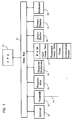
- Figure 1 is a block diagram of a typical embodiment utilizing the present invention in connection with an integrated office automation tool having scanning, facsimile and information processing capabilities, the latter optionally including data processing and word processing capabilities.
- the apparatus in Figure 1 utilizes the present invention to process degraded image data, prior to the data being subjected to a character recognition operation.
- degraded images may be received, for example, by facsimile transmission to the apparatus.
- a central processing unit (“CPU") 10 such as a programmable microprocessor
- CPU central processing unit
- a number of other devices are also connected to data bus 11.
- a scanner 12 for scanning an image pixel-by-pixel into image memory (RAM 17, described below) is connected to bus 11, as are a facsimile device 13 (optionally including a telephone, not shown) for transmitting and receiving image data on a telephone line 14 and a read only memory (“ROM”) 15 for storing one or more computer programs for execution by CPU 10.
- ROM read only memory
- a memory 16 for storing a dictionary of characters against which input characters are compared
- a random access memory (“RAM") 17 for storing intermediate data, such as input image data, intermediate products, processed image data, derived image filters and the like
- an output device 18 (such as disk memory, a modem, etc.) for outputting the identity of characters recognized in the input image data
- a printer/display 19 for displaying images processed by the apparatus
- a keyboard 20 for allowing operator control of the apparatus.
- Scanner 12 and facsimile 13 constitute alternative forms of input means for inputting image data into the apparatus.
- scanner 12 originals are scanned line-by-line and pixel-by-pixel, and under the control of CPU 10, the pixels of image data are stored in bit map format in image memory in RAM 17, as described more fully below.
- facsimile 13 image data is received in compressed form over telephone line 14.
- the compressed image data is uncompressed into a pixel image by means conventional in the art, and CPU 10 stores the pixels of image data in bit map format in image memory in RAM 17.
- Other input means are, of course, possible, and the image data may simply be retrieved from a mass storage medium such as a disk memory or derived from a video camera.
- Facsimile 13 and printer/display 19 constitute alternative forms of output means for outputting processed image data pixel-by-pixel for viewing at the apparatus (in the case of printer/display 19), or at a remote location (in the case of facsimile 13).
- processed image data is retrieved from processed image data memory in RAM 17 and routed to the appropriate unit.
- Output device 18 is means for outputting the identity of characters recognized in the image data, for example, in ASCII code.
- the characters' identities may be output at the apparatus (such as a disk memory), or may be output for transmission to a remote location (such as a modem).
- Output device 18 may also include means for reformatting the characters' identities such a conversion from ASCII to facsimile-compatible format so as to allow transmission to a remote facsimile machine.
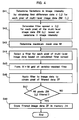
- Figure 2 is a functional block diagram for explaining the operation of the Figure 1 apparatus. The processes depicted in Figure 2 are executed by CPU 10 in accordance with a computer program stored in program ROM 15.
- image data is obtained by CPU 10 from scanner 12 or facsimile 13 and stored in image memory in RAM 17.
- the image data is multi-level image data, such as gray-scale and/or color image data, and not binary image data.
- the image data is binary data, it may be converted by CPU 10 into pseudo-multi-level image data by the process shown in Figure 3.
- binary image data is converted to pseudo-multi-level image data by applying a filter to the binary data.
- a circularly symmetric Gaussian is applied to the binary image data, but filters with other shapes, such as triangular, rectangular, exponential or parabolic, may also be used.
- step S32 the input binary image data Z is convolved with the Gaussian derived in step S31 to obtain pseudo-multi-level image data ZM.
- Z(i,j) is set to zero.
- Z(i,j) may be edge-extended, that is, the values of Z(i,j) at the edges may be used beyond the edges.
- CPU 10 stores the resulting pseudo-multi-level image data ZM in multi-level image memory 22 within RAM 17 (Fig. 1).
- image memory 21 already contains multi-level image data then that data may be stored without processing directly in memory 22.
- a variable mask filter is derived for each pixel of multi-level image data, as shown at 23.
- the filters derived for all the pixels are applied to the multi-level image data.
- the result of this application is stored in filtered image memory 24.
- a filter is derived for each pixel ZM(i,j) in the image data.
- Equation (7) shows that the spread of each filter is inversely proportionate to variations in input image intensity plus a constant.
- a maximum filter mask size M is determined for the image data ZM under consideration. Specifically, as stated previously, for a Gaussian it is known that 99.7% of all volume lies within a region extending ⁇ 3 ⁇ from the center, i.e., a range of 6 ⁇ . Thus, the maximum mask size M is the next largest odd number (to provide an identifiable center pixel) of six times the largest ⁇ (i,j) calculated in step S42.
- a filter is selected for each pixel ZM(i,j) based on the spread calculated in step S42 and the maximum mask size M calculated in step S43.
- the filter is a circularly symmetric Gaussian, but filters having other shapes, such as rectangular, triangular, exponential or parabolic, may also be used.
- Step S45 forms an M X M grid, mz, of filter values for the Gaussian.
- the Gaussian is variably masked based on the spread of the Gaussian so that the M X M grid is formed with the Gaussian in the central portion thereof and zeros at the periphery thereof.
- the extent of zero-filling is determined by the spread ⁇ (i,j) of the filter for each pixel, namely [M-6 ⁇ (i,j)]/2 zeros are added on both sides of the Gaussian to fill the M X M grid.
- This process is given in equation form as follows: where both m and n vary around the center pixel (0,0) from -(M-1)/2 to +(M-1)/2, inclusive.
- the variable mask mz is an M X M grid that is derived for each pixel ZM(i,j) and that has the filter over a ⁇ 3 ⁇ range in the center of the grid and zeros elsewhere.
- step S45 it is possibly to pre-calculate variably-masked Gaussians for a variety of spreads, and to store the precalculated Gaussians in a look-up table. Based on the spread calculated in step S42, an appropriate pre-calculated filter is selected from the look-up table.
- step S47 steps S44, S45 and S46 are repeated for each pixel ZM(i,j) in the multi-level image data.
- step S48 the filtered image data ZF is stored in filtered image memory 24 within RAM 17.
- the various memories 22, 23 and 24 in connection with CPU 10 and program ROM 15, and the steps S41 through S48 provide an image processing method and apparatus whereby a filter is derived for each pixel of multi-level image data based on variations in intensity of surrounding pixels and whereby the filter is applied to the image data to obtain filtered image data.
- the filter is a Gaussian whose spread is inversely proportionate to variations in image intensity plus a constant thereby yielding filtered image data which is smoothed with respect to noise spots and the like but in which edge detail is preserved both with respect to edge sharpness and edge localization.
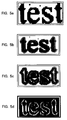
- Figure 5(a) shows an original binary image in the form of the word "test.”
- the word "test” in Figure 5(b) is seen to retain edge localization and sharpness, but noise spots have been smoothed away.
- the filtered image data ZF is differentiated and the differential image data ZD is stored in difference memory 25 within RAM 17.
- the inverted image data ZI is stored in inverted image data memory 26 within RAM 17.
- Multiplier 27 forms a pixel-by-pixel product of the filtered image data ZF stored in filtered data memory 24 and the inverted image data ZI stored in inverted image data memory 26 as follows and as shown in Figure 5(e):
- ZP(i,j) ZF(i,j) ⁇ ZI(i,j)
- the resulting product ZP is smoothed and thinned image data and is stored in smoothed and thinned data memory 28 within RAM 17.
- the product ZP may be subjected to a thresholding operation, as shown in Figure 5(f), to convert the multi-level data ZP into smoothed and thinned binary image data.
- a threshold set between 85 and 105 out of 255 has been found to yield satisfactory results.
- the thresholded data is stored in threshold memory 29 within RAM 17.
- the processed image may be viewed at the apparatus on printer/display 19, or may be transmitted over telephone line 14 for remote viewing via facsimile 13.
- the memories and multiplier 22 to 29, together with CPU 10 and program ROM 15, provide a method and apparatus for obtaining smoothed and thinned image data whereby a filter that depends on variations in intensity of the image data is derived for each pixel of image data, the filters are applied to the image data to obtain filtered image data, inverted image data is derived from first difference data of the filtered image data, and the inverted data and the filtered data are multiplied to form smoothed and thinned image data.
- a computer program suitable for the apparatus in Figure 1, written in the "C" language, is given at Appendix B.
- CPU 10 can be programmed via program ROM 15 to permit an operator to select whether or not to smooth and thin image data prior to the character recognition operation. That is, in the case of a high quality image, smoothing and thinning the image data is beneficial because it reduces the size of the character dictionary needed for the character recognition operation. If this benefit is not desired, then CPU 10 may be programmed to give the operator the option of deselecting the smoothing and thinning process and proceeding directly to the character recognition operation, described below. On the other hand, of the image is degraded, or if the benefit of a reduced character dictionary for high quality images is desired, then the operation may select the smoothing and thinning process prior to the character recognition operation.
- adaptive segmenter 30 is provided in the apparatus to achieve additional and fuller character segmentation.
- a character recognizer is provided at 31. Character recognizers are known in the art and the details thereof will not be described here. Generally, the character recognizer 31 processes each segmented character provided by segmenter 30 by comparing each character to a predetermined dictionary of characters stored in dictionary 16. Advantageously, because smoothing and thinning reduces the input image to its essential elements, the same characters appear the same even though they are written in different fonts. Thus, the size of the character dictionary 16 may be reduced, simplifying the apparatus.
- decoded character memory 32 As character recognizer 31 processes the segmented characters, the identified characters are stored in decoded character memory 32 within RAM 17. Typically, decoded characters are stored in ASCII format in a text file although that is not necessarily the case.
- the decoded characters may be subjected to further processing, for example, word or text or spreadsheet processing.
- an operator may utilize keyboard 20 to retrieve the decoded characters stored in memory 32, and use the data processing capabilities of the Figure 1 office automation tool to modify the decoded characters.
- the operation may then cause CPU 10 to direct the modified characters (or, if desired, the unmodified characters) to output device 18 for re-retransmission, for example, by modem to a remote location.
- output device 18 may be configured to convert the format of the characters such as a conversion from ASCII format to a facsimile-compatible format.
- the Figure 1 apparatus thus provides an operator with the capability of receiving an image via facsimile 13, enhancing the image to compensate for degradations caused by facsimile transmission, recognizing characters in the enhanced image, modifying or performing other data processing on the recognized characters, and retransmitting the modified characters, for example to another facsimile device.
Landscapes
- Engineering & Computer Science (AREA)
- Physics & Mathematics (AREA)
- General Physics & Mathematics (AREA)
- Theoretical Computer Science (AREA)
- Computer Vision & Pattern Recognition (AREA)
- Multimedia (AREA)
- Image Processing (AREA)
- Character Input (AREA)
- Facsimile Image Signal Circuits (AREA)
Claims (31)
- Verfahren zum Verarbeiten eines aus Eingangspixeldaten bestehenden Eingangsbilds, umfassend die Schritte:Anwenden eines Filters, dessen Ausdehnung eine Funktion der Bildintensität ist, auf jeden Pixel, um gefilterte Bilddaten (ZF) zu erhalten;
dadurch gekennzeichnet, daß die Ausdehnung des auf jeden Pixel angewandten Filters von Änderungen der Bildintensität umgebender Pixel abhängt, und durch die Schritte:Ableiten invertierter differenzierter Bilddaten (ZI) aus den gefilterten Bilddaten (ZF); undpixelweise Multiplizieren der invertierten differenzierten Bilddaten (ZI) und der gefilterten Bilddaten (ZF), um geglättete und ausgedünnte Bilddaten (ZP) zu erhalten. - Verfahren nach Anspruch 1, ferner umfassend die Schritte des Zuführens und Speicherns der das Eingangsbild bildenden Eingangspixeldaten, wobei die Eingangspixeldaten Mehrfachpegeldaten sind.
- Verfahren nach Anspruch 1, ferner umfassend einen Eingabeschritt zum Zuführen der Eingangspixeldaten, wobei der Eingabeschritt einen Speicherschritt zum Speichern binärer Bilddaten (Z) in einen Speicher beinhaltet.
- Verfahren nach Anspruch 3, bei dem der Eingabeschritt ferner einen Ableitschritt zum Ableiten von Pseudomehrfachpegelbilddaten (ZM) aus den binären Bilddaten (Z) beinhaltet, wobei die Pseudomehrfachpegelbilddaten (ZM) die Eingangspixeldaten bilden.
- Verfahren nach Anspruch 3, bei dem der Speicherschritt die binären Bilddaten (Z) in dem Speicher pixelweise speichert.
- Verfahren nach Anspruch 2, 3 oder 4, bei dem der Eingabeschritt unter Verwendung eines Scanners (12) durchgeführt wird.
- Verfahren nach Anspruch 2, 3 oder 4, bei dem der Eingabeschritt unter Verwendung eines Telefaxgeräts (13) durchgeführt wird.
- Verfahren nach einem der vorangehenden Ansprüche, bei dem der auf jeden Pixel angewandte Filter näherungsweise ein Gaußfilter ist, dessen Ausdehnung umgekehrt proportional zu Änderungen in der Bildintensität umgebender Pixel plus einer Konstanten ist.
- Verfahren nach einem der vorangehenden Ansprüche, ferner umfassend den Schritt des Auswählens einer Maske für den Filter und Füllens eines Mittenabschnitts derselben mit Filterwerten und peripherer Abschnitte derselben mit Nullen.
- Verfahren nach Anspruch 9, ferner umfassend den Schritt des Ermittelns einer größten Maskengröße auf der Grundlage der größten Ausdehnung der Filter.
- Verfahren nach einem der vorangehenden Ansprüche, bei dem der Ableitschritt den Schritt des Berechnens erster Differenzdaten der gefilterten Bilddaten (ZF) beinhaltet, um differenzierte Bilddaten (ZD) zu erhalten.
- Verfahren nach einem der vorangehenden Ansprüche, ferner umfassend den Schritt des Schwellenbewertens der geglätteten und ausgedünnten Bilddaten (ZP), die in dem multiplizierenden Schritt erhalten wurden.
- Verfahren nach einem der vorangehenden Ansprüche, ferner umfassend die Schritte:Segmentieren benachbarter Zeichen in den geglätteten und ausgedünnten Daten (ZP); undIdentifizieren eines segmentierten Zeichens auf der Grundlage eines Vergleichs des segmentierten Zeichens mit einem Wörterbuch von Zeichen.
- Verfahren nach Anspruch 13, ferner umfassend einen Speicherschritt zum Speichern von Identitäten erkannter Zeichensegmente.
- Verfahren nach einem der vorangehenden Ansprüche, ferner umfassend einen Ausgabeschritt zum Ausgeben der geglätteten und ausgedünnten Bilddaten an eine Sichtanzeige (19).
- Vorrichtung zum Verarbeiten eines aus Eingangspixeldaten bestehenden Eingangsbilds, umfassend:eine Einrichtung zum Anwenden eines Filters, dessen Ausdehnung eine Funktion der Bildintensität ist, auf jeden Pixel, um gefilterte Bilddaten (ZF) zu erhalten;
dadurch gekennzeichnet, daß die Filteranwendungseinrichtung derart angeordnet ist, daß auf jeden Pixel ein Filter angewandt wird, dessen Ausdehnung von Änderungen der Bildintensität umgebender Pixel abhängt, und durch:eine Einrichtung zum Ableiten invertierter differenzierter Bilddaten (ZI) aus den gefilterten Bilddaten (ZF); undeine Einrichtung zum Multiplizieren der invertierten differenzierten Bilddaten (ZI) und der gefilterten Bilddaten (ZF) pixelweise, um geglättete und ausgedünnte Bilddaten (ZP) zu erhalten. - Vorrichtung nach Anspruch 16, ferner umfassend eine Einrichtung zum Zuführen und Speichern der Eingangspixeldaten, die das Eingangsbild bilden, wobei die Eingangspixeldaten Mehrfachpegeldaten sind.
- Vorrichtung nach Anspruch 16, ferner umfassend eine Einrichtung zum Zuführen der Eingangspixeldaten und eine Einrichtung zum Speichern binärer Bilddaten (Z) in einen Speicher.
- Vorrichtung nach Anspruch 18, bei dem die Eingabeeinrichtung ferner eine Einrichtung zum Ableiten von Pseudomehrfachpegelbilddaten (ZM) aus den binären Daten (Z) beinhaltet, wobei die Pseudomehrfachpegelbilddaten (ZM) die Eingangspixeldaten bilden.
- Vorrichtung nach Anspruch 18, bei der die Speichereinrichtung zum pixelweisen Speichern der binären Bilddaten in dem Speicher angeordnet ist.
- Vorrichtung nach Anspruch 17, 18 oder 19, bei der die Eingabeeinrichtung einen Scanner (12) umfaßt.
- Vorrichtung nach Anspruch 17, 18 oder 19, bei der die Eingabeeinrichtung ein Telefaxgerät (13) umfaßt.
- Vorrichtung nach einem der Ansprüche 16 bis 22, bei der die Filteranwendeeinrichtung angeordnet ist zum Anwenden, auf jeden Pixel, eines näherungsweisen Gaußfilters, dessen Ausdehnung umgekehrt proportional zu Änderungen in der Bildintensität umgebender Pixel plus einer Konstanten ist.
- Vorrichtung nach einem der Ansprüche 16 bis 23, ferner umfassend eine Einrichtung zum Auswählen einer Maske für den Filter und Füllen eines Mittenabschnitts derselben mit Filterwerten und eines peripheren Abschnitts derselben mit Nullen.
- Vorrichtung nach Anspruch 24, ferner umfassend eine Einrichtung zum Ermitteln einer größten Maskengröße auf der Grundlage der größten Ausdehnung der Filter.
- Vorrichtung nach einem der Ansprüche 16 bis 25, bei der die Ableiteinrichtung angeordnet ist zum Berechnen erster Differenzdaten der gefilterten Bilddaten (ZF), um differenzierte Bilddaten (ZD) zu erhalten.
- Vorrichtung nach einem der Ansprüche 16 bis 26, ferner umfassend eine Einrichtung zum Schwellenbewerten der geglätteten und ausgedünnten Bilddaten (ZP), die durch die multiplizierende Einrichtung erhalten wurden.
- Vorrichtung nach einem der Ansprüche 16 bis 27, ferner umfassend:eine Einrichtung zum Segmentieren benachbarter Zeichen in den geglätteten und ausgedünnten Daten (ZP); undeine Einrichtung zum Identifizieren eines segmentierten Zeichens auf der Grundlage eines Vergleichs des segmentierten Zeichens mit einem mit einem Wörterbuch von Zeichen.
- Vorrichtung nach Anspruch 28, ferner umfassend eine Einrichtung zum Speichern von Identitäten erkannter Zeichensegmente.
- Vorrichtung nach einem der Ansprüche 16 bis 29, ferner umfassend eine Einrichtung zum Ausgeben der geglätteten und ausgedünnten Bilddaten an eine Sichtanzeige (19).
- Speichermedium, welches computer-implementierbare Anweisungen zum Steuern eines Computers zum Durchführen des Verfahrens nach einem der Ansprüche 1 bis 15 speichert.
Applications Claiming Priority (2)
| Application Number | Priority Date | Filing Date | Title |
|---|---|---|---|
| US07/771,220 US5351314A (en) | 1991-10-04 | 1991-10-04 | Method and apparatus for image enhancement using intensity dependent spread filtering |
| US771220 | 1991-10-04 |
Publications (3)
| Publication Number | Publication Date |
|---|---|
| EP0535992A2 EP0535992A2 (de) | 1993-04-07 |
| EP0535992A3 EP0535992A3 (en) | 1993-12-01 |
| EP0535992B1 true EP0535992B1 (de) | 2000-02-02 |
Family
ID=25091106
Family Applications (1)
| Application Number | Title | Priority Date | Filing Date |
|---|---|---|---|
| EP92309035A Expired - Lifetime EP0535992B1 (de) | 1991-10-04 | 1992-10-02 | Verfahren und Vorrichtung zur Bildverbesserung |
Country Status (4)
| Country | Link |
|---|---|
| US (1) | US5351314A (de) |
| EP (1) | EP0535992B1 (de) |
| JP (1) | JP3264999B2 (de) |
| DE (1) | DE69230629T2 (de) |
Families Citing this family (37)
| Publication number | Priority date | Publication date | Assignee | Title |
|---|---|---|---|---|
| DE4105517C2 (de) * | 1991-02-22 | 1995-11-16 | Hell Ag Linotype | Verfahren und Vorrichtung zur verbesserten Wiedergabe von Konturen |
| US5680479A (en) * | 1992-04-24 | 1997-10-21 | Canon Kabushiki Kaisha | Method and apparatus for character recognition |
| GB2282514B (en) * | 1993-10-04 | 1997-11-05 | Aston Electronic Designs Limit | Video signal processors |
| JP3059615B2 (ja) * | 1993-10-27 | 2000-07-04 | キヤノン株式会社 | 印刷システム及び印刷制御装置及び制御方法 |
| JPH07131641A (ja) * | 1993-11-08 | 1995-05-19 | Canon Inc | 画像処理装置 |
| US5588072A (en) * | 1993-12-22 | 1996-12-24 | Canon Kabushiki Kaisha | Method and apparatus for selecting blocks of image data from image data having both horizontally- and vertically-oriented blocks |
| JPH07220091A (ja) * | 1994-02-04 | 1995-08-18 | Canon Inc | 画像処理装置及び方法 |
| US5563962A (en) * | 1994-03-08 | 1996-10-08 | The University Of Connecticut | Two dimensional digital hysteresis filter for smoothing digital images |
| US5802257A (en) * | 1994-11-25 | 1998-09-01 | Canon Kabushiki Kaisha | Information processing apparatus, method and memory medium that control a bold process in accordance with the setting of a facsimile mode |
| US5764307A (en) * | 1995-07-24 | 1998-06-09 | Motorola, Inc. | Method and apparatus for spatially adaptive filtering for video encoding |
| US6005978A (en) * | 1996-02-07 | 1999-12-21 | Cognex Corporation | Robust search for image features across image sequences exhibiting non-uniform changes in brightness |
| US6389162B2 (en) | 1996-02-15 | 2002-05-14 | Canon Kabushiki Kaisha | Image processing apparatus and method and medium |
| US5893127A (en) * | 1996-11-18 | 1999-04-06 | Canon Information Systems, Inc. | Generator for document with HTML tagged table having data elements which preserve layout relationships of information in bitmap image of original document |
| US6512848B2 (en) | 1996-11-18 | 2003-01-28 | Canon Kabushiki Kaisha | Page analysis system |
| US5892843A (en) * | 1997-01-21 | 1999-04-06 | Matsushita Electric Industrial Co., Ltd. | Title, caption and photo extraction from scanned document images |
| DE19707046A1 (de) | 1997-02-21 | 1998-08-27 | Rolf Prof Dr Ing Eckmiller | Lernfähiger "Active Vision" Implant Encoder |
| AU7564698A (en) * | 1997-05-05 | 1998-11-27 | Alexander R. Roustaei | Optical scanner and image reader for reading images and decoding optical information including one and two dimensional symbologies at variable depth of field |
| US6298173B1 (en) | 1997-10-03 | 2001-10-02 | Matsushita Electric Corporation Of America | Storage management system for document image database |
| US6457032B1 (en) | 1997-11-15 | 2002-09-24 | Cognex Corporation | Efficient flexible digital filtering |
| US6310697B1 (en) | 1998-07-07 | 2001-10-30 | Electronics For Imaging, Inc. | Text enhancement system |
| US6501565B1 (en) * | 1998-07-07 | 2002-12-31 | Electronics For Imaging, Inc. | Method and apparatus for smoothing text outlines |
| US6327388B1 (en) | 1998-08-14 | 2001-12-04 | Matsushita Electric Industrial Co., Ltd. | Identification of logos from document images |
| JP3594889B2 (ja) * | 2000-08-07 | 2004-12-02 | 日本電信電話株式会社 | 画像処理方法、画像処理装置、及び画像処理方法を実行するプログラムを記録した記録媒体 |
| US6947178B2 (en) * | 2001-02-26 | 2005-09-20 | International Business Machines Corporation | De-screening halftones using sigma filters |
| US7203337B2 (en) * | 2001-06-21 | 2007-04-10 | Wespot Ab | Adjusted filters |
| US7433084B2 (en) * | 2002-07-01 | 2008-10-07 | Xerox Corporation | Digital de-screening technique for scanned documents |
| US8144984B2 (en) * | 2006-12-08 | 2012-03-27 | Canon Kabushiki Kaisha | Image processing apparatus, image processing method, and program for color fringing estimation and compensation |
| EP2034437A1 (de) * | 2007-09-06 | 2009-03-11 | Thomson Licensing | Räumliche Diffusion bei Bildern |
| WO2009128798A1 (en) * | 2008-04-16 | 2009-10-22 | Nikon Corporation | Method for deblurring an image that produces less ringing |
| JP5223702B2 (ja) * | 2008-07-29 | 2013-06-26 | 株式会社リコー | 画像処理装置、ノイズ低減方法、プログラム、記憶媒体 |
| JP5419491B2 (ja) * | 2009-02-20 | 2014-02-19 | 三菱重工業株式会社 | 文字認識装置及び文字認識方法 |
| US9117263B2 (en) * | 2012-05-03 | 2015-08-25 | Qualcomm Incorporated | Noise removal from images containing text |
| CN104217202B (zh) * | 2013-06-03 | 2019-01-01 | 支付宝(中国)网络技术有限公司 | 信息识别方法、设备和系统 |
| CN106296578B (zh) * | 2015-05-29 | 2020-04-28 | 阿里巴巴集团控股有限公司 | 一种图像处理方法及装置 |
| WO2017080420A1 (en) * | 2015-11-09 | 2017-05-18 | Versitech Limited | Auxiliary data for artifacts –aware view synthesis |
| KR102151780B1 (ko) * | 2018-11-28 | 2020-09-03 | 안희철 | 컴퓨팅 장치의 하나 이상의 프로세서에서 수행되는, 필체를 통해 생성한 폰트를 이용하는 드로잉 방법, 상기 방법을 실행하기 위해 컴퓨터 판독가능 저장매체에 저장된 컴퓨터 프로그램 및 필체를 통해 생성한 폰트를 이용하는 드로잉 시스템 |
| CN111709344B (zh) * | 2020-06-09 | 2023-10-17 | 上海海事大学 | 一种基于高斯混合模型的epll图像去光照识别处理方法 |
Citations (3)
| Publication number | Priority date | Publication date | Assignee | Title |
|---|---|---|---|---|
| US4692943A (en) * | 1983-12-30 | 1987-09-08 | Dr. Ludwig Pietzsch Gmbh | Method of and system for opto-electronic inspection of a two-dimensional pattern on an object |
| US4884225A (en) * | 1987-04-03 | 1989-11-28 | University Of Massachusetts Medical Center | Filtering in 3-D visual system |
| US4891750A (en) * | 1986-10-29 | 1990-01-02 | Pitney Bowes Inc. | Optical character recognition by forming and detecting matrices of geo features |
Family Cites Families (5)
| Publication number | Priority date | Publication date | Assignee | Title |
|---|---|---|---|---|
| US4197583A (en) * | 1978-05-03 | 1980-04-08 | Baird Corporation | Image display system |
| JPS60178588A (ja) * | 1984-02-24 | 1985-09-12 | Fujitsu Ltd | 画像処理装置 |
| US5119444A (en) * | 1986-07-22 | 1992-06-02 | Schlumberger Technologies, Inc. | System for expedited computation of laplacian and gaussian filters and correlation of their outputs for image processing |
| JPS63265371A (ja) * | 1986-12-15 | 1988-11-01 | Toshiba Corp | 線図形つなぎ装置 |
| JP2675303B2 (ja) * | 1987-04-28 | 1997-11-12 | キヤノン株式会社 | 文字認識方法 |
-
1991
- 1991-10-04 US US07/771,220 patent/US5351314A/en not_active Expired - Fee Related
-
1992
- 1992-10-02 DE DE69230629T patent/DE69230629T2/de not_active Expired - Fee Related
- 1992-10-02 EP EP92309035A patent/EP0535992B1/de not_active Expired - Lifetime
- 1992-10-02 JP JP26443892A patent/JP3264999B2/ja not_active Expired - Fee Related
Patent Citations (3)
| Publication number | Priority date | Publication date | Assignee | Title |
|---|---|---|---|---|
| US4692943A (en) * | 1983-12-30 | 1987-09-08 | Dr. Ludwig Pietzsch Gmbh | Method of and system for opto-electronic inspection of a two-dimensional pattern on an object |
| US4891750A (en) * | 1986-10-29 | 1990-01-02 | Pitney Bowes Inc. | Optical character recognition by forming and detecting matrices of geo features |
| US4884225A (en) * | 1987-04-03 | 1989-11-28 | University Of Massachusetts Medical Center | Filtering in 3-D visual system |
Non-Patent Citations (2)
| Title |
|---|
| M.Vaezi, "Optimum Intensity-Dependent Spread Filters in Image Processing",proc.SPIE/SPSE Symposium on Electronic Imaging Conference, February 1991. * |
| T.N. Cornsweet et al.,"Intensity-dependent spacial summation" JOSAA,Vol.2, No.10, October 1985. * |
Also Published As
| Publication number | Publication date |
|---|---|
| US5351314A (en) | 1994-09-27 |
| JP3264999B2 (ja) | 2002-03-11 |
| DE69230629D1 (de) | 2000-03-09 |
| DE69230629T2 (de) | 2000-06-21 |
| JPH05225388A (ja) | 1993-09-03 |
| EP0535992A3 (en) | 1993-12-01 |
| EP0535992A2 (de) | 1993-04-07 |
Similar Documents
| Publication | Publication Date | Title |
|---|---|---|
| EP0535992A2 (de) | Verfahren und Vorrichtung zur Bildverbesserung | |
| EP1323132B1 (de) | Bildschärfeverbesserung durch variabele kontrastdehnung | |
| EP2545499B1 (de) | Texterweiterung eines textbildes mit einem durch ein ocr-verfahren analysierten text | |
| US6137918A (en) | Memory efficient method and apparatus to enable tagging of thin antialiased lines | |
| EP1320987B1 (de) | Verhahren zum verbessern der kompressionsfähigkeit und der bildqualität von abgetasteten dokumenten | |
| US6393150B1 (en) | Region-based image binarization system | |
| JP4471062B2 (ja) | 適合画像強調フィルター及び強調画像データの生成方法 | |
| US5905820A (en) | Enhancement of digital images for electronic displays | |
| US7639892B2 (en) | Adaptive image improvement | |
| US6201613B1 (en) | Automatic image enhancement of halftone and continuous tone images | |
| JP3636936B2 (ja) | 濃淡画像の2値化方法および濃淡画像の2値化プログラムを記録した記録媒体 | |
| US7724981B2 (en) | Adaptive contrast control systems and methods | |
| JP2777202B2 (ja) | 画像処理装置 | |
| DE69513560T2 (de) | Bildverarbeitungsvorrichtung und Bildausgabevorrichtung zur Umsetzung eines binären Bildes in ein mehrwertiges Bild | |
| US6014465A (en) | Method for transforming a gray-level image into a black-and-white image | |
| US8554005B1 (en) | Digital image enhancement method and system that embolden or thin image features | |
| EP0715274B1 (de) | Ein Gerät zur optischen Zeichenerkennung und Verfahren zum Selektieren dessen Betriebsart | |
| KR100537829B1 (ko) | 스캔 영상의 상역 분리 방법 | |
| US7567725B2 (en) | Edge smoothing filter for character recognition | |
| JPH0863607A (ja) | 画像データの圧縮方法及び処理方法 | |
| KR19980077975A (ko) | 다중 역치값을 이용한 이치화 방법 | |
| CN121921195A (zh) | 图像处理方法、装置、电子设备及可读介质 | |
| JPH06225122A (ja) | 画像形成装置 | |
| JPH1117957A (ja) | 画素データ処理システム | |
| EP2811733A1 (de) | Verfahren zur dynamischen Hintergrundreduktion |
Legal Events
| Date | Code | Title | Description |
|---|---|---|---|
| PUAI | Public reference made under article 153(3) epc to a published international application that has entered the european phase |
Free format text: ORIGINAL CODE: 0009012 |
|
| AK | Designated contracting states |
Kind code of ref document: A2 Designated state(s): DE FR GB IT |
|
| PUAL | Search report despatched |
Free format text: ORIGINAL CODE: 0009013 |
|
| AK | Designated contracting states |
Kind code of ref document: A3 Designated state(s): DE FR GB IT |
|
| 17P | Request for examination filed |
Effective date: 19940422 |
|
| RAP1 | Party data changed (applicant data changed or rights of an application transferred) |
Owner name: CANON KABUSHIKI KAISHA |
|
| 17Q | First examination report despatched |
Effective date: 19970410 |
|
| GRAG | Despatch of communication of intention to grant |
Free format text: ORIGINAL CODE: EPIDOS AGRA |
|
| GRAG | Despatch of communication of intention to grant |
Free format text: ORIGINAL CODE: EPIDOS AGRA |
|
| GRAG | Despatch of communication of intention to grant |
Free format text: ORIGINAL CODE: EPIDOS AGRA |
|
| GRAH | Despatch of communication of intention to grant a patent |
Free format text: ORIGINAL CODE: EPIDOS IGRA |
|
| GRAH | Despatch of communication of intention to grant a patent |
Free format text: ORIGINAL CODE: EPIDOS IGRA |
|
| GRAA | (expected) grant |
Free format text: ORIGINAL CODE: 0009210 |
|
| AK | Designated contracting states |
Kind code of ref document: B1 Designated state(s): DE FR GB IT |
|
| PG25 | Lapsed in a contracting state [announced via postgrant information from national office to epo] |
Ref country code: FR Free format text: THE PATENT HAS BEEN ANNULLED BY A DECISION OF A NATIONAL AUTHORITY Effective date: 20000202 |
|
| REF | Corresponds to: |
Ref document number: 69230629 Country of ref document: DE Date of ref document: 20000309 |
|
| ET | Fr: translation filed | ||
| ITF | It: translation for a ep patent filed | ||
| PGFP | Annual fee paid to national office [announced via postgrant information from national office to epo] |
Ref country code: GB Payment date: 20000918 Year of fee payment: 9 |
|
| PLBE | No opposition filed within time limit |
Free format text: ORIGINAL CODE: 0009261 |
|
| 26N | No opposition filed | ||
| PG25 | Lapsed in a contracting state [announced via postgrant information from national office to epo] |
Ref country code: DE Free format text: LAPSE BECAUSE OF NON-PAYMENT OF DUE FEES Effective date: 20010703 |
|
| PG25 | Lapsed in a contracting state [announced via postgrant information from national office to epo] |
Ref country code: GB Free format text: LAPSE BECAUSE OF NON-PAYMENT OF DUE FEES Effective date: 20011002 |
|
| REG | Reference to a national code |
Ref country code: GB Ref legal event code: IF02 |
|
| REG | Reference to a national code |
Ref country code: FR Ref legal event code: ST |
|
| GBPC | Gb: european patent ceased through non-payment of renewal fee |
Effective date: 20011002 |
|
| PG25 | Lapsed in a contracting state [announced via postgrant information from national office to epo] |
Ref country code: IT Free format text: LAPSE BECAUSE OF NON-PAYMENT OF DUE FEES;WARNING: LAPSES OF ITALIAN PATENTS WITH EFFECTIVE DATE BEFORE 2007 MAY HAVE OCCURRED AT ANY TIME BEFORE 2007. THE CORRECT EFFECTIVE DATE MAY BE DIFFERENT FROM THE ONE RECORDED. Effective date: 20051002 |