EP0536145B1 - Procede et installation de production de pieces moulees en matieres plastiques reactionnelles reticulees - Google Patents
Procede et installation de production de pieces moulees en matieres plastiques reactionnelles reticulees Download PDFInfo
- Publication number
- EP0536145B1 EP0536145B1 EP19910908633 EP91908633A EP0536145B1 EP 0536145 B1 EP0536145 B1 EP 0536145B1 EP 19910908633 EP19910908633 EP 19910908633 EP 91908633 A EP91908633 A EP 91908633A EP 0536145 B1 EP0536145 B1 EP 0536145B1
- Authority
- EP
- European Patent Office
- Prior art keywords
- semi
- finished product
- reaction
- polyurea
- polyurethane
- Prior art date
- Legal status (The legal status is an assumption and is not a legal conclusion. Google has not performed a legal analysis and makes no representation as to the accuracy of the status listed.)
- Revoked
Links
Images





Classifications
-
- B—PERFORMING OPERATIONS; TRANSPORTING
- B29—WORKING OF PLASTICS; WORKING OF SUBSTANCES IN A PLASTIC STATE IN GENERAL
- B29C—SHAPING OR JOINING OF PLASTICS; SHAPING OF MATERIAL IN A PLASTIC STATE, NOT OTHERWISE PROVIDED FOR; AFTER-TREATMENT OF THE SHAPED PRODUCTS, e.g. REPAIRING
- B29C70/00—Shaping composites, i.e. plastics material comprising reinforcements, fillers or preformed parts, e.g. inserts
- B29C70/04—Shaping composites, i.e. plastics material comprising reinforcements, fillers or preformed parts, e.g. inserts comprising reinforcements only, e.g. self-reinforcing plastics
- B29C70/28—Shaping operations therefor
- B29C70/40—Shaping or impregnating by compression not applied
- B29C70/50—Shaping or impregnating by compression not applied for producing articles of indefinite length, e.g. prepregs, sheet moulding compounds [SMC] or cross moulding compounds [XMC]
-
- B—PERFORMING OPERATIONS; TRANSPORTING
- B29—WORKING OF PLASTICS; WORKING OF SUBSTANCES IN A PLASTIC STATE IN GENERAL
- B29B—PREPARATION OR PRETREATMENT OF THE MATERIAL TO BE SHAPED; MAKING GRANULES OR PREFORMS; RECOVERY OF PLASTICS OR OTHER CONSTITUENTS OF WASTE MATERIAL CONTAINING PLASTICS
- B29B17/00—Recovery of plastics or other constituents of waste material containing plastics
- B29B17/0005—Direct recuperation and re-use of scrap material during moulding operation, i.e. feed-back of used material
-
- B—PERFORMING OPERATIONS; TRANSPORTING
- B29—WORKING OF PLASTICS; WORKING OF SUBSTANCES IN A PLASTIC STATE IN GENERAL
- B29C—SHAPING OR JOINING OF PLASTICS; SHAPING OF MATERIAL IN A PLASTIC STATE, NOT OTHERWISE PROVIDED FOR; AFTER-TREATMENT OF THE SHAPED PRODUCTS, e.g. REPAIRING
- B29C41/00—Shaping by coating a mould, core or other substrate, i.e. by depositing material and stripping-off the shaped article; Apparatus therefor
- B29C41/24—Shaping by coating a mould, core or other substrate, i.e. by depositing material and stripping-off the shaped article; Apparatus therefor for making articles of indefinite length
- B29C41/28—Shaping by coating a mould, core or other substrate, i.e. by depositing material and stripping-off the shaped article; Apparatus therefor for making articles of indefinite length by depositing flowable material on an endless belt
-
- B—PERFORMING OPERATIONS; TRANSPORTING
- B29—WORKING OF PLASTICS; WORKING OF SUBSTANCES IN A PLASTIC STATE IN GENERAL
- B29C—SHAPING OR JOINING OF PLASTICS; SHAPING OF MATERIAL IN A PLASTIC STATE, NOT OTHERWISE PROVIDED FOR; AFTER-TREATMENT OF THE SHAPED PRODUCTS, e.g. REPAIRING
- B29C43/00—Compression moulding, i.e. applying external pressure to flow the moulding material; Apparatus therefor
- B29C43/32—Component parts, details or accessories; Auxiliary operations
- B29C43/34—Feeding the material to the mould or the compression means
-
- B—PERFORMING OPERATIONS; TRANSPORTING
- B29—WORKING OF PLASTICS; WORKING OF SUBSTANCES IN A PLASTIC STATE IN GENERAL
- B29C—SHAPING OR JOINING OF PLASTICS; SHAPING OF MATERIAL IN A PLASTIC STATE, NOT OTHERWISE PROVIDED FOR; AFTER-TREATMENT OF THE SHAPED PRODUCTS, e.g. REPAIRING
- B29C48/00—Extrusion moulding, i.e. expressing the moulding material through a die or nozzle which imparts the desired form; Apparatus therefor
- B29C48/001—Combinations of extrusion moulding with other shaping operations
-
- B—PERFORMING OPERATIONS; TRANSPORTING
- B29—WORKING OF PLASTICS; WORKING OF SUBSTANCES IN A PLASTIC STATE IN GENERAL
- B29C—SHAPING OR JOINING OF PLASTICS; SHAPING OF MATERIAL IN A PLASTIC STATE, NOT OTHERWISE PROVIDED FOR; AFTER-TREATMENT OF THE SHAPED PRODUCTS, e.g. REPAIRING
- B29C48/00—Extrusion moulding, i.e. expressing the moulding material through a die or nozzle which imparts the desired form; Apparatus therefor
- B29C48/03—Extrusion moulding, i.e. expressing the moulding material through a die or nozzle which imparts the desired form; Apparatus therefor characterised by the shape of the extruded material at extrusion
- B29C48/07—Flat, e.g. panels
-
- B—PERFORMING OPERATIONS; TRANSPORTING
- B29—WORKING OF PLASTICS; WORKING OF SUBSTANCES IN A PLASTIC STATE IN GENERAL
- B29C—SHAPING OR JOINING OF PLASTICS; SHAPING OF MATERIAL IN A PLASTIC STATE, NOT OTHERWISE PROVIDED FOR; AFTER-TREATMENT OF THE SHAPED PRODUCTS, e.g. REPAIRING
- B29C48/00—Extrusion moulding, i.e. expressing the moulding material through a die or nozzle which imparts the desired form; Apparatus therefor
- B29C48/03—Extrusion moulding, i.e. expressing the moulding material through a die or nozzle which imparts the desired form; Apparatus therefor characterised by the shape of the extruded material at extrusion
- B29C48/12—Articles with an irregular circumference when viewed in cross-section, e.g. window profiles
-
- B—PERFORMING OPERATIONS; TRANSPORTING
- B29—WORKING OF PLASTICS; WORKING OF SUBSTANCES IN A PLASTIC STATE IN GENERAL
- B29C—SHAPING OR JOINING OF PLASTICS; SHAPING OF MATERIAL IN A PLASTIC STATE, NOT OTHERWISE PROVIDED FOR; AFTER-TREATMENT OF THE SHAPED PRODUCTS, e.g. REPAIRING
- B29C53/00—Shaping by bending, folding, twisting, straightening or flattening; Apparatus therefor
- B29C53/02—Bending or folding
- B29C53/04—Bending or folding of plates or sheets
- B29C53/043—Bending or folding of plates or sheets using rolls or endless belts
-
- B—PERFORMING OPERATIONS; TRANSPORTING
- B29—WORKING OF PLASTICS; WORKING OF SUBSTANCES IN A PLASTIC STATE IN GENERAL
- B29C—SHAPING OR JOINING OF PLASTICS; SHAPING OF MATERIAL IN A PLASTIC STATE, NOT OTHERWISE PROVIDED FOR; AFTER-TREATMENT OF THE SHAPED PRODUCTS, e.g. REPAIRING
- B29C69/00—Combinations of shaping techniques not provided for in a single one of main groups B29C39/00 - B29C67/00, e.g. associations of moulding and joining techniques; Apparatus therefore
- B29C69/02—Combinations of shaping techniques not provided for in a single one of main groups B29C39/00 - B29C67/00, e.g. associations of moulding and joining techniques; Apparatus therefore of moulding techniques only
-
- B—PERFORMING OPERATIONS; TRANSPORTING
- B29—WORKING OF PLASTICS; WORKING OF SUBSTANCES IN A PLASTIC STATE IN GENERAL
- B29C—SHAPING OR JOINING OF PLASTICS; SHAPING OF MATERIAL IN A PLASTIC STATE, NOT OTHERWISE PROVIDED FOR; AFTER-TREATMENT OF THE SHAPED PRODUCTS, e.g. REPAIRING
- B29C41/00—Shaping by coating a mould, core or other substrate, i.e. by depositing material and stripping-off the shaped article; Apparatus therefor
- B29C41/02—Shaping by coating a mould, core or other substrate, i.e. by depositing material and stripping-off the shaped article; Apparatus therefor for making articles of definite length, i.e. discrete articles
- B29C41/08—Coating a former, core or other substrate by spraying or fluidisation, e.g. spraying powder
-
- B—PERFORMING OPERATIONS; TRANSPORTING
- B29—WORKING OF PLASTICS; WORKING OF SUBSTANCES IN A PLASTIC STATE IN GENERAL
- B29C—SHAPING OR JOINING OF PLASTICS; SHAPING OF MATERIAL IN A PLASTIC STATE, NOT OTHERWISE PROVIDED FOR; AFTER-TREATMENT OF THE SHAPED PRODUCTS, e.g. REPAIRING
- B29C43/00—Compression moulding, i.e. applying external pressure to flow the moulding material; Apparatus therefor
-
- B—PERFORMING OPERATIONS; TRANSPORTING
- B29—WORKING OF PLASTICS; WORKING OF SUBSTANCES IN A PLASTIC STATE IN GENERAL
- B29C—SHAPING OR JOINING OF PLASTICS; SHAPING OF MATERIAL IN A PLASTIC STATE, NOT OTHERWISE PROVIDED FOR; AFTER-TREATMENT OF THE SHAPED PRODUCTS, e.g. REPAIRING
- B29C43/00—Compression moulding, i.e. applying external pressure to flow the moulding material; Apparatus therefor
- B29C43/22—Compression moulding, i.e. applying external pressure to flow the moulding material; Apparatus therefor of articles of indefinite length
- B29C43/24—Calendering
-
- B—PERFORMING OPERATIONS; TRANSPORTING
- B29—WORKING OF PLASTICS; WORKING OF SUBSTANCES IN A PLASTIC STATE IN GENERAL
- B29C—SHAPING OR JOINING OF PLASTICS; SHAPING OF MATERIAL IN A PLASTIC STATE, NOT OTHERWISE PROVIDED FOR; AFTER-TREATMENT OF THE SHAPED PRODUCTS, e.g. REPAIRING
- B29C48/00—Extrusion moulding, i.e. expressing the moulding material through a die or nozzle which imparts the desired form; Apparatus therefor
-
- B—PERFORMING OPERATIONS; TRANSPORTING
- B29—WORKING OF PLASTICS; WORKING OF SUBSTANCES IN A PLASTIC STATE IN GENERAL
- B29C—SHAPING OR JOINING OF PLASTICS; SHAPING OF MATERIAL IN A PLASTIC STATE, NOT OTHERWISE PROVIDED FOR; AFTER-TREATMENT OF THE SHAPED PRODUCTS, e.g. REPAIRING
- B29C48/00—Extrusion moulding, i.e. expressing the moulding material through a die or nozzle which imparts the desired form; Apparatus therefor
- B29C48/001—Combinations of extrusion moulding with other shaping operations
- B29C48/0011—Combinations of extrusion moulding with other shaping operations combined with compression moulding
-
- B—PERFORMING OPERATIONS; TRANSPORTING
- B29—WORKING OF PLASTICS; WORKING OF SUBSTANCES IN A PLASTIC STATE IN GENERAL
- B29C—SHAPING OR JOINING OF PLASTICS; SHAPING OF MATERIAL IN A PLASTIC STATE, NOT OTHERWISE PROVIDED FOR; AFTER-TREATMENT OF THE SHAPED PRODUCTS, e.g. REPAIRING
- B29C48/00—Extrusion moulding, i.e. expressing the moulding material through a die or nozzle which imparts the desired form; Apparatus therefor
- B29C48/03—Extrusion moulding, i.e. expressing the moulding material through a die or nozzle which imparts the desired form; Apparatus therefor characterised by the shape of the extruded material at extrusion
- B29C48/07—Flat, e.g. panels
- B29C48/08—Flat, e.g. panels flexible, e.g. films
-
- B—PERFORMING OPERATIONS; TRANSPORTING
- B29—WORKING OF PLASTICS; WORKING OF SUBSTANCES IN A PLASTIC STATE IN GENERAL
- B29C—SHAPING OR JOINING OF PLASTICS; SHAPING OF MATERIAL IN A PLASTIC STATE, NOT OTHERWISE PROVIDED FOR; AFTER-TREATMENT OF THE SHAPED PRODUCTS, e.g. REPAIRING
- B29C67/00—Shaping techniques not covered by groups B29C39/00 - B29C65/00, B29C70/00 or B29C73/00
- B29C67/24—Shaping techniques not covered by groups B29C39/00 - B29C65/00, B29C70/00 or B29C73/00 characterised by the choice of material
- B29C67/246—Moulding high reactive monomers or prepolymers, e.g. by reaction injection moulding [RIM], liquid injection moulding [LIM]
-
- B—PERFORMING OPERATIONS; TRANSPORTING
- B29—WORKING OF PLASTICS; WORKING OF SUBSTANCES IN A PLASTIC STATE IN GENERAL
- B29K—INDEXING SCHEME ASSOCIATED WITH SUBCLASSES B29B, B29C OR B29D, RELATING TO MOULDING MATERIALS OR TO MATERIALS FOR MOULDS, REINFORCEMENTS, FILLERS OR PREFORMED PARTS, e.g. INSERTS
- B29K2105/00—Condition, form or state of moulded material or of the material to be shaped
- B29K2105/25—Solid
- B29K2105/253—Preform
- B29K2105/256—Sheets, plates, blanks or films
-
- Y—GENERAL TAGGING OF NEW TECHNOLOGICAL DEVELOPMENTS; GENERAL TAGGING OF CROSS-SECTIONAL TECHNOLOGIES SPANNING OVER SEVERAL SECTIONS OF THE IPC; TECHNICAL SUBJECTS COVERED BY FORMER USPC CROSS-REFERENCE ART COLLECTIONS [XRACs] AND DIGESTS
- Y02—TECHNOLOGIES OR APPLICATIONS FOR MITIGATION OR ADAPTATION AGAINST CLIMATE CHANGE
- Y02W—CLIMATE CHANGE MITIGATION TECHNOLOGIES RELATED TO WASTEWATER TREATMENT OR WASTE MANAGEMENT
- Y02W30/00—Technologies for solid waste management
- Y02W30/50—Reuse, recycling or recovery technologies
- Y02W30/62—Plastics recycling; Rubber recycling
Definitions
- the invention relates to a method for producing molded parts from crosslinked polyurethane, polyurethane-polyurea or polyurea elastomers.
- Molded parts of this type can be produced by RIM (Reaction Injection Molding).
- RIM Reaction Injection Molding
- a chemical reaction takes place between the mixed liquid reaction components with each shot.
- the branched raw materials described in DE-B2-2622951 (Bayer) are preferably used as reaction components for the production of polyurethane-polyurea elastomers.
- the functionality number of reactive groups of molecules
- edge pieces or waste of such thermosets or elastomers in contrast to thermoplastics in purely mechanical processing, could only be used as fillers or burned as an energy supplier in waste incineration, but could not be used for real material recycling (see, among others, Hans-Georg Elias: "Macromolecules: Structure, Properties, Syntheses, Substances, Technology", 4th edition, 1981, pages 918, 979 and 1004).
- Hans-Georg Elias "Macromolecules: Structure, Properties, Syntheses, Substances, Technology", 4th edition, 1981, pages 918, 979 and 1004
- the discontinuous RIM process if there is a deviation from the relatively narrow process tolerances, there is a risk that the molded parts will have different material properties in areas close to the gate and away from the gate, and that a pore-containing molded part surface will arise due to the outgassing of air.
- the invention is therefore based on the object of developing a method of the type mentioned at the outset which can be implemented using relatively simple molding tools and with which large-area and at the same time thin-walled molded parts with constant material properties and an excellent surface quality can be produced over their entire extent.
- the solution according to the invention is based in particular on the knowledge that the reaction plastics in question based on polyurethane and / or polyurea are multi-phase material systems with a segmented structure of the primary chain. Due to different polarities, soft segments form on the one hand from the long-chain, low-melting polyols and, on the other hand, hard segments on high-melting oligomer units, which are formed, for example, from isocyanates and amine chain extenders. During the chemical reaction, the hard and soft segments separate and form domains. The soft segment domains are for high elasticity, high resilience, good cold impact resistance and high damping capacity, while the hard segment domains are important for the achievable stiffness and heat resistance.
- reaction components such as polyol, an amine chain extender and isocyanate
- the carrier web can be designed as a woven or fiber mat, which can additionally contribute to reinforcing the semi-finished product and the molded part produced therefrom.
- the liquid or already plastic reaction plastic layer can be coated or laminated with a covering or decorative film along the movement path.
- the reaction mixture which has been partially cured along the movement path is compressed and / or calibrated, preferably by pressing or rolling, while reducing the layer thickness.
- the coherent, at least partially hardened, reaction plastic layer is divided into plate-shaped semifinished products at the end of the movement path or to wind them up to form a semifinished product roll and to store them temporarily in this form before the final molded part is produced.
- the coherent, at least partially cured, reaction plastic layer is produced at the end of the movement path of the molded part is continuously divided and at the same time reshaped.
- the partially hardened reaction plastic is tempered at 120 to 300 ° C. after compression as a semi-finished product and / or as a molded part.
- waste material made of reaction plastic is comminuted to form granules with a grain size of 0.5 to 5 mm and the granules are pressed either in multiple layers between heated rollers or in an extrusion process using a slot die, thereby forming a coherent, if necessary, to connect rolled skin-like layer as a semifinished product or to compress the granules at elevated temperature and to thereby bond as a semifinished product with the formation of pellets or plates.
- the semi-finished product produced in this way can then be formed without cutting under the action of a pressure of 150 to 400 bar at a temperature of 120 to 350 ° C. to produce a molded part.
- Another variant of the invention provides that waste molded parts made of reaction plastic are rolled smooth with heated rollers to form plate-shaped semi-finished products. This semifinished product can then also be formed in the manner described above to produce the molded part.
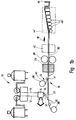
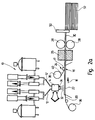
- the production systems shown schematically in FIGS. 1 to 3 essentially consist of a metering station 10 for the two reaction components polyol and isocyanate, a mixing head 14 charged with the reaction components via lines 12, a conveyor section 16 with a carrier web 20 moved in the direction of arrow 18 , with an addition point 22 located below the mixing head 14, a laminating station 24, a compression station 26 and take-off rollers 28 for the incoming semifinished web 30.
- the liquid reaction mixture 32 is so via the downward-facing outlet opening 34 of the movable mixing head 14 in the direction of the arrow 18 injected from the supply roll 36 carrier web 20 injected that a coherent layer 30 forms with an approximately constant layer thickness.
- the movement of the mixing head also ensures that a glass fiber filler contained in the reaction mixture is distributed in the layer 30 in an undirected or targeted manner when applied to the carrier web.
- a mat or fabric web can additionally be fed with which the reaction plastic connects and which therefore has a reinforcing function.
- the initially liquid reaction mixture gradually hardens as a result of the chemical reaction between the reaction components along the conveyor section 16.
- the changing material consistency is used in the course of the process so that in the area of the laminating station 24, in which the reaction mixture is still sticky, a decorative film 40 drawn off from a supply roll 38 is applied to the layer surface with a pressure roll 41.
- the reaction mixture In the area of the compression station 26, which is designed as a pressing or rolling mill, the reaction mixture has a plastic deformability which enables a reduction in cross-section and a material compression. Any gas inclusions that could lead to surface pores and material clouding are also displaced, compressed and / or brought into solution. In the area of the take-off rollers 28, the material is already so firm that no permanent deformations occur at the roller pressure required for removal.
- the semi-finished product 30 drawn off by the rollers 28 is continuously fed via a preheating station 42 to a forming press 44 in which the semi-finished product is pressed at a temperature of 120 to 350 ° C. using pressures of 150 to 400 bar with the help of the heated pressing tools 46 molded parts 48 are produced.
- a profile rolling device not shown, can also be used 44 'with heated profile rollers 46' can be used (Fig. 1b).
- the reaction plastic is only annealed at 60 to 250 ° C. after the molded part has been produced, and is cured to approximately 100%.
- plate-shaped semi-finished product 52 is produced from the material 30 drawn off from the compression station 26 in a separating station 50, which is preferably designed as a separating saw, which is annealed in this form for about three minutes at 120 ° C. and then until Further processing is temporarily stored. The further processing then takes place in a forming station 44 which is independent of the semi-finished product production, as is shown in FIG. 2b.
- a preheating zone 42 is also provided there, in which the plate-shaped semifinished product 52 is heated to a temperature between 120 and 350 ° C. before it is formed in the forming press 44 with a pressing pressure of 150 to 400 bar to form the shaped part 48 with heated forming tools 46 becomes.
- the approximately 2 to 3 mm thick semifinished web is wound onto a roll 53 for the purpose of intermediate storage with the aid of a winding drive 54 and a pressure roller 56.
- the molded part can then be produced independently of the semi-finished product using the semi-finished product roll 53 with the help of a forming press 44 in the manner described above.
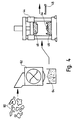
- the forming technique described above can in principle also be used for the production of molded parts 48 from reactive plastic waste.
- the plastic waste 60 is comminuted in a cutting mill 62 to a regranulate 64 with a grain size of about 0.5 to 5 mm and in this form immediately or after prior pelleting or connection to a rolled sheet as a coarse semi-finished product in the manner described above a forming press 44 or a transfer molding tool, not shown.
- an extruder 70 with a slot die 72 is provided, in which the regranulate 64 filled in via the funnel 74 is pressed under the action of pressure and heat and extruded in the form of a flat strand 76.
- a compression station 26 designed as a rolling station, the extrudate is compressed and calibrated to form the continuous semi-finished layer 30.
- the semifinished product 30 emerging from the compression station 26 is continuously fed to a forming press 44, in which the semifinished product is produced using press pressures of 150 to 400 bar at a temperature of 120 to 350 ° C. with the aid of heated press tools 46 molded parts 48 are produced.
- the approximately 2 to 3 mm thick semi-finished web 30 is wound onto a roll 53 for the purpose of intermediate storage with the aid of a winding drive 54 and a pressure roller 56.
- the molded part can then be produced independently of the semi-finished product (see 3b).
Landscapes
- Engineering & Computer Science (AREA)
- Mechanical Engineering (AREA)
- Environmental & Geological Engineering (AREA)
- Chemical & Material Sciences (AREA)
- Composite Materials (AREA)
- Casting Or Compression Moulding Of Plastics Or The Like (AREA)
Abstract
Claims (12)
- Procédé de production de pièces moulées en matières plastiques réactionnelles, composées d'élastomères réticulés de polyuréthane, de polyuréthane-polycarbamide ou de polycarbamide, caractérisé par les phases de procédé suivantes:- les constituants réactionnels de la matière plastique réactionnelle sont mélangés à l'état liquide,- le mélange réactionnel (32), alors formé, est appliqué à l'état liquide sur une bande (20) déplacée en continu ou en discontinu, en formant une couche cohérente, puis durci le long d'une section de transport (16) de la bande, en formant un demi-produit,- le demi-produit est transformé sans enlèvement de copeaux, sous l'effet d'une pression de 150 à 400 bars et d'une température de 120 à 350°C, en produisant la piéce moulée (48).
- Procédé suivant la revendication 1, caractérisé en ce que les constituants réactionnels sont chargés d'additions d'air et/ou de fibres de verre avant l'opération de mélange.
- Procédé suivant l'une des revendications 1 et 2, caractérisé en ce que la bande (20) est réalisée sous forme de mat de tissu ou de fibres, ou comporte un tel mat.
- Procédé suivant l'une quelconque des revendications 1 à 3, caractérisé en ce que la couche de matière plastique réactionnelle (30), encore liquide ou plastique, est enduite ou doublée, le long de la section de transport, d'une feuille de couverture ou décorative (40).
- Procédé de production de pièces moulées en matières plastiques réactionnelles, composées d'élastomères réticulés de polyuréthane, de polyuréthane-polycarbamide ou de polycarbamide, caractérisé par les phases suivantes de procédé:- des déchets de matière plastique réactionnelle sont broyés en formant du granulat,- le granulat est comprimé sous un chauffage de 150 à 400°C, et extrudé en un demi-produit en formant une couche cohérente,- le demi-produit est transformé sans enlèvement de copeaux, sous l'effet d'une pression de 150 à 400 bars et d'une température de 120 à 350°C, en produisant la pièce moulée.
- Procédé suivant l'une quelconque des revendications 1 à 5, caractérisé en ce que la couche cohérente (30) est comprimée ou calibrée, par compression ou laminage de préférence, avec une réduction de son épaisseur de couche.
- Procédé suivant l'une quelconque des revendications 1 à 6, caractérisé en ce que la couche cohérente (30) est partagée en un demi-produit en forme de plaque (52), ou est enroulée en un rouleau de demi-produit (53), et entreposée sous cette forme.
- Procédé suivant l'une quelconque des revendications 1 à 6, caractérisé en ce que la couche cohérente (30) est partagée et transformée en continu, en produisant des pièces moulées (48).
- Procédé suivant l'une quelconque des revendications 1 à 8, caractérisé en ce que la matière plastique réactionnelle est recuite sous une température de 120 à 300°C, après la compression en demi-produit (52, 53) et/ou en pièce moulée (48).
- Procédé de production de piéces moulées en matières plastiques réactionnelles, composées d'élastomères réticulés de polyuréthane, de polyuréthane-polycarbamide, ou de polycarbamide, caractérisé par les phases de procédé suivantes:- des déchets de matière plastique réactionnelle sont broyés en formant du granulat,- le granulat, comprimé en plusieurs couches par des rouleaux chauffés, est alors lié sous forme de demi-produit, en formant une couche cohérente analogue à une feuille brute,- le demi-produit est transformé sans enlèvement de copeaux, sous l'effet d'une pression de 150 à 400 bars et d'une température de 120 à 350°C, en produisant la pièce moulée.
- Procédé de production de pièces moulées en matières plastiques réactionnelles, composées d'élastomères réticulés de polyuréthane, de polyuréthane-polycarbamide, ou de polycarbamide, caractérisé par les phases de procédé suivantes:- des déchets de matière plastique réactionnelle sont broyés en formant du granulat,- le granulat, comprimé en discontinu, est alors lié sous forme de demi-produit, en formant des boulettes ou des plaques,- le demi-produit est transformé sans enlèvement de copeaux, sous l'effet d'une pression de 150 à 400 bars et d'une température de 120 à 350°C, en produisant la pièce moulée.
- Procédé de production de pièces moulées en matières plastiques réactionnelles, composées d'élastomères réticulés de polyuréthane, de polyuréthane-polycarbamide, ou de polycarbamide, caractérisé par les phases de procédé suivantes:- des déchets de pièces moulées en matière plastique réactionnelle sont polis par des rouleaux chauffés, en formant un demi-produit en forme de plaque,- le demi-produit est transformé sans enlèvement de copeaux, sous l'effet d'une pression de 150 à 400 bars et d'une température de 120 à 350°C, en produisant la pièce moulée.
Applications Claiming Priority (2)
| Application Number | Priority Date | Filing Date | Title |
|---|---|---|---|
| DE19904020109 DE4020109A1 (de) | 1990-06-23 | 1990-06-23 | Verfahren und anlage zur herstellung von formteilen aus vernetzten reaktionskunststoffen |
| DE4020109 | 1990-06-23 |
Publications (2)
| Publication Number | Publication Date |
|---|---|
| EP0536145A1 EP0536145A1 (fr) | 1993-04-14 |
| EP0536145B1 true EP0536145B1 (fr) | 1994-01-05 |
Family
ID=6408982
Family Applications (1)
| Application Number | Title | Priority Date | Filing Date |
|---|---|---|---|
| EP19910908633 Revoked EP0536145B1 (fr) | 1990-06-23 | 1991-04-25 | Procede et installation de production de pieces moulees en matieres plastiques reactionnelles reticulees |
Country Status (3)
| Country | Link |
|---|---|
| EP (1) | EP0536145B1 (fr) |
| DE (2) | DE4020109A1 (fr) |
| WO (1) | WO1992000177A1 (fr) |
Cited By (2)
| Publication number | Priority date | Publication date | Assignee | Title |
|---|---|---|---|---|
| CN101811344A (zh) * | 2010-04-02 | 2010-08-25 | 马自坤 | 一种浮顶油罐橡胶密封带的制造方法 |
| WO2024136764A1 (fr) * | 2022-12-21 | 2024-06-27 | Arbor - Okrasne A Ovocne Skolky, S.R.O. | Planche de rétention, de drainage et de culture, son procédé de production et système d'équipement permettant sa production |
Families Citing this family (11)
| Publication number | Priority date | Publication date | Assignee | Title |
|---|---|---|---|---|
| DE4205119A1 (de) * | 1992-02-20 | 1993-08-26 | Ercom Composite Recyling Gmbh | Verfahren und vorrichtung zum herstellen einer duroplastischen pressmasse aus faser-harz-werkstoff, insbesondere einer smc-matte (prepreg) |
| DE69324788D1 (de) * | 1993-01-18 | 1999-06-10 | Microlite Sl | Verfahren zum Rückgewinnung von Polyurethan |
| AT401908B (de) * | 1993-11-29 | 1996-12-27 | Greiner & Soehne C A | Mehrlagiges bauelement sowie verfahren und vorrichtung zu seiner herstellung |
| US5574773A (en) * | 1994-02-22 | 1996-11-12 | Qualcomm Incorporated | Method and apparatus of providing audio feedback over a digital channel |
| GB9708151D0 (en) * | 1996-12-04 | 1997-06-11 | Robobond Ltd | Method of forming ornamented plastics articles |
| GB9625192D0 (en) * | 1996-12-04 | 1997-01-22 | Robobond Ltd | Method of forming ornamented plastics articles |
| DE202008017825U1 (de) | 2008-04-11 | 2010-09-02 | Jarus Gmbh | Mischkopf für flüssige und pastöse Komponenten |
| DE102016200530B4 (de) | 2016-01-18 | 2018-07-12 | Volkswagen Aktiengesellschaft | Verfahren zur Herstellung eines faserverstärkten Kunststoffbauteils |
| DE102016105228B4 (de) * | 2016-03-21 | 2022-03-10 | Lisa Dräxlmaier GmbH | Reduzierung von Sicherungsbrüchen durch partielle Reduktion der Wärmedehnung des Kunststoffgehäuses |
| CN107053572B (zh) * | 2017-05-16 | 2019-03-12 | 佛山市高明亿阳塑胶有限公司 | 一种用于pvc塑胶地板的压延装置 |
| CN115139427B (zh) * | 2022-05-18 | 2024-11-22 | 中材锂膜(内蒙古)有限公司 | 一种改善锂电池隔膜物理性能一致性的自动混料系统 |
Family Cites Families (17)
| Publication number | Priority date | Publication date | Assignee | Title |
|---|---|---|---|---|
| DD78646A (fr) * | ||||
| DE842267C (de) * | 1950-12-20 | 1952-09-15 | Rolf Moroni | Verfahren und Vorrichtung zur fortlaufenden Herstellung von endlosen Platten, Bahnenoder Folien aus aufschaeumbaren Stoffen, insbesondere solchen auf Polyurethanbasis |
| BE728672A (fr) * | 1969-02-20 | 1969-08-01 | ||
| US3846522A (en) * | 1970-09-10 | 1974-11-05 | Elpex Inc | Forming of thermoplastic polymers |
| BE793041A (fr) * | 1971-12-23 | 1973-06-20 | Bayer Ag | Resines de polyurethanes dures renforcees et aptes au formage reversible a la chaleur |
| DD115067A1 (fr) * | 1974-07-10 | 1975-09-12 | ||
| DD134336A1 (de) * | 1977-11-08 | 1979-02-21 | Werner Grossmann | Verfahren zur herstellung von formkoerpern aus polyurethanabfaellen |
| GB1595431A (en) * | 1978-01-19 | 1981-08-12 | Diamond Shamrock Chem | Recovery of polyurethane scrap |
| DE2828506C2 (de) * | 1978-06-29 | 1980-04-17 | Bayer Ag, 5090 Leverkusen | Verfahren und Vorrichtung zum Herstellen eines schäumfähigen Gemisches aus mindestens zwei fließfähigen, schaumstoffbildenden Reaktionskomponenten und Zuschlagstoffen |
| US4303349A (en) * | 1978-07-12 | 1981-12-01 | Upton Albert E | Method of manufacturing articles |
| DD144885A1 (de) * | 1979-07-16 | 1980-11-12 | Heinrich Prokoph | Verfahren zur herstellung von formteilen aus polyurethanabfaellen |
| DE3138857C2 (de) * | 1981-09-30 | 1986-02-06 | Lenser Kunststoff-Presswerk Gmbh + Co Kg, 7913 Senden | Verfahren zur Herstellung von Fertigformlingen mit Bereichen unterschiedlichen Querschnitts, insbesondere von Kammer- und Membranfilterplatten für Fest-Flüssigtrennung |
| DE3138866A1 (de) * | 1981-09-30 | 1983-04-14 | Lenser Kunststoff-Presswerk Gmbh + Co Kg, 7913 Senden | Verfahren zur herstellung von fertigformlingen mit bereichen unterschiedlichen querschnitts, insbesondere von kammer- und membranfilterplatten fuer fest-fluessigtrennung |
| DE3242089A1 (de) * | 1982-11-13 | 1984-05-17 | Basf Ag | Verfahren zur kontinuierlichen herstellung von halbzeug aus faserverstaerkten, thermoplastischen polyurethanen |
| DD227380A1 (de) * | 1984-06-07 | 1985-09-18 | Plastik Werk Berlin Veb | Verwendung ein- oder mehrfach vorplastizierter duroplastischer formmasse |
| US4769202A (en) * | 1985-11-29 | 1988-09-06 | The B. F. Goodrich Company | Process of making a conveyor belt |
| DE3744479A1 (de) * | 1987-12-30 | 1989-07-13 | Hans Germar | Verfahren zum herstellen von glasfaserverstaerkten polyurethan-formteilen |
-
1990
- 1990-06-23 DE DE19904020109 patent/DE4020109A1/de not_active Withdrawn
-
1991
- 1991-04-25 EP EP19910908633 patent/EP0536145B1/fr not_active Revoked
- 1991-04-25 DE DE91908633T patent/DE59100823D1/de not_active Revoked
- 1991-04-25 WO PCT/EP1991/000804 patent/WO1992000177A1/fr not_active Ceased
Cited By (2)
| Publication number | Priority date | Publication date | Assignee | Title |
|---|---|---|---|---|
| CN101811344A (zh) * | 2010-04-02 | 2010-08-25 | 马自坤 | 一种浮顶油罐橡胶密封带的制造方法 |
| WO2024136764A1 (fr) * | 2022-12-21 | 2024-06-27 | Arbor - Okrasne A Ovocne Skolky, S.R.O. | Planche de rétention, de drainage et de culture, son procédé de production et système d'équipement permettant sa production |
Also Published As
| Publication number | Publication date |
|---|---|
| EP0536145A1 (fr) | 1993-04-14 |
| WO1992000177A1 (fr) | 1992-01-09 |
| DE59100823D1 (de) | 1994-02-17 |
| DE4020109A1 (de) | 1992-01-02 |
Similar Documents
| Publication | Publication Date | Title |
|---|---|---|
| EP1386721B1 (fr) | Procédé et dispositif de fabrication de pièces moulées renforcées de fibres | |
| DE68909382T2 (de) | Kontinuierliches Verfahren zum Herstellen hochfester und hochelastischer Polyolefinwerkstoffe. | |
| EP0794859B1 (fr) | Procédé de fabrication d'une plaque stratifiée | |
| DE4431755C2 (de) | Sandwichplatte aus Stärkeschaum | |
| AT401751B (de) | Verfahren zum herstellen von langgestreckten profilierten teilen und vorrichtung zur durchführung des verfahrens | |
| AT401908B (de) | Mehrlagiges bauelement sowie verfahren und vorrichtung zu seiner herstellung | |
| DE2328883A1 (de) | Schichtplatte | |
| DE102008011410A1 (de) | Verfahren zur Herstellung eines profilierten Preforms und eines profilierten FVK-Bauteils, Pultrusionsanlage sowie Press-Vorrichtung zur Durchführung des Verfahrens | |
| WO1992000177A1 (fr) | Procede et installation de production de pieces moulees en matieres plastiques reactionnelles reticulees | |
| EP0135595B1 (fr) | Procédé de fabrication d'un matériau de revêtement de sol, ou analogue, représentant une structure à une ou à plusieurs couches, ainsi que son utilisation pour le revêtement de sol de terrains et halls de sport | |
| US4925379A (en) | Device for producing a plastic sheet of high optical quality | |
| EP0728574A2 (fr) | Elément structurel de type sandwich en polyuréthane et procédé pour sa preparation | |
| WO2014091001A2 (fr) | Procédé, appareil et mat imprégné de résine pour fabriquer des pièces moulées renforcées par fibres, notamment par extrusion, dans une presse de moulage | |
| DE69000851T2 (de) | Verfahren und vorrichtung zum umformen von thermoplastischen werkstoffen, insbesondere verbundwerkstoffen, in form duenner blaetter. | |
| EP0482092B1 (fr) | Procede de production de plaques ou de dalles stratifiees en un materiau alveolaire thermoplastique | |
| DE69621106T2 (de) | Verfahren und Vorrichtung zum Herstellen von Rakeln für elektrophotographische Geräte | |
| EP0280154A2 (fr) | Semi-produit moulable de production de pièces façonné à rigidité flexionnelle | |
| DE4113056A1 (de) | Verfahren zur verarbeitung von recyclingprodukten | |
| EP0985519A2 (fr) | Procédé pour la fabrication de plaques thermoplastiques renforcées par des fibres naturelles ainsi que leur utilisation dans la production d'objets | |
| DE9007714U1 (de) | Anlage zur Herstellung von Formteilen aus vernetzten Reaktionskunststoffen | |
| DE69811086T2 (de) | Verfahren zur herstellung eines verbundmaterials | |
| DE102007050784B4 (de) | Verfahren zum Herstellen von Kunststoffplatten aus einem thermoplastischen Kunststoffrecyclat | |
| DE102018111283A1 (de) | Vorrichtung und Verfahren zum kontinuierlichen Blasformen faserverstärkter thermoplastischer Hohlprofile mit einem konstanten oder sich änderndem Querschnitt | |
| DE2365895B2 (fr) | ||
| AT413678B (de) | Verfahren zur herstellung eines sandwichbauteils |
Legal Events
| Date | Code | Title | Description |
|---|---|---|---|
| PUAI | Public reference made under article 153(3) epc to a published international application that has entered the european phase |
Free format text: ORIGINAL CODE: 0009012 |
|
| 17P | Request for examination filed |
Effective date: 19921222 |
|
| AK | Designated contracting states |
Kind code of ref document: A1 Designated state(s): DE |
|
| 17Q | First examination report despatched |
Effective date: 19930518 |
|
| GRAA | (expected) grant |
Free format text: ORIGINAL CODE: 0009210 |
|
| AK | Designated contracting states |
Kind code of ref document: B1 Designated state(s): DE |
|
| REF | Corresponds to: |
Ref document number: 59100823 Country of ref document: DE Date of ref document: 19940217 |
|
| PGFP | Annual fee paid to national office [announced via postgrant information from national office to epo] |
Ref country code: DE Payment date: 19940527 Year of fee payment: 4 |
|
| PLBI | Opposition filed |
Free format text: ORIGINAL CODE: 0009260 |
|
| 26 | Opposition filed |
Opponent name: BAYER AG, LEVERKUSEN KONZERNVERWALTUNG RP PATENTE Effective date: 19941005 |
|
| RDAG | Patent revoked |
Free format text: ORIGINAL CODE: 0009271 |
|
| STAA | Information on the status of an ep patent application or granted ep patent |
Free format text: STATUS: PATENT REVOKED |
|
| 27W | Patent revoked |
Effective date: 19950710 |