EP0536151B1 - Derives orthosubstitues de guanidine de diphenyle, et agents antidiabetiques ou hypoglycemiants les contenant - Google Patents
Derives orthosubstitues de guanidine de diphenyle, et agents antidiabetiques ou hypoglycemiants les contenant Download PDFInfo
- Publication number
- EP0536151B1 EP0536151B1 EP91909161A EP91909161A EP0536151B1 EP 0536151 B1 EP0536151 B1 EP 0536151B1 EP 91909161 A EP91909161 A EP 91909161A EP 91909161 A EP91909161 A EP 91909161A EP 0536151 B1 EP0536151 B1 EP 0536151B1
- Authority
- EP
- European Patent Office
- Prior art keywords
- formula
- carbon atoms
- group
- guanidino
- biphenylyl
- Prior art date
- Legal status (The legal status is an assumption and is not a legal conclusion. Google has not performed a legal analysis and makes no representation as to the accuracy of the status listed.)
- Expired - Lifetime
Links
- 0 CSC(N(*)*)=Nc1ccccc1* Chemical compound CSC(N(*)*)=Nc1ccccc1* 0.000 description 4
Classifications
-
- C—CHEMISTRY; METALLURGY
- C07—ORGANIC CHEMISTRY
- C07D—HETEROCYCLIC COMPOUNDS
- C07D265/00—Heterocyclic compounds containing six-membered rings having one nitrogen atom and one oxygen atom as the only ring hetero atoms
- C07D265/28—1,4-Oxazines; Hydrogenated 1,4-oxazines
- C07D265/30—1,4-Oxazines; Hydrogenated 1,4-oxazines not condensed with other rings
-
- C—CHEMISTRY; METALLURGY
- C07—ORGANIC CHEMISTRY
- C07D—HETEROCYCLIC COMPOUNDS
- C07D211/00—Heterocyclic compounds containing hydrogenated pyridine rings, not condensed with other rings
- C07D211/04—Heterocyclic compounds containing hydrogenated pyridine rings, not condensed with other rings with only hydrogen or carbon atoms directly attached to the ring nitrogen atom
- C07D211/06—Heterocyclic compounds containing hydrogenated pyridine rings, not condensed with other rings with only hydrogen or carbon atoms directly attached to the ring nitrogen atom having no double bonds between ring members or between ring members and non-ring members
- C07D211/08—Heterocyclic compounds containing hydrogenated pyridine rings, not condensed with other rings with only hydrogen or carbon atoms directly attached to the ring nitrogen atom having no double bonds between ring members or between ring members and non-ring members with hydrocarbon or substituted hydrocarbon radicals directly attached to ring carbon atoms
- C07D211/18—Heterocyclic compounds containing hydrogenated pyridine rings, not condensed with other rings with only hydrogen or carbon atoms directly attached to the ring nitrogen atom having no double bonds between ring members or between ring members and non-ring members with hydrocarbon or substituted hydrocarbon radicals directly attached to ring carbon atoms with substituted hydrocarbon radicals attached to ring carbon atoms
- C07D211/26—Heterocyclic compounds containing hydrogenated pyridine rings, not condensed with other rings with only hydrogen or carbon atoms directly attached to the ring nitrogen atom having no double bonds between ring members or between ring members and non-ring members with hydrocarbon or substituted hydrocarbon radicals directly attached to ring carbon atoms with substituted hydrocarbon radicals attached to ring carbon atoms with hydrocarbon radicals, substituted by nitrogen atoms
-
- A—HUMAN NECESSITIES
- A61—MEDICAL OR VETERINARY SCIENCE; HYGIENE
- A61P—SPECIFIC THERAPEUTIC ACTIVITY OF CHEMICAL COMPOUNDS OR MEDICINAL PREPARATIONS
- A61P3/00—Drugs for disorders of the metabolism
- A61P3/08—Drugs for disorders of the metabolism for glucose homeostasis
-
- A—HUMAN NECESSITIES
- A61—MEDICAL OR VETERINARY SCIENCE; HYGIENE
- A61P—SPECIFIC THERAPEUTIC ACTIVITY OF CHEMICAL COMPOUNDS OR MEDICINAL PREPARATIONS
- A61P3/00—Drugs for disorders of the metabolism
- A61P3/08—Drugs for disorders of the metabolism for glucose homeostasis
- A61P3/10—Drugs for disorders of the metabolism for glucose homeostasis for hyperglycaemia, e.g. antidiabetics
-
- C—CHEMISTRY; METALLURGY
- C07—ORGANIC CHEMISTRY
- C07C—ACYCLIC OR CARBOCYCLIC COMPOUNDS
- C07C257/00—Compounds containing carboxyl groups, the doubly-bound oxygen atom of a carboxyl group being replaced by a doubly-bound nitrogen atom, this nitrogen atom not being further bound to an oxygen atom, e.g. imino-ethers, amidines
- C07C257/10—Compounds containing carboxyl groups, the doubly-bound oxygen atom of a carboxyl group being replaced by a doubly-bound nitrogen atom, this nitrogen atom not being further bound to an oxygen atom, e.g. imino-ethers, amidines with replacement of the other oxygen atom of the carboxyl group by nitrogen atoms, e.g. amidines
- C07C257/14—Compounds containing carboxyl groups, the doubly-bound oxygen atom of a carboxyl group being replaced by a doubly-bound nitrogen atom, this nitrogen atom not being further bound to an oxygen atom, e.g. imino-ethers, amidines with replacement of the other oxygen atom of the carboxyl group by nitrogen atoms, e.g. amidines having carbon atoms of amidino groups bound to acyclic carbon atoms
-
- C—CHEMISTRY; METALLURGY
- C07—ORGANIC CHEMISTRY
- C07C—ACYCLIC OR CARBOCYCLIC COMPOUNDS
- C07C257/00—Compounds containing carboxyl groups, the doubly-bound oxygen atom of a carboxyl group being replaced by a doubly-bound nitrogen atom, this nitrogen atom not being further bound to an oxygen atom, e.g. imino-ethers, amidines
- C07C257/10—Compounds containing carboxyl groups, the doubly-bound oxygen atom of a carboxyl group being replaced by a doubly-bound nitrogen atom, this nitrogen atom not being further bound to an oxygen atom, e.g. imino-ethers, amidines with replacement of the other oxygen atom of the carboxyl group by nitrogen atoms, e.g. amidines
- C07C257/16—Compounds containing carboxyl groups, the doubly-bound oxygen atom of a carboxyl group being replaced by a doubly-bound nitrogen atom, this nitrogen atom not being further bound to an oxygen atom, e.g. imino-ethers, amidines with replacement of the other oxygen atom of the carboxyl group by nitrogen atoms, e.g. amidines having carbon atoms of amidino groups bound to carbon atoms of rings other than six-membered aromatic rings
-
- C—CHEMISTRY; METALLURGY
- C07—ORGANIC CHEMISTRY
- C07C—ACYCLIC OR CARBOCYCLIC COMPOUNDS
- C07C261/00—Derivatives of cyanic acid
- C07C261/04—Cyanamides
-
- C—CHEMISTRY; METALLURGY
- C07—ORGANIC CHEMISTRY
- C07C—ACYCLIC OR CARBOCYCLIC COMPOUNDS
- C07C279/00—Derivatives of guanidine, i.e. compounds containing the group, the singly-bound nitrogen atoms not being part of nitro or nitroso groups
- C07C279/18—Derivatives of guanidine, i.e. compounds containing the group, the singly-bound nitrogen atoms not being part of nitro or nitroso groups having nitrogen atoms of guanidine groups bound to carbon atoms of six-membered aromatic rings
-
- C—CHEMISTRY; METALLURGY
- C07—ORGANIC CHEMISTRY
- C07C—ACYCLIC OR CARBOCYCLIC COMPOUNDS
- C07C317/00—Sulfones; Sulfoxides
- C07C317/26—Sulfones; Sulfoxides having sulfone or sulfoxide groups and nitrogen atoms, not being part of nitro or nitroso groups, bound to the same carbon skeleton
- C07C317/32—Sulfones; Sulfoxides having sulfone or sulfoxide groups and nitrogen atoms, not being part of nitro or nitroso groups, bound to the same carbon skeleton with sulfone or sulfoxide groups bound to carbon atoms of six-membered aromatic rings of the carbon skeleton
- C07C317/34—Sulfones; Sulfoxides having sulfone or sulfoxide groups and nitrogen atoms, not being part of nitro or nitroso groups, bound to the same carbon skeleton with sulfone or sulfoxide groups bound to carbon atoms of six-membered aromatic rings of the carbon skeleton having sulfone or sulfoxide groups and amino groups bound to carbon atoms of six-membered aromatic rings being part of the same non-condensed ring or of a condensed ring system containing that ring
- C07C317/38—Sulfones; Sulfoxides having sulfone or sulfoxide groups and nitrogen atoms, not being part of nitro or nitroso groups, bound to the same carbon skeleton with sulfone or sulfoxide groups bound to carbon atoms of six-membered aromatic rings of the carbon skeleton having sulfone or sulfoxide groups and amino groups bound to carbon atoms of six-membered aromatic rings being part of the same non-condensed ring or of a condensed ring system containing that ring with the nitrogen atom of at least one amino group being part of any of the groups, X being a hetero atom, Y being any atom, e.g. N-acylaminosulfones
- C07C317/42—Y being a hetero atom
-
- C—CHEMISTRY; METALLURGY
- C07—ORGANIC CHEMISTRY
- C07C—ACYCLIC OR CARBOCYCLIC COMPOUNDS
- C07C323/00—Thiols, sulfides, hydropolysulfides or polysulfides substituted by halogen, oxygen or nitrogen atoms, or by sulfur atoms not being part of thio groups
- C07C323/23—Thiols, sulfides, hydropolysulfides or polysulfides substituted by halogen, oxygen or nitrogen atoms, or by sulfur atoms not being part of thio groups containing thio groups and nitrogen atoms, not being part of nitro or nitroso groups, bound to the same carbon skeleton
- C07C323/39—Thiols, sulfides, hydropolysulfides or polysulfides substituted by halogen, oxygen or nitrogen atoms, or by sulfur atoms not being part of thio groups containing thio groups and nitrogen atoms, not being part of nitro or nitroso groups, bound to the same carbon skeleton at least one of the nitrogen atoms being part of any of the groups, X being a hetero atom, Y being any atom
- C07C323/43—Y being a hetero atom
- C07C323/44—X or Y being nitrogen atoms
-
- C—CHEMISTRY; METALLURGY
- C07—ORGANIC CHEMISTRY
- C07D—HETEROCYCLIC COMPOUNDS
- C07D207/00—Heterocyclic compounds containing five-membered rings not condensed with other rings, with one nitrogen atom as the only ring hetero atom
- C07D207/02—Heterocyclic compounds containing five-membered rings not condensed with other rings, with one nitrogen atom as the only ring hetero atom with only hydrogen or carbon atoms directly attached to the ring nitrogen atom
- C07D207/04—Heterocyclic compounds containing five-membered rings not condensed with other rings, with one nitrogen atom as the only ring hetero atom with only hydrogen or carbon atoms directly attached to the ring nitrogen atom having no double bonds between ring members or between ring members and non-ring members
- C07D207/10—Heterocyclic compounds containing five-membered rings not condensed with other rings, with one nitrogen atom as the only ring hetero atom with only hydrogen or carbon atoms directly attached to the ring nitrogen atom having no double bonds between ring members or between ring members and non-ring members with hetero atoms or with carbon atoms having three bonds to hetero atoms with at the most one bond to halogen, e.g. ester or nitrile radicals, directly attached to ring carbon atoms
- C07D207/12—Oxygen or sulfur atoms
-
- C—CHEMISTRY; METALLURGY
- C07—ORGANIC CHEMISTRY
- C07D—HETEROCYCLIC COMPOUNDS
- C07D211/00—Heterocyclic compounds containing hydrogenated pyridine rings, not condensed with other rings
- C07D211/04—Heterocyclic compounds containing hydrogenated pyridine rings, not condensed with other rings with only hydrogen or carbon atoms directly attached to the ring nitrogen atom
- C07D211/06—Heterocyclic compounds containing hydrogenated pyridine rings, not condensed with other rings with only hydrogen or carbon atoms directly attached to the ring nitrogen atom having no double bonds between ring members or between ring members and non-ring members
- C07D211/36—Heterocyclic compounds containing hydrogenated pyridine rings, not condensed with other rings with only hydrogen or carbon atoms directly attached to the ring nitrogen atom having no double bonds between ring members or between ring members and non-ring members with hetero atoms or with carbon atoms having three bonds to hetero atoms with at the most one bond to halogen, e.g. ester or nitrile radicals, directly attached to ring carbon atoms
- C07D211/40—Oxygen atoms
- C07D211/42—Oxygen atoms attached in position 3 or 5
-
- C—CHEMISTRY; METALLURGY
- C07—ORGANIC CHEMISTRY
- C07D—HETEROCYCLIC COMPOUNDS
- C07D211/00—Heterocyclic compounds containing hydrogenated pyridine rings, not condensed with other rings
- C07D211/04—Heterocyclic compounds containing hydrogenated pyridine rings, not condensed with other rings with only hydrogen or carbon atoms directly attached to the ring nitrogen atom
- C07D211/06—Heterocyclic compounds containing hydrogenated pyridine rings, not condensed with other rings with only hydrogen or carbon atoms directly attached to the ring nitrogen atom having no double bonds between ring members or between ring members and non-ring members
- C07D211/36—Heterocyclic compounds containing hydrogenated pyridine rings, not condensed with other rings with only hydrogen or carbon atoms directly attached to the ring nitrogen atom having no double bonds between ring members or between ring members and non-ring members with hetero atoms or with carbon atoms having three bonds to hetero atoms with at the most one bond to halogen, e.g. ester or nitrile radicals, directly attached to ring carbon atoms
- C07D211/40—Oxygen atoms
- C07D211/44—Oxygen atoms attached in position 4
- C07D211/46—Oxygen atoms attached in position 4 having a hydrogen atom as the second substituent in position 4
-
- C—CHEMISTRY; METALLURGY
- C07—ORGANIC CHEMISTRY
- C07D—HETEROCYCLIC COMPOUNDS
- C07D211/00—Heterocyclic compounds containing hydrogenated pyridine rings, not condensed with other rings
- C07D211/04—Heterocyclic compounds containing hydrogenated pyridine rings, not condensed with other rings with only hydrogen or carbon atoms directly attached to the ring nitrogen atom
- C07D211/68—Heterocyclic compounds containing hydrogenated pyridine rings, not condensed with other rings with only hydrogen or carbon atoms directly attached to the ring nitrogen atom having one double bond between ring members or between a ring member and a non-ring member
- C07D211/72—Heterocyclic compounds containing hydrogenated pyridine rings, not condensed with other rings with only hydrogen or carbon atoms directly attached to the ring nitrogen atom having one double bond between ring members or between a ring member and a non-ring member with hetero atoms or with carbon atoms having three bonds to hetero atoms, with at the most one bond to halogen, directly attached to ring carbon atoms
-
- C—CHEMISTRY; METALLURGY
- C07—ORGANIC CHEMISTRY
- C07D—HETEROCYCLIC COMPOUNDS
- C07D213/00—Heterocyclic compounds containing six-membered rings, not condensed with other rings, with one nitrogen atom as the only ring hetero atom and three or more double bonds between ring members or between ring members and non-ring members
- C07D213/02—Heterocyclic compounds containing six-membered rings, not condensed with other rings, with one nitrogen atom as the only ring hetero atom and three or more double bonds between ring members or between ring members and non-ring members having three double bonds between ring members or between ring members and non-ring members
- C07D213/04—Heterocyclic compounds containing six-membered rings, not condensed with other rings, with one nitrogen atom as the only ring hetero atom and three or more double bonds between ring members or between ring members and non-ring members having three double bonds between ring members or between ring members and non-ring members having no bond between the ring nitrogen atom and a non-ring member or having only hydrogen or carbon atoms directly attached to the ring nitrogen atom
- C07D213/24—Heterocyclic compounds containing six-membered rings, not condensed with other rings, with one nitrogen atom as the only ring hetero atom and three or more double bonds between ring members or between ring members and non-ring members having three double bonds between ring members or between ring members and non-ring members having no bond between the ring nitrogen atom and a non-ring member or having only hydrogen or carbon atoms directly attached to the ring nitrogen atom with substituted hydrocarbon radicals attached to ring carbon atoms
- C07D213/36—Radicals substituted by singly-bound nitrogen atoms
-
- C—CHEMISTRY; METALLURGY
- C07—ORGANIC CHEMISTRY
- C07D—HETEROCYCLIC COMPOUNDS
- C07D233/00—Heterocyclic compounds containing 1,3-diazole or hydrogenated 1,3-diazole rings, not condensed with other rings
- C07D233/04—Heterocyclic compounds containing 1,3-diazole or hydrogenated 1,3-diazole rings, not condensed with other rings having one double bond between ring members or between a ring member and a non-ring member
- C07D233/28—Heterocyclic compounds containing 1,3-diazole or hydrogenated 1,3-diazole rings, not condensed with other rings having one double bond between ring members or between a ring member and a non-ring member with hetero atoms or with carbon atoms having three bonds to hetero atoms with at the most one bond to halogen, e.g. ester or nitrile radicals, directly attached to ring carbon atoms
- C07D233/44—Nitrogen atoms not forming part of a nitro radical
- C07D233/50—Nitrogen atoms not forming part of a nitro radical with carbocyclic radicals directly attached to said nitrogen atoms
-
- C—CHEMISTRY; METALLURGY
- C07—ORGANIC CHEMISTRY
- C07D—HETEROCYCLIC COMPOUNDS
- C07D295/00—Heterocyclic compounds containing polymethylene-imine rings with at least five ring members, 3-azabicyclo [3.2.2] nonane, piperazine, morpholine or thiomorpholine rings, having only hydrogen atoms directly attached to the ring carbon atoms
- C07D295/04—Heterocyclic compounds containing polymethylene-imine rings with at least five ring members, 3-azabicyclo [3.2.2] nonane, piperazine, morpholine or thiomorpholine rings, having only hydrogen atoms directly attached to the ring carbon atoms with substituted hydrocarbon radicals attached to ring nitrogen atoms
- C07D295/12—Heterocyclic compounds containing polymethylene-imine rings with at least five ring members, 3-azabicyclo [3.2.2] nonane, piperazine, morpholine or thiomorpholine rings, having only hydrogen atoms directly attached to the ring carbon atoms with substituted hydrocarbon radicals attached to ring nitrogen atoms substituted by singly or doubly bound nitrogen atoms
- C07D295/125—Heterocyclic compounds containing polymethylene-imine rings with at least five ring members, 3-azabicyclo [3.2.2] nonane, piperazine, morpholine or thiomorpholine rings, having only hydrogen atoms directly attached to the ring carbon atoms with substituted hydrocarbon radicals attached to ring nitrogen atoms substituted by singly or doubly bound nitrogen atoms with the ring nitrogen atoms and the substituent nitrogen atoms attached to the same carbon chain, which is not interrupted by carbocyclic rings
- C07D295/13—Heterocyclic compounds containing polymethylene-imine rings with at least five ring members, 3-azabicyclo [3.2.2] nonane, piperazine, morpholine or thiomorpholine rings, having only hydrogen atoms directly attached to the ring carbon atoms with substituted hydrocarbon radicals attached to ring nitrogen atoms substituted by singly or doubly bound nitrogen atoms with the ring nitrogen atoms and the substituent nitrogen atoms attached to the same carbon chain, which is not interrupted by carbocyclic rings to an acyclic saturated chain
-
- C—CHEMISTRY; METALLURGY
- C07—ORGANIC CHEMISTRY
- C07D—HETEROCYCLIC COMPOUNDS
- C07D295/00—Heterocyclic compounds containing polymethylene-imine rings with at least five ring members, 3-azabicyclo [3.2.2] nonane, piperazine, morpholine or thiomorpholine rings, having only hydrogen atoms directly attached to the ring carbon atoms
- C07D295/16—Heterocyclic compounds containing polymethylene-imine rings with at least five ring members, 3-azabicyclo [3.2.2] nonane, piperazine, morpholine or thiomorpholine rings, having only hydrogen atoms directly attached to the ring carbon atoms acylated on ring nitrogen atoms
- C07D295/20—Heterocyclic compounds containing polymethylene-imine rings with at least five ring members, 3-azabicyclo [3.2.2] nonane, piperazine, morpholine or thiomorpholine rings, having only hydrogen atoms directly attached to the ring carbon atoms acylated on ring nitrogen atoms by radicals derived from carbonic acid, or sulfur or nitrogen analogues thereof
- C07D295/215—Radicals derived from nitrogen analogues of carbonic acid
-
- C—CHEMISTRY; METALLURGY
- C07—ORGANIC CHEMISTRY
- C07D—HETEROCYCLIC COMPOUNDS
- C07D295/00—Heterocyclic compounds containing polymethylene-imine rings with at least five ring members, 3-azabicyclo [3.2.2] nonane, piperazine, morpholine or thiomorpholine rings, having only hydrogen atoms directly attached to the ring carbon atoms
- C07D295/22—Heterocyclic compounds containing polymethylene-imine rings with at least five ring members, 3-azabicyclo [3.2.2] nonane, piperazine, morpholine or thiomorpholine rings, having only hydrogen atoms directly attached to the ring carbon atoms with hetero atoms directly attached to ring nitrogen atoms
- C07D295/26—Sulfur atoms
Definitions
- This invention relates to novel therapeutic agents useful as antidiabetic agents, particularly as hypoglycaemic agents, to processes for the preparation of such agents and to pharmaceutical compositions containing them.
- EP-A-0 000 952 describes benzhydryl guanidine derivatives having hypoglycaemic activity but makes no reference to ortho substituted biphenyl guanidine derivatives.
- R1 is phenyl, 2-fluorophenyl, 3-fluorophenyl, 4-fluorophenyl, 4-chlorophenyl, 4-methoxyphenyl, 3-methylphenyl, 4-methylphenyl, 3-methylthiophenyl, 3-methanesulphonylphenyl, 4-methanesulphonylphenyl or 4-acetylphenyl.
- R6 and R7 are independently H or methyl (for example R2 is amino or methylamino).
- the group R3 is H or an alkyl group containing 1 to 3 carbon atoms (eg methyl or ethyl) and the group R4 is (a) H, (b) an alkyl group of 1 to 3 carbon atoms (eg ethyl) optionally substituted by methoxy, pyridyl or dimethylamino (eg R4 is 2-methoxyethyl, 2-pyridyl-ethyl or 2-dimethylaminoethyl) or (c) a phenyl group substituted by hydroxy.
- the group R3 is H or an alkyl group containing 1 to 3 carbon atoms (eg methyl or ethyl) and the group R4 is (a) H, (b) an alkyl group of 1 to 3 carbon atoms (eg ethyl) optionally substituted by methoxy, pyridyl or dimethylamino (eg R4 is 2-methoxyethyl, 2-
- formula IV represents 1-methyl-2-imidazolidinylidene, 1-(n-butyl)-2-imidazolidinylidene, 1-(2-hydroxyethyl)-2-imidazolidinylidene or 1,3-dimethyl-2-imidazolidinylidene.
- the group NR3R4 is 3-hydroxy-1-pyrrolidinyl, piperidino, 1,2,5,6-tetrahydropyridyl, 4-methylpiperidino, 3-hydroxypiperidino, 4-hydroxypiperidino, 4-hydroxy-4-methylpiperidino, 3-methoxypiperidino, 4-methoxypiperidino, 3-hydroxymethylpiperidino, 4-hydroxymethylpiperidino, 4-dimethylcarbamoylpiperidino, 4-piperidinon-1-yl, 4-piperidinon-1-yl oxime, 4-piperidinon-1-yl oxime-O-methyl ether, morpholino, 2-methylmorpholino, 3,3-dimethylmorpholino, thiomorpholino, thiomorpholino-1-oxide, thiomorpholino-1,1-dioxide, 4-methyl-1-piperazinyl, 4-e
- R5 represents H or one or more substituents (preferably one or two substituents) selected from fluoro, methyl, methoxy, or methylthio. Where more than one substituent is present they may be the same or different.
- Compounds of formula I may exist as salts with pharmaceutically acceptable acids.
- Examples of such salts include hydrochlorides, hydrobromides, hydriodides, sulphates, nitrates, maleates, acetates, citrates, fumarates, tartrates, succinates, benzoates, pamoates and salts with acidic amino acids such as glutamic acid.
- Compounds of formula I and their salts may exist in the form of solvates (for example hydrates).
- Some compounds of formula I contain one or more asymmetric carbon atoms and exist in different optically active forms.
- the compounds of formula I contain one chiral centre the compounds exist in two enantiomeric forms and the present invention includes both enantiomeric forms and mixtures thereof.
- the compounds of formula I contain more than one chiral centre, the compounds may exist in diastereoisomeric forms.
- the present invention includes each of these diastereoisomeric forms and mixtures thereof.
- the present invention also includes pharmaceutical compositions containing a therapeutically effective amount of a compound of formula I together with a pharmaceutically acceptable diluent or carrier.
- the active compound may be administered orally, rectally, parenterally or topically, preferably orally.
- the therapeutic compositions of the present invention may take the form of any of the known pharmaceutical compositions for oral, rectal, parenteral or topical administration.
- Pharmaceutically acceptable carriers suitable for use in such compositions are well known in the art of pharmacy.
- the compositions of the invention may contain 0.1-90% by weight of active compound.
- the compositions of the invention are generally prepared in unit dosage form.
- compositions for oral administration are the preferred compositions of the invention and these are the known pharmaceutical forms for such administration, for example tablets, capsules, syrups and aqueous or oily suspensions.
- the excipients used in the preparation of these compositions are the excipients known in the pharmacist's art.
- Tablets may be prepared by mixing the active compound with an inert diluent such as calcium phosphate in the presence of disintegrating agents, for example maize starch, and lubricating agents, for example magnesium stearate, and tableting the mixture by known methods.
- the tablets may be formulated in a manner known to those skilled in the art so as to give a sustained release of the compounds of the present invention.
- Such tablets may, if desired, be provided with enteric coatings by known methods, for example by the use of cellulose acetate phthalate.
- capsules for example hard or soft gelatin capsules, containing the active compound with or without added excipients, may be prepared by conventional means and, if desired, provided with enteric coatings in a known manner.
- the tablets and capsules may conveniently each contain 50 to 500 mg of the active compound.
- compositions for oral administration include, for example, aqueous solutions containing the active compound, aqueous suspensions containing the active compound in an aqueous medium in the presence of a non-toxic suspending agent such as sodium carboxymethylcellulose, and oily suspensions containing a compound of the present invention in a suitable vegetable oil, for example arachis oil.
- the compounds of the present invention in the form of particles of very small size, for example as obtained by fluid energy milling.
- the active compound may, if desired, be associated with other compatible pharmacologically active ingredients.
- compositions containing a therapeutically effective amount of a compound of formula I may be used to treat hyperglycaemia in human beings.
- the amount of the compound of formula I administered per day is in the range 50 to 3000 mg.
- the preferred administration route is oral administration.
- Compounds of formula I may be prepared by the reaction of an aminophenyl compound of formula VI with an amide or a urea of formula R2.CO.NR3R4 in the presence of a condensing agent such as phosphorus oxychloride, thionyl chloride, phosgene, phosphorus pentachloride or benzenesulphonyl chloride.
- a condensing agent such as phosphorus oxychloride, thionyl chloride, phosgene, phosphorus pentachloride or benzenesulphonyl chloride.
- Compounds of formula I in which the groups R2 and R3 together with the carbon and nitrogen atoms to which they are attached form a ring represented by formula IV may be prepared by the reaction of an aminophenyl compound of formula VI with a urea of formula XI in the presence of a condensing agent such as phosphorus oxychloride, thionyl chloride, phosgene, phosphorus pentachloride or benzenesulphonyl chloride.
- a condensing agent such as phosphorus oxychloride, thionyl chloride, phosgene, phosphorus pentachloride or benzenesulphonyl chloride.
- Compounds of formula I in which the groups R2 and R3 together with the carbon and nitrogen atoms to which they are attached form a ring represented by formula IV may be prepared by the reaction of a compound of formula XII optionally in the form of a salt (e.g. a hydriodide salt) in which R14 and R15 are H with a diamine of formula XIII R11NHENHR4 XIII
- Compounds of formula I in which the group NR3R4 is NH2 may be prepared by the reaction of a com- pound of formula VI optionally in the form of a salt (e.g. a hydrochloride salt) with a cyano compound of formula R2CN, optionally in the presence of aluminium chloride.
- Compounds of formula I in which the group R2 is NH2 may be prepared by the reaction of a compound of formula VI optionally in the form of a salt (e.g. a hydrochloride salt) with a cyanamide compound of formula R3R4NCN.
- the reaction may be performed in a liquid reaction medium (for example m-cresol) or by heating the reactants together in the absence of a liquid carrier.
- Compounds of formula I in which the group R2 is NH2 may be prepared by the reaction of compounds of formula XIV with amines of formula NHR3R4 optionally in a liquid reaction medium (for example ethanol).
- a liquid reaction medium for example ethanol
- R2 is a group of formula II in which R6 is alkyl and R7 is H or alkyl
- R7 is H or alkyl
- the reaction may be performed in an alcoholic medium (e.g. ethanol or n-butanol) optionally in the presence of a base such as pyridine or triethylamine or in the presence of potassium hydroxide and lead acetate.
- HNR3R4 is ammonia
- the ammonia may be dissolved in the alcoholic medium and the reaction may be performed under elevated pressure in a sealed reaction vessel.
- R2 is a group of formula II in which R6 is alkyl and R7 is H or alkyl
- R7 is H or alkyl
- the reaction may be performed in the presence of a base (such as potassium hydroxide or potassium carbonate) and lead acetate.
- a base such as potassium hydroxide or potassium carbonate
- lead acetate When HNR3R4 is ammonia, the ammonia may be dissolved in an alcoholic medium (e.g. ethanol) and the reaction may be performed under elevated pressure in a sealed reaction vessel.
- an alcoholic medium e.g. ethanol
- Compounds of formula VI may be prepared by the reduction of the nitro group in a compound of formula XVII for example (a) using hydrogen and a Raney nickel catalyst, (b) hydrogen and a palladium/carbon catalyst, (c) sodium sulphide, (d) stannous chloride dihydrate in hydrochloric acid, ethyl acetate or ethanol or (e) iron in the presence of acid.
- Compounds of formula XIV may be prepared by the reaction of potassium hydroxide with compounds of formula XII in which R14 and R15 are both H or in which R14 is benzoyl and R15 is H in the presence of lead acetate.
- Compounds of formula XIV may be prepared by the reaction of thioureas of formula XV in which R14 and R15 are H (a) with sodium chlorite in the presence of a base such as sodium carbonate and a copper catalyst such as a mixture of cuprous and cupric chlorides or (b) with potassium hydroxide in the presence of lead acetate.
- Thioureas of formula XV in which R14 and R15 are H may be prepared by the reaction of ammonia with an isothiocyanate of formula XVIII
- Compounds of formula XV in which R14 is an alkyl group and R15 is H may be prepared by the reaction of an aminophenyl of formula VI with an alkylisothiocyanate of formula R14NCS.
- Carbodiimides of formula XVI may be prepared by the reaction of a thiourea of formula XV in which R14 is the group R4 and R15 is H with sodium chlorite.
- Compounds of formula XVIII may be prepared by the reaction of a compound of formula VI with thiophosgene in a liquid reaction medium such as dioxan.
- results obtained at any value of x in the above tests were then reviewed and the hypoglycaemic activity of each compound was classified on the following scale. Where more than one set of results is available at a particular value of x, the mean value of the % reduction is used to classify the activity of the compounds.
- N-(2-biphenylyl)-4-morpholine carboxamidine (m.p. 153-154°C) which was recrystallised from ethylacetate.
- N-(2-Biphenylyl)morpholine-4-carboxamidine (3.5 g) was dissolved in methanol (15 ml) and treated with fumaric acid (1.45 g) to give N-(2-biphenylyl)morpholine-4-carboxamidine fumarate (m.p. 222-223°C) which was recrystallised from a 1:1 mixture of methanol and ether.
- N-(4-Methoxy-2-biphenylyl)morpholine-4-carboxamidine (1.2 g) was dissolved in methanol (10 ml) and treated with fumaric acid (1.45 g) to give N-(4-methoxy-2-biphenylyl)morpholine-4-carboxamidine fumarate [m.p. 120° (dec)] which was recrystallised from a 1:1 mixture of methanol and ether.
- N-Methyl-4-benzyloxyphenylcyanamide (3.6 g) was added to a suspension of 2-aminobiphenyl hydrochloride (3 g) in m-cresol (8 ml) and the mixture was heated at 90-95°C for 3 hours and then added to water. The aqueous layer was basified with solid sodium bicarbonate and extracted with ether. The extract was dried (Na2SO4) and the solvent removed to give a residue which was extracted into boiling hexane to yield N-(4-benzyloxyphenyl)-N'-(2-biphenylyl)-N-methylguanidine.
- Benzoylisothiocyanate (9.44 g) was added to a solution of 2-amino-5-methylthiobiphenyl (10.3 g) in trichloromethane (120 ml) at 5°C. The mixture was kept at ambient temperature for 12 hours and the solvent partially removed. The resulting solid was suspended in hexane, separated by filtration and added to boiling aqueous sodium hydroxide solution (24.5 g in 200 ml water) to yield 5-methylthio-2-biphenylylthiourea.
- N-benzylpiperazine (8.8 g), methanesulphonyl chloride (4.3 ml), anhydrous potassium carbonate (20 g) in dry acetonitrile (100 ml) was stirred at ambient temperature for five hours to give N-benzyl-N'-methanesulphonypiperazine (m.p. 115-116°C).
- N-(2-biphenylyl)cyanamide 2.5 g
- 4-piperidone hydrochloride 5.8 g
- sodium bicarbonate 4.4 g
- ethanol 30 ml
- 3'-Methanesulphonyl-2-nitrobiphenyl 14 g was heated at 90-95°C, for 10 hours with hydrated sodium sulphide (51 g) and ethanol (400 ml) to give 2-amino-3'-methanesulphonylbiphenyl (m.p. 114-115°C).
- N-benzoyl-N'-(3'-methanesulphonyl-2-biphenylyl)thiourea 8.2 g
- sodium hydroxide 0.9 g
- ethanol 20 ml
- N-(3'-methanesulphonyl-2-biphenylyl)thiourea (6.1 g)
- lead acetate trihydrate (7.6 g)
- potassium hydroxide (11.2 g)
- water (30 ml) was heated at 90-95°C for 30 minutes to give N-(3'-methanesulphonyl-2-biphenylyl)cyanamide as a yellow oil.
- N-benzoyl-N'-(4'-fluoro-2-biphenylyl)thiourea 2.8 g
- sodium hydroxide 0.4 g
- water 10 ml
- N-benzoyl-N'-(2'-fluoro-2-biphenylyl)thiourea 9.5 g
- sodium hydroxide 1.14 g
- water 80 ml
- active compound denotes any compound of the invention but particularly any compound which is the final product of one of the preceding Examples.
- capsules 10 parts by weight of active compound and 240 parts by weight of lactose are de-aggregated and blended. The mixture is filled into hard gelatin capsules, each capsule containing a unit dose of part of a unit dose of active compound.
- Tablets are prepared from the following ingredients. Parts by weight Active compound 10 Lactose 190 Maize starch 22 Polyvinylpyrrolidone 10 Magnesium stearate 3
- the active compound, the lactose and some of the starch are de-aggregated, blended and the resulting mixture is granulated with a solution of the polyvinylpyrrolidone in ethanol.
- the dry granulate is blended with the magnesium stearate and the rest of the starch.
- the mixture is then compressed in a tabletting machine to give tablets each containing a unit dose or a part of a unit dose of active compound.
- Tablets are prepared by the method described in (b) above.
- the tablets are enteric coated in a conventional manner using a solution of 20% cellulose acetate phthalate and 3% diethyl phthalate in ethanol:dichloromethane (1:1).
- suppositories 100 parts by weight of active compound is incorporated in 1300 parts by weight of triglyceride suppository base and the mixture formed into suppositories each containing a therapeutically effective amount of active ingredient.
Landscapes
- Chemical & Material Sciences (AREA)
- Organic Chemistry (AREA)
- Health & Medical Sciences (AREA)
- Diabetes (AREA)
- Pharmacology & Pharmacy (AREA)
- General Health & Medical Sciences (AREA)
- Engineering & Computer Science (AREA)
- Bioinformatics & Cheminformatics (AREA)
- Hematology (AREA)
- Obesity (AREA)
- Chemical Kinetics & Catalysis (AREA)
- General Chemical & Material Sciences (AREA)
- Medicinal Chemistry (AREA)
- Nuclear Medicine, Radiotherapy & Molecular Imaging (AREA)
- Emergency Medicine (AREA)
- Life Sciences & Earth Sciences (AREA)
- Animal Behavior & Ethology (AREA)
- Endocrinology (AREA)
- Public Health (AREA)
- Veterinary Medicine (AREA)
- Pharmaceuticals Containing Other Organic And Inorganic Compounds (AREA)
- Acyclic And Carbocyclic Compounds In Medicinal Compositions (AREA)
- Organic Low-Molecular-Weight Compounds And Preparation Thereof (AREA)
- Steroid Compounds (AREA)
- Hydrogenated Pyridines (AREA)
- Heterocyclic Carbon Compounds Containing A Hetero Ring Having Nitrogen And Oxygen As The Only Ring Hetero Atoms (AREA)
- Pyrrole Compounds (AREA)
- Medicines That Contain Protein Lipid Enzymes And Other Medicines (AREA)
- Pyridine Compounds (AREA)
- Medicines Containing Material From Animals Or Micro-Organisms (AREA)
- Saccharide Compounds (AREA)
Claims (17)
- Composés de formule I

R₁ est un groupe phényle facultativement substitué par un radical halogéno, alkyle ayant 1 à 3 atomes de carbone, alkoxy ayant 1 à 3 atomes de carbone, alcanoyle ayant 2 à 4 atomes de carbone, 3-méthanesulfonylphényle, 4-méthanesulfonylphényle, ou un groupe de formule S(O)nR₈ dans laquelle n a la valeur 0 ou 1 et R₈ est un groupe alkyle ayant 1 à 3 atomes de carbone ;
R₂ est un groupe de formule II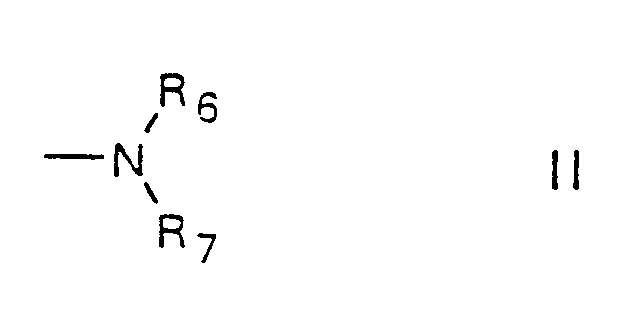
R₃ est de l'hydrogène ou un groupe aliphatique à chaîne droite ou ramifiée ayant 1 à 4 atomes de carbone ;
R₄ représente (a) un atome d'hydrogène, (b) un groupe aliphatique à chaîne droite ou ramifiée ayant 1 à 6 atomes de carbone, facultativement substitué par un radical hydroxy ou un dérivé acylé correspondant, par un groupe alkoxy contenant 1 à 3 atomes de carbone, par un groupe alkylthio contenant 1 à 3 atomes de carbone, par un groupe amino facultativement alkylé, par un groupe carbocyclique contenant 3 à 7 atomes de carbone, par un groupe pyridyle ou par un groupe cyano, (c) un noyau carbocyclique contenant 3 à 7 atomes de carbone et facultativement substitué par un radical hydroxy, sous réserve que R₃, R₄, R₆ et R₇ ne soient pas tous des groupes méthyle lorsque R₁ est un groupe phényle ;
ou bien le groupe R₂ et le groupe R₃ forment, conjointement avec les atomes de carbone et d'azote auxquels ils sont attachés, un noyau hétérocyclique de formule IV
ou bien R₃ et R₄ forment, conjointement avec l'atome d'azote auquel ils sont attachés, un noyau hétérocyclique de formule V
R₅ représente de l'hydrogène ou un ou plusieurs substituants facultatifs choisis entre des radicaux halogéno, des groupes alkyle contenant 1 à 4 atomes de carbone, des groupes alkoxy contenant 1 à 3 atomes de carbone, le groupe trifluorométhyle ou des groupes de formule S(O)mR₈ dans laquelle m a la valeur 0, 1 ou 2 et R₈ est un groupe alkyle contenant 1 à 3 atomes de carbone. - Composés de formule I suivant la revendication 1, dans lequel R₁ est un groupe phényle, 2-fluorophényle, 3-fluorophényle, 4-fluorophényle, 4-chlorophényle, 4-méthoxyphényle, 3-méthylphényle, 4-méthylphényle, 3-méthylthiophényle, 3-méthanesulfonylphényle, 4-méthanesulfonylphényle ou 4-acétylphényle.
- Composés de formule I suivant la revendication 1 ou la revendication 2, dans lesquels R₂ est un groupe de formule II dans laquelle R₆ et R₇ sont, indépendamment, de l'hydrogène ou des groupes méthyle.
- Composés de formule I suivant l'une quelconque des revendications précédentes, dans lesquels R₃ représente H ou un groupe alkyle contenant 1 à 3 atomes de carbone et R₄ représente (a) de l'hydrogène, (b) un groupe alkyle ayant 1 à 3 atomes de carbone facultativement substitué par un radical méthoxy, pyridyle ou diméthylamino ou (c) un groupe phényle substitué par un radical hydroxy.
- Composés de formule I suivant la revendication 1 ou la revendication 2, dans lesquels E représente -(CH₂)₂-, R₁₁ est de l'hydrogène ou un groupe méthyle et R₄ est un groupe méthyle, n-butyle ou 2-hydroxyéthyle.
- Composés de formule I suivant la revendication 5, dans lesquels la formule IV représente un groupe 1-méthyl-2-imidazolidinylidène, 1-(n-butyl)-2-imidazolidinylidène, 1-(2-hydroxyéthyl)-2-imidazolidinylidène ou 1,3-diméthyl-2-imidazolidinylidène.
- Composés de formule I suivant l'une quelconque des revendications 1 à 3, dans lesquels G représente un groupe choisi entre
-(CH₂)₄-,
-(CH₂)₅-,
-CH₂-CH=CH-(CH₂)₂-,
-(CH₂)₂O(CH₂)₂-,
-(CH₂)₂OCHMeCH₂-
-CMe₂CH₂O(CH₂)₂-
-(CH₂)₂S(CH₂)₂-,
-(CH₂)₂SO(CH₂)₂-,
-(CH₂)₂SO₂(CH₂)₂-,
-(CH₂)₂NMe(CH₂)₂-,
-(CH₂)₂NEt(CH₂)₂-
-(CH₂)₂N(SO₂Me)(CH₂)₂-,
-(CH₂)₂N(CH₂CH₂OH)(CH₂)₂-,
-(CH₂)₂CHMe(CH₂)₂-,
-CH₂CH(OH)(CH₂)₂-,
-CH₂CH(OH)(CH₂)₃-,
-CH₂CH(CH₂OH)(CH₂)₃-,
-(CH₂)₂CH(CH₂OH)(CH₂)₂-,
-(CH₂)₂CH(OH)(CH₂)₂-,
-(CH₂)₂C(OH)(Me)(CH₂)₂-,
-(CH₂)₂CH(OMe)(CH₂)₂-,
-CH₂CH(OMe)(CH₂)₃-,
-(CH₂)₂CH(CONMe₂)(CH₂)₂-,
-(CH₂)₂CO(CH₂)₂-
-(CH₂)₂C=NOH(CH₂)₂-,
-(CH₂)₂C=NOMe(CH₂)₂-, - Composés de formule I suivant l'une quelconque des revendications 1 à 3, dans lesquels le groupe -NR₃R₄ est un groupe 3-hydroxy-1-pyrrolidinyle, pipéridino, 1,2,5,6-tétrahydropyridyle, 4-méthylpipéridino, 3-hydroxypipéridino, 4-hydroxypipéridino, 4-hydroxy-4-méthylpipéridino, 3-méthoxypipéridino, 4-méthoxypipéridino, 3-hydroxyméthylpipéridino, 4-hydroxyméthylpipéridino, 4-diméthylcarbamoylpipéridino, 4-pipéridinone-1-yle, 4-pipéridinone-1-yl-oxime, éther de O-méthyle de 4-pipéridinone-1-yl-oxime, morpholino, 2-méthylmorpholino, 3,3-diméthylmorpholino, thiomorpholino, thiomorpholino-1-oxyde, thiomorpholino-1,1-dioxyde, 4-méthyl-1-pipérazinyle, 4-éthyl-1-pipérazinyle, 4-(2-hydroxyéthyl)-1-pipérazinyle, 4-méthylsulfonyl-1-pipérazinyle.
- Composés de formule I suivant la revendication 1 ou la revendication 2, dans lesquels le groupe -N=C(R₂)NR₃R₄ est un groupe
N,N-diméthylguanidino,
N,N'-diméthylguanidino,
N-méthyl-N-(2-pyridyléthyl)guanidino,
N-éthyl-N-(2-méthoxyéthyl)guanidino,
N-méthyl-N-(2-diméthylaminoéthyl)guanidino,
N-(4-hydroxyphényl)-N-méthylguanidino,
N,N-(3-oxapentaméthylène)guanidino,
N,N-(2-méthyl-3-oxapentaméthylène)guanidino,
N,N-(1,1-diméthyl-3-oxapentaméthylène)guanidino,
N,N-(3-thiapentaméthylène)guanidino,
N,N-(3-thiapentaméthylène)guanidino-S-oxyde,
N,N-(3-thiapentaméthylène)guanidino-S,S-dioxyde,
N,N-(3-méthyl-3-azapentaméthylène)guanidino,
N,N-(3-éthyl-3-azapentaméthylène)guanidino,
N,N-[3-(2-hydroxyéthyl)-3-azapentaméthylène]guanidino,
N,N-(3-méthylsulfonyl-3-azapentaméthylène)guanidino,
N,N-(2-hydroxytétraméthylène)guanidino,
N,N-pentaméthylèneguanidino,
N,N-(2-penténylène)guanidino,
N,N-(3-méthylpentaméthylène)guanidino,
N,N-(2-hydroxypentaméthylène)guanidino,
N,N-(3-hydroxypentaméthylène)guanidino,
N,N-(3-hydroxy-3-méthylpentaméthylène)guanidino,
N,N-(2-hydroxyméthylpentaméthylène)guanidino,
N,N-(3-hydroxyméthylpentaméthylène)guanidino,
N,N-(3-diméthylcarbamoylpentaméthylène)guanidino,
N,N-(2-méthoxypentaméthylène)guanidino,
N,N-(3-méthoxypentaméthylène)guanidino,
N,N-(3-oxopentaméthylène)guanidino,
N,N-(3-hydroxyiminopentaméthylène)guanidino,
N,N-(3-méthoxyiminopentaméthylène)guanidino. - Composés de formule I suivant l'une quelconque des revendications précédentes, dans lesquels R₅ représente un ou plusieurs substituants choisis entre des substituants fluoro, méthyle, méthoxy ou méthylthio.
- Compositions pharmaceutiques, contenant une quantité thérapeutiquement efficace d'un composé de formule I suivant l'une quelconque des revendications précédentes en association avec un diluant ou support acceptable du point de vue pharmaceutique.
- Procédé de production de composés de formule I
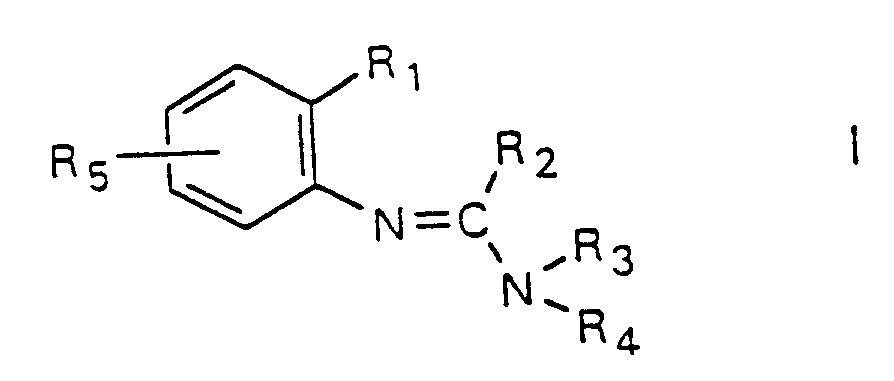
R₁ est un groupe phényle facultativement substitué par un radical halogéno, alkyle ayant 1 à 3 atomes de carbone, alkoxy ayant 1 à 3 atomes de carbone, alcanoyle ayant 2 à 4 atomes de carbone, ou un groupe de formule S(O)nR₈ dans laquelle n a la valeur 0 ou 1 et R₈ est un groupe alkyle ayant 1 à 3 atomes de carbone ;
R₂ est un groupe de formule II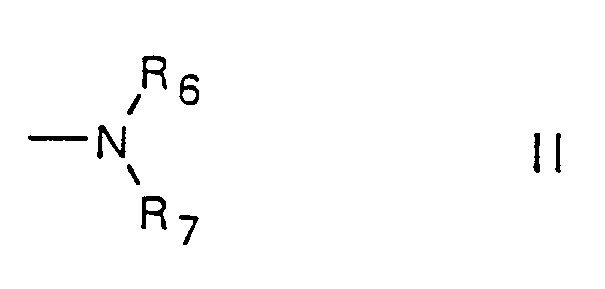
R₃ est de l'hydrogène ou un groupe aliphatique à chaîne droite ou ramifiée ayant 1 à 4 atomes de carbone ;
R₄ représente (a) un atome d'hydrogène, (b) un groupe aliphatique à chaîne droite ou ramifiée ayant 1 à 6 atomes de carbone, facultativement substitué par un radical hydroxy ou un dérivé acylé correspondant, par un groupe alkoxy contenant 1 à 3 atomes de carbone, par un groupe alkylthio contenant 1 à 3 atomes de carbone, par un groupe amino facultativement alkylé, par un groupe carbocyclique contenant 3 à 7 atomes de carbone, par un groupe pyridyle ou par un groupe cyano, (c) un noyau carbocyclique contenant 3 à 7 atomes de carbone et facultativement substitué par un radical hydroxy, sous réserve que R₃, R₄, R₆ et R₇ ne soient pas tous des groupes méthyle lorsque R₁ est un groupe phényle ;
ou bien le groupe R₂ et le groupe R₃ forment, conjointement avec les atomes de carbone et d'azote auxquels ils sont attachés, un noyau hétérocyclique de formule IV
ou bien R₃ et R₄ forment, conjointement avec l'atome d'azote auquel ils sont attachés, un noyau hétérocyclique de formule V
R₅ représente de l'hydrogène ou un ou plusieurs substituants facultatifs choisis entre des radicaux halogéno, des groupes alkyle contenant 1 à 4 atomes de carbone, des groupes alkoxy contenant 1 à 3 atomes de carbone, le groupe trifluorométhyle ou des groupes de formule S(O)mR₈ dans laquelle m a la valeur 0, 1 ou 2 et R₈ est un groupe alkyle contenant 1 à 3 atomes de carbone ;
ledit procédé comprenant, comme étapesA) la réaction d'un composé aminophénylique de formule VI B) la réaction d'un composé aminophénylique de formule VI (facultativement sous la forme d'un sel) avec un composé cyano de formule R₂CN pour former des composés de formule I dans laquelle NR₃R₄ est un groupe NH₂,C) la réaction d'un composé aminophénylique de formule VI (facultativement sous la forme d'un sel) avec un composé de cyanamide de formule R₃R₄NCN pour produire des composés de formule I dans laquelle R₂ est un groupe NH₂,D) la réaction d'un composé de formule XIV
 E) dans des composés de formule I dans laquelle R₆ est un groupe alkyle, la réaction d'un composé de formule XII

- Utilisation de composés de formule I suivant l'une quelconque des revendications 1 à 10 dans le traitement du diabète.
- Utilisation de composés de formule I suivant l'une quelconque des revendications 1 à 10 dans le traitement de l'hyperglycémie.
- Utilisation de composés de formule I suivant l'une quelconque des revendications 1 à 10 dans la préparation d'un médicament destiné au traitement du diabète.
- Utilisation de composés de formule I suivant l'une quelconque des revendications 1 à 10 dans la préparation d'un médicament destiné au traitement de l'hyperglycémie.
- Composé suivant la revendication 1, choisi entre :
la N-(2-biphénylyl)-4-hydroxypipéridine-1-carboxamidine
la N-(4'-fluoro-2-biphénylyl)-4-hydroxypipéridine-1-carboxamidine
la N-(5-fluoro-2-biphénylyl)-4-hydroxypipéridine-1-carboxamidine.
Applications Claiming Priority (4)
| Application Number | Priority Date | Filing Date | Title |
|---|---|---|---|
| IN126BO1990 IN172842B (fr) | 1990-05-17 | 1990-05-17 | |
| GB9014456 | 1990-06-28 | ||
| GB909014456A GB9014456D0 (en) | 1990-06-28 | 1990-06-28 | Therapeutic agents |
| PCT/EP1991/000911 WO1992000273A1 (fr) | 1990-05-17 | 1991-05-15 | Derives orthosubstitues d'amidine de diphenyle et de guanidine de diphenyle, et agents antidiabetiques ou hypoglycemiants les contenant |
Publications (2)
| Publication Number | Publication Date |
|---|---|
| EP0536151A1 EP0536151A1 (fr) | 1993-04-14 |
| EP0536151B1 true EP0536151B1 (fr) | 1994-09-14 |
Family
ID=26297257
Family Applications (1)
| Application Number | Title | Priority Date | Filing Date |
|---|---|---|---|
| EP91909161A Expired - Lifetime EP0536151B1 (fr) | 1990-05-17 | 1991-05-15 | Derives orthosubstitues de guanidine de diphenyle, et agents antidiabetiques ou hypoglycemiants les contenant |
Country Status (27)
| Country | Link |
|---|---|
| US (1) | US5302720A (fr) |
| EP (1) | EP0536151B1 (fr) |
| JP (1) | JPH089589B2 (fr) |
| KR (1) | KR920005714A (fr) |
| CN (1) | CN1028521C (fr) |
| AT (1) | ATE111445T1 (fr) |
| AU (1) | AU637695B2 (fr) |
| BG (1) | BG61260B1 (fr) |
| CA (1) | CA2041846A1 (fr) |
| CZ (1) | CZ280182B6 (fr) |
| DE (1) | DE69104041T4 (fr) |
| DK (1) | DK0536151T3 (fr) |
| ES (1) | ES2064103T3 (fr) |
| FI (1) | FI95566C (fr) |
| GB (1) | GB2244486B (fr) |
| HR (1) | HRP930699A2 (fr) |
| HU (1) | HU210200B (fr) |
| IE (1) | IE64485B1 (fr) |
| IL (1) | IL98029A (fr) |
| IN (1) | IN172842B (fr) |
| MX (1) | MX25770A (fr) |
| NO (1) | NO179204C (fr) |
| NZ (1) | NZ238119A (fr) |
| PL (1) | PL167657B1 (fr) |
| PT (1) | PT97700B (fr) |
| RU (1) | RU2099323C1 (fr) |
| WO (1) | WO1992000273A1 (fr) |
Families Citing this family (20)
| Publication number | Priority date | Publication date | Assignee | Title |
|---|---|---|---|---|
| CA2089261A1 (fr) * | 1990-08-30 | 1992-03-01 | John F.W. Keana | Amidines substituees a fort pouvoir liant avec le recepteur sigma |
| US5298657A (en) * | 1992-03-20 | 1994-03-29 | Cambridge Neuroscience Inc. | Preparation of substituted guanidines |
| EP0690851B1 (fr) * | 1993-03-23 | 1999-05-19 | Astra Aktiebolag | Derives de guanidine efficaces en therapeutique |
| US5512596A (en) * | 1994-09-02 | 1996-04-30 | Gilead Sciences, Inc. | Aromatic compounds |
| WO1996017612A1 (fr) * | 1994-12-08 | 1996-06-13 | Knoll Aktiengesellschaft | Utilisation de composes de phenylamidine et de phenylguanidine substitues dans le traitement de l'ischemie cerebrale et cardiaque, des convulsions et de la drepanocytose |
| DE69708198T2 (de) * | 1996-04-30 | 2002-03-28 | Pfizer Inc., New York | Muscarinische Rezeptor-Agonisten |
| US6756389B2 (en) * | 1996-08-09 | 2004-06-29 | Cambridge Neuroscience, Inc. | Pharmaceutically active compounds and methods of use |
| KR19990017013A (ko) * | 1997-08-20 | 1999-03-15 | 윤종용 | 가변단속주기의 오디오신호 발생장치 |
| DE19737463A1 (de) * | 1997-08-28 | 1999-03-04 | Hoechst Marion Roussel De Gmbh | Verwendung von Inhibitoren des Natrium-Wasserstoff-Austauschers zur Herstellung eines Arzneimittels zur Behandlung von Erkrankungen, die durch Protozoen verursacht werden |
| EP1083822A4 (fr) | 1998-06-11 | 2005-10-12 | S P O Medical Equipment Ltd | Dispositif de detection de stress physiologique et procede correspondant |
| HUP0301189A3 (en) | 2000-07-24 | 2003-11-28 | Bayer Cropscience Ag | Pyrazolyl biphenyl carboxamides, intermediates, preparation and use thereof for controlling undesired microorganisms |
| AU2001278480A1 (en) * | 2000-07-24 | 2002-02-05 | Bayer Crop Science Ag | Biphenyl carboxamides |
| DE10258314A1 (de) * | 2002-12-13 | 2004-06-24 | Bayer Cropscience Ag | Biphenyloximether |
| PE20070182A1 (es) * | 2005-07-29 | 2007-03-06 | Wyeth Corp | Derivados cianopirrol-fenil amida como moduladores del receptor de progesterona |
| PE20070341A1 (es) * | 2005-07-29 | 2007-04-13 | Wyeth Corp | Derivados de pirrol como moduladores del receptor de progesterona |
| CA2619059A1 (fr) | 2005-09-13 | 2007-03-22 | Bayer Cropscience Ag | Derives de phenylamidine pesticides thiazolyloxy substitues |
| CN104945287B (zh) * | 2015-06-12 | 2017-06-13 | 苏州大学张家港工业技术研究院 | 一种脒的磺酸内盐化合物的合成方法 |
| AR101498A1 (es) * | 2015-08-11 | 2016-12-21 | Chemo Res S L | Procedimiento para la preparación del compuesto n-(3,5-dimetilfenil)-n-(2-trifluorometilfenil)guanidina y su forma cristalina a |
| GB201809295D0 (en) | 2018-06-06 | 2018-07-25 | Institute Of Cancer Res Royal Cancer Hospital | Lox inhibitors |
| GB201818750D0 (en) | 2018-11-16 | 2019-01-02 | Institute Of Cancer Res Royal Cancer Hospital | Lox inhibitors |
Family Cites Families (31)
| Publication number | Priority date | Publication date | Assignee | Title |
|---|---|---|---|---|
| US1850682A (en) * | 1927-01-10 | 1932-03-22 | Ig Farbenindustrie Ag | Substituted guanidines |
| GB614072A (en) * | 1946-07-01 | 1948-12-09 | Boots Pure Drug Co Ltd | Manufacture of phenanthridine compounds |
| BE639393A (fr) * | 1962-10-30 | |||
| US3252982A (en) * | 1963-10-16 | 1966-05-24 | Ciba Geigy Corp | Benzhydryl compounds |
| US3669974A (en) * | 1971-03-25 | 1972-06-13 | Usv Pharma Corp | N,n1-disubstituted benzamidines |
| BE788767A (fr) * | 1971-09-13 | 1973-01-02 | Richardson Merrell Inc | Compositions hypoglycemiques contenant des derives de benzhydryllactamimide |
| FR2223361B1 (fr) * | 1973-03-27 | 1977-04-29 | Philagro Sa | |
| DE2417669A1 (de) * | 1974-04-11 | 1975-10-16 | Hoechst Ag | Verfahren zur herstellung von n(halogenaryl)-n',n'-dialkylamidinen |
| US4061746A (en) * | 1976-04-23 | 1977-12-06 | Richardson-Merrell Inc. | Lactamimide inhibitors of gastrointestinal hypersecretion |
| JPS604829B2 (ja) * | 1977-03-28 | 1985-02-06 | 日本曹達株式会社 | イミダゾール誘導体、その製造方法及び農園芸用殺菌剤 |
| US4101659A (en) * | 1977-08-29 | 1978-07-18 | Mcneil Laboratories, Incorporated | Benzhydryl guanidines |
| US4414211A (en) * | 1978-09-18 | 1983-11-08 | Mcneilab, Inc. | Heterocyclic derivatives of guanidine |
| NL7810350A (nl) * | 1978-10-16 | 1980-04-18 | Duphar Int Res | Preparaat met groeiregulerende werking en gebruik van dit preparaat in land- en tuinbouw. |
| ZA801680B (en) * | 1979-04-03 | 1981-03-25 | Fujisawa Pharmaceutical Co | 2-imidazoline derivatives,process for the preparation thereof and the pharmaceutical composition of the same |
| AU538963B2 (en) * | 1979-07-09 | 1984-09-06 | Seth Thomas Shaw Jr. | Drug for use with an iud |
| US4281004A (en) * | 1980-03-31 | 1981-07-28 | Pfizer Inc. | Phenylguanidine therapeutic agents |
| DE3108564A1 (de) * | 1981-03-06 | 1982-11-18 | Bayer Ag, 5090 Leverkusen | N-tert-butyl-phenyl-n'-cyclohexyl-quanidine, verfahren zu ihrer herstellung sowie ihre verwendung als fungizide |
| ATE19880T1 (de) * | 1981-08-24 | 1986-06-15 | Merck & Co Inc | Thiadiazole oxyde mit antisekretorischer wirkung. |
| DE3220828A1 (de) * | 1982-06-03 | 1983-12-08 | Hoechst Ag, 6230 Frankfurt | Bisamidin-derivate von dephenyl, verfahren zu ihrer herstellung und ihre verwendung als arzneimittel |
| IN158084B (fr) * | 1982-06-25 | 1986-08-30 | Council Scient Ind Res | |
| DE3343815A1 (de) * | 1983-12-03 | 1985-06-13 | Hoechst Ag, 6230 Frankfurt | Neue bisamidindiphenylderivate, ein verfahren zu ihrer herstellung und ihre verwendung als chemotherapeutika |
| US4680300A (en) * | 1985-01-10 | 1987-07-14 | Syntex (U.S.A.) Inc. | Anti-inflammatory guanidines |
| US4693850A (en) * | 1985-03-15 | 1987-09-15 | Mcneilab, Inc. | Methane sulfonic acid derivatives |
| US4781866A (en) * | 1985-03-15 | 1988-11-01 | Mcneilab, Inc. | Process for producing amidine sulfonic acid intermediates for guanidines |
| US4656270A (en) * | 1985-03-15 | 1987-04-07 | Mcneilab, Inc. | Process for producing guanidines such as linogliride |
| SG47583A1 (en) * | 1986-01-13 | 1998-04-17 | American Cyanamid Co | 4,5,6-Substituted-n- (substituted-phenyl) -2- pyrimidinamines |
| US4709094A (en) * | 1986-07-10 | 1987-11-24 | State Of Oregon, Acting By And Through The Oregon State Board Of Higher Education, Acting For And On Behalf Of The Oregon Health Sciences University And The University Of Oregon | Sigma brain receptor ligands and their use |
| IE62023B1 (en) * | 1989-01-02 | 1994-12-14 | Boots Co Plc | Therapeutic agents |
| GB8903592D0 (en) * | 1989-02-16 | 1989-04-05 | Boots Co Plc | Therapeutic agents |
| DE3922232A1 (de) * | 1989-07-06 | 1991-01-17 | Basf Ag | Fungizide guanidine |
| EP0418199A3 (en) * | 1989-09-13 | 1991-06-12 | Ciba-Geigy Ag | Guanidine derivatives |
-
1990
- 1990-05-17 IN IN126BO1990 patent/IN172842B/en unknown
-
1991
- 1991-04-29 IE IE143991A patent/IE64485B1/en not_active IP Right Cessation
- 1991-05-02 IL IL9802991A patent/IL98029A/en active IP Right Grant
- 1991-05-06 CA CA002041846A patent/CA2041846A1/fr not_active Abandoned
- 1991-05-07 AU AU76394/91A patent/AU637695B2/en not_active Ceased
- 1991-05-07 CZ CS911334A patent/CZ280182B6/cs not_active IP Right Cessation
- 1991-05-10 NZ NZ238119A patent/NZ238119A/en unknown
- 1991-05-13 GB GB9110306A patent/GB2244486B/en not_active Expired - Fee Related
- 1991-05-14 MX MX25770A patent/MX25770A/es unknown
- 1991-05-15 DE DE69104041A patent/DE69104041T4/de not_active Expired - Fee Related
- 1991-05-15 ES ES91909161T patent/ES2064103T3/es not_active Expired - Lifetime
- 1991-05-15 WO PCT/EP1991/000911 patent/WO1992000273A1/fr not_active Ceased
- 1991-05-15 PL PL91297374A patent/PL167657B1/pl unknown
- 1991-05-15 AT AT91909161T patent/ATE111445T1/de not_active IP Right Cessation
- 1991-05-15 JP JP3508950A patent/JPH089589B2/ja not_active Expired - Lifetime
- 1991-05-15 EP EP91909161A patent/EP0536151B1/fr not_active Expired - Lifetime
- 1991-05-15 KR KR1019910007829A patent/KR920005714A/ko not_active Ceased
- 1991-05-15 DK DK91909161.1T patent/DK0536151T3/da active
- 1991-05-15 RU RU9292016545A patent/RU2099323C1/ru active
- 1991-05-16 PT PT97700A patent/PT97700B/pt not_active IP Right Cessation
- 1991-05-16 HU HU911650A patent/HU210200B/hu not_active IP Right Cessation
- 1991-11-14 CN CN91110775A patent/CN1028521C/zh not_active Expired - Fee Related
-
1992
- 1992-06-17 US US07/899,939 patent/US5302720A/en not_active Expired - Fee Related
- 1992-12-10 NO NO924783A patent/NO179204C/no unknown
- 1992-12-22 BG BG97221A patent/BG61260B1/bg unknown
- 1992-12-23 FI FI925871A patent/FI95566C/fi active
-
1993
- 1993-04-02 HR HR930699A patent/HRP930699A2/hr not_active Application Discontinuation
Also Published As
Similar Documents
| Publication | Publication Date | Title |
|---|---|---|
| US5302720A (en) | Biphenyl-substituted guanidine derivatives useful as hypoglycaemic agents | |
| RU2114114C1 (ru) | Пиразолопиримидиноновые соединения, фармацевтическая композиция и способ лечения | |
| CZ280642B6 (cs) | Fenylacetylové deriváty /4-amino-2,6-dimethylfenylsulfonyl/nitromethanu, způsob jejich přípravy a farmaceutické kompozice, které je obsahují | |
| HU208111B (en) | Process for producing phenol derivatives and pharmaceutical compositions comprising such compounds | |
| EP0385038B1 (fr) | Dérivés ortho-substitués de phénylamidine et phénylguanidine, et agents antidiabétiques ou hypoglycémiques les contenant | |
| US4895840A (en) | N-(aryl-,aryloxy-,arylthio-arylsulfinyl-and arylsulfonyl-)alkyl-N,N'-(or n'n')alkylaminoalkyl ureas and cyanoguanidines | |
| KR0168398B1 (ko) | 당뇨병 및 과혈당증 치료제로 유용한 화합물 및 이의 제조방법 | |
| US4018830A (en) | Phenylthioaralkylamines | |
| US4724235A (en) | N-(arylthioalkyl)-N'-(aminoalkyl)ureas useful in the treatment of arrhythmia | |
| US4597902A (en) | N-(arylthioalkyl)-N'-(aminoalkyl)ureas | |
| HRP930669A2 (en) | Transdermal terapheutic system with physostigmin as an active substance | |
| EP0066415B1 (fr) | N-(arylthioalkyl)-N'(aminoalkyl)urées | |
| US5240918A (en) | 2-(substituted imino)-thiazolidines and process for the preparation thereof | |
| RO111764B1 (ro) | Derivati de bifenilguanidina orto-substituiti, procedee pentru prepararea acestora, compozitii farmaceutice si metoda de utilizare | |
| US5041462A (en) | Novel substituted acetamide compounds and use as anti-allergic agents | |
| SI8912485A (sl) | Nova hipoglikemična sredstva in postopek za njihovo pripravo | |
| MXPA99010183A (en) | Substituted 3,3-diamino-2-propenenitriles, their preparation and use |
Legal Events
| Date | Code | Title | Description |
|---|---|---|---|
| PUAI | Public reference made under article 153(3) epc to a published international application that has entered the european phase |
Free format text: ORIGINAL CODE: 0009012 |
|
| 17P | Request for examination filed |
Effective date: 19921201 |
|
| AK | Designated contracting states |
Kind code of ref document: A1 Designated state(s): AT BE CH DE DK ES FR GR IT LI LU NL SE |
|
| 17Q | First examination report despatched |
Effective date: 19931126 |
|
| GRAA | (expected) grant |
Free format text: ORIGINAL CODE: 0009210 |
|
| AK | Designated contracting states |
Kind code of ref document: B1 Designated state(s): AT BE CH DE DK ES FR GR IT LI LU NL SE |
|
| REF | Corresponds to: |
Ref document number: 111445 Country of ref document: AT Date of ref document: 19940915 Kind code of ref document: T |
|
| REF | Corresponds to: |
Ref document number: 69104041 Country of ref document: DE Date of ref document: 19941020 |
|
| ET | Fr: translation filed | ||
| ITF | It: translation for a ep patent filed | ||
| K2C2 | Correction of patent specification (partial reprint) published |
Effective date: 19940914 |
|
| REG | Reference to a national code |
Ref country code: ES Ref legal event code: FG2A Ref document number: 2064103 Country of ref document: ES Kind code of ref document: T3 |
|
| EAL | Se: european patent in force in sweden |
Ref document number: 91909161.1 |
|
| REG | Reference to a national code |
Ref country code: DK Ref legal event code: T3 |
|
| REG | Reference to a national code |
Ref country code: GR Ref legal event code: FG4A Free format text: 3014356 |
|
| PLBE | No opposition filed within time limit |
Free format text: ORIGINAL CODE: 0009261 |
|
| STAA | Information on the status of an ep patent application or granted ep patent |
Free format text: STATUS: NO OPPOSITION FILED WITHIN TIME LIMIT |
|
| 26N | No opposition filed | ||
| PGFP | Annual fee paid to national office [announced via postgrant information from national office to epo] |
Ref country code: SE Payment date: 19980427 Year of fee payment: 8 |
|
| PGFP | Annual fee paid to national office [announced via postgrant information from national office to epo] |
Ref country code: DK Payment date: 19980501 Year of fee payment: 8 |
|
| PGFP | Annual fee paid to national office [announced via postgrant information from national office to epo] |
Ref country code: CH Payment date: 19980505 Year of fee payment: 8 |
|
| PGFP | Annual fee paid to national office [announced via postgrant information from national office to epo] |
Ref country code: AT Payment date: 19980506 Year of fee payment: 8 |
|
| PGFP | Annual fee paid to national office [announced via postgrant information from national office to epo] |
Ref country code: BE Payment date: 19980512 Year of fee payment: 8 |
|
| PGFP | Annual fee paid to national office [announced via postgrant information from national office to epo] |
Ref country code: NL Payment date: 19980518 Year of fee payment: 8 |
|
| PGFP | Annual fee paid to national office [announced via postgrant information from national office to epo] |
Ref country code: ES Payment date: 19980519 Year of fee payment: 8 |
|
| PGFP | Annual fee paid to national office [announced via postgrant information from national office to epo] |
Ref country code: LU Payment date: 19980611 Year of fee payment: 8 |
|
| PGFP | Annual fee paid to national office [announced via postgrant information from national office to epo] |
Ref country code: GR Payment date: 19990430 Year of fee payment: 9 |
|
| PG25 | Lapsed in a contracting state [announced via postgrant information from national office to epo] |
Ref country code: LU Free format text: LAPSE BECAUSE OF NON-PAYMENT OF DUE FEES Effective date: 19990515 Ref country code: AT Free format text: LAPSE BECAUSE OF NON-PAYMENT OF DUE FEES Effective date: 19990515 |
|
| PG25 | Lapsed in a contracting state [announced via postgrant information from national office to epo] |
Ref country code: SE Free format text: LAPSE BECAUSE OF NON-PAYMENT OF DUE FEES Effective date: 19990516 |
|
| PG25 | Lapsed in a contracting state [announced via postgrant information from national office to epo] |
Ref country code: ES Free format text: THE PATENT HAS BEEN ANNULLED BY A DECISION OF A NATIONAL AUTHORITY Effective date: 19990517 |
|
| PG25 | Lapsed in a contracting state [announced via postgrant information from national office to epo] |
Ref country code: LI Free format text: LAPSE BECAUSE OF NON-PAYMENT OF DUE FEES Effective date: 19990531 Ref country code: DK Free format text: LAPSE BECAUSE OF NON-PAYMENT OF DUE FEES Effective date: 19990531 Ref country code: CH Free format text: LAPSE BECAUSE OF NON-PAYMENT OF DUE FEES Effective date: 19990531 Ref country code: BE Free format text: LAPSE BECAUSE OF NON-PAYMENT OF DUE FEES Effective date: 19990531 |
|
| BERE | Be: lapsed |
Owner name: THE BOOTS CY P.L.C. Effective date: 19990531 |
|
| PG25 | Lapsed in a contracting state [announced via postgrant information from national office to epo] |
Ref country code: NL Free format text: LAPSE BECAUSE OF NON-PAYMENT OF DUE FEES Effective date: 19991201 |
|
| REG | Reference to a national code |
Ref country code: CH Ref legal event code: PL |
|
| EUG | Se: european patent has lapsed |
Ref document number: 91909161.1 |
|
| NLV4 | Nl: lapsed or anulled due to non-payment of the annual fee |
Effective date: 19991201 |
|
| REG | Reference to a national code |
Ref country code: DK Ref legal event code: EBP |
|
| PG25 | Lapsed in a contracting state [announced via postgrant information from national office to epo] |
Ref country code: GR Free format text: LAPSE BECAUSE OF NON-PAYMENT OF DUE FEES Effective date: 20000531 |
|
| REG | Reference to a national code |
Ref country code: ES Ref legal event code: FD2A Effective date: 20020204 |
|
| PGFP | Annual fee paid to national office [announced via postgrant information from national office to epo] |
Ref country code: FR Payment date: 20020503 Year of fee payment: 12 |
|
| PGFP | Annual fee paid to national office [announced via postgrant information from national office to epo] |
Ref country code: DE Payment date: 20020531 Year of fee payment: 12 |
|
| PG25 | Lapsed in a contracting state [announced via postgrant information from national office to epo] |
Ref country code: DE Free format text: LAPSE BECAUSE OF NON-PAYMENT OF DUE FEES Effective date: 20031202 |
|
| PG25 | Lapsed in a contracting state [announced via postgrant information from national office to epo] |
Ref country code: FR Free format text: LAPSE BECAUSE OF NON-PAYMENT OF DUE FEES Effective date: 20040130 |
|
| REG | Reference to a national code |
Ref country code: FR Ref legal event code: ST |
|
| PG25 | Lapsed in a contracting state [announced via postgrant information from national office to epo] |
Ref country code: IT Free format text: LAPSE BECAUSE OF NON-PAYMENT OF DUE FEES;WARNING: LAPSES OF ITALIAN PATENTS WITH EFFECTIVE DATE BEFORE 2007 MAY HAVE OCCURRED AT ANY TIME BEFORE 2007. THE CORRECT EFFECTIVE DATE MAY BE DIFFERENT FROM THE ONE RECORDED. Effective date: 20050515 |