EP0536729A1 - Matériau supraconducteur de type oxide - Google Patents
Matériau supraconducteur de type oxide Download PDFInfo
- Publication number
- EP0536729A1 EP0536729A1 EP92117135A EP92117135A EP0536729A1 EP 0536729 A1 EP0536729 A1 EP 0536729A1 EP 92117135 A EP92117135 A EP 92117135A EP 92117135 A EP92117135 A EP 92117135A EP 0536729 A1 EP0536729 A1 EP 0536729A1
- Authority
- EP
- European Patent Office
- Prior art keywords
- magnetic field
- superconducting material
- oxide superconducting
- superconducting
- bi2sr2ca
- Prior art date
- Legal status (The legal status is an assumption and is not a legal conclusion. Google has not performed a legal analysis and makes no representation as to the accuracy of the status listed.)
- Withdrawn
Links
Images
Classifications
-
- C—CHEMISTRY; METALLURGY
- C04—CEMENTS; CONCRETE; ARTIFICIAL STONE; CERAMICS; REFRACTORIES
- C04B—LIME, MAGNESIA; SLAG; CEMENTS; COMPOSITIONS THEREOF, e.g. MORTARS, CONCRETE OR LIKE BUILDING MATERIALS; ARTIFICIAL STONE; CERAMICS; REFRACTORIES; TREATMENT OF NATURAL STONE
- C04B35/00—Shaped ceramic products characterised by their composition; Ceramics compositions; Processing powders of inorganic compounds preparatory to the manufacturing of ceramic products
- C04B35/01—Shaped ceramic products characterised by their composition; Ceramics compositions; Processing powders of inorganic compounds preparatory to the manufacturing of ceramic products based on oxide ceramics
- C04B35/45—Shaped ceramic products characterised by their composition; Ceramics compositions; Processing powders of inorganic compounds preparatory to the manufacturing of ceramic products based on oxide ceramics based on copper oxide or solid solutions thereof with other oxides
- C04B35/4521—Shaped ceramic products characterised by their composition; Ceramics compositions; Processing powders of inorganic compounds preparatory to the manufacturing of ceramic products based on oxide ceramics based on copper oxide or solid solutions thereof with other oxides containing bismuth oxide
-
- C—CHEMISTRY; METALLURGY
- C01—INORGANIC CHEMISTRY
- C01G—COMPOUNDS CONTAINING METALS NOT COVERED BY SUBCLASSES C01D OR C01F
- C01G29/00—Compounds of bismuth
- C01G29/006—Compounds containing bismuth, with or without oxygen or hydrogen, and containing two or more other elements
-
- C—CHEMISTRY; METALLURGY
- C04—CEMENTS; CONCRETE; ARTIFICIAL STONE; CERAMICS; REFRACTORIES
- C04B—LIME, MAGNESIA; SLAG; CEMENTS; COMPOSITIONS THEREOF, e.g. MORTARS, CONCRETE OR LIKE BUILDING MATERIALS; ARTIFICIAL STONE; CERAMICS; REFRACTORIES; TREATMENT OF NATURAL STONE
- C04B35/00—Shaped ceramic products characterised by their composition; Ceramics compositions; Processing powders of inorganic compounds preparatory to the manufacturing of ceramic products
- C04B35/01—Shaped ceramic products characterised by their composition; Ceramics compositions; Processing powders of inorganic compounds preparatory to the manufacturing of ceramic products based on oxide ceramics
- C04B35/45—Shaped ceramic products characterised by their composition; Ceramics compositions; Processing powders of inorganic compounds preparatory to the manufacturing of ceramic products based on oxide ceramics based on copper oxide or solid solutions thereof with other oxides
- C04B35/4512—Shaped ceramic products characterised by their composition; Ceramics compositions; Processing powders of inorganic compounds preparatory to the manufacturing of ceramic products based on oxide ceramics based on copper oxide or solid solutions thereof with other oxides containing thallium oxide
-
- H—ELECTRICITY
- H10—SEMICONDUCTOR DEVICES; ELECTRIC SOLID-STATE DEVICES NOT OTHERWISE PROVIDED FOR
- H10N—ELECTRIC SOLID-STATE DEVICES NOT OTHERWISE PROVIDED FOR
- H10N60/00—Superconducting devices
- H10N60/80—Constructional details
- H10N60/85—Superconducting active materials
- H10N60/855—Ceramic superconductors
- H10N60/857—Ceramic superconductors comprising copper oxide
-
- C—CHEMISTRY; METALLURGY
- C01—INORGANIC CHEMISTRY
- C01P—INDEXING SCHEME RELATING TO STRUCTURAL AND PHYSICAL ASPECTS OF SOLID INORGANIC COMPOUNDS
- C01P2002/00—Crystal-structural characteristics
- C01P2002/50—Solid solutions
-
- C—CHEMISTRY; METALLURGY
- C01—INORGANIC CHEMISTRY
- C01P—INDEXING SCHEME RELATING TO STRUCTURAL AND PHYSICAL ASPECTS OF SOLID INORGANIC COMPOUNDS
- C01P2006/00—Physical properties of inorganic compounds
- C01P2006/32—Thermal properties
-
- C—CHEMISTRY; METALLURGY
- C01—INORGANIC CHEMISTRY
- C01P—INDEXING SCHEME RELATING TO STRUCTURAL AND PHYSICAL ASPECTS OF SOLID INORGANIC COMPOUNDS
- C01P2006/00—Physical properties of inorganic compounds
- C01P2006/40—Electric properties
-
- C—CHEMISTRY; METALLURGY
- C01—INORGANIC CHEMISTRY
- C01P—INDEXING SCHEME RELATING TO STRUCTURAL AND PHYSICAL ASPECTS OF SOLID INORGANIC COMPOUNDS
- C01P2006/00—Physical properties of inorganic compounds
- C01P2006/42—Magnetic properties
Definitions
- the present invention relates to an oxide superconducting material of Bi2(Sr, Ca)3CU2O q which is used in a higher magnetic field primarily including superconducting magnets.
- oxide superconducting materials Due to not only the higher critical temperature (Tc) but also the critical magnetic field (Bc2) and critical current density (Jc) both essentially high enough, oxide superconducting materials have been expected of their application to the wire materials (coil materials) for superconducting magnets, power lead (a component to connect a superconducting magnet with a power supply) and the like. For such utilities, a higher Jc is demanded at a higher magnetic field for long-size and large-area superconducting materials in their entirety.
- polycrystalline oxide superconducting materials have problems in that the Jc which can flow in its entire sample is low and the dependency thereof on magnetic field and temperature is great (Jc rapidly decreases as magnetic field and temperature get higher). This is because (1) the Jc which can pass through the crystalline particles in the entire sample (Jc inter ) is far lower than the Jc which can flow within the crystalline particles (Jc intra ) (weak bonding) and (2) the pinning strength for a magnetic flux quantized in the samples, via the heterogeneous points (pinning center) inside the crystalline particles, is weak (weak pinning strength) which strength determines the Jc in a higher magnetic field.
- the technique to disperse non-superconducting deposits such as Y2BaCuO5 and the like within the crystal particles has been developed through the improvement of melting process, so that the problem of weak pinning strength is greatly improved to achieve a sufficiently high Jc intra at the temperature of liquid nitrogen (77 K) and in a magnetic field of several T(tesla)s.
- the dispersion technique of non-superconducting deposits has an action rather to deteriorate (lower) Jc inter from the respect of the problem of weak bonding. This would be because the non-superconducting particles also deposits at the border of the crystalline particles.
- the atomic ratio of Sr and Ca in 2212 phase is not limited to 2:1, and it has been known that a pure phase can be generated up to 1:1.
- the representation as Bi2(Sr, Ca)3Cu2O q is also possible.
- oxide superconducting materials have higher Tc, the possibility of the application at a higher temperature has been under investigation. If such application is possible under cooling in liquid nitrogen (20 K), not only the cooling cost can be cut but also the reliability of the cooling system is also improved remarkably.
- tape-shaped materials of Bi 2212 phase having excellent Jc property at 4.2 K exhibit more dependencies from of magnetic field and temperature at a temperature higher than 20 K.
- the anisotropy to the direction of magnetic field also becomes greater under this temperature. This is due to the weak pinning strength described above.
- the present invention has been made so as to solve such problems and to provide an oxide superconducting material applicable at a higher temperature and a higher magnetic field.
- the oxide superconducting material of the present invention is the one represented by the following general formula (1): Bi2Sr 2-x La x Ca 1-y M y Cu2O q (1) (wherein M is at least one of rare earth metals except for Sc, La, Ce and Pr; 0.1 ⁇ x + y ⁇ 0.4 and x ⁇ 0, y ⁇ 0; 8.1 ⁇ q ⁇ 8.4 .
- the pinning strength of Bi 2212 superconducting material is enhanced so that the desired superconducting material can be achieved.
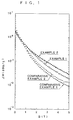
- Fig. 1 is a graph depicting the dependency of magnetization hysteresis ( ⁇ M) of an oxide superconducting material on magnetic field (B) at 20 K according to one embodiment of the present invention.
- the process consisting of press molding, calcination and grinding was repeated three times.
- the resulting calcined powder was molded at a pressure of 1,000 kgf/cm2, and sintered in air at 860°C for 30 hours.
- the structure of the resulting sintered product was analyzed by powder X-ray diffraction analysis and the oxygen content was determined by a coulometric titration.
- Both of the critical temperature (the temperature wherein a diamagnetism is initiated; Tc on ) and the size of magnetization hysteresis ( ⁇ M) in proportion to average critical current density (Jc) were evaluated with SQUID (superconducting quantum interference device) magnetrometer, a device for measuring magnetization ratio.
- Fig. 1 is a characteristic chart depicting the magnetic field (B) dependency of magnetization hysteresis ( ⁇ M) of the four samples shown in Table 1, at 20 K. Comparing the data of the two samples without substitution (Comparative Examples 1 and 2), ⁇ M of Comparative Example 1 is higher at lower magnetic fields while the one of Comparative Example 2 is higher at higher magnetic fields.
- Comparative Example 1 has a higher carrier density and Comparative Example 2 has higher Tc, with the result that Comparative Example 2 has a higher critical magnetic field (Bc2).
- Bc2 critical magnetic field
- Examples 1 and 2 show almost no difference from the cases of no substitution for Sr and Ca (Comparative Examples 1 and 2) at lower magnetic fields.
- ⁇ M in Examples 1 and 2 does not decrease as much as Comparative Examples, because the decrease in Jc is small at higher magnetic fields. Therefore, the change in the oxygen content has almost no influence on the pinning property, so that it can be said that the partial substitution of trivalent metals for Sr or Ca site with trivalent metals improves the pinning strength.
- the magnetization property was improved by about two times ( ⁇ M[Air]/ ⁇ M[Comparative Example 2]>2).
- the rare earth metals having ionic radii smaller than that of Ca (1.12 angstroms) has higher magnetization property, and the effect on improving the property gets enhanced particularly at a higher magnetic field.
- the pinning strength of Bi 2212 phase can be enhanced, and thus, it is indicated that the critical current density and its dependency on temperature and magnetic field can be improved distinctively. It is thereby possible that conventional superconducting magnets designed to generate a magnetic field of e.g. 3.5 T at 20 K can be reconstructed to generate a magnetic field of about 5 T although they are of the same size. Furthermore, it is also possible that a superconducting magnet of the same size as that of a conventionally designed superconductive magnet to generate a magnetic field of 5 T at 15 K generates a magnetic field of 5 T at 20 K.
- a superconducting material which can be used at a higher temperature and at a higher magnetic field.
- an oxide superconducting material represented by the following general formula (1): Bi2Sr 2-x La x Ca 1-y M y Cu2O q (1) (wherein M is at least one of rare earth metals except Sc, La, Ce and Pr; 0.1 ⁇ x + y ⁇ 0.4 and x ⁇ 0, y ⁇ 0; 8.1 ⁇ q ⁇ 8.4).
- the superconducting material of the present invention is applicable at a higher temperature and at a higher magnetic field.
Landscapes
- Chemical & Material Sciences (AREA)
- Engineering & Computer Science (AREA)
- Ceramic Engineering (AREA)
- Organic Chemistry (AREA)
- Manufacturing & Machinery (AREA)
- Materials Engineering (AREA)
- Structural Engineering (AREA)
- Inorganic Compounds Of Heavy Metals (AREA)
- Inorganic Chemistry (AREA)
- Compositions Of Oxide Ceramics (AREA)
- Superconductors And Manufacturing Methods Therefor (AREA)
Applications Claiming Priority (2)
| Application Number | Priority Date | Filing Date | Title |
|---|---|---|---|
| JP3260145A JPH06219741A (ja) | 1991-10-08 | 1991-10-08 | 酸化物超電導材料 |
| JP260145/91 | 1991-10-08 |
Publications (1)
| Publication Number | Publication Date |
|---|---|
| EP0536729A1 true EP0536729A1 (fr) | 1993-04-14 |
Family
ID=17343936
Family Applications (1)
| Application Number | Title | Priority Date | Filing Date |
|---|---|---|---|
| EP92117135A Withdrawn EP0536729A1 (fr) | 1991-10-08 | 1992-10-07 | Matériau supraconducteur de type oxide |
Country Status (2)
| Country | Link |
|---|---|
| EP (1) | EP0536729A1 (fr) |
| JP (1) | JPH06219741A (fr) |
-
1991
- 1991-10-08 JP JP3260145A patent/JPH06219741A/ja active Pending
-
1992
- 1992-10-07 EP EP92117135A patent/EP0536729A1/fr not_active Withdrawn
Non-Patent Citations (3)
| Title |
|---|
| APPL. PHYS. LETT. vol. 56, no. 5, 29 January 1990, pages 487 - 489 , XP000128481 P. SOMASUNDARAM ET AL. * |
| PHYSICA C vol. 171, no. 3-4, 1 November 1990, pages 315 - 320 R. YOSHIZAKI ET AL. * |
| SUPERCOND. SCI. TECHNOL. vol. 3, no. 5, May 1990, pages 242 - 248 C.N.R. RAO ET AL. * |
Also Published As
| Publication number | Publication date |
|---|---|
| JPH06219741A (ja) | 1994-08-09 |
Similar Documents
| Publication | Publication Date | Title |
|---|---|---|
| DE3855371T2 (de) | Auf neuen supraleitenden Materialien basierende Anordnungen und Systeme | |
| Lee et al. | Thermoelectric power and superconducting properties of Y 1 Ba 2 Cu 3 O 7− δ and R 1 Ba 2 Cu 3 O 7− δ | |
| Dihom et al. | Calcium-substituted Y3Ba5Cu8O18 ceramics synthesized via thermal treatment method: structural and superconducting properties | |
| US8688181B1 (en) | Superconductive compounds having high transition temperature, and methods for their use and preparation | |
| Iyo et al. | High-pressure synthesis and properties of Ba2Can− 1CunO2n (O, F) 2 (n= 2–5) superconductors | |
| EP0356722A1 (fr) | Oxyde supraconducteur et méthode de fabrication | |
| EP0536730A1 (fr) | Matériau en oxide supraconducteur et procédé de fabrication | |
| EP0558160B1 (fr) | Procédé pour préparation d'un monocristal d'oxyde supraconducteur | |
| EP0760354B1 (fr) | Matériau en oxide métallique | |
| DE69120840T2 (de) | Supraleiter auf Thalliumbasis substituiert durch seltene Erden | |
| DE69224064T2 (de) | Verfahren zur herstellung von formkörpern aus hochtemperatursupraleitern mit hohen kritischen stromdichten | |
| EP0483858B1 (fr) | Oxydes de cuivre en couches | |
| US5502029A (en) | Laminated super conductor oxide with strontium, calcium, copper and at least one of thallium, lead, and bismuth | |
| EP0536729A1 (fr) | Matériau supraconducteur de type oxide | |
| JPH02196020A (ja) | 酸化物超伝導性素材及びその製造法 | |
| Yang et al. | Structural transformation and magnetic properties of Sr-doped Gd2CuO4 | |
| US5407908A (en) | Method of manufacturing an oxide superconductor | |
| Ohshima et al. | Structural Magnetic and Superconducting Properties of the Ba1-x Eu x CuO3-y Compounds | |
| Kawano et al. | Superconducting properties of Bi2 (LaxLn1− x) yCa3− yCu2Oz (Ln= Y, Ce, Pr, Nd, Sm, Eu, Gd, Tb, Dy, Ho, Er and Tm) | |
| JP3291628B2 (ja) | 希土置換タリウム基超伝導体 | |
| JP3283909B2 (ja) | 金属酸化物材料及びその製造方法 | |
| JP2749194B2 (ja) | Bi−Sr−Ca−Cu−O系超電導体の製法 | |
| Chen et al. | Superconductivity and magnetic properties in Pr0. 2Yb0. 8− xLaxBa2Cu3O7− δ: The effect of ionic radii on hybridization | |
| JPH01208319A (ja) | 酸化物超伝導材料 | |
| Sheen et al. | Superconductivity at 63 K in YS r 2.2 C u 2.6 F e 0.25 O y |
Legal Events
| Date | Code | Title | Description |
|---|---|---|---|
| PUAI | Public reference made under article 153(3) epc to a published international application that has entered the european phase |
Free format text: ORIGINAL CODE: 0009012 |
|
| AK | Designated contracting states |
Kind code of ref document: A1 Designated state(s): DE FR GB |
|
| 17P | Request for examination filed |
Effective date: 19930428 |
|
| 17Q | First examination report despatched |
Effective date: 19930812 |
|
| 18D | Application deemed to be withdrawn |
Effective date: 19980501 |