EP0536760B1 - Selbstausdehnendes Lager - Google Patents
Selbstausdehnendes Lager Download PDFInfo
- Publication number
- EP0536760B1 EP0536760B1 EP92117226A EP92117226A EP0536760B1 EP 0536760 B1 EP0536760 B1 EP 0536760B1 EP 92117226 A EP92117226 A EP 92117226A EP 92117226 A EP92117226 A EP 92117226A EP 0536760 B1 EP0536760 B1 EP 0536760B1
- Authority
- EP
- European Patent Office
- Prior art keywords
- liquid chamber
- pressure
- vibration
- casing
- main liquid
- Prior art date
- Legal status (The legal status is an assumption and is not a legal conclusion. Google has not performed a legal analysis and makes no representation as to the accuracy of the status listed.)
- Expired - Lifetime
Links
Images




Classifications
-
- F—MECHANICAL ENGINEERING; LIGHTING; HEATING; WEAPONS; BLASTING
- F16—ENGINEERING ELEMENTS AND UNITS; GENERAL MEASURES FOR PRODUCING AND MAINTAINING EFFECTIVE FUNCTIONING OF MACHINES OR INSTALLATIONS; THERMAL INSULATION IN GENERAL
- F16F—SPRINGS; SHOCK-ABSORBERS; MEANS FOR DAMPING VIBRATION
- F16F13/00—Units comprising springs of the non-fluid type as well as vibration-dampers, shock-absorbers, or fluid springs
- F16F13/04—Units comprising springs of the non-fluid type as well as vibration-dampers, shock-absorbers, or fluid springs comprising both a plastics spring and a damper, e.g. a friction damper
- F16F13/26—Units comprising springs of the non-fluid type as well as vibration-dampers, shock-absorbers, or fluid springs comprising both a plastics spring and a damper, e.g. a friction damper characterised by adjusting or regulating devices responsive to exterior conditions
- F16F13/264—Units comprising springs of the non-fluid type as well as vibration-dampers, shock-absorbers, or fluid springs comprising both a plastics spring and a damper, e.g. a friction damper characterised by adjusting or regulating devices responsive to exterior conditions comprising means for acting dynamically on the walls bounding a working chamber
-
- F—MECHANICAL ENGINEERING; LIGHTING; HEATING; WEAPONS; BLASTING
- F16—ENGINEERING ELEMENTS AND UNITS; GENERAL MEASURES FOR PRODUCING AND MAINTAINING EFFECTIVE FUNCTIONING OF MACHINES OR INSTALLATIONS; THERMAL INSULATION IN GENERAL
- F16F—SPRINGS; SHOCK-ABSORBERS; MEANS FOR DAMPING VIBRATION
- F16F13/00—Units comprising springs of the non-fluid type as well as vibration-dampers, shock-absorbers, or fluid springs
- F16F13/04—Units comprising springs of the non-fluid type as well as vibration-dampers, shock-absorbers, or fluid springs comprising both a plastics spring and a damper, e.g. a friction damper
- F16F13/06—Units comprising springs of the non-fluid type as well as vibration-dampers, shock-absorbers, or fluid springs comprising both a plastics spring and a damper, e.g. a friction damper the damper being a fluid damper, e.g. the plastics spring not forming a part of the wall of the fluid chamber of the damper
- F16F13/22—Units comprising springs of the non-fluid type as well as vibration-dampers, shock-absorbers, or fluid springs comprising both a plastics spring and a damper, e.g. a friction damper the damper being a fluid damper, e.g. the plastics spring not forming a part of the wall of the fluid chamber of the damper characterised by comprising also a dynamic damper
Definitions
- the invention relates to a self-expanding mount for controlling transmission of vibration of a vibration source to a base, including a resilient member fixed to one of said vibration source and said base, a casing fixed to the other of said vibration source and said base, a main liquid chamber defined between said resilient member and said casing and filled with liquid, liquid pressure changing means for changing pressure of said liquid within said main liquid chamber in response to a control signal corresponding to vibration of said vibration source, an auxiliary liquid chamber, and a communication passage having a restriction and connecting said auxiliary liquid chamber to said main liquid chamber, wherein a variation in pressure of said liquid is caused by said liquid pressure-changing means to cause contraction and expansion of said resilient member to thereby control the transmission of vibration of said vibration source to said base.
- US-A-4 650 170 dislcoses a vibration-proofing device which comprises a first and a second liquid chamber as main liquid chambers positioned between a housing main body secured to a power unit side and a frame body secured to a body side, and partly defined by first and second elastic members.
- the first liquid chamber communicates through an orifice with a third (auxiliary) liquid chamber partly defined by a diaphragm, and the second liquid chamber communicates through a hole with a fourth (auxiliary) liquid chamber partly defined by a bellow.
- the bellow penetrates the housing main body in a freely slidable manner, and is elastically deformed in response to vibrations of a vibrating element which is activated by means of a solenoid which is connected to a control circuit through a drive circuit to be controlled according to a crank angle of an engine. Liquid flows from the second liquid chamber to the fourth liquid chamber or vice versa whenever there occurs a pressure difference between these chambers making it difficult to accurately control slight vibrations.
- EP-A-0 163 162 discloses a hydraulically damped two-chamber engine mount or motor support, which comprises an upper chamber at a motor or engine side and a lower chamber which are separated from each other by an intermediate plate which has a throttling or restricting opening or orifice formed therein.
- the upper chamber is partly defined by a chamber wall formed of a rubber-elastic material, part of which forms an elastic rubber membrane with a central quenching mass which is surrounded by a coil.
- a permanent magnet is arranged opposite the coil.
- JP-A-60-8540 (& US-A-4 650 170) discloses a vibration-absorbing device comprising a fluid chamber provided between a vibrating body or engine and a vibrated body or a chassis of a vehicle, which is filled with fluid and adapted to expand and contract in response to vibration transmitted from the vibrating body.
- Pulsating pressure-generating means impart pulsating pressure to the fluid within the fluid chamber in opposite phase to a pulsation caused by a vibration transmitted from the vibrating body to thereby prevent transmission of vibration from the vibrating body to the vibrated body.
- the pulsating pressure-generating means comprise a vibrating element which is formed of a generally flat plate made of a magnetic material and forming part of walls defining the fluid chamber. The vibrating element being capable of vibrating to thereby impart pulsation to the fluid within the fluid chamber.
- a pair of solenoids cause, when energized, vibration of the vibrating element.
- the vibrating element in the form of a generally flat plate is disposed to be reciprocally displaced within a space between the two solenoids which are arranged at opposite ends of the vibrating element.
- the distance between the solenoids should be short in view of the fact that the output from the solenoids, i.e. the driving force for vibrating the vibrating element is inversely proportionate to the square of the distance between the solenoids. Therefore, the amount of displacement of the vibrating element cannot be set to a large value. Consequently, the fluid pressure within the fluid chamber cannot be varied with a large amplitude and hence, the resilient member fixed to the engine cannot be contracted and expanded with a large amplitude. Thus, low frequency engine vibration components, which are large in amplitude, cannot be accurately and effectively controlled.
- US-A-4638983 discloses an apparatus for the resilient mounting of a vibrating body, including a mounting bracket and a pedestal which are interconnected through a resilient element that contains a liquid-filled hollow space (main liquid chamber).
- a compensating baffle associated with a positioning element being provided whose adjustment permits compensation of pressure variations in the liquid caused by disturbing vibrations.
- the compensating baffle faces the liquid-filled space.
- the positioning element is adapted to be actuated by a primary element which detects disturbing vibrations of the vibrating body.
- the primary element and the positioning element are interconnected through a freely programmable control unit.
- An equalizing space (auxiliary liquid chamber) is connected to a working space or liquid-filled space through a throttle opening.
- the compensating baffle associated with the positioning element is supported, via a resilient rubber membrane which seals against the liquid-filled hollow space, in a core fitted in a central portion of the resilient element disposed on the engine side. Therefore, to obtain large displacement of the compensating baffle, the resilient rubber membrane has to be large in surface area. However, if such a rubber membrane with a large surface area is used, a variation in the liquid pressure caused by displacement of the compensating baffle is absorbed by the rubber membrance which is more flexible than the resilient element. Therefore, the rubber membrane should have a smaller surface area, which results in smaller displacement of the compensating baffle.
- the vibrating element or the compensating baffle as a driven member is displaced in an oscillating manner within the liquid chamber to vary liquid pressure within the liquid chamber, which causes expansion and contraction of the resilient member defining the liquid chamber and fixed to the engine to thereby prevent a vibration of an engine from being transmitted to a chassis.
- one aspect of the invention is characterized in that said liquid pressure-changing means comprises a hollow cylinder formed in said casing and defining part of said main liquid chamber, said hollow cylinder opening into a part of said main liquid chamber bordered by said resilient member and having a closed end remoted from said main liquid chamber, a driven member received in said hollow cylinder for axial displacement therein to change an amount of liquid displaced thereby within said hollow cylinder, and electromagnetic driving means for driving said driven member; and said communication passage has pressure-relieving means provided therein, and said communication passage is closed by said pressure-relieving means when a value of pressure difference between said main liquid chamber and said auxiliary liquid chamber is less than a predetermined value, whereas said communication passage is opened by said pressure-relieving means when the value of said pressure difference is more than said predetermined value.
- said liquid pressure-changing means comprises a hollow cylinder formed in said casing and defining part of said main liquid chamber, said hollow cylinder opening into a part of said main liquid chamber bordered by said resilient member, a driven member slidably received in said hollow cylinder, said electromagnetic driving means being arranged within said casing for causing oscillating displacement of said driven member in an axial direction of said hollow cylinder to change an amount of liquid displaced thereby within said hollow cylinder, in response to vibration of said vibration source; and said casing has a cylindrical portion located in said hollow cylinder at a side remote from said main liquid chamber, a space defined between an upper surface of said cylindrical portion and a lower surface of said driven member, and an annular space defined between an outer peripheral surface of said cylindrical portion and an inner peripheral surface of said hollow cylinder, said annular space having a closed end remote from said main liquid chamber, and another end connected to said communication passage.
- An excessive change in the liquid pressure within the main liquid chamber occurs when a load applied from the vibration source or the base to the self-expanding mount itself changes excessively.
- the excessive change in the liquid pressure transmits the excessively-changing load applied from the outside of the mount to the liquid pressure-changing means for actively changing the pressure within the main liquid chamber, which may adversely affect the operability and durability of the liquid pressure-changing means.
- the self-expanding mount according to the present invention is provided with the pressure-relieving means for allowing liquid to flow from one of the main liquid chamber and the auxiliary chamber to the other when an excessive change occurs in the pressure of liquid within the main liquid chamber, to thereby cope with an excessive change in the pressure within the main liquid chamber and hence enhance the operability and durability of the liquid pressure-changing means.
- the provision of the pressure-relieving means is of much significance when used in the arrangement employing the pressure-changing means such as the bellows, which can change the pressure within the main liquid chamber with large amplitude so as to control vibrations of the vibration source in a low frequency region, which are large in amplitude.
- the electromagnetic driving means comprises a permanent magnet arranged below the casing, a driving element disposed in an magnetic field formed by the permanent magnet and displaceable axially of the cylinder, a coil wound on the driving element and disposed to be supplied with the control signal corresponding to vibration of the vibration source, and a transmitting member disposed to transmit displacement of the driving element to the driven member.
- the driven member comprises a bellows.
- the bellows has an axial size substantially larger than a diametric size thereof.
- the driven member comprises a piston
- the self-expanding mount includes pressure-relieving means for allowing liquid from one of the main liquid chamber and the auxiliary liquid chamber to the other when an excessive change occurs in the pressure of liquid within the main liquid chamber.
- the driven member comprises a piston, the electromagnetic driving means being arranged within the casing for causing oscillating displacement of the piston in an axial direction of the hollow cylinder in response to vibration of the vibration source.
- the electromagnetic driving means comprises a permanent magnet arranged in said inner peripheral surface of said hollow cylinder, and a coil wound on a portion of said driven member located within a magnetic field formed by said permanent magnet, said coil being disposed to be supplied with said control signal corresponding to vibration of said vibration source, and said portion of said driven member having said coil wound thereon being received in said annular space.
- Fig. 1 shows a self-expanding engine mount (self-expanding mount) according to a first embodiment of the invention.
- the self-expanding engine mount 1 is comprised of a resilient rubber member (resilient member) 3 fixed to a bracket 2 on the engine side, a casing 5 arranged on the side of a chassis frame (base) 4, a main liquid chamber 6 defined between the resilient rubber member 3 and the casing 5 and filled with a liquid (an incompressible fluid such as an antifreeze), liquid pressure-changing means 7 responsive to a control signal supplied from external control means, which is comprised of an electronic control unit (ECU) 5, etc., shown in Fig. 6, hereinafter referred to, and which generates the signal in response to the vibration of the engine (the vibration source), for changing the pressure of the liquid within the main liquid chamber 6, and an auxiliary liquid chamber 9 communicating with the main liquid chamber 6 via a restriction passage 8.
- ECU electronice control unit
- the resilient rubber member 3 has a circular section, and has a recess 3a formed in an upper end surface of a central portion thereof.
- the recess 3a receives a fixture member 10 secured thereto.
- the fixture member 10 is fastened to the bracket 2 by means of a bolt 11 and a nut 12, thus fixing the central portion of the resilient rubber member 3 to the bracket 2 on the engine side.
- the resilient rubber member 3 has an outer periphery 3b secured to an inner peripheral surface of a holding member 13.
- the outer periphery 3b of the rubber member 3 has a lower end peripheral edge 3c sandwiched between an inner lower end of the holding member 13 and a partition plate 14 disposed on the top of the casing 5.
- the holding member 13 is fixed to the casing 5 via the partition member 14 by means of bolts 15.
- the partition plate 14 is also fixed to the chassis frame 4 together with the casing 5 by means of bolts 16.
- the resilient rubber member 3 is supportedly held between the bracket 2 and the casing 5 fixed to the chassis frame 4, defining an upper space 6a forming part of the main liquid chamber 6.
- the casing 5 is formed therein with a vertically extending central cylindrical space (cylinder) 5a in which a metallic bellows 71 is arranged and an annular recess 5b formed in an upper end surface of the casing 5 concentrically of the space 5a.
- cylinder central cylindrical space
- the partition plate 14 has an annular thick portion 14b fitted in the annular recess 5b of the casing 5, the thick portion 14b being formed therein with a through bore 14c with a diameter matching that of the cylindrical space 5a.
- the partition plate 14 is secured to the upper end surface of the lower casing 5 at the thick portion 14b by means of set screws 17.
- the liquid pressure-changing means 7 is comprised of the aforementioned metallic bellows 71 as a driven member, which is arranged within the cylindrical space 5a of the casing 5, and a voice coil motor (hereinafter simply referred to as "VCM”) 70 as electromagnetic driving means for driving the metallic bellows 71.
- VCM voice coil motor
- the VCM 70 has a body 72 arranged on the bottom of the casing 5.
- the body 72 has an annular flange 72a formed integrally thereon and fixed to a lower end surface 5c of the casing 5 via a partition plate 74, and has an annular space 72b formed in an outer periphery thereof and axially extending from an axially intermediate portion of the body 72 to a lower end face of the body 72.
- the VCM 70 has an annular permanent magnet 75 secured to an outer wall 72e defining the annular space 72b, a driving element 76 having a bobbin 76a in the form of a hollow cylinder and slidably fitted on an inner wall 72f defining the space 72b such that it can move within the magnetic field generated by the permanent magnet 75, the bobbin 76a having a coil 77 wound around an outer peripheral surface thereof, and a rod 78 slidably fitted through a central through hole 72c axially extending along the axis of the body 72 for transmitting the displacement of the driving element 76 to the metallic bellows 71.
- the metallic bellows 71 has a lower end 71a thereof secured to an upper end surface of the partition plate 74, and an upper end 71b thereof secured to a lower end surface of a presser plate 79 fixed to an upper end of the rod 78.
- the partition plate 74 has a central hole 74a formed therethrough for allowing the rod 78 to move therethrough.
- the central hole 74a has a diameter much smaller than the diametric size of the metallic bellows 71.
- the main liquid chamber 6 is defined by the resilient rubber member 3, an inner peripheral surface of the casing 5 defining the cylindrical space 5a, and the partition plate 74.
- the VCM 70 having the above described construction operates in such a manner that the coil 77, which is disposed within the magnetic field generated by the permanent magnet 75, is supplied with a control current from the external control means, which is responsive to the engine vibration, so that an electromagnetic driving force is generated in the coil 77 to thereby cause the driving element 76 to be displaced axially of the cylindrical space 5a, reciprocatively or in an oscillating manner.
- This oscillating displacement of the driving element 76 is transmitted via the rod 78 to the metallic bellows 71 to cause same to expand and contract within the main liquid chamber 6, which causes variation in the liquid pressure within the main liquid chamber 6.
- the metallic bellows 71 is in its neutral position as shown in Fig.
- the bellows 71 is designed such that its vertical or longitudinal size is substantially larger than its diametrical size, i.e. it is shaped such that it affords a large amount of axial displacement and has a small effective surface area.
- the auxiliary liquid chamber 9 is formed by an annular space defined at a lower outer periphery of the casing 5 by a diaphragm 18, which is in the form of an annular band.
- the diaphragm 18 carries an annular fixture member 19 secured to an upper end 18a thereof, and an annular fixture member 20 having an L-shaped section secured to a lower end 18b thereof.
- the fixture member 19 is fixed to a lower end surface 5d of the casing 5, which is disposed in contact with the chassis frame 4, by means of set screws 21, while the fixture member 20 is fixed to the casing 5 together with the flange 72a by means of the aforementioned set screws 73.
- the diaphragm 18 is supportedly held between the casing 5 and the body 72.
- the restriction passage 8 is formed by a through bore 8a axially extending through the thick portion 14b of the partition plate 14 at an outer periphery of the upper space 6a of the main liquid chamber 6, a bore 8b radially extending from the through bore 8a to an outer peripheral surface of the thick portion 14b, a communicating groove 8c communicating with the bore 8b and radially extending below the partition plate 14 from the bore 8b to a location just above the auxiliary liquid chamber 9, an annular groove 8d circumferentially extending below the partition plate 14 through approximately 270 degrees from a radially outer end of the communicating groove 8c to a terminal end 8d' thereof, and a through hole 8e axially extending through the casing 15 to communicate between the terminal end 8d' and the auxiliary liquid chamber 9.
- the resonance frequency of the restriction passage 8 which depends on the cross-sectional area and length of the passage, is set to a very low value (e.g. 7 Hz) lower than a basic vibration frequency (approx. 10 Hz to approx. 100 Hz) of the engine.
- a very low value e.g. 7 Hz
- a basic vibration frequency approximately 10 Hz to approx. 100 Hz
- the restriction passage 8 acts to prevent the liquid from flowing between the main liquid chamber 6 and the auxiliary liquid chamber 9 in response to the vibration of the engine, thus confining variation in the liquid pressure to the inside of the main liquid chamber 6.
- the casing 5 is provided with a pressure-relieving mechanism 40.
- the pressure-relieving mechanism 40 includes a vertically-extending main bore 41 formed in the upper casing 5 and communicating at an upper end thereof with the through bore 8a, a communicating bore 42 horizontally extending from an intermediate portion of the main bore 41 and opening in an outer peripheral surface of the casing 5, a communicating bore 43 communicating between the communicating bore 42 and the auxiliary liquid chamber 9, and a communicating bore 44 communicating between a lower portion of the main bore 41 and the auxiliary liquid chamber 9.
- the communicating bore 42 has an open end thereof closed by a blank plug 45 screwed therein.
- a valving element 46 is slidably received in the main bore 41.
- the valving element 46 is in the form of a hollow cylinder having an upper open end on the main liquid chamber 6 side and a lower closed end.
- the valving element 46 has an intermediate portion thereof formed with a closing portion 46a which has a width sufficient to close an inlet opening 42a of the communicating hole 42, and communicating openings 46b, 46c on opposite sides of the closing portion 46a.
- a pair of springs 47, 48 urging the valving element toward a neutral position (as shown in Fig. 3) in which the closing portion 46a closes the communicating hole 42.
- an O ring 31 is mounted in the upper end surface of the casing 5 to seal between contact surfaces of the lower casing 5 and the partition plate 14, at a location radially outward of the annular groove 8d of the restriction passage 8.
- an O ring 32 is mounted in the lower end surface 5c of the casing 5 to seal between contact surfaces of the casing 5 and the partition plate 74, at a location radially outward of the cylindrical space 5a.
- the self-expanding engine mounts 1 constructed as above are arranged, e.g. as shown in Fig. 6, at front and rear portions of the engine E in a power unit to support the front and rear portions of the engine E on the chassis frame 4.
- the coil 77 of the VCM 70 of each engine mount 1 is supplied with a control signal current via a lead 55 shown in Figs. 1 and 3 from a corresponding controller 51.
- Inputs of the controllers 51 are connected to an output of an electronic control unit (hereinafter referred to as "the ECU") 50.
- the ECU 50 is supplied from the engine E with various parameter signals related to the vibration of the engine, such as a signal indicative of the engine rotational speed, based on which the ECU 5 supplies control commands to the controllers 51 in response to the engine vibration.
- the ECU 50 When the ECU 50 detects engine vibration, it supplies a control command for controlling the engine vibration to each controller 51, which in turn supplies a control signal current commensurate with the control command to the coil 77 of the VCM 70 of each engine mount. Accordingly, the driving element 76 of each VCM 70 is alternately displaced upward and downward, i.e. axially of the cylindrical space 5a by a magnetic driving force generated within the coil 77, as the latter is energized and deenergized, in the magnetic field formed by the permanent magnet 75, by the control signal current. The oscillating displacement of the driving element 76 is transmitted via the rod 78 to the metallic bellows 71 to cause alternate contraction and expansion of the bellows 71 about its neutral position shown in Fig. 1, within the main liquid chamber 6.
- the alternate contraction and expansion of the bellows 71 causes a variation in the pressure of the liquid within the main liquid chamber 6 to thereby resiliently deform the resilient rubber member 3 upward and downward to alternately expand and contract same.
- the direction of this deformation of the resilient rubber member 3 is such that when the engine E presses down the mount 1 or the resilient rubber member 3, the latter is resiliently deformed downward to contract, whereas when the engine E pulls up the mount 1 or the resilient rubber member 3, the resilient rubber member 3 is resiliently deformed upward to expand.
- the alternate contraction and expansion of the resilient rubber member 3 prevents the engine vibration from being transmitted to the chassis frame 4, i.e. to the chassis of the vehicle.
- the pressure-relieving mechanism 40 operates as follows: When the liquid pressure within the main liquid chamber 6 is pressurized above a predetermined value, the valving element 46 of the pressure-relieving mechanism 40 is downwardly displaced from its neutral position shown in Figs. 1 and 3, as viewed in the figures, into a position shown in Fig.
- the valving element 46 of the pressure-relieving mechanism 40 is upwardly displaced from its neutral position into a position shown in Fig. 4, to allow the lower opening 46c of the valving element 46 to communicate with the inlet opening 42a of the communicating hole 42, so that, as indicated by the arrow in Fig. 4, fluid flows from the auxiliary liquid chamber 9 via the communication holes 43, 42, the lower opening 46c, the inside of the valving element 46, the main bore 41 and the communicating hole 8a, into the main liquid chamber 6, which prevents an excessive change in the liquid pressure within the main liquid chamber 6, to thereby protect the metallic bellows 71 and the VCM 70.
- the liquid having flowed into the main liquid chamber 6 is returned via the restriction passage 8 to the auxiliary liquid chamber 9 by the restitution force of the diaphragm 18, after the valving element 46 has returned to its neutral position, which enables to maintain the pressure within the main liquid chamber 6 at a substantially constant value.
- the driving element 76 of the VCM 70 is reciprocatively displaced axially of the cylindrical space 5a by a driving force generated in the coil 77 disposed in the magnetic field of the permanent magnet 75 in response to a control signal current supplied thereto from the external control means.
- the displacement of the driving element 76 is transmitted through the rod 78 to the metallic bellows 71 to cause same to alternately contract and expand about the neutral position shown in Fig. 1 within the main liquid chamber 6. Therefore, the metallic bellows 71 as the driven member can have a large stroke of contraction and expansion, i.e. a large amount of displacement, thereby enabling to vary the liquid pressure within the main liquid chamber 6 with a large amplitude.
- This enables to alternately displace upward and downward the resilient rubber member 3 fixed to the bracket 2 on the engine side with a large amplitude, thereby accurately and effectively controlling low frequency vibrations of the engine, having large amplitude.
- the metallic belows 71 is employed, which has a vertical or longitudinal size much larger than its diametric size so that it can have a large amount of axial displacement and a small effective surface area.
- the metallic bellows 71 can have a large total amount of displacement even with a small driving force, i.e. a small output from the VCM 70.
- the metallic bellows 71 per se has a structure enabling to obtain a large total amount of displacement, which also contributes to increase of the amplitude of variation of the liquid pressure within the main liquid chamber 6 and hence increase of the amplitude of contraction and expansion of the resilient rubber member 3 fixed to the bracket 2 on the engine side.
- the metallic bellows 71 when the metallic bellows 71 is extended upward from its neutral position shown in Fig. 1 into the highest position, its upper end portion can move into the upper space 6a of the main liquid chamber 6, which also contributes to increase of the amplitude of variation of the liquid pressure within the main liquid chamber 6.
- the self-expanding mount 1 employs a piston 710 as the driven member, in place of the metallic bellows 71 employed in the first embodiment described above.
- the piston 710 is slidably received within the cylindrical space 5a.
- the piston 710 has a flat upper end surface 710a facing the upper space 6a of the main liquid chamber 6, and an annular recess 710b opening in the direction of the VCM 70.
- the annular recess 710b has a large volume for reducing the weight.
- the piston 710 is secured to an upper end of the rod 78 by means of a set screw 711.
- a lower space 6b is defined within the cylindrical space 5a at a lower side of the piston 710 and communicated with the auxiliary liquid chamber 9 via a communicating hole 712 formed in the casing 5.
- the piston 710 is normally biased in a neutral position shown in Fig. 7 by a pair of coiled springs 713 and 714.
- the upper coiled spring 713 is interposed between an upper end surface of the body 72 of the VCM 70 and a spring seat 715 secured to the rod 78, and the lower coiled spring 714 is interposed between an inner wall of the driving element 76 and a lower end surface of the body 72.
- a control signal current corresponding to engine vibration is applied to the coil 77 of the VCM 70, so that a magnetic driving force corresponding to the engine vibration is generated in the coil 77 disposed in the magnetic field formed by the permanent magnet 75, to cause the driving element 76 to be reciprocatively displaced axially of the cylindrical space 5a.
- This displacement of the driving element 76 is transmitted via the rod 78 to the piston 710 to cause same to be reciprocatively displaced about its neutral position shown in Fig. 7 to thereby cause a variation in the liquid pressure within the main liquid chamber 6 and hence cause resilient deformation of the resilient rubber member 3 in the upward and downward directions.
- the engine vibration is prevented from being transmitted to the chassis frame 4, i.e. to the vehicle chassis.
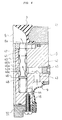
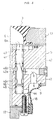
- the self-expanding engine mount 1 according to the third embodiment is distinguished from the first and second embodiments described above in that the liquid pressure-changing means 7 is arranged within the cylindrical space 5a, and part of the electromagnetic driving means of the liquid pressure-changing means 7 is formed integrally on a piston 710A corresponding to the piston 710 employed in the second embodiment.
- the resilient rubber member 3 in this embodiment is designed such that it is larger in radius than the resilient rubber member 3 of the above described embodiments, and hence it affords a larger amount of contraction and expansion in response to variation in the liquid pressure within the main liquid chamber 6. Further, to compensate for reduced strength thereof due to the increased radius, an annular reinforcing member 25 is embedded in an radially intermediate portion of the resilient rubber member 3.
- a cylindrical portion 24 is formed within the cylindrical space 5a of the casing 5, with its horizontal upper end surface 24a located at a middle portion of the space 5a.
- an annular space 27 which is closed at its lower end and communicates with a space within the cylindrical space 5a defining part of the main liquid chamber 6 via an upper open end thereof.
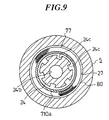
- the cylindrical portion 24 has a central through hole 24b axially formed therethrough, and a plurality of axially extending deep grooves 24c formed in an outer peripheral surface thereof, which are shown in Fig. 9.
- the liquid pressure-changing means 7 is comprised of the aforesaid piston 710A slidably received within the cylindrical space 5a, and the VCM 70 as electromagnetic driving means arranged within the casing 5 for reciprocatively displacing the piston 710A axially of the cylindrical space 5a in response to engine vibration.
- the piston 710A has a bobbin 710a in the form of a hollow cylinder integrally formed thereon and slidably received in the annular space 27.
- the VCM 70 is comprised of an annular permanent magnet 75 securedly fitted in an annular groove 5b formed in an inner peripheral wall of the casing 5 defining the cylindrical space 5a, and a coil 77 wound around an outer peripheral surface of the bobbin 710a.
- the piston 710A per se forms the driving element of the VCM 70.
- the piston 710A is normally held in a neutral position, while floating within the main liquid chamber 6, by coiled springs 141, 142 arranged at upper and lower ends thereof, respectively, for urgingly holding the piston 710A in the neutral position.
- Fig. 8 shows the lowest position of the piston 710A, in which the lower spring 142 is compressed to the maximum degree.
- the upper spring 141 is interposed between an annular spring holder 143 secured to an upper end surface of the casing 5 and an upper end surface of the piston 710A.
- the lower spring 142 is interposed between a lower end surface of the bobbin 710a and a bottom surface of the annular space 27.
- auxiliary liquid chamber 9 is defined between a lower end surface 5c of the lower casing 5 and a diaphragm 18.
- the diaphragm 18 has a peripheral edge thereof sandwiched between an annular fixture member 20 and the lower end surface 5c of the casing 5 and secured to the casing 5 by a plurality of set screws 73.
- the auxiliary liquid chamber 9 communicates with the main liquid chamber 6 via a communication passage formed of the central through hole 24b of the cylindrical portion 24, a space 147 defined between the upper end surface 24a of the cylindrical portion 24 and the piston 710A, a space defined between the outer peripheral surface of the cylindrical portion 24 and the bobbin 710a, and a space 80 defined between an outer peripheral surface of the piston 710A including an outer peripheral surface of the coil 77 and the wall of the casing 5 defining the cylindrical space 5a.
- the space 80 corresponds to the restriction passage 8 of the first and second embodiments and has the same function with that of the latter.
- the self-expanding mount 1 according to the third embodiment constructed as above is mounted onto a chassis of a vehicle, not shown, in a similar manner to the first embodiment, and similarly connected to the ECU 50 in Fig. 3.
- the piston 710A is reciprocatively displaced upward and downward by a magnetic driving force generated in the coil 77 disposed in the magnetic field of the permanent magnet 75 in response to a control signal current supplied thereto.
- the displacement of the piston 710A causes a change in the liquid pressure within the main liquid chamber 6, to thereby cause alternate upward and downward deformation of the resilient rubber member 3 for contraction and expansion in response to engine vibration. This contraction and expansion prevents transmission of the engine vibration to the chassis.
- the piston 710A is reciprocatively displaced axially of the cylindrical space 5a by the VCM 70 as the electromagnetic driving means in response to engine vibration.
- the piston 710A can have a large amount of displacement, enabling to vary the liquid pressure within the main liquid chamber 6 with a large amplitude to thereby accurately and effectively control engine vibrations in a low frequency region, which are large in amplitude.
- the piston 710A per se forms the driving element of the VCM 70 as part of the liquid pressure-changing means 7 in such a manner that it is displaced in an oscillating manner within the cylindrical space 5a, together with the coil 77 integral with the piston 710A, by a magnetic driving force generated in the coil 77 disposed in the magnetic field formed by the permanent magnet 75. Therefore, it dispenses with the driving element 76 of the VCM 70, the metallic bellows 71, the rod 78 connecting the driving element 76 to the piston 710, and other members associated therewith, which are employed in the second embodiment.
- This simplified construction of the liquid pressure-changing mechanism enables to reduce the number of component parts, saving the manufacturing cost, and reduce the total size and weight of the liquid pressure-changing means 7, which in turn enables to reduce the amount of the control signal current inputted to the coil 77 for driving the piston 710A as the driving element, thus saving the electric power.
- the reduction of the total mass of the liquid pressure-changing means 7 contributes to reducing the total size and weight of the engine mount 1.
- the vertical size of the engine mount 1 can be reduced to make the whole mount 1 compact in size, reducing the total space occupied by the engine mount 1.
- the spacing 80 defined between the outer peripheral surface of the piston 710A including the outer peripheral surface of the coil 77 and the inner peripheral surface of the cylindrical space 5a forms a restriction corresponding to the restriction passage 8 of the first embodiment, as mentioned above. Therefore, it is not necessary to provide a special path which serves as restricting means for restricting the flow of liquid, i.e. the restriction passage 8, as in the first embodiment, which enables to simplify the machining operation, as well as to simplify the construction, and reduce the total space occupied by the mount 1 and the mass of same.
- the third embodiment when the liquid pressure within the main liquid chamber 6 excessively rises, part of the liquid within the chamber 6 escapes into the space 147 between the upper end surface 24a of the cylindrical portion 24 and the lower side surface of the piston 710A, which prevents sudden downward movement of the piston 710A.
- This can dispense with the pressure-relieving mechanism 40 employed in the first and second embodiments, also contributing to simplification of the construction of the mount 1.
Landscapes
- Engineering & Computer Science (AREA)
- General Engineering & Computer Science (AREA)
- Mechanical Engineering (AREA)
- Combined Devices Of Dampers And Springs (AREA)
- Arrangement Or Mounting Of Propulsion Units For Vehicles (AREA)
Claims (9)
- Selbstausdehnendes Lager (1) zum Steuern der Übertragung von Schwingung einer Schwingungsquelle zu einer Basis (4), umfassend; ein elastisches Element (3), das an einem Element Schwingungsquelle und Basis (4) befestigt ist, ein Gehäuse (5), das an dem anderen Element Schwingungsquelle und Basis (4) befestigt ist, eine Hauptflüssigkeitskammer (6), die zwischen dem elastischen Element (3) und dem Gehäuse (5) begrenzt und mit Flüssigkeit gefüllt ist, Flüssigkeitsdruckänderungsmittel (7) zum Ändern des Flüssigkeitsdrucks in der Hauptflüssigkeitskammer (6) in Antwort auf ein einer Schwingung der Schwingungsquelle entsprechendes Steuersignal, eine Hilfsflüssigkeitskammer (9) und eine Verbindungspassage (8), die eine Verengung aufweist und die Hilfsflüssigkeitskammer (9) mit der Hauptflüssigkeitskammer (6) verbindet, wobei das Flüssigkeitsdruckänderungsmittel (7) eine Änderung des Flüssigkeitsdrucks bewirkt, um eine Kontraktion und Expansion des elastischen Elements (3) zu bewirken, um hierdurch die Übertragung von Schwingung der Schwingungsquelle zu der Basis (4) zu steuern,dadurch gekennzeichnet, daß das Flüssigkeitsdruckänderungsmittel (7) einen Hohlzylinder (5a) aufweist, der in dem Gehäuse (5) gebildet ist und einen Teil der Hauptflüssigkeitskammer (6) begrenzt, wobei sich der Hohlzylinder in einen Teil der Hauptflüssigkeitskammer (6) öffnet, der durch das elastische Element (3) begrenzt ist und ein von der Hauptflüssigkeitskammer entferntes geschlossenes Ende aufweist, ein Abtriebselement (71, 710), das in dem Hohlzylinder (5a) axial verschiebbar aufgenommen ist, um eine hierdurch in dem Hohlzylinder (5a) verdrängte Flüssigkeitsmenge zu ändern, und ein elektromagnetisches Antriebsmittel (70) zum Antrieb des Abtriebselements;wobei in der Verbindungspassage (8) ein Druckablaßmittel (40) vorgesehen ist und wobei die Verbindungspassage (8) durch das Druckablaßmittel (40) geschlossen wird, wenn ein Wert der Druckdifferenz zwischen der Hauptflüssigkeitskammer (6) und der Hilfsflüssigkeitskammer (9) unter einem vorbestimmten Wert liegt, während die Verbindungspassage (8) durch das Druckablaßmittel (40) geöffnet wird, wenn der Wert der Druckdifferenz über dem vorbestimmten Wert liegt.
- Selbstausdehnendes Lager nach Anspruch 1, in dem das elektromagnetische Antriebsmittel (70) einen Permanentmagneten (75) aufweist, der unter dem Gehäuse (5) angeordnet ist, ein Antriebselement (76, 710a), das in einem durch den Permanentmagneten (75) gebildeten Magnetfeld angeordnet ist und in Achsrichtung des Zylinders (5a) verschiebbar ist, eine Wicklung (77), die auf das Antriebselement (76) gewickelt und zur Versorgung mit dem der Schwingung der Schwingungsquelle entsprechenden Steuersignal angeordnet ist, und ein Übertragungselement (78), das zur Übertragung des Hubs des Antriebselements (76) zu dem Abtriebselement (71) angeordnet ist.
- Selbstausdehnendes Lager nach Anspruch 1 oder 2, in dem das Abtriebselement (71) einen Balgen aufweist.
- Selbstausdehnendes Lager nach Anspruch 3, in dem eine Axialabmessung des Balgens (71) wesentlich größer als dessen Durchmesser ist.
- Selbstausdehnendes Lager nach Anspruch 1 oder 2, in dem das Abtriebselement (710) einen Kolben aufweist.
- Selbstausdehnendes Lager nach einem der Ansprüche 1 bis 5, in dem die Hilfsflüssigkeitskammer (9) teilweise durch eine Membrane (18) mit elastischer Rückstellkraft gebildet ist.
- Selbstausdehnendes Lager (1) zum Steuern der Übertragung von Schwingung einer Schwingungsquelle zu einer Basis (4), umfassend: ein elastisches Element (3), das an einem Element Schwingungsquelle und Basis (4) befestigt ist, ein Gehäuse (5), das an dem anderen Element Schwingungsquelle und Basis (4) befestigt ist, eine Hauptflüssigkeitskammer (6), die zwischen dem elastischen Element (3) und dem Gehäuse (5) begrenzt und mit Flüssigkeit gefüllt ist, Flüssigkeitsdruckänderungsmittel (7) zum Ändern des Flüssigkeitsdrucks in der Hauptflüssigkeitskammer (6) in Antwort auf ein einer Schwingung der Schwingungsquelle entsprechendes Steuersignal, eine Hilfsflüssigkeitskammer (9) und eine Verbindungspassage (8), die eine Verengung aufweist und die Hilfsflüssigkeitskammer (9) mit der Hauptflüssigkeitskammer (6) verbindet, wobei das Flüssigkeitsdruckänderungsmittel (7) eine Änderung des Flüssigkeitsdrucks bewirkt, um eine Kontraktion und Expansion des elastischen Elements (3) zu bewirken, um hierdurch die Übertragung von Schwingung der Schwingungsquelle zu der Basis (4) zu steuern,dadurch gekennzeichnet, daß das Flüssigkeitsdruckänderungsmittel (7) einen Hohlzylinder (5a)umfaßt, der in dem Gehäuse (5) gebildet ist und einen Teil der Hauptflüssigkeitskammer (6) begrenzt, wobei sich der Hohlzylinder (5a) in einen von dem elastischen Element (3) begrenzten Teil der Hauptflüssigkeitskammer (6) öffnet, ein Abtriebselement (710A), das gleitend in dem Hohlzylinder (5a) aufgenommen ist, wobei das elektromagnetische Antriebsmittel (70) in dem Gehäuse (5) angeordnet ist, um eine oszillierende Verlagerung des Abtriebselements (710A) in Axialrichtung des Hohlzylinders (5a) bewirken, um eine hierduch in Antwort auf Schwingung der Schwingungsquelle in dem Hohlzylinder (5a) verdrängte Flüssigkeitsmenge zu ändern;wobei das Gehäuse (5) einen zylindrischen Abschnitt (24) aufweist, in der der Hohlzylinder (5a) an einem von der Hauptflüssigkeitskammer (6) entfernten Ende angeordnet ist, ein Raum (147) zwischen einer Oberfläche (24a) des zylindrischen Abschnitts (24) und einer Unterfläche des Abtriebselements (710A) gebildet ist und ein Ringraum (27) zwischen einer Außenumfangsfläche des zylindrischen Abschnitts (24) und einer Innenumfangsfläche des Hohlzylinders (5) begrenzt ist, wobei der Ringraum (27) ein von der Hauptflüssigkeitskammer entferntes geschlossenes Ende und ein mit der Verbindungspassage (80) verbundenes anderes Ende aufweist.
- Selbstausdehnendes Lager nach Anspruch 7, in dem das Abtriebselement (710A) einen Kolben aufweist, wobei das elektromagnetische Antriebsmittel (70) in dem Gehäuse (5) angeor4dnet ist, um in Antwort auf Schwingung der Schwingungsquelle eine oszillierende Verlagerung des Kolbens (710A) in Axialrichtung des Hohlzylinders (5a) zu bewirken.
- Selbstausdehnendes Lager nach Anspruch 7, in dem das elektromagnetische Antriebsmittel (70) einen in der Innenumfangsfläche des Hohlzylinders (5a) angeordneten Permanentmagneten (75) und eine Wicklung (77) aufweist, die auf ein Teil des Abtriebselements (710A) gewickelt ist, das sich in einem durch den Permanentmagneten (75) gebildeten Magnetfeld befindet, wobei die Wicklung (77) zur Versorgung mit dem der Schwingung der Schwingungsquelle entsprechenden Steuersignal angeordnet ist, und wobei das Teil des Abtriebselements (710A) mit der darauf gewickelten Wicklung (77) in dem Ringraum (27) aufgenommen ist.
Applications Claiming Priority (4)
| Application Number | Priority Date | Filing Date | Title |
|---|---|---|---|
| JP290639/91 | 1991-10-09 | ||
| JP3290640A JPH0599263A (ja) | 1991-10-09 | 1991-10-09 | 自己伸縮型マウント |
| JP29063991A JPH0599262A (ja) | 1991-10-09 | 1991-10-09 | 自己伸縮型マウント |
| JP290640/91 | 1991-10-09 |
Publications (2)
| Publication Number | Publication Date |
|---|---|
| EP0536760A1 EP0536760A1 (de) | 1993-04-14 |
| EP0536760B1 true EP0536760B1 (de) | 1996-05-08 |
Family
ID=26558161
Family Applications (1)
| Application Number | Title | Priority Date | Filing Date |
|---|---|---|---|
| EP92117226A Expired - Lifetime EP0536760B1 (de) | 1991-10-09 | 1992-10-08 | Selbstausdehnendes Lager |
Country Status (3)
| Country | Link |
|---|---|
| US (1) | US5344128A (de) |
| EP (1) | EP0536760B1 (de) |
| DE (1) | DE69210529T2 (de) |
Families Citing this family (10)
| Publication number | Priority date | Publication date | Assignee | Title |
|---|---|---|---|---|
| US6003849A (en) * | 1997-03-04 | 1999-12-21 | Honeywell Inc. | Hybrid isolator and structural control actuator strut |
| US5947457A (en) * | 1997-04-08 | 1999-09-07 | Lord Corporation | Fluid-filled active vibration absorber |
| US6293532B2 (en) | 1997-08-04 | 2001-09-25 | Lord Corporation | Fluid and elastomer apparatus |
| AT3217U1 (de) * | 1998-07-02 | 1999-11-25 | Avl List Gmbh | Vorrichtung sowie ein verfahren zur abstützung einer brennkraftmaschine gegen rollbewegungen |
| JP3692815B2 (ja) * | 1999-02-05 | 2005-09-07 | 東海ゴム工業株式会社 | 流体封入式能動型防振装置 |
| FR2793859B1 (fr) * | 1999-05-17 | 2001-08-03 | Hutchinson | Support antivibratoire hydraulique actif, et systeme antivibratoire actif comportant un tel support |
| EP1069339A1 (de) * | 1999-07-13 | 2001-01-17 | Firma Carl Freudenberg | Hydraulisch dämpfendes Lager |
| US6896109B2 (en) * | 2003-04-07 | 2005-05-24 | Csa Engineering, Inc. | Magnetorheological fluid vibration isolator |
| ES2629886T3 (es) | 2012-08-15 | 2017-08-16 | Beijingwest Industries Co. Ltd. | Un aparato de soporte |
| KR101354263B1 (ko) * | 2012-10-24 | 2014-01-23 | 현대자동차주식회사 | 병렬형 엔진 마운트 구조 |
Family Cites Families (13)
| Publication number | Priority date | Publication date | Assignee | Title |
|---|---|---|---|---|
| JPS5871220A (ja) * | 1981-10-22 | 1983-04-27 | Nissan Motor Co Ltd | パワ−ユニツトのマウンテイング装置 |
| US4531484A (en) * | 1981-11-20 | 1985-07-30 | Nissan Motor Co., Ltd. | Vibration responsive mounting arrangement for automotive engine or the like |
| JPS591829A (ja) * | 1982-06-28 | 1984-01-07 | Toyoda Gosei Co Ltd | 液封入防振装置 |
| JPS608540A (ja) * | 1983-06-27 | 1985-01-17 | Nissan Motor Co Ltd | 防振装置 |
| DE3419437A1 (de) * | 1984-05-24 | 1985-11-28 | Metzeler Kautschuk GmbH, 8000 München | Zweikammer-motorlager mit hydraulischer daempfung |
| DE3433255C2 (de) * | 1984-09-11 | 1987-01-02 | Fa. Carl Freudenberg, 6940 Weinheim | Schwingungsdämpfendes Lager |
| JPS62118134A (ja) * | 1985-11-18 | 1987-05-29 | Toyoda Gosei Co Ltd | 車両のエンジンマウント |
| JPS62127539A (ja) * | 1985-11-28 | 1987-06-09 | Nissan Motor Co Ltd | 振動体支持装置 |
| JPS62215141A (ja) * | 1986-03-14 | 1987-09-21 | Bridgestone Corp | 防振装置 |
| JPS646543A (en) * | 1987-06-29 | 1989-01-11 | Bridgestone Corp | Vibration isolating device |
| FR2666858B2 (fr) * | 1990-01-30 | 1992-12-31 | Hutchinson | Perfectionnements aux dispositifs antivibratoires hydrauliques. |
| DE4021035A1 (de) * | 1990-07-02 | 1992-01-16 | Metzeler Gimetall Ag | Elastisches motorlager |
| JPH04157228A (ja) * | 1990-10-20 | 1992-05-29 | Mazda Motor Corp | 液体封入式エンジンマウント |
-
1992
- 1992-10-08 US US07/958,232 patent/US5344128A/en not_active Expired - Fee Related
- 1992-10-08 EP EP92117226A patent/EP0536760B1/de not_active Expired - Lifetime
- 1992-10-08 DE DE69210529T patent/DE69210529T2/de not_active Expired - Fee Related
Also Published As
| Publication number | Publication date |
|---|---|
| US5344128A (en) | 1994-09-06 |
| DE69210529T2 (de) | 1996-10-02 |
| DE69210529D1 (de) | 1996-06-13 |
| EP0536760A1 (de) | 1993-04-14 |
Similar Documents
| Publication | Publication Date | Title |
|---|---|---|
| US5238232A (en) | Self-expanding mount | |
| US6105943A (en) | Active damping oscillator having non-connected shaft member and outer sleeve movable relative to each other by energization of coils | |
| US4650170A (en) | Vibration-proofing device | |
| US4648576A (en) | Mounting structure for power unit | |
| EP1016806B1 (de) | Magnetorheologische Flüssigkeitsvorrichtungen | |
| US20010032919A1 (en) | Fluid-filled active elastic engine mount | |
| EP0536760B1 (de) | Selbstausdehnendes Lager | |
| US7946561B2 (en) | Anti-vibration support system for engine | |
| JPH10184770A (ja) | 流体封入式防振装置 | |
| JP3658874B2 (ja) | 制振器 | |
| EP0846885B1 (de) | Schwingungsdämpfer mit Masse bewegbar durch Flüssigkeitsdruckänderung in einem Arbeitsraum | |
| US5261649A (en) | Elastic mount having main fluid chamber communicating with auxiliary fluid chamber partially defined by oscillating plate actuated by moving coil in annular gap between two yokes connected to permanent magnet | |
| JP3503288B2 (ja) | 流体封入式防振装置 | |
| US5277409A (en) | Elastic mount having fluid chamber partially defined by elastically supported oscillating plate | |
| JP3518095B2 (ja) | 流体封入式防振装置 | |
| JP2005291276A (ja) | 流体封入式能動型防振装置 | |
| JP4263159B2 (ja) | 防振装置 | |
| JP3752926B2 (ja) | 建築構造物用の能動型動的吸振器 | |
| JPH0599262A (ja) | 自己伸縮型マウント | |
| JPH0389044A (ja) | 流体封入式防振マウント | |
| JPH0599263A (ja) | 自己伸縮型マウント | |
| JP3428737B2 (ja) | アクティブマウント | |
| JP2008095930A (ja) | 防振装置 | |
| JP2025149422A (ja) | 緩衝器 | |
| JPH10184772A (ja) | 防振装置 |
Legal Events
| Date | Code | Title | Description |
|---|---|---|---|
| PUAI | Public reference made under article 153(3) epc to a published international application that has entered the european phase |
Free format text: ORIGINAL CODE: 0009012 |
|
| AK | Designated contracting states |
Kind code of ref document: A1 Designated state(s): DE FR GB |
|
| 17P | Request for examination filed |
Effective date: 19930629 |
|
| 17Q | First examination report despatched |
Effective date: 19940511 |
|
| GRAA | (expected) grant |
Free format text: ORIGINAL CODE: 0009210 |
|
| AK | Designated contracting states |
Kind code of ref document: B1 Designated state(s): DE FR GB |
|
| REF | Corresponds to: |
Ref document number: 69210529 Country of ref document: DE Date of ref document: 19960613 |
|
| ET | Fr: translation filed | ||
| PLBE | No opposition filed within time limit |
Free format text: ORIGINAL CODE: 0009261 |
|
| 26N | No opposition filed | ||
| PGFP | Annual fee paid to national office [announced via postgrant information from national office to epo] |
Ref country code: GB Payment date: 19981009 Year of fee payment: 7 Ref country code: FR Payment date: 19981009 Year of fee payment: 7 |
|
| PG25 | Lapsed in a contracting state [announced via postgrant information from national office to epo] |
Ref country code: GB Free format text: LAPSE BECAUSE OF NON-PAYMENT OF DUE FEES Effective date: 19991008 |
|
| GBPC | Gb: european patent ceased through non-payment of renewal fee |
Effective date: 19991008 |
|
| PG25 | Lapsed in a contracting state [announced via postgrant information from national office to epo] |
Ref country code: FR Free format text: LAPSE BECAUSE OF NON-PAYMENT OF DUE FEES Effective date: 20000630 |
|
| REG | Reference to a national code |
Ref country code: FR Ref legal event code: ST |
|
| PGFP | Annual fee paid to national office [announced via postgrant information from national office to epo] |
Ref country code: DE Payment date: 20001002 Year of fee payment: 9 |
|
| PG25 | Lapsed in a contracting state [announced via postgrant information from national office to epo] |
Ref country code: DE Free format text: LAPSE BECAUSE OF NON-PAYMENT OF DUE FEES Effective date: 20020702 |