EP0537509A2 - Schéma d'arbitrage adaptif pour l'allocation du temps de service d'une ressource partagée - Google Patents
Schéma d'arbitrage adaptif pour l'allocation du temps de service d'une ressource partagée Download PDFInfo
- Publication number
- EP0537509A2 EP0537509A2 EP92116148A EP92116148A EP0537509A2 EP 0537509 A2 EP0537509 A2 EP 0537509A2 EP 92116148 A EP92116148 A EP 92116148A EP 92116148 A EP92116148 A EP 92116148A EP 0537509 A2 EP0537509 A2 EP 0537509A2
- Authority
- EP
- European Patent Office
- Prior art keywords
- access
- resource
- time
- requestors
- requestor
- Prior art date
- Legal status (The legal status is an assumption and is not a legal conclusion. Google has not performed a legal analysis and makes no representation as to the accuracy of the status listed.)
- Withdrawn
Links
Images



Classifications
-
- G—PHYSICS
- G06—COMPUTING OR CALCULATING; COUNTING
- G06F—ELECTRIC DIGITAL DATA PROCESSING
- G06F8/00—Arrangements for software engineering
- G06F8/40—Transformation of program code
- G06F8/41—Compilation
- G06F8/45—Exploiting coarse grain parallelism in compilation, i.e. parallelism between groups of instructions
- G06F8/458—Synchronisation, e.g. post-wait, barriers, locks
Definitions
- This invention relates to providing access to a resource of a computer system to a number of requestors. More specifically, with this invention a maximum access time is provided to each requestor with the access time being a function of the waiting time and being returned to an initial value after each requestor accesses the resource.
- the taxonomy of scheduling algorithms is somewhat hard to define. For the purpose of this invention, we will emphasize one criterion to distinguish two large classes of algorithms. This is the duration for which a requestor may use the common resource after it has been allocated to it. Many algorithms allow a requestor to use the resource until completion (such as FCFS). Some other algorithms define a fixed quota. A requestor may use the allocated resource until the expiration of the time quota. If the requestor could not complete during that granted time, i.e., it still needs the resource for more time, it is reentered to the queue and will have to wait for its next turn before it is given a new service time quota.
- the allocation policy may, however, be based on criteria other than the order of entering a queue.
- An example may be the time needed to complete the job, i.e., the resource is given to the requestor whose job needs the longest (or shortest) time to complete among its competitors. But in all of these cases, the requestor is given a FIXED MAXIMUM TIME during which he can use the resource before releasing it.
- the service time quota may be different for different classes of requestors, but it is the same for all the requestors in any given class. This classification is used to reflect the relative priority or importance of requestors. It is also known that some scheduling disciplines allow requestors to be transferred from one class to another class with different priority, usually with different quota, as they remain in the system. In such schemes, the processor usually serves all the requestors of the higher priority class first on a round robin basis then moves to serve the next lower priority class and so on. This idea is used in many real time systems, where the requestor priority reflects its urgency or its closeness to the required completion deadline. In some other schemes, low level requestors are served first and their level is raised after each service. This gives fast initial response (attention) to incoming requestors and also favors those with short service requirements.
- One such scheme is embodied in the foreground-background algorithm [ 2 ].
- Time-dependent priority scheduling discipline is simply a nonpreemptive priority scheduling scheme where the priority level of a request increases as it waits in the queue.
- the amount of increase in the priority level is either a linear function of time or a higher order function.
- Different classes of requests may have different priority functions. Whenever the resource becomes available, the request with the largest priority level gains access to the resource and uses it until service completion, i.e., no service quantum and feedback of requests.
- each request has an impatience factor, ⁇ , and a corresponding offered bribe, ⁇ ⁇ .
- the goal is to minimize the expected cost, subject to an average bribe constraint, thus yielding an optimal set of bribes, ⁇ ⁇ .
- the system consists of two boxes: a queue box and a service box.
- a queue box Upon arrival, requests wait in the queue box and their priority levels increase linearly with time at a given rate, ⁇ .
- the service box contains a waiting room (a set of queues) and the resource to be allocated. Similarly, the priority levels of requests in the service box increase linearly with time, but at a given rate ⁇ that is smaller than ⁇ . Requests are transferred from the queue box to the service box whenever their priority level matches the priority level of requests in the service box. This is always possible since ⁇ is smaller then ⁇ .
- the scheduling discipline within the service box is arbitrary (including feedback queues) and thus selfish scheduling defines a large class of scheduling disciplines.
- the priority level of a request in the service box increases linearly with time, independent of whether the request is waiting in a queue or receiving service. Furthermore, due to the structure of the selfish scheduling system, the priority level does not change if a request is interrupted, possibly due to the expiration of a service quantum. In other words, at a given point in time, all requests in the service box have the same priority level which increases linearly with time, uniformly among all requests.
- U. S. Patent 4,488,218 to Grimes discloses circuitry which allows stations to dynamically change their priority according to various parameters, one such parameter being whether the buffer is full or half full.
- the resource is kept until completion of the required service. Otherwise, nothing is mentioned about the time a station is allowed to keep the resource after it is allocated.
- U. S. Patent 4,633,394 to Georgiou et al discloses a circuit to implement fixed priority. Requestors are grouped into two fairness groups, and round robin is applied among the groups with all requestors from one group being served before the requestors in the other group. A requestor is moved to the other group as soon as it is completely served.
- U. S. Patent 4,672,536 to Giroir et al discloses an arbitration scheme where access to a common resource is granted to the requestor with the oldest request among those having the highest priority. Use of the resource is not interrupted.
- U. S. Patent 4,719,569 to Ludemann et al discloses an arbitration scheme that enables a device to keep using a resource that is granted to it as long as the device continues issuing new requests exceeding a given rate. This scheme uses emergency and need, not waiting time, to determine the length of allowed service time.
- this invention provides a method and apparatus for providing access to a common resource of a computer system to a number of requestors requesting access to the resource.
- a waiting time for each of the requestors is detected. This waiting time is the time the requestor waits for access to the resource after having requested such access.
- a maximum access time which is a function of the waiting time, is given to each requestor at the time of access. When the requestor completes its access, the maximum access time is then reduced to an initial value, which is the same for all requestors.
- variable dynamic time allocation scheme of this invention allows a system to reach high efficiencies when the system is heavily loaded, as manifested by longer waiting times, while insuring fairness when the system is reasonably loaded, as manifested by shorter waiting times.
- This invention also allows for the preservation of initial requestor classification, thereby maintaining a true indicator that reflects the real priority of a requestor. For example, this priority may be used to preempt or discard lower class requestors in the case of congestion.
- the adaptive scheduling scheme of this invention introduces a concept whereby the priority level of a request waiting in the queue increases as a function of its waiting time since its last admission to the queue.
- An admission to the queue may be either after a new arrival of a requestor, or after a feedback request following the expiration of the service credits of the requestor using the resource.
- the service credit allocated to a request is a function of the request's priority level, in contrast to service-till-completion or a quantum which is independent of the attained time-dependent priority level.
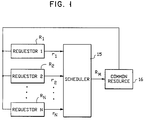
- FIG. 1 is a schematic illustration of the overall system implementing the invention. Shown are requestors R1, R2,..., R N , which can request access to resource 16. The selection as to which requestor, and for how long, gains access to the common resource is accomplished by the scheduler 15, which is described in more detail in FIG. 2.
- the scheduler 15 which is described in more detail in FIG. 2.
- a requestor places a request for access to the common resource, one of the lines r1 through r N will be activated thereby causing one of the timers 20-1 through 20-N to be reset to zero.
- the reset timer will continue to run until access is given to the requestor. This waiting time will appear on one of the output (W1 through W N ) of timers 20-1 through 20-N.
- Service credits for each of the requestors are determined by one of the service credit calculators 21-1 through 21-N based on the waiting time recorded by the corresponding timer. These service credits (C1 through C N ), are defined as the product of a credit rate C and a waiting time W I .
- the service credit values C1 through C N are compared by comparator 26, and the requestor having the largest service credit value is scheduled to gain access to the resource. The result of comparing the service credit values appears on output lines S1 through SK. The value(s) selected is (are) equal to the largest service credit value.
- Selector 25 then uses the outputs of the comparator to actually select which requestor is to gain access to the common resource.
- the selected requestor R M is allowed to use the resource for a maximum access T M , which is the sum of the value of the basic quota q b and the service credit C M .
- the selected requestor R M will then use the resource for a maximum time T M or until the requestor finishes its required service from the resource, whichever occurs first. When the request is completed it leaves the system. If the request is not completed within T M another request is made thereby resetting the timer.
- FIG.3 Shown in FIG.3 is a flow diagram of the generalized algorithm implementing this invention.
- Requestor R I places a request to use the resource. See 301.
- the waiting time, W I is reset to zero to keep track of the time the request started its waiting period (302).
- Requestors wait until the resource becomes available (303).
- the service credits, C I are computed for all the waiting requestors.
- the term "service credits" is defined as the product of the credit rate, C, and the waiting time elapsed (i.e., the timer value, W I ) since the last time the requestor places a request (304).
- the requestor with the largest credit value, say R M is selected to gain access and use the resource (305).
- the selected requestor R M is allowed to use the resource for up to a maximum access time, T M , which is the sum of the value of the basic quota, q b , and the service credits, C M (306).
- T M a maximum access time
- the selected requestor R M uses the resource for a time T M or until the request finishes its required service from the resource, whichever occurs first (307). If the request is completed, it releases the resource (308); otherwise, it places another request (301) and resets its waiting time timer (302).
- the scheme can be used for the allocation of input/output connections.
- register 31 contains the persistence interval t p and register 32 contains the basic quota q b .
- the Persistence Interval represents the time between two consecutive requests of the same requestor, i.e., assuming that input port P Ii has placed a request for a connection and it is not granted the connection, it will request again after a time interval equal the value Persistence Interval t p . In this fashion, the Persistence Interval time practically represents the rate at which credit is gained.
- the Persistence Interval register 31 and the Basic Quota register 32 are loaded with the values.
- Each input port P Ii has two registers associated with it: the Persistence Counter 50-I, which corresponds to the Timer 20-I in FIG.2, and the Service Time register 51-I, which corresponds to the service credit calculator 21-I in FIG. 2.
- the scheduler initializes the Persistence Counter 50-I to the value in register 31 and the Service Timer 51-I to the value of register 32.
- Service Time counter 51-I will be initialized again to the value of Basic Quota 32 (q b ).
- the Persistence counter 50-I is also initialized to the value of the Persistence Interval register 31 every time the counter is reset.
- the comparator 35 (which corresponds to comparator 26 in FIG.2) identifies for every output port all the input ports which request connection to it and have the same highest value in their Service Time registers. If, according to this procedure, only one input port is selected for a connection to an output port, then this input port will be granted that connection as explained above. Otherwise, if more than one input port is selected by the comparator 35, then the Selector 36 (corresponding to the selector 25 in Figure 2) will select only one among them, according to any arbitrary (but previously chosen) algorithm, such as round-robin or fixed priority.
- the implementation of the comparator 35 and the selector 36 circuits is simple and straight forward. The details of their implementation does not have a significant effect on the operation of the method described here but we believe that a round robin scheme for the selector will provide better fairness properties.
Landscapes
- Engineering & Computer Science (AREA)
- General Engineering & Computer Science (AREA)
- Theoretical Computer Science (AREA)
- Software Systems (AREA)
- Physics & Mathematics (AREA)
- General Physics & Mathematics (AREA)
- Computer And Data Communications (AREA)
- Mobile Radio Communication Systems (AREA)
- Multi Processors (AREA)
Applications Claiming Priority (2)
| Application Number | Priority Date | Filing Date | Title |
|---|---|---|---|
| US77797091A | 1991-10-17 | 1991-10-17 | |
| US777970 | 1991-10-17 |
Publications (2)
| Publication Number | Publication Date |
|---|---|
| EP0537509A2 true EP0537509A2 (fr) | 1993-04-21 |
| EP0537509A3 EP0537509A3 (en) | 1993-10-13 |
Family
ID=25111872
Family Applications (1)
| Application Number | Title | Priority Date | Filing Date |
|---|---|---|---|
| EP19920116148 Withdrawn EP0537509A3 (en) | 1991-10-17 | 1992-09-22 | An adaptive scheduling scheme for dynamic service time allocation on a shared resource |
Country Status (3)
| Country | Link |
|---|---|
| EP (1) | EP0537509A3 (fr) |
| JP (1) | JPH05210523A (fr) |
| CA (1) | CA2072729A1 (fr) |
Cited By (4)
| Publication number | Priority date | Publication date | Assignee | Title |
|---|---|---|---|---|
| EP0964332A1 (fr) * | 1998-06-10 | 1999-12-15 | Sun Microsystems, Inc. | Méthode et dispositif pour ordonnancer des processus pour l'allocation de ressources |
| US7036124B1 (en) | 1998-06-10 | 2006-04-25 | Sun Microsystems, Inc. | Computer resource management for competing processes |
| US20110071793A1 (en) * | 2009-09-18 | 2011-03-24 | International Business Machines Corporation | Method to compute wait time |
| CN109558227A (zh) * | 2018-11-12 | 2019-04-02 | 中国航空工业集团公司西安飞行自动控制研究所 | 一种基于任务执行预算的单调速率任务调度方法 |
Families Citing this family (3)
| Publication number | Priority date | Publication date | Assignee | Title |
|---|---|---|---|---|
| US7995597B2 (en) | 2008-10-14 | 2011-08-09 | Nortel Networks Limited | Method and system for weighted fair queuing |
| KR101491689B1 (ko) * | 2013-07-24 | 2015-02-11 | 한국과학기술정보연구원 | 다중 사용자를 위한 자원 할당 방법 및 장치 |
| JP2018005851A (ja) * | 2016-07-08 | 2018-01-11 | 株式会社デンソー | 電子装置 |
-
1992
- 1992-06-29 CA CA 2072729 patent/CA2072729A1/fr not_active Abandoned
- 1992-08-20 JP JP4221476A patent/JPH05210523A/ja active Pending
- 1992-09-22 EP EP19920116148 patent/EP0537509A3/en not_active Withdrawn
Non-Patent Citations (3)
| Title |
|---|
| AUTOMATION AND REMOTE CONTROL vol. 46, no. 10, October 1985, PLENUM, NEW YORK, NY, USA pages 1613 - 1619 GERMAN O.V. 'Queueing discipline in a system with time quantization' * |
| JOURNAL OF THE ASSOC. FOR COMPUTING MACHINERY vol. 26, no. 4, October 1979, NEW YORK, NY, USA pages 761 - 778 U. NARAYAN BHAT 'An evaluation of CPU efficiency under dynamic quantum allocation' * |
| STUDIES IN TELECOMMUNICATION vol. 5, 1985, NORTH HOLLAND, AMSTERDAM,NETHERLANDS pages 931 - 937 CARMELITA GOERG ET AL. 'Improving mean delay in data communication networks by new combined strategies based on the SRPT-principle' * |
Cited By (6)
| Publication number | Priority date | Publication date | Assignee | Title |
|---|---|---|---|---|
| EP0964332A1 (fr) * | 1998-06-10 | 1999-12-15 | Sun Microsystems, Inc. | Méthode et dispositif pour ordonnancer des processus pour l'allocation de ressources |
| US7036124B1 (en) | 1998-06-10 | 2006-04-25 | Sun Microsystems, Inc. | Computer resource management for competing processes |
| US20110071793A1 (en) * | 2009-09-18 | 2011-03-24 | International Business Machines Corporation | Method to compute wait time |
| US8521472B2 (en) * | 2009-09-18 | 2013-08-27 | International Business Machines Corporation | Method to compute wait time |
| CN109558227A (zh) * | 2018-11-12 | 2019-04-02 | 中国航空工业集团公司西安飞行自动控制研究所 | 一种基于任务执行预算的单调速率任务调度方法 |
| CN109558227B (zh) * | 2018-11-12 | 2023-03-31 | 中国航空工业集团公司西安飞行自动控制研究所 | 一种基于任务执行预算的单调速率任务调度方法 |
Also Published As
| Publication number | Publication date |
|---|---|
| JPH05210523A (ja) | 1993-08-20 |
| EP0537509A3 (en) | 1993-10-13 |
| CA2072729A1 (fr) | 1993-04-18 |
Similar Documents
| Publication | Publication Date | Title |
|---|---|---|
| US7149227B2 (en) | Round-robin arbiter with low jitter | |
| US6909691B1 (en) | Fairly partitioning resources while limiting the maximum fair share | |
| US5596576A (en) | Systems and methods for sharing of resources | |
| US5301333A (en) | Tree structured variable priority arbitration implementing a round-robin scheduling policy | |
| Raghavan et al. | Stochastic contention resolution with short delays | |
| US7191273B2 (en) | Method and apparatus for scheduling a resource to meet quality-of-service restrictions | |
| US5835494A (en) | Multi-level rate scheduler | |
| US20070174529A1 (en) | Queue manager having a multi-level arbitrator | |
| US20070064711A1 (en) | System and method for providing, by a plurality of schedulers, differentiated service to consumers of distributed resources | |
| JPH04227146A (ja) | 分散待ち行列二重バス網への複数優先トラヒックの公平なアクセス | |
| WO2001065765A2 (fr) | Procede et dispositif servant a distribuer des largeurs de bande | |
| Zhang et al. | Dynamic scheduling with service curve for QoS guarantee of large-scale cloud storage | |
| JP2005510957A (ja) | トラフィックシェイピングのための階層的クレジットキューイング | |
| EP0537509A2 (fr) | Schéma d'arbitrage adaptif pour l'allocation du temps de service d'une ressource partagée | |
| Dudin et al. | Queueing system with batch arrival of heterogeneous orders, flexible limited processor sharing and dynamical change of priorities | |
| US6424655B1 (en) | Transpose table-biased arbitration | |
| US20070089114A1 (en) | Real time scheduling system for operating system | |
| US8254401B2 (en) | Device for shared management of a resource among several users | |
| JPS58107962A (ja) | スケジユ−リング方式 | |
| Sarkar et al. | Frame-based proportional round-robin | |
| Karatza et al. | Performance analysis of parallel job scheduling in distributed systems | |
| Peng et al. | {Fair-EDF}: A Latency Fairness Framework for Shared Storage Systems | |
| Kumar et al. | Analysis of multiprogramming-multiprocessor retrial queueing systems with Bernoulli vacation schedule | |
| Mittal et al. | Dynamic real-time channel establishment in multiple access bus networks | |
| Lu et al. | Mathematical model for access mode of contention-collision cancellation in a star LAN |
Legal Events
| Date | Code | Title | Description |
|---|---|---|---|
| PUAI | Public reference made under article 153(3) epc to a published international application that has entered the european phase |
Free format text: ORIGINAL CODE: 0009012 |
|
| AK | Designated contracting states |
Kind code of ref document: A2 Designated state(s): DE FR GB |
|
| PUAL | Search report despatched |
Free format text: ORIGINAL CODE: 0009013 |
|
| AK | Designated contracting states |
Kind code of ref document: A3 Designated state(s): DE FR GB |
|
| 18D | Application deemed to be withdrawn |
Effective date: 19940414 |