EP0537701A1 - Vorrichtung zur Herstellung mineralverstärkter thermoplastischer Formmassen - Google Patents
Vorrichtung zur Herstellung mineralverstärkter thermoplastischer Formmassen Download PDFInfo
- Publication number
- EP0537701A1 EP0537701A1 EP92117532A EP92117532A EP0537701A1 EP 0537701 A1 EP0537701 A1 EP 0537701A1 EP 92117532 A EP92117532 A EP 92117532A EP 92117532 A EP92117532 A EP 92117532A EP 0537701 A1 EP0537701 A1 EP 0537701A1
- Authority
- EP
- European Patent Office
- Prior art keywords
- melt
- blade elements
- zone
- extruder
- throttle
- Prior art date
- Legal status (The legal status is an assumption and is not a legal conclusion. Google has not performed a legal analysis and makes no representation as to the accuracy of the status listed.)
- Granted
Links
- 238000009757 thermoplastic moulding Methods 0.000 title claims abstract description 11
- 229910052500 inorganic mineral Inorganic materials 0.000 title abstract description 6
- 239000011707 mineral Substances 0.000 title abstract description 6
- 239000000463 material Substances 0.000 title abstract description 4
- 238000004519 manufacturing process Methods 0.000 title description 3
- 239000012779 reinforcing material Substances 0.000 claims abstract description 14
- 239000000203 mixture Substances 0.000 claims abstract description 13
- 238000002156 mixing Methods 0.000 claims abstract description 12
- 238000000265 homogenisation Methods 0.000 claims abstract description 4
- 238000004140 cleaning Methods 0.000 claims abstract description 3
- 239000000155 melt Substances 0.000 claims description 22
- 238000000034 method Methods 0.000 claims description 12
- 238000004898 kneading Methods 0.000 claims description 11
- 239000012764 mineral filler Substances 0.000 claims description 8
- 239000000454 talc Substances 0.000 claims description 7
- 229910052623 talc Inorganic materials 0.000 claims description 7
- -1 polypropylene Polymers 0.000 claims description 6
- 238000007789 sealing Methods 0.000 claims description 6
- 239000004743 Polypropylene Substances 0.000 claims description 4
- 229920000098 polyolefin Polymers 0.000 claims description 4
- 229920001155 polypropylene Polymers 0.000 claims description 4
- 238000000465 moulding Methods 0.000 abstract description 8
- 230000007547 defect Effects 0.000 abstract description 2
- 230000003287 optical effect Effects 0.000 abstract description 2
- 239000002245 particle Substances 0.000 description 6
- 230000000694 effects Effects 0.000 description 4
- 239000011159 matrix material Substances 0.000 description 4
- 239000004033 plastic Substances 0.000 description 4
- 229920003023 plastic Polymers 0.000 description 4
- 230000007704 transition Effects 0.000 description 4
- 239000000945 filler Substances 0.000 description 3
- 229920000642 polymer Polymers 0.000 description 3
- TZCXTZWJZNENPQ-UHFFFAOYSA-L barium sulfate Chemical compound [Ba+2].[O-]S([O-])(=O)=O TZCXTZWJZNENPQ-UHFFFAOYSA-L 0.000 description 2
- 210000001520 comb Anatomy 0.000 description 2
- 238000007872 degassing Methods 0.000 description 2
- 238000002347 injection Methods 0.000 description 2
- 239000007924 injection Substances 0.000 description 2
- 238000011144 upstream manufacturing Methods 0.000 description 2
- 241001136792 Alle Species 0.000 description 1
- 241000237858 Gastropoda Species 0.000 description 1
- 239000004952 Polyamide Substances 0.000 description 1
- 239000004698 Polyethylene Substances 0.000 description 1
- 238000009825 accumulation Methods 0.000 description 1
- 239000000654 additive Substances 0.000 description 1
- 230000000996 additive effect Effects 0.000 description 1
- 230000000903 blocking effect Effects 0.000 description 1
- 230000015556 catabolic process Effects 0.000 description 1
- 150000001875 compounds Chemical class 0.000 description 1
- 238000007796 conventional method Methods 0.000 description 1
- 238000006731 degradation reaction Methods 0.000 description 1
- 238000013461 design Methods 0.000 description 1
- 238000006073 displacement reaction Methods 0.000 description 1
- 238000005516 engineering process Methods 0.000 description 1
- 239000003365 glass fiber Substances 0.000 description 1
- 238000010348 incorporation Methods 0.000 description 1
- 238000001746 injection moulding Methods 0.000 description 1
- 239000012803 melt mixture Substances 0.000 description 1
- 238000002844 melting Methods 0.000 description 1
- 230000008018 melting Effects 0.000 description 1
- 239000010445 mica Substances 0.000 description 1
- 229910052618 mica group Inorganic materials 0.000 description 1
- 229920002647 polyamide Polymers 0.000 description 1
- 229920000728 polyester Polymers 0.000 description 1
- 229920000573 polyethylene Polymers 0.000 description 1
- 238000012545 processing Methods 0.000 description 1
- 230000002787 reinforcement Effects 0.000 description 1
- 238000007493 shaping process Methods 0.000 description 1
- 239000007787 solid Substances 0.000 description 1
- 239000004753 textile Substances 0.000 description 1
- 230000000930 thermomechanical effect Effects 0.000 description 1
- 229920001169 thermoplastic Polymers 0.000 description 1
- 239000012815 thermoplastic material Substances 0.000 description 1
- 239000004416 thermosoftening plastic Substances 0.000 description 1
- 238000012546 transfer Methods 0.000 description 1
- 238000009736 wetting Methods 0.000 description 1
Images
Classifications
-
- B—PERFORMING OPERATIONS; TRANSPORTING
- B29—WORKING OF PLASTICS; WORKING OF SUBSTANCES IN A PLASTIC STATE IN GENERAL
- B29B—PREPARATION OR PRETREATMENT OF THE MATERIAL TO BE SHAPED; MAKING GRANULES OR PREFORMS; RECOVERY OF PLASTICS OR OTHER CONSTITUENTS OF WASTE MATERIAL CONTAINING PLASTICS
- B29B7/00—Mixing; Kneading
- B29B7/30—Mixing; Kneading continuous, with mechanical mixing or kneading devices
- B29B7/34—Mixing; Kneading continuous, with mechanical mixing or kneading devices with movable mixing or kneading devices
- B29B7/38—Mixing; Kneading continuous, with mechanical mixing or kneading devices with movable mixing or kneading devices rotary
- B29B7/46—Mixing; Kneading continuous, with mechanical mixing or kneading devices with movable mixing or kneading devices rotary with more than one shaft
- B29B7/48—Mixing; Kneading continuous, with mechanical mixing or kneading devices with movable mixing or kneading devices rotary with more than one shaft with intermeshing devices, e.g. screws
- B29B7/488—Parts, e.g. casings, sealings; Accessories, e.g. flow controlling or throttling devices
-
- B—PERFORMING OPERATIONS; TRANSPORTING
- B29—WORKING OF PLASTICS; WORKING OF SUBSTANCES IN A PLASTIC STATE IN GENERAL
- B29B—PREPARATION OR PRETREATMENT OF THE MATERIAL TO BE SHAPED; MAKING GRANULES OR PREFORMS; RECOVERY OF PLASTICS OR OTHER CONSTITUENTS OF WASTE MATERIAL CONTAINING PLASTICS
- B29B7/00—Mixing; Kneading
- B29B7/30—Mixing; Kneading continuous, with mechanical mixing or kneading devices
- B29B7/34—Mixing; Kneading continuous, with mechanical mixing or kneading devices with movable mixing or kneading devices
- B29B7/38—Mixing; Kneading continuous, with mechanical mixing or kneading devices with movable mixing or kneading devices rotary
- B29B7/46—Mixing; Kneading continuous, with mechanical mixing or kneading devices with movable mixing or kneading devices rotary with more than one shaft
- B29B7/48—Mixing; Kneading continuous, with mechanical mixing or kneading devices with movable mixing or kneading devices rotary with more than one shaft with intermeshing devices, e.g. screws
- B29B7/482—Mixing; Kneading continuous, with mechanical mixing or kneading devices with movable mixing or kneading devices rotary with more than one shaft with intermeshing devices, e.g. screws provided with screw parts in addition to other mixing parts, e.g. paddles, gears, discs
- B29B7/483—Mixing; Kneading continuous, with mechanical mixing or kneading devices with movable mixing or kneading devices rotary with more than one shaft with intermeshing devices, e.g. screws provided with screw parts in addition to other mixing parts, e.g. paddles, gears, discs the other mixing parts being discs perpendicular to the screw axis
-
- B—PERFORMING OPERATIONS; TRANSPORTING
- B29—WORKING OF PLASTICS; WORKING OF SUBSTANCES IN A PLASTIC STATE IN GENERAL
- B29B—PREPARATION OR PRETREATMENT OF THE MATERIAL TO BE SHAPED; MAKING GRANULES OR PREFORMS; RECOVERY OF PLASTICS OR OTHER CONSTITUENTS OF WASTE MATERIAL CONTAINING PLASTICS
- B29B7/00—Mixing; Kneading
- B29B7/30—Mixing; Kneading continuous, with mechanical mixing or kneading devices
- B29B7/34—Mixing; Kneading continuous, with mechanical mixing or kneading devices with movable mixing or kneading devices
- B29B7/38—Mixing; Kneading continuous, with mechanical mixing or kneading devices with movable mixing or kneading devices rotary
- B29B7/46—Mixing; Kneading continuous, with mechanical mixing or kneading devices with movable mixing or kneading devices rotary with more than one shaft
- B29B7/48—Mixing; Kneading continuous, with mechanical mixing or kneading devices with movable mixing or kneading devices rotary with more than one shaft with intermeshing devices, e.g. screws
- B29B7/488—Parts, e.g. casings, sealings; Accessories, e.g. flow controlling or throttling devices
- B29B7/489—Screws
-
- B—PERFORMING OPERATIONS; TRANSPORTING
- B29—WORKING OF PLASTICS; WORKING OF SUBSTANCES IN A PLASTIC STATE IN GENERAL
- B29B—PREPARATION OR PRETREATMENT OF THE MATERIAL TO BE SHAPED; MAKING GRANULES OR PREFORMS; RECOVERY OF PLASTICS OR OTHER CONSTITUENTS OF WASTE MATERIAL CONTAINING PLASTICS
- B29B7/00—Mixing; Kneading
- B29B7/80—Component parts, details or accessories; Auxiliary operations
- B29B7/84—Venting or degassing ; Removing liquids, e.g. by evaporating components
- B29B7/845—Venting, degassing or removing evaporated components in devices with rotary stirrers
-
- B—PERFORMING OPERATIONS; TRANSPORTING
- B29—WORKING OF PLASTICS; WORKING OF SUBSTANCES IN A PLASTIC STATE IN GENERAL
- B29B—PREPARATION OR PRETREATMENT OF THE MATERIAL TO BE SHAPED; MAKING GRANULES OR PREFORMS; RECOVERY OF PLASTICS OR OTHER CONSTITUENTS OF WASTE MATERIAL CONTAINING PLASTICS
- B29B7/00—Mixing; Kneading
- B29B7/80—Component parts, details or accessories; Auxiliary operations
- B29B7/86—Component parts, details or accessories; Auxiliary operations for working at sub- or superatmospheric pressure
-
- B—PERFORMING OPERATIONS; TRANSPORTING
- B29—WORKING OF PLASTICS; WORKING OF SUBSTANCES IN A PLASTIC STATE IN GENERAL
- B29B—PREPARATION OR PRETREATMENT OF THE MATERIAL TO BE SHAPED; MAKING GRANULES OR PREFORMS; RECOVERY OF PLASTICS OR OTHER CONSTITUENTS OF WASTE MATERIAL CONTAINING PLASTICS
- B29B7/00—Mixing; Kneading
- B29B7/80—Component parts, details or accessories; Auxiliary operations
- B29B7/88—Adding charges, i.e. additives
- B29B7/90—Fillers or reinforcements, e.g. fibres
-
- B—PERFORMING OPERATIONS; TRANSPORTING
- B29—WORKING OF PLASTICS; WORKING OF SUBSTANCES IN A PLASTIC STATE IN GENERAL
- B29C—SHAPING OR JOINING OF PLASTICS; SHAPING OF MATERIAL IN A PLASTIC STATE, NOT OTHERWISE PROVIDED FOR; AFTER-TREATMENT OF THE SHAPED PRODUCTS, e.g. REPAIRING
- B29C48/00—Extrusion moulding, i.e. expressing the moulding material through a die or nozzle which imparts the desired form; Apparatus therefor
- B29C48/25—Component parts, details or accessories; Auxiliary operations
- B29C48/268—Throttling of the flow, e.g. for cooperating with plasticising elements or for degassing
-
- B—PERFORMING OPERATIONS; TRANSPORTING
- B29—WORKING OF PLASTICS; WORKING OF SUBSTANCES IN A PLASTIC STATE IN GENERAL
- B29C—SHAPING OR JOINING OF PLASTICS; SHAPING OF MATERIAL IN A PLASTIC STATE, NOT OTHERWISE PROVIDED FOR; AFTER-TREATMENT OF THE SHAPED PRODUCTS, e.g. REPAIRING
- B29C48/00—Extrusion moulding, i.e. expressing the moulding material through a die or nozzle which imparts the desired form; Apparatus therefor
- B29C48/25—Component parts, details or accessories; Auxiliary operations
- B29C48/36—Means for plasticising or homogenising the moulding material or forcing it through the nozzle or die
- B29C48/395—Means for plasticising or homogenising the moulding material or forcing it through the nozzle or die using screws surrounded by a cooperating barrel, e.g. single screw extruders
-
- B—PERFORMING OPERATIONS; TRANSPORTING
- B29—WORKING OF PLASTICS; WORKING OF SUBSTANCES IN A PLASTIC STATE IN GENERAL
- B29C—SHAPING OR JOINING OF PLASTICS; SHAPING OF MATERIAL IN A PLASTIC STATE, NOT OTHERWISE PROVIDED FOR; AFTER-TREATMENT OF THE SHAPED PRODUCTS, e.g. REPAIRING
- B29C48/00—Extrusion moulding, i.e. expressing the moulding material through a die or nozzle which imparts the desired form; Apparatus therefor
- B29C48/25—Component parts, details or accessories; Auxiliary operations
- B29C48/36—Means for plasticising or homogenising the moulding material or forcing it through the nozzle or die
- B29C48/395—Means for plasticising or homogenising the moulding material or forcing it through the nozzle or die using screws surrounded by a cooperating barrel, e.g. single screw extruders
- B29C48/40—Means for plasticising or homogenising the moulding material or forcing it through the nozzle or die using screws surrounded by a cooperating barrel, e.g. single screw extruders using two or more parallel screws or at least two parallel non-intermeshing screws, e.g. twin screw extruders
- B29C48/402—Means for plasticising or homogenising the moulding material or forcing it through the nozzle or die using screws surrounded by a cooperating barrel, e.g. single screw extruders using two or more parallel screws or at least two parallel non-intermeshing screws, e.g. twin screw extruders the screws having intermeshing parts
-
- B—PERFORMING OPERATIONS; TRANSPORTING
- B29—WORKING OF PLASTICS; WORKING OF SUBSTANCES IN A PLASTIC STATE IN GENERAL
- B29C—SHAPING OR JOINING OF PLASTICS; SHAPING OF MATERIAL IN A PLASTIC STATE, NOT OTHERWISE PROVIDED FOR; AFTER-TREATMENT OF THE SHAPED PRODUCTS, e.g. REPAIRING
- B29C48/00—Extrusion moulding, i.e. expressing the moulding material through a die or nozzle which imparts the desired form; Apparatus therefor
- B29C48/25—Component parts, details or accessories; Auxiliary operations
- B29C48/36—Means for plasticising or homogenising the moulding material or forcing it through the nozzle or die
- B29C48/395—Means for plasticising or homogenising the moulding material or forcing it through the nozzle or die using screws surrounded by a cooperating barrel, e.g. single screw extruders
- B29C48/40—Means for plasticising or homogenising the moulding material or forcing it through the nozzle or die using screws surrounded by a cooperating barrel, e.g. single screw extruders using two or more parallel screws or at least two parallel non-intermeshing screws, e.g. twin screw extruders
- B29C48/405—Intermeshing co-rotating screws
-
- B—PERFORMING OPERATIONS; TRANSPORTING
- B29—WORKING OF PLASTICS; WORKING OF SUBSTANCES IN A PLASTIC STATE IN GENERAL
- B29C—SHAPING OR JOINING OF PLASTICS; SHAPING OF MATERIAL IN A PLASTIC STATE, NOT OTHERWISE PROVIDED FOR; AFTER-TREATMENT OF THE SHAPED PRODUCTS, e.g. REPAIRING
- B29C48/00—Extrusion moulding, i.e. expressing the moulding material through a die or nozzle which imparts the desired form; Apparatus therefor
- B29C48/03—Extrusion moulding, i.e. expressing the moulding material through a die or nozzle which imparts the desired form; Apparatus therefor characterised by the shape of the extruded material at extrusion
-
- B—PERFORMING OPERATIONS; TRANSPORTING
- B29—WORKING OF PLASTICS; WORKING OF SUBSTANCES IN A PLASTIC STATE IN GENERAL
- B29K—INDEXING SCHEME ASSOCIATED WITH SUBCLASSES B29B, B29C OR B29D, RELATING TO MOULDING MATERIALS OR TO MATERIALS FOR MOULDS, REINFORCEMENTS, FILLERS OR PREFORMED PARTS, e.g. INSERTS
- B29K2105/00—Condition, form or state of moulded material or of the material to be shaped
- B29K2105/06—Condition, form or state of moulded material or of the material to be shaped containing reinforcements, fillers or inserts
- B29K2105/16—Fillers
Definitions
- the invention relates to a device for producing mineral-reinforced thermoplastic materials, in particular talc and chalk-reinforced polyolefins, which ensures that mineral fillers and reinforcing materials are incorporated into the polymer matrix so homogeneously that in the subsequent shaping step, e.g. Injection molding, part surfaces are created that have no optical defects such as streaks or cloud structure.
- the production of reinforced thermoplastics by incorporating reinforcing materials into a polymer matrix is known, for example, from DE-AS 1 454 802 and DE-OS 3 206 325.
- the reinforcing materials are mixed homogeneously as an additive to the polymer in a single or multi-shaft mixing and kneading machine.
- a multi-shaft mixing and kneading machine preference is given to so-called co-rotating screw extruders such as those shown in DE-OS 3 206 325.
- thermoplastic molding compositions are subjected to a melt mixture with melt degassing against atmospheric pressure or under vacuum, the shear and expansion forces resulting from the act on the molding compound, the filler or reinforcing material particles are deagglomerated and broken up.
- the object which is achieved with the present invention was therefore to find a device or a method by means of which mineral fillers or reinforcing materials can be incorporated into thermoplastic molding compositions in such a way that moldings produced therefrom - in particular injection molded articles - have optically perfect surfaces .
- the invention thus relates to a device for incorporating mineral fillers and reinforcing materials into thermoplastic molding compositions in the form of an extruder, with self-cleaning intermeshing and co-rotating screws arranged in a housing bore, which form a feed zone, a melt mixing zone and, in addition to a homogenization zone, an ejection zone, the melting and kneading mixing area by paddle elements is formed, which is followed by a melt choke.
- This melt throttle ensures pressure build-up in the blade elements.
- the extruders to be used according to the invention are basically common types used in production, in which two or more or single or multiple-flight screw shafts rotate in the same direction in a housing which is closely connected to the outer circumference of the combs.
- extruders are the twin-screw extruders with co-rotating shafts from Werner & Pfleiderer GmbH (Stuttgart), e.g. the type ZSK 90. With these machines only the elements according to the invention have to be mounted on the extruder shaft (or the extruder shafts).
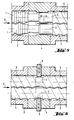
- the blade elements are a right-hand screw element 10 and a left-hand screw element 11 of a large pitch, arranged one behind the other, as shown by way of example in FIG. 3 (blade element 10, right-hand) and FIG. 4 (blade element 11, left-hand). These blade or screw elements 10 and 11 are attached in pairs on each shaft 12 of the extruder 13, in front of the melt choke B.
- the screw elements 10, 11 are preferably two- or three-flighted, closely intermeshing and mutually stripping.
Landscapes
- Engineering & Computer Science (AREA)
- Mechanical Engineering (AREA)
- Processing And Handling Of Plastics And Other Materials For Molding In General (AREA)
- Extrusion Moulding Of Plastics Or The Like (AREA)
- Injection Moulding Of Plastics Or The Like (AREA)
Abstract
Description
- Die Erfindung betrifft eine Vorrichtung zur Herstellung mineralverstärkter thermoplastischer Kunststoffe, insbesondere talkum- und kreideverstärkter Polyolefine, die gewährleistet, daß mineralische Füll- und Verstärkungsstoffe so homogen in die PolymermatriX eingearbeitet werden, daß beim nachfolgenden Formgebungsschritt, z.B. Spritzgußverarbeitung, Teileoberflächen entstehen, die keine optischen Defekte wie Schlieren oder Wolkenstruktur aufweisen.
- Die Herstellung verstärkter thermoplastischer Kunststoffe durch Einarbeiten von Verstärkungsstoffen in eine Polymermatrix ist beispielsweise aus der DE-AS 1 454 802 und der DE-OS 3 206 325 bekannt.
Hierbei werden die Verstärkungsstoffe als Zusatzstoff zum Polymer in einer ein- oder mehrwelligen Misch- und Knetmaschine homogen vermischt.
Als mehrwellige Misch- und Knetmaschine kommen bevorzugt sogenannte Gleichdrallschneckenextruder wie sie die DE-OS 3 206 325 zeigt in Betracht. - Gemäß diesem Stand der Technik werden die thermoplastischen Formmassen einer Schmelzmischung mit Schmelzeentgasung gegen Atmosphärendruck oder unter Vakuum unterworfen, wobei durch die Scher- und Dehnkräfte, die auf die Formmasse einwirken, die Füll- oder Verstärkungsstoffpartikel desagglomeriert und zerteilt werden.
- Diese Kräfte sind für ein gegebenes Matrixsystem abhängig von den geometrischen Gegebenheiten, der Spaltweite zwischen der Gewindenut einer Schnecke und dem eingreifenden Kamm der anderen Schnecke sowie den Übergängen im Bereich der Knetblöcke (vgl. Fig. 1), den Verfahrensparametern (Drehzahl, Gehäuse und/oder Wellentemperierung) und dem Maschinenfüllgrad (Dosierleistung).
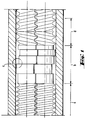
- Fig. 1
- zeigt einen Abschnitt des Schneckenaufbaus eines Gleichdrallschneckenextruders. Dabei bedeuten:
- (a) ineinandergreifendes Dichtprofil (sog. Erdmenger-Dichtprofil wie in DE-PS 862 668 beschrieben)
- (b) Knetblock mit Übergang (c) und
- (d) ineinandergreifendes, Rechts-Links-Dichtprofil
- Nachteile des bekannten Verfahrens sind die während des Prozesses unveränderbaren gegebenen geometrischen Maschinenteileanordnungen und die Übergänge der Knetscheiben eines Knetblocks (s.Fig. 1 "(C)"). Bei ungünstig gewählten geometrischen Verhältnissen sind diese nur durch einen Maschinenumbau veränderbar. Die Knetscheibenübergänge stellen Unterbrechungen im Abdichtungsprofil der ineinandergreifenden Kämme dar, durch die Schmelzeanteile den Scher- und Dehnkräften ausweichen können. Durch diesen Effekt können Schmelzeanteile mit ungenügend benetzten mineralischen Partikeln in den Extruderaustrag gelangen. Durch Hintereinanderschalten von mehreren Knetscheiben oder Knetblöcken kann dieser Effekt zwar herabgesetzt werden, gleichzeitig resultiert daraus aber eine höhere Materialbelastung, die sich in einem verstärkten thermomechanischen Abbau des Kunststoffes niederschlägt.
- Die Aufgabe, die mit der vorliegenden Erfindung gelöst wird, bestand somit darin, eine Vorrichtung bzw. ein Verfahren zu finden, womit mineralische Füll- oder Verstärkungsstoffe so in thermoplastische Formmassen eingearbeitet werden können, daß daraus hergestellte Formkörper - insbesondere Spritzgußartikel- optisch einwandfreie Oberflächen aufweisen.
- Die Erfindung betrifft somit eine Vorrichtung zur Einarbeitung mineralischer Füll- und Verstärkungsstoffe in thermoplastische Formmassen in Form eines Extruders, mit in einer Gehäusebohrung angeordneten, selbstreinigend ineinandergreifend und gleichsinnig drehenden Schnecken, die in Förderrichtung eine Einzugszone, eine Schmelzmischzone und neben einer Homogenisierungszone eine Ausstoßzone bilden, wobei der Schmelz- und Knetmischbereich durch Schaufelelemente gebildet wird, denen eine Schmelzedrossel nachgeschaltet ist.
- Diese Schmelzedrossel sorgt für einen Druckaufbau in den Schaufelelementen.
- Bei den erfindungsgemäß zu verwendeten Extrudern handelt es sich grundsätzlich um gängige in der Produktion eingesetzte Typen, bei denen sich zwei oder mehr oder ein- oder mehrgängige Schneckenwellen in einem dicht an den äußeren Umfang der Kämme anschließenden Gehäuse gleichsinnig drehen. Beispiele für solche Extruder sind die Doppelschneckenextruder mit gleichsinnig drehenden Wellen der Fa. Werner & Pfleiderer GmbH (Stuttgart), wie z.B. der Typ ZSK 90. Bei diesen Maschinen müssen lediglich die erfindungsgemäßen Elemente auf der Extruderwelle (bzw. den Extruderwellen) montiert werden.
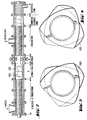
- Fig. 2 zeigt den schematischen Aufbau eines Extruders 13, bei dem die einzelnen Elemente baukastenförmig auf Wellen 12 aufgefädelt sind und der im Schmelzmischbereich die erfindungsgemäße Plastifizier- und Homogensierzone (Pos. A und B) aufweist. Die Maschine weist ein Schneckengehäuse 2 auf, welches aus einzelnen Gehäuseschüssen 9 zusammengesetzt ist, die aneinandergeflanscht sind und in welchen Plastifizierelemente 1 und Förderelemente 5 aufgenommen sind. Hierdurch werden längs der Maschine mehrere unterschiedliche Zonen gebildet, neben der Schmelzmischzone, Einzugs- und Förderzonen, eine Homogenisierzone und die Ausstoßzone.
- Die variable Plastifizier- und Homogenisierzone des Schmelzmischbereiches ist gekennzeichnet durch
- a) sogenannte Schaufelelemente (10,11) und
- b) eine Schmelzedrossel (14).
- Bei den Schaufelelementen handelt es sich um je ein hintereinander angeordnetes rechtsgängiges Schneckenelement 10 und linksgängiges Schneckenelement 11 großer Steigung, wie sie in der Fig. 3 (Schaufelelement 10, rechtsgängig) und der Fig. 4 (Schaufelelement 11, linksgängig) beispielhaft gezeigt sind. Diese Schaufel- bzw. Schneckenelemente 10, bzw. 11 sind paarweise auf jeder Welle 12 des Extruders 13, vor der Schmelzedrossel B angebracht. Es handelt sich bevorzugt um zwei- oder dreigängige, dicht ineinandergreifende und sich gegenseitig abstreifende Schneckenelemente 10, 11.
- Für beide Schneckenelemente 10 bzw. 11 gilt vorzugsweise:
- Steigung:
- (7-17) ×D (D= Außendurchmesser des jeweiligen Schneckenelements)
- Länge:
- (1,1-2,5)×D
- 1 Plastifizierelement
- 2 Schneckengehäuse
- 3 Drosselelement
- 4 Drosselgehäuse
- 5 Förderelement
- 6 Förderrichtung
- 7 Schneckenverschiebung
- 8 Schieberplatte
- Weitere Drosselelemente sind aus der Literatur bekannt (vgl. z.B. Kunststoff-Handbruch 1975, Bd. I, S. 1045, 1056).
- Durch den erzielten Staueffekt wird der Füllgrad in den voranliegenden Schaufelelementen 10 bzw. 11 stark erhöht, wodurch die Scher- und Dehnkräfte beim Materialübergang über den Schneckenprofilkamm 15 dispergierend auf die Feststoffpartikel wirken. Bei Zusammenwirken des hohen Druckes im Schmelzmischbereich in Verbindung mit den Elementen großer Steigung, die so rechts- und linksgängig hintereinander geschaltet werden, daß sich eine Keilform der Schneckenkämme 15 ergibt, in die durch den Drehsinn der Welle die Strömungslinien der Schmelze zusätzlich verdichtet werden, wird der Benetzungsgrad der mineralischen Partikel mit der Kunststoffmatrix entscheidend verstärkt.
- Bevorzugt wird mit der kontinuierlich einstellbaren Drossel in den vorgeschalteten Schaufelelementen ein Massedruck von 60-120 bar erzeugt.
- Hierdurch ist im zwischen Gehäuse und Schneckenkamm gebildeten Spalt der Schmelzefluß im Prozeß gezielt einstellbar, und durch die Elemente großer Steigung entfallen Unterbrechungen im Abdichtprofil.
- Die vorliegende Erfindung betrifft weiterhin ein Verfahren zur Einarbeitung mineralischer Füll- und Verstärkungsstoffe in thermoplastische Formmassen mit Hilfe eines Extruders, dadurch gekennzeichnet, daß als Extruder die beschriebene erfindungsgemäße Vorrichtung verwendet wird.
- Es ist möglich, Formmassen, in die bereits Füll- und Verstärkungsstoffe nach herkömmlichen Methoden eingearbeitet worden sind, durch Regranulierung mit Hilfe der beschriebenen Vorrichtung in ihren Eigenschaften deutlich zu verbessern.
- Die erfindungsgemäße Vorrichtung bzw. das erfindungsgemäße Verfahren sind grundsätzlich geeignet für die Einarbeitung aller mineralischen Füll-und Verstärkungsstoffe in alle thermoplastischen Formmassen in allen für die Technik relevanten Mengenverhältnissen.
- Als Beispiele für Füll- und Verstärkungsstoffe seien genannt: Talkum, Kreide, Glimmer, Bariumsulfat, gemahlene oder geschnittene Textilglasfaser, insbesondere Talkum.
- Unter thermoplastischen Formmassen (Kunststoffe) sind beispielsweise Polyolefine, Polyester oder Polyamide zu verstehen. Bevorzugt werden Polyolefine und von diesen insbesondere Polyethylen und Polypropylen eingesetzt.
- Insbesondere bevorzugt ist die Einarbeitung von Talkum in Polypropylen.
- Mit einem Doppelschneckenextruder der Fa. Werner & Pfleiderer GmbH (Stuttgart), ZSK 90, der mit den erfindungsgemäßen Schaufelelementen und der Schmelzedrossel versehen war (vgl. Fig.2), wurde Polypropylen mit 40% Talkverstärkung und einem Schmelzindex MFI 5/230°C= 10 g/10 min bei einer Schmelzetemperatur von 260°C aufbereitet. Der Druck vor der Drossel betrug 100 bar. Das Schaufelelement hatte einen Durchmesser von 90 mm, eine Länge von 120 mm und eine Steigung von 960 mm. Bei der Schmelzedrossel handelte es sich um eine Axialdrossel.
- Nach anschließender Verarbeitung der so hergestellten Formmassen zu Spritzguß-Stapelkästen zeigten diese Formkörper Teileoberflächen, die völlig "schlieren-und wolkenfrei" waren.
Claims (10)
- Vorrichtung zur Einarbeitung mineralischer Füll- und Verstärkungsstoffe in thermoplastische Formmassen in Form eines Extruders, mit in einer Gehäusebohrung angeordneten, selbstreinigend ineinandergreifend und gleichsinnig drehenden Schnecken, die in Förderrichtung eine Einzugszone, eine Schmelzmischzone und neben einer Homogeniserungszone eine Ausstoßzone bilden, dadurch gekennzeichnet, daß der Schmelze- und Knetmischbereich durch Schaufelelemente (10,11) gebildet wird, denen eine Schmelzedrossel (14) nachgeschaltet ist.
- Vorrichtung nach Anspruch 1, dadurch gekennzeichnet, daß es sich bei den Schaufelelementen (10,11) um rechts- und linksgängige Schaufelelemente handelt, die paarweise auf jeder Schneckenwelle (12) des Extruders angebracht sind.
- Vorrichtung nach Anspruch 1 oder 2, dadurch gekennzeichnet, daß die Schaufelelemente (11,12) zwei- oder dreigängig sind, eine große Steigung und ein Dichtprofil aufweisen.
- Vorrichtung nach einem oder mehreren Ansprüche 1-3, dadurch gekennzeichnet, daß die Steigung der Schaufelelemente (11,12) das 7-17 fache und deren Länge das 1,1-2,5 fache ihres Außendurchmessers beträgt.
- Vorrichtung nach einem oder mehren der Ansprüche 1-4, dadurch gekennzeichnet, daß als Schmelzedrossel (14) eine Axial- oder Radialdrossel verwendet wird.
- Verfahren zur Einarbeitung mineralischer Füll-und Verstärkungsstoffe in thermoplastische Formmassen mit Hilfe eines Extruders, dadurch gekennzeichnet, daß als Extruder die Vorrichtung nach einem oder mehreren der Ansprüche 1-5 verwendet wird.
- Verfahren nach Anspruch 6, dadurch gekennzeichnet, daß mit der Schmelzedrossel ein Massedruck von 60-120 bar in den Schaufelelementen erzeugt wird.
- Verfahren nach Anspruch 6 oder 7, dadurch gekennzeichnet, daß es sich bei der thermoplastischen Formmasse um ein Polyolefin handelt.
- Verfahren nach einem oder mehreren der Ansprüche 6-8, dadurch gekennzeichnet, daß es sich bei dem mineralischen Füll-und Verstärkungsstoff um Talkum handelt.
- Verfahren nach einem oder mehren der Ansprüche 6-9, dadurch gekennzeichnet, daß Talkum in Polyproylen eingearbeitet wird.
Applications Claiming Priority (2)
| Application Number | Priority Date | Filing Date | Title |
|---|---|---|---|
| DE4134169 | 1991-10-16 | ||
| DE4134169A DE4134169A1 (de) | 1991-10-16 | 1991-10-16 | Vorrichtung zur herstellung mineralverstaerkter thermoplastischer formmassen |
Publications (2)
| Publication Number | Publication Date |
|---|---|
| EP0537701A1 true EP0537701A1 (de) | 1993-04-21 |
| EP0537701B1 EP0537701B1 (de) | 1997-07-09 |
Family
ID=6442756
Family Applications (1)
| Application Number | Title | Priority Date | Filing Date |
|---|---|---|---|
| EP92117532A Expired - Lifetime EP0537701B1 (de) | 1991-10-16 | 1992-10-14 | Vorrichtung zur Herstellung mineralverstärkter thermoplastischer Formmassen |
Country Status (3)
| Country | Link |
|---|---|
| EP (1) | EP0537701B1 (de) |
| DE (2) | DE4134169A1 (de) |
| ES (1) | ES2103863T3 (de) |
Cited By (7)
| Publication number | Priority date | Publication date | Assignee | Title |
|---|---|---|---|---|
| EP0641640A1 (de) * | 1993-09-02 | 1995-03-08 | Werner & Pfleiderer GmbH | Schneckenelement für eine Schneckenmaschine |
| EP0709176A3 (de) * | 1994-10-24 | 1997-01-02 | Rohm & Haas | Gegendruckregelvorrichtung für Doppelschneckenextruder |
| EP0764074A4 (de) * | 1994-06-03 | 1997-10-15 | Farrel Corp | Mehrschraubenextrusionsmengvorrichtung mit modularen mischelementen |
| EP0822054A1 (de) * | 1996-08-02 | 1998-02-04 | Techint Compagnia Tecnica Internazionale S.P.A. | Verfahren und Vorrichtung zum Mischen und kontinuierlichen Extrudieren Polymermateralien, mit trockener Vormischung von diesem Material |
| DE10339352A1 (de) * | 2003-08-25 | 2005-03-24 | Bühler AG | SME-Steuerung für die Verarbeitung stärkehaltiger Produkte |
| EP2612740A4 (de) * | 2010-09-01 | 2014-07-02 | Kobe Steel Ltd | Verfahren zur steuerung der viskosität eines polypropylens mithilfe eines knetextruders und knetextruder |
| WO2025166393A1 (de) * | 2024-02-09 | 2025-08-14 | 4Next Generation Gmbh | Vorrichtung zum verarbeiten von kunststoffmaterial |
Families Citing this family (1)
| Publication number | Priority date | Publication date | Assignee | Title |
|---|---|---|---|---|
| US7635217B2 (en) * | 2008-01-03 | 2009-12-22 | Wenger Manufacturing, Inc. | Extruder having variable mid-barrel restriction and adjacent high intensity mixing assembly |
Citations (8)
| Publication number | Priority date | Publication date | Assignee | Title |
|---|---|---|---|---|
| US3446485A (en) * | 1966-09-22 | 1969-05-27 | Colgate Palmolive Co | Mixing apparatus |
| US3618902A (en) * | 1969-11-14 | 1971-11-09 | Teledyne Inc | Continuous mixer |
| US3764118A (en) * | 1972-02-17 | 1973-10-09 | Intercole Automation Inc | Continuous mixer |
| GB2052281A (en) * | 1979-06-20 | 1981-01-28 | Werner & Pfleiderer | Throttle device for a twin-shafted screw machine |
| EP0087699A1 (de) * | 1982-02-22 | 1983-09-07 | Werner & Pfleiderer GmbH | Mehrwellige, kontinuierlich arbeitende Misch- und Knetmaschine für plastifizierbare Massen mit ineinandergreifenden, gleichsinnig drehenden Schnecken konstanten Achsabstandes |
| EP0118847A2 (de) * | 1983-03-14 | 1984-09-19 | AUTOMATIK Apparate-Maschinenbau GmbH | Verfahren und Vorrichtung zum Füllen von thermoplastichem Material mit Verstärkungsstoff |
| EP0391003A2 (de) * | 1989-04-04 | 1990-10-10 | Kabushiki Kaisha Kobe Seiko Sho | Kontinuierliche Knetmaschine |
| EP0426619A2 (de) * | 1989-10-31 | 1991-05-08 | ICMA SAN GIORGIO S.p.A. | Verfahren zur Herstellung von Platten |
-
1991
- 1991-10-16 DE DE4134169A patent/DE4134169A1/de not_active Withdrawn
-
1992
- 1992-10-14 ES ES92117532T patent/ES2103863T3/es not_active Expired - Lifetime
- 1992-10-14 EP EP92117532A patent/EP0537701B1/de not_active Expired - Lifetime
- 1992-10-14 DE DE59208676T patent/DE59208676D1/de not_active Expired - Fee Related
Patent Citations (8)
| Publication number | Priority date | Publication date | Assignee | Title |
|---|---|---|---|---|
| US3446485A (en) * | 1966-09-22 | 1969-05-27 | Colgate Palmolive Co | Mixing apparatus |
| US3618902A (en) * | 1969-11-14 | 1971-11-09 | Teledyne Inc | Continuous mixer |
| US3764118A (en) * | 1972-02-17 | 1973-10-09 | Intercole Automation Inc | Continuous mixer |
| GB2052281A (en) * | 1979-06-20 | 1981-01-28 | Werner & Pfleiderer | Throttle device for a twin-shafted screw machine |
| EP0087699A1 (de) * | 1982-02-22 | 1983-09-07 | Werner & Pfleiderer GmbH | Mehrwellige, kontinuierlich arbeitende Misch- und Knetmaschine für plastifizierbare Massen mit ineinandergreifenden, gleichsinnig drehenden Schnecken konstanten Achsabstandes |
| EP0118847A2 (de) * | 1983-03-14 | 1984-09-19 | AUTOMATIK Apparate-Maschinenbau GmbH | Verfahren und Vorrichtung zum Füllen von thermoplastichem Material mit Verstärkungsstoff |
| EP0391003A2 (de) * | 1989-04-04 | 1990-10-10 | Kabushiki Kaisha Kobe Seiko Sho | Kontinuierliche Knetmaschine |
| EP0426619A2 (de) * | 1989-10-31 | 1991-05-08 | ICMA SAN GIORGIO S.p.A. | Verfahren zur Herstellung von Platten |
Cited By (7)
| Publication number | Priority date | Publication date | Assignee | Title |
|---|---|---|---|---|
| EP0641640A1 (de) * | 1993-09-02 | 1995-03-08 | Werner & Pfleiderer GmbH | Schneckenelement für eine Schneckenmaschine |
| EP0764074A4 (de) * | 1994-06-03 | 1997-10-15 | Farrel Corp | Mehrschraubenextrusionsmengvorrichtung mit modularen mischelementen |
| EP0709176A3 (de) * | 1994-10-24 | 1997-01-02 | Rohm & Haas | Gegendruckregelvorrichtung für Doppelschneckenextruder |
| EP0822054A1 (de) * | 1996-08-02 | 1998-02-04 | Techint Compagnia Tecnica Internazionale S.P.A. | Verfahren und Vorrichtung zum Mischen und kontinuierlichen Extrudieren Polymermateralien, mit trockener Vormischung von diesem Material |
| DE10339352A1 (de) * | 2003-08-25 | 2005-03-24 | Bühler AG | SME-Steuerung für die Verarbeitung stärkehaltiger Produkte |
| EP2612740A4 (de) * | 2010-09-01 | 2014-07-02 | Kobe Steel Ltd | Verfahren zur steuerung der viskosität eines polypropylens mithilfe eines knetextruders und knetextruder |
| WO2025166393A1 (de) * | 2024-02-09 | 2025-08-14 | 4Next Generation Gmbh | Vorrichtung zum verarbeiten von kunststoffmaterial |
Also Published As
| Publication number | Publication date |
|---|---|
| ES2103863T3 (es) | 1997-10-01 |
| DE4134169A1 (de) | 1993-04-22 |
| DE59208676D1 (de) | 1997-08-14 |
| EP0537701B1 (de) | 1997-07-09 |
Similar Documents
| Publication | Publication Date | Title |
|---|---|---|
| EP0087699B1 (de) | Mehrwellige, kontinuierlich arbeitende Misch- und Knetmaschine für plastifizierbare Massen mit ineinandergreifenden, gleichsinnig drehenden Schnecken konstanten Achsabstandes | |
| EP0995567B1 (de) | Verfahren zur Herstellung von gefüllten, modifizierten und mit Fasern verstärkten Thermoplasten und Doppel-Schnecken-Extruder zur Durchführung des Verfahrens | |
| DE69210543T2 (de) | Herstellungsverfahren zum Formen eines Verbundproduktes | |
| EP0490056B1 (de) | Verfahren und Vorrichtung zur einstufigen, kontinuierlichen Herstellung einer Kautschukgrund- und -fertigmischung für Fahrzeugreifen, Antriebsriemen, Transportbänder sowie für technische Gummiartikel in nur einer Mischung | |
| EP2101983B1 (de) | Mischung von kunststoff mit holzpartikeln | |
| EP0447423B1 (de) | Formteil aus gespritzten oder extrudierten kunststoffabfällen | |
| DE4021922C2 (de) | Verfahren für das Kompoundieren und Recyclen von Kunststoffen | |
| DE2601696A1 (de) | Verfahren und vorrichtung zur herstellung eines extrudats aus einem kunstharz und einem feststoffteilchenzusatz in einem extruder fuer kunststoffe | |
| DE202016101935U1 (de) | Extrusionsanlage zur Herstellung von Formstücken aus Kunststoffen | |
| DD231029A1 (de) | Verfahren und einrichtung zum compoundieren von thermoplasten, insbesondere thermoplastabfaellen | |
| DE69629491T2 (de) | Verfahren zum herstellen von homogenen materialien mit einem extruder, und extruder | |
| EP2580042A1 (de) | Vorrichtung zur verarbeitung von material durch mischung und/oder plastifizierung | |
| EP0537701B1 (de) | Vorrichtung zur Herstellung mineralverstärkter thermoplastischer Formmassen | |
| DE60211177T2 (de) | Misch- und knetvorrichtung für kunststoffe | |
| EP0397004B1 (de) | Verfahren und Vorrichtung zur Herstellung verschleissfester und schockzäher Extrudate aus ultrahochmolekularem Polyethylen | |
| DE102004007479B4 (de) | Verfahren und Vorrichtung zur Verarbeitung von mindestens zwei Materialien zu einem Produkt | |
| AT507972B1 (de) | Vorrichtung zur verarbeitung von material durch mischung und/oder plastifizierung | |
| DE1912459A1 (de) | Verfahren und Vorrichtung zur Verarbeitung von hochviskosen Werkstoffen,insbesondere Kautschukmischungen in Einschnecken-Extrudern | |
| AT526871B1 (de) | Formgebungsmaschine zum Herstellen von Formteilen | |
| EP0879129B1 (de) | Verfahren zur herstellung einer füllstoffhaltigen biaxial orientierten polymerfolie | |
| DE102021133445A1 (de) | Verfahren und Vorrichtung zur Herstellung eines mehrschichtigen Kunststofffolienverbundes und daraus thermogeformter Produkte | |
| DE1953114A1 (de) | Spritzwerkzeug fuer die Herstellung von Ein- oder Mehrschichtschlaeuchen | |
| EP4446089A1 (de) | Verfahren und vorrichtung zur aufbereitung von kunststoffmaterial | |
| DE4201330A1 (de) | Verfahren zur herstellung von produkten aus polyolefin-kunststoffabfaellen sowie anlage zur durchfuehrung eines solchen verfahrens | |
| EP4438259A1 (de) | Vorrichtung und verfahren zum aufbereiten von kunststoffmaterial |
Legal Events
| Date | Code | Title | Description |
|---|---|---|---|
| PUAI | Public reference made under article 153(3) epc to a published international application that has entered the european phase |
Free format text: ORIGINAL CODE: 0009012 |
|
| AK | Designated contracting states |
Kind code of ref document: A1 Designated state(s): DE ES FR GB IT |
|
| 17P | Request for examination filed |
Effective date: 19930723 |
|
| 17Q | First examination report despatched |
Effective date: 19941111 |
|
| RAP1 | Party data changed (applicant data changed or rights of an application transferred) |
Owner name: WERNER & PFLEIDERER GMBH |
|
| GRAG | Despatch of communication of intention to grant |
Free format text: ORIGINAL CODE: EPIDOS AGRA |
|
| GRAH | Despatch of communication of intention to grant a patent |
Free format text: ORIGINAL CODE: EPIDOS IGRA |
|
| GRAH | Despatch of communication of intention to grant a patent |
Free format text: ORIGINAL CODE: EPIDOS IGRA |
|
| GRAA | (expected) grant |
Free format text: ORIGINAL CODE: 0009210 |
|
| AK | Designated contracting states |
Kind code of ref document: B1 Designated state(s): DE ES FR GB IT |
|
| GBT | Gb: translation of ep patent filed (gb section 77(6)(a)/1977) |
Effective date: 19970704 |
|
| ET | Fr: translation filed | ||
| REF | Corresponds to: |
Ref document number: 59208676 Country of ref document: DE Date of ref document: 19970814 |
|
| REG | Reference to a national code |
Ref country code: ES Ref legal event code: FG2A Ref document number: 2103863 Country of ref document: ES Kind code of ref document: T3 |
|
| ITF | It: translation for a ep patent filed | ||
| PLBE | No opposition filed within time limit |
Free format text: ORIGINAL CODE: 0009261 |
|
| STAA | Information on the status of an ep patent application or granted ep patent |
Free format text: STATUS: NO OPPOSITION FILED WITHIN TIME LIMIT |
|
| 26N | No opposition filed | ||
| PGFP | Annual fee paid to national office [announced via postgrant information from national office to epo] |
Ref country code: GB Payment date: 19990913 Year of fee payment: 8 |
|
| PGFP | Annual fee paid to national office [announced via postgrant information from national office to epo] |
Ref country code: FR Payment date: 19990920 Year of fee payment: 8 |
|
| PGFP | Annual fee paid to national office [announced via postgrant information from national office to epo] |
Ref country code: DE Payment date: 19990927 Year of fee payment: 8 |
|
| PGFP | Annual fee paid to national office [announced via postgrant information from national office to epo] |
Ref country code: ES Payment date: 19991020 Year of fee payment: 8 |
|
| PG25 | Lapsed in a contracting state [announced via postgrant information from national office to epo] |
Ref country code: GB Free format text: LAPSE BECAUSE OF NON-PAYMENT OF DUE FEES Effective date: 20001014 |
|
| PG25 | Lapsed in a contracting state [announced via postgrant information from national office to epo] |
Ref country code: ES Free format text: LAPSE BECAUSE OF NON-PAYMENT OF DUE FEES Effective date: 20001015 |
|
| GBPC | Gb: european patent ceased through non-payment of renewal fee |
Effective date: 20001014 |
|
| PG25 | Lapsed in a contracting state [announced via postgrant information from national office to epo] |
Ref country code: FR Free format text: LAPSE BECAUSE OF NON-PAYMENT OF DUE FEES Effective date: 20010629 |
|
| PG25 | Lapsed in a contracting state [announced via postgrant information from national office to epo] |
Ref country code: DE Free format text: LAPSE BECAUSE OF NON-PAYMENT OF DUE FEES Effective date: 20010703 |
|
| REG | Reference to a national code |
Ref country code: FR Ref legal event code: ST |
|
| REG | Reference to a national code |
Ref country code: ES Ref legal event code: FD2A Effective date: 20011113 |
|
| PG25 | Lapsed in a contracting state [announced via postgrant information from national office to epo] |
Ref country code: IT Free format text: LAPSE BECAUSE OF NON-PAYMENT OF DUE FEES;WARNING: LAPSES OF ITALIAN PATENTS WITH EFFECTIVE DATE BEFORE 2007 MAY HAVE OCCURRED AT ANY TIME BEFORE 2007. THE CORRECT EFFECTIVE DATE MAY BE DIFFERENT FROM THE ONE RECORDED. Effective date: 20051014 |