EP0540862A2 - Kappe zum Verschliessen von Öffnungen an Ohrpassstücken - Google Patents
Kappe zum Verschliessen von Öffnungen an Ohrpassstücken Download PDFInfo
- Publication number
- EP0540862A2 EP0540862A2 EP92115709A EP92115709A EP0540862A2 EP 0540862 A2 EP0540862 A2 EP 0540862A2 EP 92115709 A EP92115709 A EP 92115709A EP 92115709 A EP92115709 A EP 92115709A EP 0540862 A2 EP0540862 A2 EP 0540862A2
- Authority
- EP
- European Patent Office
- Prior art keywords
- cap
- membrane
- copolymer
- ear
- fitments
- Prior art date
- Legal status (The legal status is an assumption and is not a legal conclusion. Google has not performed a legal analysis and makes no representation as to the accuracy of the status listed.)
- Granted
Links
Images
Classifications
-
- H—ELECTRICITY
- H04—ELECTRIC COMMUNICATION TECHNIQUE
- H04R—LOUDSPEAKERS, MICROPHONES, GRAMOPHONE PICK-UPS OR LIKE ACOUSTIC ELECTROMECHANICAL TRANSDUCERS; ELECTRIC HEARING AIDS; PUBLIC ADDRESS SYSTEMS
- H04R25/00—Electric hearing aids
- H04R25/65—Housing parts, e.g. shells, tips or moulds, or their manufacture
- H04R25/652—Ear tips; Ear moulds
- H04R25/654—Ear wax retarders
-
- C—CHEMISTRY; METALLURGY
- C08—ORGANIC MACROMOLECULAR COMPOUNDS; THEIR PREPARATION OR CHEMICAL WORKING-UP; COMPOSITIONS BASED THEREON
- C08J—WORKING-UP; GENERAL PROCESSES OF COMPOUNDING; AFTER-TREATMENT NOT COVERED BY SUBCLASSES C08B, C08C, C08F, C08G or C08H
- C08J7/00—Chemical treatment or coating of shaped articles made of macromolecular substances
- C08J7/04—Coating
- C08J7/0427—Coating with only one layer of a composition containing a polymer binder
-
- C—CHEMISTRY; METALLURGY
- C08—ORGANIC MACROMOLECULAR COMPOUNDS; THEIR PREPARATION OR CHEMICAL WORKING-UP; COMPOSITIONS BASED THEREON
- C08J—WORKING-UP; GENERAL PROCESSES OF COMPOUNDING; AFTER-TREATMENT NOT COVERED BY SUBCLASSES C08B, C08C, C08F, C08G or C08H
- C08J2327/00—Characterised by the use of homopolymers or copolymers of compounds having one or more unsaturated aliphatic radicals, each having only one carbon-to-carbon double bond, and at least one being terminated by a halogen; Derivatives of such polymers
- C08J2327/02—Characterised by the use of homopolymers or copolymers of compounds having one or more unsaturated aliphatic radicals, each having only one carbon-to-carbon double bond, and at least one being terminated by a halogen; Derivatives of such polymers not modified by chemical after-treatment
- C08J2327/12—Characterised by the use of homopolymers or copolymers of compounds having one or more unsaturated aliphatic radicals, each having only one carbon-to-carbon double bond, and at least one being terminated by a halogen; Derivatives of such polymers not modified by chemical after-treatment containing fluorine atoms
- C08J2327/18—Homopolymers or copolymers of tetrafluoroethylene
-
- C—CHEMISTRY; METALLURGY
- C08—ORGANIC MACROMOLECULAR COMPOUNDS; THEIR PREPARATION OR CHEMICAL WORKING-UP; COMPOSITIONS BASED THEREON
- C08J—WORKING-UP; GENERAL PROCESSES OF COMPOUNDING; AFTER-TREATMENT NOT COVERED BY SUBCLASSES C08B, C08C, C08F, C08G or C08H
- C08J2471/00—Characterised by the use of polyethers obtained by reactions forming an ether link in the main chain; Derivatives of such polymers
Definitions
- the invention relates to a cap for closing openings on earmolds for in-the-ear hearing aids with at least one opening which is covered by a microporous membrane made of polytetrafluoroethylene.
- a generic cap is already known from European patent application 0 310 866, which is intended to prevent the penetration of moisture and ear wax (cerumen) from the ear canal into the interior of the hearing aid.
- the liquid form of the cerumen penetrates into the microporous membrane and hardens there, so that the sound permeability is only partially guaranteed or no longer exists. Cleaning with pure water, even in an ultrasonic bath, is not very successful. The use of detergents is prohibited because they dissolve the cerumen, but clog the pores or even penetrate into the interior of the hearing aid and damage the electronic components there.
- the invention has for its object to develop the known perforated caps or the membrane material used in this context such that it can be cleaned better and more effectively with the same sound permeability.
- the cleaning should preferably take place with the cap fitted, i. H. the cleaning bath must not penetrate the membrane.
- the object is achieved in that the membrane material is coated with a copolymer.
- the copolymer is preferably an amorphous copolymer of tetrafluoroethylene and perfluoro-2,2-dimethyl-1,3-dioxole.
- the copolymer consists of 10 to 40 mole percent tetrafluoroethylene and 90 to 60 mole percent perfluoro-2,2-dimethyl-1,3-dioxole.
- the membrane can preferably also be used as a laminate which has a carrier layer with a mesh or sieve structure.
- the material and mesh size of the backing layer must be selected so that on the one hand the desired mechanical reinforcement is achieved, but on the other hand the sound transmission properties are only minimally influenced.
- the copolymer used for coating is commercially available under the name Teflon AF1600 from Dupont. It is preferably applied in the form of a dilute solution.
- the solvent is perfluoro (2-butyltetahydrofuran).
- the concentration of the copolymer in the solution is preferably 0.01 to 5% by weight.
- the solution can be sprayed onto the membrane, for example, but the membrane can also be immersed in the solution.
- the membrane made of microporous polytetrafluoroethylene treated in this way is strongly oleophobic, ie it largely prevents the liquid cerumen from penetrating into the membrane material. Any soiling that occurs adheres to the surface of the membrane and can therefore be easily cleaned in an ultrasonic bath.
- the use of detergents is also possible, since the coating prevents the molecules of the active agent or detergent from penetrating into the membrane or even through the membrane.
- the membrane In special cases it can happen that cerumen gets stuck in the space between a protective grille arranged above the housing of the hearing aid and the membrane in such a way that it cannot be detached by an ultrasound treatment and possibly dishwashing detergents or solvents. In such a case, mechanical cleaning is desirable. If the membrane is also to be cleaned mechanically, it must be reinforced with a support layer with a mesh or sieve structure.
- the carrier layer and the coated membrane are advantageously used in the form of a laminate. The carrier layer must be selected so that it fulfills its supporting function, but attenuates the sound that passes through as little as possible.
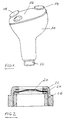
- FIG. 1 consists of a housing 10 with a sound outlet connector 12 and a sound inlet connector 14.
- knobs 18 On the end face 16 of the device there are various knobs 18 for adjusting the volume and for adjusting the components arranged inside the device , such as microphone, amplifier electronics etc. Sound entry and exit ports 12, 14 are each closed with a cap. A cross section through such a cap is shown in FIG. 2.
- the microporous membrane 20 is clamped between two mounting rings 22 and 24. The mounting rings are held in place by a mounting ring 26 screwed into the internal thread of the cap.
- the cap can of course also be constructed differently, instead of the internal thread, corresponding snap or snap connections can be provided. Welding or gluing is also possible.
- the only decisive factor is that the membrane 20 is securely and watertightly mounted.
- the sound passage opening of the cap can be covered by a protective grille (not shown) to protect the membrane against mechanical loads.
- the earmold can be partially or entirely immersed in the ultrasonic bath for cleaning.
Landscapes
- Engineering & Computer Science (AREA)
- Health & Medical Sciences (AREA)
- Signal Processing (AREA)
- Chemical & Material Sciences (AREA)
- Neurosurgery (AREA)
- Otolaryngology (AREA)
- Physics & Mathematics (AREA)
- Acoustics & Sound (AREA)
- Manufacturing & Machinery (AREA)
- General Health & Medical Sciences (AREA)
- Chemical Kinetics & Catalysis (AREA)
- Medicinal Chemistry (AREA)
- Polymers & Plastics (AREA)
- Organic Chemistry (AREA)
- Laminated Bodies (AREA)
- Details Of Audible-Bandwidth Transducers (AREA)
- Separation Using Semi-Permeable Membranes (AREA)
Abstract
Description
- Die Erfindung betrifft eine Kappe zum Verschließen von Öffnungen an Ohrpaßstücken für Im-Ohr-Hörgeräte mit wenigstens einer Öffnung, die von einer mikroporösen Membran aus Polytetrafluorethylen abgedeckt ist.
- Durch die europäische Patentanmeldung 0 310 866 ist bereits eine gattungsgemäße Kappe bekannt, die das Eindringen von Feuchtigkeit und Ohrenschmalz (Cerumen) vom Ohrkanal in das Innere des Hörgeräts verhindern soll. Man hat jedoch festgestellt, daß die flüssige Form des Cerumens in die mikroporöse Membran eindringt und dort aushärtet, wodurch die Schalldurchlässigkeit nur noch bedingt gewährleistet oder gar nicht mehr gegeben ist. Eine Abreinigung mit reinem Wasser, auch im Ultraschallbad, ist wenig erfolgreich. Die Verwendung von Spülmitteln verbietet sich, da diese zwar das Cerumen auflösen, die Poren aber verstopfen oder gar in das Innere des Hörgeräts vordringen und dort die elektronischen Bauteile beschädigen.
- Der Erfindung liegt die Aufgabe zugrunde, die bekannten Lochkappen bzw. das in diesem Zusammenhang verwendete Membranmaterial derart weiterzubilden, daß es bei gleicher Schalldurchlässigkeit besser und wirksamer abreinigbar ist. Das Abreinigen soll dabei vorzugsweise bei montierter Kappe erfolgen, d. h. das Reinigungsbad darf die Membran nicht durchdringen.
- Erfindungsgemäß wird die Aufgabe dadurch gelöst, daß das Membranmaterial mit einem Copolymer beschichtet ist. Das Copolymer ist vorzugsweise ein amorphes Copolymer aus Tetrafluorethylen und Perfluor-2,2-dimethyl-1,3-dioxol. Gemäß einer Weiterbildung der Erfindung besteht das Copolymer aus 10 bis 40 Molprozent Tetrafluorethylen und 90 bis 60 Molprozent Perfluor-2,2-dimethyl-1,3-dioxol.
- Um auch eine mechanische Abreinigung der empfindlichen Membran zu ermöglichen, kann die Membran vorzugsweise auch als Laminat eingesetzt werden, das eine Trägerschicht mit einer Netz- oder Siebstruktur aufweist. Material und Maschenweite der Trägerschicht müssen so ausgewählt werden, daß einerseits die gewünschte mechanische Verstärkung erzielt wird, daß aber andererseits die Schalldurchtrittseigenschaften nur minimal beeinflußt werden.
- Das zur Beschichtung verwendete Copolymer ist im Handel unter dem Namen Teflon AF1600 von der Firma Dupont erhältlich. Es wird vorzugsweise in Form einer verdünnten Lösung aufgetragen. Das Lösungsmittel ist Perfluor-(2-butyltetahydrofuran). Die Konzentration des Copolymers in der Lösung beträgt vorzugsweise 0,01 bis 5 Gew.-%. Die Lösung kann beispielsweise auf die Membran aufgesprüht werden, die Membran kann aber auch in die Lösung eingetaucht werden.
- Die Zugabe weiterer Komponenten in niedriger Dosierung, wie beispielsweise UV-Stabilisiermittel, Farbstoffe, Weichmacher und dergleichen verändern den Charakter und die Wirkung des Copolymers nicht.
- Die derart behandelte Membran aus mikroporösem Polytetrafluorethylen ist stark oleophob, d. h. sie verhindert weitgehend ein Eindringen des flüssigen Cerumens in das Membranmaterial. Auftretende Verschmutzungen bleiben vielmehr an der Oberfläche der Membran haften und können daher in einem Ultraschallbad unschwer abgereinigt werden. Auch der Einsatz von Spülmitteln ist möglich, da die Beschichtung ein Eindringen der Moleküle des Wirkungsmittels bzw. Spülmittels in die Membran oder gar durch die Membran hindurch verhindert.
- In Sonderfällen kann es vorkommen, daß sich Cerumen im Raum zwischen einem über dem Gehäuse des Hörgeräts angeordneten Schutzgitter und der Membran so festsetzt, daß es durch eine Ultraschallbehandlung und gegebenenfalls Spül- oder Lösungsmitteln nicht abgelöst werden kann. In einem solchen Fall ist eine mechanische Reinigung wünschenswert. Soll die Membran auch mechanisch abgereinigt werden, muß sie mit einer Trägerschicht mit einer Netz- oder Siebstruktur verstärkt werden. Vorteilhafterweise wird die Trägerschicht und die beschichtete Membran in Form eines Laminats eingesetzt. Die Trägerschicht muß so ausgewählt werden, daß sie zwar ihre Stützfunktion erfüllt, den durchtretenden Schall aber möglichst wenig dämpft.
- Nachfolgend ist eine Ausführungsform der Erfindung anhand der beigefügten Zeichnung beispielsweise beschrieben. Darin zeigen:
- Fig. 1
- ein Im-Ohr-Hörgerät in schematischer Darstellung und
- Fig. 2
- ein Querschnitt durch eine Verschlußkappe.
- Das Im-Ohr-Hörgerät gemäß Fig. 1 besteht aus einem Gehäuse 10 mit einem Schallausgangsstutzen 12 und einem Schalleingangsstutzen 14. Auf der Stirnfläche 16 des Geräts befinden sich diverse Drehknöpfe 18 für die Einstellung der Lautstärke und zur Justierung der im Inneren des Geräts angeordneten Bauelemente, wie Mikrophon, Verstärkerelektronik etc. Schalleintritts- und Schallaustrittsstutzen 12, 14 sind jeweils mit einer Kappe verschlossen. Ein Querschnitt durch eine solche Kappe ist in Fig. 2 gezeigt. Die mikroporöse Membran 20 ist zwischen zwei Montageringen 22 und 24 eingeklemmt. Die Montageringe werden durch einen in das Innengewinde der Kappe eingeschraubten Befestigungsring 26 an Ort und Stelle gehalten.
- Die Kappe kann natürlich auch anders aufgebaut sein, statt dem Innengewinde können entsprechende Schnapp- oder Rastverbindungen vorgesehen sein. Auch ein Einschweißen oder Einkleben ist möglich. Entscheidend ist lediglich, daß die Membran 20 sicher und wasserdicht montiert ist. Die Schalldurchtrittsöffnung der Kappe kann zum Schutz der Membran gegen mechanische Belastungen von einem Schutzgitter (nicht gezeigt) abgedeckt sein.
- Eine entsprechend sichere Montage der Membran vorausgesetzt, ist es nicht erforderlich, zur Reinigung die Schutzkappen vom Gerät 10 abzuschrauben, das Ohrpaßstück kann vielmehr teilweise bzw. insgesamt in das Ultraschallbad zur Reinigung eingetaucht werden.
Claims (4)
- Kappe zum Verschließen von Öffnungen an Ohrpaßstücken für Im-Ohr-Hörgeräte mit wenigstens einer Öffnung, die von einer mikroporösen Membran aus Polytetrafluorethylen abgedeckt ist,
dadurch gekennzeichnet,
daß die Membran (20) mit einem Copolymer beschichtet ist. - Kappe nach Anspruch 1,
dadurch gekennzeichnet,
daß das Copolymer ein amorphes Copolymer aus Tetrafluorethylen und Perfluor-2,2-dimethyl-1,3-dioxol ist. - Kappe nach Anspruch 2,
dadurch gekennzeichnet,
daß das Copolymer aus 10 bis 40 Molprozent Tetrafluorethylen und 90 und 60 Molprozent Perfluor-2,2-dimethyl-1,3-dioxol besteht. - Kappe nach wenigstens einem der Ansprüche 1 bis 3,
dadurch gekennzeichnet,
daß die beschichtete Membran auf eine Trägerschicht mit einer Netz- oder Siebstruktur auflaminiert ist, die den Schalldurchtritt möglichst wenig dämpft.
Applications Claiming Priority (2)
| Application Number | Priority Date | Filing Date | Title |
|---|---|---|---|
| DE9113936U DE9113936U1 (de) | 1991-11-08 | 1991-11-08 | Kappe zum Verschließen von Öffnungen an Ohrpaßstücken |
| DE9113936U | 1991-11-08 |
Publications (3)
| Publication Number | Publication Date |
|---|---|
| EP0540862A2 true EP0540862A2 (de) | 1993-05-12 |
| EP0540862A3 EP0540862A3 (en) | 1993-11-24 |
| EP0540862B1 EP0540862B1 (de) | 1996-07-10 |
Family
ID=6873089
Family Applications (1)
| Application Number | Title | Priority Date | Filing Date |
|---|---|---|---|
| EP92115709A Expired - Lifetime EP0540862B1 (de) | 1991-11-08 | 1992-09-14 | Kappe zum Verschliessen von Öffnungen an Ohrpassstücken |
Country Status (4)
| Country | Link |
|---|---|
| EP (1) | EP0540862B1 (de) |
| JP (1) | JPH05276596A (de) |
| DE (2) | DE9113936U1 (de) |
| DK (1) | DK0540862T3 (de) |
Cited By (7)
| Publication number | Priority date | Publication date | Assignee | Title |
|---|---|---|---|---|
| WO2000061267A1 (en) * | 1999-04-14 | 2000-10-19 | Pall Corporation | Porous membrane |
| WO2000048443A3 (de) * | 2000-06-06 | 2002-02-14 | Phonak Ag | Im-ohr-hörgerät und verfahren zu dessen herstellung |
| US6770202B1 (en) | 1999-04-14 | 2004-08-03 | Pall Corporation | Porous membrane |
| US6879696B1 (en) | 2000-06-06 | 2005-04-12 | Phonak Ag | In-ear hearing aid and method for its manufacture |
| US7751579B2 (en) | 2003-06-13 | 2010-07-06 | Etymotic Research, Inc. | Acoustically transparent debris barrier for audio transducers |
| US8175310B2 (en) | 2004-10-01 | 2012-05-08 | Gn Resound A/S | BTE hearing aid adaptor |
| US8842864B2 (en) | 2009-10-23 | 2014-09-23 | Oticon A/S | Hearing instrument comprising a divided wax filter |
Families Citing this family (5)
| Publication number | Priority date | Publication date | Assignee | Title |
|---|---|---|---|---|
| DE9113936U1 (de) * | 1991-11-08 | 1992-03-12 | W.L. Gore & Associates Gmbh, 85640 Putzbrunn | Kappe zum Verschließen von Öffnungen an Ohrpaßstücken |
| WO2008025355A1 (en) * | 2006-08-31 | 2008-03-06 | Widex A/S | Filter for a hearing aid and a hearing aid |
| DK1915032T3 (da) * | 2006-10-18 | 2012-05-07 | Siemens Audiologische Technik | Høreapparat |
| DE102008055919A1 (de) * | 2008-11-05 | 2009-12-03 | Siemens Medical Instruments Pte. Ltd. | Vorrichtung zur Befestigung eines Hörers für Hörgeräte |
| US8462973B2 (en) * | 2010-05-17 | 2013-06-11 | W.L. Gore & Associates, Inc. | Ear fitting |
Family Cites Families (5)
| Publication number | Priority date | Publication date | Assignee | Title |
|---|---|---|---|---|
| DE3413067C1 (de) * | 1984-04-06 | 1989-06-08 | Westra Electronic Gmbh, 8901 Welden | Gehoergangseitiges Hoergeraete-Otoplastik-Endstueck und Hoergeraete-Otoplastik |
| IT1185520B (it) * | 1985-02-22 | 1987-11-12 | Montefluos Spa | Poliacrilati e poliacrilammidi fluorurati a grado di reticolazione controllato e loro procedimento di preparazione |
| DE8713369U1 (de) * | 1987-10-05 | 1989-02-09 | Siemens AG, 1000 Berlin und 8000 München | Vorrichtung zum Verschließen von Öffnungen an Hörgeräten oder Ohrpaßstücken für Hörgeräte |
| JPH06104754B2 (ja) * | 1989-07-24 | 1994-12-21 | ジェルマン サイエンシズ テクノロジー インコーポレイテッド | 改良された撥水性及び撥油性を得るための多孔質基材の処理方法 |
| DE9113936U1 (de) * | 1991-11-08 | 1992-03-12 | W.L. Gore & Associates Gmbh, 85640 Putzbrunn | Kappe zum Verschließen von Öffnungen an Ohrpaßstücken |
-
1991
- 1991-11-08 DE DE9113936U patent/DE9113936U1/de not_active Expired - Lifetime
-
1992
- 1992-09-14 EP EP92115709A patent/EP0540862B1/de not_active Expired - Lifetime
- 1992-09-14 DK DK92115709.5T patent/DK0540862T3/da active
- 1992-09-14 DE DE59206733T patent/DE59206733D1/de not_active Expired - Fee Related
- 1992-10-22 JP JP4284109A patent/JPH05276596A/ja active Pending
Cited By (7)
| Publication number | Priority date | Publication date | Assignee | Title |
|---|---|---|---|---|
| WO2000061267A1 (en) * | 1999-04-14 | 2000-10-19 | Pall Corporation | Porous membrane |
| US6770202B1 (en) | 1999-04-14 | 2004-08-03 | Pall Corporation | Porous membrane |
| WO2000048443A3 (de) * | 2000-06-06 | 2002-02-14 | Phonak Ag | Im-ohr-hörgerät und verfahren zu dessen herstellung |
| US6879696B1 (en) | 2000-06-06 | 2005-04-12 | Phonak Ag | In-ear hearing aid and method for its manufacture |
| US7751579B2 (en) | 2003-06-13 | 2010-07-06 | Etymotic Research, Inc. | Acoustically transparent debris barrier for audio transducers |
| US8175310B2 (en) | 2004-10-01 | 2012-05-08 | Gn Resound A/S | BTE hearing aid adaptor |
| US8842864B2 (en) | 2009-10-23 | 2014-09-23 | Oticon A/S | Hearing instrument comprising a divided wax filter |
Also Published As
| Publication number | Publication date |
|---|---|
| EP0540862A3 (en) | 1993-11-24 |
| DE9113936U1 (de) | 1992-03-12 |
| DE59206733D1 (de) | 1996-08-14 |
| DK0540862T3 (da) | 1996-08-12 |
| EP0540862B1 (de) | 1996-07-10 |
| JPH05276596A (ja) | 1993-10-22 |
Similar Documents
| Publication | Publication Date | Title |
|---|---|---|
| EP1060640B1 (de) | Hörgerät | |
| EP0540862B1 (de) | Kappe zum Verschliessen von Öffnungen an Ohrpassstücken | |
| EP0310866B1 (de) | Vorrichtung zum Verschliessen von Öffnungen an Hörgeräten oder Ohrpassstücken für Hörgeräte | |
| DE3504891C2 (de) | ||
| DE69209254T2 (de) | Nicht-verschliessbarer Wandler für IdO-Verwendungen | |
| EP0433348B1 (de) | Cerumenfänger für schwerhörigengeräte | |
| DE19640796A1 (de) | Schutzvorrichtung für die Schallein- und/oder Schallaustrittsöffnung an Gehäusen oder Ohrpaßstücken von Hörhilfegeräten | |
| DE19715365C2 (de) | Kondensatormikrofon | |
| DE102004023306B3 (de) | Hörgerät mit Cerumenschutz | |
| EP1349424A2 (de) | Cerumenschutzsystem für Hörvorrichtungen | |
| DE102020131994A1 (de) | Druckausgleichselement | |
| DE9115939U1 (de) | Schaltgeräteaufnahme und Deckel für ein Druckausgleichselement | |
| DE10327634B4 (de) | Mikrofon | |
| DE10009847C2 (de) | Wetterschutzgehäuse für Mikrofone | |
| DE20208601U1 (de) | Im-Ohr-Hörgerät | |
| DE2909880C2 (de) | Elektrodynamischer Lautsprecher | |
| DE19843389C2 (de) | Perforierte Otoplastik für Hörgeräte | |
| DE102010013447A1 (de) | Schutzeinrichtung für ein Hörhilfegerät | |
| DE19742249C2 (de) | Mikrophon | |
| DE1958455C3 (de) | Signalhorn, insbesondere für Kraftfahrzeuge | |
| DE3510346A1 (de) | Dynamischer, akustischer wandler | |
| EP0723380A1 (de) | Elektronisches Informationsgerät, insbesondere Informations-Notrufsäule | |
| DE102024106452A1 (de) | Druckausgleichsvorrichtung und deren Verwendung | |
| DE102019115529A1 (de) | Fahrzeug mit Mikrofon-Anordnung | |
| DE1958455B2 (de) | Signalhorn, insbesondere fuer kraftfahrzeuge |
Legal Events
| Date | Code | Title | Description |
|---|---|---|---|
| PUAI | Public reference made under article 153(3) epc to a published international application that has entered the european phase |
Free format text: ORIGINAL CODE: 0009012 |
|
| AK | Designated contracting states |
Kind code of ref document: A2 Designated state(s): CH DE DK FR GB IT LI |
|
| PUAL | Search report despatched |
Free format text: ORIGINAL CODE: 0009013 |
|
| AK | Designated contracting states |
Kind code of ref document: A3 Designated state(s): CH DE DK FR GB IT LI |
|
| 17P | Request for examination filed |
Effective date: 19931026 |
|
| 17Q | First examination report despatched |
Effective date: 19950201 |
|
| GRAH | Despatch of communication of intention to grant a patent |
Free format text: ORIGINAL CODE: EPIDOS IGRA |
|
| GRAH | Despatch of communication of intention to grant a patent |
Free format text: ORIGINAL CODE: EPIDOS IGRA |
|
| GRAA | (expected) grant |
Free format text: ORIGINAL CODE: 0009210 |
|
| AK | Designated contracting states |
Kind code of ref document: B1 Designated state(s): CH DE DK FR GB IT LI |
|
| REG | Reference to a national code |
Ref country code: DK Ref legal event code: T3 |
|
| GBT | Gb: translation of ep patent filed (gb section 77(6)(a)/1977) |
Effective date: 19960719 |
|
| REF | Corresponds to: |
Ref document number: 59206733 Country of ref document: DE Date of ref document: 19960814 |
|
| ITF | It: translation for a ep patent filed | ||
| ET | Fr: translation filed | ||
| REG | Reference to a national code |
Ref country code: CH Ref legal event code: NV Representative=s name: PATENTANWAELTE SCHAAD, BALASS, MENZL & PARTNER AG |
|
| PLBE | No opposition filed within time limit |
Free format text: ORIGINAL CODE: 0009261 |
|
| 26N | No opposition filed | ||
| REG | Reference to a national code |
Ref country code: GB Ref legal event code: IF02 |
|
| PGFP | Annual fee paid to national office [announced via postgrant information from national office to epo] |
Ref country code: FR Payment date: 20020819 Year of fee payment: 11 |
|
| PGFP | Annual fee paid to national office [announced via postgrant information from national office to epo] |
Ref country code: DK Payment date: 20020821 Year of fee payment: 11 Ref country code: CH Payment date: 20020821 Year of fee payment: 11 |
|
| PGFP | Annual fee paid to national office [announced via postgrant information from national office to epo] |
Ref country code: GB Payment date: 20020911 Year of fee payment: 11 |
|
| PGFP | Annual fee paid to national office [announced via postgrant information from national office to epo] |
Ref country code: DE Payment date: 20020930 Year of fee payment: 11 |
|
| PG25 | Lapsed in a contracting state [announced via postgrant information from national office to epo] |
Ref country code: GB Free format text: LAPSE BECAUSE OF NON-PAYMENT OF DUE FEES Effective date: 20030914 |
|
| PG25 | Lapsed in a contracting state [announced via postgrant information from national office to epo] |
Ref country code: LI Free format text: LAPSE BECAUSE OF NON-PAYMENT OF DUE FEES Effective date: 20030930 Ref country code: DK Free format text: LAPSE BECAUSE OF NON-PAYMENT OF DUE FEES Effective date: 20030930 Ref country code: CH Free format text: LAPSE BECAUSE OF NON-PAYMENT OF DUE FEES Effective date: 20030930 |
|
| PG25 | Lapsed in a contracting state [announced via postgrant information from national office to epo] |
Ref country code: DE Free format text: LAPSE BECAUSE OF NON-PAYMENT OF DUE FEES Effective date: 20040401 |
|
| GBPC | Gb: european patent ceased through non-payment of renewal fee |
Effective date: 20030914 |
|
| REG | Reference to a national code |
Ref country code: CH Ref legal event code: PL |
|
| REG | Reference to a national code |
Ref country code: DK Ref legal event code: EBP |
|
| PG25 | Lapsed in a contracting state [announced via postgrant information from national office to epo] |
Ref country code: FR Free format text: LAPSE BECAUSE OF NON-PAYMENT OF DUE FEES Effective date: 20040528 |
|
| REG | Reference to a national code |
Ref country code: FR Ref legal event code: ST |
|
| PG25 | Lapsed in a contracting state [announced via postgrant information from national office to epo] |
Ref country code: IT Free format text: LAPSE BECAUSE OF NON-PAYMENT OF DUE FEES Effective date: 20050914 |