EP0541737B1 - Les n-phenyl-cinnamamides, protecteurs contre les effets nocifs de la lumiere ultra-violette - Google Patents
Les n-phenyl-cinnamamides, protecteurs contre les effets nocifs de la lumiere ultra-violette Download PDFInfo
- Publication number
- EP0541737B1 EP0541737B1 EP92908925A EP92908925A EP0541737B1 EP 0541737 B1 EP0541737 B1 EP 0541737B1 EP 92908925 A EP92908925 A EP 92908925A EP 92908925 A EP92908925 A EP 92908925A EP 0541737 B1 EP0541737 B1 EP 0541737B1
- Authority
- EP
- European Patent Office
- Prior art keywords
- function
- phenyl
- cinnamamide
- sunscreen
- materials
- Prior art date
- Legal status (The legal status is an assumption and is not a legal conclusion. Google has not performed a legal analysis and makes no representation as to the accuracy of the status listed.)
- Expired - Lifetime
Links
- 0 C*C1=**CC=C1 Chemical compound C*C1=**CC=C1 0.000 description 1
- VEHWSSFTCUPIQE-UHFFFAOYSA-N CC1C=CC(C2)C2C1 Chemical compound CC1C=CC(C2)C2C1 VEHWSSFTCUPIQE-UHFFFAOYSA-N 0.000 description 1
Classifications
-
- A—HUMAN NECESSITIES
- A61—MEDICAL OR VETERINARY SCIENCE; HYGIENE
- A61Q—SPECIFIC USE OF COSMETICS OR SIMILAR TOILETRY PREPARATIONS
- A61Q17/00—Barrier preparations; Preparations brought into direct contact with the skin for affording protection against external influences, e.g. sunlight, X-rays or other harmful rays, corrosive materials, bacteria or insect stings
- A61Q17/04—Topical preparations for affording protection against sunlight or other radiation; Topical sun tanning preparations
-
- A—HUMAN NECESSITIES
- A23—FOODS OR FOODSTUFFS; TREATMENT THEREOF, NOT COVERED BY OTHER CLASSES
- A23B—PRESERVATION OF FOODS, FOODSTUFFS OR NON-ALCOHOLIC BEVERAGES; CHEMICAL RIPENING OF FRUIT OR VEGETABLES
- A23B2/00—Preservation of foods or foodstuffs, in general
- A23B2/70—Preservation of foods or foodstuffs, in general by treatment with chemicals
- A23B2/725—Preservation of foods or foodstuffs, in general by treatment with chemicals in the form of liquids or solids
- A23B2/729—Organic compounds; Microorganisms; Enzymes
- A23B2/762—Organic compounds containing nitrogen
-
- A—HUMAN NECESSITIES
- A23—FOODS OR FOODSTUFFS; TREATMENT THEREOF, NOT COVERED BY OTHER CLASSES
- A23B—PRESERVATION OF FOODS, FOODSTUFFS OR NON-ALCOHOLIC BEVERAGES; CHEMICAL RIPENING OF FRUIT OR VEGETABLES
- A23B7/00—Preservation of fruit or vegetables; Chemical ripening of fruit or vegetables
- A23B7/16—Coating with a protective layer; Compositions or apparatus therefor
-
- A—HUMAN NECESSITIES
- A61—MEDICAL OR VETERINARY SCIENCE; HYGIENE
- A61K—PREPARATIONS FOR MEDICAL, DENTAL OR TOILETRY PURPOSES
- A61K31/00—Medicinal preparations containing organic active ingredients
- A61K31/16—Amides, e.g. hydroxamic acids
- A61K31/165—Amides, e.g. hydroxamic acids having aromatic rings, e.g. colchicine, atenolol, progabide
-
- A—HUMAN NECESSITIES
- A61—MEDICAL OR VETERINARY SCIENCE; HYGIENE
- A61K—PREPARATIONS FOR MEDICAL, DENTAL OR TOILETRY PURPOSES
- A61K31/00—Medicinal preparations containing organic active ingredients
- A61K31/185—Acids; Anhydrides, halides or salts thereof, e.g. sulfur acids, imidic, hydrazonic or hydroximic acids
-
- A—HUMAN NECESSITIES
- A61—MEDICAL OR VETERINARY SCIENCE; HYGIENE
- A61K—PREPARATIONS FOR MEDICAL, DENTAL OR TOILETRY PURPOSES
- A61K31/00—Medicinal preparations containing organic active ingredients
- A61K31/185—Acids; Anhydrides, halides or salts thereof, e.g. sulfur acids, imidic, hydrazonic or hydroximic acids
- A61K31/19—Carboxylic acids, e.g. valproic acid
-
- A—HUMAN NECESSITIES
- A61—MEDICAL OR VETERINARY SCIENCE; HYGIENE
- A61K—PREPARATIONS FOR MEDICAL, DENTAL OR TOILETRY PURPOSES
- A61K31/00—Medicinal preparations containing organic active ingredients
- A61K31/21—Esters, e.g. nitroglycerine, selenocyanates
- A61K31/215—Esters, e.g. nitroglycerine, selenocyanates of carboxylic acids
-
- A—HUMAN NECESSITIES
- A61—MEDICAL OR VETERINARY SCIENCE; HYGIENE
- A61K—PREPARATIONS FOR MEDICAL, DENTAL OR TOILETRY PURPOSES
- A61K8/00—Cosmetics or similar toiletry preparations
- A61K8/18—Cosmetics or similar toiletry preparations characterised by the composition
- A61K8/30—Cosmetics or similar toiletry preparations characterised by the composition containing organic compounds
- A61K8/40—Cosmetics or similar toiletry preparations characterised by the composition containing organic compounds containing nitrogen
- A61K8/42—Amides
-
- C—CHEMISTRY; METALLURGY
- C07—ORGANIC CHEMISTRY
- C07C—ACYCLIC OR CARBOCYCLIC COMPOUNDS
- C07C235/00—Carboxylic acid amides, the carbon skeleton of the acid part being further substituted by oxygen atoms
- C07C235/02—Carboxylic acid amides, the carbon skeleton of the acid part being further substituted by oxygen atoms having carbon atoms of carboxamide groups bound to acyclic carbon atoms and singly-bound oxygen atoms bound to the same carbon skeleton
- C07C235/32—Carboxylic acid amides, the carbon skeleton of the acid part being further substituted by oxygen atoms having carbon atoms of carboxamide groups bound to acyclic carbon atoms and singly-bound oxygen atoms bound to the same carbon skeleton the carbon skeleton containing six-membered aromatic rings
- C07C235/38—Carboxylic acid amides, the carbon skeleton of the acid part being further substituted by oxygen atoms having carbon atoms of carboxamide groups bound to acyclic carbon atoms and singly-bound oxygen atoms bound to the same carbon skeleton the carbon skeleton containing six-membered aromatic rings having the nitrogen atom of at least one of the carboxamide groups bound to a carbon atom of a six-membered aromatic ring
-
- C—CHEMISTRY; METALLURGY
- C07—ORGANIC CHEMISTRY
- C07C—ACYCLIC OR CARBOCYCLIC COMPOUNDS
- C07C237/00—Carboxylic acid amides, the carbon skeleton of the acid part being further substituted by amino groups
- C07C237/02—Carboxylic acid amides, the carbon skeleton of the acid part being further substituted by amino groups having the carbon atoms of the carboxamide groups bound to acyclic carbon atoms of the carbon skeleton
- C07C237/20—Carboxylic acid amides, the carbon skeleton of the acid part being further substituted by amino groups having the carbon atoms of the carboxamide groups bound to acyclic carbon atoms of the carbon skeleton the carbon skeleton containing six-membered aromatic rings
Definitions
- Sunlight at the level of the Earth's crust, includes a portion of ultraviolet light whose spectrum ranges from 280 to 400 nm.
- the shorter wavelength radiation is retained by the circumterreste ozone layer , in the upper atmosphere.
- Ultraviolet light of short wavelengths at 280 nm is called UV-C, from 280 to 320 nm UV-B and from 320 to 400 nm UV-A.
- the irradiation of a living organism by UV-C is lethal; UV-B irradiation is toxic, causing erythema and damage to the stratum corneum: UV-A irradiation causes browning of the skin by inducing melanogenesis in melanocytes.
- filters or sunscreens containing inorganic or organic substances which reflect or absorb UV-A and UV-B light respectively.
- the mineral substances are talc, zinc oxide and titanium oxide, they are called sunscreens. They are preferred for the aesthetics of translucent or milky solutions of organic molecules, sunscreens, in solution in creams, milks, lotions, oils, gels, at a concentration of 0.5 to 10
- the organic molecules are chosen according to their power of absorption of ultraviolet light UV-A and UV-B and their harmlessness. In Table I we present the main sunscreens sold, indicating their maximum wavelength of their UV A and UV-B absorption spectrum ( ⁇ max.) And the intensity of their UV-absorbing power.
- UV-B expressed as molecular extinction coefficient ( ⁇ max.), Their belonging to the UV class.
- Table I filters ⁇ max. (nm) ⁇ max UV 1) para-amino-benzoic acid 283 15300 B 2) octyl para-dimethylamino benzoate 311 27300 B 3) 4-methoxy-2-hydroxy-benzophenone 288 14000 B 325 9400 AT 4) 4-methoxy-2-hydoxy-3-sulfo-benzophenone 286 13400 B 325 8400 AT 5) 2,2'-dihydroxy-4-methoxy-benzophenone 284 13270 B 327 10440 AT 6) 2-ethyl-hexyl 4-methoxy-cinnamate 311 23300 B 7) 4-methoxy-4'-n-butyl-dibenzoyl-methane 358 34720 AT solvent: ethanol
- Cosmetic preparations almost always contain a mixture of UV-A and UV-B filters, in order to achieve the widest possible protection.
- UV-A and UV-B light require a degree of unsaturation on the part of organic substances which increases from UV-B structures to UV-A structures.
- the modulation of the absorbent properties also requires the presence of organic functions with an inductive effect (electron donor) on the unsaturated system, e.g. the alkoxy, hydroxy, amino, alkylamino functions, and in a favorable position by relation to these functions of groups of atoms (electron attractors), e.g. carboxy, carboalkoxy, carbamide, ketone, sulfonic, nitrile functions.
- organic functions with an inductive effect e.g. the alkoxy, hydroxy, amino, alkylamino functions
- Non-cyclic carbon unsaturated structures e.g. ethylene derivatives
- undergo the cis-trans isomerism whose equilibrium is often shifted by ultraviolet light towards the geometrical isomer with the lowest absorbing power.
- An unsaturation between two aromatic residues produced by two carbons
- a function comprising two polarizable centers between two aromatic residues is capable of creating a conjugation whose state excited by ultraviolet photons could be of relatively low energy compared to the ground state . This effect will cause, depending on the functions present, a hypsochromic or bathochromic or even auxochromic displacement of the spectral values, i.e. it will allow the choice of an appropriate structure for the preparation of a desired solar filter.
- N-phenyl-cinnamamides we can make a sun filter with very high absorbency of ultraviolet light chosen. These properties give N-phenyl-cinnamamides, as sunglasses, protectors foodstuffs and materials against alterations caused by ultraviolet light, a quality of protection which is not known in sunscreens on the market (see Table I).
- the N- (4-carbethoxy-phenyl) -4-dimethyl-amino-cinnamamide described in JP A-74 69,847 absorbs in UV A, the near visible. Its coloring makes it unsuitable for cosmetic use.
- N-phenyl-cinnamamides The synthesis of N-phenyl-cinnamamides was carried out using suitable cinnamic acid derivatives, the carboxy function of which was transformed into acid chloride or acid anhydride of the mixed anhydride or into activated esters or azide or into a derived from a carbodiimide reacting with the amino phenyl function substituted or unsubstituted, in an anhydrous solvent.
- the products are crystallized from water and recrystallized from the solvent indicated in the description of N-phenyl-cinnamamides.
- the analyzes focused on the composition C, H, N, S; the melting points are determined with the Kofler apparatus (Reichert); the UV spectra were established with the Cary 2300 spectrometer; the IR spectra were obtained with the Perkin-Elmer 735 B spectrometer.
Landscapes
- Health & Medical Sciences (AREA)
- Chemical & Material Sciences (AREA)
- Life Sciences & Earth Sciences (AREA)
- Public Health (AREA)
- Organic Chemistry (AREA)
- Veterinary Medicine (AREA)
- Animal Behavior & Ethology (AREA)
- General Health & Medical Sciences (AREA)
- Epidemiology (AREA)
- Engineering & Computer Science (AREA)
- Pharmacology & Pharmacy (AREA)
- Medicinal Chemistry (AREA)
- Polymers & Plastics (AREA)
- Zoology (AREA)
- Food Science & Technology (AREA)
- Wood Science & Technology (AREA)
- General Chemical & Material Sciences (AREA)
- Emergency Medicine (AREA)
- Chemical Kinetics & Catalysis (AREA)
- Birds (AREA)
- Dermatology (AREA)
- Cosmetics (AREA)
- Organic Low-Molecular-Weight Compounds And Preparation Thereof (AREA)
- Paints Or Removers (AREA)
- Materials For Medical Uses (AREA)
- Acyclic And Carbocyclic Compounds In Medicinal Compositions (AREA)
Description
- La lumière solaire,au niveau de l'écorce terrestre,comprend une partie de lumière ultra-violette dont le spectre s'étend de 280 à 400 nm.Les radiations de longueur d'onde plus courte sont retenues par la couche d'ozone circumterreste,dans la haute atmosphère.
La lumière ultra-violette des courtes longueurs d'ondes à 280 nm est appelée UV-C,de 280 à 320 nm UV-B et de 320 à 400 nm UV-A. L'irradiation d'un organisme vivant par les UV-C est léthale; l'irradiation par les UV-B est toxique,provoquant de l'érythème et des lésions du stratum corneum:l'irradiation par les UV-A provoque le brunissement de la peau en induisant la mélanogenèse dans les mélanocytes.La mélanine formée à partir de la dopamine provenant de la tyrosine est transférée dans le kératocytes.Le brunissement rend l'épiderme moins sensible à l'effet toxique des UV-A qui pénétrent dans le derme.Il n'empêche cependant pas les UV-A de provoquer le vieillissement de la peau et l'induction de carcinomes cutanés.
La quantité de UV-A parvenant sur la surface terrestre est env.1000 fois plus importante que la quantité de UV-B.
L'organisme humain,en particulier les téguments(peau et cheveux) doit être protégé contre les effets néfastes des radiations UV-A et UV-B de la lumière solaire et celà d'autant plus que la populaticn est de race blanche et qu'elle vit sur des continents à forte exposition solaire ou qu'elle s'expose momentanément à de fortes irradiations solaires.
Pour réaliser cette protection on a créé des produits cosmétiques, appelés filtres ou écrans solaires,contenant des substances inorganiques ou organiques qui réfléchissent ou absorbent respectivement la lumière UV-A et UV-B.Les substances minérales sont le talc,l'oxyde de zinc et l'oxyde de titane,on les appelle des écrans solaires. On leurs préfére pour l'esthétique des solutions translucides ou laiteuses de molécules organiques,les filtres solaires,en solution dans des crèmes,des laits,des lotions,des huiles,des gels,à raison d'une concentration de 0,5 à 10 %.Les molécules organiques sont choisies en fonction de leur pouvoir dábsorption de la lumière ultra-violette UV-A et UV-B et de leur inocuité.
Dans le tableau I nous présentons les principaux filtres solaires commercialisés,en indiquant leur longueur d'onde maximum de leur spectre d'absorption UV A et UV-B (λ max.) et l'intensité de leur pouvoir d'absorption des UV-A et UV-B,exprimé en coefficient d'extinction moléculaire ( ε max.),leur appartenance à la classe des UV.Tableau I filtres λ max. (nm) ε max UV 1) acide para-amino-benzoique 283 15300 B 2) para-diméthylamino-benzoate d'octyle 311 27300 B 3) 4-méthoxy-2-hydroxy-benzophénone 288 14000 B 325 9400 A 4) 4-méthoxy-2-hydoxy-3-sulfo-benzophénone 286 13400 B 325 8400 A 5) 2,2'-dihydroxy-4-méthoxy-benzophénone 284 13270 B 327 10440 A 6) 4-méthoxy-cinnamate de 2-éthyl-héxyle 311 23300 B 7) 4-méthoxy-4'-n-butyl-dibenzoyl-méthane 358 34720 A solvant: éthanol - Les préparations cosmétiques contiennent presque toujours un mélange de filtres UV-A et UV-B,afin de réaliser la plus large protection possible.
- Les qualités idéales des filtres solairesUV-A et UV-B sont les suivantes:
- 1) une absorbabilité de la lumière UV-A et UV-B supérieure à ε max.20000,
- 2) une bonne photostabilité,
- 3) une bonne stabilité chimique,
- 4) une bonne fixation au stratum corneum,
- 5) une bonne incorporation à la composition cosmétique,
- 6) une bonne inocuité,
- La présente invention concerne les substances organiques objet des revendications 1 à 6.Cessubstances sont utilisables en tant que filtres solaire,d'écrans solaires,de protecteurs des denrées alimentaires et des matériaux contre les altérations provoquées par la lumière ultra-violette. La structure des substances organiques a été choisie en fonction
- 1) de leur grand pouvoir absorbant la lumière UV-A et UV-B (ε max suprérieur à 20000),
- 2) de leur photostabilité,
- 3) de leur parentée à des substances déjà utilisées comme filtres solaires,dont on a reconnu à l'échelle mondiale,leur inocuité sanitaire,
- 4) leur résistivité en milieu aqueux,
- 5)leur appartenance à une même famille de composés dont de faible variation permet de moduler leurs propriétés UV-A et UV-B.
- Une bonne absorbabilité des lumières UV-A et UV-B requiert de la part des substances organiques un degré d'insaturation qui augmente en passant des structures UV-B aux structures UV-A.
- La modulation des propriété absorbantes,exprimées en ε max, requiert aussi la présence de fonctions organiques à effet inductif (donneur d'électrons)sur le système insaturé,par ex.les fonctions alkoxy,hydroxy,amino,alkylamino, et en position favorable par rapport à ces fonctions des groupements d'atomes(attireurs d'électrons),par ex. les fonctions carboxy,carboalkoxy,carbamides,cétonique,sulfonique,nitrile.
- Les structures insaturée au carbone,non cyclique, par ex. les dérivés de l'éthylène,subissent l'isomérie cis-trans,dont souvent l'équilibre est déplacé par la lumière ultra-violette vers l'isomère géomètrique au pouvoir absorbant le plus bas.Une insaturation entre deux restes aromatiques rèalisée par deux carbones n'est donc pas souhaitable.Par contre,une fonction comprenant deux centres polarisables entre deux restes aromatiques est susceptible de créer une conjugaison dont l'état excité par les photons ultraviolets pourrait être d'énergie relativement peu élevée par rapport à l'état fondamental.Cet effet provoquera selon les fonctions présentes un déplacement hypsochromique ou bathochromique voire auxochromique des valeurs spectrales c-à-d il permettra le choix d'une structure appropriée pour la préparation d'un filtre solaire souhaité.
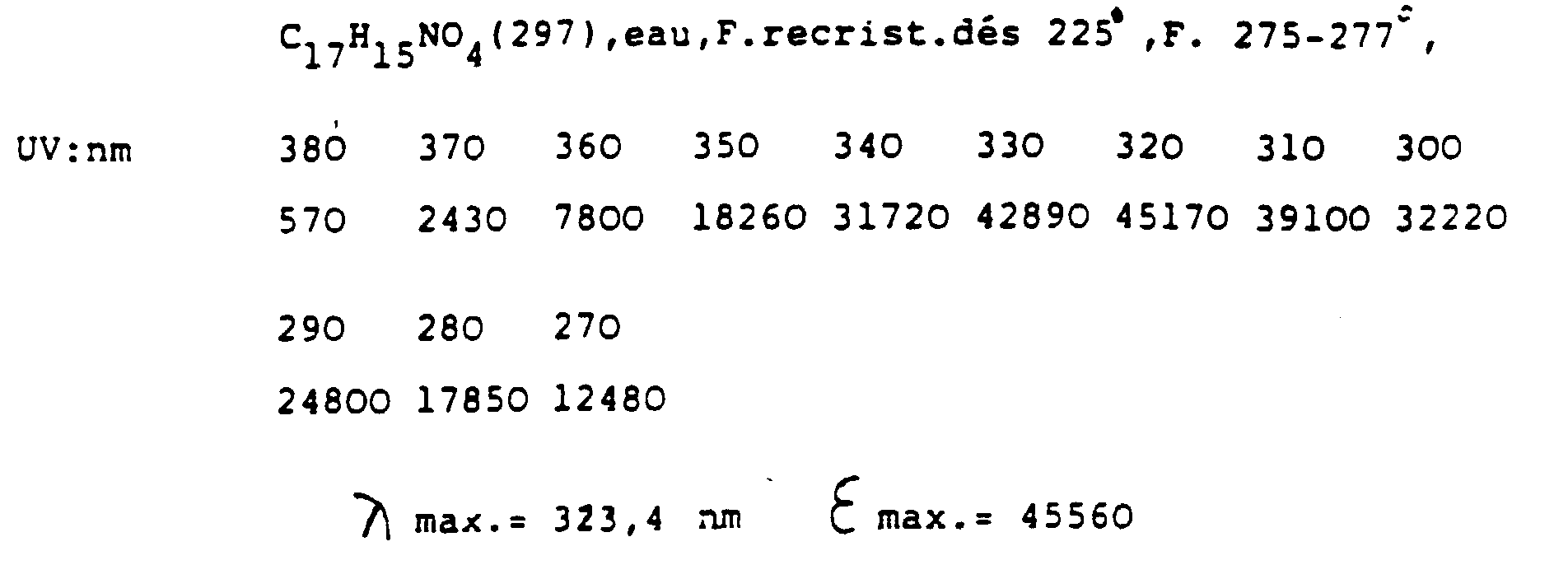
- Nous avons choisi pour la fonction intermédiaire,polarisable,entre une reste cinnamyle et un reste phényle,la fonction-CONH-,réalisant les N-phényl-cinnamamides.Leur pouvoir d'absorption de la lumière entre 280 et 350 nm(UV-B et UV-A) est trés élevé.La position de leur λ max.peut être choisie choisie en vertu des fonctions donneur et accepteur d'électrons placées séparément sur le reste cinnamyl d'un côté et sur le reste phényl de l'autre.Pour la raison de la meilleure transmission de cet effet à travers toute la molécule,nous préférons les positions para et ortho par rapport à la place de la fonction intermédiaire-CONH-
Les deux structures générales des N-phényl-cinnamamides selon un mode particulier de l'invention sont représentées dans le taleau II.
- Lorsque à partir de la fonction donneur d'électrons A,la fonction B accepteur d'électrons permet d'étendre la polarisation au reste phényle,l'effet bathochromique augmente(déplacement vers ou dans les UV-A);lorsque la fonction A est moins donneur d'électrons l'effet hypsochromique se manifeste( déplacement vers ou dans les UV-B).
Ainsi,dans la même famille de subtances,les N-phényl-cinnamamides, on peut confectionner un filtre solaire à trés fort pouvoir absorbant de la lumière ultra-violette choisie.Ces propriétés confèrent aux N-phényl-cinnamamides,comme fitres solaires,protecteurs des denrées alimentaires et des matériaux contre les altérations provoquées par la lumière ultra-violette,une qualité de protection que l'on ne connaît pas chez les filtres solaires commercialisés(voir le tableau I). - Des N-phénylcinnamamides ont été déjà proposées comme filtres solaires:la N-(4-sulfophényl)-cinnamamide(et ses sels) est décrite dans EP-A 950097.Elle possède une absorption UV-B (λ max.= 300 nm), et son intensité d'absorption est relativement faible (ε = 25100). La N-(4-carbéthoxy-phényl)-4-diméthyl-amino-cinnamamide décrite dans JP A-74 69,847 absorbe dans les UV A, le proche visible. Sa coloration le rend impropre à l'usage cosmétique.
- La synthèse des N-phényl-cinnamamides a été effectueé à partir des dérivé appropriés de l'acide cinnamique dont la fonction carboxy a été transformée en chlorure d'acide ou anhydride d'acide du anhydride mixte ou en esters activés ou azide ou en un dérivé d'une carbodiimide réagissant avec la fonction amino phényl substitué ou non,dans un solvant anhydre.Les produits sont cristallisés dans l'eau et recristallisés dans le solvant indiqué dans la description des N-phényl-cinnamamides.
Les analyses ont portés sur la composition C,H,N,S;les points de fusion sont déterminés avec l'appareil de Kofler(Reichert);les spectres UV ont été établis avec le spectromètre Cary 2300;les spectres IR ont été obtenus avec le spectromètre 735 B de Perkin-Elmer. -

-

-

-

-

Claims (10)
- Les N-phényl-cinnamamides de la formule I,utilisés en qualité de filtres solaires et d'écrans solaires en cosmétique et applications topiques médicales,utilisés en qualité d'agents de protection des denrées alimentaires et des matériaux contre les dommages provoqués par la lumière ultra-violette,

dans laquelle R2est un hydrogène,une fonction hydroxy,une fonction acide carboxylique,une fonction ester carboxylique,une fonction sulfonique,
dans laquelle R3 est une fonction carboxylique modifiée:une fonction acide carboxylique à l'exception du cas dans lequel R1 est une fonction dialkylamino,une fonction ester carboxylique à l'exception du cas dans lequel R1 est une fonction dialkylamino,une fonction carboxamide,une fonction carboxamide avec un acide aminé,une fonction amide peptidique,une fonction amide avec une amine aromatiqueune fonction amide N-acylée,une fonction cétonique aliphatique,une fonction cétonique aromatique,une fonction -dicétonique,une fonction sulfonique à l'exception du cas dans lequel R1 est un hydrogène,une fonction sulfamyle,une fonction sulfoxyde,une fonction sulfone,une fonction nitrile,un reste 2-benzimidazole substitué ou nonun reste 2-benzothiazole substitué ou non.dans laquelle R4 est un hydrogène,une fonction hydroxy,une fonction alkoxy jusqu'à 6 atomes de carbone,une fonction acide carboxylique,une fonction ester carboxylique si R1 n'est pas un alkoxy de 1 à 4 atomes de carbone. - Une N-phényl-cinnamamide de la formule II,selon la revendication 1,caractérisée par ses propriétés de filtre solaire UV-B,de protection des denrées alimentaires et des matériaux contre les dommages provoqués par la lumière ultra-violette,

- Une N-phényl-cinnamamide de la formule III,selon la revendication 1,caractérisée par ses propriétés de filtre solaire UV-A et UV-B,de protection des denrées alimentaires et des matériaux contre les dommages provoqués par la lumière ultra-violette,

- Une N-phényl-cinnamamide de la formule V,selon la revendication1,caratérisée par ses propriétés de filtre solaire UV-A et UV-B,de protection des denrées alimentaires et des matériaux contre les dommages provoqués par la lumière ultra-violette,

- Une N-phényl-cinnamamide de la formule VI,selon la revendication 1,caractérisée par ses propriétés de filtre solaire UV-A et UV-B,de protection des denrées alimentaires et des matériaux contre les dommages provoqués par la lumière ultra-violette,

- Une N-phényl-cinnamamide de la formule VII,selon la revendication 1,caractérisée par ses propriétés de filtre solaire UV-A et UV-B,de protection des denrées alimentaires et des matériaux contre les dommages provoqués par la lumière ultra-violette,

- Usage de la N-(4-carboxy-phényl)-4-méthoxy-cinnamamide, de la N-(4-carbéthoxy-phényl)-4-méthoxy-cinnamamide et de la N-(4-carbo-2-éthyl-hexyloxy-phényl)-4-méthoxy-cinnamamide en qualité de filtres solaire UV-AB,pour des applications dans des formulations cosmétiques.
- Usage de la la N-(4-(6-méthyl-benzothiazolyl-2-phényl)-4-méthoxy-cinnamamide en qualité de filtres solaires UV-A, pour des applications dans des formulations cosmétiques.
- Usage de la N-(4-carbéthoxy-phényl)-cinnamamide en qualité de filtres solaires UV-B,pour des applications dans des formulations cosmétiques
- Usage des N-phényl-cinnamamides suivant les revendications 1 à 6 en qualité d'agents de protection des matériaux contre les dommages provoqués par la lumière ultra-violette.
Applications Claiming Priority (3)
| Application Number | Priority Date | Filing Date | Title |
|---|---|---|---|
| CH1305/91 | 1991-05-02 | ||
| CH130591 | 1991-05-02 | ||
| PCT/CH1992/000088 WO1992019223A1 (fr) | 1991-05-02 | 1992-05-01 | Les n-phenyl-cinnamamides, protecteurs contre les effets nocifs de la lumiere ultra-violette |
Publications (2)
| Publication Number | Publication Date |
|---|---|
| EP0541737A1 EP0541737A1 (fr) | 1993-05-19 |
| EP0541737B1 true EP0541737B1 (fr) | 1997-04-09 |
Family
ID=4207338
Family Applications (1)
| Application Number | Title | Priority Date | Filing Date |
|---|---|---|---|
| EP92908925A Expired - Lifetime EP0541737B1 (fr) | 1991-05-02 | 1992-05-01 | Les n-phenyl-cinnamamides, protecteurs contre les effets nocifs de la lumiere ultra-violette |
Country Status (6)
| Country | Link |
|---|---|
| EP (1) | EP0541737B1 (fr) |
| JP (1) | JPH06501490A (fr) |
| AT (1) | ATE151408T1 (fr) |
| AU (1) | AU1664892A (fr) |
| DE (1) | DE69218888D1 (fr) |
| WO (1) | WO1992019223A1 (fr) |
Cited By (1)
| Publication number | Priority date | Publication date | Assignee | Title |
|---|---|---|---|---|
| WO2024200549A1 (fr) * | 2023-03-28 | 2024-10-03 | Roka Furadada, S.L. | Composés de dibenzoylméthane en tant que précurseurs photochimiques d'absorbeurs d'ultraviolets |
Families Citing this family (5)
| Publication number | Priority date | Publication date | Assignee | Title |
|---|---|---|---|---|
| DE4437502A1 (de) * | 1993-12-02 | 1995-06-08 | Basf Ag | Hirudin-Konjugate aus Hirudin und lipophilen Verbindungen |
| US6080880A (en) * | 1997-11-28 | 2000-06-27 | Societe L'oreal S.A. | Silicone-substituted cinnamamide/malonamide/malonate compounds and photoprotective compositions comprised thereof |
| KR100492809B1 (ko) * | 2001-11-23 | 2005-06-03 | 한국화학연구원 | 항산화 활성을 갖는 4-히드록시 신남아미드 유도체, 그의제조방법 및 이를 포함하는 약학적 조성물 |
| CN100334061C (zh) * | 2002-11-05 | 2007-08-29 | 立德化学株式会社 | 紫外线防御化合物 |
| CN104304244B (zh) * | 2014-09-11 | 2016-08-24 | 广西田园生化股份有限公司 | 一种用于农药制剂中的抗紫外线吸收剂 |
Family Cites Families (5)
| Publication number | Priority date | Publication date | Assignee | Title |
|---|---|---|---|---|
| US4337270A (en) * | 1980-05-21 | 1982-06-29 | Hisamitsu Pharmaceutical Co., Inc. | Novel anthranilic acid derivatives |
| DE3219643A1 (de) * | 1982-05-25 | 1983-12-01 | Haarmann & Reimer Gmbh | Gegebenenfalls in form eines salzes vorliegendes zimtsaeure-(p-sulfo-phenylamid), ein verfahren zu seiner herstellung und seine verwendung in lichtschutzmitteln |
| US4536346A (en) * | 1983-05-06 | 1985-08-20 | American Cyanamid Company | Aralkanamidophenyl compounds |
| US4883653A (en) * | 1984-06-25 | 1989-11-28 | Olin Corporation | Aryl N,N-bis cinnamamide compounds and their use as ultraviolet light stabilizers |
| FR2594332B1 (fr) * | 1986-02-14 | 1988-12-16 | Jung Louis | Derives d'acides amino-benzoiques, d'acides hydroxy-benzoiques, d'acides cinnamiques, d'acide urocanique et de benzimidazole presentant ou non un groupement d'acide amine absorbant les uvb et/ou les uva et permettant d'eviter les photodermatoses, chez l'homme, consecutives a l'administration de medicaments, a l'emploi de cosmetiques parfumes ou de parfums |
-
1992
- 1992-05-01 WO PCT/CH1992/000088 patent/WO1992019223A1/fr not_active Ceased
- 1992-05-01 DE DE69218888T patent/DE69218888D1/de not_active Expired - Lifetime
- 1992-05-01 AT AT92908925T patent/ATE151408T1/de not_active IP Right Cessation
- 1992-05-01 EP EP92908925A patent/EP0541737B1/fr not_active Expired - Lifetime
- 1992-05-01 JP JP4508419A patent/JPH06501490A/ja active Pending
- 1992-05-01 AU AU16648/92A patent/AU1664892A/en not_active Abandoned
Non-Patent Citations (1)
| Title |
|---|
| CHEMICAL ABSTRACTS, vol. 83, no. 8, 25 août 1975, Columbus, Ohio, US; abstract no. 65337y, page 436; & JP-A-7 469 874 * |
Cited By (1)
| Publication number | Priority date | Publication date | Assignee | Title |
|---|---|---|---|---|
| WO2024200549A1 (fr) * | 2023-03-28 | 2024-10-03 | Roka Furadada, S.L. | Composés de dibenzoylméthane en tant que précurseurs photochimiques d'absorbeurs d'ultraviolets |
Also Published As
| Publication number | Publication date |
|---|---|
| JPH06501490A (ja) | 1994-02-17 |
| DE69218888D1 (de) | 1997-05-15 |
| AU1664892A (en) | 1992-12-21 |
| EP0541737A1 (fr) | 1993-05-19 |
| WO1992019223A1 (fr) | 1992-11-12 |
| ATE151408T1 (de) | 1997-04-15 |
Similar Documents
| Publication | Publication Date | Title |
|---|---|---|
| BE1000623A3 (fr) | Composition cosmetique photostable contenant un filtre uv-a et un filtre uv-b, son utilisation pour la protection de la peau contre les rayons uv et procede de stabilisation du filtre uv-a par le filtre uv-b. | |
| KR101007768B1 (ko) | 자외선 흡수제 | |
| CA2076003C (fr) | Composition cosmetique filtrante photostable contenant un filtre uv-a et un beta,beta-diphenylacrylate ou o-cyano-beta,beta- diphenylacrylate d'alkyle | |
| EP0542941B1 (fr) | Les n-phenyl-benzamides protecteurs contre les effets nocifs de la lumiere ultra-violette | |
| FR2799119A1 (fr) | Procede pour ameliorer la stabilite vis-a-vis du rayonnement uv de filtres solaires photosensibles | |
| FR2674851A1 (fr) | Derives s-triaziniques portant des substituants benzylidene camphre, compositions cosmetiques filtrantes et leur utilisation pour proteger la peau et les cheveux du rayonnement ultraviolet. | |
| EP1299076A2 (fr) | Utilisation du resveratrol en tant qu'ecran solaire | |
| FR2674850A1 (fr) | Derives s-triaziniques portant des substituants benzalmalonates, compositions cosmetiques filtrantes les contenant et leur utilisation pour proteger la peau et les cheveux du rayonnement ultraviolet. | |
| AU2001281792A1 (en) | The use of resveratrol as sunscreen | |
| FR3158039A1 (fr) | Composition cosmetique solaire contenant des acides amines analogues de la mycosporine | |
| FR2636530A1 (fr) | Composition cosmetique filtrante photostable sous forme d'emulsion contenant un filtre hydrosoluble a large bande d'absorption et au moins un filtre uv-a liposoluble et son utilisation pour la protection de la peau contre le rayonnement ultraviolet | |
| EP0541737B1 (fr) | Les n-phenyl-cinnamamides, protecteurs contre les effets nocifs de la lumiere ultra-violette | |
| JP2005539052A (ja) | 化粧品および医薬品における光安定性uvフィルターとしてのジケトピペラジン誘導体の使用 | |
| US6518451B2 (en) | Diesters of naphthalene dicarboxylic acid | |
| FR3102672A1 (fr) | Composition solaire résistante à l’eau à haute teneur de triazines | |
| FR2780975A1 (fr) | Procede de photostabilisation de filtres solaires derives du dibenzoylmethane, compositions cosmetiques filtrantes photostabilisees ainsi obtenues et leurs utilisations | |
| JPH09202723A (ja) | トリアジン誘導体及びグリセリル化合物を含有する化粧品及び皮膚科用の光線防御用調製物 | |
| EP1753747B1 (fr) | Derives dimeriques de 5,6-diphenyl-1,2,4-triazine et leurs utilisations en tant qu'agents protecteurs du soleil | |
| CN106420409B (zh) | 一种薰衣草精油防晒霜组合物 | |
| CA2564493C (fr) | Derives monomeriques de 5,6-diphenyl-1,2,4-triazine et leurs utilisations | |
| EP3103436B1 (fr) | Composés dérivés de l'acide 3-(alkylthio)propénoïque, et leur application en cosmétique | |
| Mariani et al. | Synthesis, in vitro percutaneous absorption and phototoxicity of new benzylidene derivatives of 1, 3, 3-trimethyl-2-oxabicyclo [2.2. 2] octan-6-one as potential UV sunscreens | |
| JP2002053527A (ja) | 5,5−ジアリール−2,4−ペンタジエン酸エステル系化合物および該化合物を有効成分とする紫外線吸収剤 | |
| EP0376652A2 (fr) | Compositions de dérivés 1-cyclohexénylacétonitrile d'aldéhydes absorbant la radiation ultraviolette | |
| FR2749510A1 (fr) | Composition protectrice contre les rayons ultra-violets solaires |
Legal Events
| Date | Code | Title | Description |
|---|---|---|---|
| PUAI | Public reference made under article 153(3) epc to a published international application that has entered the european phase |
Free format text: ORIGINAL CODE: 0009012 |
|
| AK | Designated contracting states |
Kind code of ref document: A1 Designated state(s): AT BE DE DK ES FR GB GR IT LU NL SE |
|
| 17P | Request for examination filed |
Effective date: 19930511 |
|
| 17Q | First examination report despatched |
Effective date: 19941205 |
|
| GRAH | Despatch of communication of intention to grant a patent |
Free format text: ORIGINAL CODE: EPIDOS IGRA |
|
| GRAH | Despatch of communication of intention to grant a patent |
Free format text: ORIGINAL CODE: EPIDOS IGRA |
|
| GRAA | (expected) grant |
Free format text: ORIGINAL CODE: 0009210 |
|
| AK | Designated contracting states |
Kind code of ref document: B1 Designated state(s): AT BE DE DK ES FR GB GR IT LU NL SE |
|
| PG25 | Lapsed in a contracting state [announced via postgrant information from national office to epo] |
Ref country code: NL Effective date: 19970409 Ref country code: IT Free format text: LAPSE BECAUSE OF FAILURE TO SUBMIT A TRANSLATION OF THE DESCRIPTION OR TO PAY THE FEE WITHIN THE PRE;WARNING: LAPSES OF ITALIAN PATENTS WITH EFFECTIVE DATE BEFORE 2007 MAY HAVE OCCURRED AT ANY TIME BEFORE 2007. THE CORRECT EFFECTIVE DATE MAY BE DIFFERENT FROM THE ONE RECORDED.SCRIBED TIME-LIMIT Effective date: 19970409 Ref country code: GR Free format text: LAPSE BECAUSE OF FAILURE TO SUBMIT A TRANSLATION OF THE DESCRIPTION OR TO PAY THE FEE WITHIN THE PRESCRIBED TIME-LIMIT Effective date: 19970409 Ref country code: GB Effective date: 19970409 Ref country code: ES Free format text: THE PATENT HAS BEEN ANNULLED BY A DECISION OF A NATIONAL AUTHORITY Effective date: 19970409 Ref country code: DK Effective date: 19970409 Ref country code: AT Effective date: 19970409 |
|
| REF | Corresponds to: |
Ref document number: 151408 Country of ref document: AT Date of ref document: 19970415 Kind code of ref document: T |
|
| PG25 | Lapsed in a contracting state [announced via postgrant information from national office to epo] |
Ref country code: LU Free format text: LAPSE BECAUSE OF NON-PAYMENT OF DUE FEES Effective date: 19970501 |
|
| REF | Corresponds to: |
Ref document number: 69218888 Country of ref document: DE Date of ref document: 19970515 |
|
| PG25 | Lapsed in a contracting state [announced via postgrant information from national office to epo] |
Ref country code: BE Effective date: 19970531 |
|
| PG25 | Lapsed in a contracting state [announced via postgrant information from national office to epo] |
Ref country code: SE Effective date: 19970709 |
|
| PG25 | Lapsed in a contracting state [announced via postgrant information from national office to epo] |
Ref country code: DE Effective date: 19970710 |
|
| NLV1 | Nl: lapsed or annulled due to failure to fulfill the requirements of art. 29p and 29m of the patents act | ||
| GBV | Gb: ep patent (uk) treated as always having been void in accordance with gb section 77(7)/1977 [no translation filed] |
Effective date: 19970409 |
|
| BERE | Be: lapsed |
Owner name: BAUDET PIERRE Effective date: 19970531 |
|
| PLBE | No opposition filed within time limit |
Free format text: ORIGINAL CODE: 0009261 |
|
| PG25 | Lapsed in a contracting state [announced via postgrant information from national office to epo] |
Ref country code: FR Free format text: LAPSE BECAUSE OF NON-PAYMENT OF DUE FEES Effective date: 19980331 |
|
| 26N | No opposition filed | ||
| REG | Reference to a national code |
Ref country code: FR Ref legal event code: ST |
|
| PG25 | Lapsed in a contracting state [announced via postgrant information from national office to epo] |
Ref country code: FR Free format text: LAPSE BECAUSE OF NON-PAYMENT OF DUE FEES Effective date: 19970531 |