EP0542082A2 - Verfahren zur kontinuierlichen Umsetzung von Difluortriazinyl-Verbindungen mit Aminen - Google Patents
Verfahren zur kontinuierlichen Umsetzung von Difluortriazinyl-Verbindungen mit Aminen Download PDFInfo
- Publication number
- EP0542082A2 EP0542082A2 EP92118739A EP92118739A EP0542082A2 EP 0542082 A2 EP0542082 A2 EP 0542082A2 EP 92118739 A EP92118739 A EP 92118739A EP 92118739 A EP92118739 A EP 92118739A EP 0542082 A2 EP0542082 A2 EP 0542082A2
- Authority
- EP
- European Patent Office
- Prior art keywords
- alkyl
- formula
- amines
- reactor
- compounds
- Prior art date
- Legal status (The legal status is an assumption and is not a legal conclusion. Google has not performed a legal analysis and makes no representation as to the accuracy of the status listed.)
- Granted
Links
- 150000001412 amines Chemical class 0.000 title claims abstract description 24
- 238000000034 method Methods 0.000 title claims description 24
- 150000001875 compounds Chemical class 0.000 title claims description 10
- -1 Difluorotriazinyl compounds Chemical class 0.000 claims abstract description 40
- 239000000725 suspension Substances 0.000 claims abstract description 14
- 125000000020 sulfo group Chemical group O=S(=O)([*])O[H] 0.000 claims description 22
- 238000006243 chemical reaction Methods 0.000 claims description 21
- 229910006069 SO3H Inorganic materials 0.000 claims description 20
- 125000004178 (C1-C4) alkyl group Chemical group 0.000 claims description 16
- 229910004727 OSO3H Inorganic materials 0.000 claims description 16
- YNAVUWVOSKDBBP-UHFFFAOYSA-N Morpholine Chemical compound C1COCCN1 YNAVUWVOSKDBBP-UHFFFAOYSA-N 0.000 claims description 13
- 229910052736 halogen Inorganic materials 0.000 claims description 9
- 150000002367 halogens Chemical class 0.000 claims description 9
- 125000000896 monocarboxylic acid group Chemical group 0.000 claims description 9
- 125000006297 carbonyl amino group Chemical group [H]N([*:2])C([*:1])=O 0.000 claims description 6
- 238000002156 mixing Methods 0.000 claims description 6
- 239000007858 starting material Substances 0.000 claims description 5
- 239000007864 aqueous solution Substances 0.000 claims description 4
- 125000001931 aliphatic group Chemical group 0.000 claims description 3
- 125000003118 aryl group Chemical group 0.000 claims description 3
- 229910052757 nitrogen Inorganic materials 0.000 claims description 3
- 125000004433 nitrogen atom Chemical group N* 0.000 claims description 3
- 150000003254 radicals Chemical class 0.000 claims description 3
- 239000002152 aqueous-organic solution Substances 0.000 claims description 2
- 239000000243 solution Substances 0.000 description 19
- 239000000460 chlorine Substances 0.000 description 17
- 150000003457 sulfones Chemical class 0.000 description 16
- 125000000229 (C1-C4)alkoxy group Chemical group 0.000 description 14
- 125000002496 methyl group Chemical group [H]C([H])([H])* 0.000 description 11
- CDBYLPFSWZWCQE-UHFFFAOYSA-L Sodium Carbonate Chemical compound [Na+].[Na+].[O-]C([O-])=O CDBYLPFSWZWCQE-UHFFFAOYSA-L 0.000 description 7
- 239000002585 base Substances 0.000 description 7
- 229910052801 chlorine Inorganic materials 0.000 description 7
- 239000000975 dye Substances 0.000 description 7
- 239000000985 reactive dye Substances 0.000 description 7
- PAYRUJLWNCNPSJ-UHFFFAOYSA-N Aniline Chemical compound NC1=CC=CC=C1 PAYRUJLWNCNPSJ-UHFFFAOYSA-N 0.000 description 6
- 229910052794 bromium Inorganic materials 0.000 description 6
- 125000003830 C1- C4 alkylcarbonylamino group Chemical group 0.000 description 5
- 125000000391 vinyl group Chemical group [H]C([*])=C([H])[H] 0.000 description 5
- 125000004760 (C1-C4) alkylsulfonylamino group Chemical group 0.000 description 4
- 0 C*Bc(ccc1c2OC3=C(*)C4=Nc5ccc(B**)c(S(O)(=O)=O)c5OC4=C(*)C3=N1)c2S(O)(=O)=O Chemical compound C*Bc(ccc1c2OC3=C(*)C4=Nc5ccc(B**)c(S(O)(=O)=O)c5OC4=C(*)C3=N1)c2S(O)(=O)=O 0.000 description 4
- OJGMBLNIHDZDGS-UHFFFAOYSA-N N-Ethylaniline Chemical compound CCNC1=CC=CC=C1 OJGMBLNIHDZDGS-UHFFFAOYSA-N 0.000 description 4
- 125000004442 acylamino group Chemical group 0.000 description 4
- 125000004658 aryl carbonyl amino group Chemical group 0.000 description 4
- 229910052802 copper Inorganic materials 0.000 description 4
- 125000000956 methoxy group Chemical group [H]C([H])([H])O* 0.000 description 4
- 229910052759 nickel Inorganic materials 0.000 description 4
- 239000011541 reaction mixture Substances 0.000 description 4
- 125000000217 alkyl group Chemical group 0.000 description 3
- 125000003917 carbamoyl group Chemical group [H]N([H])C(*)=O 0.000 description 3
- 125000004432 carbon atom Chemical group C* 0.000 description 3
- 229920002678 cellulose Polymers 0.000 description 3
- 239000001913 cellulose Substances 0.000 description 3
- SYGWYBOJXOGMRU-UHFFFAOYSA-N chembl233051 Chemical compound C1=CC=C2C3=CC(C(N(CCN(C)C)C4=O)=O)=C5C4=CC=CC5=C3SC2=C1 SYGWYBOJXOGMRU-UHFFFAOYSA-N 0.000 description 3
- 239000007859 condensation product Substances 0.000 description 3
- 239000006185 dispersion Substances 0.000 description 3
- 125000001495 ethyl group Chemical group [H]C([H])([H])C([H])([H])* 0.000 description 3
- 239000000463 material Substances 0.000 description 3
- 239000002184 metal Substances 0.000 description 3
- 229910052751 metal Inorganic materials 0.000 description 3
- XLYOFNOQVPJJNP-UHFFFAOYSA-N water Substances O XLYOFNOQVPJJNP-UHFFFAOYSA-N 0.000 description 3
- 125000004769 (C1-C4) alkylsulfonyl group Chemical group 0.000 description 2
- IJGRMHOSHXDMSA-UHFFFAOYSA-N Atomic nitrogen Chemical compound N#N IJGRMHOSHXDMSA-UHFFFAOYSA-N 0.000 description 2
- ZAMOUSCENKQFHK-UHFFFAOYSA-N Chlorine atom Chemical compound [Cl] ZAMOUSCENKQFHK-UHFFFAOYSA-N 0.000 description 2
- AFBPFSWMIHJQDM-UHFFFAOYSA-N N-methylaniline Chemical compound CNC1=CC=CC=C1 AFBPFSWMIHJQDM-UHFFFAOYSA-N 0.000 description 2
- UFWIBTONFRDIAS-UHFFFAOYSA-N Naphthalene Chemical compound C1=CC=CC2=CC=CC=C21 UFWIBTONFRDIAS-UHFFFAOYSA-N 0.000 description 2
- JCXJVPUVTGWSNB-UHFFFAOYSA-N Nitrogen dioxide Chemical compound O=[N]=O JCXJVPUVTGWSNB-UHFFFAOYSA-N 0.000 description 2
- NQRYJNQNLNOLGT-UHFFFAOYSA-N Piperidine Chemical compound C1CCNCC1 NQRYJNQNLNOLGT-UHFFFAOYSA-N 0.000 description 2
- 125000003545 alkoxy group Chemical group 0.000 description 2
- 125000006598 aminocarbonylamino group Chemical group 0.000 description 2
- 150000004982 aromatic amines Chemical class 0.000 description 2
- 125000005126 aryl alkyl carbonyl amino group Chemical group 0.000 description 2
- 125000004429 atom Chemical group 0.000 description 2
- 125000000043 benzamido group Chemical group [H]N([*])C(=O)C1=C([H])C([H])=C([H])C([H])=C1[H] 0.000 description 2
- 239000007795 chemical reaction product Substances 0.000 description 2
- 229910052804 chromium Inorganic materials 0.000 description 2
- 230000008878 coupling Effects 0.000 description 2
- 238000010168 coupling process Methods 0.000 description 2
- 238000005859 coupling reaction Methods 0.000 description 2
- 239000012954 diazonium Substances 0.000 description 2
- 150000001989 diazonium salts Chemical class 0.000 description 2
- 238000006193 diazotization reaction Methods 0.000 description 2
- 125000005842 heteroatom Chemical group 0.000 description 2
- 229910052739 hydrogen Inorganic materials 0.000 description 2
- 125000004435 hydrogen atom Chemical group [H]* 0.000 description 2
- 229910052742 iron Inorganic materials 0.000 description 2
- 238000002955 isolation Methods 0.000 description 2
- UCFFGYASXIPWPD-UHFFFAOYSA-N methyl hypochlorite Chemical compound COCl UCFFGYASXIPWPD-UHFFFAOYSA-N 0.000 description 2
- 229910000029 sodium carbonate Inorganic materials 0.000 description 2
- 235000017550 sodium carbonate Nutrition 0.000 description 2
- 125000005420 sulfonamido group Chemical group S(=O)(=O)(N*)* 0.000 description 2
- 229910052725 zinc Inorganic materials 0.000 description 2
- 125000003161 (C1-C6) alkylene group Chemical group 0.000 description 1
- JVMSQRAXNZPDHF-UHFFFAOYSA-N 2,4-diaminobenzenesulfonic acid Chemical compound NC1=CC=C(S(O)(=O)=O)C(N)=C1 JVMSQRAXNZPDHF-UHFFFAOYSA-N 0.000 description 1
- VOPSFYWMOIKYEM-UHFFFAOYSA-N 2,5-diaminobenzene-1,4-disulfonic acid Chemical compound NC1=CC(S(O)(=O)=O)=C(N)C=C1S(O)(=O)=O VOPSFYWMOIKYEM-UHFFFAOYSA-N 0.000 description 1
- HEAHMJLHQCESBZ-UHFFFAOYSA-N 2,5-diaminobenzenesulfonic acid Chemical compound NC1=CC=C(N)C(S(O)(=O)=O)=C1 HEAHMJLHQCESBZ-UHFFFAOYSA-N 0.000 description 1
- HIVUAOXLSJITPA-UHFFFAOYSA-N 2-amino-5-hydroxynaphthalene-1,7-disulfonic acid Chemical compound OC1=CC(S(O)(=O)=O)=CC2=C(S(O)(=O)=O)C(N)=CC=C21 HIVUAOXLSJITPA-UHFFFAOYSA-N 0.000 description 1
- MJNYPLCGWXFYPD-UHFFFAOYSA-N 2-amino-5-sulfobenzoic acid Chemical compound NC1=CC=C(S(O)(=O)=O)C=C1C(O)=O MJNYPLCGWXFYPD-UHFFFAOYSA-N 0.000 description 1
- ZMCHBSMFKQYNKA-UHFFFAOYSA-N 2-aminobenzenesulfonic acid Chemical compound NC1=CC=CC=C1S(O)(=O)=O ZMCHBSMFKQYNKA-UHFFFAOYSA-N 0.000 description 1
- YAIKCRUPEVOINQ-UHFFFAOYSA-N 2-aminonaphthalene-1,5-disulfonic acid Chemical compound OS(=O)(=O)C1=CC=CC2=C(S(O)(=O)=O)C(N)=CC=C21 YAIKCRUPEVOINQ-UHFFFAOYSA-N 0.000 description 1
- GWIAAIUASRVOIA-UHFFFAOYSA-N 2-aminonaphthalene-1-sulfonic acid Chemical compound C1=CC=CC2=C(S(O)(=O)=O)C(N)=CC=C21 GWIAAIUASRVOIA-UHFFFAOYSA-N 0.000 description 1
- MWGATWIBSKHFMR-UHFFFAOYSA-N 2-anilinoethanol Chemical compound OCCNC1=CC=CC=C1 MWGATWIBSKHFMR-UHFFFAOYSA-N 0.000 description 1
- AJHPGXZOIAYYDW-UHFFFAOYSA-N 3-(2-cyanophenyl)-2-[(2-methylpropan-2-yl)oxycarbonylamino]propanoic acid Chemical compound CC(C)(C)OC(=O)NC(C(O)=O)CC1=CC=CC=C1C#N AJHPGXZOIAYYDW-UHFFFAOYSA-N 0.000 description 1
- UARPFAZLXITZKP-UHFFFAOYSA-N 3-amino-2-hydroxybenzenesulfonic acid Chemical compound NC1=CC=CC(S(O)(=O)=O)=C1O UARPFAZLXITZKP-UHFFFAOYSA-N 0.000 description 1
- VNWVMZDJPMCAKD-UHFFFAOYSA-N 3-amino-5-hydroxynaphthalene-2,7-disulfonic acid Chemical compound C1=C(S(O)(=O)=O)C=C2C=C(S(O)(=O)=O)C(N)=CC2=C1O VNWVMZDJPMCAKD-UHFFFAOYSA-N 0.000 description 1
- ZAJAQTYSTDTMCU-UHFFFAOYSA-N 3-aminobenzenesulfonic acid Chemical compound NC1=CC=CC(S(O)(=O)=O)=C1 ZAJAQTYSTDTMCU-UHFFFAOYSA-N 0.000 description 1
- MTJGVAJYTOXFJH-UHFFFAOYSA-N 3-aminonaphthalene-1,5-disulfonic acid Chemical compound C1=CC=C(S(O)(=O)=O)C2=CC(N)=CC(S(O)(=O)=O)=C21 MTJGVAJYTOXFJH-UHFFFAOYSA-N 0.000 description 1
- PNPCRKVUWYDDST-UHFFFAOYSA-N 3-chloroaniline Chemical compound NC1=CC=CC(Cl)=C1 PNPCRKVUWYDDST-UHFFFAOYSA-N 0.000 description 1
- YADSWTKOIHUSDX-UHFFFAOYSA-N 4,6-diaminobenzene-1,3-disulfonic acid Chemical compound NC1=CC(N)=C(S(O)(=O)=O)C=C1S(O)(=O)=O YADSWTKOIHUSDX-UHFFFAOYSA-N 0.000 description 1
- RKDUVPVDHFMLPC-UHFFFAOYSA-N 4,6-difluorotriazine Chemical class FC1=CC(F)=NN=N1 RKDUVPVDHFMLPC-UHFFFAOYSA-N 0.000 description 1
- ZDIRCGKEOWZBIM-UHFFFAOYSA-N 4-amino-2-methylbenzenesulfonic acid Chemical compound CC1=CC(N)=CC=C1S(O)(=O)=O ZDIRCGKEOWZBIM-UHFFFAOYSA-N 0.000 description 1
- ALYNCZNDIQEVRV-PZFLKRBQSA-N 4-amino-3,5-ditritiobenzoic acid Chemical compound [3H]c1cc(cc([3H])c1N)C(O)=O ALYNCZNDIQEVRV-PZFLKRBQSA-N 0.000 description 1
- WQTCZINVPXJNEL-UHFFFAOYSA-N 4-amino-3-methylbenzenesulfonic acid Chemical compound CC1=CC(S(O)(=O)=O)=CC=C1N WQTCZINVPXJNEL-UHFFFAOYSA-N 0.000 description 1
- ZFRBZRZEKIOGQI-UHFFFAOYSA-N 4-amino-5-hydroxynaphthalene-1,3-disulfonic acid Chemical compound C1=CC(O)=C2C(N)=C(S(O)(=O)=O)C=C(S(O)(=O)=O)C2=C1 ZFRBZRZEKIOGQI-UHFFFAOYSA-N 0.000 description 1
- ZUQOBHTUMCEQBG-UHFFFAOYSA-N 4-amino-5-hydroxynaphthalene-1,7-disulfonic acid Chemical compound OS(=O)(=O)C1=CC(O)=C2C(N)=CC=C(S(O)(=O)=O)C2=C1 ZUQOBHTUMCEQBG-UHFFFAOYSA-N 0.000 description 1
- LRDIEHDJWYRVPT-UHFFFAOYSA-N 4-amino-5-hydroxynaphthalene-1-sulfonic acid Chemical compound C1=CC(O)=C2C(N)=CC=C(S(O)(=O)=O)C2=C1 LRDIEHDJWYRVPT-UHFFFAOYSA-N 0.000 description 1
- APRRQJCCBSJQOQ-UHFFFAOYSA-N 4-amino-5-hydroxynaphthalene-2,7-disulfonic acid Chemical compound OS(=O)(=O)C1=CC(O)=C2C(N)=CC(S(O)(=O)=O)=CC2=C1 APRRQJCCBSJQOQ-UHFFFAOYSA-N 0.000 description 1
- QOGVSLHQIYEIRX-UHFFFAOYSA-N 4-amino-5-hydroxynaphthalene-2-sulfonic acid Chemical compound C1=CC(O)=C2C(N)=CC(S(O)(=O)=O)=CC2=C1 QOGVSLHQIYEIRX-UHFFFAOYSA-N 0.000 description 1
- HVBSAKJJOYLTQU-UHFFFAOYSA-N 4-aminobenzenesulfonic acid Chemical compound NC1=CC=C(S(O)(=O)=O)C=C1 HVBSAKJJOYLTQU-UHFFFAOYSA-N 0.000 description 1
- QSNSCYSYFYORTR-UHFFFAOYSA-N 4-chloroaniline Chemical compound NC1=CC=C(Cl)C=C1 QSNSCYSYFYORTR-UHFFFAOYSA-N 0.000 description 1
- SEHCLGZKORRUKN-UHFFFAOYSA-N 4-hydroxy-6-(methylamino)naphthalene-2-sulfonic acid Chemical compound C1=C(S(O)(=O)=O)C=C(O)C2=CC(NC)=CC=C21 SEHCLGZKORRUKN-UHFFFAOYSA-N 0.000 description 1
- ZCNCWYFISJTFHB-UHFFFAOYSA-N 4-hydroxy-7-(methylamino)naphthalene-2-sulfonic acid Chemical compound OC1=CC(S(O)(=O)=O)=CC2=CC(NC)=CC=C21 ZCNCWYFISJTFHB-UHFFFAOYSA-N 0.000 description 1
- DQNAQOYOSRJXFZ-UHFFFAOYSA-N 5-Amino-1-naphthalenesulfonic acid Chemical compound C1=CC=C2C(N)=CC=CC2=C1S(O)(=O)=O DQNAQOYOSRJXFZ-UHFFFAOYSA-N 0.000 description 1
- JXZGTFLJFKLVAX-UHFFFAOYSA-N 5-amino-2-methoxybenzenesulfonic acid Chemical compound COC1=CC=C(N)C=C1S(O)(=O)=O JXZGTFLJFKLVAX-UHFFFAOYSA-N 0.000 description 1
- BRKFTWHPLMMNHF-UHFFFAOYSA-N 5-amino-2-methylbenzenesulfonic acid Chemical compound CC1=CC=C(N)C=C1S(O)(=O)=O BRKFTWHPLMMNHF-UHFFFAOYSA-N 0.000 description 1
- GZTZPXFDNYIVBZ-UHFFFAOYSA-N 5-amino-4-hydroxynaphthalene-1,7-disulfonic acid Chemical compound C1=CC(O)=C2C(N)=CC(S(O)(=O)=O)=CC2=C1S(O)(=O)=O GZTZPXFDNYIVBZ-UHFFFAOYSA-N 0.000 description 1
- SOXXKJYGIOINNC-UHFFFAOYSA-N 5-amino-4-hydroxynaphthalene-1-sulfonic acid Chemical compound C1=CC(O)=C2C(N)=CC=CC2=C1S(O)(=O)=O SOXXKJYGIOINNC-UHFFFAOYSA-N 0.000 description 1
- GBWNQBBVSVGAAL-UHFFFAOYSA-N 5-aminobenzene-1,3-disulfonic acid Chemical compound NC1=CC(S(O)(=O)=O)=CC(S(O)(=O)=O)=C1 GBWNQBBVSVGAAL-UHFFFAOYSA-N 0.000 description 1
- UWPJYQYRSWYIGZ-UHFFFAOYSA-N 5-aminonaphthalene-2-sulfonic acid Chemical compound OS(=O)(=O)C1=CC=C2C(N)=CC=CC2=C1 UWPJYQYRSWYIGZ-UHFFFAOYSA-N 0.000 description 1
- NRNGQXBLASGPLB-UHFFFAOYSA-N 6-(ethylamino)-4-hydroxynaphthalene-2-sulfonic acid Chemical compound C1=C(S(O)(=O)=O)C=C(O)C2=CC(NCC)=CC=C21 NRNGQXBLASGPLB-UHFFFAOYSA-N 0.000 description 1
- HBZVNWNSRNTWPS-UHFFFAOYSA-N 6-amino-4-hydroxynaphthalene-2-sulfonic acid Chemical compound C1=C(S(O)(=O)=O)C=C(O)C2=CC(N)=CC=C21 HBZVNWNSRNTWPS-UHFFFAOYSA-N 0.000 description 1
- KZCSUEYBKAPKNH-UHFFFAOYSA-N 6-aminonaphthalene-1,3-disulfonic acid Chemical compound OS(=O)(=O)C1=CC(S(O)(=O)=O)=CC2=CC(N)=CC=C21 KZCSUEYBKAPKNH-UHFFFAOYSA-N 0.000 description 1
- YUNBHHWDQDGWHC-UHFFFAOYSA-N 6-aminonaphthalene-1-sulfonic acid Chemical compound OS(=O)(=O)C1=CC=CC2=CC(N)=CC=C21 YUNBHHWDQDGWHC-UHFFFAOYSA-N 0.000 description 1
- DXQHKRLJFRUIKF-UHFFFAOYSA-N 7-(ethylamino)-4-hydroxynaphthalene-2-sulfonic acid Chemical compound OC1=CC(S(O)(=O)=O)=CC2=CC(NCC)=CC=C21 DXQHKRLJFRUIKF-UHFFFAOYSA-N 0.000 description 1
- NWYPJANFHLUNFH-UHFFFAOYSA-N 7-amino-3-hydroxynaphthalene-1-sulfonic acid Chemical compound C1=C(O)C=C(S(O)(=O)=O)C2=CC(N)=CC=C21 NWYPJANFHLUNFH-UHFFFAOYSA-N 0.000 description 1
- KYARBIJYVGJZLB-UHFFFAOYSA-N 7-amino-4-hydroxy-2-naphthalenesulfonic acid Chemical compound OC1=CC(S(O)(=O)=O)=CC2=CC(N)=CC=C21 KYARBIJYVGJZLB-UHFFFAOYSA-N 0.000 description 1
- OKAUOXITMZTUOJ-UHFFFAOYSA-N 7-aminonaphthalene-2-sulfonic acid Chemical compound C1=CC(S(O)(=O)=O)=CC2=CC(N)=CC=C21 OKAUOXITMZTUOJ-UHFFFAOYSA-N 0.000 description 1
- KSWRZJNADSIDKV-UHFFFAOYSA-N 8-amino-3-hydroxynaphthalene-1,6-disulfonic acid Chemical compound OC1=CC(S(O)(=O)=O)=C2C(N)=CC(S(O)(=O)=O)=CC2=C1 KSWRZJNADSIDKV-UHFFFAOYSA-N 0.000 description 1
- GGZZISOUXJHYOY-UHFFFAOYSA-N 8-amino-4-hydroxynaphthalene-2-sulfonic acid Chemical compound C1=C(S(O)(=O)=O)C=C2C(N)=CC=CC2=C1O GGZZISOUXJHYOY-UHFFFAOYSA-N 0.000 description 1
- RJSYPKWVIJGNLO-UHFFFAOYSA-N CCOClOC Chemical compound CCOClOC RJSYPKWVIJGNLO-UHFFFAOYSA-N 0.000 description 1
- 229920000742 Cotton Polymers 0.000 description 1
- YEGIXPKIFOHJPA-UHFFFAOYSA-N Oc1cc(S(O)(=O)=O)cc2cc(S(O)(=O)=O)cc(Nc3nc(F)nc(N4CCOCC4)n3)c12 Chemical compound Oc1cc(S(O)(=O)=O)cc2cc(S(O)(=O)=O)cc(Nc3nc(F)nc(N4CCOCC4)n3)c12 YEGIXPKIFOHJPA-UHFFFAOYSA-N 0.000 description 1
- 125000000218 acetic acid group Chemical group C(C)(=O)* 0.000 description 1
- 239000002253 acid Substances 0.000 description 1
- 150000007513 acids Chemical class 0.000 description 1
- 125000002252 acyl group Chemical group 0.000 description 1
- 230000006978 adaptation Effects 0.000 description 1
- 239000003513 alkali Substances 0.000 description 1
- 125000002947 alkylene group Chemical group 0.000 description 1
- 125000003277 amino group Chemical group 0.000 description 1
- 125000004397 aminosulfonyl group Chemical group NS(=O)(=O)* 0.000 description 1
- 229940039407 aniline Drugs 0.000 description 1
- 125000004657 aryl sulfonyl amino group Chemical group 0.000 description 1
- 125000003236 benzoyl group Chemical group [H]C1=C([H])C([H])=C(C([H])=C1[H])C(*)=O 0.000 description 1
- 239000006227 byproduct Substances 0.000 description 1
- 102220414581 c.33A>G Human genes 0.000 description 1
- 125000005521 carbonamide group Chemical group 0.000 description 1
- 238000004140 cleaning Methods 0.000 description 1
- 238000009833 condensation Methods 0.000 description 1
- 230000005494 condensation Effects 0.000 description 1
- 238000001816 cooling Methods 0.000 description 1
- 125000004093 cyano group Chemical group *C#N 0.000 description 1
- 238000010438 heat treatment Methods 0.000 description 1
- 230000007062 hydrolysis Effects 0.000 description 1
- 238000006460 hydrolysis reaction Methods 0.000 description 1
- 125000002887 hydroxy group Chemical group [H]O* 0.000 description 1
- 239000003446 ligand Substances 0.000 description 1
- 239000000203 mixture Substances 0.000 description 1
- NRZRRZAVMCAKEP-UHFFFAOYSA-N naphthionic acid Chemical compound C1=CC=C2C(N)=CC=C(S(O)(=O)=O)C2=C1 NRZRRZAVMCAKEP-UHFFFAOYSA-N 0.000 description 1
- 125000001624 naphthyl group Chemical group 0.000 description 1
- 229910052760 oxygen Inorganic materials 0.000 description 1
- 125000004430 oxygen atom Chemical group O* 0.000 description 1
- NFBAXHOPROOJAW-UHFFFAOYSA-N phenindione Chemical class O=C1C2=CC=CC=C2C(=O)C1C1=CC=CC=C1 NFBAXHOPROOJAW-UHFFFAOYSA-N 0.000 description 1
- 125000001997 phenyl group Chemical group [H]C1=C([H])C([H])=C(*)C([H])=C1[H] 0.000 description 1
- 125000000843 phenylene group Chemical group C1(=C(C=CC=C1)*)* 0.000 description 1
- 125000004193 piperazinyl group Chemical group 0.000 description 1
- 230000008092 positive effect Effects 0.000 description 1
- 239000002243 precursor Substances 0.000 description 1
- 239000000047 product Substances 0.000 description 1
- 239000000376 reactant Substances 0.000 description 1
- 230000001105 regulatory effect Effects 0.000 description 1
- 102220090095 rs1042713 Human genes 0.000 description 1
- 102220216906 rs1060505002 Human genes 0.000 description 1
- 102220228145 rs1064794513 Human genes 0.000 description 1
- 102220067365 rs143592561 Human genes 0.000 description 1
- 238000007086 side reaction Methods 0.000 description 1
- 230000003068 static effect Effects 0.000 description 1
- 125000001424 substituent group Chemical group 0.000 description 1
- 229950000244 sulfanilic acid Drugs 0.000 description 1
- 229910052717 sulfur Inorganic materials 0.000 description 1
- 125000004306 triazinyl group Chemical group 0.000 description 1
Classifications
-
- C—CHEMISTRY; METALLURGY
- C09—DYES; PAINTS; POLISHES; NATURAL RESINS; ADHESIVES; COMPOSITIONS NOT OTHERWISE PROVIDED FOR; APPLICATIONS OF MATERIALS NOT OTHERWISE PROVIDED FOR
- C09B—ORGANIC DYES OR CLOSELY-RELATED COMPOUNDS FOR PRODUCING DYES, e.g. PIGMENTS; MORDANTS; LAKES
- C09B62/00—Reactive dyes, i.e. dyes which form covalent bonds with the substrates or which polymerise with themselves
- C09B62/02—Reactive dyes, i.e. dyes which form covalent bonds with the substrates or which polymerise with themselves with the reactive group directly attached to a heterocyclic ring
- C09B62/04—Reactive dyes, i.e. dyes which form covalent bonds with the substrates or which polymerise with themselves with the reactive group directly attached to a heterocyclic ring to a triazine ring
-
- C—CHEMISTRY; METALLURGY
- C07—ORGANIC CHEMISTRY
- C07D—HETEROCYCLIC COMPOUNDS
- C07D251/00—Heterocyclic compounds containing 1,3,5-triazine rings
- C07D251/02—Heterocyclic compounds containing 1,3,5-triazine rings not condensed with other rings
- C07D251/12—Heterocyclic compounds containing 1,3,5-triazine rings not condensed with other rings having three double bonds between ring members or between ring members and non-ring members
- C07D251/26—Heterocyclic compounds containing 1,3,5-triazine rings not condensed with other rings having three double bonds between ring members or between ring members and non-ring members with only hetero atoms directly attached to ring carbon atoms
- C07D251/40—Nitrogen atoms
- C07D251/48—Two nitrogen atoms
- C07D251/50—Two nitrogen atoms with a halogen atom attached to the third ring carbon atom
-
- C—CHEMISTRY; METALLURGY
- C09—DYES; PAINTS; POLISHES; NATURAL RESINS; ADHESIVES; COMPOSITIONS NOT OTHERWISE PROVIDED FOR; APPLICATIONS OF MATERIALS NOT OTHERWISE PROVIDED FOR
- C09B—ORGANIC DYES OR CLOSELY-RELATED COMPOUNDS FOR PRODUCING DYES, e.g. PIGMENTS; MORDANTS; LAKES
- C09B62/00—Reactive dyes, i.e. dyes which form covalent bonds with the substrates or which polymerise with themselves
- C09B62/44—Reactive dyes, i.e. dyes which form covalent bonds with the substrates or which polymerise with themselves with the reactive group not directly attached to a heterocyclic ring
- C09B62/4401—Reactive dyes, i.e. dyes which form covalent bonds with the substrates or which polymerise with themselves with the reactive group not directly attached to a heterocyclic ring with two or more reactive groups at least one of them being directly attached to a heterocyclic system and at least one of them being directly attached to a non-heterocyclic system
- C09B62/4403—Reactive dyes, i.e. dyes which form covalent bonds with the substrates or which polymerise with themselves with the reactive group not directly attached to a heterocyclic ring with two or more reactive groups at least one of them being directly attached to a heterocyclic system and at least one of them being directly attached to a non-heterocyclic system the heterocyclic system being a triazine ring
Definitions
- the application relates to a process for the continuous reaction of difluorotriazinyl compounds with amines.
- difluorotriazinyl compounds I with amines or chromophore-containing amines is carried out according to known methods by adjusting the temperature and the pH after the components have been combined. This is usually done in agitator containers, but this has disadvantages because pH gradients and / or stoichiometry gradients are created by adding one of the components and / or by adjusting the pH.
- the object is to find an improved process for the reaction of triazinyl compounds with amines, in particular aminonaphtholsulfonic acids.
- Lower aliphatic radicals are in particular lower alkyl and alkenyl radicals.
- aromatic amines examples include: 1-aminobenzene-2-sulfonic acid, 1-aminobenzene-3-sulfonic acid, 1-aminobenzene-4-sulfonic acid, 1-amino-4-methylbenzene-3-sulfonic acid, 1-amino-4-methoxybenzene-3-sulfonic acid, 1- Amino-2-methylbenzene-4-sulfonic acid, 1-amino-3-methylbenzene-4-sulfonic acid, 1-aminobenzene-3,5-disulfonic acid, 2-amino-5-sulfobenzoic acid, 1-aminonaphthalene-4-sulfonic acid, 1- Aminonaphthalene-5-sulfonic acid, 1-aminonaphthalene-6-sulfonic acid, 2-aminonaphthalene-5-sulfonic acid, 2-aminonaphthalene-7-sulfonic acid, 2-aminonaphthalene-4,8-d
- Suitable reactors are those in which the reactants are mixed intensively in the stoichiometrically desired ratio with high specific energy input while avoiding or at least minimizing backmixing, the reaction conditions, e.g. Temperature and pH are chosen so that there is already considerable conversion in the reactor.
- the reaction conditions e.g. Temperature and pH are chosen so that there is already considerable conversion in the reactor.
- Suitable reactors are, for example, nozzle reactors as in Zehner, P. u. Bittins, K .: Progresstechnik D 23, 1985; Pp. 373-393, in which the starting materials are introduced simultaneously and continuously into the reactor at different speeds and intensive mixing is brought about by the difference in flow velocities, and in the process the reaction is largely completed in this reactor while the flow is largely free of re-mixing becomes.
- Reactors of the type specified in FIG. 1 of DE-A-40 16 159 are also particularly suitable.
- reactors are dispersion units of the rotor / stator mixer type (O. Fuchs, Chemiker-Zeitung - Chem. Apparatur 84, year (1960), No. 24, p. 809 ff), which are very efficient due to high speeds and small reaction volumes intensive mixing achieved in a short time.
- An advantage of the process is the extensive avoidance of by-products and secondary products. This is possible due to the intensive mixing in a short time, the precise control of the process parameters and the avoidance or minimization of backmixing.
- the residence time in the reactor is sufficient for the reaction to have taken place to a considerable extent.
- reactors such as e.g. Rotor / stator systems, flow tube possibly with static mixer and agitator tank can be used.
- the reaction can also be completed in discontinuously operated agitator vessels.
- the components I, amine Y-H and base are fed into the reactor, for example, centrally and via a concentric annular gap (nozzle reactor) or centrally and into one or more of the rotor rings (rotor / stator mixer).
- the reaction is carried out at temperatures from 0 to 90 ° C., preferably 0 to 50 ° C.
- the amount of alkali in the amine solution is chosen so that a pH between 4 and 11, preferably between 5 and 10, is established towards the end of the reaction.
- the reactive dye obtained can be isolated or dried directly without intermediate isolation.
- reaction product When reacting I with a non-chromophoric amine, the reaction product can be isolated, but it is preferably processed further without intermediate isolation, e.g. to reactive dyes, either by subsequent diazotization and coupling with a coupling component or by conversion with a diazotization.
- This further processing can be carried out discontinuously or continuously in a known manner.
- the condensation products of the difluorotriazinyl compound I and amines are obtained by the process according to the invention in a significantly higher purity than by the previously customary processes. This has a positive effect on the quality of the reactive dyes produced from the condensation products, since the condensation products are usually processed further without intermediate cleaning.
- the reaction mixture which leaves the reactor at a temperature of 20 to 21.degree. C. and a pH of 8.5 to 8.6, contains the compound of the formula (2) the conversion after the reactor is over 95% and (2) is obtained in very high purity.
- the reactive dye of the formula is obtained the cellulose material dyes in red tones.
- the reaction mixture which leaves the reactor at a temperature of about 15 ° C., pH value from 9.0 to 9.2, contains the compound of the formula (2) the conversion after the reactor is over 90% and (2) is obtained in very high purity.
- 23 l / h of a solution of (3) are centralized simultaneously and continuously through separate feed lines (0.29 mol / l; pH 3; 0 ° C) and 38.3 kg / h of a solution of (4) (0.1 mol / l, pH> 13, 10 ° C) passed to one of the rotor rims.
- the reaction mixture which leaves the reactor contains the reactive dye of the formula the conversion to (5) after the reactor is more than 60%.
- the reaction is completed on a dwell or in one or more agitator vessels.
Landscapes
- Chemical & Material Sciences (AREA)
- Organic Chemistry (AREA)
- Organic Low-Molecular-Weight Compounds And Preparation Thereof (AREA)
Abstract
Description
- Die Anmeldung betrifft ein Verfahren zur kontinuierlichen Umsetzung von Difluortriazinyl-Verbindungen mit Aminen.
- Die Umsetzung von Difluortriazinyl-Verbindungen I

mit Aminen oder chromophorhaltigen Aminen wird nach bekannten Verfahren durch Einstellen der Temperatur und des pH-Wertes nach Zusammenfügen der Komponenten durchgeführt. Dies erfolgt üblicherweise in Rührwerksbehältern, was jedoch Nachteile mit sich bringt, weil durch die Zugabe einer der Komponenten und/oder durch Einstellung des pH-Wertes pH-Gradienten und/oder Stöchiometrie-Gradienten entstehen. - Diese Nachteile werden hervorgerufen durch die geringe spezifische Mischenergie in Rührwerksbehältern. Bei der Umsetzung von besonders reaktionsfähigen Verbindungen wie Difluortriazinen mit Aminen führen diese Nachteile zu Ausbeuteverlusten durch Hydrolyse und Nebenreaktionen.
- Es besteht die Aufgabe, ein verbessertes Verfahren für die Umsetzung von Triazinylverbindungen mit Aminen, insbesondere Aminonaphtholsulfonsäuren, zu finden.
- Die Erfindung betrifft ein verbessertes Verfahren zur Umsetzung von Difluortriazinyl-Verbindungen der Formel I

- bevorzugt sulfogruppenhaltige - mit Aminen Y-H zu Reaktivfarbstoffen oder deren Vorprodukten der Formel II
wobei: - X-H und Y-H
- unabhängig voneinander ein primäres oder sekundäres aliphatisches, aromatisches oder heterocyclisches Amin ist, das an einem oder beiden Resten des Stickstoff-Atomes substituiert sein kann, vorzugsweise durch OH, OSO₃H, SO₃H, COOH, Cl, OC₁-C₄-Alkyl, C₁-C₄-Alkyl, SO₂-(CH₂)₂-OSO₃H, SO₂-CH=CH₂, SO₂-(CH₂)₂-Cl, NH-Acyl, NH-C₁-C₄-Alkyl, CONH(CH₂)₂-O-(CH₂)₂-SO₂-CH=CH₂, O(CH₂)₂SO₂-CH=CH₂, O-Acyl,
wobei X-H und/oder Y-H auch chromophorhaltige Amine sein können, - Geeignete aliphatische und heterocyclische Amine X-H bzw. Y-H sind beispielsweise solche, in denen
- X bzw. Y
- ein Rest der Formel

- R₃=
- ein Wasserstoffatom oder ein gegebenenfalls substituierter niederer aliphatischer Rest oder ein cycloaliphatischer Rest ist und
- R₄=
- ein Wasserstoffatom oder ein gegebenenfalls substituierter niederer aliphatischer Rest oder ein gegebenenfalls substituierter aromatischer carbocyclischer Rest oder eine niedere Alkoxygruppe oder die Cyangruppe oder die Gruppe der Formel -CS-NH₂ oder eine gegebenenfalls substituierte Aminogruppe bedeutet oder
- R₃ und R₄
- zusammen mit dem Stickstoffatom ein niederes Alkylen und gegebenenfalls Heteroatome, wie beispielsweise ein Stickstoff- oder Sauerstoffatom, enthaltenden Ring bilden, wie beispielsweise einen Morpholin-, Piperidin- oder Piperazin-Ring.
- Niedere aliphatische Reste sind insbesondere niedere Alkyl- und Alkenylreste.
- Die in den obigen Definitionen verwendete Angabe "niedere" bedeutet hier wie im folgenden, daß der in der Gruppe enthaltene Alkyl- oder Alkylenrest aus 1 bis 4 C-Atomen und der Alkenylrest aus 2 bis 4 C-Atomen besteht.
- Substituierte niedere Alkylreste sind beispielsweise Alkylgruppen von 1 bis 4 C-Atomen, die durch einen oder zwei Substituenten aus der Gruppe Acerylamino, Hydroxy, Sulfato, β-Sulfatoethylsulfonyl, O-(CH₂)₂-SO₂-CH=CH₂, β-Thiosulfatoethylsulfonyl, niederes Alkoxy, Sulfo, Carboxy, Phenyl, Naphthyl und/oder durch Sulfo, Carboxy, β-Sulfatoethylsutfonyl, β-Thiosulfatoethylsulfonyl, Methyl, Ethyl, Methoxy, Ethoxy, Chlor, Sulfamoyl oder Carbamoyl substituiertes Phenyl substituiert sind.
- Geeignete aromatische Amine X-H bzw. Y-H sind beispielsweise solche der Formel IV

wobei: - R₁=
- H, C₁-C₄-Alkyl, das durch OR, OSO₃H, SO₃H, COOR oder Halogen substituiert sein kann,
- R =
- H, CH₃, C₂H₅,
- Z =
- H, R, OH, Cl, OR, NH-Acyl, NHR, SO₂-CH=CH₂, SO₂-CH₂-CH₂-OSO₃H, O-Acyl, SO₂-CH₂-CH₂-Cl oder CONH(CH₂)₂O(CH₂)₂-SO₂-CH=CH₂.
- Besonders geeignete aromatische Amine sind beispielsweise:
1-Aminobenzol-2-sulfonsäure, 1-Aminobenzol-3-sulfonsäure, 1-Aminobenzol-4-sulfonsäure, 1-Amino-4-methylbenzol-3-sulfonsäure, 1-Amino-4-methoxybenzol-3-sulfonsäure, 1-Amino-2-methylbenzol-4-sulfonsäure, 1-Amino-3-methylbenzol-4-sulfonsäure, 1-Aminobenzol-3,5-disulfonsäure, 2-Amino-5-sulfobenzoesäure, 1-Aminonaphthalin-4-sulfonsäure, 1-Aminonaphthalin-5-sulfonsäure, 1-Aminonaphthalin-6-sulfonsäure, 2-Aminonaphthalin-5-sulfonsäure, 2-Aminonaphthalin-7-sulfonsäure, 2-Aminonaphthalin-4,8-disulfonsäure, 2-Aminonaphthalin-5,7-disulfonsäure, 1,4-Diaminobenzol-2,5-disulfonsäure, 1,3-Diaminobenzol-4-sulfonsäure, 1,4-Diaminobenzol-2-sulfonsäure, 1,3-Diaminobenzol-4,6-disulfonsäure, 1-Amino-5-hydroxynaphthalin-7-sulfonsäure, 1-Amino-8-hydroxynaphthalin-4-sulfonsäure, 1-Amino-8-hydroxynaphthalin-3-sulfonsäure, 1-Amino-8-hydroxynaphthalin-5-sulfonsäure, 2-Amino-5-hydroxynaphthalin-7-sulfonsäure, 2-Amino-6-hydroxynaphthalin-8-sulfonsäure, 2-Amino-8-hydroxynaphthalin-6-sulfonsäure, 2-Methylamino-5-hydroxynaphthalin-7-sulfonsäure, 2-Ethylamino-5-hydroxynaphthalin-7-sulfonsäure, 2-Methylamino-8-hydroxynaphthalin-6-sulfonsäure, 2-Ethylamino-8-hydroxynaphthalin-6-sulfonsäure, 1-Amino-6-hydroxynaphthalin-3,8-disulfonsäure, 1-Amino-8-hydroxynaphthalin-3,6-disulfonsäure, 1-Amino-8-hydroxynaphthalin-2,4-disulfonsäure, 1-Amino-8-hydroxynaphthalin-4,6-disulfonsäure, 1-Amino-8-hydroxynaphthalin-3,5-disulfonsäure, 2-Amino-5-hydroxynaphthalin-7,1-disulfonsäure und 2-Amino-8-hydroxynaphthalin-3,6-disulfonsäure. - Anilin-4-β-sulfatoethylsulfon, Anilin-4-β-thiosulfatoethylsulfon, Anilin-3-β-sulfatoethylsulfon, 2-Methoxyanilin-5-β-sulfatoethylsulfon, 2-Methoxyanilin-5-β-thiosulfatoethylsulfon, 4-Methoxyanilin-3-β-sulfatoethylsulfon, 2,5-Dimethoxyanilin-4-β-sulfatoethylsulfon, 2,5-Dimethoxyanilin-4-β-sulfatoethylsulfon, 2-Methoxy-5-methylanilin-4-β-sulfatoethylsulfon, Anilin-2-β-sulfatoethylsulfon, 2-Chloranilin-5-β-sulfatoethylsulfon, 4-Chloranilin-3-ß-sulfatoethylsulfon, 3-(3- oder 4-Aminobenzoyl)-aminophenyl-β-sulfatoethylsulfon, 6-Carboxyanilin-3-vinylsulfon, 2-Sulfoanilin-4-β-sulfatoethylsulfon, 2-Sulfoanilin-4-vinylsulfon, 2,4-Disulfoanilin-5-vinylsulfon, 2-Hydroxyanilin-5-β-sulfatoethylsulfon, 2-Hydroxyanilin-4-β-sulfatoethylsulfon, 3-Sulfo-2-hydroxyanilin-5-β-sulfatoethylsulfon, 2-Naphthylamin-8-β-sulfatoethylsulfon, 2-Naphthylamin-6-β-sulfatoethylsulfon, 1-Sulfo-2-naphthylamin-6-β-sulfatoethylsulfon, 1-Naphthylamin-4-β-sulfatoethylsulfon, 1-Sulfo-2-naphthylamin-5-β-sulfatoethylsulfon, 6-Sulfo-2-naphthylamin-8-β-sulfatoethylsulfon, 2-Amino-3-sulfonaphthalin-6,8-bis-(β-sulfatoethylsulfon), N-Methylanilin, N-Ethylanilin, N-β-Hydroxyethylanilin, N-β-Sulfatoethylanilin, 3-Aminobenzoesäure, 4-Aminobenzoesäure, Anilin, 3-Chloranilin, 4-Chloranilin.
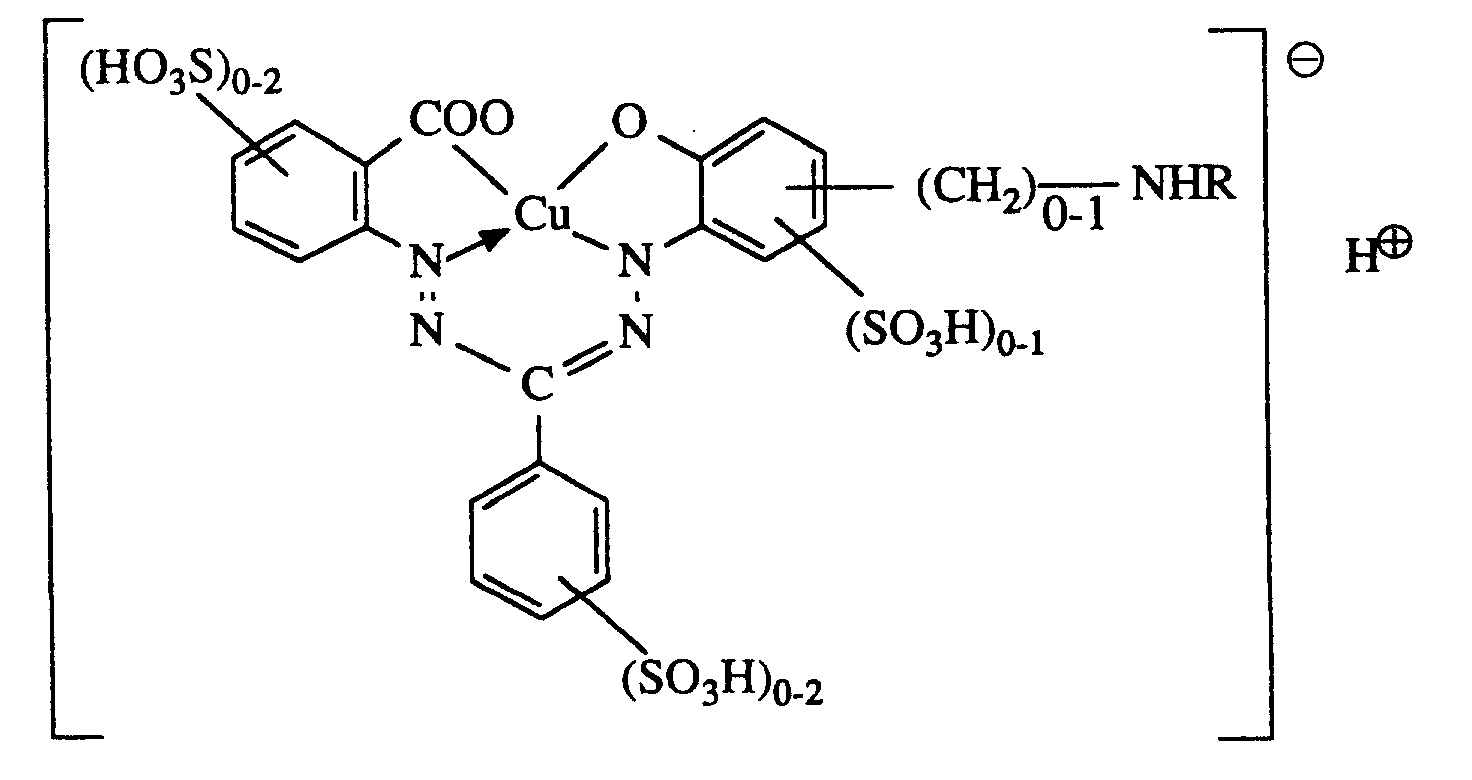
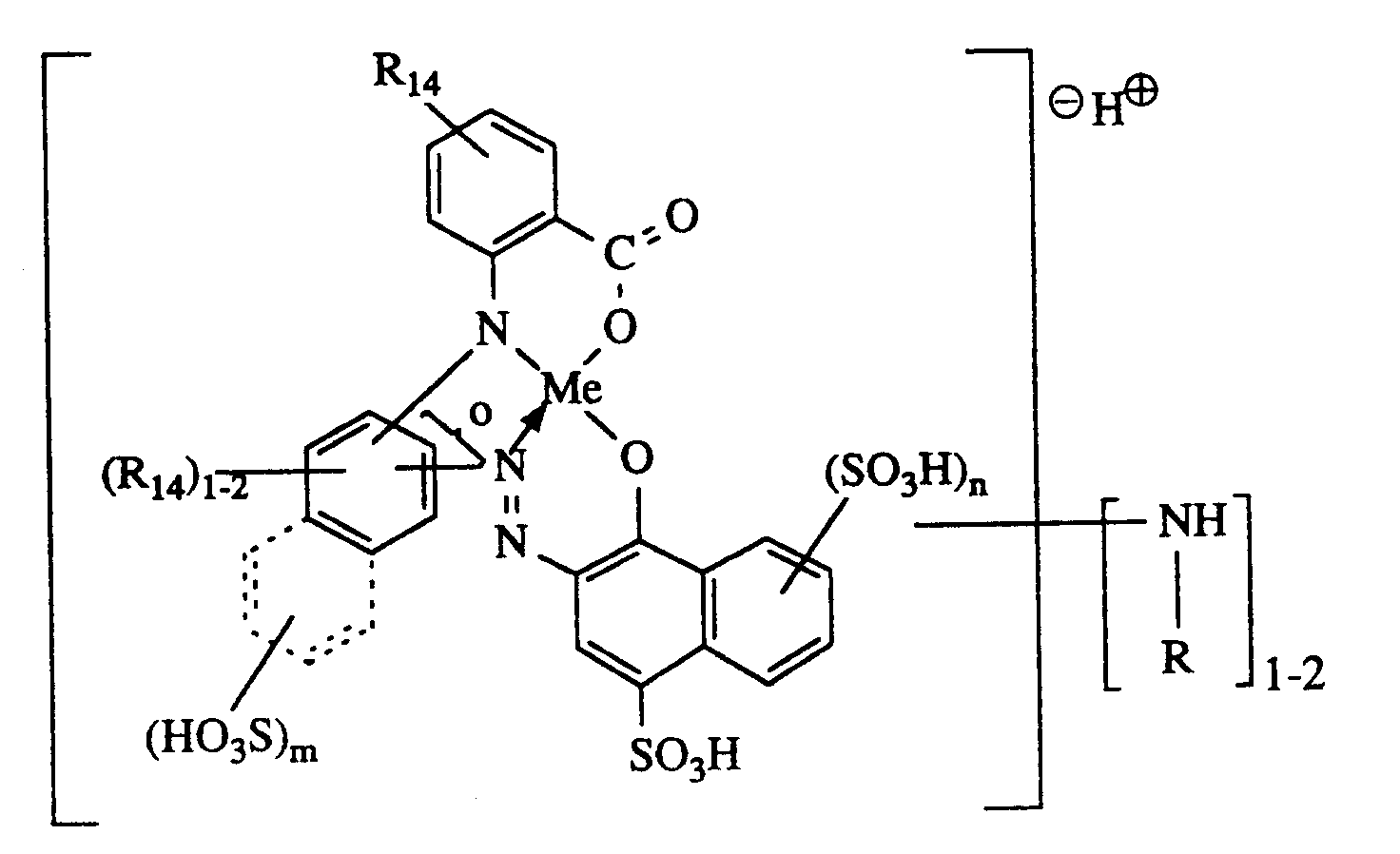
- Als chromophore Amine Y-H und/oder X-H kommen besonders Farbstoffe der folgenden Strukturtypen in Betracht:


worin
acyl z.B. Acetyl oder gegebenenfalls substituiertes Benzoyl ist, - R =
- H, CH₃ oder C₂H₅,
- R₁ =
- die obengenannte Bedeutung hat,
- R₅ =
- H, CH₃, OCH₃ oder Cl,
- R₆ =
- H, C₁-C₄-Alkyl, C₁-C₄-Alkoxy, Cl, Br, COOH, SO₃H.
- Metallkomplexe von Farbstoffen der Formeln:

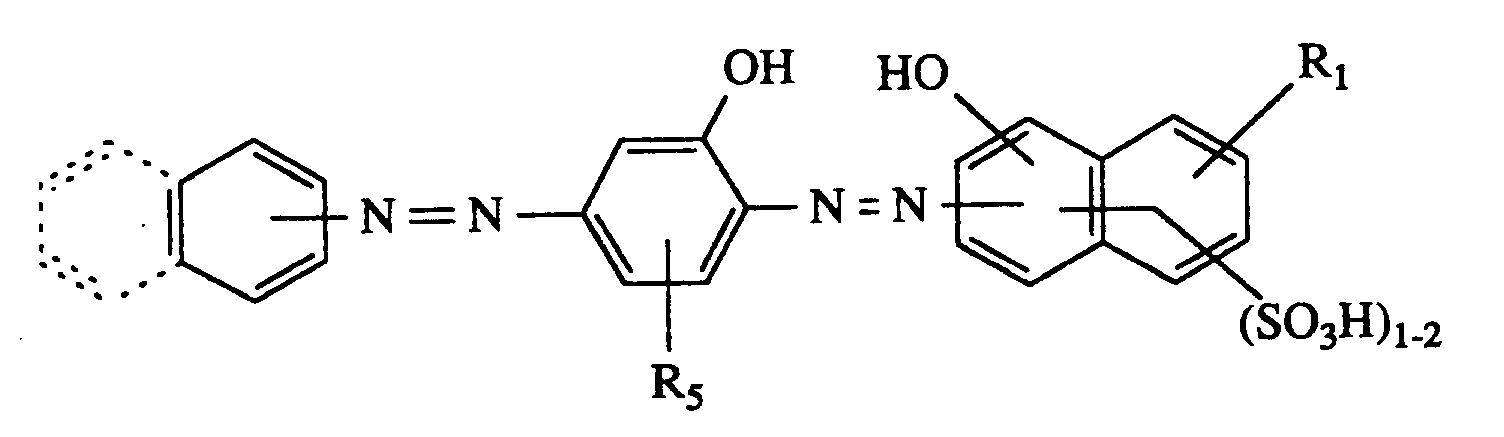
worin - R₇ =
- H, OH, NH₂, NHCOCH₃, NHCOPh, Cl, C₁-C₄-Alkoxy oder C₁-C₄-Alkyl ist.
- Als Metallatom sind Cu (1:1-Komplex) oder Cr und Co (1:2-Komplex) bevorzugt. Cr- und Co-Komplexe können die Azoverbindung der oben angegebenen Formel einmal oder zweimal enthalten, d.h., sie können symmetrisch oder mit beliebigen anderen Ligandengruppen unsymmetrisch aufgebaut sein.

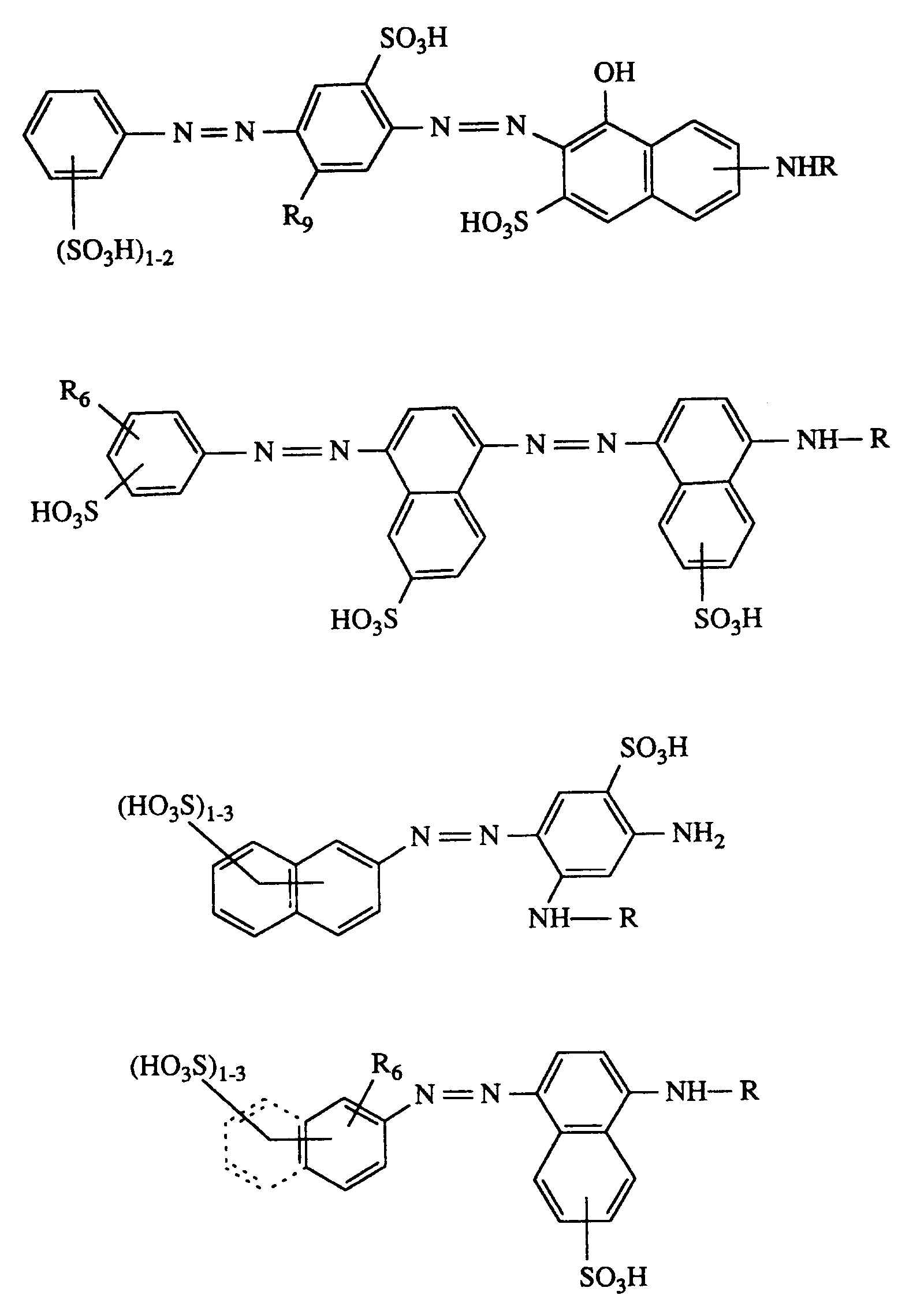


- R₈ =
- H, SO₃H, CH₂SO₃H, Cl, C₁-C₄-Alkylsulfonyl, CN, Carbonamid, insbesondere CONH₂,
- R₉ =
- H, C₁-C₄-Alkyl, C₁-C₄-Alkoxy, Acylamino, insbesondere C₁-C₄-Alkylcarbonylamino oder Arylcarbonylamino wie gegebenenfalls substituiertes Phenylcarbonylamino, C₁-C₄-Alkylsulfonylamino, Cl, Br, Aminocarbonylamino, C₁-C₄-AIkylsulfonylamino, Arylsulfonylamino,
- R₁₀=
- H, C₁-C₄-Alkyl, C₁-C₄-Alkoxy, OH, SO₃H.
- Die durch Strichelungen angedeuteten kondensierten Ringe stehen für alternativ mögliche Naphthalinsysteme.
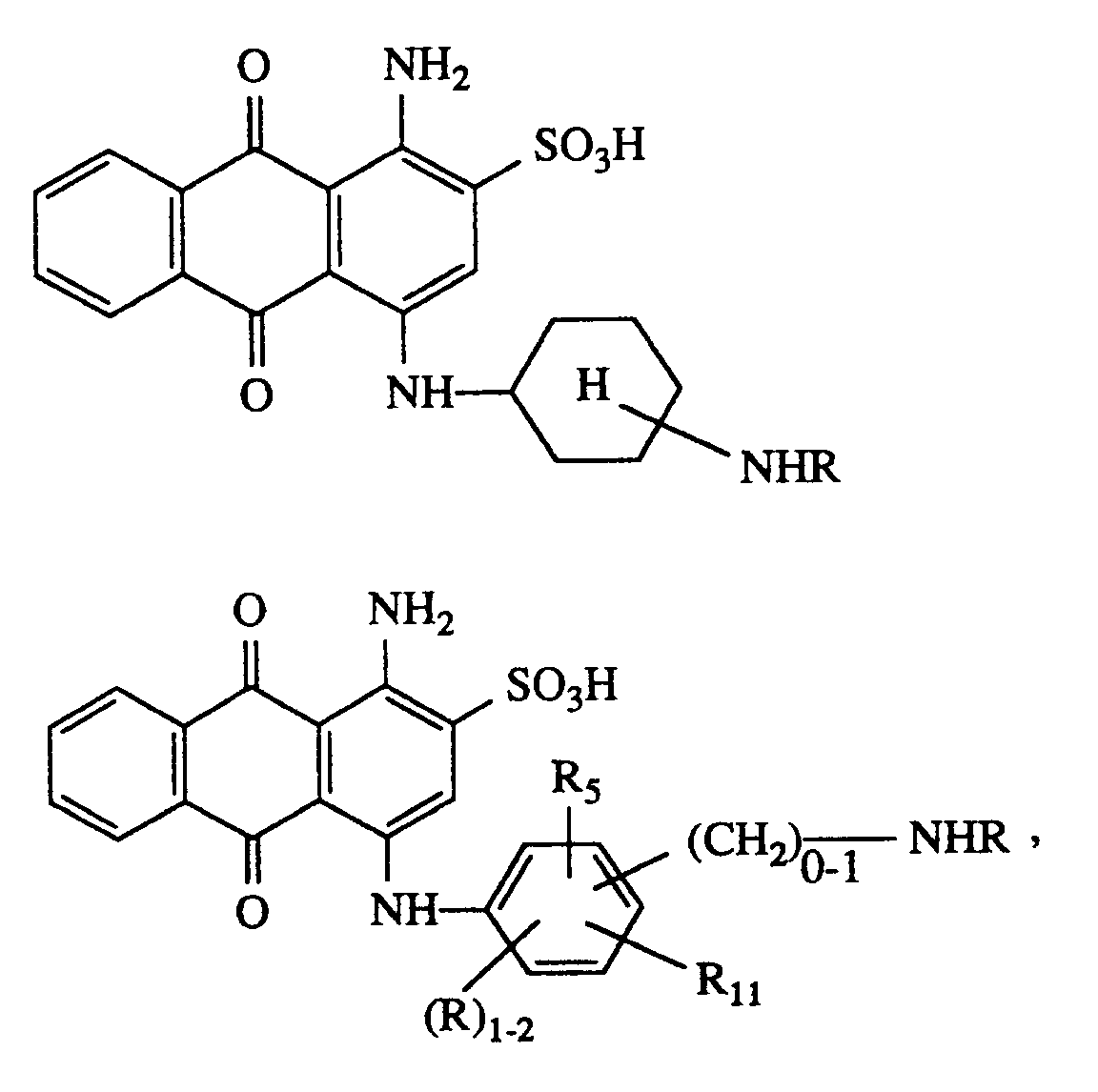
worin - R₅ =
- H, Methyl, Methoxy, Chlor
- R₁₁=
- H, SO₃H und
- R =
- H, Methyl, Ethyl ist.
- A
- für ein gegebenenfalls substituiertes Phenylen oder ein gegebenenfalls substituiertes aromatisch-aliphatisches Brückenglied oder für ein gegebenenfalls durch Heteroatome wie NR, O oder S enthaltende Gruppierungen unterbrochenes, geradkettiges oder verzweigtes C₁-C₆-Alkylen, das mit OR, OSO₃H, SO₃H, COOR oder Halogen substituiert sein kann, steht.
Innerhalb eines Brückengliedes A kann NR mit NR₁ oder NR₂ auch einen heterocyclischen aliphatischen Ring bilden. - B =
-

- T₁, T₂ =
- H, Cl, Br, C₁-C₂-Alkyl, OCH₃, OC₂H₅, Acylamino, C₁-C₂-Alkoxycarbonyl ist.
- Me =
- Cu, Ni ist,
- u + v + w =
- 3,4-4,0 ist, mit der Maßgabe, daß
- u =
- 0,8-2,0,
- v =
- 0-1,0,
- w =
- 1,0-3,0 ist und
- R₁ und A
- die oben angegebenen Bedeutungen haben,
- R₁₂und R₁₃ =
- H, C₁-C₂-Alkyl, gegebenenfalls substituiert durch OH, OSO₃H, SO₃H oder COOH ist.
- v,w =
- 0 oder 1, wobei w ungleich v,
- R₁₄=
- H, C₁-C₄-Alkyl, C₁-C₄-Alkoxy, OH, Halogen, COOH, NO₂, SO₃H, Sulfonamido, C₁-C₄-Alkylcarbonylamino, gegebenenfalls substituiertes Phenylcarbonylamino, C₁-C₄-Alkylsulfonylamino, gegebenenfalls substituiertes Phenylsulfonylamino,
- Me =
- zweiwertiges Metallatom, vorzugsweise Fe, Cu, Zn, Co, Ni,
- R₁₅=
- C₁-C₄-Alkyl, Halogen, insbesondere Chlor, C₁-C₄-Alkoxy, C₁-C₄-AIkylcarbonylamino, Arylcarbonylamino, Aralkylcarbonylamino,
- R₁₆=
- C₁-C₄-Alkoxy, oder R₁₅ und R₁₆ einen Ring bilden und folgende Bedeutung haben:
- Geeignete Reaktoren sind solche, bei denen die Reaktionspartner im stöchiometrisch gewünschten Verhaltnis unter hohem spezifischen Energieeintrag unter Vermeidung zumindest aber Minimierung von Rückvermischung intensiv miteinander vermischt werden, wobei die Reaktionsbedingungen, z.B. Temperatur und pH-Wert, so gewählt werden, daß in dem Reaktor bereits ein erheblicher Umsatz erfolgt.
- Geeignete Reaktoren sind beispielsweise Düsenreaktoren wie bei Zehner, P. u. Bittins, K.: Fortschr. Verf. Technik D 23, 1985; S. 373-393 beschrieben, bei denen die Edukte gleichzeitig und kontinuierlich mit unterschiedlichen Geschwindigkeiten in den Reaktor eingeleitet werden und durch die Differenz der Strömungsgeschwindigkeiten eine intensive Vermischung bewirkt wird, und dabei die Umsetzung bei weitgehend rückveimischungsfreier Strömung zu einem erheblichen Teil in diesem Reaktor abgeschlossen wird. Geeignet sind insbesondere auch Reaktoren von dem Typ, der in Fig. 1 der DE-A-40 16 159 angegeben ist.
- Weitere geeignete Reaktoren sind Dispergiereinheiten des Typs Rotor/Stator-Mischer (O. Fuchs, Chemiker-Zeitung - Chem. Apparatur 84, Jahrgang (1960), Nr. 24, S. 809 ff), die durch hohe Drehzahlen und Kleine Reaktionsvolumen eine sehr intensive Durchmischung in kurzer Zeit erreichte.
- Folgende Verfahrensvarianten unter Verwendung der erfindungsgemäßen Reaktoren sind bevorzugt:
- Eine Lösung oder Suspension von I und eine Lösung oder Suspension von Y-H werden gleichzeitig und kontinuierlich durch getrennte Zuleitungen dem Reaktor zugeführt.
Die zur exakten Einstellung des pH-Wertes im Reaktor nötige Base wird einem oder beiden Edukten vorher zugegeben.
Die Einstellung der Stöchiometrie erfolgt durch das Regeln der Eduktströme und die Temperierung wird durch Kühlen oder Heizen von einem oder beiden Edukten bewerkstelligt. - Eine Mischung von I und Y-H, deren stöchiometrisches Verhältnis vorher festgelegt ist, wird als Lösung oder Suspension dem Reaktor temperiert zugeführt. Gleichzeitig und kontinuierlich wird durch eine getrennte Zuleitung, die zum Erreichen des Reaktions-pH-Wertes nötige Menge Base - gegebenenfalls temperiert - in den Reaktor gefördert.
- Eine Lösung oder Suspension von I und Y-H werden dem Reaktor gleichzeitig und kontinuierlich durch getrennte Zuleitungen - gegebenenfalls temperiert - zugeführt. Die zur Umsetzung nötige Menge an Base wird durch eine dritte Zuführung gleichzeitig und kontinuierlich - gegebenenfalls temperiert - in den Reaktor gefördert.
- Diese Verfahrensvarianten ermöglichen eine optimale Anpassung der Kondensationsbedingungen von I mit dem Amin Y-H bezüglich Stöchiometrie, pH-Wert und Temperatur in die Erfordernisse der Edukte, der Reaktionskinetik und des Reaktionsproduktes II.
- Ein Vorteil des Verfahrens ist die weitgehende Vermeidung von Neben- und Folgeprodukten. Dies ist möglich durch die intensive Durchmischung in kurzer Zeit, die exakte Steuerung der Verfahrensparameter und die Vermeidung bzw. Minimierung der Rückvermischung.
- Die Verweilzeit in dem Reaktor reicht aus, daß die Umsetzung bereits in einem erheblichen Maße erfolgt ist.
- Zur Beendigung der Reaktion können weitere kontinuierlich durchströmte Reaktoren wie z.B. Rotor/Stator-Systeme, Strömungsrohr evtl. mit Statikmischer und Rührwerksbehälter verwendet werden. Alternativ kann die Reaktion auch in diskontinuierlich betriebenen Rührwerksbehältern zu Ende geführt werden.
- Die Zuführung der Komponenten I, Amin Y-H und Base in den Reaktor erfolgt zum Beispiel zentral und über einen konzentrischen Ringspalt (Düsenreaktor) oder zentral und in einen oder mehrere der Rotorkränze (Rotor/Stator-Mischer).
- Gemäß einer weiteren besonderen Durchführungsform des neuen Verfahrens wird die Reaktion bei Temperaturen von 0 bis 90°C, vorzugsweise 0 bis 50°C, durchgeführt.
- Die Alkalimenge in der Aminlösung wird so gewälhlt, daß sich gegen Ende der Reaktion ein pH-Wert zwischen 4 und 11, vorzugsweise zwischen 5 und 10, einstellt.
- Wird ein chromophores Amin Y-H mit einer Difluortriazinyl-Verbindung I umgesetzt, kann der erhaltene Reaktivfarbstoff isoliert oder ohne Zwischenisolierung direkt getrocknet werden.
- Bei Umsetzung von I mit einem nichtchromophoren Amin kann das Reaktionsprodukt isoliert werden, es wird jedoch vorzugsweise ohne Zwischenisolierung weiterverarbeitet, z.B. zu Reaktivfarbstoffen, entweder durch nachfolgende Diazotierung und Kupplung mit einer Kupplungskomponente oder durch Umsatz mit einer Diazotierung.
- Diese Weiterverarbeitung kann diskontinuierlich oder kontinuierlich auf bekannte Art und Weise durchgeführt werden.
- Nach dem erfindungsgemäßen Verfahren erhält man die Kondensationsprodukte aus der Difluortriazinyl-Verbindung I und Aminen in vielen Fällen in deutlich höherer Reinheit als nach den bisher üblichen Verfahren. Dies wirkt sich positiv auf die Qualität der aus den Kondensationsprodukten hergestellten Reaktivfarbstoffe aus, da üblicherweise die Kondensationsprodukte ohne Zwischenreinigung weiterverarbeitet werden.
- In einem Strahldüsenreaktor von 60 cm³ Volumen werden gleichzeitig und kontinuierlich über zwei getrennte Zuleitungen 40 l/h Sodalösung (200 g/l) von 20°C zentral sowie 38 l/h einer wäßrigen Lösung (pH = 4; 0°C) von 0,45 Mol/l Morpholin und 0,45 Mol/l der Verbindung (1) der Formel

durch einen Ringspalt so eingespeist, daß die Sodalösung mit einem Druckabfall von 34 bar in die strömende wäßrige Lösung von 1 und Morpholin eintritt und die Rückvermischung im Reaktor weitgehend vermieden wird. - Das Reaktionsgemisch, das dem Reaktor mit einer Temperatur von 20 bis 21°C, pH-Wert von 8,5 bis 8,6 verläßt, enthält die Verbindung der Formel (2),

wobei der Umsatz nach dem Reaktor über 95 % beträgt und (2) in sehr hoher Reinheit erhalten wird. - (2) wird mit dem Diazoniumsalz von 2-Naphthylamin-1-sulfonsäure nach bekannten Verfahren umgesetzt. Man erhält den Reaktivfarbstoff der Formel

der Cellulosematerial in roten Tönen färbt. - Verwendet man statt Morpholin analoge Mengen Anilin und speist die Lösung von (1) und Anilin zentral unter einem Druckverlust von 30 bar und die Sodalösung über den Ringspalt ein und arbeitet ansonsten analog Beispiel 1, erhält man den Farbstoff der Formel,

der Cellulosematerialien in klaren roten Tönen anfärbt. - In eine Dispergiereinheit vom Typ Rotor/Stator-Mischer werden gleichzeitig und kontinuierlich zentral 50,0 kg/h einer homogenen 10°C kalten Suspension von Na₂CO₃ in Wasser (167 g/l) und auf einen der Rotorkränze 33,6 kg/b einer Lösung von 0,45 Mol/l(1) und 0,45 Mol/l Morpholin (pH = 4,0; 0°C) eingeleitet.
- Das Reaktionsgemisch, das den Reaktor mit einer Temperatur von ca 15°C, pH-Wert von 9,0 bis 9,2, verläßt, enthält die Verbindung der Formel (2),

wobei der Umsatz nach dem Reaktor über 90 % beträgt und (2) in sehr hoher Reinheit erhalten wird. - (2) wird mit dem Diazoniumsalz von 2-Naphthylamin-1,5-disulfonsäure nach bekannten Verfahren umgesetzt. Man erhält den Reaktivfarbstoff der Formel,

der Cellulosematerial in roten Tönen färbt. - In eine Dispergiereinheit vom Typ Rotor/Stator-Mischer werden gleichzeitig und kontinuierlich durch drei getrennte Zuleitungen 33,6 kg/h einer Lösung von (1) (0,45 Mol/l, pH 4, 0°C) zentral und 30 l/h einer Lösung von N-Ethylanilin in Wasser 0,45 Mol/l (pH 4, 0°C) auf einen der Rotorkränze und 50 kg/h einer 10°C kalten Suspension von Na₂CO₃ in Wasser (167 g/l) auf einen anderen Rotorkranz eingespeist. Das Reaktionsgemisch, das den Reaktor verlaßt, enthält die Verbindung der Formel,
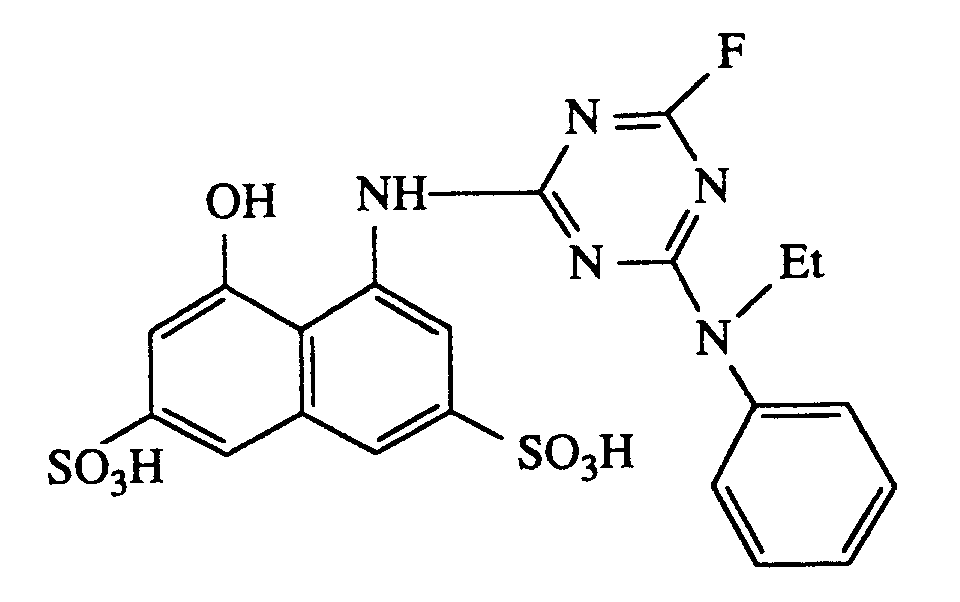
die analog Beispiel 3 zu dem Farbstoff der Formel
umgesetzt wird, er färbt Baumwolle in klaren roten Tönen. - In eine Dispergiereinheit vom Typ Rotor/Stator-Mischer werden gleichzeitig und kontinuierlich durch getrennte Zuleitungen 23 l/h einer Lösung von (3) zentral

(0,29 Mol/l; pH 3; 0°C) und 38,3 kg/h einer Lösung von (4) (0,1 Mol/l, pH > 13, 10°C) auf einen der Rotorkränze geleitet.
- Das Reaktionsgemisch, das den Reaktor verläßt (pH 8,5; 19°C) enthält den Reaktivfarbstoff der Formel,
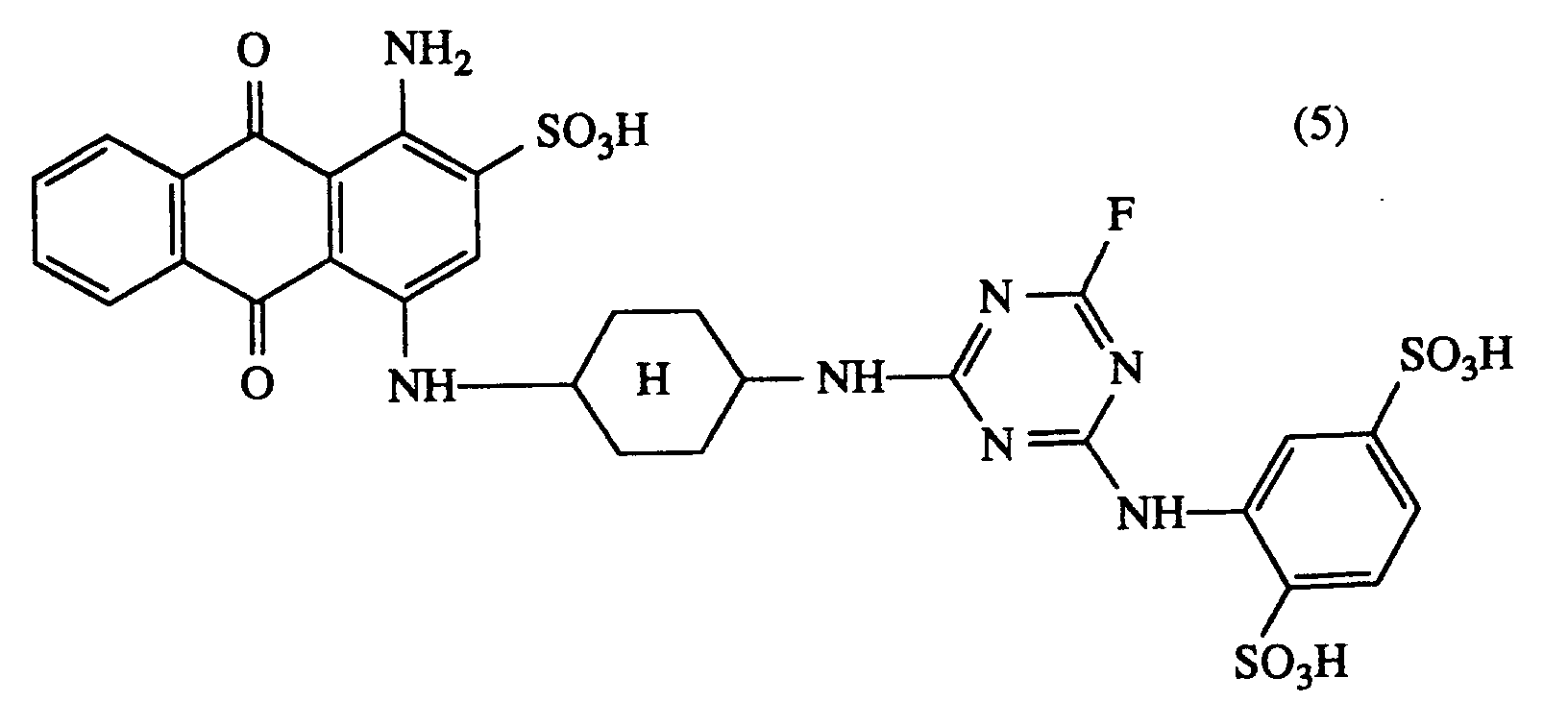
wobei der Umsatz zu (5) nach dem Reaktor mehr als 60 % beträgt. Zu Ende geführt wird die Reaktion auf einer Verweilzeitstrecke oder in einem oder mehren Rührwerkskesseln.

worin



worin

Claims (8)
- Verfahren zur Umsetzung von Difluortriazinyl-Verbindungen der Formel I

 X-H und Y-H unabhängig voneinander ein primäres oder sekundäres aliphatisches, aromatisches oder heterocyclisches Amin ist, das an einem oder beiden Resten des Stickstoff-Atomes substituiert sein kann, vorzugsweise durch OH, OSO₃H, SO₃H, COOH, Cl, OC₁-C₄-Alkyl, C₁-C₄-Alkyl, SO₂-(CH₂)₂-OSO₃H, SO₂-CH=CH₂, SO₂-(CH₂)₂-Cl, NH-Acyl, NH-C₁-C₄-Alkyl, CONH(CH₂)₂-O-(CH₂)₂-SO₂-CH=CH₂, O(CH₂)₂SO₂-CH=CH₂, O-Acyl,wobei X-H und/oder Y-H auch chromophorhaltige Amine sein können,
dadurch gekennzeichnet, daß man die Difluortriazinyl-Verbindung vom Typ I als wäßrige oder wäßrig-organische Lösung oder als Suspension und das Amin Y-H kontinuierlich in einem Reaktor zur Umsetzung bringt. - Verfahren nach Anspruch 1, dadurch gekennzeichnet, daß die Verbindungen der Formel I wenigstens eine Sulfogruppe tragen.
- Verfahren nach wenigstens einem der vorhergehenden Ansprüche, dadurch gekennzeichnet, daß die Amine X-H und/oder Y-H folgender Formel IV entsprechen
 R₁= H, C₁-C₄-Alkyl, das durch OR, OSO₃H, SO₃H, COOOR oder Halogen substituiert sein kann,R = H, CH₃, C₂H₅,Z = H, R, OH, Cl, OR, NH-Acyl, NHR, SO₂-CH=CH₂, SO₂-CH₂-CH₂-OSO₃H, O-Acyl, SO₂-CH₂-CH₂-Cl oder CONH(CH₂)₂O(CH₂)₂-SO₂-CH=CH₂.
- Verfahren nach wenigstens einem der vorhergehenden Ansprüche, dadurch gekennzeichnet, daß die Verbindungen der Formel I folgender Formel entsprechen

- Verfahren gemäß wenigstens einem der vorhergehenden Ansprüche, dadurch gekennzeichnet, daß die Verbindung der Formel

- Verfahren nach wenigstens einem der vorhergehenden Ansprüche, dadurch gekennzeichnet, daß die Edukte gleichzeitig und kontinuierlich mit unterschiedlicher Geschwindigkeit in einen Reaktor eingeleitet werden und durch die Differenz der Strömungsgeschwindigkeiten eine intensive Vermischung bewirkt wird, wobei die Umsetzung weitgehend rückvermischungsfrei durchgeführt wird.
- Verfahren nach wenigstens einem der vorhergehenden Ansprüche, dadurch gekennzeichnet, daß die Edukte gleichzeitig und kontinuierlich in einem Reaktor vom Typ Rotor/Stator-Mischer geleitet werden und dort durch die hohe Drehzahl und das Kleine Reaktionsvolumen in kurzer Zeit sehr intensiv durchmischt werden.
- Verfahren nach wenigstens einem der vorhergehenden Ansprüche, dadurch gekennzeichnet, daß die Amine X-H und/oder Y-H chromophorhaltige Amine sind.
Applications Claiming Priority (2)
| Application Number | Priority Date | Filing Date | Title |
|---|---|---|---|
| DE4137292A DE4137292A1 (de) | 1991-11-13 | 1991-11-13 | Verfahren zur kontinuierlichen umsetzung von difluortriazinyl-verbindungen mit aminen |
| DE4137292 | 1991-11-13 |
Publications (3)
| Publication Number | Publication Date |
|---|---|
| EP0542082A2 true EP0542082A2 (de) | 1993-05-19 |
| EP0542082A3 EP0542082A3 (en) | 1994-08-24 |
| EP0542082B1 EP0542082B1 (de) | 1998-02-25 |
Family
ID=6444692
Family Applications (1)
| Application Number | Title | Priority Date | Filing Date |
|---|---|---|---|
| EP92118739A Expired - Lifetime EP0542082B1 (de) | 1991-11-13 | 1992-11-02 | Verfahren zur kontinuierlichen Umsetzung von Difluortriazinyl-Verbindungen mit Aminen |
Country Status (4)
| Country | Link |
|---|---|
| US (1) | US5332813A (de) |
| EP (1) | EP0542082B1 (de) |
| JP (1) | JPH05222009A (de) |
| DE (2) | DE4137292A1 (de) |
Cited By (1)
| Publication number | Priority date | Publication date | Assignee | Title |
|---|---|---|---|---|
| WO1994004515A1 (en) * | 1992-08-12 | 1994-03-03 | Sandoz Ltd | Method of increasing the spf rating and compounds suitable for increasing the spf rating of fibre or fabric |
Family Cites Families (5)
| Publication number | Priority date | Publication date | Assignee | Title |
|---|---|---|---|---|
| CH617929A5 (de) * | 1976-10-15 | 1980-06-30 | Ciba Geigy Ag | |
| EP0053097A1 (de) * | 1980-11-20 | 1982-06-02 | Ciba-Geigy Ag | Reaktivfarbstoffe, deren Herstellung und Verwendung |
| DE3586409D1 (de) * | 1984-08-21 | 1992-09-03 | Ciba Geigy Ag | Verfahren zur kontinuierlichen umsetzung von cyanurfluorid mit aminonaphtholsulfonsaeuren. |
| DE4016159A1 (de) * | 1990-05-19 | 1991-11-21 | Bayer Ag | Verfahren zur kontinuierlichen umsetzung von cyanurfluorid mit aminen sowie reaktor zur durchfuehrung des verfahrens |
| DE4100513A1 (de) * | 1991-01-10 | 1992-07-16 | Bayer Ag | Verbessertes verfahren zur herstellung eines substituierten 1-amino-2-sulfonaphthalins |
-
1991
- 1991-11-13 DE DE4137292A patent/DE4137292A1/de not_active Withdrawn
-
1992
- 1992-11-02 EP EP92118739A patent/EP0542082B1/de not_active Expired - Lifetime
- 1992-11-02 DE DE59209207T patent/DE59209207D1/de not_active Expired - Fee Related
- 1992-11-03 US US07/971,165 patent/US5332813A/en not_active Expired - Fee Related
- 1992-11-06 JP JP4321369A patent/JPH05222009A/ja active Pending
Cited By (1)
| Publication number | Priority date | Publication date | Assignee | Title |
|---|---|---|---|---|
| WO1994004515A1 (en) * | 1992-08-12 | 1994-03-03 | Sandoz Ltd | Method of increasing the spf rating and compounds suitable for increasing the spf rating of fibre or fabric |
Also Published As
| Publication number | Publication date |
|---|---|
| JPH05222009A (ja) | 1993-08-31 |
| DE59209207D1 (de) | 1998-04-02 |
| DE4137292A1 (de) | 1993-05-19 |
| US5332813A (en) | 1994-07-26 |
| EP0542082B1 (de) | 1998-02-25 |
| EP0542082A3 (en) | 1994-08-24 |
Similar Documents
| Publication | Publication Date | Title |
|---|---|---|
| EP0172790B1 (de) | Verfahren zur kontinuierlichen Umsetzung von Cyanurfluorid mit Aminonaphtholsulfonsäuren | |
| DE2746109C2 (de) | ||
| EP0471702B1 (de) | Wasserlösliche faserreaktive farbstoffe, verfahren zu ihrer herstellung und ihre verwendung | |
| EP0538785B1 (de) | Wasserlösliche faserreaktive Farbstoffe, Verfahren zu ihrer Herstellung und ihre Verwendung | |
| EP0542079B1 (de) | Verfahren zur kontinuierlichen Umsetzung von Halogenpyrimidinen mit Aminen | |
| EP0014844B1 (de) | Fluortriazin-Derivate, Verfahren zur Herstellung von Fluortriazin-Derivaten und von Reaktivfarbstoffen und deren Verwendung | |
| EP0094665B2 (de) | Verfahren und Anlage zur Herstellung einer Suspension von Cyanurchlorid in Wasser oder zur Umsetzung von Cyanurchlorid mit Ammoniak oder Aminen | |
| DE4338117A1 (de) | Reaktivfarbstoffe, deren Herstellung und Verwendung | |
| EP0542082B1 (de) | Verfahren zur kontinuierlichen Umsetzung von Difluortriazinyl-Verbindungen mit Aminen | |
| EP0131545B1 (de) | Reaktivfarbstoffe, deren Herstellung und Verwendung | |
| EP0458110B1 (de) | Verfahren zur kontinuierlichen Umsetzung von Cyanurfluorid mit Aminen. | |
| DE19542547A1 (de) | Faserreaktive Azofarbstoffe, Verfahren zu ihrer Herstellung und ihre Verwendung | |
| EP0079563A2 (de) | Wasserlösliche 1:2-Metallkomplex-Azoverbindungen, Verfahren zu ihrer Herstellung und ihre Verwendung als Farbstoffe | |
| EP0808343A1 (de) | Verfahren zur herstellung von reaktivazofarbstoffen | |
| EP0471713A1 (de) | Wasserlösliche azofarbstoffe, verfahren zu ihrer herstellung und ihre verwendung. | |
| EP0233139A2 (de) | Reaktivfarbstoffe, deren Herstellung und Verwendung | |
| DE69800999T2 (de) | Reaktive farbstoffe mit einen festen quaternären ammonium-gruppe | |
| EP0400382A1 (de) | Verfahren zur Herstellung von substituierten 2,4-Diamino-6-fluor-s-triazinen | |
| EP0388864B1 (de) | Wasserlösliche faserreaktive Farbstoffe, Verfahren zu ihrer Herstellung und ihre Verwendung | |
| EP0059355A2 (de) | Verwendung von Reaktivfarbstoffen zum Färben und Bedrucken von hydroxylgruppenhaltigen Fasermaterialien | |
| DE3843605A1 (de) | Wasserloesliche faserreaktive farbstoffe, verfahren zu ihrer herstellung und ihre verwendung | |
| EP0069376A2 (de) | Kupferkomplex-Monoazoverbindungen, Verfahren zu ihrer Herstellung und ihre Verwendung als Farbstoffe | |
| EP0162386B1 (de) | Azoreaktivfarbstoffe | |
| EP0103156B1 (de) | Wasserlösliche Kupferkomplex-Disazoverbindungen, Verfahren zu ihrer Herstellung und ihre Verwendung als Farbstoffe | |
| DE19521589A1 (de) | Polyfunktionelle Azoreaktivfarbstoffe |
Legal Events
| Date | Code | Title | Description |
|---|---|---|---|
| PUAI | Public reference made under article 153(3) epc to a published international application that has entered the european phase |
Free format text: ORIGINAL CODE: 0009012 |
|
| AK | Designated contracting states |
Kind code of ref document: A2 Designated state(s): CH DE FR GB LI |
|
| PUAL | Search report despatched |
Free format text: ORIGINAL CODE: 0009013 |
|
| AK | Designated contracting states |
Kind code of ref document: A3 Designated state(s): CH DE FR GB LI |
|
| 17P | Request for examination filed |
Effective date: 19950116 |
|
| 17Q | First examination report despatched |
Effective date: 19960711 |
|
| GRAG | Despatch of communication of intention to grant |
Free format text: ORIGINAL CODE: EPIDOS AGRA |
|
| GRAG | Despatch of communication of intention to grant |
Free format text: ORIGINAL CODE: EPIDOS AGRA |
|
| GRAH | Despatch of communication of intention to grant a patent |
Free format text: ORIGINAL CODE: EPIDOS IGRA |
|
| GRAH | Despatch of communication of intention to grant a patent |
Free format text: ORIGINAL CODE: EPIDOS IGRA |
|
| GRAA | (expected) grant |
Free format text: ORIGINAL CODE: 0009210 |
|
| AK | Designated contracting states |
Kind code of ref document: B1 Designated state(s): CH DE FR GB LI |
|
| REG | Reference to a national code |
Ref country code: CH Ref legal event code: EP |
|
| REG | Reference to a national code |
Ref country code: CH Ref legal event code: NV Representative=s name: E. BLUM & CO. PATENTANWAELTE |
|
| GBT | Gb: translation of ep patent filed (gb section 77(6)(a)/1977) |
Effective date: 19980227 |
|
| REF | Corresponds to: |
Ref document number: 59209207 Country of ref document: DE Date of ref document: 19980402 |
|
| ET | Fr: translation filed | ||
| PGFP | Annual fee paid to national office [announced via postgrant information from national office to epo] |
Ref country code: GB Payment date: 19981106 Year of fee payment: 7 |
|
| PGFP | Annual fee paid to national office [announced via postgrant information from national office to epo] |
Ref country code: FR Payment date: 19981118 Year of fee payment: 7 |
|
| PLBE | No opposition filed within time limit |
Free format text: ORIGINAL CODE: 0009261 |
|
| STAA | Information on the status of an ep patent application or granted ep patent |
Free format text: STATUS: NO OPPOSITION FILED WITHIN TIME LIMIT |
|
| 26N | No opposition filed | ||
| PG25 | Lapsed in a contracting state [announced via postgrant information from national office to epo] |
Ref country code: GB Free format text: LAPSE BECAUSE OF NON-PAYMENT OF DUE FEES Effective date: 19991102 |
|
| GBPC | Gb: european patent ceased through non-payment of renewal fee |
Effective date: 19991102 |
|
| PG25 | Lapsed in a contracting state [announced via postgrant information from national office to epo] |
Ref country code: FR Free format text: LAPSE BECAUSE OF NON-PAYMENT OF DUE FEES Effective date: 20000731 |
|
| REG | Reference to a national code |
Ref country code: FR Ref legal event code: ST |
|
| PGFP | Annual fee paid to national office [announced via postgrant information from national office to epo] |
Ref country code: DE Payment date: 20041028 Year of fee payment: 13 |
|
| PGFP | Annual fee paid to national office [announced via postgrant information from national office to epo] |
Ref country code: CH Payment date: 20041117 Year of fee payment: 13 |
|
| PG25 | Lapsed in a contracting state [announced via postgrant information from national office to epo] |
Ref country code: LI Free format text: LAPSE BECAUSE OF NON-PAYMENT OF DUE FEES Effective date: 20051130 Ref country code: CH Free format text: LAPSE BECAUSE OF NON-PAYMENT OF DUE FEES Effective date: 20051130 |
|
| PG25 | Lapsed in a contracting state [announced via postgrant information from national office to epo] |
Ref country code: DE Free format text: LAPSE BECAUSE OF NON-PAYMENT OF DUE FEES Effective date: 20060601 |
|
| REG | Reference to a national code |
Ref country code: CH Ref legal event code: PL |