EP0542374B1 - Melaminpolykondensat - Google Patents
Melaminpolykondensat Download PDFInfo
- Publication number
- EP0542374B1 EP0542374B1 EP92203471A EP92203471A EP0542374B1 EP 0542374 B1 EP0542374 B1 EP 0542374B1 EP 92203471 A EP92203471 A EP 92203471A EP 92203471 A EP92203471 A EP 92203471A EP 0542374 B1 EP0542374 B1 EP 0542374B1
- Authority
- EP
- European Patent Office
- Prior art keywords
- range
- alkyl
- general formula
- comprised
- formaldehyde
- Prior art date
- Legal status (The legal status is an assumption and is not a legal conclusion. Google has not performed a legal analysis and makes no representation as to the accuracy of the status listed.)
- Expired - Lifetime
Links
- 0 CCCCC[C@](C1)[C@]1(CC1)[C@@]1C1(CCC[C@@](CCC)[C@@]2(CC)[C@](CC)C2[C@](C*[C@]2C(C[C@@]3[C@@]45[C@@]3[C@@](C3)[C@@]3(C3)[C@@]3[C@]4[C@]5CCCC3(C4)CCC4C3)CC2)C2CC2)CC1 Chemical compound CCCCC[C@](C1)[C@]1(CC1)[C@@]1C1(CCC[C@@](CCC)[C@@]2(CC)[C@](CC)C2[C@](C*[C@]2C(C[C@@]3[C@@]45[C@@]3[C@@](C3)[C@@]3(C3)[C@@]3[C@]4[C@]5CCCC3(C4)CCC4C3)CC2)C2CC2)CC1 0.000 description 8
- JJYFGHAIZLFSMU-UHFFFAOYSA-N CC(C)=NC(N)NC(N)=N Chemical compound CC(C)=NC(N)NC(N)=N JJYFGHAIZLFSMU-UHFFFAOYSA-N 0.000 description 1
Classifications
-
- C—CHEMISTRY; METALLURGY
- C08—ORGANIC MACROMOLECULAR COMPOUNDS; THEIR PREPARATION OR CHEMICAL WORKING-UP; COMPOSITIONS BASED THEREON
- C08G—MACROMOLECULAR COMPOUNDS OBTAINED OTHERWISE THAN BY REACTIONS ONLY INVOLVING UNSATURATED CARBON-TO-CARBON BONDS
- C08G12/00—Condensation polymers of aldehydes or ketones with only compounds containing hydrogen attached to nitrogen
- C08G12/02—Condensation polymers of aldehydes or ketones with only compounds containing hydrogen attached to nitrogen of aldehydes
- C08G12/26—Condensation polymers of aldehydes or ketones with only compounds containing hydrogen attached to nitrogen of aldehydes with heterocyclic compounds
- C08G12/30—Condensation polymers of aldehydes or ketones with only compounds containing hydrogen attached to nitrogen of aldehydes with heterocyclic compounds with substituted triazines
Definitions
- the present invention relates to compounds obtained by means of polycondensation of polyaminic compositions, essentially constituted by melaminic derivatives, with aldehydes.
- US-A-2,524,727 discloses the reaction products of aldehydes (esp. formaldehyde) with polyalkylene polymelamine.
- aldehydes esp. formaldehyde
- polyalkylene polymelamine The NH 2 -group of the melamine is unsubstituted.
- the present invention relates to compounds of polycondensation with aldehydes, preferably formaldehyde, of derivatives of 2,4,6-triamino-1,3,5-triazine.
- These compounds are used in the preparation of self-extinguishing polymeric compositions, based on thermoplastic polymers, or polymers endowed with elastomeric properties, in particular olefinic polymers or copolymers, in combination with ammonium or amine phosphates and/or phosphonates.
- the subject matter of the present invention are the aminoplastic resins obtained by means of the polymerization of a mixture comprising:
- radicals from R to R 3 in general formula (I) are: methyl; ethyl; propyl; isopropyl; n-butyl; isobutyl; tert -butyl; n-pentyl; isopentyl; n-hexyl; tert -hexyl; octyl; tert -octyl; decyl; dodecyl; octadecyl; ethenyl; propenyl; butenyl; isobutenyl; hexenyl; octenyl; cyclohexyl; propylcyclohexyl; butylcyclohexyl; decylcyclohexyl; hydroxycyclohexyl; hydroxyethylcyclohexyl; 2-hydroxyethyl; 2-hydroxypropyl; 3-hydroxypropyl; 3-hydroxybutyl; 4-hydroxy
- heterocyclic radicals which may replace the moiety: in general formula (I) are: aziridine; pyrrolidine; piperidine; morpholine; thiomorpholine; piperazine; 4-methylpiperazine; 4-ethylpiperazine; 2-methylpiperazine; 2,5-dimethylpiperazine; 2,3,5,6-tetramethylpiperazine; 2,2,5,5-tetramethylpiperazine; 2-ethylpiperazine; and 2,5-diethylpiperazine.
- heterocyclic radicals which may replace the moiety: are: aziridine; pyrrolidine; piperidine; morpholine; thiomorpholine; piperazine; 4-methylpiperazine; and 4-ethylpiperazine.
- divalent -Z- radicals are those which derive, by elimination of a hydrogen atom from each aminic moiety, from the following diaminic compounds: piperazine; 2-methyl piperazine; 2,5-dimethylpiperazine; 2,3,5,6-tetramethyl piperazine; 2-ethylpiperazine; 2,5-diethyl piperazine; 1,2-diaminoethane; 1,3-diaminopropane; 1,4-diaminobutane; 1,5-diaminopentane; 1,6-diaminohexane; 1,8-diaminooctane; 1,10-diaminodecane; 1,12-diaminododecane; N,N-dimethyl-1,2-diaminoethane; N-methyl-1,3-diaminopropane; N-ethyl-1,2-diaminoethane; N-isopropyl-1,2-
- multivalent radicals are those which derive, by elimination of a hydrogen atom from each reacted amino group, from the following polyaminic compounds: bis (2-aminoethyl) amine; bis (3-aminopropyl)amine; bis (4-aminobutyl) amine; bis (5-aminopentyl)amine; bis [2-(N-methylamino) ethyl] amine; 2-N-butyl-bis (2-aminoethyl) amine; bis [3-(N-methylamino)propyl) amine; N-(3-aminopropyl)-1,4-diaminobutane; N-(3-aminopropyl)-1,5-diaminopentane; N-(4-aminobutyl)-1,5-diaminopentane; tris (2-aminoethyl) amine; tris (3-aminopropyl) amine; tris (4-a
- formaldehyde as this term is used in the instant disclosure and in the appended claims, any forms are meant, in which formaldehyde is usually marketed: aqueous solution, metaformaldehyde, paraformaldehyde.
- R 4 radical in general formula (II) are: methyl; ethyl; n-propyl; isopropyl; n-butyl; isobutyl; tert -butyl; n-pentyl; isopentyl; n-hexyl; n-heptyl; isoheptyl; n-octyl; ethenyl; propenyl; isobutenyl; sec -butenyl; n-pentenyl; cyclohexyl; phenyl; 2-methylphenyl; 3-methylphenyl; 4-methylphenyl; 4-isopropylphenyl; 2,4,6-trimethylphenyl; 1-phenylethyl; 2-phenylethyl; and 2-phenylethenyl.
- polyaminic derivatives are: urea; ethyleneurea; propyleneurea; thiourea; ethylenethiourea; melamine; acetoguanamine; propionoguanamine; butyroguanamine; isobutyroguanamine; caprinoguanamine; succinoguanamine; benzoguanamine; metamethylbenzoguanamine; benzylguanamine; hydantoin; piperazine-2,5-dione; and barbituric acid.
- aminoplastic resins according to the present invention can be synthetized as follows:
- the resin is first dried at 100°C, then is submitted to thermal treatment for some hours, preferably from 1 to 3 hours, in a vacuum oven at 150°C.
- aminoplastic resins are obtained as white crystalline line powders, which are insoluble in water and can be used in self-extinguishing polymeric compositions without any further purification.
- An alternative synthesis method consists in causing the reactions of the above (a) and (b) steps to take place in one single step, at a pH value comprised within the range of from 1 to 5, and at a higher temperature than 40°C.
- Condensation compounds obtained by means of the polymerization with aldehydes, preferably formaldehyde, of the melaminic derivatives of general formula (I), either containing, or not containing, polyaminic derivatives, not cited in the Examples, are those as reported in Table 1, in which R 3 , when present, is substituted by the triazinic ring of formula:
- reaction mixture is kept at said temperature of 0-3°C for a further 3 hours, then the aqueous phase is separated.
- the organic solution is treated with two portions of 200 cm 3 each, of water, with the aqueous phase being separated each time.
- reaction mixture is heated up to 40°C with stirring, until a solution is obtained, then, with the temperature being kept constant at 40°C, 102 g of an aqueous solution of ammonia at 30% by weight are added during a 30 minute time.
- the reaction mixture is subsequently heated up to 45°C, and is kept 4 hours at that temperature.
- the resulting mixture is heated up to 100°C and is kept 2 hours at that temperature.
- the filter cake is washed with a plentiful water and is dried.
- the reaction mass is heated up to 70°C, and is kept stirred at that temperature for five hours.
- the reaction mass is heated up to boiling temperature, and is kept under refluxing conditions for five hours.
- reaction mixture is kept at 60°C for one further hour, then the resulting product is filtered off, and the filter cake is washed on the same filter with hot water.
- the reaction mixture is heated up to 50°C and is kept 7 hours at this temperature; then, the reaction mixture is allowed to cool down to room temperature, the obtained product is filtered off and the filter cake is washed with water.
- the resulting mixture is heated up to 100°C, and is kept 2 hours at that temperature. Then, 10 g of sodium hydroxide are added and the resulting mixture is heated up to 140°C. The reaction mixture is kept 16 hours at 140°C, then is cooled down to room temperature and the resulting product is filtered off and the filter cake is washed with plentiful water.
- the reaction mass is heated up to 65°C, and is kept stirred at that temperature for 4 hours.
- reaction mixture With stirring, the reaction mixture is heated up to 40°C in order to obtain a solution, then, with the temperature being kept at 40°C, 284 g of an aqueous solution of ammonia at 30% by weight are added during a 1 hour and 30 minute time.
- the reaction mixture is subsequently heated up to 45°C and is kept 4 hours at this temperature.
- the reaction mass is heated up to 100°C, and is kept 2 hours at this temperature.
- reaction mixture is allowed to reflux for approximately 20 hours, then is cooled down to room temperature and is filtered.
- the reaction mass is heated up to 70°C, and is kept stirred at that temperature for 6 hours.
- reaction mixture is kept at 60°C for a further hour, than the resulting product is filtered off, and the filter cake is washed on the same filter with hot water.
- reaction mixture is kept at the temperature of 0-3°C for a further 2 hours, then the resulting product is filtered off and is washed on the filter with water.
- reaction mixture is heated up to 40°C and then, during a 30 minute time, 139.8 g of intermediate (XXIII) are added, with the reaction temperature being kept at 40°C.
- the reaction temperature is increased up to 45°C and is kept at that value for approximately 6 hours.
- reaction is cooled down to room temperature and the resulting product is filtered off.
- the filter cake is washed with water and is dried.
- reaction mixture is heated up to 100°C and is kept at that temperature for 2 hours. Then, 18 g of sodium hydroxide are added and the resulting mixture is heated up to boiling temperature.
- reaction mass is kept under refluxing conditions for 24 hours, then is cooled down to room temperature, the resulting product is filtered off and the filter cake is washed with water.
- intermediate (XXV) is furthermore confirmed by I.R. spectroscopic analysis.
- the reaction mixture is heated up to 60°C and is kept stirred at that temperature for 4 hours.
- reaction mixture is kept for a further hour at 50°C, then the resulting product is filtered off, and the filter cake is washed on the same filter with hot water.
- the reaction mixture is heated up to 60°C and is kept with stirring at that temperature for 4 hours.
- reaction mixture is kept at 50°C for a further hour, then the resulting product is filtered off, and the filter cake is washed on the same filter with hot water.
- reaction mixture is heated up to 80°C and is kept at that temperature for two hours. Then, 16 g of sodium hydroxide are added and the reaction temperature is increased up to 110°C.
- reaction mass is kept at 100°C for 18 hours, then is cooled down to room temperature, and the resulting product is filtered off, with the filter cake being washed with plentiful water on the same filter.
- reaction mixture is heated 4 hours at 60°C, is acidified with 7.9 g of an aqueous solution at 48% by weight of hydrobromic acid and is kept 8 hours under refluxing conditions.
- reaction mixture is then diluted with 200 cm 3 of water, is cooled down to 50°C, and is neutralized with 1.5 g of sodium hydroxide.
- reaction mixture is caused to reflux for 16 hours, then is cooled down to 10°C, and the resulting product is filtered off, with the filter cake being washed on the same filter with cold water.
- the reaction mixture is heated up to 45°C and is kept at that temperature for 6 hours.
- reaction mass is heated at 80°C for two hours, then 16 g of sodium hydroxide dissolved in 30 cm 3 of water are added, and the reaction mixture is heated up to boiling temperature.
- the reaction mixture is heated up to 50°C and is kept at that temperature for 3 hours.
- the resulting mixture is acidified with 4.1 g of hydrochloric acid at 37% by weight, then is heated up to boiling temperature and is caused to reflux for 4 hours.
- reaction mixture is kept at the temperature of 0-3°C for a further two hours, then the resulting product is filtered off and the filter cake is washed on the filter with cold water.
- reaction mixture is heated up to 40°C and then 168.6 g of intermediate (XXX) are added during a 30 minute time, with the reaction temperature being kept at 40°C.
- the reaction temperature is increased up to 45°C and is kept at that value for approximately 6 hours.
- reaction mixture is cooled down to the temperature of 10°C, the resulting product is filtered off, and the filter cake is washed on the same filter with cold water.
- reaction mixture is heated up to 100°C and is kept at that temperature for 2 hours. Then, 20 g of sodium hydroxide are added and the resulting mixture is heated up to boiling temperature.
- reaction mixture is caused to reflux for 24 hours, then is cooled down to room temperature, and the resulting product is filtered off, with the filter cake being washed with plentiful water.
- the reaction mass is heated up to 65°C and is kept 5 hours at that temperature, with stirring.
- reaction mixture is kept at 50°C for a further hour, then the resulting product is filtered off, and the filter cake is washed on the same filter with hot water.
- the resins of melaminic derivatives of general formula (I), either containing, or not containing, polyaminic compounds, as reported in Table 2 and having higher melting points than 300°C are prepared by polymerization with formaldehyde.
- the radical R 3 when present, is replaced by the triazinic ring of formula:
- Specimens are obtained as small slabs of approximately 3 mm of thickness, and on them the level of self-extinguishment is determined by measuring the oxygen index (L.O.I. according to ASTM D-2863/77) on a STANTON REDCROFT instrument, and applying the "Vertical Burning Test", which makes it possible the material to be classified at the three levels 94 V-0,94 V-1 and 94 V-2 according to UL 94 standards (published by "Underwriters Laboratories” - USA).
Landscapes
- Chemical & Material Sciences (AREA)
- Health & Medical Sciences (AREA)
- Chemical Kinetics & Catalysis (AREA)
- Medicinal Chemistry (AREA)
- Polymers & Plastics (AREA)
- Organic Chemistry (AREA)
- Phenolic Resins Or Amino Resins (AREA)
- Compositions Of Macromolecular Compounds (AREA)
- Macromolecular Compounds Obtained By Forming Nitrogen-Containing Linkages In General (AREA)
Claims (9)
- Aminoplastharze, erhalten durch die Polymerisation einer Mischung, umfassend:(1) 0 bis 50 Gewichtsteile eines oder mehrerer Polyaminderivate, ausgewählt aus der aus Harnstoff, Ethylenharnstoff, Propylenharnstoff, Thioharnstoff, Ethylenthioharnstoff, Melamin, Acetoguanamin, Propionoguanamin, Butyroguanamin, Isobutyroguanamin, Caprinoguanamin, Succinoguanamin, Benzoguanamin, meta-Methylbenzoguanamin, Benzylguanamin, Hydantoin, Piperazin-2,5-dion, Barbitursäure bestehenden Gruppe,(2) 50 bis 100 Gewichtsteile eines oder mehrerer Derivate von 2,4,6-Triamino-1,3,5-Triazin mit der allgemeinen Formel (I)(i)
 (ii)
(ii) (iii)mit Formaldehyd oder einer Mischung von Formaldehyd und einem Aldehyd mit der allgemeinen Formel (II):
R4-CHO (II)
worin der Aldehyd mit der allgemeinen Formel (II) in einer Menge von bis zu 20 mol-% vorhanden ist und worin:
die Radikale von R bis R2, welche gleich oder voneinander verschieden sein können und welche verschiedene Bedeutung bei jedem Triazinring haben können, sind:
H, C1-C18-Alkyl, C2-C8 Alkenyl, C6-C16-Cycloalkyl, Alkylcycloalkyl, gegebenenfalls mit einer Hydroxy- oder einer C1-C4-Hydroxyalkyl-Gruppe substituiert,
-CH2⁅CmH2m⁆O-R5
 m = eine ganze Zahl im Bereich von 1 bis 7 ist,p = eine ganze Zahl im Bereich von 1 bis 5 ist,R5 = H, C1-C8-Alkyl, C2-C6-Alkenyl, -[-CqH2q-]-O-R7, worin q eine ganze Zahl im Bereich von 1 bis 4 ist und R7 H oder C1-C4-Alkyl, C6-C12-Cycloalkyl oder Alkylcycloalkyl,die Radikale R6, welche gleich oder verschieden sein können, sind:
H, C1-C8-Alkyl, C2-C6-Alkenyl, C6-C12-Cycloalkyl oder Alkylcycloalkyl, C1-C4-Hydroxyalkyl, oder die Gruppe
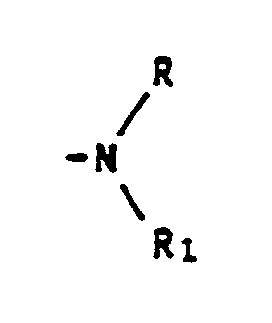
worin R3 Wasserstoff ist oder:
worin z ein divalentes Radikal ist, welches in den Bereich einer der folgenden Formeln fällt:


worin R10 Wasserstoff, Hydroxy, C1-C4-Alkyl, C1-C4-Alkoxy ist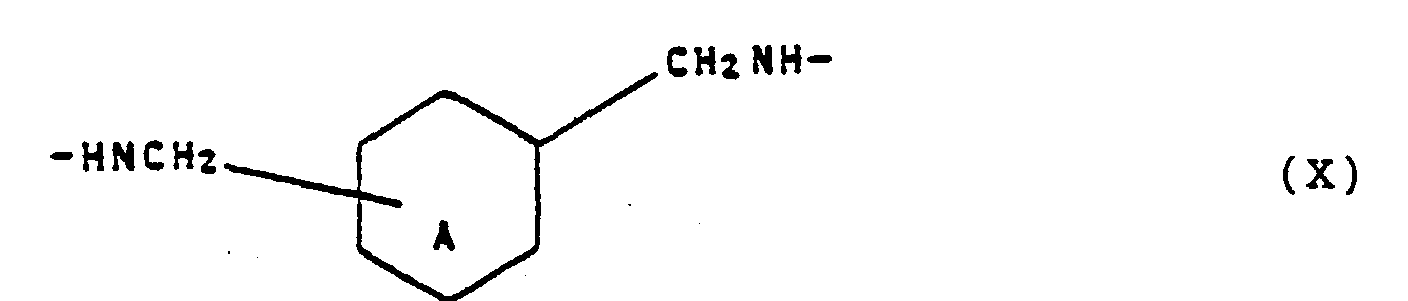

 R11 ist Wasserstoff oder C1-C4-Alkyl,c ist eine ganze Zahl im Bereich von 1 bis 5,die Indizes s, welche gleich oder verschieden voneinander sein können haben die gleiche Bedeutung wie oben definiert,w ist eine Zahl im Bereich von 2 bis 4,d ist entweder 1 oder 2,R4 ist C1-C8-Alkyl, C2-C6-Alkenyl, C6-C12-Cycloalkyl, C6-C12-Aryl, gegebenenfalls mit einem oder mehreren C1-C4-Alkylradikalen substituiert, C7-C16-Aralkyl, C8-C12-Aralkenyl, mit der Bedingung, daß
wenn R, R1 und R2 gleichzeitig Wasserstoff bedeuten, das divalente Radikal Z in der Formel (i) verschieden ist von den Formeln (IV), (V) und (VII), während in der Formel (ii) R, R1 und R2 nicht gleichzeitig Wasserstoff bedeuten. - Aminoplastharz gemäß Anspruch 1, in welchem das Polyaminderivat ausgewählt ist aus Verbindungen, welche den 1,3,5-Triazinring oder mindestens eine 〉C=O - und/oder 〉C=S - Gruppe enthalten.
- Aminoplastharz gemäß Anspruch 1 oder 2, in welchen die Gruppe

Aziridin, Pyrrolidin, Piperidin, Morpholin, Thiomorpholin, Piperazin, 4-Methylpiperazin, 4-Ethylpiperazin, 2-Methylpiperazin, 2,5-Dimethylpiperazin, 2,3,5,6-Tetramethylpiperazin, 2,2,5,5-Tetramethylpiperazin, 2-Ethylpiperazin, 2,5-Diethylpiperazin. - Aminoplastharze gemäß Anspruch 1, 2 oder 3, in welchen die Gruppe

Aziridin, Pyrrolidin, Piperidin, Morpholin, Thiomorpholin, Piperazin, 4-Methylpiperazin, 4-Ethylpiperazin. - Aminoplastharze gemäß einem der voranstehenden Ansprüche, in welchen das R4-Radikal ausgewählt ist aus:
Methyl, Ethyl, n-Propyl, Isopropyl, n-Butyl, Isobutyl, tert-Butyl, n-Pentyl, Isopentyl, n-Hexyl, n-Heptyl, Isoheptyl, n-Octyl, Ethenyl, Propenyl, Isobutenyl, sec-Butenyl, n-Pentenyl, Cyclohexyl, Phenyl, 2-Methylphenyl, 3-Methylphenyl, 4-Methylphenyl, 4-Isopropylphenyl, 2,4,6-Trimethylphenyl, 1-Phenylethyl, 2-Phenylethyl, 2-Phenylethenyl. - Verfahren zur Herstellung der Aminoplastharze gemäß einem der voranstehenden Ansprüche, umfassend:(a) Reagieren lassen des Derivats der allgemeinen Formel (I), entweder gemischt mit dem Polyaminderivat oder nicht damit gemischt, mit Formaldehyd oder eine Mischung von Formaldehyd, welche bis zu 20 mol-% eines Aldehyds der allgemeinen Formel (II) enthält;(b) Ansäuern des resultierenden Reaktionsprodukts hinab bis zu einem pH-Wert im Bereich von 1 bis 5.
- Verfahren gemäß Anspruch 6, in welchem die Reaktion (a) ausgeführt wird mit einem molaren Verhältnis des Derivats der allgemeinen Formel (I) oder seiner Mischung mit dem Polyamin-Derivat zu Formaldehyd oder dessen Mischung mit dem Aldehyd mit der allgemeinen Formel (II) innerhalb des Bereichs von 1:1 bis 1:12.
- Verfahren gemäß Anspruch 6 oder 7, in welchem die Reaktion (a) bei einer Temperatur im Bereich von 20°C bis zum Siedepunkt des verwendeten Lösemittels durchgeführt wird und in welchem die Reaktion (b) bei einer Temperatur im Bereich von 40°C bis zum Siedepunkt des Lösemittels durchgeführt wird.
- Verfahren nach Anspruch 6, 7 oder 8, in welchem die Reaktionen der Stufen (a) und (b) in einem einzelnen Schritt bei einer Temperatur oberhalb von 40°C durchgeführt werden.
Applications Claiming Priority (2)
| Application Number | Priority Date | Filing Date | Title |
|---|---|---|---|
| ITMI913044 | 1991-11-14 | ||
| ITMI913044A IT1252292B (it) | 1991-11-14 | 1991-11-14 | Policondensati melamminici |
Publications (2)
| Publication Number | Publication Date |
|---|---|
| EP0542374A1 EP0542374A1 (de) | 1993-05-19 |
| EP0542374B1 true EP0542374B1 (de) | 1997-06-04 |
Family
ID=11361107
Family Applications (1)
| Application Number | Title | Priority Date | Filing Date |
|---|---|---|---|
| EP92203471A Expired - Lifetime EP0542374B1 (de) | 1991-11-14 | 1992-11-12 | Melaminpolykondensat |
Country Status (11)
| Country | Link |
|---|---|
| US (1) | US5606011A (de) |
| EP (1) | EP0542374B1 (de) |
| JP (1) | JPH06504578A (de) |
| AT (1) | ATE154043T1 (de) |
| AU (2) | AU2943192A (de) |
| CA (1) | CA2082868A1 (de) |
| DE (1) | DE69220181T2 (de) |
| DK (1) | DK0542374T3 (de) |
| ES (1) | ES2101798T3 (de) |
| IT (1) | IT1252292B (de) |
| WO (1) | WO1993010165A1 (de) |
Families Citing this family (10)
| Publication number | Priority date | Publication date | Assignee | Title |
|---|---|---|---|---|
| IT1252686B (it) * | 1991-11-14 | 1995-06-23 | Mini Ricerca Scient Tecnolog | Composizioni polimeriche autoestinguenti |
| IT1252683B (it) * | 1991-11-14 | 1995-06-23 | Mini Ricerca Scient Tecnolog | Policondensati melamminici |
| IT1252685B (it) * | 1991-11-14 | 1995-06-23 | Mini Ricerca Scient Tecnolog | Composizioni polimeriche autoestinguenti |
| IT1252291B (it) * | 1991-11-14 | 1995-06-08 | Mini Ricerca Scient Tecnolog | Composizioni polimeriche autoestinguenti |
| GB0228724D0 (en) | 2002-12-09 | 2003-01-15 | Prometic Biosciences Ltd | Multidimensinal libraries |
| ES2501169T3 (es) * | 2003-11-24 | 2014-10-01 | Prometic Biosciences Inc. | Dímeros de triazina para el tratamiento de enfermedades autoinmunitarias |
| EP1969930A1 (de) * | 2007-03-12 | 2008-09-17 | Bayer CropScience AG | Phenoxyphenylamidine und deren Verwendung als Fungizide |
| CN108017589B (zh) * | 2016-11-01 | 2019-12-13 | 中国石油化工股份有限公司 | 一种三嗪型天然气减阻剂及其合成方法和用途 |
| CN108017590B (zh) * | 2016-11-01 | 2019-12-13 | 中国石油化工股份有限公司 | 三嗪型天然气减阻剂及其合成方法和用途 |
| US11772990B2 (en) | 2018-04-19 | 2023-10-03 | King Fahd University Of Petroleum And Minerals | Removal of cadmium ions using a terpolymer/carbon nanotube composite |
Family Cites Families (7)
| Publication number | Priority date | Publication date | Assignee | Title |
|---|---|---|---|---|
| US2544071A (en) * | 1951-03-06 | Diethylenetrimelamine and method | ||
| US2339622A (en) * | 1941-12-03 | 1944-01-18 | Gen Electric | Condensation product and method of preparing the same |
| US2524727A (en) * | 1947-01-30 | 1950-10-03 | American Cyanamid Co | Reaction products of an aldehyde and a triazine derivative |
| AU627615B2 (en) * | 1989-08-28 | 1992-08-27 | Ministero Dell Universita E Della Ricerca Scientifica E Tecnologica | Self-extinguishing polymeric compositions |
| IT1252039B (it) * | 1990-03-27 | 1995-05-29 | Mini Ricerca Scient Tecnolog | Policondensati della 2,4,6-triammino-1,3,5-triazina come agenti antifiamma |
| IT1252683B (it) * | 1991-11-14 | 1995-06-23 | Mini Ricerca Scient Tecnolog | Policondensati melamminici |
| IT1252291B (it) * | 1991-11-14 | 1995-06-08 | Mini Ricerca Scient Tecnolog | Composizioni polimeriche autoestinguenti |
-
1991
- 1991-11-14 IT ITMI913044A patent/IT1252292B/it active IP Right Grant
-
1992
- 1992-11-12 EP EP92203471A patent/EP0542374B1/de not_active Expired - Lifetime
- 1992-11-12 ES ES92203471T patent/ES2101798T3/es not_active Expired - Lifetime
- 1992-11-12 AT AT92203471T patent/ATE154043T1/de not_active IP Right Cessation
- 1992-11-12 DK DK92203471.5T patent/DK0542374T3/da active
- 1992-11-12 DE DE69220181T patent/DE69220181T2/de not_active Expired - Fee Related
- 1992-11-13 AU AU29431/92A patent/AU2943192A/en not_active Abandoned
- 1992-11-13 CA CA002082868A patent/CA2082868A1/en not_active Abandoned
- 1992-11-13 WO PCT/EP1992/002618 patent/WO1993010165A1/en not_active Ceased
- 1992-11-13 JP JP5508976A patent/JPH06504578A/ja active Pending
- 1992-11-16 AU AU28388/92A patent/AU653653B2/en not_active Ceased
-
1994
- 1994-02-22 US US08/199,961 patent/US5606011A/en not_active Expired - Fee Related
Also Published As
| Publication number | Publication date |
|---|---|
| ITMI913044A0 (it) | 1991-11-14 |
| WO1993010165A1 (en) | 1993-05-27 |
| DE69220181T2 (de) | 1997-11-27 |
| US5606011A (en) | 1997-02-25 |
| JPH06504578A (ja) | 1994-05-26 |
| ATE154043T1 (de) | 1997-06-15 |
| CA2082868A1 (en) | 1993-05-15 |
| ITMI913044A1 (it) | 1993-05-14 |
| DK0542374T3 (da) | 1997-09-29 |
| ES2101798T3 (es) | 1997-07-16 |
| IT1252292B (it) | 1995-06-08 |
| AU2943192A (en) | 1993-06-15 |
| DE69220181D1 (de) | 1997-07-10 |
| EP0542374A1 (de) | 1993-05-19 |
| AU653653B2 (en) | 1994-10-06 |
| AU2838892A (en) | 1993-05-20 |
Similar Documents
| Publication | Publication Date | Title |
|---|---|---|
| US8202924B2 (en) | Polytriazinyl compounds as flame retardants and light stabilizers | |
| EP0542374B1 (de) | Melaminpolykondensat | |
| EP0415371A2 (de) | Selbstlöschende Polymerzusammensetzungen | |
| US5380815A (en) | Melaminic polycondensates | |
| EP0542373B1 (de) | Mit aminoplastischem Kunstharz mikroverkapseltes Ammoniumpolyphosphat | |
| EP0448774B1 (de) | Triazinverbindungen | |
| EP0542359B1 (de) | Ammoniumpolyphosphat, mikroverkapselt mit aminoplastischen Kunstharzen | |
| EP0542370B1 (de) | Selbstlöschende Polymerzusammensetzungen | |
| EP0542369A1 (de) | Selbstverlöschende Polymerzusammensetzungen | |
| US5371218A (en) | Salts of triazine compounds with cyanuric acid | |
| EP0551153B1 (de) | 2,4-Diamino-1,3,5-Triazinyl-6-Phosphonsäurederivate | |
| CA2159757A1 (en) | Flame-retardant polymer compositions and salts of cyanuric acid with triazine compounds useful in the preparation of the compositions |
Legal Events
| Date | Code | Title | Description |
|---|---|---|---|
| PUAI | Public reference made under article 153(3) epc to a published international application that has entered the european phase |
Free format text: ORIGINAL CODE: 0009012 |
|
| AK | Designated contracting states |
Kind code of ref document: A1 Designated state(s): AT BE CH DE DK ES FR GB IT LI NL SE |
|
| 17P | Request for examination filed |
Effective date: 19931014 |
|
| 17Q | First examination report despatched |
Effective date: 19950117 |
|
| GRAG | Despatch of communication of intention to grant |
Free format text: ORIGINAL CODE: EPIDOS AGRA |
|
| GRAH | Despatch of communication of intention to grant a patent |
Free format text: ORIGINAL CODE: EPIDOS IGRA |
|
| GRAH | Despatch of communication of intention to grant a patent |
Free format text: ORIGINAL CODE: EPIDOS IGRA |
|
| GRAA | (expected) grant |
Free format text: ORIGINAL CODE: 0009210 |
|
| AK | Designated contracting states |
Kind code of ref document: B1 Designated state(s): AT BE CH DE DK ES FR GB IT LI NL SE |
|
| PG25 | Lapsed in a contracting state [announced via postgrant information from national office to epo] |
Ref country code: IT Free format text: LAPSE BECAUSE OF FAILURE TO SUBMIT A TRANSLATION OF THE DESCRIPTION OR TO PAY THE FEE WITHIN THE PRE;WARNING: LAPSES OF ITALIAN PATENTS WITH EFFECTIVE DATE BEFORE 2007 MAY HAVE OCCURRED AT ANY TIME BEFORE 2007. THE CORRECT EFFECTIVE DATE MAY BE DIFFERENT FROM THE ONE RECORDED.SCRIBED TIME-LIMIT Effective date: 19970604 Ref country code: CH Effective date: 19970604 Ref country code: LI Effective date: 19970604 Ref country code: BE Effective date: 19970604 |
|
| REF | Corresponds to: |
Ref document number: 154043 Country of ref document: AT Date of ref document: 19970615 Kind code of ref document: T |
|
| REG | Reference to a national code |
Ref country code: CH Ref legal event code: EP |
|
| REF | Corresponds to: |
Ref document number: 69220181 Country of ref document: DE Date of ref document: 19970710 |
|
| REG | Reference to a national code |
Ref country code: ES Ref legal event code: FG2A Ref document number: 2101798 Country of ref document: ES Kind code of ref document: T3 |
|
| ET | Fr: translation filed | ||
| ET1 | Fr: translation filed ** revision of the translation of the patent or the claims | ||
| REG | Reference to a national code |
Ref country code: DK Ref legal event code: T3 |
|
| REG | Reference to a national code |
Ref country code: CH Ref legal event code: PL |
|
| PLBE | No opposition filed within time limit |
Free format text: ORIGINAL CODE: 0009261 |
|
| 26N | No opposition filed | ||
| PGFP | Annual fee paid to national office [announced via postgrant information from national office to epo] |
Ref country code: SE Payment date: 19981105 Year of fee payment: 7 |
|
| PGFP | Annual fee paid to national office [announced via postgrant information from national office to epo] |
Ref country code: FR Payment date: 19981110 Year of fee payment: 7 |
|
| PGFP | Annual fee paid to national office [announced via postgrant information from national office to epo] |
Ref country code: AT Payment date: 19981112 Year of fee payment: 7 Ref country code: DK Payment date: 19981112 Year of fee payment: 7 |
|
| PGFP | Annual fee paid to national office [announced via postgrant information from national office to epo] |
Ref country code: GB Payment date: 19981113 Year of fee payment: 7 |
|
| PGFP | Annual fee paid to national office [announced via postgrant information from national office to epo] |
Ref country code: DE Payment date: 19981120 Year of fee payment: 7 |
|
| PGFP | Annual fee paid to national office [announced via postgrant information from national office to epo] |
Ref country code: ES Payment date: 19981123 Year of fee payment: 7 |
|
| PGFP | Annual fee paid to national office [announced via postgrant information from national office to epo] |
Ref country code: NL Payment date: 19981126 Year of fee payment: 7 |
|
| PG25 | Lapsed in a contracting state [announced via postgrant information from national office to epo] |
Ref country code: GB Free format text: LAPSE BECAUSE OF NON-PAYMENT OF DUE FEES Effective date: 19991112 Ref country code: AT Free format text: LAPSE BECAUSE OF NON-PAYMENT OF DUE FEES Effective date: 19991112 |
|
| PG25 | Lapsed in a contracting state [announced via postgrant information from national office to epo] |
Ref country code: SE Free format text: LAPSE BECAUSE OF NON-PAYMENT OF DUE FEES Effective date: 19991113 Ref country code: ES Free format text: LAPSE BECAUSE OF NON-PAYMENT OF DUE FEES Effective date: 19991113 |
|
| PG25 | Lapsed in a contracting state [announced via postgrant information from national office to epo] |
Ref country code: DK Free format text: LAPSE BECAUSE OF NON-PAYMENT OF DUE FEES Effective date: 19991130 |
|
| PG25 | Lapsed in a contracting state [announced via postgrant information from national office to epo] |
Ref country code: NL Free format text: LAPSE BECAUSE OF NON-PAYMENT OF DUE FEES Effective date: 20000601 |
|
| GBPC | Gb: european patent ceased through non-payment of renewal fee |
Effective date: 19991112 |
|
| EUG | Se: european patent has lapsed |
Ref document number: 92203471.5 |
|
| PG25 | Lapsed in a contracting state [announced via postgrant information from national office to epo] |
Ref country code: FR Free format text: LAPSE BECAUSE OF NON-PAYMENT OF DUE FEES Effective date: 20000731 |
|
| NLV4 | Nl: lapsed or anulled due to non-payment of the annual fee |
Effective date: 20000601 |
|
| REG | Reference to a national code |
Ref country code: DK Ref legal event code: EBP |
|
| PG25 | Lapsed in a contracting state [announced via postgrant information from national office to epo] |
Ref country code: DE Free format text: LAPSE BECAUSE OF NON-PAYMENT OF DUE FEES Effective date: 20000901 |
|
| REG | Reference to a national code |
Ref country code: FR Ref legal event code: ST |
|
| REG | Reference to a national code |
Ref country code: ES Ref legal event code: FD2A Effective date: 20001214 |