EP0543743B1 - Ski mit nicht rechteckigem Schnitt - Google Patents
Ski mit nicht rechteckigem Schnitt Download PDFInfo
- Publication number
- EP0543743B1 EP0543743B1 EP92420415A EP92420415A EP0543743B1 EP 0543743 B1 EP0543743 B1 EP 0543743B1 EP 92420415 A EP92420415 A EP 92420415A EP 92420415 A EP92420415 A EP 92420415A EP 0543743 B1 EP0543743 B1 EP 0543743B1
- Authority
- EP
- European Patent Office
- Prior art keywords
- ski
- shell
- core
- ski according
- reinforcement
- Prior art date
- Legal status (The legal status is an assumption and is not a legal conclusion. Google has not performed a legal analysis and makes no representation as to the accuracy of the status listed.)
- Expired - Lifetime
Links
Images
Classifications
-
- A—HUMAN NECESSITIES
- A63—SPORTS; GAMES; AMUSEMENTS
- A63C—SKATES; SKIS; ROLLER SKATES; DESIGN OR LAYOUT OF COURTS, RINKS OR THE LIKE
- A63C5/00—Skis or snowboards
- A63C5/06—Skis or snowboards with special devices thereon, e.g. steering devices
- A63C5/07—Skis or snowboards with special devices thereon, e.g. steering devices comprising means for adjusting stiffness
-
- A—HUMAN NECESSITIES
- A63—SPORTS; GAMES; AMUSEMENTS
- A63C—SKATES; SKIS; ROLLER SKATES; DESIGN OR LAYOUT OF COURTS, RINKS OR THE LIKE
- A63C5/00—Skis or snowboards
- A63C5/04—Structure of the surface thereof
- A63C5/0405—Shape thereof when projected on a plane, e.g. sidecut, camber, rocker
Definitions
- the present invention relates to a shaped ski, of non-rectangular section.
- skis of non-rectangular section having a shell forming the upper face and the lateral faces of the ski, these lateral faces possibly being inclined on at least part of their height.
- this inclination can be constant, or variable over the length of the ski, and provided by flat or curved surfaces.
- skis comprising a filling core made of synthetic foam, for example polyurethane, which has excellent properties of stability over time, and is of low weight.
- the advantage of a traditional ski is in particular that it has rigid edges, for example in ABS, or in phenolic laminate, ensuring an excellent transmission of the forces exerted by the snow surface on the ski edges, towards the face upper of it equipped with the fixation for a shoe of the skier.
- the documents FR 2 611 519 and WO 91/08029 describe a ski with hull whose lateral walls are inclined, comprising a core of rectangular section, and in which the transmission of the forces between the edges and the upper face is carried out by elements of reinforcement located in contact with the inclined walls, and formed for example by sheets of fabric impregnated with resin.
- the space between the central core and the side faces is occupied by a filling material.
- Documents FR 2 611 518, FR 2 615 404 and EP 0 394 835 relate to shaped skis, comprising a shell forming the inclined lateral faces of the ski, a core of rectangular section, reinforcing elements in contact with the inclined walls, with provision of a space between the inclined walls and the core, which is filled with viscoelastic elements having a vibration damping power.
- the object of the invention is to provide a shaped ski, of non-rectangular section, comprising a filling core, for example made of synthetic foam, and in particular of polyurethane, the upper face and at least part of the lateral faces is constituted by a hull, in order to have the quality of finish of the skis comprising a hull, while offering the technical qualities of traditional skis by ensuring, at least at the level of the skate, a direct transmission of the forces from the edges to the upper face of the ski equipped with the binding.
- a filling core for example made of synthetic foam, and in particular of polyurethane
- the ski which it concerns comprises two longitudinal reinforcing elements, extending at least in the central part of the ski, arranged on either side of the core, each reinforcing element having a lower face s' extending largely over the width of an edge so as to provide it with effective support, and extending over at least part of the height of the ski, the reinforcing elements not being covered laterally by the shell and forming thus the edges of the ski, at least in the central part of it.
- this ski comprises, at least in its skid area, reinforcing elements which form edges, and which ensure perfect transmission of forces from the edges to the upper face of the ski equipped with the binding.
- Such a ski can be produced in different forms.
- the reinforcing elements are only present in the central part or skate area of the ski, are not covered laterally by the hull and thus form the edges of the ski, while the hull alone forms the walls side of the ski in the end zones thereof.
- the reinforcing elements extend over a length greater than the length of the central part or skate area of the ski, are not covered laterally by the hull and thus form the edges of the ski over all their length.
- the reinforcing elements extend over a length greater than the length of the central part or skid area of the ski, are not covered laterally by the shell and form the edges of the ski in the area central of it, and are covered laterally by the hull in the ski areas located in front and behind the skate area.
- each reinforcing element serves, in the skate area, to support an edge and its opposite face serves to support an edge of the hull.
- the shell can laterally have two flanges substantially parallel to the plane of the sole, bearing against two faces of the same orientation as the edges.
- the edges may themselves each have a shaped upper surface serving to support an inclined lateral part of the shell. It is also possible that the upper face of each edge serves to embed one of the edges of the shell.
- the height of the lateral parts of the hull is substantially constant over the entire length of the ski, while the height of each edge is maximum in the skid zone and decreases respectively towards the front and towards the back.
- each reinforcing element may have a face, intended to bear against the core, which is perpendicular to the plane of the sole, or on the contrary inclined relative to this perpendicular.
- the outer face of each edge can be perpendicular to the plane of the sole or inclined relative to this perpendicular.
- Each reinforcement element can have a base of constant width over the entire length of the ski, the core then having a variable width over the length of the ski, or alternatively each reinforcement element can have a base of variable width, while the core has a constant width over the length of the ski.
- Each reinforcing element can be monolithic, and made of a synthetic material or of wood, or even be made from several parts butted in the longitudinal direction, these different parts being produced from different materials.
- each reinforcing element located in the ski skid area is rigid, the end parts being able to be made of more flexible materials, such as viscoelastic materials having good damping characteristics.
- each reinforcing element can be made of a multimaterial complex, such as Zicral-ABS, Zicral being a mark of an aluminum alloy, and ABS being acrylonitrile-butadiene -styrene.
- the two reinforcing elements of the same ski can be identical or have different characteristics of rigidity and damping, or also have different geometric characteristics, such as width and / or height .
- the reinforcing elements extend over the entire active length of the ski, that is to say substantially between the front and rear contact zones of the ski on snow.
- the filling core of this ski can be produced independently and then assembled with the reinforcing elements and the hull, or else the reinforcing elements can first of all be assembled with the hull, after which the core is injected in situ.
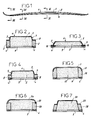
- the ski shown in FIGS. 1 to 4 comprises a filling core 2 made of synthetic material, for example made of polyurethane foam, a shell 3 forming the upper face 4 of the ski and a part 5 of the side faces thereof, lower edges longitudinal 6, and a sliding sole 7.
- a filling core 2 made of synthetic material, for example made of polyurethane foam
- a shell 3 forming the upper face 4 of the ski and a part 5 of the side faces thereof, lower edges longitudinal 6, and a sliding sole 7.
- this ski comprises two longitudinal reinforcing elements 8, extending over a length greater than the central part of the ski or skid zone, arranged on either side of the core.
- Each reinforcing element 8 extends over a large part of the width of a square 6, and serves to support the shell 3, and is not covered laterally by this shell, thus forming the visible edges of the ski.
- the shell 3 laterally comprises two flanges 9 substantially parallel to the plane of the sole, bearing against two faces of same orientation as the songs 8.
- the height of the lateral parts 5 of the hull is substantially constant over the length of the ski, while the height of each edge 8 is maximum in the skid zone and decreases respectively towards the front and towards the rear, to become zero in the ends, as shown in Figure 3.
- a band of viscoelastic material 10 is provided between the hull and the edges.
- each edge 18 has, in the central part of the ski, a height corresponding substantially to that of the ski, and has a shaped upper surface, serving to support a part inclined side 15 of the shell, having a complementary shape.
- the core 12 has a rectangular shape, the face of each reinforcing element located in contact with the core being perpendicular to the plane of the sole.
- FIG. 6 represents another embodiment of this ski, in which the upper face of each edge 28, which is parallel to the plane of the sole, serves to embed an end of an edge 29 of the hull 24.
- each reinforcing element 38 has lateral faces, respectively external and internal, the latter being in contact with the core 32, inclined relative to the perpendicular to the plane of the sole.
- the shell laterally comprises two flanges 35 substantially parallel to the plane of the sole, bearing against two faces of the same orientation as the edges 38.
- FIG. 8 represents a very schematic top view of a ski without shell, according to the invention, in which each reinforcing element 48 has a base of constant width, over the entire length of the ski.
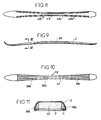
- each reinforcement element consists of a juxtaposed multimaterial complex, such as a central layer of Zicral 48a and two lateral layers of ABS 48b.
- FIGS. 9 to 11 show another embodiment of this ski, in which the reinforcing elements 58 forming the edge are only visible in the skid zone (FIG. 9), and are covered by the shell in the front parts and back of the ski ( Figure 11).
- Each reinforcing element 58 can be made in three parts, namely a central part 58a, a front part 58b and a rear part 58c butted longitudinally. It is important that the central portion 58a is made of a resistant material, the portions 58b and 58c possibly being made, for example, of materials having a good quality of damping, such as a viscoelastic material. It can also be noted that if, in the embodiment shown in FIG. 7, the core 42 has a width which varies along the ski, in which case the reinforcing elements are of constant width, the core 52 of the ski shown in FIG. Figures 9 and 10, may have a constant width, in which case the width of the reinforcing elements is variable throughout the ski.
- the invention brings a great improvement to the existing technique by providing a ski which combines the aesthetic advantages of hull skis, and the technical advantages of traditional skis, by providing a hull ski comprising edges in the skating area.
- the invention is not limited to the sole embodiments of this ski described above by way of examples, on the contrary it embraces all the variants included in the subject of the appended claims .
- the reinforcement elements could only extend in the central part of the ski, or that some of the characteristics, described with reference to an embodiment, could be combined with characteristics described with reference to another embodiment without departing from the scope of the invention.
Landscapes
- Footwear And Its Accessory, Manufacturing Method And Apparatuses (AREA)
- Transition And Organic Metals Composition Catalysts For Addition Polymerization (AREA)
- Laminated Bodies (AREA)
- Fittings On The Vehicle Exterior For Carrying Loads, And Devices For Holding Or Mounting Articles (AREA)
- Injection Moulding Of Plastics Or The Like (AREA)
Claims (23)
Priority Applications (1)
| Application Number | Priority Date | Filing Date | Title |
|---|---|---|---|
| DE9218645U DE9218645U1 (de) | 1991-11-19 | 1992-11-16 | Ski mit nicht-rechteckigem Querschnitt |
Applications Claiming Priority (2)
| Application Number | Priority Date | Filing Date | Title |
|---|---|---|---|
| FR9114750 | 1991-11-19 | ||
| FR9114750A FR2683734B1 (fr) | 1991-11-19 | 1991-11-19 | Ski en forme, de section non rectangulaire. |
Publications (3)
| Publication Number | Publication Date |
|---|---|
| EP0543743A1 EP0543743A1 (de) | 1993-05-26 |
| EP0543743B1 true EP0543743B1 (de) | 1995-03-08 |
| EP0543743B2 EP0543743B2 (de) | 2001-07-04 |
Family
ID=9419463
Family Applications (1)
| Application Number | Title | Priority Date | Filing Date |
|---|---|---|---|
| EP92420415A Expired - Lifetime EP0543743B2 (de) | 1991-11-19 | 1992-11-16 | Ski mit nicht rechteckigem Schnitt |
Country Status (6)
| Country | Link |
|---|---|
| US (2) | US5292148A (de) |
| EP (1) | EP0543743B2 (de) |
| JP (3) | JP2564913Y2 (de) |
| AT (1) | ATE119417T1 (de) |
| DE (2) | DE543743T1 (de) |
| FR (1) | FR2683734B1 (de) |
Families Citing this family (36)
| Publication number | Priority date | Publication date | Assignee | Title |
|---|---|---|---|---|
| FR2683734B1 (fr) * | 1991-11-19 | 1994-01-07 | Rossignol Sa | Ski en forme, de section non rectangulaire. |
| FR2703916B1 (fr) * | 1993-04-16 | 1995-05-19 | Rossignol Sa | Ski comportant des chants et une coque supérieure. |
| USRE36453E (en) * | 1993-04-16 | 1999-12-21 | Skis Rossignol S.A. | Ski including sides and an upper shell |
| FR2703915B1 (fr) * | 1993-04-16 | 1995-06-02 | Rossignol Sa | Ski comportant des chants et une coque supérieure. |
| FR2703917B1 (fr) * | 1993-04-16 | 1995-05-19 | Rossignol Sa | Ski dont la paroi supérieure et les parois latérales sont constituées par une coque. |
| FR2704440B1 (fr) * | 1993-04-30 | 1995-07-28 | Salomon Sa | Planche de glisse, notamment surf de neige. |
| DE4328840A1 (de) * | 1993-08-27 | 1995-03-02 | Franz Voelkl Gmbh & Co Ski Ten | Schalenski |
| FR2720288B1 (fr) * | 1994-05-26 | 1996-07-05 | Rossignol Sa | Ski dont la section varie sur la longueur. |
| JP2847472B2 (ja) * | 1994-08-31 | 1999-01-20 | 株式会社ジャパーナ | スキー板の製法 |
| FR2729866B1 (fr) * | 1995-01-30 | 1997-04-11 | Rossignol Sa | Perfectionnement aux skis a coque pourvus de chants de support de la coque |
| FR2747579B1 (fr) * | 1996-04-22 | 1998-05-22 | Rossignol Sa | Procede de realisation d'une planche de glisse et planche de glisse obtenue par ce procede |
| JPH119757A (ja) * | 1997-06-20 | 1999-01-19 | Fuji Heavy Ind Ltd | 滑走板 |
| US6382658B1 (en) * | 1997-11-19 | 2002-05-07 | North Shore Partners | Method of making a snowboard having improved turning performance |
| FR2773997B1 (fr) * | 1998-01-28 | 2000-02-25 | Rossignol Sa | Planche de glisse dont les chants sont equipes d'elements de renforcement presents sur une partie de la longueur portante de la planche |
| FR2780294B1 (fr) | 1998-06-25 | 2000-08-11 | Rossignol Sa | Planche de glisse sur neige |
| FR2781384B1 (fr) | 1998-07-21 | 2000-08-25 | Rossignol Sa | Ski presentant sur chacun de ses chants des elements de renforcement |
| FR2798297B1 (fr) | 1999-09-09 | 2001-11-16 | Rossignol Sa | Ski, ou autre planche de glisse sur neige, comportant des chants lateraux rigides et distincts |
| FR2799659B1 (fr) * | 1999-10-14 | 2002-01-11 | Rossignol Sa | Planche de glisse |
| FR2802438B1 (fr) | 1999-12-21 | 2002-05-31 | Rossignol Sa | Planche de glisse |
| US6386561B1 (en) | 2000-06-19 | 2002-05-14 | Rolf R. Hanson | Laminated skateboard with protective edge and racing base |
| JP2004505737A (ja) * | 2000-08-16 | 2004-02-26 | ケイ‐ツー、コーポレーション | 部分的な側壁を有するスノーボード |
| EP1330296B1 (de) * | 2000-10-06 | 2007-05-02 | ATOMIC Austria GmbH | Ski und skiherstellungsverfahren |
| US20020089149A1 (en) * | 2001-01-05 | 2002-07-11 | Scott Barbieri | Gliding board with varying bending properties |
| FR2820983B1 (fr) * | 2001-02-20 | 2004-04-16 | Rossignol Sa | Planche de glisse |
| FR2820982B1 (fr) | 2001-02-20 | 2003-03-28 | Rossignol Sa | Planche de glisse |
| FR2820984B1 (fr) | 2001-02-20 | 2003-06-06 | Rossignol Sa | Plateforme de rehaussement de la fixation d'une planche de glisse, et planche de glisse equipee d'une telle plateforme |
| FR2820981B1 (fr) * | 2001-02-22 | 2003-03-28 | Rossignol Sa | Procede pour realiser une planche de glisse sur neige, renfort et planche de glisse sur neige comprenant un tel renfort |
| FR2848868B1 (fr) * | 2002-12-19 | 2007-01-19 | Salomon Sa | Planche de glisse ou de roulage |
| FR2850292B1 (fr) * | 2003-01-27 | 2006-09-01 | Salomon Sa | Planche de glisse ou de roulage |
| US7823892B2 (en) * | 2007-05-04 | 2010-11-02 | Quiksilver, Inc. | Snowboard |
| FR2947182B1 (fr) * | 2009-06-26 | 2011-09-09 | Salomon Sas | Planche de glisse |
| AT11519U1 (de) * | 2010-01-27 | 2010-12-15 | Atomic Austria Gmbh | Verfahren zur herstellung eines äusseren begrenzungselementes für einen gleitbrettkörper sowie verfahren zur herstellung eines damit ausgestatteten gleitbrettkörpers |
| FR2956035B1 (fr) | 2010-02-05 | 2012-08-03 | Rossignol Sa | Planche de glisse sur neige avec des chants de largeur variable |
| SI23531B (sl) * | 2010-11-15 | 2019-06-28 | Elan, D.O.O. | Smučka z asimetričnimi karakteristikami |
| FR3057782B1 (fr) * | 2016-10-26 | 2018-11-09 | Skis Rossignol | Ensemble d'au moins deux elements de construction d'un chant de planche de glisse, et planche de glisse incluant un chant realise avec un tel ensemble |
| DE102017125770A1 (de) * | 2016-12-29 | 2018-07-05 | Völkl Sports GmbH & Co. KG | Untergurt mit Klammereffekt |
Family Cites Families (27)
| Publication number | Priority date | Publication date | Assignee | Title |
|---|---|---|---|---|
| US2369004A (en) * | 1942-01-08 | 1945-02-06 | Alexis D Andreef | Ski |
| US2362380A (en) * | 1942-05-02 | 1944-11-07 | Kallstrom Anders Gustav | Ski |
| FR1207145A (fr) * | 1958-08-25 | 1960-02-15 | Perfectionnements aux skis | |
| AT271283B (de) * | 1964-10-09 | 1969-05-27 | Brueder Riha K G | Aus mehreren Einzelteilen zusammengesetzter Ski |
| US3272522A (en) * | 1965-06-21 | 1966-09-13 | Peter Kennedy Inc | Composite metal and plastic ski |
| FR1459879A (fr) * | 1965-08-12 | 1966-06-17 | Ski métallique | |
| DE1678299A1 (de) * | 1968-02-27 | 1971-12-09 | Voelkl Ohg Franz | Ski |
| AT347831B (de) * | 1976-12-10 | 1979-01-10 | Rohrmoser Alois Skifabrik | Ski |
| US4300786A (en) * | 1979-12-19 | 1981-11-17 | Johnson Wax Associates | Snow ski with adjustable camber |
| FR2476495A1 (fr) * | 1980-02-21 | 1981-08-28 | Rossignol Sa | Ski |
| IT8253045U1 (it) * | 1982-03-11 | 1983-09-11 | Tua Ski Srl | Sci per nevi profonde e difficili |
| DE3437865A1 (de) * | 1983-10-21 | 1985-05-09 | Kabushiki Kaisha Swallow Ski, Iiyama, Nagano | Herstellungsverfahren fuer skier |
| ATE30213T1 (de) * | 1984-11-05 | 1987-10-15 | Rossignol Sa | Ski. |
| EP0220235B1 (de) * | 1985-04-08 | 1990-10-24 | The Volant Ski Corporation | Schneeski und methode zu seiner herstellung |
| FR2610525A1 (fr) * | 1987-02-05 | 1988-08-12 | Salomon Sa | Ski de fond presentant une nervure longitudinale en saillie par rapport a sa face superieure |
| FR2611518B1 (fr) * | 1987-02-27 | 1989-11-17 | Salomon Sa | Ski a amortissement reparti |
| FR2611519B1 (fr) * | 1987-02-27 | 1994-06-17 | Salomon Sa | Procede pour realiser un ski et ski realise selon ce procede |
| FR2615404B1 (fr) * | 1987-05-22 | 1989-09-01 | Salomon Sa | Ski a amortissement reparti |
| JPH01113083A (ja) * | 1987-06-26 | 1989-05-01 | Mizuno Corp | スキ−板及びその製造方法 |
| DE3914189A1 (de) * | 1989-04-28 | 1990-10-31 | Blizzard Oesterreich Ges M B H | Skiherstellungsverfahren und ski, hergestellt nach diesem verfahren |
| JPH05501659A (ja) * | 1989-12-06 | 1993-04-02 | ケスレー・アクチエンゲゼルシャフト | スキー |
| AT398380B (de) * | 1989-12-22 | 1994-11-25 | Kaestle Ag | Ski, insbesondere alpinski, und verfahren zu seiner herstellung |
| AT397209B (de) * | 1990-09-27 | 1994-02-25 | Rohrmoser Alois Skifabrik | Ski mit einer räumlich profilierten oberseite |
| EP0490044A1 (de) * | 1990-12-14 | 1992-06-17 | Salomon S.A. | Wintersportski bestehend aus einer Versteifung und einer Basis |
| FR2683734B1 (fr) * | 1991-11-19 | 1994-01-07 | Rossignol Sa | Ski en forme, de section non rectangulaire. |
| EP0580383A3 (de) * | 1992-07-20 | 1995-04-12 | Csir | Flüssigkeitsanalyse. |
| DE4328840A1 (de) * | 1993-08-27 | 1995-03-02 | Franz Voelkl Gmbh & Co Ski Ten | Schalenski |
-
1991
- 1991-11-19 FR FR9114750A patent/FR2683734B1/fr not_active Expired - Fee Related
-
1992
- 1992-10-09 US US07/958,675 patent/US5292148A/en not_active Ceased
- 1992-11-16 DE DE0543743T patent/DE543743T1/de active Pending
- 1992-11-16 EP EP92420415A patent/EP0543743B2/de not_active Expired - Lifetime
- 1992-11-16 AT AT92420415T patent/ATE119417T1/de not_active IP Right Cessation
- 1992-11-16 DE DE69201630T patent/DE69201630T3/de not_active Expired - Fee Related
- 1992-11-19 JP JP1992080034U patent/JP2564913Y2/ja not_active Expired - Fee Related
-
1997
- 1997-08-19 JP JP007341U patent/JPH1078U/ja active Pending
-
1998
- 1998-11-12 US US09/189,838 patent/USRE36586E/en not_active Expired - Lifetime
-
1999
- 1999-02-10 JP JP11033495A patent/JPH11299958A/ja active Pending
Also Published As
| Publication number | Publication date |
|---|---|
| FR2683734B1 (fr) | 1994-01-07 |
| JP2564913Y2 (ja) | 1998-03-11 |
| DE543743T1 (de) | 1994-12-22 |
| EP0543743A1 (de) | 1993-05-26 |
| JPH11299958A (ja) | 1999-11-02 |
| DE69201630T2 (de) | 1995-07-06 |
| USRE36586E (en) | 2000-02-29 |
| ATE119417T1 (de) | 1995-03-15 |
| US5292148A (en) | 1994-03-08 |
| DE69201630D1 (de) | 1995-04-13 |
| JPH1078U (ja) | 1998-03-31 |
| EP0543743B2 (de) | 2001-07-04 |
| DE69201630T3 (de) | 2001-11-08 |
| FR2683734A1 (fr) | 1993-05-21 |
| JPH0558176U (ja) | 1993-08-03 |
Similar Documents
| Publication | Publication Date | Title |
|---|---|---|
| EP0543743B2 (de) | Ski mit nicht rechteckigem Schnitt | |
| EP0577947B1 (de) | Ski mit einer Rippe und einer Stützvorrichtung | |
| EP0622096B1 (de) | Snowboard | |
| EP0543744B1 (de) | Ski mit einem nicht-rechteckigen Durchschnitt | |
| EP0620027B1 (de) | Ski mit Seitenwangen und Oberschale | |
| EP0620028B1 (de) | Ski mit Seitenwangen und Oberschale | |
| EP1175925A1 (de) | Gleitbrett | |
| EP0465794B1 (de) | Ski mit gerippter Oberfläche | |
| EP1331026B1 (de) | Verbesserung von Gleittbrettern | |
| EP1166832B1 (de) | Schneegleitbrett mit einem oberen Verstärkungselement | |
| EP1440712A1 (de) | Gleit- oder Rollbrett | |
| EP0619127B1 (de) | Ski | |
| FR2713101A1 (fr) | Accessoire pour plaque montée sur la face supérieure d'un ski alpin et destinée à recevoir la fixation d'une chaussure. | |
| EP1424108B1 (de) | Schneegleitbrett mit seitliche Abstützungplatte | |
| FR2773997A1 (fr) | Planche de glisse dont les chants sont equipes d'elements de renforcement presents sur une partie de la longueur portante de la planche | |
| EP1350543B1 (de) | Snowboard oder Rollbrett | |
| FR2670392A1 (fr) | Ski pour sport d'hiver constitue d'une embase et d'un raidisseur. | |
| FR2675391A1 (fr) | Ski pour sport d'hiver comprenant un raidisseur et une embase. | |
| EP1264618A1 (de) | Ski für Alpinskifahren | |
| FR2882526A1 (fr) | Planche de glisse sur neige avec renfort interne | |
| EP0765679B1 (de) | Langlaufski, insbesondere geeignet für das Üben des Skatings | |
| FR2748398A1 (fr) | Planche de glisse | |
| FR2674443A1 (fr) | Ski a face superieure nervuree. | |
| FR2811903A1 (fr) | Planche munie d'un dispositif d'amortissement des vibrations | |
| FR2675390A1 (fr) | Ski pour sport d'hiver comprenant une embase, un raidisseur et un support pour fixations. |
Legal Events
| Date | Code | Title | Description |
|---|---|---|---|
| PUAI | Public reference made under article 153(3) epc to a published international application that has entered the european phase |
Free format text: ORIGINAL CODE: 0009012 |
|
| AK | Designated contracting states |
Kind code of ref document: A1 Designated state(s): AT CH DE ES LI |
|
| 17P | Request for examination filed |
Effective date: 19930512 |
|
| 17Q | First examination report despatched |
Effective date: 19940726 |
|
| DET | De: translation of patent claims | ||
| GRAA | (expected) grant |
Free format text: ORIGINAL CODE: 0009210 |
|
| AK | Designated contracting states |
Kind code of ref document: B1 Designated state(s): AT CH DE ES LI |
|
| PG25 | Lapsed in a contracting state [announced via postgrant information from national office to epo] |
Ref country code: ES Free format text: THE PATENT HAS BEEN ANNULLED BY A DECISION OF A NATIONAL AUTHORITY Effective date: 19950308 |
|
| REF | Corresponds to: |
Ref document number: 119417 Country of ref document: AT Date of ref document: 19950315 Kind code of ref document: T |
|
| REF | Corresponds to: |
Ref document number: 69201630 Country of ref document: DE Date of ref document: 19950413 |
|
| PLBI | Opposition filed |
Free format text: ORIGINAL CODE: 0009260 |
|
| 26 | Opposition filed |
Opponent name: FRANZ VOELKL GMBH & CO. SKI UND TENNIS SPORTARTIKE Effective date: 19950602 |
|
| PLBF | Reply of patent proprietor to notice(s) of opposition |
Free format text: ORIGINAL CODE: EPIDOS OBSO |
|
| PLBF | Reply of patent proprietor to notice(s) of opposition |
Free format text: ORIGINAL CODE: EPIDOS OBSO |
|
| PLBF | Reply of patent proprietor to notice(s) of opposition |
Free format text: ORIGINAL CODE: EPIDOS OBSO |
|
| PLAW | Interlocutory decision in opposition |
Free format text: ORIGINAL CODE: EPIDOS IDOP |
|
| APAC | Appeal dossier modified |
Free format text: ORIGINAL CODE: EPIDOS NOAPO |
|
| APAE | Appeal reference modified |
Free format text: ORIGINAL CODE: EPIDOS REFNO |
|
| APAC | Appeal dossier modified |
Free format text: ORIGINAL CODE: EPIDOS NOAPO |
|
| PLBQ | Unpublished change to opponent data |
Free format text: ORIGINAL CODE: EPIDOS OPPO |
|
| PLBQ | Unpublished change to opponent data |
Free format text: ORIGINAL CODE: EPIDOS OPPO |
|
| PLAB | Opposition data, opponent's data or that of the opponent's representative modified |
Free format text: ORIGINAL CODE: 0009299OPPO |
|
| PLAB | Opposition data, opponent's data or that of the opponent's representative modified |
Free format text: ORIGINAL CODE: 0009299OPPO |
|
| R26 | Opposition filed (corrected) |
Opponent name: FRANZ VOELKL GMBH & CO. SKI UND TENNIS SPORTARTIKE Effective date: 19950602 |
|
| R26 | Opposition filed (corrected) |
Opponent name: VOELKL SPORTS GMBH & CO. KG Effective date: 19950602 |
|
| APAC | Appeal dossier modified |
Free format text: ORIGINAL CODE: EPIDOS NOAPO |
|
| PLAW | Interlocutory decision in opposition |
Free format text: ORIGINAL CODE: EPIDOS IDOP |
|
| PUAH | Patent maintained in amended form |
Free format text: ORIGINAL CODE: 0009272 |
|
| 27A | Patent maintained in amended form |
Effective date: 20010704 |
|
| AK | Designated contracting states |
Kind code of ref document: B2 Designated state(s): AT CH DE ES LI |
|
| REG | Reference to a national code |
Ref country code: CH Ref legal event code: AEN Free format text: MAINTIEN DU BREVET DONT L'ETENDUE A ETE MODIFIEE |
|
| PGFP | Annual fee paid to national office [announced via postgrant information from national office to epo] |
Ref country code: CH Payment date: 20050825 Year of fee payment: 14 |
|
| APAH | Appeal reference modified |
Free format text: ORIGINAL CODE: EPIDOSCREFNO |
|
| PG25 | Lapsed in a contracting state [announced via postgrant information from national office to epo] |
Ref country code: LI Free format text: LAPSE BECAUSE OF NON-PAYMENT OF DUE FEES Effective date: 20061130 Ref country code: CH Free format text: LAPSE BECAUSE OF NON-PAYMENT OF DUE FEES Effective date: 20061130 |
|
| REG | Reference to a national code |
Ref country code: CH Ref legal event code: PL |
|
| PGFP | Annual fee paid to national office [announced via postgrant information from national office to epo] |
Ref country code: DE Payment date: 20071108 Year of fee payment: 16 |
|
| PGFP | Annual fee paid to national office [announced via postgrant information from national office to epo] |
Ref country code: AT Payment date: 20071017 Year of fee payment: 16 |
|
| PLAB | Opposition data, opponent's data or that of the opponent's representative modified |
Free format text: ORIGINAL CODE: 0009299OPPO |
|
| PG25 | Lapsed in a contracting state [announced via postgrant information from national office to epo] |
Ref country code: AT Free format text: LAPSE BECAUSE OF NON-PAYMENT OF DUE FEES Effective date: 20081116 |
|
| PG25 | Lapsed in a contracting state [announced via postgrant information from national office to epo] |
Ref country code: DE Free format text: LAPSE BECAUSE OF NON-PAYMENT OF DUE FEES Effective date: 20090603 |