EP0543986B1 - Polymerharz für Peptidsynthese - Google Patents
Polymerharz für Peptidsynthese Download PDFInfo
- Publication number
- EP0543986B1 EP0543986B1 EP92914068A EP92914068A EP0543986B1 EP 0543986 B1 EP0543986 B1 EP 0543986B1 EP 92914068 A EP92914068 A EP 92914068A EP 92914068 A EP92914068 A EP 92914068A EP 0543986 B1 EP0543986 B1 EP 0543986B1
- Authority
- EP
- European Patent Office
- Prior art keywords
- resin
- fmoc
- peptide
- amino acid
- polymeric resin
- Prior art date
- Legal status (The legal status is an assumption and is not a legal conclusion. Google has not performed a legal analysis and makes no representation as to the accuracy of the status listed.)
- Expired - Lifetime
Links
- 239000002952 polymeric resin Substances 0.000 title claims abstract description 15
- 229920003002 synthetic resin Polymers 0.000 title claims abstract description 15
- 238000010647 peptide synthesis reaction Methods 0.000 title claims abstract description 14
- 108090000765 processed proteins & peptides Proteins 0.000 claims abstract description 84
- 239000011159 matrix material Substances 0.000 claims abstract description 15
- 229920003053 polystyrene-divinylbenzene Polymers 0.000 claims abstract 2
- 229920005989 resin Polymers 0.000 claims description 169
- 239000011347 resin Substances 0.000 claims description 169
- 150000001413 amino acids Chemical class 0.000 claims description 31
- 238000000034 method Methods 0.000 claims description 15
- 238000010168 coupling process Methods 0.000 claims description 10
- 125000003545 alkoxy group Chemical group 0.000 claims description 9
- 125000000217 alkyl group Chemical group 0.000 claims description 9
- 125000003275 alpha amino acid group Chemical group 0.000 claims description 9
- 230000008878 coupling Effects 0.000 claims description 9
- 238000005859 coupling reaction Methods 0.000 claims description 9
- 125000006239 protecting group Chemical group 0.000 claims description 7
- 125000002924 primary amino group Chemical group [H]N([H])* 0.000 claims description 6
- 150000001735 carboxylic acids Chemical class 0.000 claims description 5
- 229910052739 hydrogen Inorganic materials 0.000 claims description 4
- 239000001257 hydrogen Substances 0.000 claims description 4
- 125000002496 methyl group Chemical group [H]C([H])([H])* 0.000 claims description 4
- 125000004435 hydrogen atom Chemical group [H]* 0.000 claims description 3
- 230000002194 synthesizing effect Effects 0.000 claims description 2
- UFHFLCQGNIYNRP-UHFFFAOYSA-N Hydrogen Chemical compound [H][H] UFHFLCQGNIYNRP-UHFFFAOYSA-N 0.000 claims 2
- 125000004432 carbon atom Chemical group C* 0.000 claims 2
- 125000000956 methoxy group Chemical group [H]C([H])([H])O* 0.000 claims 1
- 229920000642 polymer Polymers 0.000 claims 1
- 102000004196 processed proteins & peptides Human genes 0.000 abstract description 17
- 125000003088 (fluoren-9-ylmethoxy)carbonyl group Chemical group 0.000 abstract description 14
- BZVJOYBTLHNRDW-UHFFFAOYSA-N triphenylmethanamine Chemical group C=1C=CC=CC=1C(C=1C=CC=CC=1)(N)C1=CC=CC=C1 BZVJOYBTLHNRDW-UHFFFAOYSA-N 0.000 abstract description 12
- LZTRCELOJRDYMQ-UHFFFAOYSA-N triphenylmethanol Chemical compound C=1C=CC=CC=1C(C=1C=CC=CC=1)(O)C1=CC=CC=C1 LZTRCELOJRDYMQ-UHFFFAOYSA-N 0.000 abstract description 12
- ZENOXNGFMSCLLL-UHFFFAOYSA-N vanillyl alcohol Chemical compound COC1=CC(CO)=CC=C1O ZENOXNGFMSCLLL-UHFFFAOYSA-N 0.000 abstract description 9
- 239000007790 solid phase Substances 0.000 abstract description 7
- 229920001184 polypeptide Polymers 0.000 abstract description 4
- 238000002360 preparation method Methods 0.000 abstract 1
- YMWUJEATGCHHMB-UHFFFAOYSA-N Dichloromethane Chemical compound ClCCl YMWUJEATGCHHMB-UHFFFAOYSA-N 0.000 description 120
- QTBSBXVTEAMEQO-UHFFFAOYSA-N Acetic acid Chemical compound CC(O)=O QTBSBXVTEAMEQO-UHFFFAOYSA-N 0.000 description 36
- RWRDLPDLKQPQOW-UHFFFAOYSA-N Pyrrolidine Chemical compound C1CCNC1 RWRDLPDLKQPQOW-UHFFFAOYSA-N 0.000 description 36
- ZMXDDKWLCZADIW-UHFFFAOYSA-N N,N-Dimethylformamide Chemical compound CN(C)C=O ZMXDDKWLCZADIW-UHFFFAOYSA-N 0.000 description 33
- 238000006467 substitution reaction Methods 0.000 description 16
- OKKJLVBELUTLKV-UHFFFAOYSA-N Methanol Chemical compound OC OKKJLVBELUTLKV-UHFFFAOYSA-N 0.000 description 12
- JGFZNNIVVJXRND-UHFFFAOYSA-N N,N-Diisopropylethylamine (DIPEA) Chemical compound CCN(C(C)C)C(C)C JGFZNNIVVJXRND-UHFFFAOYSA-N 0.000 description 12
- 238000007792 addition Methods 0.000 description 12
- 238000001914 filtration Methods 0.000 description 12
- 230000015572 biosynthetic process Effects 0.000 description 11
- 239000000047 product Substances 0.000 description 11
- JMTMSDXUXJISAY-UHFFFAOYSA-N 2H-benzotriazol-4-ol Chemical compound OC1=CC=CC2=C1N=NN2 JMTMSDXUXJISAY-UHFFFAOYSA-N 0.000 description 10
- 125000004122 cyclic group Chemical group 0.000 description 10
- NPZTUJOABDZTLV-UHFFFAOYSA-N hydroxybenzotriazole Substances O=C1C=CC=C2NNN=C12 NPZTUJOABDZTLV-UHFFFAOYSA-N 0.000 description 10
- 238000003786 synthesis reaction Methods 0.000 description 10
- 238000004458 analytical method Methods 0.000 description 9
- 238000004519 manufacturing process Methods 0.000 description 9
- BDNKZNFMNDZQMI-UHFFFAOYSA-N 1,3-diisopropylcarbodiimide Chemical compound CC(C)N=C=NC(C)C BDNKZNFMNDZQMI-UHFFFAOYSA-N 0.000 description 8
- WYURNTSHIVDZCO-UHFFFAOYSA-N Tetrahydrofuran Chemical compound C1CCOC1 WYURNTSHIVDZCO-UHFFFAOYSA-N 0.000 description 8
- BGRWYRAHAFMIBJ-UHFFFAOYSA-N diisopropylcarbodiimide Natural products CC(C)NC(=O)NC(C)C BGRWYRAHAFMIBJ-UHFFFAOYSA-N 0.000 description 8
- 239000000725 suspension Substances 0.000 description 8
- -1 9-fluorenylmethyloxy carbonyl Chemical group 0.000 description 7
- 0 Cc1ccc(C(c2ccc(*)cc2*)(c2c(*)cc(*)cc2)OC(*)=O)cc1 Chemical compound Cc1ccc(C(c2ccc(*)cc2*)(c2c(*)cc(*)cc2)OC(*)=O)cc1 0.000 description 7
- 238000003776 cleavage reaction Methods 0.000 description 7
- 238000010511 deprotection reaction Methods 0.000 description 7
- 238000011068 loading method Methods 0.000 description 7
- 230000007017 scission Effects 0.000 description 7
- 239000007787 solid Substances 0.000 description 7
- JBWKIWSBJXDJDT-UHFFFAOYSA-N triphenylmethyl chloride Chemical compound C=1C=CC=CC=1C(C=1C=CC=CC=1)(Cl)C1=CC=CC=C1 JBWKIWSBJXDJDT-UHFFFAOYSA-N 0.000 description 7
- 150000001732 carboxylic acid derivatives Chemical class 0.000 description 6
- 229920001577 copolymer Polymers 0.000 description 6
- XLYOFNOQVPJJNP-UHFFFAOYSA-N water Substances O XLYOFNOQVPJJNP-UHFFFAOYSA-N 0.000 description 6
- SJVFAHZPLIXNDH-QFIPXVFZSA-N (2s)-2-(9h-fluoren-9-ylmethoxycarbonylamino)-3-phenylpropanoic acid Chemical compound C([C@@H](C(=O)O)NC(=O)OCC1C2=CC=CC=C2C2=CC=CC=C21)C1=CC=CC=C1 SJVFAHZPLIXNDH-QFIPXVFZSA-N 0.000 description 5
- VEXZGXHMUGYJMC-UHFFFAOYSA-M Chloride anion Chemical compound [Cl-] VEXZGXHMUGYJMC-UHFFFAOYSA-M 0.000 description 5
- 238000006243 chemical reaction Methods 0.000 description 5
- 238000002523 gelfiltration Methods 0.000 description 5
- 238000002953 preparative HPLC Methods 0.000 description 5
- 239000007858 starting material Substances 0.000 description 5
- SCYULBFZEHDVBN-UHFFFAOYSA-N 1,1-Dichloroethane Chemical compound CC(Cl)Cl SCYULBFZEHDVBN-UHFFFAOYSA-N 0.000 description 4
- KRHYYFGTRYWZRS-UHFFFAOYSA-N Fluorane Chemical compound F KRHYYFGTRYWZRS-UHFFFAOYSA-N 0.000 description 4
- 239000002253 acid Substances 0.000 description 4
- VSCWAEJMTAWNJL-UHFFFAOYSA-K aluminium trichloride Chemical compound Cl[Al](Cl)Cl VSCWAEJMTAWNJL-UHFFFAOYSA-K 0.000 description 4
- 239000002904 solvent Substances 0.000 description 4
- YLQBMQCUIZJEEH-UHFFFAOYSA-N tetrahydrofuran Natural products C=1C=COC=1 YLQBMQCUIZJEEH-UHFFFAOYSA-N 0.000 description 4
- ZPGDWQNBZYOZTI-UHFFFAOYSA-N 1-(9h-fluoren-9-ylmethoxycarbonyl)pyrrolidine-2-carboxylic acid Chemical compound OC(=O)C1CCCN1C(=O)OCC1C2=CC=CC=C2C2=CC=CC=C21 ZPGDWQNBZYOZTI-UHFFFAOYSA-N 0.000 description 3
- WFDIJRYMOXRFFG-UHFFFAOYSA-N Acetic anhydride Chemical compound CC(=O)OC(C)=O WFDIJRYMOXRFFG-UHFFFAOYSA-N 0.000 description 3
- 238000003747 Grignard reaction Methods 0.000 description 3
- FXHOOIRPVKKKFG-UHFFFAOYSA-N N,N-Dimethylacetamide Chemical compound CN(C)C(C)=O FXHOOIRPVKKKFG-UHFFFAOYSA-N 0.000 description 3
- 208000022639 SchC6pf-Schulz-Passarge syndrome Diseases 0.000 description 3
- 208000001364 Schopf-Schulz-Passarge syndrome Diseases 0.000 description 3
- YXFVVABEGXRONW-UHFFFAOYSA-N Toluene Chemical compound CC1=CC=CC=C1 YXFVVABEGXRONW-UHFFFAOYSA-N 0.000 description 3
- ZMANZCXQSJIPKH-UHFFFAOYSA-N Triethylamine Chemical compound CCN(CC)CC ZMANZCXQSJIPKH-UHFFFAOYSA-N 0.000 description 3
- 150000001408 amides Chemical class 0.000 description 3
- 230000000903 blocking effect Effects 0.000 description 3
- PFKFTWBEEFSNDU-UHFFFAOYSA-N carbonyldiimidazole Chemical compound C1=CN=CN1C(=O)N1C=CN=C1 PFKFTWBEEFSNDU-UHFFFAOYSA-N 0.000 description 3
- 238000001212 derivatisation Methods 0.000 description 3
- 125000001495 ethyl group Chemical group [H]C([H])([H])C([H])([H])* 0.000 description 3
- 238000011534 incubation Methods 0.000 description 3
- 238000002156 mixing Methods 0.000 description 3
- 230000003287 optical effect Effects 0.000 description 3
- SWZCTMTWRHEBIN-QFIPXVFZSA-N (2s)-2-(9h-fluoren-9-ylmethoxycarbonylamino)-3-(4-hydroxyphenyl)propanoic acid Chemical compound C([C@@H](C(=O)O)NC(=O)OCC1C2=CC=CC=C2C2=CC=CC=C21)C1=CC=C(O)C=C1 SWZCTMTWRHEBIN-QFIPXVFZSA-N 0.000 description 2
- QWXZOFZKSQXPDC-NSHDSACASA-N (2s)-2-(9h-fluoren-9-ylmethoxycarbonylamino)propanoic acid Chemical compound C1=CC=C2C(COC(=O)N[C@@H](C)C(O)=O)C3=CC=CC=C3C2=C1 QWXZOFZKSQXPDC-NSHDSACASA-N 0.000 description 2
- QGZKDVFQNNGYKY-UHFFFAOYSA-N Ammonia Chemical compound N QGZKDVFQNNGYKY-UHFFFAOYSA-N 0.000 description 2
- 101100129088 Caenorhabditis elegans lys-2 gene Proteins 0.000 description 2
- 101100315624 Caenorhabditis elegans tyr-1 gene Proteins 0.000 description 2
- KXDHJXZQYSOELW-UHFFFAOYSA-N Carbamic acid Chemical class NC(O)=O KXDHJXZQYSOELW-UHFFFAOYSA-N 0.000 description 2
- RTZKZFJDLAIYFH-UHFFFAOYSA-N Diethyl ether Chemical compound CCOCC RTZKZFJDLAIYFH-UHFFFAOYSA-N 0.000 description 2
- 229930194542 Keto Natural products 0.000 description 2
- 101100342977 Neurospora crassa (strain ATCC 24698 / 74-OR23-1A / CBS 708.71 / DSM 1257 / FGSC 987) leu-1 gene Proteins 0.000 description 2
- 102000007079 Peptide Fragments Human genes 0.000 description 2
- 108010033276 Peptide Fragments Proteins 0.000 description 2
- WQDUMFSSJAZKTM-UHFFFAOYSA-N Sodium methoxide Chemical compound [Na+].[O-]C WQDUMFSSJAZKTM-UHFFFAOYSA-N 0.000 description 2
- WETWJCDKMRHUPV-UHFFFAOYSA-N acetyl chloride Chemical compound CC(Cl)=O WETWJCDKMRHUPV-UHFFFAOYSA-N 0.000 description 2
- 239000012346 acetyl chloride Substances 0.000 description 2
- 150000008064 anhydrides Chemical class 0.000 description 2
- 230000008033 biological extinction Effects 0.000 description 2
- 125000003178 carboxy group Chemical group [H]OC(*)=O 0.000 description 2
- 230000001066 destructive effect Effects 0.000 description 2
- 230000000694 effects Effects 0.000 description 2
- 230000008030 elimination Effects 0.000 description 2
- 238000003379 elimination reaction Methods 0.000 description 2
- 125000000468 ketone group Chemical group 0.000 description 2
- 239000000203 mixture Substances 0.000 description 2
- QPJSUIGXIBEQAC-UHFFFAOYSA-N n-(2,4-dichloro-5-propan-2-yloxyphenyl)acetamide Chemical compound CC(C)OC1=CC(NC(C)=O)=C(Cl)C=C1Cl QPJSUIGXIBEQAC-UHFFFAOYSA-N 0.000 description 2
- 229920006122 polyamide resin Polymers 0.000 description 2
- 238000002390 rotary evaporation Methods 0.000 description 2
- 238000007086 side reaction Methods 0.000 description 2
- KLBPUVPNPAJWHZ-UMSFTDKQSA-N (2r)-2-(9h-fluoren-9-ylmethoxycarbonylamino)-3-tritylsulfanylpropanoic acid Chemical compound C([C@@H](C(=O)O)NC(=O)OCC1C2=CC=CC=C2C2=CC=CC=C21)SC(C=1C=CC=CC=1)(C=1C=CC=CC=1)C1=CC=CC=C1 KLBPUVPNPAJWHZ-UMSFTDKQSA-N 0.000 description 1
- CSMYOORPUGPKAP-IBGZPJMESA-N (2r)-3-(acetamidomethylsulfanyl)-2-(9h-fluoren-9-ylmethoxycarbonylamino)propanoic acid Chemical compound C1=CC=C2C(COC(=O)N[C@@H](CSCNC(=O)C)C(O)=O)C3=CC=CC=C3C2=C1 CSMYOORPUGPKAP-IBGZPJMESA-N 0.000 description 1
- UMRUUWFGLGNQLI-QFIPXVFZSA-N (2s)-2-(9h-fluoren-9-ylmethoxycarbonylamino)-6-[(2-methylpropan-2-yl)oxycarbonylamino]hexanoic acid Chemical compound C1=CC=C2C(COC(=O)N[C@@H](CCCCNC(=O)OC(C)(C)C)C(O)=O)C3=CC=CC=C3C2=C1 UMRUUWFGLGNQLI-QFIPXVFZSA-N 0.000 description 1
- KSDTXRUIZMTBNV-INIZCTEOSA-N (2s)-2-(9h-fluoren-9-ylmethoxycarbonylamino)butanedioic acid Chemical compound C1=CC=C2C(COC(=O)N[C@@H](CC(=O)O)C(O)=O)C3=CC=CC=C3C2=C1 KSDTXRUIZMTBNV-INIZCTEOSA-N 0.000 description 1
- DVBUCBXGDWWXNY-SFHVURJKSA-N (2s)-5-(diaminomethylideneamino)-2-(9h-fluoren-9-ylmethoxycarbonylamino)pentanoic acid Chemical compound C1=CC=C2C(COC(=O)N[C@@H](CCCN=C(N)N)C(O)=O)C3=CC=CC=C3C2=C1 DVBUCBXGDWWXNY-SFHVURJKSA-N 0.000 description 1
- QTWZCODKTSUZJN-LJAQVGFWSA-N (2s)-5-[[amino-[(2,2,5,7,8-pentamethyl-3,4-dihydrochromen-6-yl)sulfonylamino]methylidene]amino]-2-(9h-fluoren-9-ylmethoxycarbonylamino)pentanoic acid Chemical compound C12=CC=CC=C2C2=CC=CC=C2C1COC(=O)N[C@H](C(O)=O)CCCN=C(N)NS(=O)(=O)C(C(C)=C1C)=C(C)C2=C1OC(C)(C)CC2 QTWZCODKTSUZJN-LJAQVGFWSA-N 0.000 description 1
- ASOKPJOREAFHNY-UHFFFAOYSA-N 1-Hydroxybenzotriazole Chemical compound C1=CC=C2N(O)N=NC2=C1 ASOKPJOREAFHNY-UHFFFAOYSA-N 0.000 description 1
- HBAHZZVIEFRTEY-UHFFFAOYSA-N 2-heptylcyclohex-2-en-1-one Chemical compound CCCCCCCC1=CCCCC1=O HBAHZZVIEFRTEY-UHFFFAOYSA-N 0.000 description 1
- 239000004475 Arginine Substances 0.000 description 1
- 101100505161 Caenorhabditis elegans mel-32 gene Proteins 0.000 description 1
- 150000008574 D-amino acids Chemical class 0.000 description 1
- 208000010228 Erectile Dysfunction Diseases 0.000 description 1
- LFQSCWFLJHTTHZ-UHFFFAOYSA-N Ethanol Chemical compound CCO LFQSCWFLJHTTHZ-UHFFFAOYSA-N 0.000 description 1
- VEXZGXHMUGYJMC-UHFFFAOYSA-N Hydrochloric acid Chemical group Cl VEXZGXHMUGYJMC-UHFFFAOYSA-N 0.000 description 1
- 150000008575 L-amino acids Chemical class 0.000 description 1
- QIVBCDIJIAJPQS-VIFPVBQESA-N L-tryptophane Chemical compound C1=CC=C2C(C[C@H](N)C(O)=O)=CNC2=C1 QIVBCDIJIAJPQS-VIFPVBQESA-N 0.000 description 1
- 229920001367 Merrifield resin Polymers 0.000 description 1
- 125000000729 N-terminal amino-acid group Chemical group 0.000 description 1
- 239000004793 Polystyrene Substances 0.000 description 1
- QIVBCDIJIAJPQS-UHFFFAOYSA-N Tryptophan Natural products C1=CC=C2C(CC(N)C(O)=O)=CNC2=C1 QIVBCDIJIAJPQS-UHFFFAOYSA-N 0.000 description 1
- 125000003158 alcohol group Chemical group 0.000 description 1
- 230000029936 alkylation Effects 0.000 description 1
- 238000005804 alkylation reaction Methods 0.000 description 1
- 125000003277 amino group Chemical group 0.000 description 1
- ODKSFYDXXFIFQN-UHFFFAOYSA-N arginine Natural products OC(=O)C(N)CCCNC(N)=N ODKSFYDXXFIFQN-UHFFFAOYSA-N 0.000 description 1
- 239000002585 base Substances 0.000 description 1
- PASDCCFISLVPSO-UHFFFAOYSA-N benzoyl chloride Chemical compound ClC(=O)C1=CC=CC=C1 PASDCCFISLVPSO-UHFFFAOYSA-N 0.000 description 1
- 239000003795 chemical substances by application Substances 0.000 description 1
- JMFRWRFFLBVWSI-UHFFFAOYSA-N cis-coniferyl alcohol Natural products COC1=CC(C=CCO)=CC=C1O JMFRWRFFLBVWSI-UHFFFAOYSA-N 0.000 description 1
- 238000010276 construction Methods 0.000 description 1
- 230000003247 decreasing effect Effects 0.000 description 1
- 238000007865 diluting Methods 0.000 description 1
- 239000000706 filtrate Substances 0.000 description 1
- 239000012467 final product Substances 0.000 description 1
- 238000009472 formulation Methods 0.000 description 1
- 239000012634 fragment Substances 0.000 description 1
- 125000000524 functional group Chemical group 0.000 description 1
- 125000002887 hydroxy group Chemical group [H]O* 0.000 description 1
- 238000012994 industrial processing Methods 0.000 description 1
- 230000000977 initiatory effect Effects 0.000 description 1
- 239000000543 intermediate Substances 0.000 description 1
- 230000002427 irreversible effect Effects 0.000 description 1
- 238000011031 large-scale manufacturing process Methods 0.000 description 1
- 125000005647 linker group Chemical group 0.000 description 1
- 239000000463 material Substances 0.000 description 1
- 238000003541 multi-stage reaction Methods 0.000 description 1
- 238000007040 multi-step synthesis reaction Methods 0.000 description 1
- ANRQGKOBLBYXFM-UHFFFAOYSA-M phenylmagnesium bromide Chemical compound Br[Mg]C1=CC=CC=C1 ANRQGKOBLBYXFM-UHFFFAOYSA-M 0.000 description 1
- 229920002223 polystyrene Polymers 0.000 description 1
- 238000009877 rendering Methods 0.000 description 1
- 150000003335 secondary amines Chemical class 0.000 description 1
- 239000000126 substance Substances 0.000 description 1
- 230000008961 swelling Effects 0.000 description 1
- 125000005931 tert-butyloxycarbonyl group Chemical group [H]C([H])([H])C(OC(*)=O)(C([H])([H])[H])C([H])([H])[H] 0.000 description 1
- HNKJADCVZUBCPG-UHFFFAOYSA-N thioanisole Chemical compound CSC1=CC=CC=C1 HNKJADCVZUBCPG-UHFFFAOYSA-N 0.000 description 1
- 125000002221 trityl group Chemical group [H]C1=C([H])C([H])=C([H])C([H])=C1C([*])(C1=C(C(=C(C(=C1[H])[H])[H])[H])[H])C1=C([H])C([H])=C([H])C([H])=C1[H] 0.000 description 1
- OUYCCCASQSFEME-UHFFFAOYSA-N tyrosine Natural products OC(=O)C(N)CC1=CC=C(O)C=C1 OUYCCCASQSFEME-UHFFFAOYSA-N 0.000 description 1
- 125000001493 tyrosinyl group Chemical group [H]OC1=C([H])C([H])=C(C([H])=C1[H])C([H])([H])C([H])(N([H])[H])C(*)=O 0.000 description 1
- 238000005406 washing Methods 0.000 description 1
- 230000004584 weight gain Effects 0.000 description 1
- 235000019786 weight gain Nutrition 0.000 description 1
Classifications
-
- C—CHEMISTRY; METALLURGY
- C07—ORGANIC CHEMISTRY
- C07K—PEPTIDES
- C07K1/00—General methods for the preparation of peptides, i.e. processes for the organic chemical preparation of peptides or proteins of any length
- C07K1/04—General methods for the preparation of peptides, i.e. processes for the organic chemical preparation of peptides or proteins of any length on carriers
- C07K1/042—General methods for the preparation of peptides, i.e. processes for the organic chemical preparation of peptides or proteins of any length on carriers characterised by the nature of the carrier
-
- C—CHEMISTRY; METALLURGY
- C07—ORGANIC CHEMISTRY
- C07C—ACYCLIC OR CARBOCYCLIC COMPOUNDS
- C07C17/00—Preparation of halogenated hydrocarbons
- C07C17/093—Preparation of halogenated hydrocarbons by replacement by halogens
- C07C17/16—Preparation of halogenated hydrocarbons by replacement by halogens of hydroxyl groups
-
- C—CHEMISTRY; METALLURGY
- C08—ORGANIC MACROMOLECULAR COMPOUNDS; THEIR PREPARATION OR CHEMICAL WORKING-UP; COMPOSITIONS BASED THEREON
- C08F—MACROMOLECULAR COMPOUNDS OBTAINED BY REACTIONS ONLY INVOLVING CARBON-TO-CARBON UNSATURATED BONDS
- C08F8/00—Chemical modification by after-treatment
- C08F8/14—Esterification
-
- C—CHEMISTRY; METALLURGY
- C08—ORGANIC MACROMOLECULAR COMPOUNDS; THEIR PREPARATION OR CHEMICAL WORKING-UP; COMPOSITIONS BASED THEREON
- C08F—MACROMOLECULAR COMPOUNDS OBTAINED BY REACTIONS ONLY INVOLVING CARBON-TO-CARBON UNSATURATED BONDS
- C08F8/00—Chemical modification by after-treatment
- C08F8/30—Introducing nitrogen atoms or nitrogen-containing groups
Definitions
- the present invention relates to a novel polymeric resin and method suitable for use in creating polypeptides.
- Solid phase peptide synthesis has proven to be the only practical method of producing synthetic peptides longer than 8-10 amino acids.
- One method of producing synthetic peptides is called Boc (tert-butyloxycarbonyl) SPPS.
- Another method of producing synthetic peptides is known as Fmoc (9-fluorenylmethyloxy carbonyl) SPPS.
- Boc and Fmoc SPPS employ minuscule spheres of specially produced resin which are suspended in a chemical solution. Each of these spheres serve as a anchor for the assembly of amino acid chains to produce polypeptides.
- the Boc SPPS although the most popular currently used method for the synthesis of peptides, suffers from low yield of product (especially with peptides of medium to long length), low purity, and an inability to build certain combinations of the amino acids except with great difficulty and expense.
- trifluoroacetic (TFA) normally used to deprotect the amino terminal during each synthesis cycle in the Boc protection strategy, also cleaves approximately 1% of the resin anchor peptides from the resin spheres.
- yield and purity diminishes rapidly during the synthesis processes. The latter is a result of cleaved and lost chains leaving free initiation sites on the resin, thus permitting new chains to start building thereupon.
- hydrofluoric acid (HF) an integral component of Boc SPPS, is responsible for many destructive side effects when applied to synthetic peptides.
- Fmoc SPPS improves upon Boc SPPS in that an orthogonal synthesis system is employed.
- the side-chain blocking groups and the peptide-resin linkages are completely stable to the agents used during each step of the synthesis of peptides.
- the deprotecting step of each cycle employs a secondary amine base which does not attack the bond between the growing peptide chain and resin support, since this bond is acid labile.
- TFA is used with Fmoc, eliminating the destructive side effects of HF.
- Some Fmoc SPPS employs polyamide resin which generally possesses a low loading capacity. Present polyamide resins also tends to clump together rendering it impotent for large scale production.
- the present invention provides polymeric resins suitable for use in peptide synthesis as set out in the accompanying Claim 1.
- the invention provides derivatized polymeric resins suitable for use in peptide synthesis which are set out in the accompanying claim 5.
- a third aspect of the present invention relates to a method of synthesizing a peptide comprising the steps set out in the accompanying claim 8.
- the present invention provides three resins each of which provides a unique functional handle onto which protected amino acids and other molecules possessing a free carboxylic acids moiety can be attached.
- the first resin (Resin #1) takes the formula of 4-hydroxy-3-methoxy-benzoyl alcohol (HMBA) attached to a polystyrene-dvb copolymer and is a general purpose resin for routine Fmoc-SPPS. It is far less expensive to produce than the standard p-alkoxy benzoyl alcohol resin used for Fmoc-SPPS since the starting material, vanillyl alcohol is readily and inexpensively available in large quantities.
- the finished synthetic peptide can be cleaved from the resin using 25% TFA in dichloromethane (DCM) which is a significant improvement over the 95% TFA required to cleave products from p-alkoxy benzoyl alcohol resin.
- the HMBA resin may be derivatized or loaded with an amino acid or other carboxylic acid containing molecule.
- the second resin may be termed trityl alcohol attached to a polystyrene-dvb matrix.
- the second resin is a very dilute acid susceptible resin for the production of protected peptide fragments by Fmoc-SPPS.
- the finished protected peptides are cleaved from the support matrix with 15% acetic acid and 85% DCM.
- the elimination of TFA during this desirable cleaving step is a significant, and unexpected property of Resin #2.
- the level of substitution of the starting material and the yield of synthetic peptides using such material is quiet high.
- the third resin (Resin #3) is specifically designed for the production of peptide amides by Fmoc-SSPS.
- Resin #3 is a trityl amine linked to a polystyrene-dvb matrix.
- Such trityl amine resin may be loaded with an amino acid and employed in peptide synthesis using the Fmoc-SSPS strategy.
- the trityl amine resin may also be loaded with other carboxyl acid containing molecules to yield carboxyl amides.
- the peptide amide may be cleaved from the resin using 25% TFA in DCM without multistep syntheses of linker intermediates.
- Another aim of the present invention is to provide solid support resins for Fmoc-solid phase peptide synthesis which eliminates undesirable side reactions during the attachment of the first amino acid to the solid support matrix.
- Yet another aim of the present invention is to provide solid support resins for Fmoc-solid phase peptide synthesis which requires a decreased amounts of solvent in the washing steps during the peptides building processes compared to pricr art resins.
- Yet another aim of the present invention is to provide solid support resins for Fmoc-solid phase peptide synthesis which are relatively inexpensive and easy to manufacture.
- Resin #1 may be prepared by adding the Merrifield resin of the prior art to the vanillyl alcohol or a derivative thereof by the following reaction:
- the R with a circle around it indicates a styrenedivinylbenzene copolymer in a gel form or a pellicular form which is suitable for fldw synthesis.
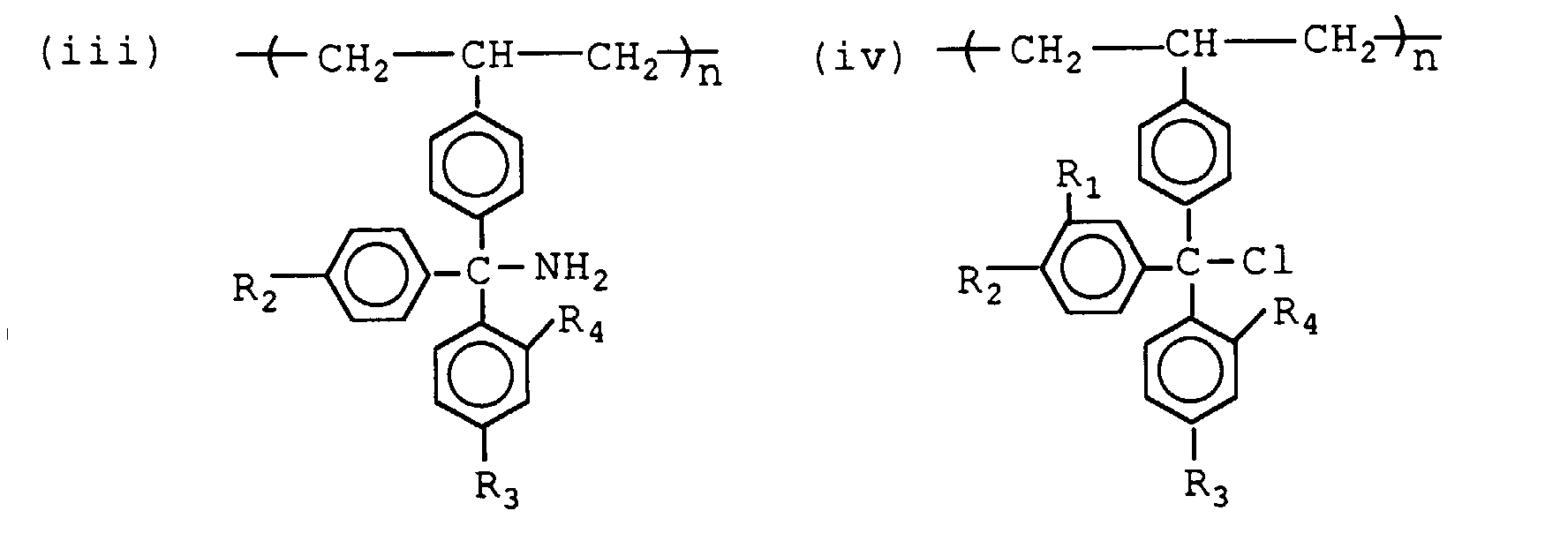
- Resin #1 may be represented by the following formulae: where: "n" is the basic unit of the resin matrix, R is a methyl, ethyl, or lower alkyl group having (7) carbons or less. R may also stand for methoxy, ethoxy, or lower alkoxy group having (7) carbons or less.
- Treating the above resin with an Fmoc-amino acid group loads or derivatizes the subject resin. Such addition takes place in the presence of carbonyldiimidazol (CDI) and DCM. The product is collected by filtration after an incubation period.
- CDI carbonyldiimidazol
- the product is collected by filtration after an incubation period.
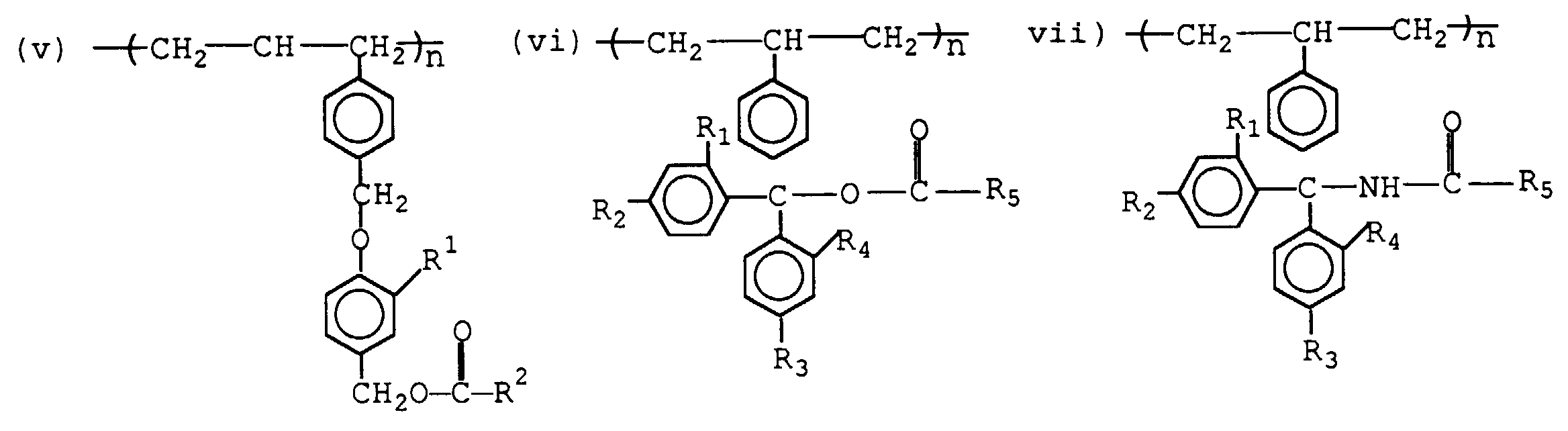
- the following formulae represents the derivatized resin #1. where "n" is the basic unit of the resin matrix, R 1 an alkyl or alkoxy group, and where R 2 is an amino acid moiety or other carboxylic acid containing molecule. It has been discovered that the derivatized HMBA resin (Resin #1) may be cleaved using 25% TFA in DCM which achieves a significant improvement over the 95% TFA required by the prior art, in that undesirable side reactions are virtually eliminated.
- Resin #2 is formed by the reaction between polystyrene-dvb copolymer and benzoyl chloride in the presence of aluminum chloride and dichloroethane (DCE) to produce a keto resin. Such resin is then formed into an alcohol by a Grignard reaction in the presence of tetrahydrofuran (THF) according to the following reaction:
- Resin #2 is a very dilute acid susceptible resin which may be employed for the production of protected peptide fragments by Fmoc-SPPS. 15% acetic acid in 85% DCM, rather than TFA, may be used to cleave the finished protected peptides from the support matrix. Resin #2 may be shown by the following formula: where "n" is the basic unit of the resin matrix, R 1 , R 2 , R 3 , and/or R 4 is either hydrogen, methyl, ethyl, or lower alkyl groups of (7) carbons or less, methoxy, ethoxy, or lower alkoxy groups of (7) carbons or less.
- resin 2 In its derivatized or loaded form, resin 2 may be represented by the formula: where R 5 is an amino acid moiety or other carboxylic acid containing molecule. It should be noted that the alcohol functional group of Resin #2 must be converted to a chloride prior to loading, which will be described in detail hereinafter.
- Resin #3 is used specifically for the production of peptide amides by Fmoc-SPPS and is prepared according to the following reaction where a trityl chloride resin is converted to the trityl amine resin (Resin #3) in the presence of anhydrous ammonia and DCM:
- trityl chloride resin shown above may be gathered from the derivatization process with respect to resin #2 under the following reaction by treating trityl alcohol resin with acetylchloride in the presence of DCM:
- the trityl chloride resin may be loaded with the Fmoc-amino acid group or converted to the trityl amine resin above shown.
- the trityl amine resin (Resin #3) may be presented by the following formula: where "n" is the basic unit of the resin matrix, R 1 ; R 2 , R 3 , and/or R 4 , are hydrogen, methyl, ethyl or other lower alkyl group, with less than (7) carbons, methoxy, ethoxy or other lower alkoxy group, with less than (7) carbons.
- resin #3 In its derivatized or loaded state, resin #3 may be represented by the following formula: where R 5 is an amino acid moiety or other carboxylic acid containing molecule.
- This example describes the production, derivatization and cleavage of resin #1 hereinbefore described.
- HMBA resin was collected by filtration, washed with DMF, twice with dichloromethane (DCM), once with methanol, and again, twice with DCM. The washed filtrate was dried in an oven at 45° Centigrade. The resulting yield was 11.63gm of derivitized HMBA resin which calculated to a weight gain of 5.63gm. It was determined that 36.5 mmoles of the HMBA was attached to the polystyrene-DVB copolymer. Thus, the final product included 2.7mmole/gm of functional units. 1.0gm of this product was loaded using exemplar Fmoc-phenylalanine as follows.
- the loaded resins above identified can be used in Fmoc-SPPS and the cyclic additions of amino acids through the use of preformed symmetric anhydrides, DIPCDI/HOBt, BOP/HOBt or various other coupling methods.
- peptide (with a free carboxyl terminal) is cleaved from the support resin by treating the peptide-resin with 100ml of 25% TFA in DCM per mmole of peptide.
- Table II illustrates the time course for cleavage of various Fmoc-amino acids from the support resin.
- the free synthetic peptide is isolated and used as desired.
- Fmoc-Amino Acid Length of Incubation Mmole/gm Fmoc-Leu 10 min. 0.22 20 min. 0.22 30 min. 0.28 60 min. 0.38 120 min. 0.23 Fmoc-Val 10 min. 0.36 20 min. 0.36 30 min. 0.32 60 min 0.42 120 min. 0.45 Fmoc-Gln(Trt) 10 min. 0.25 20 min. 0.30 30 min. 0.26 60 min. 0.24 120 min. 0.28
- keto-resin 5gm of keto-resin was suspended in 50ml of tetrahydrofuran (THF) and 15ml of 3M phenylmagnesium bromide in ether was added to the suspension with constant mixing.
- the Grignard reaction was incubated overnight at room temperature to yield trityl alcohol resin (Resin #2) which was collected by filtration, washed twice with DCM, once with methanol, again, twice with DCM, and dried in an oven at 35° C. The trityl alcohol resin is then converted to a chloride prior to loading.
- the dried trityl alcohol resin from the Grignard reaction was swollen in 50ml of toluene and 10ml of acetyl chloride (140mmole) was added and incubated overnight at room temperature to convert the functional group from a hydroxyl to a chloride.
- the trityl chloride resin was collected by filtration washed and dried as the trityl alcohol resin hereinbefore. To load the trityl chloride resin 3 grams of the same was employed.
- the resulting quantity represents the mmole per gram of Fmoc-amino acid attached to the resin and, thus, equals the level of substitution achieved.
- Table III illustrates the level of substitution achieved with various Fmoc amino acids using resin #2: TABLE III Loading of Trityl Alcohol Resin (Resin #2) with Fmoc-Amino Acids.
- Fmoc-Amino Acid Level of Substitution Achieved in mmole/gm Fmoc-Ala 0.41 Fmoc-Cys(Trt) 0.95 Fmoc-Cys(Acm) 0.46 Fmoc-Asp(o-t-But) 0.95 Fmoc-Glu(o-t-But) 034 Fmoc-Phe 0.95 & 0.62 Fmoc-Gly 0.80, 1.00 & 0.60 Fmoc-His(Trt) 0.81 Fmoc-Ile 1.03 Fmoc-Lys(Boc) 0.85 Fmoc-Leu 0.88 & 0.79 Fmoc-Met 0.83 Fmoc-Asn 0.76 Fmoc-Asn(Trt) 0.65 Fmoc-Pro 0.84 Fmoc-Gln 0.53 Fmoc-Gln(Trt) 0.42 Fmoc-Arg(Mtr) 0.
- the derivatized or loaded resin was then ready for use in Fmoc-SPPS and the cyclic addition of amino acids using preformed symmetric anhydrides with an equivalent of DIEA or BOP/HOBt/DIEA coupling.
- Various amino acids were attached and cleaved from the support resin by treatment of the peptide-resin with 200ml of 15% acetic acid and DCM per mole of peptide.
- Table IV illustrates the time course for cleavage of various Fmoc-amino acids from the support resin. TABLE IV Fmoc-Amino Acid Length of Incubation Mmole/gm Fmoc-Phe 10 min. 0.67 20 min. 0.59 30 min. 0.59 60 min. 0.61 120 min.
- the trityl chloride resin produced and described in Example II was used as the starting material.
- the chloride group was converted to a amine group by swelling the trityl chloride resin in DCM and anhydrous ammonia was bubbled through the suspension overnight.
- the trityl amine resin was collected by filtration, washed, and dried according to the process described in Example II. 1.0gm of the trityl amine resin was loaded with Fmoc amino acids.
- the level of substitution was determined on a 10mg sample by cleaving off the Fmoc group with 1.0ml of 20% pyrrolidine in DCM, filtering off the resin, adjusting the volume to 10ml, and measuring the optical density (OD) of a 1:10 dilute sample, and dividing the OD by the molar extinction coefficient x 10 -3 .
- the resulting number represents the mmole/gm of Fmoc-amino acid attached to the resin and equals the level substitution achieved.
- Table V illustrates the level of substitution achieved with various Fmoc-amino acids prepared by using resin #3: TABLE V Loading of Trityl Amine Resin (Resin #3) with Fmoc-Amino Acids.
- Fmoc-Amino Acid Level of Substitution Achieved in mmole/gm Fmoc-Met 0.15 Fmoc-Phe 1.30 Fmoc-Pro 0.35 Fmoc-Asn 0.71
- Fmoc-Ala-HMBA resin 200 mgm of Fmoc-Ala-HMBA resin, of Example 1 at a level of substitution of 0.5 mmole/gm (0.1 mmole of substituted resin) was used.
- the remaining eleven amino acids of the present 12 mer were added in cyclic fashion.
- the addition of each Fmoc-Amino Acid was achieved using a four fold molar excess of the individual Fmoc-Amino Acids, HOBt, and DIPCDI during coupling cycle.
- the Fmoc-protecting group was removed using 20% pyrrolidine in DMF during the deprotection step of each cycle. After the amino terminal tyrosine was deprotected, the amino terminus was acetylated using acetic anhydride and triethylamine.
- the synthetic peptide was cleaved from support resin and the side chains of the trifunctional amino acids were deprotected simultaneously by treating the peptide-resin with 25% TFA, 4% water and DTT in DCM.
- the crude peptide was partially purified by gel filtration in 25% acetic acid and yielded 126mgm of peptide. Based on a molecular weight of 1208.6, the yield of peptide was 104.2%.
- the partially pure peptide was purified to homogeneity by preparative HPLC, which yielded 82.5 mgm of pure peptide (68.3% overall yield). Amino acid analysis of the peptide yielded the following results shown in Table VII below. TABLE VII Residue Theory Found Ala 3 2.9 Tyr 1 1.0 Lys 2 2.0 Pro 2 2.0 Cys 1 present Ser 1 0.9 Leu 1 1.0
- Fmoc-Val-HMBA resin 465 mgm of Fmoc-Val-HMBA resin at a level of substitution of 0.43 mmole/gm (0.2mmole of substituted resin) was employed.
- the cyclic addition of each Fmoc-amino acid was achieved using a four-fold molar excess of the individual Fmoc-amino acids, HOBt, and DIPCDI during each coupling cycle.
- the Fmoc protecting group was removed using 20% pyrrolidine in DMF during the deprotection step of each cycle.
- the peptide was cleaved from the support resin and the side chains of the trifunctional amino acids were deprotected simultaneously by treating the peptide-resin with 25% TFA, 4% water, and 1% DTT in DCM.
- the crude peptide was partially purified by gel filtration in 25% acetic acid and yielded 256 mgm of peptide. Based on a molecular weight of 1282.3, the yield was 99.8%.
- the partially pure peptide was purified to homogeneity by preparative HPLC and yielded 119 mgm of pure peptide (46.4% overall yield). Amino acid analysis of the peptide yielded the following results which is represented in Table VIII below.
- the crude peptide was partially purified by gel filtration in 25% acetic acid and yielded 231 mgm of peptide. Based on a molecular weight of 1610.9, the yield was 95.6%.
- the partially pure peptide was purified to homogeneity by preparative HPLC and yielded 172 mgm of pure peptide (70.9% overall yield). Amino acid analysis of the peptide yielded the following results which is shown in Table IX:
- Fmoc-Gly-Trityl resin 100 mgm of Fmoc-Gly-Trityl resin at 1.00 mmole/gm (0.1 mmole of substituted resin) was used.
- the cyclic addition of each Fmoc-amino acid was achieved using an equivalent HOBt, a three fold molar excess of the individual Fmoc-amino acids and BOP, and a 6 fold molar excess of DIEA during each coupling cycle.
- the Fmoc-protecting group was removed using 20% pyrrolidine in DMF during the deprotection step of each cycle. However, the last Fmoc protecting group on the amino acid terminal residue was not removed.
- Fmoc-Gly-Trityl resin 200 mgm was used.
- the cyclic addition of each Fmoc-amino acid was achieved using an equivalent of HOBt, a three fold molar excess of the individual Fmoc-amino acids and BOP, and a six fold molar excess of DIEA during each coupling cycle.
- the Fmoc-protecting group was removed using 20% pyrrolidine in DMF during the deprotection step of each cycle. However, the last Fmoc-protecting group on the amino terminal residue was not removed.
- Example VII the amino terminus as well as all the side chains of the trifunctional amino acids were still protected when synthesis of the peptide was complete.
- the fully protected peptide was cleaved from the support resin with 15% acetic acid in DCM.
- the protected peptide was collected, the acetic acid extracted into water 3 times.
- the solvent was removed by rotary evaporation and the product dried over P 2 O 5 under vacuum. 177 mgm of protected peptide was recovered. Based on a molecular weight of 960.8 for the fully protected peptide, the yield was 92.2%.
- a sample of the protected peptide was treated with 20% pyrrolidine in DCM to remove the Fmoc-protecting group, and the sample hydrolyzed for amino acid analysis.
- the amino acid analysis yielded the following results which is shown in Table XI. TABLE XI Residue Theory Found Glx 2 2.0 Thr 1 0.9 Pro 1 1.0 Gly 1 1.0 Leu 1 1.0
- Fmoc-Met-Trityl Amine resin 170 mgm of Fmoc-Met-Trityl Amine resin at 0.15 mmole/gm (0.025 mmole of substituted resin) was used.
- the cyclic addition of each Fmoc-amino acid was achieved using a four fold molar excess of the individual Fmoc-amino acids, HOBt and DIPCDI during each coupling cycle.
- the Fmoc-protecting group was removed using 20% pyrrolidine in DMF during the deprotection step of each cycle.
- the peptide was cleaved from the support resin and the side chains of the trifunctional amino acids were deprotected simultaneously by treating the peptide-resin with 25% TFA, 4% water, and 1% DTT in DCM.
- Fmoc-Phe-Trityl Amine resin 260 mgm of Fmoc-Phe-Trityl Amine resin at 1.30 mmole/gm (0.20 mmole of substituted resin) was used.
- the cyclic addition of each Fmoc-amino acid was achieved using a four fold molar excess of the individual Fmoc-amino acids, HOBt and DIPCDI during each coupling cycle.
- the Fmoc-protecting group was removed using 20% pyrrolidine in DMF during the deprotection step of each cycle.
- the peptide was cleaved from the support resin with 25% TFA and 1.0% DTT in DCM for 60 minutes.
Landscapes
- Chemical & Material Sciences (AREA)
- Organic Chemistry (AREA)
- Medicinal Chemistry (AREA)
- Health & Medical Sciences (AREA)
- General Chemical & Material Sciences (AREA)
- Chemical Kinetics & Catalysis (AREA)
- Polymers & Plastics (AREA)
- Biophysics (AREA)
- General Health & Medical Sciences (AREA)
- Genetics & Genomics (AREA)
- Biochemistry (AREA)
- Molecular Biology (AREA)
- Proteomics, Peptides & Aminoacids (AREA)
- Life Sciences & Earth Sciences (AREA)
- Analytical Chemistry (AREA)
- Peptides Or Proteins (AREA)
- Addition Polymer Or Copolymer, Post-Treatments, Or Chemical Modifications (AREA)
Claims (9)
- Zur Verwendung bei der Peptidsynthese geeignetes Polymerharz, dessen Aufbau im wesentlichen einer der folgenden Formeln entspricht:

- Polymerharz nach Anspruch 1, worin die Polymermatrix ein Polystyrol-Divinylbenzol-Copolymer ist.
- Polymerharz nach Anspruch 1 oder 2, worin R eine Methylgruppe oder eine Methoxygruppe ist.
- Polymerharz nach Anspruch 1 oder 2, worin R1, R2, R3 und R4 jeweils Wasserstoff sind.
- Zur Verwendung bei der Peptidsynthese geeignetes, derivatisiertes Polymerharz, dessen Aufbau im wesentlichen einer der folgenden Formeln entspricht:
- Derivatisiertes Polymerharz der Formel (v) nach Anspruch 5, worin R2 ein eine Aminosäuregruppe oder eine Carbonsäure enthaltendes, mit einer Schutzgruppe versehenes Molekül ist.
- Derivatisiertes Polymerharz nach Anspruch 5, bei dem R1, R2, R3 und R4 jeweils Wasserstoff sind und R5 ein eine Aminosäuregruppe oder eine Carbonsäure enthaltendes, mit einer Schutzgruppe versehenes Molekül ist.
- Verfahren zur Herstellung eines Peptids, folgende Schritte umfassend:a) das Bereitstellen eines derivatisierten Polymerharzes mit einer aus den folgenden ausgewählten Formel:
 b) das Abspalten der Schutzgruppe von der Aminosäuregruppe; undc) das Anbinden einer Aminosäure mit einer geschützten aminoterminalen Gruppe an die R2-Gruppe.
 - Verwendung eines Polymerharzes nach Anspruch 1 oder eines derivatisierten Polymerharzes nach Anspruch 5 bei der Peptidsynthese.
Applications Claiming Priority (3)
| Application Number | Priority Date | Filing Date | Title |
|---|---|---|---|
| US07/715,561 US5198531A (en) | 1991-06-14 | 1991-06-14 | Polymeric resin for peptide synthesis |
| US715561 | 1991-06-14 | ||
| PCT/US1992/005046 WO1992022591A1 (en) | 1991-06-14 | 1992-06-09 | Polymeric resin for peptide synthesis |
Publications (3)
| Publication Number | Publication Date |
|---|---|
| EP0543986A1 EP0543986A1 (de) | 1993-06-02 |
| EP0543986A4 EP0543986A4 (en) | 1993-11-10 |
| EP0543986B1 true EP0543986B1 (de) | 1996-09-04 |
Family
ID=24874558
Family Applications (1)
| Application Number | Title | Priority Date | Filing Date |
|---|---|---|---|
| EP92914068A Expired - Lifetime EP0543986B1 (de) | 1991-06-14 | 1992-06-09 | Polymerharz für Peptidsynthese |
Country Status (6)
| Country | Link |
|---|---|
| US (2) | US5198531A (de) |
| EP (1) | EP0543986B1 (de) |
| JP (1) | JP2722392B2 (de) |
| AU (1) | AU2238992A (de) |
| DE (1) | DE69213401T2 (de) |
| WO (1) | WO1992022591A1 (de) |
Families Citing this family (34)
| Publication number | Priority date | Publication date | Assignee | Title |
|---|---|---|---|---|
| US5605798A (en) | 1993-01-07 | 1997-02-25 | Sequenom, Inc. | DNA diagnostic based on mass spectrometry |
| FR2742157B1 (fr) * | 1995-12-11 | 1998-01-16 | Elf Aquitaine | Nouveau mode de preparation de resines a fonction guanidine et obtention de nouvelles resines a fonction guanidine |
| US5798035A (en) * | 1996-10-03 | 1998-08-25 | Pharmacopeia, Inc. | High throughput solid phase chemical synthesis utilizing thin cylindrical reaction vessels useable for biological assay |
| EP1164203B1 (de) * | 1996-11-06 | 2007-10-10 | Sequenom, Inc. | DNA-Diagnostik mittels Massenspektrometrie |
| DE69735112T2 (de) | 1996-11-06 | 2006-09-07 | Sequenom, Inc., San Diego | Verfahren zur Analyse und Vorrichtung |
| US6133436A (en) | 1996-11-06 | 2000-10-17 | Sequenom, Inc. | Beads bound to a solid support and to nucleic acids |
| US6207370B1 (en) | 1997-09-02 | 2001-03-27 | Sequenom, Inc. | Diagnostics based on mass spectrometric detection of translated target polypeptides |
| GB9727126D0 (en) * | 1997-12-22 | 1998-02-25 | Zeneca Ltd | Process |
| US6723564B2 (en) | 1998-05-07 | 2004-04-20 | Sequenom, Inc. | IR MALDI mass spectrometry of nucleic acids using liquid matrices |
| US6124484A (en) * | 1998-07-17 | 2000-09-26 | Isis Pharmaceuticals, Inc. | Recovery of triarylmethyl halide protecting groups cleaved during oligonucleotide synthesis |
| WO2000026262A2 (en) * | 1998-11-05 | 2000-05-11 | Mitokor | Functionalized polymeric substrates for binding molecular moieties |
| US7163686B1 (en) | 1999-05-15 | 2007-01-16 | The Regents Of The University Of California | Protein A based binding domains with desirable activities |
| WO2000069457A1 (en) | 1999-05-15 | 2000-11-23 | University Of California, San Diego | Protein a based binding domains with desirable activities |
| PT1280831E (pt) * | 2000-05-12 | 2006-12-29 | Lonza Ag | Processo para a preparação de cloreto de 2-clorotritilo ligado a um polimero |
| US7427260B2 (en) * | 2001-03-30 | 2008-09-23 | Mayo Foundation For Medical Education And Research | Efficient methods for solid phase synthesis using trityl chloride resins |
| US6787635B2 (en) * | 2001-04-05 | 2004-09-07 | 3M Innovative Properties Company | Solid phase synthesis supports and methods |
| WO2002083606A1 (en) * | 2001-04-17 | 2002-10-24 | University Of Alberta | A linker system for the synthesis and screening of combinatorial libraries of polyamine derivatives on water compatible supports |
| KR100718431B1 (ko) * | 2001-11-27 | 2007-05-14 | 주식회사 유앤비케미칼 | 트리틸기가 도입된 폴리스티렌 수지의 제조 방법 |
| US7049394B2 (en) * | 2002-08-19 | 2006-05-23 | Rohm And Haas Company | Method for preparing free flow resin |
| TWI249540B (en) * | 2002-08-19 | 2006-02-21 | Rohm & Haas | Resin functionalization method |
| US20040063856A1 (en) * | 2002-09-30 | 2004-04-01 | Bohling James Charles | Resin for solid phase synthesis |
| JP3955257B2 (ja) * | 2002-12-17 | 2007-08-08 | 独立行政法人科学技術振興機構 | 高分子固定ホルムアミドとその触媒並びにアリル化反応方法 |
| CN100491414C (zh) | 2002-12-20 | 2009-05-27 | 弗·哈夫曼-拉罗切有限公司 | 键合于固相的ctc-树脂的再循环方法 |
| US20040158037A1 (en) * | 2003-02-12 | 2004-08-12 | Bohling James Charles | Amino acid loaded trityl alcohol resins, method of production of amino acid loaded trityl alcohol resins and biologically active substances and therapeutics produced therewith |
| EP1701976A2 (de) * | 2003-12-31 | 2006-09-20 | F.Hoffmann-La Roche Ag | Peptidsynthese und entschützung mit cosolvenz |
| BRPI0618609A2 (pt) | 2005-11-16 | 2011-09-06 | Novartis Ag | biomarcadores para tratamento com anticorpo anti-nogo-a em danos à medula espinhal |
| GR1005656B (el) * | 2006-06-27 | 2007-09-20 | Βιομεντικα Λαιφ Σαιενσις Ανωνυμη Εταιρια Φαρμακευτικων Προιοντων | Πολυμερης τριτυλο-τυπου ρητινη για πεπτιδικη συνθεση σε στερεα φαση |
| KR101560844B1 (ko) * | 2007-06-04 | 2015-10-15 | 벤-구리온 유니버시티 오브 더 네게브 리서치 앤드 디벨럽먼트 어쏘러티 | 트라이-아릴계 화합물 및 이를 포함하는 조성물 |
| US8815807B2 (en) | 2008-06-03 | 2014-08-26 | President And Fellows Of Harvard College | Peptides and peptide compositions having osteoinductive activity |
| US8592555B2 (en) * | 2008-08-11 | 2013-11-26 | Emd Millipore Corporation | Immunoglobulin-binding proteins with improved specificity |
| SG195555A1 (en) | 2008-12-24 | 2013-12-30 | Emd Millipore Corp | Caustic stable chromatography ligands |
| SG186552A1 (en) | 2011-06-08 | 2013-01-30 | Emd Millipore Corp | Chromatography matrices including novel staphylococcus aureus protein a based ligands |
| MX2016005995A (es) | 2013-11-05 | 2016-08-17 | Ben-Gurion Univ Of The Negev Res And Dev Authority | Compuestos para el tratamiento de diabetes y complicaciones de la enfermedad derivadas de la misma. |
| DE102016009766A1 (de) * | 2016-08-11 | 2018-02-15 | Julius-Maximilians-Universität Würzburg | Herstellung von Bitterstoffderivaten |
Family Cites Families (7)
| Publication number | Priority date | Publication date | Assignee | Title |
|---|---|---|---|---|
| US3645996A (en) * | 1969-03-10 | 1972-02-29 | Lilly Co Eli | Resins useful in peptide synthesis |
| US3743628A (en) * | 1970-10-16 | 1973-07-03 | Squibb & Sons Inc | Solid phase synthesis of peptides |
| US3814732A (en) * | 1971-10-21 | 1974-06-04 | Hoffmann La Roche | Modified solid supports for solid phase synthesis |
| US3954709A (en) * | 1973-05-29 | 1976-05-04 | The Regents Of The University Of Colorado | Phenylethyl group containing resins for the synthesis of peptides |
| IL44168A (en) * | 1974-02-08 | 1980-03-31 | Yeda Res & Dev | Acyl amino acylamino or oxime activated phenalkyl (or heteroacylalkyl) benzenes optionally linked to a polymer backbone as reagents useful in organic synthesis as ion exchange agents for the capture of aldehydes or for extracting metals and process for their preparation |
| SE457797B (sv) * | 1982-01-13 | 1989-01-30 | Kureha Chemical Ind Co Ltd | Foerfarande foer framstaellning av poroest substrat innefattande paerlor som har metylolgrupper av sampolymer paa basis av tvaerbunden styren och anvaendni ng av substratet vid vaetskekromatografi |
| US4831084A (en) * | 1987-05-18 | 1989-05-16 | Bachem Feinchemikalien A.G. | Resin-linker combination for the solid-phase synthesis of peptides and intermediates |
-
1991
- 1991-06-14 US US07/715,561 patent/US5198531A/en not_active Expired - Fee Related
-
1992
- 1992-06-09 WO PCT/US1992/005046 patent/WO1992022591A1/en not_active Ceased
- 1992-06-09 AU AU22389/92A patent/AU2238992A/en not_active Abandoned
- 1992-06-09 JP JP5501075A patent/JP2722392B2/ja not_active Expired - Lifetime
- 1992-06-09 EP EP92914068A patent/EP0543986B1/de not_active Expired - Lifetime
- 1992-06-09 DE DE69213401T patent/DE69213401T2/de not_active Expired - Fee Related
-
1994
- 1994-09-13 US US08/305,807 patent/US5563220A/en not_active Expired - Fee Related
Also Published As
| Publication number | Publication date |
|---|---|
| WO1992022591A1 (en) | 1992-12-23 |
| US5563220A (en) | 1996-10-08 |
| JP2722392B2 (ja) | 1998-03-04 |
| US5198531A (en) | 1993-03-30 |
| DE69213401D1 (de) | 1996-10-10 |
| EP0543986A4 (en) | 1993-11-10 |
| DE69213401T2 (de) | 1997-02-27 |
| AU2238992A (en) | 1993-01-12 |
| EP0543986A1 (de) | 1993-06-02 |
| JPH06502679A (ja) | 1994-03-24 |
Similar Documents
| Publication | Publication Date | Title |
|---|---|---|
| EP0543986B1 (de) | Polymerharz für Peptidsynthese | |
| US5235028A (en) | Polyethylene glycol derivatives for solid-phase applications | |
| EP0546055B1 (de) | Polyäthylenglykolderivate zur festphaseanwendungen | |
| US4859736A (en) | Synthetic polystyrene resin and its use in solid phase peptide synthesis | |
| DE69732640T2 (de) | Festphasen-peptidsynthese | |
| AU667035B2 (en) | Process for making peptides | |
| JP2003530311A (ja) | ペプチド合成の方法および組成物 | |
| KR20050016959A (ko) | 당사슬 아스파라긴을 갖는 당펩티드의 제조법 및 그당펩티드 | |
| US5545698A (en) | Polyethylene glycol derivatives for solid-phase applications | |
| US4855407A (en) | Solid phase process for synthesizing peptides | |
| US4831084A (en) | Resin-linker combination for the solid-phase synthesis of peptides and intermediates | |
| JP2002525405A (ja) | Peg−ベースのマクロモノマー、これから製造された化学的に不活性なポリマー、ならびにこれらポリマーの有機合成および酵素反応への使用 | |
| EP0073828A1 (de) | Peptide synthese hoher ausbeute | |
| KR20250050780A (ko) | 고체상 합성용 불용성 지지체 | |
| EP1644401B1 (de) | Verbessertes verfahren für festphasensynthese | |
| CA1271300A (en) | Solid phase process for synthesizing peptides | |
| KR20220008674A (ko) | 링커-레진 화합물, 그 제조방법, 및 그 화합물을 이용한 펩타이드 제조방법 |
Legal Events
| Date | Code | Title | Description |
|---|---|---|---|
| PUAI | Public reference made under article 153(3) epc to a published international application that has entered the european phase |
Free format text: ORIGINAL CODE: 0009012 |
|
| 17P | Request for examination filed |
Effective date: 19930303 |
|
| AK | Designated contracting states |
Kind code of ref document: A1 Designated state(s): CH DE FR GB IT LI |
|
| A4 | Supplementary search report drawn up and despatched |
Effective date: 19930923 |
|
| AK | Designated contracting states |
Kind code of ref document: A4 Designated state(s): CH DE FR GB IT LI |
|
| 17Q | First examination report despatched |
Effective date: 19950130 |
|
| GRAH | Despatch of communication of intention to grant a patent |
Free format text: ORIGINAL CODE: EPIDOS IGRA |
|
| GRAH | Despatch of communication of intention to grant a patent |
Free format text: ORIGINAL CODE: EPIDOS IGRA |
|
| RBV | Designated contracting states (corrected) |
Designated state(s): CH DE FR GB LI |
|
| GRAA | (expected) grant |
Free format text: ORIGINAL CODE: 0009210 |
|
| AK | Designated contracting states |
Kind code of ref document: B1 Designated state(s): CH DE FR GB LI |
|
| REF | Corresponds to: |
Ref document number: 69213401 Country of ref document: DE Date of ref document: 19961010 |
|
| ET | Fr: translation filed | ||
| PGFP | Annual fee paid to national office [announced via postgrant information from national office to epo] |
Ref country code: GB Payment date: 19970611 Year of fee payment: 6 |
|
| PGFP | Annual fee paid to national office [announced via postgrant information from national office to epo] |
Ref country code: FR Payment date: 19970613 Year of fee payment: 6 |
|
| PGFP | Annual fee paid to national office [announced via postgrant information from national office to epo] |
Ref country code: DE Payment date: 19970619 Year of fee payment: 6 |
|
| PGFP | Annual fee paid to national office [announced via postgrant information from national office to epo] |
Ref country code: CH Payment date: 19970630 Year of fee payment: 6 |
|
| PLBE | No opposition filed within time limit |
Free format text: ORIGINAL CODE: 0009261 |
|
| STAA | Information on the status of an ep patent application or granted ep patent |
Free format text: STATUS: NO OPPOSITION FILED WITHIN TIME LIMIT |
|
| 26N | No opposition filed | ||
| PG25 | Lapsed in a contracting state [announced via postgrant information from national office to epo] |
Ref country code: GB Free format text: LAPSE BECAUSE OF NON-PAYMENT OF DUE FEES Effective date: 19980609 |
|
| PG25 | Lapsed in a contracting state [announced via postgrant information from national office to epo] |
Ref country code: LI Free format text: LAPSE BECAUSE OF NON-PAYMENT OF DUE FEES Effective date: 19980630 Ref country code: CH Free format text: LAPSE BECAUSE OF NON-PAYMENT OF DUE FEES Effective date: 19980630 |
|
| GBPC | Gb: european patent ceased through non-payment of renewal fee |
Effective date: 19980609 |
|
| REG | Reference to a national code |
Ref country code: CH Ref legal event code: PL |
|
| PG25 | Lapsed in a contracting state [announced via postgrant information from national office to epo] |
Ref country code: FR Free format text: LAPSE BECAUSE OF NON-PAYMENT OF DUE FEES Effective date: 19990226 |
|
| PG25 | Lapsed in a contracting state [announced via postgrant information from national office to epo] |
Ref country code: DE Free format text: LAPSE BECAUSE OF NON-PAYMENT OF DUE FEES Effective date: 19990401 |
|
| REG | Reference to a national code |
Ref country code: FR Ref legal event code: ST |