EP0544410A2 - Système d'irrigation avec bypass à haut débit pour utilisation lors d'interventions endoscopiques - Google Patents
Système d'irrigation avec bypass à haut débit pour utilisation lors d'interventions endoscopiques Download PDFInfo
- Publication number
- EP0544410A2 EP0544410A2 EP92309833A EP92309833A EP0544410A2 EP 0544410 A2 EP0544410 A2 EP 0544410A2 EP 92309833 A EP92309833 A EP 92309833A EP 92309833 A EP92309833 A EP 92309833A EP 0544410 A2 EP0544410 A2 EP 0544410A2
- Authority
- EP
- European Patent Office
- Prior art keywords
- pump
- flow
- irrigation
- irrigation system
- liquid
- Prior art date
- Legal status (The legal status is an assumption and is not a legal conclusion. Google has not performed a legal analysis and makes no representation as to the accuracy of the status listed.)
- Withdrawn
Links
Images

Classifications
-
- A—HUMAN NECESSITIES
- A61—MEDICAL OR VETERINARY SCIENCE; HYGIENE
- A61M—DEVICES FOR INTRODUCING MEDIA INTO, OR ONTO, THE BODY; DEVICES FOR TRANSDUCING BODY MEDIA OR FOR TAKING MEDIA FROM THE BODY; DEVICES FOR PRODUCING OR ENDING SLEEP OR STUPOR
- A61M3/00—Medical syringes, e.g. enemata; Irrigators
- A61M3/02—Enemata; Irrigators
- A61M3/0233—Enemata; Irrigators characterised by liquid supply means, e.g. from pressurised reservoirs
-
- A—HUMAN NECESSITIES
- A61—MEDICAL OR VETERINARY SCIENCE; HYGIENE
- A61M—DEVICES FOR INTRODUCING MEDIA INTO, OR ONTO, THE BODY; DEVICES FOR TRANSDUCING BODY MEDIA OR FOR TAKING MEDIA FROM THE BODY; DEVICES FOR PRODUCING OR ENDING SLEEP OR STUPOR
- A61M3/00—Medical syringes, e.g. enemata; Irrigators
- A61M3/02—Enemata; Irrigators
- A61M3/0204—Physical characteristics of the irrigation fluid, e.g. conductivity or turbidity
- A61M3/0208—Physical characteristics of the irrigation fluid, e.g. conductivity or turbidity before use
-
- A—HUMAN NECESSITIES
- A61—MEDICAL OR VETERINARY SCIENCE; HYGIENE
- A61M—DEVICES FOR INTRODUCING MEDIA INTO, OR ONTO, THE BODY; DEVICES FOR TRANSDUCING BODY MEDIA OR FOR TAKING MEDIA FROM THE BODY; DEVICES FOR PRODUCING OR ENDING SLEEP OR STUPOR
- A61M3/00—Medical syringes, e.g. enemata; Irrigators
- A61M3/02—Enemata; Irrigators
- A61M3/0204—Physical characteristics of the irrigation fluid, e.g. conductivity or turbidity
- A61M3/0216—Pressure
-
- A—HUMAN NECESSITIES
- A61—MEDICAL OR VETERINARY SCIENCE; HYGIENE
- A61M—DEVICES FOR INTRODUCING MEDIA INTO, OR ONTO, THE BODY; DEVICES FOR TRANSDUCING BODY MEDIA OR FOR TAKING MEDIA FROM THE BODY; DEVICES FOR PRODUCING OR ENDING SLEEP OR STUPOR
- A61M3/00—Medical syringes, e.g. enemata; Irrigators
- A61M3/02—Enemata; Irrigators
- A61M3/0204—Physical characteristics of the irrigation fluid, e.g. conductivity or turbidity
- A61M3/022—Volume; Flow rate
-
- A—HUMAN NECESSITIES
- A61—MEDICAL OR VETERINARY SCIENCE; HYGIENE
- A61M—DEVICES FOR INTRODUCING MEDIA INTO, OR ONTO, THE BODY; DEVICES FOR TRANSDUCING BODY MEDIA OR FOR TAKING MEDIA FROM THE BODY; DEVICES FOR PRODUCING OR ENDING SLEEP OR STUPOR
- A61M3/00—Medical syringes, e.g. enemata; Irrigators
- A61M3/02—Enemata; Irrigators
- A61M3/0233—Enemata; Irrigators characterised by liquid supply means, e.g. from pressurised reservoirs
- A61M3/0254—Enemata; Irrigators characterised by liquid supply means, e.g. from pressurised reservoirs the liquid being pumped
-
- F—MECHANICAL ENGINEERING; LIGHTING; HEATING; WEAPONS; BLASTING
- F04—POSITIVE - DISPLACEMENT MACHINES FOR LIQUIDS; PUMPS FOR LIQUIDS OR ELASTIC FLUIDS
- F04B—POSITIVE-DISPLACEMENT MACHINES FOR LIQUIDS; PUMPS
- F04B43/00—Machines, pumps, or pumping installations having flexible working members
- F04B43/02—Machines, pumps, or pumping installations having flexible working members having plate-like flexible members, e.g. diaphragms
- F04B43/06—Pumps having fluid drive
-
- F—MECHANICAL ENGINEERING; LIGHTING; HEATING; WEAPONS; BLASTING
- F04—POSITIVE - DISPLACEMENT MACHINES FOR LIQUIDS; PUMPS FOR LIQUIDS OR ELASTIC FLUIDS
- F04B—POSITIVE-DISPLACEMENT MACHINES FOR LIQUIDS; PUMPS
- F04B49/00—Control, e.g. of pump delivery, or pump pressure of, or safety measures for, machines, pumps, or pumping installations, not otherwise provided for, or of interest apart from, groups F04B1/00 - F04B47/00
- F04B49/22—Control, e.g. of pump delivery, or pump pressure of, or safety measures for, machines, pumps, or pumping installations, not otherwise provided for, or of interest apart from, groups F04B1/00 - F04B47/00 by means of valves
-
- A—HUMAN NECESSITIES
- A61—MEDICAL OR VETERINARY SCIENCE; HYGIENE
- A61M—DEVICES FOR INTRODUCING MEDIA INTO, OR ONTO, THE BODY; DEVICES FOR TRANSDUCING BODY MEDIA OR FOR TAKING MEDIA FROM THE BODY; DEVICES FOR PRODUCING OR ENDING SLEEP OR STUPOR
- A61M3/00—Medical syringes, e.g. enemata; Irrigators
- A61M3/02—Enemata; Irrigators
- A61M3/0233—Enemata; Irrigators characterised by liquid supply means, e.g. from pressurised reservoirs
- A61M3/0241—Enemata; Irrigators characterised by liquid supply means, e.g. from pressurised reservoirs the liquid being supplied by gravity
-
- F—MECHANICAL ENGINEERING; LIGHTING; HEATING; WEAPONS; BLASTING
- F02—COMBUSTION ENGINES; HOT-GAS OR COMBUSTION-PRODUCT ENGINE PLANTS
- F02B—INTERNAL-COMBUSTION PISTON ENGINES; COMBUSTION ENGINES IN GENERAL
- F02B75/00—Other engines
- F02B75/02—Engines characterised by their cycles, e.g. six-stroke
- F02B2075/022—Engines characterised by their cycles, e.g. six-stroke having less than six strokes per cycle
- F02B2075/025—Engines characterised by their cycles, e.g. six-stroke having less than six strokes per cycle two
Definitions
- This invention relates to irrigation systems for irrigating a body cavity during an endoscopic procedure, such as in an arthroscopic procedure.
- endoscopic procedures there are a variety of endoscopic procedures in which it may be desirable to irrigate a body cavity into which the endoscope has been placed.
- endoscopic procedures requiring irrigation is in the surgical treatment of the joints (knees, shoulders, elbows, wrists and ankles) by arthroscopic surgery.
- Arthroscopic surgery is far less invasive than open surgical procedures and has become widely accepted.
- Atypical arthroscopic procedure lasts about 45 minutes to one hour as compared to three hours for an open surgical procedure.
- Arthroscopic surgery enables the surgeon to directly visualize the anatomy of the joint in a less invasive and reduced trauma procedure.
- Significantly less anesthesia is required in an arthroscopic procedure as compared to open surgery.
- the recovery from an arthroscopic procedure typically is much quickerthan from open surgery.
- Arthroscopy provides for the direct visualization of the interior of a joint through a fiber optic endoscope referred to as an arthroscope.
- the procedure enables the surgeon to diagnose and treat damage to the joint.
- torn cartilage and debris can be located and removed using instruments specifically designed for arthroscopic surgery.
- the procedure involves the insertion of instruments into the joint through small incisions made in the region of thejoint.
- the arthroscopic procedure is diagnostic, typically two instruments are inserted into the joint.
- the arthroscopic procedure is therapeutic, typically three or more instruments are inserted into the joint.
- One instrument common to all arthroscopic procedures is an arthroscope which has light transmitting optical fibers by which the interior of the joint may be illuminated and observed through an eyepiece or by coupling the output optical fibers to a video camera and displaying the image on a video monitor.
- the endoscope typically has one or more conduits through which irrigation liquid may flow into or out of the joint.
- the second instrument typically will be a probe with which the surgeon may probe the interior of the joint while observing the interior of the joint through the endoscope.
- the irrigation liquid usually saline solution
- the joint compartment normally is compressed and provides little room for the endoscope or the arthroscopic instruments.
- the irrigation fluid is admitted to the interior of the joint under pressure to cause the joint to become distended.
- the surgeon has more room to manipulate the endoscope and the instruments as is necessary to perform the procedure.
- a further important effect of pressurizing the joint is to provide a tamponading effect, such as to minimize bleeding within the joint.
- the pressure which is above the patient's blood pressure, tends to close off bleeding capillaries in tissue that may have been cut during the procedure. This is particularly important in situations where tourniquets are neither convenient nor effective, such as in the shoulders.
- Distension of the joint is controlled by maintaining a desired level of pressure in the joint and by balancing the inflow and the outflow of irrigation solution. If the outflow exceeds the inflow, the joint will collapse and the surgeon must delay the procedure until distension is achieved. Distension may be maintained either by maintaining a continuous inflow and outflow at the joint or by intermittently closing both the inflow and the outflow while the surgeon works within the joint space and then, after the solution becomes murky, reestablishing inflow and outflow to flush the area with fresh solution. In either instance, controlling the flow rate is necessary to achieve sufficient distension without creating excessive intra-articular pressure. It is important to monitor the intra-articular pressure throughout the arthroscopic procedure and, to do so, surgeons frequently feel the outside of the joint to evaluate the bulges caused by the distension.
- the amount of irrigation fluid flowing through the joint typically is greater than that when the procedure is merely diagnostic.
- the additional flow requirements result from the fact that the procedure will generate a considerable amount of debris which must be flushed from the joint not only to avoid post-operative complications from the procedure but also to facilitate the surgeons continued visualization of the interior of the joint.
- Acommonly used technique for irrigating the joint is by gravity flow of irrigation solution from an overhead supply.
- irrigation bags containing irrigation liquid are hung at a height of about 6 to 8 feet above the patient.
- a tube leading from the bags is connected to one of the ports of the arthroscope or to a separate irrigation cannula which will have been inserted previously into the joint.
- the tube typically is provided with a clamp which, when opened, enables the irrigation liquid to flow by gravity into the joint.
- a pulley system often is utilized so that the attending nurse can lower the bags and change them as they empty.
- between about 3 to 15 liters of irrigation liquid typically are used on a knee arthroscopy although in some cases as many as 30 liters might be used.
- the pressure of the irrigation liquid applied to the joint is dependent on the height of the bag containing the irrigation liquid.
- the gravity system is awkward and presents a number of difficulties. For example, with some patients, particularly muscular patients, the gravity flow system does not distend the joint very effectively. Additional pressure is required. Many surgical facilities do not have sufficient height to raise the bag to distend the joint under such circumstances. Typically, this results in the necessity for an attending nurse to squeeze the irrigation bag continuously throughout the entire arthroscopy procedure. Also among the difficulties with the gravity system is that when a bag approaches being empty and must be changed, it must be pulled down from its elevated position. That reduces the fluid pressure in the joint and risks loss of distension.
- the irrigation system uses a fluid powered, preferably pneumatically operated, diaphragm pulsatile pump of the type generally described in U.S. Application Serial No. 387,712 filed July 31, 1989.
- the pump is driven by a source of compressed air or nitrogen, as is available commonly in a hospital.
- the system includes a source of irrigation liquid contained in irrigation bags.
- the irrigation bags are connected by flexible tubing to the inlet side of the pump.
- the bags may be disposed about one to two feet above patient level.
- the pressurized gas also is connected to the driving side of the pump through a regulator that is preset to have a maximum pressure setting that will cause the pump to develop an output pressure of the order of 300 mm Hg, which corresponds, in a gravity system, to a fourteen feet height above the patient of an irrigation bag.
- the outlet side of the pump is connected by tubing and a connector on its outlet end to an inflow cannula or the flow channel of the arthroscope through one of the ports of the arthroscope.
- the pressure and flow rate developed by the pump are controlled by adjusting the regulator.
- the regulator may be calibrated to read in height, corresponding to the range of approximately six to fourteen feet of irrigation bag suspension above the patient.
- the construction of the pump is such that it will enable flow of irrigation liquid through the pump under the influence of the gravity head of the irrigation bag at a pressure level of as little of one foot of bag height. Should it be desired to shut off flow completely, that may be accomplished by closing a clamp on the pump outlet tubing or inlet tubing.
- the pump provides a steady pulsatile flow.
- the pulsatile flow is desirable in that it provides for better irrigation in that it dislodges loose debris. Additionally, it causes loose but attached tissue, such as cartilage flaps or the like, to be more visible as they flap loosely or oscillate in the pulsatile flow. Should it be desired to shut off the pulsatile flow, that may be accomplished by shutting off the pump.
- the pump and associated tubing and irrigation bags are of inexpensive, simple construction and are disposable, thus lending themselves to one-time disposable use.
- the pump is a two stroke pump that includes a housing divided into two compartments by a flexible, resilient element, such as an elastic diaphragm.
- the two chambers include a pumping chamber and a driving chamber.
- the pumping chamber has inlet and outlet ports which are connected, respectively, to the irrigation liquid supply and the conduit leading to the irrigation cannula or the irrigation channel in the arthroscope.
- a check valve arrangement is provided in the system to assure flow only in a direction from the inlet to the outlet of the pump.
- the driving chamber also is provided with an inlet port and an outlet port, the inlet port of the driving chamber being connectable to a source of gas under pressure. The outlet, when open, is exhausted to the atmosphere.
- the device is arranged such that an elastic diaphragm normally closes the outlet port.
- the pumping action is effected by applying pneumatic pressure at the inlet to the driving chamber.
- the configuration of the diaphragm, interior of the pump and the air inlet and outlet ports are such as to cause the diaphragm to flex and oscillate in a manner that expands and contracts the volume of the pumping chamber.
- the expansion and contraction in cooperation with the one-way check valve, develops a pulsatile flow of liquid through the device.
- the device is modified to enable relatively high flow rates from the reservoir to the inlet cannula by providing a bypass channel that communicates directly the liquid inlet and liquid outlet sides of the pump, thereby bypassing the pump mechanism.
- the bypass channel may be formed as part of the valve housing and includes another one-way valve that, when open, has a substantially larger flow area then that of the first one-way check valve associated with the pumping chamber of the pump. The larger flow area through the bypass valve in the bypass channel does not restrict the flow rate to the extent as the first one-way valve in the pump mechanism.
- the configuration of the bypass valve is such that when the pump is operating in its normal, relatively low, flow pulsatile mode, the bypass valve will close during the pumping stroke so as not to interfere with the pumping action of the pump.
- the substantial drop in pressure developed by the high suction causes immediate opening of the bypass valve to permit irrigation liquid to flow through the bypass channel directly to the joint, bypassing the pumping mechanism.
- the arrangement is such that as soon as the high flow rate demands are ended, the pump resumes normal flow pulsatile operation automatically.
- Another object of the invention is to provide an irrigation system of the type described which enables forcefully pressured as well as gravity flow of irrigation liquid.
- a further object of the invention is to provide an improved irrigation system for irrigating a body cavity in an endoscopic procedure that includes a fluid powered pumping system.
- a further object of the invention is to provide an improved system of the type described in which the pump generates a pulsatile flow in which the system may automatically default to or be controlled to operate, alternately, in a gravity mode and also has a parallel flow path that bypasses the pump to permit higher liquid flow rates than those achievable through the pump.
- Another object of the invention is to provide a system of the type described which is free of electrical connections, wiring or appliances.
- a further object of the invention is to provide a system of the type described which is pneumatically operated.
- a further object of the invention is to provide a system of the type described in which the pump is constructed to shut off automatically when a predetermined pressure is reached and to restart immediately when the pressure drops below the predetermined pressure.
- Another object of the invention is to provide an improved pumping system of the type described in which the pump is provided with a bypass channel through which high liquid flow rates can be achieved in direct response to operation of a high speed, high suction arthroscopic instrument.
- a further object of the invention is to provide an improved arthroscopic pumping system of the type described in which distension pressure in a joint may be maintained at both low and high flow rates and which does not require repeated manual settings of controls by the operator.
- Still another object of the invention is to provide a system of the type described that is quick to set up, requires very few connections and is easy to use.
- FIG. 1 illustrates, somewhat diagrammatically (and out of scale), the system as set up to perform a therapeutic art hroscopy on a patient's knee 10.
- the patient's knee will have at least three members inserted into the knee joint including the arthroscope 12, a flow cannula 14 and a surgical instrument, indicated generally by the reference character 16.
- the instrument may be a high speed shaver or other device having high liquid flow rates.
- the arthroscope 12 carries optical fibers arranged to deliver light from a suitable source (not shown) into the interior of the knee joint as well as to permit viewing by the surgeon into the knee joint through the eyepiece 18.
- the arthroscope 12 may be coupled to a video camera to display the image of the interior of the joint on a video monitor.
- the arthroscope 12 also typically will have one flow channel leading to ports 20, 22 which may be connected to appropriate tubing.
- the ports 20, 22 may include stopcocks to open or close the flow channel as desired.
- the ports 20, 22 may be used as inflow channels into the joint or outflow channels to direct fluid from the joint or in a different mode one port may be used for inflow and the other, alternately, for outflow.
- the flow cannula 14 also may be provided with a stopcock 24 by which flow though the cannula 14 may be controlled between on and off positions.
- the flow cannula 14 is used to provide additional flow capacity to or from the joint in addition to the flow capacity provided by the flow channel in the arthroscope 12. Typically, such additional flow capacity will be required when performing a therapeutic procedure as compared to a diagnostic procedure in which less flow capacity is required.
- the flow cannula may be used as an inflow or an outflow member, it being illustrated as in inflow member.
- the surgical instrument 16 may take any of a variety of forms adapted to cut, scrape, shave or the like, as will be appreciated by those familiar with the art.
- such surgical instruments adapted for use in arthroscopy also incorporate suction capability by which liquid and debris is ingested and withdrawn from the interior of the joint.
- the surgical instruments often also serves as an outflow cannula as well as performing a surgical function on tissue within the joint.
- the inflow of irrigation liquid is through the flow cannula 14 and the outflow of irrigation liquid and debris will be from one or more of the surgical instruments 16 or flow channel through the arthroscope 12.
- the surgical instrument 16 may be a high speed shaver adapted to remove material, such as cartilage, from the joint.
- the distal end of one type of shaver is illustrated diagrammatically in FIG. 1Aand may have a high speed rotating blade 17 exposed at an opening 19.
- the opening is adapted to ingest shaved material as well as liquid within the joint to aspirate the shaved material and liquid from the joint through a lumen 21 in the instrument.
- the irrigation system as illustrated in FIG. 1 includes a reservoir of irrigation liquid which may be in the form of one or more flexible bags 26, or rigid bottles, containing the liquid.
- the system also includes a fluid driven pump 28, the driving fluid preferably being a gas such as air or nitrogen.
- the driving gas under pressure, is supplied from a source, indicated diagrammatically at 30 and may be in the form of bottled gas or may be from a convenient hospital wall supply.
- the gas is supplied through a regulator 32 and a tubing set 34 to the pump 28.
- the liquid outflow side of the pump 28 is connected through a tubing set 36 and a connector tube 38 to the inlet of flowcannula 14.
- the gas source 30 is provided with a pressure gauge 40 and a connector42 which mates with a connector 44 on the pressure regulator 32.
- the pressure regulator 32 includes another connector 46 which mates with a connector 48 on the end of a flexible tube 50 of the tubing set 34. The otherend of the tube 50 is connected to the pump 28 to deliver gas under pressure to the pump 28 to drive the pump in the manner described below.
- the pump 28 is connected to receptive fittings 60 on the irrigation bags by tubes 52A, 52B.
- the outlet ends of the tubes 52A, 52B are connected to the pump as described below.
- the other ends of the tubes 52A, 52B include a spike connector 58 that is insertable into the fittings 60.
- the pump 28 preferably is generally of the type described in U.S. Patent4,662,829 dated May 5,1987 and entitled Pulsatile Pump, the disclosure of which is incorporated herein by reference, modified in accordance with the present invention.
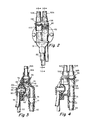
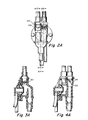
- FIGS. 2-4 illustrate a configuration of such a pump.
- the pump includes a housing 61 which may be molded, in components, from appropriate plastic materials.
- the interior of the housing is divided into a variable volume pumping chamber 62 and a driving chamber 64, the chambers 62, 64 being defined in part and separated by a flexible, resilient member 66 such as an elastic diaphragm.
- the housing 61 may be formed in two sections 68, 70.
- the flexible resilient member 66 preferably is captured between the housing sections 68, 70 when the device is assembled.
- the periphery of the diaphragm may be provided with an enlarged rim 72 which can be received in a receptive groove formed in one or both of the sections 68, 70 to cooperatively grip the rim 72.
- the housing section 68, 70 and the periphery of the flexible resilient member 66 are sealed to assure hermetic isolation between the chamber 62, 64 as well as a complete seal to the atmosphere.
- the housing 61 includes a first fluid inlet 74 and a fluid outlet 76 leading to and from the pumping chamber 62, respectively.
- the inlet 74 is connected to the irrigation bags 26 by tubes 52A, 52B at one of two nipples 56A, 56B formed on a pump cap 56 mounted on top of the housing 61.
- the pump cap 56 defines a common chamber that receives liquid from both tubes 52A and 52B. Thus, either one or both of the irrigation bags 26 can supply liquid to the device.
- the device also includes means for maintaining unidirectional flow along the flow path defined by the inlet 74, pumping chamber 62 and outlet 76 and, to that end, a first check valve 80, such as a duckbill type valve, is placed along the flow path, preferably adjacent to the inlet 74.
- a first check valve 80 such as a duckbill type valve
- the outlet 76 of the housing 61 is in communication with a pump outflow tube 82 (which is an inflow tube with respect to the knee joint) that forms part of the tubing set 36.
- the tube connector 38 is provided with an adjustable clamp 84 which can be set to partially or completely obstruct the tube connector 38.
- the pumping action is effected by oscillations of the elastic diaphragm 66.
- the device includes a two stroke mode of operation, including an ejection stroke and a filling stroke.
- diaphragm 66 is caused to flex to decrease the volume of the pumping chamber 62, applying pressure to the fluid in the chamber 62.
- fluid is caused to flow from the pumping chamber 62 into the tubing 82, through the tube connector 38 and into the flow cannula 14. Reverse flow is prevented by the check valve 80.
- the ejection stroke is terminated abruptly in a manner to enable the elastic diaphragm 66 to return to its starting position in which the volume of pumping chamber 62 re- expands to its original volume.
- the reexpansion of the pumping chamber defines the filling stroke and causes fluid to be drawn from the irrigation bags 26 through the tubing 52Aand first check valve 80 to the pumping chamber 62 in readiness for the next pumping stroke.
- the flexible, resilient member 66 is constructed and mounted in the housing 61 so that it can oscillate under the influence of positive pneumatic pressure applied to the driving chamber64.
- the device includes an air inlet passage 88 and an air outlet passage 90.
- the inlet passage 88 is connected to a source of air or other appropriate gas under pressure by the air inlet tube 50 which is in communication (via a passage not apparent in the drawings) with the air inlet passage 88.
- Exhaust air from the air outlet passage 90 may be communicated from the driving chamber by an exhaust tube 94.
- the air exhaust passage 90 leads from an exhaust port 96 which is located in registry with the center of the elastic element 66. Exhaust port 96 is arranged to communicate with the driving chamber64.
- the diaphragm 66 is normally biased to the exhaust port 96 so as to seal off the exhaust port from the driving chamber 64.
- the diaphragm is biased by its elasticity and by providing a bearing member such as an upstanding wall 98 which surrounds the exhaust port over which the elastic diaphragm 66 is stretched. In this configuration of the device, the height and location of the wall 98 is selected with respect to the manner in which the peripheral rim 72 of the diaphragm 66 is held in place.
- the elastic diaphragm 66 is stretched into a dome shape and is maintained under elastic tension which biases the diaphragm 66 toward the exhaust port 96 to close the port 96.
- the driving chamber 64 may be considered as somewhat annularly shaped, being bounded by the wall 98, the surface of the elastic diaphragm 66 and portions of the housing 70.
- the air inlet passage 88 communicates with the driving chamber 64 at an air inlet port 102 which opens through a wall in the housing section 70.
- the pressure built up within the driving chamber 64 is applied, through the diaphragm, to the fluid in the pumping chamber 62 thereby ejecting fluid through the outlet 76.
- the volume of fluid pumped in the ejection stroke is equal to the difference in volume in the driving chamber from its relaxed position to its position of maximum expansion.
- the ejection stroke continues as long as the diaphragm remains biased in its sealed relation against the exhaust port 96.
- the biasing force is created by the inherent elasticity of the diaphragm and the manner in which it is stretched over the rim of the wall 98 which surrounds and defines the exhaust port 96.
- the central portion of the diaphragm which makes the seal against the rim of the wall 98 maintains that seal until the remaining portion of the diaphragm 66 has been flexed and expanded to a point in which the opening force applied to the central portion of the diaphragm by the expanding peripheral portions of the diaphragm exceeds the biasing force.
- the central portion of the diaphragm is maintained in seated, sealed relation against the rim of the wall 98 not only under the influence of the bias of the elastic diaphragm but also under the influence of a pulse of increased pressure applied to the fluid in the pumping chamber.
- the pressure pulse applied to the liquid in the pumping chamber forces the central portion of the diaphragm more firmly into seated engagement on the rim of the wall 98.
- the impedance on the outlet side of the pump also has an effect on the timing of the unseating of the diaphragm from the air outlet port.
- the impedance should be great enough to allow sufficient pressure to build up within the pumping chamber so as to maintain the central portion of the diaphragm in sealing engagement on the outlet port for a time sufficient to enable a desired volume of liquid to be pumped during the ejection stroke.
- the stretched diaphragm abruptly unseats the central portion of the diaphragm from its sealing engagement with the rim of the wall 98.
- the elastic diaphragm immediately assumes a more uniform dome shape under the influence of the equalization of the internal elastic forces in the diaphragm.
- the internal elastic forces within the diaphragm 66 cause the diaphragm to contract which draws the diaphragm down into sealing engagement with the rim of the wall 98.
- the impedance in the air outlet line is substantially less than in the air inlet. This may be accomplished by selectively proportioning the flow areas of the air inlet and air outlet.
- Regulator 32 is adjustable, as by a knob control 33, to supply air under pressure to the pump 28.
- the regulator which may be any of a number of commercially available regulators, is preset in relation to the operating characteristics of the pump 28 so as to have a maximum outlet pressure that will result in a maximum fluid pressure at the outlet of the pump of the order of 300 mm Hg. Such a pressure corresponds to an approximate maximum height (about 14 feet above the patient) to which the irrigation bags are raised at a gravity mode.
- the regulator may be adjusted to provide lower air pressures to the pump 28 which will result in correspondingly lower outlet pressures, flow rates and pulse rates of the irrigation liquid.
- the setting for the regulator 32 is controlled in conjunction with management of the rate of irrigation liquid outflow from the joint. Such outflow may be controlled by the stopcocks 20, 22 or by appropriate controls associated with the suction side of the surgical instrument 16.
- the pressure regulator 32 may be adjusted to drive the pump 28 to a desired corresponding output pressure.
- the pump will automatically stop operating once the corresponding liquid pressure has been reached. Should the pressure of the liquid drop, for example, from an increase in the outflow of liquid from the joint, the pump restarts automatically and immediately to maintain the selected pressure level. In this manner, the system is very effective in maintaining the desired degree of liquid pressure and joint distension. It will be appreciated that the various parameters may be adjusted as desired to suit the requirements of the particular procedure being performed.
- the housing is formed to define a bypass chamber 100 having an inlet end that is connectible to and communicates with the reservoir 26 and an outlet end that communicates directly with outflow tube 82.
- the bypass chamber 100 in the illustrated embodiment, is connected to the reservoir 26 by tubing 52A, 52B which is attached to the nipples 56A, 56B of the housing cap 56.
- the cap 56 defines a common chamber that is fed by both tubes 52Aand 52B so that one or both of the reservoirs 26 may be connected simultaneously to both the pump flow path and the bypass flow path.
- the lower ends of the bypass chamber 100 and the pump chamber62 are connected by a bottom cap 101 that is attached to outflow tube 82.
- the bypass chamber 100 includes a second one-way check valve 102, preferably in the form of a hinged flapper valve that presents relatively low resistance to opening and closing and which also presents a significantly larger cross-sectional flow area than that of the first duckbill check valve 80.
- the flapper valve may be formed from a sheet of polymeric material such as ethylene propylene or silicone rub- berto include an outer mounting ring 104 and an inner flap element 106 hinged to the mounting ring by a tab (see FIG. 2A).
- the material preferably should have properties suitable to form a living hinge at the tab while being sufficiently flexible to open and close with low pressure differentials in order that the valve may open and close easily and quickly.
- Such valves are commercially available from Vernay Laboratories, Inc., Yellow Springs, Ohio.
- the surgical instrument 16 comprises a high speed shaver or similar high flow device
- the system will operate as described above, when the suction of the shaver is not applied.
- the oscillations in pressure in the pumping chamber 62 will be transmitted to t he bypass chamber 100. Consequently, in this mode of operation, both the first and second check valves will oscillate between open and closed positions, the valves opening during the filling stroke and closing during the pumping stroke.
- the suction from the high speed shaver is turned on, the pressure in the pumping and bypass chambers drops.
- the first and second check valves 80, 102 are selected so thatwhen the pressure drops, the high flow bypass valve 102 will open to a substantially full flow open configuration.
- the first check valve 80 is selected so that the drop in pressure from the increased suction of the shaver will not interfere with the oscillating opening and closing of that valve under the continued pumping and filling action of the pump.
- the first check valve 80 preferably a duckbill valve, defines a smaller flow area than the bypass valve and is configured to have a rapid response time so that it can open and close quickly in response to the pulsations developed by the oscillating diaphragm.
- Such valves can be obtained commercially, for example, from Vernay Laboratories.
- the system is capable of automatically and immediately shifting from a low flow configuration to a high flow configuration without setting of controls or other manipulation by the user. Additionally, it will be appreciated that because there are multiple inlets from the liquid reservoir(s) and common connection from the reservoir to both the pumping and the bypass flow paths, it is possible to change a depleted reservoir bag (or bottle) while fluid flow is maintained from the other bag.
- the pump provides a controllable pulsatile flow while maintaining capability for high flow rates in response to operation of devices calling for such flow.
- the pulsatile flow is desirable because it tends to dislodge and trap debris and enhances the cleansing action of the irrigation liquid. Additionally, during diagnosis and evaluation, the pulsating action of the liquid tends to highlight loose tissue or cartilage segments, such as cartilage flaps, by enhancing their movement and rendering them more visible. Should it be desired to stop the pulsatile flow, for example, to make it easier to grasp and surgically repair a particular portion of the joint, that may be accomplished in several ways.
- both check valves should be selected as to permit flow of irrigation liquid under a gravity head.
- check valve 80 should be selected so as to permit flow under a gravity head of the order of one foot.
- the second high flow check valve may be selected to permit flow of irrigation liquid under even less of a head.
- the gauge on the pressure regulator may be calibrated in direct pressure readings as well as in corresponding equivalent irrigation bag height in order to facilitate correlation of the regulator settings with terminology familiar to those who have used gravity drainage systems.
- the invention provides an irrigation system adapted to maintain liquid distensions of a body cavity that is capable of handling low as well as high flow irrigation demands and with minimal attention from the user. It is quick and easy to set up with very few connections.
- the entire system of irrigation bag, tubing and pump is inexpensive and lends itself to one-time disposable use. It provides pulsatile as well as gravity flow capability and is easily switched between those modes of operation.
- the invention has been described in connection with an arthroscopy procedure on a knee, it should be understood that is equally usable with other non-arthroscopic procedures.
- the invention may be used in irrigation of the bladder or other body cavities in conjunction with endoscopic procedures.
Landscapes
- Health & Medical Sciences (AREA)
- Engineering & Computer Science (AREA)
- General Health & Medical Sciences (AREA)
- Heart & Thoracic Surgery (AREA)
- Hematology (AREA)
- Life Sciences & Earth Sciences (AREA)
- Animal Behavior & Ethology (AREA)
- Anesthesiology (AREA)
- Public Health (AREA)
- Veterinary Medicine (AREA)
- Biomedical Technology (AREA)
- Mechanical Engineering (AREA)
- General Engineering & Computer Science (AREA)
- Physics & Mathematics (AREA)
- Fluid Mechanics (AREA)
- Infusion, Injection, And Reservoir Apparatuses (AREA)
- Surgical Instruments (AREA)
- Endoscopes (AREA)
- External Artificial Organs (AREA)
Applications Claiming Priority (2)
| Application Number | Priority Date | Filing Date | Title |
|---|---|---|---|
| US783845 | 1991-10-29 | ||
| US07/783,845 US5322506A (en) | 1989-07-31 | 1991-10-29 | Irrigation system with high flow bypass for use with endoscopic procedure |
Publications (2)
| Publication Number | Publication Date |
|---|---|
| EP0544410A2 true EP0544410A2 (fr) | 1993-06-02 |
| EP0544410A3 EP0544410A3 (en) | 1993-08-04 |
Family
ID=25130575
Family Applications (1)
| Application Number | Title | Priority Date | Filing Date |
|---|---|---|---|
| EP19920309833 Withdrawn EP0544410A3 (en) | 1991-10-29 | 1992-10-27 | Irrigation system with high flow bypass for use with endoscopic procedure |
Country Status (4)
| Country | Link |
|---|---|
| US (1) | US5322506A (fr) |
| EP (1) | EP0544410A3 (fr) |
| JP (1) | JPH05207969A (fr) |
| CA (1) | CA2081545A1 (fr) |
Cited By (3)
| Publication number | Priority date | Publication date | Assignee | Title |
|---|---|---|---|---|
| WO2006039512A1 (fr) * | 2004-09-30 | 2006-04-13 | Boston Scientific Limited | Systeme de distribution de fluide destine a etre utilise avec un endoscope |
| EP2674176A1 (fr) * | 2012-06-12 | 2013-12-18 | EOS GmbH | Dispositif de réglage de la pression d'irrigation lors d'opérations oculaires |
| WO2016085400A1 (fr) * | 2014-11-27 | 2016-06-02 | Provtagaren Ab | Commande de pompe pour des volumes à faible débit |
Families Citing this family (31)
| Publication number | Priority date | Publication date | Assignee | Title |
|---|---|---|---|---|
| US6746419B1 (en) | 1993-04-19 | 2004-06-08 | Stryker Corporation | Irrigation handpiece with built in pulsing pump |
| US6213970B1 (en) | 1993-12-30 | 2001-04-10 | Stryker Corporation | Surgical suction irrigation |
| IT1286624B1 (it) * | 1996-05-10 | 1998-07-15 | Mattioli Eng Srl | Apparecchiatura a componenti sterili monouso,per trattamenti di dermoabrasione mediante getti di sostanze riducenti |
| EP0797413B1 (fr) * | 1994-12-09 | 2003-11-05 | F. Barry Bays | Ensemble de valve d'abaissement de la pression du liquide synovial |
| US5792108A (en) * | 1995-10-23 | 1998-08-11 | C. R. Bard, Inc. | Self-priming pulsed lavage pump |
| US5807313A (en) * | 1996-07-19 | 1998-09-15 | C. R. Bard, Inc. | Battery powered surgical irrigator |
| US5814009A (en) * | 1996-10-11 | 1998-09-29 | Cabot Technology Corporation | Fluid management system and replaceable tubing assembly therefor |
| DE19731965A1 (de) * | 1997-07-24 | 1999-01-28 | Etm Endotech Gmbh Medizintechn | Luft/Wasser- und Absaugventile an Endoskopen |
| US6371934B1 (en) | 1997-08-06 | 2002-04-16 | C. R. Bard, Inc. | Irrigation system and tip with debrider |
| FR2779934B1 (fr) | 1998-06-17 | 2001-01-05 | Saphir Medical Sa | Piece a main a commande pneumatique pour applications chirurgicales et medicales |
| DE69927153T2 (de) | 1998-06-19 | 2006-07-06 | Eschmann Holdings Ltd., Lancing | VERFAHREN ZUR ERZEUGUNG EINER PULSFOLGE EINES STERILEN FLÜSSIGKEITSSTRAHLS Für MEDIZINISCHE ZWECKE |
| FR2780268B1 (fr) | 1998-06-24 | 2000-09-29 | Saphir Medical Sa | Appareil de distribution a deux voies d'un liquide sterile de travail selon des sequences predeterminees pour des applications chirurgicales ou medicales a l'aide d'au moins une piece a main |
| DE19912844A1 (de) | 1999-03-22 | 2000-09-28 | Saphir Medical Products Gmbh | Verwendung eines Schneidegerätes, welches ein Fluid als Schneidemedium einsetzt, zur chirurgischen Behandlung |
| US6276567B1 (en) | 1999-03-29 | 2001-08-21 | Hydrus, Inc. | Pressurized fluid delivery apparatus |
| US6652488B1 (en) | 2000-09-11 | 2003-11-25 | Stryker Corporation | Surgical suction irrigator |
| AU2003287190A1 (en) | 2002-10-23 | 2004-05-13 | Alastair J. T. Clemow | Modular femoral component for a total knee joint replacement for minimally invasive implantation |
| EP1909864B1 (fr) * | 2005-06-13 | 2012-10-17 | Smith & Nephew, Inc. | Systeme de gestion d'un fluide chirurgical |
| US7947010B2 (en) * | 2005-07-08 | 2011-05-24 | Depuy Products, Inc. | Composition and system for wound decontamination |
| US8075520B2 (en) * | 2006-04-06 | 2011-12-13 | Reznik Alan M | Arthroscopic fluid control device and method for controlling fluid flow in arthroscopic procedures |
| US7785287B2 (en) * | 2006-04-06 | 2010-08-31 | Reznik Alan M | Arthroscopic fluid control device |
| EP2800593A4 (fr) * | 2012-01-04 | 2015-05-20 | Surgical Apps Pty Ltd | Pompe médicale à commande manuelle |
| US9883905B2 (en) | 2013-10-02 | 2018-02-06 | Applied Medical Rescources Corporation | Electrosurgical probes for suction and irrigation systems |
| CN104027884B (zh) * | 2014-05-23 | 2016-05-11 | 孙钦友 | 腹腔镜吸引装置 |
| US20160106400A1 (en) * | 2014-10-15 | 2016-04-21 | New York University | Endoscopic side release biopsy valve |
| TWI659728B (zh) | 2017-11-02 | 2019-05-21 | 國立交通大學 | 具末端轉向機構的微創手術用具 |
| US11305074B2 (en) | 2018-01-25 | 2022-04-19 | Biogastrex Llc | Insufflation system |
| WO2020257110A1 (fr) * | 2019-06-19 | 2020-12-24 | David Kirk | Outil d'irrigation de la vessie |
| CN114040788B (zh) * | 2019-06-27 | 2024-10-29 | 波士顿科学医学有限公司 | 针对流体管理系统的内窥镜检测 |
| CN112263211A (zh) * | 2020-11-12 | 2021-01-26 | 上海市第六人民医院 | 一种用于关节镜手术的注水装置 |
| WO2022190296A1 (fr) * | 2021-03-10 | 2022-09-15 | オリンパス株式会社 | Système d'opération chirurgicale ainsi que procédé de fonctionnement de celui-ci, et dispositif de commande |
| WO2025090730A1 (fr) * | 2023-10-24 | 2025-05-01 | Boston Scientific Scimed, Inc. | Dispositifs, systèmes et méthodes d'alimentation en fluides d'un endoscope |
Family Cites Families (32)
| Publication number | Priority date | Publication date | Assignee | Title |
|---|---|---|---|---|
| US3468905A (en) * | 1965-09-07 | 1969-09-23 | Chevron Res | N-(1-halo-1-nitroalkylthio)dicarboximides |
| US3918453A (en) * | 1974-07-01 | 1975-11-11 | Baxter Laboratories Inc | Surgical suction device |
| US4084612A (en) * | 1977-03-21 | 1978-04-18 | The United States Of America As Represented By The Administrator Of The National Aeronautics And Space Administration | Flow compensating pressure regulator |
| US4117843A (en) * | 1977-05-12 | 1978-10-03 | Surgical Design Corp. | Surgical operating system with upper pressure limit |
| US4381591A (en) * | 1979-04-24 | 1983-05-03 | American Hospital Supply Corporation | Method of assembling medical flushing valve |
| US4337770A (en) * | 1979-06-07 | 1982-07-06 | Young James E | Flow regulating device for arterial catheter systems |
| US4300571A (en) * | 1979-07-27 | 1981-11-17 | Medex Inc. | Constant flush device |
| IT7943514A0 (it) * | 1979-10-26 | 1979-10-26 | Buoncristiani Vincenzo | Apparecchiatura automatica per la dialisi peritoneale col riciclaggiodel liquido dello scarico durante la seduta dialitica |
| US4261360A (en) * | 1979-11-05 | 1981-04-14 | Urethral Devices Research, Inc. | Transurethral irrigation pressure controller |
| US4655197A (en) * | 1982-12-01 | 1987-04-07 | Snyder Laboratories, Inc. | Lavage system with variable frequency, flow rate and pressure |
| US4635621A (en) * | 1982-12-01 | 1987-01-13 | Snyder Laboratories, Inc. | Lavage system with replaceable pump |
| US4525156A (en) * | 1983-02-16 | 1985-06-25 | Benusa John E | Method for stomach lavage |
| US4563173A (en) * | 1983-04-19 | 1986-01-07 | National Biomedical Research Foundation | Pump-actuated sequencing valve and system |
| US4515588A (en) * | 1983-05-16 | 1985-05-07 | Health Care Concepts, Inc. | I.V. flow regulator |
| US4604089A (en) * | 1983-08-15 | 1986-08-05 | Codman & Shurtleff, Inc. | Pressure regulated irrigation system for arthroscopy |
| US4662829A (en) * | 1984-01-05 | 1987-05-05 | C. R. Bard, Inc. | Pulsatile pump |
| DE3408331C2 (de) * | 1984-03-07 | 1986-06-12 | Fresenius AG, 6380 Bad Homburg | Pumpanordnung für medizinische Zwecke |
| US4673389A (en) * | 1984-11-29 | 1987-06-16 | Minnesota Mining And Manufacturing Company | Sequence valve for piggyback IV administration |
| US4650462A (en) * | 1985-07-29 | 1987-03-17 | Minnesota Mining And Manufacturing Company | Irrigation system |
| US4902277A (en) * | 1987-08-26 | 1990-02-20 | Orthoconcept | Circulating a liquid through a joint |
| US5000733A (en) * | 1986-05-23 | 1991-03-19 | Orthoconcept S.A. | Circulating a liquid through a joint |
| US4902276A (en) * | 1986-06-09 | 1990-02-20 | The Regents Of The University Of California | Apparatus and method for removing obstructions in bodily organs or cavities |
| US4781687A (en) * | 1986-10-16 | 1988-11-01 | Baxter Travenol Laboratories, Inc. | Irrigation system utilizing air bladder pressure regulator and method of use |
| US4820265A (en) * | 1986-12-16 | 1989-04-11 | Minnesota Mining And Manufacturing Company | Tubing set |
| US4878894A (en) * | 1987-02-26 | 1989-11-07 | Sutter Leroy V | Gas/saline valve with suction control |
| US4838856A (en) * | 1987-07-02 | 1989-06-13 | Truckee Meadows Research & Development | Fluid infusion flow control system |
| US4940457A (en) * | 1987-12-23 | 1990-07-10 | Snyder Laboratories, Inc. | Irrigation system for use during arthroscopy |
| US5053002A (en) * | 1988-01-11 | 1991-10-01 | Olympus Corporation | Irrigation system for angioscope |
| US4904246A (en) * | 1988-07-19 | 1990-02-27 | Snyder Laboratories, Inc. | Cannula assembly |
| US4946439A (en) * | 1988-08-15 | 1990-08-07 | Critikon, Inc. | Dual source parenteral infusion system with secondary infusion module |
| US4950225A (en) * | 1988-09-22 | 1990-08-21 | American Immuno Tech, Inc. | Method for extracorporeal blood shear treatment |
| DE8814243U1 (de) * | 1988-11-14 | 1989-01-12 | K.E.W. Industri A/S, Hadsund | Gerät zum Ausspritzen von Flüssigkeit durch ein Spritzorgan z.B. ein Hochdruckreinigungsgerät, sowie ein Zusatzgerät zur Änderung eines derartigen Geräts |
-
1991
- 1991-10-29 US US07/783,845 patent/US5322506A/en not_active Expired - Lifetime
-
1992
- 1992-10-21 JP JP4282648A patent/JPH05207969A/ja active Pending
- 1992-10-27 EP EP19920309833 patent/EP0544410A3/en not_active Withdrawn
- 1992-10-27 CA CA002081545A patent/CA2081545A1/fr not_active Abandoned
Cited By (5)
| Publication number | Priority date | Publication date | Assignee | Title |
|---|---|---|---|---|
| WO2006039512A1 (fr) * | 2004-09-30 | 2006-04-13 | Boston Scientific Limited | Systeme de distribution de fluide destine a etre utilise avec un endoscope |
| EP2674176A1 (fr) * | 2012-06-12 | 2013-12-18 | EOS GmbH | Dispositif de réglage de la pression d'irrigation lors d'opérations oculaires |
| WO2013185985A1 (fr) * | 2012-06-12 | 2013-12-19 | Eos Gmbh | Dispositif de réglage de la pression d'irrigation dans le cadre de chirurgies oculaires |
| US9867928B2 (en) | 2012-06-12 | 2018-01-16 | Eos Gmbh | Device for adjusting the irrigation pressure in eye operations |
| WO2016085400A1 (fr) * | 2014-11-27 | 2016-06-02 | Provtagaren Ab | Commande de pompe pour des volumes à faible débit |
Also Published As
| Publication number | Publication date |
|---|---|
| EP0544410A3 (en) | 1993-08-04 |
| JPH05207969A (ja) | 1993-08-20 |
| CA2081545A1 (fr) | 1993-04-30 |
| US5322506A (en) | 1994-06-21 |
Similar Documents
| Publication | Publication Date | Title |
|---|---|---|
| US5322506A (en) | Irrigation system with high flow bypass for use with endoscopic procedure | |
| US5176629A (en) | Irrigation system for use with endoscopic procedure | |
| US11877952B2 (en) | Selectively moveable valve elements for aspiration and irrigation circuits | |
| JP6592003B2 (ja) | 眼科手術用液圧ポンプ | |
| US7678070B2 (en) | System of dampening pressure pulsations caused by a positive displacement pump in endoscopic surgery | |
| EP0643570B1 (fr) | Systeme de gestion de tubulures | |
| JP3995882B2 (ja) | 制御される密閉バルブを有する腹腔鏡手術用アクセスポート | |
| CA2559205C (fr) | Pompe a vide deux cylindres pour systeme medical d'aspiration | |
| Oretorp et al. | Arthroscopy and irrigation control | |
| WO2004023987A1 (fr) | Ensemble d'irrigation medical | |
| RU2773370C2 (ru) | Селективно перемещаемые клапаны для контуров аспирации и ирригации |
Legal Events
| Date | Code | Title | Description |
|---|---|---|---|
| PUAI | Public reference made under article 153(3) epc to a published international application that has entered the european phase |
Free format text: ORIGINAL CODE: 0009012 |
|
| AK | Designated contracting states |
Kind code of ref document: A2 Designated state(s): BE DE FR GB IT NL |
|
| PUAL | Search report despatched |
Free format text: ORIGINAL CODE: 0009013 |
|
| AK | Designated contracting states |
Kind code of ref document: A3 Designated state(s): BE DE FR GB IT NL |
|
| 17P | Request for examination filed |
Effective date: 19940107 |
|
| 17Q | First examination report despatched |
Effective date: 19950724 |
|
| 18D | Application deemed to be withdrawn |
Effective date: 19960806 |