EP0545406B1 - Verfahren zur Herstellung von Tonern - Google Patents
Verfahren zur Herstellung von Tonern Download PDFInfo
- Publication number
- EP0545406B1 EP0545406B1 EP92120640A EP92120640A EP0545406B1 EP 0545406 B1 EP0545406 B1 EP 0545406B1 EP 92120640 A EP92120640 A EP 92120640A EP 92120640 A EP92120640 A EP 92120640A EP 0545406 B1 EP0545406 B1 EP 0545406B1
- Authority
- EP
- European Patent Office
- Prior art keywords
- particles
- binder resin
- resin particles
- colorant
- process according
- Prior art date
- Legal status (The legal status is an assumption and is not a legal conclusion. Google has not performed a legal analysis and makes no representation as to the accuracy of the status listed.)
- Expired - Lifetime
Links
- 238000000034 method Methods 0.000 title claims description 84
- 230000008569 process Effects 0.000 title claims description 73
- 239000002245 particle Substances 0.000 claims description 602
- 229920005989 resin Polymers 0.000 claims description 206
- 239000011347 resin Substances 0.000 claims description 206
- 239000003086 colorant Substances 0.000 claims description 168
- 239000000203 mixture Substances 0.000 claims description 140
- 239000011230 binding agent Substances 0.000 claims description 106
- 238000002156 mixing Methods 0.000 claims description 89
- 238000004898 kneading Methods 0.000 claims description 52
- 239000003795 chemical substances by application Substances 0.000 claims description 44
- 238000007906 compression Methods 0.000 claims description 25
- 230000006835 compression Effects 0.000 claims description 25
- 238000005549 size reduction Methods 0.000 claims description 23
- 238000010298 pulverizing process Methods 0.000 claims description 15
- 239000000696 magnetic material Substances 0.000 claims description 8
- 238000001816 cooling Methods 0.000 claims description 6
- 229910010293 ceramic material Inorganic materials 0.000 claims description 4
- 239000000155 melt Substances 0.000 claims description 4
- 238000007580 dry-mixing Methods 0.000 claims 1
- 239000000047 product Substances 0.000 description 96
- 239000000463 material Substances 0.000 description 80
- 239000006185 dispersion Substances 0.000 description 71
- 239000000049 pigment Substances 0.000 description 51
- VYPSYNLAJGMNEJ-UHFFFAOYSA-N Silicium dioxide Chemical compound O=[Si]=O VYPSYNLAJGMNEJ-UHFFFAOYSA-N 0.000 description 31
- RBTKNAXYKSUFRK-UHFFFAOYSA-N heliogen blue Chemical compound [Cu].[N-]1C2=C(C=CC=C3)C3=C1N=C([N-]1)C3=CC=CC=C3C1=NC([N-]1)=C(C=CC=C3)C3=C1N=C([N-]1)C3=CC=CC=C3C1=N2 RBTKNAXYKSUFRK-UHFFFAOYSA-N 0.000 description 31
- 239000000843 powder Substances 0.000 description 30
- MCMNRKCIXSYSNV-UHFFFAOYSA-N Zirconium dioxide Chemical compound O=[Zr]=O MCMNRKCIXSYSNV-UHFFFAOYSA-N 0.000 description 26
- 230000000052 comparative effect Effects 0.000 description 26
- 239000000654 additive Substances 0.000 description 24
- 229920001577 copolymer Polymers 0.000 description 21
- 239000012188 paraffin wax Substances 0.000 description 21
- 230000000996 additive effect Effects 0.000 description 20
- 239000012530 fluid Substances 0.000 description 19
- 238000009472 formulation Methods 0.000 description 19
- 230000003287 optical effect Effects 0.000 description 19
- 230000000007 visual effect Effects 0.000 description 19
- 238000001035 drying Methods 0.000 description 18
- 238000012360 testing method Methods 0.000 description 18
- 238000004519 manufacturing process Methods 0.000 description 16
- -1 benzothiazole compound Chemical class 0.000 description 15
- 238000009826 distribution Methods 0.000 description 14
- 239000000377 silicon dioxide Substances 0.000 description 13
- 239000011248 coating agent Substances 0.000 description 12
- 238000000576 coating method Methods 0.000 description 12
- 239000006229 carbon black Substances 0.000 description 11
- 230000002209 hydrophobic effect Effects 0.000 description 11
- 239000002904 solvent Substances 0.000 description 11
- 238000004040 coloring Methods 0.000 description 10
- SZVJSHCCFOBDDC-UHFFFAOYSA-N iron(II,III) oxide Inorganic materials O=[Fe]O[Fe]O[Fe]=O SZVJSHCCFOBDDC-UHFFFAOYSA-N 0.000 description 10
- 230000002093 peripheral effect Effects 0.000 description 10
- 238000012216 screening Methods 0.000 description 10
- XEEYBQQBJWHFJM-UHFFFAOYSA-N Iron Chemical compound [Fe] XEEYBQQBJWHFJM-UHFFFAOYSA-N 0.000 description 9
- 230000009471 action Effects 0.000 description 9
- 239000000498 cooling water Substances 0.000 description 9
- 229920006337 unsaturated polyester resin Polymers 0.000 description 9
- 229910000859 α-Fe Inorganic materials 0.000 description 9
- 230000005540 biological transmission Effects 0.000 description 8
- XCJYREBRNVKWGJ-UHFFFAOYSA-N copper(II) phthalocyanine Chemical compound [Cu+2].C12=CC=CC=C2C(N=C2[N-]C(C3=CC=CC=C32)=N2)=NC1=NC([C]1C=CC=CC1=1)=NC=1N=C1[C]3C=CC=CC3=C2[N-]1 XCJYREBRNVKWGJ-UHFFFAOYSA-N 0.000 description 8
- 238000010438 heat treatment Methods 0.000 description 7
- 238000009736 wetting Methods 0.000 description 7
- VYZAMTAEIAYCRO-UHFFFAOYSA-N Chromium Chemical compound [Cr] VYZAMTAEIAYCRO-UHFFFAOYSA-N 0.000 description 6
- 239000004743 Polypropylene Substances 0.000 description 6
- FAPWRFPIFSIZLT-UHFFFAOYSA-M Sodium chloride Chemical compound [Na+].[Cl-] FAPWRFPIFSIZLT-UHFFFAOYSA-M 0.000 description 6
- 239000002253 acid Substances 0.000 description 6
- 229910052804 chromium Inorganic materials 0.000 description 6
- 239000011651 chromium Substances 0.000 description 6
- 239000008151 electrolyte solution Substances 0.000 description 6
- 229920001155 polypropylene Polymers 0.000 description 6
- 238000002360 preparation method Methods 0.000 description 6
- 239000001993 wax Substances 0.000 description 6
- 229910002012 Aerosil® Inorganic materials 0.000 description 5
- UQSXHKLRYXJYBZ-UHFFFAOYSA-N Iron oxide Chemical compound [Fe]=O UQSXHKLRYXJYBZ-UHFFFAOYSA-N 0.000 description 5
- PNEYBMLMFCGWSK-UHFFFAOYSA-N aluminium oxide Inorganic materials [O-2].[O-2].[O-2].[Al+3].[Al+3] PNEYBMLMFCGWSK-UHFFFAOYSA-N 0.000 description 5
- 239000008119 colloidal silica Substances 0.000 description 5
- 239000010963 304 stainless steel Substances 0.000 description 4
- 229910000589 SAE 304 stainless steel Inorganic materials 0.000 description 4
- 229910017052 cobalt Inorganic materials 0.000 description 4
- 239000010941 cobalt Substances 0.000 description 4
- GUTLYIVDDKVIGB-UHFFFAOYSA-N cobalt atom Chemical compound [Co] GUTLYIVDDKVIGB-UHFFFAOYSA-N 0.000 description 4
- 229910052751 metal Inorganic materials 0.000 description 4
- 239000002184 metal Substances 0.000 description 4
- IEQIEDJGQAUEQZ-UHFFFAOYSA-N phthalocyanine Chemical compound N1C(N=C2C3=CC=CC=C3C(N=C3C4=CC=CC=C4C(=N4)N3)=N2)=C(C=CC=C2)C2=C1N=C1C2=CC=CC=C2C4=N1 IEQIEDJGQAUEQZ-UHFFFAOYSA-N 0.000 description 4
- 239000000126 substance Substances 0.000 description 4
- OKTJSMMVPCPJKN-UHFFFAOYSA-N Carbon Chemical group [C] OKTJSMMVPCPJKN-UHFFFAOYSA-N 0.000 description 3
- PPBRXRYQALVLMV-UHFFFAOYSA-N Styrene Chemical compound C=CC1=CC=CC=C1 PPBRXRYQALVLMV-UHFFFAOYSA-N 0.000 description 3
- 238000005054 agglomeration Methods 0.000 description 3
- 230000002776 aggregation Effects 0.000 description 3
- 230000008901 benefit Effects 0.000 description 3
- 239000011362 coarse particle Substances 0.000 description 3
- 235000019646 color tone Nutrition 0.000 description 3
- 229910052742 iron Inorganic materials 0.000 description 3
- 230000005291 magnetic effect Effects 0.000 description 3
- 150000002739 metals Chemical class 0.000 description 3
- 238000004064 recycling Methods 0.000 description 3
- 239000003507 refrigerant Substances 0.000 description 3
- 239000011780 sodium chloride Substances 0.000 description 3
- 238000002834 transmittance Methods 0.000 description 3
- COHYTHOBJLSHDF-UHFFFAOYSA-N Indigo Chemical compound N1C2=CC=CC=C2C(=O)C1=C1C(=O)C2=CC=CC=C2N1 COHYTHOBJLSHDF-UHFFFAOYSA-N 0.000 description 2
- PXHVJJICTQNCMI-UHFFFAOYSA-N Nickel Chemical compound [Ni] PXHVJJICTQNCMI-UHFFFAOYSA-N 0.000 description 2
- 239000004952 Polyamide Substances 0.000 description 2
- RTAQQCXQSZGOHL-UHFFFAOYSA-N Titanium Chemical compound [Ti] RTAQQCXQSZGOHL-UHFFFAOYSA-N 0.000 description 2
- 229910052787 antimony Inorganic materials 0.000 description 2
- WATWJIUSRGPENY-UHFFFAOYSA-N antimony atom Chemical compound [Sb] WATWJIUSRGPENY-UHFFFAOYSA-N 0.000 description 2
- 230000015572 biosynthetic process Effects 0.000 description 2
- 238000007334 copolymerization reaction Methods 0.000 description 2
- VPWFPZBFBFHIIL-UHFFFAOYSA-L disodium 4-[(4-methyl-2-sulfophenyl)diazenyl]-3-oxidonaphthalene-2-carboxylate Chemical compound [Na+].[Na+].[O-]S(=O)(=O)C1=CC(C)=CC=C1N=NC1=C(O)C(C([O-])=O)=CC2=CC=CC=C12 VPWFPZBFBFHIIL-UHFFFAOYSA-L 0.000 description 2
- 239000002270 dispersing agent Substances 0.000 description 2
- 230000006872 improvement Effects 0.000 description 2
- 239000006249 magnetic particle Substances 0.000 description 2
- 239000006247 magnetic powder Substances 0.000 description 2
- 238000005259 measurement Methods 0.000 description 2
- 229920002647 polyamide Polymers 0.000 description 2
- YGSDEFSMJLZEOE-UHFFFAOYSA-N salicylic acid Chemical compound OC(=O)C1=CC=CC=C1O YGSDEFSMJLZEOE-UHFFFAOYSA-N 0.000 description 2
- 150000003839 salts Chemical class 0.000 description 2
- 238000005204 segregation Methods 0.000 description 2
- 238000010008 shearing Methods 0.000 description 2
- 239000002689 soil Substances 0.000 description 2
- 239000000243 solution Substances 0.000 description 2
- 239000004094 surface-active agent Substances 0.000 description 2
- JOUDBUYBGJYFFP-FOCLMDBBSA-N thioindigo Chemical compound S\1C2=CC=CC=C2C(=O)C/1=C1/C(=O)C2=CC=CC=C2S1 JOUDBUYBGJYFFP-FOCLMDBBSA-N 0.000 description 2
- 239000010936 titanium Substances 0.000 description 2
- 229910052719 titanium Inorganic materials 0.000 description 2
- 238000012546 transfer Methods 0.000 description 2
- 238000001132 ultrasonic dispersion Methods 0.000 description 2
- QCGOYKXFFGQDFY-UHFFFAOYSA-M 1,3,3-trimethyl-2-[3-(1,3,3-trimethylindol-1-ium-2-yl)prop-2-enylidene]indole;chloride Chemical compound [Cl-].CC1(C)C2=CC=CC=C2N(C)\C1=C\C=C\C1=[N+](C)C2=CC=CC=C2C1(C)C QCGOYKXFFGQDFY-UHFFFAOYSA-M 0.000 description 1
- OSNILPMOSNGHLC-UHFFFAOYSA-N 1-[4-methoxy-3-(piperidin-1-ylmethyl)phenyl]ethanone Chemical compound COC1=CC=C(C(C)=O)C=C1CN1CCCCC1 OSNILPMOSNGHLC-UHFFFAOYSA-N 0.000 description 1
- KTZVZZJJVJQZHV-UHFFFAOYSA-N 1-chloro-4-ethenylbenzene Chemical compound ClC1=CC=C(C=C)C=C1 KTZVZZJJVJQZHV-UHFFFAOYSA-N 0.000 description 1
- FFRBMBIXVSCUFS-UHFFFAOYSA-N 2,4-dinitro-1-naphthol Chemical compound C1=CC=C2C(O)=C([N+]([O-])=O)C=C([N+]([O-])=O)C2=C1 FFRBMBIXVSCUFS-UHFFFAOYSA-N 0.000 description 1
- DZNJMLVCIZGWSC-UHFFFAOYSA-N 3',6'-bis(diethylamino)spiro[2-benzofuran-3,9'-xanthene]-1-one Chemical compound O1C(=O)C2=CC=CC=C2C21C1=CC=C(N(CC)CC)C=C1OC1=CC(N(CC)CC)=CC=C21 DZNJMLVCIZGWSC-UHFFFAOYSA-N 0.000 description 1
- LVOJOIBIVGEQBP-UHFFFAOYSA-N 4-[[2-chloro-4-[3-chloro-4-[(5-hydroxy-3-methyl-1-phenylpyrazol-4-yl)diazenyl]phenyl]phenyl]diazenyl]-5-methyl-2-phenylpyrazol-3-ol Chemical compound CC1=NN(C(O)=C1N=NC1=CC=C(C=C1Cl)C1=CC(Cl)=C(C=C1)N=NC1=C(O)N(N=C1C)C1=CC=CC=C1)C1=CC=CC=C1 LVOJOIBIVGEQBP-UHFFFAOYSA-N 0.000 description 1
- CGLVZFOCZLHKOH-UHFFFAOYSA-N 8,18-dichloro-5,15-diethyl-5,15-dihydrodiindolo(3,2-b:3',2'-m)triphenodioxazine Chemical compound CCN1C2=CC=CC=C2C2=C1C=C1OC3=C(Cl)C4=NC(C=C5C6=CC=CC=C6N(C5=C5)CC)=C5OC4=C(Cl)C3=NC1=C2 CGLVZFOCZLHKOH-UHFFFAOYSA-N 0.000 description 1
- VJUKWPOWHJITTP-UHFFFAOYSA-N 81-39-0 Chemical compound C1=CC(C)=CC=C1NC1=CC=C2C3=C1C(=O)C1=CC=CC=C1C3=CC(=O)N2C VJUKWPOWHJITTP-UHFFFAOYSA-N 0.000 description 1
- RSWGJHLUYNHPMX-UHFFFAOYSA-N Abietic-Saeure Natural products C12CCC(C(C)C)=CC2=CCC2C1(C)CCCC2(C)C(O)=O RSWGJHLUYNHPMX-UHFFFAOYSA-N 0.000 description 1
- OYPRJOBELJOOCE-UHFFFAOYSA-N Calcium Chemical compound [Ca] OYPRJOBELJOOCE-UHFFFAOYSA-N 0.000 description 1
- 108091005944 Cerulean Proteins 0.000 description 1
- 239000013032 Hydrocarbon resin Substances 0.000 description 1
- UFHFLCQGNIYNRP-UHFFFAOYSA-N Hydrogen Chemical compound [H][H] UFHFLCQGNIYNRP-UHFFFAOYSA-N 0.000 description 1
- 206010022979 Iron excess Diseases 0.000 description 1
- FYYHWMGAXLPEAU-UHFFFAOYSA-N Magnesium Chemical compound [Mg] FYYHWMGAXLPEAU-UHFFFAOYSA-N 0.000 description 1
- KWORKYDIARWARF-UHFFFAOYSA-N N-(4-chloro-2-methylphenyl)-4-[(4-chloro-2-methylphenyl)diazenyl]-3-hydroxynaphthalene-2-carboxamide Chemical compound Cc1cc(Cl)ccc1NC(=O)c1cc2ccccc2c(N=Nc2ccc(Cl)cc2C)c1O KWORKYDIARWARF-UHFFFAOYSA-N 0.000 description 1
- CTQNGGLPUBDAKN-UHFFFAOYSA-N O-Xylene Chemical compound CC1=CC=CC=C1C CTQNGGLPUBDAKN-UHFFFAOYSA-N 0.000 description 1
- 239000004698 Polyethylene Substances 0.000 description 1
- 239000004793 Polystyrene Substances 0.000 description 1
- NRCMAYZCPIVABH-UHFFFAOYSA-N Quinacridone Chemical compound N1C2=CC=CC=C2C(=O)C2=C1C=C1C(=O)C3=CC=CC=C3NC1=C2 NRCMAYZCPIVABH-UHFFFAOYSA-N 0.000 description 1
- KHPCPRHQVVSZAH-HUOMCSJISA-N Rosin Natural products O(C/C=C/c1ccccc1)[C@H]1[C@H](O)[C@@H](O)[C@@H](O)[C@@H](CO)O1 KHPCPRHQVVSZAH-HUOMCSJISA-N 0.000 description 1
- BUGBHKTXTAQXES-UHFFFAOYSA-N Selenium Chemical compound [Se] BUGBHKTXTAQXES-UHFFFAOYSA-N 0.000 description 1
- 229920002125 Sokalan® Polymers 0.000 description 1
- 229920007962 Styrene Methyl Methacrylate Polymers 0.000 description 1
- MRQIXHXHHPWVIL-ISLYRVAYSA-N Sudan I Chemical compound OC1=CC=C2C=CC=CC2=C1\N=N\C1=CC=CC=C1 MRQIXHXHHPWVIL-ISLYRVAYSA-N 0.000 description 1
- ATJFFYVFTNAWJD-UHFFFAOYSA-N Tin Chemical compound [Sn] ATJFFYVFTNAWJD-UHFFFAOYSA-N 0.000 description 1
- HCHKCACWOHOZIP-UHFFFAOYSA-N Zinc Chemical compound [Zn] HCHKCACWOHOZIP-UHFFFAOYSA-N 0.000 description 1
- 239000006230 acetylene black Substances 0.000 description 1
- 230000002730 additional effect Effects 0.000 description 1
- 125000002723 alicyclic group Chemical group 0.000 description 1
- 125000001931 aliphatic group Chemical group 0.000 description 1
- 125000002947 alkylene group Chemical group 0.000 description 1
- 229910045601 alloy Inorganic materials 0.000 description 1
- 239000000956 alloy Substances 0.000 description 1
- 229910052782 aluminium Inorganic materials 0.000 description 1
- XAGFODPZIPBFFR-UHFFFAOYSA-N aluminium Chemical compound [Al] XAGFODPZIPBFFR-UHFFFAOYSA-N 0.000 description 1
- 239000007864 aqueous solution Substances 0.000 description 1
- 125000003118 aryl group Chemical group 0.000 description 1
- IRERQBUNZFJFGC-UHFFFAOYSA-L azure blue Chemical compound [Na+].[Na+].[Na+].[Na+].[Na+].[Na+].[Na+].[Na+].[Al+3].[Al+3].[Al+3].[Al+3].[Al+3].[Al+3].[S-]S[S-].[O-][Si]([O-])([O-])[O-].[O-][Si]([O-])([O-])[O-].[O-][Si]([O-])([O-])[O-].[O-][Si]([O-])([O-])[O-].[O-][Si]([O-])([O-])[O-].[O-][Si]([O-])([O-])[O-] IRERQBUNZFJFGC-UHFFFAOYSA-L 0.000 description 1
- QFFVPLLCYGOFPU-UHFFFAOYSA-N barium chromate Chemical compound [Ba+2].[O-][Cr]([O-])(=O)=O QFFVPLLCYGOFPU-UHFFFAOYSA-N 0.000 description 1
- 239000000981 basic dye Substances 0.000 description 1
- 229910052790 beryllium Inorganic materials 0.000 description 1
- ATBAMAFKBVZNFJ-UHFFFAOYSA-N beryllium atom Chemical compound [Be] ATBAMAFKBVZNFJ-UHFFFAOYSA-N 0.000 description 1
- 229910052797 bismuth Inorganic materials 0.000 description 1
- JCXGWMGPZLAOME-UHFFFAOYSA-N bismuth atom Chemical compound [Bi] JCXGWMGPZLAOME-UHFFFAOYSA-N 0.000 description 1
- 239000000038 blue colorant Substances 0.000 description 1
- 229910052793 cadmium Inorganic materials 0.000 description 1
- BDOSMKKIYDKNTQ-UHFFFAOYSA-N cadmium atom Chemical compound [Cd] BDOSMKKIYDKNTQ-UHFFFAOYSA-N 0.000 description 1
- CJOBVZJTOIVNNF-UHFFFAOYSA-N cadmium sulfide Chemical compound [Cd]=S CJOBVZJTOIVNNF-UHFFFAOYSA-N 0.000 description 1
- 229910052791 calcium Inorganic materials 0.000 description 1
- 239000011575 calcium Substances 0.000 description 1
- 125000004432 carbon atom Chemical group C* 0.000 description 1
- 239000000969 carrier Substances 0.000 description 1
- 239000013522 chelant Substances 0.000 description 1
- IWWWBRIIGAXLCJ-BGABXYSRSA-N chembl1185241 Chemical compound C1=2C=C(C)C(NCC)=CC=2OC2=C\C(=N/CC)C(C)=CC2=C1C1=CC=CC=C1C(=O)OCC IWWWBRIIGAXLCJ-BGABXYSRSA-N 0.000 description 1
- HBHZKFOUIUMKHV-UHFFFAOYSA-N chembl1982121 Chemical compound OC1=CC=C2C=CC=CC2=C1N=NC1=CC=C([N+]([O-])=O)C=C1[N+]([O-])=O HBHZKFOUIUMKHV-UHFFFAOYSA-N 0.000 description 1
- PZTQVMXMKVTIRC-UHFFFAOYSA-L chembl2028348 Chemical compound [Ca+2].[O-]S(=O)(=O)C1=CC(C)=CC=C1N=NC1=C(O)C(C([O-])=O)=CC2=CC=CC=C12 PZTQVMXMKVTIRC-UHFFFAOYSA-L 0.000 description 1
- YOCIQNIEQYCORH-UHFFFAOYSA-M chembl2028361 Chemical compound [Na+].OC1=CC=C2C=C(S([O-])(=O)=O)C=CC2=C1N=NC1=CC=CC=C1 YOCIQNIEQYCORH-UHFFFAOYSA-M 0.000 description 1
- KYRMFSOATGQQBV-UHFFFAOYSA-N chromium;2-hydroxybenzoic acid Chemical compound [Cr].OC(=O)C1=CC=CC=C1O KYRMFSOATGQQBV-UHFFFAOYSA-N 0.000 description 1
- 229910000152 cobalt phosphate Inorganic materials 0.000 description 1
- 239000002131 composite material Substances 0.000 description 1
- 150000001875 compounds Chemical class 0.000 description 1
- 238000010924 continuous production Methods 0.000 description 1
- NKNDPYCGAZPOFS-UHFFFAOYSA-M copper(i) bromide Chemical compound Br[Cu] NKNDPYCGAZPOFS-UHFFFAOYSA-M 0.000 description 1
- IOJUPLGTWVMSFF-UHFFFAOYSA-N cyclobenzothiazole Natural products C1=CC=C2SC=NC2=C1 IOJUPLGTWVMSFF-UHFFFAOYSA-N 0.000 description 1
- 230000003247 decreasing effect Effects 0.000 description 1
- 230000001419 dependent effect Effects 0.000 description 1
- 238000011161 development Methods 0.000 description 1
- 239000000975 dye Substances 0.000 description 1
- 238000005538 encapsulation Methods 0.000 description 1
- 230000007613 environmental effect Effects 0.000 description 1
- 239000003822 epoxy resin Substances 0.000 description 1
- PLYDMIIYRWUYBP-UHFFFAOYSA-N ethyl 4-[[2-chloro-4-[3-chloro-4-[(3-ethoxycarbonyl-5-oxo-1-phenyl-4h-pyrazol-4-yl)diazenyl]phenyl]phenyl]diazenyl]-5-oxo-1-phenyl-4h-pyrazole-3-carboxylate Chemical compound CCOC(=O)C1=NN(C=2C=CC=CC=2)C(=O)C1N=NC(C(=C1)Cl)=CC=C1C(C=C1Cl)=CC=C1N=NC(C(=N1)C(=O)OCC)C(=O)N1C1=CC=CC=C1 PLYDMIIYRWUYBP-UHFFFAOYSA-N 0.000 description 1
- 238000001704 evaporation Methods 0.000 description 1
- 230000008020 evaporation Effects 0.000 description 1
- 238000002474 experimental method Methods 0.000 description 1
- 239000003302 ferromagnetic material Substances 0.000 description 1
- 239000012467 final product Substances 0.000 description 1
- 239000010419 fine particle Substances 0.000 description 1
- 239000013538 functional additive Substances 0.000 description 1
- 229910002804 graphite Inorganic materials 0.000 description 1
- 239000010439 graphite Substances 0.000 description 1
- 230000005484 gravity Effects 0.000 description 1
- 239000000040 green colorant Substances 0.000 description 1
- 238000000227 grinding Methods 0.000 description 1
- LNEPOXFFQSENCJ-UHFFFAOYSA-N haloperidol Chemical compound C1CC(O)(C=2C=CC(Cl)=CC=2)CCN1CCCC(=O)C1=CC=C(F)C=C1 LNEPOXFFQSENCJ-UHFFFAOYSA-N 0.000 description 1
- 229920001519 homopolymer Polymers 0.000 description 1
- 229920006270 hydrocarbon resin Polymers 0.000 description 1
- 229910052739 hydrogen Inorganic materials 0.000 description 1
- 239000001257 hydrogen Substances 0.000 description 1
- WTFXARWRTYJXII-UHFFFAOYSA-N iron(2+);iron(3+);oxygen(2-) Chemical compound [O-2].[O-2].[O-2].[O-2].[Fe+2].[Fe+3].[Fe+3] WTFXARWRTYJXII-UHFFFAOYSA-N 0.000 description 1
- JEIPFZHSYJVQDO-UHFFFAOYSA-N iron(III) oxide Inorganic materials O=[Fe]O[Fe]=O JEIPFZHSYJVQDO-UHFFFAOYSA-N 0.000 description 1
- 239000006233 lamp black Substances 0.000 description 1
- 239000011133 lead Substances 0.000 description 1
- MOUPNEIJQCETIW-UHFFFAOYSA-N lead chromate Chemical compound [Pb+2].[O-][Cr]([O-])(=O)=O MOUPNEIJQCETIW-UHFFFAOYSA-N 0.000 description 1
- 239000000314 lubricant Substances 0.000 description 1
- 229910052749 magnesium Inorganic materials 0.000 description 1
- 239000011777 magnesium Substances 0.000 description 1
- WPBNNNQJVZRUHP-UHFFFAOYSA-L manganese(2+);methyl n-[[2-(methoxycarbonylcarbamothioylamino)phenyl]carbamothioyl]carbamate;n-[2-(sulfidocarbothioylamino)ethyl]carbamodithioate Chemical compound [Mn+2].[S-]C(=S)NCCNC([S-])=S.COC(=O)NC(=S)NC1=CC=CC=C1NC(=S)NC(=O)OC WPBNNNQJVZRUHP-UHFFFAOYSA-L 0.000 description 1
- 238000002844 melting Methods 0.000 description 1
- 230000008018 melting Effects 0.000 description 1
- ADFPJHOAARPYLP-UHFFFAOYSA-N methyl 2-methylprop-2-enoate;styrene Chemical compound COC(=O)C(C)=C.C=CC1=CC=CC=C1 ADFPJHOAARPYLP-UHFFFAOYSA-N 0.000 description 1
- 229910052759 nickel Inorganic materials 0.000 description 1
- 239000001061 orange colorant Substances 0.000 description 1
- FJKROLUGYXJWQN-UHFFFAOYSA-N papa-hydroxy-benzoic acid Natural products OC(=O)C1=CC=C(O)C=C1 FJKROLUGYXJWQN-UHFFFAOYSA-N 0.000 description 1
- 239000003208 petroleum Substances 0.000 description 1
- 239000005011 phenolic resin Substances 0.000 description 1
- 230000000704 physical effect Effects 0.000 description 1
- 229940104573 pigment red 5 Drugs 0.000 description 1
- 229920001490 poly(butyl methacrylate) polymer Polymers 0.000 description 1
- 229920003229 poly(methyl methacrylate) Polymers 0.000 description 1
- 229920002285 poly(styrene-co-acrylonitrile) Polymers 0.000 description 1
- 229920002037 poly(vinyl butyral) polymer Polymers 0.000 description 1
- 239000004584 polyacrylic acid Substances 0.000 description 1
- 229920000647 polyepoxide Polymers 0.000 description 1
- 229920000573 polyethylene Polymers 0.000 description 1
- 238000006116 polymerization reaction Methods 0.000 description 1
- 239000004926 polymethyl methacrylate Substances 0.000 description 1
- 229920002223 polystyrene Polymers 0.000 description 1
- 229920002635 polyurethane Polymers 0.000 description 1
- 239000004814 polyurethane Substances 0.000 description 1
- 229920002689 polyvinyl acetate Polymers 0.000 description 1
- 239000011118 polyvinyl acetate Substances 0.000 description 1
- 229920000915 polyvinyl chloride Polymers 0.000 description 1
- 239000004800 polyvinyl chloride Substances 0.000 description 1
- 229920002102 polyvinyl toluene Polymers 0.000 description 1
- 125000002924 primary amino group Chemical group [H]N([H])* 0.000 description 1
- 239000011164 primary particle Substances 0.000 description 1
- 150000003856 quaternary ammonium compounds Chemical class 0.000 description 1
- 235000012752 quinoline yellow Nutrition 0.000 description 1
- 229940051201 quinoline yellow Drugs 0.000 description 1
- 239000004172 quinoline yellow Substances 0.000 description 1
- IZMJMCDDWKSTTK-UHFFFAOYSA-N quinoline yellow Chemical compound C1=CC=CC2=NC(C3C(C4=CC=CC=C4C3=O)=O)=CC=C21 IZMJMCDDWKSTTK-UHFFFAOYSA-N 0.000 description 1
- 238000011084 recovery Methods 0.000 description 1
- WPPDXAHGCGPUPK-UHFFFAOYSA-N red 2 Chemical compound C1=CC=CC=C1C(C1=CC=CC=C11)=C(C=2C=3C4=CC=C5C6=CC=C7C8=C(C=9C=CC=CC=9)C9=CC=CC=C9C(C=9C=CC=CC=9)=C8C8=CC=C(C6=C87)C(C=35)=CC=2)C4=C1C1=CC=CC=C1 WPPDXAHGCGPUPK-UHFFFAOYSA-N 0.000 description 1
- 239000001062 red colorant Substances 0.000 description 1
- PYWVYCXTNDRMGF-UHFFFAOYSA-N rhodamine B Chemical compound [Cl-].C=12C=CC(=[N+](CC)CC)C=C2OC2=CC(N(CC)CC)=CC=C2C=1C1=CC=CC=C1C(O)=O PYWVYCXTNDRMGF-UHFFFAOYSA-N 0.000 description 1
- 229960004889 salicylic acid Drugs 0.000 description 1
- 229910052711 selenium Inorganic materials 0.000 description 1
- 239000011669 selenium Substances 0.000 description 1
- 239000007787 solid Substances 0.000 description 1
- 239000010935 stainless steel Substances 0.000 description 1
- 229910001220 stainless steel Inorganic materials 0.000 description 1
- 239000007858 starting material Substances 0.000 description 1
- 238000003860 storage Methods 0.000 description 1
- 229920003048 styrene butadiene rubber Polymers 0.000 description 1
- 150000003505 terpenes Chemical class 0.000 description 1
- 235000007586 terpenes Nutrition 0.000 description 1
- ANRHNWWPFJCPAZ-UHFFFAOYSA-M thionine Chemical compound [Cl-].C1=CC(N)=CC2=[S+]C3=CC(N)=CC=C3N=C21 ANRHNWWPFJCPAZ-UHFFFAOYSA-M 0.000 description 1
- 229910052718 tin Inorganic materials 0.000 description 1
- 239000011135 tin Substances 0.000 description 1
- KHPCPRHQVVSZAH-UHFFFAOYSA-N trans-cinnamyl beta-D-glucopyranoside Natural products OC1C(O)C(O)C(CO)OC1OCC=CC1=CC=CC=C1 KHPCPRHQVVSZAH-UHFFFAOYSA-N 0.000 description 1
- WFKWXMTUELFFGS-UHFFFAOYSA-N tungsten Chemical compound [W] WFKWXMTUELFFGS-UHFFFAOYSA-N 0.000 description 1
- 229910052721 tungsten Inorganic materials 0.000 description 1
- 239000010937 tungsten Substances 0.000 description 1
- 235000013799 ultramarine blue Nutrition 0.000 description 1
- 229910052720 vanadium Inorganic materials 0.000 description 1
- GPPXJZIENCGNKB-UHFFFAOYSA-N vanadium Chemical compound [V]#[V] GPPXJZIENCGNKB-UHFFFAOYSA-N 0.000 description 1
- 239000008096 xylene Substances 0.000 description 1
- 239000001060 yellow colorant Substances 0.000 description 1
- 229910052725 zinc Inorganic materials 0.000 description 1
- 239000011701 zinc Substances 0.000 description 1
Images




Classifications
-
- G—PHYSICS
- G03—PHOTOGRAPHY; CINEMATOGRAPHY; ANALOGOUS TECHNIQUES USING WAVES OTHER THAN OPTICAL WAVES; ELECTROGRAPHY; HOLOGRAPHY
- G03G—ELECTROGRAPHY; ELECTROPHOTOGRAPHY; MAGNETOGRAPHY
- G03G9/00—Developers
- G03G9/08—Developers with toner particles
- G03G9/0802—Preparation methods
- G03G9/081—Preparation methods by mixing the toner components in a liquefied state; melt kneading; reactive mixing
-
- G—PHYSICS
- G03—PHOTOGRAPHY; CINEMATOGRAPHY; ANALOGOUS TECHNIQUES USING WAVES OTHER THAN OPTICAL WAVES; ELECTROGRAPHY; HOLOGRAPHY
- G03G—ELECTROGRAPHY; ELECTROPHOTOGRAPHY; MAGNETOGRAPHY
- G03G9/00—Developers
- G03G9/08—Developers with toner particles
- G03G9/0802—Preparation methods
- G03G9/0808—Preparation methods by dry mixing the toner components in solid or softened state
Definitions
- the present invention relates to a process for preparing a toner for developing an electrostatic image, used in an image forming process such as electrophotography, electrostatic recording or electrostatic printing. More particularly, the present invention is concerned with a process for producing a toner in which toner components such as a colorant and a charge control agent are uniformly dispersed in a binder resin.
- electrophotography it is common to employ a process comprising forming an electrostatic latent image on a photosensitive member, utilizing a photoconductive material and according to various means, subsequently developing the latent image by the use of a toner, and transferring the toner image to a transfer medium such as paper if necessary, followed by fixing by various methods to obtain copies.
- toners are grouped into dry process toners and wet process toners.
- wet process have the problems such as evaporation of solvents, toner recovery and smell generation, and hence in recent years the dry process toners are prevalent.
- Toner is a powder that forms an image.
- toner particles must carry a number of functions, for example, chargeability, transportability or fluidity, fixability, coloring power, storage stability and so forth.
- a toner is prepared in the form of a composite comprised of various kinds of materials.
- the dry process toners are produced by various methods such as a pulverization process, a polymerization process and an encapsulation process. Among these methods, the pulverization process is prevalent.
- various materials such as a binder resin that participates in the fixing of toner to transfer mediums, various colorants that give tints required for toner, as well as materials such as a charge control agent, a magnetic material, a release agent and a fluidity-providing agent, are mixed by a dry process, and thereafter melt-kneaded with shear force at a given temperature using a general-purpose kneading machine such as a kneader, an extruder or a roll mill.
- a general-purpose kneading machine such as a kneader, an extruder or a roll mill.
- the kneaded product is cooled to solidify, and optionally crushed to give a crushed product material, and thereafter pulverized using a pulverizer such as a jet mill to bestow a particle diameter suitable for a toner. Thereafter, the pulverized product is classified according to the requirement, using a classifier of various types, to give desirable particle size distribution that enables the toner to exhibit satisfactory performances. Further, if necessary, functional additives such as a fluidity improving agent, a lubricant, and an abrasive can be added in a dry process to give a toner. When the toner is used as a two-component developer, the toner is mixed with a carrier of various types to prepare a two-component developer, which is used for the formation of images.
- a pulverizer such as a jet mill
- the coloring power and light transmission properties are influenced by the amount of a colorant, and are also greatly influenced by the dispersion state of the colorant
- the dispersion states of the materials in toner particles are almost determined by the steps of mixing materials and kneading the mixed materials .
- a planetary-screw mixing apparatus such as a Nauta mixer as shown in Fig. 8 or a blade agitating type mixing apparatus such as a Henschel mixer as shown in Fig. 7 is usually used.
- a mixture obtained by such a mixing apparatus is then melt-kneaded.
- agitators extruders feasible for continuous kneading are usually used for mass production.
- the dispersion of the colorant in the binder resin in particular, is unsatisfactory and hence the coloring power and light transmission properties required for toners become poor.
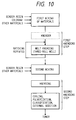
- a partly improved production process to overcome these problems comprising a first kneading step and a second kneading step as shown in the prior art in Fig. 10. More specifically, in the first step a resin containing a colorant in a higher concentration than the final product is kneaded, and then in the second kneading step, other additives such as a binder resin and a charge control agent are further added and mixed, and the mixture is kneaded using a kneading machine such as a kneader or an extruder to give a kneaded product.
- a kneading machine such as a kneader or an extruder
- a mixer used in the step of mixing materials for the first kneading step is a tumbling mixer such as a V-type blender or a double-cone mixer, or a high-speed agitating mixer (Fig. 7) such as a Henschel mixer, which cannot achieve microdipersion of materials.
- a tumbling mixer such as a V-type blender or a double-cone mixer
- a high-speed agitating mixer Fig. 7
- Henschel mixer which cannot achieve microdipersion of materials.
- no good dispersion or wetting of the materials can be obtained even if conditions for mixing and kneading are carefully managed.
- the agglomeration of material particles becomes too strong to achieve sufficient dispersion with ease in the course of premixing.
- finer particles tend to contain more air making sufficient kneading and dispersion difficult.
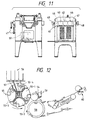
- a typical kneading machine used in the first kneading step is a three-roll mill (Fig. 11), in which the kneading is batch-wise operation and an operator must constantly take care of the kneading process, delicately changing conditions such as kneading temperature, roll rotational speed, roll clearance, roll rotational ratio and pass frequency (frequency of treatment) to make the dispersion of colorants in the kneaded product as uniform as possible. Hence, it requires a great skill.
- batch treatment should be repeated at least twice manually, and preferably four times or more. Thus, considering the structural safety of the machine, further improvement is required for this production process.
- JP-A-62-11863 is directed to a toner containing a magnetic powder, said magnetic powder comprising magnetic particles containing metal iron in 50 to 100 wt.% in a binder resin.
- a colorant agent may be contained in the binder resin.
- the toner can be prepared by premixing a binder resin, a powder comprised of the above-mentioned magnetic particles and other toner components by using a ball-mill to uniformly mix and disperse the toner components.
- JP-A-60-114 867 discloses a toner for developing an electrostatic latent image in electrophotography.
- a binder resin and a benzothiazole compound functioning as charge control agent are premixed by a ball-mill, the mixture is pulverized to obtain a toner powder.
- iron powder is admixed to the toner powder to make a developer.
- EP-A-0 458 196 is directed to a process for producing a toner comprising the steps of forming a mixture of a solvent, a first binding resin which is soluble in said solvent and particles of the colorant agent which are insoluble in said solvent dispersing the particles of the colorant agent in the binder resin while applying a shearing force thereto to obtain a dispersed substance, removing the solvent, mixing the obtained composition with a second binding resin and a charge controlling agent, melt-kneading the mixture to obtain a kneaded substance and forming the toner from the kneaded substance.
- the shearing force is applied to the binder resin soluble in a solvent and a colorant agent in the presence of the solvent.
- EP-A-0 524 549 a document according to Art. 54(3) (4) EPC, discloses the production of an electrophotographic toner produced by dispersing and mixing toner components, melting and kneading the resulting mixture which is then subjected to pulverization and classification. At the dispersing and mixing step, fine toner powder obtained in the last step is added to the mixture of the components as dispersed and mixed. In the dispersing and mixing step, a Henschel mixer may be used.
- An object of the present invention is to provide a process for producing a toner of high performance, improving the dispersion of materials as stated above.
- Another object of the present invention is to provide a process for producing a toner, improving the uniformity of dispersion of a colorant and other internal additives in toner particles or between toner particles.
- a still another object of the present invention is to provide a process for producing a toner with a fine dispersion and a high coloring power, in which the dispersion and wetting of a colorant are improved to reduce the variation of the proportion of a colorant and others between each particle even when materials are formed into fine particles by pulverization.
- a further object of the present invention is to provide a process for producing a toner which causes less falling-off of internal additive components during pulverization and less soil on a developer sleeve or a carrier.
- a still further object of the present invention is to provide a process for producing a toner free from segregation of a colorant and other materials, promising good development performance and durability, free from fogging, and also having good environmental properties.
- Fig. 1 is a schematic illustration of one example of dispersion mixers for carrying out the present invention.
- Fig. 2 is a schematic illustration of another example of dispersion mixers for carrying out the present invention.
- Fig. 3 is a schematic illustration of still another example of dispersion mixers for carrying out the present invention.
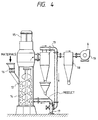
- Fig. 4 is a schematic illustration of a further example of dispersion mixers for carrying out the present invention.
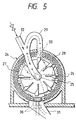
- Fig. 5 is a schematic illustration of a still further example of dispersion mixers for carrying out the present invention.
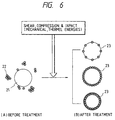
- Fig. 6 is a model illustration of the dispersion of binder resin particles and colorant particles, or colorant particles and other additive particles, and the fixation of the colorant particles to the binder resin particles.
- Fig. 7 is a schematic illustration of a Henschel mixer used in conventional processes.
- Fig. 8 is a schematic illustration of a planetary-screw mixing apparatus used in conventional processes.
- Fig. 9 is a flow chart to show an example of the process for producing a toner according to the present invention.
- Fig. 10 is a flow chart to show a prior art process for producing a toner.
- Fig. 11 is a schematic illustration of a three-roll mill.
- Fig. 12 is a schematic illustration of a copying machine used in running tests.
- melt-kneading As previously discussed, in the conventional processes to produce toners by pulverization, materials are mixed before melt-kneading using a planetary-screw mixing apparatus such as a Nauta mixer, or a rotating blade type mixing apparatus such as a Henschel mixer (hereinafter "premixing").
- a planetary-screw mixing apparatus such as a Nauta mixer
- a rotating blade type mixing apparatus such as a Henschel mixer
- the dispersion of materials in the production process for toners does not solely depend on the dispersing ability of a kneading machine.
- the dispersing ability of the kneading machine In the production process using many kinds of materials, there is a limit in the dispersing ability of the kneading machine itself.
- a limit for the residence time in the extruder is present, which becomes a factor for the insufficient dispersion.
- the present invention provides a process comprising mixing and dispersing colorant particles and binder resin particles and fastening (fixing) the colorant particles on the surfaces of the binder resin particles and/or in the vicinities of the surfaces in the dispersion mixing step before the melt-kneading, not with the conventional mixing apparatus but with a dispersing-and-"fastening" mixing apparatus capable of applying strong shear, compression and impact force to the material particles.
- dispersing-and-fastening mixing apparatus it is possible to use an apparatus capable of imparting mechanical and thermal energies mainly comprised of shear, compression and impact force to the materials being treated, equipped with certain ball-like media and rotor blades and a stator.
- fastening the colorant on the surfaces of the binder resin particles and/or in the vicinities of that surfaces means a state in which a part of a colorant particle is buried in the surface of a binder resin particle as a core under the electron microscopic observation.
- a "fastening ratio” indicates a percentage of binder resin particles to which said colorant particles have been fastened on the surface and/or in the vicinities of the surface based on 100 binder resin particles observed, and it may preferably be not less than 30% by number, more preferably not less than 50% by number, and still more preferably not less than 60% by number.
- FIG. 1 illustrating an example of the dispersing-and-fastening mixing apparatus using ball-like media.
- reference numeral 1 denotes a main body container (a tank); 2, an agitator shaft; 3, an agitator arm; 4, balls used as the ball-like media.
- this dispersing-and-fastening mixing apparatus as the agitator arm is rotated at a high speed, the balls move to uniformly disperse the materials by the action of shear, compression and impact force generated between balls.
- at least colorant particles and binder resin particles are fed into the dry-process dispersing-and-fastening mixing apparatus (Fig. 1) and the colorant particles and binder resin particles are uniformly mixed and dispersed by the action of the shear, compression and impact force.
- additive particles such as colorant particles having particularly strongly agglomerating properties, or charge control agent particles and magnetic material particles optionally used, are adequately loosened and uniformly mixed and dispersed with the binder resin particles, and the additive particles such as colorant particles are fastened on the surfaces of the binder resin particles and/or in the vicinities of that surfaces. Thereafter, the ball-like media are removed using a large-diameter particle removing means such as a sieve to give a colorant fastened product. Then the colorant-fastened product is melt-kneaded, and a pulverized material is obtained from the kneaded product.
- the dispersion mixing apparatus using ball-like media has been used in a wet process in the presence of a solvent. In such a case, it is difficult to completely remove the solvent and also it requires the step of removing the solvent to complicate the process.
- the material of the balls and the rotation speed of the agitator arm may be appropriately set according to the starting materials and the desired state of dispersion and fastening.
- the balls, the agitator arm and the tank may preferably be made of ceramic materials having an excellent wear resistance such as alumina and zirconia.
- the tank may preferably have a jacket structure so that a refrigerant can be passed therethrough to control mixing temperature to 50°C or below.
- the powder to be treated may preferably have a particle diameter not more than 1/7, and more preferably not more than 1/10, of the particle diameter of the ball-like media. Particles with a diameter more than 1/7 of the particle diameter of the ball-like media are not preferable since they can not be readily captured by the ball-like media requiring a long time to fasten.
- the ball-like media are substantially spherical, and have a diameter of from 1 mm to 15 mm, and preferably from 5 mm to 10 mm.
- Ball-like media with a diameter larger than 15 mm have smaller surface areas and lesser contact points between ball-like media, compared with the smaller media of the same weight, lowering dispersing and grinding capacities. Balls with a diameter smaller than 1 mm tend to cause adhesion of the colorant particles to the ball surfaces because of their agglomerating properties, often making the operation impossible.
- the treatment time for dispersing-and-fastening mixing may be set according to the desired state of dispersion. Taking account of productivity, preferable conditions are that the fastening of the colorant particles is completed within 120 minutes, more preferably within 60 minutes. In the present production process, when more uniform dispersing-and-fastening mixing is desired, the colorant particles and binder resin particles may be previously mixed before such dry-process dispersing-and-fastening mixing is carried out.
- Figs. 2, 3 and 4 illustrate other examples of the dry-process dispersing-and-fastening mixing apparatus.
- Fig. 2 is a ball mill type apparatus.
- balls 6 When a drum 5 is rotated, balls 6 are lifted up along the inner wall and thereafter fall to the bottom of the drum by gravity, during which the powders being treated are dispersed by balls' own weight and also the materials are mixed and dispersed and the colorant particles are fastened or fixed by the action of shear, compression and impact forces generated between balls, so that the materials to be treated are mixed and dispersed and the colorant particles are fastened.
- Fig. 3 illustrates a ball mill of a vibration type.
- Balls or other ball-like media 8 are put in a cylindrical or trough-shaped container 7, and this container is vibrated to move the ball-like media so that the materials are mixed and dispersed and the colorant particles are fastened.
- These apparatus may be of either a batch type or a continuous type, which may be appropriately selected according to the kinds of the materials to be treated and the desired fastnening state of colorant particles.
- Fig. 4 is a dispersion machine of a tower mill type. Balls are filled in a fixed tower type shell are agitated and tumbled with a vertical screw. This is a continuous type apparatus. In the case of this apparatus, the powdery product is separated by in-tower upward flow and taken out through a cyclone.
- the dispersing-and-fastening mixing apparatus are by no means limited to these apparatus. Any apparatus can be used so long as ball-like media are used and the shear, compression and impact force can be generated between the ball-like media.
- Fig. 6 is a model illustration of the dispersed particles to which the colorant particles have been fastened.
- reference numeral 21 denotes a binder resin particle; and 22, colorant particles or colorant particles and other additive particles. Before they are treated, in the state (A), the colorant particles or the colorant particles and other additive particles 22 are present in partly agglomerated state around the binder resin particle 21 and are the dispersion is not uniform.
- FIG. 5 illustrating an example of the apparatus in which an apparatus equipped with roter blades and a stator is used to repeatedly impart mechanical and thermal energies mainly comprised of shear, compression and impact force to the colorant particles and binder resin particles.
- reference numeral 24 denotes a main body casing; 25, a rotor; 26, a rotor blade; 27, a stator; 28, a stator jacket; 29, a recycling pipe; 30, a discharge valve; 31, a discharge chute; 32, a material feed chute; and 33, a trajectory along which particles fly and collide against each other.
- binder resin particles and colorant particles, or colorant particles and other additive particles, fed from the material feed chute 32 undergo impact blow action mainly the rotor blades 26 disposed in the rotor 25 rotating at a high speed, and the particles further collide against the stator 27 provided around them, so that the agglomerates of binder resin particles, colorant particles or other additive particles disintegrate and concurrently dispersed in the system and at the same time the colorant particles or the colorant particles and other additive particles adhere to the surfaces of the binder resin particles by electrostatic force and van der Waals attraction.
- This state proceeds along the trajectory 33 of the flying and colliding of particles, in other words, the particles are processed as they pass several times through the recycling pipe 29 along the flow of air currents produced by the rotation of the rotor blades.
- the particles further repeatedly subjected to impact blow action from the rotor blade 26 and the stator 27, so that the colorant particles or the colorant particles and other additive particles are uniformly dispersed and fastened or fixed on the surfaces of the binder resin particles and/or in the vicinities of the surfaces as shown in Fig. 6, the state (B).
- the clearance between the rotor blade and the stator is from 0.5 mm to 10 mm, preferably from 2 mm to 5 mm.
- the finished particles, finely dispersed and colorant-fastened particles come through the discharge chute 28 upon the opening of the discharge valve 27, and are collected in a bag filter.
- the colorant particles having particularly strong agglomerating properties or other additive particles as typified by charge control agent particles and magnetic material particles are well mixed and dispersed, and fastened or fixed on the surfaces of the binder resin particles or in the vicinities of that surfaces. Thereafter, the colorant fastened treated product is melt-kneaded, and a pulverized material is obtained from the kneaded product.
- conditions such as rotor peripheral speed, treatment time, number of blades, and the materials of the members coming into contact with the materials being treated may be chosen according to the physical properties and chemical properties of the materials to be treated and the desired states of fine dispersion and fastening.
- the members coming into contact with the materials being treated may preferably be made of ceramic materials of excellent wear resistance such as alumina and zirconia.
- the inside of the rotor may preferably be equipped with a jacket structure so that it can be cooled by passing a refrigerant from the rotating shaft of the rotor. This is effective in controlling the environment inside the apparatus and the temperature of the materials being treated, when used in combination with a stator-side jacket cooling function, as well as preventing the materials from adhereing to the inner wall of the apparatus.
- the recycling pipe may also have a jacket structure so that a refrigerant can be passed therethrough. This is preferable for the same reason as stated above.
- the colorant particles and binder resin particles may be previously mixed before such dispersing-and-fastening mixing is carried out.
- the dispersing-and-fastening mixing apparatus is by no means limited to the apparatus shown in Fig. 5. Any apparatus can be used so long as the rotor blade and stator are used and the mechanical energy and thermal energy mainly comprised of the shear, compression and impact force can be imparted to the materials being treated.
- the dispersing-and-fastening mixing has been described taking as examples the apparatus using ball-like media as shown in Figs. 1 to 4 and the apparatus using rotor blades and a stator as shown in Fig. 5.
- the present invention is by no means limited to these methods. It is possible to use any apparatus so long as it can apply the shear, compression and impact force to make additive particles including colorant particles fastened on the surfaces and/or in the vicinity of that surfaces.
- the binder resin particles and colorant particles used in the present invention may preferably be in a weight ratio between 100:1 and 100:100.
- Use of the colorant particles in an excessively large amount relative to the amount of the binder resin particles makes it impossible to break up the agglomeration of colorant particles which causes difficulty in their uniform fastening. Their use in an extremely small amount requires a long fastening time, decreasing the efficiency.
- the preferable ratio of the average particle diameter of the colorant particles and other additive particles to the average particle diameter of the binder resin particles may be 0.2 or less. When the particle diameter ratio is more than 0.2, the uniform and fine dispersion and fastening of the colorant particles or other additive particles become difficult.
- the average particle diameter of the particles is measured by the following method.
- the average particle diameter is measured in the following way.
- Coulter counter Type TA-II manufactured by Coulter Electronics, Inc.
- Elzone Particle Counter 80XY-2 manufactured by Particle Data Co., U.S.A.
- an electrolytic solution an aqueous solution of 1 to 4% NaCl is used.
- Measurement is carried out by adding as a dispersant from 0.1 to 5 ml of a surface active agent, preferably an alkylbenzene sulfonate, to from 100 to 150 ml of the above aqueous electrolytic solution, and further adding from 0.5 to 50 mg of a sample to be measured.
- a surface active agent preferably an alkylbenzene sulfonate
- the electrolytic solution in which the sample has been suspended is subjected to dispersion for about 1 minute to about 3 minutes using an ultrasonic dispersion device.
- the particle size distribution of particles of 1 ⁇ m to 40 ⁇ m is measured by means of the above Coulter counter Type TA-II or Elzone Particle Counter 80XY-2. Then the volume average distribution and number average distribution are determined.
- the Coulter counter is sometimes poor in reproducibility because of an influence of noise. Accordingly, using a microscope, photographs are taken on the same face while changing focal depth, and the photographs are analyzed to determine number average distribution and check its accuracy. When the microscope is used, particle diameters of about 3,000 particles are measured to determine their distribution.
- Particle diameter of particles distributing from 40 ⁇ m to 500 ⁇ m is measured using a JIS standard sieve to calculate a 50% by weight diameter, which is used as the average particle diameter.
- the binder resin particles used in the present invention may preferably have a softening point of from 60°C to 200°C, and more preferably from 60°C to 150°C.
- the dispersing-and-fastening mixing of the colorant particles and binder resin particles should be carried out at a treatment temperature substantially lower than the softening point of the binder resin particles, stated specifically, preferably at a treatment temperature of 100°C or below, and more preferably from 20°C to 80°C.
- the dispersing-and-fastening mixing of the colorant particles and binder resin particles when the dispersing-and-fastening mixing of the colorant particles and binder resin particles is carried out, size reduction of the binder resin particles occurs while the shear, compression and impact force are applied, and hence the surface area of the binder resin particles increases, that is, the area where the colorant particles can be deposited and fastened increases.
- the colorant particles can be more effectively and uniformly fastened.
- the treated powder has a particle size such that a residual percentage on a 2 mm JIS sieve is 6% or less, and preferably 3% or less.
- the residual percentage on a 2 mm JIS sieve is measured in the following way.
- a JIS standard sieve with 2 mm mesh is superposed on a pan, and 100 g of sample is placed on the 2 mm JIS standard sieve, which are then vibrated by means of a vibrator.
- the weight of the sample remaining on the 2 mm JIS standard sieve and the weight of the sample having passed the 2 mm JIS standard sieve are measured, and the proportion of the residue on the 2 mm JIS standard sieve to the weight of the whole sample is calculated.
- kneading machine used in the present invention it is possible to use various types of kneading machines such as a roll mill, a kneader and an extruder.
- the dispersing-and-fastening mixing is carried out using mechanical energy and thermal energy by applying the shear, compression and impact force to the particles being treated to achieve good dispersion and obtain the binder resin particles on the surfaces and/or in the vicinity of the surfaces of which said colorant particles have been fastened. This reduces the load on the subsequent kneading step.
- the kneaded products of the binder resin particles to which the colorant particles have been fastened is cooled to solidify and thereafter pulverized, followed by classification to give colorant-containing binder resin particles.
- the colorant-containing binder resin particles can be used as a toner as they are, or may be further mixed with an external additive such as hydrophobic fine colloidal silica powder.
- a process for producing a toner can comprise two mixing steps; first, mixing at least binder resin particles and colorant particles, and then mixing the mixture containing the colorant particles, obtained in the first mixing step, with at least binder resin particles of the same type or a different type, followed by kneading of the resulting mixture and pulverization of the kneaded product thus obtained.
- the material with high agglomerating properties such as the colorant particles is uniformly and finely dispersed using not the conventional apparatus but the dry-process dispersing-and-fastening mixing apparatus capable of applying strong shear, compression and impact force, in particular, the dry-process dispersion machine using ball-like media.
- the materials containing a colorant and a binder resin are fed into the dry-process dispersion machine as shown in Fig. 1, and the binder resin particles and colorant particles are more uniformly mixed and dispersed by the action of the shear, compression and impact force generated between the ball-like media. Because of this action of the shear, compression and impact force, agglomerates of additive particles such as colorant particles having particularly strongly agglomerating properties, or charge control agent particles optionally used, are disintegrated nearly to their primary particles, and the resulting particles are uniformly fastened or fixed on the surfaces of the binder resin particles and/or in the vicinities of that surfaces.
- additive particles such as colorant particles having particularly strongly agglomerating properties, or charge control agent particles optionally used
- Colorant particles having not been fastened are also uniformly mixed and dispersed in the mixture. Thereafter, in the second mixing step, the mixture and at least binder resin particles of the same type or a different type and internal additive particles such as charge control agent particles optionally used are added to carry out second-step mixing. Then the resulting mixture is melt-kneaded, and a pulverized material is obtained from the kneaded product.
- the colorant particles in the first mixing step may preferably be in a content at least 1.5 times the content of the colorant particles in the mixture obtained in the second mixing step, and more preferably at least twice (2 times) in view of economical advantages.
- a mixer used in the mixing in the second mixing step it is possible to use a tumbling mixer such as a V-type blender or a double-cone mixer, a high-speed agitating mixer such as a Henschel mixer or a dry-process dispersion mixer using ball-like media.
- a tumbling mixer such as a V-type blender or a double-cone mixer
- a high-speed agitating mixer such as a Henschel mixer or a dry-process dispersion mixer using ball-like media.
- a kneading machine such as a kneader, an extruder or a roll mill can be used.
- a kneading machine such as a kneader, an extruder or a roll mill.
- the conventional process in the binder resin particles containing colorant particles in a high concentration, the dispersion state of the colorant is insufficient and it has been difficult to make the colorant disperse uniformly and finely in the kneading step or, even if uniform dispersion is not impossible, it has been very difficult to select a kneading machine and kneading conditions, leaving a very small latitude for the kneading step.
- the conventional process requires to carry out the kneading step twice, and in this respect has been a complicated production process in which kneading, cooling and pulverization are each carried out twice.
- the dry-process dispersing-and-fastening mixing apparatus using ball-like media is used in the first mixing step, to thereby obtain a mixture in which the colorant particles are uniformly fastened on the surfaces of the binder resin particles and/or in the vicinities of that surfaces, and the colorant particles having not been fastened can be uniformly dispersed.
- the first kneading step can be omitted but also the load in the subsequent kneading step can be reduced, the latitude in the kneading step is broadened and also a kneaded product can be obtained in a better dispersed state.
- the dispersion state of the colorant particles and the charge control agent particles is superior compared with the conventional toners.
- charge loss is much smaller, so that no flying of toner occurs and fog-free images can be obtained.
- the toner of the present invention can give clear color tones because of an improvement in the dispersibility of the colorant particles in the toner.
- binder resin used in the toner all sorts of known resins can be used, as exemplified by homopolymers of styrene or derivatives thereof such as polystyrene, poly-p-chlorostyrene and polyvinyltoluene; styrene copolymers such as a styrene-p-chlorostyrene copolymer, a styrene-propylene copolymer, a styrene-vinyltoluene copolymer, a styrene-vinylnaphthalene copolymer, a styrene-methyl acrylate copolymer, a styrene-ethyl acrylate copolymer, a styrene-butyl acrylate copolymer, a styrene-octyl acrylate copolymer, a styrene
- the present invention can be greatly effective when a color toner is produced using a resin having a melt viscosity of not more than 5.10 4 Pa ⁇ s (5 ⁇ 10 5 poises), and preferably not more than 1.10 4 Pa ⁇ s (1 ⁇ 10 5 poises), at 100°C.
- the melt viscosity can be measured in the following way.
- a flow tester CFT-500 Type (manufactured by Shimadzu Corporation) is use.
- a sample of 60 mesh-pass is weighed out in an amount of about 1.0 to 1.5 g.
- the sample is pressed using a molder under a load of 100 kg/m 2 for 1 minute.
- the resulting pressed sample is measured under conditions shown below, using the flow tester in an environment of normal temperature and normal humidity (temperature: about 20-30°C; humidity: 30-70%RH) to obtain a temperature-apparent viscosity curve. From the smooth curve thus obtained, an apparent viscosity at 100°C is determined, and the resulting value is regarded as the melt-viscosity of the sample with respect to temperatures.
- Rate of temperature rise 6.0 D/M (°C/min) Set temperature 70.0 DEG (°C) Maximum temperature 200.0 DEG (°C) Interval 3.0 DEG (°C) Preheating 300.0 SEC (seconds) Load 20.0 KGF (kg) Die diameter 1.0 MM (mm) Die length 1.0 MM (mm) Plunger 1.0 CM 2 (cm 2 )
- colorant particles any known colorants can be used.
- the colorants can be exemplified by black colorants such as carbon black, acetylene black, lamp black, black iron oxide, graphite, Aniline Black, Cyanine Black and Phthalocyanine Black; yellow colorants such as chrome yellow, cadmium yellow, yellow iron oxide, titanium yellow, Naphthol Yellow, Hanza Yellow, Chrome Yellow, Pigment Yellow, quinacridone, Benzidine Yellow, Permanent Yellow, Quinoline Yellow lake and Anthrapyrimidien Yellow; orange colorants such Permanent Orange, Vulcan Fast Orange, Benzidine Orange and Indanethrene Brilliant Orange; brown colorants such as iron oxide, amber and Permanent Brown; red colorants such as red iron oxide, antimony powder, Permanent Red, Fire Red, Brilliant Carmine, Light Fast Red Toner, Permanent Carmine, Pyrazolone Red, Bordeaux, Herio Bordeaux, Rhodamine Lake, Thioindigo Red and Thioindigo Maroon; violet colorants such as Cobalt Violet, Fast Violet and Dioxazine Violet; blue colorants
- Pigment Blue 16 or a phthalocyanine derivative of the formula (I) shown below or a copper phthalocyanine pigment of the formula (II) shown below which is a Ba salt having a copper phthalocyanine structure substituted with two or three carboxybenzamidomethyl groups.
- X 1 to X 4 each represent or -H, wherein R and R' each represents an alkylene group having 1 to 5 carbon atoms; provided that all the X 1 to X 4 are not hydrogen simultaneously.
- a magnetic material is contained, which may also serve as a colorant.
- the magnetic material contained in a magnetic toner according to the present invention may include oxides such as magnetite, ⁇ -iron oxide, ferrite and iron-excess type ferrite; and metals such as iron, cobalt and nickel or alloys of any of these metals with any of metals such as aluminum, cobalt, iron, lead, magnesium, tin, zinc, antimony, beryllium, bismuth, cadmium, calcium, manganese, selenium, titanium, tungsten and vanadium, and mixtures thereof.
- any of these ferromagnetic materials should preferably have an average particle diameter of from 0.1 to 1 ⁇ m, more preferably from 0.1 to 0.5 ⁇ m, and still more preferably from 0.1 to 0.3 ⁇ m, in approximation, and preferably be contained in the magnetic toner in an amount of from 60 to 200 parts by weight, and more preferably from 70 to 150 parts by weight, based on 100 parts by weight of the resin component.
- the charge control agent particles optionally added may include particles of amino compounds, quaternary ammonium compounds, and organic dyes, in particular, basic dyes and salts thereof, Nigrosine bases and salicylic acid type chelate compounds.
- the shear, compression and impact force are applied to the binder resin particles and colorant particles to make the colorant particles fastened on the surfaces of the binder resin particles and/or in the vicinities of that surfaces, before the binder resin particles and colorant particles are melt-kneaded.
- the colorant can be uniformly dispersed in the binder resin when the resulting colorant particles and binder resin particles are melt-kneaded under the conventional conditions, so that an excellent toner can be obtained which has a stable quality and does not cause toner flying or fogging, and has a high economical advantage, a high coloring power and high transmission properties.
- Unsaturated polyester resin particles weight average particle diameter: 140 ⁇ m; residual percentage on 2 mm sieve: 3%; softening point: 70°C
- Carbon black particles average particle diameter: 1 ⁇ m or less; maximum particle diameter of agglomerates under microscopic observation: about 30 ⁇ m
- Charge control agent particles dialkylsalicylic acid chromium complex powder; average particle diameter: 1 ⁇ m or less
- a tank with a capacity of 61 lit. and 120 kg of zirconia balls of 10 mm diameter were used.
- the tank was made of SUS 304 stainless steel.
- the agitator arm was made of zirconia.
- a sample of the powdery mixture thus obtained was dispersed in fluid paraffin on a slide, and then observed with a microscope to confirm that carbon black particles and charge control agent particles were uniformly covering the surfaces of certain resin particles and/or buried the vicinities of the surfaces. These resin particles were further observed using a scanning electron microscope S-800 ( ⁇ 10,000), manufactured by Hitachi Ltd. to confirm that the carbon black particles were partly buried in the surfaces of the resin particles.
- the fastening rate was 50% by number or more and the carbon black particles and charge control agent particles had been substantially fastened on the surfaces of the resin particles and/or in the vicinities of the surfaces.
- the powdery mixture obtained was fed into a twin-screw unidirectional extruder PCM-30, manufactured by Ikegai Corp., and melt-kneaded and dispersed at a heating temperature of 100°C and a paddle rotation speed of 200 rpm to give a melt-kneaded product.
- a small piece of the kneaded product was melted on a slide and another slide was superposed thereon, and pressed to prepare a preparation.
- the state of dispersion of the colorant in the kneaded product was observed using an optical microscope to confirm that any particles of 20 ⁇ m or more in diameter, agglomerates of the colorant particles, were not seen in the visual field and all components had been excellently dispersed.
- toner particles with a weight average particle diameter of 8 ⁇ m.
- hydrophobic silica trade name: R-972; available from Nippon Aerosil Co., Ltd.
- This toner was blended with a carrier (a resin-coated ferrite powder; average particle diameter: 70 ⁇ m). A two-component developer with a toner concentration of 6% was thus obtained.
- Coulter counter Type TA-II manufactured by Coulter Electronics, Inc.
- An interface manufactured by Nikkaki k.k.
- CX-1 manufactured by Canon Inc.
- an electrolytic solution an aqueous 1% NaCl solution was prepared using first-grade sodium chloride.
- Measurement was carried out by adding as a dispersant from 0.1 to 5 ml of a surface active agent, preferably an alkylbenzene sulfonate, to from 100 to 150 ml of the above aqueous electrolytic solution, and further adding from 2 to 20 mg of a sample to be measured.
- the electrolytic solution in which the sample had been suspended was subjected to dispersion for about 1 minute to about 3 minutes using an ultrasonic dispersion device.
- the particle size distribution of particles of 2 ⁇ m to 40 ⁇ m was measured by means of the above Coulter counter Type TA-II, using an aperture of 100 ⁇ . Then the average particle diameter of the toner was determined.
- the reflection density was measured using a Macbeth reflection densitometer.
- Unsaturated polyester resin particles weight average particle diameter: 140 ⁇ m; residual percentage on 2 mm sieve: 3%; softening point: 70°C
- Copper phthalocyanine pigment particles C.I. Pigment Blue 15; average particle diameter: 1 ⁇ m or less; maximum particle diameter of agglomerates in microscopic observation: about 50 ⁇ m
- Charge control agent particles 4 parts (dialkylsalicylic acid chromium complex powder; average particle diameter: 1 ⁇ m or less)
- a tank with a capacity of 61 lit. and 120 kg of zirconia balls of 10 mm diameter were used.
- the tank was made of SUS 304 stainless steel.
- the agitator arm was made of zirconia.
- a sample of the powdery mixture thus obtained was dispersed in fluid paraffin on a slide, and then observed with a microscope to confirm that copper phthalocyanine pigment particles and charge control agent particles were uniformly covering the surfaces of certain resin particles and/or buried the vicinities of the surfaces. These resin particles were further observed using a scanning electron microscope S-800 ( ⁇ 10,000), manufactured by Hitachi Ltd. to confirm that the copper phthalocyanine particles were partly buried in the surfaces of the resin particles. The fastening rate was 60% by number or more and the copper phthalocyanine particles and charge control agent particles had been substantially fastened on the surfaces of the resin particles and/or in the vicinities of the surfaces.
- the powdery mixture obtained was fed into a twin-screw unidirectional extruder PCM-30, manufactured by Ikegai Corp., and melt-kneaded and dispersed at a heating temperature of 100°C and a paddle rotation speed of 200 rpm to give a melt-kneaded product.
- a small piece of the kneaded product was melted on a slide and another slide was pressed to prepare a preparation.
- the state of dispersion of the colorant in the kneaded product was observed using an optical microscope to confirm that any particles of 20 ⁇ m or more in diameter, agglomerates of the colorant particles, were not seen in the visual field and all components had been excellently dispersed.
- toner particles with a weight average particle diameter of 8 ⁇ m.
- hydrophobic silica trade name: R-972; available from Nippon Aerosil Co., Ltd.
- This toner was blended with a carrier (a resin-coated ferrite powder; average particle diameter: 70 ⁇ m). A two-component developer with a toner concentration of 6% was thus obtained.
- Unsaturated polyester resin particles weight average particle diameter: 200 ⁇ m; residual percentage on 2 mm sieve: 10%; softening point: 70°C
- Copper phthalocyanine pigment particles C.I. Pigment Blue 15; average particle diameter: 1 ⁇ m or less; maximum particle diameter of agglomerates in microscopic observation: about 50 ⁇ m
- Charge control agent particles dialkylsalicylic acid chromium complex powder; average particle diameter: 1 ⁇ m or less
- a tank with a capacity of 61 lit. and 120 kg of zirconia balls of 10 mm diameter were used.
- the tank was made of SUS 304 stainless steel.
- the agitator arm was made of zirconia.
- a sample of the powdery mixture thus obtained was dispersed in fluid paraffin on a slide, and then observed with a microscope.
- copper phthalocyanine pigment particles and charge control agent particles were uniformly covering the surfaces of certain resin particles and/or buried the vicinities of the surfaces, except that some large particles were partly covered.
- These resin particles were further observed using a scanning electron microscope S-800 ( ⁇ 10,000), manufactured by Hitachi Ltd. to confirm that the copper phthalocyanine particles were partly buried in the surfaces of the resin particles.
- the fastening rate was 55% by number or more and the copper phthalocyanine particles and charge control agent particles had been substantially fastened on the surfaces of the resin particles and/or in the vicinities of the surfaces.
- the powdery mixture obtained was fed into a twin-screw unidirectional extruder PCM-30, manufactured by Ikegai Corp., and melt-kneaded and dispersed at a heating temperature of 100°C and a paddle rotation speed of 200 rpm to give a melt-kneaded product.
- toner particles with a weight average particle diameter of 8 ⁇ m (measured using the Coulter counter).
- hydrophobic silica trade name: R-972; available from Nippon Aerosil Co., Ltd.
- This toner was blended with a carrier (a resin-coated ferrite powder; average particle diameter: 70 ⁇ m).
- a two-component developer with a toner concentration of 6% was thus obtained.
- a copying test was carried out on a full-color copying machine CLC-1, manufactured by Canon Inc., equipped with a color electrophotographic apparatus using an OPC photosensitive drum.
- a 10,000 sheet running test was carried out in a high-temperature high-humidity environment of 30°C and 80%RH. As a result, no flying of toner occurred, and fog-free, good images were obtained.
- the toner amount required to give an image density of 1.5 was as small as 0.7 mg/cm 2 .
- Styrene-butyl methacrylate copolymer particles weight ratio of copolymerization: 7:3; weight average particle diameter: 300 ⁇ m; residual percentage on 2 mm sieve: 5%; softening point: 80°C
- Magnetite particles BET surface specific area: 8 m 2 /g; average particle diameter: 0.2 ⁇ m; maximum particle diameter of agglomerates in microscopic observation: about 20 ⁇ m
- Nigrosine particles 2 parts average particle diameter: 1 ⁇ m or less
- Polypropylene wax average particle diameter: 30 ⁇ m
- a tank with a capacity of 61 lit. and 120 kg of zirconia balls of 10 mm diameter were used.
- the tank was made of SUS 304 stainless steel.
- the agitator arm was made of zirconia.
- a sample of the powdery mixture thus obtained was dispersed in fluid paraffin on a slide, and then observed with a microscope.
- magnetite particles, nigrosine particles and polypropyrene wax particles were uniformly covering the surfaces of certain resin particles and/or buried in the vicinities of the surfaces.
- These resin particles were further observed using a scanning electron microscope S-800 ( ⁇ 10,000), manufactured by Hitachi Ltd. to confirm that the magnetite particles, nigrosine particles and polypropyrene wax particles were partly buried in the surfaces of the resin particles.
- the fastening rate was 50% by number or more and the particles of magnetite, nigrosin and polypropyrene wax particles had been substantially fastened on the surfaces of the resin particles and/or in the vicinities of the surfaces.
- the powdery mixture obtained was fed into a twin-screw unidirectional extruder PCM-30, manufactured by Ikegai Corp., and melt-kneaded and dispersed at a heating temperature of 150°C and a paddle rotation speed of 200 rpm to give a melt-kneaded product.
- the aforesaid melt-kneaded product was cooled, and the cooled product was finely pulverized using a jet mill, followed by classification to give toner particles (toner) with a weight average particle diameter of 12.0 ⁇ m (measured using the Coulter counter).
- toner particles 0.4% by weight of fine silica powder was externally added using a Henschel mixer to give a one-component developer comprised of toner particles having fine silica powder on their surfaces.
- the one-component developer thus obtained was set in a developing apparatus of a copying machine NP3525, manufactured by Canon Inc., to carry out developing. As a result, good images with an image density of 1.35 were obtained.
- occurence of fogging was small, and no increase in fogging was seen even after the developer was left in a high-temperature high-humidity environment of 35°C and 90%RH.
- Example 2 The same materials as used in Example 1 were mixed using a Henschel mixer as shown in Fig. 7, at a peripheral speed of 20 m/sec for 5 minutes to give a powdery mixture.
- the powdery mixture obtained was melt-kneaded under the same conditions as in Example 1 to obtain a melt-kneaded product.
- Example 2 a toner was prepared in the same manner as in Example 1, and a running test was carried out similarly. As a result, flying of toner and fogging occurred upon 2,000 sheet running. Toner amount required to give an image density of 1.5 was 0.8 mg/cm 2 .
- Example 2 The same materials as used in Example 2 were mixed using the Henschel mixer as shown in Fig. 7, at a peripheral speed of 30 m/sec for 10 minutes to give a powdery mixture.
- a sample from the powdery mixture thus obtained was dispersed in fluid paraffin on a slide, and then observed with a microscope to confirm that the surfaces of resin particles were almost transparent, no additive particles appeared to be fastened and many agglomerates of the pigment of 2 ⁇ m or more in diameter were observed here and there in the visual field.
- the fastening rate was 15% by number or less and substantially no copper phthalocyanine pigment particles and charge control agent particles had been fastened on the surfaces of the resin particles and/or in the vicinities of that surfaces.
- the powdery mixture obtained was melt-kneaded under the same conditions as in Example 2 to obtain a melt-kneaded product.
- Example 2 a toner was prepared in the same manner as in Example 2, and a running test was carried out similarly. As a result, flying of toner and fogging occurred upon 1,000 sheet running. Color tones were a little dull, and no clear cyan color was obtained.
- Toner amount required to gove an image density of 1.5 was 0.90 mg/cm 2 .
- Example 3 The same materials as used in Example 3 were mixed using the Henschel mixer as shown in Fig. 7, at a peripheral speed of 30 m/sec for 5 minutes to give a powdery mixture.
- a sample of the powdery mixture thus obtained was dispersed in fluid paraffin on a slide, and then observed with a microscope to confirm that in the surfaces of resin particles transparent area is prevailing and many agglomerates of the pigment were seen.
- These resin particles were anyway observed using a scanning electron microscope S-800 ( ⁇ 10,000), manufactured by Hitachi Ltd., to reveal that no pigment particles were buried in the surfaces of the resin particles, the fastening rate was 10% by number or less and substantially no copper phthalocyanine pigment particles and charge control agent particles had been fastened on the surfaces of the resin particles and/or buried in the vicinities of the surfaces.
- the powdery mixture obtained was melt-kneaded under the same conditions as in Example 3 to obtain a melt-kneaded product.
- Example 3 a toner was prepared in the same manner as in Example 3, and a running test was carried out similarly. As a result, the image density was 1.20, which was lower than that in Example 3, and fogging occurred.
- a tank with a capacity of 50 lit. and 120 kg of high alumina balls of 10 mm diameter were used.
- the tank was made of high alumina.
- the agitator arm was made of zirconia.
- a sample from the powdery mixture thus obtained was dispersed in fluid paraffin on a slide, and then observed with a microscope to confirm that copper phthalocyanine pigment particles were uniformly covering the surfaces of certain resin particles and/or embedded in the vicinities of the surfaces. These resin particles were further observed using a scanning electron microscope S-800 ( ⁇ 10,000), manufactured by Hitachi Ltd., to reveal that the copper phthalocyanine pigment particles were partly embedded in the surfaces of the resin particles, the fastening rate was 80% by number or more and the copper phthalocyanine pigment particles had been substantially fastened to the resin particles.
- the mixer used had a capacity of 75 lit., and the mixing was carried out for 3 minutes while feeding 15°C cooling water to the jacket.
- the resulting mixture was kneaded using an extruder (RCM-30 Type; Ikegai Corp.).
- the mixer was driven under conditions of a barrel temperature of 100°C, a screw rotation speed of 300 rpm and a material feed rate of 20 kg/hour.
- the kneaded toner product thus obtained was cooled on a cooling belt and thereafter crushed using a speed mill having a screen of 2 mm diameter.
- a sample from the resulting crushed product was dissolved in xylene with viscosity control, and thereafter, using a motor film applicator using a bar coater, the resulting solution was applied to an OHP sheet so as to give a coating thickness of about 7 ⁇ m. This coating was observed using an optical microscope to confirm that coarse colorant particle agglomerates of 20 ⁇ m or more in diameter were hardly observed in the visual field.
- this crushed product was pulverized using an I-type jet mill, and further coarse powder and fine powder were cut off from the pulverized product using an elbow jet classifier to give a cyan toner with an average particle diameter (D4) of 8.3 ⁇ m.
- the average particle diameter was measured using a Coulter counter (TA-II).
- the toner was further mixed with 0.6% by weight of colloidal silica by external addition, and thereafter blended with a resin-coated iron powder carrier. A two-component developer was thus obtained.
- the dispersing-and-fastening mixing was carried out under conditions as follows: Balls of 10 mm diameter, made of zirconia were used as ball-like media, and 5 kg of the materials of Formulation No. 1 were subjected to dry-process dispersion for 90 minutes at the rotation speed of the agitator arm of 100 rpm keeping the temperature of the mixture at 40°C while a 15°C cooling water was fed to the jacket. Thereafter the ball-like media were separated using a 6 mesh sieve to give a powdery mixture.
- a sample from the powdery mixture thus obtained was dispersed in fluid paraffin on a slide, and then observed with a microscope to confirm that the surfaces of certain resin particles and the vicinities of that surfaces were uniformly covered or embedded with copper phthalocyanine pigment particles. These resin particles were further observed using a scanning electron microscope S-800 ( ⁇ 10,000), manufactured by Hitachi Ltd., to reveal that the copper phthalocyanine pigment particles were partly embedded in the surfaces of the resin particles, the fastening rate was 80% by number or more and the copper phthalocyanine pigment particles had been substantially fastened to the resin particles.
- the colorant-containing powdery mixture obtained was used to make 10 kg of the same mixture as shown in Formulation No. 2, using the same mixer as used in Example 5.
- the resulting mixture was kneaded using an extruder (RCM-30 Type; Ikegai Corp.).
- the mixer was driven under conditions of a barrel temperature of 100°C, a screw rotation speed of 300 rpm and a material feed rate of 20 kg/hour.
- the kneaded toner product thus obtained was cooled on a cooling belt and thereafter crushed using a speed mill having a screen of 2 mm diameter.
- Example 5 A sample from the resulting crushed product was applied to an OHP sheet in the same manner as in Example 5 to form a coating. This coating was observed using an optical microscope to confirm that any coarse colorant agglomerates with a particle diameter of 20 ⁇ m or more were hardly seen in the visual field. Next, this crushed product was subjected to pulverization, classification, external addition and mixing with a carrier in the same manner as in Example 5. A two-component developer was thus obtained.
- Example 5 Using the same dispersion apparatus as in Example 5, the dispersing-and-fastening mixing of the above materials of Formulation No. 3 was carried out under the same conditions as in Example 6. Balls made of zirconia were used as the ball-like media.
- a sample from the powdery mixture thus obtained was dispersed in fluid paraffin on a slide, and then observed with a microscope to confirm that the surfaces of certain resin particles and the vicinities of that surfaces were uniformly covered and or embedded with copper phthalocyanine pigment particles. These resin particles were further observed using a scanning electron microscope S-800 ( ⁇ 10,000), manufactured by Hitachi Ltd., to reveal that the copper phthalocyanine pigment particles were partly buried in the surfaces of the resin particles, the fastening rate was 85% by number or more and the copper phthalocyanine pigment particles had been substantially fastened to the resin particles.
- the colorant-containing powdery mixture obtained was used to make 10 kg of the same composition as shown in Formulation No. 4 below, using the same mixer as used in Example 5.
- - Formulation No. 4 Colorant-containing powdery mixture 85.7 parts Unsaturated polyester resin particles (weight average particle diameter: 140 ⁇ m; residual percentage on 2 mm sieve: 3%; softening point: 70°C) 100 parts Charge control agent particles (dialkylsalicylic acid chromium complex powder; average particle diameter: 1 ⁇ m or less). 6.6 parts
- the resulting mixture was kneaded using an extruder (RCM-30 Type; Ikegai Corp.) under the same conditions as in Example 5.
- the kneaded toner product thus obtained was cooled on a cooling belt and thereafter crushed using a speed mill having a screen of. 2 mm diameter.
- the resulting crushed product was applied to an OHP sheet in the same manner as in Example 5 to form a coating.
- This coating was observed using an optical microscope to confirm that any coarse colorant agglomerates with a particle diameter of 20 ⁇ m or more were hardly seen in the visual field. The number of the coarse particles was the smallest compared with other Examples.
- this crushed product was subjected to pulverization, classification, external addition and mixing with a carrier in the same manner as in Example 5. A two-component developer was thus obtained.
- a sample from the powdery mixture thus obtained was dispersed in fluid paraffin on a slide, and then observed with a microscope to reveal that the surfaces of the resin particles were almost transparent, the pigment particles in the mixture had not been well dispersed and many agglomerates were observed.
- the fastening rate was 1% by number or less and the copper phthalocyanine pigment particles had not been substantially fastened on the surfaces of the resin particles and/or embedded in the vicinities of the surfaces.
- 0.2 kg of the powdery mixture obtained was fed into a material feed zone of the three-roll mill (manufactured by Inoue Seisakusho K.K.) as shown in Fig. 11, and melt-kneaded in the gap regions between three rolls. Then the kneaded product was discharged from a kneaded product outlet. In the kneaded product, the pigment particles were not so well dispersed that the simillar kneading was repeated four times in total to obtain a high-concentration pigment-containing resin. This operation was carried out plural times to obtain 2 kg of kneaded product. The product was cooled and then crushed to give a kneaded product crushed material.
- outer diameter of the roll was 0.051 m
- an effective roll length was 0.152 m
- a feed roll rotation speed was 70 rpm
- a roll rotation ratio was 1:1.5:2 between a feed roll (assumed as 1), a middle roll and an apron roll, respectively
- a roll gap was 5 mm and a roll temperature was 60°C.
- the kneaded product crushed material thus obtained was mixed and kneaded in the same composition as Formulation No. 4 under the same conditions as in Example 5.
- the kneaded product was cooled and thereafter crushed using a speed mill having a screen of 1 mm diameter.
- a sample from the resulting crushed product was applied to an OHP sheet in the same manner as in Example 5 to form a coating. This coating was observed using an optical microscope to confirm that coarse colorant particle agglomerates of 20 ⁇ m or more in diameter were seen here and there in the visual field.
- this crushed product was pulverized using an I-type jet mill, and further coarse powder and fine powder were cut off from the pulverized product using an elbow jet classifier to give a cyan toner with an average particle diameter (D4) of 8.2 ⁇ m.
- the toner was further incorporated with 0.6% by weight of colloidal silica by external addition, and thereafter blended with a resin-coated ferrite carrier. A two-component developer was thus obtained.
- a sample from the powdery mixture thus obtained was dispersed in fluid paraffin on a slide, and then observed with a microscope to reveal that the surfaces of the resin particles were almost transparent, the pigment particles in the mixture had not been well dispersed and many agglomerates were seen.
- the fastening rate was 5% by number or less and the copper phthalocyanine pigment particles had not been substantially fastened on the surfaces of the resin particles and/or in the vicinities of the surfaces.
- This coating was observed using an optical microscope to confirm that coarse colorant particle agglomerates of 20 ⁇ m or more in diameter were seen here and there in the visual field.
- this crushed product was pulverized and classified in the same manner as in Example 5 to give a cyan toner with an average particle diameter (D4) of 8.2 ⁇ m.
- the toner was further incorporated with 0.6% by weight of colloidal silica by external addition, and thereafter blended with a resin-coated ferrite carrier. A two-component developer was thus obtained.
- a sample from the powdery mixture thus obtained was dispersed in fluid paraffin on a slide, and then observed with a microscope to reveal that the surfaces of the resin particles were almost transparent, the pigment particles in the mixture had not been well dispersed and many agglomerates were seen.
- the fastening rate was 5% by number or less and the copper phthalocyanine pigment particles had not been substantially fastened on the surfaces of the resin particles and/or in the vicinities of that surfaces.
- This coating was observed using an optical microscope to confirm that coarse colorant particle agglomerates of 20 ⁇ m or more in diameter were seen here and there in the visual field.
- this crushed product was pulverized and classified in the same manner as in Example 5 to give a cyan toner with an average particle diameter (D4) of 8.2 ⁇ m.
- the toner was further incorporated with 0.6% by weight of colloidal silica by external addition, and thereafter blended with a resin-coated iron powder carrier. A two-component developer was thus obtained.
- the images were reproduced using a color laser copier 500 (CLC-500), manufactured by Canon Inc. Using an OHP sheet, solid images were formed thereon so as to have a toner quantity of 0.5 mg/cm 2 on the sheet, and fixed at a temperature of 160°C. Differences of image densities were examined using a Macbeth reflection densitometer.
- CLC-500 color laser copier 500
- OHP sheet solid images were formed thereon so as to have a toner quantity of 0.5 mg/cm 2 on the sheet, and fixed at a temperature of 160°C. Differences of image densities were examined using a Macbeth reflection densitometer.
- Haze value diffused transmittance total transmittance The better the colorant is dispersed, the smaller the diffused transmittance becomes and therefore the smaller the haze value becomes.
- the haze value was measured using an NDN-1001DP type haze meter, manufactured by Nippon Denshoku Kogyo K.K.
- Unsaturated polyester resin particles weight average particle diameter: 140 ⁇ m; residual percentage on 2 mm sieve: 3%; softening point: 80°C
- Copper phthalocyanine pigment particles C.I. Pigment Blue 15; average particle diameter: 1 ⁇ m or less
- Charge control agent particles dialkylsalicylic acid chromium complex 4.0 parts powder; average particle diameter: 1 ⁇ m or less
- the apparatus had a rotor diameter of 250 mm, 12 rotor blades and a clearance between the rotor blade and stator of 4 mm, and its material-contacting members were made of SUS304 stainless steel.
- a sample from the powdery mixture thus obtained was dispersed in fluid paraffin on a slide, and then observed with a microscope to confirm that the surfaces of certain resin particles and the vicinities of that surfaces were uniformly covered and/or embedded with copper phthalocyanine pigment particles and charge control agent particles.
- These resin particles were further observed using a scanning electron microscope S-800 ( ⁇ 10,000), manufactured by Hitachi Ltd., to reveal that the copper phthalocyanine pigment particles and charge control agent particles were seen to be embedded in the surfaces of the resin particles, the fastening rate was 60% by number or more and the copper phthalocyanine pigment particles and charge control agent particles had been substantially fastened on the surfaces of the resin particles and/or in the vicinities of the surfaces.
- a small piece of the kneaded product was melted on a slide and another slide was pressed thereon to prepare a preparation.
- the state of dispersion of the colorant in the kneaded product was observed using an optical microscope to confirm that any large-diameter particles of 20 ⁇ m or more in diameter, agglomerates of the colorant particles, were not seen in the visual field and all components had been dispersed in a good state, though slightly inferior to the treatment using ball-like media.
- toner particles with a weight average particle diameter of 8 ⁇ m (measured using the Coulter counter).
- hydrophobic silica trade name: R-972; available from Nippon Aerosil Co., Ltd.
- This toner was blended with a carrier (a resin-coated ferrite powder; average particle diameter: 70 ⁇ m).
- Particle size distribution and reflection density of the toner were measured in the same manner as in Example 1.
- Unsaturated polyester resin particles weight average particle diameter: 140 ⁇ m; residual percentage on 2 mm sieve: 3%; softening point: 70°C
- Carbon black particles average particle diameter: 1 ⁇ m or less; maximum particle diameter of agglomerates in microscopic observation: about 30 ⁇ m
- Charge control agent particles salicylic acid chromium complex powder; average particle diameter: 1 ⁇ m or less
- the above materials were charged in an amount of 0.25 kg, at the peripheral speed of the rotor blades at 70 m/sec the treatment was carried out for 5 minutes to give a powdery mixture.
- the treatment was carried out at at a temperature of 60°C while 18°C cooling water was fed to the stator jacket.
- a sample from the powdery mixture thus obtained was dispersed in fluid paraffin on a slide, and then observed with a microscope to confirm that the surfaces of certain resin particles and the vicinities of that surfaces were uniformly covered and/or embedded with carbon black particles and charge control agent particles. These resin particles were further observed using a scanning electron microscope S-800 ( ⁇ 10,000), manufactured by Hitachi Ltd., to reveal that the carbon black particles and charge control agent particles were partly buried in the surfaces of the resin particles, the fastening rate was 60% by number or more and the carbon black particles and charge control agent particles had been substantially fastened on the surfaces of the resin particles and/or in the vicinities of the surfaces.
- toner particles with a weight average particle diameter of 8 ⁇ m (measured using the Coulter counter).
- hydrophobic silica trade name: R-972; available from Nippon Aerosil Co., Ltd.
- This toner was blended with a carrier (a resin-coated ferrite powder; average particle diameter: 70 ⁇ m).
- Particle size distribution and reflection density of the toner was measured in the same manner as in Example 1.
- Styrene-butyl methacrylate copolymer particles weight ratio of copolymerization: 7:3; weight average particle diameter: 300 ⁇ m; residual percentage on 2 mm sieve: 5%; softening point: 80°C
- Magnetite particles BET surface specific area: 8 m 2 /g; average particle diameter: 0.2 ⁇ m
- Nigrosine particles average particle diameter: 1 ⁇ m or less
- Polypropylene wax particles average particle diameter: 30 ⁇ m
- the above materials were charged in an amount of 0.33 kg, and setting the peripheral speed of the rotor blades at 65 m/sec the treatment was carried out to give a powdery mixture.
- the treatment was carried out at a temperature of 60°C for 5 minutes while 18°C cooling water was fed to the stator jacket.
- a sample from the powdery mixture thus obtained was dispersed in fluid paraffin on a slide, and then observed with a microscope to confirm that the surfaces of certain resin particles and the vicinities of that surfaces were uniformly covered and/or embedded with magnetite particles, Nigrosine particles and polypropylene particles.
- These resin particles were further observed using a scanning electron microscope S-800 ( ⁇ 10,000), manufactured by Hitachi Ltd., to reveal that particles of the respective component were partly embedded in the surfaces of the resin particles, the fastening rate was 50% by number or more and the magnetite particles, Nigrosine particles and polypropylene particles had been substantially fastened on the surfaces of the resin particles and/or in the vicinities of the surfaces.
- the aforesaid melt-kneaded product was cooled, and the cooled product was finely pulverized using a jet mill, followed by classification to give toner particles (toner) with a weight average particle diameter of 12.0 ⁇ m (measured using the Coulter counter).
- toner particles 0.4% by weight of fine silica powder was externally added using a Henschel mixer to give a one-component developer.
- the one-component developer thus obtained was set in a developing apparatus of a copying machine NP3525, manufactured by Canon Inc., to carry out developing. As a result, good images with an image density of 1.35 (measured by the Macbeth reflection densitometer) were obtained. Only a little fogging occurred, and fogging did not increase even after the developer was left in a high-temperature high-humidity environment of 35°C and 90%RH.
- Example 8 The same materials as used in Example 8 were mixed using the apparatus as shown in Fig. 7, at a peripheral speed of 30 m/sec for 10 minutes to give a powdery mixture.
- a sample from the powdery mixture thus obtained was dispersed in fluid paraffin on a slide, and then observed with a microscope to confirm that the surfaces of resin particles were almost transparent and also many agglomerates of the pigment were seen.
- the fastening rate was 5% by number or less and substantially no copper phthalocyanine pigment particles and charge control agent particles had been fastened on the surfaces of the resin particles and/or in the vicinities of the surfaces.
- the powdery mixture obtained was melt-kneaded under the same conditions as in Example 8 to obtain a melt-kneaded product.
- Example 8 a toner was prepared in the same manner as in Example 8, and a running test was carried out similarly. As a result, flying of toner and fogging occurred upon 1,000 sheet running. Color tones in images were slightly dull and no vivid cyan color was obtained. Toner amount required to achieve an image density of 1.5 (measured using a Macbeth reflection densitometer) was 0.90 mg/cm 2 .
- Example 9 The same materials as used in Example 9 were mixed using the apparatus as shown in Fig. 7, at a peripheral speed of 20 m/sec for 5 minutes to give a powdery mixture.
- a sample from the powdery miture thus obtained was dispersed in fluid paraffin on a slide, and then observed with a microscope to confirm that the surfaces of resin particles were almost transparent and also many agglomerates of the pigment were seen.
- the fastening rate was 5% by number or less and substantially no carbon black particles and charge control agent particles had been fastened on the surfaces of the resin particles and/or in the vicinities of the surfaces.
- the powdery mixture obtained was melt-kneaded under the same conditions as in Example 9 to obtain a melt-kneaded product.
- Example 9 a toner was prepared in the same manner as in Example 9, and a running test was carried out similarly. As a result, flying of toner and fogging occurred upon 2,000 sheet running. Toner amount required to achieve an image density of 1.5 (measured using a Macbeth reflection densitometer) was 0.8 mg/cm 2 .
- Example 10 The same materials as used in Example 10 were mixed using the apparatus as shown in Fig. 7, at a peripheral speed of 30 m/sec for 5 minutes to give a powdery mixture.
- a sample from the powdery mixture thus obtained was dispersed in fluid paraffin on a slide, and then observed with a microscope to confirm that the surfaces of resin particles were almost transparent and the respective agglomerates of other components were separate.
- the fastening rate was 10% by number or less and substantially no magnetite particles, Nigrosine particles and polypropylene wax particles had been fastened on the surfaces of the resin particles and/or in the vicinities of the surfaces.
- the powdery mixture obtained was melt-kneaded under the same conditions as in Example 10 to obtain a melt-kneaded product.
- Example 10 Next, a toner was prepared in the same manner as in Example 10, and an image reproduction test was carried out. As a result, the image density was 1.20 (measured using a Macbeth reflection densitometer), which was lower than that in Example 10, and also fogging much occurred.
- the binder resin particles and colorant particles are mixed and treated applying shear, compression and impact force to fasten (fix) the colorant particles on the surface of the binder resin particles and/or in the vicinities of the surface.
- This shear, compression and impact treatment is defined in claim 1.
- the colorant can be more uniformly dispersed in the binder resin when they are melt-kneaded, to provide an excellent toner which has high coloring power and high transmission properties as well as stable anti-flying or fogging quality with economical advantages.
Landscapes
- Physics & Mathematics (AREA)
- General Physics & Mathematics (AREA)
- Developing Agents For Electrophotography (AREA)
- Processing And Handling Of Plastics And Other Materials For Molding In General (AREA)
- Processes Of Treating Macromolecular Substances (AREA)
Claims (30)
- Verfahren zur Herstellung eines Toners, das in Reihenfolge die Schritte umfasst:wobei die Scher-, Kompressions- und Stoßkräfte durch die Bewegung von kugelähnlichen Medien mit einem Durchmesser von 1 mm bis 15 mm in einem Hauptkörpergehäuse verursacht durch einen in dem Hauptkörpergehäuse vorhandenen Rührwerksarm ausgeübt werden, oder(a) Trockenmischen von wenigstens Farbstoffpartikeln und Bindeharzpartikeln während die Scher-, Kompressions- und Stoßkräfte darauf ausgeübt werden, um(i) die Farbstoffpartikel und die Bindeharzpartikel zu dispergieren und die Farbstoffpartikel an den Bindeharzpartikeln zu befestigen, und um(ii) den massegemittelten Partikeldurchmesser der wenigstens die Bindeharzpartikel und die Farbstoffpartikel umfassenden Mischung nach der Mischbehandlung, im Vergleich zum massegemittelten Partikeldurchmesser der Bindeharzpartikel vor der Mischbehandlung, zu verringern; wobei die behandelte Mischung einen derartigen Partikeldurchmesser hat, dass ein verbleibender Prozentsatz auf einem 2 mm JIS Standardsieb 6% oder weniger ist(b) Schmelz-Kneten der Mischung;(c) Kühlung des resultierenden gekneteten Produkts um es zu verfestigen; und(d) Trockenpulverisierung des gekühlten Produkts, um einen Toner zu bilden;
durch Passieren der Farbstoffpartikel und der Bindeharzpartikel durch einen Zwischenraum von 0,5 mm bis 10 mm zwischen einer Laufschaufel und einen um die Laufschaufel herum befestigten Stator. - Verfahren nach Anspruch 1, wobei die kugelähnlichen Medien im Wesentlichen sphärische Kugeln umfassen.
- Verfahren nach Anspruch 1, wobei die kugelähnlichen Medien aus einem keramischen Material gebildet sind.
- Verfahren nach Anspruch 1, wobei das Mischen bei einer Behandlungstemperatur von 50°C oder darunter durchgeführt wird.
- Verfahren nach Anspruch 1, wobei die Farbstoffpartikel und die Bindeharzpartikel vor der Durchführung der Mischbehandlung jeweils einen Partikeldurchmesser von nicht mehr als 1/7 des Partikeldurchmessers der kugelähnlichen Medien haben.
- Verfahren nach Anspruch 1, wobei die Farbstoffpartikel und die Bindeharzpartikel vor der Mischbehandlung jeweils einen Partikeldurchmesser von nicht mehr als 1/10 des Partikeldurchmessers der kugelähnlichen Medien haben.
- Verfahren nach Anspruch 1, wobei die kugelähnlichen Medien im Wesentlichen einen sphärischen Körper mit einem Durchmesser von 5 mm bis 10 mm umfassen.
- Verfahren nach Anspruch 1, wobei die Mischbehandlung in einer Behandlungszeit von nicht mehr als 120 Minuten durchgeführt wird.
- Verfahren nach Anspruch 1, wobei die Mischbehandlung in einer Behandlungszeit von nicht mehr als 60 Minuten durchgeführt wird.
- Verfahren nach Anspruch 1, wobei die Mischbehandlung zur Dispergierung der Farbstoffpartikel und der Bindeharzpartikel, um die Farbstoffpartikel an den Bindeharzpartikeln zu befestigen und die Partikelgröße der Bindeharzpartikel zu verringern, durch die wiederholte Ausübung der Scher- Kompressions- und Stoßkräfte auf die Farbstoffpartikel und Bindeharzpartikel durchgeführt wird.
- Verfahren nach Anspruch 1, wobei die Laufschaufel und der Stator so beschaffen sind, dass ein Zwischenraum von 2 mm bis 5 mm zwischen ihnen verbleibt.
- Verfahren nach Anspruch 1, wobei die Laufschaufel und der Stator jeweils aus einem keramischen Material hergestellt sind.
- Verfahren nach Anspruch 1, wobei die Bindeharzpartikel und die Farbstoffpartikel ein Masseverhältnis von 100:1 bis 100:100 haben.
- Verfahren nach Anspruch 1, wobei das relative Verhältnis des durchschnittlichen Partikeldurchmessers der Farbstoffpartikel zu dem durchschnittlichen Partikeldurchmesser der Bindeharzpartikel nicht mehr als 0,2 ist.
- Verfahren nach Anspruch 1, wobei die Bindeharzpartikel einen Erweichungspunkt von 60°C bis 200°C haben.
- Verfahren nach Anspruch 1, wobei die Bindeharzpartikel einen Erweichungspunkt von 60°C bis 150°C haben.
- Verfahren nach Anspruch 1, wobei die Mischbehandlung bei einer Behandlungstemperatur durchgeführt wird, die niedriger als der Erweichungspunkt der Bindeharzpartikel ist.
- Verfahren nach Anspruch 1, wobei die Mischbehandlung bei einer Behandlungstemperatur von 100°C oder darunter durchgeführt wird.
- Verfahren nach Anspruch 1, wobei die Mischbehandlung bei einer Behandlungstemperatur von 20°C bis 80°C durchgeführt wird.
- Verfahren nach Anspruch 1, wobei die Bindeharzpartikel durch die Ausübung von Scher-Kompressions- und Stoßkräften einer Größenverringerung unterzogen werden, so dass der verbleibende Prozentsatz auf einem 2 mm Sieb nicht mehr als 6% ist, nachdem die Bindeharzpartikel und die Farbstoffpartikel dispergiert und Letztere an den Vorhergehenden befestigt wurden.
- Verfahren nach Anspruch 1, wobei die Bindeharzpartikel durch die Ausübung von Scher-Kompressions- und Stoßkräften einer Größenverringerung unterzogen werden, so dass der verbleibende Prozentsatz auf einem 2 mm Sieb nicht mehr als 3% ist, nachdem die Bindeharzpartikel und die Farbstoffpartikel dispergiert und Letztere an den Vorhergehenden befestigt wurden.
- Verfahren nach Anspruch 1, wobei die Bindeharzpartikel und die Farbstoffpartikel, bevor die Mischbehandlung durchgeführt wird, vorgemischt werden.
- Verfahren nach Anspruch 1, wobei die Bindeharzpartikel eine Schmelzviskosität von nicht mehr als 5 . 104 Pa.s (5 . 105 Poise) bei 100°C haben.
- Verfahren nach Anspruch 1, wobei die Bindeharzpartikel eine Schmelzviskosität von nicht mehr als 1 · 104 Pa.s (1 · 105 Poise) bei 100°C haben.
- Das Verfahren nach Anspruch 1, wobei wenigstens ein magnetisches Material und Ladungskontrollmittelpartikel zusätzlich zugegeben werden, um die Mischbehandlung durchzuführen, so dass die Scher- Kompressions- und Stoßkräfte auf die Farbstoffpartikel, die Bindeharzpartikel und wenigstens eins von den Partikeln magnetischen Materials und den Ladungskontrollmittelpartikeln ausgeübt werden, um diese Partikel zu dispergieren und die Farbstoffpartikel und wenigstens eins von den Partikeln magnetischen Materials und den Ladungskontrollmittelpartikeln an den Bindeharzpartikeln zu befestigen.
- Verfahren nach Anspruch 1, wobei die Bindeharzpartikel, an welche die Farbstoffpartikel befestigt sind, zu einem Anteil von nicht weniger als 30% der Anzahl gebildet werden, basierend auf 100 untersuchten Bindeharzpartikeln.
- Verfahren nach Anspruch 1, wobei die Bindeharzpartikel, an welche die Farbstoffpartikel befestigt sind, zu einem Anteil von nicht weniger als 50% der Anzahl gebildet werden, basierend auf 100 untersuchten Bindeharzpartikeln.
- Verfahren nach Anspruch 1, wobei vor dem Schmelzen-Kneten die Mischung mit zusätzlichen Bindeharzpartikeln des gleichen oder eines anderen Typs, der in der Mischung enthaltenen Bindeharzpartikel, trockengemischt wird.
- Verfahren nach Anspruch 10, wobei die in der Gesamtheit der Bindeharzpartikel und Farbstoffpartikel enthaltenen Farbstoffpartikel, die zur Befestigung der Farbstoffpartikel an die Bindeharzpartikel verwendet wird, in einer Konzentration sind, die nicht weniger als das 1,5-fache der Konzentration der Farbstoffpartikel in einer Mischung ist, welche durch weiteres Mischen anderer Bindeharzpartikel des gleichen oder eines anderen Typs der Bindeharzpartikel gebildet wurden, an welchen die Farbstoffpartikel befestigt wurden.
- Verfahren nach Anspruch 10, wobei die Farbstoffpartikel in der Gesamtheit der Bindeharzpartikel und der Farbstoffpartikel, die zur Befestigung der Farbstoffpartikel an die Bindeharzpartikel verwendet wird, in einer Konzentration sind, die nicht weniger als das Zweifache der Konzentration der Farbstoffpartikel in einer Mischung ist, welche durch weiteres Mischen anderer Bindeharzpartikel des gleichen oder eines anderen Typs der Bindeharzpartikel gebildet wurden, an welchen die Farbstoffpartikel befestigt wurden.
Applications Claiming Priority (9)
| Application Number | Priority Date | Filing Date | Title |
|---|---|---|---|
| JP320536/91 | 1991-12-04 | ||
| JP32053691 | 1991-12-04 | ||
| JP32053691 | 1991-12-04 | ||
| JP2901592 | 1992-01-21 | ||
| JP29015/92 | 1992-01-21 | ||
| JP2901592 | 1992-01-21 | ||
| JP31710092 | 1992-11-26 | ||
| JP31710092A JP3363495B2 (ja) | 1991-12-04 | 1992-11-26 | トナーの製造方法 |
| JP317100/92 | 1992-11-26 |
Publications (2)
| Publication Number | Publication Date |
|---|---|
| EP0545406A1 EP0545406A1 (de) | 1993-06-09 |
| EP0545406B1 true EP0545406B1 (de) | 2002-03-13 |
Family
ID=27286402
Family Applications (1)
| Application Number | Title | Priority Date | Filing Date |
|---|---|---|---|
| EP92120640A Expired - Lifetime EP0545406B1 (de) | 1991-12-04 | 1992-12-03 | Verfahren zur Herstellung von Tonern |
Country Status (4)
| Country | Link |
|---|---|
| US (1) | US5856056A (de) |
| EP (1) | EP0545406B1 (de) |
| JP (1) | JP3363495B2 (de) |
| DE (1) | DE69232477T2 (de) |
Families Citing this family (10)
| Publication number | Priority date | Publication date | Assignee | Title |
|---|---|---|---|---|
| DE19534384B4 (de) * | 1994-09-16 | 2015-08-20 | Ricoh Co., Ltd. | Farb-Trockentoner für die Elektrophotographie und Herstellung desselben |
| JPH09297428A (ja) * | 1996-05-08 | 1997-11-18 | Toshiba Corp | 現像剤及び現像剤の製造方法 |
| JPH117162A (ja) * | 1997-06-16 | 1999-01-12 | Toyo Ink Mfg Co Ltd | 電子写真用トナー粒子の製造方法及びその利用 |
| EP1043630B1 (de) * | 1999-04-08 | 2006-01-11 | Ricoh Company, Ltd. | Toner, Tonerherstellungsverfahren, Bilderzeugungsverfahren und Tonercontainer |
| JP3935315B2 (ja) | 1999-11-01 | 2007-06-20 | キヤノン株式会社 | 重合法トナーの製造方法 |
| JP3720243B2 (ja) * | 2000-06-05 | 2005-11-24 | シャープ株式会社 | 樹脂成形品およびその製造方法 |
| US6383701B1 (en) * | 2000-09-26 | 2002-05-07 | Toshiba Tec Kabushiki Kaisha | Developing agent, method for manufacturing the same, and image forming apparatus |
| US6979663B2 (en) * | 2002-12-19 | 2005-12-27 | Süd-Chemie Inc. | Method and apparatus for the production of enrobed catalyst pastilles |
| JP4024822B2 (ja) * | 2006-08-30 | 2007-12-19 | Ntn株式会社 | 磁気エンコーダおよびこれを具備する車輪用軸受 |
| JP4739316B2 (ja) * | 2007-12-20 | 2011-08-03 | キヤノン株式会社 | 電子写真用キャリアの製造方法及び該製造方法を用いて製造した電子写真用キャリア |
Family Cites Families (10)
| Publication number | Priority date | Publication date | Assignee | Title |
|---|---|---|---|---|
| JPS57129444A (en) * | 1981-02-03 | 1982-08-11 | Matsushita Electric Ind Co Ltd | Production of magnetic toner |
| JPS61156054A (ja) * | 1984-12-27 | 1986-07-15 | Fujitsu Ltd | 電子写真用トナ−の製造方法 |
| JPS61273556A (ja) * | 1985-05-29 | 1986-12-03 | Nippon Paint Co Ltd | 静電写真用乾式トナ− |
| JPH0677161B2 (ja) * | 1987-03-31 | 1994-09-28 | キヤノン株式会社 | 静電荷像現像用トナーの製造方法 |
| US4839255A (en) * | 1987-03-31 | 1989-06-13 | Canon Kabushiki Kaisha | Process for producing toner for developing electrostatic images |
| DE3931714C2 (de) * | 1988-09-22 | 1998-04-16 | Minolta Camera Kk | Toner zum Entwickeln elektrostatischer, latenter Bilder, umfassend spezifizierte Imidazole |
| JP2704756B2 (ja) * | 1989-04-25 | 1998-01-26 | キヤノン株式会社 | カラートナー |
| JPH043171A (ja) * | 1990-04-20 | 1992-01-08 | Minolta Camera Co Ltd | 現像剤構成粒子の製造方法 |
| EP0458196B1 (de) * | 1990-05-17 | 1996-09-18 | Canon Kabushiki Kaisha | Verfahren zur Herstellung von Tonern |
| US5272034A (en) * | 1991-07-22 | 1993-12-21 | Mita Industrial Co., Ltd. | Process for producing electrophotographic toner |
-
1992
- 1992-11-26 JP JP31710092A patent/JP3363495B2/ja not_active Expired - Fee Related
- 1992-12-03 EP EP92120640A patent/EP0545406B1/de not_active Expired - Lifetime
- 1992-12-03 DE DE69232477T patent/DE69232477T2/de not_active Expired - Lifetime
- 1992-12-03 US US07/985,130 patent/US5856056A/en not_active Expired - Lifetime
Also Published As
| Publication number | Publication date |
|---|---|
| US5856056A (en) | 1999-01-05 |
| JP3363495B2 (ja) | 2003-01-08 |
| JPH05265253A (ja) | 1993-10-15 |
| DE69232477D1 (de) | 2002-04-18 |
| DE69232477T2 (de) | 2002-07-18 |
| EP0545406A1 (de) | 1993-06-09 |
Similar Documents
| Publication | Publication Date | Title |
|---|---|---|
| US5272034A (en) | Process for producing electrophotographic toner | |
| EP0545406B1 (de) | Verfahren zur Herstellung von Tonern | |
| JPH09258487A (ja) | 電子写真用カラートナー及びその製造方法 | |
| JP2009139511A (ja) | 電子写真用トナー、二成分現像剤、画像形成方法、画像形成装置、及びプロセスカートリッジ | |
| JP3101480B2 (ja) | 静電荷像現像用トナー及びその製造方法 | |
| EP0926564B1 (de) | Tonerherstellungsverfahren | |
| JP2004085850A (ja) | 静電荷像現像用トナー | |
| JP3736744B2 (ja) | 電子写真用トナーの製造方法 | |
| JPH07160037A (ja) | 電子写真用トナー | |
| JP3456025B2 (ja) | 静電荷像現像用トナーの製造方法 | |
| JP3010326B2 (ja) | カラートナーの製造方法 | |
| JP2993624B2 (ja) | カラートナーの製造方法 | |
| JP2002351141A (ja) | 電子写真用トナーの製造方法及び現像方法 | |
| JP3417180B2 (ja) | 電子写真用トナー及びその製造方法 | |
| JP2566152B2 (ja) | マイクロカプセルトナーの製造方法 | |
| JP3443979B2 (ja) | トナー組成物の製造方法 | |
| JP2000221726A (ja) | 電子写真用トナー | |
| JP3531308B2 (ja) | トナー組成物の製造方法およびトナー組成物 | |
| JP2006308640A (ja) | トナーの製造方法 | |
| JP2003015354A (ja) | 静電荷像現像用トナー | |
| JPH07311478A (ja) | 静電荷像現像用トナーの製造方法 | |
| JP3635709B2 (ja) | 静電荷像現像用トナー | |
| JPH07199520A (ja) | 電子写真用現像剤 | |
| JP2003015357A (ja) | 電子写真用トナーの製造方法 | |
| JPH04235567A (ja) | 静電荷像現像用トナーの製造方法 |
Legal Events
| Date | Code | Title | Description |
|---|---|---|---|
| PUAI | Public reference made under article 153(3) epc to a published international application that has entered the european phase |
Free format text: ORIGINAL CODE: 0009012 |
|
| AK | Designated contracting states |
Kind code of ref document: A1 Designated state(s): DE FR GB IT NL |
|
| 17P | Request for examination filed |
Effective date: 19931026 |
|
| 17Q | First examination report despatched |
Effective date: 19960703 |
|
| GRAG | Despatch of communication of intention to grant |
Free format text: ORIGINAL CODE: EPIDOS AGRA |
|
| GRAG | Despatch of communication of intention to grant |
Free format text: ORIGINAL CODE: EPIDOS AGRA |
|
| GRAG | Despatch of communication of intention to grant |
Free format text: ORIGINAL CODE: EPIDOS AGRA |
|
| GRAH | Despatch of communication of intention to grant a patent |
Free format text: ORIGINAL CODE: EPIDOS IGRA |
|
| GRAH | Despatch of communication of intention to grant a patent |
Free format text: ORIGINAL CODE: EPIDOS IGRA |
|
| REG | Reference to a national code |
Ref country code: GB Ref legal event code: IF02 |
|
| GRAA | (expected) grant |
Free format text: ORIGINAL CODE: 0009210 |
|
| AK | Designated contracting states |
Kind code of ref document: B1 Designated state(s): DE FR GB IT NL |
|
| PG25 | Lapsed in a contracting state [announced via postgrant information from national office to epo] |
Ref country code: NL Free format text: LAPSE BECAUSE OF FAILURE TO SUBMIT A TRANSLATION OF THE DESCRIPTION OR TO PAY THE FEE WITHIN THE PRESCRIBED TIME-LIMIT Effective date: 20020313 |
|
| REF | Corresponds to: |
Ref document number: 69232477 Country of ref document: DE Date of ref document: 20020418 |
|
| ET | Fr: translation filed | ||
| NLV1 | Nl: lapsed or annulled due to failure to fulfill the requirements of art. 29p and 29m of the patents act | ||
| PLBE | No opposition filed within time limit |
Free format text: ORIGINAL CODE: 0009261 |
|
| STAA | Information on the status of an ep patent application or granted ep patent |
Free format text: STATUS: NO OPPOSITION FILED WITHIN TIME LIMIT |
|
| 26N | No opposition filed |
Effective date: 20021216 |
|
| PGFP | Annual fee paid to national office [announced via postgrant information from national office to epo] |
Ref country code: IT Payment date: 20081220 Year of fee payment: 17 |
|
| PGFP | Annual fee paid to national office [announced via postgrant information from national office to epo] |
Ref country code: FR Payment date: 20081222 Year of fee payment: 17 |
|
| REG | Reference to a national code |
Ref country code: FR Ref legal event code: ST Effective date: 20100831 |
|
| PG25 | Lapsed in a contracting state [announced via postgrant information from national office to epo] |
Ref country code: FR Free format text: LAPSE BECAUSE OF NON-PAYMENT OF DUE FEES Effective date: 20091231 |
|
| PG25 | Lapsed in a contracting state [announced via postgrant information from national office to epo] |
Ref country code: IT Free format text: LAPSE BECAUSE OF NON-PAYMENT OF DUE FEES Effective date: 20091203 |
|
| PGFP | Annual fee paid to national office [announced via postgrant information from national office to epo] |
Ref country code: GB Payment date: 20101223 Year of fee payment: 19 |
|
| PGFP | Annual fee paid to national office [announced via postgrant information from national office to epo] |
Ref country code: DE Payment date: 20101231 Year of fee payment: 19 |
|
| GBPC | Gb: european patent ceased through non-payment of renewal fee |
Effective date: 20111203 |
|
| REG | Reference to a national code |
Ref country code: DE Ref legal event code: R119 Ref document number: 69232477 Country of ref document: DE Effective date: 20120703 |
|
| PG25 | Lapsed in a contracting state [announced via postgrant information from national office to epo] |
Ref country code: DE Free format text: LAPSE BECAUSE OF NON-PAYMENT OF DUE FEES Effective date: 20120703 Ref country code: GB Free format text: LAPSE BECAUSE OF NON-PAYMENT OF DUE FEES Effective date: 20111203 |