EP0545659B1 - Fluorkohlenwasserstoff-Fluorsilicon Mischungen - Google Patents
Fluorkohlenwasserstoff-Fluorsilicon Mischungen Download PDFInfo
- Publication number
- EP0545659B1 EP0545659B1 EP19920310924 EP92310924A EP0545659B1 EP 0545659 B1 EP0545659 B1 EP 0545659B1 EP 19920310924 EP19920310924 EP 19920310924 EP 92310924 A EP92310924 A EP 92310924A EP 0545659 B1 EP0545659 B1 EP 0545659B1
- Authority
- EP
- European Patent Office
- Prior art keywords
- weight
- carbon atoms
- fluorosilicone
- parts
- vinyl
- Prior art date
- Legal status (The legal status is an assumption and is not a legal conclusion. Google has not performed a legal analysis and makes no representation as to the accuracy of the status listed.)
- Expired - Lifetime
Links
- 0 *c1c(*)c(C(O*)=O)c(C(O*)=O)c(*)c1* Chemical compound *c1c(*)c(C(O*)=O)c(C(O*)=O)c(*)c1* 0.000 description 3
- YUWFEBAXEOLKSG-UHFFFAOYSA-N Cc1c(C)c(C)c(C)c(C)c1C Chemical compound Cc1c(C)c(C)c(C)c(C)c1C YUWFEBAXEOLKSG-UHFFFAOYSA-N 0.000 description 1
Classifications
-
- C—CHEMISTRY; METALLURGY
- C08—ORGANIC MACROMOLECULAR COMPOUNDS; THEIR PREPARATION OR CHEMICAL WORKING-UP; COMPOSITIONS BASED THEREON
- C08K—Use of inorganic or non-macromolecular organic substances as compounding ingredients
- C08K5/00—Use of organic ingredients
- C08K5/04—Oxygen-containing compounds
- C08K5/10—Esters; Ether-esters
- C08K5/12—Esters; Ether-esters of cyclic polycarboxylic acids
-
- C—CHEMISTRY; METALLURGY
- C08—ORGANIC MACROMOLECULAR COMPOUNDS; THEIR PREPARATION OR CHEMICAL WORKING-UP; COMPOSITIONS BASED THEREON
- C08L—COMPOSITIONS OF MACROMOLECULAR COMPOUNDS
- C08L27/00—Compositions of homopolymers or copolymers of compounds having one or more unsaturated aliphatic radicals, each having only one carbon-to-carbon double bond, and at least one being terminated by a halogen; Compositions of derivatives of such polymers
- C08L27/02—Compositions of homopolymers or copolymers of compounds having one or more unsaturated aliphatic radicals, each having only one carbon-to-carbon double bond, and at least one being terminated by a halogen; Compositions of derivatives of such polymers not modified by chemical after-treatment
- C08L27/12—Compositions of homopolymers or copolymers of compounds having one or more unsaturated aliphatic radicals, each having only one carbon-to-carbon double bond, and at least one being terminated by a halogen; Compositions of derivatives of such polymers not modified by chemical after-treatment containing fluorine atoms
-
- C—CHEMISTRY; METALLURGY
- C08—ORGANIC MACROMOLECULAR COMPOUNDS; THEIR PREPARATION OR CHEMICAL WORKING-UP; COMPOSITIONS BASED THEREON
- C08L—COMPOSITIONS OF MACROMOLECULAR COMPOUNDS
- C08L83/00—Compositions of macromolecular compounds obtained by reactions forming in the main chain of the macromolecule a linkage containing silicon with or without sulfur, nitrogen, oxygen or carbon only; Compositions of derivatives of such polymers
- C08L83/04—Polysiloxanes
- C08L83/08—Polysiloxanes containing silicon bound to organic groups containing atoms other than carbon, hydrogen and oxygen
Definitions
- the present invention relates to elastomeric blends of fluorohydrocarbon and fluorosilicone which have improved low temperature physical properties.
- the invention further relates to a compatibility agent which effects the compatibility of the elastomers.
- Fluorohydrocarbon-fluorosilicone blends have been used to provide tough, abrasion resistant elastomers. Blends of fluorohydrocarbons and fluorosilicones have also been used to provide a combination of physical properties, heat and fluid resistance and low temperature characteristics. Such blends are particularly useful in automotive applications where heat and chemical resistance of fluoroelastomers is required, along with improved low temperature operating capability.
- blends of fluorohydrocarbons with fluorosilicones have been prepared in ratios of 80:20, respectively, and 60:40. It has been found that blends comprising 80 parts fluorohydrocarbon per 20 parts fluorosilicone exhibit better tensile strength, elongation, 100% modulus and Shore hardness than blends of 60 parts fluorohydrocarbon and 40 parts fluorosilicone. However, the 80:20 blends exhibit a brittle point of only -30°C whereas the 60:40 blends exhibit a brittle point of -43°C. Consequently, since the lower brittle point is essential for O-rings in automotive applications, the 60:40 blend is used for such applications.
- compositions provide one or another physical property within a desirable range, none of these compositions yield a combination of brittle points equal to or below -35°C, Shore A strengths greater than 80, 100% moduli of near 5520 KPa (800 PSI) and above, tensile strengths of 12420 KPa (1800 PSI) and above, and elongations of near 300% and above.
- the present invention provides fluorohydrocarbon-fluorosilicone and fluorohydrocarbon-fluorosilicone copolymer blends which exhibit both improved physical properties and low brittle points.
- Blends in the range of 70:30 to 75:25 exhibiting brittle points of -35° to -42°C have been prepared which show good handling, good processibility and physical properties superior to prior 60:40 blend compositions.
- These physical properties include Shore A strengths greater than 80, 100% moduli of near 5520 KPa (800 PSI) and above, tensile strengths of 12420 KPa (1800 PSI) and above, and elongations of near 300% and above.
- the improved physical properties and lower brittle point are attributed in part to the addition of a reactive organic halogen bearing intermediate to the blend.
- the intermediate appears to effect the compatibility of the elastomers in the blend by acting as an interfacial wetting agent.
- the compatibility agent has the general formula wherein X 1 ,X 2 ,X 3 and X 4 are each a halogen which may be the same as any of the others, R 1 is selected from a hydrocarbon having 2-10 carbon atoms, an ether, and an alkenyl group having 2-10 carbon atoms, and R 2 is selected from a hydrocarbon having 2-10 carbon atoms, an ether, and an alkenyl group having 2-10 carbon atoms.
- R 1 or R 2 is an ether, it preferably has a formula -R 3 -O-R 4 - wherein R 3 is a hydrocarbon chain having 2-10 carbon atoms, and R 4 is a hydrocarbon chain having 2-10 carbon atoms.
- R 3 is a hydrocarbon chain having 2-10 carbon atoms
- R 4 is a hydrocarbon chain having 2-10 carbon atoms.
- the fluorohydrocarbon has a Mooney [ML 1+10 @ 25°F (121°C)] viscosity in the range of approximately 50-60, and the blend includes PDMS polymers having a total compound vinyl weight content in the range of 0.13 to 0.20 weight percent.
- the blends of the present invention comprise fluorohydrocarbon to fluorosilicone ratios in the range of 50:50 to 80:20 with ranges of 70:30 to 75:25 being more preferred.
- Ranges of 60:40 are predicted to show better results than a range of 50:50.
- a compatibility agent is added in the range of 1-20 parts, and more preferably in the range of 4-10 parts.
- Compositions having both 5 parts and 7 parts compatibility agent have produced elastomers having good physical properties and a low brittle point.
- the compatibility agent is a reactive organic halogen bearing intermediate having the formula wherein X 1 ,X 2 ,X 3 and X 4 are each a halogen, which may be the same as any of the others; R 1 is a hydrocarbon having 2-10 carbon atoms, an ether, or an alkenyl group having 2-10 carbon atoms and R 2 is a hydrocarbon having 2-10 carbon atoms, an ether, or an alkenyl group having 2-10 carbon atoms.
- R 1 is an ether of the formula - R 3 -O-R 4 - wherein R 3 and R 4 are chosen from alkyl or alkenyl groups having 2-10 carbon atoms.
- R 2 OH is an iso-substituted alcohol substituent.
- Bromine has proven to be an effective halogen for the X substituents, probably due to its limited reactivity when compared with chlorine and fluorine.
- R 3 and R 4 are aliphatic hydrocarbons having 2-10 carbon atoms, preferably alkanes, and R 2 is an aliphatic hydrocarbon chain having 2-10 carbon atoms.
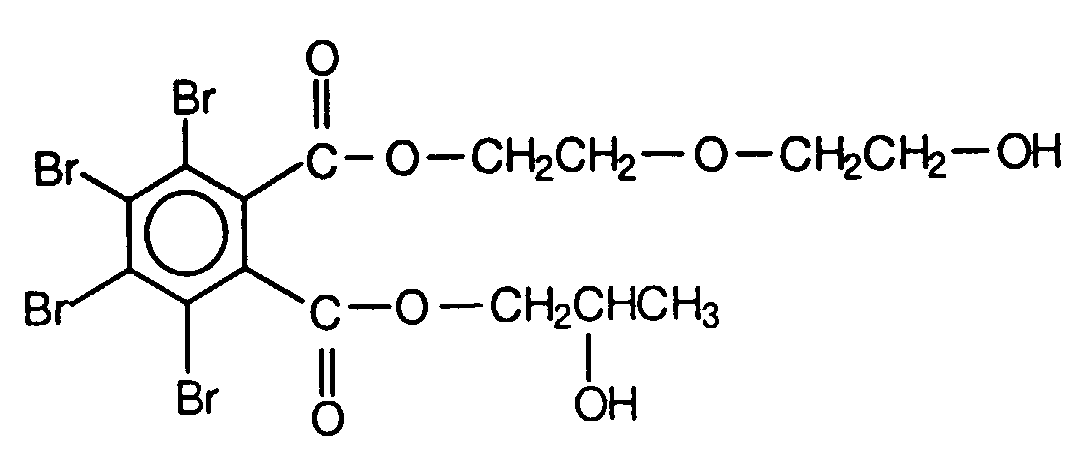
- One compatibility agent which has been tested and proven to provide compositions having desirable qualities is a derivative of tetrabromophthalic anhydride diol which has the formula This compound has the nomenclature 3,4,5,6 tetrabromophthalic 1,2 benzene dicarboxylic acid mixed esters with diethylene glycol and 1,2 dihydroxy propylene glycol and is available as PTH-4 Diol from Great Lakes Chemical Corporation, West Lafayette, Indiana.
- Derivatives of tetrabromophthalic anhydride diol are useful in amounts of 1 to 20 parts, preferably 4-10 parts. Particular compositions comprising 5 and 7 parts of the derivatives have produced fluorohydrocarbon-fluorosilicone (polydimethylsiloxane) copolymers having brittle points of -35°C and -42°C.
- the compatibility agent is particularly useful with the blends of fluorohydrocarbons and fluorosilicones used according to the present invention.
- the diol is soluble in the blends due to the ether linkages and is not attacked by aliphatics and aromatics. Thus, the diol is not destroyed in the reaction of the polymers. It is believed that the diol acts as an interfacial wetting agent which is compatible by itself with either the fluorohydrocarbon or the fluorosilicone which are generally not compatible with each other.
- the diol is soluble in either fluoro-compound and facilitates their cross-linking. In general, halogenated ethers are soluble in either.
- the fluorohydrocarbons used in the blends according to the present invention preferably comprise a medium viscosity fluoroelastomer raw gum that is capable of being cross-linked by peroxide vulcanizing agents.
- These fluorohydrocarbone offer improved resistance to water and steam over conventional fluoroelastomers.
- These fluorohydrocarbons also offer advantages in vulcanizing thick cross-section parts without fissuring as the type and quantity of volatiles liberated during cure are different from those associated with conventional fluoroelastomer cure systems.
- the fluorohydrocarbons should also be capable of curing with conventional diamine or dihydroxide cure systems.
- Typical properties of the fluorohydrocarbon gumstock include a specific gravity of approximately less than 2.0, preferably about 1.8, a partial solubility in low molecular weight esters and ketones and a Mooney viscosity of approximately 50-60.
- the fluorohydrocarbon elastomer may be mixed with curative, fillers and other compounding ingredients by conventional mill or internal mixing methods.
- a peroxide curing agent and co-agent are preblended with the dry powders prior to adding to the gum on the mill or in an internal mixer. Temperatures above 121°C should be avoided during mixing. After mixing, the mixture should be cooled rapidly by either air or water cooling techniques, and stored in a cool dry place prior to use.
- the fluorohydrocarbon is used in blends with fluorosilicones to obtain compositions having a combination of good physical properties, heat and fluid resistance, and low temperature brittle pointe. These compounds are extremely useful in automotive applications where the heat and chemical resistance of fluoroelastomers is required along with improved low temperature performance.
- Preferred vinyl containing polymer or polymers used according to the present invention are high molecular weight polymers such as long chain polymers which are vinyl terminated and have vinyl-on-chain such that the total vinyl content is between 0.1 to 0.3, preferably 0.10 to 0.30 weight percent based upon compound weight, more preferably, a total vinyl of 0.13 to 0.20 weight percent based upon compound weight.
- the total vinyl weight of the silicone polymers has shown advantageous results at 0.13 weight percent and 0.15 weight percent.
- a mixture of vinyl terminated high molecular weight fluorosilicone polymer and vinyl terminated/vinyl-on-chain high molecular weight silicone polymer may be used.
- vinyl terminated/vinyl-on-chain polymer between about 38% and 45% vinyl terminated/vinyl-on-chain polymer is used compared to 62-55% of only vinyl terminated fluorosilicones by parts. It is expected that 50:50 mixtures of vinyl terminated and vinyl terminated/vinyl-on-chain polymers may be used.
- the total weight of vinyl is generally less. For example, total vinyl weights percent of 0.13 to 0.20 weight percent may be used, whereas total vinyl weights of 0.13 to 0.16 weight percent are preferred.
- Cross-linking reactions between the fluorohydrocarbons and fluorosilicones can be catalyzed or initiated by any of various free radical generating initiators.
- Initiators should be chosen in order to control the Durometer hardness of the final blend.
- Vinyl specific free radical initiators are necessary for crosslinking via the vinyl units.
- the most preferred vinyl specific free radical initiators are peroxide initiators. Dibenzoyl peroxide is most commonly used, however, any well known peroxide initiator compatible with the blends can be used, such as those shown in the "Handbook of Silicone Rubber Fabrication", Wilfred Lynch, 1978, Litton Educational Publishing, Inc., page 37, which disclosure is hereby incorporated by reference.
- the fluorohydrocarbon and fluorosilicone can be mixed with the compatibility agent before adding any other components to the blend.
- the basic mixture can be stored and modified later or used as is once an initiator is added.
- a fumed silica filler is added along with telomeric fluid to make the filler compatible.
- One untreated filler is a fumed silica having a surface area of about 200 m 2 /gm available from Cabot Corporation, Tuscola, Illinois under the tradename Cab-O-Sil MS-7 ®.
- Treated fillers may also be used such as Aerosil R-972® available from Degussa Corporation, Waterford, N.Y.
- This filler has a surface area of about 120 m 2 /gm and has been treated with dimethyldichlorosilane.
- the treatment ties up free silanol bonds on the silica to form non-reactive siloxane groups, i.e. dimethylsiloxy bridging groups.
- the acid acceptor e.g., Ca(OH) 2 soaks up acid liberated from the removal of HX from the fluorohydrocarbon to generate a site of unsaturation for curing. This acid would otherwise cause cleavage of the product chains.
- the vinyl-on-chain fluorosilicone additive may comprise up to 10 parts of the total blend. Ranges of 3 to 7 are more preferred, 5 to 7 parts being most preferred.
- the blends according to the present invention may be prepared through mixing in a high intensity mixer, such as a Banbury mixer to facilitate compounding.
- the blends are then subject to a cook cycle in a doughmixer to complete the in-situ treatment of the filler, which in most cases is fumed silica.
- the silica filler may be added subsequent to preparing fluorohydrocarbon and fluorosilicone blends with a compatibility agent.
- Example 1 shows a typical method for preparing blends of fluorocarbons and fluorosilicones in accordance with both the prior art and the present invention.
- a Banbury mixer was charged with a fluorohydrocarbon HMW polymer (70 grams), 30.0 grams of a vinyl terminated fluorosilicone HMW polymer with a Williams Plasticity (WP) of 200 +/- 20 determined from a three minute reading at 25°C, 3.0 grams of a vinyl terminated fluorosilicone HMW polymer with 1.4 wgt % vinyl-on-chain along with about 15% of the total amount of fumed silica filler to be used. Approxiamately 29.0 grams of filler are used in the process.
- the silica filler was Cab-O-sil MS-7®. The batch was mixed for 2 minutes before adding 0.15 grams of divinyltetramethyldisilazane.
- the mixture was again sheared for 2 minutes then another 15% of the fumed silica charge was added along with 2.7 grams (50%) of the fluorosiliconedisiloxanol telomeric fluid.
- the mixture was sheared for 5 minutes before adding 7.0 grams of an M stopped PDMS containing 13.2M% VOC and another 15% of the fumed silicone charge.
- After 4 minutes of shear, another 15% of the filler was added then sheared again before adding the balance of the fumed silica. Once the balance of fumed silica was added, the batch was sheared for 40 minutes then dumped.
- the masterbatch was placed in a doughmixer and heated for 2 hours at 160-170°C while maintaining a N 2 purge rate of 0.34 m 3 /h (12 ft 3 /hr).
- the system was cooled down to 50°C and placed in the Banbury where 1.9 grams of Ca(OH) 2 per 100 of compound and 0.63 gram of a masterbatch having 75 wt % Ce(OH) 4 dispersed in Viscosil® 60,000 cps (from General Electric Company, Waterford, N.Y.) per 100 of compound were added.
- the system was then sheared for 2 minutes before 0.76 gram per 100 of compound of triallylisocyanurate was added.
- Example II, III and IV were made according to processes similar to those of Example I.
- Table 2 shows the compositions and property profiles for Examples II, III and IV. Some compounds were replaced with other similar components.
- the brittle points of the various compositions herein were determined from ASTM test method D 746 which is a standard method for brittleness testing by impact. The method is described in ASTM Vol. 08.01, 1991, pages 240-243.
- Examples V-IX were made in a similar manner.
- the ratios of the polymers and other additives varied V VI VII VIII IX Fluorohydrocarbon 75 75 80 80 80 Fluorosilicone HMW Polymer Vinyl Terminated 15 15 13 11 11 Fluorosilicone HMW Polymer with Vinyl on chain ends & on chain-total Vi + 0.07 wgt % 10 10 8 9 9 M Stopped PDMS with 13.2M% VOC 7.0 7.0 5 6 5 Fluorosilicone disiloxanol telomeric fluid 5.4 5.4 10.4 11.0 11.0 Vinyl terminated PDMS plasticizer 3 3 - - - Divinyltetramethyldisilazane 0.15 0.15 0.15 0.2 0.2 GAP-D (Gamma aminopropyltrimethoxysilane) 0.5 0.5 0.5 0.5 1.0 - Kynar (polyvinylidene fluoride) - 5 5 5 3 Tetrabromophthalic anhydride diol
- a fluorohydrocarbon-fluorosilicone PDMS copolymer blend was prepared in a similar manner.
- the fluorosilicone PDMS copolymer was vinyl terminated and had vinyl-on-chain, the aggregate vinyl value being 0.04 wgt %.
- the Williams plasticity of the copolymer was 180.
- the formulation for this particular compound is as follows: COMPOUND X Medium Viscosity fluoroelastomer raw gum 640 grams Vinyl Terminated FS HMW Polymer 88 grams FS-PDMS 72 grams Divinyltetramethyldisilazane 1.6 grams M-Stopped PDMS with 13.2M% VOC 40.0 grams Fluorosilicone Disiloxanol Telomeric Fluid 88.0 grams Polyvinylidene fluoride 24 grams Tetrabromophthalic anhydride diol 56 grams Fumed silica 200m 2 /gm 232 grams Calcium Hydroxide 32 grams Cerium Hydroxide masterbatch 8.0 grams Triallylisocyanurate 6.4 grams
- FHC-FSPDMS copolymer blends provide compositions having brittle points to -35°C which exhibit good physical properties. These types of blends are useful for O-rings in automotive applications due to their toughness and resistance to abrasion.
- compositions having about 3.7 parts by weight of the derivative of tetrabromophthalic anhydride diol have shown very little consumption.
- Compounds having about 7.0 parts by weight of the derivative have shown extinguishing times of less than 1 second.
- Tables 5, 6 and 7 show test results of various burn tests.
- the compositions having zero percent of the derivative had first and second burn times of 7 and 115 seconds, respectively, and a consumption of 100 percent.
Landscapes
- Chemical & Material Sciences (AREA)
- Health & Medical Sciences (AREA)
- Chemical Kinetics & Catalysis (AREA)
- Medicinal Chemistry (AREA)
- Polymers & Plastics (AREA)
- Organic Chemistry (AREA)
- Compositions Of Macromolecular Compounds (AREA)
Claims (10)
- Mischung aus Fluorkohlenwasserstoff und Fluorsilicon mit einer Versprödungstemperatur von weniger als -30°C, umfassend 50 bis 80 Gewichtsteile eines Fluorkohlenwasserstoffes, 20 bis 50 Gewichtsteile eines Fluorsilicon-Polymers hohen Molekulargewichtes mit einem gesamten Vinyl-Gewichtsgehalt im Bereich von 0,1 bis 0,3 Gew.-% und 1 bis 20 Gewichtsteile eines Verträglichkeitsmittels der allgemeinen Formel
 R1 ausgewählt ist aus der Gruppe bestehend aus einem Kohlenwasserstoff mit 2 bis 10 Kohlenstoffatomen und einem Ether mit 2 bis 20 Kohlenstoffatomen und deren Mischungen undR2 ausgewählt ist aus der Gruppe beste-hend aus einem Kohlenwasserstoff mit 2 bis 10 Kohlenstoffatomen und einem Ether mit 2 bis 20 Kohlenstoffatomen und deren Mischungen.
 - Zusammensetzung nach Anspruch 1, worin R1 ein Ether und R2 ein geradkettiger, aliphatischer Kohlenwasserstoff ist.
- Zusammensetzung nach Anspruch 1 oder 2, worin X1, X2, X3 und X4 jeweils Brom sind.
- Zusammensetzung nach einem vorhergehenden Anspruch, worin das Verträglichkeitsmittel ein Derivat von Tetrabromphthalsäureanhydriddiol der Formel ist
- Zusammensetzung nach einem vorhergehenden Anspruch, worin das Fluorsilicon-Polymer hohen Molekulargewichtes sowohl ein Vinyl-Endgruppen aufweisendes Fluorsilicon-Polymer hohen Molekulargewichtes als auch ein Fluorsilicon-Polymer hohen Molekulargewichtes mit Vinyl-Endgruppen und Vinylgruppen in der Kette umfaßt.
- Zusammensetzung nach Anspruch 5, worin das Fluosilicon-Polymer hohen Molekulargewichtes mit Vinyl-Endgruppen und Vinylgruppen in der Kette 38 bis 50 Gew.-% des Fluorsilicon-Polymers umfaßt.
- Zusammensetzung nach einem vorhergehenden Anspruch, weiter umfassend zwischen 1 und 10 Gewichtsteile eines M-Endgruppen aufweisenden Polydimethylsiloxans mit bis zu 15 Gew.-% Vinylsubstituenten in der Kette.
- Zusammensetzung nach einem vorhergehenden Anspruch, weiter umfassend bis zu 50% Füllstoff aus pyrogenem Siliciumdioxid und bis zu 15% einer telomeren Fluorsilicon-Disiloxanol-Flüssigkeit.
- Mischung aus Fluorkohlenwasserstoff und Fluorsilicon mit einer Versprödungstemperatur von weniger als -30°C, umfassend 50 bis 80 Gewichtsteile eines Fluorkohlenwasserstoffes mit einer Mooney [ML 1+10 bei 25°F (121°C)] Viskosität im Bereich von etwa 50-60, 20 bis 50 Gewichtsteile eines Fluorsilicon- und PDMS-Polymers hohen Molekulargewichtes mit einem gesamten Vinyl-Gewichtsgehalt im Bereich von 0,13 bis 0,20 Gew.-% und 1 bis 20 Gewichtsteile eines Verträglichkeitsmittels der allgemeinen Formel
 R1 ausgewählt ist aus der Gruppe bestehend aus einem Kohlenwasserstoff mit 2 bis 10 Kohlenstoffatomen und einem Ether mit 2 bis 20 Kohlenstoffatomen und deren Mischungen undR2 ausgewählt ist aus der Gruppe beste-hend aus einem Kohlenwasserstoff mit 2 bis 10 Kohlenstoffatomen und einem Ether mit 2 bis 20 Kohlenstoffatomen und deren Mischungen.
 - O-Ring, umfassend eine Mischung aus Fluorkohlenwasserstoff und Fluorsilicon mit einer Versprödungstemperatur von weniger als -30°C, umfassend 50 bis 80 Gewichtsteile eines Fluorkohlenwasserstoffes, 20 bis 50 Gewichtsteile eines Fluorsilicon-Polymers hohen Molekulargewichtes mit einem gesamten Vinyl-Gewichtsgehalt im Bereich von 0,1 bis 0,3 Gew.-% und 1 bis 20 Gewichtsteile eines Verträglichkeitsmittels der allgemeinen Formel
 R1 ausgewählt ist aus der Gruppe bestehend aus einem Kohlenwasserstoff mit 2 bis 10 Kohlenstoffatomen und einem Ether mit 2 bis 20 Kohlenstoffatomen und deren Mischungen undR2 ausgewählt ist aus der Gruppe beste-hend aus einem Kohlenwasserstoff mit 2 bis 10 Kohlenstoffatomen und einem Ether mit 2 bis 20 Kohlenstoffatomen und deren Mischungen.
Applications Claiming Priority (2)
| Application Number | Priority Date | Filing Date | Title |
|---|---|---|---|
| US80268091A | 1991-12-05 | 1991-12-05 | |
| US802680 | 1991-12-05 |
Publications (2)
| Publication Number | Publication Date |
|---|---|
| EP0545659A1 EP0545659A1 (de) | 1993-06-09 |
| EP0545659B1 true EP0545659B1 (de) | 1996-07-31 |
Family
ID=25184408
Family Applications (1)
| Application Number | Title | Priority Date | Filing Date |
|---|---|---|---|
| EP19920310924 Expired - Lifetime EP0545659B1 (de) | 1991-12-05 | 1992-11-30 | Fluorkohlenwasserstoff-Fluorsilicon Mischungen |
Country Status (3)
| Country | Link |
|---|---|
| EP (1) | EP0545659B1 (de) |
| JP (1) | JP3433955B2 (de) |
| DE (1) | DE69212578T2 (de) |
Families Citing this family (6)
| Publication number | Priority date | Publication date | Assignee | Title |
|---|---|---|---|---|
| CA2092474A1 (en) * | 1992-05-12 | 1993-11-13 | Edwin R. Evans | Flame retardant system for polyorganosiloxane compositions |
| JPH0741627A (ja) * | 1993-07-28 | 1995-02-10 | Toray Dow Corning Silicone Co Ltd | ゴム組成物 |
| WO2010077811A1 (en) * | 2008-12-17 | 2010-07-08 | 3M Innovative Properties Company | Blended fluorosilicone release materials |
| WO2011059462A1 (en) | 2009-11-16 | 2011-05-19 | 3M Innovative Properties Company | Fluorosilicone blend release materials |
| JP6549994B2 (ja) * | 2016-01-14 | 2019-07-24 | 日本電子株式会社 | Nmr測定用プローブ |
| CN118222182B (zh) * | 2024-03-04 | 2024-12-17 | 道夫新材料(惠州)有限公司 | 一种有机硅绝缘漆及其制备方法 |
Family Cites Families (2)
| Publication number | Priority date | Publication date | Assignee | Title |
|---|---|---|---|---|
| US4263414A (en) * | 1979-08-30 | 1981-04-21 | Minnesota Mining And Manufacturing Company | Vulcanizable blend of bromine-containing fluoropolymer and fluorosilicone gums |
| US4764550A (en) * | 1985-09-17 | 1988-08-16 | Pennwalt Corporation | Tetrahalophthalate esters as flame retardants for polyphenylene ether resins |
-
1992
- 1992-11-30 EP EP19920310924 patent/EP0545659B1/de not_active Expired - Lifetime
- 1992-11-30 DE DE1992612578 patent/DE69212578T2/de not_active Expired - Fee Related
- 1992-12-03 JP JP32384892A patent/JP3433955B2/ja not_active Expired - Fee Related
Also Published As
| Publication number | Publication date |
|---|---|
| JP3433955B2 (ja) | 2003-08-04 |
| DE69212578D1 (de) | 1996-09-05 |
| JPH05271507A (ja) | 1993-10-19 |
| EP0545659A1 (de) | 1993-06-09 |
| DE69212578T2 (de) | 1997-02-20 |
Similar Documents
| Publication | Publication Date | Title |
|---|---|---|
| US3341490A (en) | Blends of two polysiloxane copolymers with silica | |
| US4942202A (en) | Rubber composition and vulcanized rubber product | |
| US5053450A (en) | Elastomer compositions | |
| JP3294283B2 (ja) | 圧縮永久歪の低下したシラノール基含有シリコーンエラストマーの製造方法 | |
| JPH02120365A (ja) | 低圧縮永久歪フルオロシリコーンゴム | |
| US5051480A (en) | Elastomeric blends | |
| EP0180843A1 (de) | Elastomere Silikonzusammensetzungen | |
| JPH01266154A (ja) | 熱可塑性エラストマーのブレンド | |
| JPH11514394A (ja) | 共硬化性耐塩基性フルオロエラストマー混合組成物 | |
| US4742101A (en) | Curable fluorosilicone rubber composition | |
| EP0380104B1 (de) | Fluorkautschukzusammensetzungen mit verbesserter Verarbeitbarkeit und mit verbesserten mechanischen Eigenschaften | |
| US3415900A (en) | Cross linking hydrofluorinated olefin polymers and silicone rubbers and resultant cross linked compositions | |
| EP0636663A2 (de) | Mischungen auf Basis Fluorkautschuks und Siloxankautschuks | |
| EP0238873B1 (de) | Hitzehärtende Organopolysiloxanzusammensetzung | |
| JPS636586B2 (de) | ||
| JPH0370775A (ja) | フルオロシリコーンゴム組成物及びその製造方法 | |
| EP0545659A1 (de) | Fluorkohlenwasserstoff-Fluorsilicon Mischungen | |
| EP0485906B1 (de) | Vulkanisierbare Gummimischung | |
| EP0656391A2 (de) | Kautschukzusammensetzung | |
| EP0785233A2 (de) | Peroxide-vernetzte Mischungen aus Polyacryl- und teilhydriertess Nitril-Kautschuken | |
| EP0227163B1 (de) | Vernetzbare Elastomer-Mischungen | |
| JP2859075B2 (ja) | 金属酸化物の混合物を含有する耐油性に優れた熱硬化性フルオロシリコーンゴム組成物 | |
| US3804801A (en) | Fluorohydrocarbon elastomers | |
| EP0562830B1 (de) | Fluor enthaltende Silikonkautschukzusammensetzung | |
| US4248768A (en) | Siloxane elastomers containing manganous oxide |
Legal Events
| Date | Code | Title | Description |
|---|---|---|---|
| PUAI | Public reference made under article 153(3) epc to a published international application that has entered the european phase |
Free format text: ORIGINAL CODE: 0009012 |
|
| AK | Designated contracting states |
Kind code of ref document: A1 Designated state(s): BE DE FR GB NL |
|
| 17P | Request for examination filed |
Effective date: 19931129 |
|
| 17Q | First examination report despatched |
Effective date: 19950413 |
|
| GRAH | Despatch of communication of intention to grant a patent |
Free format text: ORIGINAL CODE: EPIDOS IGRA |
|
| GRAH | Despatch of communication of intention to grant a patent |
Free format text: ORIGINAL CODE: EPIDOS IGRA |
|
| GRAA | (expected) grant |
Free format text: ORIGINAL CODE: 0009210 |
|
| AK | Designated contracting states |
Kind code of ref document: B1 Designated state(s): BE DE FR GB NL |
|
| ET | Fr: translation filed | ||
| REF | Corresponds to: |
Ref document number: 69212578 Country of ref document: DE Date of ref document: 19960905 |
|
| PLBE | No opposition filed within time limit |
Free format text: ORIGINAL CODE: 0009261 |
|
| 26N | No opposition filed | ||
| PGFP | Annual fee paid to national office [announced via postgrant information from national office to epo] |
Ref country code: NL Payment date: 20011102 Year of fee payment: 10 |
|
| REG | Reference to a national code |
Ref country code: GB Ref legal event code: IF02 |
|
| PG25 | Lapsed in a contracting state [announced via postgrant information from national office to epo] |
Ref country code: NL Free format text: LAPSE BECAUSE OF NON-PAYMENT OF DUE FEES Effective date: 20030601 |
|
| NLV4 | Nl: lapsed or anulled due to non-payment of the annual fee |
Effective date: 20030601 |
|
| PGFP | Annual fee paid to national office [announced via postgrant information from national office to epo] |
Ref country code: BE Payment date: 20051208 Year of fee payment: 14 |
|
| PG25 | Lapsed in a contracting state [announced via postgrant information from national office to epo] |
Ref country code: BE Free format text: LAPSE BECAUSE OF NON-PAYMENT OF DUE FEES Effective date: 20061130 |
|
| BERE | Be: lapsed |
Owner name: *GENERAL ELECTRIC CY Effective date: 20061130 |
|
| PGFP | Annual fee paid to national office [announced via postgrant information from national office to epo] |
Ref country code: FR Payment date: 20081117 Year of fee payment: 17 |
|
| PGFP | Annual fee paid to national office [announced via postgrant information from national office to epo] |
Ref country code: DE Payment date: 20081223 Year of fee payment: 17 |
|
| PGFP | Annual fee paid to national office [announced via postgrant information from national office to epo] |
Ref country code: GB Payment date: 20081128 Year of fee payment: 17 |
|
| GBPC | Gb: european patent ceased through non-payment of renewal fee |
Effective date: 20091130 |
|
| REG | Reference to a national code |
Ref country code: FR Ref legal event code: ST Effective date: 20100730 |
|
| PG25 | Lapsed in a contracting state [announced via postgrant information from national office to epo] |
Ref country code: FR Free format text: LAPSE BECAUSE OF NON-PAYMENT OF DUE FEES Effective date: 20091130 |
|
| PG25 | Lapsed in a contracting state [announced via postgrant information from national office to epo] |
Ref country code: DE Free format text: LAPSE BECAUSE OF NON-PAYMENT OF DUE FEES Effective date: 20100601 |
|
| PG25 | Lapsed in a contracting state [announced via postgrant information from national office to epo] |
Ref country code: GB Free format text: LAPSE BECAUSE OF NON-PAYMENT OF DUE FEES Effective date: 20091130 |