EP0545822A2 - Gemeinsames Dateizugriffssystem und gemeinsames Dateizugriffsverfahren in einem Computersystem mit verteiltem Speicher - Google Patents
Gemeinsames Dateizugriffssystem und gemeinsames Dateizugriffsverfahren in einem Computersystem mit verteiltem Speicher Download PDFInfo
- Publication number
- EP0545822A2 EP0545822A2 EP92403269A EP92403269A EP0545822A2 EP 0545822 A2 EP0545822 A2 EP 0545822A2 EP 92403269 A EP92403269 A EP 92403269A EP 92403269 A EP92403269 A EP 92403269A EP 0545822 A2 EP0545822 A2 EP 0545822A2
- Authority
- EP
- European Patent Office
- Prior art keywords
- file
- computer
- master
- location
- sub
- Prior art date
- Legal status (The legal status is an assumption and is not a legal conclusion. Google has not performed a legal analysis and makes no representation as to the accuracy of the status listed.)
- Granted
Links
Images





Classifications
-
- G—PHYSICS
- G06—COMPUTING OR CALCULATING; COUNTING
- G06F—ELECTRIC DIGITAL DATA PROCESSING
- G06F16/00—Information retrieval; Database structures therefor; File system structures therefor
- G06F16/10—File systems; File servers
- G06F16/13—File access structures, e.g. distributed indices
- G06F16/134—Distributed indices
Definitions
- the present invention relates to a file access system in a distributed memory type computer system, and more particularly to a common file access system wherein the distributed memory type computer system has a common file system used by each computer in the distributed memory type computer system.
- each computer in the system must have a respective file system so as to guarantee the uniqueness of file data. This is because if the system has a common file system accessed by a plurality of computers in the system, in accordance with a write order produced by an application program in the user space set up in each computer, the operating system in a kernel space set up in each computer individually re-writes data in the user space even if this user space is commonly used by the other computers so that the user space is updated without an exclusion control between the computers, e.g., an exclusion control using a file control table set up in the kernel space of each computer, etc.
- an exclusion control e.g., an exclusion control using a file control table set up in the kernel space of each computer, etc.
- each computer of the distributed memory type computer system has a respective file system in a conventional art. Therefore, in the conventional art there are some problems that some processing, e.g., a file data search process or an access priority check process, etc., become more complicated, and this in particular applies to the case when a file set up by another computer is accessed, and thus the performance of the total system remarkably deteriorates thereby. Further, when maintaining work of the computer system, the work of updating the version of an operating system or the work of debugging a program needs to implement every file system so that there is another problem that the quantity of the maintenance work is increased.
- some processing e.g., a file data search process or an access priority check process, etc.
- the purpose of the present invention is to solve the problems described above, and to provide a new file access system and a new file access method that enables realization of a distributed memory type computer system having a common file system, while maintaining the uniqueness of a file data used commonly by each computer in the distributed memory type computer system.
- the purpose of the present invention is to provide a distributed memory type computer system having a common file system the performance of which as a total computer system experiences little deterioration even if formed by a great number of computers.
- the purpose of the present invention is to provide a distributed memory type computer system having a common file system for which maintenance work, e.g., updating the version of the operating system, debugging a program in common with every computer in the distributed memory type computer system, etc., is simplified.
- a distributed memory type computer system comprises a common file system for managing file data being accessed by multiple distributed processing computers; a master computer for managing file data in the common file system and having access to the common file system in accordance with a file access request and information on a file location provided by each distributed processing computer; at least one sub-master computer for providing the information on file locations in the common file system to each distributed processing computer in response to an inquiry from each distributed processing computer about a file access location; multiple distributed processing computers for requesting from the sub-master computer a file location and receiving the information on the file location from the sub-master computer when accessing the file in the common file system, and for providing the file access request along with the information on the file location to the master computer; and a communication network for transmitting data between the master computer, the sub-master computer and the distributed processing computers.
- the master computer has a master control table for directly managing file data in the common file system, e.g., an inode control table for managing information of data blocks in use in the common file system, and a super block control table for managing free space in the common file system (those tables are similar to the UNIX operating system), and an access execution unit for accessing the common file system using the master control table in accordance with file access requests and information on file locations provided by each distributed processing computer.
- a master control table for directly managing file data in the common file system, e.g., an inode control table for managing information of data blocks in use in the common file system, and a super block control table for managing free space in the common file system (those tables are similar to the UNIX operating system), and an access execution unit for accessing the common file system using the master control table in accordance with file access requests and information on file locations provided by each distributed processing computer.
- the sub-master computer has a sub-master control table for managing file locations in the common file system, e.g., a file control table for managing information on the location of a file in the common file system used in the operating system of a UNIX computer system, and providing information on file locations in the common file system to each distributed processing computer in response to inquiry from each distributed processing computer about a file locations.
- a sub-master control table for managing file locations in the common file system, e.g., a file control table for managing information on the location of a file in the common file system used in the operating system of a UNIX computer system, and providing information on file locations in the common file system to each distributed processing computer in response to inquiry from each distributed processing computer about a file locations.
- the distributed processing computer has a data processing unit for referring to or updating file data related to the common file system, a sub-master control table inquiry unit for requesting from the sub-master computer a file location and receiving the information on the file location from the sub-master computer when accessing the file in the common file system, and an access requesting unit for providing a file access request along with information on the file location to the master computer when receiving the information on the file location from the sub-master computer.
- the data processing unit of a distributed processing computer when the data processing unit of a distributed processing computer begins to write data in the common file system, the data processing unit designates a write location as an offset from the beginning of a file and sends an access request to the sub-master control table inquiry unit, and at the same time the data processing unit designates the write data and its attributes and also sends an access request to the access requesting unit.
- the sub-master control table inquiry unit inquires from a computer having a sub-master control table about an access location in a file designated by a write location.
- the computer having a sub-master control table designates information on the access location by appointing a file block corresponding to the designated access location, and then sends the information to the sub-master control table inquiry unit.
- the sub-master control table inquiry unit When receiving the information related to the access location in the designated file from the computer having a sub-master control table, the sub-master control table inquiry unit sends the information on the access location to the access requesting unit. Then, the access requesting unit designates the access location information, write data designated by the data processing unit and information on the data attributes, and then sends a write request to a computer having a common file system. When receiving the write request, the computer having the common file system executes a write processing using a master control table in accordance with the information on the access location and the data attributes.
- a distributed memory type computer system is able to maintain the uniqueness of data of a file commonly accessed by each computer in the distributed memory type computer system, by managing file data of the common file system by using hierarchically distributed control tables and without the need for caching (mapping) file data from the common file system, etc. Therefore, the distributed memory type computer system is able to incorporate a common file system, and also a data processing load on each computer is reduced and the data processing speed of each computer is accelerated.
- Fig. 1 is a schematic view of a conventional distributed memory type computer system for explaining a problem of the distributed memory type computer system.
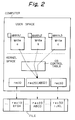
- Fig. 2 is a schematic view of a non-parallel type computer system for explaining data processing in a non-parallel type computer system.
- Fig. 3 is a schematic view of a distributed memory type computer system for explaining a problem of the conventional distributed memory type computer system.
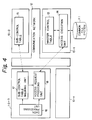
- Fig. 4 is a principle block diagram of a distributed memory type computer system according to the present invention.
- Fig. 5 is a schematic view of a parallel type computer system applicable to the distributed memory type computer system according to the present invention.
- Fig. 6 is a schematic view of a preferred embodiment of the present invention.
- Fig. 7 shows an example of data management using an inode control table as used in the operating system of a UNIX computer system, in an embodiment of the present invention.
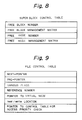
- Fig. 8 shows an example of data management using a super block control table as used in the operating system of a UNIX computer system, in an embodiment of the present invention.
- Fig. 9 shows an example of data management using a file control table as used in the operating system of a UNIX computer system, in an embodiment of the present invention.
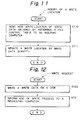
- Fig. 10 is a flowchart of data processing executed by a B type computer as a distributed processing computer.
- Fig. 11 is a flowchart of data processing executed by a B type computer as a sub-master computer.
- Fig. 12 is a flowchart of data processing executed by an A type computer as a master computer.
- Fig. 1 is a schematic view of a conventional distributed memory type computer system for explaining a problem of the distributed memory type computer system.
- the system has a common file system accessed by each of computers 1, 2, 3.
- the operating system in a kernel space set up in each computer individually rewrites data in the user space even if this user space is commonly used by the other computers so that the user space is updated without an exclusion control between the computers, e.g., an exclusion control using a file control table set up in the kernel space of each computer, etc.
- Fig. 2 is a schematic view of a non-parallel type computer system for explaining data processing in the non-parallel type computer system
- data at a write location requested by an application program is cached (mapped) in a single memory area in accordance with a-single control table for a single file, and then write data is written over cached data in accordance with the single control table, and thereby the computer system as described above is able to execute a write processing without error.
- data "ABCD" of a record 20 in a file data is cached in the memory.
- Fig. 3 is a schematic view of a distributed memory type computer system
- three computers 1, 2, 3 respectively cache data "ABCD" in each memory.
- the data "ABCD” written in each memory of the computers 1, 2, 3 are the same at first.
- Fig. 4 is a principle block diagram of a distributed memory type computer system according to the present invention.
- a distributed memory type computer system comprises a common file system 11 for managing a file data being accessed by multiple distributed processing computers 10-3 l - 10-3 n , a master computer 10-1 for managing file data in the common file system 11 and having access to the common file system 11 in accordance with a file access request along with information on a file location provided by each distributed processing computer 10-3 l - 10-3 n , at least one sub-master computer(s) 10-2 l - 10-2 m for providing information on file locations in the common file system to each distributed processing computer 10-3 l - 10-3 n in response to inquiries from each distributed processing computer 10-3 l - 10-3 n about file locations, multiple distributed processing computers 10-3 l - 10-3 n for inquiring of the sub-master computer(s) 10-2 l - 10-2 m file locations and receiving information on a file location from the submaster computer(s) 10-2 l - 10-2 m when accessing a file in the common file system 11 and for providing
- the master computer 10-1 has a master control table 13 for directly managing file data in the common file system 11, e.g., an inode control table for managing information on data blocks in use in the common file system and a super block control table for managing free space in the common file system (those tables are similar to the UNIX operating system), and an access execution unit 14 for accessing the common file system 11 using the master control table 13 in accordance with file access requests and information on file locations provided by each distributed processing computer 10-3 l - 10-3 n .
- a master control table 13 for directly managing file data in the common file system 11, e.g., an inode control table for managing information on data blocks in use in the common file system and a super block control table for managing free space in the common file system (those tables are similar to the UNIX operating system), and an access execution unit 14 for accessing the common file system 11 using the master control table 13 in accordance with file access requests and information on file locations provided by each distributed processing computer 10-3 l - 10-3 n .
- the sub-master computer 10-2 l - 10-2 m has a sub-master control table 15 for managing file locations in the common file system 11, e.g., a file control table for managing information on file locations inside a file in the common file system 11 as used in the UNIX operating system, and providing information on file locations in the common file system 11 to each distributed processing computer 10-3 l - 10-3 n in response to inquiries from each distributed processing computer 10-3 l - 10-3 n about file locations.
- a sub-master control table 15 for managing file locations in the common file system 11, e.g., a file control table for managing information on file locations inside a file in the common file system 11 as used in the UNIX operating system, and providing information on file locations in the common file system 11 to each distributed processing computer 10-3 l - 10-3 n in response to inquiries from each distributed processing computer 10-3 l - 10-3 n about file locations.
- Each of distributed processing computers 10-3 l - 10-3 n has a data processing unit 16 for referring to or updating file data related to the common file system 11; a sub-master control table inquiry unit 17 for inquiring of the sub-master computer(s) 10-2 l - 10-2 m file locations and receiving the information on file locations from the sub-master computer(s) 10-2 l - 10-2 m when accessing a file in the common file system 11; and an access requesting unit 18 for providing a file access request along with information on a file locations to the master computer 10-1 when receiving information on a file location from the sub-master computer.
- Fig. 5 shows a schematic view of a parallel type computer system applicable to the distributed memory type computer system according to the present invention.
- reference numeral 20 is an A type computer
- a reference numeral 40 is a crossbar network which connects the A type computer 20 with the plural B type computers 30-i and forms a communication network between them.
- the A type computer 20 consists of a CPU unit 21, a memory unit 22 and a network adaptor unit 23 and further has a disk storage unit 24.
- the B type computer 30-i consists of a CPU unit 31, a memory unit 32 and a network adaptor unit 33.
- the B type computer 30-i has the same constitution as that of the A type computer 20 except for the disk storage unit 24.
- a storage device that is formed by a non-volatile semiconductor memory may be used in place of the disk storage unit 24 of the A type computer 20.
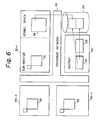
- Fig. 6 is a schematic view of a preferred embodiment of the present invention.
- an inode control table 25 and a super block control table 26 used to access the disk 24 are set up in the A type computer 20 that functions as a master computer.
- At least one B type computer 30-i B type computer 30-1 in Fig. 6) is selected as a sub-master computer, and a file control table 34 used to access the disk 24 is set up in the B type computer 30-1.
- the B type computer 30-1 functions both as a sub-master computer and a distributed processing computer.
- control tables that are needed to access the disk 24 have hierarchical constitution, and thereby it is possible to concentrate the control tables and certain functions associated with the operation of the control tables in specific computers 20, 30-1 as described above.
- Fig. 7 shows an example of data management using an inode control table 25 set up in the A type computer 20
- Fig. 8 shows an example of data management using a super block control table 26 also set up in the A type computer
- Fig. 9 shows an example of data management using a file control table 34 set up in the B type computer 30-1 in Fig. 6.
- These control tables 25, 26, 34 are generally used in the UNIX operating system.
- the inode control table 25 set up in the A type computer 20 is used to manage information on data block locations in use in the disk 24, and the super block control table 26 shown in Fig. 8 is used to manage free space on the disk 24.
- the file control table 34 set up in the B type computer 30-1 is used to manage information on file locations inside a file on the disk 24. A description of every item contained in those control tables 25, 26, 34 is not given here. For such an explanations, refer to suitable documentation on the UNIX operating system.
- FIG. 11 is a flowchart showing a process executed by a B type computer 30-1 as a sub-master computer and shows an example of a processing flow executed by the operating system of the B type computer 30-1 when receiving an inquiry about a write location of write data, which is produced by execution of the process shown in Fig. 10.
- Fig. 12 is a flowchart showing a process executed by an A type computer 20 as a master computer and shows an example of a processing flow executed by the operating system of the A type computer 20 when receiving a write request which is produced by execution of the process shown in Fig. 10.
- a step 1 when receiving a write request for writing data on the disk 24, which is produced by an execution of an application program 35 in the B type computer 30-i, a step 1 (ST1), the operating system of the B type computer 30-i executes a process wherein the B type computer 30-i inquires of the B type computer 30-1 having a file control table 34 about a write location of a write data, and at the same time sends information on a quantity of the write data to the B type computer 30-1.
- the B type computer 30-1 when receiving an inquiry as described above from the B type computer 30-i, the B type computer 30-1 examines the write location of the write data by referring to a read/write location in the file control table 34, and a file size and an access time in its internal memory, which are the same value as that in the inode control table 25, and then notifies the write location of the write data to the inquiring B type computer 30-i (ST10).
- the write location in the file control table 34 is updated by the quantity of the write data known from the B type computer 30-i in the step 1, and thereby a preparation process for a next new inquiry is ended. Therefore, the write location is controlled so as not to cause a substitution error.
- the operating system of the B type computer 30-i waits until receiving an answer to the inquiry described above sent from the B type computer 30-1 in step 2 (ST2), and thereby maintains a status check indicating with/without the answer.
- information on a write location of write data sent from the B type computer 30-1 is received in step 3 (ST3).
- the B type computer 30-i designates a file identification code, write data, data length and received information, i.e., a read/write location of a file control table 34, file size and access time of an inode control table 25, described above, and then sends a write request along with this information to the A type computer 20 (a master).
- the B type computer 30-i waits for notification of process end of the write request sent from the A type computer 20 in step 5 (ST5).
- step 20 when receiving the write request described above, in step 20 (ST20) the A type computer 20 mainly writes data related to the file identification code of the inode control table 25, i.e., file size, access time, information on a location on a disk, etc., data related to information on a read/write location of the file control table 34, and data of the super block control table 26, i.e., a free block number, a management matrix of a free block, etc., on a predetermined area of the disk 24. Thereafter, the A type computer 20 sends a notice of process end for the write request to the B type computer 30-i in step 21 (ST21).
- the file identification code of the inode control table 25 i.e., file size, access time, information on a location on a disk, etc.
- data related to information on a read/write location of the file control table 34 and data of the super block control table 26, i.e., a free block number, a management matrix of a free block, etc., on
- Fig. 10 if the operating system of the B type computer 30-i that controls the application program 35 producing the write request receives the notice of process end of the write request sent from the A type computer 20 in step 5, the operating system of the B type computer 30-i provides a notice of process end for the write request to the application program 35 and finally completes all processes related to the write request.
- the B type computer 30-i (i 2-n), except for the B type computer 30-1 used as a sub-master computer, is explained as a distributed processing computer that has an application program 35 producing a write request as described above.
- the B type computer 30-1 as a sub-master computer, and also the A type computer 20 as a master computer may also have the application program 35 producing a write request in the same manner as described above.
- the A type computer 20 has a common file disk 24, and control tables used to access the common file disk 24 from the other B type computers 30-i are hierarchically distributed in the A type computer 20 and a specific B type computer 30-1 as a sub-master computer.
- Each B type computer 30-i does not need to cache file data of the disk 24 and further may only send an access request for the disk 24 to the A type computer 20 and the B type computer 30-1, and thereby only the A type computer 20 can access the disk 24. Therefore, a load on the A type computer 20 is reduced by sharing a portion of the control tables with the B type computer 30-1 as a sub-master computer, and further the uniqueness of file data can be easily maintained by this constitution.
- a distributed memory type computer system is able to maintain the uniqueness of file data commonly accessed by each computer in the distributed memory type computer system.
- a distributed memory type computer system is able to keep performance as a total computer system from deteriorating even if the computer system is formed by a great number of computers, and thereby it is possible to realize simplification of pre-preparation or checking of an access priority and provide high speed file access. Namely, since a first processing computer executes, e.g., an open process, a seek process, etc., and another computer may copy information from a file, a total file access time is accelerated.
- maintenance work e.g., updating the version of an operating system, debugging a program in association with every computer in the computer system, etc.
- the maintenance work is made simplified because the maintenance work can be carried out by using only the operating system of the common file system.
Landscapes
- Engineering & Computer Science (AREA)
- Theoretical Computer Science (AREA)
- Data Mining & Analysis (AREA)
- Databases & Information Systems (AREA)
- Physics & Mathematics (AREA)
- General Engineering & Computer Science (AREA)
- General Physics & Mathematics (AREA)
- Information Retrieval, Db Structures And Fs Structures Therefor (AREA)
- Multi Processors (AREA)
- Information Transfer Between Computers (AREA)
Applications Claiming Priority (3)
| Application Number | Priority Date | Filing Date | Title |
|---|---|---|---|
| JP319086/91 | 1991-12-03 | ||
| JP31908691 | 1991-12-03 | ||
| JP31908691A JP3349715B2 (ja) | 1991-12-03 | 1991-12-03 | 分散メモリ型計算機システム。 |
Publications (3)
| Publication Number | Publication Date |
|---|---|
| EP0545822A2 true EP0545822A2 (de) | 1993-06-09 |
| EP0545822A3 EP0545822A3 (en) | 1993-11-03 |
| EP0545822B1 EP0545822B1 (de) | 2000-06-07 |
Family
ID=18106339
Family Applications (1)
| Application Number | Title | Priority Date | Filing Date |
|---|---|---|---|
| EP92403269A Expired - Lifetime EP0545822B1 (de) | 1991-12-03 | 1992-12-03 | Gemeinsames Dateizugriffssystem und gemeinsames Dateizugriffsverfahren in einem Computersystem mit verteiltem Speicher |
Country Status (4)
| Country | Link |
|---|---|
| EP (1) | EP0545822B1 (de) |
| JP (1) | JP3349715B2 (de) |
| CA (1) | CA2084376C (de) |
| DE (1) | DE69231147T2 (de) |
Family Cites Families (2)
| Publication number | Priority date | Publication date | Assignee | Title |
|---|---|---|---|---|
| US4888681A (en) * | 1987-10-19 | 1989-12-19 | International Business Machines Corporation | Space management system for data files having shared access |
| EP0417396A3 (en) * | 1989-09-14 | 1993-03-03 | International Business Machines Corporation | Distributed image storage and retrieval system |
-
1991
- 1991-12-03 JP JP31908691A patent/JP3349715B2/ja not_active Expired - Fee Related
-
1992
- 1992-12-02 CA CA002084376A patent/CA2084376C/en not_active Expired - Fee Related
- 1992-12-03 EP EP92403269A patent/EP0545822B1/de not_active Expired - Lifetime
- 1992-12-03 DE DE69231147T patent/DE69231147T2/de not_active Expired - Fee Related
Also Published As
| Publication number | Publication date |
|---|---|
| DE69231147D1 (de) | 2000-07-13 |
| CA2084376A1 (en) | 1993-06-04 |
| JPH05158780A (ja) | 1993-06-25 |
| CA2084376C (en) | 1997-05-20 |
| EP0545822A3 (en) | 1993-11-03 |
| DE69231147T2 (de) | 2000-11-09 |
| JP3349715B2 (ja) | 2002-11-25 |
| EP0545822B1 (de) | 2000-06-07 |
Similar Documents
| Publication | Publication Date | Title |
|---|---|---|
| US5835908A (en) | Processing multiple database transactions in the same process to reduce process overhead and redundant retrieval from database servers | |
| US6389513B1 (en) | Disk block cache management for a distributed shared memory computer system | |
| US6889288B2 (en) | Reducing data copy operations for writing data from a network to storage of a cached data storage system by organizing cache blocks as linked lists of data fragments | |
| JP4862006B2 (ja) | 計算機システム | |
| US6697846B1 (en) | Shared file system | |
| US4603380A (en) | DASD cache block staging | |
| JP4568115B2 (ja) | ハードウェアベースのファイルシステムのための装置および方法 | |
| US6032224A (en) | Hierarchical performance system for managing a plurality of storage units with different access speeds | |
| US9405680B2 (en) | Communication-link-attached persistent memory system | |
| US5426747A (en) | Method and apparatus for virtual memory mapping and transaction management in an object-oriented database system | |
| US6029168A (en) | Decentralized file mapping in a striped network file system in a distributed computing environment | |
| US6148377A (en) | Shared memory computer networks | |
| US6633891B1 (en) | Managing replacement of data in a cache on a node based on caches of other nodes | |
| US7624207B2 (en) | Method, system and program products for reducing data movement within a computing environment | |
| US6112281A (en) | I/O forwarding in a cache coherent shared disk computer system | |
| US20050240628A1 (en) | Delegation of metadata management in a storage system by leasing of free file system blocks from a file system owner | |
| US6711559B1 (en) | Distributed processing system, apparatus for operating shared file system and computer readable medium | |
| JP2002082775A (ja) | 計算機システム | |
| US6782444B1 (en) | Digital data storage subsystem including directory for efficiently providing formatting information for stored records | |
| US6651157B1 (en) | Multi-processor system and method of accessing data therein | |
| US5900009A (en) | System and method for accessing records in a cache slot which are associated with a current owner storage element or at least one previous owner storage element | |
| US6732194B1 (en) | Method and apparatus for multi-sequential data operations | |
| JPH07244642A (ja) | 並列処理計算機 | |
| EP0545822B1 (de) | Gemeinsames Dateizugriffssystem und gemeinsames Dateizugriffsverfahren in einem Computersystem mit verteiltem Speicher | |
| EP1098255A2 (de) | Vermindern des Netzwerkverkehrs während des Zugriffs auf ein fernes Dateisystem durch das Erhalten einer Liste von nicht-zugeordneten Regionen der Dateien |
Legal Events
| Date | Code | Title | Description |
|---|---|---|---|
| PUAI | Public reference made under article 153(3) epc to a published international application that has entered the european phase |
Free format text: ORIGINAL CODE: 0009012 |
|
| AK | Designated contracting states |
Kind code of ref document: A2 Designated state(s): DE FR GB |
|
| PUAL | Search report despatched |
Free format text: ORIGINAL CODE: 0009013 |
|
| AK | Designated contracting states |
Kind code of ref document: A3 Designated state(s): DE FR GB |
|
| 17P | Request for examination filed |
Effective date: 19940218 |
|
| 17Q | First examination report despatched |
Effective date: 19971006 |
|
| GRAG | Despatch of communication of intention to grant |
Free format text: ORIGINAL CODE: EPIDOS AGRA |
|
| GRAG | Despatch of communication of intention to grant |
Free format text: ORIGINAL CODE: EPIDOS AGRA |
|
| GRAH | Despatch of communication of intention to grant a patent |
Free format text: ORIGINAL CODE: EPIDOS IGRA |
|
| GRAH | Despatch of communication of intention to grant a patent |
Free format text: ORIGINAL CODE: EPIDOS IGRA |
|
| GRAA | (expected) grant |
Free format text: ORIGINAL CODE: 0009210 |
|
| AK | Designated contracting states |
Kind code of ref document: B1 Designated state(s): DE FR GB |
|
| REF | Corresponds to: |
Ref document number: 69231147 Country of ref document: DE Date of ref document: 20000713 |
|
| ET | Fr: translation filed | ||
| PGFP | Annual fee paid to national office [announced via postgrant information from national office to epo] |
Ref country code: FR Payment date: 20001031 Year of fee payment: 9 |
|
| PGFP | Annual fee paid to national office [announced via postgrant information from national office to epo] |
Ref country code: GB Payment date: 20001121 Year of fee payment: 9 |
|
| PGFP | Annual fee paid to national office [announced via postgrant information from national office to epo] |
Ref country code: DE Payment date: 20010217 Year of fee payment: 9 |
|
| PLBE | No opposition filed within time limit |
Free format text: ORIGINAL CODE: 0009261 |
|
| 26N | No opposition filed | ||
| PG25 | Lapsed in a contracting state [announced via postgrant information from national office to epo] |
Ref country code: GB Free format text: LAPSE BECAUSE OF NON-PAYMENT OF DUE FEES Effective date: 20011203 |
|
| REG | Reference to a national code |
Ref country code: GB Ref legal event code: IF02 |
|
| PG25 | Lapsed in a contracting state [announced via postgrant information from national office to epo] |
Ref country code: DE Free format text: LAPSE BECAUSE OF NON-PAYMENT OF DUE FEES Effective date: 20020702 |
|
| GBPC | Gb: european patent ceased through non-payment of renewal fee |
Effective date: 20011203 |
|
| PG25 | Lapsed in a contracting state [announced via postgrant information from national office to epo] |
Ref country code: FR Free format text: LAPSE BECAUSE OF NON-PAYMENT OF DUE FEES Effective date: 20020830 |
|
| REG | Reference to a national code |
Ref country code: FR Ref legal event code: ST |