EP0548982A2 - Non-coherent PSK demodulator using delaye detection - Google Patents
Non-coherent PSK demodulator using delaye detection Download PDFInfo
- Publication number
- EP0548982A2 EP0548982A2 EP92121972A EP92121972A EP0548982A2 EP 0548982 A2 EP0548982 A2 EP 0548982A2 EP 92121972 A EP92121972 A EP 92121972A EP 92121972 A EP92121972 A EP 92121972A EP 0548982 A2 EP0548982 A2 EP 0548982A2
- Authority
- EP
- European Patent Office
- Prior art keywords
- phase
- output
- signal
- exclusive
- frequency
- Prior art date
- Legal status (The legal status is an assumption and is not a legal conclusion. Google has not performed a legal analysis and makes no representation as to the accuracy of the status listed.)
- Granted
Links
Images








Classifications
-
- H—ELECTRICITY
- H04—ELECTRIC COMMUNICATION TECHNIQUE
- H04L—TRANSMISSION OF DIGITAL INFORMATION, e.g. TELEGRAPHIC COMMUNICATION
- H04L27/00—Modulated-carrier systems
- H04L27/18—Phase-modulated carrier systems, i.e. using phase-shift keying
- H04L27/22—Demodulator circuits; Receiver circuits
- H04L27/233—Demodulator circuits; Receiver circuits using non-coherent demodulation
- H04L27/2332—Demodulator circuits; Receiver circuits using non-coherent demodulation using a non-coherent carrier
-
- H—ELECTRICITY
- H03—ELECTRONIC CIRCUITRY
- H03D—DEMODULATION OR TRANSFERENCE OF MODULATION FROM ONE CARRIER TO ANOTHER
- H03D13/00—Circuits for comparing the phase or frequency of two mutually-independent oscillations
- H03D13/001—Circuits for comparing the phase or frequency of two mutually-independent oscillations in which a pulse counter is used followed by a conversion into an analog signal
-
- H—ELECTRICITY
- H03—ELECTRONIC CIRCUITRY
- H03D—DEMODULATION OR TRANSFERENCE OF MODULATION FROM ONE CARRIER TO ANOTHER
- H03D13/00—Circuits for comparing the phase or frequency of two mutually-independent oscillations
- H03D13/003—Circuits for comparing the phase or frequency of two mutually-independent oscillations in which both oscillations are converted by logic means into pulses which are applied to filtering or integrating means
-
- H—ELECTRICITY
- H03—ELECTRONIC CIRCUITRY
- H03D—DEMODULATION OR TRANSFERENCE OF MODULATION FROM ONE CARRIER TO ANOTHER
- H03D7/00—Transference of modulation from one carrier to another, e.g. frequency-changing
-
- H—ELECTRICITY
- H04—ELECTRIC COMMUNICATION TECHNIQUE
- H04L—TRANSMISSION OF DIGITAL INFORMATION, e.g. TELEGRAPHIC COMMUNICATION
- H04L27/00—Modulated-carrier systems
- H04L27/18—Phase-modulated carrier systems, i.e. using phase-shift keying
- H04L27/22—Demodulator circuits; Receiver circuits
- H04L27/233—Demodulator circuits; Receiver circuits using non-coherent demodulation
- H04L27/2335—Demodulator circuits; Receiver circuits using non-coherent demodulation using temporal properties of the received signal
- H04L27/2337—Demodulator circuits; Receiver circuits using non-coherent demodulation using temporal properties of the received signal using digital techniques to measure the time between zero-crossings
-
- H—ELECTRICITY
- H03—ELECTRONIC CIRCUITRY
- H03D—DEMODULATION OR TRANSFERENCE OF MODULATION FROM ONE CARRIER TO ANOTHER
- H03D2200/00—Indexing scheme relating to details of demodulation or transference of modulation from one carrier to another covered by H03D
- H03D2200/0041—Functional aspects of demodulators
- H03D2200/0066—Mixing
- H03D2200/007—Mixing by using a logic circuit, e.g. flipflop, XOR
-
- H—ELECTRICITY
- H03—ELECTRONIC CIRCUITRY
- H03D—DEMODULATION OR TRANSFERENCE OF MODULATION FROM ONE CARRIER TO ANOTHER
- H03D7/00—Transference of modulation from one carrier to another, e.g. frequency-changing
- H03D7/16—Multiple-frequency-changing
- H03D7/161—Multiple-frequency-changing all the frequency changers being connected in cascade
-
- H—ELECTRICITY
- H03—ELECTRONIC CIRCUITRY
- H03D—DEMODULATION OR TRANSFERENCE OF MODULATION FROM ONE CARRIER TO ANOTHER
- H03D7/00—Transference of modulation from one carrier to another, e.g. frequency-changing
- H03D7/16—Multiple-frequency-changing
- H03D7/165—Multiple-frequency-changing at least two frequency changers being located in different paths, e.g. in two paths with carriers in quadrature
Definitions
- This invention relates to delayed detection type demodulators used in the radio communication systems, and more particularly to the improvements in the frequency converter and the phase comparator or the phase detection circuit used in the delayed detection type demodulators.
- a conventional delayed detection type demodulator provided with a frequency converter and a phase comparator is disclosed, for example, in Japanese Laid-Open Patent (Kokai) No. 64-12646, "DPSK demodulation system". Next, this delayed detection type demodulator is described by reference to Fig. 8.
- the frequency converter 20 includes a multiplier 21 and a low pass filter 22.
- the phase comparator 30 includes: a phase shifter 31 for shifting the phase of the local carrier (the phase reference signal) by ⁇ /2 radians; a multiplier 32 for multiplying the local carrier by the output of the low pass filter 22; a multiplier 33 for multiplying the output of the phase shifter 31 by that of the low pass filter 22; a low pass filter 34 for removing the high frequency components from the output of the multiplier 32; a low pass filter 35 for removing the high frequency components from the output of the multiplier 33; a sampler 36 for sampling the output of the low pass filter 34; a sampler 37 for sampling the output of the low pass filter 35; and a coordinate converter 38 for calculating and generating a relative phase signal from the outputs of the samplers 36 and 37.
- a delay element 40 delays the relative phase signal by one symbol period of the received signal.
- a subtractor 41 subtracts, in modulo 2 ⁇ , the relative phase signal delayed by one symbol period by the delay element 40 from the relative phase signal directly output from the coordinate converter 38.
- a judgment circuit 42 outputs the demodulated data corresponding to the values of the inter-symbol phase shift differences.
- the received signal is a differential phase shift keying (DPSK) signal.
- DPSK differential phase shift keying
- This received signal is input to the frequency converter 20, where the multiplier 21 multiplies it by the signal for frequency conversion. It is assumed that the frequency of the received signal is 1 1 Hz and that of the frequency conversion signal f 2 Hz.
- the multiplied signal output from the multiplier 21 includes a high frequency component at 1 1 + f 2 Hz and a low frequency component at
- This multiplied signal output from the multiplier 21 is supplied to the low pass filter 22, where the high frequency component is suppressed and only the low frequency component at
- the received signal thus undergoes the frequency conversion.
- the received signal is processed by the phase comparator 30.
- the multiplier 32 multiplies the received signal after the frequency conversion (output from the frequency converter 20) by the phase reference signal (the local carrier).
- the low pass filter 34 removes the high frequency components from the output of the multiplier 32, thereby obtaining the base band signal in phase with the local carrier (referred to as the in-phase base band signal).
- the phase shifter 31 shifts the phase of the phase reference signal or the local carrier by ⁇ /2 radians.
- the multiplier 33 multiplies the received signal after the frequency conversion (output from the frequency converter 20) by the output of the phase shifter 31.
- the low pass filter 35 removes the high frequency components from the output of the multiplier 33, thereby obtaining the base band signal in quadrature with the local carrier (referred to as the quadrature base band signal).
- the in-phase base band signal output from the low pass filter 34 is sampled by the sampler 36 and supplied to the coordinate converter 38.
- the quadrature base band signal output from the low pass filter 35 is sampled by the sampler 37 and supplied to the coordinate converter 38.
- the coordinate converter 38 outputs the relative phase signal representing the phase shift of the received signal after frequency conversion relative to the local carrier or the phase reference signal.
- the value of the relative phase signal 0 is expressed by the values x and y of the sampled in-phase and quadrature base band signals as follows:
- the relative phase signal output from the coordinate converter 38 is supplied to the subtractor 41 and the delay element 40.
- the relative phase signal is delayed by one symbol period of the received signal and then is supplied to the subtractor 41.
- the subtractor 41 subtracts, in modulo 2 ⁇ , the output of the delay element 40 from the output of the coordinate converter 38, and thereby obtains the phase shift difference signal (abbreviated hereinafter to phase difference signal).
- the phase difference signal output from the subtractor 41 represents the phase transition over each symbol period of the received signal.
- the judgment circuit 42 obtains the demodulated data on the basis of the predetermined correspondence relationship between the inter-symbol phase difference signal and the demodulated data.
- the above conventional delayed detection type demodulator has the following disadvantage. Since the frequency converter and the phase comparator circuits are composed of analog elements, integration of circuit elements into ICs is difficult. Thus, the adjustment or tuning of the circuits is indispensable. Further, it is difficult to reduce the size and the power consumption of the circuit.
- a frequency converter circuit for converting a frequency of a first two-valued signal using a second two-valued signal having a frequency distinct from the frequency of the first signal, comprising: an exclusive OR element for obtaining a logical exclusive OR of the first and second signal; shift average generator means, coupled to the exclusive OR element, for generating a signal corresponding to k times a shift average of an output of the exclusive OR element, k being a positive integer; and judgment means, coupled to the shift average generator means, for converting an output of the shift average generator means to a two-valued logical signal.
- the shift average generator means comprises: a shift register coupled to the exclusive OR element and having (2n + 1) stages to hold respective bits, where n is a positive integer and the output of the exclusive OR element is first supplied to a first stage of the shift register, the shift register shifting the bits held in the stages from the first toward (2n + 1 )th stage in synchronism with a clock having a period substantially shorter than periods of the first and second signals; and an adder means coupled to the shift register, for adding bits of the respective stages of the shift register, wherein an output of the adder constituting the output of the shift average generator means.
- the shift average generator means comprises: a shift register coupled to the exclusive OR element and having (2n + 2) stages to hold respective bits, where n is a positive integer and the output of the exclusive OR element is first supplied to a first stage of the shift register, the shift register shifting the bits held in the stages from the first toward (2n + 2)th stage in synchronism with a clock having a period substantially shorter than periods of the first and second signals; a sign invertor coupled to the shift register, for inverting a polarity of an output bit of the (2n + 2)th stage; an adder coupled to the first stage of the shift register and the sign invertor; and a delay element having an input coupled to an output of the adder and having an output coupled to an input of the adder, the delay element delaying the output of the adder in synchronism with the clock of the shift register; wherein the adder adds outputs of: the first stage of the shift register; the sign invertor; and the delay element, the output of the delay element constituting the output of the
- the judgment means compares the output of the shift average generator means with a predetermined threshold level to convert the output of the shift average generator means to the two-valued logical signal.
- phase comparator for determining a phase shift of a two-valued received signal relative to a phase reference signal having a fixed frequency substantially equal to a frequency of the received signal
- the phase comparator comprising: an exclusive OR element for obtaining a logical exclusive OR of the received signal and the phase reference signal; absolute phase shift measurement means coupled to the exclusive OR element, for determining a duration in which an output of the exclusive OR element is sustained at a logical "1" during each half period of the phase reference signal; and phase shift polarity judgment means coupled to the exclusive OR element, for judging whether the phase of the received signal is delayed or advanced with reference to the phase reference signal, on the basis of a value of the exclusive OR element at each half period of the phase reference signal; wherein a combination of outputs of the absolute phase shift measurement means and the phase shift polarity judgment means represents the phase shift of the received signal relative to the phase reference signal.
- the absolute phase shift measurement means comprises: an adder coupled to the exclusive OR element; and a delay element having an input coupled to an output of the adder and having an output coupled to an input of the adder, the delay element delaying the output of the adder in synchronism with a clock having a period substantially shorter than the period of the phase reference signal, the delay element being reset at each half period of the phase reference signal; wherein the adder adds outputs of the exclusive OR element and the delay element to obtain a value corresponding to the duration in which the output of the exclusive OR element is sustained at a logical "1" during each half period of the phase reference signal.
- the delayed detection type demodulator acccording to this invention for demodulating a two-valued received signal using a phase reference signal having a fixed frequency substantially equal to a frequency of the received signal comprises: a phase comparator including: an exclusive OR element for obtaining a logical exclusive OR of the received signal and the phase reference signal; absolute phase shift measurement means coupled to the exclusive OR element, for determining a duration in which an output of the exclusive OR element is sustained at a logical "1" during each half period of the phase reference signal; and phase shift polarity judgment means coupled to the exclusive OR element, for judging whether the phase of the received signal is delayed or advanced with reference to the phase reference signal, on the basis of a value of the exclusive OR element at each half period of the phase reference signal; wherein a combination of outputs of the absolute phase shift measurement means and the phase shift polarity judgment means constituting a relative phase signal output from the phase comparator; a delay element coupled to the phase comparator, for delaying the relative phase signal output from the phase comparator
- the delayed detection type demodulator for demodulating a first two-valued signal using a phase reference signal having a fixed frequency substantially equal to a frequency of the first signal
- the delayed detection type demodulator comprises: a frequency converter circuit for converting the frequency of the first signal using a second two-valued signal having a frequency distinct from the frequency of the first signal, including: an exclusive OR element for obtaining a logical exclusive OR of the first and second signal; shift average generator means, coupled to the exclusive OR element, for generating a signal corresponding to k times a shift average of an output of the exclusive OR element, k being a positive integer; and judgment means, coupled to the shift average generator means, for converting an output of the shift average generator means to a two-valued logical signal, an output of the judgment means constituting an output of the frequency converter; a phase comparator including: an exclusive OR element coupled to the judgment means of the frequency converter, for obtaining a logical exclusive OR of the output the frequency converter the received signal and the phase reference signal; absolute
- the phase detection circuit for detecting a phase shift of an input signal relative to a phase reference signal, comprises: half-period detector means for generating, in response to the input signal, a half-period detection signal at each half-period of the input signal;phase reference signal generator means for generating the phase reference signal in response to a clock having a frequency not less than twice a frequency of the input signal; and phase shift determiner means, coupled to the half-period detector means and phase reference signal generator means and including phase inversion corrector means for correcting the phase reference signal for a phase inversion thereof at each alternate half-period of the input signal, the phase shift determiner means determining and outputting a phase shift of the input signal with respect to the phase reference signal at each half-period of the input signal, on the basis of the phase reference signal corrected by the phase inversion corrector means and the half-period detection signal output from the half-period detector means.
- the half-period detector means includes: a delay element for delaying the input signal by a delay time shorter than the half-period of the input signal; and a first exclusive OR element for generating a logical exclusive OR of the input signal and an output of the delay element;
- the phase reference signal generator means includes a counter for counting in modulo 2N a clock having a frequency substantially equal to 2N times the frequency of the input signal, where N is a positive integer;
- the phase inversion corrector means adds a numerical value "0" or "N” in modulo 2N to an output of the counter in response to the output of the delay element;
- the phase shift determiner means includes, in addition to the phase inversion corrector means, a D flip-flop array coupled to the phase inversion corrector means and the first exclusive OR element, the D flip-flop array holding an output of the phase inversion corrector means in response to the logical exclusive OR output of the exclusive OR element, wherein a value held in the D flip-flop array constitutes an output of the phase shift determine
- phase inversion corrector means may include: a multiplier coupled to the delay element, for multiplying the output of the delay element by N; and an adder coupled to the counter and the multiplier, for adding an output of the multiplier to the output of the counter in modulo 2N.
- the phase inversion corrector means may include: a data selector coupled to the delay element, for selecting a numerical value "0" when the output of the delay element is at logical "0", and a numerical value "1" when the output of the delay element is at logical "1 "; and an adder coupled to the counter and the data selector, for adding an output of the data selector to the output of the counter in modulo 2N.
- the phase inversion corrector means may include: logical product elements coupled to the delay element, for generating logical products of the output of the delay element and respective bits of a numerical value "N"; and an adder coupled to the counter and the logical product elements, for adding outputs of the logical product elements with the output of the counter in modulo 2N.
- the counter counts a clock having a frequency substantially equal to 2M times the frequency of the input signal, where M is a positive integer; and the phase inversion corrector means includes a second exclusive OR element coupled to the output of the delay element and a most significant bit of the output of the counter, the second exclusive OR element generating a logical exclusive OR of the output of the delay element and the most significant bit of the output of the counter, wherein an output of the phase inversion corrector means consists of a combination of least significant bits of the output of the modulo 2N counter and the logical exclusive OR output of the second exclusive OR element.
- the delayed detection type demodulator for demodulating a two-valued received signal using a phase reference signal having a fixed frequency substantially equal to a frequency of the received signal
- the delayed detection type demodulator comprises: half-period detector means for generating, in response to the received signal, a half-period detection signal at each half-period of the received signal; phase reference signal generator means for generating the phase reference signal in response to a clock having a frequency not less than twice the frequency of the received signal, phase shift determiner means, coupled to the half-period detector means and phase reference signal generator means and including phase inversion corrector means for correcting the phase reference signal for a phase inversion thereof at each alternate half-period of the received signal, the phase shift determiner means outputting a relative phase signal representing a relative phase of the received signal with respect to the phase reference signal at each half-period of the received signal, on the basis of the phase reference signal corrected by the phase inversion corrector means and the half-period detection signal
- the method according to this invention for detecting a phase shift of an input signal relative to a phase reference signal comprises the steps of: generating, in response to the input signal; a half-period detection signal at each half-period of the input signal; generating the phase reference signal in response to a clock having a frequency not less than twice a frequency of the input signal; correcting the phase reference signal for a phase inversion thereof at each alternate half-period of the input signal; and determining a phase shift of the input signal with respect to the phase reference signal at each half-period of the input signal, on the basis of the corrected phase reference signal and the half-period detection signal.
- a frequency converter circuit for converting a frequency of an input signal utilizing a signal for frequency conversion, wherein the frequency converter circuit comprises: a multiplier means for multiplying the input signal by the signal for frequency conversion; and a sampler means for sampling an output of the multiplier means at a frequency twice a frequency of the signal for frequency conversion.
- Fig. 1 is a block diagram showing the circuit structure of a delayed detection type demodulator provided with a frequency converter and a phase comparator according to this invention.
- a limiter amplifier 10 subjects the received signal to a two-value quantization.
- a frequency converter 50 coupled to the limiter amplifier 10 effects a frequency conversion on the two-value quantized received signal output from the limiter amplifier 10.
- the frequency converter 50 is organized as follows.
- An exclusive OR element 51 is coupled to the limiter amplifier 10 to obtain the logical exclusive OR of the output of the limiter amplifier 10 and the signal for frequency conversion (the frequency conversion signal).
- a shift average generator 52 removes the high frequency variation components from the output of the exclusive OR element 51.
- the shift average generator 52 includes: a shift register 53 for sequentially delaying the output of the exclusive OR element 51; and an adder 54 for adding the output bits of the shift register 53.
- a comparator 55 coupled to the adder 54 compares the output of the adder 54 with a predetermined threshold value.
- a phase comparator 60 is coupled to the frequency converter 50 to compare the phase of output of the frequency converter 50 (the received signal after subjected to the frequency conversion) and the phase of the phase reference signal.
- the phase comparator 60 is organized as follows.
- An exclusive OR element 61 coupled to the comparator 55 effects the logical exclusive OR operation upon the output of the comparator 55 and the phase reference signal.
- an absolute phase shift measurement means 62 determines the absolute value of the phase shift of the received signal after frequency conversion relative to the phase reference signal.
- the absolute phase shift measurement means 62 includes an adder 63 coupled to the exclusive OR element 61 and a pair of D flip-fops 64 and 65 coupled to the adder 63.
- the output of the D flip-flop array 64 delaying the output of the adder 63, is returned to the adder 63.
- the adder 63 adds the outputs of the exclusive OR element 61 and the D flip-flop array 64.
- the D flip-flop array 65 stores the output of the adder 63.
- the phase comparator 60 further includes a D flip-flop 66. In response to the output of the exclusive OR element 61, the D flip-flop 66 judges whether the phase of the received signal after frequency conversion is advanced or retarded relative to the phase reference signal. The bits output from the D flip-fops 65 and 66 are combined to obtain the output of the phase comparator 60 (i.e., the relative phase signal).
- the output of the phase comparator 60 is supplied to the subtractor 41 and the delay element 40.
- the relative phase signal is delayed by one symbol period of the received signal and then is supplied to the subtractor 41.
- the subtractor 41 subtracts, in modulo 2 7 r , the output of the delay element 40 from the output of the phase comparator 60, and thereby obtains the phase difference signal.
- the judgment circuit 42 obtains the demodulated data on the basis of the predetermined correspondence relationship between the phase difference signal and the demodulated data.
- the limiter amplifier 10 shapes the received signal into a rectangular waveform of a constant amplitude. Namely, the limiter amplifier 10 acts as a two-valued quantizer for subjecting the received signal to the two-value quantization, such that the output of the limiter amplifier 10 is quantized to logical "0" and "1".
- the two-value quantized output of the limiter amplifier 10 is supplied to the frequency converter 50, where the exclusive OR element 51 effects the logical exclusive OR operation upon the output of the limiter amplifier 10 and the signal for frequency conversion (the frequency conversion signal) which also takes either the logical value "0" or "1".
- the exclusive OR element 51 acts as a multiplier for multiplying the output of the limiter amplifier 10 (the two-value quantized received signal) by the signal for frequency conversion.
- the output of the exclusive OR element 51 is then supplied to the shift register 53 having (2n + 1) stages to hold respective bits, where n is a positive integer.
- the frequency of the clock signal for driving the shift register 53 is assumed to be higher than the frequency of the output of the limiter amplifier 10 and the frequency of the signal for frequency conversion.
- the (2n + 1) bits output from the respective stages of the shift register 53 are supplied to the adder 54.
- the period of the clock for the shift register 53 be T c .
- the output of the adder 54 constitutes the output of the shift average generator 52, which is supplied to the comparator 55.
- the comparator 55 compares the output of the shift average generator 52 with the constant n. Depending on the value b i of the output of the shift average generator 52 and the constant n, the value d i of the output signal of the comparator 55 is given as follows:
- the comparator 55 acts as a judgment means for converting the output b i of the shift average generator 52 into a two-valued signal which takes either of the two logical values "0" and "1".
- the signal processing within the frequency converter 50 thus converts the frequency of the two-value quantized received signal (output of the limiter amplifier 10). Namely, if the frequency of the two-value quantized received signal is represented by f 1 Hz, that of the signal for frequency conversion by f 2 Hz, then the frequency of the received signal after frequency conversion (the output of the frequency converter 50) is:
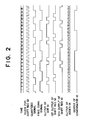
- the waveforms shown below the time scale are, from top to bottom: the clock that drives the shift register 53; the output of the limiter amplifier 10 (the two-value quantized received signal); the signal for frequency conversion (the frequency conversion signal); the output of the exclusive OR element 51; the first bit of the shift register 53; the fifth bit of the shift register 53, the output of the adder 54 (the inserted numbers representing the values of the output); and the output of the comparator 55. It is assumed that all the five bits of the shift register 53 are at logical "0" at time "1".
- the frequency of the clock driving the shift register 53 be f 0 Hz.
- the frequency f 1 of the two-value quantized received signal (the output of the limiter amplifier 10 supplied to the frequency converter 50) and the frequency f 2 of the signal for frequency conversion are given by:
- the frequency f 3 of the output of the frequency converter 50 (the received signal after frequency conversion)
- the frequency f 1 of the output of the limiter amplifier 10 (the two-value quantized received signal)
- the frequency f 2 of the signal for frequency conversion satisfy:
- the waveforms of the two-value quantized received signal and the frequency conversion signal (the signal for frequency conversion) can be interchanged without affecting the waveforms of the output waveforms of the exclusive OR element 51, the shift register 53, the adder 54 and the comparator 55.
- the frequency f o of the clock for the shift register 53, the frequency f 1 of the two-value quantized received signal, and the frequency f 2 of the signal for frequency conversion satisfy:
- the frequency f 3 of the received signal after frequency conversion are expressed in terms of the frequencies f 1 and f 2 as follows:
- the output of the exclusive OR element 51 includes a high frequency variation component at fo/2 Hz.
- the output of the comparator 55 does not include variation components at such high frequency.
- the shift average generator 52 consisting of the shift register 53 and the adder 54, and the comparator 55 acting as the judgment means for converting the output of the shift average generator 52 into a two-valued logical signal, function together as a low pass filter for removing the high frequency components from the output of the exclusive OR element 51.
- the output of the frequency converter 50 (the received signal after the frequency conversion) is supplied to the phase comparator 60.
- the exclusive OR element 61 effects the exclusive OR operation upon the received signal after the frequency conversion and the phase reference signal which is a two-valued signal taking either the logical "0" or "1".
- the exclusive OR element 61 acts as a multiplier for multiplying the received signal after the frequency conversion by the phase reference signal.
- the duration during which the output of the exclusive OR element 61 is continuously sustained at the logical "1" " is proportional to the absolute value of the phase shift of the received signal after the frequency conversion relative to the phase reference signal.
- Fig. 3 is a timing chart showing the waveforms of the phase reference signal, the received signal after the frequency conversion, and the output of the exclusive OR element 61 of Fig. 1, in the two cases where the received signal after frequency conversion is advanced (shown above) and delayed (shown below) with respect to the phase reference signal.
- the absolute value of the phase shift of the received signal after frequency conversion relative to the phase reference signal is expressed in terms of: the length of time 7 between the leading or trailing edges of the received signal after frequency conversion and the phase reference signal; and the period T of the phase reference signal. Namely, the absolute value of the phase shift is expressed as follows:
- the time 7 between the leading or the trailing edges of the phase reference signal and the received signal after frequency conversion is equal to the time during which the output of the exclusive OR element 61 is continuously sustained at logical "1".
- the duration by which the output of the exclusive OR element 61 is sustained at logical "1" " is proportional to the absolute value of the phase shift of the received signal after frequency conversion relative to the phase reference signal. Consequently, the absolute value of the phase shift of the received signal after frequency converter relative to the phase reference signal can be determined by measuring the duration in which the output of the exclusive OR element 61 is continuously sustained at logical "1".
- the output of the exclusive OR element 61 is supplied to the absolute phase shift measurement means 62, where the adder 63 adds the outputs of the exclusive OR element 61 and the D flip-flop array 64, the output of the adder 63 being supplied to the D flip-flop array 64 and the D flip-flop array 65.
- the frequency of the clock which drives the D flip-flop array 64 is selected at M times the frequency of the phase reference signal, where M is an even number not less than four.
- the D flip-flop array 64 acts as a delay element for storing the output of the adder 63.
- the output of adder 63 is incremented by one over each period of the clock of the D flip-flop array 64.
- the output of the adder 63 remains constant.
- the output of the adder 63 is also input to the D flip-flop array 65.
- the frequency of the clock of the D flip-flop array 65 is two times that of the phase reference signal, the leading edges of the clock of the D flip-flop array 65 coinciding with the leading or the trailing edges of the phase reference signal.
- the D flip-flop array 64 is reset at the rising edge of the clock for the D flip-flop array 65. Namely, the D flip-flop array 64 is reset at each half period of the phase reference signal.
- the output of the D flip-flop array 65 is thus equal to the integral part of the duration of logical "1" " of the output of the exclusive OR element 61 during each half period of the phase reference signal, as measured by the periods of the clock of the D flip-flop array 64. Namely, the output of the D flip-flop array 65 is obtained by dividing the duration of the logical "1" " of the exclusive OR element 61 by the length of the period of the clock of the D flip-flop array 64 and then discarding the fractional part of the quotient resulting from the division.
- Fig. 5 is a timing chart showing the same waveforms as those of Fig. 4, occurring when the received signal after the frequency conversion is delayed relative to the phase reference signal. In Figs.
- the numbers shows at the last three waveforms are the values thereof at respective time intervals.
- the frequency of the clock of the D flip-flop array 65 is two times that of the clock of the phase reference signal. Further, the D flip-flop array 64 is reset at respective leading edges of the clock of the D flip-flop array 65. Furthermore, as described above, the output of the D flip-flop array 65 is obtained by normalizing the duration of the logical "1" " of the exclusive OR element 61 during each half period of the phase reference signal by the length of the period of the clock of the D flip-flop array 64 and then discarding the fractional parts of the normalized value.
- the value of the output of the D flip-flop array 65 be represented by ⁇ , where ⁇ is an integer ranging from 0 to M/2 ( u ⁇ ⁇ 0, 1, ..., M/2 ⁇ ). Then, the following relationship holds among: the output u of the D flip-flop array 65, the ratio M of the frequency of the clock of the D flip-flop array 64 to the frequency of the clock of the phase reference signal, and the absolute value of the phase shift of the received signal after frequency conversion relative to the phase reference signal:
- the value ⁇ of the output of the absolute phase shift measurement means 62 is approximately equal to the absolute value of the phase shift of the received signal after frequency conversion relative to the phase reference signal, and the error is not greater than ⁇ 7 r/M.
- the measurement error of the absolute value of the phase shift can be reduced arbitrarily.
- the absolute value of the phase shift of the received signal after the frequency conversion relative to the phase reference signal is thus measured by the absolute phase shift measurement means 62. If the sign bit representing the positive or the negative sign is added to the measurement value ⁇ in correspondence with the phase delay or the phase advance of the received signal after the frequency conversion relative to the phase reference signal, then the phase shift of the received signal after frequency conversion relative to the phase reference signal can adequately be represented.
- the value of the output of the exclusive OR element 61 at each leading edge of the clock of the D flip-flop array 65 corresponds to the delay or the advance of the phase of the received signal after frequency conversion relative to the phase reference signal.
- the output of the exclusive OR element 61 is supplied to the D flip-flop 66 which is driven by the same clock as the D flip-flop array 65, such that the output of the D flip-flop 66 represents whether the phase of the received signal after frequency conversion is delayed or advanced relative to the phase reference signal.
- Fig. 6 is a timing chart showing the waveforms related to the operation of the D flip-flop 66 of Fig. 1. From top to bottom in Fig. 6, are shown the waveforms of: the clock for driving the D flip-flop 66; the phase reference signal; the received signal after frequency conversion; the output of the exclusive OR element 61; and the output of the D flip-flop 66.
- the clock of the D flip-flop 66 is the same as the clock of the D flip-flop array 65. Namely, the frequency of the clock of the D flip-flop 66 is two times that of the phase reference signal, the leading edges of the clock of the D flip-flop 66 coinciding with the leading or the trailing edges of the phase reference signal.
- the D flip-flop 66 judges at the edge of each half period of the phase reference signal whether the received signal after frequency conversion is delayed or advanced relative to the phase reference signal.
- the output of the D flip-flop 66 constitutes the sign bit representing the polarity of the phase shift of the received signal after frequency conversion relative to the phase reference signal.
- the output of the D flip-flop 66 is combined with the output of the absolute phase shift measurement means 62 to form together the output of the phase comparator 60.
- the output of the phase comparator 60 is a combination of the outputs of the absolute phase shift measurement means 62 and the D flip-flop 66.
- the output of the phase comparator 60 is the relative phase signal which represents absolute value of the phase shift of the received signal after frequency conversion relative to the phase reference signal.
- the relative phase signal output from the phase comparator 60 is delayed by the delay element 40 by one symbol period of the received signal, and thence is supplied to the subtractor 41.
- the relative phase signal is also supplied to the subtractor 41 of modulo 2-ff.
- the subtractor 41 Upon receiving the outputs of the phase comparator 60 and the delay element 40, the subtractor 41 subtracts, in modulo 2 7 r, the output of the delay element 40 from the output of the phase comparator 60, and thereby obtains the inter-symbol phase difference signal, which represents the phase transition over each symbol period of the received signal.
- the inter-symbol phase difference signal output from the subtractor 41 is supplied to the judgment circuit 42.
- the judgment circuit 42 obtains the demodulated data corresponding to the value of the inter-symbol phase difference signal, on the basis of the predetermined correspondence relationship between the inter-symbol phase difference signal and the demodulated data.
- the constant n may be any positive integer.
- Fig. 7 is a block diagram showing the circuit structure of another delayed detection type demodulator according to this invention.
- the circuit is similar to that of Fig. 1 except for the structure of the shift average generator 52a of the frequency converter 50a.
- the shift average generator 52a includes: a shift register 53a provided with (2n + 2) stages (first through (2n + 2)th stages to hold respective bits), where n is a positive integer and the bits are sequentially shifted from the first toward the (2n + 2)th bit in synchronism with the clock of the shift register 53a; and an adder 54a for adding the first bit of the shift register 53a and the outputs of a sign invertor 56 and a D flip-flop 57.
- the sign invertor 56 inverts the polarity of the (2n + 2)th bit of the shift register 53a and supplies the result to the adder 54a.
- the D flip-flop 57 coupled to the output of the adder 54a serves as a delay element for storing the output of the adder 54a. The output of the D flip-flop 57 is supplied to the adder 54a.
- the limiter amplifier 10 quantizes the received signal into a two-value quantized signal taking either the logical "0" or "1".
- the two-value quantized received signal output from the limiter amplifier 10 is supplied to the frequency converter 50a, in which the exclusive OR element 51 effects logical exclusive OR operation upon the output of the limiter amplifier 10 (the two-value quantized received signal) and the signal for frequency conversion (the frequency conversion signal) which also takes either the logical value "0" or "1".
- the exclusive OR element 51 acts as a multiplier for multiplying the output of the limiter amplifier 10 (the two-value quantized received signal) by the signal for frequency conversion.
- the output of the exclusive OR element 51 is supplied to the first stage of the shift register 53a, from whence it is shifted toward the (2n + 2)th stage in synchronism with the clock of the shift register 53a.
- the frequency of the clock of the shift register 53a is substantially greater than the frequencies of the two-value quantized received signal and the signal for frequency conversion.
- the first bit of the shift register 53a is input to the adder 54a.
- the (2n + 2)th bit of the shift register 53a is input to the sign invertor 56, where the sign or polarity thereof is inverted and thence supplied to the adder 54a.
- the output of the D flip-flop 57 is also supplied to the adder 54a.
- the adder 54a adds the first bit of the shift register 53a, the output of the sign invertor 56, and the output of the D flip-flop 57, and outputs the result to the D flip-flop 57.
- the D flip-flop 57 serves as the delay element for storing the output of the adder 54a.
- the clock of the D flip-flop 57 be the same as that of the shift register 53a.
- the sign invertor 56 inverts the polarity of the (2n + 2)th bit output from the shift register 53a.
- the output s i of the D flip-flop 57 for 1 ⁇ i ⁇ 2n + 1 is thus expressed as:
- the value s 2n+1 is equal to (2n + 1) times the average of the preceding (2n + 1) output values aoo, a 01 , ..., a 0(2n) , of the exclusive OR element 51. From this it can be shown that the following relation holds for t (2n + 1) T c :
- the output s i of the D flip-flop 57 is equal to (2n + 1) times the average of preceding (2n + 1) output values, a 0(i-2n-1) , a 0(i-2n), ..., a 0(i-1) , of the exclusive OR element 51.
- This output s i of the D flip-flop 57 constitutes the output of the shift average generator 52a.
- the shift average generator 52A functions similarly to the shift average generator 52 of Fig. 1.
- the number of the signals input to the adder 54a is three, irrespective of the number of the stages of the shift register 53a.
- the number of signals input to the adder 54 is equal to the number of stages, (2n + 1), of the shift register 53. Since n is greater than one (n 1) and hence (2n + 1) ⁇ 3, the number of signals input to the adder 54a is not greater than (and generally substantially less than) the number of signals input to the adder 54 in the circuit of Fig. 1.
- the circuit of the embodiment of Fig. 7 is simplified.
- the output of the shift average generator 52a is supplied to the comparator 55.
- the comparator 55 compares the output of the shift average generator 52a with the constant n. Depending on the value s i of the output of the shift average generator 52a and the constant n, the value d i of the output signal of the comparator 55 is given as follows:
- the comparator 55 acts as a judgment means for converting the output s i of the shift average generator 52a into a two-valued signal which takes either the logical value "0" or "1".
- the signal processing within the frequency converter 50a subsequent to the shift average generator 52a is identical to that subsequent to the shift average generator 52 in Fig. 1.
- the shift average generator 52a acts in a similar manner as the shift average generator 52 of Fig. 1.
- the shift average generator 52a consisting of the shift register 53a, the adder 54a, the sign invertor 56, and the D flip-flop 57, and the comparator 55 acting as the judgment means for converting the output of the shift average generator 52a into a two-valued logical signal, function as a low pass filter for removing the high frequency components from the output of the exclusive OR element 51.
- the two-value quantized received signal output from the limiter amplifier 10 is subjected to the frequency conversion by means of the signal processing within the frequency converter 50a. Namely, if the frequency of the two-value quantized received signal is represented by f 1 Hz and that of the signal for frequency conversion by f 2 Hz, then the frequency of the received signal after frequency conversion output from the comparator 55 is
- the received signal after frequency conversion output from the frequency converter 50a is supplied to the phase comparator 60, which is the same as in Fig. 1.
- the phase comparator 60 outputs the relative phase signal representing the phase shift of the received signal after frequency conversion relative to the phase reference signal.
- the relative phase signal output from the phase comparator 60 is delayed by the delay element 40 by one symbol period of the received signal.
- the relative phase signal is input to the subtractor 41, to which the relative phase signal delayed by one symbol period by the delay element 40 is also input.
- the subtractor 41 In response to the outputs of the phase comparator 60 and the delay element 40, the subtractor 41 outputs the inter-symbol phase difference signal which is obtained by subtracting in modulo 2 7 r the relative phase signal delayed by one symbol period from the relative phase signal output from the phase comparator 60.
- the inter-symbol phase difference signal output from the subtractor 41 represents the phase transition over one symbol period of the received signal.
- the judgment circuit 42 obtains the demodulated data corresponding to the value of the inter-symbol phase difference signal, on the basis of the predetermined correspondence relationship between the inter-symbol phase difference signal and the demodulated data.
- circuit of Fig. 7 relates to the case where the received signal is modulated in accordance with the differential phase shift keying (DPSK).
- DPSK differential phase shift keying
- a delayed detection type demodulator using a phase detection circuit is described.
- a digital delayed detection type demodulator using a phase detection circuit is disclosed, for example, in H. Tomita et al., "DIGITAL INTERMEDIATE FREQUENCY DEMODULATION TECHNIQUE", Paper B-299, 1990 Fall National Convention of Electronic Information Communication Association of Japan.
- the delayed detection type demodulator is described by reference to drawings.
- Fig. 9 is a block diagram showing the structure of a digital delayed detection type demodulator provided with a phase detection circuit.
- the received signal is supplied to a limiter amplifier 10.
- the output of the limiter amplifier 10 is coupled to a phase detection circuit 200 including: a counter 201 counting in modulo K, where K is a positive integer; and a D flip-flop array 202.
- the output of the phase detection circuit 200 is coupled to: a delay element 40 having a delay time equal to the one symbol period of the received signal; and a subtractor 41 effecting subtraction in modulo 2-ff.
- the received signal which is a differential phase shift keying (DPSK) signal
- DPSK differential phase shift keying
- the limiter amplifier 10 acts as a quantizer for effecting two-value quantization upon the received signal.
- the received signal is quantized by the limiter amplifier 10 into a two-valued signal taking the value either at the logical "0" or logical "1".
- the counter 201 of modulo K within the phase detection circuit 200 is driven by a clock having a frequency substantially equal to K times the frequency of the received signal.
- the output of the counter 201 is supplied to the D flip-flop array 202, which is driven (i.e., reset) by the two-value quantized received signal output from the limiter amplifier 10.
- the output of the phase detection circuit 200 thus represents the relative phase of the two-value quantized received signal with respect to a virtual phase reference signal.
- Fig. 10 are shown, from top to bottom, the waveforms of: the clock for driving the counter 201; the output of the counter 201; the virtual phase reference signal, which is obtained by demultiplying the clock of the counter 201 by K (equal to 16 in this case); the two-value quantized received signal; and the output of the D flip-flop array 202. From top to bottom in Fig.
- the virtual phase reference signal rises to logical "1" " at the instant when the output of the counter 201 is reset to logical "0", and falls to logical "0" at the instant when the output of the counter 201 reaches K/2 (equal to 8 in this case). If the period of the clock of the counter 201 is represented by T and that of the virtual phase reference signal T" then:
- the output of the counter 201 at the leading edge of the two-value quantized received signal is equal to an integer obtained by dividing the time 7 by the period T of the clock of the counter 201 and then discarding the fractional parts of the quotient.
- the D flip-flop array 202 is reset at each leading edge of the two-value quantized received signal to hold the output of the counter 201.
- the output of the D flip-flop array 202 is equal to the integer obtained by dividing the shift time 7 by the period T of the clock of the counter 201 and then discarding the fractional parts of the quotient resulting from the division. Namely, if the output of the D flip-flop array 202 is represented by ⁇ , where u ⁇ ⁇ 0, 1, ..., K - 1 ⁇ , then the following relation holds among ⁇ , T and T :
- Fig. 10 shows the case where the relative phase of the two-value quantized received signal with respect to the virtual phase reference signal is constant.
- the output of the D flip-flop array 202 remains at eight (8).
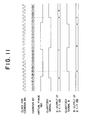
- Fig. 11 shows the case where the relative phase signal of the two-value quantized received signal A is increasingly delayed and the relative phase signal of the two-value quantized received signal B is increasingly advanced.
- the output A of the D flip-flop array 202 increases from seven (7) to nine (9).
- the output B of the D flip-flop array 202 decreases from nine (9) to seven (7). In either case, the output of the D flip-flop array 202 varies in proportion to the variation of the relative phase of the two-value quantized received signal with respect to the virtual phase reference signal.
- the phase detection circuit of Fig. 9 has the following disadvantage.
- the D flip-flop array 202 is driven only at the leading edges of the two-value quantized received signal.
- the relative phase signal output from the phase detection circuit is updated only at each full period of the two-value quantized received signal.
- the value of the relative phase of the two-value quantized received signal can be updated two times for each period of the two-value quantized received signal.
- the phase detection circuit of Fig. 9 has the disadvantage that the rate at which the relative phase signal is updated is low.
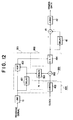
- Fig. 12 is a block diagram of a delayed detection type demodulator provided with a phase detection circuit according to this invention, by which the value of the relative phase of the two-value quantized received signal with respect to the virtual phase reference signal can be updated two times for each period of the two-value quantized received signal.
- the output of limiter amplifier 10 is coupled to a phase detection circuit 400 which includes: a delay element 401 and an exclusive OR element 402 coupled to the limiter amplifier 10; a modulo 2N counter 403 for counting in modulo N, where N is a positive integer; a D flip-flop array 404; and a phase inversion corrector 500.
- the phase inversion corrector 500 includes: a multiplier 501 and an adder 502 for effecting addition in modulo 2N.
- the phase detection circuit 400 is divided into a half-period detector means 901, a phase reference signal generator means 902 and a phase shift determiner means 903.
- the half-period detector means 901 consists of the delay element 401 and the exclusive OR element 402.
- the half-period detector means 901 Upon receiving an input signal of predetermined period from the limiter amplifier 10, the half-period detector means 901 outputs a half-period detection signal at each half-period of the input signal.
- the phase reference signal generator means 902 consists of the modulo 2N counter 403.
- the phase reference signal generator means 902 On the basis of a clock having a frequency not less than twice the frequency of the input signal, the phase reference signal generator means 902 generates the phase reference signal serving as the reference for determining the phase shift of the two-value quantized received signal.
- a phase shift determiner means 903 consists of the D flip-flop array 404 and the phase inversion corrector 500.
- the phase inversion corrector 500 corrects the phase inversion of the phase reference signal at each half-period of the input signal.
- the phase shift determiner means 903 determines and outputs the phase shift of the half-period detection signal relative to the phase reference signal at each half-period of the input signal.
- the delay element 40, subtractor 41, and the judgment circuit 42 are similar to those described above.
- the limiter amplifier 10 shapes the received signal into a rectangular waveform of a constant amplitude. Namely, the limiter amplifier 10 acts as a two-valued quantizer for subjecting the received signal to the two-value quantization, such that the output of the limiter amplifier 10 is quantized to logical "0" and "1".
- the two-value quantized received signal output from the limiter amplifier 10 is supplied to the phase detection circuit 400, where it is first input to the delay element 401.
- the delay time of the delay element 401 is shorter than the half-period of the two-value quantized received signal.
- the delayed received signal output from the delay element 401 is supplied to the exclusive OR element 402, together with the two-value quantized received signal output from the limiter amplifier 10.
- the exclusive OR element 402 effects the logical exclusive OR operation upon the outputs of the limiter amplifier 10 and the delay element 401.
- the output of the exclusive OR element 402 is a pulse signal (referred to as the differential pulse signal) which rises (i.e., has leading edges) at the leading and the tailing edges of the two-value quantized received signal.
- Fig. 13 is a timing chart showing waveforms exemplifying the operation of the delay element 401 and the exclusive OR element 402 of Fig. 12. From top to bottom in Fig. 13 are shown the waveforms of: the two-value quantized received signal; the output of the delay element 401; and the output of the exclusive OR element 402 (the differential pulse signal).
- the delay time of the delay element 401 namely the time length by which the two-value quantized received signal is delayed, is shorter than the half-period of the two-value quantized received signal.
- the differential pulse signal output from the exclusive OR element 402 rises (i.e., has the leading edges) at the leading and the trailing edges of the two-value quantized received signal.
- the modulo 2N counter 403 is driven by a clock having a frequency substantially equal to 2N times the frequency of the two-value quantized received signal. If a virtual phase reference signal similar to that of Fig. 9 is assumed which is obtained by demultiplying the clock signal of the modulo 2N counter 403 by 2N, the virtual phase reference signal rises (i.e., has the leading edge) at the instant when the output of the modulo 2N counter 403 is reset to "0", and falls (i.e., has the trailing edge) at the instant when the output of the modulo 2N counter 403 reaches N. The output of the modulo 2N counter 403 represents the phase of this virtual phase reference signal.
- the output of the modulo 2N counter 403 at each leading edge of the differential pulse signal output from the exclusive OR element 402 represents the phase of the virtual phase reference signal at the leading or the trailing edge of the two-value quantized received signal.
- the absolute phase of the two-value quantized received signal at the trailing edge thereof is equal to 7 r.
- phase shift of the two-value quantized received signal relative to the virtual phase reference signal is given by:
- ⁇ 1 is equal to an integer obtained by first normalizing (i.e., dividing) the time T , between the leading edges of the virtual phase reference signal and the two-value quantized received signal, by the period T of the modulo 2N counter 403 and then discarding the fractional part of the quotient resulting from the division.
- T and ⁇ the following relation holds among ⁇ 1 , T and ⁇ :
- N 8 in the case of Fig. 14
- the output of the modulo 2N counter 403 at a trailing edge of the two-value quantized received signal be represented by ⁇ 2 , where ⁇ 2 E ⁇ 0, 1, ... , 2N-1 ⁇ .
- ⁇ 2 is equal to an integer obtained by: first normalizing (i.e., dividing) the time 7 between the trailing edges of the virtual phase reference signal and the two-value quantized received signal by the period Y of the modulo 2N counter 403; then discarding the fractional part of the quotient resulting from the division; and finally adding numerical value "N" to the quotient.
- the output ⁇ 1 of the modulo 2N counter 403 at the leading edge of the two-value quantized received signal and the value obtained by adding numerical value "N" in modulo 2N to the output ⁇ 2 of the modulo 2N counter 403 at the trailing edge of the two-value quantized received signal can be regarded as representing the relative phase of the two-value quantized received signal with respect to the virtual phase reference signal.
- the relative phase of the two-value quantized received signal can be obtained by correcting the output of the modulo 2N counter 403, i.e., by adding the numerical value "0" at the leading edge, and the numerical value "N" at the trailing edge, of the two-value quantized received signal.
- the phase inversion corrector 500 effects this correction for the output of the modulo 2N counter 403. Namely, upon receiving the output of the modulo 2N counter 403, the phase inversion corrector 500 adds to it the numerical value "0" at the leading edge, and the numerical value "N" at the trailing edge, of the two-value quantized received signal. Next, the operation of the phase inversion corrector 500 is described by reference to drawings.
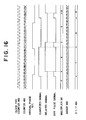
- Fig. 16 is a view similar to that of Fig. 15, but showing the case where the relative phase of the two-value quantized received signal with respect to the virtual phase reference signal is increasingly delayed.
- Fig. 17 is a view similar to that of Fig. 15, but showing the case where the relative phase of the two-value quantized received signal with respect to the virtual phase reference signal is increasingly advanced.
- the value of the delayed received signal output from the delay element 401 is at logical "0" at the leading edge, and at logical “1" " at the trailing edge, of the two-value quantized received signal.
- the multiplier 501 multiplies output of the delay element 401 by N, thereby outputting the numerical value "0" at the leading edge, and the numerical value "N” at the trailing edge, of the two-value quantized received signal.
- the adder 502 adds in modulo 2N the outputs of the modulo 2N counter 403 and the multiplier 501, thereby obtaining the output of the phase inversion corrector 500.
- the output of the phase inversion corrector 500 is equal to the output of the modulo 2N counter 403 at the leading edge of the two-value quantized received signal.
- the output of the phase inversion corrector 500 is equal to the value obtained by adding in modulo 2N the numerical value "N" to the output of the modulo 2N counter 403, at the trailing edge of the two-value quantized received signal.
- the output of the phase inversion corrector 500 is supplied to the D flip-flop array 404, which is driven (i.e., reset) by the differential pulse signal output from the exclusive OR element 402.
- the differential pulse signal has leading edges at the leading and trailing edges of the two-value quantized received signal.
- the D flip-flop array 404 is reset at each leading and trailing edge of the two-value quantized received signal.
- ⁇ the output of the D flip-flop array 404 is represented by ⁇ , then 11. is expressed in terms of the output values ⁇ 1 and Q 2 of the modulo 2N counter 403 at the leading and the trailing edges, respectively:
- the output of the D flip-flop array 202 representing the relative phase of the two-value quantized received signal is updated only once for each period of the two-value quantized received signal.
- the D flip-flop array 404 is driven by the differential pulse signal at the leading and the trailing edges of the two-value quantized received signal.
- the output of the D flip-flop array 404 representing the relative phase of the two-value quantized received signal is updated twice for each period of the two-value quantized received signal.
- the updating rate of the relative phase signal is thereby doubled. This can be easily comprehended by comparing Fig. 15 with Fig. 10 and Figs. 16 and 17 with Fig. 11.
- the two-value quantized received signal A of Fig. 11 and the two-value quantized received signal of Fig. 16 are the same.
- the output A of the D flip-flop array 202 in Fig. 11 varies from “7” to “9”, while the output of the D flip-flop array 404 in Fig. 16 varies gradually from “7” to "8” to "9”.
- the two-value quantized received signal B of Fig. 11 and the two-value quantized received signal of Fig. 17 are the same.
- the output B of the D flip-flop array 202 in Fig. 11 varies from "9” to "7”
- the output of the D flip-flop array 404 in Fig. 17 varies gradually from “9” to "8” to "7”.
- the updating rate of the relative phase signal is doubled for the circuit of Fig. 12, and hence the variation of the value of the relative phase signal is rendered less abrupt.
- the phase inversion corrector 500 consists of the multiplier 501 and the adder 502.
- the element corresponding to the multiplier 501 may be implemented by any circuit which outputs numerical value "0" upon receiving numerical value "0", and numerical value "N” upon receiving numerical value "1".
- Such element may be implemented by a data selector which selects and outputs numerical value "0” upon receiving numerical value "0", and numerical value "N” upon receiving numerical value "1”.
- the phase inversion corrector 500 may consist of logical product elements (AND gates) for effecting logical product operations (AND operations) upon the respective bits of the numerical value "N" and the output of the delay element 401.
- the above description relates to the case where the received signal is modulated in accordance with the differential phase shift keying (DPSK).
- DPSK differential phase shift keying
- the constant N may be any positive integer.
- Fig. 18 is a block diagram of another delayed detection type demodulator provided with a phase detection circuit according to this invention, by which the value of the relative phase of the two-value quantized received signal with respect to the virtual phase reference signal can be updated two times for each period of the two-value quantized received signal.
- the phase detection circuit 400a is functionally divided into: a half-period detector means 901 consisting of the delay element 401 and the exclusive OR element 402; a phase reference signal generator means 902 consisting of the modulo 2M counter 403a, where M is a positive integer; and a phase shift determiner means 903 consisting of the D flip-flop array 404a and a phase inversion corrector 500a.
- the phase inversion corrector 500a consists of an exclusive OR element 503 having inputs coupled to the output of the delay element 401 and the most significant bit (MSB) of the output of the modulo 2M counter 403a.
- the combination of the least significant bits (namely the first through (M- I)th bit of the modulo 2M counter 403a) and the output of the exclusive OR element 503 is input to the D flip-flop array 404a. Otherwise the circuit of Fig. 18 is similar to the circuit of Fig. 12.
- the limiter amplifier 10 shapes the received signal into a rectangular waveform of a constant amplitude. Namely, the limiter amplifier 10 acts as a two-valued quantizer for subjecting the received signal to the two-value quantization, such that the output of the limiter amplifier 10 is quantized to logical "0" and "1".
- the two-value quantized received signal output from the limiter amplifier 10 is supplied to the phase detection circuit 400a, where it is first input to the delay element 401 and the exclusive OR element 402.
- the delay time of the delay element 401 is shorter than the half-period of the two-value quantized received signal.
- the delayed received signal output from the delay element 401 is supplied to-the exclusive OR element 402.
- the exclusive OR element 402 effects the logical exclusive OR operation upon the outputs of the limiter amplifier 10 and the delay element 401.
- the output of the exclusive OR element 402 is a pulse signal (referred to as the differential pulse signal) which rises (i.e., has leading edges) at the leading and the tailing edges of the two-value quantized received signal.
- the modulo 2M counter 403a is driven by a clock having a frequency substantially equal to 2 m times the frequency of the two-value quantized received signal, where M is a positive integer. If a virtual phase reference signal similar to that of Fig. 9 is assumed which is obtained by demultiplying the clock signal of the modulo 2 M counted 403a by 2M, the virtual phase reference signal rises (i.e., has the leading edge) at the instant when the output of the modulo 2 M counter 403a is reset to "0", and falls (i.e., has the trailing edge) at the instant when the output of the modulo 2 M counter 403a reaches 2 M-1 . The output of the modulo 2 M counter 403a represents the phase of this virtual phase reference signal.
- the output of the modulo 2 M counter 403a at each leading edge of the differential pulse signal output from the exclusive OR element 402 represents the phase of the virtual phase reference signal at the leading or the trailing edge of the two-value quantized received signal.
- the absolute phase of the two-value quantized received signal at the trailing edge thereof is equal to ⁇ .
- the phase inversion corrector 500a effects this correction for the output of the modulo 2 M counter 403a. Namely, upon receiving the output of the modulo 2 M counter 403a, the phase inversion corrector 500a adds to it the numerical value "0" at the leading edge, and the numerical value "2 M-1 " at the trailing edge, of the two-value quantized received signal. Next, the operation of the phase inversion corrector 500a is described by reference to drawings.
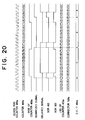
- Fig. 20 is a view similar to that of Fig. 19, but showing the case where the relative phase of the two-value quantized received signal with respect to the virtual phase reference signal is increasingly delayed.
- Fig. 21 is a view similar to that of Fig. 19, but showing the case where the relative phase of the two-value quantized received signal with respect to the virtual phase reference signal is increasingly advanced.
- the numbers at the waveforms of the modulo 2 M counter 403a, the least significant bits of the 403a, the phase inversion corrector 500a, and the D flip-flop array 404a represent the values thereof
- the output of the modulo 2 M counter 403a consists of M bits.
- the most significant bit of the modulo 2 M counter 403a represents the the numerical value 2 M-1 .
- adding the numerical value 2 M-1 to the output of the modulo 2 M counter 403a in modulo 2M is equivalent to logical inversion of the most significant bit of the modulo 2 M counter 403a.
- adding numerical value "0" and "1 ", respectively, to the output of the modulo 2 M counter 403a at the leading and the trailing edges of the two-value quantized received signal results in effecting no logical inversion at the leading edge, and the logical inversion at the trailing edge, of the two-value quantized received signal, upon the most significant bit of the modulo 2 M counter 403a.
- the value of the delayed received signal output from the delay element 401 is at logical "0" at the leading edge, and at logical "1" " at the trailing edge, of the two-value quantized received signal.
- the exclusive OR element 503 effects the logical exclusive OR operation upon the delayed received signal output from the delay element 401 and the most significant bit of the output from the modulo 2 M counter 403a.
- the output of the 503 is combined as the new most significant bit with the least significant bits (the first through (M - 1)th bits) of the modulo 2 M counter 403a, to form the output of the phase inversion corrector 500a.
- the output of the phase inversion corrector 500a is equal to the output of the modulo 2 M counter 403a at the leading edges of the two-value quantized received signal (no logical inversion of the most significant bit is effected).
- the output of the phase inversion corrector 500a at the trailing edges of the two-value quantized received signal consists of the logically inverted most significant bit of the modulo 2 M counter 403a combined with the least significant bits thereof.
- the output of the phase inversion corrector 500a is equal to the value obtained by adding numerical value "0" at the leading edge, and numerical value "2 M-1 " at the trailing edge, of the two-value quantized received signal, to the output of the modulo 2 M counter 403a.
- the phase inversion corrector 500a can be implemented only by the exclusive OR element 503.
- the circuit of Fig. 18 is simplified compared to the circuit of Fig. 12.
- the output of the phase inversion corrector 500a is supplied to the D flip-flop array 404a, which is driven (i.e., reset) by the differential pulse signal output from the exclusive OR element 402.
- the differential pulse signal has leading edges at the leading and trailing edges of the two-value quantized received signal.
- the D flip-flop array 404a is reset at each leading and trailing edge of the two-value quantized received signal.
- ⁇ is expressed in terms of the output values ⁇ 1 and ⁇ 2 ( ⁇ 1 , ⁇ 2 E ⁇ 0, 1, ... , 2 M - 11) of the modulo 2 M counter 403a at the leading and the trailing edges, respectively:
- the D flip-flop array 404a of Fig. 18 is driven by the differential pulse signal at the leading and the trailing edges of the two-value quantized received signal
- the output of the D flip-flop array 404a representing the relative phase of the two-value quantized received signal is updated twice for each period of the two-value quantized received signal.
- the updating rate of the relative phase signal is thereby doubled compared to the case of Fig. 9. This can be easily comprehended by comparing Fig. 19 with Fig. 10 and Figs. 20 and 21 with Fig. 11.
- the two-value quantized received signal A of Fig. 11 and the two-value quantized received signal of Fig. 20 are the same.
- the output A of the D flip-flop array 202 in Fig. 11 varies from “7” to “9”, while the output of the D flip-flop array 404a in Fig. 20 varies gradually from “7” to "8” to “9”.
- the two-value quantized received signal B of Fig. 11 and the two-value quantized received signal of Fig. 21 are the same.
- the output B of the D flip-flop array 202 in Fig. 11 varies from “9” to "7”
- the output of the D flip-flop array 404a in Fig. 21 varies gradually from “9” to "8” to "7”.
- the updating rate of the relative phase signal is doubled for the circuit of Fig. 12, and hence the variation of the value of the relative phase signal is rendered less abrupt.
- the above description relates to the case where the received signal is modulated in accordance with the differential phase shift keying (DPSK).
- DPSK differential phase shift keying
- the principle embodied in the circuit of Fig. 18 can be applied to MSK or GMSK modulation systems.
- the constant M may be any positive integer.
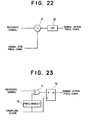
- Fig. 22 recapitulates the frequency converter 20 of Fig. 8.
- the received signal having a frequency f 1 Hz is multiplied by the signal for frequency conversion (the frequency conversion signal) having a frequency f 2 Hz, where:
- the output of the multiplier 21 includes frequency components at f 1 + f 2 Hz and
- the output of the multiplier 21 is supplied to the low pass filter 22.
- the low pass filter 22 passes only the low frequency component at
- the low pass filter 22 outputs a signal at
- f 1 - f 2 Hz of the converted signal output from the low pass filter 22 is less than the frequency f 1 Hz of the received signal.
- the frequency converter of Fig. 22 uses a low pass filter 22 for removing the high frequency components.
- the low pass filter 22 generally has a complicated structure and tends to be large- sized and consumes power.
- Fig. 23 is a block diagram showing an alternate structure of the frequency converter according to this invention.
- the output of the exclusive OR element 71 functioning as a multiplier and having an input for the received signal is coupled to the D-input of a D flip-flop 72 serving as a sampler.
- the sampling clock driving the D flip-flop 72 is demultiplied by two by a frequency demultiplier 73 and thence supplied to the other input of the exclusive OR element 71.
- the frequency demultiplier 73 demultiplies the sampling clock by two and outputs the demultiplied clock signal to the exclusive OR element 71 as the signal for frequency conversion (the frequency conversion signal). Namely, if the frequency of the sampling clock is represented by f, Hz, then the frequency of the frequency conversion signal is f s /2 Hz.
- the received signal input to the exclusive OR element 71 is a two-valued digital signal taking either the logical "0" or logical "1". As in the case of the circuit of Fig. 22, the following relation holds between the frequency f 1 Hz of the received signal and the frequency f s /2 of the frequency conversion signal:
- the exclusive OR element 71 effects the logical exclusive OR operation upon the received signal and the output of the frequency demultiplier 73, both of which are logical two-valued signals. If the logical "0" and the logical "1" are converted into the numerical values " 1" and "- 1", respectively, the logical exclusive OR operation is converted to the multiplication operation of the numerical values.
- the exclusive OR element 71 acts as a multiplier for multiplying the received signal by the frequency conversion signal output from the frequency demultiplier 73.
- the output of the exclusive OR element 71 is a multiplication of the received signal at frequency f 1 Hz by the frequency conversion signal at frequency f s /2 Hz. Consequently, the output of the exclusive OR element 51 includes components at frequency f 1 + f s /2 Hz and
- the output of the exclusive OR element 71 is supplied to the D flip-flop 72. Since the D flip-flop 72 is driven by the sampling clock at frequency f s Hz, the D flip-flop 72 samples the output off the exclusive OR element 51 at f s Hz. It is assumed here that:
- a signal at a frequency F Hz is input to the D flip-flop 72, where the frequency F Hz satisfies the relation: f s /2 ⁇ F ⁇ 3 f s /2, as does the high frequency component at f 1 + f s /2 Hz of the output of the exclusive OR element 71, then, the signal is sampled at f s Hz, or the frequency of the sampling clock driving the D flip-flop 72. Under this circumstance, the signal at a frequency higher than the Nyquist frequency of sampling is sampled. As a result, the aliasing phenomenon is observed, and a frequency component at
- the aliasing phenomenon is discussed, for example, in: M. Hino, "SPECTRAL ANALYSIS,” pp. 175 through 177, Asakura Shoten, 1977.
- the high frequency component of the output of the exclusive OR element 71 namely the component at f 1 + f s /2 Hz, appears as the frequency component at
- Hz of the output of the exclusive OR element 71 appear as the frequency component at
- the D flip-flop 72 outputs a signal consisting solely of the frequency component at
- f 1 f s /2 Hz of the output of the D flip-flop 72 is less than the frequency f 1 Hz of the received signal.
- the low pass filter of the conventional circuit of Fig. 22 can thus be dispensed with. Since the size and power consumption of a D flip-flop is smaller than those of a low pass filter, the overall size and power consumption can be reduced.
Landscapes
- Engineering & Computer Science (AREA)
- Power Engineering (AREA)
- Computer Networks & Wireless Communication (AREA)
- Signal Processing (AREA)
- Digital Transmission Methods That Use Modulated Carrier Waves (AREA)
- Manipulation Of Pulses (AREA)
Abstract
Description
- This invention relates to delayed detection type demodulators used in the radio communication systems, and more particularly to the improvements in the frequency converter and the phase comparator or the phase detection circuit used in the delayed detection type demodulators.
- A conventional delayed detection type demodulator provided with a frequency converter and a phase comparator is disclosed, for example, in Japanese Laid-Open Patent (Kokai) No. 64-12646, "DPSK demodulation system". Next, this delayed detection type demodulator is described by reference to Fig. 8.
- In Fig. 8, the
frequency converter 20 includes amultiplier 21 and alow pass filter 22. Thephase comparator 30 includes: aphase shifter 31 for shifting the phase of the local carrier (the phase reference signal) by π/2 radians; amultiplier 32 for multiplying the local carrier by the output of thelow pass filter 22; amultiplier 33 for multiplying the output of thephase shifter 31 by that of thelow pass filter 22; alow pass filter 34 for removing the high frequency components from the output of themultiplier 32; alow pass filter 35 for removing the high frequency components from the output of themultiplier 33; asampler 36 for sampling the output of thelow pass filter 34; asampler 37 for sampling the output of thelow pass filter 35; and a coordinate converter 38 for calculating and generating a relative phase signal from the outputs of thesamplers delay element 40 delays the relative phase signal by one symbol period of the received signal. Asubtractor 41 subtracts, in modulo 2π, the relative phase signal delayed by one symbol period by thedelay element 40 from the relative phase signal directly output from the coordinate converter 38. Ajudgment circuit 42 outputs the demodulated data corresponding to the values of the inter-symbol phase shift differences. - Next the operation of the circuit of Fig. 8 is described in detail. It is a common practice in the field of demodulators to convert the frequencies of the received signal to low frequencies using a frequency converter. This facilitates subsequent signal processing. The received signal is a differential phase shift keying (DPSK) signal. This received signal is input to the
frequency converter 20, where themultiplier 21 multiplies it by the signal for frequency conversion. It is assumed that the frequency of the received signal is 11 Hz and that of the frequency conversion signal f2 Hz. Then the multiplied signal output from themultiplier 21 includes a high frequency component at 11 + f2 Hz and a low frequency component at |f1 - f2 Hz. This multiplied signal output from themultiplier 21 is supplied to thelow pass filter 22, where the high frequency component is suppressed and only the low frequency component at |f1 - f2 Hz is passed. The received signal thus undergoes the frequency conversion. - After subjected to the frequency conversion by the
frequency converter 20, the received signal is processed by thephase comparator 30. Themultiplier 32 multiplies the received signal after the frequency conversion (output from the frequency converter 20) by the phase reference signal (the local carrier). Thelow pass filter 34 removes the high frequency components from the output of themultiplier 32, thereby obtaining the base band signal in phase with the local carrier (referred to as the in-phase base band signal). - The
phase shifter 31 shifts the phase of the phase reference signal or the local carrier by π/2 radians. Themultiplier 33 multiplies the received signal after the frequency conversion (output from the frequency converter 20) by the output of thephase shifter 31. Thelow pass filter 35 removes the high frequency components from the output of themultiplier 33, thereby obtaining the base band signal in quadrature with the local carrier (referred to as the quadrature base band signal). - The in-phase base band signal output from the
low pass filter 34 is sampled by thesampler 36 and supplied to the coordinate converter 38. Similarly, the quadrature base band signal output from thelow pass filter 35 is sampled by thesampler 37 and supplied to the coordinate converter 38. The coordinate converter 38 outputs the relative phase signal representing the phase shift of the received signal after frequency conversion relative to the local carrier or the phase reference signal. The value of therelative phase signal 0 is expressed by the values x and y of the sampled in-phase and quadrature base band signals as follows:
- The relative phase signal output from the coordinate converter 38 is supplied to the
subtractor 41 and thedelay element 40. At thedelay element 40 the relative phase signal is delayed by one symbol period of the received signal and then is supplied to thesubtractor 41. Thesubtractor 41 subtracts, in modulo 2π, the output of thedelay element 40 from the output of the coordinate converter 38, and thereby obtains the phase shift difference signal (abbreviated hereinafter to phase difference signal). - The phase difference signal output from the
subtractor 41 represents the phase transition over each symbol period of the received signal. Upon receiving the phase difference signal from thesubtractor 41, thejudgment circuit 42 obtains the demodulated data on the basis of the predetermined correspondence relationship between the inter-symbol phase difference signal and the demodulated data. - The above conventional delayed detection type demodulator has the following disadvantage. Since the frequency converter and the phase comparator circuits are composed of analog elements, integration of circuit elements into ICs is difficult. Thus, the adjustment or tuning of the circuits is indispensable. Further, it is difficult to reduce the size and the power consumption of the circuit.
- It is therefore an object of this invention to provide a delayed detection type demodulator provided with a frequency converter and a phase comparator consisting of digital circuit elements, such that the circuit can easily be integrated into ICs and hence the adjustment step of the circuits can be dispensed with and the size and the power consumption can be reduced.
- The above object is accomplished in accordance with the principle of this invention by a frequency converter circuit for converting a frequency of a first two-valued signal using a second two-valued signal having a frequency distinct from the frequency of the first signal, comprising: an exclusive OR element for obtaining a logical exclusive OR of the first and second signal; shift average generator means, coupled to the exclusive OR element, for generating a signal corresponding to k times a shift average of an output of the exclusive OR element, k being a positive integer; and judgment means, coupled to the shift average generator means, for converting an output of the shift average generator means to a two-valued logical signal.
- Preferably, the shift average generator means comprises: a shift register coupled to the exclusive OR element and having (2n + 1) stages to hold respective bits, where n is a positive integer and the output of the exclusive OR element is first supplied to a first stage of the shift register, the shift register shifting the bits held in the stages from the first toward (2n + 1 )th stage in synchronism with a clock having a period substantially shorter than periods of the first and second signals; and an adder means coupled to the shift register, for adding bits of the respective stages of the shift register, wherein an output of the adder constituting the output of the shift average generator means.
- It is still preferred that the shift average generator means comprises: a shift register coupled to the exclusive OR element and having (2n + 2) stages to hold respective bits, where n is a positive integer and the output of the exclusive OR element is first supplied to a first stage of the shift register, the shift register shifting the bits held in the stages from the first toward (2n + 2)th stage in synchronism with a clock having a period substantially shorter than periods of the first and second signals; a sign invertor coupled to the shift register, for inverting a polarity of an output bit of the (2n + 2)th stage; an adder coupled to the first stage of the shift register and the sign invertor; and a delay element having an input coupled to an output of the adder and having an output coupled to an input of the adder, the delay element delaying the output of the adder in synchronism with the clock of the shift register; wherein the adder adds outputs of: the first stage of the shift register; the sign invertor; and the delay element, the output of the delay element constituting the output of the shift average generator means.
- Preferably, the judgment means compares the output of the shift average generator means with a predetermined threshold level to convert the output of the shift average generator means to the two-valued logical signal.
- The above object of this invention is also accomplished by a phase comparator for determining a phase shift of a two-valued received signal relative to a phase reference signal having a fixed frequency substantially equal to a frequency of the received signal, the phase comparator comprising: an exclusive OR element for obtaining a logical exclusive OR of the received signal and the phase reference signal; absolute phase shift measurement means coupled to the exclusive OR element, for determining a duration in which an output of the exclusive OR element is sustained at a logical "1" during each half period of the phase reference signal; and phase shift polarity judgment means coupled to the exclusive OR element, for judging whether the phase of the received signal is delayed or advanced with reference to the phase reference signal, on the basis of a value of the exclusive OR element at each half period of the phase reference signal; wherein a combination of outputs of the absolute phase shift measurement means and the phase shift polarity judgment means represents the phase shift of the received signal relative to the phase reference signal.
- Preferably, the absolute phase shift measurement means comprises: an adder coupled to the exclusive OR element; and a delay element having an input coupled to an output of the adder and having an output coupled to an input of the adder, the delay element delaying the output of the adder in synchronism with a clock having a period substantially shorter than the period of the phase reference signal, the delay element being reset at each half period of the phase reference signal; wherein the adder adds outputs of the exclusive OR element and the delay element to obtain a value corresponding to the duration in which the output of the exclusive OR element is sustained at a logical "1" during each half period of the phase reference signal.
- The delayed detection type demodulator acccording to this invention for demodulating a two-valued received signal using a phase reference signal having a fixed frequency substantially equal to a frequency of the received signal, the delayed detection type demodulator comprises: a phase comparator including: an exclusive OR element for obtaining a logical exclusive OR of the received signal and the phase reference signal; absolute phase shift measurement means coupled to the exclusive OR element, for determining a duration in which an output of the exclusive OR element is sustained at a logical "1" during each half period of the phase reference signal; and phase shift polarity judgment means coupled to the exclusive OR element, for judging whether the phase of the received signal is delayed or advanced with reference to the phase reference signal, on the basis of a value of the exclusive OR element at each half period of the phase reference signal; wherein a combination of outputs of the absolute phase shift measurement means and the phase shift polarity judgment means constituting a relative phase signal output from the phase comparator; a delay element coupled to the phase comparator, for delaying the relative phase signal output from the phase comparator by one symbol period of the received signal; and a subtractor coupled to the phase comparator and the delay element, for subtacting an output of the delay element from the relative phase signal.
- Alternatively, the delayed detection type demodulator according to this invention for demodulating a first two-valued signal using a phase reference signal having a fixed frequency substantially equal to a frequency of the first signal, the delayed detection type demodulator comprises: a frequency converter circuit for converting the frequency of the first signal using a second two-valued signal having a frequency distinct from the frequency of the first signal, including: an exclusive OR element for obtaining a logical exclusive OR of the first and second signal; shift average generator means, coupled to the exclusive OR element, for generating a signal corresponding to k times a shift average of an output of the exclusive OR element, k being a positive integer; and judgment means, coupled to the shift average generator means, for converting an output of the shift average generator means to a two-valued logical signal, an output of the judgment means constituting an output of the frequency converter; a phase comparator including: an exclusive OR element coupled to the judgment means of the frequency converter, for obtaining a logical exclusive OR of the output the frequency converter the received signal and the phase reference signal; absolute phase shift measurement means coupled to the exclusive OR element, for determining a duration in which an output of the exclusive OR element is sustained at a logical "1" during each half period of the phase reference signal; and phase shift polarity judgment means coupled to the exclusive OR element, for judging whether the phase of the first signal is delayed or advanced with reference to the phase reference signal, on the basis of a value of the exclusive OR element at each half period of the phase reference signal; wherein a combination of outputs of the absolute phase shift measurement means and the phase shift polarity judgment means constituting a relative phase signal output from the phase comparator; a delay element coupled to the phase comparator, for delaying the relative phase signal output from the phase comparator by one symbol period of the first signal; and a subtractor coupled to the phase comparator and the delay element for subtacting an output of the delay element from the relative phase signal.
- The phase detection circuit according to this invention for detecting a phase shift of an input signal relative to a phase reference signal, comprises: half-period detector means for generating, in response to the input signal, a half-period detection signal at each half-period of the input signal;phase reference signal generator means for generating the phase reference signal in response to a clock having a frequency not less than twice a frequency of the input signal; and phase shift determiner means, coupled to the half-period detector means and phase reference signal generator means and including phase inversion corrector means for correcting the phase reference signal for a phase inversion thereof at each alternate half-period of the input signal, the phase shift determiner means determining and outputting a phase shift of the input signal with respect to the phase reference signal at each half-period of the input signal, on the basis of the phase reference signal corrected by the phase inversion corrector means and the half-period detection signal output from the half-period detector means.
- Preferably, the half-period detector means includes: a delay element for delaying the input signal by a delay time shorter than the half-period of the input signal; and a first exclusive OR element for generating a logical exclusive OR of the input signal and an output of the delay element; the phase reference signal generator means includes a counter for counting in modulo 2N a clock having a frequency substantially equal to 2N times the frequency of the input signal, where N is a positive integer; the phase inversion corrector means adds a numerical value "0" or "N" in modulo 2N to an output of the counter in response to the output of the delay element; and the phase shift determiner means includes, in addition to the phase inversion corrector means, a D flip-flop array coupled to the phase inversion corrector means and the first exclusive OR element, the D flip-flop array holding an output of the phase inversion corrector means in response to the logical exclusive OR output of the exclusive OR element, wherein a value held in the D flip-flop array constitutes an output of the phase shift determiner means.
- Further, the phase inversion corrector means may include: a multiplier coupled to the delay element, for multiplying the output of the delay element by N; and an adder coupled to the counter and the multiplier, for adding an output of the multiplier to the output of the counter in modulo 2N.
- Alternatively, the phase inversion corrector means may include: a data selector coupled to the delay element, for selecting a numerical value "0" when the output of the delay element is at logical "0", and a numerical value "1" when the output of the delay element is at logical "1 "; and an adder coupled to the counter and the data selector, for adding an output of the data selector to the output of the counter in modulo 2N.
- Still alternatively, the phase inversion corrector means may include: logical product elements coupled to the delay element, for generating logical products of the output of the delay element and respective bits of a numerical value "N"; and an adder coupled to the counter and the logical product elements, for adding outputs of the logical product elements with the output of the counter in modulo 2N.
- Preferably, the counter counts a clock having a frequency substantially equal to 2M times the frequency of the input signal, where M is a positive integer; and the phase inversion corrector means includes a second exclusive OR element coupled to the output of the delay element and a most significant bit of the output of the counter, the second exclusive OR element generating a logical exclusive OR of the output of the delay element and the most significant bit of the output of the counter, wherein an output of the phase inversion corrector means consists of a combination of least significant bits of the output of the modulo 2N counter and the logical exclusive OR output of the second exclusive OR element.
- According to an alternative aspect of this invention, the delayed detection type demodulator for demodulating a two-valued received signal using a phase reference signal having a fixed frequency substantially equal to a frequency of the received signal, the delayed detection type demodulator comprises: half-period detector means for generating, in response to the received signal, a half-period detection signal at each half-period of the received signal; phase reference signal generator means for generating the phase reference signal in response to a clock having a frequency not less than twice the frequency of the received signal, phase shift determiner means, coupled to the half-period detector means and phase reference signal generator means and including phase inversion corrector means for correcting the phase reference signal for a phase inversion thereof at each alternate half-period of the received signal, the phase shift determiner means outputting a relative phase signal representing a relative phase of the received signal with respect to the phase reference signal at each half-period of the received signal, on the basis of the phase reference signal corrected by the phase inversion corrector means and the half-period detection signal output from the half-period detector means; a delay element coupled to the phase shift determiner means, for delaying the relative phase signal output from the phase shift determiner means by one symbol period of the received signal; and a subtractor coupled to the phase shift determiner means and the delay element, for subtacting on output of the delay element from the relative phase signal.
- The method according to this invention for detecting a phase shift of an input signal relative to a phase reference signal, comprises the steps of: generating, in response to the input signal; a half-period detection signal at each half-period of the input signal; generating the phase reference signal in response to a clock having a frequency not less than twice a frequency of the input signal; correcting the phase reference signal for a phase inversion thereof at each alternate half-period of the input signal; and determining a phase shift of the input signal with respect to the phase reference signal at each half-period of the input signal, on the basis of the corrected phase reference signal and the half-period detection signal.
- Further, according to this invention a frequency converter circuit is provided for converting a frequency of an input signal utilizing a signal for frequency conversion, wherein the frequency converter circuit comprises: a multiplier means for multiplying the input signal by the signal for frequency conversion; and a sampler means for sampling an output of the multiplier means at a frequency twice a frequency of the signal for frequency conversion.
- The features which are believed to be characteristic of this invention are set forth with particularity in the appended claims. The structure and method of operation of this invention itself, however, will be best understood from the following detailed description, taken in conjunction with the accompanying drawings, in which:
- Fig. 1 is a block diagram showing the circuit structure of a delayed detection type demodulator provided with a frequency converter and a phase comparator according to this invention;
- Fig. 2 is a timing chart showing waveforms within the frequency converter in the case where the shift register has five stages to hold respective bits;
- Fig. 3 is a timing chart showing the waveforms of the phase reference signal, the received signal after the frequency conversion, and the output of the
exclusive OR element 61 of Fig. 1, in the two cases where the received signal after frequency conversion is advanced (shown above) and delayed (shown below) with respect to the phase reference signal; - Fig. 4 is a timing chart showing the waveforms occurring within the absolute phase shift measurement means 62 of Fig. 1 when the received signal after the frequency conversion is advanced relative to the phase reference signal, in the case where the frequency of the D flip-
flop array 64 is 16 times the frequency of the phase reference signal; - Fig. 5 is a timing chart showing the same waveforms as those of Fig. 4, occurring when the received signal after the frequency conversion is delayed relative to the phase reference signal;
- Fig. 6 is a timing chart showing the waveforms related to the operation of the D flip-
flop 66 of Fig. 1; - Fig. 7 is a block diagram showing the circuit structure of another delayed detection type demodulator according to this invention;
- Fig. 8 is a block diagram showing a conventional delayed detection type demodulator provided with a frequency converter and a phase comparator;
- Fig. 9 is a block diagram showing the structure of a digital delayed detection type demodulator provided with a phase detection circuit;
- Fig. 10 is a timing chart showing waveforms exemplifying the operation of a phase detection circuit of Fig. 9 in the case where the relative phase of the received signal with respect to the virtual phase reference signal is fixed;
- Fig. 11 is a timing chart showing waveforms exemplifying the operation of a phase detection circuit of Fig. 9, in the case where the relative phase of the received signal with respect to the virtual phase reference signal varies;
- Fig. 12 is a block diagram of a delayed detection type demodulator provided with a phase detection circuit according to this invention, by which the value of the relative phase of the two-value quantized received signal with respect to the virtual phase reference signal can be updated two times for each period of the two-value quantized received signal;
- Fig, 13 is a timing chart showing waveforms exemplifying the operation of the
delay element 401 and the exclusive ORelement 402 of Fig. 12; - Fig. 14 is a timing chart exemplifying the waveforms of the output of the modulo 2N
counter 403, the virtual phase reference signal, the two-value quantized received signal, and the differential pulse signal of Fig. 12, in the case where N = 8; - Fig. 15 is a timing chart showing the waveforms exemplifying the operation of the
phase detection circuit 400 of Fig. 12, where N = 8 (2N = 16) and where the relative phase of the two-value quantized received signal with respect to the virtual phase reference signal remains constant; - Fig. 16 is a view similar to that of Fig. 15, but showing the cage where the relative phase of the two-value quantized received signal with respect to the virtual phase reference signal is increasingly delayed;
- Fig. 17 is a view similar to that of Fig. 15, but showing the case where the relative phase of the two-value quantized received signal with respect to the virtual phase reference signal is increasingly advanced;
- Fig. 18 is a block diagram of another delayed detection type demodulator provided with a phase detection circuit according to this invention, by which the value of the relative phase of the two-value quantized received signal with respect to the virtual phase reference signal can be updated two times for each period of the two-value quantized received signal;
- Fig. 19 is a timing chart showing the waveforms exemplifying the operation of the
phase detection circuit 400a of Fig. 18, where M = 4 (2" = 16) and where the relative phase of the two-value quantized received signal with respect to the virtual phase reference signal remains constant; - Fig. 20 is a view similar to that of Fig. 19, but showing the case where the relative phase of the two-value quantized received signal with respect to the virtual phase reference signal is increasingly delayed;
- Fig. 21 is a view similar to that of Fig. 19, but showing the case where the relative phase of the two-value quantized received signal with respect to the virtual phase reference signal is increasingly advanced;
- Fig. 22 recapitulates the
frequency converter 20 of Fig. 8; and - Fig. 23 is a block diagram showing an alternate structure of the frequency converter according to this invention.
- In the drawings, like reference numerals represent like or corresponding parts or portions.
- Referring now to the accompanying drawings, the preferred embodiments of this invention are described.
- Fig. 1 is a block diagram showing the circuit structure of a delayed detection type demodulator provided with a frequency converter and a phase comparator according to this invention. A
limiter amplifier 10 subjects the received signal to a two-value quantization. Afrequency converter 50 coupled to thelimiter amplifier 10 effects a frequency conversion on the two-value quantized received signal output from thelimiter amplifier 10. Thefrequency converter 50 is organized as follows. An exclusive ORelement 51 is coupled to thelimiter amplifier 10 to obtain the logical exclusive OR of the output of thelimiter amplifier 10 and the signal for frequency conversion (the frequency conversion signal). Ashift average generator 52 removes the high frequency variation components from the output of the exclusive ORelement 51. The shiftaverage generator 52 includes: ashift register 53 for sequentially delaying the output of the exclusive ORelement 51; and anadder 54 for adding the output bits of theshift register 53. Acomparator 55 coupled to theadder 54 compares the output of theadder 54 with a predetermined threshold value. - Further, a
phase comparator 60 is coupled to thefrequency converter 50 to compare the phase of output of the frequency converter 50 (the received signal after subjected to the frequency conversion) and the phase of the phase reference signal. Thephase comparator 60 is organized as follows. An exclusive ORelement 61 coupled to thecomparator 55 effects the logical exclusive OR operation upon the output of thecomparator 55 and the phase reference signal. In response to the output of the exclusive ORelement 61, an absolute phase shift measurement means 62 determines the absolute value of the phase shift of the received signal after frequency conversion relative to the phase reference signal. The absolute phase shift measurement means 62 includes anadder 63 coupled to the exclusive ORelement 61 and a pair of D flip-fops adder 63. The output of the D flip-flop array 64, delaying the output of theadder 63, is returned to theadder 63. Theadder 63 adds the outputs of the exclusive ORelement 61 and the D flip-flop array 64. The D flip-flop array 65 stores the output of theadder 63. Thephase comparator 60 further includes a D flip-flop 66. In response to the output of the exclusive ORelement 61, the D flip-flop 66 judges whether the phase of the received signal after frequency conversion is advanced or retarded relative to the phase reference signal. The bits output from the D flip-fops - The output of the
phase comparator 60 is supplied to thesubtractor 41 and thedelay element 40. At thedelay element 40 the relative phase signal is delayed by one symbol period of the received signal and then is supplied to thesubtractor 41. Thesubtractor 41 subtracts, in modulo 2 7r , the output of thedelay element 40 from the output of thephase comparator 60, and thereby obtains the phase difference signal. Thejudgment circuit 42 obtains the demodulated data on the basis of the predetermined correspondence relationship between the phase difference signal and the demodulated data. - Next, the operation of the circuit of Fig. 1 is described in greater detail. First, the
limiter amplifier 10 shapes the received signal into a rectangular waveform of a constant amplitude. Namely, thelimiter amplifier 10 acts as a two-valued quantizer for subjecting the received signal to the two-value quantization, such that the output of thelimiter amplifier 10 is quantized to logical "0" and "1". - The two-value quantized output of the
limiter amplifier 10 is supplied to thefrequency converter 50, where the exclusive ORelement 51 effects the logical exclusive OR operation upon the output of thelimiter amplifier 10 and the signal for frequency conversion (the frequency conversion signal) which also takes either the logical value "0" or "1". By the way, it is noted that if the logical values "0" and "1" " are converted to numerical values "1" and "-1 ", respectively, then the exclusive OR operation corresponds to the multiplication operation of corresponding numbers. Under this assumption, the exclusive ORelement 51 acts as a multiplier for multiplying the output of the limiter amplifier 10 (the two-value quantized received signal) by the signal for frequency conversion. - The output of the exclusive OR
element 51 is then supplied to theshift register 53 having (2n + 1) stages to hold respective bits, where n is a positive integer. The frequency of the clock signal for driving theshift register 53 is assumed to be higher than the frequency of the output of thelimiter amplifier 10 and the frequency of the signal for frequency conversion. The (2n + 1) bits output from the respective stages of theshift register 53 are supplied to theadder 54. - Let the period of the clock for the
shift register 53 be Tc. Further, let the value of the output of the exclusive ORelement 51 at the time t = i. 7c be represented by a0i, where i is an integer and a0i is either "0" or "1": ao 1 {0, 1}. Furthermore, let the value of the mth bit of theshift register 53 at time t = i. 7e be ami, where m = 1, ... (2n + 1), i is an integer, and ami is either "0" or "1": ami ∈ {0, 1}. Then,
- Thus, the output bi of the
adder 54 at the time t = i· Tc is given by:
- Namely, the output bi of the
adder 54 at the time t = i · Tc is equal to (2n + 1) times the average of the (2n + 1) sequentially shifted values: a0(i-1)... a0(i-2n-1), of the output of the exclusive ORelement 51. The output of theadder 54 constitutes the output of the shiftaverage generator 52, which is supplied to thecomparator 55. - The
comparator 55 compares the output of the shiftaverage generator 52 with the constant n. Depending on the value bi of the output of the shiftaverage generator 52 and the constant n, the value di of the output signal of thecomparator 55 is given as follows:

- Namely, the
comparator 55 acts as a judgment means for converting the output bi of the shiftaverage generator 52 into a two-valued signal which takes either of the two logical values "0" and "1". - The signal processing within the
frequency converter 50 thus converts the frequency of the two-value quantized received signal (output of the limiter amplifier 10). Namely, if the frequency of the two-value quantized received signal is represented by f1 Hz, that of the signal for frequency conversion by f2 Hz, then the frequency of the received signal after frequency conversion (the output of the frequency converter 50) is: |f1- f2 Hz. - Next, this is described in detail by reference to the waveform diagrams. Fig. 2 is a timing chart showing waveforms within the frequency converter in the case where the shift register has five stages to hold respective bits, namely where n = 2. At the top row is shown the time scale as measured by the periods of the clock for shift register 53 (the first through 25th periods). The waveforms shown below the time scale are, from top to bottom: the clock that drives the
shift register 53; the output of the limiter amplifier 10 (the two-value quantized received signal); the signal for frequency conversion (the frequency conversion signal); the output of the exclusive ORelement 51; the first bit of theshift register 53; the fifth bit of theshift register 53, the output of the adder 54 (the inserted numbers representing the values of the output); and the output of thecomparator 55. It is assumed that all the five bits of theshift register 53 are at logical "0" at time "1". - Let the frequency of the clock driving the
shift register 53 be f0 Hz. Further, assume that the frequency f1 of the two-value quantized received signal (the output of thelimiter amplifier 10 supplied to the frequency converter 50) and the frequency f2 of the signal for frequency conversion are given by:

- Then, the frequency f3 of the output of comparator 55 (i.e., the output of the frequency converter 50) is given by:

- From the above three equations, the frequency f3 of the output of the frequency converter 50 (the received signal after frequency conversion), the frequency f1 of the output of the limiter amplifier 10 (the two-value quantized received signal), and the frequency f2 of the signal for frequency conversion satisfy:

- Further, since the commutative law holds for the logical exclusive OR operation, the waveforms of the two-value quantized received signal and the frequency conversion signal (the signal for frequency conversion) can be interchanged without affecting the waveforms of the output waveforms of the exclusive OR
element 51, theshift register 53, theadder 54 and thecomparator 55. Under such circumstances, the frequency fo of the clock for theshift register 53, the frequency f1 of the two-value quantized received signal, and the frequency f2 of the signal for frequency conversion satisfy:

- Thus, the frequency f3 of the received signal after frequency conversion are expressed in terms of the frequencies f1 and f2 as follows:

- The above relations can thus be summarized by the equation:
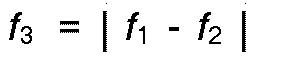
- In Fig. 2, the output of the exclusive OR
element 51 includes a high frequency variation component at fo/2 Hz. However, the output of thecomparator 55 does not include variation components at such high frequency. Namely, the shiftaverage generator 52 consisting of theshift register 53 and theadder 54, and thecomparator 55 acting as the judgment means for converting the output of the shiftaverage generator 52 into a two-valued logical signal, function together as a low pass filter for removing the high frequency components from the output of the exclusive ORelement 51. - The output of the frequency converter 50 (the received signal after the frequency conversion) is supplied to the
phase comparator 60. The exclusive ORelement 61 effects the exclusive OR operation upon the received signal after the frequency conversion and the phase reference signal which is a two-valued signal taking either the logical "0" or "1". As in the case of the exclusive ORelement 51 within thefrequency converter 50, the exclusive ORelement 61 acts as a multiplier for multiplying the received signal after the frequency conversion by the phase reference signal. - The duration during which the output of the exclusive OR
element 61 is continuously sustained at the logical "1" " is proportional to the absolute value of the phase shift of the received signal after the frequency conversion relative to the phase reference signal. Next this is described in detail by reference to waveforms. - Fig. 3 is a timing chart showing the waveforms of the phase reference signal, the received signal after the frequency conversion, and the output of the exclusive OR
element 61 of Fig. 1, in the two cases where the received signal after frequency conversion is advanced (shown above) and delayed (shown below) with respect to the phase reference signal. The absolute value of the phase shift of the received signal after frequency conversion relative to the phase reference signal is expressed in terms of: the length of time 7 between the leading or trailing edges of the received signal after frequency conversion and the phase reference signal; and the period T of the phase reference signal. Namely, the absolute value of the phase shift is expressed as follows:
- As understood from Fig. 3, the time 7 between the leading or the trailing edges of the phase reference signal and the received signal after frequency conversion is equal to the time during which the output of the exclusive OR
element 61 is continuously sustained at logical "1". Thus, the duration by which the output of the exclusive ORelement 61 is sustained at logical "1" " is proportional to the absolute value of the phase shift of the received signal after frequency conversion relative to the phase reference signal. Consequently, the absolute value of the phase shift of the received signal after frequency converter relative to the phase reference signal can be determined by measuring the duration in which the output of the exclusive ORelement 61 is continuously sustained at logical "1". - The output of the exclusive OR
element 61 is supplied to the absolute phase shift measurement means 62, where theadder 63 adds the outputs of the exclusive ORelement 61 and the D flip-flop array 64, the output of theadder 63 being supplied to the D flip-flop array 64 and the D flip-flop array 65. - The frequency of the clock which drives the D flip-
flop array 64 is selected at M times the frequency of the phase reference signal, where M is an even number not less than four. The D flip-flop array 64 acts as a delay element for storing the output of theadder 63. Thus, during the time when the output of the exclusive ORelement 61 is sustained at "1 ", the output ofadder 63 is incremented by one over each period of the clock of the D flip-flop array 64. On the other hand, during the time when the output of the exclusive ORelement 61 is at "0", the output of theadder 63 remains constant. - The output of the
adder 63 is also input to the D flip-flop array 65. The frequency of the clock of the D flip-flop array 65 is two times that of the phase reference signal, the leading edges of the clock of the D flip-flop array 65 coinciding with the leading or the trailing edges of the phase reference signal. Further, the D flip-flop array 64 is reset at the rising edge of the clock for the D flip-flop array 65. Namely, the D flip-flop array 64 is reset at each half period of the phase reference signal. - The output of the D flip-
flop array 65 is thus equal to the integral part of the duration of logical "1" " of the output of the exclusive ORelement 61 during each half period of the phase reference signal, as measured by the periods of the clock of the D flip-flop array 64. Namely, the output of the D flip-flop array 65 is obtained by dividing the duration of the logical "1" " of the exclusive ORelement 61 by the length of the period of the clock of the D flip-flop array 64 and then discarding the fractional part of the quotient resulting from the division. - Next, the operation of the absolute phase shift measurement means 62 is described by reference to the waveform diagrams. Fig. 4 is a timing chart showing the waveforms occurring within the absolute phase shift measurement means 62 of Fig. 1 when the received signal after the frequency conversion is advanced relative to the phase reference signal, in the case where the frequency of the D flip-
flop array 64 is 16 times the frequency of the phase reference signal (namely, M = 16). Fig. 5 is a timing chart showing the same waveforms as those of Fig. 4, occurring when the received signal after the frequency conversion is delayed relative to the phase reference signal. In Figs. 4 and 5, from top to bottom are shown the waveforms of: the clock driving the D flip-flop array 64; the clock driving the D flip-flop array 65; the phase reference signal; the received signal after frequency conversion; the output of the exclusive ORelement 61; the output of the D flip-flop array 64; the output of theadder 63; and the output of the D flip-flop array 65. The numbers shows at the last three waveforms are the values thereof at respective time intervals. - As described above, the frequency of the clock of the D flip-
flop array 65 is two times that of the clock of the phase reference signal. Further, the D flip-flop array 64 is reset at respective leading edges of the clock of the D flip-flop array 65. Furthermore, as described above, the output of the D flip-flop array 65 is obtained by normalizing the duration of the logical "1" " of the exclusive ORelement 61 during each half period of the phase reference signal by the length of the period of the clock of the D flip-flop array 64 and then discarding the fractional parts of the normalized value. - Let the value of the output of the D flip-
flop array 65 be represented by µ, where µ is an integer ranging from 0 to M/2 ( u ∈ {0, 1, ..., M/2}). Then, the following relationship holds among: the output u of the D flip-flop array 65, the ratio M of the frequency of the clock of the D flip-flop array 64 to the frequency of the clock of the phase reference signal, and the absolute value of the phase shift of the received signal after frequency conversion relative to the phase reference signal:
- Namely, the value µ of the output of the absolute phase shift measurement means 62 is approximately equal to the absolute value of the phase shift of the received signal after frequency conversion relative to the phase reference signal, and the error is not greater than ± 7r/M. Thus, by selecting a large value of the ratio M of the frequency of the clock of the D flip-
flop array 64 to the frequency of the phase reference signal, the measurement error of the absolute value of the phase shift can be reduced arbitrarily. - The absolute value of the phase shift of the received signal after the frequency conversion relative to the phase reference signal is thus measured by the absolute phase shift measurement means 62. If the sign bit representing the positive or the negative sign is added to the measurement value µ in correspondence with the phase delay or the phase advance of the received signal after the frequency conversion relative to the phase reference signal, then the phase shift of the received signal after frequency conversion relative to the phase reference signal can adequately be represented.
- As comprehended from Figs. 4 and 5, the value of the output of the exclusive OR
element 61 at each leading edge of the clock of the D flip-flop array 65 corresponds to the delay or the advance of the phase of the received signal after frequency conversion relative to the phase reference signal. - Namely, in the case of Fig. 4 where the phase of the received signal after frequency conversion is advanced relative to the phase reference signal, the output of the exclusive OR
element 61 at the instant at which the D flip-flop array 65 rises is at logical "1". On the other hand, in the case of Fig. 5 where the phase of the received signal after frequency conversion is delayed relative to the phase reference signal, the output of the exclusive ORelement 61 at the instant at which the D flip-flop array 65 rises is at logical "0". - Thus, the output of the exclusive OR
element 61 is supplied to the D flip-flop 66 which is driven by the same clock as the D flip-flop array 65, such that the output of the D flip-flop 66 represents whether the phase of the received signal after frequency conversion is delayed or advanced relative to the phase reference signal. - Next, this is described by reference to waveform diagrams. Fig. 6 is a timing chart showing the waveforms related to the operation of the D flip-
flop 66 of Fig. 1. From top to bottom in Fig. 6, are shown the waveforms of: the clock for driving the D flip-flop 66; the phase reference signal; the received signal after frequency conversion; the output of the exclusive ORelement 61; and the output of the D flip-flop 66. - As described above the clock of the D flip-
flop 66 is the same as the clock of the D flip-flop array 65. Namely, the frequency of the clock of the D flip-flop 66 is two times that of the phase reference signal, the leading edges of the clock of the D flip-flop 66 coinciding with the leading or the trailing edges of the phase reference signal. - It can be comprehended from Fig. 6 that when the phase of the received signal after frequency conversion is delayed relative to the phase reference signal, namely when the position of the leading or the trailing edge is delayed than the corresponding leading or trailing edge of the phase reference signal, the D flip-
flop 66 outputs the logical "0" for each half period of the phase reference signal. On the other hand, when the phase of the received signal after frequency conversion is advanced relative to the phase reference signal, namely when the position of the the leading or the trailing edge is advanced than the corresponding leading or trailing edge of the phase reference signal, the D flip-flop 66 outputs the logical "1" for each half period of the phase reference signal. - Thus, in response to the output of the exclusive OR
element 61, the D flip-flop 66 judges at the edge of each half period of the phase reference signal whether the received signal after frequency conversion is delayed or advanced relative to the phase reference signal. The output of the D flip-flop 66 constitutes the sign bit representing the polarity of the phase shift of the received signal after frequency conversion relative to the phase reference signal. The output of the D flip-flop 66 is combined with the output of the absolute phase shift measurement means 62 to form together the output of thephase comparator 60. - Thus, the output of the
phase comparator 60 is a combination of the outputs of the absolute phase shift measurement means 62 and the D flip-flop 66. The output of thephase comparator 60 is the relative phase signal which represents absolute value of the phase shift of the received signal after frequency conversion relative to the phase reference signal. - The relative phase signal output from the
phase comparator 60 is delayed by thedelay element 40 by one symbol period of the received signal, and thence is supplied to thesubtractor 41. The relative phase signal is also supplied to thesubtractor 41 of modulo 2-ff. Upon receiving the outputs of thephase comparator 60 and thedelay element 40, thesubtractor 41 subtracts, in modulo 2 7r, the output of thedelay element 40 from the output of thephase comparator 60, and thereby obtains the inter-symbol phase difference signal, which represents the phase transition over each symbol period of the received signal. The inter-symbol phase difference signal output from thesubtractor 41 is supplied to thejudgment circuit 42. Thejudgment circuit 42 obtains the demodulated data corresponding to the value of the inter-symbol phase difference signal, on the basis of the predetermined correspondence relationship between the inter-symbol phase difference signal and the demodulated data. - The above description relates to the case where the received signal is modulated in accordance with the differential phase shift keying (DPSK). This invention can also be applied to MSK or GMSK modulation systems. Further, in the case of the above embodiment, the constant n serving as the parameter of the
frequency converter 50 is equal to 2 (n = 2) and hence the output of theshift register 53 has five bits. However, the constant n may be any positive integer. For example, it may be that n = 6 (namely theshift register 53 may have 13 bit stages) or n = 7 (namely, theshift register 53 may have 15 bit stages). Furthermore, in the case of the above embodiment, the ratio M of the frequency of the clock of the D flip-flop array 64 to that of the phase reference signal is 16 (M = 16). However, the constant M may be any positive even number, such as 32 (M = 32) or 64 (M = 64). - Fig. 7 is a block diagram showing the circuit structure of another delayed detection type demodulator according to this invention. The circuit is similar to that of Fig. 1 except for the structure of the shift
average generator 52a of thefrequency converter 50a. The shiftaverage generator 52a includes: ashift register 53a provided with (2n + 2) stages (first through (2n + 2)th stages to hold respective bits), where n is a positive integer and the bits are sequentially shifted from the first toward the (2n + 2)th bit in synchronism with the clock of theshift register 53a; and anadder 54a for adding the first bit of theshift register 53a and the outputs of asign invertor 56 and a D flip-flop 57. Thesign invertor 56 inverts the polarity of the (2n + 2)th bit of theshift register 53a and supplies the result to theadder 54a. The D flip-flop 57 coupled to the output of theadder 54a serves as a delay element for storing the output of theadder 54a. The output of the D flip-flop 57 is supplied to theadder 54a. - Next, the operation of the circuit of Fig. 7 is described. As in the case of the circuit of Fig. 1, the
limiter amplifier 10 quantizes the received signal into a two-value quantized signal taking either the logical "0" or "1". The two-value quantized received signal output from thelimiter amplifier 10 is supplied to thefrequency converter 50a, in which the exclusive ORelement 51 effects logical exclusive OR operation upon the output of the limiter amplifier 10 (the two-value quantized received signal) and the signal for frequency conversion (the frequency conversion signal) which also takes either the logical value "0" or "1". As in the case of the circuit of Fig. 1, the exclusive ORelement 51 acts as a multiplier for multiplying the output of the limiter amplifier 10 (the two-value quantized received signal) by the signal for frequency conversion. - The output of the exclusive OR
element 51 is supplied to the first stage of theshift register 53a, from whence it is shifted toward the (2n + 2)th stage in synchronism with the clock of theshift register 53a. The frequency of the clock of theshift register 53a is substantially greater than the frequencies of the two-value quantized received signal and the signal for frequency conversion. The first bit of theshift register 53a is input to theadder 54a. On the other hand, the (2n + 2)th bit of theshift register 53a is input to thesign invertor 56, where the sign or polarity thereof is inverted and thence supplied to theadder 54a. The output of the D flip-flop 57 is also supplied to theadder 54a. Thus, theadder 54a adds the first bit of theshift register 53a, the output of thesign invertor 56, and the output of the D flip-flop 57, and outputs the result to the D flip-flop 57. The D flip-flop 57 serves as the delay element for storing the output of theadder 54a. The clock of the D flip-flop 57 be the same as that of theshift register 53a. - Let the output of the D flip-
flop 57 and the respective bits of theshift register 53a be at logical "0" at the initial state. Let the period of the clock of theshift register 53a and the D flip-flop 57 be represented by Tc. Further, let the operation of the exclusive ORelement 51 at the time t = i·Tc, where i is an integer, be represented by a0i (ao; ∈ {0, 1}). Furthermore, let the first and the (2n + 1 )th bits of theshift register 53a at the time t = i· Tc be represented by p; and qi (pi ∈ {0, 1} and qi ∈ {0, 1}). Then, taking into consideration that all the bits of theshift register 53a are at logical "0" at the initial state (i.e., at the time t = 0), the following relationships hold, depending upon the value of i:

- As described above the
sign invertor 56 inverts the polarity of the (2n + 2)th bit output from theshift register 53a. Thus, if the output of thesign invertor 56 at the time t = i. Tc is represented by ri (ri ∈ {-1, 0}), then ri is given, depending on the value of i, by:
- Further, the output si of the D flip-
flop 57 at the time t = i· Tc is represented by:
- The output so of the D flip-
flop 57 at the initial state (i.e., at the time t = 0) is equal to 0 (so = 0). Further, the output ri of thesign invertor 56 is also equal to 0 (ri = 0) during the time t (2n + 1)Tc. The output si of the D flip-flop 57 for 1 ≦ i ≦ 2n + 1 is thus expressed as:
- Next, the above equation is proved for arbitrary 1 ≦ i ≦ 2n + 1 by mathematical induction. First, for i = 1, the eqation holds since:

- Next, assume that the equation is true for i = j. Then, the equation is satisfied for i = j + 1 because:
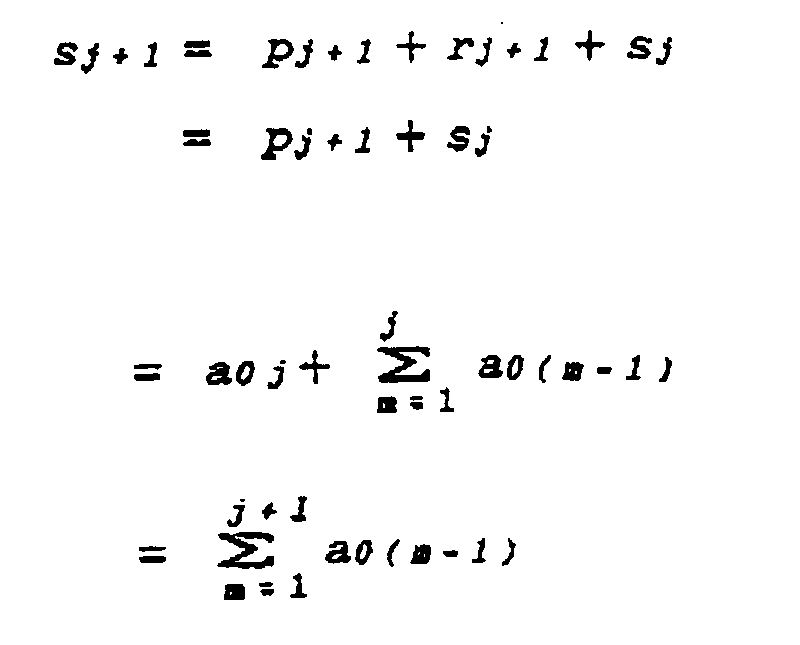
- Thus, it has been proved that the equation holds for all integer i in the range: 1 ≦ i ≦ 2n + 1 (QED).
- Thus, the output s2n+ of the D flip-
flop 57 at the time t = (2n + 1) Tc is given by:
- Namely, the value s2n+1 is equal to (2n + 1) times the average of the preceding (2n + 1) output values aoo, a01, ..., a0(2n), of the exclusive OR
element 51. From this it can be shown that the following relation holds for t (2n + 1) Tc:
- Next, the above equation is proved by mathematical induction. First, for i = 2n + 1 the equation holds since:

- Next, assume that the equation holds for i = j. Then the equation is satisfied for i = j + 1 since:

- Thus, the equation has been proved for all integer i not less than (2n + 1): i (2n + 1). (QED)
- In summary, it has been shown that the output si of the D flip-
flop 57 is equal to (2n + 1) times the average of preceding (2n + 1) output values, a0(i-2n-1), a0(i-2n), ..., a0(i-1), of the exclusive ORelement 51. This output si of the D flip-flop 57 constitutes the output of the shiftaverage generator 52a. Thus, after the time t = (2n + 1) Tc, the shift average generator 52A functions similarly to the shiftaverage generator 52 of Fig. 1. - By the way, the number of the signals input to the
adder 54a is three, irrespective of the number of the stages of theshift register 53a. In the case of the circuit of Fig. 1, the number of signals input to theadder 54 is equal to the number of stages, (2n + 1), of theshift register 53. Since n is greater than one (n 1) and hence (2n + 1) ≧ 3, the number of signals input to theadder 54a is not greater than (and generally substantially less than) the number of signals input to theadder 54 in the circuit of Fig. 1. Thus, compared to the embodiment of Fig. 1, the circuit of the embodiment of Fig. 7 is simplified. - The output of the shift
average generator 52a is supplied to thecomparator 55. Thecomparator 55 compares the output of the shiftaverage generator 52a with the constant n. Depending on the value si of the output of the shiftaverage generator 52a and the constant n, the value di of the output signal of thecomparator 55 is given as follows:
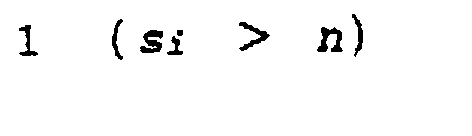
- Namely, the
comparator 55 acts as a judgment means for converting the output si of the shiftaverage generator 52a into a two-valued signal which takes either the logical value "0" or "1". - Thus, the signal processing within the
frequency converter 50a subsequent to the shiftaverage generator 52a is identical to that subsequent to the shiftaverage generator 52 in Fig. 1. Further, the shiftaverage generator 52a acts in a similar manner as the shiftaverage generator 52 of Fig. 1. Thus, as in the case of the embodiment of Fig. 1, the the shiftaverage generator 52a, consisting of theshift register 53a, theadder 54a, thesign invertor 56, and the D flip-flop 57, and thecomparator 55 acting as the judgment means for converting the output of the shiftaverage generator 52a into a two-valued logical signal, function as a low pass filter for removing the high frequency components from the output of the exclusive ORelement 51. - Thus, as in the case of the embodiment of Fig. 1, the two-value quantized received signal output from the
limiter amplifier 10 is subjected to the frequency conversion by means of the signal processing within thefrequency converter 50a. Namely, if the frequency of the two-value quantized received signal is represented by f1 Hz and that of the signal for frequency conversion by f2 Hz, then the frequency of the received signal after frequency conversion output from thecomparator 55 is | - f2 Hz. - The received signal after frequency conversion output from the
frequency converter 50a is supplied to thephase comparator 60, which is the same as in Fig. 1. Thus, thephase comparator 60 outputs the relative phase signal representing the phase shift of the received signal after frequency conversion relative to the phase reference signal. The relative phase signal output from thephase comparator 60 is delayed by thedelay element 40 by one symbol period of the received signal. At the same time, the relative phase signal is input to thesubtractor 41, to which the relative phase signal delayed by one symbol period by thedelay element 40 is also input. In response to the outputs of thephase comparator 60 and thedelay element 40, thesubtractor 41 outputs the inter-symbol phase difference signal which is obtained by subtracting in modulo 27r the relative phase signal delayed by one symbol period from the relative phase signal output from thephase comparator 60. The inter-symbol phase difference signal output from thesubtractor 41 represents the phase transition over one symbol period of the received signal. Thejudgment circuit 42 obtains the demodulated data corresponding to the value of the inter-symbol phase difference signal, on the basis of the predetermined correspondence relationship between the inter-symbol phase difference signal and the demodulated data. - The above description of circuit of Fig. 7 relates to the case where the received signal is modulated in accordance with the differential phase shift keying (DPSK). The principle of the invention can also be applied to MSK or GMSK modulation systems. Further, in the case of the above embodiment of Fig. 7, the constant n serving as the parameter of the
frequency converter 50a is equal to 2 (n = 2) and hence theshift register 53 has six stages to hold the respective bits. However, the constant n may be any positive integer. For example, it may be that n = 6 (namely theshift register 53a may have 14 bits) or n = 7 (namely, theshift register 53a may have 16 bits). - Next, a delayed detection type demodulator using a phase detection circuit is described. A digital delayed detection type demodulator using a phase detection circuit is disclosed, for example, in H. Tomita et al., "DIGITAL INTERMEDIATE FREQUENCY DEMODULATION TECHNIQUE", Paper B-299, 1990 Fall National Convention of Electronic Information Communication Association of Japan. The delayed detection type demodulator is described by reference to drawings.
- Fig. 9 is a block diagram showing the structure of a digital delayed detection type demodulator provided with a phase detection circuit. First, the received signal is supplied to a
limiter amplifier 10. The output of thelimiter amplifier 10 is coupled to aphase detection circuit 200 including: acounter 201 counting in modulo K, where K is a positive integer; and a D flip-flop array 202. The output of thephase detection circuit 200 is coupled to: adelay element 40 having a delay time equal to the one symbol period of the received signal; and asubtractor 41 effecting subtraction in modulo 2-ff. - Next the operation of the circuit of Fig. 9 is described. The received signal, which is a differential phase shift keying (DPSK) signal, is shaped by the
limiter amplifier 10 into a rectangular waveform of constant amplitude. Namely, thelimiter amplifier 10 acts as a quantizer for effecting two-value quantization upon the received signal. Thus, the received signal is quantized by thelimiter amplifier 10 into a two-valued signal taking the value either at the logical "0" or logical "1". - The
counter 201 of modulo K within thephase detection circuit 200 is driven by a clock having a frequency substantially equal to K times the frequency of the received signal. The output of thecounter 201 is supplied to the D flip-flop array 202, which is driven (i.e., reset) by the two-value quantized received signal output from thelimiter amplifier 10. The output of thephase detection circuit 200 thus represents the relative phase of the two-value quantized received signal with respect to a virtual phase reference signal. - Next this is described by reference to waveform diagrams. Figs. 10 and 11 are timing charts showing the waveforms exemplifying the operation of the
phase detection circuit 200, where K = 16. In Fig. 10 are shown, from top to bottom, the waveforms of: the clock for driving thecounter 201; the output of thecounter 201; the virtual phase reference signal, which is obtained by demultiplying the clock of thecounter 201 by K (equal to 16 in this case); the two-value quantized received signal; and the output of the D flip-flop array 202. From top to bottom in Fig. 11 are shown the waveforms of: the clock for thecounter 201; the output of thecounter 201; the virtual phase reference signal; the two-value quantized received signal A, the phase of which is increasingly delayed; output A of D flip-flop array 202 corresponding to the two-value quantized received signal A; the two-value quantized received signal B, the phase of which is increasingly advanced; and the output B of the D flip-flop array 202 corresponding to the two-value quantized received signal B. - The virtual phase reference signal rises to logical "1" " at the instant when the output of the
counter 201 is reset to logical "0", and falls to logical "0" at the instant when the output of thecounter 201 reaches K/2 (equal to 8 in this case). If the period of the clock of thecounter 201 is represented by T and that of the virtual phase reference signal T" then:
- Thus, if the length of time between the leading edges of the virtual phase reference signal and the two-value quantized received signal is represented by T , then the phase shift of the two-value quantized received signal relative to the virtual phase reference signal is given by:

- On the other hand, as seen from Fig. 10, the output of the
counter 201 at the leading edge of the two-value quantized received signal is equal to an integer obtained by dividing the time 7 by the period T of the clock of thecounter 201 and then discarding the fractional parts of the quotient. - The D flip-
flop array 202 is reset at each leading edge of the two-value quantized received signal to hold the output of thecounter 201. Thus, the output of the D flip-flop array 202 is equal to the integer obtained by dividing the shift time 7 by the period T of the clock of thecounter 201 and then discarding the fractional parts of the quotient resulting from the division. Namely, if the output of the D flip-flop array 202 is represented by µ, where u ∈ {0, 1, ..., K - 1}, then the following relation holds among µ, T and T :
- Thus, the following relation holds between the phase shift of the two-value quantized received signal relative to the virtual phase reference signal and the output µ of the D flip-flop array 202:

- This relation shows that the output of the D flip-
flop array 202 can be regarded as the relative phase of the two-value quantized received signal with respect to the virtual phase reference signal. - Fig. 10 shows the case where the relative phase of the two-value quantized received signal with respect to the virtual phase reference signal is constant. Thus, the output of the D flip-
flop array 202 remains at eight (8). On the other hand, Fig. 11 shows the case where the relative phase signal of the two-value quantized received signal A is increasingly delayed and the relative phase signal of the two-value quantized received signal B is increasingly advanced. Thus, upon receiving the two-value quantized received signal A, the output A of the D flip-flop array 202 increases from seven (7) to nine (9). On the other hand, upon receiving the two-value quantized received signal B, the output B of the D flip-flop array 202 decreases from nine (9) to seven (7). In either case, the output of the D flip-flop array 202 varies in proportion to the variation of the relative phase of the two-value quantized received signal with respect to the virtual phase reference signal. - The operation of the
delay element 40, thesubtractor 41 and thejudgment circuit 42 are similar to those of Fig. 1. - The phase detection circuit of Fig. 9 has the following disadvantage. The D flip-
flop array 202 is driven only at the leading edges of the two-value quantized received signal. Thus, the relative phase signal output from the phase detection circuit is updated only at each full period of the two-value quantized received signal. In principle, however, the value of the relative phase of the two-value quantized received signal can be updated two times for each period of the two-value quantized received signal. Namely, the phase detection circuit of Fig. 9 has the disadvantage that the rate at which the relative phase signal is updated is low. - Next, a delayed detection type demodulator provided with a phase detection circuit which solves this problem of the circuit of Fig. 9 is described.
- Fig. 12 is a block diagram of a delayed detection type demodulator provided with a phase detection circuit according to this invention, by which the value of the relative phase of the two-value quantized received signal with respect to the virtual phase reference signal can be updated two times for each period of the two-value quantized received signal. The output of
limiter amplifier 10 is coupled to aphase detection circuit 400 which includes: adelay element 401 and an exclusive ORelement 402 coupled to thelimiter amplifier 10; a modulo 2Ncounter 403 for counting in modulo N, where N is a positive integer; a D flip-flop array 404; and aphase inversion corrector 500. Thephase inversion corrector 500 includes: amultiplier 501 and anadder 502 for effecting addition in modulo 2N. - Functionally, the
phase detection circuit 400 is divided into a half-period detector means 901, a phase reference signal generator means 902 and a phase shift determiner means 903. The half-period detector means 901 consists of thedelay element 401 and the exclusive ORelement 402. Upon receiving an input signal of predetermined period from thelimiter amplifier 10, the half-period detector means 901 outputs a half-period detection signal at each half-period of the input signal. The phase reference signal generator means 902 consists of the modulo 2Ncounter 403. On the basis of a clock having a frequency not less than twice the frequency of the input signal, the phase reference signal generator means 902 generates the phase reference signal serving as the reference for determining the phase shift of the two-value quantized received signal. A phase shift determiner means 903 consists of the D flip-flop array 404 and thephase inversion corrector 500. Thephase inversion corrector 500 corrects the phase inversion of the phase reference signal at each half-period of the input signal. On the basis of the corrected phase reference signal and the half-period detection signal output from the half-period detector means 901, the phase shift determiner means 903 determines and outputs the phase shift of the half-period detection signal relative to the phase reference signal at each half-period of the input signal. - The
delay element 40,subtractor 41, and thejudgment circuit 42 are similar to those described above. - Next, the operation of the circuit of Fig. 12 is described in detail. In Fig. 12, the
limiter amplifier 10 shapes the received signal into a rectangular waveform of a constant amplitude. Namely, thelimiter amplifier 10 acts as a two-valued quantizer for subjecting the received signal to the two-value quantization, such that the output of thelimiter amplifier 10 is quantized to logical "0" and "1". - The two-value quantized received signal output from the
limiter amplifier 10 is supplied to thephase detection circuit 400, where it is first input to thedelay element 401. The delay time of thedelay element 401 is shorter than the half-period of the two-value quantized received signal. The delayed received signal output from thedelay element 401 is supplied to the exclusive ORelement 402, together with the two-value quantized received signal output from thelimiter amplifier 10. The exclusive ORelement 402 effects the logical exclusive OR operation upon the outputs of thelimiter amplifier 10 and thedelay element 401. Thus, the output of the exclusive ORelement 402 is a pulse signal (referred to as the differential pulse signal) which rises (i.e., has leading edges) at the leading and the tailing edges of the two-value quantized received signal. Next, this is described by reference to drawings. - Fig. 13 is a timing chart showing waveforms exemplifying the operation of the
delay element 401 and the exclusive ORelement 402 of Fig. 12. From top to bottom in Fig. 13 are shown the waveforms of: the two-value quantized received signal; the output of thedelay element 401; and the output of the exclusive OR element 402 (the differential pulse signal). As shown in Fig. 13, the delay time of thedelay element 401, namely the time length by which the two-value quantized received signal is delayed, is shorter than the half-period of the two-value quantized received signal. Thus, the differential pulse signal output from the exclusive ORelement 402 rises (i.e., has the leading edges) at the leading and the trailing edges of the two-value quantized received signal. - On the other hand, the modulo 2N
counter 403 is driven by a clock having a frequency substantially equal to 2N times the frequency of the two-value quantized received signal. If a virtual phase reference signal similar to that of Fig. 9 is assumed which is obtained by demultiplying the clock signal of the modulo 2N counter 403 by 2N, the virtual phase reference signal rises (i.e., has the leading edge) at the instant when the output of the modulo 2Ncounter 403 is reset to "0", and falls (i.e., has the trailing edge) at the instant when the output of the modulo 2Ncounter 403 reaches N. The output of the modulo 2Ncounter 403 represents the phase of this virtual phase reference signal. Namely, if the output of the modulo 2N counter 403 at the time when the phase of the virtual phase reference signal is 0 is represented by a ( a E {0, 1, ..., 2N- 1}), then the following relation holds between 0 and a :
- Thus, the output of the modulo 2N counter 403 at each leading edge of the differential pulse signal output from the exclusive OR
element 402 represents the phase of the virtual phase reference signal at the leading or the trailing edge of the two-value quantized received signal. However, the absolute phase of the two-value quantized received signal at the trailing edge thereof is equal to 7r. Thus, if the output of the modulo 2N counter 403 at the trailing edge of the two-value quantized received signal is corrected by numerical value "N" corresponding to the phase 7r, then the relative phase of the two-value quantized received signal with respect to the virtual phase reference signal at the trailing edge of the two-value quantized received signal can be obtained. Next, this is described by reference to drawings. - Fig. 14 is a timing chart exemplifying the waveforms of the output of the modulo 2N
counter 403, the virtual phase reference signal, the two-value quantized received signal, and the differential pulse signal of Fig. 12, in the case where N = 8. From top to bottom are shown the waveforms of: the clock for the modulo 2Ncounter 403; the output of the modulo 2Ncounter 403; the virtual phase reference signal; the two-value quantized received signal; the delayed received signal (output of the delay element 401); and the differential pulse signal (output of the exclusive OR element 402). The modulo 2N counter 403 counts the clock in modulo 2N = 16. - Let the periods of the clock of the modulo 2N
counter 403 and the virtual phase reference signal be represented by T and Tr, respectively. Then:
- Thus, if the time length between the leading or the trailing edges of the virtual phase reference signal and the two-value quantized received signal is represented by T , the phase shift of the two-value quantized received signal relative to the virtual phase reference signal is given by:

- Further, let the output of the modulo 2N counter 403 at a leading edge of the two-value quantized received signal be represented by β1, where β1 E {0, 1, ... , 2N-1}. Then β1 is equal to an integer obtained by first normalizing (i.e., dividing) the time T , between the leading edges of the virtual phase reference signal and the two-value quantized received signal, by the period T of the modulo 2N
counter 403 and then discarding the fractional part of the quotient resulting from the division. Namely, the following relation holds among β1, T and τ:
- On the other hand, the output of the modulo 2N counter 403 at the trailing edge of the virtual phase reference signal is equal to "N" ( = 8 in the case of Fig. 14) corresponding to the phase π. Let the output of the modulo 2N counter 403 at a trailing edge of the two-value quantized received signal be represented by β2, where β2 E {0, 1, ... , 2N-1}. Then β2 is equal to an integer obtained by: first normalizing (i.e., dividing) the time 7 between the trailing edges of the virtual phase reference signal and the two-value quantized received signal by the period Y of the modulo 2N
counter 403; then discarding the fractional part of the quotient resulting from the division; and finally adding numerical value "N" to the quotient. Thus, the following relation holds among β2, T and τ:
- The subtraction in the above equation is in modulo 2N. The subtraction in modulo 2N, however, is equivalent to addition in modulo 2N. Thus the above equation is equivalent to:

- From the above discussion, it has been shown that the following relations hold among the output of the modulo 2N
counter 403, β1 and β2, and the phase shift of the two-value quantized received signal:

- These relations show that the output β1 of the modulo 2N counter 403 at the leading edge of the two-value quantized received signal and the value obtained by adding numerical value "N" in modulo 2N to the output β2 of the modulo 2N counter 403 at the trailing edge of the two-value quantized received signal can be regarded as representing the relative phase of the two-value quantized received signal with respect to the virtual phase reference signal. In other words, the relative phase of the two-value quantized received signal can be obtained by correcting the output of the modulo 2N
counter 403, i.e., by adding the numerical value "0" at the leading edge, and the numerical value "N" at the trailing edge, of the two-value quantized received signal. - The
phase inversion corrector 500 effects this correction for the output of the modulo 2Ncounter 403. Namely, upon receiving the output of the modulo 2Ncounter 403, thephase inversion corrector 500 adds to it the numerical value "0" at the leading edge, and the numerical value "N" at the trailing edge, of the two-value quantized received signal. Next, the operation of thephase inversion corrector 500 is described by reference to drawings. - Fig. 15 is a timing chart showing the waveforms exemplifying the operation of the
phase detection circuit 400 of Fig. 12, where N = 8 (2N = 16) and where the relative phase of the two-value quantized received signal with respect to the virtual phase reference signal remains constants Fig. 16 is a view similar to that of Fig. 15, but showing the case where the relative phase of the two-value quantized received signal with respect to the virtual phase reference signal is increasingly delayed. Fig. 17 is a view similar to that of Fig. 15, but showing the case where the relative phase of the two-value quantized received signal with respect to the virtual phase reference signal is increasingly advanced. From top to bottom in the figures are shown the waveforms of: the clock for the modulo 2Ncounter 403; the output of the modulo 2Ncounter 403; the virtual phase reference signal; the two-value quantized received signal; the delayed received signal (output of the delay element 401); the differential pulse signal (output of the exclusive OR element 402); the output of themultiplier 501; the output of theadder 502; and the output of the D flip-flop array 404. - As shown in these figures, the value of the delayed received signal output from the
delay element 401 is at logical "0" at the leading edge, and at logical "1" " at the trailing edge, of the two-value quantized received signal. Themultiplier 501 multiplies output of thedelay element 401 by N, thereby outputting the numerical value "0" at the leading edge, and the numerical value "N" at the trailing edge, of the two-value quantized received signal. Theadder 502 adds in modulo 2N the outputs of the modulo 2Ncounter 403 and themultiplier 501, thereby obtaining the output of thephase inversion corrector 500. The output of thephase inversion corrector 500 is equal to the output of the modulo 2N counter 403 at the leading edge of the two-value quantized received signal. The output of thephase inversion corrector 500 is equal to the value obtained by adding in modulo 2N the numerical value "N" to the output of the modulo 2Ncounter 403, at the trailing edge of the two-value quantized received signal. - The output of the
phase inversion corrector 500 is supplied to the D flip-flop array 404, which is driven (i.e., reset) by the differential pulse signal output from the exclusive ORelement 402. As described above, the differential pulse signal has leading edges at the leading and trailing edges of the two-value quantized received signal. Thus, the D flip-flop array 404 is reset at each leading and trailing edge of the two-value quantized received signal. Thus, if the output of the D flip-flop array 404 is represented by µ, then 11. is expressed in terms of the output values β1 and Q2 of the modulo 2N counter 403 at the leading and the trailing edges, respectively:

- Thus, the following relation holds between the phase shift of the two-value quantized received signal with respect to the virtual phase reference signal and the output µ of the D flip-flop array 404:

- This relation shows that the output µ of the D flip-
flop array 404 can be regarded as representing the relative phase of the two-value quantized received signal with respect to the virtual phase reference signal. This can be easily understood by reference to Figs. 15 through 17. - It is noted that in the case of the circuit of Fig. 9, the output of the D flip-
flop array 202 representing the relative phase of the two-value quantized received signal is updated only once for each period of the two-value quantized received signal. In the case of the circuit of Fig. 12, however, the D flip-flop array 404 is driven by the differential pulse signal at the leading and the trailing edges of the two-value quantized received signal. Thus, the output of the D flip-flop array 404 representing the relative phase of the two-value quantized received signal is updated twice for each period of the two-value quantized received signal. The updating rate of the relative phase signal is thereby doubled. This can be easily comprehended by comparing Fig. 15 with Fig. 10 and Figs. 16 and 17 with Fig. 11. - Namely, the two-value quantized received signal A of Fig. 11 and the two-value quantized received signal of Fig. 16 are the same. The output A of the D flip-
flop array 202 in Fig. 11 varies from "7" to "9", while the output of the D flip-flop array 404 in Fig. 16 varies gradually from "7" to "8" to "9". Similarly, the two-value quantized received signal B of Fig. 11 and the two-value quantized received signal of Fig. 17 are the same. The output B of the D flip-flop array 202 in Fig. 11 varies from "9" to "7", while the output of the D flip-flop array 404 in Fig. 17 varies gradually from "9" to "8" to "7". The updating rate of the relative phase signal is doubled for the circuit of Fig. 12, and hence the variation of the value of the relative phase signal is rendered less abrupt. - The operations of the
delay element 40, thesubtractor 41, and thejudgment circuit 42 are similar to those of the corresponding parts described above. - In Fig. 12, the
phase inversion corrector 500 consists of themultiplier 501 and theadder 502. However, the element corresponding to themultiplier 501 may be implemented by any circuit which outputs numerical value "0" upon receiving numerical value "0", and numerical value "N" upon receiving numerical value "1". Such element may be implemented by a data selector which selects and outputs numerical value "0" upon receiving numerical value "0", and numerical value "N" upon receiving numerical value "1". Alternatively, thephase inversion corrector 500 may consist of logical product elements (AND gates) for effecting logical product operations (AND operations) upon the respective bits of the numerical value "N" and the output of thedelay element 401. - The above description relates to the case where the received signal is modulated in accordance with the differential phase shift keying (DPSK). This invention, however, can also be applied to MSK or GMSK modulation systems. Further, in the case of the above embodiment, the constant N serving as the operation parameter of the
phase detection circuit 400 is equal to 8 (N = 8). However, the constant N may be any positive integer. For example, N may be N = 16 or N = 32. - Fig. 18 is a block diagram of another delayed detection type demodulator provided with a phase detection circuit according to this invention, by which the value of the relative phase of the two-value quantized received signal with respect to the virtual phase reference signal can be updated two times for each period of the two-value quantized received signal. In Fig. 18, the
phase detection circuit 400a is functionally divided into: a half-period detector means 901 consisting of thedelay element 401 and the exclusive ORelement 402; a phase reference signal generator means 902 consisting of the modulo2M counter 403a, where M is a positive integer; and a phase shift determiner means 903 consisting of the D flip-flop array 404a and aphase inversion corrector 500a. Thephase inversion corrector 500a consists of an exclusive ORelement 503 having inputs coupled to the output of thedelay element 401 and the most significant bit (MSB) of the output of the modulo2M counter 403a. The combination of the least significant bits (namely the first through (M- I)th bit of the modulo2M counter 403a) and the output of the exclusive ORelement 503 is input to the D flip-flop array 404a. Otherwise the circuit of Fig. 18 is similar to the circuit of Fig. 12. - Next, the operation of the circuit of Fig. 18 is described in detail. In Fig. 18, the
limiter amplifier 10 shapes the received signal into a rectangular waveform of a constant amplitude. Namely, thelimiter amplifier 10 acts as a two-valued quantizer for subjecting the received signal to the two-value quantization, such that the output of thelimiter amplifier 10 is quantized to logical "0" and "1". - The two-value quantized received signal output from the
limiter amplifier 10 is supplied to thephase detection circuit 400a, where it is first input to thedelay element 401 and the exclusive ORelement 402. The delay time of thedelay element 401 is shorter than the half-period of the two-value quantized received signal. The delayed received signal output from thedelay element 401 is supplied to-the exclusive ORelement 402. The exclusive ORelement 402 effects the logical exclusive OR operation upon the outputs of thelimiter amplifier 10 and thedelay element 401. Thus, the output of the exclusive ORelement 402 is a pulse signal (referred to as the differential pulse signal) which rises (i.e., has leading edges) at the leading and the tailing edges of the two-value quantized received signal. - The modulo
2M counter 403a is driven by a clock having a frequency substantially equal to 2m times the frequency of the two-value quantized received signal, where M is a positive integer. If a virtual phase reference signal similar to that of Fig. 9 is assumed which is obtained by demultiplying the clock signal of themodulo 2M counted 403a by 2M, the virtual phase reference signal rises (i.e., has the leading edge) at the instant when the output of themodulo 2Mcounter 403a is reset to "0", and falls (i.e., has the trailing edge) at the instant when the output of themodulo 2Mcounter 403a reaches 2M-1. The output of themodulo 2Mcounter 403a represents the phase of this virtual phase reference signal. Namely, if the output of themodulo 2Mcounter 403a at the time when the phase of the virtual phase reference signal is 0 is represented by a ( a E{O, 1, ... , 2M - 1}), then the following relation holds between 0 and a :
- Thus, the output of the
modulo 2Mcounter 403a at each leading edge of the differential pulse signal output from the exclusive ORelement 402 represents the phase of the virtual phase reference signal at the leading or the trailing edge of the two-value quantized received signal. However, the absolute phase of the two-value quantized received signal at the trailing edge thereof is equal to π. Thus, if the output of themodulo 2Mcounter 403a at the trailing edge of the two-value quantized received signal is corrected by numerical value "2M-1" corresponding to the phase π, then the relative phase of the two-value quantized received signal with respect to the virtual phase reference signal at the trailing edge of the two-value quantized received signal can be obtained. - The
phase inversion corrector 500a effects this correction for the output of themodulo 2Mcounter 403a. Namely, upon receiving the output of themodulo 2Mcounter 403a, thephase inversion corrector 500a adds to it the numerical value "0" at the leading edge, and the numerical value "2M-1" at the trailing edge, of the two-value quantized received signal. Next, the operation of thephase inversion corrector 500a is described by reference to drawings. - Fig. 19 is a timing chart showing the waveforms exemplifying the operation of the
phase detection circuit 400a of Fig. 18, where M = 4 (2" = 16) and where the relative phase of the two-value quantized received signal with respect to the virtual phase reference signal remains constant. Fig. 20 is a view similar to that of Fig. 19, but showing the case where the relative phase of the two-value quantized received signal with respect to the virtual phase reference signal is increasingly delayed. Fig. 21 is a view similar to that of Fig. 19, but showing the case where the relative phase of the two-value quantized received signal with respect to the virtual phase reference signal is increasingly advanced. From top to bottom in the respective figures are shown the waveforms of: the clock for themodulo 2M counter 403a; the output of the modulo2M counter 403a; the MSSB or the most significant bit (the Mth bit) of the modulo2M counter 403a; the two-value quantized received signal; the delayed received signal (output of the delay element 401); the differential pulse signal (output of the exclusive OR element 402); the output of the exclusive ORelement 503; the LSBs or the least significant bits (the first through (M - I)th bits) of themodulo 2Mcounter 403a; the output of thephase inversion corrector 500a (the combination of the least significant bits of themodulo 2Mcounter 403a and the output of the exclusive ORelement 503; and the output of the D flip-flop array 404a. The numbers at the waveforms of themodulo 2Mcounter 403a, the least significant bits of the 403a, thephase inversion corrector 500a, and the D flip-flop array 404a represent the values thereof at respective instants. - The output of the
modulo 2Mcounter 403a consists of M bits. The most significant bit of themodulo 2Mcounter 403a represents the thenumerical value 2M-1. Thus, adding thenumerical value 2M-1 to the output of themodulo 2Mcounter 403a in modulo 2M is equivalent to logical inversion of the most significant bit of themodulo 2Mcounter 403a. Thus, adding numerical value "0" and "1 ", respectively, to the output of themodulo 2Mcounter 403a at the leading and the trailing edges of the two-value quantized received signal results in effecting no logical inversion at the leading edge, and the logical inversion at the trailing edge, of the two-value quantized received signal, upon the most significant bit of themodulo 2Mcounter 403a. - As shown in Figs. 19 through 21, the value of the delayed received signal output from the
delay element 401 is at logical "0" at the leading edge, and at logical "1" " at the trailing edge, of the two-value quantized received signal. The exclusive ORelement 503 effects the logical exclusive OR operation upon the delayed received signal output from thedelay element 401 and the most significant bit of the output from themodulo 2Mcounter 403a. The output of the 503 is combined as the new most significant bit with the least significant bits (the first through (M - 1)th bits) of themodulo 2Mcounter 403a, to form the output of thephase inversion corrector 500a. Thus, the output of thephase inversion corrector 500a is equal to the output of themodulo 2Mcounter 403a at the leading edges of the two-value quantized received signal (no logical inversion of the most significant bit is effected). On the other hand, the output of thephase inversion corrector 500a at the trailing edges of the two-value quantized received signal consists of the logically inverted most significant bit of themodulo 2Mcounter 403a combined with the least significant bits thereof. Thus, the output of thephase inversion corrector 500a is equal to the value obtained by adding numerical value "0" at the leading edge, and numerical value "2M-1" at the trailing edge, of the two-value quantized received signal, to the output of themodulo 2Mcounter 403a. - By limiting the constant 2N serving as the operation parameter in the circuit of Fig. 12 to the integer which can be expressed in the form 2M, the
phase inversion corrector 500a can be implemented only by the exclusive ORelement 503. Thus, the circuit of Fig. 18 is simplified compared to the circuit of Fig. 12. - The output of the
phase inversion corrector 500a is supplied to the D flip-flop array 404a, which is driven (i.e., reset) by the differential pulse signal output from the exclusive ORelement 402. As described above, the differential pulse signal has leading edges at the leading and trailing edges of the two-value quantized received signal. Thus, the D flip-flop array 404a is reset at each leading and trailing edge of the two-value quantized received signal. Thus, if the output of the D flip-flop array 404a is represented by µ, where µ ∈ {0, 1, ... , 2M -1), then µ is expressed in terms of the output values β1 and β2 (β1, β2 E {0, 1, ... , 2M - 11) of themodulo 2Mcounter 403a at the leading and the trailing edges, respectively:

- Thus, the following relation holds between the phase shift of the two-value quantized received signal with respect to the virtual phase reference signal and the output µ of the D flip-
flop array 404a:
- This relation shows that the output µ of the D flip-
flop array 404a can be regarded as representing the relative phase of the two-value quantized received signal with respect to the virtual phase reference signal. This can be easily understood by reference to Figs. 19 through 21. - As in the case of the circuit of Fig. 12, the D flip-
flop array 404a of Fig. 18 is driven by the differential pulse signal at the leading and the trailing edges of the two-value quantized received signal Thus, the output of the D flip-flop array 404a representing the relative phase of the two-value quantized received signal is updated twice for each period of the two-value quantized received signal. The updating rate of the relative phase signal is thereby doubled compared to the case of Fig. 9. This can be easily comprehended by comparing Fig. 19 with Fig. 10 and Figs. 20 and 21 with Fig. 11. - Namely, the two-value quantized received signal A of Fig. 11 and the two-value quantized received signal of Fig. 20 are the same. The output A of the D flip-
flop array 202 in Fig. 11 varies from "7" to "9", while the output of the D flip-flop array 404a in Fig. 20 varies gradually from "7" to "8" to "9". Similarly, the two-value quantized received signal B of Fig. 11 and the two-value quantized received signal of Fig. 21 are the same. The output B of the D flip-flop array 202 in Fig. 11 varies from "9" to "7", while the output of the D flip-flop array 404a in Fig. 21 varies gradually from "9" to "8" to "7". The updating rate of the relative phase signal is doubled for the circuit of Fig. 12, and hence the variation of the value of the relative phase signal is rendered less abrupt. - The operations of the
delay element 40, thesubtractor 41, and thejudgment circuit 42 of Fig. 18 are the same as those of the corresponding parts described above. - The above description relates to the case where the received signal is modulated in accordance with the differential phase shift keying (DPSK). However, the principle embodied in the circuit of Fig. 18 can be applied to MSK or GMSK modulation systems. Further, in the case of the above embodiment, the constant M serving as the operation parameter of the
phase detection circuit 400a is equal to 4 (M = 4). However, the constant M may be any positive integer. For example, M may be five (M = 5) or six (M = 6). - Fig. 22 recapitulates the
frequency converter 20 of Fig. 8. The received signal having a frequency f1 Hz is multiplied by the signal for frequency conversion (the frequency conversion signal) having a frequency f2 Hz, where: -

- The output of the
multiplier 21 includes frequency components at f1 + f2 Hz and |f1 - f2 Hz. Taking into consideration the above relation between the f1 and f2, the following relation hold:
- The output of the
multiplier 21 is supplied to thelow pass filter 22. Thelow pass filter 22 passes only the low frequency component at |f1 - f2 Hz out of the high and the low frequency components at f1 + f2 and | f1 - f2 Hz. Thus, thelow pass filter 22 outputs a signal at |f1 - f2 Hz, thereby effecting frequency conversion upon the received signal. The frequency |f1 - f2 Hz of the converted signal output from thelow pass filter 22 is less than the frequency f1 Hz of the received signal. - The frequency converter of Fig. 22 uses a
low pass filter 22 for removing the high frequency components. Thelow pass filter 22, however, generally has a complicated structure and tends to be large- sized and consumes power. - Fig. 23 is a block diagram showing an alternate structure of the frequency converter according to this invention. In Fig. 23, the output of the exclusive OR
element 71 functioning as a multiplier and having an input for the received signal is coupled to the D-input of a D flip-flop 72 serving as a sampler. The sampling clock driving the D flip-flop 72 is demultiplied by two by afrequency demultiplier 73 and thence supplied to the other input of the exclusive ORelement 71. - Next, the operation of the circuit of Fig. 23 is described in detail. The frequency demultiplier 73 demultiplies the sampling clock by two and outputs the demultiplied clock signal to the exclusive OR
element 71 as the signal for frequency conversion (the frequency conversion signal). Namely, if the frequency of the sampling clock is represented by f, Hz, then the frequency of the frequency conversion signal is fs/2 Hz. - The received signal input to the exclusive OR
element 71 is a two-valued digital signal taking either the logical "0" or logical "1". As in the case of the circuit of Fig. 22, the following relation holds between the frequency f1 Hz of the received signal and the frequency fs/2 of the frequency conversion signal:
- The exclusive OR
element 71 effects the logical exclusive OR operation upon the received signal and the output of thefrequency demultiplier 73, both of which are logical two-valued signals. If the logical "0" and the logical "1" are converted into the numerical values " 1" and "- 1", respectively, the logical exclusive OR operation is converted to the multiplication operation of the numerical values. Thus, the exclusive ORelement 71 acts as a multiplier for multiplying the received signal by the frequency conversion signal output from thefrequency demultiplier 73. - Thus, the output of the exclusive OR
element 71 is a multiplication of the received signal at frequency f1 Hz by the frequency conversion signal at frequency fs/2 Hz. Consequently, the output of the exclusive ORelement 51 includes components at frequency f1 + fs/2 Hz and | f1 - fs/2 Hz. In view of the above relation between f1 and fs/2, the following relation hold:
- The output of the exclusive OR
element 71 is supplied to the D flip-flop 72. Since the D flip-flop 72 is driven by the sampling clock at frequency fs Hz, the D flip-flop 72 samples the output off the exclusive ORelement 51 at fs Hz. It is assumed here that: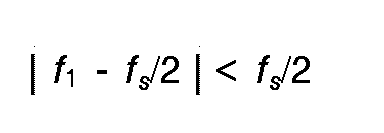
- This relation implies that the sampling Nyquist frequency: fs/2 Hz is less than the the frequency |f1 - fs/2 Hz of the low frequency component of the output of the exclusive OR
element 71. Thus, in view of the sampling theorem, the low frequency component of the output of the exclusive ORelement 71 at |f1 - fs/2 Hz appears without change at the same frequency |f1 - fs/2| Hz in the output of the D flip-flop 72. - Further, taking into consideration the fact that f1 > 0, together with the above relation, it can be concluded that:

- Thus the following relation holds:

- This relation gives the lower and upper limits for the the high frequency component of the output of the exclusive OR
element 71, namely the component at f1 + fs/2 Hz. - If a signal at a frequency F Hz is input to the D flip-
flop 72, where the frequency F Hz satisfies the relation: fs/2 < F < 3 fs/2, as does the high frequency component at f1 + fs/2 Hz of the output of the exclusive ORelement 71, then, the signal is sampled at fs Hz, or the frequency of the sampling clock driving the D flip-flop 72. Under this circumstance, the signal at a frequency higher than the Nyquist frequency of sampling is sampled. As a result, the aliasing phenomenon is observed, and a frequency component at |F- fs Hz appears in the output of the D flip-flop 72. The aliasing phenomenon is discussed, for example, in: M. Hino, "SPECTRAL ANALYSIS," pp. 175 through 177, Asakura Shoten, 1977. - Thus, the high frequency component of the output of the exclusive OR
element 71, namely the component at f1 + fs/2 Hz, appears as the frequency component at | f1 + fs/2 - fs| = | f1 -fs/2 Hz in the output of the D flip-flop 72 due to the aliasing phenomenon. - Thus, both the frequency components at f1 + fs/2 Hz and |f1 - fs/2 | Hz of the output of the exclusive OR
element 71 appear as the frequency component at |f1 - fs/2 | Hz within the output of the D flip-flop 72. Namely, the D flip-flop 72 outputs a signal consisting solely of the frequency component at | f1 -fs/2 Hz. The frequency conversion is thus effected upon the received signal. The frequency | f1 fs/2 Hz of the output of the D flip-flop 72 is less than the frequency f1 Hz of the received signal. The circuit of Fig. 23 thus effects a frequency conversion by which the received signal is converted into a signal having a frequency lower than the frequency of the received signal. The low pass filter of the conventional circuit of Fig. 22 can thus be dispensed with. Since the size and power consumption of a D flip-flop is smaller than those of a low pass filter, the overall size and power consumption can be reduced.
Claims (17)
Priority Applications (2)
| Application Number | Priority Date | Filing Date | Title |
|---|---|---|---|
| EP97120802A EP0833483A3 (en) | 1991-12-27 | 1992-12-24 | Phase comparator for demodulator using differential detection |
| EP97120803A EP0831625A3 (en) | 1991-12-27 | 1992-12-24 | Phase detection circuit and differential detection demodulator |
Applications Claiming Priority (6)
| Application Number | Priority Date | Filing Date | Title |
|---|---|---|---|
| JP3347245A JP2837982B2 (en) | 1991-12-27 | 1991-12-27 | Delay detection demodulator |
| JP347245/91 | 1991-12-27 | ||
| JP53583/92 | 1992-03-12 | ||
| JP4053583A JP2932820B2 (en) | 1992-03-12 | 1992-03-12 | Phase detection circuit, delay detection demodulation device, and phase detection method |
| JP67124/92 | 1992-03-25 | ||
| JP6712492A JPH05276061A (en) | 1992-03-25 | 1992-03-25 | Frequency conversion circuit |
Related Child Applications (2)
| Application Number | Title | Priority Date | Filing Date |
|---|---|---|---|
| EP97120803A Division EP0831625A3 (en) | 1991-12-27 | 1992-12-24 | Phase detection circuit and differential detection demodulator |
| EP97120802A Division EP0833483A3 (en) | 1991-12-27 | 1992-12-24 | Phase comparator for demodulator using differential detection |
Publications (3)
| Publication Number | Publication Date |
|---|---|
| EP0548982A2 true EP0548982A2 (en) | 1993-06-30 |
| EP0548982A3 EP0548982A3 (en) | 1994-04-13 |
| EP0548982B1 EP0548982B1 (en) | 1999-04-07 |
Family
ID=27295001
Family Applications (3)
| Application Number | Title | Priority Date | Filing Date |
|---|---|---|---|
| EP97120803A Withdrawn EP0831625A3 (en) | 1991-12-27 | 1992-12-24 | Phase detection circuit and differential detection demodulator |
| EP92121972A Expired - Lifetime EP0548982B1 (en) | 1991-12-27 | 1992-12-24 | Frequency conversion circuit |
| EP97120802A Withdrawn EP0833483A3 (en) | 1991-12-27 | 1992-12-24 | Phase comparator for demodulator using differential detection |
Family Applications Before (1)
| Application Number | Title | Priority Date | Filing Date |
|---|---|---|---|
| EP97120803A Withdrawn EP0831625A3 (en) | 1991-12-27 | 1992-12-24 | Phase detection circuit and differential detection demodulator |
Family Applications After (1)
| Application Number | Title | Priority Date | Filing Date |
|---|---|---|---|
| EP97120802A Withdrawn EP0833483A3 (en) | 1991-12-27 | 1992-12-24 | Phase comparator for demodulator using differential detection |
Country Status (7)
| Country | Link |
|---|---|
| US (3) | US5313170A (en) |
| EP (3) | EP0831625A3 (en) |
| AU (2) | AU653660B2 (en) |
| CA (1) | CA2086279C (en) |
| DE (1) | DE69228862T2 (en) |
| FI (1) | FI925870A7 (en) |
| NO (1) | NO925012L (en) |
Families Citing this family (16)
| Publication number | Priority date | Publication date | Assignee | Title |
|---|---|---|---|---|
| JP2837982B2 (en) * | 1991-12-27 | 1998-12-16 | 三菱電機株式会社 | Delay detection demodulator |
| US5406218A (en) * | 1993-02-19 | 1995-04-11 | Hitachi, Ltd. | Phase demodulator receiving inputs from phase detector and binary phase detector |
| IL107656A (en) * | 1993-11-18 | 1996-11-14 | Dsp Telecomm Ltd | Demodulator |
| US5539776A (en) * | 1993-11-24 | 1996-07-23 | At&T Corp. | All digital if-to-baseband signal converter |
| US5757868A (en) * | 1994-02-16 | 1998-05-26 | Motorola, Inc. | Digital phase detector with integrated phase detection |
| US5572588A (en) * | 1994-07-05 | 1996-11-05 | Motorola, Inc. | Method and apparatus for detecting reception of a tone signal |
| CN1087120C (en) * | 1994-11-10 | 2002-07-03 | 松下电器产业株式会社 | Direct Conversion Receiver |
| JP3390272B2 (en) * | 1994-11-10 | 2003-03-24 | 沖電気工業株式会社 | Synchronous detection circuit |
| EP0800284B1 (en) * | 1996-04-04 | 2006-01-04 | New Japan Radio Corp., Ltd. | Correlator for spread spectrum signals |
| JPH1093646A (en) * | 1996-09-12 | 1998-04-10 | Pacific Commun Res:Kk | Digital orthogonal detector circuit |
| US6026117A (en) * | 1997-10-23 | 2000-02-15 | Interdigital Technology Corporation | Method and apparatus for generating complex four-phase sequences for a CDMA communication system |
| US6160434A (en) * | 1998-05-14 | 2000-12-12 | Mitsubishi Denki Kabushiki Kaisha | Ninety-degree phase shifter |
| DE10017923C2 (en) * | 2000-04-11 | 2003-01-02 | Siemens Ag | Measuring arrangement with two phase-selective rectifiers |
| US6969984B2 (en) * | 2000-12-21 | 2005-11-29 | Tropian, Inc. | Direct phase and frequency demodulation |
| US7164731B2 (en) * | 2003-03-31 | 2007-01-16 | Via Technologies, Inc. | Apparatus and method of adaptive frequency offset estimations for a receiver |
| US8218644B1 (en) * | 2009-05-12 | 2012-07-10 | Accumulus Technologies Inc. | System for compressing and de-compressing data used in video processing |
Family Cites Families (9)
| Publication number | Priority date | Publication date | Assignee | Title |
|---|---|---|---|---|
| GB1178935A (en) * | 1967-09-13 | 1970-01-21 | Philips Electronic Associated | Low-Frequency Generator |
| US4190802A (en) * | 1978-08-17 | 1980-02-26 | Motorola, Inc. | Digital demodulator for phase shift keyed signals |
| US4804925A (en) * | 1986-03-26 | 1989-02-14 | Fuji Photo Film Co., Ltd. | DPSK exclusive-OR demodulator |
| JP2554705B2 (en) * | 1988-04-25 | 1996-11-13 | 三菱電機株式会社 | Phase synchronization circuit |
| US4878029A (en) * | 1988-12-05 | 1989-10-31 | General Electric Company | Complex digital sampling converter for demodulator |
| FR2644952A1 (en) * | 1989-03-21 | 1990-09-28 | Duranton Rene | Phase modulator/demodulator utilising "exclusive OR" gates |
| EP0434355A3 (en) * | 1989-12-18 | 1993-02-24 | Nec Corporation | Differential phase demodulator for psk-modulated signals |
| JPH03274844A (en) * | 1990-03-24 | 1991-12-05 | Japan Radio Co Ltd | Circuit for detecting delay of psk modulation signal |
| JP2771354B2 (en) * | 1991-08-26 | 1998-07-02 | 日本電気株式会社 | Demodulator |
-
1992
- 1992-12-23 NO NO92925012A patent/NO925012L/en not_active Application Discontinuation
- 1992-12-23 FI FI925870A patent/FI925870A7/en unknown
- 1992-12-24 EP EP97120803A patent/EP0831625A3/en not_active Withdrawn
- 1992-12-24 EP EP92121972A patent/EP0548982B1/en not_active Expired - Lifetime
- 1992-12-24 CA CA002086279A patent/CA2086279C/en not_active Expired - Fee Related
- 1992-12-24 US US07/997,768 patent/US5313170A/en not_active Expired - Lifetime
- 1992-12-24 DE DE69228862T patent/DE69228862T2/en not_active Expired - Fee Related
- 1992-12-24 EP EP97120802A patent/EP0833483A3/en not_active Withdrawn
- 1992-12-24 AU AU30425/92A patent/AU653660B2/en not_active Ceased
-
1994
- 1994-03-28 US US08/218,977 patent/US5485108A/en not_active Expired - Lifetime
- 1994-03-28 US US08/219,020 patent/US5369374A/en not_active Expired - Lifetime
- 1994-07-25 AU AU68690/94A patent/AU660878B2/en not_active Ceased
Also Published As
| Publication number | Publication date |
|---|---|
| EP0833483A3 (en) | 2006-08-16 |
| CA2086279A1 (en) | 1993-06-28 |
| AU660877B2 (en) | 1995-07-06 |
| FI925870A0 (en) | 1992-12-23 |
| NO925012D0 (en) | 1992-12-23 |
| US5369374A (en) | 1994-11-29 |
| AU660878B2 (en) | 1995-07-06 |
| EP0548982A3 (en) | 1994-04-13 |
| EP0831625A2 (en) | 1998-03-25 |
| EP0833483A2 (en) | 1998-04-01 |
| DE69228862D1 (en) | 1999-05-12 |
| US5313170A (en) | 1994-05-17 |
| NO925012L (en) | 1993-06-28 |
| US5485108A (en) | 1996-01-16 |
| EP0831625A3 (en) | 2006-08-16 |
| AU6869094A (en) | 1994-09-22 |
| AU6868894A (en) | 1994-09-22 |
| DE69228862T2 (en) | 1999-10-07 |
| CA2086279C (en) | 1999-08-10 |
| AU3042592A (en) | 1993-07-01 |
| EP0548982B1 (en) | 1999-04-07 |
| FI925870A7 (en) | 1993-06-28 |
| AU653660B2 (en) | 1994-10-06 |
Similar Documents
| Publication | Publication Date | Title |
|---|---|---|
| EP0548982A2 (en) | Non-coherent PSK demodulator using delaye detection | |
| US5122758A (en) | Differential phase demodulator for psk-modulated signals | |
| EP0978972A2 (en) | Clock recovery circuit of demodulator | |
| US5535252A (en) | Clock synchronization circuit and clock synchronizing method in baseband demodulator of digital modulation type | |
| EP0464814A2 (en) | Non-coherent PSK demodulator | |
| US5640427A (en) | Demodulator | |
| US5484987A (en) | Delayed detection type demodulator | |
| EP0771097B1 (en) | Differential detecting apparatus for PSK signals | |
| EP0783206A2 (en) | Data synchronizer lock detector and method of operation thereof | |
| EP0154503A2 (en) | Digital signal processor | |
| US6359942B1 (en) | FSK demodulator | |
| EP0198701B1 (en) | Phase detection circuit | |
| GB2234411A (en) | Integrated circuit for digital demodulation | |
| EP0783214A2 (en) | Data synchronizer phase detector and method of operation thereof | |
| EP0234900B1 (en) | Phase detecting circuit | |
| CA2204046C (en) | Differential detection demodulator and phase comparator therefor | |
| US6163209A (en) | Demodulation of angle modulated carriers using a noncoherent reference | |
| US20100254491A1 (en) | Dc offset compensating system and method | |
| JP2504243B2 (en) | Demodulation method | |
| JP3237322B2 (en) | CN ratio measuring means | |
| JP2004343166A (en) | ASK demodulation circuit | |
| JP3260691B2 (en) | Unique word detection circuit | |
| JP3183456B2 (en) | Clock recovery circuit and receiving device using the same | |
| JP2744542B2 (en) | Digital signal receiver | |
| JP2744541B2 (en) | Double differential coded communication device |
Legal Events
| Date | Code | Title | Description |
|---|---|---|---|
| PUAI | Public reference made under article 153(3) epc to a published international application that has entered the european phase |
Free format text: ORIGINAL CODE: 0009012 |
|
| AK | Designated contracting states |
Kind code of ref document: A2 Designated state(s): DE FR GB IT SE |
|
| PUAL | Search report despatched |
Free format text: ORIGINAL CODE: 0009013 |
|
| AK | Designated contracting states |
Kind code of ref document: A3 Designated state(s): DE FR GB IT SE |
|
| 17P | Request for examination filed |
Effective date: 19940905 |
|
| 17Q | First examination report despatched |
Effective date: 19970624 |
|
| GRAG | Despatch of communication of intention to grant |
Free format text: ORIGINAL CODE: EPIDOS AGRA |
|
| GRAG | Despatch of communication of intention to grant |
Free format text: ORIGINAL CODE: EPIDOS AGRA |
|
| GRAH | Despatch of communication of intention to grant a patent |
Free format text: ORIGINAL CODE: EPIDOS IGRA |
|
| GRAH | Despatch of communication of intention to grant a patent |
Free format text: ORIGINAL CODE: EPIDOS IGRA |
|
| GRAA | (expected) grant |
Free format text: ORIGINAL CODE: 0009210 |
|
| AK | Designated contracting states |
Kind code of ref document: B1 Designated state(s): DE FR GB IT SE |
|
| ET | Fr: translation filed | ||
| REF | Corresponds to: |
Ref document number: 69228862 Country of ref document: DE Date of ref document: 19990512 |
|
| PLBE | No opposition filed within time limit |
Free format text: ORIGINAL CODE: 0009261 |
|
| STAA | Information on the status of an ep patent application or granted ep patent |
Free format text: STATUS: NO OPPOSITION FILED WITHIN TIME LIMIT |
|
| 26N | No opposition filed | ||
| REG | Reference to a national code |
Ref country code: GB Ref legal event code: 746 Effective date: 20010103 |
|
| REG | Reference to a national code |
Ref country code: FR Ref legal event code: D6 |
|
| REG | Reference to a national code |
Ref country code: GB Ref legal event code: IF02 |
|
| PGFP | Annual fee paid to national office [announced via postgrant information from national office to epo] |
Ref country code: SE Payment date: 20041206 Year of fee payment: 13 |
|
| PGFP | Annual fee paid to national office [announced via postgrant information from national office to epo] |
Ref country code: FR Payment date: 20041208 Year of fee payment: 13 |
|
| PGFP | Annual fee paid to national office [announced via postgrant information from national office to epo] |
Ref country code: DE Payment date: 20041216 Year of fee payment: 13 |
|
| PGFP | Annual fee paid to national office [announced via postgrant information from national office to epo] |
Ref country code: GB Payment date: 20041222 Year of fee payment: 13 |
|
| PG25 | Lapsed in a contracting state [announced via postgrant information from national office to epo] |
Ref country code: IT Free format text: LAPSE BECAUSE OF NON-PAYMENT OF DUE FEES;WARNING: LAPSES OF ITALIAN PATENTS WITH EFFECTIVE DATE BEFORE 2007 MAY HAVE OCCURRED AT ANY TIME BEFORE 2007. THE CORRECT EFFECTIVE DATE MAY BE DIFFERENT FROM THE ONE RECORDED. Effective date: 20051224 Ref country code: GB Free format text: LAPSE BECAUSE OF NON-PAYMENT OF DUE FEES Effective date: 20051224 |
|
| PG25 | Lapsed in a contracting state [announced via postgrant information from national office to epo] |
Ref country code: SE Free format text: LAPSE BECAUSE OF NON-PAYMENT OF DUE FEES Effective date: 20051225 |
|
| PG25 | Lapsed in a contracting state [announced via postgrant information from national office to epo] |
Ref country code: DE Free format text: LAPSE BECAUSE OF NON-PAYMENT OF DUE FEES Effective date: 20060701 |
|
| EUG | Se: european patent has lapsed | ||
| GBPC | Gb: european patent ceased through non-payment of renewal fee |
Effective date: 20051224 |
|
| PG25 | Lapsed in a contracting state [announced via postgrant information from national office to epo] |
Ref country code: FR Free format text: LAPSE BECAUSE OF NON-PAYMENT OF DUE FEES Effective date: 20060831 |
|
| REG | Reference to a national code |
Ref country code: FR Ref legal event code: ST Effective date: 20060831 |