EP0550153A2 - Elektrode aus einer wasserstoffabsorbierenden Legierung und Verfahren zu ihrer Herstellung - Google Patents
Elektrode aus einer wasserstoffabsorbierenden Legierung und Verfahren zu ihrer Herstellung Download PDFInfo
- Publication number
- EP0550153A2 EP0550153A2 EP92310948A EP92310948A EP0550153A2 EP 0550153 A2 EP0550153 A2 EP 0550153A2 EP 92310948 A EP92310948 A EP 92310948A EP 92310948 A EP92310948 A EP 92310948A EP 0550153 A2 EP0550153 A2 EP 0550153A2
- Authority
- EP
- European Patent Office
- Prior art keywords
- hydrogen
- absorbing alloy
- absorbing
- annealed
- alloy
- Prior art date
- Legal status (The legal status is an assumption and is not a legal conclusion. Google has not performed a legal analysis and makes no representation as to the accuracy of the status listed.)
- Granted
Links
Images

Classifications
-
- H—ELECTRICITY
- H01—ELECTRIC ELEMENTS
- H01M—PROCESSES OR MEANS, e.g. BATTERIES, FOR THE DIRECT CONVERSION OF CHEMICAL ENERGY INTO ELECTRICAL ENERGY
- H01M4/00—Electrodes
- H01M4/02—Electrodes composed of, or comprising, active material
- H01M4/36—Selection of substances as active materials, active masses, active liquids
- H01M4/38—Selection of substances as active materials, active masses, active liquids of elements or alloys
- H01M4/383—Hydrogen absorbing alloys
-
- H—ELECTRICITY
- H01—ELECTRIC ELEMENTS
- H01M—PROCESSES OR MEANS, e.g. BATTERIES, FOR THE DIRECT CONVERSION OF CHEMICAL ENERGY INTO ELECTRICAL ENERGY
- H01M4/00—Electrodes
- H01M4/02—Electrodes composed of, or comprising, active material
- H01M4/24—Electrodes for alkaline accumulators
- H01M4/242—Hydrogen storage electrodes
-
- Y—GENERAL TAGGING OF NEW TECHNOLOGICAL DEVELOPMENTS; GENERAL TAGGING OF CROSS-SECTIONAL TECHNOLOGIES SPANNING OVER SEVERAL SECTIONS OF THE IPC; TECHNICAL SUBJECTS COVERED BY FORMER USPC CROSS-REFERENCE ART COLLECTIONS [XRACs] AND DIGESTS
- Y02—TECHNOLOGIES OR APPLICATIONS FOR MITIGATION OR ADAPTATION AGAINST CLIMATE CHANGE
- Y02E—REDUCTION OF GREENHOUSE GAS [GHG] EMISSIONS, RELATED TO ENERGY GENERATION, TRANSMISSION OR DISTRIBUTION
- Y02E60/00—Enabling technologies; Technologies with a potential or indirect contribution to GHG emissions mitigation
- Y02E60/10—Energy storage using batteries
Definitions
- This invention relates to a hydrogen-absorbing alloy electrode used as a negative electrode in an alkaline storage battery.
- Alkaline storage batteries such as Ni-Cd batteries, or lead acid batteries are known.
- metal hydride storage batteries using a metal oxide such as a nickel hydroxide as a positive electrode and a hydrogen-absorbing alloy in which hydrogen is absorbed and desorbed reversibly as a negative electrode, are attractive.
- the hydrogen-absorbing alloy for the negative electrode should be able to absorb and desorb reversibly at room temperature.
- Electrochemical characteristics of the hydrogen-absOrbing alloy electrode and the charge characteristics of an alkaline storage battery using the above as a negative electrode depend on various characteristics of the alloy used. Therefore, it is important to research and develop proper hydrogen-absorbing alloys for the electrode.
- Another method of decreasing the equilibrium-pressure in the hydrogen-absorbing alloy having a composition MmBx involves the reduction of the stoichiometric ratio "x" of an amount of element "B" is reduced.
- Japanese patent publication laid-open No.60-89066 which describes a hydrogen-absorbing alloy represented by a formula ABmCn, and a value of "m+n” in the range from 4.8 to 5.4.
- Japanese patent publication laid-open No.2-277737 describes a hydrogen-absorbing alloy represented by a formula ANiaCobMnc, and a value of "a+b+c" ranging from 3.85 to 4.78.
- each component of the alloy is measured and mixed in a fixed ratio, melted in an arc furnace having an inert argon atmosphere, and cooled.
- the alloys are held in a vacuum furnace and heat treated at high temperature (approximately 1000 °C) during a fixed period of time.
- This "annealing" heat treatment causes homogenization of the hydrogen-absorbing alloys.
- Japanese patent publication laid-open No.62-31947 describes an annealing treatment of the hydrogen-absorbing alloys within the temperature range of 950 °C to 1250 °C.
- the hydrogen-absorbing alloys are mechanically pulverized into granules having an average granule size of about 50 ⁇ m or less.
- the granules are kneaded into a paste with about 10 % by weight of powdered polytetrafluorethylene (PTFE) which acts as a binder and a conductive agent.
- PTFE powdered polytetrafluorethylene
- the paste is coated onto a conductive substrate such as a current collector comprising a punched metal plate.
- the current collector is pressed to form the hydrogen-absorbing alloy electrode.
- Japanese patent No.58-46287 describes a hydrogen-absorbing alloy powder and conductive agent which are mixed and sintered, formed into a porous body, which produces the electrode.
- a primary object of the present invention is to provide a hydrogen-absorbing electrode with improved electrode characteristics such as high rate discharge characteristics.
- Another object of the present invention is to provide a hydrogen-absorbing electrode with improved electrode characteristics such as high rate discharge characteristics in the initial charge-discharge cycles.
- Still another object of the present invention is to provide a hydrogen-absorbing alloy electrode whose discharge voltage stability is improved.
- a hydrogen-absorbing alloy electrode comprising an annealed hydrogen-absorbing alloy having a non-stoichiometric composition and coated on a conductive substrate.
- the above annealed hydrogen-absorbing alloy may be heat treated at a temperature range between about 700 °C to about 1150 °C.
- the annealed hydrogen-absorbing alloy may have a crystal structure type of CaCu5, whose stoichiometric ratio is in a range from about 3.85 to about 4.78.
- This alloy may be heat-treated at a temperature range between about 900 °C to about 1100 °C.
- the alloy may also be formed with a stoichiometric ratio is in a range between about 5.40 to about 6.50.
- a method of manufacturing a hydrogen-absorbing alloy electrode comprising the step of; preparing a hydrogen-absorbing alloy having a non-stoichiometric composition, annealing said alloy, pulverizing said annealed alloy, mixing said pulverized alloy with a binder to form a paste, and coating said paste on a conductive substrate.
- annealing may be carried out in a temperature range between about 700 °C to about 1150 °C.
- the hydrogen-absorbing alloy may have a crystal structure of CaCu5 type, whose stoichiometric ratio is a range between about 3.85 to about 4.78, whose annealing may be carried out at a temperature range between about 900 °C to about 1100 °C.
- the hydrogen-absorbing alloy may also have a crystal structure of CaCu5 type, whose stoichiometric ratio is in a range between about 5.40 to about 6.50.
- a non-annealed hydrogen-absorbing alloy comprises an "A-B" composition having a non-stoichiometric composition.
- the alloy has an A-enriched phase or a B-enriched phase.
- an ABn phase as a main phase, and the A-enriched phase or the B-enriched phase can not be definitively distinguished from the ABn phase.
- the A-enriched phase or the B-enriched phase can be clearly distinguished from the ABn phase.
- FIG.1 is a cross-sectional illustration of the annealed hydrogen-absorbing alloy granules, having the nonstoichiometric composition.
- FIG.2 is a cross-sectional illustration of the non-annealed hydrogen-absorbing alloy granules, having the non-stoichiometric composition.
- hatched portions with thin lines show either the A-enriched phase or the B-enriched phase, while the other hatched portion with bold lines represents the ABn phase as the main phase.
- the A-enriched phase or the B-enriched phase is spread out over wide portion of the granule.
- the A-enriched phase or the B-enriched phase is cohered into small portion of the granules, and is observed by cracks generated in these small portions.
- the alloy When an electrode employing the annealed alloy with the non-stoichiometric composition is charged and discharged once, the alloy is expands and shrinks according to absorbing and desorbing characteristics of the hydrogen in the electrode. AS a result, the areas surrounding the A-enriched phase or the B-enriched phase, the generate and grow cracks. The new cracks are generated in the portions contacting an electrolyte, where the electrode reactions proceed. The stress strain in a crystal lattice in these portions of the hydrogen-absorbing alloy is very large, therefore, a surface energy for these portions is increased. Accordingly, the speed of electrode reaction is improved due to the presence of cracks.
- the non-stoichiometric Composition means that an atom ratio in a composition formula of the hydrogen-absorbing alloy, as a general rule, is not an integral number.
- the stoichiometric composition means that the atom ratio in the composition formula of the hydrogen-absorbing alloy is an integral number.
- the "n" is substantially equal to 5.
- annealing means the heat treatment in which the hydrogen-absorbing alloy is held at a certain temperature range for a fixed period of time, and indicates the treatment is able to get rid of the stress strain present in the crystal lattice of the hydrogen-absorbing alloy. Therefore, annealed hydrogen-absorbing alloy has the same meaning as hydrogen-absorbing alloy with annealing or hydrogen-absorbing alloy which is annealed.
- the characteristics these of electrodes using these alloys are compared.
- These hydrogen-absorbing alloys have a crystal structure of the CaCu5 type and are represented by formulas of AB 4.7 , AB 5.0 or AB 5.5 .
- the "A” is a Mish metal
- the "B” consists of Nix and Mny with the ratio of the x:y set to 1:7.
- the hydrogen-absorbing alloys of these formulas are prepared in both annealed and non-annealed states, resulting in six types of the alloys.
- the hydrogen-absorbing alloys are then mechanically pulverized into granules, and classified.
- the granules are kneaded with nickel powder, a conductive agent, and a powdered PTFE, a binder, into a paste.
- a weight ratio of "hydrogen-absorbing alloy”:"conductive agents”:"binder” is set at 5:4:1. These mixtures are measured to obtain 1 gram of the hydrogen-absorbing alloy and are wrapped by nickel mesh, a conductive substrate, whereby the hydrogen-absorbing alloy electrodes were produced.
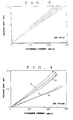
- FIG.3 shows the discharge test after a 1st cycle charging
- FIG.4 shows the discharge test after a 2nd cycle charging.
- line “A” represents a result for an annealed alloy of the formula AB5
- line “B” represents the result for a non-annealed alloy of the formula AB5.
- Line “C” represents the result for a non-annealed alloy of the formula AB 5.5
- line “D” represents the result for a non-annealed alloy of the formula AB 4.7
- Line “E” represents the result for an annealed alloy of the formula AB 5.5
- line “F” represents the result of an annealed alloy of the formula AB 4.7 .
- the powdered PTFE is used as the binder, because the charge-discharge cycles characteristics were considered. It is useful for the binder to bridge-form, preventing the hydrogen-absorbing alloy from falling off the electrode.
- polyethleneoxide, polyvinylalcohol, methylcellose, carboxymethylcellulose and hydroxypropylcellulose can be used as a binder, when they are reacted with a hexamethylenediamineisocyanate to bridge-form and build up three-dimensional structures. In this way, the hydrogen-absorbing alloys is effectively prevented from falling off.
- the electrode characteristics of discharge capacity, mechanical strength and conductivity can be maintained. Accordingly, the high capacity of the electrode can be retained during the long charge-discharge cycles.
- alloys are prepared in both annealed and non-annealed states. The internal pressures of batteries employing these alloys are tested. In this embodiment, the same composition ratio of each element of the hydrogen-absorbing alloy as used in the first embodiment is prepared.
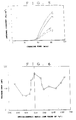
- FIG.5 shows the relationship between the charging time (min) of the batteries and the change in internal pressure (kg/cm2) for each battery.
- line “G” represents a result of a non-annealed alloy of the formula AB 4.70
- line “H” represents the result of the non-annealed alloy of the formula AB 5.50
- Line “I” represents the result of an annealed alloy of the formula AB 4.70
- line “J” represents the result of an annealed alloy of the formula AB 5.50 .
- the batteries employing annealed alloys have reduced the internal pressure in the batteries.
- the battery equipped with the stoichiometric composition hydrogen-absorbing alloy despite annealing, does not show reduced internal pressure in the battery.
- the stoichiometric ratio of the hydrogen-absorbing alloy is changed and tested.
- the same composition ratio of each element of the hydrogen-absorbing alloys as used in the first embodiment are used.
- the composition formula ABn the value of "n" is changed in the range between 3.5 to 7.0.
- FIG.6 shows the relationship between variation of stoichiometric ratio in the hydrogen-absorbing alloy and the voltage drop of the electrode.
- Testing conditions are to discharge at 400mA/g and to measure the voltage drop of the electrode after the 2nd cycle.
- Annealing conditions for these hydrogen-absorbing alloy for electrodes is typically set at the temperature of 800 °C for 8 hours in an arc furnace having an inactive argon atmosphere.
- Typical measuring points for the voltage drop in the electrode are taken for values of "n" in the formula "ABn" set at 3.85, 4.30, 4.50, 4.70, 4.78, 4.80, 4.90, 5.00, 5.35, 5.40, 5.55, 5.80, 6.20, 6.50 and 6.70, respectively.
- the discharge characteristics of the electrode improve when "n" ranges from about 3.85 to about 4.78 and from about 5.40 to about 6.50 in the hydrogen-absorbing alloys.
- the annealing temperatures of the hydrogen-absorbing alloys having the non-stoichiometric compositions are tested.
- the hydrogen-absorbing alloys having the crystal structure of the CaCu5 type are represented by the formula such as "Mm(NiaCobAlcMnd)n".
- Mm is "A”
- (NiaCobAlcMnd)" is "B”
- the value of "n” is changed within the range between from 3.5 to 7.0.
- the ratio of "a:b", “a:c” and “a:d” set at 5:1, 18:1 and 6:1.
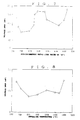
- FIG.7 shows the relationship between the variation of the stoichiometric ratio in the hydrogen-absorbing alloy and the voltage drop of the electrode.
- testing conditions are set to the same as the above-mentioned third embodiment.
- Measuring points for the value "n" of the formula "ABn" are set at 3.85, 4.00, 4.50, 4.78, 4.82, 5.00, 5.40, 5.50, 6.20, 6.50 and 6.70, respectively.
- the discharge characteristics improve when "n" is in the range between about 3.85 to about 4.78 and between about 5.40 to about 6.50.
- the annealing temperatures of the hydrogen-absorbing alloys having the non-stoichiometric compositions are changed and the characteristics of the voltage drop of the electrodes are measured.
- the value of the "n” is set 4.70. The relationship between the annealing temperatures in the temperature range between 600 °C to 1200 °C and the degree of the voltage drop (mV) on the discharging electrode is measured.
- FIG.8 shows the relationship between the annealing temperatures and the degree of the voltage drop in the electrode.
- the voltage drop is shown for the discharging at 400 mA/g after the 2nd cycle.
- the discharge characteristics of the electrode improve for annealing temperatures ranging between about 700 °C to about 1150 °C.
- the formula of "ABn” has a value of "n” less than 5.0 in the annealed hydrogen-absorbing alloy.
- the hydrogen-absorbing alloys having the crystal structure of CaCu5 type are represented by the composition formula of "Mm(NiaCobAlcMnd)n".
- the value of "n” is set to 4.70 in the hydrogen-absorbing alloys.
- the elements of Ni, Co, Al and Mn are set to a ratio of "a:b", “a:c” and “a:d” having values of 5:1, 18:1 and 6:1, respectively.
- the annealing temperatures are between 700 °C to 1200 °C and the discharge capacity (mAh/g) of the electrode is measured.
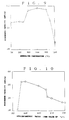
- FIG.9 shows the relationship between the annealing temperatures of the hydrogen-absorbing alloy and the discharge capacity of the electrode. According to FIG.9, when the value of "n” in the formula "ABn" is set to 4.70, the discharge capacity increases in the annealing temperature range between about 900 °C to about 1100 . C.
- the hydrogen-absorbing alloys are those used for the above-mentioned sixth embodiment, where the value of "n” in the formula "ABn” is changed in the range between 3.80 to 5.50, which is a variation of the stoichiometric ratio.
- the discharge capacity (mAh/g) of these hydrogen-absorbing alloy electrodes is measured.
- FIG. 10 shows the relationship between the value of "n” in the formula "ABn” and the discharge capacity of the electrode.
- a nickel mesh is used as a conductive substrate, however, needless to say, other types of conductive substrates, such as a foamed metal substrate, a metal fiber substrate, a metal mesh and a punched metal plate are available.
Landscapes
- Chemical & Material Sciences (AREA)
- Chemical Kinetics & Catalysis (AREA)
- Electrochemistry (AREA)
- General Chemical & Material Sciences (AREA)
- Battery Electrode And Active Subsutance (AREA)
Applications Claiming Priority (4)
| Application Number | Priority Date | Filing Date | Title |
|---|---|---|---|
| JP34331091 | 1991-12-25 | ||
| JP343310/91 | 1991-12-25 | ||
| JP09090292A JP3291313B2 (ja) | 1991-12-25 | 1992-04-10 | アルカリ蓄電池用水素吸蔵合金電極 |
| JP90902/92 | 1992-04-10 |
Publications (3)
| Publication Number | Publication Date |
|---|---|
| EP0550153A2 true EP0550153A2 (de) | 1993-07-07 |
| EP0550153A3 EP0550153A3 (en) | 1993-09-08 |
| EP0550153B1 EP0550153B1 (de) | 1997-07-23 |
Family
ID=26432310
Family Applications (1)
| Application Number | Title | Priority Date | Filing Date |
|---|---|---|---|
| EP92310948A Expired - Lifetime EP0550153B1 (de) | 1991-12-25 | 1992-12-01 | Elektrode aus einer wasserstoffabsorbierenden Legierung und Verfahren zu ihrer Herstellung |
Country Status (3)
| Country | Link |
|---|---|
| EP (1) | EP0550153B1 (de) |
| JP (1) | JP3291313B2 (de) |
| DE (1) | DE69221105T2 (de) |
Cited By (3)
| Publication number | Priority date | Publication date | Assignee | Title |
|---|---|---|---|---|
| EP0697745A1 (de) * | 1994-07-22 | 1996-02-21 | Sanyo Electric Co., Ltd. | Elektrode aus einer wasserstoffabsorbierenden Legierung für eine alkalische Metall/Hydridbatterie |
| EP0806803A1 (de) * | 1996-05-09 | 1997-11-12 | Mitsubishi Materials Corporation | Wasserstoffabsorbierende Legierung, Verfahren zu ihrer Herstellung und Elektrode |
| EP1026764A3 (de) * | 1999-02-05 | 2002-09-25 | Toshiba Battery Co., Ltd. | Wasserstoffabsorbierende Legierung, Verfahren zur Herstellung und alkalischer Akkumulator |
Family Cites Families (1)
| Publication number | Priority date | Publication date | Assignee | Title |
|---|---|---|---|---|
| NL9001677A (nl) * | 1990-07-24 | 1992-02-17 | Koninkl Philips Electronics Nv | Elektrochemische cel met hydride vormende intermetallische verbinding. |
-
1992
- 1992-04-10 JP JP09090292A patent/JP3291313B2/ja not_active Expired - Fee Related
- 1992-12-01 EP EP92310948A patent/EP0550153B1/de not_active Expired - Lifetime
- 1992-12-01 DE DE69221105T patent/DE69221105T2/de not_active Expired - Fee Related
Cited By (6)
| Publication number | Priority date | Publication date | Assignee | Title |
|---|---|---|---|---|
| EP0697745A1 (de) * | 1994-07-22 | 1996-02-21 | Sanyo Electric Co., Ltd. | Elektrode aus einer wasserstoffabsorbierenden Legierung für eine alkalische Metall/Hydridbatterie |
| US5616435A (en) * | 1994-07-22 | 1997-04-01 | Sanyo Electric Co., Ltd. | Hydrogen-absorbing alloy electrode for metal hydride alkaline battery |
| CN1084934C (zh) * | 1994-07-22 | 2002-05-15 | 三洋电机株式会社 | 用于金属氢化物碱电池的吸氢合金电极 |
| EP0806803A1 (de) * | 1996-05-09 | 1997-11-12 | Mitsubishi Materials Corporation | Wasserstoffabsorbierende Legierung, Verfahren zu ihrer Herstellung und Elektrode |
| US5900334A (en) * | 1996-05-09 | 1999-05-04 | Mitsubishi Materials Corporation | Hydrogen occluding alloy |
| EP1026764A3 (de) * | 1999-02-05 | 2002-09-25 | Toshiba Battery Co., Ltd. | Wasserstoffabsorbierende Legierung, Verfahren zur Herstellung und alkalischer Akkumulator |
Also Published As
| Publication number | Publication date |
|---|---|
| EP0550153B1 (de) | 1997-07-23 |
| EP0550153A3 (en) | 1993-09-08 |
| JP3291313B2 (ja) | 2002-06-10 |
| DE69221105D1 (de) | 1997-09-04 |
| DE69221105T2 (de) | 1998-01-02 |
| JPH05234589A (ja) | 1993-09-10 |
Similar Documents
| Publication | Publication Date | Title |
|---|---|---|
| KR920010422B1 (ko) | 수소흡수저장전극 및 그 제조법 | |
| EP0383991B1 (de) | Alkalische Sammlerbatterie mit einer wasserstoffabsorbierenden Legierung | |
| US5376474A (en) | Hydrogen-absorbing alloy for a negative electrode and manufacturing method therefor | |
| EP0666606B1 (de) | Wasserstoffeinlagerungslegierung für Elektrode von verschlossener Batterie | |
| Geng et al. | Characteristics of the High‐Rate Discharge Capability of a Nickel/Metal Hydride Battery Electrode | |
| EP0506084B1 (de) | Wasserstoffspeicherlegierung und ihre Verwendung bei einer Elektrode | |
| US5358800A (en) | Active material of hydrogen storage alloy electrode | |
| EP0550153B1 (de) | Elektrode aus einer wasserstoffabsorbierenden Legierung und Verfahren zu ihrer Herstellung | |
| EP0621647A1 (de) | Wasserstoffspeicherlegierung und ihre Verwendung bei einer Elektrode | |
| EP0739990B1 (de) | Wasserstoffspeicherlegierung und Elektrode daraus | |
| US5814108A (en) | Method for manufacturing nickel-metal-hydride battery | |
| JPH04233160A (ja) | 電気化学的電池 | |
| US5591394A (en) | Zirconium-based hydrogen storage alloy useable for negative electrodes for secondary battery | |
| JPH1125964A (ja) | アルカリ蓄電池 | |
| JP2792955B2 (ja) | 水素電極用水素吸蔵合金 | |
| JPS62249358A (ja) | 水素吸蔵電極 | |
| JP3136738B2 (ja) | 水素吸蔵合金電極の製造法 | |
| JP3470987B2 (ja) | 水素吸蔵合金および水素吸蔵合金電極 | |
| WO2000044951A1 (en) | Ab5-type rare earth transition intermetallic compounds for the negative electrodes of rechargeable batteries | |
| JP2955351B2 (ja) | 二次電池用水素吸蔵合金 | |
| JP3198896B2 (ja) | ニッケル・水素蓄電池 | |
| JPH0949040A (ja) | 水素吸蔵合金および水素吸蔵合金電極 | |
| JPH04319258A (ja) | 水素吸蔵合金電極 | |
| JPH11191412A (ja) | アルカリ蓄電池 | |
| JPH08287908A (ja) | 水素吸蔵合金電極 |
Legal Events
| Date | Code | Title | Description |
|---|---|---|---|
| PUAI | Public reference made under article 153(3) epc to a published international application that has entered the european phase |
Free format text: ORIGINAL CODE: 0009012 |
|
| AK | Designated contracting states |
Kind code of ref document: A2 Designated state(s): DE FR |
|
| PUAL | Search report despatched |
Free format text: ORIGINAL CODE: 0009013 |
|
| AK | Designated contracting states |
Kind code of ref document: A3 Designated state(s): DE FR |
|
| 17P | Request for examination filed |
Effective date: 19931202 |
|
| 17Q | First examination report despatched |
Effective date: 19950511 |
|
| GRAG | Despatch of communication of intention to grant |
Free format text: ORIGINAL CODE: EPIDOS AGRA |
|
| GRAH | Despatch of communication of intention to grant a patent |
Free format text: ORIGINAL CODE: EPIDOS IGRA |
|
| GRAH | Despatch of communication of intention to grant a patent |
Free format text: ORIGINAL CODE: EPIDOS IGRA |
|
| GRAA | (expected) grant |
Free format text: ORIGINAL CODE: 0009210 |
|
| AK | Designated contracting states |
Kind code of ref document: B1 Designated state(s): DE FR |
|
| REF | Corresponds to: |
Ref document number: 69221105 Country of ref document: DE Date of ref document: 19970904 |
|
| ET | Fr: translation filed | ||
| PLBE | No opposition filed within time limit |
Free format text: ORIGINAL CODE: 0009261 |
|
| 26N | No opposition filed | ||
| PGFP | Annual fee paid to national office [announced via postgrant information from national office to epo] |
Ref country code: DE Payment date: 20061123 Year of fee payment: 15 |
|
| PGFP | Annual fee paid to national office [announced via postgrant information from national office to epo] |
Ref country code: FR Payment date: 20061208 Year of fee payment: 15 |
|
| PG25 | Lapsed in a contracting state [announced via postgrant information from national office to epo] |
Ref country code: DE Free format text: LAPSE BECAUSE OF NON-PAYMENT OF DUE FEES Effective date: 20080701 |
|
| REG | Reference to a national code |
Ref country code: FR Ref legal event code: ST Effective date: 20081020 |
|
| PG25 | Lapsed in a contracting state [announced via postgrant information from national office to epo] |
Ref country code: FR Free format text: LAPSE BECAUSE OF NON-PAYMENT OF DUE FEES Effective date: 20071231 |